Devialet does nothing by accident, and the Phantom Ultimate 108 dB wireless speaker under review here is a very deliberate statement. This is the same company that gave us the Mania, the Astra and Astra Opéra de Paris integrated amplifiers, and the Dione soundbar—products where engineering, design, and attitude are inseparable. Subtlety has never been part of the brief, and Devialet isn’t pretending otherwise.
The real question is whether the Phantom Ultimate 108 dB is all presentation and bravado; a galette with no fève inside—or whether, once you strip away the gloss and the French pretense, it’s one of the most genuinely satisfying wireless speaker experiences you can buy today.
The new Phantom Ultimate lineup doubles down on what Devialet does best: extreme performance wrapped in industrial art, powered by next-generation ADH amplification that treats subtlety like an unfashionable Louis Vuitton tote from two seasons ago. Offered in the flagship 108 dB model at $3,800 (each) and the more compact 98 dB version at $1,900, these speakers are loud, ambitious, and technically obsessive by design. the full-size 108 dB flagship and the more compact 98 dB, both clearly designed to be seen as much as heard.
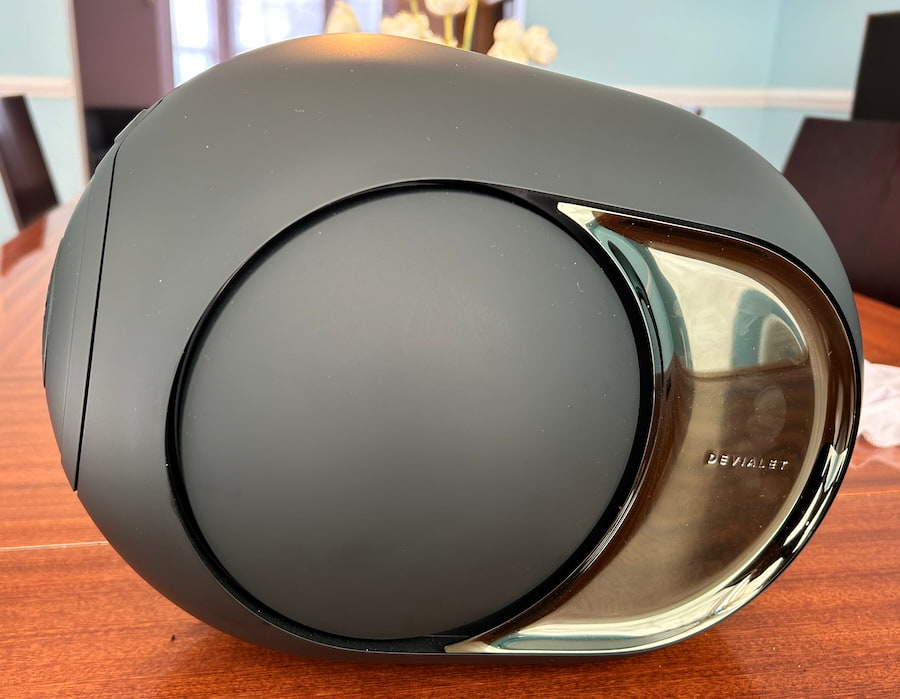
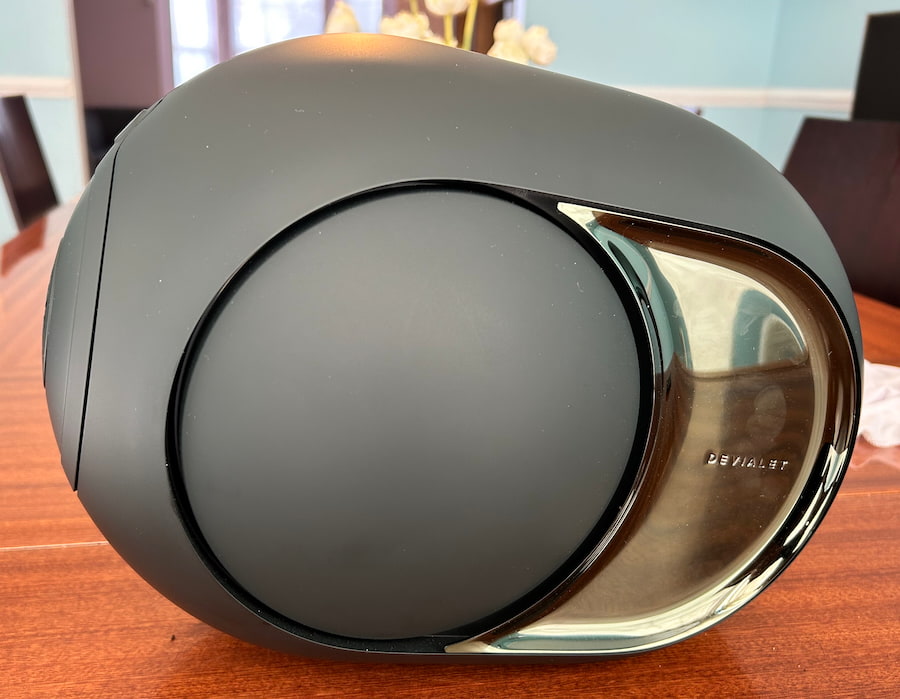
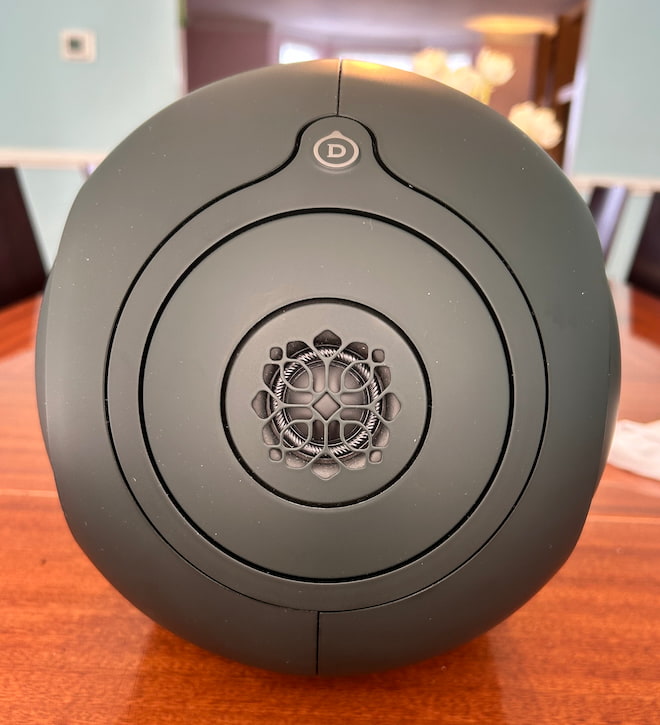
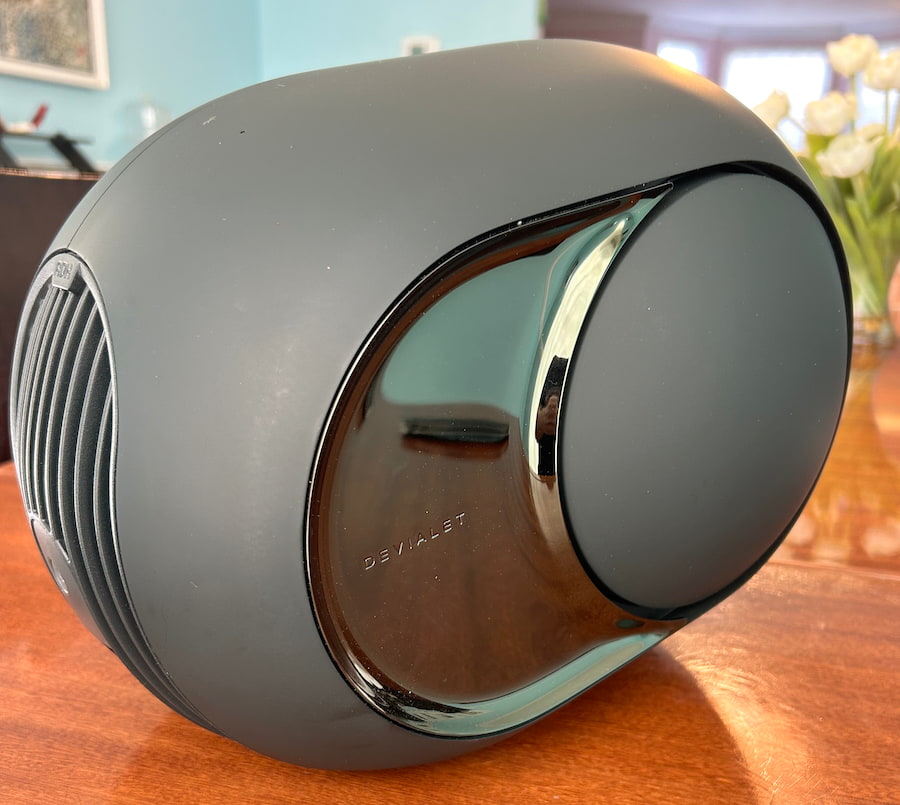
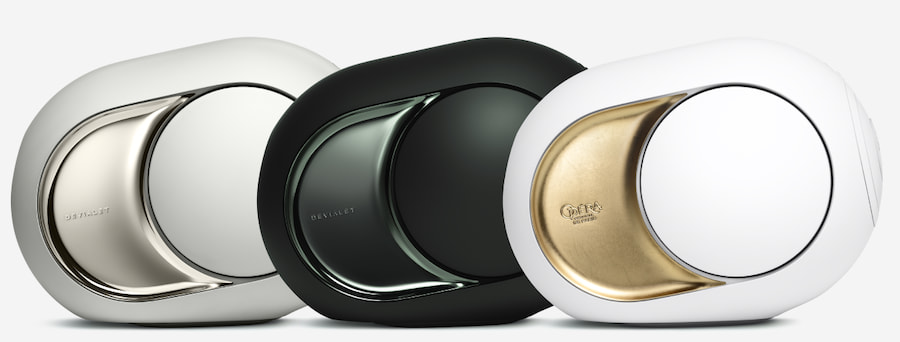
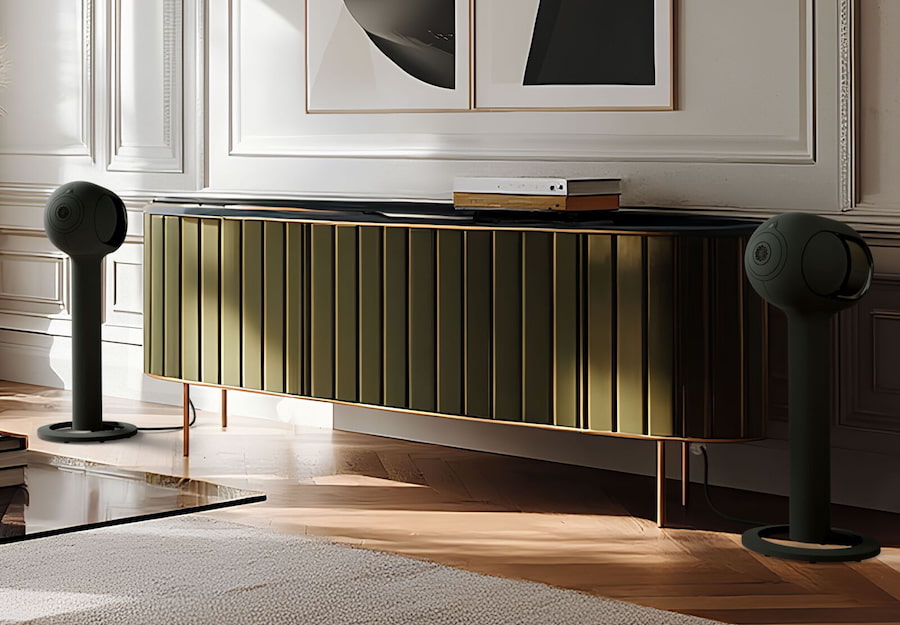
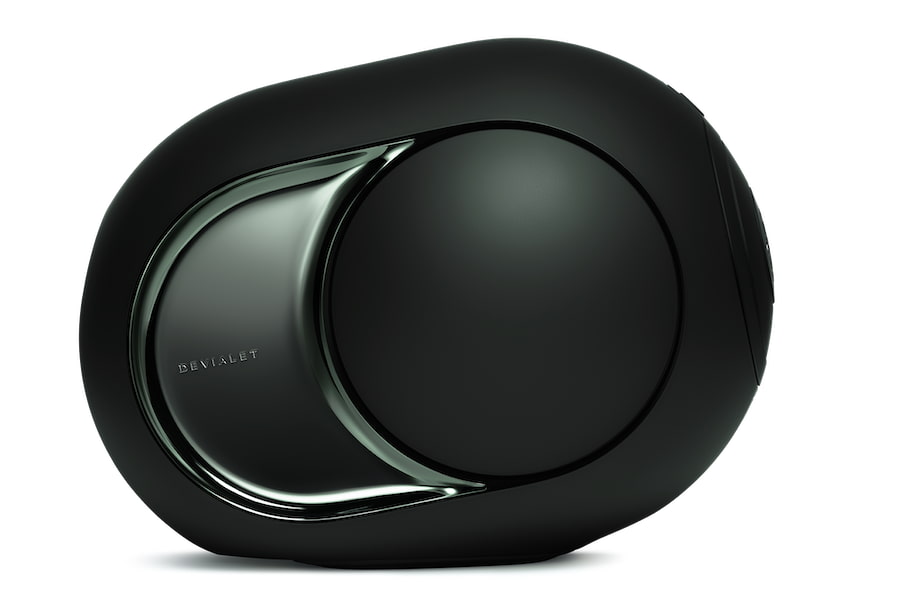
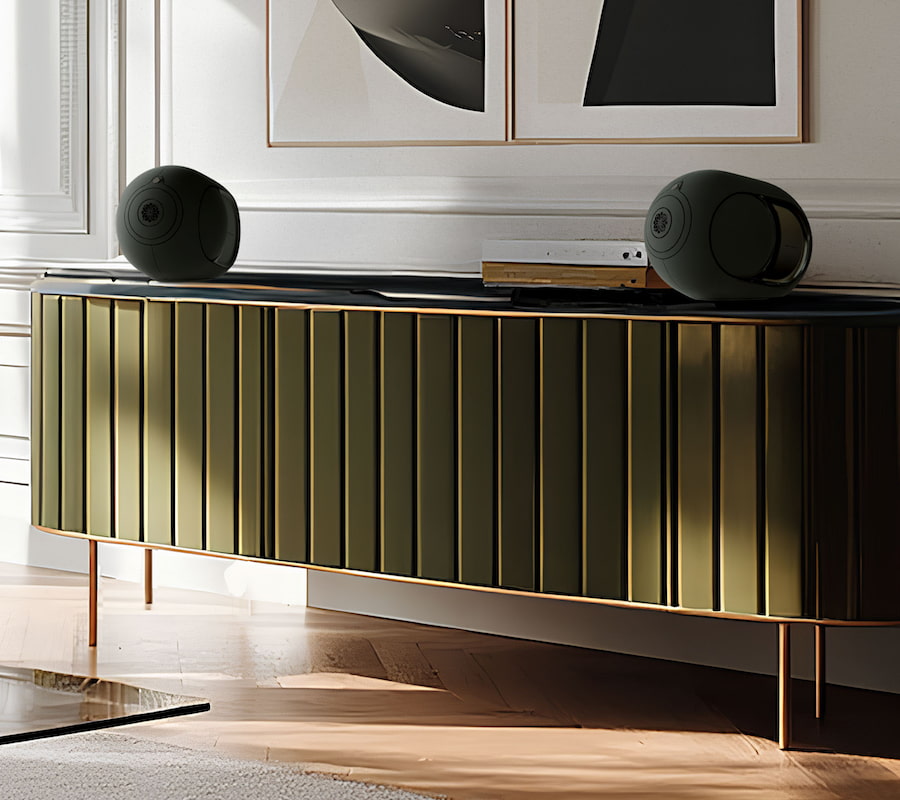
Finish options include Deep Forest, a dark green paired with black chrome accents, and Light Pearl, an ultra-matte off-white that leans modern rather than flashy. Devialet supplied a pair in the Deep Forest finish, and my overall impression is that they integrate easily into a wide range of rooms.
Advertisement
The darker green and black chrome accents work with both traditional and modern furniture, and they don’t clash with common flooring or carpeting choices, which makes placement less of a design headache than you might expect from something this distinctive.
Devialet Phantom Ultimate: Fifteen Years of French Obsession, Precision Engineering, and a Taste for Gold
Devialet has been headquartered in Paris since 2007, and in that time they’ve made it very clear they are not interested in blending in or asking permission. The Phantom Ultimate is the result of more than fifteen years of focused engineering, design iteration, and a very French refusal to accept “good enough.” With hundreds of patents across acoustics, electronics, signal processing, and manufacturing, Devialet isn’t chasing novelty—they’re refining a very specific idea of what modern high end audio should look and sound like.
Every curve, finish, and yes, the gold detailing, is intentional. Call it excess if you want, but this is what happens when engineers land in Paris, drink the espresso, ignore the noise, and build exactly what they want—whether the rest of the world is ready or not.
At the core of the Phantom Ultimate collection are several proprietary technologies that shape how Devialet designs and controls its wireless speakers. The focus here is precision and system management rather than novelty, with each technology serving a clearly defined role.
Advertisement
At the foundation of the Phantom Ultimate 108 dB is ADH New Gen (Analog Digital Hybrid) amplification, which pairs a Class A analog stage with Class D amplification for efficiency and control. In this latest iteration, Devialet has refined the control algorithms to extend high-frequency response up to 35 kHz while keeping thermal behavior and power delivery stable at higher listening levels. The goal here isn’t just output, but consistency when the speaker is pushed.
SAM (Speaker Active Matching) operates continuously in the background, monitoring the drivers in real time and adjusting phase and amplitude as needed. This allows the system to maintain accuracy while ensuring the drivers stay within safe operating limits, particularly during complex or high-energy passages where distortion or stress would otherwise creep in.
Low-frequency performance is handled by HBI (Heart Bass Implosion), which uses opposing woofers in a sealed enclosure to achieve bass extension down to 14 Hz. Instead of relying on a large cabinet, this approach focuses on control and symmetry, allowing the Phantom Ultimate to produce deep bass from a relatively compact enclosure without sounding loose or overblown.
Advertisement. Scroll to continue reading.
For everyday use, AVL (Adaptive Volume Level) helps smooth out level changes by automatically adjusting output based on the content being played. This keeps dialogue, music, and dynamic material balanced without constant volume adjustments, particularly when switching between different sources.
Advertisement
All of this is managed by a new intelligent processor built around the NXP i.MX 8M Nano SoC, which handles signal processing more efficiently than previous generations. Its role is largely invisible, but critical, supporting the speaker’s real-time adjustments without adding unnecessary complexity to the user experience.
Together, these elements explain why the Phantom Ultimate behaves differently from many wireless speakers, emphasizing control and consistency over showmanship.
Devialet Phantom Ultimate 108 dB: French Overkill or a Serious Wireless Speaker?
Devialet positions the Phantom Ultimate 108 dB as its most advanced Phantom yet, and on paper it’s a serious piece of work: new driver architecture, updated processing, and a feature set built around modern streaming and connectivity. The design brief is clear; high output, wide bandwidth, and tight control without turning the speaker into a complicated science project for the owner. Devialet also points to four newly registered patents tied to the Ultimate platform, which is their way of saying this isn’t just a cosmetic refresh with a new paint code.
The core hardware is a three-way layout built around a new-generation aluminum dome tweeter, a new-generation aluminum midrange dome, and two new-generation ABS-dome woofers. The bass system is engineered for low-frequency extension and control, the midrange is meant to reduce resonance so voices and instruments stay clean, and the tweeter redesign focuses on durability and refinement up top.
In practical terms, that translates to a claimed frequency response of 14 Hz to 35 kHz within plus or minus 6 dB, which is a very wide window for a single-box wireless speaker, and a maximum output rated at 108 dB SPL at 1 meter. Total amplification is listed at 1,100 watts, and Devialet is using 32-bit/96 kHz processing as the platform for all of the internal DSP and system management.
Advertisement
Connectivity is current and straightforward. The Phantom Ultimate 108 dB supports Wi-Fi 6 and Bluetooth 5.3, and it runs on Devialet’s DOS 3 software platform. Streaming support includes AirPlay, Google Cast, Roon Ready, Spotify Connect (with lossless promised “coming soon”), TIDAL Connect, and UPnP.
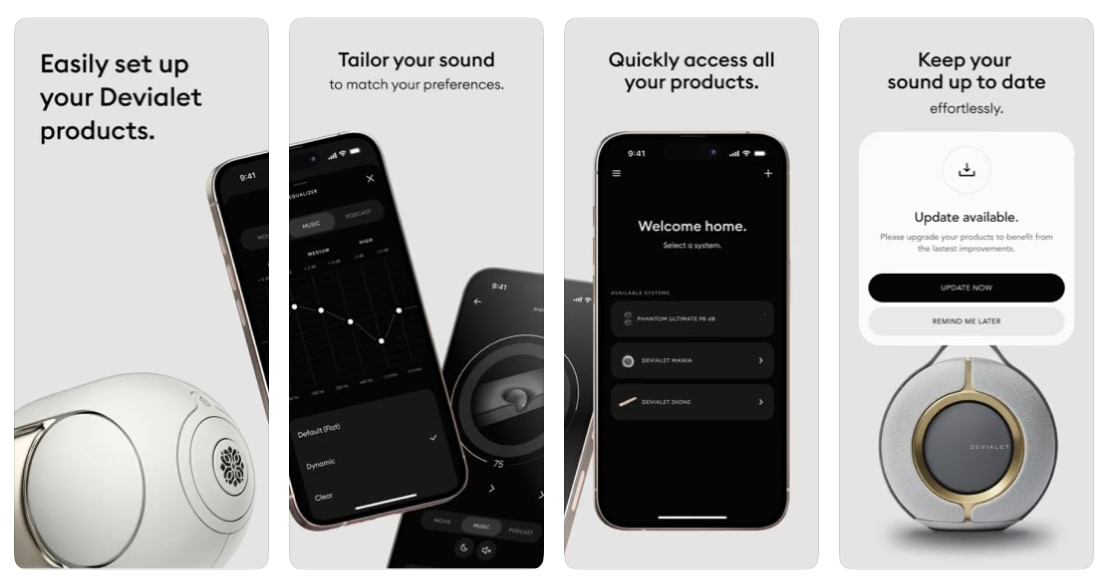
The control center is the Devialet app, which adds practical listening presets like Music, Podcast, and Cinema modes, and handles updates so the system can evolve over time.
One important note from my time with the speakers: Qobuz Connect was not part of the deal during this review period. Based on how aggressively Devialet has been expanding protocol support, I wouldn’t be shocked if that changes, but I’m not treating it as a feature until it’s actually live.
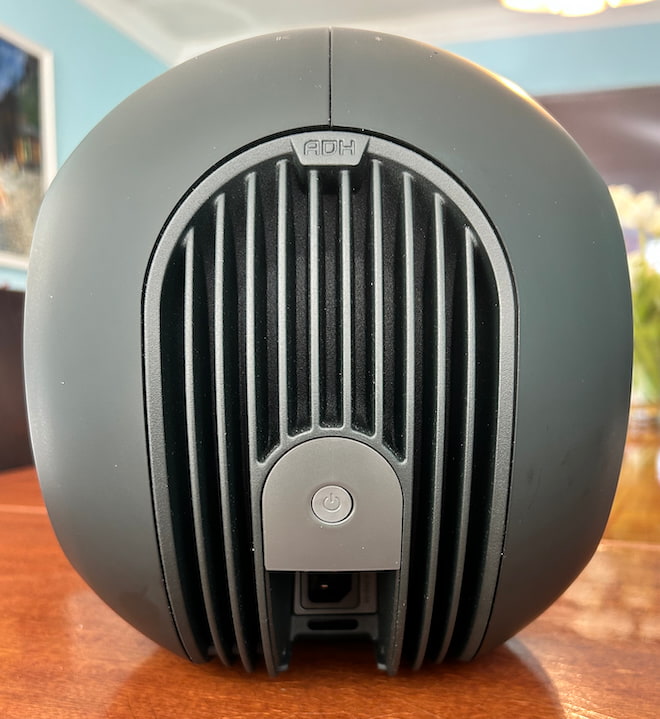
Physically, the Devialet Phantom Ultimate 108 dB is deceptively compact-looking, but it’s not small once you measure it (or try to lift it like you’re still twenty five). The cabinet is 246 mm (9.7 in) wide, 342 mm (13.5 in) deep, and 255 mm (9.7 in) tall, and each speaker weighs 11.1 kg (24.5 lbs), and yes—this is the part where my doctor would have preferred I respected my post-surgery lifting limits. I didn’t. Moving them is a two-hands, pay-attention job, and once they’re in place you’ll understand why Devialet isn’t pretending these are “portable” in any meaningful sense.
The build quality, however, is excellent. The finish work is clean, the fit is tight, and the overall product looks like nothing else in the category—whether you find that thrilling or slightly ridiculous is between you and your interior designer.
Advertisement
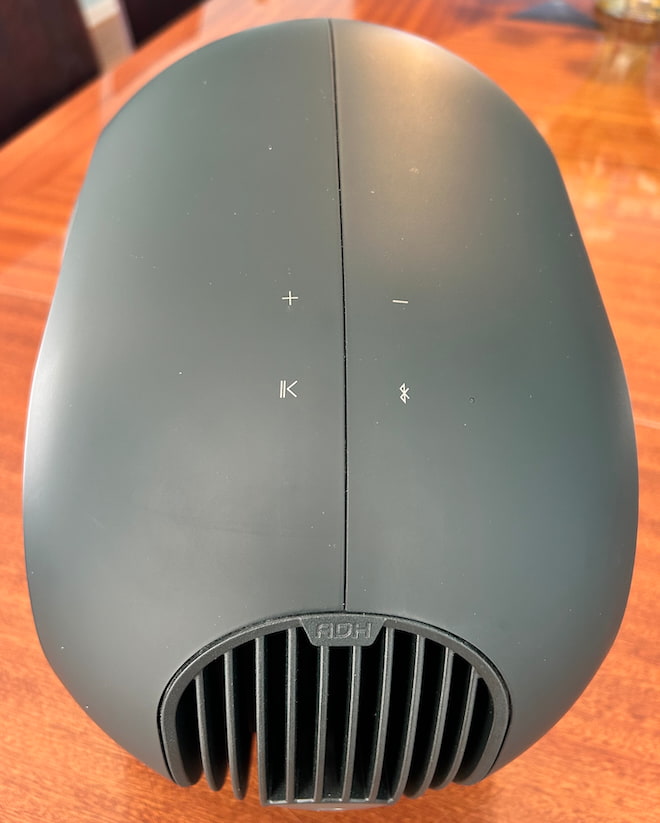
Setup is refreshingly simple, because Devialet doesn’t give you a spaghetti bowl of inputs. You’ve got power, and you’ve got Ethernet to hardwire them for stability. That’s basically it. The top-mounted interface uses four touch controls, and day to day operation is mostly app-driven. If you’re the type who wants a wireless speaker that behaves like an appliance, this is closer to that than many “audiophile” lifestyle products that still manage to be fussy.
Advertisement. Scroll to continue reading.
So the Devialet Phantom Ultimate 108 dB is less about ticking spec-sheet boxes and more about how it behaves in real rooms. In the Deep Forest finish, it actually comes across as more restrained than you might expect—especially by Devialet standards. The dark green and black accents read as deliberate rather than flashy, and in lower light it can feel surprisingly understated for a product with this much output on tap.
Devialet Phantom Ultimate 108 dB is available in Light Pearl, Deep Forest, and Gold Leaf (Opéra de Paris).
It’s also worth stressing that these are sold as individual speakers, not pairs, and setup matters. Even running a single unit, I had no trouble filling multiple spaces: my living room at 20 x× 13 x 9 feet, a den at 16 x 13 x 9 feet, and even a former basement office here in New Jersey measuring 33 x 13 x 8 feet. In all three, the Phantom Ultimate delivered real scale—solid low-end weight, strong presence, and more volume than anyone would reasonably need. Your ears will give up long before the speaker does.
Advertisement
In larger, open-concept spaces, that sense of scale becomes even more obvious. Depending on the music and how hard you push it, the Phantom Ultimate can sound genuinely large and authoritative in a way most wireless speakers simply cannot manage. That ability to impose itself when asked—without falling apart or sounding strained—is still rare in this category, and it’s where the Phantom Ultimate 108 dB quietly separates itself from the pack.
Devialet Phantom Ultimate Accessories: Essentials, Options, and Real-World Proof
Devialet includes a two-year manufacturer warranty with all of its products, covering defects in materials, workmanship, and design. Coverage can be extended by an additional three years through Devialet Care for $120. The process is entirely digital; purchase the plan, receive an activation code by email, and you’re done. Clean, efficient, and very much on brand.
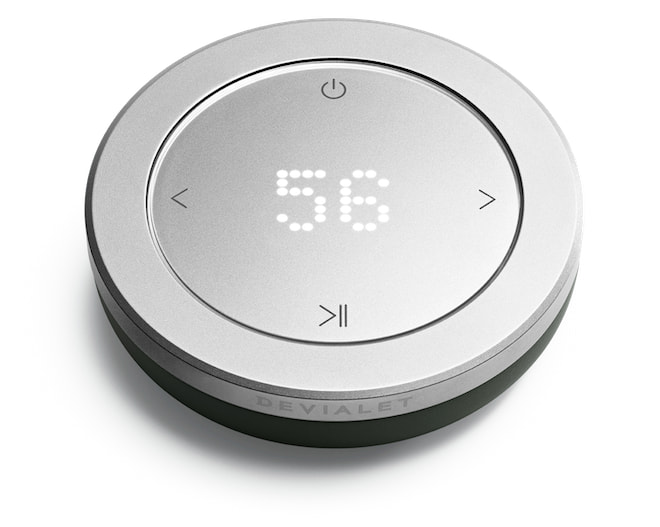
Devialet Phantom Ultimate Remote
For control, there’s the Phantom Ultimate Remote priced at $199. One remote can operate a single speaker or a stereo pair, and multiple remotes automatically synchronize if you’re using more than one. It’s responsive, intuitive, and a welcome alternative to reaching for the app every time you want to adjust volume or switch content.
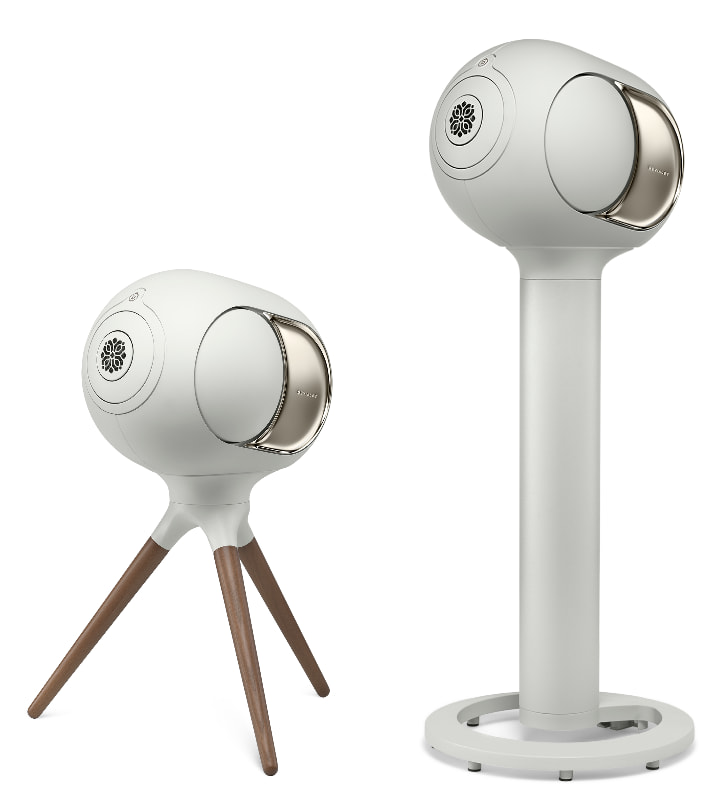
Placement matters with the Phantom Ultimate, and Devialet treats it that way. The Treepod Stand at $349 is available in Iconic White, Deep Forest, and Light Pearl. It measures 424 × 345 × 370 mm (16.7 × 13.6 × 14.6 inches) and positions the speaker precisely 345 mm (13.6 inches) above ground level. That height is intentional, placing the speaker where Devialet believes it performs best, while the solid construction keeps everything stable.
The Tree Smart Stand, priced at $399, offers a more vertical, furniture-like presentation. Measuring 340 × 660 mm (13.4 × 26.0 inches), it’s also available in Iconic White, Deep Forest, and Light Pearl. Compared to the Treepod, it’s less about flexibility and more about committing to a specific visual and spatial statement in the room.
For wall mounting, the Gecko Wall Mount costs $299 and is designed to securely support the Phantom Ultimate 108 dB while maintaining proper acoustic orientation. It’s adjustable, relatively easy to install, and offered in Light Pearl, Deep Forest, and Opéra de Paris finishes so the speaker doesn’t look like an afterthought once it’s off the floor.
Advertisement
I’ve seen the Gecko used effectively outside of a home setting as well; specifically at George Bush Intercontinental Airport in Houston. After spending a few days at the first Focal Powered by Naim location in the land of the trash-can beaters, I ended up in a restaurant near the terminal where a trio of Phantoms were mounted above the bar. Even with constant foot traffic, terminal noise, and a packed room, the sound was easy to follow and never got lost in the chaos.
None of these accessories are strictly required, but together they reinforce a consistent theme: with Devialet, placement is part of the product. How the Phantom Ultimate is supported, positioned, and integrated into a space isn’t an afterthought—it’s baked into the entire overall experience.
Devialet Phantom Ultimate on Treepod Stands
Devialet Phantom Ultimate 108 dB Setup: What You Need to Know Before You Hit Play
Yes, the Devialet app is required to set up the Phantom Ultimate during first use. There’s no workaround here. Without completing the initial configuration in the app, the speaker won’t operate—not even over Bluetooth. Think of the app as the ignition key; once setup is complete, day-to-day use is simple, but you can’t skip that first step.
If you’re wondering about stereo pairing, the answer is equally straightforward: you can only pair two speakers of the same model. A Phantom Ultimate 108 dB must be paired with another 108 dB unit, and the same rule applies to the 98 dB version. You can’t mix Phantom I and Phantom Ultimate models in a stereo configuration.
Advertisement
Advertisement. Scroll to continue reading.
As for placement, Devialet’s recommendations are sensible and worth following, especially given how much output these speakers are capable of. Position the Phantom Ultimate between 45 and 90 cm (18 to 35 inches) off the ground to balance impact and clarity. Leave at least 30 cm (12 inches) between the rear of the speaker and the wall to allow low frequencies to develop properly, and keep the area in front of the speaker clear so sound isn’t obstructed.
Listening distance matters, too. Devialet suggests placing the speaker 1.5 to 2.5 meters (5 to 8.2 feet) from your seating position. In a stereo setup, space the speakers 1.5 to 2.5 meters apart and toe them in 25 to 30 degrees toward the listening position. Done right, this creates a stable, focused soundstage without forcing the speakers to work harder than they need to.
In my own setup, I took a more hardwired approach. I ran CAT6 directly from a new Verizon Fios fibre optic modem, which sits directly below the main floor. From there, I’ve terminated connections in seven rooms throughout the house, each either connected directly to the modem or through an ASUS Mesh WiFi 7 router. In every location I tested, the Phantom Ultimate speakers were seeing at least 700 Mbps of available bandwidth, regardless of where they were placed. Connectivity was never a limiting factor.
Advertisement
Placement experiments went beyond the official recommendations as well. In one configuration, I set the speakers on our dining room credenza using IsoAcoustics isolation platforms, which raised the center of the driver to approximately 45 inches off the floor. In other setups, the speakers were spaced 6 to 7 feet apart and positioned 2 to 3 feet from the rear wall.
Setup with the Devialet app was relatively easy and mostly uneventful, which is a good thing. The speaker was discovered quickly on the network, and the step-by-step process was clear enough that there was little guesswork involved. Since the app is required for initial setup and the speaker won’t function without it, it’s reassuring that the process doesn’t feel complicated or fragile.
The app version in use during my time with the Phantom Ultimate was 1.25.x, which added full support for the Ultimate platform. That update introduced additional audio settings for the Phantom Ultimate models, including three listening modes, a six-band equalizer, and other advanced controls, along with a revised layout and a smoother setup and stereo-pairing process.
Network discovery was consistent, and firmware updates completed without issues. The expanded Network Status section, which shows Wi-Fi strength and connection quality, was useful for confirming that everything was operating as expected.
Advertisement
Streaming support is handled through integrated protocols rather than forcing you into a closed ecosystem. Bluetooth, AirPlay 2, Spotify Connect, Roon Ready, and UPnP were all available, and switching between services was straightforward. Volume control is precise, whether adjusting a single speaker or managing playback across rooms.
I also tested multi-room playback with one speaker in each room. Synchronization was generally solid, with only a slight delay when starting playback across rooms—small enough that you’d likely miss it unless you were listening for it. Once playing, everything stayed aligned, and the app allows different volume levels in each room, which makes the feature genuinely usable rather than decorative.
Devialet Phantom Ultimate 108 dB Green Pair on Tree Stands
Listening Impressions: Attitude Française, Sans le Ridicule
The urge to see what kind of structural damage these could inflict was definitely there right out of the box, but I held back. From past experience with Devialet speakers, I already knew the low-end story—deep bass, serious impact, and plenty of definition were a given. My longer-term takeaway from earlier models, though, was that all that sub-bass and mid-bass muscle sometimes came at the expense of midrange presence. Call it a polite “V” if you want.
Before getting more critical, I let the speakers run for a few hours a day over several days, looping music from an older iPhone 14. Whether burn-in is real is always up for debate, but at the very least, no drivers were harmed in the process—and if there’s any downside to repeated sessions of Shostakovich followed by deadmau5, I haven’t found it yet.
Advertisement
The Phantom Ultimate feels different, and in a way that mattered to me. There’s still weight and authority down low, but it no longer feels like the midrange is being asked to take a step back. That shift shows up quickly with something like Nick Cave’s “Avalanche.” His voice is there, front and center, but it’s the piano and string textures that really benefit—notes have body, tone, and decay, which are essential to how that track works. On better speakers, those elements carry as much emotional weight as the vocal, and here they finally do.
Advertisement. Scroll to continue reading.
Domestic realities (it’s been a long two years) meant I didn’t push the Phantom Ultimate 108 dB to the kind of levels that would have felt a little irresponsible, but I did get it loud enough to understand what it’s capable of. Even without going full send, there was plenty of mid-bass and lower midrange energy, and that weight carried well beyond the main listening position.
Moving around the room, the soundstage did lose some specificity, but there was no hollowing out of the sound or collapse in scale. The overall presentation stayed intact, with weight and presence remaining consistent even when listening well off-axis.
Advertisement
That translated across all three rooms I used for testing, where the presence was obvious without needing to sit in a carefully defined sweet spot. At one point, I did catch myself wondering whether this was simply too much speaker for the space. That thought disappeared the moment I pulled the volume back to just above conversation level. Everything snapped into focus—timing felt right, dynamics were intact, and the speaker didn’t lose its grip. It’s a reminder that control matters more than brute force, even when a speaker clearly has plenty of it in reserve.
Switching over to Peter Gabriel—“Been Undone” (Dark-Side Mix), “In Your Eyes,”“i/o” (Bright Side Mix), “Games Without Frontiers,” and “Biko”—it became clear that the Phantom Ultimate is very much tuned for listeners who gravitate toward electronic music, synth-driven rock, and rhythm-forward material. The presentation is propulsive and clean, with a lot of detail on tap; some might call it borderline “hi-fi”—and it delivers real slam without smearing bass lines or slowing things down. There’s texture and speed here, and the speaker has no trouble keeping complex mixes organized at higher levels.
Vocals on some of these tracks leaned slightly toward a polished, studio-lit presentation rather than a softer, more natural one, but the trade-off is scale. The Phantom Ultimate sounds big in a way that would make most of the passive speakers I own feel small, especially when it comes to low-end reach and overall presence.
“Biko,” “So Much,” and “In Your Eyes” hit differently for me, and that had less to do with the speaker than the music itself. Those tracks carry their own weight; memories of not being at your best with someone, and the kind of longing that puts you back under a blanket on a beach in Cape Town. We own our successes and our failures. Gabriel just has a way of making both feel uncomfortably close.
Advertisement
deadmau5, Boards of Canada, Talking Heads, and Tangerine Dream were a very different experience through these speakers. The sense of scale, presence, speed, and spaciousness brought out aspects of their music that few other speakers I’ve used over the years have managed to capture as convincingly. Rhythms had drive, layers stayed separated, and the overall presentation felt expansive without losing control.
If I had a larger home office and a dog who wouldn’t spend the entire day staring suspiciously at them—these would be very high on my list.
Listening to McCoy Tyner, Donald Byrd, Coltrane, Wes Montgomery, Miles Davis, Grant Green, and Lee Morgan highlighted both the strengths and the limits of these speakers. Rhythm, snap, and tonal weight are clear positives. The Phantom Ultimate locks into timing well, and it gives piano, bass, and drums real propulsion without sounding slow or bloated.
Texture was there, but it sometimes felt a little constructed—more grey than warm. Compared to my Wharfedale, Q Acoustics, or Triangle speakers, there was less richness in the upper bass and lower midrange. The Devialet brings power, thrust, and precision, but it doesn’t lean into the kind of imperfect coloration that, for me, makes jazz feel more human and less polished.
Advertisement
Horns, to their credit, weren’t bright or edgy, but you can clearly hear the character of an aluminum dome tweeter versus a soft dome. One rolls off sooner and trades sparkle for ease; the other delivers more energy and extension up top. Neither approach is wrong, but which one is more pleasing comes down to taste—and with acoustic jazz, my preference still leans toward warmth over sparkle.
The Bottom Line
The Phantom Ultimate 108 dB is a reminder of what happens when a wireless speaker is engineered like a serious loudspeaker rather than a lifestyle accessory. The technology matters here—ADH New Gen amplification, aggressive DSP control, serious processing power, and drivers that are designed to move air with authority. What it does best is scale, speed, and clarity. Few wireless speakers I’ve heard can project this kind of weight and presence into a room without falling apart, and even fewer maintain control when pushed. As a pair, the Phantom Ultimate delivers a level of output and composure that most wireless systems simply can’t approach.
Advertisement. Scroll to continue reading.
That said, it’s not perfect. While bass control, dynamics, and timing are excellent, the tonal balance leans toward precision over warmth. Acoustic textures, particularly in jazz—can sound a bit polished compared to the richer, more forgiving voicing of my Wharfedale, Q Acoustics, or Triangle speakers. And while the aluminum dome tweeter brings energy and extension, some listeners may prefer the softer roll-off and natural ease of a traditional soft dome design.
Advertisement
This is a speaker for listeners who want maximum performance with minimal boxes, who value modern streaming, industrial design, and the ability to fill large or open spaces without resorting to separates, subwoofers, or complicated setups. At $3,800 per speaker, it’s unquestionably expensive, and it should be—this isn’t competing with mainstream wireless speakers on price. It’s competing on capability.
Even so, there’s no way around the conclusion: the Phantom Ultimate 108 dB earns an Editors’ Choice Award. In terms of sheer scale, power, speed, and clarity from a wireless speaker system, it’s the most convincing I’ve heard. Everything else I have at home from KEF, Triangle, Audioengine, and Q Acoustics sounds slightly broken by comparison—also far more affordable, and very much playing in a different league.
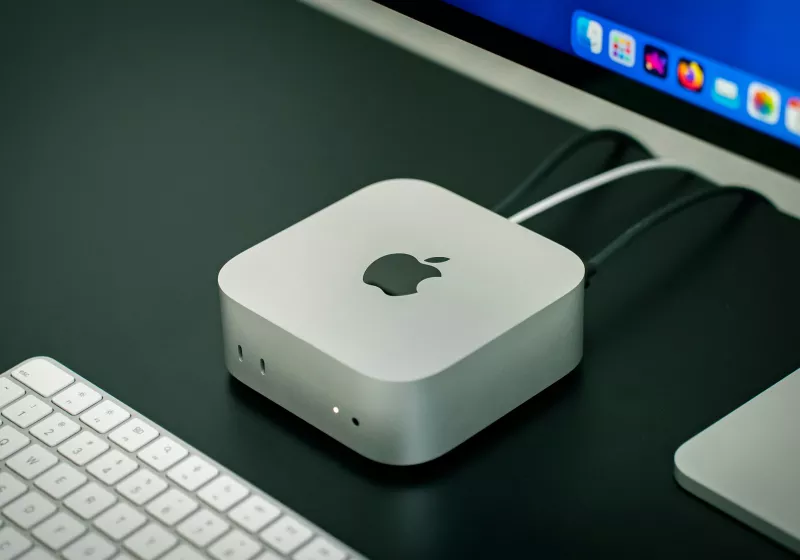
Consumer Intelligence Research Partners estimates the Mac Mini accounted for roughly 3% of Apple’s US Mac unit sales last year. That position has shifted quickly. Read Entire Article Source link
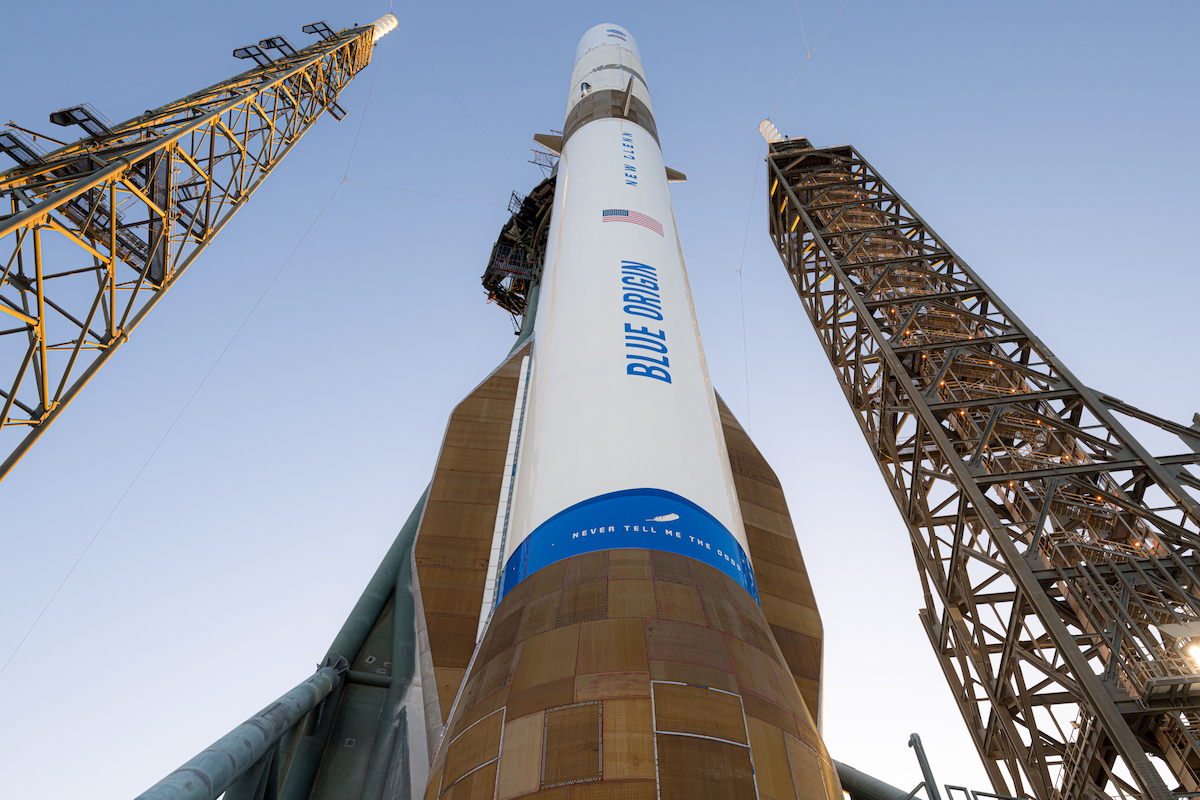
Jeff Bezos’ space company Blue Origin successfully re-used one of its New Glenn rockets for the first time ever on Sunday, but the company failed at its primary mission: delivering a communications satellite to orbit for customer AST SpaceMobile.
AST SpaceMobile issued a statement Sunday afternoon that the upper stage of the New Glenn rocket placed BlueBird 7 satellite into an orbit that was “lower than planned.” The satellite successfully separated from the rocket and powered on, the company said, but the altitude is too low “to sustain operations” and will now have to be de-orbited — left to burn up in the atmosphere of Earth.
The cost of the loss of the satellite is covered by AST SpaceMobile’s insurance policy, according the company, and there are successive BlueBird satellites that will be completed in around a month. AST SpaceMobile has contracts with more than just Blue Origin, and the company said it expects to be able to launch 45 more to space by the end of 2026.
But this represents the first major failure for Blue Origin’s New Glenn program, which only made its first flight in January 2025 after more than a decade in development. This was the second mission where New Glenn carried a customer payload to space, after launching twin spacecraft bound for Mars on behalf of NASA last November. The company did not immediately respond to a request for comment.
Advertisement
The apparent failure of New Glenn’s second stage could have wider implications beyond Blue Origin’s near-term commercial ambitions. The company is pushing hard to become one of the main launch providers for NASA’s Artemis missions to the moon and beyond. The space agency — and the Trump administration — has put pressure on Blue Origin and SpaceX to be able to put landers on the moon by the end of President Donald Trump’s second term, before advancing to returning humans to the lunar surface.
Blue Origin CEO Dave Limp has even said his company “will move heaven and Earth” to help NASA get back to the moon faster.
Blue Origin recently completed testing its first version of its own lunar lander, which the company is expected to try and launch at some point this year (without any crew). Blue Origin had suggested last year that it was considering launching this lander on New Glenn’s third mission, but ultimately decided to launch the AST SpaceMobile satellite instead.
Techcrunch event
Advertisement
San Francisco, CA | October 13-15, 2026
The third New Glenn launch seemed to start just fine on Sunday, with the the mega-rocket lifting off at 7:35 a.m. local time from Cape Canaveral, Florida. It was the first time Blue Origin re-used a previously-flown New Glenn booster — the same one that flew during New Glenn’s second mission. Roughly 10 minutes after liftoff, the booster came back down and landed on a drone ship in the ocean, just like it had last November. Jeff Bezos even shared drone footage of the booster’s landing on X, the social media site owned by his rival Elon Musk. (Musk offered congratulations.)
Advertisement
Roughly two hours after the launch, though, Blue Origin announced in its own post that the New Glenn upper stage placed AST SpaceMobile satellite in an “off-nominal orbit.” The company has not released any more information since that post.
Blue Origin spent a long time developing New Glenn, and it has been taken as a sign of confidence in that process that the company decided to start launching commercial payloads during these early missions. By comparison, SpaceX has spent the last few years flying test versions of its massive Starship, but has stuck with using dummy payloads as it works out the rocket’s kinks.
SpaceX did lose payloads deeper into its Falcon 9 program. In 2015, on the 19th Falcon 9 mission, the rocket blew up mid-flight and lost an entire International Space Station cargo spacecraft. In 2016, a Falcon 9 exploded on the launch pad during testing, causing the loss of an internet satellite for Meta.
A new NYT Connections puzzle appears at midnight each day for your time zone – which means that some people are always playing ‘today’s game’ while others are playing ‘yesterday’s’. If you’re looking for Sunday’s puzzle instead then click here: NYT Connections hints and answers for Sunday, April 19 (game #1043).
Good morning! Let’s play Connections, the NYT’s clever word game that challenges you to group answers in various categories. It can be tough, so read on if you need Connections hints.
What should you do once you’ve finished? Why, play some more word games of course. I’ve also got daily Strands hints and answers and Quordle hints and answers articles if you need help for those too, while Marc’s Wordle today page covers the original viral word game.
Advertisement
SPOILER WARNING: Information about NYT Connections today is below, so don’t read on if you don’t want to know the answers.
Article continues below
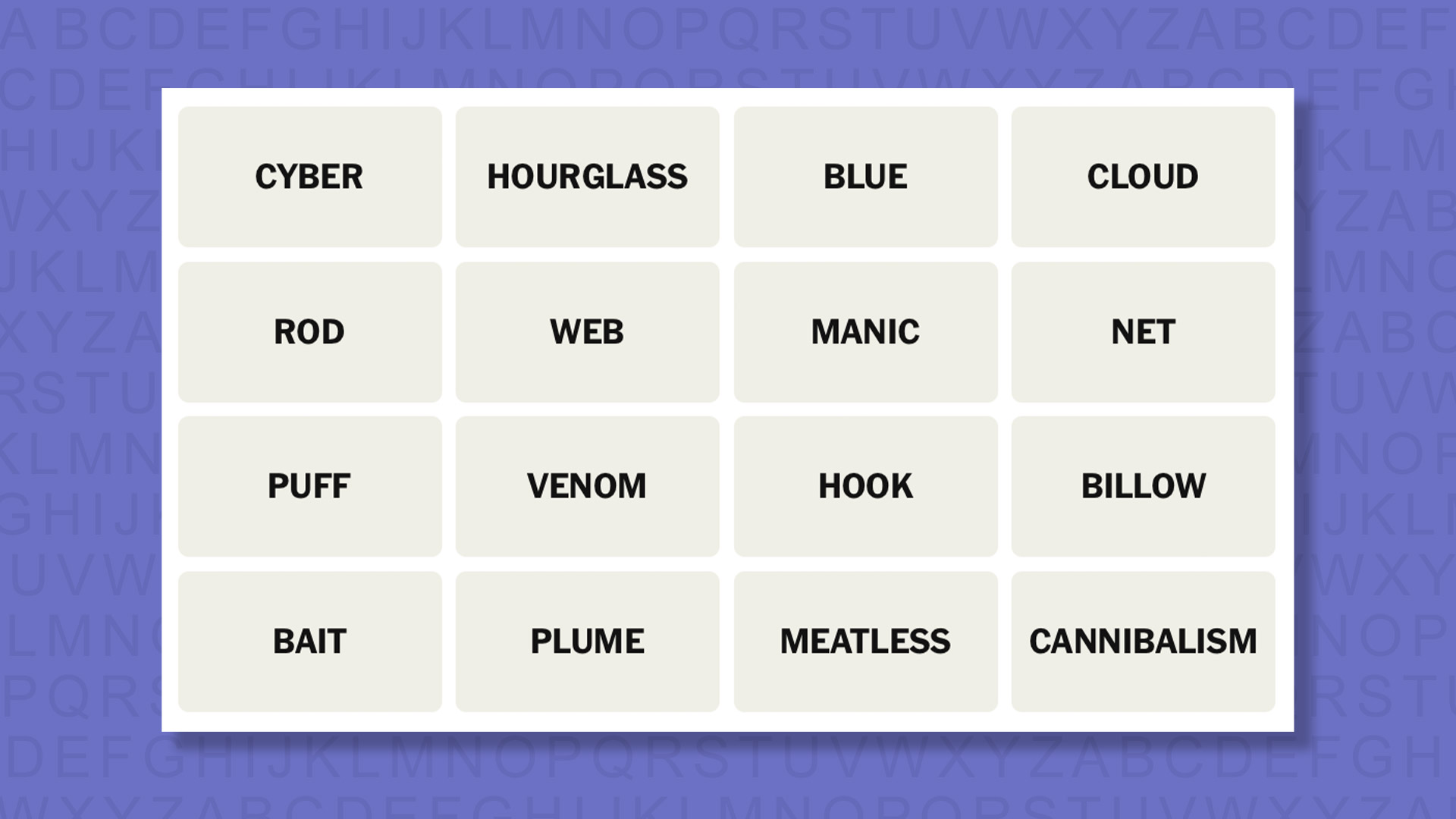
NYT Connections today (game #1044) – today’s words
(Image credit: New York Times)
Today’s NYT Connections words are…
CYBER
HOURGLASS
BLUE
CLOUD
ROD
WEB
MANIC
NET
PUFF
VENOM
HOOK
BILLOW
BAIT
PLUME
MEATLESS
CANNIBALISM
NYT Connections today (game #1044) – hint #1 – group hints
What are some clues for today’s NYT Connections groups?
YELLOW: A bunch of fumes
GREEN: Used for angling
BLUE: Linked to an infamous arachnid
PURPLE: Start the week
Need more clues?
We’re firmly in spoiler territory now, but read on if you want to know what the four theme answers are for today’s NYT Connections puzzles…
Advertisement
Sign up for breaking news, reviews, opinion, top tech deals, and more.
NYT Connections today (game #1044) – hint #2 – group answers
What are the answers for today’s NYT Connections groups?
YELLOW: MASS OF SMOKE
GREEN: FISHING GEAR
BLUE: ASSOCIATED WITH BLACK WIDOW SPIDERS
PURPLE: _____ MONDAY
Right, the answers are below, so DO NOT SCROLL ANY FURTHER IF YOU DON’T WANT TO SEE THEM.
Advertisement
NYT Connections today (game #1044) – the answers
(Image credit: New York Times)
The answers to today’s Connections, game #1044, are…
YELLOW: MASS OF SMOKE BILLOW, CLOUD, PLUME, PUFF
GREEN: FISHING GEAR BAIT, HOOK, NET, ROD
BLUE: ASSOCIATED WITH BLACK WIDOW SPIDERS CANNIBALISM, HOURGLASS, VENOM, WEB
PURPLE: _____ MONDAY BLUE, CYBER, MANIC, MEATLESS
My rating: Easy
My score: Perfect
A bit of music knowledge got me to my 33rd “Purple First” thanks to Blue Monday by New Order and Prince’s Manic Monday,made famous by The Bangles. CYBER I was confident about, but MEATLESS I went with purely because of the alliteration.
This actually seemed the easiest group, not that I’m complaining.
Advertisement
Elsewhere, nature knowledge may have helped me get ASSOCIATED WITH BLACK WIDOW SPIDERS, but I spotted the more obvious yellow and green groups first.
Yesterday’s NYT Connections answers (Sunday, April 19, game #1043)
BLUE: CARDS IN TEXAS HOLD ‘EM FLOP, HOLE, RIVER, TURN
PURPLE: LAST WORDS OF CANDY BRANDS IN THE SINGULAR CAP, DUD, KID, MINT
What is NYT Connections?
NYT Connections is one of several increasingly popular word games made by the New York Times. It challenges you to find groups of four items that share something in common, and each group has a different difficulty level: green is easy, yellow a little harder, blue often quite tough and purple usually very difficult.
On the plus side, you don’t technically need to solve the final one, as you’ll be able to answer that one by a process of elimination. What’s more, you can make up to four mistakes, which gives you a little bit of breathing room.
Advertisement
It’s a little more involved than something like Wordle, however, and there are plenty of opportunities for the game to trip you up with tricks. For instance, watch out for homophones and other word games that could disguise the answers.
It’s playable for free via the NYT Games site on desktop or mobile.
There are many drivers who often bemoan the very existence of traffic lights. Despite incurring the daily ire of commuters who are running late for work, even those haters have to acknowledge the traffic signal’s invaluable function in helping to keep our roadways safe.
Traffic signals have, of course, evolved considerably since they were first pressed into use in the late-1860s, with the first electric lights coming into play sometime around 1912. It wasn’t long until those signals started using colored lights, and have since evolved into the red, yellow, and green modes we are all too familiar with today. Even as safety remains the primary purpose of the hundreds of thousands of traffic lights currently employed throughout the United States, some theorize that the life-saving devices may one day cease to exist.
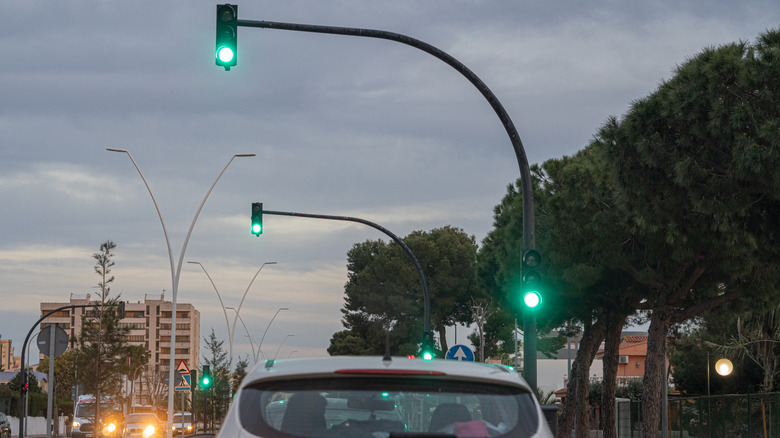
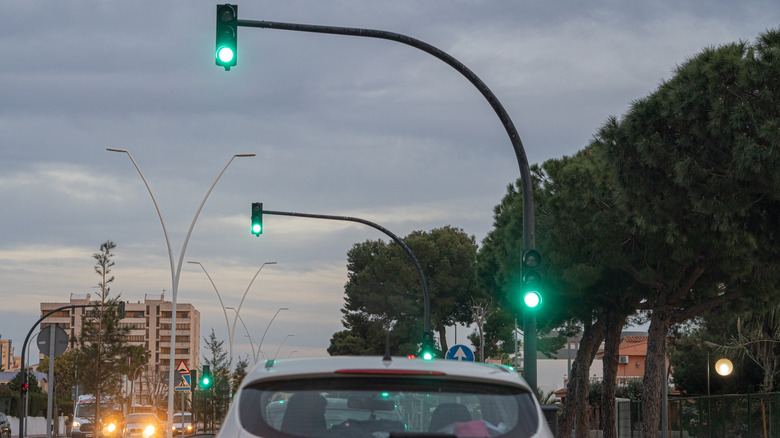
Until that fateful day, getting stuck at red lights when you’re in a rush will remain a constant source of commuter frustration. On some occasions, however, a stream of greens opens up on the road ahead like the parting of the Red Sea. That stream of green has a name, with researchers dubbing it the “Green Wave.” While they may seem rare, the “Green Wave” is a common occurrence in certain parts of the world, and it serves a very important purpose.
Advertisement
What is the purpose of a traffic light Green Wave?
Brasil2/Getty Images
While it might seem like a weird sort of karmic intervention, that “Green Wave” of traffic lights was actually programmed for a specific purpose by whatever government organization is in charge of maintaining the traffic signals in your city, state or township. They are, however, far more commonly utilized on high-volume roads in urban areas. The purpose of a “Green Wave” is to improve the flow of traffic in those areas, particularly during times with increased traffic volume.
At its core, the concept is very simple. The idea is to keep traffic flowing during peak volume times by simply reducing the number of stops at concurrent traffic signals. To enact a “Green Wave,” planners and engineers simply synchronize the traffic lights in congested areas to all turn green at the same time and stay that way for a specified period that ensures a steady flow of traffic in one direction. The method is, naturally, easier to manage on one-way streets with no turning lanes, though some cities have attempted to aid traffic flow further by simply outlawing left turns in metropolitan areas. Some have even taken to banning right turns too.
Advertisement
In any case, on top of aiding the flow of traffic in congested areas, “Green Wave” traffic patterns are also believed to have a positive effect on the environment. After all, the reduction in stop-and-go traffic also reduces a vehicle’s idling time, which, in turn, leads to reduced greenhouse gas emissions.
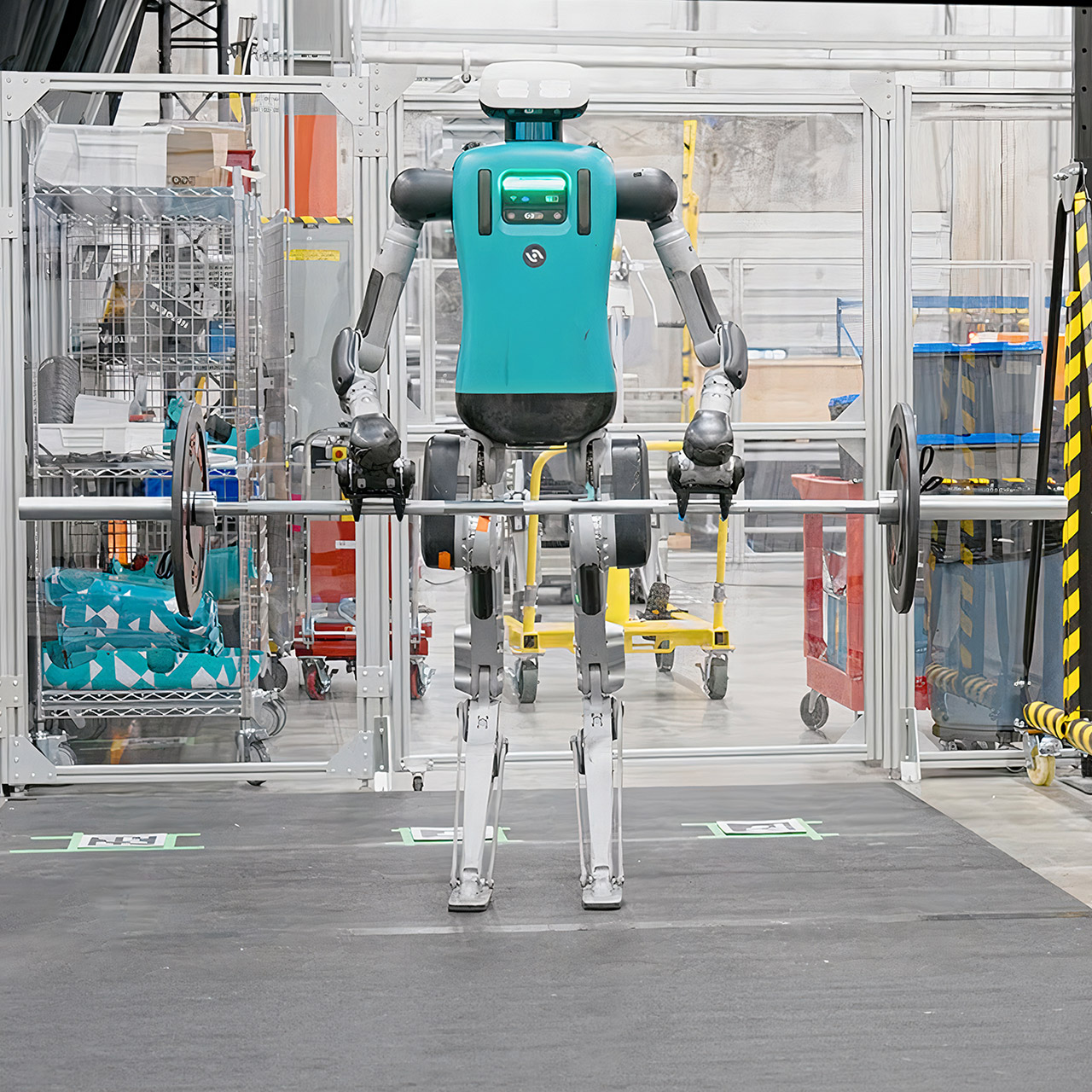
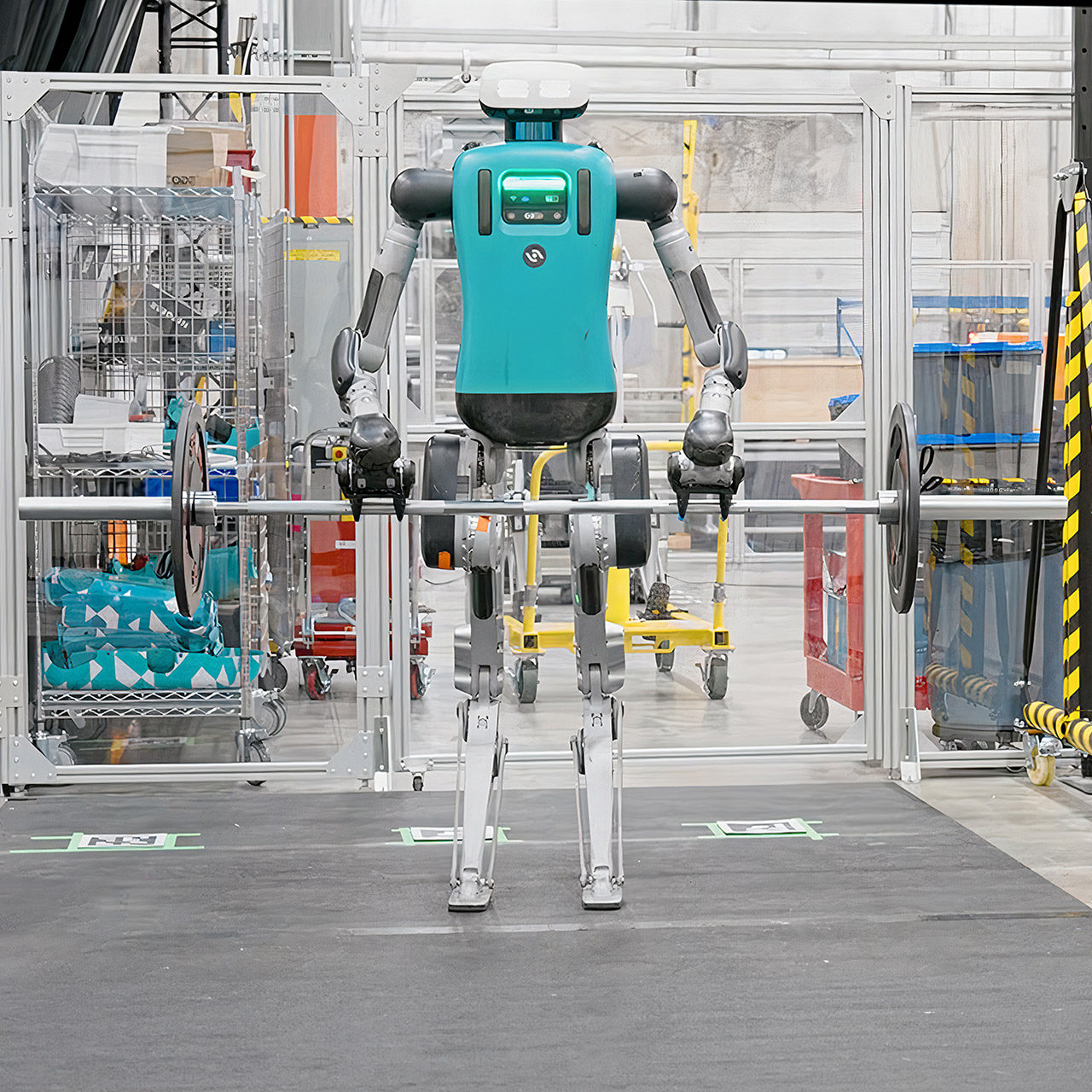
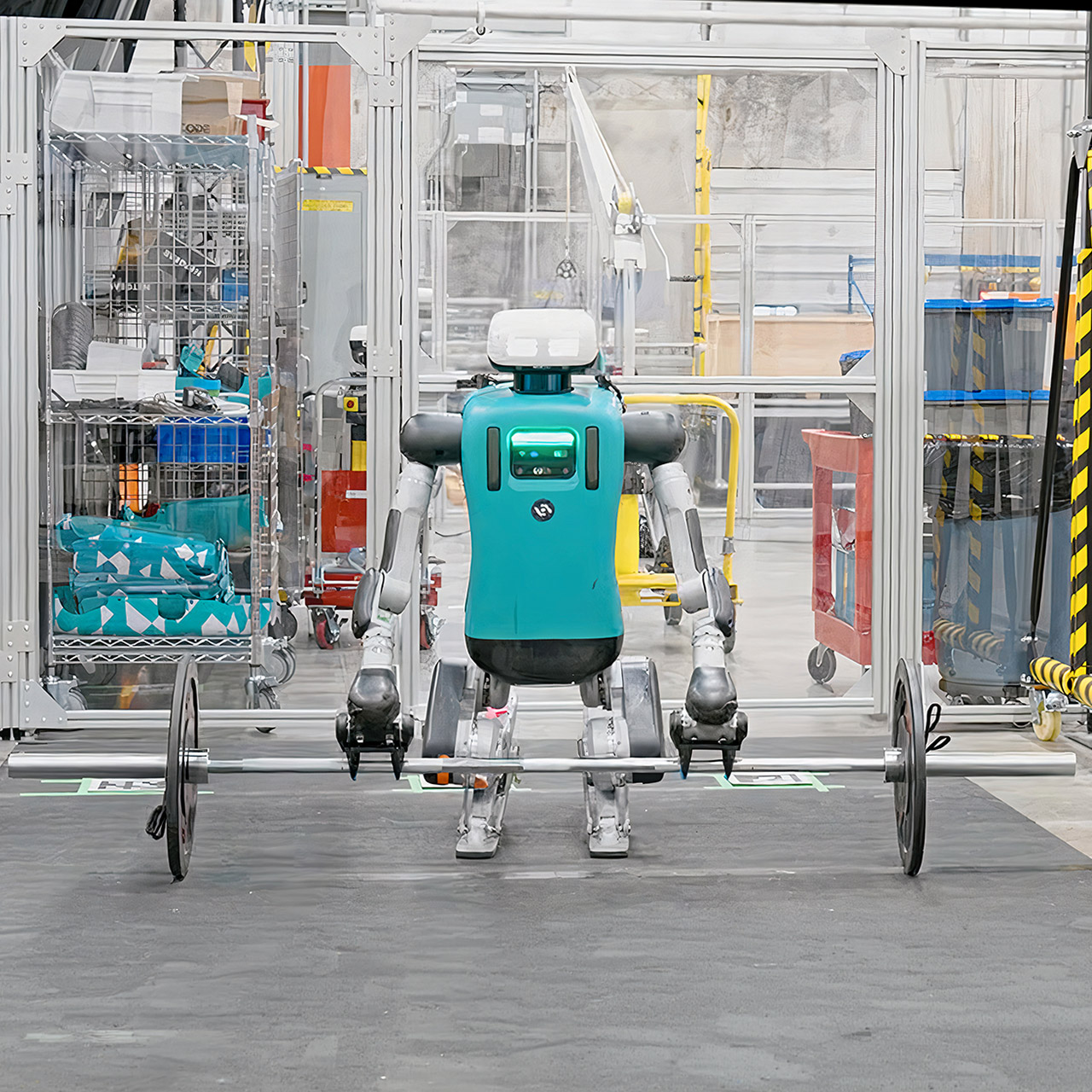
Digit is seen performing deadlifts with a 65-pound weight in the center of a lab. Agility Robotics shared the video a few days ago, and to be honest, the robot maintains a fairly steady balance and completes the task from beginning to end. Someone mentions that the new version can lift significantly more weight than the previous one, while another laughs about how it can run all day without stopping.
The engineers designed the test so that Digit had to work harder than usual. Every additional pound it must lift causes the robot to modify its entire body at simultaneously, including its arms, legs, torso, and everything else. The system must keep the weight centered and avoid tipping over, therefore the legs, arms, and rest of the robot must all function together. These actuators and joints can withstand repeated load without breaking down. Digit’s video simply shows the robot grasping the weight, rising up, then effortlessly placing it down repeatedly in a standard indoor location built for people.
Sleek & Durable Design: Standing at 132cm tall and weighing only approx. 35kg, the G1 is constructed with aerospace-grade aluminum alloy and carbon…
High Flexibility & Safe Movement: Boasting 23 joint degrees of freedom (6 per leg, 5 per arm), it offers an extensive range of motion. For safety, it…
Smart Interaction & Connectivity: Powered by an 8-core high-performance CPU and equipped with a depth camera and 3D LiDAR. It supports Wi-Fi 6 and…
Simulation is where all of the training takes place, because before it touches a real weight, an engineer creates a digital copy of the same thing in a virtual world. Then they anticipate what will happen when the weight shifts. The grip pressure remains constant, with no slipping or lowering. Any changes to the robot’s equilibrium are registered extremely instantly. The policy learns the perfect lift in the simulated environment with no complications before being transmitted directly to the real robot. When you see the real robot perform it, it looks fairly natural because it has already handled every potential variable thousands of times in the simulation.
Engineers chose deadlifts for the test because the movement requires complete body control. A simple arm raise would not put the hardware under the same level of stress. By incorporating weight into the simulation loop, the team is able to handle balancing changes that a pre-programmed script cannot handle alone. As a result, Digit lifts consistently, with no wobbling or resets. This method is easily adaptable to other objects or larger loads in future tests.
Digit was built by Agility to manage long, repetitive jobs that wear people out, such as working in factories or warehouses where you must squeeze into tight spaces, pick up oddly shaped goods, and continue without taking a break. This deadlift test demonstrates Digit’s ability to lift weight on ordinary floors while remaining steady, which is ideal for picking up boxes, carrying tools, and stacking things in human-designed places.
Advertisement
It also illustrates how far they’ve come in teaching robots to perform physical tasks. Whole-body synchronization was originally a nightmare, with hand-tuned code for each joint angle. But now they can simply train a policy in simulation that adapts on the go. Digit detects weight using its sensors, corrects itself in real time, and completes the lift without assistance, while the hardware can keep up because the training has already taught the actuators and joints to be more durable. [Source]
In October and through November, America’s EV sales reached their lowest point since 2022 after government subsidies expired, remembers Time. “But first-quarter data for 2026 shows that used EV sales were 12% higher than the same time last year and 17% higher than the previous quarter.
“One factor likely helping push buyers toward these cars is high gas prices, which recently topped $4.00 a gallon for the first time in four years,” they write — but it’s not just in the U.S. Instead, they argue the conflict “is driving a global surge of interest in electric vehicles…”
In the U.K., electric car sales reached a record high, with 86,120 vehicles sold in March… The French online used-car retailer Aramisauto reported its share of EV sales nearly doubled from February 16 to March 9, rising to 12.7% from 6.5%, while sales of fueled models dropped to 28% of sales from 34%, and sales of diesel models dropped to 10% from 14%. Germany’s largest online car market, mobile.de, told Reuters that the share of EV searches on its website has tripled since the start of March — from 12% to 36%, with car dealers receiving 66% more enquiries for used EVs than in February.
South Korea reported that registrations for electric vehicles more than doubled in March compared to the prior year, due in part to rising fuel prices and government subsidies… In New Zealand, more than 1,000 EVs were registered in the week that ended on March 22, close to double the week before, making it the country’s biggest week for electric vehicle registrations since the end of 2023, according to the country’s Transport Minister, Chris Bishop.
In America, Bloomberg also reports 605 high-speed EV charging stations switched on in just the first three months of 2025, “a 34% increase over the year-earlier period,” according to their analysis of federal data. A data platform focused on EV infrastructure tells Bloomberg that speedier and more reliable chargers are convincing more drivers to go electric and use public plugs.
Most loudspeaker designers don’t spend much time debating open versus closed the way headphone enthusiasts do. Cabinets are part of the equation for a reason, offering control, efficiency, and predictable performance. That’s the accepted playbook. But like any good rule in audio, someone is always trying to break it.
At AXPONA 2026, La Dolce Audio showed what happens when you ignore that playbook and lean into experimentation. Founder Terry Gesualdo isn’t approaching amplification or speaker design from a traditional standpoint, he’s part of a growing group of builders exploring open designs and current drive amplification as an alternative to the usual voltage driven norm.
I met Gesualdo on the shuttle ride over to the show, which feels about right. This isn’t a polished, corporate origin story, it’s the familiar path of someone who started by modifying gear, then building his own tube amps for himself, then for friends and family. The difference here is that he didn’t stop at tweaking circuits. He kept pushing until the results looked and sounded like something entirely his own.
Current Drive Tube Amplification: Why La Dolce Audio Isn’t Following the Script
Having built a few tube amps, I’m always curious to see what others are doing, and Terry Gesualdo is not following the usual path. Most of his designs are single ended pentode circuits, not triodes, and not push pull designs chasing more voltage swing. That choice alone puts him in a different lane than a lot of tube builders.
Advertisement
Where things really diverge is the move to current drive. Most amplifiers are voltage driven. That’s the standard approach across both solid state and tube designs. Current drive shows up more often inside DACs where signal levels are extremely small, and occasionally in headphone amplifiers, but rarely in loudspeaker systems where current demands are far higher.
The idea behind current drive is fairly straightforward. By controlling current instead of voltage, the amplifier reduces the impact of back EMF from the driver. That back EMF is the voice coil behaving like a generator as it moves through the magnetic field, feeding energy back into the amplifier. Reduce that interaction and, in theory, you reduce distortion and improve control over the driver.
It’s not a new concept, but it’s one that almost nobody is applying to loudspeakers in this way, especially with tube amplification. That’s what makes what La Dolce Audio is doing worth paying attention to.
Control Over Harmonics Instead of Chasing Purity
Circling back to that idea of ignoring the usual playbook, another aspect that reinforces how La Dolce Audio is taking a different path is the near exclusive use of pentode tubes instead of the more common triodes. Triodes are the simplest form of amplification with three active elements, anode, cathode, and grid. Fewer parts in the signal path is why many listeners and designers gravitate toward them. The assumption is less complexity means lower distortion and fewer unwanted artifacts.
But that’s only part of the story. Harmonic distortion doesn’t disappear just because the circuit is simpler. It just changes character. And not all harmonics are a problem. A lot of what people describe as tube warmth comes from second and third order harmonics, which many listeners actually prefer.
Advertisement
Terry Gesualdo leans into that reality rather than trying to avoid it. By using pentodes, which add additional control elements beyond what a triode offers, he can shape those harmonic structures instead of accepting whatever the circuit gives him. That includes adjusting the balance between second and third order harmonics and even their phase relationships.
It’s a different mindset. Instead of chasing the lowest possible distortion number, the goal is control over how that distortion presents itself, and giving the listener a way to fine tune the result.
Advertisement. Scroll to continue reading.
Some will find that approach a bit sacrilegious. There’s a large part of the hobby focused on removing as much of this behavior as possible, chasing lower distortion numbers and cleaner measurements. That’s not the goal here.
Advertisement
La Dolce Audio leans into a different philosophy. “If it sounds good, do it” is more than a slogan. It reflects the idea that listening is subjective and that not every system needs to be locked into a single interpretation of neutrality. By giving users control over harmonic structure, the design puts some of that decision making back in the listener’s hands.
UA2.5 and UA2.5M: Modular Power and User Tunability
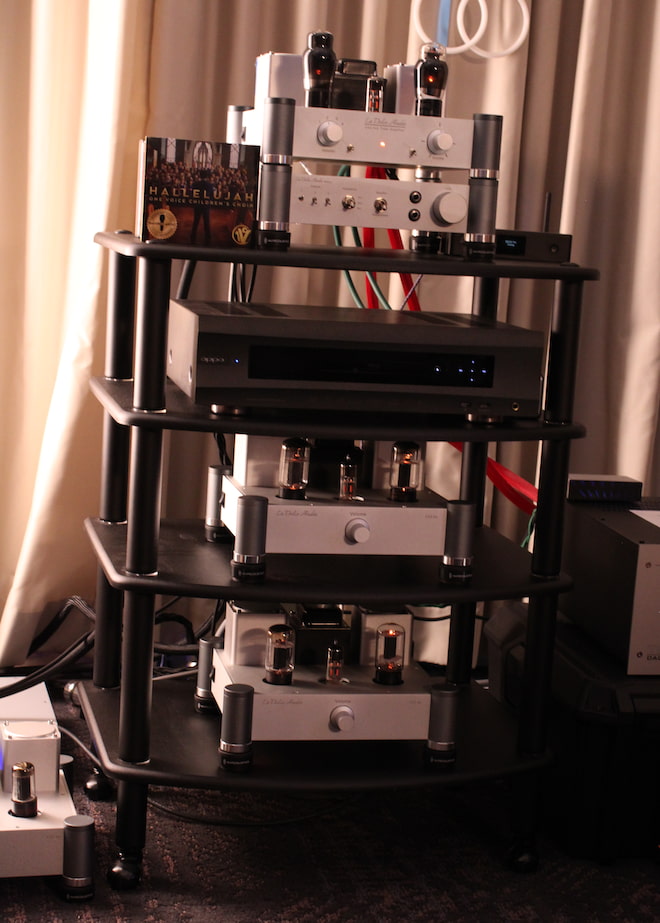
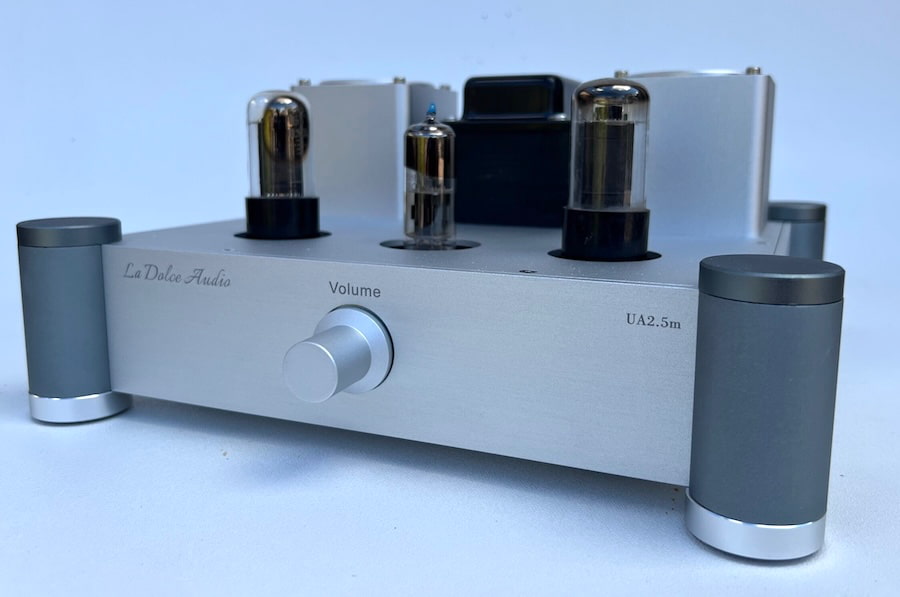
La Dolce Audio UA2.5M monoblock
La Dolce Audio offers two amplifier paths built around the same core ideas but with different roles. The UA2.5 is a dual channel amplifier rated at roughly 3 to 5 watts depending on tube selection, and it’s where most of the flexibility lives. With 24 possible sound signatures, it gives the user direct control over how the amplifier presents harmonic content and overall character.
The UA2.5M monoblocks step things up in output, delivering around 9 watts per channel, but they take a more focused approach. They are designed to be paired with the UA2.5, which handles preamp duties and sound shaping. As a result, the monoblocks do not include the same tuning controls, focusing instead on providing additional power while maintaining the same underlying design philosophy.
HPA2.3 Headphone Adapter
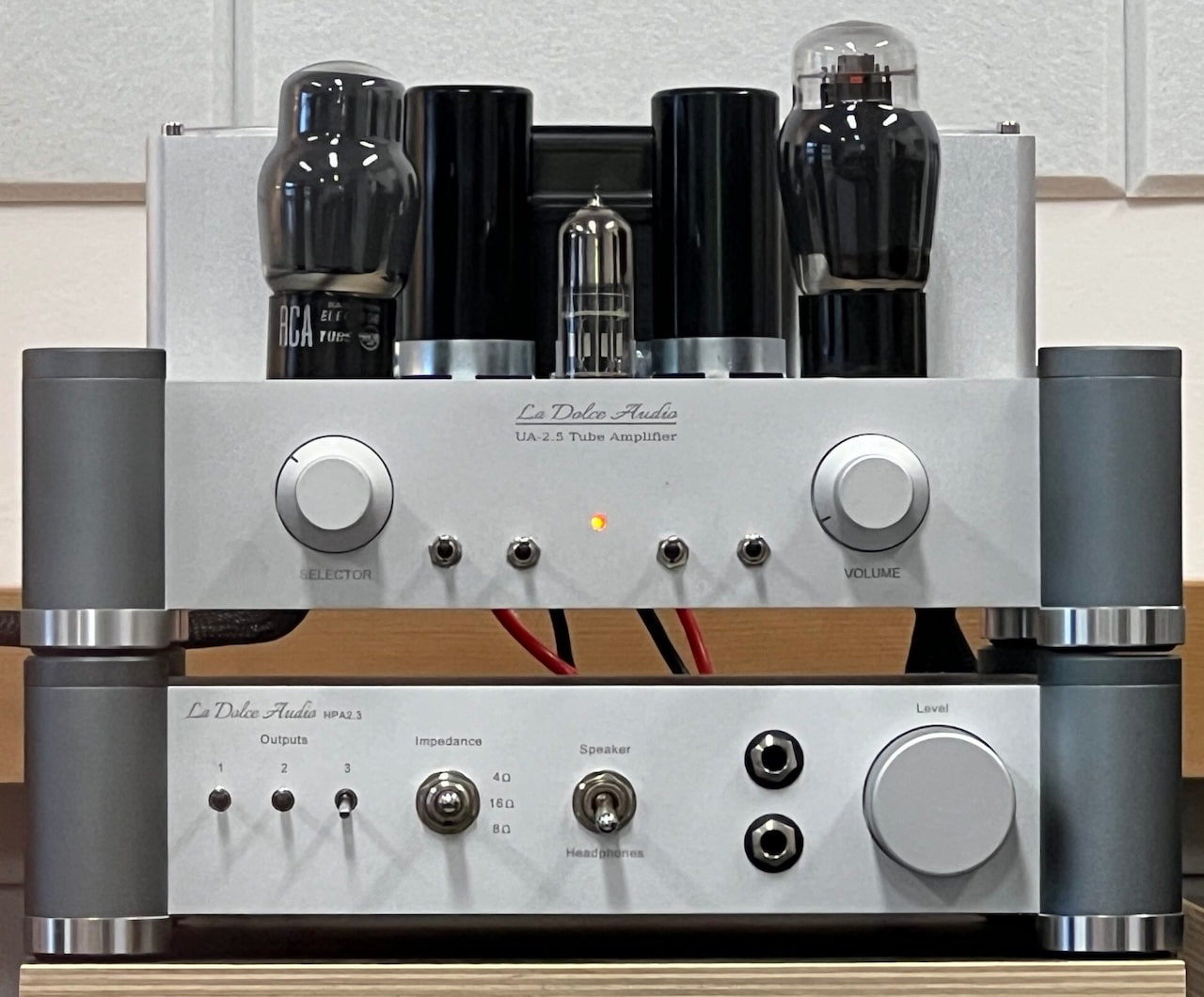
La Dolce Audio UA2.5 Tube Amplifier (top) with HPA2.3 Headphone Adapter (bottom)
Alongside its amplifiers, La Dolce Audio offers the HPA2.3 headphone “amplifier,” although that label needs a bit of clarification. It’s not an amplifier in the traditional sense. The HPA2.3 is a passive device designed to work with the UA2.5, relying on it for signal processing and gain. In practice, it converts the UA2.5 into a headphone amplifier rather than operating as one on its own.
That means the HPA2.3 can drive a wide range of headphones depending on how the UA2.5 is configured, but it cannot function independently. No preamp, no sound.
Pricing reflects that modular approach. The UA2.5, which serves as the foundation of the system, runs between $1,799 and $2,499 depending on configuration and tube selection. The UA2.5M monoblocks are $1,999 each, and the HPA2.3 adds another $599. A full system lands in the $3,500 range, depending on how far you go down the rabbit hole.
Advertisement
The Bottom Line
La Dolce Audio isn’t trying to fit into the usual mold, and that’s the point. In a category where a lot of designs feel like small variations on the same theme, this is a reminder that there are still different ways to approach amplification and system building.
Beyond the amplifiers, the partnership with ABX Audiophiles on Discord to offer open baffle speaker kits adds another layer. It invites listeners to get involved, not just as buyers but as participants, with a community that shares ideas, solves problems, and pushes designs forward together. We’ll have more on that ABX side of things in a forthcoming article.
It won’t be for everyone. If you want plug and play simplicity, this isn’t it. But if you’re the type who likes to understand what your system is doing and shape it to your preferences, La Dolce offers something most companies don’t. A system you can actually interact with, not just listen to.
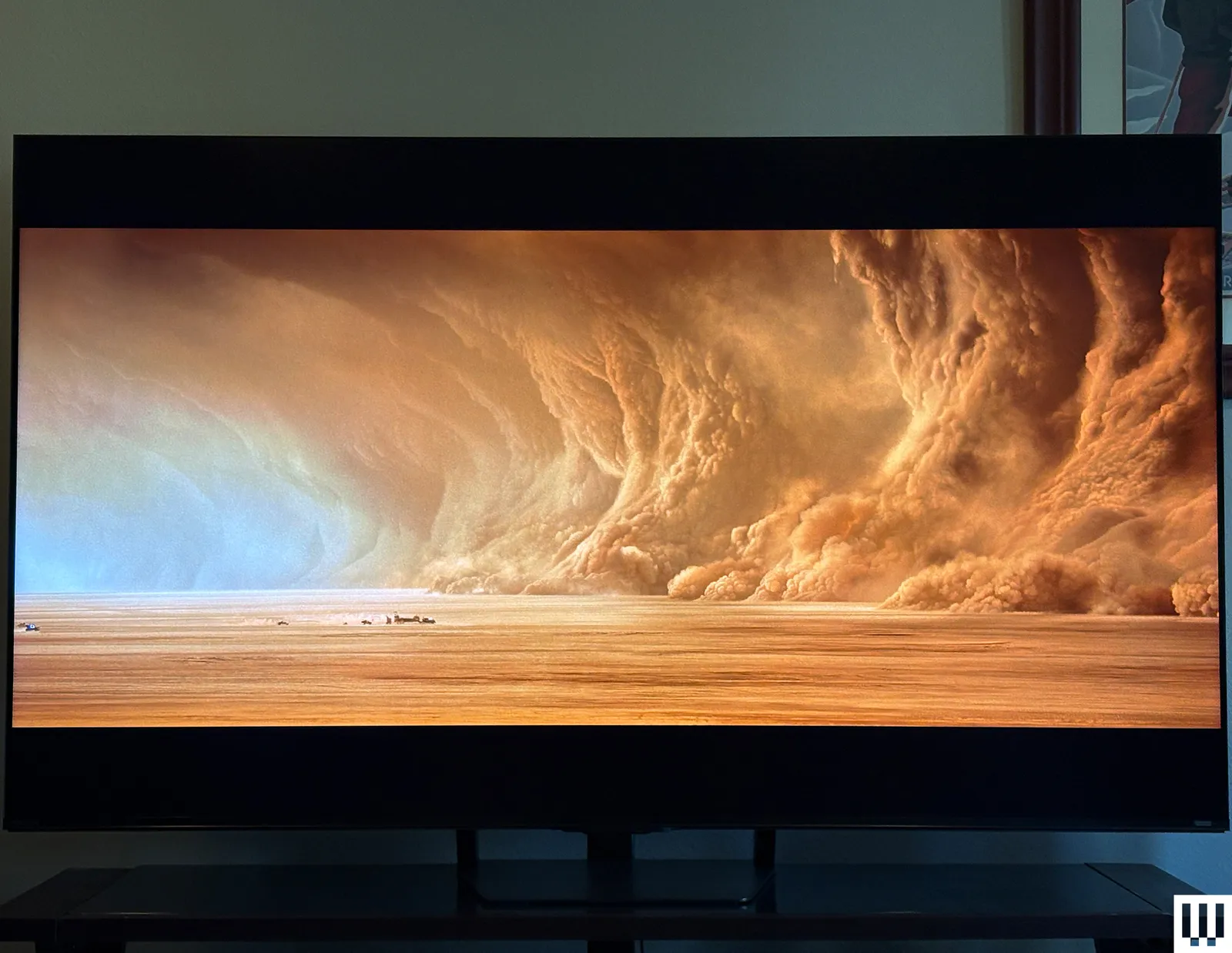
Unlike previous years in what TV nerds like me call the “brightness wars,” the U7SG doesn’t outblast its predecessor, but it’s not a problem. It gets around three times as bright as anything you can stream (which is naturally capped due to compression), and has enough firepower for all but the flashiest 4K HDR Blu-rays. Its color processing shows a little more restraint than in previous models. It’s not quite what I’d call “accurate to the director’s intent,” like the best TVs I test, but it does keep itself from blasting your eyeballs most of the time.
The high brightness is matched by deep black levels, without much of the “blooming” or “haloing” around bright objects that can dilute the contrast of many budget-friendly TVs. It’s not as striking as OLED TVs, which can control each of their millions of pixels on demand, but it’ll wow you in deep space scenes just the same. I was pleased that the TV’s odd local dimming issue didn’t crop up in real-world content, but the picture does tend to flatten shadows in dark scenes more than expected, even as the matte-like screen does a good job keeping reflections at bay.
Photograph: Ryan Waniata
There are some other notable flaws. Moving off to the TV’s side in my easy chair led to dimmer colors, washed-out contrast between the brightest and darkest images, and uneven backlighting, aka the “dirty-screen effect.” That stood out most in the green backdrop of the Masters on Sunday as Rory McIlroy held on for the win. It wasn’t an issue when viewing head-on, but even then, I noticed some dingy yellow lines along the screen’s left and right sides with light backgrounds. (I may not have noticed them much if I hadn’t been bombarding this TV with test content first.)
The U7SG still doesn’t feel quite like a premium model. But it’s a very clear, bright TV, and will feel more like it’s worth the money once RGB shows up on other Hisense models and the price on this one drops. If you want something brighter than a similarly priced OLED like the LG B5, the U7 is a great buy and has a few good upgrades over last year’s U75QG.
Advertisement
We’ll know more about the 2026 TV landscape once the new RGB TVs have landed, but if you need a powerful, classy-looking TV before then, the U7SG should be on your list.
Feroze Motafram is an operations consultant based in Sammamish, Wash., and founder of Avestan LLC. This piece is adapted from a LinkedIn post.
Someone asked me recently what made me think about writing this. The trigger, I told them, was simpler than you might expect.
I live in Sammamish, in the shadow of Microsoft’s looming presence. Microsoft employees are my neighbors, my social circle, the people I run into at weekend gatherings. Over time I noticed that conversations with them had a distinctive gravitational pull — always inward, toward reorgs, internal politics, who reports to whom now, who’s ascendant, who’s out. Customers were rarely part of the conversation. This usually means navigating the organization has become more consuming than building anything within it.
Microsoft’s stock decline and the softening of real estate in this corridor (both affecting me personally) were the prompts to write it down. The material was already sitting in front of me.
I should be clear about what I am and am not. My formal training is in electrical engineering. The primary instruments of my early career were set squares and slide rules, which will tell you something about both my vintage and my domain. I have spent the intervening decades as a senior executive at Fortune 100 companies and, more recently, as an operations and supply chain consultant. I build and fix things: supply chains, organizations that have lost their way. What I can offer is not insider knowledge. It is 30 years of pattern recognition, applied to what is visible from where I stand.
Advertisement
This is the lens I am bringing. Take it for what it is worth.
The market is asking a question
Microsoft stock declined roughly 25% in Q1 2026, representing its worst quarterly performance since the 2008 financial crisis despite blockbuster results. The market may overreact, but it is not stupid. When the stock of a company of this scale underperforms that of its peer group by double digits, the question worth asking is not “is this a buying opportunity.” The question is: what does the market understand about this organization that the headlines don’t capture?
Part of the answer is visible in the financials. A striking portion of Microsoft’s forward revenue backlog is tied to a single counterparty, OpenAI, an unprofitable startup that has since signed a landmark cloud agreement with Amazon, directly challenging the Azure exclusivity Microsoft had treated as a cornerstone of its AI strategy. Meanwhile, Microsoft is building its own internal AI model as a hedge, an expensive bet layered on top of an already expensive bet.
But the part that does not show up in an earnings report may be the more consequential story. That is what I want to offer here.
Advertisement
The monopoly dividend, and its hidden cost
For the better part of three decades, Microsoft enjoyed something very few companies in history have had: a captive market. Enterprise customers did not use Office because they loved it. They used it because leaving was more painful than staying. That distinction between loyalty and lock-in matters enormously, and it is one that organizations rarely make honestly about themselves.
When your customers cannot leave, the feedback loops that drive genuine innovation go silent. The tendency is to stop asking “what does the customer need?” and start asking “what can we get away with?” Processes multiply. Committees proliferate. Bureaucracy thrives. The organization optimizes for defending territory rather than creating it.
This is not a character failing. It occurs insidiously and unconsciously. It is an entirely rational organizational response to a monopolistic competitive environment. But it leaves a mark. And that mark does not disappear simply because the competitive environment changes.
Satya Nadella earned his laurels, but the work isn’t finished
The Azure pivot was a genuine strategic achievement, and Microsoft CEO Satya Nadella’s cultural reset from “know-it-all” to “learn-it-all,” as he framed it, was real and necessary. The stack-ranking era that preceded him did generational damage to Microsoft’s ability to collaborate, retain talent, and take meaningful risks. He arrested that decline and deserves full credit for it.
Advertisement
But here one must tread carefully. Stack ranking was formally abolished in the final months of Steve Ballmer’s tenure. The announcement was celebrated, the headlines were laudatory. What is rather more interesting is what one hears in conversations since. Ask Microsoft employees about the performance review system that replaced it, and the response is rarely enthusiastic. Whether the underlying mechanics genuinely changed, or whether the organization simply learned to dress the same instincts in more palatable language, is a question I cannot answer from the outside. What I can observe is that the people doing the work don’t appear to believe the answer is reassuring.
Cultural transformation in a 220,000-person organization moves at a glacial pace. You can change the language in a decade. Changing the instincts takes considerably longer. One has to wonder how many of the engineers and managers who learned to survive the Ballmer years by navigating politics rather than building products have since moved on, and how many remain, in leadership positions, still oriented by instinct toward self-protection over bold action.
What I can observe is the output. Copilot (inarguably Microsoft’s most strategically critical product) has converted just 15 million paid subscribers from a captive base of 450 million Microsoft 365 users. That is 3.3%. When your own customers will not buy what you are selling at scale, it is worth asking whether the product is genuinely solving a problem or simply a feature in search of a use case.
Microsoft’s internal preoccupations do not stay inside the building. I have observed versions of this dynamic before, most vividly when I lived in Brookfield, Wis., in the orbit of GE Healthcare’s then-headquarters. But what I observe in this corridor is of a different magnitude. It is not just politics that dominates the conversation. It is the organization itself — its structure, its hierarchies, its shifting priorities — that has become the primary subject of intellectual energy.
Advertisement
The campus, in a very real sense, has become the product. When navigating the organization becomes more consuming than building anything within it, that is not a criticism of the individuals. It is a diagnosis of the system they are operating inside.
The human capital story no one is writing
There is a dimension to this that the financial press has largely missed, and I raise it because I see it in my community every day… including, in ways I did not anticipate, in my own backyard.
A significant proportion of Microsoft’s engineering talent (and the engineering talent of the broader Seattle tech corridor) consists of H-1B visa holders. These are exceptional professionals: highly educated, deeply skilled, often carrying decade-long career investments in the United States. They have built lives here. Many have children born here. They have been, in many cases, the intellectual engine of the products Microsoft is depending on to compete in the AI era.
That population is operating under a level of personal anxiety that is, in my observation, without modern precedent. Travel advisories from their own employers. A $100,000 petition fee for new visa applications. Proposed rule changes touching birthright citizenship. A policy environment that sends a clear and unambiguous message: your presence here is conditional, negotiable, and subject to revision without notice.
Advertisement
The behavioral consequence of that anxiety is not visible in a quarterly earnings report. But it is real and consequential. People operating under existential personal uncertainty do not take professional risks. They do not champion the bold new initiative. They do not volunteer for the high-visibility project that could fail. They execute reliably on what already exists and protect their position. In an organization that already has a cultural predisposition toward risk aversion, this compounds the pathology in ways that will show up — perhaps not this quarter, but in the product decisions made over the next eighteen months.
The effects are visible beyond the campus walls. Conversations with real estate professionals in this corridor tell a consistent story: demand from this community, which has historically been among the most financially capable buyers in the region, has softened measurably. Not because the finances have changed, but because the horizon has. When you are uncertain whether your visa will be renewed, or whether your children’s citizenship status may be revisited, you do not buy a house.
The softening of demand is not merely an abstraction for those of us who live here. But the more significant consequence is not measured in property values. It is measured in the quality of risk-taking inside those campuses. And risk-taking is precisely what Microsoft needs most right now.
The case for optimism, and why it requires more than patience
None of this is to suggest Microsoft is broken beyond repair. Betting against Microsoft has historically been an enterprise for the foolhardy. The balance sheet remains stellar. The enterprise relationships are genuinely extraordinary. Ripping out Azure, Teams, and the M365 stack is not a decision any CIO makes lightly. The installed-base moat is real, and should not be underestimated by anyone, least of all an operations consultant from the suburbs.
Advertisement
What I would offer, more modestly, is this: the bull case requires more than a great balance sheet and sticky products. It requires an organization capable of genuine innovation at speed. Which in turn requires a culture that rewards risk, retains its most creative talent, and executes with urgency. Whether Microsoft can summon those qualities at this particular moment is a question I cannot answer with conviction.
What I can say is that the market, which is considerably more qualified than I am, appears to be asking the same question. The valuation has compressed to levels not seen in a decade, briefly falling below the S&P 500 for the first time in a generation. That is not the posture of a market betting with conviction that the answer is yes.
Perhaps it should be. I honestly don’t know. What I do know is that the signals visible from outside the building — from the neighborhood, from weekend gatherings, from the casual conversations — are worth paying attention to. They usually are.
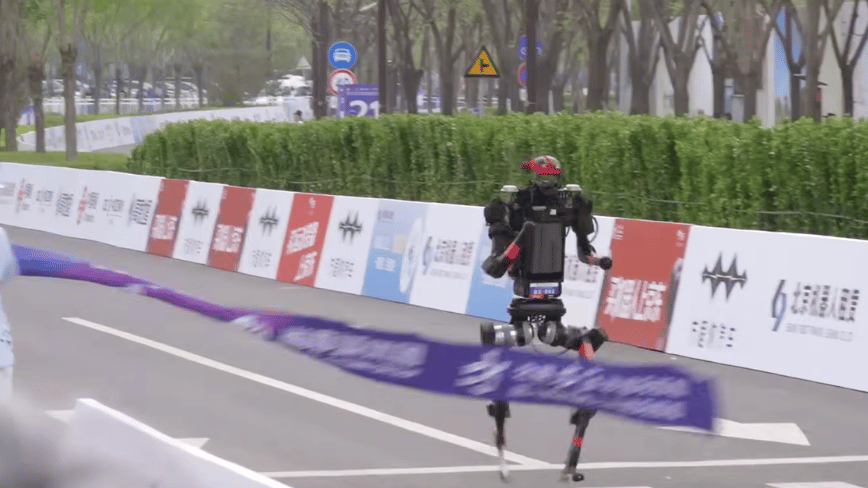
A humanoid robot named Lightning completed the Beijing E-Town Half-Marathon today in 50 minutes and 26 seconds, beating the human world record by nearly seven minutes. The robot, built by Shenzhen Honor Smart Technology Development Co., navigated the 21-kilometre course autonomously, without remote control, using multi-sensor fusion and real-time decision-making algorithms. A second Lightning unit, this one remotely controlled, crossed the finish line even faster at 48 minutes and 19 seconds. The human half-marathon world record is 57 minutes and 20 seconds, set by Uganda’s Jacob Kiplimo in Lisbon on 8 March.
The robots and the roughly 12,000 human runners followed the same route but competed in separate lanes. The human race was won by Zhao Haijie of China in 1 hour, 7 minutes, and 47 seconds. The robot race was won by a machine that stands 169 centimetres tall, has an effective leg length of 95 centimetres designed to mimic elite human runners, generates 400 newton-metres of peak torque, and uses a proprietary liquid cooling system with a heat exchange flow rate exceeding four litres per minute, technology borrowed from Honor’s smartphone division.
The scale of the event
This was the second edition of the Robot World Humanoid Robot Games Half-Marathon, co-hosted by the Beijing Municipal People’s Government and China Media Group. The first, held on the same date last year, was riddled with mishaps. Only six of 21 robotic runners completed the course. Several stumbled, careened out of control, or simply lay down at the starting line. The winner, a Tiangong Ultra robot, finished in 2 hours, 40 minutes, and 42 seconds.
The 2026 edition was a different event in almost every respect. One hundred and twelve teams from 26 brands entered, fielding more than 300 individual robots, including five international teams from Germany, France, and Brazil. Roughly 40% of the teams competed in the autonomous navigation category, in which robots must navigate the course without human input. Remote-controlled teams had their net times multiplied by a 1.2 coefficient, a 20% penalty designed to encourage autonomous capability. All three podium finishers in the autonomous category were Honor robots, and all three posted times faster than the human world record.
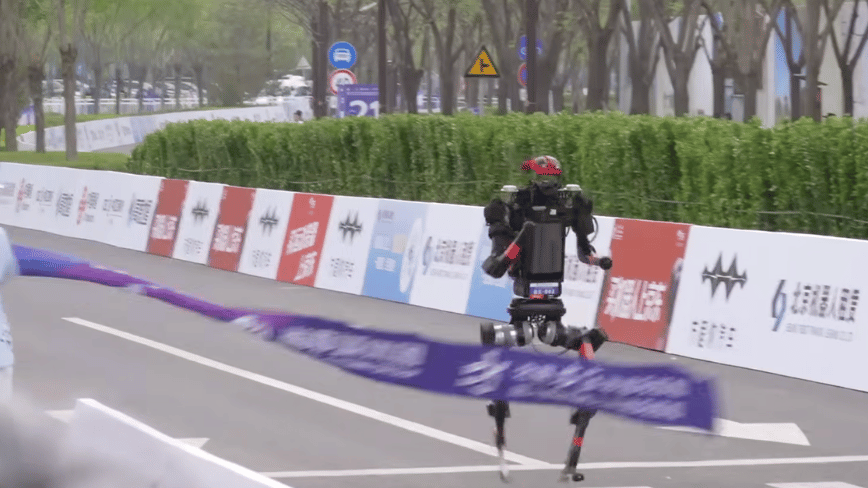
The improvement from 2025 to 2026, from six finishers out of 21 to more than 100 teams competing with autonomous navigation, represents the kind of year-over-year progress that makes the event significant beyond spectacle. Lightning still collided with a barricade near the finish line and fell, requiring staff to help it back up before it completed the race. Another robot fell at the start line. But the failures were exceptions rather than the norm, a reversal from last year.
Advertisement
Who built the winner
Honor, the smartphone manufacturer spun off from Huawei in 2020, is the first major phone company to enter the humanoid robotics market. It unveiled its humanoid robot programme at Mobile World Congress on 1 March and committed $10 billion over five years to AI development. The company says Lightning’s running speed of four metres per second is 14% faster than Boston Dynamics’ Atlas. The entire development-to-marathon-entry process took one year.
Du Xiaodi, an Honor engineer on the winning team, said the competition’s value lies in technology transfer: “Looking ahead, some of these technologies might be transferred to other areas. For example, structural reliability and liquid-cooling technology could be applied in future industrial scenarios.” The race functions as a forcing function for locomotion, balance, navigation, and endurance, the same capabilities required for factory floors, construction sites, and eventually domestic environments.
China’s humanoid robot industry
The marathon is a showcase for an industry that China is building with the kind of coordinated state investment it previously applied to electric vehicles and solar panels. The 15th Five-Year Plan, covering 2026 to 2030, elevates robotics and “embodied intelligence” to one of the country’s top ten “new industry tracks.” The government has committed a one-trillion-yuan ($138 billion) state-backed fund to humanoid robots, industrial automation, and embodied AI. In February, the Ministry of Industry and Information Technology unveiled the “Humanoid Robot and Embodied Intelligence Standard System,” drafted by more than 120 research institutions and manufacturers, with a roadmap to push Chinese standards into ISO and IEC international adoption by 2028.
MIIT describes humanoid robots as “the next groundbreaking innovation following computers, smartphones, and new-energy vehicles.” The industry is projected to surpass 20 billion yuan ($2.8 billion) in scale by the end of this year.Chinese companiesalready dominate production. AGIBOT shipped more than 5,000 units in 2025. Unitree Robotics shipped 5,500. UBTech shipped more than 1,000 and plans to reach 5,000 this year and 10,000 in 2027. Chinese firms accounted for nearly 90% of global humanoid robot shipments last year. By comparison, Boston Dynamics, Figure AI, and Agility Robotics each shipped approximately 150 units.
Advertisement
The gap between running and usefulness
The question the marathon raises is whether speed on a road translates into capability in a factory or a home. Western humanoid robot companies, includingTesla with Optimus, Figure AI, andthose supplying BMW, have emphasised dexterity and manipulation: picking up objects, assembling components, navigating cluttered indoor environments. Chinese companies have invested heavily in bipedal locomotion and speed, which produces more dramatic demonstrations but addresses a narrower slice of the problem.
The global humanoid robot market is projected to reach somewhere between $6.5 billion and $15 billion by 2030, depending on the research firm, with Goldman Sachs estimating $38 billion by 2035. The spread in projections reflects genuine uncertainty about how quickly robots that can run a half marathon will learn to do things that people will pay for. Industrial deployment is advancing: Figure 02 completed an 11-month pilot at a BMW plant, moving more than 90,000 components. But the gap between a controlled factory deployment and the kind of general-purpose humanoid robot thatChina showcasedat its Spring Festival Gala remains wide.
Lightning’s 50-minute half-marathon is a genuine engineering achievement. A robot that navigates 21 kilometres autonomously, maintains balance at 25 kilometres per hour, manages thermal loads through liquid cooling, and recovers from a collision with a barricade has demonstrated capabilities that did not exist in any humanoid platform a year ago. The question is not whether the technology is impressive. It is whether the country investing $138 billion in it will find applications that justify the spending before the rest of the world catches up ona different approachto the same problem.

















































You must be logged in to post a comment Login