The biotech industry’s engineered cells could become an $8 trillion market by 2035, notes Phys.org. But how do you keep them from being stolen? Their article notes “an uptick in the theft and smuggling of high-value biological materials, including specially engineered cells.”
In Science Advances, a team of U.S. researchers present a new approach to genetically securing precious biological material. They created a genetic combination lock in which the locking or encryption process scrambled the DNA of a cell so that its important instructions were non-functional and couldn’t be easily read or used. The unlocking, or decryption, process involves adding a series of chemicals in a precise order over time — like entering a password — to activate recombinases, which then unscramble the DNA to their original, functional form…
They created a biological keypad with nine distinct chemicals, each acting as a one-digit input. By using the same chemicals in pairs to form two-digit inputs, where two chemicals must be present simultaneously to activate a sensor, they expanded the keypad to 45 possible chemical inputs without introducing any new chemicals. They also added safety penalties — if someone tampers with the system, toxins are released — making it extremely unlikely for an unauthorized person to access the cells.
“The researchers conducted an ethical hacking exercise on the test lock and found that random guessing yielded a 0.2% success rate, remarkably close to the theoretical target of 0.1%.”
We spotted the Aceii One while wandering the halls at Beyond Expo 2026, and it’s hard to slot it neatly into the usual “ball machine” category.
The Aceii One positions itself as a smart tennis partner rather than a feeding device, combining ball launching, AI vision tracking, coaching tools, and gamified training modes into a single mobile platform. The pitch is ambitious: replace predictable drills with something closer to a live rally that adapts to your level.
At the core is a dual-stage launch system that fires balls at intervals of up to 0.5 seconds, with speeds up to 80 mph (129 km/h). That alone puts it in serious training territory, but the differentiator is how it behaves between shots.
Thanks to its vertical dual-camera vision system, Aceii One tracks both player movement and ball trajectory in real time. It claims detection of shots up to 130 mph, using 1080p cameras and a 100° field of view. In practice, this lets it reposition, adjust feeds, and simulate rally patterns instead of just firing fixed sequences.
Advertisement
It also moves. A differential drive base lets it roll across court surfaces at up to 3.5 m/s, shifting between baseline, sideline, and service-line positions. In theory, that removes one of the biggest limitations of traditional machines: static placement.
Advertisement
Where Aceii One diverges most clearly from conventional hardware is its software. It doesn’t just offer drills; it builds structured “play.” It includes three main modes: Ranking Mode, which assigns an NTRP-style level and tracks progression; Challenge Mode, which unlocks new objectives as you improve; and Battle Mode, which simulates opponents using stored or shared play profiles.
The system turns repetition into progression by layering scoring, tiers, and unlocks on top of normal training. There’s also a coaching layer via the ACEII app, which builds structured courses and feeds them into practice sessions. It can analyse shot placement, spin, consistency, and speed, then adjust future drills accordingly.
Advertisement
However, the most interesting claim here is real-time coaching. Every shot is said to be analysed, with feedback covering placement, spin rate, and timing. It can identify errors and suggest corrections in the next drill cycle rather than after the session ends. There’s also a “Match Play” system that shifts training into competitive formats with scoring and adaptive difficulty, based on your NTRP range (1.0 to 5.0). It’s closer to a hybrid of training machine and interactive simulator than anything currently offered by consumer tennis equipment.
Physically, Aceii One is built around portability. It uses a foldable suitcase-style chassis, weighs around 25kg, and carries up to 120 balls. The design includes foldable legs, integrated storage, and a detachable ball container. Battery life ranges from two hours in motion to eight hours in stationary feeding, with a full recharge in around two hours. It also includes safety features like instant obstacle detection and automatic feed shutdown.
Aceii One is trying to move tennis robotics away from predictable repetition into something closer to adaptive training intelligence. Whether it fully replaces a coach is doubtful, but it clearly pushes beyond the traditional “ball launcher with settings” category.
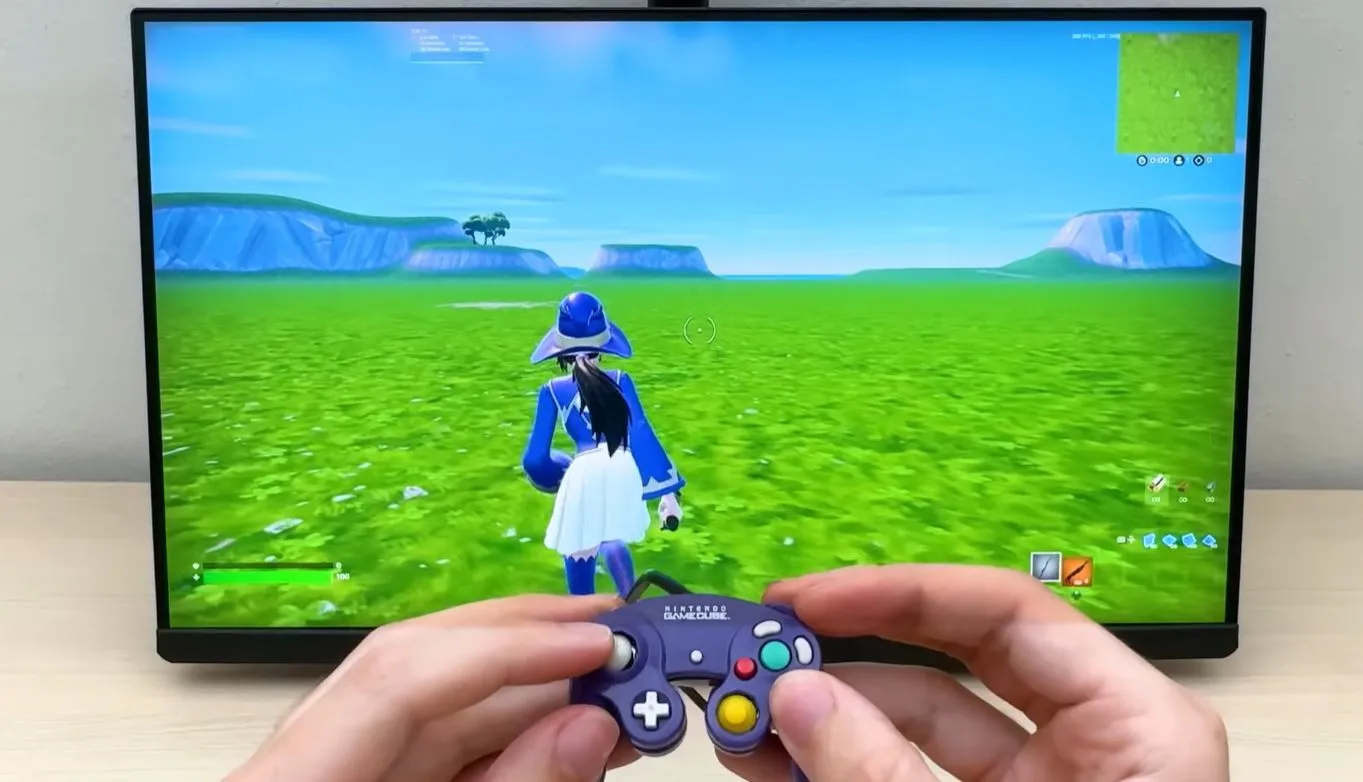
Mini game controllers with buttons and joysticks that move like the real deal are a pretty cool keychain and fidget toy, but at least for some of us there’s this intrusive thought that tells us that it would be so much cooler if it actually was a functional game controller. Enter [Brux] tearing into a miniature GameCube controller and adding the required guts.
The keychain/fidget toy is made by Backpack Buddies and is one of a range of similar toys that feature buttons you can press and joysticks that move, giving a pretty good start on the externals of the controller. Once cracked open at the seam, some interior redecorating had to be performed to clear space and add something to mount switches onto. Here [Brux] opted to glue SMD switches to custom 3D components in lieu of a PCB. These were subsequently wired up with thin enameled wire, before attaching the original buttons to them following some more plastic surgery.
Some tiny joystick innards were then installed before gluing on the final buttons and joystick caps. As for how it all connects to a real GameCube, here an RP2040 was used to handle the translation of control inputs to the GameCube controller protocol. Then a GameCube controller was sacrificed for its cable and controller connector, but as can be seen in the video it does all work and creates the perfect controller for guests.
Identical posts from Nvidia, Arm, and Microsoft contained the words “A new era of PC,” followed by the coordinates “25.0528, 121.5990,” which map to the Computex 2026 venue in Taipei. The cryptic posts can be seen as early confirmation that Nvidia is finally ready to support Windows’ push into Arm chipsets. Read Entire Article Source link
At 620 million monthly users, calling a frontier model for every image recommendation isn’t a strategy — it’s a bill. Pinterest CTO Matt Madrigal solved it by gutting Qwen3-VL’s vision layer and rebuilding it with proprietary embeddings, cutting costs 90% and boosting accuracy 30%.
Madrigal’s team has been heavily investing in customizing open-source models “foundationally in-house.”
“If you’ve got really unique data that you can then fine-tune an open source model with, data quality will, frankly, outweigh or overcome model size,” Madrigal explained in a recent VB Beyond the Pilot podcast.
Advertisement
How Pinterest customized Qwen for visual discovery
Pinterest, which has around 620 million monthly active users, has long applied open source models for visual search and discovery, going back to Google’s BERT and OpenAI’s CLIP. The company fine-tuned its own Pin CLIP on the latter, incorporating proprietary visual embeddings and image metadata.
Pinterest’s conversational shopping assistant, Navigator 1, was built on Qwen3-VL and customized in “pretty significant” ways. Madrigal’s team essentially “ripped out” Qwen’s vision encoder layer and fine-tuned the model on proprietary multimodal embeddings. This has allowed them to capture metadata around pins and images that can then be precomputed offline and regularly retrained on new information to deliver personalized experiences.
“Open-source models, especially with open Apache licenses where you can truly tweak a lot of open weights and customize for unique use cases — that’s where we’ve found open source to be so powerful for us,” Madrigal said.
Bringing their own embeddings allows his team to gain context around metadata, pins, and images; also, notably, the model performs better at runtime and inference. Without these embeddings, devs would have to call and encode each image returned at runtime, one at a time. That results in a latency “20 times worse” from an inference perspective, Madrigal said.
Advertisement
“If it’s something that’s going to be critical for our end users, that’s going to drive engagement, that will have to scale to over 600 million monthly active users, we’re going to either probably build it or we’re going to leverage open source and customize the heck out of it,” he said.
VB Transform · July 14–15 · Menlo Park · Agentic orchestration
Intuit rebuilt its multi-agent system in 60 days. What did they change — and why?
At Transform, engineering leaders from Intuit, Target, and Instacart break down how they redesigned their orchestration architectures for reliability, scale, and real customers.
To guide users from inspiration to purchase, Madrigal’s team built a “taste graph”: a dynamic representation of what individual users actually like, not just what they click on. “It’s this representation of billions of people’s evolving tastes,” he said.
People go to Google or other search engines when they have a clear picture of what they want; Pinterest is for when they’re still in the discovery phase, Madrigal said. Pinterest’s goal is to encourage “lateral exploration” and transform discovery to intent (that is, clicking through ads or making purchases).
Under the hood, the architecture combines a graph structure with representational learning. User embeddings capture a user’s evolving tastes. These are constantly updated based on activity and new content and signals. “It’s not a social graph,” Madrigal said. “It’s much more of a preference graph: What’s going to inspire you? What are you trying to do next?”
For instance, one user may be into mid-century modern designs; another may prefer a Nantucket aesthetic. Those preferences will be captured in user embeddings, and the taste graph will deliver up specific, relevant products as a result.
Advertisement
“You go from the upper funnel, inspiration discovery, all the way through lower funnel intent,” Madrigal said.
Listen to the full podcast to hear more about:
How Pinterest uses sandboxes to encourage creativity in a way that is secure and contained;
Why a continuous feedback loop can prevent visual AI slop;
The importance of constant benchmarking to gauge user engagement, performance, latency, and other factors.
‘Most likely, you won’t see it on a Leica M camera’: Leica hints that generative AI tools like Gemini Omni are at odds with its photography heritage, but says they ‘make perfect sense’ for phones like the Xiaomi 17T Pro
These days, it’s not uncommon for phones to share two big selling points: a partnership with a trusted photography brand and flashy AI features. The Xiaomi 17T Pro, launched this week in Vienna, is no different, boasting Leica-tuned cameras and fresh new AI skills from Google‘s text-to-video tool, Gemini Omni.
Of course, Leica is a storied brand with 157 years of history — so how does Omni’s presence on the Xiaomi 17T Pro sit with this photography heritage?
At a post-launch roundtable attended by TechRadar, the German camera giant — which has been collaborating with Xiaomi since 2022 — shared its take on the utility of generative AI, and its remarks were decidedly diplomatic.
Google’s Erin Pettigrew demonstrating Gemini Omni at Xiaomi’s Vienna launch event (Image credit: Future)
For context, at the launch itself, Google made a cameo appearance to reintroduce Gemini Omni, which debuted at Google I/O 2026 earlier this month and is available on compatible Android phones, including the Xiaomi 17T series.
Advertisement
Latest Videos From
On stage in Vienna, Erin Pettigrew, Director of Product Experience at Gemini, generated a postcard-style video of herself enjoying the city’s cafe culture “to send back to [her] friends and family,” presumably because doing so was easier than filming an actual video of herself enjoying Vienna’s cafe culture.
Here’s what Leica had to say about generative AI tools like Omni:
“The philosophy of Leica is always to create authentic images; real images that really replicate reality,” said Marius Eschweiler, VP of Business Unit Mobile at Leica. “I think there is a little difference between customers who are choosing [to use] a smartphone for taking images [and traditional photographers], and I think we are offering smartphone users a good Leica experience with different Leica modes that are focused on authenticity.
Advertisement
“But there are also use cases [for generative AI], like this cute video postcard Erin [Pettigrew] presented. This is just a different use case. Whether you want to take a serious image or create something with generative AI — I think that’s a different use case. Most likely, you won’t see it on a Leica M camera, but I think on a Xiaomi 17T series, it makes perfect sense.”
Sign up for breaking news, reviews, opinion, top tech deals, and more.
Leica’s Head of Development and Engineering for Mobile, Pablo Acevedo Noda, was also keen to point out that Leica offers a Content Credentials feature, which embeds a digital signature into photos taken with Leica hardware — including the best Xiaomi phones — to verify their authenticity.
A photo taken on the Leica-tuned Xiaomi 17T Pro (Image credit: Future)
“Adding Content Credentials to photos taken with the phone prevents somebody from tampering with the photo afterwards — [or at least] you’ll know that it has been tampered with,” Noda explained.
Advertisement
“Sometimes, it will be obvious — if you add something special with Nano Banana, for example — but sometimes, it will not be obvious. The metadata will have that information there. That’s the important part.”
In a similar vein, Google announced a major upgrade for its Verify AI tool at I/O 2026 to show that it too is concerned about preserving authenticity and combating misinformation (though that feels a little bit like an arms dealer preaching to the masses about gun safety).
The sticky relationship between photography and generative AI has been a topic of conversation for several years now. I’ve asked the likes of Samsung, Qualcomm, and Honor for their thoughts on the subject in the past, and while some of those companies have been looser with their definition of ‘photography’ than others (in the early days of Galaxy AI, Samsung told me “there’s no such thing as a real picture”), most seem to agree that there is a place for generative AI tools in photography, as long as they’re presented to users as a choice.
Advertisement
Of course, there’s a big difference between AI-enhanced photo tweaks and a full-blown text-to-image machine like Gemini Omni, but it’s clear that tech companies are aware of (and in many cases, reacting to) consumer concerns surrounding AI.
My hunch is that Leica — a 157-year-old camera maker — has its own private thoughts about tools like Gemini Omni, but diplomacy prevails when multiple companies are involved in producing a single smartphone such as the Xiaomi 17T Pro. At least we know that Leica’s traditional M cameras are safe from generative AI for now…
A leaked Meta memo confirms an AI pendant entering testing next year. The company also plans “Wearables for Work” and expanded AI glasses.
Meta is developing an AI-powered pendant that it plans to start testing within the next year, according to an internal memo viewed by The Information. The device builds on the Limitless acquisition Meta completed at the end of 2025. Limitless made a pendant that users could clip to their shirt or wear as a necklace to record and transcribe conversations.
The memo also outlines plans to expand Meta’s AI glasses lineup and launch a business subscription called Wearables for Work. The enterprise tier would position Meta’s hardware as a productivity tool rather than a consumer novelty. Reality Labs, Meta’s hardware division, lost $4 billion in Q1 2026 alone.
The AI pendant category has a troubled history. Humane’s AI Pin launched in 2024 to withering reviews and was effectively dead within a year, with HP acquiring the startup’s assets for $116 million. Friend, another AI pendant startup, spent more than $1 million on subway advertisements and struggled to find users. Neither device offered enough utility to justify wearing an additional gadget.
Meta’s approach is different in one important respect. It already has a wearables business that works. Meta sold more than seven million Ray-Ban smart glasses in 2025 and commands roughly 82% of the smart glasses market. The pendant would be a second form factor in an ecosystem that has proven consumer demand, not a standalone product betting on a category that does not yet exist.
Advertisement
Limitless raised more than $33 million from investors including Sam Altman and Andreessen Horowitz before Meta acquired it. CEO Dan Siroker said at the time that Meta’s vision for “personal superintelligence” through wearables aligned with what Limitless was building. The startup stopped selling devices to new customers after the acquisition but continued supporting existing users.
The Wearables for Work subscription is the most commercially interesting detail in the memo. Meta’s glasses already integrate with Meta AI for voice queries, real-time translation, and visual identification. An enterprise tier could add meeting transcription, ambient note-taking, CRM integration, and hands-free access to workplace tools. The concept mirrors Microsoft’s Copilot subscription model but delivered through hardware rather than software.
The wearables market is fragmenting into distinct categories. Apple Watch dominates the smartwatch segment but is losing momentum to screenless health trackers. Oura has filed for IPO. Whoop and Google’s Fitbit Air emphasise passive data collection. Meta’s pendant would sit in a fourth category: ambient AI capture, the always-on recording device that supplements rather than replaces a phone.
The privacy implications are significant. Meta’s Ray-Ban glasses have already faced lawsuits and regulatory scrutiny over how they handle footage captured by their built-in cameras. A pendant that records conversations raises the same concerns in a more intimate form factor. The regulatory environment in the EU, where Meta faces ongoing DMA enforcement and GDPR scrutiny, could constrain where the device is sold.
Advertisement
Meta’s hardware strategy is now spread across glasses, pendants, a planned smartwatch codenamed Malibu 2, VR headsets, and the Vision Pro competitor. The company is betting that AI wearables will reverse Reality Labs’ cumulative losses, which have exceeded $60 billion since the division was created. The pendant is one piece of that bet. Whether it succeeds where Humane and Friend failed depends on whether Meta can make ambient AI recording useful enough that people will wear it, and trustworthy enough that the people around them will tolerate it.
We spend hours testing every product or service we review, so you can be sure you’re buying the best. Find out more about how we test.
LG B6 OLED TV: Two minute review
The LG B6 is the entry-level OLED TV in LG’s 2026 TV lineup. While it provides a brightness boost over its predecessor, the LG B5, which I rated as one of 2025’s best TVs, the LG B6 doesn’t deliver the full and clear upgrade I was hoping for.
The LG B6 has a full suite of features and still delivers great performance, but as long as the LG B5 remains in stock and is less expensive, the new model is held back from being an unqualified pick by a few issues.
Advertisement
The biggest change over the B5 is the B6’s higher brightness. Bright scenes have more impact, highlights are mostly punchier and colors benefit, looking that little more vibrant. Contrast is powerful and appears stronger thanks to the brightness increase, while textures are crisp, as you’d expect from the best OLED TVs.
Latest Videos From
However, the LG B6 had more of a green tint than its predecessor when compared side-by-side. This meant that despite its improvements, the B6’s picture wasn’t the full step-up over the B5 that I was looking for — it giveth on one hand, and taketh on the other. Viewed in isolation, the B6 is still a great looking TV, though — the thing about slightly color tints is that your eye gets used to them quickly and then you can just focus on the image.
Much like previous years, the B6’s 2.0 channel speaker system is solid for day to day viewing with clear speech and it is accurate with some solid detail for movies. Bass however is limited and the soundstage is narrow. If you’re after the cinematic experience and want the sound to match the picture, I’d add one of the best soundbars.
The B6 is easily one of 2026’s best gaming TVs. It has a full array of features on all four HDMI ports — 4K 120Hz, full variable refresh rate options, HGiG, auto low latency mode, Dolby Vision Gaming — and has four HDMI 2.1 ports. An 8.9ms measured input lag means performance is smooth with razor-sharp response time, and the picture looks superb while gaming. If you’re looking for a gaming OLED, this is an excellent choice.
Advertisement
The webOS 26 smart TV software doesn’t reinvent the wheel compared to webOS 25, but it didn’t need to. What webOS 26 does is make navigation easier with a new menu layout, more Quick Cards and more customization. While the banner ad on the home screen is annoying, it’s the only wrinkle in webOS 26, which I rate as one of the best smart TV platforms on offer.
Sign up for breaking news, reviews, opinion, top tech deals, and more.
But as I alluded to above, while I think the B6 is a great TV overall, the B5 is definitely the better option while it’s available. The 65-inch B6 I tested costs $1,999 / £2,399 / AU$3,295 (with a cheaper B6E option available for £1,799 in the UK).
While this is a decent price and similar to the B5’s launch prices, the B6 doesn’t change enough to recommend it over the B5 if you’re buying around its launch time. If it’s a great-value entry-level OLED you want, I’d spend less on the LG B5.
Advertisement
If you have the budget right now, I’d definitely opt for the LG C6 (65-inch model priced at $2,699 / £2,599 / AU$3,995) as my preferred choice. It’s the best upgrade to LG’s OLED lineup in 2026, and provides even better brightness and picture than the B6, but with impeccable colors.
LG B6 review: Prices & release date
The LG B6 delivers deep black tones and crisp textures (Image credit: Future)
Release date: May 2026
48-inch: $TBA / £1,299 / AU$1,995
55-inch: $TBA / £1,599 / AU$2,495
65-inch: $1,999 / £2,399 / AU$3,295
77-inch: $,2799 / £TBA / AU$TBA
83-inch: $4,499 / £TBA / AU$TBA
The LG B6 is the entry level OLED in LG’s 2026 OLED TV lineup, sitting below the mid-range LG C6 and flagship LG G6 and LG W6 (also known as the Wallpaper). The 65-inch model I tested costs $1,999 / £2,399 / AU$3,295 officially, which is the same launch prices as last year’s LG B5.
It’s worth noting that in some regions there are two LG B6 models: the B65 and the B6E. I asked LG what the differences between the two are, and it said the B6E does not have the following features: Precision Picture Master Pro, Precision Sound Master Pro, and it does not have the marble effect design on the back.
Advertisement
Other than this they should be the same, making the B6E by far the better deal, because I don’t particular rate these features, LG’s suggestion is that they have the same panel and Dolby Vision support otherwise. A 65-inch LG B6E model costs £1,999 in the UK, a full £400 cheaper.
LG B5 review: Specs
Swipe to scroll horizontally
Screen type:
OLED
Advertisement
Refresh rate:
120Hz
HDR support:
Dolby Vision, HDR10, HLG
Advertisement
Audio support:
Dolby Atmos
Smart TV:
webOS 26
Advertisement
HDMI ports:
4x HDMI 2.1
Built-in tuner:
ATSC 1.0 (US)
Advertisement
LG B6 review: Benchmark results
Image 1 of 2
The above EOTF graphs show the accuracy of the LG G6 for hitting different HDR brightness levels in grayscale. The closer to the yellow line, the more accurate the TV is. The above measurements were taken with the B6 in its out-of-the-box Filmmaker Mode. On the next slide is the results for Cinema Home mode. (Image credit: Future)
(Image credit: Future)
Image 1 of 2
Spectral power distribution refers to the intensity of light that a source will display at various wavelengths of color. It can reveal how accurate a source can show color at different light levels, and can be instructive to understand how a TV’s panel handles color. This shows the B6 in Filmmaker Mode, Check the next slide for Cinema Home mode.(Image credit: Future)
(Image credit: Future)
LG B6 review: Features
The B6 has a good number of features, including four HDMI 2.1 ports (Image credit: Future)
Alpha 8 AI Gen 3 processor is a good mid-range processor
4K 120Hz, FreeSync and G-Sync across all four HDMI 2.1 ports
Higher brightness than the LG B5
The B6 uses a W-OLED panel, much like its predecessor. However, there has been a brightness boost (I’ll get into that below in the Picture Quality section) that would suggest it’s using the new OLED SE panel: a cheaper, brighter WOLED panel that we saw in action in the Panasonic Z86C, which is that company’s new entry-level OLED for 2026.
The B6 comes with the Alpha 8 AI Gen 3 processor, which introduces a couple of new picture and sound tools such as the Precision Picture Master Pro and Precision Sound Pro, which both aim to upscale picture and audio respectively. It’s worth noting the B6E, a cheaper B6 model available in some regions including the UK, does not support these features.
Advertisement
The B6 supports Dolby Vision HDR and Dolby Atmos for enhanced audio, but it does not support HDR10+ or DTS, the same as 2025. LG says it currently has no plans to support Dolby Vision 2. The B6 also supports Chromecast and AirPlay 2.
For audio, the B6 has a built-in 2.0 channel, 20W speaker system: the same as the B5 from last year. This year, much like the LG G6 and C6, the number of sound presets has been reduced to four, including AI Sound Pro, and Clear Voice for dialogue enhancement.
The B6 uses webOS 26, which introduces some refined AI features, such as AI concierge which now uses AI companions such as Gemini for lifestyle uses such as planning trips. The menu layout has also been re-ordered in order to prioritize major settings such as Energy Saving and Network.
For gaming, the B6 carries over the same features from the B5: 4K 120Hz, full VRR support including both FreeSync and G-Sync, auto low latency mode and Dolby Vision Gaming, all featured on four HDMI 2.1 ports. Game Optimizer returns with additional settings for gaming, including the Prevent Input Delay option.
Advertisement
LG B6 review: Picture quality
The B6 has some seriously bold colors, shown best in animated movies like Elemental (pictured) (Image credit: Disney / Future)
Brighter than its predecessor
Crisp detail and strong contrast
Green tint visible in some scenes
Starting with measurements, the biggest difference between the B6 and last year’s B5 is the boost in HDR peak brightness. The B6 measured 835 nits in Filmmaker Mode, 895 nits in Cinema mode and 740 nits in Standard mode. These are big jumps over the B5’s 668 nits in Cinema mode and 637 nits in Standard mode.
For fullscreen HDR brightness, the jump hasn’t been quite as significant, with the B6 measuring 154 nits in Cinema Home, compared to 131 nits of the B5 in the same mode. In fact, there was even a drop in Standard mode, with the B6 measuring 150 nits compared to the B5’s 172 nits.
Moving to real-world testing, I found myself switching between Filmmaker Mode and Cinema Home depending on the content. Both picture modes looked good, but Filmmaker Mode suited darker, more contrast-y scenes, while Cinema Home looked great with colors and animation.
The B6 did a good job with SDR content. Watching an HD stream of Fight Club on Disney Plus, it upscaled textures to give them a crisper look and added some brightness that delivered stronger perceived contrast compared to some cheaper TVs I’d done this test on.
Advertisement
With lower-resolution content, such as YouTube videos, the B6 did a decent job upscaling textures and boosting colors to give them a better look, but ultimately the image didn’t hit 4K levels. There is a Precision HDR Master Pro setting in the main B6 model (not the B6E) which did sharpen textures when activated, but it was too artificial for my liking.
Watching a desert scene from Lawrence of Arabia, the white sands of the desert did indeed look brighter on the B6 compared to the B5 when I compared the two side by side, showing the brightness boost was real.
The B6 has received a brightness boost which is best shown in scenes with a lot of white tones, such as the scene from Lawrence of Arabia (pictured) (Image credit: Sony Pictures / Future)
In Dark City, as John is in the automat, the highlights from the overhead lights and the yellow walls also looked brighter on the B6.
However, during my B6 and B5 comparison, the scene from Dark City was the first to tip me off on a potential issue with the B6: green tint. The yellow walls of the automat seemed to have a green hue on them on both the B6 and B5, but it was more noticeable on the new model.
Advertisement
The B6 demonstrated strong contrast with deep dark tones in high contrast scenes. It also had a higher perceived contrast over the B5 thanks to the brightness boost. In The Batman, as Batman wanders the crime scene in Mayor Mitchell’s house, the balance between the light tones from the lamps on the wall and the dark tones of the dark-panel wood walls was excellent.
Unfortunately, The Batman also exemplified the green tint issue on the B6 compared to the B5. In the subway scene, the rear walls looked more green on the B6, looking like the gray I expected on the B5. Maybe I got unlucky with my review unit, but it was definitely worth noting as green tint has been a criticism of LG’s OLED TVs before.
Image 1 of 2
While the B6 shows strong contrast in The Batman (pictured), this subway scene does show the B6 has a green tint — click to see it compared to the B5(Image credit: Warner Bros. / Future )
The LG B6 (left) and LG B5 (right)(Image credit: Warner Bros / Future )
The B6 delivers bold, rich colors that benefitted from the new brightness boost. A Dolby Vision stream of Elemental on Disney Plus really showcased them, with the blues of Wade and his family, and the oranges and reds of Ember dazzling on screen. As Ember mends a vase, the purples and oranges of the new vase glistened, showing strong highlights.
In the ‘Wizard and I’ scene, as Elphaba stands under a tree with pink flowers, said flowers popped on screen, but still had great color depth.
Advertisement
(Image credit: Universal Pictures / Future)
The B6 delivered a measured HDR color gamut coverage of 97.4% of the DCI-P3 and 72.5% of the BT.2020 color spaces. While these aren’t bad results (we have a 95% threshold for DCI-P3, and are generally happy with a score above this), these numbers were oddly lower than the B5’s. The B5 had measured results of 99.5% and 74.85% in the DCI-P3 and BT.2020 color spaces respectively.
Viewed in isolation, the B6’s colors and contrast were actually very good but it just seemed a shame that I knew how good the B5 looked in comparison in some scenes. With the added brightness, I was hoping for a bigger picture upgrade.
Outside of this, the B6 showcased excellent textures, striking a nice balance between crisp and natural. Throughout my testing, people’s skin looked realistic while finer details such as hair appeared refined.
Much like the G6 and the C6, the B6 benefitted from using the TruMotion feature. For movies, Cinematic Movement was more than enough, reducing judder in a panning shot of a cliffside cemetery in No Time To Die. With sports, the Natural motion setting worked better, doing more smoothing and judder reduction which worked better.
Advertisement
The B6’s screen is however prone to mirror-like reflections, especially with darker scenes. Even some brighter, more colorful scenes struggled under our testing lab’s overhead lights in Filmmaker Mode. It would be nice to see some more effective anti-reflection measures brought to the B6, as I know it’s possible from my review of the LG G6.
Picture quality score: 4.5 / 5
LG B6 review: Sound quality
The B6’s built-in sound is fine for casual viewing, but are lacking for cinematic scenes like the Batmobile chase from The Batman(Image credit: Warner Bros. / Future)
2.0 channel, 20W speakers
Decent sound overall but definitely benefits from a soundbar
Fewer sound modes than last year
The B6 comes with a 2.0 channel, 20W speaker system and supports Dolby Atmos (but not DTS). LG has reduced the number of sound presets from previous years, dropping the number from eight to four.
These four presets are Standard, AI Sound Pro, Clear Voice Pro and Sound Wizard. As my go-to Cinema preset had been removed, I opted for my backup: AI Sound Pro.
Watching the Batmobile chase scene from The Batman, the B6 showcased accurate image mapping, accurately following the direction of swerving traffic and the bullet sprays from the Penguin’s gun.
The same was true playing BattlefieldV, as the B6’s speakers did a good job picking out subtle effects such as the crunching leaves underfoot in a forest mission.
Advertisement
Speech was clear enough throughout my testing as well, with most dialogue easily audible over the rest of the soundtrack.
Due to its limited 2.0 channel speaker system however, the sound doesn’t match the picture in quality. Bass felt very contained and while there was some rumble as the Batmobile ignited its engine, it felt thin in places.
The soundstage also felt narrow, never truly extending beyond the confines of the screen. Atmos effects, such as the rain in The Batman, felt limited too. I’d recommend a soundbar if you want sound impact to match the quality of the visuals.
Sound quality score: 3.5 / 5
LG B5 review: Design
The B6’s feet are made of plastic, a step down from the B5. Although the B6 still feels well built (Image credit: Future)
Mostly premium build
Feet are plastic this year instead of metal
UK Magic Remote could do with an update
The 65-inch B6 I tested had a mostly premium build and design. It has a trim frame and near bezel-less screen allowing the picture to be the focal point. While it’s a small touch, the marble effect on the rear panel made it feel a little more premium, although it’s again worth noting this is only on the main B6 model and not the cheaper B6E.
One thing I was disappointed to find was that the B6 unit I was testing had plastic feet, compared to the B5’s metal feet. While the plastic feet were more than sturdy enough, it did detract from the B6’s overall premium design.
Advertisement
LG’s Magic Remote hasn’t had many updates in recent years in the UK other than the re-arranging and addition and removal of certain buttons, with the AI button taking center stage this year, and it could do with a refresh.
The US has the sleeker AI Smart Remote, but again when brands like Sony, Philips and Hisense offer more heavy duty, metal remotes, LG’s offering could be a bit more premium.
LG B6 review: Smart TV & menus
LG’s webOS 26 is easily one of the best smart TV platforms around (Image credit: Future)
Uses LG’s webOS 26 smart TV platform
Streamlined menus and more Quick Cards for easy navigation to key options
Ads are annoying, but equivalent to other platforms
The B6 uses LG’s own webOS 26 as its smart TV platform. While webOS 25 was about the introduction of AI features — such as AI Concierge, for content recommendation and information, and AI Search, for advanced content searching — webOS 26 looks at refining menus for easier navigation while adding some new features.
Quick Cards, a place where relevant apps are organized by categories such as Sports, Game and Office, are back and some new ones have been added including Learning.
The Quick Menu, where picture and sound modes can be altered super-quickly without getting deep into menus, continues to be one of the webOS’ standout features.
Advertisement
webOS 26 is also very easy to navigate, with an intuitive menu layout that’s been re-organized for this year to make access to settings such as Energy Saving and Network easier, and these small changes have made navigation even smoother.
Unfortunately, the home page still features a large banner ad space at the very top of the screen which does push down the apps a bit. This is fairly common among modern smart TV platforms however and this is my only real complaint with webOS 26. It’s still one of the best OS on the market.
Smart TV & menus score: 5 / 5
LG B6 review: Gaming
The B6 is a superb gaming TV, expertly handling fast-paced games like Battlefield V (pictured) (Image credit: Future)
4K 120Hz and full variable refresh rate support
8.9ms input lag at 60Hz, 4.9ms at 120Hz
Excellent features and performance
The B6 comes with a full suite of gaming features including 4K 120Hz, variable refresh rate including both AMD FreeSync and Nvidia G-Sync, HGiG HDR, auto low latency mode, and Dolby Vision Gaming, with all features supported across four HDMI 2.1 ports.
The B6 had a measured input lag time of 8.9ms at 4K 60Hz (in Boost mode), which is a superb result and up there with the very best gaming TVs. It registered a 4.9ms input lag at 1080p 120Hz.
Gaming performance on the B6 is excellent. Playing a mission in Battlefield V, the B6 handled the chaotic gunfights which involved a lot of quick movement and targeting with ease, with inputs feeling very smooth. As I flew around the desert in a plane, the sudden changes in flight path felt effortless and intuitive.
Advertisement
Battlefield V also looked great on the B6, delivering some nice brightness during the desert mission, with the sun on the horizon showing the B6’s strong HDR highlights. Textures were crisp with some nice detail in the weapons and environments as well.
LG B6 review: Value
The Magic Remote (UK version shown here) could do with an upgrade (Image credit: Future)
Great features and good performance
Not the clear upgrade I wanted
B5 is the better option while available, C6 is better when prices are close
The B6 is an interesting TV when it comes to value. The 65-inch model I tested costs $1,999 / £2,399 / AU$3,295, while the 65-inch LG C6 step-up TV currently costs $2,699 / £2,599 / AU$3,995, meaning the B6 has a good price gap in US and Australia, but it’s close in the UK — too close, frankly.
There’s a good reason to choose the B6 instead of the C6 in the UK and Aus when you’re saving that much, but in the UK I’d absolutely choose the C6 given the close prices. That’s complicated by the existence of the cheaper B6E, which a 65-inch costs £1,799: excellent value for a brand new OLED that size.
That being said, the B6 isn’t the full upgrade I wanted over the B5, unlike the C6 which is a superb upgrade over its predecessor, the C5. While the B6 delivers higher brightness and still excellent picture quality, it has some picture inconsistencies (particularly the green tint) so you’re trading improvements in one area to steps back in another.
Advertisement
As a result, while the B5 is still available, I’d recommend it over the B6. A 65-inch B5 currently costs $999 / £1,199 / AU$2,199, which is a steal for that TV. Stock does seem to be dwindling in some regions already however, and when it disappears, the B6 is worthy of taking its place once it drops in price to the same kind of level.
Ultimately if you want a real upgrade, the C6 is the top dog but if it’s not in your budget, the B6 is still a very good TV.
Should I buy the LG B6 OLED TV?
The B6’s detail is excellent, with textures like the deer’s fur shown looking refined and crisp (Image credit: Future)
Swipe to scroll horizontally
LG B6 scorecard
Attributes
Advertisement
Notes
Rating
Features
Dolby Vision support as well as a full list of smart and gaming features
Advertisement
5 / 5
Picture quality
Solid peak brightness, rich color and contrast, but green tint in some scenes
4.5 / 5
Advertisement
Sound quality
Accurate and clear sound with AI Sound Pro but bass is limited and soundstage is too narrow
3.5 / 5
Design
Advertisement
Good overall build quality but feet feel cheaper than B5 and UK’s Magic Remote needs a refresh
4 / 5
Smart TV and menus
webOS 26 feels intuitive with smooth navigation and a great array if features
Advertisement
5 / 5
Gaming
Extensive list of gaming features including 4K 120Hz, full VRR support and four HDMI 2.1 ports. Great picture and performance to match
5 / 5
Advertisement
Value
A very good TV but B5 is better value and C6 feels like a more worthy upgrade
3.5 / 5
Advertisement
Buy it if…
Don’t buy it if…
LG B6 review: Also Consider
Swipe to scroll horizontally
Header Cell – Column 0
LG B6
LG B5
Advertisement
LG C6
LG G6
Price (65-inch)
$1,999 / £2,399 / AU$3,295
Advertisement
$999 / £1,199 / AU$2,199
$2,699 / £2,599 / AU$3,995
$3,399 / £2,999 / AU$4,999
Screen type
Advertisement
OLED
OLED
OLED (EX)
OLED (RGB Primary Tandem 2.0)
Advertisement
Refresh rate
120Hz
120Hz
165Hz
Advertisement
165Hz
HDR support
Dolby Vision, HDR10, HLG
Dolby Vision, HDR10, HLG
Advertisement
Dolby Vision, HDR10, HLG
Dolby Vision, HDR10, HLG
Smart TV
webOS 25
Advertisement
webOS 25
webOS 26
webOS 26
HDMI ports
Advertisement
4 x HDMI 2.1
4 x HDMI 2.1
4 x HDMI 2.1
4 x HDMI 2.1
Advertisement
How I tested the LG B6 OLED TV
(Image credit: Future)
Tested in different lighting conditions over a couple of weeks
Tested using both HDR and SDR sources
Measurements taken using Portrait Displays’ Calman color calibration software
The first steps for my testing was to do some casual viewing to establish which picture modes were the best for the LG B6. I found that both Filmmaker Mode and Cinema Home worked for movies, depending on the type of movie, whereas Standard worked best for sports.
Once this was done, I started my critical viewing using some reference scenes I use for testing, including HDR (4K Blu-ray and streaming) and SDR (DVD, YouTube, broadcast TV) sources. I also used Prime Video and HBO Max to test sports on the B6.
I used these scenes to analyze the B6’s picture, focusing on color, accuracy, contrast, detail, motion, upscaling and more. I also used other scenes to test the B6’s built-in speakers.
For 4K Blu-ray, I used a Panasonic DP-UB820 4K Blu-ray player and for gaming I used and Xbox Series X.
Advertisement
Moving on to objective testing I used specizlied equipment to take measurements of the B6. This included a Klein K-10A colorimeter, a Murideo Six G 8K Metal test pattern generator and Portrait Displays’ Calman color calibration software to record measurements.
Brightness measurements were taken using both HDR and SDR white window patterns ranging in size from 1-100%, with a focus on 10% and 100% windows, for peak and fullscreen brightness, respectively. I also tested the B6’s grayscale and color accuracy, taking an average of the Delta-E values (the margin of error between the test pattern source and what’s shown on screen), looking for a result below 3.
I also tested the B5’s coverage of the UHDA-P3 and BT.2020 color spaces. Finally, I used a Leo Bodnar 4K HDMI Input lag Tester to test the B5’s input lag in milliseconds.
I also recorded the B6’s HDR EOTF results with 1,000, 4,000 and 10,000 nits targets. I also used a Jeti Spectral 15a to take the B6’s Spectral Power Distribution.
Home appliances are a necessary part of life. Whether you rent or own your home, you’ve likely dealt with a defrosting refrigerator, a leaking dishwasher, or a washing machine that’s refusing to drain. When we purchase a new appliance, we hope to get years of service without costly repairs. Samsung, which sells all major types of home appliances, from basic, entry-level models to bespoke options with artificial intelligence, has been recognized by JD Power with high rankings for customer satisfaction. Yet many Samsung appliances tend to generate mixed reviews, with praise for design offset by concerns about reliability, performance, and customer service; in fact, the company recalled 2.8 million of its washing machines in the United States in 2016 due to issues that caused the top to detach while in use.
Of course, any appliance can break, and washing machines are typically heavily used and have complex components, facts that often tend to contribute to these home appliances having a slightly shorter lifespan than others. Overloading your machine or failing to clean it and perform regular maintenance may lead to your washer needing expensive repairs, or it could shorten that lifespan even further. If you already own a Samsung washing machine or you’re in the market for a new washer, here are four common problems endemic to the brand to watch for.
Advertisement
The controls stop working
Firuza39/Shutterstock
We’ll start the conversation with a common problem and a simple fix. If your washer won’t start, the buttons aren’t working, or the control knobs won’t allow you to select a cycle, you may have accidentally turned on the child lock. That’s right, you can lock your child out of YouTube, into your car and, it turns out, also out of your washing machine.
The child safety locks disable the machine’s controls and often lock the door. They help keep your child from playing with the buttons, accidentally starting the machine, or even from crawling inside, where they could be hurt or worse. If you don’t have children or your children are old enough to leave your washer alone, you probably don’t bother with the lock. On most Samsung machines, it’s not easy to accidentally turn on, but it is possible. The lock is activated with a two-button combination that’s labeled on the control panel. It’s typically labeled with the words “Child Lock” or a lock icon. Check your user manual if you’re unsure how the lock on your machine works. When the lock is activated, you should hear a chime and an icon should light or flash. To deactivate the lock, press and hold both buttons once to see the icon flash, then again to make the icon turn off.
If you try these steps and your washer still won’t start, it’s likely a different problem. Samsung recommends you unplug the machine, let it sit for at least a minute to reset, then plug it back in again.
Advertisement
The washer isn’t filling properly
Iurii Malaschenko/Getty Images
You load up the washing machine, add detergent and press start, only to be met with silence. You lift the lid and take a look, and your clothes are still dry and dirty. The machine isn’t filling, or perhaps it’s only filing part way and not finishing the job. Even high-efficiency washing machines need water, so what is going on?
A filling error may be indicated on a Samsung machine with an error code or by a blinking light on the indicator for the fill level (Extra Large, or Extra High, for example). The manufacturer has several recommendations if you encounter this frustrating problem. First, be sure your supply hoses, both hot and cold, are properly connected to the washer and aren’t kinked or pinched anywhere. Also verify that the water valves are open. You should also check the drain hose connections. Samsung recommends that you don’t remove the screw on the back of the washer that holds that drain hose against the machine. If the screw is missing, use any screw that fits to replace the holder.
Advertisement
If all the hoses appear functional, try unplugging the washer or flipping the circuit breaker for at least a minute to reset the machine. If it still isn’t filling properly, call a professional.
Advertisement
The washing machine isn’t draining
Stock-Asso/Shutterstock
If your problem is too much water rather than not enough, your Samsung washer may not be draining properly. If you’re lucky, you may simply receive a “no drain” or “overflow water” error code. If you’re unlucky, your washer will leak, possibly overflow, and likely create a big, expensive mess. Water damage is no joke, so this is a problem you’ll want to address before that happens.
If you didn’t have your washer professionally installed, be sure the machine is level before you use it, otherwise it may not drain properly. If you know the machine is level, inspect the drain hose. Samsung advises that the hose should not be inserted less than 6 inches and more than 8 inches into the standpipe. Be sure it is secured to the machine and is not bent or damaged, and has not formed an airtight connection. It needs to be placed at least 18 to 24 inches high, depending on the type of washer, and no higher than 96 inches. Samsung also notes that users should not install a drain hose extension kit.
Finally, if you have a front load washing machine, you may need to clean the pump filter. If the filter is clogged, the draining system may not work effectively. Once you run through all these steps, try to run the washer again; if it’s still not draining, it’s time to call in a professional.
Advertisement
The washer’s door is broken or its buttons are jammed
audiznam260921/Shutterstock
Problems with washing machines don’t always involve water. If your Samsung machine isn’t working and the “Hot” and “Large” (or similarly labeled) buttons are flashing, or you receive an error code that indicates a door error, your washer is telling you that it’s detecting that its door is either damaged or not closed properly. Check your manual to confirm the error code, then take a look at the door latch. It could be as simple as a sock or a drawstring stuck in the door. The door lock may also be malfunctioning, or the problem could be with the door itself. If you don’t see anything wrong with the door and cannot clear the error code, you should contact Samsung’s support center.
If you receive a jammed button error code, your washer is telling you that one or more of the buttons on the control panel is stuck or being continuously pressed. Samsung recommends that you turn off your washer, then check each button individually. If a button is damaged or the code doesn’t clear after you power on the washing machine, again, request support from Samsung for a repair.
Of course, there’s a long list of other possible error codes and potential problems or malfunctions. If your washer displays an error code or simply stops working, check your manual or Samsung’s website for support. If you’re unable to diagnose or solve the problem, a dreaded repair or replacement may be in order.
The global AI boom has exposed how unprepared we really are for such rapid data center expansion, and we’ve already reached the point where construction is struggling to keep pace with the continued rate of innovation.
Nowhere is this more evident than across the US, where hyperscalers and cloud providers are racing to build out new data center campuses capable of supporting the next wave of agentic AI workloads. This is, of course, as companies continue to push the boundaries with next-gen frontier models, with both electrical supply and cooling infrastructure in hot demand.
However the hype has left utilities under pressure to make grid connections faster than ever, and contractors are facing strict and often unrealistic timelines to get facilities built and connected.
Advertisement
Latest Videos From
Rapid scaling is driving misalignment between tech, construction and utilities
However, Steel Tube Institute’s Dale Crawford doesn’t believe that the ongoing skills shortage is necessarily a lack of capable people. Instead, the problem lies in how quickly the sector is scaling before a shared understanding has fully developed across the workforce. In other words, the sector is expanding before companies have had time to upskill their employees.
The challenge extends far beyond AI data centers alone, though, with similar high-density electrical systems increasingly appearing in hospital, industrial facilities and food processing plants, suggesting the industry may be entering a much bigger shift in how infrastructure demands are to be met.
It’s the speed of AI growth in particular that’s really highlighted this problem, though, leaving little time to develop standardized best practices, leaving suppliers to learn in real time instead,
Advertisement
To better understand the AI boom’s impacts on electrical infrastructure and construction, I spoke with Steel Tube Institute Executive Director Dale Crawford about the growing expertise gap, the pressure that contractors and inspectors are facing, and why standardization and investment in people may become just as important to AI infrastructure as GPUs.
Sign up to the TechRadar Pro newsletter to get all the top news, opinion, features and guidance your business needs to succeed!
The utility business is notoriously slow to change and often plagued by underinvestment. The AI industry is exactly the opposite, flush with cash and wanting tomorrow’s progress yesterday. Surely getting these two to work together can only end in tears?
The bigger issue isn’t incompatibility, it’s alignment at a very technical level. Projects are moving from design to installation before there’s a shared understanding of how these high-density systems are being implemented in the field.
When that shared understanding isn’t fully developed, the margin for misalignment across design, installation and inspection narrows, and that’s where challenges begin to surface.
From a steel conduit standpoint, that shows up on how raceway systems are specified versus how they’re installed and inspected under compressed timelines. Steel conduit is often selected for its durability and predictable performance, but if the team isn’t aligned on installation practices and code interpretation, even proven systems can become points of friction.
Advertisement
When that shared fluency isn’t there, the margin for misalignment narrows significantly. That’s where issues emerge. Because the system as a whole hasn’t developed a consistent, shared understanding at the same rate as the infrastructure is being deployed
Can you dig deeper into the challenges contractors, inspectors and project teams are encountering on these data center projects?
The systems themselves have evolved quickly. High-density loads, redundant architectures and advanced distribution configurations have become standard in a relatively short period of time.
The challenge is not any one part of the project team. It is the speed, scale and density of these projects. Contractors are installing large raceway systems in tighter, more congested environments, designers are adapting to rapidly evolving load and redundancy requirements, and AHJs are reviewing highly complex installations on aggressive schedules.
When design intent, installation practices and inspection expectations are not aligned early, issues can surface at the handoff points.
Advertisement
The best way to reduce delays and rework is to build that alignment into the project from the beginning through clear specifications, proven materials, code-aligned installation practices and early communication among the project team and the AHJ.
You mention a raft of solutions in an email you shared with me. On paper, they look great but they would take time to implement and if there’s one thing hyperscalers and the AI industry is short of, it’s definitely time.
There is a perception that standardization and education slow projects down, but in practice, the projects that stay on schedule are often the ones built around systems everyone already understands.
Well-established, code-aligned materials like steel conduit provide familiar performance characteristics and a common language across designers, contractors, inspectors and owners.
That consistency helps reduce interpretation gaps, supports a smoother review process and lowers the risk of late-stage changes or rework. In fast-moving data center construction, standardization is not a delay. It is one of the ways projects keep moving
Part of the problem is that the current explosion in demand was not foreseen by anyone. It just happened, making it impossible to gather data sets and expertise that is often the driving force for long-term reliability of mission critical facilities. What are your views on that?
The pace and scale of demand, particularly tied to AI, accelerated beyond expectations, and the traditional pace of workforce development hasn’t kept up. That puts the industry in a position where systems are evolving faster than experience can accumulate, making continuous, structured education essential for deeper technical understanding.
From a conduit perspective, the applications themselves aren’t new, but the scale, density and integration of these systems are. At the same time, established standards and proven approaches help bridge that gap by providing a consistent framework that supports alignment even as systems evolve.
Advertisement
Now, let’s be blunt. The industry needs experts and people with experience and we need them now. That will take years given the current environment. Should investment in training happen right now or could we end up with a bunch of experts twiddling thumbs after the AI bubble exploded?
This isn’t limited to data centers. The same complexity in electrical systems and the same reliance on robust, well-understood raceway solutions, such as steel conduit, are showing up in hospitals, food processing facilities and other mission-critical facilities.
This reflects a broader structural shift in electrical infrastructure, not a short-term cycle, so investing in training is about ensuring systems can be delivered safely and consistently.
The greater risk is the cost of operating without sufficient expertise in environments where performance, uptime and compliance leave very little margin for error.
Go from 4K resolution for Crimson Desert to 680Hz for Counter-Strike 2.
ginchang/Shutterstock
Gaming monitors that let you switch between two modes aren’t new, but MSI is pushing that even further with its OLED monitor can shift across three modes. For Computex 2026, MSI is claiming a world’s first with a 31.5-inch gaming monitor that can bounce between 4K resolution with a 360Hz refresh rate, 2K resolution with 520Hz and FHD resolution with 680Hz.
Officially named the MPG OLED 322URDX36, the monitor lets gamers go from maximum resolution for AAA titles that are graphically demanding to an ultra-fast refresh rate for more competitive games where split-second decisions matter. Along with MSI’s Triple Mode feature, the upcoming monitor also has its Penta Tandem technology that the company advertises as a five-layer stack of panels designed to reduce color fringing and make text more legible. MSI also equipped the Triple Mode monitor with a DarkArmor Film that’s supposed to boost black levels by 40 percent and increase scratch resistance.
Besides all of MSI’s included proprietary technologies, the upcoming monitor can hit a peak brightness of 1,500 nits and will have a DisplayPort 2.1a and a USB-C port. MSI didn’t reveal any pricing or release details, but said the MPG OLED 322URDX36 will be on display at its booth during Computex 2026, which kicks off on June 2.
















































You must be logged in to post a comment Login