

Crypto World
WLFI Token Controversy: $5B Collateral Move, Withdrawal Crisis, and Justin Sun Blacklist Claim


TLDR:
- WLFI deposited $5B of its own token on Dolomite, borrowing $75M and sending $40M to Coinbase Prime.
- Dolomite’s utilization hit 100%, blocking ordinary depositors from withdrawing their stablecoins on the platform.
- Justin Sun alleged WLFI used a smart contract backdoor to blacklist his wallet, freezing $107M of his funds.
- Investor losses reached $3.87B across 600,000 wallets while related entities collected $350M in fees total.
World Liberty Financial (WLFI) is back at the center of crypto controversy following a series of financial moves that have raised serious questions about governance, transparency, and conflict of interest.
The token, currently trading at $0.07, has seen social activity surge sharply even as its price falls 18% this week and 67% from September highs.
With 600,000 wallets holding the token, losses now stand at $3.87B while related entities have collected $350M in fees.
Conflict of Interest Raises Questions Over WLFI’s Dolomite Transaction
WLFI deposited $5 billion worth of its own token as collateral on Dolomite, a DeFi lending protocol. Against that collateral, it borrowed $75 million in stablecoins. Shortly after, $40 million of those funds moved directly to Coinbase Prime.
The transaction structure drew immediate scrutiny due to the relationships involved. Dolomite was co-founded by Corey Caplan, who also holds an advisory role at World Liberty Financial. Essentially, the borrower had direct ties to the lender, the collateral, and the protocol itself.
When WLFI deposited the $5B in tokens, Dolomite’s utilization rate hit 100% almost immediately. That spike left ordinary depositors unable to withdraw their stablecoins, even though their balances appeared intact on paper.
This kind of arrangement has led many in the crypto community to question whether the transaction served the broader user base.
LunarCrush reported that social mentions, engagements, and crypto market share for WLFI are all climbing sharply, driven largely by these controversies.
Justin Sun Blacklist Claim Adds Another Layer to WLFI’s Growing Troubles
Beyond the Dolomite situation, WLFI now faces a separate and equally serious allegation. Justin Sun, founder of TRON, publicly claimed that WLFI blacklisted his wallet using a backdoor function embedded in the project’s smart contract.
According to Sun, this action froze approximately $107 million of his holdings without notice or recourse. The claim raised immediate concerns about centralized control within what was marketed as a decentralized finance project.
A backdoor function capable of freezing wallets runs counter to core DeFi principles. It suggests that specific parties may hold override authority over the protocol, which is not a standard feature in genuinely decentralized systems.
Meanwhile, WLFI’s circulating supply has reached 31.7 billion tokens. That growth in supply, combined with a price drop of 67% from its September peak, points to ongoing pressure on token value.
The Trump family and associated business entities have reportedly collected $350M in fees throughout this period, while investor losses have reached $3.87 billion across 600,000 wallets.




Dash has renewed its focus on digital cash, arguing that peer-to-peer payments remain one of crypto’s most useful goals even as stablecoins, DeFi and decentralized applications take more attention.
Summary
- Dash says digital cash remains crypto’s strongest use case as stablecoins and DeFi gain ground.
- The project says stablecoins carry issuer, peg and freeze risks that digital cash avoids directly.
- Dash links payments, savings, DeFi and DApps to one scarce base money model for users.
Dash said its strategy still follows the early idea behind Bitcoin: a peer-to-peer electronic cash system. The project said that use case has lost attention in parts of the crypto market, but it remains central to its roadmap.
In a post on X, Dash described digital cash as the “killer app” for blockchain because it can support direct payments, savings, finance and digital services. The project said digital cash should be fungible, private, fast, low-cost and permissionless.
Dash also argued that digital cash differs from tokenized versions of fiat money. In its view, a true digital cash asset should not only represent money held elsewhere. It should act as the base money itself.
The statement places Dash back inside a long-running debate over whether crypto should focus on payments, trading, stablecoins, yield products or application networks.
Stablecoin risks remain part of the argument
Dash said stablecoins have grown because they move familiar fiat value onto digital rails. However, it argued that stablecoins still depend on outside assets, issuers or algorithms to keep their peg.
The project said this creates risks around depegging, technical failures and centralized control. It also argued that fiat-backed stablecoins keep users tied to currencies that can lose purchasing power over time.
As previously reported by crypto.news, U.S. enforcement actions have also placed stablecoin controls under sharper review. Recent cases included Iran-linked USDT freezes and wider debate over issuer power after Circle-related asset freeze disputes.
Dash used that backdrop to argue that digital cash offers a different model. It said a scarce crypto asset can grow more useful with adoption while reducing reliance on centralized issuers.
DeFi and DApps need usable base money
Dash also linked digital cash to decentralized finance. The project said DeFi markets need a strong unit of value for lending, trading and collateral.
It argued that stablecoins often become the default base asset because many crypto tokens lack daily payment use. Dash said a widely used digital cash asset could serve both DeFi and real-world commerce.
The project made a similar point about decentralized applications. Dash said app networks often rely on gas tokens that users do not spend outside the digital economy.
Dash said its Evolution network aims to support decentralized data and applications while keeping payments at the center. The project framed this as one system for money, data and digital services.
Payments remain Dash’s core pitch
Dash’s wider message is simple. It wants digital cash to serve as money for both online and offline use.
The project said a payment asset should be fast, low-cost and useful beyond speculation. Its public site says Dash payments can settle in about one second and cost less than one cent.
Dash did not reject stablecoins, DeFi or DApps. It said those tools can serve targeted use cases. However, it argued that they work better when built around scarce, usable base money.
That position keeps Dash focused on one of crypto’s oldest goals. While much of the market now chases tokenized dollars, yield products and app platforms, Dash says digital cash remains the foundation for a decentralized financial system.


Canadian billionaire Frank Giustra has challenged Bitcoin’s “digital gold” label again, arguing that crypto can still be traced and seized by governments.
Summary
- Frank Giustra said crypto can be traced and seized, weakening Bitcoin’s digital gold claim.
- His comments followed US claims of nearly $1 billion in Iran-linked crypto seizures.
- The debate comes as governments hold seized Bitcoin and increase blockchain enforcement actions.
Giustra made the comments after U.S. Treasury Secretary Scott Bessent discussed the seizure of nearly $1 billion in cryptocurrency linked to Iran. The remarks renewed debate over whether Bitcoin can serve as a safe-haven asset like gold.
The mining financier and gold advocate argued that crypto’s public ledger leaves holders exposed to state action. In his view, blockchain records make digital assets easier to trace than physical gold.
His comment came in response to claims that crypto holders can avoid seizure by memorizing seed phrases or holding assets outside exchanges. Giustra rejected that argument and said blockchain tracing can still lead authorities to users.
He wrote that the U.S. government’s Bitcoin reserve is made up of seized coins. He added, “There is no escape,” while arguing that a holder may have to live as a fugitive if authorities pursue them.
US seizure claims fuel the debate
Bessent said U.S. authorities had seized close to $1 billion in crypto tied to Iran-linked networks. The Treasury Secretary said officials were tracking digital funds used outside the traditional banking system.
He also made a direct warning about wallet holders, saying, “Some of them are typing in their wallets right now and have no idea it’s already gone.” The comment drew attention because it framed crypto seizure as an active enforcement tool.
As previously reported by crypto.news, U.S. authorities said they had seized nearly $1 billion in Iran-linked cryptocurrency as part of a wider campaign against Tehran’s financial networks. The same reporting thread showed that Tether froze $344 million in USDT across two Tron wallets linked to Iran’s Islamic Revolutionary Guard Corps after sanctions and law enforcement action.
The cases show the difference between crypto assets. Stablecoin issuers can freeze tokens directly when they receive legal or compliance requests. Bitcoin cannot be frozen by an issuer, but public records can still support tracing, court orders, exchange seizures and recovery actions.
Bitcoin reserve adds another layer
Giustra has often used government-held Bitcoin to question the digital gold narrative. He has argued that if state reserves mostly come from confiscations, Bitcoin’s resistance to seizure is weaker than supporters claim.
A previous crypto.news report noted that the U.S. government was estimated to hold about 328,372 BTC as of February 2026. That made it the largest known state holder of Bitcoin at the time.
For Giustra, that point matters because seized Bitcoin now forms part of official reserve discussions. He argues that this weakens the claim that Bitcoin is beyond government reach.
Bitcoin supporters often respond that self-custody gives users more control than bank deposits or exchange balances. They also argue that memorized seed phrases and peer-to-peer transfers can reduce reliance on custodians.
Giustra’s counterpoint focuses on practical risk. He says users still face tracing, legal pressure, border controls, exchange surveillance and personal security risk if authorities link them to specific wallets.
Gold comparison remains unsettled
The Bitcoin versus gold debate has grown as investors search for assets outside fiat currencies. Bitcoin supporters point to its fixed supply, global transferability and independence from central banks.
Gold advocates argue that physical gold has a longer track record, no public digital trail and no need for internet-based settlement. Giustra has repeatedly said Bitcoin behaves more like a speculative asset than a true safe haven.
His latest comments do not claim that Bitcoin has no market value. They focus on whether crypto deserves the same protection status investors often attach to gold.
The debate now sits between two facts. Bitcoin gives holders direct control when they use self-custody, but governments can still trace transactions and seize assets through custodians, legal orders or recovery cases.
For now, Giustra’s argument keeps pressure on one of Bitcoin’s strongest narratives. If crypto can be traced and seized, he says, it should not be treated as digital gold in the same way as physical bullion.

Bitcoin’s latest price action highlighted ongoing selling pressure tied to exchange-traded product (ETF) flows, even as supportive buying appeared at key levels. A string of large outflows continued to weigh on the market, following last week’s $1.42 billion withdrawal and the prior week’s $1.26 billion redemption. Despite the persistent pressures, traders reported spot-buying activity near a crucial support level, helping to defend around $70,000 as the market tried to avoid a deeper pullback.
In the backdrop, the dynamics of ETF outflows, futures exposure, and on-chain signals painted a mixed picture. While the immediate price action reflected continued liquidity drain from ETF redemptions, fresh spot demand and strategic positioning in futures markets created pockets of resilience. Cointelegraph’s observation of spot-market activity indicated that demand resurfaced at or just above the $70,000 mark, offering a floor even as the broader downtrend persisted in other timeframes. Spot-volume patterns noted earlier by Cointelegraph.
Key takeaways
- ETF selling continued to dominate near-term price action, with back-to-back weekly redemptions contributing to volatility and subdued upside momentum.
- Spot-buying activity helped defend the $70,000 support zone, indicating persistent demand beneath a psychological and technical floor.
- Open interest remains skewed toward higher strike levels, with roughly $300 million concentrated in the $73,000–$74,000 range, where traders opened new leveraged longs.
- The order-book landscape showed modest bid-side strength, implying traders view dips below $75,000 as buying opportunities rather than reasons to abandon risk they’ve accumulated.
ETF outflows versus spot demand: reading the market mood
Market technicians and observers have been parsing the tug-of-war between ETF-related liquidity drains and real-money demand nudging Bitcoin higher on intraday timeframes. The outflows exert immediate downward pressure on price when liquidity exits, yet on-chain and spot-market signals suggest a more nuanced balance. In recent days, the surge in ETF redemptions has coincided with inflows on Coinbase and notable futures liquidations, illustrating how the selling pressure can be absorbed by a combination of long-positioned longs and recovered spot demand.
Beyond simply tracking price, analysts are paying close attention to the persistence of spot-volume support and how it aligns with futures exposure. The latest data point from spot markets indicates that buyers have been stepping in at or near key levels, helping to create a temporary floor. This dynamic matters because sustained spot demand at critical price points can reduce downside risk and reduce the velocity of further declines, even if ETF-driven liquidity remains a constant headwind.
Market microstructure: what the order books and open interest reveal
Several microstructure signals suggest that the market is attempting to price in continued volatility while not ceding all ground to the bears. An open-interest heatmap showed approximately $300 million of open interest concentrated in the yellow band around $73,000 to $74,000, consistent with a cohort of traders adding leveraged long exposure at higher prices. This pattern points to a belief among some market participants that Bitcoin could stage a relief rally from elevated levels, even if overall momentum remains uncertain.
On the order-book side, Hyblock’s analysis of the bid-ask ratio—calibrated at a 10% aggregate depth—turned modestly positive. In practical terms, the indicator moving above zero signals a tilt toward buyers in the immediate order book, with a tendency for demand to step in when prices dip toward the mid-to-high $70,000s. The ratio’s movement suggests, at least in the short term, that traders see prices below roughly $75,000 as discounted—creating a mechanism for price support through selective buying and risk-taking by traders with longer time horizons.
Although the combination of ETF outflows, Coinbase inflows, and occasional futures liquidations has created intermittent selling pressure, the reported data also show that spot-buying and long-position accumulation have been sufficient to prevent a rapid downside acceleration. In practical terms, the market is absorbing selling with a floor being formed around the $70,000–$75,000 band, but there is not yet a clear pivot point signaling a sustained reversal in the broader trend.
What could shift momentum next
Looking ahead, analysts say a few narrative catalysts would be needed to unlock a larger repricing of spot and futures positions. Among them are renewed optimism around macro-political developments that could lower risk premia, tangible spot ETF inflows that strengthen demand in the physical market, or a softening in macro indicators such as crude oil prices that could reframe risk appetite across asset classes. A potential White House statement on strategic considerations for a Bitcoin reserve, while speculative, would also feed into the broader discussion about the role of digital assets in national-level policy frameworks.
These factors matter because they would either validate the current repricing dynamics that support spot demand or catalyze a broader shift in momentum that could push liquidity seeking across exchanges and products. For traders, the key takeaway is to watch how quickly new narratives translate into tangible order-flow shifts—whether as stronger spot buying at lower levels or larger-scale futures positioning that could propel a more decisive move in either direction.
In the longer view, the market remains sensitive to developments in ETF product approvals, regulatory guidance, and the evolving relationship between on-chain activity and centralized venues. While the near-term thread points to a cautious, mixed landscape, the underlying question for investors is whether the current floor can outlast the selling pressure long enough to establish a more durable base for a new rally.
Readers should keep an eye on fresh market catalysts, especially any progress on the narrative themes discussed above, as well as continued spot-volume patterns and open-interest movements that could signal a shift in momentum in the days ahead.
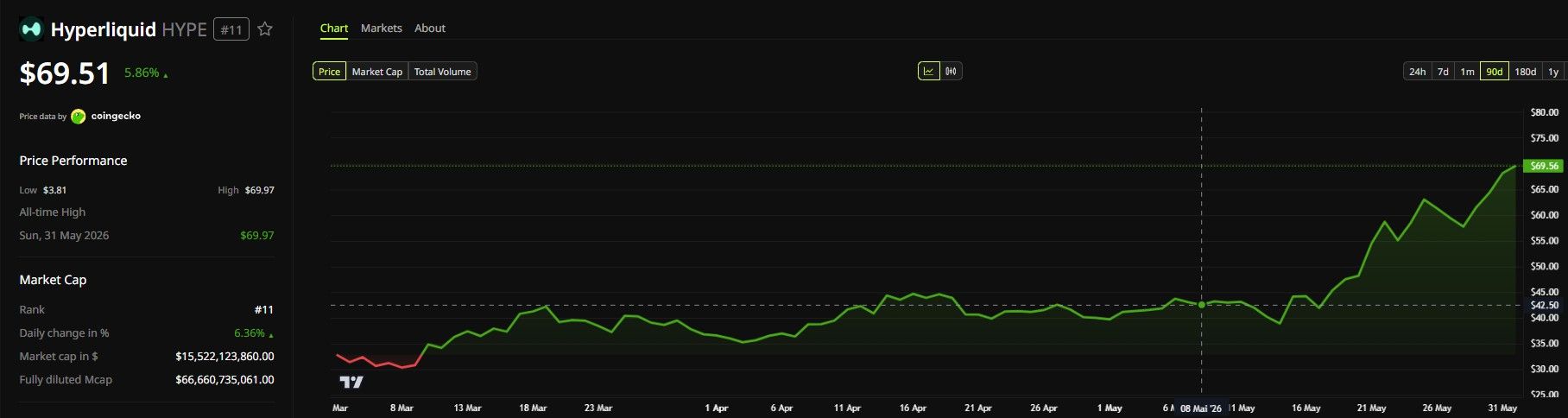
Arthur Hayes, co-founder of BitMEX, set a $150 price target for Hyperliquid (HYPE) and said the token should surpass Solana (SOL) before the current bull run ends.
Hayes posted the call on X, pushing back against widespread claims that the crypto market has turned bearish.
Hayes Pushes Back on Bear Market Sentiment
The posts drew quick skepticism. When one user declared they were in “a bear market,” Hayes replied that his speculative altcoin holdings disagreed.
He argued that this divergence between broad market weakness and outperforming high-risk assets points to a bull market that remains intact for the right positions.

Hayes has previously bought into HYPE, accumulating over 26,000 tokens. His latest posts suggest that position has grown into a high-conviction bet. He cited the Clarity Act and TradFi resistance in his thesis.
Can HYPE Overtake Solana Before the Cycle Ends
Hayes has previously forecast a bull cycle running through 2028, anchored by stablecoin expansion and increased speculative trading volumes.
Hyperliquid’s buyback program has deployed over $1.16 billion to repurchase HYPE in the open market, providing a structural bid below the market price. The protocol’s revenues have also grown sharply, with Hyperliquid Strategies reporting $152.5 million in quarterly profit.
Hayes believes HYPE can overtake Solana before the bull run ends, even though Solana currently holds a significantly larger market cap and remains the dominant smart contract platform for DeFi and speculative trading.
Bitwise CIO Matt Hougan has reached a similar conclusion on HYPE, describing it as a generational asset. Bitwise CIO Matt Hougan has reached a similar conclusion on HYPE, describing it as a generational asset that should be valued against the $600 trillion global market, not crypto’s $3 trillion universe.
He called Bitwise’s BHYP ETF the strongest single-asset crypto ETP launch since Bitcoin, with nearly $60 million in inflows since mid-May. Hougan labels HYPE a “Gen 2 token” because 99% of fees are used to buy back the token.
Whether HYPE can close that gap with Solana depends on how far the speculative cycle extends. It also hinges on whether Hyperliquid’s revenue trajectory continues to justify the premium Hayes and other institutional backers are now underwriting.
The post Arthur Hayes Doubles Down on Hyperliquid Prediction, Sees HYPE Overtaking Solana appeared first on BeInCrypto.
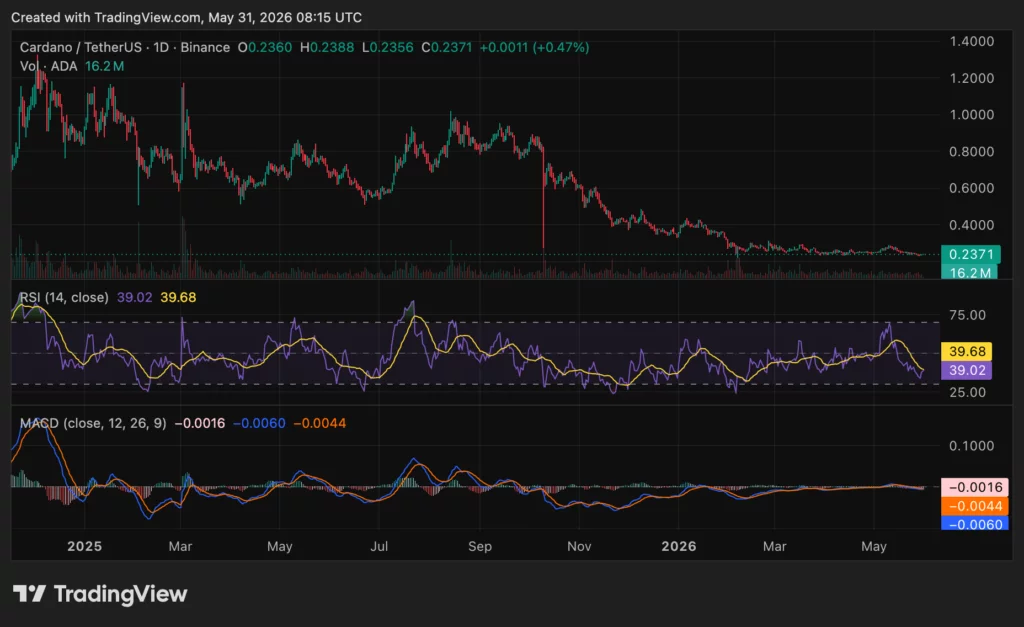
Cardano price remains under pressure after the Cardano Foundation confirmed that its proposed Cardano Summit 2026 will not take place this year following failed treasury votes.
Summary
- Cardano Summit 2026 was canceled after DReps rejected funding, adding fresh governance pressure around ADA.
- ADA traded near $0.236, below Ali’s $0.247 channel floor, keeping downside targets in focus now.
- RSI and MACD remain weak, while low volume shows buyers have not regained control yet.
The Cardano Foundation said it would respect the outcome of the latest treasury proposal votes after the community rejected funding for the planned Cardano Summit 2026. The organization said governance requires participation and a commitment to accept collective decisions.
In a statement on X, the Foundation said the proposed event “will not take place this year” after the vote failed. It added that it had reviewed feedback from DReps and would begin winding down current Summit-related execution.
The Foundation also said it was encouraged by the close vote and the level of community engagement. It noted that Emurgo’s TOKEN2049 proposal passed, meaning Cardano will still have a presence tied to the major Singapore crypto event.
The result places Cardano’s on-chain governance system back at the center of market attention. DReps now carry more weight in treasury decisions, and recent votes show that large event budgets face tougher review during a weak ADA market.
Cardano price stays near key support
Cardano traded near $0.236 on May 31, according to crypto.news price data. ADA was up 0.52% over 24 hours but remained down 3.55% for the week and 4.79% over the past month.
The token’s market cap stood near $8.77 billion, ranking Cardano at number 16. Trading volume was about $262.7 million over 24 hours, while the day’s range stayed narrow between $0.233913 and $0.238238.
The price action remains weak because ADA is trading close to a long-term support area. Analyst Ali Martinez said Cardano has traded inside a multi-year channel since 2021, with the key floor around $0.247.
According to the analyst, ADA trading near $0.232 marks a major test of that historical boundary. He said a monthly close below $0.247 would change the near-term structure and point to a deeper valuation phase.
RSI and MACD show weak momentum
The latest chart indicators still lean bearish. Volume remains relatively low at about 16.2 million ADA, which suggests that recent price movement lacks strong buying pressure.
ADA has shown a small rebound, but the price remains close to support. A clean breakdown below the $0.23 to $0.24 zone would weaken the setup further. A recovery above $0.27 to $0.30 would be needed to show stronger short-term demand.
The RSI stands at 39.02, below the neutral 50 level. That reading shows bearish momentum, though ADA has not reached the oversold zone near 30.
The RSI also turned lower after failing near its upper range. That move shows buyers lost strength before ADA could build a stronger recovery.
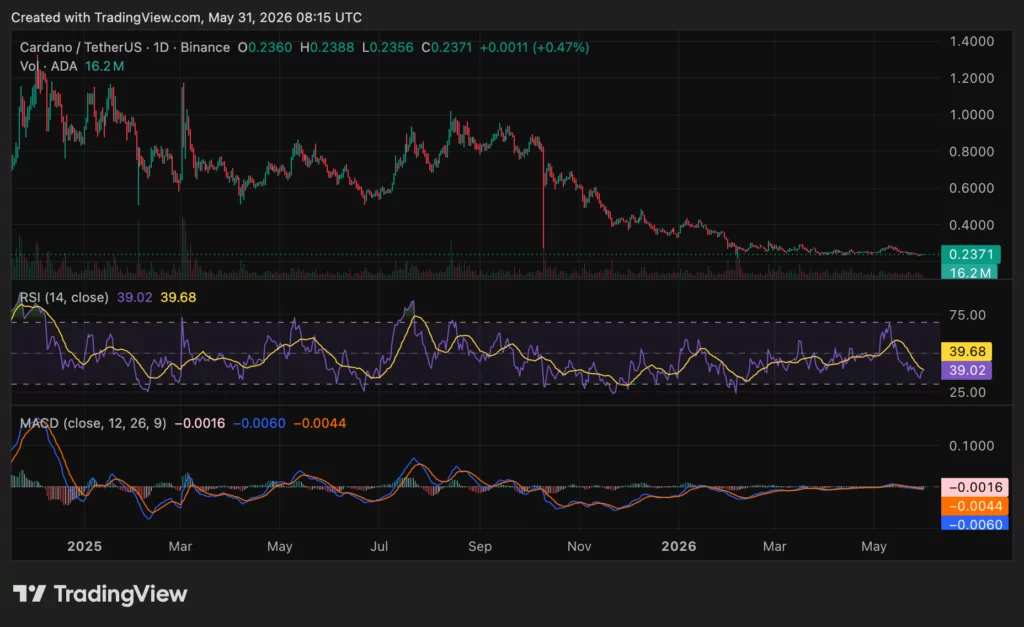
The MACD also shows mild weakness. The MACD line sits at -0.0060, below the signal line at -0.0044, while the histogram stands at -0.0016.
That setup confirms soft downside momentum. However, the histogram bars remain small, so selling pressure has not sharply expanded. ADA still needs stronger volume and a move back above nearby resistance to improve the short-term chart.
Analysts watch $0.113 and $0.051 levels
Ali Martinez warned that if Cardano loses the historical channel floor, long-term accumulation targets may sit much lower. He listed $0.113 and $0.051 as the next high-conviction macro levels for spot buyers.
That forecast depends on whether ADA stays below the $0.247 zone and fails to reclaim it after the monthly close. The level is important because it has acted as a long-term support area since the 2021 market cycle.
The failed Summit vote adds another layer to the price story. It does not directly change Cardano’s code, supply, or network activity, but it shows that treasury spending now faces stronger community review.
Recent related coverage from crypto.news also showed that Cardano’s price setup had already turned fragile before the Summit outcome. ADA previously needed to hold $0.246 to keep a rebound case alive after a TD Sequential buy signal.
That support is now under stress. If ADA remains below the $0.247 floor, traders may focus more on downside levels than on earlier rebound targets near $0.255 and $0.262.
For now, Cardano price analysis remains simple. ADA needs to reclaim $0.247 first. A move above $0.27 would show better demand. Until then, the Summit cancellation and weak indicators keep pressure on the short-term outlook.
Disclosure: This article does not represent investment advice. The content and materials featured on this page are for educational purposes only.

Fifteen years ago, one of Bitcoin’s earliest pioneers offered a warning that continues echoing through crypto markets.
Hal Finney argued that a monetary network cannot be rebooted without damaging the credibility of everything that follows.
The Debate Over a New Bitcoin
On May 30, 2011, Hal Finney and Jon Tobey entered a debate called “Early speculators’ reward.”
Basically, it was a discussion on Bitcointalk, where the OP raised a question that has followed Bitcoin since its very first days – was it fair that early adopters mined or acquired coins before most people knew the network existed?
Some participants argued that this early distribution amounted to a significant advantage – so large that the protocol itself should be relaunched. Finney rejected the premise with a response that was not just technical, but also rooted in economic logic.
“Any successful replacement of the Bitcoin block chain will forever undermine the credibility of any successor. […] How is an investor to know that it won’t happen again?”
The Problem of Credibility
Finney’s point seems simple now: if Bitcoin could be discarded because early users benefited, then any future replacement would inherit the same vulnerability, because there would be a new group of early adopters, a later group of users who resent them, and so forth – a vicious circle.
His argument also anticipated what later became a core principle of Bitcoin: monetary networks depend not only on code but also on confidence, continuity, and credible resistance to arbitrary change.
In simple words, Bitcoin’s staying power relies on itself – the Bitcoin staying power. The protocol has become so resistant to unnecessary change that it has brought forward a level of predictability that alternative economic systems cannot yet fathom.
The post 15 Years Ago, Hal Finney Explained Why Bitcoin Could Not Simply Be Replaced appeared first on CryptoPotato.


Vietnam’s Ministry of Finance has proposed allowing small and medium-sized enterprises to use digital assets, virtual assets and intellectual property as collateral for bank loans.
Summary
- Vietnam’s draft allows SMEs to pledge digital assets, virtual assets and IP for bank loans.
- SME loans reached only 20% of total credit despite firms representing 98% of businesses national.
- The plan pushes banks toward cash flow and credit-rating lending beyond real-estate collateral requirements alone.
The proposal is part of the draft revised Law on Support for SMEs, which is open for public consultation, according to Viet Nam News. The plan would widen the type of assets that businesses can use when applying for bank loans.
Under the draft, SMEs could use assets formed in the future, property rights, intellectual property rights, intangible assets, digital assets, virtual assets and other lawful assets. The change would move lending beyond the current focus on real estate and other fixed assets.
The policy targets a long-running credit gap
The Ministry of Finance said the proposal aims to improve capital access for private companies and technology startups. Many such firms own software, brands, data, patents or digital products, but lack land or property that banks usually accept as collateral.
State Bank of Vietnam data showed that outstanding SME loans reached nearly VNĐ3.8 quadrillion, or about $144.2 billion, by the end of April. That was equal to about 20% of total credit in the banking system, even though SMEs and household businesses account for more than 98% of enterprises in Vietnam.
Banks may weigh cash flow and business plans
The draft also encourages credit institutions to assess borrowers through credit ratings, business plans, market expansion potential and enterprise cash flows. This would give banks more ways to review SME credit risk without relying only on fixed collateral.
The Ministry of Finance linked the proposal to Resolution 68-NQ/TW of the Politburo, which treats the private sector as an important driver of the economy. The draft also seeks to support innovation, digital transformation, green projects and sustainable business models.
Digital asset rules continue to develop
The proposal comes as Vietnam builds a wider legal framework for digital assets. Related crypto.news coverage has reported that Vietnam has been working on a domestic digital asset exchange pilot and tighter rules around overseas crypto trading.
The new collateral plan does not mean banks must accept every digital or virtual asset. The draft says assets must be lawful under Vietnamese law. That leaves valuation, custody, risk control and legal recognition as key issues for lenders before any new rules take full effect.
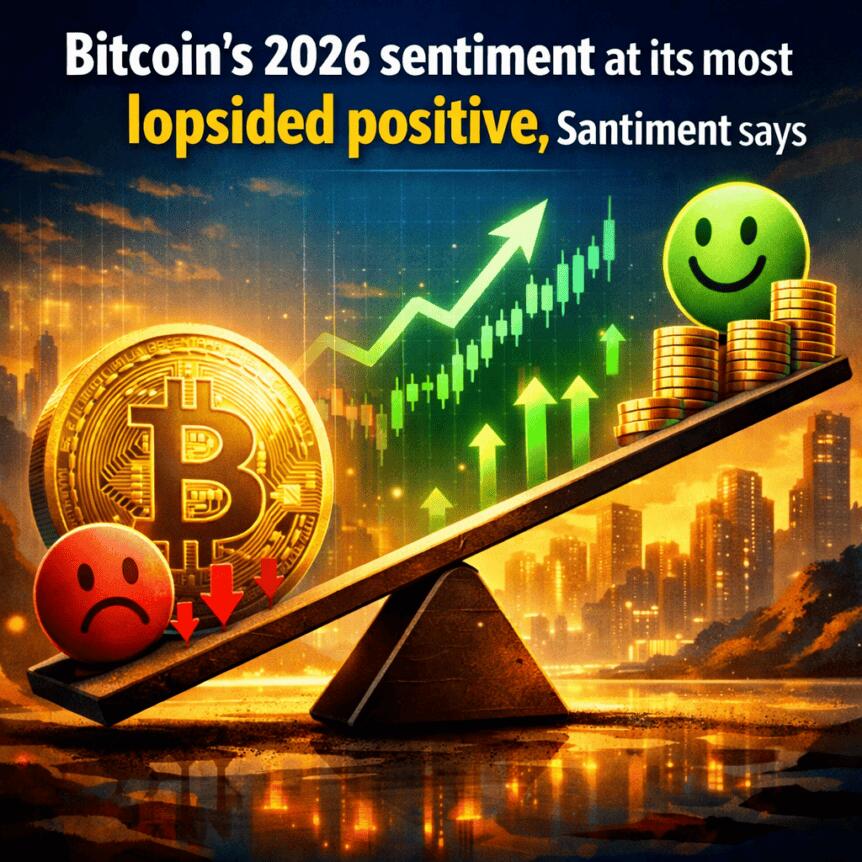
Bitcoin traders are buzzing with unusually bullish chatter on social media, even as the broader crypto market slides. A Santiment analysis shows Bitcoin’s social sentiment reaching the year’s most lopsided ratio of bullish to bearish comments, signaling a surge in optimism that contrasts with a more cautious overall market mood.
At the same time, the traditional market mechanisms that often anchor price action — exchange-traded products and related flows — tell a different story. Spot Bitcoin ETFs logged their tenth consecutive day of outflows on Friday, with total net redemptions exceeding $2.97 billion since May 15. That persistent drain on ETF positions adds a layer of complexity to the narrative around Bitcoin’s near-term path.
Key takeaways
- Santiment records Bitcoin sentiment at 2.23 bullish-to-bearish ratio, the strongest reading of 2026 so far, signaling a surge of optimistic chatter on the asset.
- Spot Bitcoin ETFs have posted ten straight days of net outflows, with more than $2.97 billion redeemed since May 15, underscoring a disconnect between social sentiment and institutional exposure.
- The Crypto Fear & Greed Index sits in “Extreme Fear” territory at a score of 23, highlighting a cautious backdrop even as social bullishness climbs.
- Market voices offer a nuanced view: some see retail-led optimism as a contrary signal, while others warn that extremes in sentiment have historically preceded short-term pullbacks.
- Prominent figures weigh in on the dynamics: Tyler Winklevoss notes a paradoxical optimism amid sour sentiment, while Cory Klippsten and Michael van de Poppe stress the continuing relevance of retail behavior and sentiment fragility.
Contrasting signals: social optimism and ETF realism
The latest Santiment briefing emphasizes a sharp divergence between Bitcoin’s social buzz and the sector’s inward-facing funding mechanics. In Santiment’s framing, “Sentiment on Bitcoin has spiked to 2.23 bullish comments for every bearish one — the most lopsided positive ratio of 2026.” The analysis notes that past episodes with the strongest positive readings tended to be followed by short-term price pullbacks, while heavily negative readings often marked local bottoms. The current euphoria, the firm adds, sits against a backdrop of ETF flow conditions that warrant caution.
Meanwhile, data on spot Bitcoin ETFs paints a different mood. Friday marked the tenth consecutive trading day of outflows from spot vehicles, with cumulative net redemptions surpassing $2.97 billion since May 15. The trend points to a steady withdrawal of institutional exposure in the ETF space, even as social sentiment remains buoyant in some corners of the market.
What sentiment means for traders and investors
Crypto markets have long traded on a mix of social mood and on-chain reality, with investors weighing each signal against the other. Santiment’s analysis underscores a contrarian thread: when optimism surges to extreme levels, the probability of a near-term pullback can rise as participants take profits or reallocate gains. Conversely, severe pessimism has historically coincided with bottoms in price, leading some traders to adopt a patient, if watchful, stance.
Beyond the data, the reflexive dimension of sentiment matters. Tyler Winklevoss, co-founder of Gemini, has previously highlighted the paradox of crypto mood: “the sentiment in crypto right now is so bad that I’m actually pretty optimistic.” The sentiment-versus-price dynamic remains a central question for market participants who must reconcile social signals with the price action implied by ETF flows and on-chain activity.
Voices shaping the narrative
Industry observers are split on how much weight to give to social sentiment in a market increasingly shaped by institutions and regulation. Cory Klippsten, founder and CEO of Swan Bitcoin, argues that retail demand remains a critical driver of Bitcoin ownership. “It’s not like BlackRock owns the Bitcoin and Fidelity owns the Bitcoin. It’s a bunch of retail accounts, mostly that actually buy that,” he said, underscoring the ongoing influence of non-institutional buyers in a sector where retail participation remains sizable.
Another longstanding voice, Michael van de Poppe of MN Trading Capital, has described current sentiment as among the weakest he’s seen, even suggesting it surpasses what was observed during prior macro lows. “Worse than 2022, 2018. Nobody even believes in a future of crypto assets that are going to do well,” he remarked, signaling a clear risk of further near-term volatility if sentiment doesn’t align with any improving fundamental backdrop.
Amid the mix of optimism and caution, market watchers also note the broader sentiment barometer: the Crypto Fear & Greed Index showing an “Extreme Fear” reading around 23. Such readings frequently accompany periods of heightened uncertainty and can precede sharp reversals as participants reassess risk and rebalance portfolios.
Looking ahead: what to watch next
The tension between bullish social sentiment and the tug of ETF outflows creates a nuanced backdrop for Bitcoin’s near-term trajectory. Investors should watch two levers closely: whether ETF redemptions begin to ease, potentially signaling a reallocation that could support price, and whether social sentiment swings back toward moderation or remains stubbornly elevated despite weak inflows. If the current dynamic persists, volatility could remain elevated as market participants attempt to reconcile diverging signals about demand and participation.
The next phase will likely hinge on how regulatory clarity and macro conditions shape investor risk appetite, and whether retail demand can sustain itself in the face of ongoing ETF outflows. As always, readers should tether expectations to data as it unfolds, recognizing that sentiment indicators offer context but not a deterministic forecast.
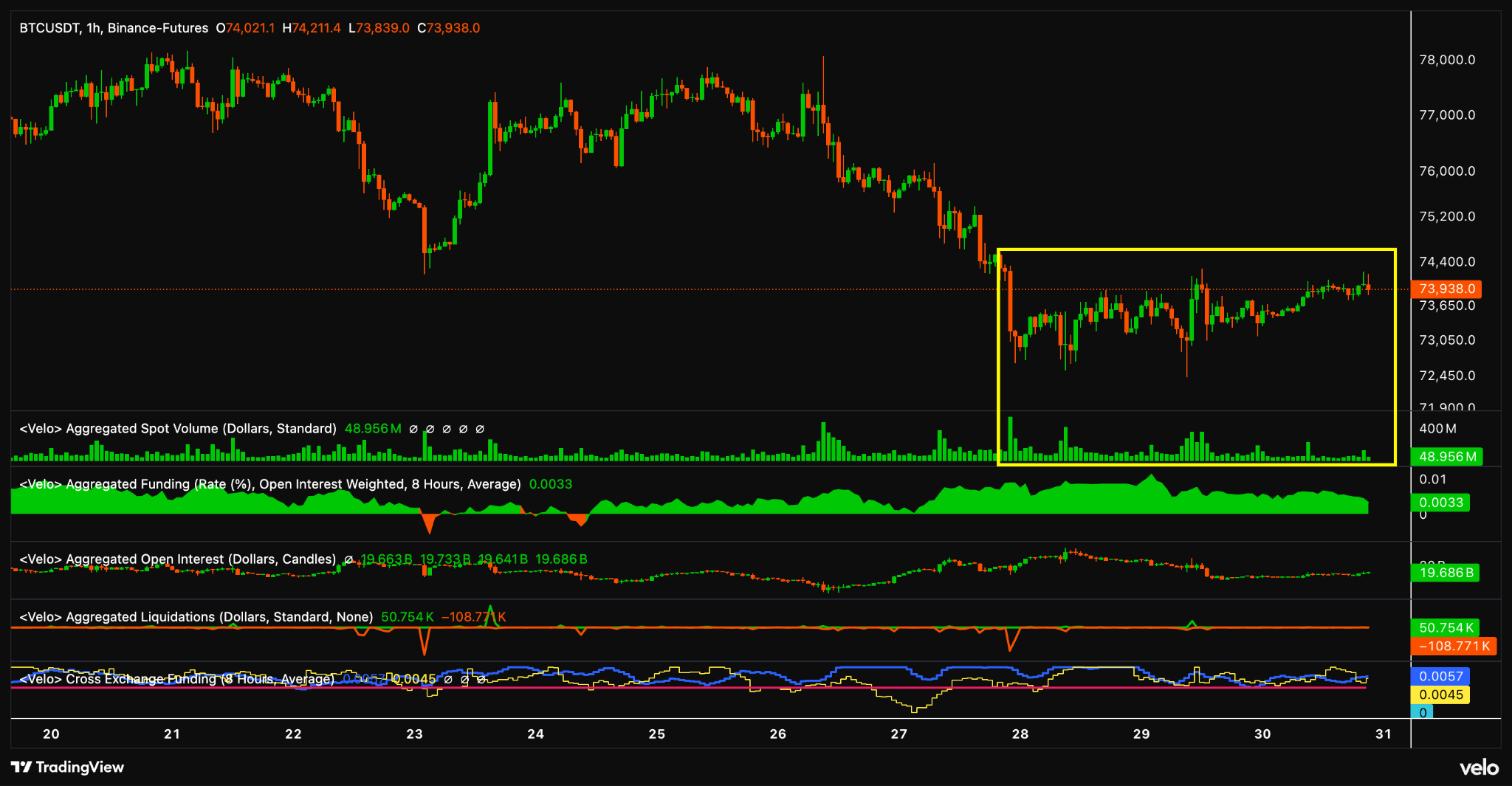
Bitcoin ETF selling overwhelmed markets again after last week’s $1.42 billion outflow followed the previous week’s $1.26 billion outflow.
BTC’s subsequent fall to $72,500 raised concerns that the price would slip back into the $60,000 to $70,000 range that BTC was locked in during February through April, but Cointelegraph’s reporting showed spot volumes kicking in to defend the $70,000 support.
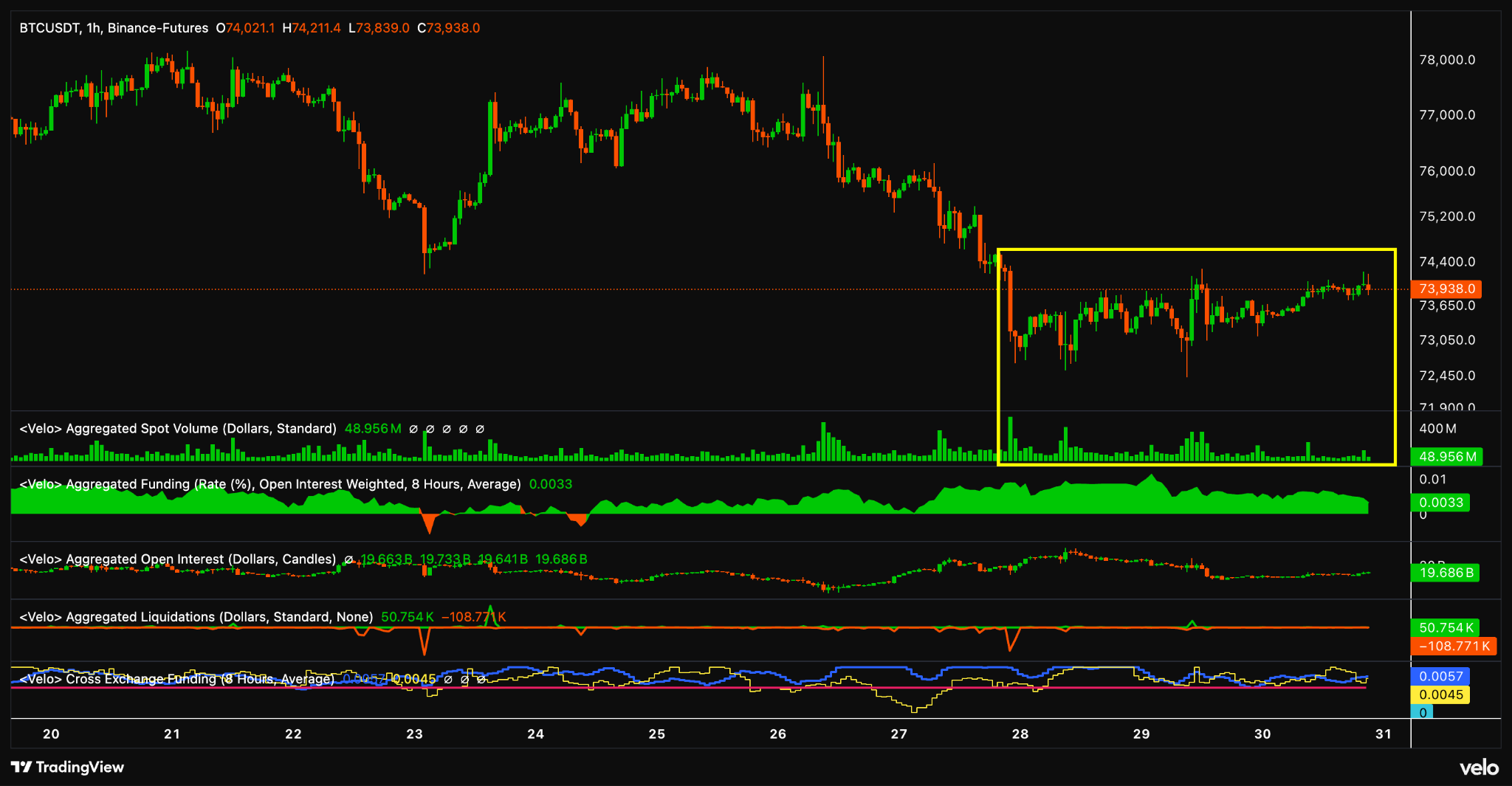
BTC/USDT aggregated spot volumes. Source: Velo
Given the sizeable ETF selling, BTC inflows to Coinbase and futures market liquidations, the spot CVD data above suggests these dip buyers are not dominant.
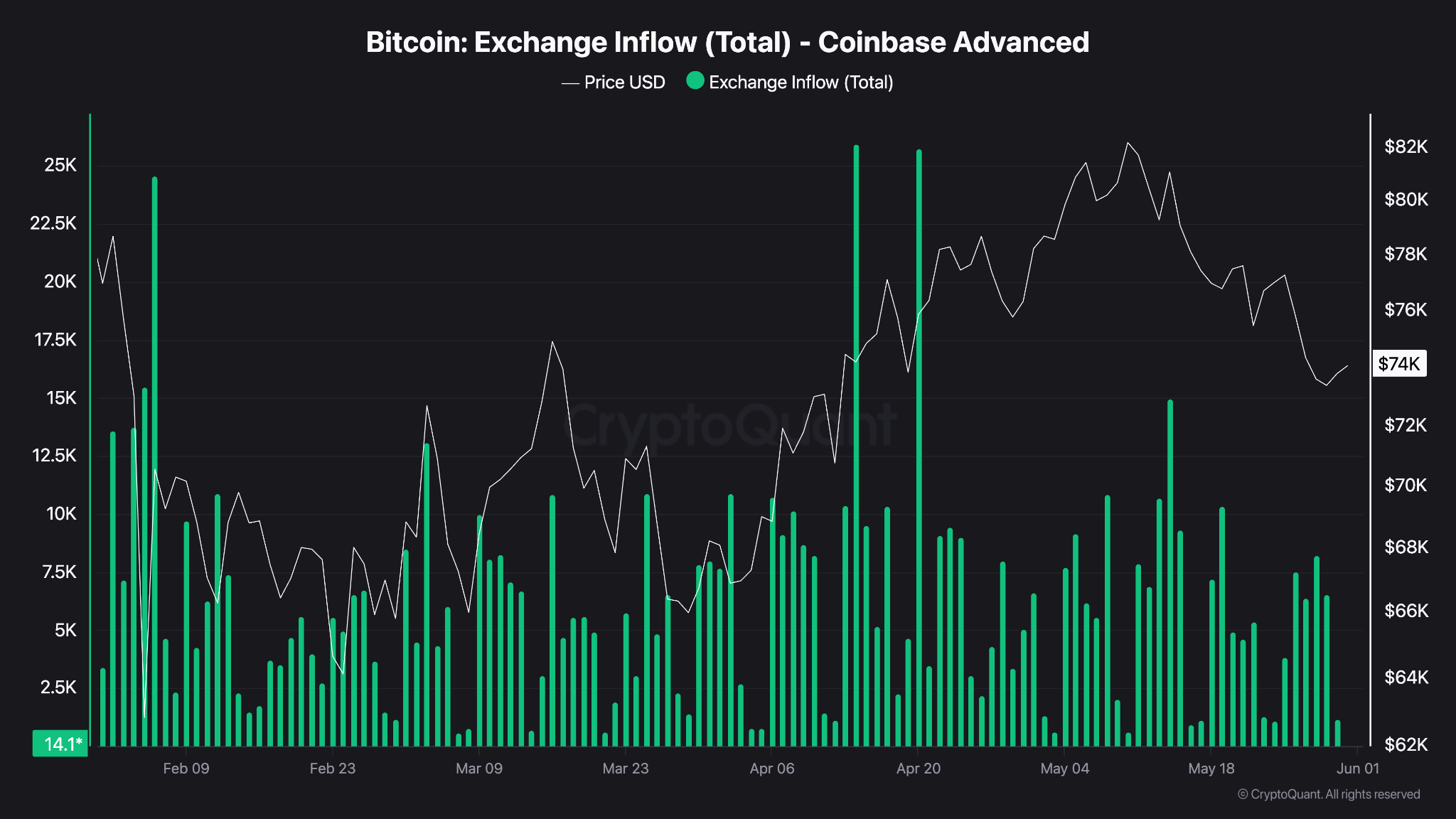
Bitcoin exchange inflows, Coinbase. Source: CryptoQuant
Open interest heatmap data, on the other hand, does show nearly $300 million of open interest concentrated in the yellow band representing $73,000 to $74,000, where traders appear to have opened new leveraged long positions.
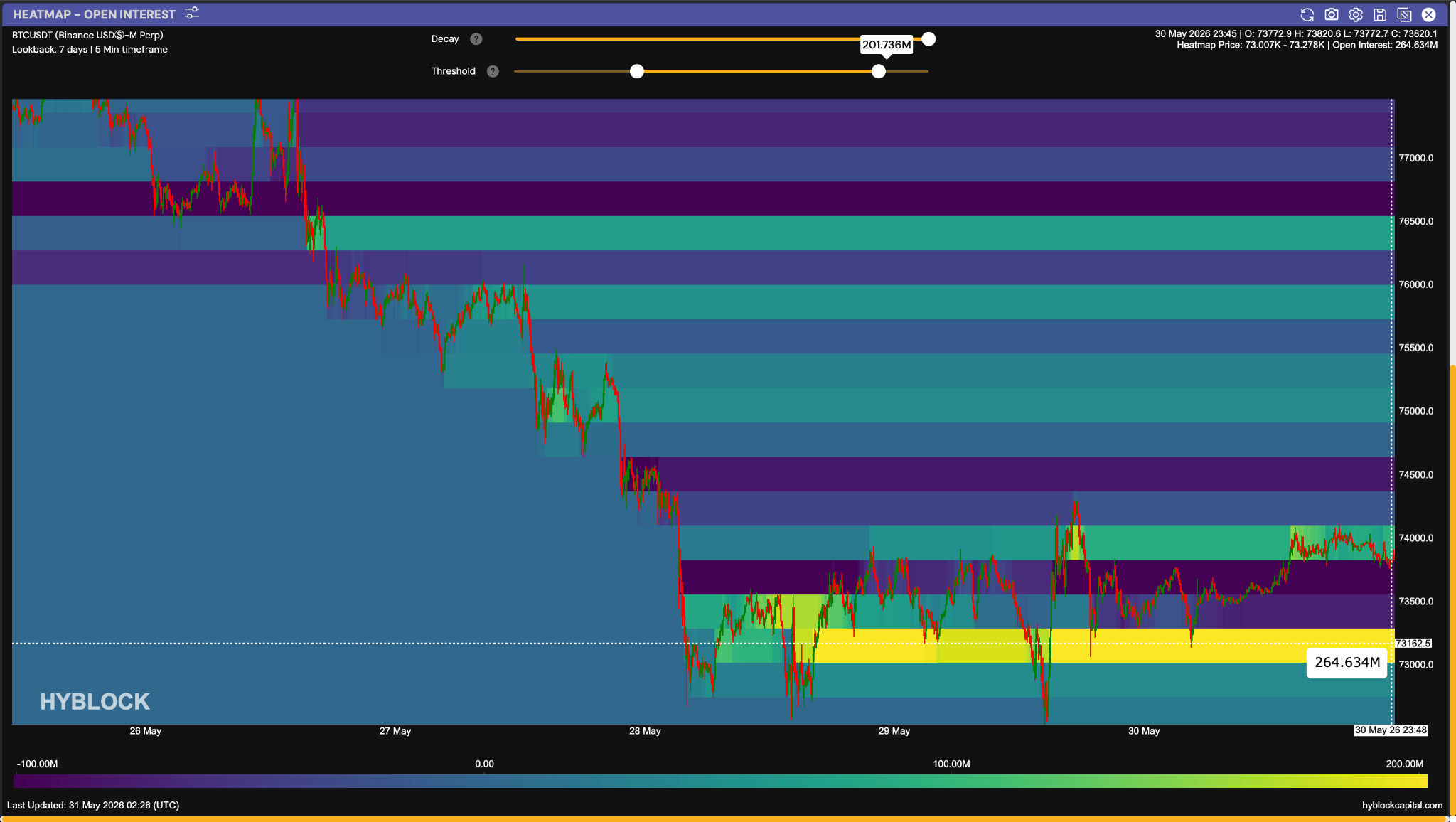
Open interest heatmap, seven-day lookback. Source: Hyblock
While ETF outflows and redemptions sync with next-day BTC inflows to Coinbase exchange, and the knock-on effect of this selling is occasional long liquidations in the futures market, Hyblock’s bid-ask ratio metric (set to 10% aggregate order-book depth) shows a modest bid-side dominant orderbook, reinforcing the view that traders view prices below $75,000 as discounted and are buying as a result.
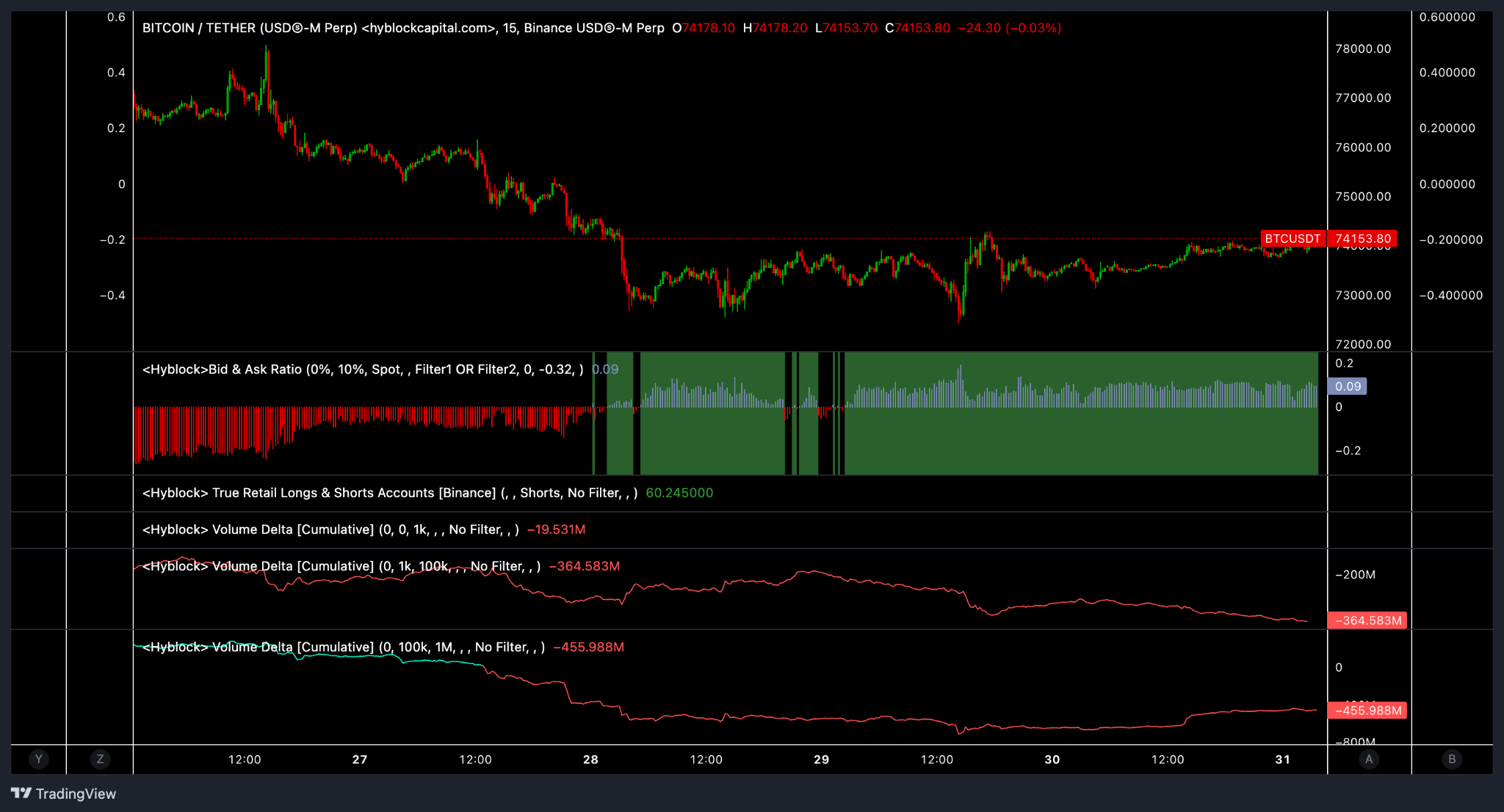
BTC/USDT bid-ask ratio (10% depth) turns positive. Source: Hyblock
The indicator ranges from -1 to +1, with values above zero indicating an increasing imbalance in the orderbook structure.
The current longs perps and spot buying activity have not been sustainably sufficient enough to reverse the downtrend, but it is helping to absorb the selling and put a floor (or support) beneath Bitcoin price.
Related: US has seized nearly $1 billion in Iranian crypto, Treasury secretary says
Beyond the technicals, in the short-term, a fresh set of narrative catalysts and newsflow focused on a peace deal between the US and Iran, positive spot BTC ETF inflows, falling crude oil prices and perhaps a White House statement on possible new additions to the Strategic Bitcoin Reserve are needed to trigger larger spot and futures positioning in BTC.
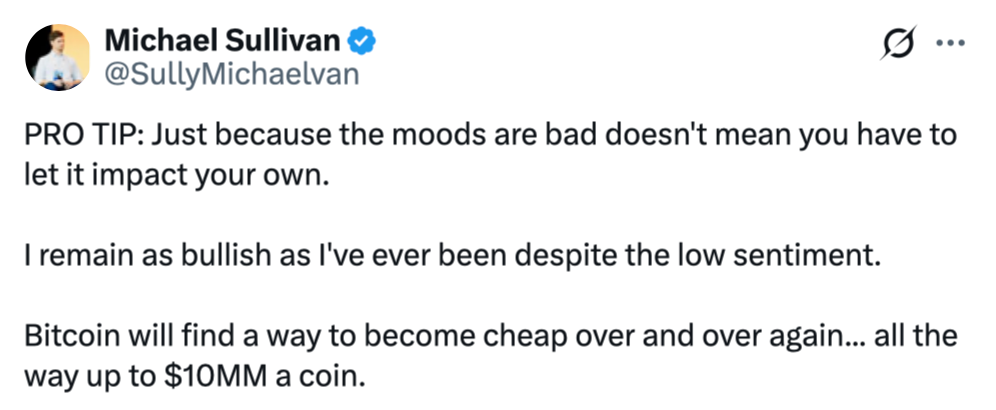
The feeling toward Bitcoin on social media has reached its most bullish level of the year, even as the overall crypto market is down, according to crypto sentiment platform Santiment.
“Sentiment on Bitcoin has spiked to 2.23 bullish comments for every bearish one — the most lopsided positive ratio of 2026,” Santiment said in a report published on Saturday.
“The previous two biggest positive-ratio days of the year preceded short-term price pullbacks, while severely negative readings marked local bottoms. The current euphoria contrasts sharply with the bearish ETF flow picture and warrants caution,” Santiment said. Spot Bitcoin ETFs logged their tenth consecutive trading day of outflows on Friday, with total net redemptions exceeding $2.97 billion since May 15.
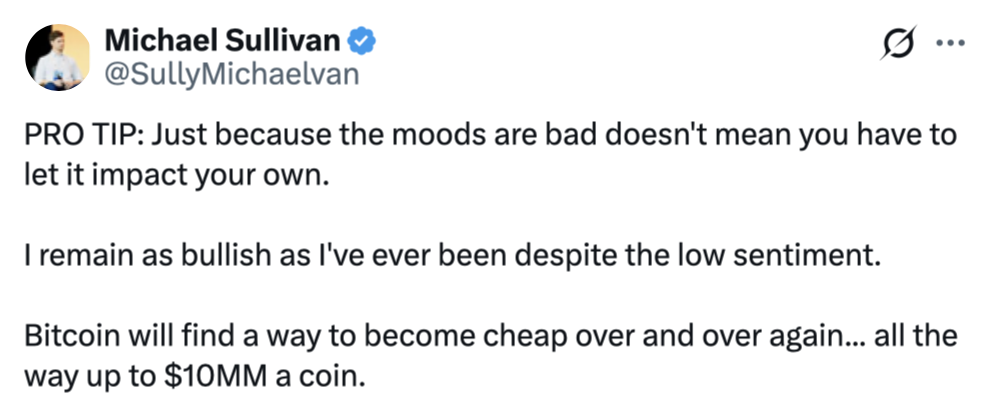
Source: Michael Sullivan
Crypto market participants often watch broader market sentiment to gauge how other investors feel and to inform their own decisions about whether to buy or sell, based on where they believe the market may be headed in the near term.
However, the market has historically moved in the opposite direction to what most market participants expect. “Extreme positive sentiment readings have historically preceded short-term pullbacks more often than continued rallies,” Santiment said.
Some traders use this contrarian view accordingly. Around the time Bitcoin fell to its yearly low of $60,000 in February, Gemini founder Tyler Winklevoss said in an X post that “the sentiment in crypto right now is so bad that I’m actually pretty optimistic.”
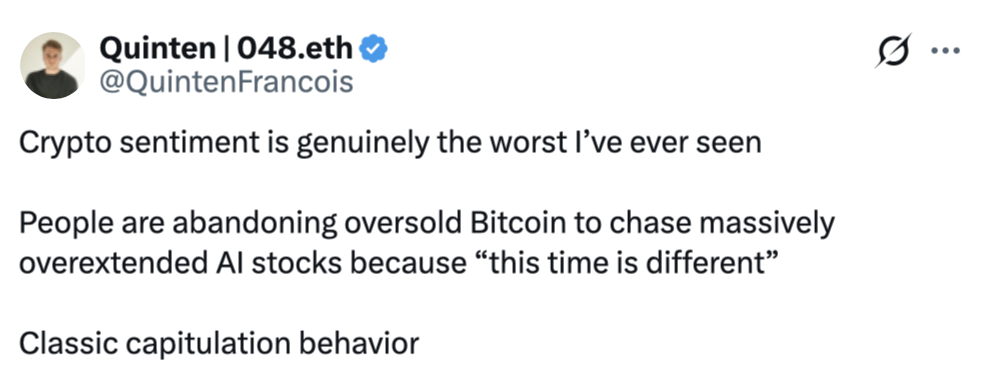
Source: Quinten Francois
The Crypto Fear & Greed Index, which measures overall crypto market sentiment, posted an “Extreme Fear” score of 23 on Saturday. MN Trading Capital founder Michael van de Poppe said that the current crypto market sentiment is the worst he has ever seen. “Worse than 2022, 2018. Nobody even believes in a future of crypto assets that are going to do well,” he added.
Related: Senator Lummis says China will ‘write the rules’ of the new financial era if CLARITY fails
While some argue that retail sentiment has become less important as institutional interest in Bitcoin has grown, others, including Swan Bitcoin CEO Cory Klippsten, disagree.
“It still does. You have to remember it’s not like BlackRock owns the Bitcoin and Fidelity owns the Bitcoin. It’s a bunch of retail accounts, mostly that actually buy that,” Klippsten said.
Magazine: HYPE chases $100 target, ETH could dump below $1800: Market Moves

Jeremy Clarkson says his choir’s Britain’s Got Talent win is ‘best thing ever’

A24’s ‘Backrooms’ Surges to Historic $85M-$88M Opening Weekend Beating ‘Mandalorian & Grogu’

Dash says crypto forgot its original killer app: digital cash


-

 Business7 days ago
NYT Strands Answers May 24 2026 Revealed for Puzzle No. 812 Theme Summer Essentials
-

 NewsBeat4 days ago
Israel says it has killed new Hamas military leader in Gaza City airstrikes
-

 Tech4 days ago
NASA taps Blue Origin to deliver lunar rovers for Moon Base initiative
-

 Politics6 days ago
Bridgerton Season 5: Cast, Release Date And Everything We Know So Far
-

 News Videos4 days ago
XRP *JUST* SUCCEEDED!!!! CLARITY ACT EXPOSED!!! (SHE EXPOSED IT)
-

 Sports5 days ago
2026 NBA Finals schedule, odds: Knicks await Thunder or Spurs after winning East
-

 Business4 days ago
Selena Gomez Reportedly Upset Over Benny Blanco’s Comments on Her ‘Terrible’ Diet
-
Crypto World5 days ago
Micron Crosses $1 Trillion Market Cap as AI Demand Reshapes Memory Sector
-

 News Videos2 days ago
This is BROKEN! INSANE 5x MONEY CAR WASH WEEK! The NEW GTA Online UPDATE Today! (GTA5 New Update)
-

 Business6 days ago
BTS Sells Out Four Las Vegas Shows at Allegiant Stadium for ARIRANG World Tour
-
 Tech5 days ago
China assigns ID codes to 28,000+ humanoid robots
-
 NewsBeat6 days ago
Hottest May day ever as London hits 34.8C in 2C leap from previous records
-

 Tech6 days ago
Microsoft’s quiet Claude Code retreat and the real cost of enterprise AI
-
Crypto World6 days ago
Brian Armstrong Outlines Crypto Vision for the Future Financial System
-

 Tech2 days ago
Waymo dominates autonomous vehicle registrations as Tesla trails behind
-

 Business5 days ago
Nikkei 225 Surges Past 65,000 for First Time as Iran Peace Hopes Fuel Record Rally
-
Tech4 days ago
The Samsung pay deal is the moment Korean unions changed register
-
 Entertainment5 days ago
‘Breaking Bad’ Star’s Easy-to-Binge 6-Part Crime Series Spin-Off Is Finally Heading to Free Streaming
-

 Tech6 days ago
Westone Audio and Etymotic Acquired by Fidelity Collective in Major IEM Market Move
-

 NewsBeat6 days ago
Crowds find riverside shade in York as temperatures soar
You must be logged in to post a comment Login