
Crypto World
ECB Maps the Promise and Peril of Tokenized Capital Markets in New Bulletin



The central bank’s latest macroprudential report examines tokenized bonds, money market funds, and euro stablecoins.



Bitcoin falling to the $50,000 level is being seen as the “last significant accumulation zone” before any sustained recovery, says LVRG Research director Nick Ruck.


New staff guidance from the SEC’s Division of Trading and Markets details conditions under which certain self-custody crypto UI can avoid broker-dealer registration.
The U.S. Securities and Exchange Commission’s Division of Trading and Markets issued new staff guidance today, April 13, that outlines conditions under which certain crypto-related user interfaces may operate without registering as broker-dealers under federal securities law.
The guidance applies specifically to what the staff calls “covered user interfaces,” which it defines as self-custody software products for interacting with crypto, which could include DeFi protocol front-ends, wallet extensions, and mobile apps.
The staff guidance defines these UIs as “an interface provided by a website, browser extension, or other software application (e.g., mobile application) that may be embedded in a wallet or separately available for download, designed to assist users engaging in user-initiated crypto asset securities transactions on blockchain protocols (or blockchain-based smart contracts) utilizing the user’s self-custodial wallet.”
Under the SEC staff statement, an interface can avoid broker-dealer registration only if it meets all of the following conditions:
- It does not take custody of user funds;
- It provides no investment advice or trade recommendations;
- It does not route or execute orders on users’ behalf;
- Generally, it charges a fixed percentage as a transaction fee;
- It exercises no discretion over transactions or market activity.
The statement also prohibits operators from labeling trading routes as “best” or “preferred” and bars any commentary that could be interpreted as investment advice.
The SEC stressed that the statement is not a formal rule or binding regulation. Rather, it reflects staff’s current interpretation of existing Exchange Act law. The guidance is set to remain in effect for five years unless superseded by formal commission-level rulemaking, per today’s statement.
The DeFi Regulation Question
The release arrives amid a long-running debate over how U.S. law should treat DeFi developers and the software infrastructure they build. As The Defiant has reported, even after a landmark joint SEC-CFTC interpretive release earlier this year, key questions about fully permissionless DeFi remain unanswered, with experts noting that regulators have largely built frameworks around centralized actors, while deferring the hardest DeFi questions to future rulemaking.
That uncertainty has fueled industry anxiety over the fate of protocol developers, front-end operators, and wallet providers under existing securities law.
Lawyers and industry observers have warned that early draft of the CLARITY Act, the pending crypto market structure bill that has not yet passed into law, leaves many issues unresolved, empowering agencies to fill in the details through future rulemaking.
Meanwhile, both the CFTC and SEC have signaled they are working to modernize rules so there is a clearer place for on-chain software systems and front-ends within the regulatory framework.
This article was written with the assistance of AI workflows. All our stories are curated, edited and fact-checked by a human.
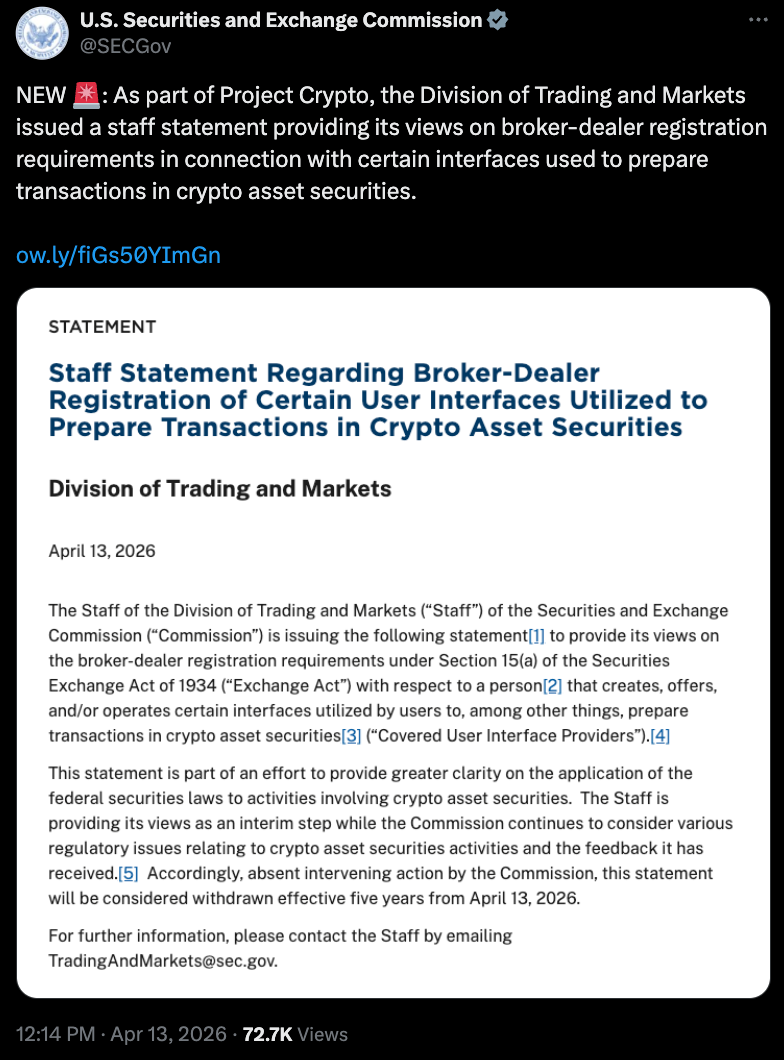
The US Securities and Exchange Commission (SEC) has issued a staff statement clarifying how the agency plans to interpret software interfaces facilitating crypto transactions in its broker-dealer regulations.
In a Monday statement, the SEC’s Division of Trading and Markets staff said that under certain circumstances, interfaces that “assist users engaging in user-initiated crypto asset securities transactions on blockchain protocols […] utilizing the user’s self-custodial wallet” may not necessarily be required to register as a broker-dealer with the agency.

The SEC statement specified that self-custodial wallets with such user interfaces may be exempt from registration requirements, provided they do not “solicit investors to engage in any specific crypto asset securities transactions,” provide commentary on “any potential execution [routes] displayed to a user,” and other circumstances.
Although the staff statement does not carry the same weight as a proposed SEC rule subject to public comment and review, it was intended to “provide greater clarity on the application of the federal securities laws to activities involving crypto asset securities.”
It follows several others that the SEC has issued following the inauguration of US President Donald Trump in January 2025, leading to new leadership at the agency in what many have seen as friendlier to the crypto industry.
Related: Ex-SEC, Coinbase staffer becomes Securitize president
“While the staff expressing its view is helpful, I favor a more permanent regulatory approach that addresses the broker definition in light of current market circumstances,” said SEC Commissioner Hester Peirce, adding:
“Crypto is forcing the Commission to confront its inner demons that have driven it toward ever more expansive readings of the securities laws.”
SEC leadership is still entirely Republican and understaffed
Although Trump announced several new nominations for various federal positions on Monday after a month of silence on the matter, no additional picks for the SEC or Commodity Futures Trading Commission (CFTC) were among the president’s names. Both financial regulators responsible for overseeing crypto regulation in the country face a dearth of leadership amid resignations and lack of nominations from the White House.
At the SEC, only three Republican commissioners out of five remain, while only CFTC Chair Michael Selig, also a Republican, serves at the commodities regulator following the departure of Caroline Pham in December.
Some lawmakers have proposed attaching a provision to a market structure bill under consideration in the Senate to require a minimum level of staffing at the SEC and CFTC before the legislation can take effect.
Magazine: Bitcoin quantum-safe without upgrade? CZ’s 2031 crypto vision: Hodler’s Digest, April 5 – 11


The AI report that the industry watches most closely landed Monday when Stanford HAI released its 2026 AI Index, revealing that the US performance lead over China has nearly evaporated, with Anthropic’s top model leading the nearest Chinese competitor by just 2.7 percent as of March 2026.
Summary
- The Stanford HAI 2026 AI Index found that the US and China have traded places at the top of AI performance rankings multiple times since early 2025; in February 2025 DeepSeek-R1 briefly matched the top US model, and the gap has remained razor-thin since, with the US still producing more top-tier models and higher-impact patents while China leads in publication volume, citations, patent output, and industrial robot installations.
- US private AI investment reached $285.9 billion in 2025, more than 23 times China’s $12.4 billion, but the number of AI researchers and developers flowing into the US dropped 89 percent since 2017, with an 80 percent decline in just the last year alone, raising structural questions about whether the investment advantage will translate to sustained performance dominance.
- Generative AI reached 53 percent population adoption within three years, faster than the personal computer or the internet; the US ranks 24th globally in adoption at 28.3 percent, behind Singapore at 61 percent and the UAE at 54 percent, while the estimated value of generative AI tools to US consumers reached $172 billion annually by early 2026.
As MIT Technology Review reported, the Stanford index makes clear that “the benchmarks designed to measure AI, the policies meant to govern it, and the job market are struggling to keep up.” The report is the ninth annual edition from Stanford’s Institute for Human-Centered AI and draws on data from Arena, the community-driven ranking platform that lets users compare large language model outputs on identical prompts. The US still hosts 5,427 data centers, more than 10 times any other country, and TSMC, which fabricates almost every leading AI chip, began US operations in 2025. South Korea has emerged as the world leader in AI innovation density, filing more patents per capita than any other country.
A 2.7 percent performance gap between the best US and Chinese models is not a comfortable lead for a country spending 23 times more on AI investment. The Stanford report makes clear that this is no longer a two-horse race defined by a wide margin, but a contest where the leading models compete on cost, reliability, and real-world usefulness rather than benchmark scores. The fact that models have traded places at the top multiple times since early 2025 means no single country has established a durable technical advantage at the frontier.
What the US Still Gets Right and Where China Has Pulled Ahead
The US advantages that remain real are in infrastructure, high-impact research citations, and the sheer number of newly funded AI companies: 1,953 in 2025, more than 10 times the next closest country. China’s advantages are in scale: 23.2 percent of global AI publications, 69.7 percent of global AI patent grants, and 276,300 industrial robot installations in 2023 alone, six times more than Japan and more than seven times more than the US. Those robot installations are not just a manufacturing metric; they represent AI deployment at physical scale that the US has not matched.
What the Researcher Inflow Decline Means Long-Term
As crypto.news has reported, the AI talent market is one of the most closely watched variables for institutional investors assessing the long-term competitive position of US technology. As crypto.news has noted, the Stanford finding that AI researcher inflow to the US dropped 80 percent in just the last year is the single most structurally significant data point in the report, because investment and infrastructure advantages erode without the talent base to translate them into model performance.


South Korea’s third-largest cryptocurrency exchange, Coinone, is facing a fine and a partial business suspension over anti-money laundering lapses, according to multiple local media reports.
South Korea’s Financial Intelligence Unit (FIU) under the Financial Services Commission accused Coinone of failing to comply with anti-money laundering obligations, including verifying user identities in about 70,000 cases, The Korea Times, Chosun and Yonhap News reported on Monday.
The FIU also alleged Coinone facilitated more than 10,000 transactions with 16 foreign exchanges not registered with South Korean regulators, despite repeated warnings.
Other accusations include violating customer due diligence obligations by marking customer verification as complete even when key information was missing, and by failing to restrict transactions for customers whose verification measures had not been completed.
Cointelegraph contacted Coinone for comment.
Regulatory crackdown against exchanges
It marks South Korea’s second regulatory crackdown against exchanges in the last month, after Bithumb, the country’s second-largest crypto exchange by trading volume, was fined $24 million and faced a six-month partial suspension in March for alleged anti-money laundering failures.
The moves come after Bithumb erroneously sent customers 620,000 Bitcoin (BTC), worth around $42 billion at the time, instead of 620,000 Korean won, prompting the Bank of Korea to push for lawmakers to pass more stringent controls on exchanges.
The central bank said on Monday that lawmakers should consider introducing trading curbs to suspend trading in the event of unusual activity or if crypto prices suddenly fluctuate
Fine, partial suspension and CEO reprimand
The FIU reportedly fined Coinone 5.2 billion won ($3.5 million) and imposed a three-month partial business suspension, which prevents new customers from depositing or withdrawing funds from the exchange until the ban is lifted.
Related: South Korea tightens crypto withdrawal-delay exemptions after scam losses
The exchange’s chief executive officer, Cha Myung-hoon, is also receiving an official reprimand. However, it’s an administrative enforcement rather than a criminal penalty.
Coinone has 10 days to dispute the action before the FIU finalizes the fine and other penalties, according to the reports.
Magazine: Bitcoin quantum-safe without upgrade? CZ’s 2031 crypto vision: Hodler’s Digest, April 5 – 11
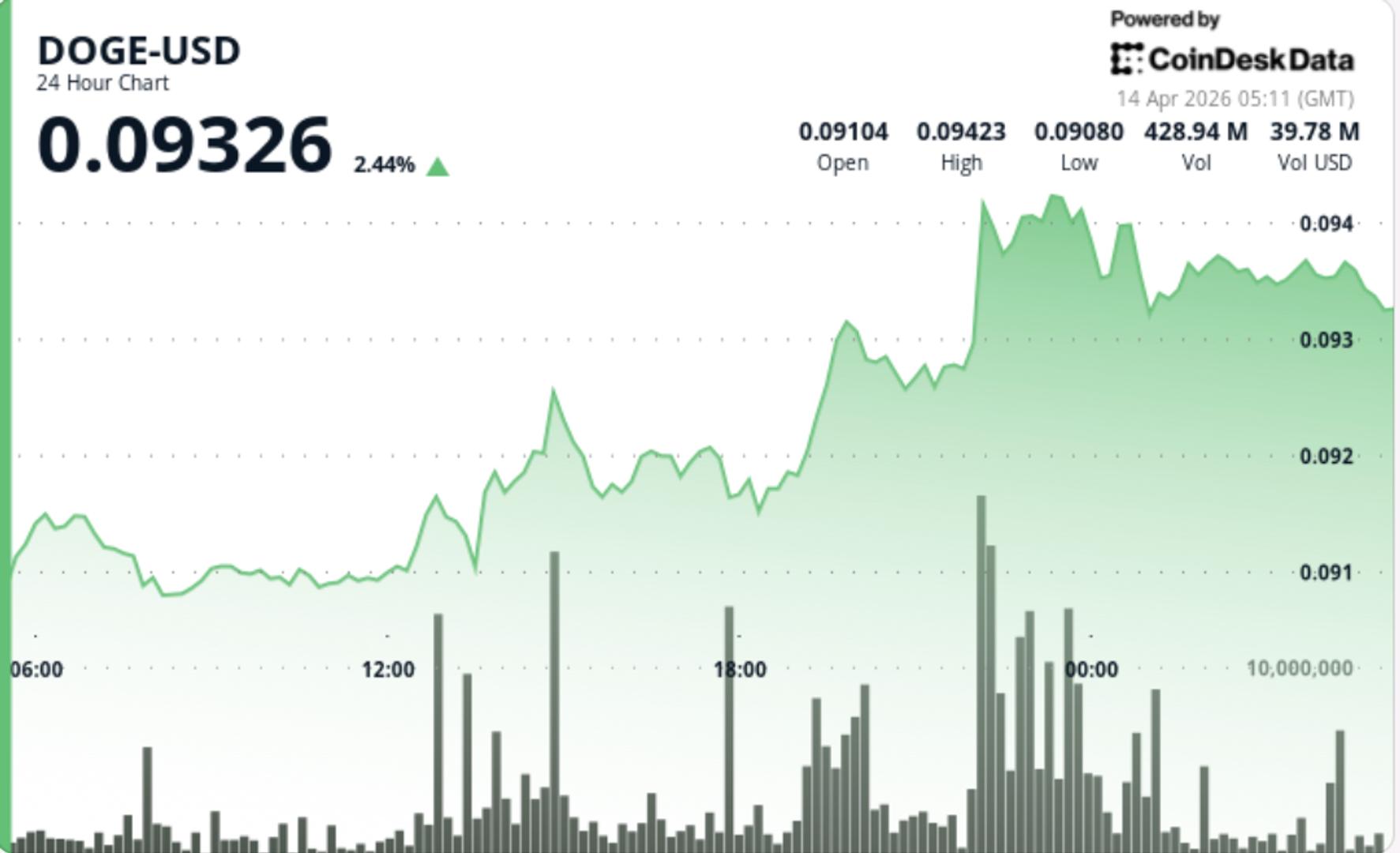
Dogecoin is pushing higher again, with volume confirming the move, but it has not cleared the level that really matters yet. The breakout looks constructive, though still early, with price holding gains rather than fading.
News Background
• DOGE-related investment products saw fresh inflows after weeks of inactivity, signaling returning institutional interest.
• Broader crypto sentiment remains mixed, with capital rotating selectively into higher-beta assets like meme coins.
Price Action Summary
• DOGE moved from $0.091 to $0.0936, breaking out of a tight consolidation range around $0.0915.
• The move was supported by sustained buying, with higher lows forming throughout the session.
• Price tested $0.094 but failed to break cleanly, instead consolidating just below resistance.
Technical Analysis
• The key signal is strong volume accompanying the breakout, suggesting real participation rather than a thin move.
• Higher lows indicate accumulation, with buyers stepping in consistently on dips.
• However, DOGE remains below the $0.094-$0.095 resistance zone, which has capped recent rallies.
• The broader pattern still reflects compression, meaning a larger move is likely but not yet confirmed.
What traders should watch
• $0.0925 is now the immediate support, with price needing to hold above it to maintain structure.
• $0.094 is the key breakout level, with a clean move above opening the path toward $0.095-$0.098.
• Failure to hold $0.092 risks a move back into the prior range near $0.091 or lower.


Aster DEX teams up with Genius to list the first GENIUS perpetuals, dangling a $200k ASTER prize pool into a thin‑liquidity, 850% meme‑rally that regulators are already watching.
Summary
- Perp DEX Aster has become a strategic ecosystem partner of trading terminal Genius and the first exchange to list a $GENIUS perpetual contract.
- To mark the launch, Aster is running a “Rocket Launch” trading event from April 13 at 15:30 UTC with a $200,000 prize pool in ASTER for users trading the new contract.
- The move coincides with a speculative frenzy around GENIUS, whose market value briefly topped $820 million after an 850% surge before easing back toward $716 million.
Decentralized derivatives platform Aster has announced it is now a strategic partner of the Genius trading ecosystem and will be the first DEX to offer a perpetual futures contract on the fast‑rising $GENIUS token. In an X post, the project said it has “become a strategic partner of Genius” and confirmed that the $GENIUS perp listing will go live alongside a promotional campaign designed to pull liquidity and traders into the new market.
According to Aster’s official Rocket Launch page, the platform will kick off a special $GENIUS contract trading event on April 13 at 15:30 UTC, funded with a prize pool of $200,000 worth of ASTER tokens. The Rocket Launch format, first introduced in 2025, splits rewards between ASTER and partner tokens and uses project‑funded buybacks to replenish ASTER incentives, with earlier campaigns also sized at around $200,000 to draw in high‑volume perp traders.
The listing comes on the heels of an extraordinary rally in GENIUS, the native token of the Genius multi‑chain trading terminal, which lets users trade spot, perpetuals and pre‑launch tokens across more than 10 networks from a single interface. ChainCatcher, citing GMGN market data, reported that GENIUS “surged over 850% in a short time,” with its fully diluted market capitalization briefly exceeding $820 million before pulling back to around $716 million as profit‑taking set in.
GMGN’s snapshot shows the token’s sharp repricing coincided with the final stretch of Genius’s Season 1 rewards campaign, which allocates 200 million “Genius Points” (GP) to active users, and with the rollout of integrations that let traders route perps from the Genius interface directly to venues like Hyperliquid and Aster. A YouTube breakdown of the project notes that there is a stated 1 billion‑token maximum supply, that GP airdrops are the main distribution channel so far, and that the team has promised “no inflation expansion or dilution tied to the points pool,” though full tokenomics remain in flux.
For Aster, which has pitched itself as a “new‑generation DEX” combining spot, perpetuals and tokenized stocks with low fees and deep liquidity, the GENIUS partnership is a bid to sit at the center of that on‑chain trading stack rather than compete with Genius’s terminal. The exchange has already used Rocket Launch campaigns to support other perp listings, including a $50,000 BAY perpetuals drive earlier this month, and MEXC has highlighted how prior events have helped push ASTER’s on‑chain holder count above 200,000.
Whether GENIUS’s 850%-plus spike proves durable is another question. CoinGecko data show that liquidity in the token’s pools remains relatively shallow — around $500,000 — meaning that highly leveraged perp products could amplify volatility in both directions once traders pile in. Still, the combination of a hot new trading terminal, a nine‑figure meme‑like market cap and a $200,000 perp‑trading prize pool on Aster underlines how quickly 2026’s on‑chain derivatives venues are turning hype into concrete market structure, even as regulators push parallel efforts to corral leverage under laws like the GENIUS Act and EU MiCA.
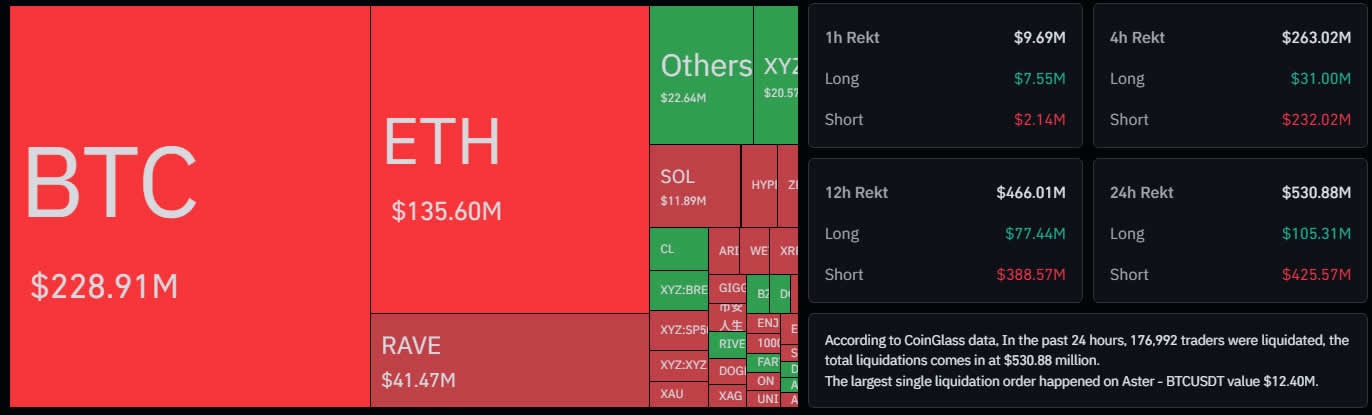
Bitcoin has surged to its highest price in nearly a month, triggering hundreds of millions worth of liquidations as hopes of a deal between the Trump administration and Iran washed the crypto market with positive sentiment.
The crypto market surged to a total value of $2.6 trillion, its highest level for a month, liquidating 177,000 traders of $530 million over the past 24 hours, according to CoinGlass.
The majority of liquidations occurred in the past 12 hours, and 80% of them, or $425 million, were leveraged short positions in Bitcoin (BTC) and Ether (ETH).
The analyst “Bull Theory” posted to X on Monday that over $300 billion in crypto shorts were liquidated over the past few hours, which has added more than $100 billion to the total crypto market capitalization.

“This isn’t a breakout. It’s a short squeeze running into overhead supply,” said Valerius Labs. “Real buyers show up above the 200 SMA [simple moving average], not 15% below it.”
Bitcoin tapped a four-week high just below $75,000 on Coinbase in late trading on Tuesday, according to TradingView. It was immediately rejected at heavy resistance there and had retreated to $74,290 at the time of writing.
Ether made a bigger move with a 7.5% daily gain to reach $2,380, its highest level since early February.

The latest move appears to be driven by derivatives, but a broader hope for a deal between the US and Iran to end weeks of conflict that has suppressed global markets could also be spurring investor confidence in riskier assets. Other drivers could include institutional inflows via spot crypto exchange-traded funds and centralized exchanges buying Bitcoin.
Traders hopeful of an Iran deal
Jeff Mei, the chief operating officer at BTSE, told Cointelegraph that markets are rallying largely because “traders believe the US and Iran are coming closer to a deal.”
Iran’s economic lifeline depends on its oil exports, and a US blockade of vital shipping lanes in the Strait of Hormuz could severely damage its economy, Mei said.
“Now, it appears that Iran is frantically looking to broker a deal, and stock and crypto markets are rallying as a response.”
Related: Bitcoin bounces to $72.5K as markets react to US Strait of Hormuz blockade
A US military blockade began on Monday, with President Donald Trump threatening any Iranian ships that approach.
“If any of these ships come anywhere close to our blockade, they will be immediately eliminated, using the same system of kill that we use against the drug dealers on boats at sea,” Trump posted on his Truth Social platform on Monday.
Trump also told reporters that Iran wants to make a deal, but his administration will not come to any agreement that allows Tehran to have a nuclear weapon.
Magazine: Bitcoin quantum-safe without upgrade? CZ’s 2031 crypto vision: Hodler’s Digest
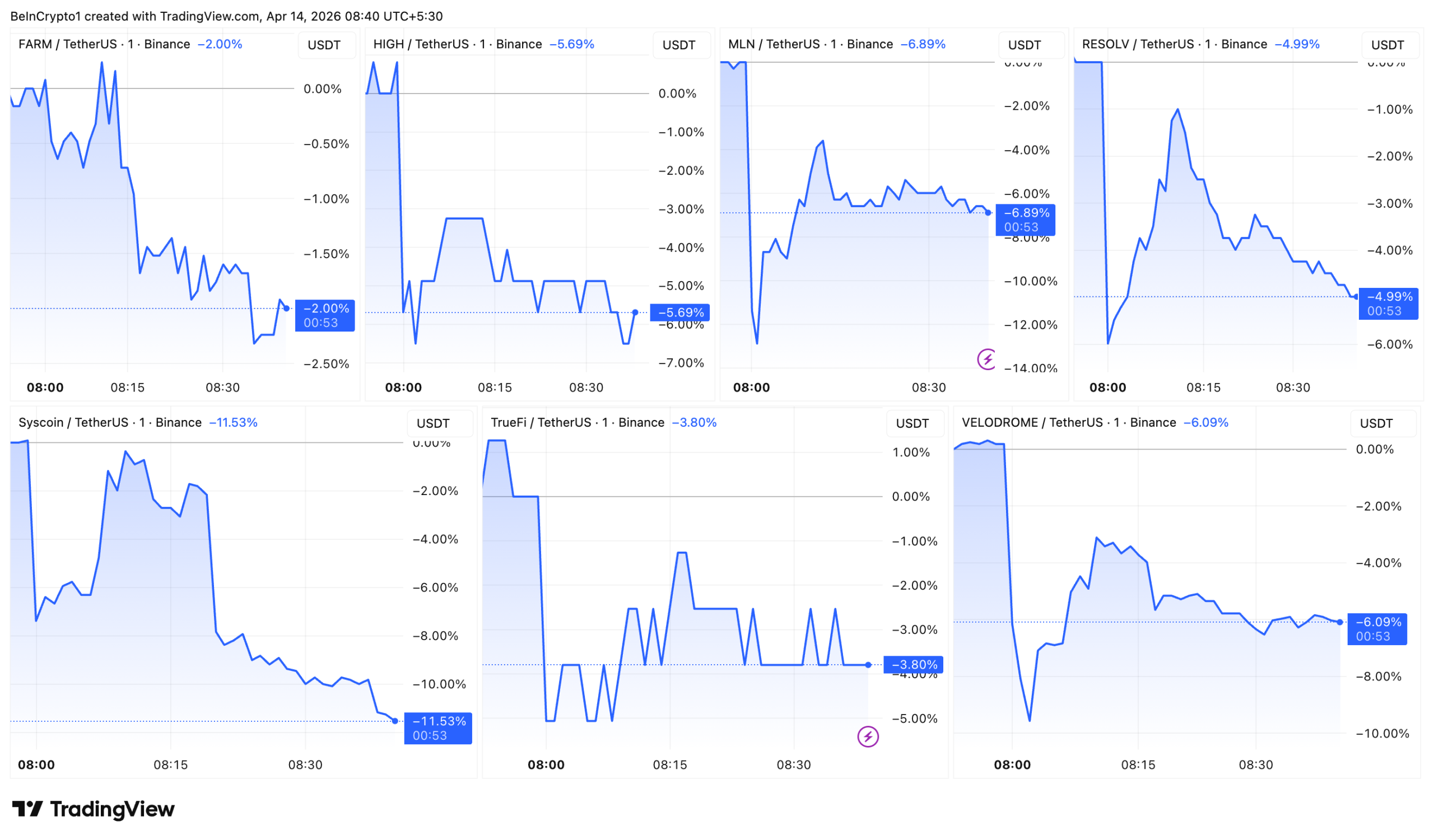
Binance flagged seven tokens with its Monitoring Tag on April 14, triggering an immediate selloff across all affected assets.
The tokens include Harvest Finance (FARM), Highstreet (HIGH), Enzyme (MLN), Resolv (RESOLV), Syscoin (SYS), TrueFi (TRU), and Velodrome Finance (VELODROME). The designation signals elevated volatility and potential removal from the exchange.
7 Altcoins at Risk for Binance Delisting
Market reaction was swift following the announcement. SYS dropped 11.53% within minutes, leading the decline. MLN fell 6.89%, while VELODROME shed 6.09%.
HIGH lost 5.69%, RESOLV declined 4.99%, and TRU slipped 3.80%. FARM recorded the smallest drop at 2.00%.
Follow us on X to get the latest news as it happens
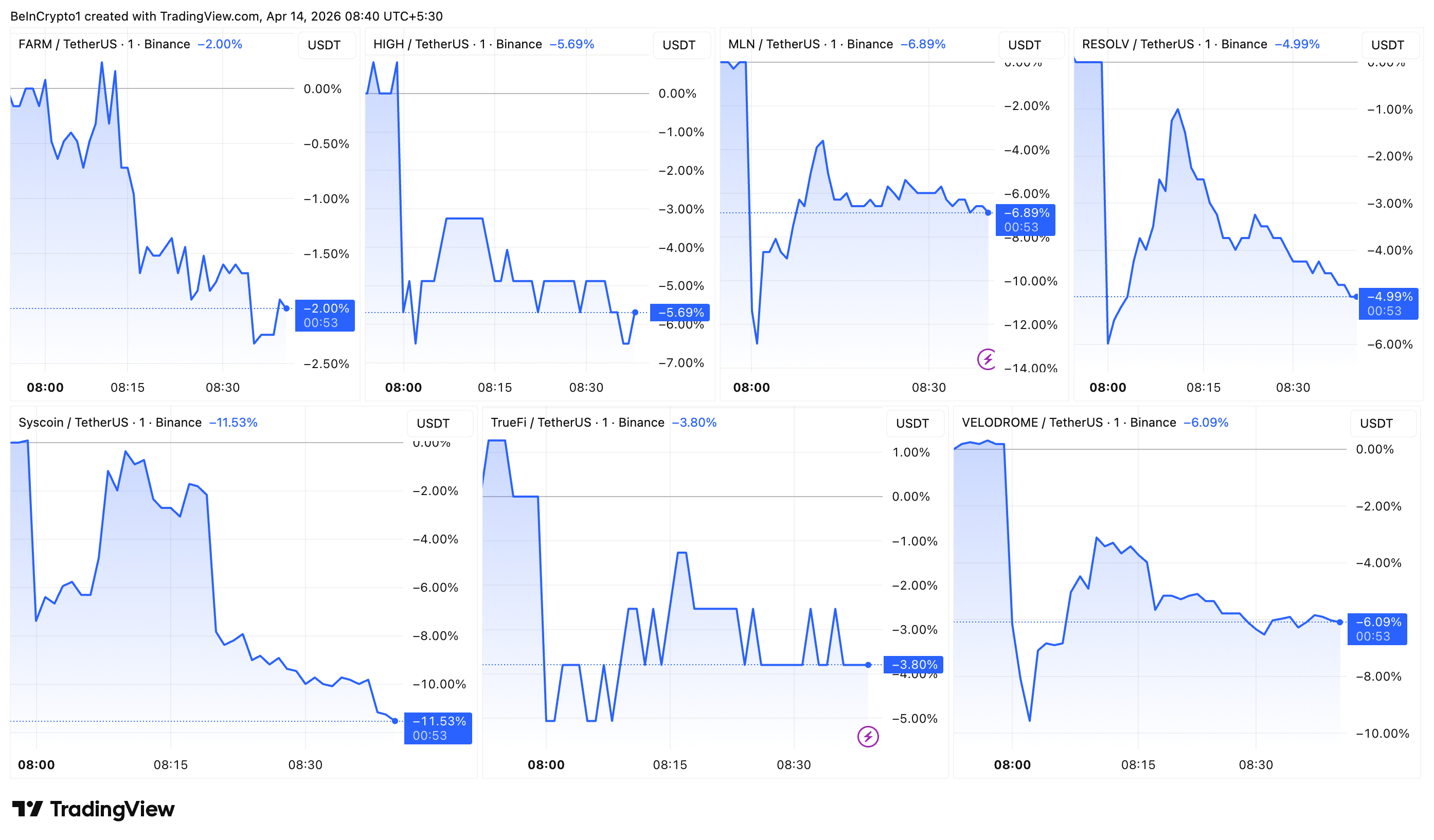
Binance’s Monitoring Tag has previously served as a warning signal for full removal. The exchange placed Beefy.Finance (BIFI) and Measurable Data Token (MDT) under the tag in June 2025.
FunToken (FUN) and Orchid (OXT) received it in March 2026. All four were confirmed for delisting on April 23, alongside FIO Protocol (FIO) and Wanchain (WAN).
That April 9 delisting notice triggered even sharper losses, with FUN crashing 27% and MDT dropping 22% within minutes.
“Tokens with the Monitoring Tag exhibit notably higher volatility and risks compared to other listed tokens. These tokens are closely monitored, with regular reviews conducted. Keep in mind that tokens with the Monitoring Tag are at risk of no longer meeting our listing criteria and being delisted from the platform,” Binance wrote.
Traders who wish to continue accessing the flagged tokens must now pass a quiz every 90 days on the Binance Spot or Margin platforms and accept the updated Terms of Use.
“The quizzes are set up to ensure users are aware of the risks before trading tokens with the Monitoring Tag or Seed Tag,” the exchange said.
In the same update, Binance also announced it will remove the Seed Tag from Tether Gold (XAUT). The Seed Tag designates newer, higher-risk listings and differs from the Monitoring Tag. Its removal signals that XAUT has met the exchange’s criteria.
Subscribe to our YouTube channel to watch leaders and journalists provide expert insights
The post 7 Tokens Face Binance Delisting Threat as Exchange Expands Watchlist appeared first on BeInCrypto.
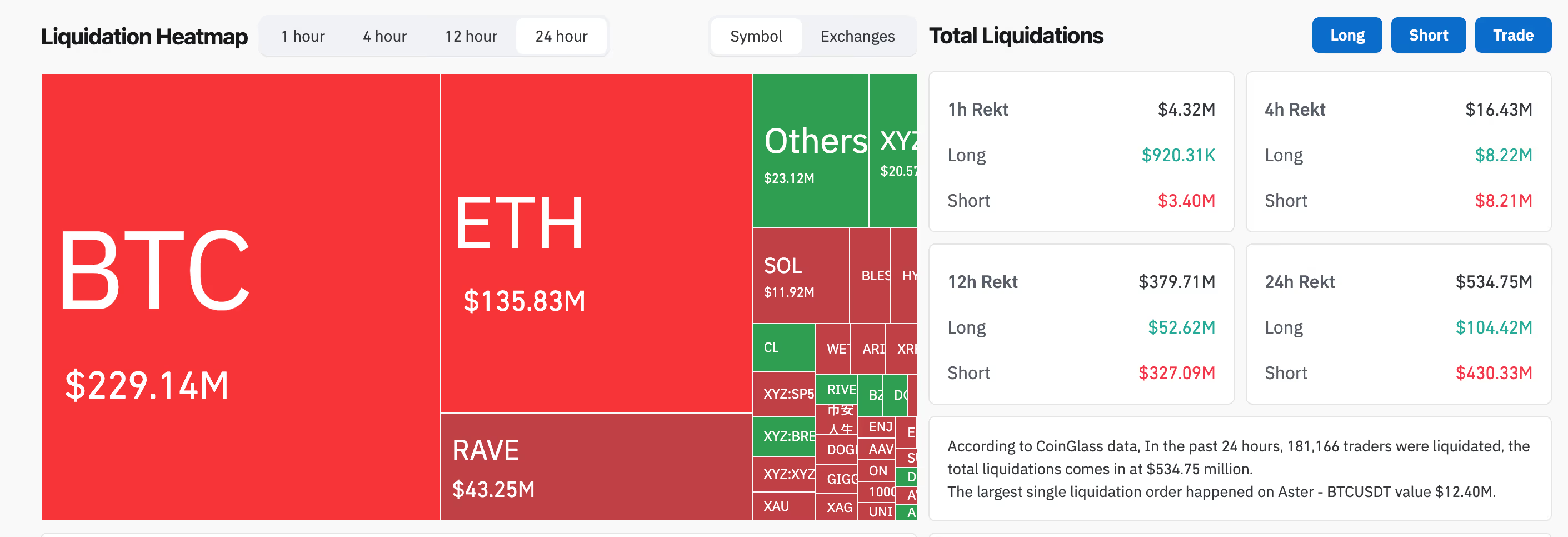
The $73,000 ceiling that rejected bitcoin three times in eight days just broke.
Bitcoin surged 4.8% to $74,484 late on Monday, its highest price since before the Iran war began in late February, after President Trump signaled a willingness to resume talks with Tehran even as the U.S. blockaded the Strait of Hormuz.
The move triggered $534 million in crypto liquidations across 180,000 traders, with $430 million coming from shorts, the second major squeeze in less than a week.
Ether led the majors with a 7.7% jump to $2,366, now up 12.4% on the week and outperforming bitcoin by a wide margin. Solana’s SOL climbed 4.6% to $85.80, up 7.6% weekly. BNB gained 3.3% to $615.80. XRP rose 2.9% to $1.36. Dogecoin added 2.7% to $0.094. Every asset in the top 10 is green on both the daily and weekly chart.
The largest single liquidation was a $12.4 million BTC-USDT short on Aster. Bitcoin accounted for $229 million in total liquidations and ether followed at $136 million. Smaller token RAVE added $43 million in liquidations as prices surged 66%, and Solana contributed $12 million.

The S&P 500 has now erased all losses triggered by the Iran conflict, with the MSCI All Country World Index heading for its eighth consecutive day of gains, the longest winning streak since September.
Brent crude fell 1.3% to $98 as markets priced in the possibility that fresh talks could happen before the April 7 ceasefire expires next week. Treasury yields fell one basis point to 4.28% as cheaper oil eased inflation concerns.
The 12-hour liquidation window was where the damage concentrated, with $379 million wiped out in that period, of which $327 million were from shorts. The ratio of short to long liquidations at roughly 4-to-1 over 12 hours reflects just how heavily the market was still positioned for failure at $73,000, even after last week’s ceasefire bounce had already punished that trade once.
For bitcoin specifically, the break above $73,000 puts the next resistance at the Traders’ Realized Price near $79,000, the level that analysis firm CryptoQuant identified as the point where active traders who bought during the drawdown return to breakeven and tend to sell.
Between here and there, the path has less technical resistance than at any point since the war began.
The risk remains the same, however. Trump ordered the Hormuz blockade after weekend talks in Islamabad produced no deal. The ceasefire expires next week. But the U.S. and Iran are discussing another round of talks, and the blockade itself is being read by markets as a targeted pressure tool rather than an escalation, one designed to curb Iran’s oil revenues while paving the way for eventual shipping resumption.

Miles Morales Faces a Dangerous Threat in New ‘Spider-Man: Beyond the Spider-Verse’ Images

James Taylor: England batter speaks 10 years after heart problem ended his career aged 26

WA govt softens call on Horizontal Falls tours


-

 Politics3 days ago
US brings back mandatory military draft registration
-
 Sports4 days ago
Man United discover Nico Schlotterbeck transfer fee as defender reaches Dortmund agreement
-

 Fashion3 days ago
Weekend Open Thread: Veronica Beard
-

 Tech6 days ago
How Long Can You Drive With Expired Registration? What Florida Law Says
-

 Politics2 days ago
World Cup exit makes Italy enter crisis mode
-

 Crypto World5 days ago
Canary Capital Files SEC Registration for PEPE ETF
-

 Business3 days ago
Tesla Model Y Tops China Auto Sales in March 2026 With 39,827 Registrations, Beating Cheaper EVs and Gas Cars
-

 Politics4 days ago
Malcolm In The Middle OG Turned Down ‘Buckets Of Money’ To Appear In Reboot
-

 Crypto World6 days ago
Bitcoin recovers as US and Iran Agree a Ceasefire Deal
-

 Fashion7 days ago
Let’s Discuss: DEI in 2026
-
 NewsBeat1 day ago
Pep Guardiola and Gary Neville agree over Arsenal title problem that benefits Man City
-

 Crypto World11 hours ago
The SEC Conditionalises DeFi Platforms to Be Avoided for Broker Registration
-

 Business4 days ago
OpenAI Halts Stargate UK Data Centre Project Over Energy Costs and Copyright Row
-

 Business3 days ago
Ireland Fuel Protests Enter Day 5 as Blockades Spark Shortages and Government Prepares Support Package
-

 Politics4 days ago
LBC Presenter Mocks Trump Over Iran War Failures
-

 Crypto World3 days ago
Federal judge blocks Arizona from bringing criminal charges against Kalshi
-

 Tech4 days ago
A version of Windows 10 released a decade ago is now eligible for additional security patches
-
 NewsBeat2 days ago
JD Vance announces ‘no agreement’ with Iran over nuclear weapons fear
-

 Crypto World8 hours ago
SEC Signals Exemption for Crypto Interfaces From Broker Registration
-

 Business3 days ago
IMF retains floor for precautionary balances at SDR 20 billion
You must be logged in to post a comment Login