

Crypto World
SEC Gives DeFi Front-Ends a Narrow Path Around Broker-Dealer Rules



New staff guidance from the SEC’s Division of Trading and Markets details conditions under which certain self-custody crypto UI can avoid broker-dealer registration.
The U.S. Securities and Exchange Commission’s Division of Trading and Markets issued new staff guidance today, April 13, that outlines conditions under which certain crypto-related user interfaces may operate without registering as broker-dealers under federal securities law.
The guidance applies specifically to what the staff calls “covered user interfaces,” which it defines as self-custody software products for interacting with crypto, which could include DeFi protocol front-ends, wallet extensions, and mobile apps.
The staff guidance defines these UIs as “an interface provided by a website, browser extension, or other software application (e.g., mobile application) that may be embedded in a wallet or separately available for download, designed to assist users engaging in user-initiated crypto asset securities transactions on blockchain protocols (or blockchain-based smart contracts) utilizing the user’s self-custodial wallet.”
Under the SEC staff statement, an interface can avoid broker-dealer registration only if it meets all of the following conditions:
- It does not take custody of user funds;
- It provides no investment advice or trade recommendations;
- It does not route or execute orders on users’ behalf;
- Generally, it charges a fixed percentage as a transaction fee;
- It exercises no discretion over transactions or market activity.
The statement also prohibits operators from labeling trading routes as “best” or “preferred” and bars any commentary that could be interpreted as investment advice.
The SEC stressed that the statement is not a formal rule or binding regulation. Rather, it reflects staff’s current interpretation of existing Exchange Act law. The guidance is set to remain in effect for five years unless superseded by formal commission-level rulemaking, per today’s statement.
The DeFi Regulation Question
The release arrives amid a long-running debate over how U.S. law should treat DeFi developers and the software infrastructure they build. As The Defiant has reported, even after a landmark joint SEC-CFTC interpretive release earlier this year, key questions about fully permissionless DeFi remain unanswered, with experts noting that regulators have largely built frameworks around centralized actors, while deferring the hardest DeFi questions to future rulemaking.
That uncertainty has fueled industry anxiety over the fate of protocol developers, front-end operators, and wallet providers under existing securities law.
Lawyers and industry observers have warned that early draft of the CLARITY Act, the pending crypto market structure bill that has not yet passed into law, leaves many issues unresolved, empowering agencies to fill in the details through future rulemaking.
Meanwhile, both the CFTC and SEC have signaled they are working to modernize rules so there is a clearer place for on-chain software systems and front-ends within the regulatory framework.
This article was written with the assistance of AI workflows. All our stories are curated, edited and fact-checked by a human.



Indonesia’s Ministry of Communication and Digital Affairs has blocked access to Polymarket, saying the crypto-based prediction market amounts to online gambling under local law.
The ministry said it had cut access to the platform and was tracing affiliated social media accounts for possible restrictions across other digital channels.
Alexander Sabar, director general of digital space supervision, claimed that platforms that allow users to wager money on uncertain outcomes remain gambling products, even when they use blockchain technology or crypto assets.
Polymarket lets users trade contracts tied to real-world events, including elections, sports, crypto prices and political outcomes. The platform has grown into one of the largest crypto prediction markets, but regulators in several jurisdictions have treated parts of the business as gambling rather than financial-market activity.
Indonesia’s statement did not name Kalshi, a U.S.-regulated prediction market operator, or other platforms but said authorities would restrict similar services that facilitate online gambling.
The order could extend to other prediction-market platforms if Indonesian regulators determine that they allow users to wager money on uncertain real-world events.
Indonesia’s move follows a broader clampdown on prediction markets in Asia. India recently blocked Polymarket after authorities classified such platforms as prohibited online money gaming, with Kalshi also facing potential scrutiny. Polymarket is separately seeking approval in Japan by 2030, where strict gambling rules limit most forms of betting outside state-sanctioned activities.
The Indonesian ministry said Singapore, Brazil and India have blocked Polymarket, while Taiwan, Thailand, China and Japan have imposed restrictions under local law. The prediction market is also blocked in Ukraine, where there’s no legal way for it to come back.
The regulator urged Indonesians not to access or participate in digital betting activity, including markets that use crypto assets, citing potential financial losses and violations of Indonesian law. The ministry said it would keep coordinating with law enforcement and other stakeholders to monitor similar platforms.

The first human to fly past Mars will be a Bitcoin miner. F2Pool co-founder Chun Wang, a Bitcoin miner, has been named by SpaceX as commander of its first private crewed interplanetary mission.
During the global Starship V3 launch livestream, Wang delivered a pre-recorded announcement from Bouvet Island confirming he would command a two-year Mars flyby mission and return to Earth. Wang co-founded F2Pool in 2013 and has mined more than 1.3 million BTC, representing over 9% of all Bitcoin blocks ever produced.
SpaceX has just announced that billionaire Bitcoin miner Wang Chun will lead its first mission to mars. — CryptoSavingExpert ® (@CryptoSavingExp) May 25, 2026
He bought Bitcoin at $1 and now he’s going to Mars!  pic.twitter.com/cyqQjESuDi
The funds for his space ambitions came directly from over a decade of mining pool fees and his stake.fish proof-of-stake business launched in 2018.
This isn’t just a human interest story. Bitcoin mining profits literally financing interplanetary travel signals a maturation of crypto wealth that markets are beginning to price in. SpaceX’s deepening crypto ties add a structural demand narrative.
Discover: The Best Crypto to Diversify Your Portfolio
Can Bitcoin Price Break $80,000 on Miner Mars Mission Momentum?
Bitcoin is consolidating at $77,500, sitting in a high-level compression zone just below the psychological $80,000 barrier. Volume has been consistent, and key technical levels are clearly defined.
Support is at $75,000, the previous breakout zone with heavy open interest concentration and confirmed buyer absorption. Immediate resistance sits between $82,000–$83,000, where sellers have repeatedly capped rallies in recent sessions. Moving average structure remains bullish, price is holding above its medium-term trend lines with no confirmed bearish crossover.

Three scenarios are on the table.
Bull case: Continued ETF inflows push BTC through $82,000, opening a path toward the $100,000+ cycle targets that major U.S. banks and asset managers have reiterated throughout 2025–2026 based on post-halving supply dynamics.
Base case: BTC grinds sideways between $74,000 and $80,000 as the market is under stress due to Middle East tensions.
Bear/invalidation: a close below $70,000 breaks the structure and signals the consolidation resolves to the downside. However, data currently does not suggest that scenario.
Discover: The best pre-launch token sales
Bitcoin Hyper Targets Early-Stage Upside While BTC Tests Resistance
At $77,500, the asymmetric upside that early Bitcoin miners like Wang captured is simply no longer available on the spot market. Where does a trader look when the base layer is pricing in maturity? Early-stage Bitcoin infrastructure is one answer.
Bitcoin Hyper ($HYPER) is positioning itself as the first Bitcoin Layer 2 with Solana Virtual Machine (SVM) integration. It boasts sub-second transaction finality and smart contract execution faster than Solana itself, while anchoring to Bitcoin’s security and trust.
The presale has raised close to $33 million at a current price of $0.0136, with a high 36% APY staking already live for participants.
The core thesis: Bitcoin’s limitations, such as slow transactions, high fees, and no programmability, are a product gap, and HYPER targets that gap directly with a decentralized canonical bridge for BTC transfers and low-cost execution infrastructure.
The post First Person to Fly Mars Going to Be A Bitcoin Miner: Bitcoin Mars Mission Started? appeared first on Cryptonews.


A New York lawsuit filed by Noah Doe seeks legal ownership of 39,069 dormant Bitcoin wallet addresses.
Summary
- Plaintiff Noah Doe filed suit in New York on May 1, 2026, seeking a declaratory judgment that 39,069 abandoned Bitcoin wallets belong to him under New York lost-property law.
- The filing was made through Brooklyn firm Lewis and Lin LLC under New York Personal Property Law Article 7-B, the lost-property statute covering found and abandoned property.
- The 39,069 listed wallets reportedly hold an estimated 3.7 million BTC worth approximately $285 billion, including addresses linked to Satoshi Nakamoto and the Mt. Gox hacker.
A New York Bitcoin wallet lawsuit filed on May 1, 2026 in the Supreme Court of the State of New York asks a court to declare that 39,069 dormant addresses legally belong to plaintiff Noah Doe.
The complaint, filed under index number 153119/2026 through Brooklyn law firm Lewis and Lin LLC, invokes New York Personal Property Law Article 7-B.
Doe says he discovered the wallets in October 2024 after identifying a security vulnerability that caused owners to permanently lose the ability to withdraw their holdings.
He developed a proprietary algorithm to identify wallets meeting the legal standard for abandonment, reported them to the NYPD, and spent more than a year attempting to locate their owners before filing suit.
What the Bitcoin wallet lawsuit is actually claiming
The complaint seeks a declaratory judgment declaring that Noah Doe and his two assignee companies, designated ABC Company and XYZ Company, are the legal owners of the 39,069 wallets and their contents.
Doe transferred ownership rights in all but 18 wallets to ABC Company on December 1, 2025, which subsequently transferred 17.7% to XYZ Company.
The listed addresses include wallet “12c6D,” associated with Satoshi Nakamoto, and “1Feex,” linked to the Mt. Gox exchange hacker. Sani, founder of blockchain analytics platform Timechain Index, estimated the total holdings across the listed wallets at approximately 3.7 million BTC, valued at around $285 billion at current prices. Crypto.news has tracked broader legislative efforts to establish legal frameworks around federal Bitcoin holdings.
Why the case could set a precedent for abandoned crypto property
The central legal question is whether dormant, self-custodied Bitcoin wallets can be treated as abandoned property under existing state law. Exchange-held assets already have dormancy and escheatment frameworks, but self-custodied wallets outside any institutional ledger sit in a legal grey zone that no court has formally resolved.
Timechain Index’s founder noted a potential procedural flaw: the plaintiffs sent legal notices to Pay-to-Public-Key-Hash addresses, while many old Satoshi-era wallet balances sit in unnotified Pay-to-Public-Key format scripts. If a court accepts the claim, it could establish precedent for how abandoned-property rules apply to decentralised assets entirely outside exchange custody.
Crypto.news has reported on the US government’s own Bitcoin holdings, as the legal and regulatory framework around Bitcoin ownership continues to evolve. The Bitcoin (BTC) price page tracks live market reaction as the lawsuit draws attention to dormant wallet dynamics.
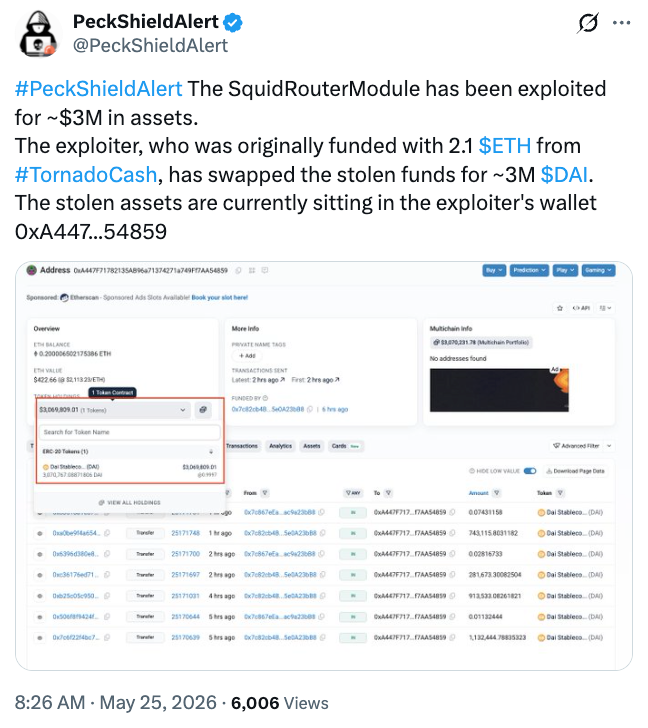
A suspected third-party Safe module exploit has drained about $3.2 million from wallets across Ethereum and Base, with multiple teams pointing to an external module as the cause.
Blockchain security platform Blockaid reported the incident on Monday, saying it involved a contract labeled “SquidRouterModule,” which initially led to confusion over a possible link to the cross-chain protocol Squid.
Squid later said on X that the issue was unrelated to its core protocol and instead involved a third-party module integrated into Safe wallets.
“A third-party SquidRouterModule was exploited, not Squid’s Router contract,” Squid said, adding that the contract shares its name but not its code.
The incident highlights how a trusted wallet module can be used to move funds if it has been granted broad execution permissions within a smart account.
86 Gnosis Safes drained for $3 million in about two hours
Safe, formerly Gnosis Safe, is a multi-sign wallet running on multiple networks, which requires a minimum number of users to approve a transaction before execution.
It can also be extended with optional modules, which are smart contracts that allow approved code to execute actions on behalf of the wallet.
Related: DeFi hacks shake institutional confidence as risks outpace yields
According to Blockaid, the attack affected at least 86 Safe accounts within roughly two hours, with all stolen tokens swapped to Dai (DAI) via attacker-controlled Uniswap V3 pools.
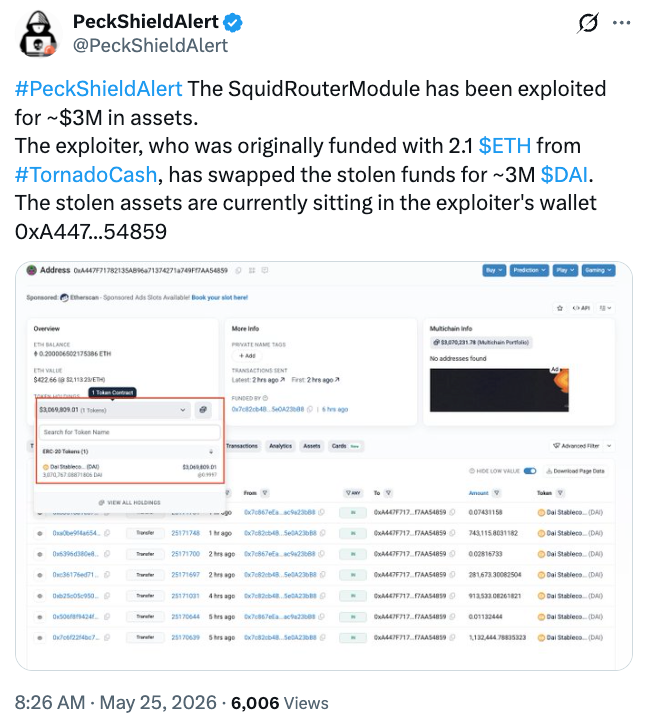
Source: PeckShieldAlert
The suspected root cause is a vulnerability in SquidRouterModule, which allegedly allowed the attacker to impersonate authorized delegates and trigger unauthorized token swaps, Blockaid said.
Module attribution and Safe response
Safe Labs CEO Rahul Rumalla said the accounts “do not seem to be operated on official Safe Wallet product,” adding that it remains unclear how and where they were created and managed, likely created through externally deployed integrations.
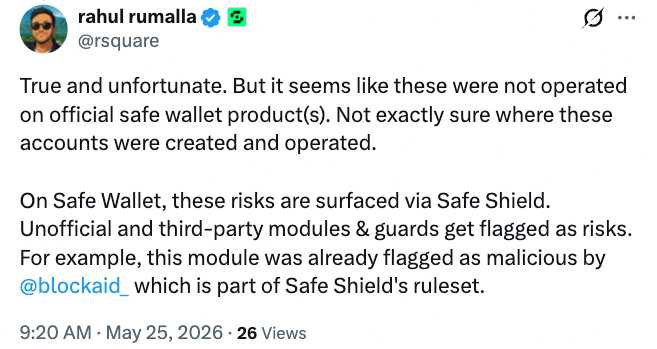
Source: Rahul Rumalla
He said Safe Wallet surfaces such risks through “Safe Shield,” a feature designed to flag potentially malicious or unverified modules and guards before they are used. The CEO added that the exploited module had already been flagged as malicious by Blockaid, which is included in Safe Shield’s risk detection ruleset.
Cointelegraph approached Safe and its CEO for comment but did not receive a response by publication time.
Magazine: ETH bears growling, Tom Lee’s buying, XRP to ‘explode’: Market Moves
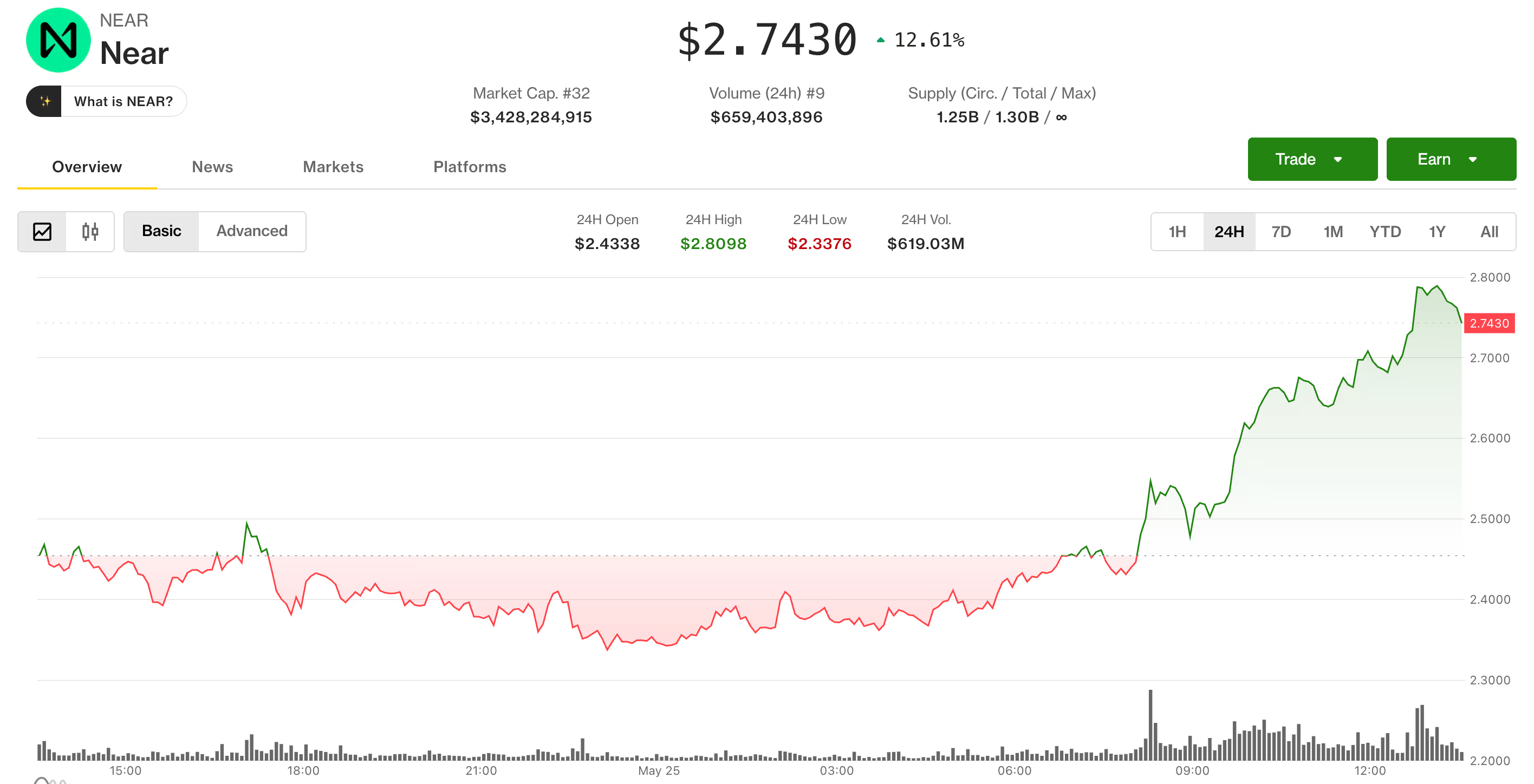
NEAR Protocol’s token climbed 15% over the past 24 hours to $2.8, extending a month-long rally that has seen the price of NEAR double in the past month.
The move comes amid the success surrounding NEAR Intents, the network’s cross-chain transaction system. The product allows users to request a desired outcome, such as swapping USDC on Ethereum for SOL on Solana, while third-party solvers execute the transaction behind the scenes.
DefiLlama data shows NEAR Intents has processed more than $19 billion in cumulative volume and generated about $32 million in fees. The figures have drawn renewed attention to the protocol after months of limited price movement.
The rally accelerated further after BitMEX co-founder Arthur Hayes described NEAR, Hyperliquid’s HYPE and ZEC as crypto’s “holy trinity” in a post on social media, before suggesting there’s a “long way to go” in its rally.

NEAR gained about 30% as traders rotated back into tokens tied to artificial intelligence and blockchain infrastructure earlier in the month, while institutional demand has been growing. The Bitwise NEAR Staking ETP listed in Europe has grown to roughly $40 million in assets under management, after seeing $7 million in inflows in a single week.
Investors are also watching an upcoming June network upgrade that introduces dynamic resharding. The change is designed to automatically split network shards as demand increases, potentially improving scalability during periods of heavy usage.
Despite the recent surge, NEAR remains well below its 2022 peak near $20.
NEAR is a layer-1 blockchain focused on applications, AI infrastructure and cross-chain transactions. The network uses a proof-of-stake model and markets itself as a platform designed to simplify interactions across blockchains while handling large volumes of activity through sharding.
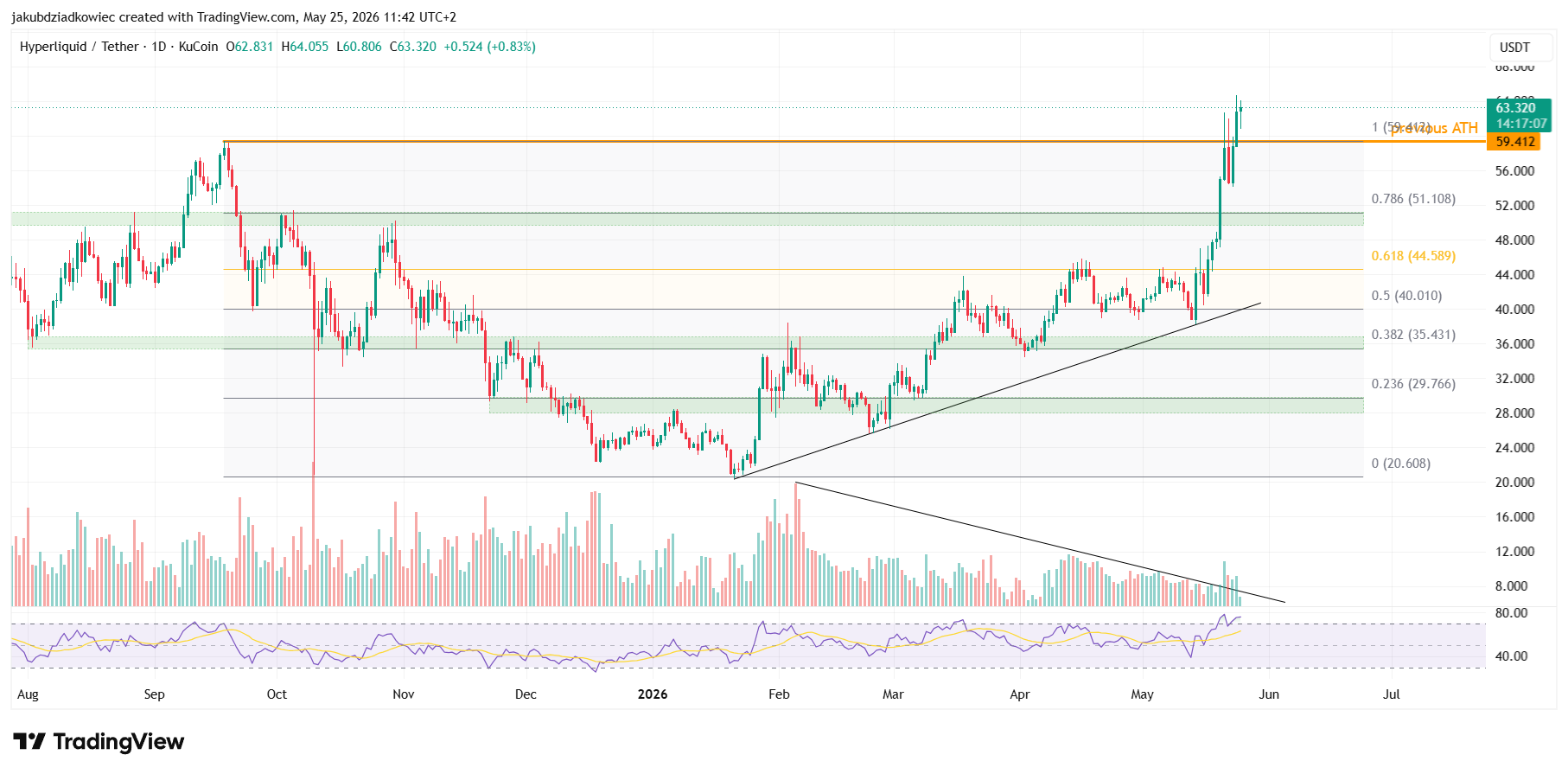
Three large-cap altcoins are flashing signals that put new all-time highs back on the table this week. Hyperliquid (HYPE), Tron (TRX), and WhiteBIT Coin (WBT) all sit within striking distance of fresh records.
HYPE has already pushed above its previous high and now trades in price discovery. TRX sits roughly 18% below its peak, while WBT trades around 13% below its own record.
HYPE Breaks Past Previous All-Time High and Enters Price Discovery
The Hyperliquid daily chart shows a clean breakout structure above the previous record near $59.50. The token bounced off an ascending trend line on May 14 and has trended higher ever since.
The most recent leg cleared the 0.786 Fibonacci retracement resistance at $51, with a fresh volume spike confirming the move into uncharted territory. RSI sits near 76, well in bullish territory but not yet at extreme overbought readings.
Background volume has been declining for several weeks, which forms a small divergence against the breakout candle. Traders may want confirmation of continued buying before assuming the price discovery phase extends much further.

X user IvanOnTech flagged the same setup with a trend-flip indicator showing HYPE up nearly 90% since its February bull flip. He framed the move as a lesson in selective altcoin exposure.
“$HYPE up almost 90% since the recent bull flip but the most important detail is that most altcoins are not recovering ADA, DOT, AVAX – all so called “bluechips” are dead and down 80-90%+ the lesson is – ONLY BUY CONFIRMED BULLISH ASSETS!”

TRX Breaks Ascending Channel and Eyes $0.40
Tron (TRX) recently broke out of an ascending parallel channel that had contained price action since November 12, 2025. The breakout also swept the September 12 swing high in the process.
The token now tests the second area of resistance near $0.37, which marks the previous swing high from August 23, 2025. TRX currently trades roughly 18% below its all-time high of $0.45.
The next upside target sits at the 1.272 Fibonacci retracement near $0.40, followed by the 1.618 extension at $0.4327. RSI hovers around 80 in bullish territory with no bearish divergence visible yet. Sustained stablecoin demand on the network continues to provide a fundamental tailwind.

X user VentureCoinist zoomed out further and highlighted TRX as one of the most consistent multi-year charts in the entire market. His log-scale view shows the token grinding higher since 2019.
“the least talked about & most insane chart in crypto $TRX has somehow been going uponly for 6+ years”

WBT Tests $57 Resistance and Eyes $60 Next
WhiteBIT Coin (WBT) continues to print higher highs and higher lows on the daily chart. The token recently swept the March 17 swing high before correcting to the 0.5 Fibonacci retracement around $55.
WBT now attempts another break above the 0.618 Fibonacci retracement resistance near $57. A confirmed close above this level would open the door to the 0.786 Fibonacci retracement at $60.
A successful break would put the price within roughly 13% of the all-time high at $64. In a deeper pullback scenario, the first support sits at the 0.382 Fibonacci retracement near $53.
Volume has been declining steadily, and RSI sits near the neutral zone. The combination points to an accumulation phase rather than aggressive directional positioning by either side.

Three Altcoin Setups for All-Time High, Three Different Stages
HYPE has already done its part by entering price discovery. TRX and WBT now need confirmed breakouts above $0.37 and $57, respectively, to validate the same thesis. The next 24 to 72 hours of price action around these levels will likely decide whether the altcoins all-time high theme extends across the entire trio. Traders should verify levels independently, since technical setups indicate probabilities, not certainties.
The post 3 Altcoins Within Striking Distance of New All-Time Highs This Week appeared first on BeInCrypto.


While most of Crypto Twitter reacted enthusiastically to Ethereum co-founder Vitalik Buterin outlining a leaner, more focused future for the Ethereum Foundation (EF), the market reaction was more muted. Ether rose about 1.4% in the 24 hours after Buterin’s post, trading near $2,132 as of Monday…. Read the full story at The Defiant
Two Texas Congressional candidates supported by millions of dollars in spending from interest groups aligned with the cryptocurrency industry are headed for runoffs this week in races for the US Senate and House of Representatives.
On Tuesday, Democratic voters in Texas’ 18th congressional district will decide between incumbent Al Green and challenger Christian Menefee to run in November’s general election. Statewide, voters will choose between Texas Attorney General Ken Paxton and incumbent John Cornyn for the Republican primary for US Senate.
Both Tuesday races are runoffs after none of the candidates failed to secure a majority in Texas’ March primaries. The crypto industry, through spending on media by political action committees (PACs), has stakes in both races, which could influence policy and the makeup of Congress going into 2027.
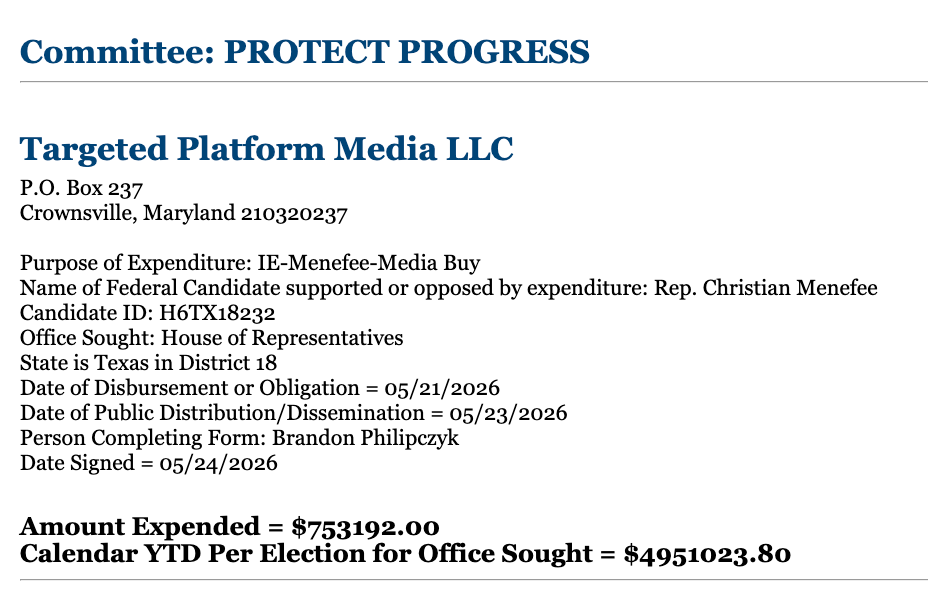
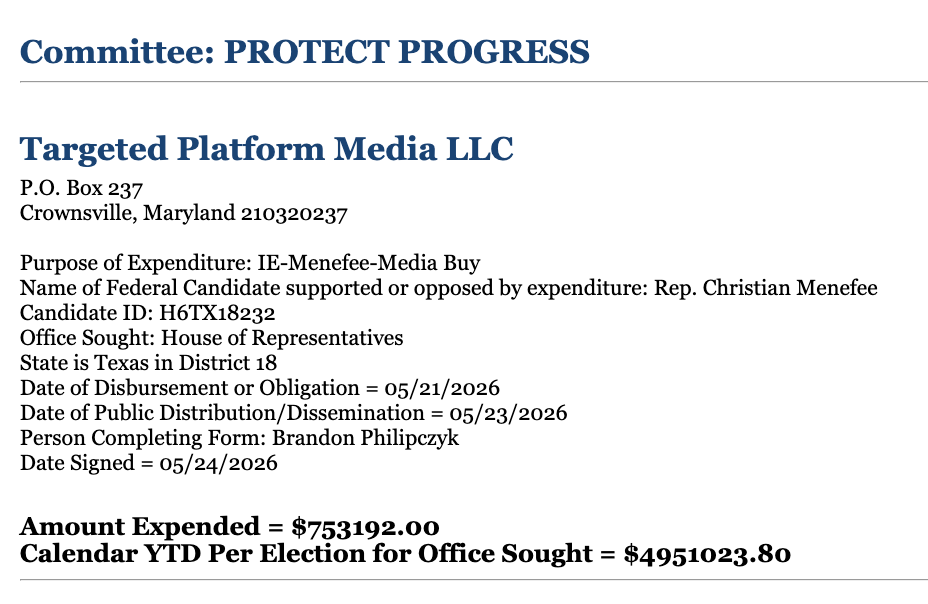
As of Sunday, Protect Progress, affiliated with the Ripple- and Coinbase-backed Fairshake PAC, reported spending $5 million to support Menefee over Green. The PAC spent $2.8 million on ads opposing Green. Menefee also has the endorsement of the Blockchain Leadership Fund, a committee backed by Anchorage Digital and Chainlink Labs, though it had not reported any expenditures as of Monday.
Source: US Federal Election Commission
The outcome of the primaries could influence who will ultimately win Texas’ 18th district and one of the state’s two Senate seats in the November general election, potentially affecting which political party controls Congress in 2027. Under a Republican majority, lawmakers have passed key pieces of legislation supported by the crypto industry, including the stablecoin GENIUS Act.
At least one of the ads funded by Protect Progress to support Menefee did not mention crypto or blockchain, but rather Green’s opposition to US President Donald Trump. Bill King, a former opinion writer for the Houston Chronicle, said in a local FOX26 segment that aired on Sunday:
“I saw 12 television commercials yesterday paid for by the Protect Progress PAC […] and that same group of people are the ones that are primarily funding Trump.”
Related: Texas Lt. Gov. calls for study of crypto, prediction markets
The Fellowship PAC, funded by Wall Street firm Cantor Fitzgerald and Anchorage, reported spending $500,000 to support Paxton over Cornyn for the US Senate seat. The expenditure came about 24 hours after Trump endorsed Paxton, saying that Cornyn had been “very late in backing” him as a Republican candidate for president.
Prediction markets heavily favor Paxton and Menefee
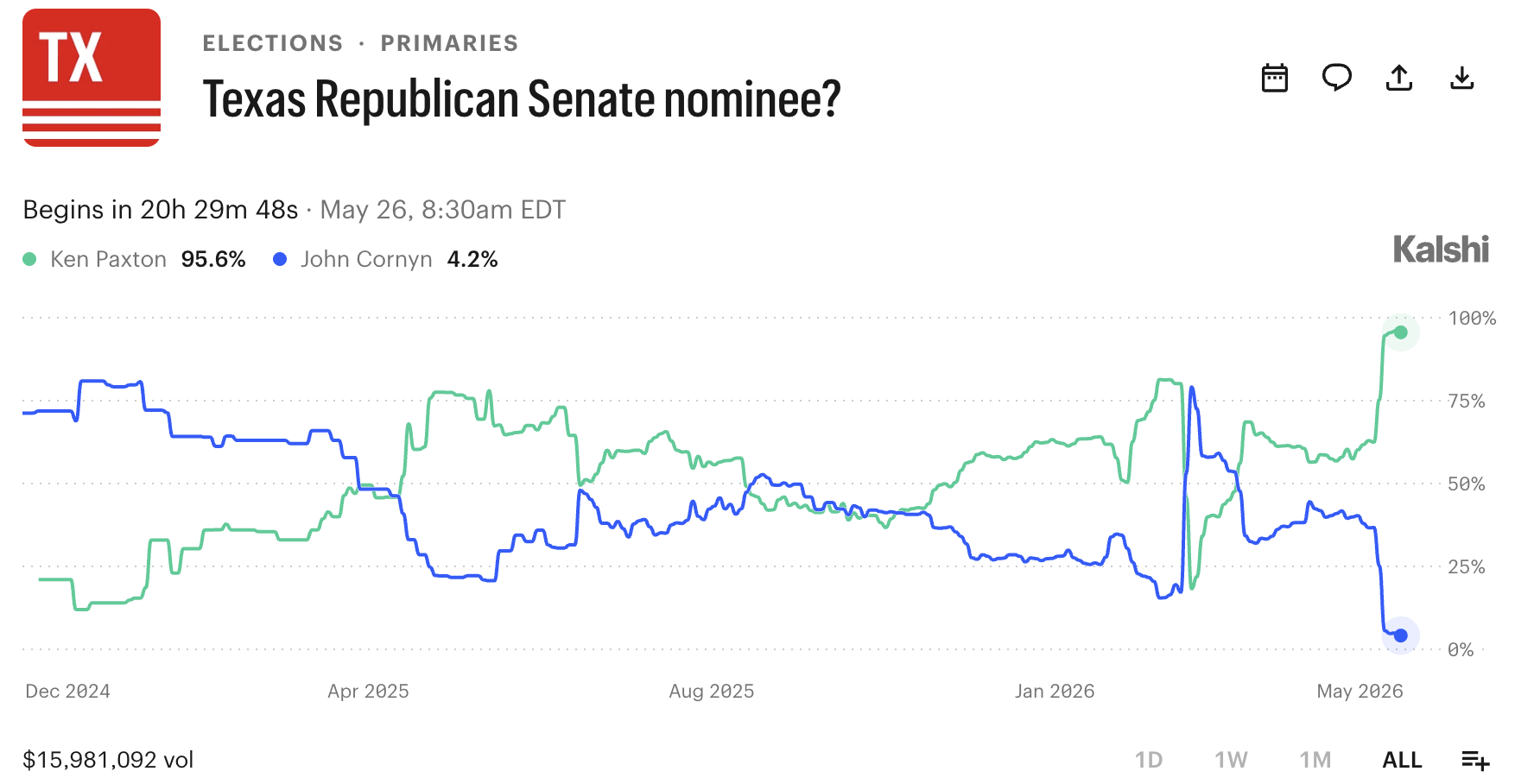
The Kalshi prediction market gave its users 91% and 96% chances on event contracts favoring Menefee over Green and Paxton over Cornyn, respectively.
Source: Kalshi
The platform has consistently provided event contracts favoring the Democratic candidate since February, while Paxton’s odds surged above 90% for the first time after Trump’s endorsement on Tuesday, and stood at almost 96%, at last look on Monday. Bets on that race topped more than $16 million in total volume.
Rival predictions market platform Polymarket gave both candidates similar chances in Tuesday’s runoffs.
Magazine: ETH bears growling, Tom Lee’s buying, XRP to ‘explode’: Market Moves
Crypto World
XRP pre-sale surpasses $10 million, XRP holders are paying close attention to SHRMiner’s free cloud mining service

Disclosure: This article does not represent investment advice. The content and materials featured on this page are for educational purposes only.
Regulatory progress and XRP growth fuel interest in cloud mining platforms like SHRMiner among crypto investors.
Summary
- Growing regulatory clarity around crypto is increasing interest in cloud mining platforms tied to digital asset ecosystems.
- SHRMiner has launched XRP-supported cloud mining contracts that allow users to participate without owning hardware.
- The platform says its AI-powered system can redirect mining power toward higher-yield assets and settle rewards daily.
According to CNBC, following months of negotiations regarding stablecoin yield rules and decentralized finance (DeFi) regulation, the Digital Asset Market Transparency Act was passed by the Senate Banking Committee on May 14.
Senators Ruben Gallego and Angela Alsobrooks, joined by all Republican members, championed the bill’s passage. Following the vote, the price of Bitcoin briefly surged to $81,965 but subsequently retreated amid macroeconomic headwinds; the bill still requires 60 votes in the Senate as well as passage by the House of Representatives.
This cryptocurrency market news highlights the trend toward a transition to regulated legitimacy; however, regulatory clarity alone does not tell retail investors where to find the greatest returns, and as the rules become increasingly clear, the window for early positioning is narrowing.

Regulatory uncertainty has historically caused even the most astute investors to adopt a wait-and-see approach. Today, with the advancement of the CLARITY Act, the central question has shifted from whether the market can grow to which specific projects will yield returns for early-moving investors.
Amidst an environment characterized by heightened price volatility and an abundance of short-term opportunities, regulated cloud mining platforms — such as SHRMiner — are emerging as the preferred choice for investors. Users need neither to own their own hardware nor possess technical expertise; they simply need to purchase computing power to participate in mining and earn daily returns, all while benefiting from the growth potential of the XRP ecosystem.
In this environment, investors are no longer merely asking:
“Will the price go up?”
But increasingly:
“How can I generate daily profits, even without engaging in active trading?”
Against this backdrop, SHRMiner has officially launched a cloud mining rewards contract that supports XRP payments. Users simply need to use XRP to activate computing power, requiring no additional hardware or complex procedures. The system automatically executes the mining operations and settles daily earnings, enabling otherwise idle XRP assets to achieve steady appreciation.
Why has cloud mining suddenly sparked such heated discussion?
SHRMiner is a UK-based cloud mining platform dedicated to providing secure, efficient, and scalable cloud mining services to over 5 million users across more than 180 countries. Users are not required to purchase mining hardware themselves, nor do they need to bear the complex costs associated with electricity, cooling, or maintenance; instead, they can participate in Bitcoin mining indirectly simply by purchasing the hash rate contracts offered by the platform. Compared to traditional individual mining methods, this model significantly lowers the barrier to entry while simultaneously making the allocation of hash rate resources more centralized and professional.
SHR Miner’s XRP cloud mining is now live
XRP has long been recognized for its pivotal role in cross-border payments and institutional finance; now, SHRMiner’s latest innovation — user-friendly cloud mining — propels XRP into a new era.
Users can choose to mine XRP directly or leverage SHRMiner’s intelligent AI engine, which automatically redirects mining power to the assets yielding the highest returns, including BTC, XRP, ETH, DOGE, USDC, and others. Earnings are paid out daily in a chosen cryptocurrency, providing a reliable source of income regardless of market fluctuations.
Whether someone is a beginner or an experienced investor, with the SHRMiner cloud mining platform, they can easily participate in mining without the need to purchase mining hardware or possess specialized technical skills. In just four simple steps, anyone can embark on their journey toward generating passive income from digital assets.
Here is how to join SHRMiner
1. Register an Account
Visit the official website or download the mobile app. Complete registration using an email address to instantly receive a $15 reward, plus a daily login bonus of $0.60. (Click here for one-click registration).
2. Select an Investment Plan
The platform offers various plans ranging from $100 to $200,000, varying in both duration and scale; users can select the plan that best suits their available funds and target returns.
3. Supported Cryptocurrency Deposits
Participate using a variety of supported cryptocurrencies, including XRP, BTC, ETH, and USDT. The system will automatically convert your deposited assets into cloud mining hash rate.
4. Activate the Contract and Earn Returns
Once the contract is activated, earnings will be automatically settled within 24 hours. Users have the option to withdraw their profits or reinvest them to capitalize on the power of compound interest.
The primary advantage of this model lies in its significantly lowered barrier to entry. Users are not required to research specific mining hardware models or hash rate configurations, nor do they need to set up their own system environments; they simply need to register an account, deposit assets, and select a mining plan to begin generating returns.
Examples of Common Contracts:
| Contract Name | price | profit | Days | Principal + Total Return |
| New User Experience Contract | $100 | $4 | 2 | $100+$8 |
| Bitdeer Sealminer A2 Pro | $500 | $6.25 | 5 | $500.00 + $31.25 |
| Litecoin Miner L9 | $1000.00 | $13.00 | 10 | $1000.00 + $130 |
| MICROBT WhatsMiner M73 | $8000.00 | $116.00 | 30 | $8000.00 + $3480 |
| Bitcoin Miner S21e XP Hyd | $10000.00 | $150.00 | 35 | $10000.00 + $5250 |
| ANTSPACE HK3 | $30000.00 | $510.00 | 40 | $30000.00 + $20400 |
After purchasing a contract, earnings will be automatically credited to an account within 24 hours. Upon the contract’s expiration, the principal will be returned in full. The principal can be withdrawn or reinvested to enjoy the benefits of compound interest. For further details regarding mining contracts, please click here to learn more.
SHRMiner Platform Advantages:
- Supports daily automatic settlement
- No additional electricity or maintenance costs required
- Utilizes advanced ASIC mining hardware, powered by renewable energy sources including hydropower, wind power, and solar power.
- Supports Multi-Currency Mining: Earn major cryptocurrencies such as BTC, XRP, ETH, DOGE, USDC, USDT, SOL, LTC, BCH, and more.
- Equipped with SSL encryption and DDoS protection, a real-time earnings dashboard for easy monitoring of mining performance
- 100% remote access, fully accessible via the SHRMiner application or browser without hardware requirements, and 24/7 online technical support.
- Affiliate Program: The Affiliate Program allows users to earn up to 4.5% commission by referring friends, with the opportunity to earn an additional bonus of up to 30,000.
Unimaginable money-making opportunities
What sets SHRMiner apart is its extraordinary daily passive income potential; users have the opportunity to earn $8,900 — or even more — every day, thereby realizing their dream of getting rich online. Imagine generating substantial income without the need for constant effort or complex setups — that is precisely what SHRMiner offers.
Conclusion
For those who are looking for ways to generate passive income, cloud mining is an excellent option. When utilized effectively, these opportunities can help effortlessly accumulate cryptocurrency wealth on “autopilot.” Market opportunities favor the swift; now is the ideal time to capitalize on the growth potential of XRP and secure stable daily returns through SHRMiner — a key to achieving sustainable wealth accumulation.
For more information, visit the official website.
Disclosure: This content is provided by a third party. Neither crypto.news nor the author of this article endorses any product mentioned on this page. Users should conduct their own research before taking any action related to the company.

Ethereum co-founder, Vitalik Buterin, said the Ethereum Foundation (EF) is moving toward a smaller, more focused role within the broader ETH ecosystem.
Amid growing concerns around EF, Buterin stated that the organization is “not a center of Ethereum” but rather “one node, with a defined purpose, alongside other nodes.”
Smaller Ship
In his latest X post, Buterin said the board is expanding and that his own influence within the organization will continue to decrease, which he described as something he wants.
He noted that the foundation’s President Aya Miyaguchi has been carrying out much of the transition work, while his own involvement has mainly focused on technical matters. According to Buterin, the EF improved its operational efficiency and execution capabilities during 2025. However, he said he became increasingly concerned by criticism from people who questioned whether the EF’s actions truly reflected Ethereum’s stated values around decentralization, privacy, and acting as a “sanctuary technology.”
According to Buterin, EF should not become a central authority, noting that the foundation controls only around 0.16% of the total ETH supply, compared to some competing blockchain foundations that reportedly control between 10% and 50% of their networks’ tokens. He also said the EF was originally created to complete a limited set of objectives tied to ETH’s early development phases, including Frontier, Homestead, Metropolis, and Serenity, which were completed in 2022.
Buterin said the EF is now prioritizing longevity over expansion and focusing only on activities that are critical to Ethereum functioning as a censorship-resistant, open, private, and secure system. He went on to explain that this approach requires difficult decisions, including allowing respected contributors and important initiatives to exist outside the foundation to attract outside capital.
He said Ethereum should avoid competing solely on speed and scalability metrics, adding that pursuing that path would lead to “mediocrity.” Instead, he said Ethereum should focus on goals such as creating a provably bug-free Ethereum through AI-assisted formal verification, improving consensus design, and reducing reliance on intermediaries in transaction inclusion.
Buterin also said Ethereum’s long-term technical goals remain compatible with scaling improvements and high throughput through Layer 2 networks and other optimizations.
“EF will be a smaller ship than in previous years, a more opinionated one – in some cases more opinionated in ways that might be difficult to comprehend – but a longer-lasting one, and one suited to making sure that Ethereum brings something meaningful to the world.”
High-Profile Exits
EF has faced growing scrutiny in recent months following a series of high-profile departures, including Tomasz Stańczak, Tim Beiko, Josh Stark, and Barnabé Monnot. Community discussions intensified as multiple exits occurred in a short period, prompting speculation about internal instability and disagreements over the Foundation’s evolving direction.
ETH investor Ryan Berckmans asserted that the departures were mainly tied to differing strategic approaches, leadership transitions, and organizational restructuring rather than declining confidence in Ethereum itself.
The post Ethereum Foundation Is “Not the Center of Ethereum,” Claims Vitalik Buterin appeared first on CryptoPotato.

Morocco wants tourists to visit Western Sahara. Some say it's tightening its control

Indonesia blocks Polymarket, calling prediction market online gambling in disguise

The pope’s AI encyclical isn’t really about AI


-

 Crypto World4 days ago
Blockchain.com files with SEC for U.S. IPO
-

 Fashion3 days ago
Holiday Weekend Open Thread – Corporette.com
-

 Business3 days ago
Dell Technologies DELL Stock Surges 15% on AI Server Momentum and Analyst Upgrades in 2026
-

 Crypto World4 days ago
Bitcoin Accumulation Weakens as BTC Realized Losses Hit $600M
-

 Crypto World3 days ago
Space X IPO Is ‘Bad News’ for Tech Stocks: But What About Bitcoin?
-

 Politics3 days ago
Makerfield: a tale of two social-media histories
-

 Crypto World2 days ago
Robinhood crypto COO Tanya Denisova exits
-

 Crypto World4 days ago
MicroStrategy’s Saylor Says Miners No Longer Set Bitcoin Price, Another Force Has Taken Over
-

 Business1 day ago
NYT Strands Answers May 24 2026 Revealed for Puzzle No. 812 Theme Summer Essentials
-

 Crypto World3 days ago
AI infrastructure race heats up as IREN pitches full-stack strategy, WhiteFiber lands $160M deal
-
 Tech3 days ago
A 0.12% parameter add-on gives AI agents the working memory RAG can’t
-

 Tech4 days ago
WhatsApp ads could make Irish debut after discussions with DPC
-

 Tech4 days ago
You Can Now Add ChatGPT To PowerPoint
-
 Crypto World7 days ago
Revolut Launches Dogecoin Debit Card Across UK and EU
-

 Business4 days ago
Trump Invests $1M-$5M in Kura Sushi USA Chain With 27 California Locations
-

 Sports4 days ago
2026 CJ Cup Byron Nelson leaderboard: Brooks Koepka finds putting stroke in Round 1
-
 NewsBeat4 days ago
Charity run by Reform leader Malcolm Offord accused of ‘law breaking’ over Scottish registration
-

 Crypto World4 days ago
Trump Media’s Bitcoin Stash Shrinks Again as 2,650 BTC Lands on Crypto.com
-
Business4 days ago
Goldman Sachs reinstates Ageas stock coverage with neutral rating
-

 Crypto World5 days ago
Exa Labs raises $250 million in funding led by a16z
You must be logged in to post a comment Login