

Business
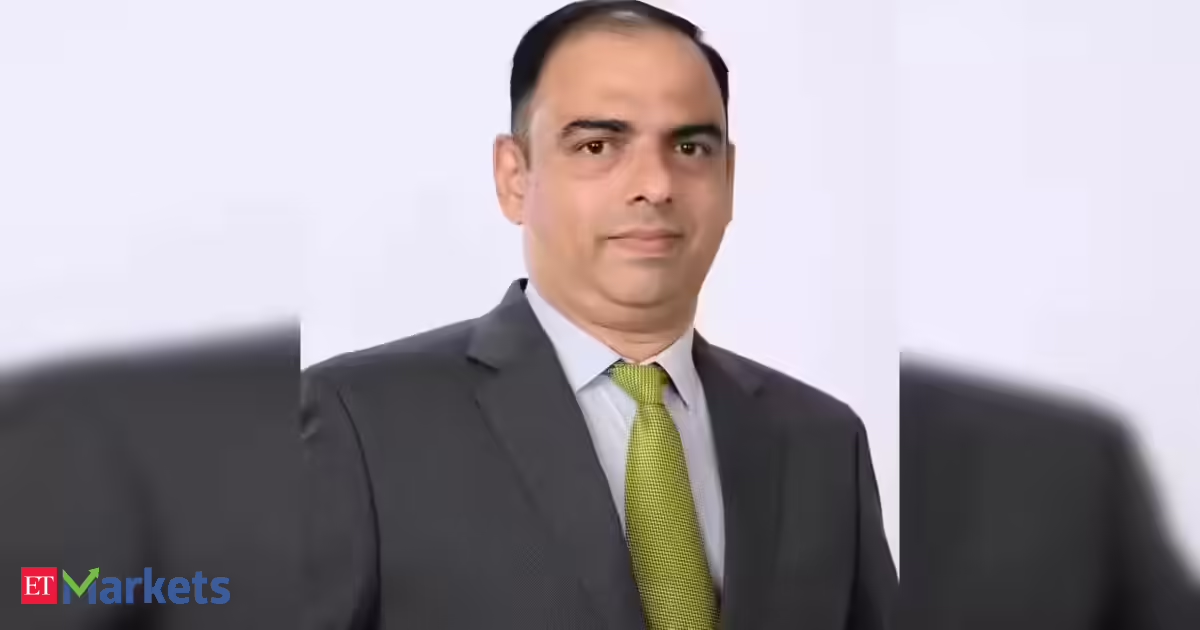
Nifty finds support: Nagaraj Shetti spots 2 breakout stocks worth watching

What the charts are saying
After rallying nearly 1,800 points in recent sessions, the Nifty pulled back sharply after news broke of a ceasefire being called off. Shetti is not reading this as the start of a new downtrend.
“The way the market has declined on Monday has not damaged the underlying uptrend,” he told ET Now. After a prolonged series of lower tops and lower bottoms, the index now appears to have formed a higher bottom, which is typically an early sign that sellers are losing control.
Shetti sees the 23,500 to 23,400 zone as strong support on the downside. On the upside, a decisive move above 24,000 to 24,100 would open the door to 24,500 in the near term. For now, he describes today’s fall as a technical dip within a broader recovery.
Stock pick one: Glenmark Pharmaceuticals
Shetti’s first trade idea is Glenmark Pharmaceuticals, currently consolidating after recovering well from lower levels. The stock is sitting at the edge of a breakout above the consolidation range, with the broader chart pattern looking constructive.

Buy level: Rs 2,205
Target: Rs 2,310
Stop loss: Rs 2,150
The risk-reward on this trade is straightforward. A breakout above the consolidation zone at around Rs 2,210 would confirm the move, with roughly 105 points of upside against a 55-point downside risk.
Stock pick two: Oberoi Realty
The second idea comes from the real estate sector. Oberoi Realty has staged a sharp recovery, gapping up from lower levels with strong momentum. Crucially, the gap has remained open over three to four subsequent sessions, a sign that buyers are defending the move rather than fading it. The stock has also reclaimed its 200-day exponential moving average, a widely watched indicator of longer-term trend direction.
Buy level: Rs 1,684 (current price)
Target: Rs 1,800
Stop loss: Rs 1,630
The stock’s technical setup is among the cleaner ones in the broader market right now, with a confirmed breakout and a clear invalidation level.
The bigger picture
Shetti’s read on the market is one that many technical analysts will find reassuring. Short-term volatility driven by geopolitical headlines is difficult to time, but it rarely changes the structure of a chart that was already in recovery mode. The formation of a higher bottom on the Nifty after months of lower lows is a meaningful shift.
The key levels to watch are now well defined. A hold above 23,400 keeps the bullish case alive. A close above 24,100 would likely bring fresh momentum buyers into the market and put 24,500 firmly in sight.
For investors sitting on the sidelines, the message from the charts is that the risk of missing the move is starting to outweigh the risk of entering too early. Quality setups like Glenmark and Oberoi Realty, with defined entry points and stop losses, offer a disciplined way to participate without taking on undue directional risk.


With the 2026 FIFA World Cup just weeks away, the world’s top national teams are finalizing preparations for the largest tournament in history. Hosted across the United States, Canada and Mexico from June 11 to July 19, the 48-team event promises high drama as favorites like Spain and France lead a competitive field chasing the ultimate prize.
Betting markets and expert analyses consistently place Spain as narrow favorites, followed closely by France, with a cluster of European and South American powerhouses rounding out the top contenders. The expanded format adds unpredictability, but pedigree, form and squad depth point to a familiar group of elites.
Here is an analysis of the top 10 teams most likely to contend for the title, based on current FIFA rankings, recent performances, betting odds and projections as of late May 2026.
1. Spain (+450 to +475)
Spain enters as the team to beat after winning Euro 2024 in commanding fashion. Luis de la Fuente’s side boasts a dynamic young core led by Lamine Yamal, Pedri and Rodri. Their possession-based style, combined with tactical flexibility, makes them formidable.
Yamal, despite a recent hamstring injury that could sideline him for Spain’s opener, remains a key threat and is expected to feature. Spain’s midfield control and depth give them an edge in a grueling schedule. Projections show them with the highest expected goals and tournament win probability around 20-26%.
2. France (+480 to +500)
The reigning FIFA No. 1 side features unmatched attacking talent with Kylian Mbappe leading the line. France’s squad depth across all positions remains elite, even after a Euro 2024 semifinal exit. Their blend of speed, power and technical quality positions them as perennial contenders.
Experts note France may possess the most raw talent in the tournament. Coach Didier Deschamps has experience guiding them to a final in 2022, and they are seen as the biggest threat to Spain.
3. England (+600 to +650)
England’s “Golden Generation” continues to mature, with Jude Bellingham, Phil Foden and Harry Kane forming a potent core. Reaching the Euro 2024 final showed progress, though finishing remains a question mark. Their physicality and set-piece prowess suit knockout football.
Gareth Southgate or his successor will rely on squad harmony in what could be a breakthrough year for the Three Lions.
4. Argentina (+800 to +900)
The defending champions arrive with Lionel Messi, now 38, seeking a record sixth World Cup appearance and a potential back-to-back title — a feat not achieved since Brazil in 1962. Messi was included in the squad announced this week.
Argentina topped CONMEBOL qualifying comfortably. While age catches up to some veterans, their experience and winning mentality under Lionel Scaloni make them dangerous. No team has successfully defended the title in the modern era, adding pressure.
5. Brazil (+750 to +800)
Despite a dip in recent form, Brazil’s historical pedigree and young talent pool keep them in the conversation. The five-time champions feature emerging stars alongside established names. Their athleticism and flair remain hallmarks.
Critics point to this as potentially the least talented Brazil squad in decades, yet their ceiling in a single-elimination setting is high.
6. Portugal (+900 to +950)
Cristiano Ronaldo’s pursuit of a first World Cup title drives Portugal. At 41, Ronaldo’s role may be more limited, but a supporting cast including Bruno Fernandes provides creativity. Portugal reached the Euro 2024 quarterfinals and possesses strong depth.
7. Germany (+1,000 to +1,300)
Hosts of Euro 2024 showed signs of revival. Julian Nagelsmann’s side blends youth and experience, with strong home support potentially boosting them if they advance deep. Defensive improvements have been noted.
8. Netherlands (+1,400 to +1,700)
The Dutch bring tactical discipline and individual quality, led by players like Virgil van Dijk. Consistent quarterfinal appearances in recent majors underscore their reliability as contenders.
9. Belgium (+2,200 to +2,500)
Kevin De Bruyne remains the heartbeat of a transitioning Belgian side. While the “golden generation” has aged, Belgium retains enough quality to cause upsets and reach the latter stages.
10. Morocco (+7,500 to +10,000)
The 2022 semifinalists represent Africa’s best hope. Their organized defense and counterattacking threat, combined with passion, make them a dangerous outsider in the expanded field.
Other notable mentions include the United States as co-hosts (+6,000 to +6,500), seeking a deep run on home soil, Colombia, Uruguay and emerging sides like Norway.
The tournament’s structure, with more teams advancing from groups, favors depth and recovery from early setbacks. Injuries remain a factor, particularly for star players like Yamal.
Coaches emphasize preparation amid a packed calendar. “We need to give him the time he needs,” Spain’s de la Fuente said regarding Yamal’s recovery.
FIFA rankings as of April 2026 place France first, followed by Spain, Argentina and England, aligning closely with betting odds and projections.
The group stage draw has created several intriguing matchups, though specific groups add layers of complexity for favorites. Home advantage for the U.S., Mexico and Canada could play a role, but European sides have dominated recent odds.
Ultimately, the 2026 World Cup represents a clash of styles and generations. Spain’s current momentum as European champions gives them a slight edge, but France’s talent pool and Argentina’s champion pedigree ensure nothing is certain.
As the tournament approaches, focus intensifies on squad fitness, tactical innovations and the ability to perform under pressure in North America’s diverse venues. One thing is guaranteed: global audiences will witness football at its highest level.

NEW YORK — Lumentum Holdings Inc. (NASDAQ: LITE), a key supplier of optical components powering artificial intelligence data centers, has captured investor attention in 2026 as its stock trades near $855 following strong quarterly results driven by hyperscale demand. With analysts maintaining a consensus Moderate Buy to Buy rating and significant price target upside, the question of whether to buy or sell the shares centers on continued AI infrastructure spending versus valuation risks in a competitive photonics market.

The San Jose, California-based company reported robust fiscal third quarter 2026 results on May 5, with net revenue reaching $808.4 million, up substantially from the prior year. GAAP net income stood at $144.2 million, or $1.50 per diluted share, while non-GAAP net income hit $225.7 million, or $2.37 per share. Gross margins improved to 44.2% on a GAAP basis and 47.9% on a non-GAAP basis.
This performance reflects Lumentum’s strong positioning in optical transceivers, lasers and switching solutions essential for AI training clusters. Revenue has accelerated for multiple consecutive quarters, fueled by 200G and higher-speed products for next-generation data centers.
Analyst sentiment remains largely positive. Across roughly 20 Wall Street firms, the consensus is Moderate Buy, with 13-14 Buy or Strong Buy ratings and a handful of Holds. Average 12-month price targets range from approximately $1,012 to $1,127, implying 18-32% upside from recent trading levels around $855. High targets reach $1,400, while lows sit near $600 to $900.
Recent updates include Barclays raising its target to $1,000 while maintaining Equal Weight, JPMorgan lifting to $1,130 with an Overweight rating, and Rosenblatt holding a Buy at $1,300. Stifel and others have also expressed confidence in the AI-driven growth story.
Lumentum has benefited from the AI supercycle. Its products, including 1.6T DR4 OSFP transceiver prototypes and 1060nm VCSEL platforms for optical interconnects, address bandwidth, power and scaling challenges in AI infrastructure. Demonstrations at OFC 2026 highlighted advancements in scale-up, scale-out and scale-across architectures.
The company is expanding manufacturing capacity, including a new U.S. facility for advanced lasers targeted at the world’s largest AI data centers. This move aims to meet surging demand from hyperscalers and reduce potential supply constraints.
Management has expressed optimism. In earnings commentary, executives noted record revenues and leverage in the business model, with expectations for continued growth into fiscal 2027. Optical Circuit Switch (OCS) business exceeded targets ahead of schedule.
For bulls, the case rests on Lumentum’s technological leadership in high-speed optics. The shift to AI workloads has created a multi-year tailwind, with analysts projecting sustained revenue expansion as data center buildouts continue. Diversification beyond traditional telecom into industrial lasers and 3D sensing provides additional stability.
Valuation remains a key consideration. Shares have risen dramatically over the past year, reflecting AI enthusiasm, but forward multiples are elevated compared to historical norms. Some models suggest the stock trades at a discount to intrinsic value based on projected cash flows from AI optics growth.
Bear cases highlight execution risks, customer concentration among a few large hyperscalers, and potential cyclicality if AI spending moderates. Competition in the photonics space from peers could pressure margins. Short-term technical signals have shown mixed readings, with some near-term caution flagged by moving averages.
Financially, Lumentum has demonstrated improving profitability and cash generation. Sequential revenue growth from fiscal Q1 through Q3 2026 underscores momentum, with non-GAAP operating margins expanding significantly. The balance sheet supports ongoing investments in R&D and capacity.
Broader industry trends support a constructive outlook. Hyperscalers’ push toward higher-bandwidth interconnects for AI training and inference favors suppliers like Lumentum with proven high-volume manufacturing expertise. Inclusion in major indices has also attracted passive inflows.
Portfolio managers note that LITE fits within growth-oriented technology allocations, particularly those focused on AI infrastructure. Position sizing should account for volatility typical in semiconductor-adjacent names. Near-term catalysts include fiscal fourth quarter results and updates on new product ramps.
Risks include macroeconomic slowdowns affecting tech capex, supply chain disruptions for critical materials like indium phosphide, and geopolitical factors influencing global trade. Regulatory scrutiny on AI energy consumption could indirectly impact deployment timelines.
Longer-term forecasts vary by source. Optimistic projections see continued compounding from AI tailwinds, potentially driving revenues toward multi-billion-dollar annual run rates. More conservative views temper expectations around market saturation or technology shifts.
In the current environment, Lumentum exemplifies the intersection of photonics innovation and artificial intelligence demand. While not without risks inherent to high-growth tech stocks, the company’s execution on financial targets and product roadmap has bolstered confidence among most covering analysts.
Investors considering a position should evaluate their time horizon and risk tolerance. Those bullish on sustained AI infrastructure investment may view current levels as an opportunity, particularly following any pullbacks. Others may opt to wait for clearer signals on margin sustainability or broader market conditions.
As with any equity, particularly in the dynamic semiconductor and optics sector, thorough due diligence is essential. Lumentum’s trajectory will likely hinge on its ability to maintain leadership in next-generation optical solutions amid intense competition and rapid technological evolution. The coming quarters of data center deployment cycles will provide further clarity on whether the AI optics boom translates into lasting shareholder value.
UFO: SpaceX IPO A Mega Catalyst, But Not The Only Reason To Buy
MongoDB Stock Rises on Earnings Beat. Software Isn’t Dead Yet.
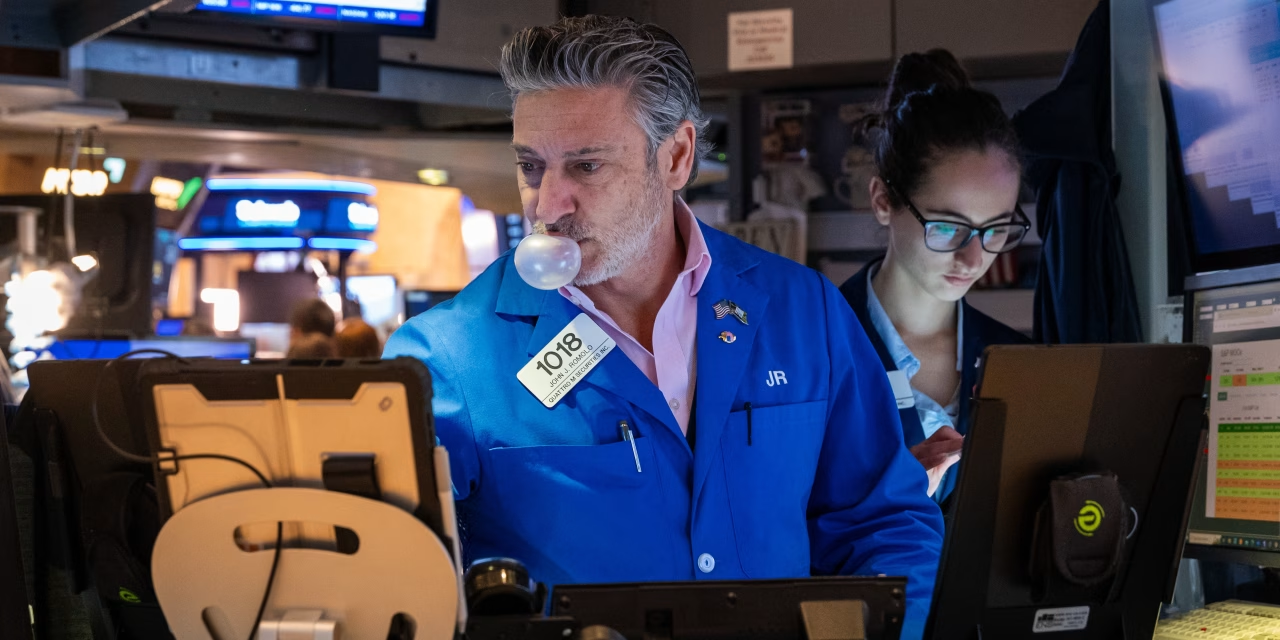
Oil is extending its decline and stocks are back in record territory after new comments from President Trump gave investors more hope about a possible peace deal with Iran.
In a Truth Social post Friday morning, Trump wrote that he “will be meeting now, in the Situation Room, to make a final determination” about a peace deal with Iran.
Copyright ©2026 Dow Jones & Company, Inc. All Rights Reserved. 87990cbe856818d5eddac44c7b1cdeb8

Zara stores in India reported a Rs 299.84 crore profit and Rs 2,782.06 crore revenue from operations in FY25, Inditex Trent Retail India Private Ltd (ITRIPL), which operates the Zara brand in India, said.
Its total income was Rs 2,767.75 crore for the financial year ended March 31, compared to Rs 2,839.50 crore a year ago.
ITRIPL is a JV between Spain’s Inditex, which owns luxury fashion brand Zara, and Tata Group’s retail arm Trent Ltd.
Zara, which competes with foreign brands like H&M and UNIQLO in India, currently operates 22 stores in the country.
In FY26, Trent reduced its stake in ITRIPL in a buyback offer by ITRIPL.
“During the year under review, the company participated in the buyback offer made by ITRIPL and tendered 94,900 equity shares. Pursuant to the acceptance of the said offer, the company’s shareholding in ITRIPL stands at 20 per cent,” it said.Inditex group has another JV association with Trent, which operates Massimo Dutti stores in India. Massimo Dutti India Pvt Ltd (MDIPL) operates three stores in India.
Its revenue increased 27.97 per cent to Rs 128.45 crore in FY25 compared to Rs 100.37 crore in FY24.
The net profit rose 13.86 per cent to Rs 11.66 crore for the financial year ended March 2026.
Like ITRIPL, Tata group retail firm Trent has a 20 per cent stake in MDIPL.
ITRIPL and MDIPL source merchandise only from the Inditex Group, one of the world’s largest fashion retail groups, headquartered in Arteixo, Galicia, Spain, whose portfolio consists of several well-known brands, such as Zara, Massimo Dutti, Pull&Bear, Bershka, and Stradivarius, a women’s fashion brand.
Moreover, the choice of product and related specifications is Inditex’s discretion. Further, the entities are dependent on the Inditex group for permissions to use the said brands in India, subject to its terms and specifications, according to the latest annual report of Trent.
ON Semiconductor: AI Power, Auto Recovery, And The Problem Of Price

Tempus AI, Inc. (TEM) Analyst/Investor Day – Slideshow

Bond Bites: Ideas And Insights
Walmart and 5 More Consumer Stocks to Buy After a Solid Retail Earnings Season

Brits told to allow three hours before flights in urgent EU airport warning

Spain, France Headline Top 10 Favorites for 2026 World Cup Glory in Expanded Tournament

‘No favourites’: PSG, Arsenal set for knife-edge Champions League final

Steven Gerrard disagrees with Gary Neville over ‘shock’ Chelsea and Arsenal claim | Football

US brings back mandatory military draft registration

Register Renaming | Hackaday

Urgent Bitcoin PONZI Devastation Incoming (Yes this Could DESTROY Crypto)

5/29/2026 – I placed a limit order for Broadcom. Not financial advice. #Broadcom #Investing #wealth

Paisa kamane wala app 2026 || NEW UPI MONEY EARNING APP || New Earning App Today || Income Tricks
-

 Business6 days ago
NYT Strands Answers May 24 2026 Revealed for Puzzle No. 812 Theme Summer Essentials
-

 NewsBeat3 days ago
Israel says it has killed new Hamas military leader in Gaza City airstrikes
-

 Politics5 days ago
Bridgerton Season 5: Cast, Release Date And Everything We Know So Far
-

 Business3 days ago
Selena Gomez Reportedly Upset Over Benny Blanco’s Comments on Her ‘Terrible’ Diet
-
 Crypto World4 days ago
Micron Crosses $1 Trillion Market Cap as AI Demand Reshapes Memory Sector
-

 Tech5 days ago
Microsoft’s quiet Claude Code retreat and the real cost of enterprise AI
-

 Business5 days ago
BTS Sells Out Four Las Vegas Shows at Allegiant Stadium for ARIRANG World Tour
-
 Tech4 days ago
China assigns ID codes to 28,000+ humanoid robots
-

 News Videos3 days ago
XRP *JUST* SUCCEEDED!!!! CLARITY ACT EXPOSED!!! (SHE EXPOSED IT)
-
Tech3 days ago
The Samsung pay deal is the moment Korean unions changed register
-

 Tech1 day ago
Waymo dominates autonomous vehicle registrations as Tesla trails behind
-

 Tech5 days ago
Westone Audio and Etymotic Acquired by Fidelity Collective in Major IEM Market Move
-

 Tech3 days ago
Millions of AI agents imperiled by critical vulnerability in open source package
-
Crypto World5 days ago
Brian Armstrong Outlines Crypto Vision for the Future Financial System
-
 Entertainment4 days ago
‘Breaking Bad’ Star’s Easy-to-Binge 6-Part Crime Series Spin-Off Is Finally Heading to Free Streaming
-
Crypto World3 days ago
SpaceX’s $2 Trillion IPO: Why Tech Giants Nvidia (NVDA), Apple (AAPL), and Microsoft (MSFT) May Face Pressure
-
 Crypto World5 days ago
Nvidia (NVDA) CEO Calls on Super Micro to Strengthen Export Controls Amid Smuggling Probe
-

 Tech3 days ago
NASA taps Blue Origin to deliver lunar rovers for Moon Base initiative
-
 NewsBeat5 days ago
Hottest May day ever as London hits 34.8C in 2C leap from previous records
-
 Entertainment4 days ago
Taylor Swift Fans Label Travis Kelce’s Beer-Chugging A ‘Red Flag
You must be logged in to post a comment Login