

Crypto World
Elon Musk’s Father Declares Crypto the Future of Finance



Errol Musk, father of Tesla and SpaceX founder Elon Musk, says there is no doubt that crypto is the future of finance.
In an exclusive interview with BeInCrypto Editor-in-Chief Vladimir Arkhireysky, the South African engineer called the old model “finished.” His comments come alongside revelations about his sons’ Bitcoin (BTC) holdings and his own first-hand experience of crypto payments.
Elon Musk’s Father Backs Crypto
Errol Musk was unequivocal about where global finance is heading.
“I have no doubt that crypto will be the future of finance. The old model has run its course, it’s finished,” he said. “The new form of money management is clearly crypto.”
The 79-year-old engineer grounded his conviction in personal experience. He described how transferring money across countries through a bank is “practically impossible,” whereas crypto transfers happen instantly.
“It’s an amazing form of money movement. For example, if I’m in South Africa and I want to bring some money from America through a bank, it’s impossible. They make it so impossible through the bank. If I go to my friends in crypto, they do it immediately, no problem,” Errol told BeInCrypto.
He noted that he has met the founder of Binance, Changpeng “CZ” Zhao, and the founder of Bybit, and has personally received crypto that bypassed traditional banking channels entirely.
Despite his conviction, Errol admitted he does not personally own any digital assets. He described himself as “old-fashioned,” though he said he would like to learn more about crypto.
“What I know about it is small, but it’s a big thing. I am still old-fashioned. I have a bank card,” he remarked. “Altogether, I’m not an expert, but it’s clearly fascinating stuff.”
Follow us on X to get the latest news as it happens
Inside the Musk Family’s Crypto Exposure
Errol also offered a rare glimpse into the Musk family’s crypto positions.
“I know it sounds astronomical. Elon and Kimbal, my two sons, have 23,400 Bitcoins,” he said.
If accurate, the figure would be striking. Based on the latest data from BitsoinTreasuries, Elon Musk’s electric vehicle firm Tesla holds 11,509 BTC, ranking 12th among the largest publicly traded holders. In addition, SpaceX holds 8,285 Bitcoins.
The family has also dealt in other tokens. Errol revealed that they once received payment in Solana (SOL), an amount he described as “a little more than a million rubles.”
“It was strange for me to receive that payment in crypto. We received Solana back then, it was worth much more, and we got out at the peak,” he mentioned.
Errol Musk is a South African engineer, pilot, and businessman. Born in 1946. Father of Elon Musk, founder of Tesla and SpaceX, and Kimbal Musk, entrepreneur and philanthropist.
Early in his career, he worked in real estate and electrical engineering and was involved in various mining projects across Africa. He is known as a candid speaker who readily comments on his sons’ achievements and global trends.
The post Elon Musk’s Father Declares Crypto the Future of Finance appeared first on BeInCrypto.

XRP is closing out May at $1.34, ending the month almost unchanged in dollar terms from a week ago. But there is a more nuanced story against Bitcoin.
While the USDT pair continues to grind near the lows, with the $1.20 support uncomfortably close, the BTC ratio has staged a convincing recovery over the past week, with the RSI on that pair climbing to its highest reading since February.
Ripple Price Analysis: The USDT Pair
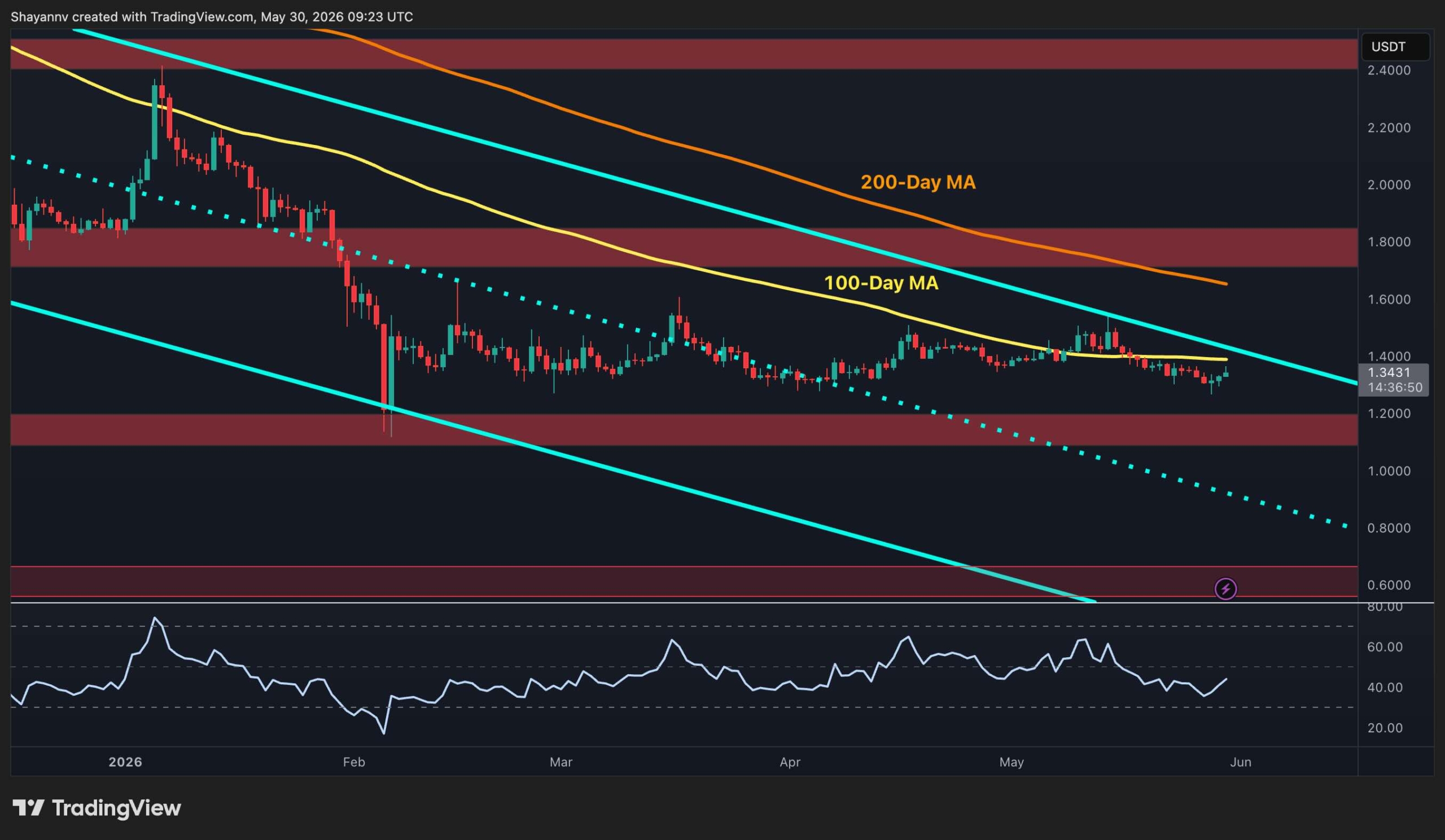
On the USDT pair, the price has gone essentially nowhere since last week. It is hovering around $1.34, pressed against the upper boundary of the descending channel.
The 100-day moving average at approximately $1.40 also sits just overhead. It is close enough to reclaim, but buyers have not been able to push the price above it over the past two weeks. On the downside, the $1.20 support band remains close below. This is a key level that has not been breached since February’s wick.
The RSI also sits in the 40–45 range and is recovering slightly from recent soft readings, but it offers no directional signal. A daily close back above the 100-day moving average at $1.40 and a breakout from the descending channel is the minimum requirement to ease the downward pressure and open the path to a genuine recovery. Failing that, the mentioned $1.20 critical demand zone could be the next decisive area for the price to visit in the coming weeks.
The BTC Pair
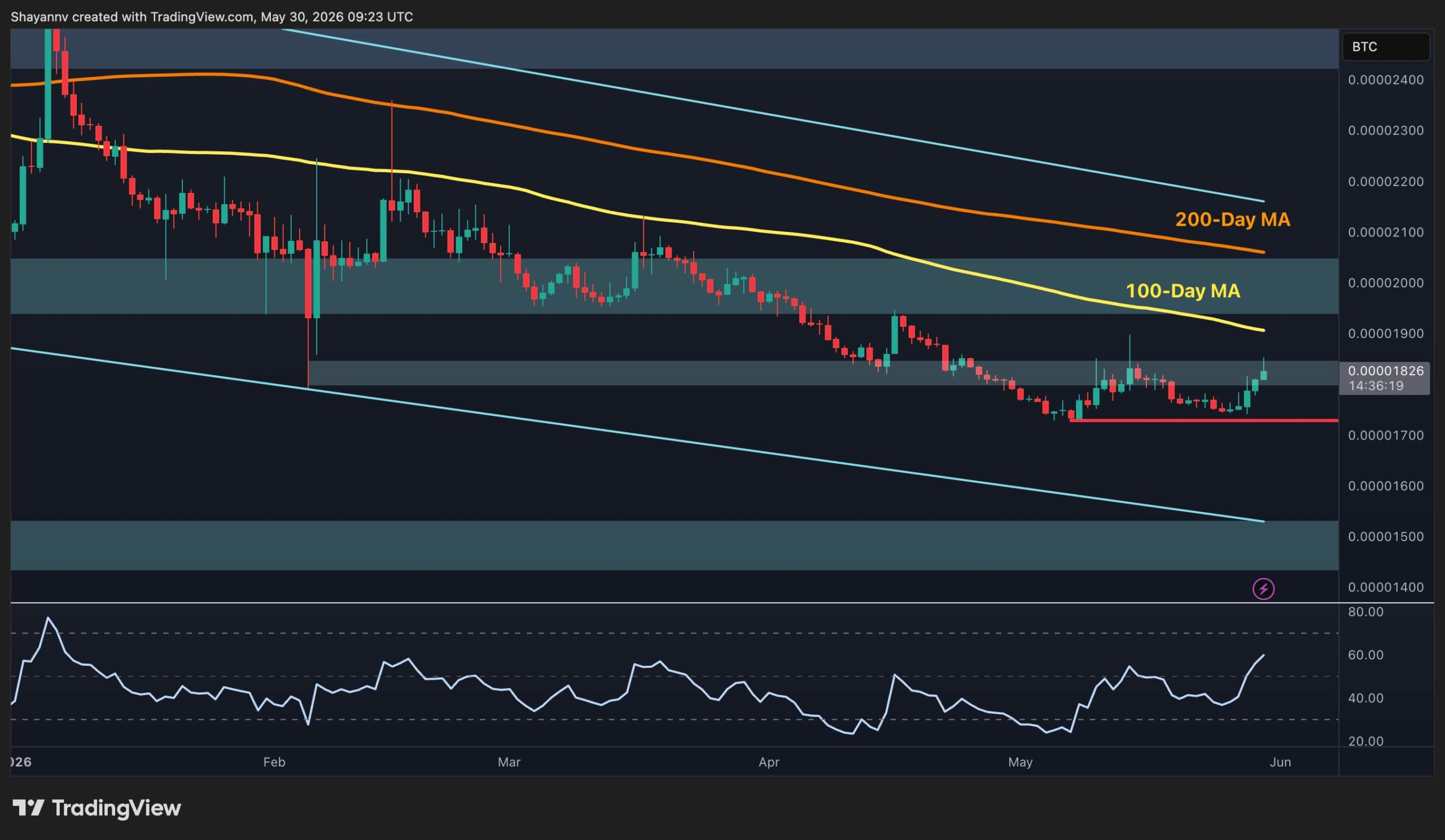
The pair against BTC tells a different story. From the recent low of 1,700 sats that held the price, XRP/BTC has recovered to above 1,800 sats and is on the verge of breaking above this area, which could be a sign of a potential recovery.
More significantly, the RSI has climbed to approximately 60–65, which is the highest reading on this pair since February and a dramatic reversal from the oversold extreme printed in early May. This kind of RSI recovery, from deeply oversold to the mid-to-upper 60s in under a month, historically carries follow-through rather than fading immediately.
The next meaningful resistance sits at the 2,000 sat zone, with the 100-day moving average declining below it near 1,900 sats, and the 200-day moving average just above at approximately 2,050 sats. Reclaiming this area would be a meaningful sign on the road to recovery for XRP.
Looking below, the recent low at 1,700 sats remains the immediate floor to defend on any pullback. Losing this level on a closing basis would invalidate the bounce entirely and could push the price much lower in the coming weeks.
The post Ripple Price Prediction: Can XRP Reclaim $1.40 as Bitcoin Pair Hits Important High? appeared first on CryptoPotato.
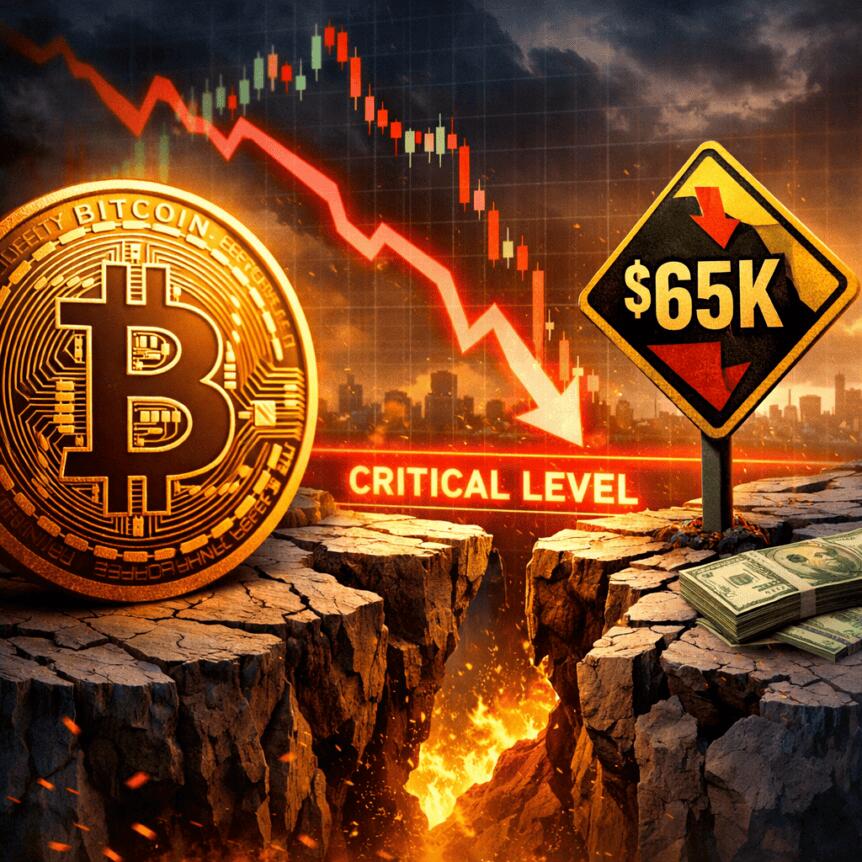
Bitcoin is trading at a crossroads, trading near the $70,000 level as buyers and sellers spar over the near-term path. A sustained hold above this threshold is seen by some bulls as essential to avert a drop toward February’s yearly low, while a breakdown could invite additional downside pressure.
On X, MN Trading Capital founder Michael van de Poppe framed the moment clearly: “Bitcoin is at a pivotal level, and if it doesn’t hold, we’re buying at <65K.” The remark underscores a market split between those who see durability above $70k as the base for a new leg higher and those who anticipate further pullbacks. At the time of publishing, Bitcoin was around $73,873, according to CoinMarketCap.
The broader market remains divided on whether the February 2024 dip to roughly $60,000 marked the cycle bottom or if there is more downside to come.
Key takeaways
- The $71,000 area is cited as a crucial support zone; failing to defend it could open the door to deeper corrections, while a hold above this level would reduce near-term downside risk.
- If Bitcoin this week maintains support, a breakout toward $76,600 could emerge, potentially signaling the start of a broader uptrend and a fresh round of momentum for select altcoins.
- Spot Bitcoin ETF outflows have persisted, with ten consecutive trading days of net redemptions and more than $2.97 billion withdrawn since May 15, according to Santiment Intelligence.
- Total assets in spot Bitcoin ETFs slipped from about $104.29 billion on May 15 to roughly $94.17 billion amid the recent outflow streak, highlighting a potential weakening of passive exposure even as prices hold.
Near-term test: can BTC defend $70k?
Analysts contrast the current setup with February’s breakdown. Van de Poppe argues that the recent structure is different from the earlier drop, stressing that the $71,000 zone is a decisive support level. In his view, holding this area is necessary to prevent a deeper correction and to set the stage for a possible rebound. If the price can sustain above this threshold, he suggests a path toward $76,600 could open, with a break higher potentially bringing in new highs and rekindling a broader market upswing.
A bullish path if support holds
Should Bitcoin sustain the current footing, the next leg up could come into view as resistance at $76,000 gives way. A clean breakout beyond that level would invite momentum into the market, potentially lifting sentiment across the crypto sector and elevating activity in altcoins. Van de Poppe characterizes such a scenario as a signal for an “Altcoin summer,” where a wave of capital could rotate into alternative assets as traders chase new highs.
ETF flows as a market thermometer
Beyond price action, market dynamics around exchange-traded products are feeding the debate about whether the cycle is bottoming. Santiment Intelligence noted a prolonged streak of outflows from spot Bitcoin ETFs, viewing the pattern as a contrarian indicator that may signal nearing capitulation has passed. The data show ten straight trading days of net withdrawals and cumulative redemptions nearing $3 billion since mid-May.
Meanwhile, the total assets held by spot Bitcoin ETFs slipped from about $104.29 billion on May 15 to approximately $94.17 billion by the end of the week, a roughly $10 billion decline in two weeks. This shift in passive exposure occurs even as prices hold in the mid-$70,000s, highlighting a tension between price action and fund flows that readers should watch for a potential inflection point.
Contrasting forecasts from veterans
Market voices remain varied. Veteran trader Peter Brandt suggested that a return to or below $60,000 could occur in 2026, implying the possibility of revisiting lower levels even if a short-term bottom holds. His outlook underscores a broader debate about the timeline of a sustained bottom and the readiness of risk markets for new highs. Separately, economist Timothy Peterson argued that Bitcoin could grind higher through the summer but would likely peak by the last week of July, a view that points to a muted pace rather than a meteoric rally.
These divergent forecasts emphasize a market in which technical levels, fund flows, and macro sentiment are all in play. The current setup—tempting resistance at pivotal levels, coupled with cautious ETF dynamics and mixed forward-looking commentary—suggests readers should anchor decisions on price action around key thresholds and inbound data rather than relying on a single signal.
Editors’ note: For price context and current levels, refer to CoinMarketCap’s Bitcoin page and related market commentary as conditions evolve.
What remains uncertain is whether the $70k floor will prove robust as traders await fresh catalysts. The coming days will reveal whether BTC can sustain above the crucial $71k–$72k region, whether a breakout above $76,000 can ignite a wider risk-on move, and how ETF flows will align with price action in the near term.
It appears that Bitcoin is no longer just a campaign talking point in DC – it’s becoming a very visible part of political investment portfolios in the circles close to President Donald Trump.
Republican lawmakers have shifted their portfolios to reflect assets and companies that are in the president’s favor.
GOP Trades Follow Trump’s Crypto Signal
According to a recent report, GOP lawmakers have migrated their portfolios toward “Trump favorites.” These include Intel and Bitcoin, which underscores how closely political sentiment and market positioning have started to overlap.
The report also says that investments in the iShares Bitcoin Trust ETF currently account for about 4% of total Republican holdings, subject to the analysis.
This figure is relatively small compared to traditional stock positions, but it holds considerable political significance. Bitcoin has become a clear financial symbol of Trump’s efforts to turn the United States into the “crypto capital of the world.”
Trump Keeps Praising Crypto
This shift comes as the president continues to publicly praise the cryptocurrency industry.
Just a few days ago, he once again promoted his goal of keeping the US the crypto capital of the world, which further reinforces a message that has been central to his digital asset agenda. Unfortunately, the industry took a dive immediately afterward, but let’s be optimistic and consider it short-term selling pressure.
This specific rhetoric has been backed by Trump’s policy. Recently, the Commodity and Futures Trading Commission took a landmark step by approving KalshiEX’s BTCPERP as the first regulated Bitcoin perpetual futures contract listed on a CFTC-regulated US-based exchange.
Moreover, the watchdog issued a no-action letter, which clears the path for Coinbase to connect American users to global derivatives markets for the very first time ever.
Back to the subject at hand, though, for investors, the growing exposure to bitcoin-linked products presents a new reality – one that confirms that crypto is evolving to be more than just a speculative asset class.
The post GOP Portfolios Shift Toward Bitcoin and Other Trump Favorites: Report appeared first on CryptoPotato.
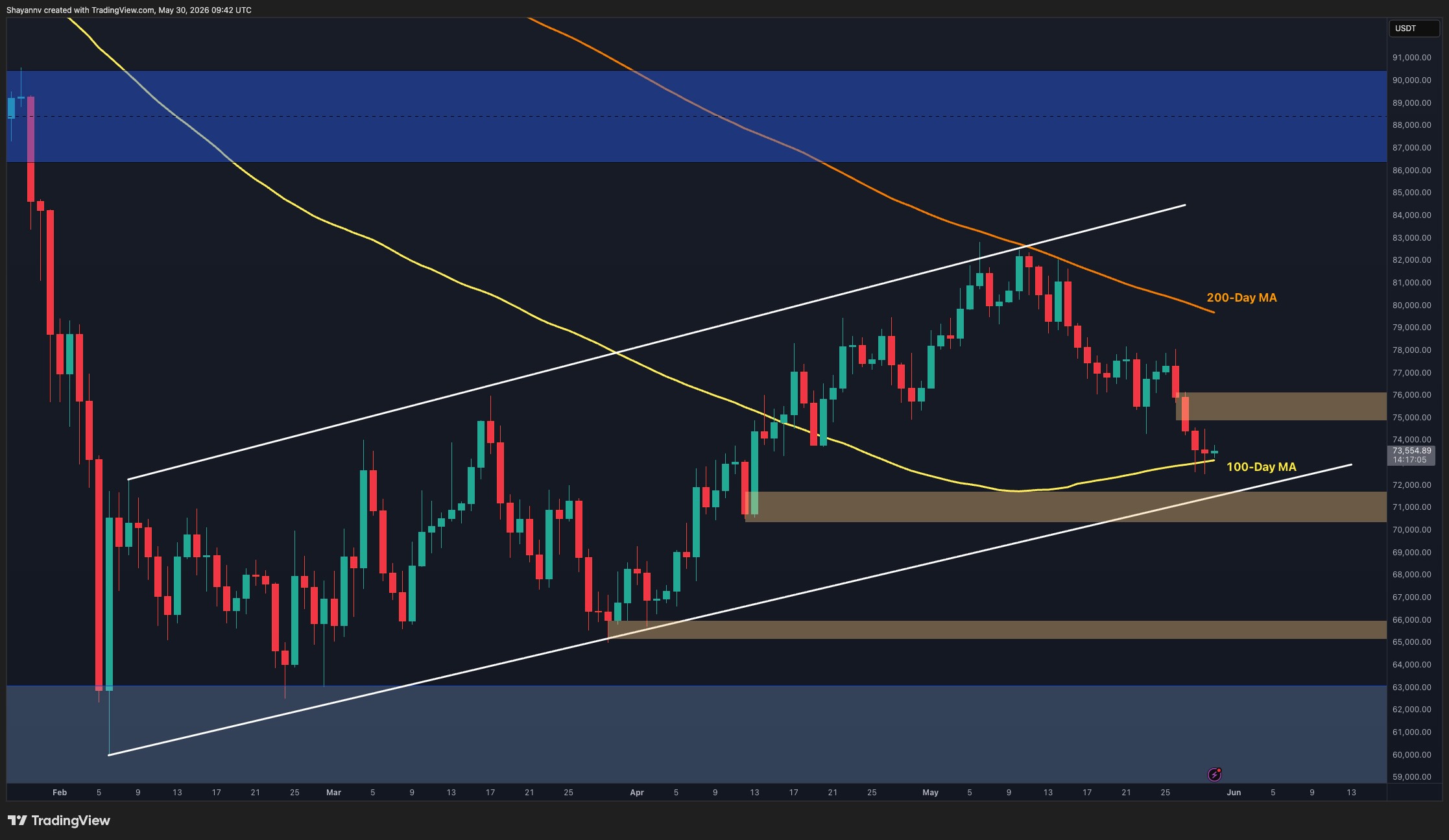
Bitcoin continues to trade under pressure after losing the critical $75K-$76K support zone, while broader market sentiment remains cautious amid weakening ETF inflows and deteriorating technical structure.
However, BTC is now approaching an important confluence of technical supports around $70K-$72K, where both trendline support and the 100-day MA could provide temporary relief for the market.
Bitcoin Price Analysis: The Daily Chart
On the daily timeframe, Bitcoin has officially broken below the key $75K-$76K support region, which previously acted as an important decision point for the market. The breakdown confirms bearish continuation after repeated failures to reclaim the descending 200-day MA near $80K-$81K.
Currently, the price is approaching a major support confluence around $70K-$72K. This region aligns with the ascending lower boundary of the broader structure, the 100-day MA around $73K, and a significant historical order block visible on the chart. Such overlapping supports often increase the probability of at least a short-term reaction or relief bounce.
If buyers manage to defend the $70K-$72K range, Bitcoin could attempt a corrective recovery back toward the broken $75K-$76K resistance zone. However, failure to hold this area may open the path toward deeper supports around $65K-$66K and potentially the broader $60K-$63K demand region.
For now, the overall market structure remains bearish unless BTC reclaims the $75K-$76K zone and stabilizes above it.
BTC/USDT 4-Hour Chart
The 4-hour chart reflects accelerating bearish momentum following the recent breakdown below the consolidation structure near $75K-$76K. Sellers remain in control, while lower highs and persistent rejection candles continue to dominate the short-term trend.
Nevertheless, Bitcoin is now entering a critical order block between $70K and $72K. This zone has historically attracted significant demand and currently overlaps with the rising trendline support shown on the chart. The market reaction here will likely determine the next major move.
A short-term bullish pullback remains possible if buyers step in around this support cluster. In that scenario, BTC could revisit the $74K-$76K region as a corrective rebound. However, if the current support fails to hold, bearish momentum could accelerate rapidly toward the $65K-$66K liquidity zone.
Therefore, the $70K-$72K area represents the most important short-term battlefield between buyers and sellers.

Sentiment Analysis
The ETF cumulative flow chart reveals an important divergence developing in the market. Despite Bitcoin attempting multiple recoveries during recent months, cumulative ETF inflows have started flattening and have recently turned weaker alongside the latest correction.
This behavior suggests that institutional demand has cooled considerably compared to previous accumulation phases. The slowdown in spot Bitcoin ETF inflows indicates reduced aggressive buying from large market participants, which partly explains BTC’s inability to sustain rallies above the $80K-$82K region.
More importantly, recent price weakness has occurred while cumulative ETF flows remain relatively stable rather than aggressively expanding higher. This signals a lack of fresh capital entering the market at current levels.
Historically, strong bullish continuation phases in Bitcoin have usually been accompanied by accelerating ETF inflows. The absence of that dynamic increases the likelihood that the current market will remain corrective in the short term.
Still, if Bitcoin stabilizes around the $70K-$72K support region and ETF flows begin strengthening again, the market could regain momentum later. Until then, weakening institutional demand, combined with a bearish technical structure, keeps downside risks elevated despite the possibility of temporary relief rallies.

The post Bitcoin Price Analysis: BTC Eyes $70K-$72K Support Amid Market Weakness appeared first on CryptoPotato.
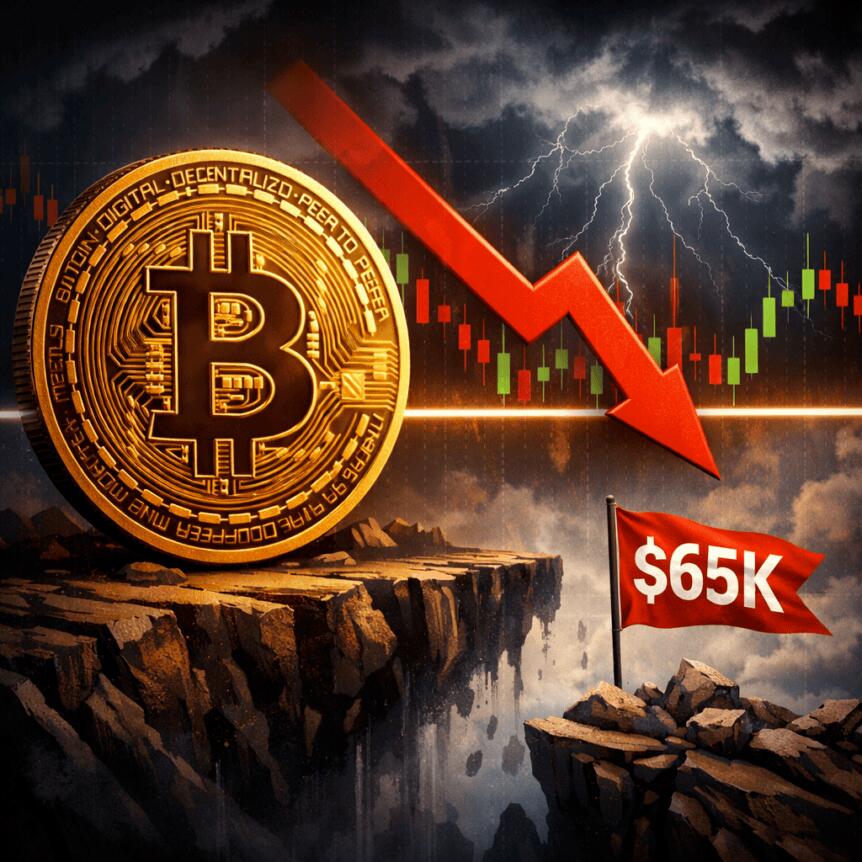
Bitcoin sits at a pivotal juncture as it hovers around the $70,000 level. A failed hold near this threshold could open a downside path toward the February yearly low, potentially pulling prices toward the mid-$60,000s. Traders are weighing whether the recent $60,000 bottom was the cycle’s low or if further weakness lies ahead.
As of publication, Bitcoin has traded in the mid to upper $70,000s after rebounding from a February trough near $60,000. Data from CoinMarketCap places the price in that vicinity, with the market watching whether the $70,000 support holds. The critical question for the near term remains whether the current level can sustain a bid or if a breach invites additional downside pressure.
Analysts are split on the outlook. Some argue the February dip marked the low for this cycle, while others warn that risk remains tilted to the downside until a firmer base is formed. Among those offering a nuanced view, veteran traders highlight the importance of concrete support at specific price zones as markets digest macro and sector signals.
Key takeaways
- A failure to hold above $70,000 could open a path toward the mid-$60,000s, with a notable risk of testing the February low. A break below the $71,000 area is seen by some as a trigger for a deeper pullback.
- If Bitcoin can defend the $71,000 zone, a rally toward roughly $76,000–$76,600 becomes more plausible, potentially setting the stage for a broader upside move and a favorable tilt for altcoins.
- Market voices diverge on timing. Peter Brandt has suggested that $60,000 may not be the bottom for 2026 and that a retest or a slight dip below that level could occur later in the year, while Michael van de Poppe argues that new lows are unlikely and emphasizes the importance of the $71k area as a defender of the uptrend.
- ETF flows offer a counterpoint to price action. Santiment Intelligence notes ten consecutive days of net outflows from spot Bitcoin ETFs, with total redemptions surpassing $2.97 billion since mid-May and total assets under management slipping from about $104.29 billion to $94.17 billion.
- Taken together, the combination of price levels, trader perspectives, and ETF flow data adds up to a market awaiting a decisive impulse—either a sustained hold at key supports or a breakout that could reignite broader risk-on momentum.
Bitcoin’s price rails: support, resistance, and the view from traders
Bitcoin’s near-term fate is being driven by a delicate balance at a few price points. The $70,000 level is widely viewed as a linchpin for the upside, but as long as it remains under pressure, a test of the February low remains on the radar for some traders. In commentary circulating in social feeds, MN Trading Capital founder Michael van de Poppe emphasized that Bitcoin sits at a pivotal level: if it cannot hold above $70,000, investors might be prepared to consider lower-price entries, potentially under $65,000. He also underscored that the $71,000 zone plays a crucial role in maintaining the current structure. “The $71K area remains to be a crucial support level, and that would be required to hold in this particular zone in order to prevent any deeper corrections, in my opinion,” he noted, describing a pattern that differs from February’s breakdown.
Conversely, a successful defense of current levels could unlock an upside path. Van de Poppe argued that if price holds and breaks through, BTC could advance toward roughly $76,600, with a breakout potentially signaling a fresh cycle for the broader crypto market and hinting at a renewed “Altcoin summer.” The same analyst suggested that new lows are not his expectation under the current setup, although he cautioned that the landscape remains sensitive to how price behaves near the critical support zone.
Other seasoned voices also weigh in. Peter Brandt, a long-time market veteran, suggested in March that $60,000 could be revisited in 2026 and that the price might retest or move slightly lower than that level in the near term—an outlook that refocuses attention on the risk of a deeper pullback, even if not the base case for many traders. Timothy Peterson, an economist and market observer, framed a more measured near-term view: Bitcoin could drift higher over the summer but is likely to top out by the last week of July, with the path remaining relatively lackluster in the interim. Such commentary illustrates the ongoing debate over whether the market is on the cusp of a new leg higher or carving out a longer consolidation beneath the major resistance highs.
ETF flows as a barometer: what the data suggest about a bottom
Beyond price, market resilience is also being examined through the lens of exchange-traded products. Santiment Intelligence flagged a continued outflow from spot Bitcoin ETFs, describing it as a potential contrarian signal about the market’s bottom timing. In their assessment, spot Bitcoin ETFs have experienced ten consecutive days of net redemptions, with total outflows exceeding $2.97 billion since mid-May. The impact on assets under management has been tangible: total net assets held by spot BTC ETFs declined from about $104.29 billion on May 15 to roughly $94.17 billion by late May/early June, a decline of approximately $10 billion in a two-week span.
These ETF dynamics—outflows amid a price that has stabilized near resistance—provide a nuanced backdrop for traders. For some, persistent redemptions could signal capitulation or a lack of buyers at current levels; for others, the data might imply the market is coiled for a turnaround once demand resurges at supportive zones. As always, ETF flows are one piece of a broader mosaic that includes on-chain metrics, macro factors, and price action around key technical levels.
In the broader context, observers also pointed readers toward ongoing discussions about retail sentiment and how it interacts with price signals. The evolving mix of price action, trader hypotheses, and ETF flow trends suggests that readers should stay attentive to how Bitcoin behaves around the $71,000–$72,000 ceiling and the $70,000 floor, while watching whether ETF outflows ease or intensify as the summer progresses.
What remains uncertain is how quickly a decisive impulse will emerge to tilt the balance back toward risk-on appetite or back toward a safer, cautious stance. For now, the market is waiting for a clear signal from price action and flows that either confirms a renewed uptrend above the $76,000 zone or justifies a more extended consolidation beneath it.
Looking ahead, traders will be watching two intertwined drivers: the price action around the critical support at $71,000–$70,000 and the evolution of ETF flows over the coming weeks. If price holds and a breakout above $76,000 materializes, the backdrop could favor a broader crypto rally. If not, a test of the mid-$60,000s remains plausible, reinforcing the notion that the path to a new cycle could still be subject to a test of patience and discipline in risk management.
The two biggest DeFi exploits of the past two months have one thing in common. They used a tool that does not exist on the XRP Ledger.
Thorchain lost roughly $10.8 million on May 15 to a cross-chain attack that drained funds across Bitcoin, Ethereum, BSC, and Base. Drift Protocol, a Solana-based decentralized perpetual exchange, and KelpDAO, a liquid restaking protocol on Ethereum, together accounted for more than $600 million in losses through April alone.
Cross-chain bridges have lost over $2.8 billion to attacks since 2021, per Chainalysis. And a significant share of these exploits used some variant of the same mechanic: flash loans.
A flash loan is a smart contract feature that lets a trader borrow millions of dollars with no collateral, on the condition that the loan is repaid inside the same transaction. The legitimate use cases include arbitrage between exchanges, collateral swaps without unwinding positions, and liquidation bots that maintain solvency in lending markets.
The attack pattern is the same mechanic pointed in the wrong direction.
A borrower takes out the loan, uses the funds to manipulate an oracle or drain a poorly designed pool, profits from the manipulation, and repays the loan, all before the transaction settles. If any step fails, the whole sequence rolls back, so the attacker risks nothing but gas fees.
The XRP Ledger does not let this work. A draft amendment filed on the XRPL standards repository earlier this week, proposing concentrated liquidity and StableSwap-style pools for the chain’s native automated market maker, included a single line in its Security Considerations section: “Flash loan attacks are structurally impossible. XRPL transactions are atomic without composable intra-transaction calls.”
What that means is that XRPL transactions either fully succeed or fully fail, like an Ethereum transaction. But unlike Ethereum, an XRPL transaction cannot call into another contract during its execution. The borrow-manipulate-repay sequence that defines a flash loan attack needs at least three nested operations inside a single transaction envelope.
That is a meaningful architectural choice, and it has a cost. Flash loans are not only an attack tool. They have become a structural component of Ethereum DeFi, with Aave, dYdX, and other major protocols offering them as a product. Arbitrage traders use flash loans to clear price differences between exchanges in a single atomic action.
Liquidation bots use them to keep over-collateralized lending positions solvent. Sophisticated DeFi users use them for collateral swaps that would otherwise require capital that gets tied up for hours. XRPL gives up all of that in exchange for closing the attack class entirely.
For most of XRPL’s history, the tradeoff did not matter because the chain’s DeFi footprint was small. That is changing. Tokenized real-world assets on the XRP Ledger have crossed $3 billion in total value, including the Ripple-JPMorgan-Mastercard-Ondo Finance pilot last month that processed a tokenized U.S. Treasury redemption in under five seconds.
The draft AMM amendment, if it passes, would close the capital-efficiency gap that has held XRPL DeFi behind Ethereum, opening the chain to a wider set of trading and yield strategies.
If the AMM amendment passes and XRPL’s DeFi liquidity grows toward something institutional capital can deploy at scale, the question becomes whether structural exploit resistance is a real competitive advantage or just a feature that institutions ignore in favor of where the liquidity already is.
Bitcoin could fall toward its February yearly low if it fails to maintain support above the $70,000 level, according to a crypto analyst.
“Bitcoin is at a pivotal level, and if it doesn’t hold, we’re buying at <$65K,” MN Trading Capital founder Michael van de Poppe said in an X post on Saturday. Bitcoin (BTC) reached a yearly low of $60,000 in early February before recovering to $73,873 at the time of publication, according to CoinMarketCap.
It comes as crypto market participants are divided over whether Bitcoin’s early February price of $60,000 marked the bottom of the cycle, or if further downside still lies ahead.
Bitcoin may break above $76,000 if the current level holds
Veteran trader Peter Brandt said in March that $60,000 may not be the lowest level for 2026, forecasting that Bitcoin could retest or even move “slightly lower” than the price level in September or October this year.
Van de Poppe said he doesn’t anticipate “new lows.”
Meanwhile, economist Timothy Peterson said in an X post on Saturday that Bitcoin may grind higher “over the summer,” but will top out by the last week of July. “It will still be relatively lackluster, though,” Peterson said.
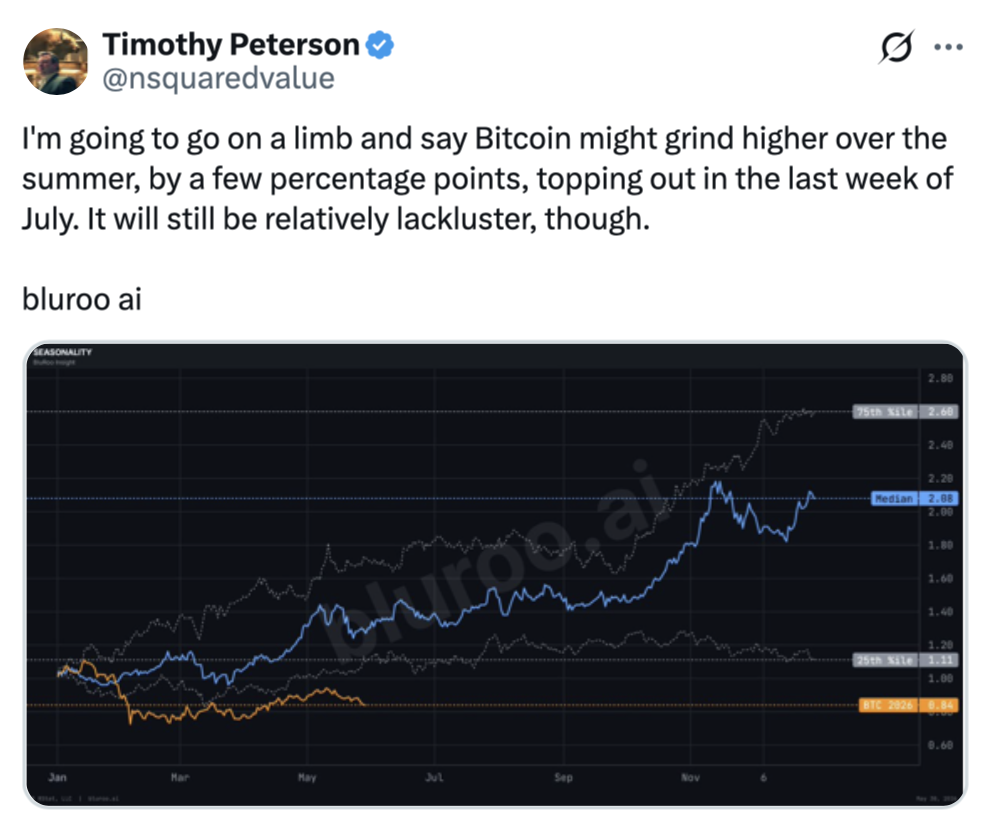
Source: Timothy Peterson
Van de Poppe said that this structure is “different than the previous breakdown in February.” He said that the range resistance didn’t hold as support in February. “The $71K area remains to be a crucial support level, and that would be required to hold in this particular zone in order to prevent any deeper corrections, in my opinion,” van de Poppe said.
However, van de Poppe said that if the current price level does hold, Bitcoin could break through to $76,600, potentially triggering a broader crypto market uptrend. “If that breaks, new highs are around the corner, and we’re likely going to see a strong Altcoin summer,” van de Poppe said.
Bitcoin ETF flows may suggest market bottom
Meanwhile, crypto analytics firm Santiment Intelligence recently said that the sustained Bitcoin ETF outflows may suggest the market bottom is nearing an end.
Related: Bitcoin retail sentiment still matters, says Swan Bitcoin CEO
Spot Bitcoin ETFs have logged outflows for ten consecutive trading days, with total net redemptions exceeding $2.97 billion since May 15.
Total net assets held across spot Bitcoin ETFs have dropped from $104.29 billion on May 15 to $94.17 billion as of Friday, a decline of roughly $10 billion in two weeks.
Magazine: HYPE chases $100 target, ETH could dump below $1800: Market Moves

Circle has temporarily froze $12.6 million in USDC tied to a confidential, privacy-focused smart contract associated with the Zama protocol. The disclosure came from on-chain sleuth ZachXBT, who noted that the contract is publicly labeled on block explorers and in Zama’s technical documentation. The exact rationale behind the freeze remains unclear at this stage.
According to ZachXBT, the funds were connected to a May 11, 2026 inflow from the Overnight Finance DeFi protocol. He cited a governance-related event around that treasury activity and argued that the move raises questions about the power to intervene in user funds when assets are commingled with a protocol’s users. In his words: “Overnight Finance held a governance vote recently to distribute treasury funds after holders alleged the team was rug-pulling. Regardless, it’s precedent-setting to unilaterally freeze the contracts or addresses of a protocol where funds have been commingled with Zama users.”
“Overnight Finance held a governance vote recently to distribute treasury funds after holders alleged the team was rug-pulling. Regardless, it’s precedent-setting to unilaterally freeze the contracts or addresses of a protocol where funds have been commingled with Zama users.”
Circle has not publicly explained the freeze, and Cointelegraph reached out to Circle for comment but did not receive a response by publication time. The move intensifies long-running debates over how a centralized fiat-backed issuer should handle access to funds tied to privacy-preserving DeFi protocols.
The episode sits against a backdrop of broader criticism aimed at Circle for past actions related to fund freezes. ZachXBT has argued that Circle has repeatedly taken steps to freeze or block the movement of stablecoins in certain circumstances, sometimes to the detriment of legitimate projects. In March, he accused Circle of “wrongfully” freezing 16 stablecoin wallets linked to online casinos and other entities involved in civil litigation, saying the wallets did not appear related to the underlying cases. He later contended that Circle had failed to freeze roughly $420 million across 15 separate cases involving fraudulent transactions or funds stolen via hacks since 2022.
Among the cited incidents, ZachXBT highlighted the Drift Protocol breach in April 2026, where about $232 million worth of user funds were reportedly not frozen in a timely manner despite Circle having a six-hour window to act. The ensuing controversy contributed to a class-action lawsuit alleging that Circle failed to intervene to halt the flow of ill-gotten funds via its Cross-Chain Transfer Protocol (CCTP), a bridge designed to move assets across networks.
These past episodes are often framed by critics as emblematic of a broader tension between the goals of anti-fraud enforcement and the rights of users who rely on permissionless, privacy-enhancing protocols. On one hand, stablecoin issuers like Circle argue that they must act to prevent the circulation of stolen or illicit funds. On the other hand, commentators warn that unilateral freezes can undermine trust in stablecoins and DeFi projects that rely on interoperability and user-owned assets. The Zama case, which centers on a privacy-enabled USDC implementation, underscores how rapidly evolving tech and governance decisions intersect with regulatory and legal risk for issuers, developers, and users alike.
Circle’s track record and the implications for DeFi resilience
The ongoing discourse around Circle’s actions is not limited to a single incident. Critics point to a string of cases cited by observers that purportedly show inconsistency in how Circle handles freezes. The Drift Protocol example, in particular, has become a reference point for arguments that timely intervention matters, especially when funds are routed through Circle’s CCTP bridge. A growing chorus argues that such interventions should be transparent, well-communicated, and subject to governance or external oversight to prevent potential overreach.
For investors and builders, the episode highlights a few practical questions. First, what safeguards exist when a stablecoin issuer takes action against funds that are part of a governance-enabled DeFi protocol? Second, how does the market assess the legitimacy of a freeze when the underlying asset is tied to a privacy-preserving smart contract? And third, what signals should projects that rely on cross-chain bridges and confidential transactions watch for in terms of issuer behavior and regulatory clarity?
Circle’s response—if provided—will likely influence how developers design future integrations with CCTP and other Circle services. Projects building privacy-centric layers on top of USDC may need to reassess risk models, including contingency plans for potential freezes, while users will be watching for clearer criteria around when and why funds could be blocked or moved by a centralized issuer.
It’s also worth noting that the broader market context remains dynamic. Stablecoins continue to face intensifying scrutiny from regulators worldwide, as well as ongoing debates about the balance between privacy, security, and compliance. The Zama case illustrates how these tensions can play out in real time, with a public liquidity channel tied to a confidential protocol suddenly intersecting with a highly regulated fiat-backed asset.
As the dust settles, market participants should monitor whether Circle offers public guidance or a detailed rationale for the freeze, and whether Zama or its users pursue any formal recourse. The outcomes could help shape future expectations for how the crypto ecosystem handles governance, privacy, and the practical realities of operating on permissionless rails while staying within the bounds of existing and evolving rules.
Source context: The details came to light through a post by ZachXBT, who has tracked Circle-related controversies and their implications for users and operators across the DeFi landscape. Cointelegraph has sought comment from Circle but has not received a response at press time.
What comes next remains uncertain: will there be a formal explanation from Circle, a related regulatory statement, or a shift in how privacy-focused protocols interact with fiat-backed stablecoins? Market watchers will want to see not only the immediate accounting of the frozen funds but also any steps that improve transparency and governance around such critical actions in the future.
Crypto World
South Korea Cracks Down on CatFi Rugpull: First-Ever Crypto Fraud Case Under New Investor Protection Law

South Korean prosecutors have filed charges against a group of individuals linked to a Solana-based meme coin project called CatFi, following allegations that the token was used in a coordinated rugpull scheme after attracting investor funds.
The Seoul Southern District Prosecutors’ Office confirmed in its Wednesday statement that five individuals are now facing charges in connection with the case, including two main suspects who have been placed in custody and three others who have been indicted without detention.
Influencer Ruse, Fake Lockups
Investigators say the group created and launched CatFi in early 2025 through the Solana meme coin platform Pump.fun. It managed to draw in investors soon after listing, only to abandon the project once enough money had entered the token. Prosecutors highlighted that the case is legally significant because it is the first time the country’s Virtual Asset User Protection Act has been used to prosecute a rug pull under fraudulent and unfair trading provisions. Interestingly, it is also the first known prosecution involving a crypto crime carried out through a decentralized exchange, which had previously remained largely outside regulatory reach.
According to the findings, the suspects did not rely solely on token mechanics to generate interest but allegedly built a misleading promotional ecosystem around the project. One of the accused reportedly presented himself online as an independent crypto influencer, using that identity to push investment interest toward CatFi. Meanwhile, another handled official project communications, where follower numbers were artificially inflated, and announcements were posted claiming fake token lock-up arrangements intended to suggest stability.
Authorities further allege that the group circulated tokens across multiple wallets and carried out wash trading activity to disguise their control over supply and to create the appearance of genuine market demand. In the hours following launch, CatFi’s price reportedly surged dramatically, increasing by roughly 1,001 times within a 26-hour window, during which about 6,000 investors bought into the token.
Prosecutors said that 256 of these investors later reported total losses amounting to around 900 million Korean won, which is roughly equivalent to $600,000, while the suspects are believed to have secured profits exceeding 400 million won. The scheme had initially drawn attention from online blockchain analysts who traced wallet activity and publicly identified those involved, but police at the time closed the case after the suspects claimed they had been victims of hacking.
The matter was later escalated when the Financial Services Commission referred it to prosecutors, which ultimately led to a joint investigation involving a dedicated crypto crime unit as well as financial and tax authorities, that tracked down the suspects, including one individual who had evaded capture for three months using disguises.
Arrests followed on May 11 for two suspects, while the remaining three were detained later on Wednesday.
High User Activity Despite Allegations
Pump.fun has come under intense scrutiny for enabling large-scale speculative token activity on Solana, where most newly created meme coins are linked to scams like rug pulls and pump-and-dump schemes. The platform’s ease of token creation and low transaction costs drove rapid trading.
Despite this, the meme coin launchpad emerged as one of the Solana ecosystem’s top revenue-generating applications in 2025. In fact, it was one of seven Solana apps that earned over $100 million in revenue during the year.
The post South Korea Cracks Down on CatFi Rugpull: First-Ever Crypto Fraud Case Under New Investor Protection Law appeared first on CryptoPotato.

The United States risks ceding its crypto leadership to other nations if lawmakers don’t push through a comprehensive market framework known as the CLARITY Act. Senior lawmakers and industry observers say passing the crypto market structure bill is pivotal to preventing a future in which Beijing or other cities write the rules of the next financial era. Senator Cynthia Lummis of Wyoming has been a leading advocate, arguing that a clear regulatory path would solidify America’s role in shaping the evolution of digital assets rather than letting the global tide turn elsewhere.
The core argument is simple: a robust, predictable regulatory framework could attract legitimate crypto activity, while leaving room for innovation across sectors from custody to decentralized finance. Lummis has repeatedly framed CLARITY as a gateway to “build the next one” after the dollar-dominated system anchored U.S. financial stability for a century. She emphasized that a clear act would prevent other countries from setting the rules before the United States does, a point she highlighted in statements linked to her social posts on X.
Key takeaways
- The CLARITY Act cleared a procedural hurdle in May when the Senate Banking Committee advanced the bill after months of stagnation, reviving hopes that a comprehensive framework could become law in 2026.
- Industry watchers caution that passage remains uncertain due to political dynamics, a crowded legislative calendar, and opposition from the banking lobby that questions certain provisions for crypto firms.
- JPMorgan Chase CEO Jamie Dimon signaled banks will push back against the current version, arguing it does not impose AML and capital requirements on crypto firms equivalent to banks, and that it still allows crypto companies to offer interest on user deposits.
- Time is a critical factor: if the CLARITY Act isn’t enacted in 2026, supporters warn the next viable window could slip to as late as 2030 amid midterm politics and shifting regulatory priorities.
- Beyond the immediate regulatory mechanics, the debate underscores a broader strategic question: how the U.S. intends to balance crypto innovation with consumer protections and financial stability.
Regulatory momentum: CLARITY Act moves forward
At the heart of the debate is a comprehensive attempt to codify a clear, predictable structure for crypto markets. In May, the Senate Banking Committee voted to advance the CLARITY Act after months of stagnation, rekindling expectations that a fuller passage could occur in 2026. The bill represents one of the most consequential attempts to codify crypto regulation in the United States, aiming to delineate which activities fall under securities, commodities, and banking supervision while setting standards for consumer protections and market integrity.
Senator Lummis has framed CLARITY as a national priority, warning that inaction could leave the United States playing catch-up to other jurisdictions. She has stressed that “America built the dollar-dominated financial system that has anchored global stability for a century. The Clarity Act ensures we build the next one. The time to act is now, before Beijing decides it will.” Her remarks, including social posts, underscore the high stakes of extending U.S. leadership into the next phase of financial technology. For readers seeking a fuller sense of her public messaging, her X posts provide context on the act’s intended trajectory.
Although the committee’s move signaled fresh momentum, the pathway to final passage remains uncertain. The legislative process in the United States is complex, and the CLARITY Act would need broad bicameral approval and a signature from the White House to become law. Observers emphasize that even though the May vote revived optimism, several obstacles linger, including potential partisan divides and a crowded 2026 legislative agenda that often slows major regulatory bills.
Some supporters argue that CLARITY could provide a framework that harmonizes U.S. oversight with global developments, reducing regulatory fragmentation that has characterized crypto policy across different states and agencies. Others caution that the bill’s design must strike a balance between enabling legitimate innovation and guarding against fraud, money laundering, and consumer risk. The bill’s long-term success could hinge on how it treats non-custodial DeFi and other emerging business models, an area highlighted by industry advocates who want to ensure fair treatment for different crypto activity types.
Related context: the full text of the CLARITY Act is available from the U.S. Congress, and reporting has noted its potential to reshape the regulatory landscape for crypto businesses across the board.
Industry pushback and the banking lobby
Even as proponents advocate for clarity, the banking industry has signaled strong opposition to the current draft. JPMorgan CEO Jamie Dimon publicly warned that banks are unlikely to accept a version that allows certain crypto activities to operate without the same oversight they face. Dimon argued that the bill does not impose equivalent anti-money-laundering (AML) and capital reserve requirements on crypto firms, creating a perceived regulatory asymmetry that banks say could undermine consumer protections and financial stability.
Dimon’s remarks, reported in coverage surrounding the CLARITY Act, also touched on the stance of crypto exchange operators. He criticized Coinbase and its CEO, Brian Armstrong, for pursuing the bill’s passage, insisting that “No one is going to bow down to this guy or that company.” The comments illustrate the broader dynamic at play: traditional financial institutions and their advocates are seeking a regulatory asymmetry that favors established banking practices, while crypto firms and their supporters push for a framework they view as essential to competitive parity and market growth.
The clash extends beyond rhetoric. Industry watchers note that the banking lobby’s opposition, coupled with political headwinds and the midterm election cycle, could compress the window for attaining a final law in 2026. If the CLARITY Act does not become law within that timeframe, some lawmakers warn that future opportunities to enact similar regulatory clarity might not surface again for several years, potentially delaying the U.S. framework for the next cycle of innovation.
Beyond the political calculus, supporters argue that a well-crafted CLARITY Act could reduce regulatory uncertainty and provide a unified standard for crypto firms, exchanges, and DeFi projects. Opponents, however, stress the need for strong AML standards and robust capital requirements to prevent systemic risk, a stance often associated with traditional financial incumbents who worry about uneven competition or regulatory arbitrage.
What happens next and why it matters
The debate over CLARITY sits at a crossroads for U.S. competitiveness in crypto and digital finance. Proponents say a clear, comprehensive framework would help attract legitimate participants, reduce compliance fragmentation across agencies, and lay the groundwork for a sustainable digital asset ecosystem. Critics contend that any framework must be rigorous enough to curb misuse and protect consumers, even if that means imposing rules that some crypto firms fear could hamper innovation.
Crucially, the timeline remains a focal point. Lummis has warned that if the CLARITY Act is not enacted in 2026, the chance to pass such legislation could slip until as late as 2030. With midterm dynamics shaping legislative calendars, industry participants are watching closely how the administration and lawmakers navigate lobbying pressure, regulatory philosophy, and the appetite for a bold, standardized regime for digital assets.
Market participants and builders will be keenly watching how the bill addresses core issues such as custody, settlement, and the classification of different asset types. While the ultimate design remains a topic of negotiation, the central question will be whether the United States can craft a framework that preserves financial stability while enabling responsible innovation, rather than ceding ground to jurisdictions that may be more permissive or faster to adapt to new business models.
As the policy debate unfolds, observers will also assess how international developments influence the United States’ approach. If the CLARITY Act lands and is complemented by an effective enforcement regime, it could position the U.S. to set global standards in digital-asset markets. Conversely, a stalled or lopsided framework could intensify competitive pressure from regions already pursuing clearer, more accelerator-friendly regimes for crypto activities.
For readers and practitioners, the most important indicators to watch are: progress in the Senate and House negotiation dynamics, statements from the White House on regulatory alignment, and how major financial institutions calibrate their compliance and lobbying strategies as the midterms approach. The outcome will shape not only regulatory clarity but also the cadence of crypto innovation, capital flows, and the ability of American firms to compete on a global stage.
In the meantime, the CLARITY Act remains a focal point of the broader U.S. regulatory discourse around crypto, with policymakers, bankers, and industry players weighing the balance between consumer protection, financial stability, and the promise of a more orderly framework for digital assets.
Readers should stay tuned to developments as the year progresses, since the regulatory landscape for crypto in the United States could hinge on a few decisive parliamentary moves, with potential implications for how the sector evolves, funds allocate, and solutions build across the digital asset ecosystem.

Morgan Wallen Overturns Piano Amid Technical Difficulties

Shoot the dice Googs #joeymerlino #mood #rant #money #armorcar

Work to start on 265 homes and primary school extension in tiny Cambridgeshire village


-

 Business6 days ago
NYT Strands Answers May 24 2026 Revealed for Puzzle No. 812 Theme Summer Essentials
-

 NewsBeat4 days ago
Israel says it has killed new Hamas military leader in Gaza City airstrikes
-

 Politics6 days ago
Bridgerton Season 5: Cast, Release Date And Everything We Know So Far
-

 Business4 days ago
Selena Gomez Reportedly Upset Over Benny Blanco’s Comments on Her ‘Terrible’ Diet
-
 Crypto World4 days ago
Micron Crosses $1 Trillion Market Cap as AI Demand Reshapes Memory Sector
-

 Business6 days ago
BTS Sells Out Four Las Vegas Shows at Allegiant Stadium for ARIRANG World Tour
-

 Tech6 days ago
Microsoft’s quiet Claude Code retreat and the real cost of enterprise AI
-

 News Videos4 days ago
XRP *JUST* SUCCEEDED!!!! CLARITY ACT EXPOSED!!! (SHE EXPOSED IT)
-
 Tech5 days ago
China assigns ID codes to 28,000+ humanoid robots
-
Crypto World6 days ago
Brian Armstrong Outlines Crypto Vision for the Future Financial System
-

 Tech2 days ago
Waymo dominates autonomous vehicle registrations as Tesla trails behind
-
Tech4 days ago
The Samsung pay deal is the moment Korean unions changed register
-
 NewsBeat5 days ago
Hottest May day ever as London hits 34.8C in 2C leap from previous records
-

 Tech6 days ago
Westone Audio and Etymotic Acquired by Fidelity Collective in Major IEM Market Move
-
 Entertainment5 days ago
‘Breaking Bad’ Star’s Easy-to-Binge 6-Part Crime Series Spin-Off Is Finally Heading to Free Streaming
-

 Tech4 days ago
Millions of AI agents imperiled by critical vulnerability in open source package
-
Crypto World4 days ago
SpaceX’s $2 Trillion IPO: Why Tech Giants Nvidia (NVDA), Apple (AAPL), and Microsoft (MSFT) May Face Pressure
-
 Crypto World6 days ago
Nvidia (NVDA) CEO Calls on Super Micro to Strengthen Export Controls Amid Smuggling Probe
-

 Business5 days ago
Nikkei 225 Surges Past 65,000 for First Time as Iran Peace Hopes Fuel Record Rally
-

 NewsBeat6 days ago
Crowds find riverside shade in York as temperatures soar
You must be logged in to post a comment Login