
Tech
Nothing’s Warp app promised to fix cross-platform file sharing, then vanished within hours


Nothing launched a genuinely useful app called Warp earlier today, with a simple idea: allowing Android users to share files, links, and copied texts directly to their Mac, Windows, or Linux machines without including any cables or convoluted workarounds.
Nothing announced the app for Chrome and Edge (Chromium-based web browsers) and Android smartphones, floating it on both the Chrome Web Store and the Google Play Store (via 9To5Google). However, a few hours later, the app is nowhere to be found, with the official listings returning errors.

So, how did Warp actually work?
Nothing’s Warp app used Google Drive as a data transfer bridge, keeping files within users’ accounts rather than routing them via Nothing’s servers. From their phones, users picked any file or link (via the Android share sheet) and sent it through Warp.
On the receiving end, a desktop, the browser extension added a right-click “Send with Nothing Warp” option, along with an upload button. Once a file was received, users still had to manually download it.
In other words, Nothing’s Warp wasn’t using peer-to-peer transfer (like Quick Share or AirDrop), but a cloud relay with some branding on top.

Did the Nothing Warp app disappear already?
That’s the part nobody has explained (yet). Within hours of launch, the official community post announcing the app returned a “This page doesn’t exist” error. The app isn’t listed on the Play Store or the Chrome Web Store anymore.
One Reddit user claims that the app bears a striking resemblance to an open-source tool, which could be one of the reasons for the potential takedown. However, this remains unconfirmed speculation at the moment, as the company hasn’t issued an official statement about the removal.
Another user downloaded the app’s setup, but couldn’t run it due to a Play Store warning, which is usually issued for safety purposes. Even so, the app is reportedly working fine for users who installed it earlier today on their smartphones and laptops.
Warp’s rapid rise and fall remind me of how the Nothing Chat app, an iMessage-bridging solution, was pulled days after launch due to security concerns. If the removal was precautionary, Nothing might go ahead with a refined version of the app.


If you have ever finished an audiobook and wished you owned the book, Spotify has an easy solution. The company now lets you buy physical books directly from its app in the U.S. and the U.K.
How to buy physical books in the Spotify app?
Spotify has partnered with Bookshop for the sale of paper books. When you browse an audiobook on Spotify, you will now see an option to buy a copy. Once you tap it, Spotify redirects you to Bookshop’s website to complete the purchase.
This means Spotify does not process payments itself. Instead, it acts as a discovery layer that connects you to independent bookstores through Bookshop’s network.

The feature is currently limited to users in the U.S. and the U.K. For now, it works alongside audiobook listings, so you can easily switch from listening to owning a physical copy.
What else is new in Spotify audiobooks?
Spotify is also expanding its audiobook experience in other ways. The company has introduced Audiobook Charts that highlight top titles across genres. This gives you a better sense of what is trending, similar to how music charts work on the platform.

The company is also rolling out the Audiobook Recap feature, which gives you short audio summaries based on where you last stopped listening. These are designed to refresh your memory of the story so far, making it easier to jump back in without feeling lost.
Last February, Spotify introduced the Page Match feature, which lets you scan a page from a physical book and continue from the same spot in the audiobook. It now supports more than 30 additional languages, including French, German, and Swedish.
Why this matters
Spotify is slowly turning itself into a one-stop shop for stories. You can discover a title, listen to it, jump between formats, and even buy the physical book without starting over elsewhere. It still feels unexpected for a platform known for music, but once you use these features, you will come to appreciate their usefulness.

Doug Field, the high-profile executive who shaped Ford’s electric vehicle (EV) and technology strategies over the past five years, is leaving the automaker. Field’s departure was announced Wednesday as part of a broader reorganization of the company’s leadership.
Field joined Ford in 2021 with a robust resume from Silicon Valley that included leading Apple’s special projects team and serving as senior vice president of engineering at Tesla. His hiring was more than just a return to his professional roots. (Field began his career at Ford as a development engineer from 1987 to 1993.) The hiring was meant to drive Ford CEO Jim Farley’s vision to turn the legacy automaker into a leader in software, EVs, and other advanced technology.
Field directly reported to Farley, tasked initially with overseeing the company’s embedded software and hardware operations, covering vehicle controls, enterprise connectivity, features, integration and validation, architecture and platform, driver assistance technology, and digital engineering tools. In practice, this made him responsible for the design, development, and implementation of the entire tech stack used in Ford and Lincoln vehicles, including infotainment, navigation, driver-assist technology, connected services, and vehicle cybersecurity.
Field was a visible figure at Ford whom Farley often praised on the company’s earnings calls. He was among the key leaders when the automaker split its business into three units: the EV and digital services division, the traditional internal combustion engine business, and the commercial vehicles unit. And he was behind Ford’s skunkworks program — a secretive internal team — to build a low-cost electric vehicle.
Under the reorganization laid out Wednesday, Ford has created what it calls a “product creation and industrialization” team to be led by COO Kumar Galhotra. Ford’s electric vehicle and design team, which Field led, will be folded into this new organization.
The new organization comes with ambitious targets, including an 8% adjusted profit margin for its Ford+ commercial business by 2029. The team will also oversee Ford’s plan to refresh 80% of its North American portfolio by volume and 70% of its global portfolio by 2029. This will include the Universal Electric Vehicle (UEV) platform, a mid-sized pickup, and the next-generation F-150 and F-Series Super Duty trucks.
The UEV platform is what the Ford skunkworks program — now known as the Advanced Development Projects team — developed. Alan Clarke, a former Tesla executive who has led that skunkworks program, is now vice president of Advanced Development Projects.
Techcrunch event
San Francisco, CA
|
October 13-15, 2026

Reading my articles from the fellowship feels like reading diary entries. They’re raw, honest and they reflect how much I was struggling with teaching at the time. Overwhelm is apparent. So is frustration. As a teacher who was impacted by COVID-19 and the year of fully remote learning for students, the Voices of Change fellowship gave me the space to reflect and name the questions that had brought me to teaching in the first place. Since leaving the classroom almost two years ago, I’ve returned to writing frequently to work through the questions teaching left me with.
Having attended Title I public schools myself, I entered the classroom seeking a lens through which to understand my school experiences. As I became more interested in education as an engine of social mobility, I wanted to understand why some kids learned to read and some did not. I wanted to understand why some schools had more resources than others. I wanted to understand why some kids went to college, and some did not. Teaching felt like a way to move closer to those answers.
The process of learning these answers was swift and painful. The stark reality was playing out in front of me every day as I taught at a public charter school during the day and then drove to the suburbs in the evenings to tutor for extra cash. I quickly saw how rarely student success is the product of a single school or teacher, but rather an aligned system of supports that begins at birth.
So here’s what I learned: some kids can read because their schools taught phonics and screened for reading disabilities in kindergarten. Some schools have more resources because housing policy and decades of segregation shaped property values and neighborhood composition. Some kids go to college because they benefited from networks of financial and familial stability, giving them resilience through challenges like the SAT, the Common App and FAFSA. The questions I began with spun out into winding tangles of policy choices, zip codes, race and class.
I’ve come to understand that the grief I felt at leaving the classroom was more than being overwhelmed and overworked — it was the undoing of my belief that education was society’s great equalizer. It was also the realization that I had been lucky; my graduation from high school and matriculation to a four-year college was as much a function of my family’s assumption from birth that I would go to college as it was my academic performance or the opportunities my schools offered.
Achieving academically was easy because I had stable housing, good health care and a network of loving and supportive adults. Had I experienced any learning challenges, they would have been swiftly addressed by my white-collar parents, who are comfortable speaking with educated professionals. Students spend the vast majority of their lives before the age of 18 outside of school. Teaching revealed how profoundly the promise of education depends on systems beyond the classroom.
That isn’t to say that schools and teachers cannot move the needle for students. Teachers grow their students every day in ways that feel nothing short of miraculous. You’d be hard-pressed to find an adult who cannot name a teacher who made a difference in their life. But the biggest gains for students occur when the systems around schools align to support the work teachers are doing — when children arrive at school healthier, safer and more secure in their lives outside the classroom.
On this front, there are two movements I’ve been paying attention to, one that brings me hope and one that makes me nervous. In graduate school, I learned about place-based partnerships, initiatives that bring stakeholders in health care, housing, education, youth services, local government and philanthropy into alignment around shared goals for supporting children and families. The most famous example is the Harlem Children’s Zone, but the model has spread widely. Organizations like StriveTogether now support networks of communities working toward cradle-to-career outcomes. Partners for Rural Impact is helping rural communities coordinate services for children across schools and social supports. Here in Boston, the Boston Children’s Council is bringing together city agencies, nonprofits and schools to think more holistically about the conditions shaping children’s lives.
What gives me hope about these efforts is that they acknowledge something teachers already know: students do not arrive at school as blank slates each morning. They arrive carrying the cumulative effects of housing stability, health-care access, nutrition, family income and community safety. Place-based partnerships represent a policy approach that supports teachers by strengthening the ecosystems around them rather than asking schools to solve poverty alone.
What makes me more uneasy is the direction some of the frustration with public education has taken. If we spent decades telling ourselves that schools were the great equalizer, then the persistence of large racial and economic achievement gaps, especially in the wake of COVID frustrations, can feel like a failure of the institution itself.
In my home state of West Virginia, that frustration has helped fuel support for the Hope Scholarship, the nation’s only universal education savings account program, which has deleterious impacts on the public education system most students rely on. Policies like this are often framed as empowering families with choice, but I worry they also reflect a disillusionment with the project of public schools as engines of democracy. It is my belief that many of the inequities in public education were never fully within schools’ control to address.
My experience as a teacher, and now as a policy practitioner, has convinced me that the path forward is not to abandon public schools, but to surround them with stronger systems of support for children and families. The question I find myself paying closest attention to now is how policy can help build those systems: partnerships that allow teachers to do what they already do best, while ensuring the conditions outside the classroom make their work possible.
from the willy-nilly dept
We’ve talked for many years about Nintendo’s shotgun approach to IP enforcement, as well as its heavy-handed ToS enforcement policies that can include bricking customer consoles and/or banning their accounts if they do something Nintendo doesn’t like, even if it’s not strictly illegal. This has all set up an ecosystem where being a Nintendo fan and customer can feel like a dangerous prospect, where navigating a capricious company is supposed to be half the fun.
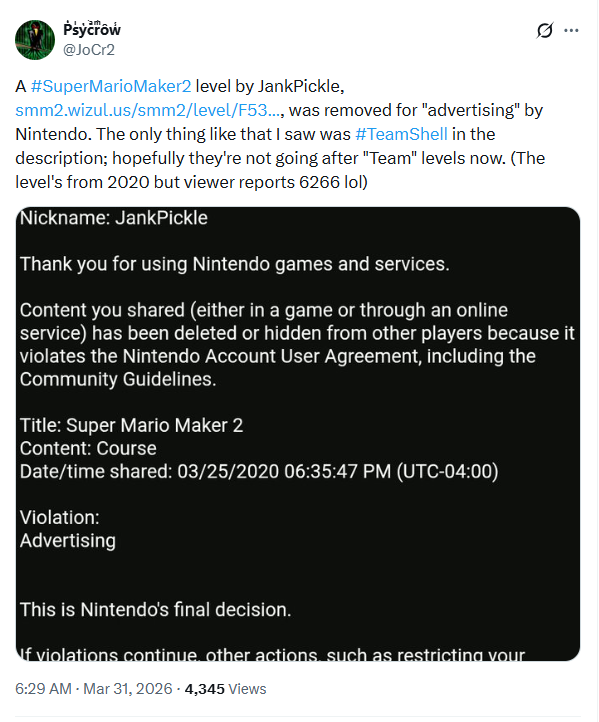
But when that same ecosystem is setup in a way that is wide open to abuse, the fun really begins. That appears to be what is happening right now as Nintendo is removing hundreds of Mario Maker 2 levels made by fans.
The common denominator for these level deletions appears to be the inclusion of a hashtag for “TeamShell,” which is a Discord server dedicated to sharing codes for levels made within the game. Notices about the removal from Nintendo indicate that they were deleted for including “advertising”, which is against Nintendo’s terms of service.

There is no indication that any money is changing hands here. Calling a hashtag to denote that a level was made with a specific Discord server in mind “advertising” is stretching the definition to the point of absurdity. On top of all of this, many of these levels are years old, causing the community to wonder why in the world this was suddenly happening now.
Then someone found this on another Discord server dedicated to the Mario Maker games.

So, who is LMT?
Turns out, the YouTube account linked to LMT’s Discord profile bears the pseudonym of someone called MT94. As explained in a post on AtWiki, MT94 was, at one point, the second-highest-rated Super Mario Maker player in the world.
Turns out that MT94 cheated their way to that ranking, and they achieved this by using three separate Nintendo Switch consoles. By consistently challenging their own accounts to co-op battles in the game, they managed to boost themselves up the rankings. After the community found out and reported them, MT94’s accounts were banned.
Now, I’ve seen some content out there indicating it was TeamShell that had a hand in exposing MT94’s alleged cheating, but nothing solid enough that I consider firm ground. But it’s clear that there is some kind of vendetta at work here. And, while most of you probably view the deletion of some Mario Maker levels as a tame story at most, it is having very real consequences due to how Nintendo conducts it business.
The truly sad thing is that Super Mario Maker users are also reporting that their Nintendo Switch accounts are being suspended as well, as there seems to be a sort of automatic system in place that suspends a Nintendo Switch account if it’s been associated with a certain number of reports.
Nintendo has a choice. It can remain heavy-handed in this manner when it comes to account suspensions for takedowns, but then it needs to actually investigate claims like this to ensure they aren’t falling for abusive takedown requests. Or it can ease up on the severity of its actions and allow for a counternotice system, or another manner for those falsely accused to avoid consequences.
What it should not be allowed to do is continue to let its own customers suffer severe consequences merely because the system it set up is so wide open for this kind of gleeful abuse.
Filed Under: fans, mario maker, takedowns, teamshell
Companies: nintendo


Thanks to World War 2 changing the way we make car tires, synthetic rubber is the primary material used in today’s tires. However, that doesn’t mean that tire manufacturers have stopped innovating. In fact, Goodyear has used a soybean oil compound in its tires since 2017. It might sound like a bizarre concept, but there’s actually a very good reason the company began using soybeans, and why it still does so today.
Goodyear incorporates the soybean blend because it’s more cost-effective than traditional petroleum-based oils used in years past. It’s also more eco-friendly, and in terms of production, it mixes with rubber very easily. Because of this, the soybean oil compound makes for a more efficient process, while also using less energy as well. Soybean oil technology, which is also used to make biodiesel fuel, causes tire tread to become more flexible as the temperature changes. This means that Goodyear tires are designed to have better grip in dry, wet, and even winter, environments.
Goodyear was the first tire manufacturer to utilize a soybean formula and did so with support from the United Soybean Board. At the time, the move was promoted as the company’s effort to develop high-performing tires while also experimenting with non-traditional raw materials. The fact that soybeans are a renewable resource only boosted Goodyear’s positioning.
Goodyear’s soybean oil expansion and future plans

In 2022, the company manufactured new commercial tires, the Metro Miler G152 and G652, for city transit systems. These tires would replace some of the existing petroleum-based tires. Goodyear maintained that the new additions would still have the same performance as before, while also moving away from the traditional tires used up to that point. That same year, the company also introduced a soybean oil compound in its Endurance WHA waste haul tire.
Goodyear later expanded even further, incorporating the soybean formula across several additional tire lines with some of the best treadwear ratings. This includes the Assurance WeatherReady tires, the Assurance ComfortDrive all-season tires, as well as two Eagle lines. The company used the same technology in its Wrangler Workhorse HT, which is mostly installed on SUVs and light pickup trucks. Goodyear’s widespread use of the compound is actually part of a bigger strategy, as the goal is to produce a fully sustainable-material tire by 2030.
The company appears to be on track for that timeline, as, in 2023, it made a demonstration tire made with 90% sustainable materials. The new tire passed the rounds of internal and external testing, in which it exhibited lower rolling resistance than similar traditional models. This means better efficiency and fuel economy overall.

An anonymous reader quotes a report from the New York Times: Many scientists have contended that humans have evolved very little over the past 10,000 years. A few hundred generations was just a blink of the evolutionary eye, it seemed. Besides, our cultural evolution — our technology, agriculture and the rest — must have overwhelmed our biological evolution by now. A vast study, published on Wednesday in the journal Nature, suggests the opposite. Examining DNA from 15,836 ancient human remains, scientists found 479 genetic variants that appeared to have been favored by natural selection in just the past 10,000 years.
The researchers also concluded that thousands of additional genetic variants have probably experienced natural selection. Before the new study, scientists had identified only a few dozen variants. “There are so many of them that it’s hard to wrap one’s mind around them,” said David Reich, a geneticist at Harvard Medical School and an author of the new study. He and his colleagues found that a mutation that is a major risk factor for celiac disease, for example, appeared just 4,000 years ago, meaning the condition may be younger than the Egyptian pyramids. The mutation became ever more common. Today, an estimated 80 million people worldwide have celiac disease, in which the immune system attacks gluten and damages the intestines.
The steady rise of the mutation came about through natural selection, the scientists argue. For some reason, people with the mutation had more descendants than people without it — even though it put them at risk of an autoimmune disorder. Other findings are even more puzzling. The researchers found that genetic variants that raise the odds of a smoking habit have been getting steadily rarer in Europe for the past 10,000 years. Something is working against those variants — but it can’t be the harm from smoking. Europeans have been smoking tobacco for only about 460 years. The scientists can’t see from their research so far what forces might be making these variants more or less common. “My short answer is, I don’t know,” said Ali Akbari, a senior staff scientist at Harvard and an author of the study. The researchers also found that some variants, like the one linked to Type B blood, became much more common in Europe around 6,000 years ago, while others changed direction over time. For example, a TYK2 immune gene variant that may have once been beneficial later became harmful because it increased tuberculosis risk.
The study also found signs of natural selection in 44 out of 563 traits. Variants linked to Type 2 diabetes, wider waists, and higher body fat have become less common, possibly because farming and carbohydrate-heavy diets made once-useful fat-storing traits more harmful. Other findings, such as selection favoring genes linked to more years of schooling, are harder to interpret.

If you like getting your daily cup of coffee from Starbucks, you’ll now be able to consult with ChatGPT for your next beverage. Starbucks said on Wednesday that a new Starbucks app in ChatGPT, now in beta, will help you figure out your next order based on your mood or craving in the moment.
An example of what a Starbucks order idea looks like through Chat GPT.
Although you won’t be able to order your Starbucks coffee directly through the ChatGPT app, it will suggest drinks and menu items you may enjoy, then direct you to the Starbucks app or website to complete your order.
OpenAI has added a host of other apps you can interact with in ChatGPT since announcing the functionality last year. You can do everything from browsing home listings to designing playlists without leaving the chatbot interface.
You’ll be able to use prompts like, “@Starbucks, I want something bright to start my morning,” or upload an image to describe your mood and location. Once the menu suggestion appears in ChatGPT, you can start the order through the chatbot and then complete it in the Starbucks app or online.
Paul Riedel, senior vice president of digital and loyalty at Starbucks, said in a statement that Starbucks noticed customers weren’t always starting off by looking at the menu. “They’re starting with a feeling,” he said. “We wanted to meet customers right in that moment of inspiration and make it easier than ever to find a drink that fits.”
An example of the oddest drinks you can order at Starbucks.
Starbucks said interacting with ChatGPT lets you personalize your order more and discover menu options you never considered before.
(Disclosure: Ziff Davis, CNET’s parent company, in 2025 filed a lawsuit against OpenAI, alleging it infringed Ziff Davis copyrights in training and operating its AI systems.)
When I tried out the new feature, I asked it about the oddest beverage combinations you can get at Starbucks. One interesting combo ChatGPT came up with was espresso with lemonade. The AI described another drink as “basically liquid dessert soup,” if that’s more up your alley.


A new malware family named ‘AgingFly’ has been identified in attacks against local governments and hospitals that steal authentication data from Chromium-based browsers and WhatsApp messenger.
The attacks were spotted in Ukraine by the country’s CERT team last month. Based on the forensic evidence, targets may also include representatives of the Defense Forces.
CERT-UA has attributed the attacks to a cyber threat cluster it tracks as UAC-0247.

Attack chain
According to the Ukrainian agency, the attack begins with the target receiving an email purporting to be a humanitarian aid offer, which encourages them to click an embedded link.
The link redirects to a legitimate site that had been compromised via a cross-site scripting (XSS) vulnerability, or to a fake site generated using an AI tool.
CERT-UA says that the target receives an archive with a shortcut file (LNK) that launches a built-in HTA handler, which in turn connects to a remote resource to retrieve and execute the HTA file.
The HTA displays a decoy form to divert attention and creates a scheduled task that downloads and runs an EXE payload that injects shellcode into a legitimate process.
Next, the attackers deploy a two-stage loader in which the second stage uses a custom executable format, and the final payload is compressed and encrypted.
“A typical TCP reverse shell or an analogue classified as RAVENSHELL can be used as stagers, which provides for establishing a TCP connection with the management server,” CERT-UA says in a report today.
A TCP connection encrypted using the XOR cipher is established to the C2 server for executing commands via the Command Prompt in Windows.
In the next stage, the AgingFly malware is delivered and deployed. At the same time, a PowerShell script (SILENTLOOP) is used to execute commands, update the configuration, and retrieve the C2 server address from a Telegram channel or fallback mechanisms.

Source: CERT-UA
After investigating a dozen such incidents, the researchers determined that the attacker is stealing browser data using the open-source security tool ChromElevator that can decrypt and extract sensitive information, like cookies and saved passwords, from Chromium-based browsers (e.g., Google Chrome, Edge, Brave) without needing administrator privileges.
The threat actor also tries to extract sensitive data from the WhatsApp application for Windows by decrypting databases using the ZAPiDESK open-source forensic tool.
According to the researchers, the actor engages in reconnaissance activity and tries to move laterally on the network, and uses publicly available utilities, like the RustScan port scanner, the Ligolo-ng and Chisel tunneling tools.
Compiling source code on the host
AgingFly is a C# malware that provides its operators with remote control, command execution, file exfiltration, screenshot capture, keylogging, and arbitrary code execution.
It communicates with its C2 server via WebSockets and encrypts the traffic using AES-CBC with a static key.
The researchers note that a particularity of the AgingFly malware is that it does not include pre-built command handlers; instead, it compiles them on the host from source code received from the C2 server.
“A distinguishing feature of AGINGFLY compared to similar malware is the absence of built-in command handlers in its code. Instead, they are retrieved from the C2 server as source code and dynamically compiled at runtime,” CERT-UA explains.
The benefits of this approach include a smaller initial payload, the ability to change or extend capabilities on demand, and the potential to evade static detection.
However, this unusual approach adds complexity, relies on C2 connectivity, a larger runtime footprint, and ultimately increases detection risk.
CERT-UA recommends that users block the launch of LNK, HTA, and JS files to disrupt the attack chain used in this campaign.

Automated pentesting proves the path exists. BAS proves whether your controls stop it. Most teams run one without the other.
This whitepaper maps six validation surfaces, shows where coverage ends, and provides practitioners with three diagnostic questions for any tool evaluation.

Smart shades from SmartWings connect via the Matter over Thread protocol, which makes them responsive, energy-efficient, and Apple Home compatible. Plus, they’re a beautiful addition to any home.

SmartWings smart roller shades review
There are a lot of gadgets you can add to your smart home like lights, locks, and sensors, but there’s one category that’s often overlooked. Window shades and blinds are a more luxurious addition to a smart home, but they’re quite useful.
I have cats, so my first thought was ensuring I put the blinds somewhere they wouldn’t get destroyed. My office is cat-free, and the windows are difficult to access, so they were the perfect option.
Continue Reading on AppleInsider | Discuss on our Forums

Verdict
With this smart refresh, SteelSeries has produced a good mid-range ultralight mouse that can deliver excellent gaming performance thanks to its new sensor, 4k wireless polling, and improved battery life.
Key Features
-

Review Price:
£99.99
-
Super lightweight
The Aerox 3 Gen 2 weights just 68 grams, making it perfect if you play first-person shooters.
-
Moving in 4K
Powered by Quantum 4K wireless, the 4000Hz polling rate improves responsiveness, trumping standard 1000Hz mice.
-
Improved battery life
The ~200 hours on Bluetooth or ~120 hours on 2.4Ghz keeps you gaming for longer.
Introduction
SteelSeries has been quietly working to improve its lineup of gaming peripherals for some time now and the Aerox 3 Gen 2 is the latest product to be sent back to the drawing board. And it’s clear that with a new sensor, improved battery life, a higher polling rate, and a refined design, Steelseries isn’t playing around.
But is it enough to earn a place on our best gaming mouse list? We put the ultralight mouse to the test over the course of two weeks – and I’ve been left pretty impressed.
Design and Performance
- Similar design to the Aerox 3 Wireless
- Flatter design makes it perfect for small hands
- A new gap between the side buttons improves control
SteelSeries hasn’t reinvented the wheel with Gen 2. The mouse still looks and feels similar to the original 2022 version – with a few small differences to address those concerns of creaking and mushy buttons, of course.
The body is still lightweight with a flatter palm rest, which is perfect for smaller hands and different grip styles. I’ve been rocking my trusty Logitech G Pro Wireless mouse for a while and I was surprised by how quickly I took to the Aerox – its shape fitting effortlessly in my hand.
The flatter design means my smaller hands were able to reach the side buttons with relative ease during gaming. These sit proud from the main body and have a smoother texture, allowing you to pick them out during intense gaming sessions. They also have a more noticeable gap from its predecessor, which made it easier to identify what button I was pressing in the heat of battle.

The mouse itself has more of a coarse texture – similar to that of the original version – making it feel grippy despite your grip style. SteelSeries says it comes with an IP54 rating, which protects it against dirt, dust, and water and while it’s certainly better than my Logitech mouse, I have noticed some lingering fingerprints on the mouse buttons after long sessions and small dust particles sitting on the internal parts. It’s nothing a bit of compressed air can’t fix, but if you like things to look clean and pristine, you’re going to need to bear that in mind.
The skates, which are once again made out of 100% virgin-grade PTFE, work well across several surfaces and can be replaced. On the SteelSeries GcK Heavy XL mousemat, I found the mouse was able to glide smoothly and without issues – arguably better than the Logitech. It also worked well on my desk, except the movement did not feel as smooth. Like the chassis, the gaps around the skates also attracted dirt.
Where the mouse design has changed considerably is with the scroll wheel. The patterned design has now been replaced by a striped design, which feels grippier. It’s easy to find, despite being sunk into the chassis compared to some of the other best gaming mice, and the scrolls feel responsive.
The mouse also comes in three new colourways: Shadow (black), Ghost (white), and Magenta Haze. These are all personal preference, but the RGB lighting will interact differently with the chassis depending on the colourway you choose.
Under the hood is where the majority of the changes have been made with a TrueMove 26,000 DPI sensor replacing the 18,000 one found in the original model. SteelSeries has also boosted the wireless polling rate from 1000Hz to 4000Hz, improving response rates across the board. For context, polling rate refers to how frequently the mouse reports its position to your PC – at 4000Hz it’s doing that four times more often than a standard 1000Hz mouse, which translates to smoother, more responsive cursor movement, which is particularly noticeable in fast-paced competitive games. This isn’t enabled by default, though, and has a considerable knock-on effect on battery life – something I’ll talk about later.
The Aerox 3 Gen 2 is a smooth operator. The mouse feels incredibly fast, especially when increasing the DPI settings for games such as Counter-Strike 2, Battlefield 6, and Escape From Tarkov. Tracking accuracy was consistent throughout testing and the sensor held up well during faster flicks without losing tracking. The default DPI is 2400, which I’d recommend for day-to-day tasks, but this can be increased steadily using the on-board DPI button or via SteelSeries software.
Combine this with the increased polling rate, and the Aerox 3 Gen 2’s performance in competitive shooters is genuinely impressive. The mouse felt quick and responsive, and the buttons have both low pre and post travel, resulting in a satisfying click response – although, the switches are louder and took some time to get used to. Over two weeks of heavy use, those clicks remained consistent – I didn’t feel like there was any mushiness, which is reassuring given creaking and button quality were issues on the original.
The same could be said for the side buttons, although my small hands struggled to reach the top one unless I shifted to a more claw-like grip. That being said, I prefer them over the Logitech, simply because the shape is smaller and it fits my hand better.

Battery Life
- Major improvements over the original Aerox 3
- Offers 120 hours or 200 hours via Bluetooth (with RGB off and default settings)
- Charges fully in just over an hour
The new version of the Aerox has made considerable improvements to the battery life of the mouse with SteelSeries promising 120 hours or 200 hours via Bluetooth. This is with the mouse kept at default settings and RGB turned off, though.
In reality, though, those numbers drop pretty quickly when you start tinkering with the settings. If you switch to 4000 Hz polling rate, for example, the battery life drops to approximately 35 hours.
Obviously this is enough to see you through a couple of gaming sessions, but if you want to get the most amount of juice out of your mouse and prevent charging during use, you’re going to want to switch off the RGB lighting and stick to default settings.
I didn’t feel too limited by the battery life – it lasted me most of the week while working and gaming, but I do feel let down by the box fresh numbers considering how feature-rich the mouse is. That being said, charging is easy to do with the long cable provided and the mouse charges fully in just over an hour.

Software and Lighting
- SteelSeries Engine is easy to use and offers lots of customisation
- RGB can be distracting
- Sensitivity Converter could be improved
As with all SteelSeries peripherals these days, you can customise the Aerox 3 Gen 2 using the SteelSeries GG app. This allows you to control the mouse’s RGB lighting and change settings – from polling rate, DPI, smoothing, acceleration, and more. The live preview mode also allows you to understand the changes you’re making as you go – removing the guesswork and making it easier for newcomers to understand.
It’s the same with the RGB settings available in the Prism menu. Here you can choose from five different effects for the lighting and 26 different presets. You also have the option to set lighting effects for when the mouse is idle and active, as well as reactive. These lights fill up the chassis from the bottom and can be seen towards the bottom of the mouse and the sides.
The default setting is to have RGB lighting when the mouse is active, however, when it’s actively being used, the lights turn off. It’s a great way of saving battery power, but to be honest, I found it to be quite distracting and I ended up turning the lights off altogether.
That being said, I like that the RGB lighting briefly keeps you in the loop with your battery status. It flashes green briefly when it’s charged, yellow when the mouse has only 5-10% battery life left, and red every two minutes when it’s on its last legs. I found the latter quite useful while playing games, as it meant I could plug it in to charge during a quieter moment.
The software also comes with the 3D Aim Trainer and Sensitivity Converter, both of which are helpful if you’re big on shooters. While I’m a big fan of the 3D Aim Trainer, I’m less convinced by the effectiveness of the Sensitivity Converter, simply because it doesn’t really take into account some of the fast twitch movement you need for certain games.
This is disappointing given SteelSeries’ efforts to package this up in the mouse’s software. Nevertheless, the 3D Aim Trainer is a great way to test the mouse and its settings, as well as warm up before moving onto ranked competitive matches.
Should you buy it?
If you’re serious about competitive FPS games
The Aerox 3 Gen 2 is a superb lightweight mouse with a feature set that is geared towards competitive shooters. While it sits in a competitive mid-range category, it’s feature rich and offers a high polling rate.
If you’re not a fan of the design
While the honeycomb design helps dissipate heat fast, it’s not for everyone – and there are plenty of ultralight mice out there with different designs at a similar price range.
Final Thoughts
The Aerox 3 Wireless Gen 2 is a confident refresh from SteelSeries that addresses most of the issues people had with the original. The new TrueMove sensor is a fantastic upgrade, the 4K wireless polling gives it an edge in competitive shooters, and the improved battery life held up for the most part in my testing. The honeycomb design will probably continue to divide opinion and the switches are on the louder side.
But for competitive FPS players – particularly those with smaller hands – this is a seriously capable mid-range gaming mouse. It’s fast, well built, and surprisingly comfortable. If you’re looking to upgrade your aging mouse or you simply want to make the jump to a high-rate wireless polling mouse without breaking the bank, this deserves a serious look.
How We Test
We use every mouse we test for at least a week. During that time, we’ll check it for ease of use and put it through its paces by playing a variety of different genres, including FPS, strategy and MOBAs.
We also check each mouse’s software to see how easy it is to customise and set up.
- Used as main mouse for over two weeks
- Tested performance on a variety of games
- Tested battery life across all modes
FAQs
The gaming mouse weighs 68g, which isn’t the lightest mouse we’ve tested but certainly placing it within the ultralight category.
Yes, the mouse does have onboard memory and you can save five sensitivity levels, which can be created inside the SteelSeries GG software.
Yes, you can continue to use the mouse while charging it via the provided USB-C cable.

MLB celebrates Jackie Robinson Day as every player wears his No. 42

Woodside reinvests $24.5m in WA communities

Bitcoin steady as S&P 500 hits record, but options market isn't buying the peace trade


-

 Politics5 days ago
US brings back mandatory military draft registration
-
 Sports5 days ago
Man United discover Nico Schlotterbeck transfer fee as defender reaches Dortmund agreement
-

 Fashion5 days ago
Weekend Open Thread: Veronica Beard
-

 Politics6 days ago
Malcolm In The Middle OG Turned Down ‘Buckets Of Money’ To Appear In Reboot
-

 Politics4 days ago
World Cup exit makes Italy enter crisis mode
-

 Crypto World7 days ago
Canary Capital Files SEC Registration for PEPE ETF
-

 Business5 days ago
Tesla Model Y Tops China Auto Sales in March 2026 With 39,827 Registrations, Beating Cheaper EVs and Gas Cars
-

 Crypto World2 days ago
The SEC Conditionalises DeFi Platforms to Be Avoided for Broker Registration
-

 Crypto World2 days ago
SEC Signals Exemption for Crypto Interfaces From Broker Registration
-

 News Videos21 hours ago
Secure crypto trading starts with an FIU-registered
-
 NewsBeat3 days ago
Pep Guardiola and Gary Neville agree over Arsenal title problem that benefits Man City
-

 Business6 days ago
OpenAI Halts Stargate UK Data Centre Project Over Energy Costs and Copyright Row
-

 Business5 days ago
Ireland Fuel Protests Enter Day 5 as Blockades Spark Shortages and Government Prepares Support Package
-

 Crypto World5 days ago
Federal judge blocks Arizona from bringing criminal charges against Kalshi
-

 Politics6 days ago
LBC Presenter Mocks Trump Over Iran War Failures
-
 NewsBeat4 days ago
JD Vance announces ‘no agreement’ with Iran over nuclear weapons fear
-

 Crypto World2 days ago
SEC Proposes Certain Crypto Interfaces Don’t Need to Register as Brokers
-

 NewsBeat2 days ago
Trump and Pope Leo: Behind their disagreement over Iran war
-

 Tech6 days ago
A version of Windows 10 released a decade ago is now eligible for additional security patches
-

 Business5 days ago
IMF retains floor for precautionary balances at SDR 20 billion
You must be logged in to post a comment Login