
Crypto World
Circle CEO Jeremy Allaire’s TIME 100 nod cements USDC’s mainstream clout



Circle CEO Jeremy Allaire lands on the 2026 TIME100 list as USDC’s compliant stablecoin rail goes mainstream with banks, fintechs and regulators worldwide.
Summary
- TIME named Circle CEO Jeremy Allaire to its 2026 “100 most influential people” list.
- The recognition highlights USDC’s role as a compliant, institution‑friendly stablecoin rail.
- Circle processed $9.6t in USDC on‑chain volume in 2025 and $217b in redemptions.
Circle CEO Jeremy Allaire has been named to the 2026 TIME100 list of the world’s most influential people, underscoring how USDC has evolved from a crypto stablecoin into core payment infrastructure for banks, fintechs and on‑chain capital markets.
In its profile, TIME wrote that Allaire “understood something most people in crypto missed,” arguing that the internet’s power came from “a new underlying financial system, not just any single app,” positioning Circle as a key architect of that system.
According to CoinDesk, the selection reflects “Circle’s role in building USDC as a compliant, institution‑friendly stablecoin” that is increasingly embedded in global payments, remittances and tokenized asset rails.
Circle’s own 2026 Internet Financial System report shows USDC processed $9.6t in on‑chain volume in 2025 and handled nearly $217b in redemptions over the year, figures more reminiscent of a mid‑tier clearing network than a speculative crypto token.
The report also highlights that USDC reserves consist of cash and short‑term U.S. Treasuries, a conservative mix regulators in the U.S. and Europe increasingly treat as a benchmark for “high‑quality” stablecoin backing, following Circle’s 2021 commitment to move reserves into cash and Treasuries only.
In a recent company vision blog, Circle said it is “building the internet financial system,” describing regulated stablecoins like USDC as “public‑private money” that can be embedded in everything from consumer apps to tokenized treasuries.
As detailed in a previous crypto.news story on Circle’s stock rally, public markets have begun to price this thesis, with Circle’s shares jumping more than 120% off early‑February lows as investors treat USDC not as a niche crypto product but as a “core stablecoin rail” for future settlement
Allaire has argued on his Money Movement show that “regulation and institutional adoption are converging,” and that compliant, attested stablecoins will sit “alongside bank money and central bank money” as part of a new monetary stack.
U.S. policymakers have already moved in that direction: as reported in a crypto.news story on Circle’s conditional national bank charter, the OCC’s decision to grant the firm access to Fed payment rails under the GENIUS Act effectively treats USDC as settlement‑grade infrastructure.
Circle has also started using its own USDC rails for internal treasury operations, settling $68m across eight entities in under 30 minutes, a live demonstration of why TIME‑level recognition now pushes the company firmly into the “too big to ignore” category for regulators and banks.

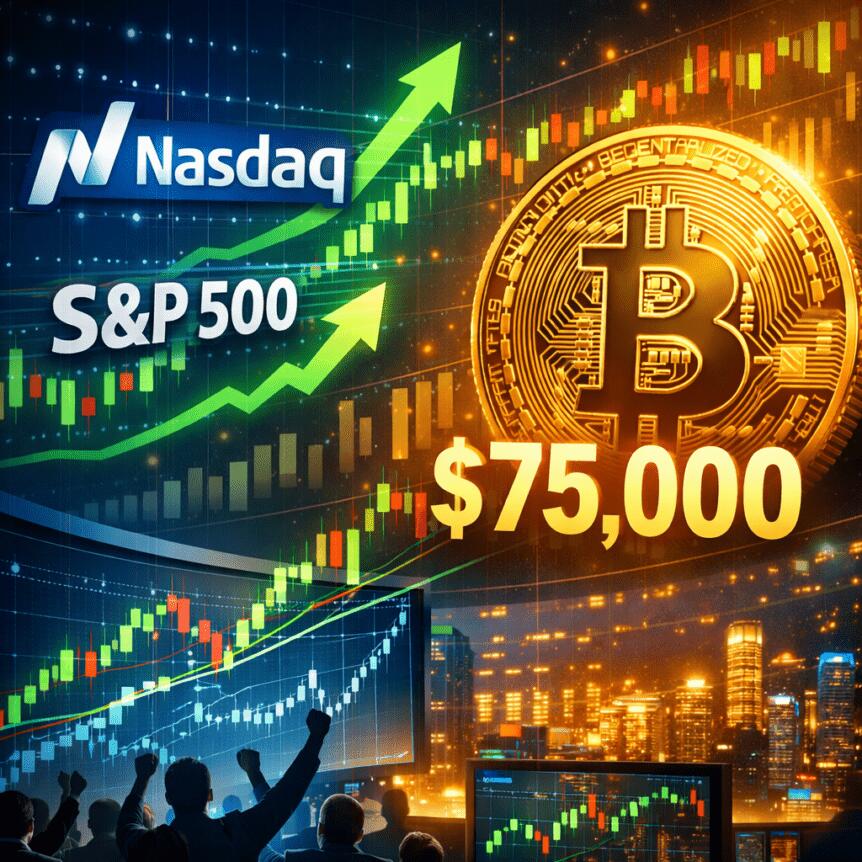
Markets extended a risk-on tilt as expectations of a broader de-escalation in the US-Iran tensions took root, lifting US equities and adding fuel to the recent momentum in cryptocurrency markets. The combined roar of stronger tech leadership and a renewed appetite for risk helped push Bitcoin toward the $75,000 zone amid a broader surge across digital assets.
Data from Yahoo Finance showed the tech-heavy Nasdaq Composite climbing to a fresh high of 24,016.02, up 1.59% on the session, while the S&P 500 advanced 0.8% to 7,022.95, marking new milestone levels for both indices. Tech shares paced the gains with roughly a 2% rise, underscoring the market’s appetite for growth-oriented names as geopolitical headlines cooled somewhat.
Bitcoin traded around $75,229 on the day, rising about 1.07% over the past 24 hours. The latest move continued a near-10% bounce over the last two weeks, signaling that the crypto space has been broadly buoyed by constructive macro signals alongside the ongoing liquidity and risk-taking environment.
On the geopolitical front, White House officials signaled a possible path to de-escalation, a narrative that contributed to the broader risk rally. President Donald Trump, speaking to Fox Business, stated that the conflict was “very close to being over” if a deal can be reached, though he cautioned that the outcome hinged on a successful agreement. The comments aligned with ongoing diplomacy efforts and added a dimension of potential stability to the market backdrop.
Amid the optimism, veteran market strategist Tom Lee of Fundstrat suggested that the next phase of the rally could lean on crypto assets alongside heavyweight technology names. In a CNBC appearance, Lee argued that although many investors remain on the sidelines awaiting clearer signals, stocks have a history of rising on adverse news, implying further upside as macro clarity improves. He highlighted Bitcoin and Ether as potential anchors for the next leg of gains, alongside the Magnificent Seven and broader software sector.
Bitcoin’s recent performance has kept it squarely in the conversation as a barometer for risk appetite. The asset’s resilience—mirroring gains in traditional equities—reflects growing confidence that the crypto market can flourish even as macro headlines evolve. Ether, DeFi projects, and other tokens have likewise benefited from this mood shift, underscoring ongoing cross-asset dynamics between conventional markets and digital assets.
Key takeaways
- U.S. equities rallied on signs of possible de-escalation with the Nasdaq at a fresh high of 24,016.02 and the S&P 500 at 7,022.95, signaling continued risk-on sentiment.
- Bitcoin touched roughly $75,229, marking a sustained multi-week rally as crypto markets ride the broader macro optimism.
- Market strategists, including Fundstrat’s Tom Lee, argue that the next rally leg could be led by crypto assets such as Bitcoin and Ether, alongside large-cap tech stocks.
- Geopolitical headlines remain a key variable; the degree of de-escalation or renewed tensions could quickly shift risk appetite and asset correlations.
- Investors should monitor whether the bullish momentum persists as talks progress, with attention on how crypto correlations evolve in a potential risk-on environment.
Macro backdrop and the tech-led rebound
The day’s market move reflects a confluence of macro optimism and sector-specific strength. The tech sector continued to outperform within the broader market rally, a pattern that has persisted through multiple risk-on episodes over the past weeks. While the headlines from Washington and Tehran dominate headlines, traders have increasingly treated the geopolitical story as a variable rather than a sole driver of price action, allowing tech and crypto assets to contribute to overall upside.
From a crypto perspective, the move in Bitcoin and the broader digital asset space appears increasingly tethered to macro risk-on dynamics rather than isolated crypto-only catalysts. The BTC price level around $75,000 acts as a psychological milestone that has historically drawn attention from traders seeking to balance risk assets against potential gains from the ongoing institutional and retail participation in the space.
Analysts note that the market’s sensitivity to geopolitical news underscores a broader narrative: crypto assets are now more deeply integrated into mainstream capital markets. This integration is shaping how investors price risk, allocate capital, and interpret the interplay between traditional equities and digital assets during times of macro uncertainty.
What comes next for traders and investors
Looking ahead, several factors will shape whether this momentum endures. First, the trajectory of the US-Iran situation remains the dominant external driver. If diplomacy advances and the conflict appears to ease further, risk-on assets—including Bitcoin and high-growth equities—could sustain their rally. Conversely, any escalation could trigger a quick risk-off repricing across both traditional markets and crypto.
Second, the reaction of central banks and policymakers to growing inflation pressures and economic resilience will influence the breadth of the rally. With technology and software names still a focal point for growth-oriented investors, any shift in rate expectations or liquidity conditions could alter the relative performance of equities and crypto assets.
Finally, the crypto market’s own catalysts—such as institutional flows, on-chain activity, regulatory developments, and the evolution of DeFi and layer-1 ecosystems—will determine whether Bitcoin and Ether can maintain leadership as the next major leg of the rally takes shape. Investors should watch for any divergence between equities and crypto, which can signal shifting risk sentiment and potential entry points for different segments of the market.
As the week unfolds, the central question for traders remains: will de-escalation translate into a broader, sustained risk-on regime, or will geopolitical tensions reassert themselves and prune the rally? The answer will likely hinge on the pace of diplomacy, the resilience of growth stocks, and the evolving appetite for crypto exposure in a changing macro landscape.
Readers should stay attentive to official statements and market data releases over the coming sessions, as the balance between risk and reward in both traditional and digital markets continues to hinge on rapidly evolving geopolitical and policy signals.
Crypto World
Bitcoin’s quantum debate splits as Adam Back pushes optional upgrades over forced freeze


The quantum computing threat has some of Bitcoin’s most vocal developers landing in wildly different places.
Blockstream’s CEO, Adam Back, told Paris Blockchain Week attendees on Wednesday that Bitcoin developers should start building optional quantum-resistant upgrades now, even though current quantum computers remain “essentially lab experiments” with progress that has been “incremental” over the 25 years he has tracked the field.
“Preparation is key. Making changes in a controlled way is far safer than reacting in a crisis,” the Blockstream CEO said.
He pointed to his company’s work testing quantum-resistant transaction signatures on Liquid, a sister network to Bitcoin. He argued that a 2021 Bitcoin upgrade called Taproot was designed flexibly enough to accept new signature methods without disrupting anyone currently using the network.
The comments echo Back’s position from last week, when he told CoinDesk that users should have roughly a decade to migrate their keys to quantum-resistant formats.
What is different now is the context around them. BIP-361, the proposal from Jameson Lopp and five other developers published Tuesday, would phase out quantum-vulnerable addresses on a fixed five-year timeline and freeze any coins that fail to migrate.
That includes roughly 1 million bitcoin attributed to Bitcoin’s pseudonymous creator, Satoshi Nakamoto, and an estimated 5.6 million coins, Loppsays, have not moved in over a decade.
Back’s framing reads as the implicit alternative to BIP-361’s forced migration. He did not mention the Lopp proposal directly, but addressed the underlying question of whether Bitcoin’s developer community can respond quickly to a sudden quantum breakthrough.
“Bugs have been identified and fixed within hours. When something becomes urgent, it focuses attention and drives consensus,” he said, suggesting Bitcoin’s rough-consensus governance could handle an emergency without pre-scheduled freezes years in advance.
The two positions represent the core disagreement shaping Bitcoin’s quantum debate.
Back is betting that developers can coordinate quickly if the threat accelerates. Lopp is betting they cannot, and that a scheduled freeze is the only way to avoid a disorderly migration under pressure.
Google and Caltech researchers said last month that functional quantum computers capable of breaking Bitcoin’s cryptography could arrive sooner than previously estimated, which is what moved the debate from theoretical to active.

A new uptrend and a flurry of buy points and breakouts have changed the tone of the stock market. The new trends have also sparked a rise in IBD’s recommended market exposure level in the last week. In this week’s How To Invest newsletter, we’ll take a look at how to build a list of stocks to watch while also…


Bitcoin has climbed nearly 10% this month, but the rally is running into resistance near $75,000. The pause is notable as U.S. stocks push to record highs.
On-chain data shows holders are selling into strength, helping explain the slowdown.
It is evident from an on-chain indicator called realized profit/loss, which tracks the total dollar value of gains or losses locked in by holders when they move their coins on-chain. The indicator compares the current price at which coins are being moved with the price at which they last moved (the assumed acquisition cost), effectively showing whether investors are selling at a profit or a loss.
Values above 1 indicate increased profit-taking, and the 30-day exponential moving average (EMA) is currently well above that threshold. The EMA is used to smooth out day-to-day noise and highlight the broader trend in realized profits.
“Profit-taking activity is rising, with the 30D EMA of the Realized Profit/Loss Ratio at 1.16, indicating investors are selling into strength. A sustained move above $78.1K will require the market to absorb this overhead supply,” the firm said in a report.
Profit-taking was particularly strong on Tuesday as Bitcoin briefly climbed toward $76,000 before quickly slipping back below $75,000. According to CryptoQuant, investors realized about $1.14 billion in profits during the move, one of the largest single-day readings this year.
The indicator, though widely tracked, has limitations, mainly that it assumes coins moving on-chain are being sold. In reality, they may simply be moving between wallets or exchanges for custody, rebalancing, or internal transfers.
That said, the latest profit-taking signal aligns with other indicators, such as the cumulative volume delta, suggesting demand is concentrated on specific exchanges while activity remains weaker elsewhere.
The CVD is a measure of who is more aggressive in the market. It shows whether the market is being driven more by buyers demanding liquidity or by sellers hitting bids.
So far, buyers have been aggressive mainly on Binance, but not so much on Coinbase or other exchanges, according to Glassnode.
Vikram Subburaj, CEO of India-based FIU-registered exchange Giottus, echoed the view, saying sentiment is improving, but conviction is still not yet fully established.
“Funding rates remain slightly negative, showing that traders are still cautious and not yet leaning aggressively long. On-chain activity has slowed down. This suggests the market is consolidating, not overheating,” he said.
Further, bitcoin options trading on Deribit continues to show a bias for put options across all time frames. It indicates lingering downside fears and demand for protection offered by puts.
Taken together, profit-taking pressure, uneven spot demand, and cautious derivatives positioning all indicate that buyers are absorbing supply but not yet overwhelming it.
Bitcoin price prediction grows increasingly complex as BTC was turned away at $76,000 for the third consecutive time, sliding back toward $74,000 while a closely watched derivatives signal flashes what could be a major setup.
Summary
- Bitcoin briefly tagged $76,000 on April 14 before reversing sharply to around $74,000, extending a two-month standoff with that resistance level.
- Funding rates on Binance’s bitcoin perpetuals have stayed negative for 46 consecutive days, a streak not seen since the FTX collapse in late 2022.
- K33 Research’s Vetle Lunde says the combination of crowded shorts and rising open interest has historically preceded sharp upside moves in BTC.
Bitcoin price prediction turns increasingly cautious as BTC logs its third rejection at $76,000 in two months. After briefly topping that level on April 14, the asset reversed and settled near $74,000, holding a 1.3% gain over 24 hours but failing to deliver any sustained breakout.
The broader context remains difficult. BTC is still roughly 41% below its October 2025 all-time high of $126,198, with the FOMC meeting on April 28, the Iran ceasefire expiry on April 22, and the CLARITY Act all sitting in the near-term window.
Funding rates on Binance’s bitcoin perpetuals have stayed negative for 46 straight days, even as open interest continues to climb. That combination means new short positions are being added into a price that refuses to collapse, exactly the setup that has historically coiled markets for a violent reversal.
K33 Research head of research Vetle Lunde flagged the dynamic in a new report, noting the 30-day average funding rate has now run negative longer than almost any comparable period in bitcoin’s history. Only March to May 2020 (63 days) and June to August 2021 (49 days) saw longer streaks. Both preceded significant recoveries.
“Comparable risk-off regimes have historically been attractive entry points for BTC,” Lunde said, as crowded short trades were forced to unwind.
What Has to Give for BTC to Break Out
Three rejections at $76,000 with no decisive close above it signal a persistent seller presence at that level. Until volume confirms a true breakout, the resistance stands. As covered, $68,000 remains the structural floor, and a break below it would expose BTC to a sharper move toward $65,000 if macro conditions deteriorate.
The near-term calendar is dense. A ceasefire extension from Iran, a dovish signal at the FOMC, or a CLARITY Act catalyst could be what forces a short squeeze. Without one, the consolidation continues.
Historical Context and What It Means
The 46-day streak now matches the duration of the defensive positioning that defined the market around the FTX crash bottom in late 2022. That regime also featured rising open interest alongside negative funding, and it resolved with a sharp upside move once sellers exhausted themselves.
The signal does not guarantee a rally. But the math is simple: the longer shorts remain crowded below $76,000 with no follow-through to the downside, the more compressed the eventual move becomes.
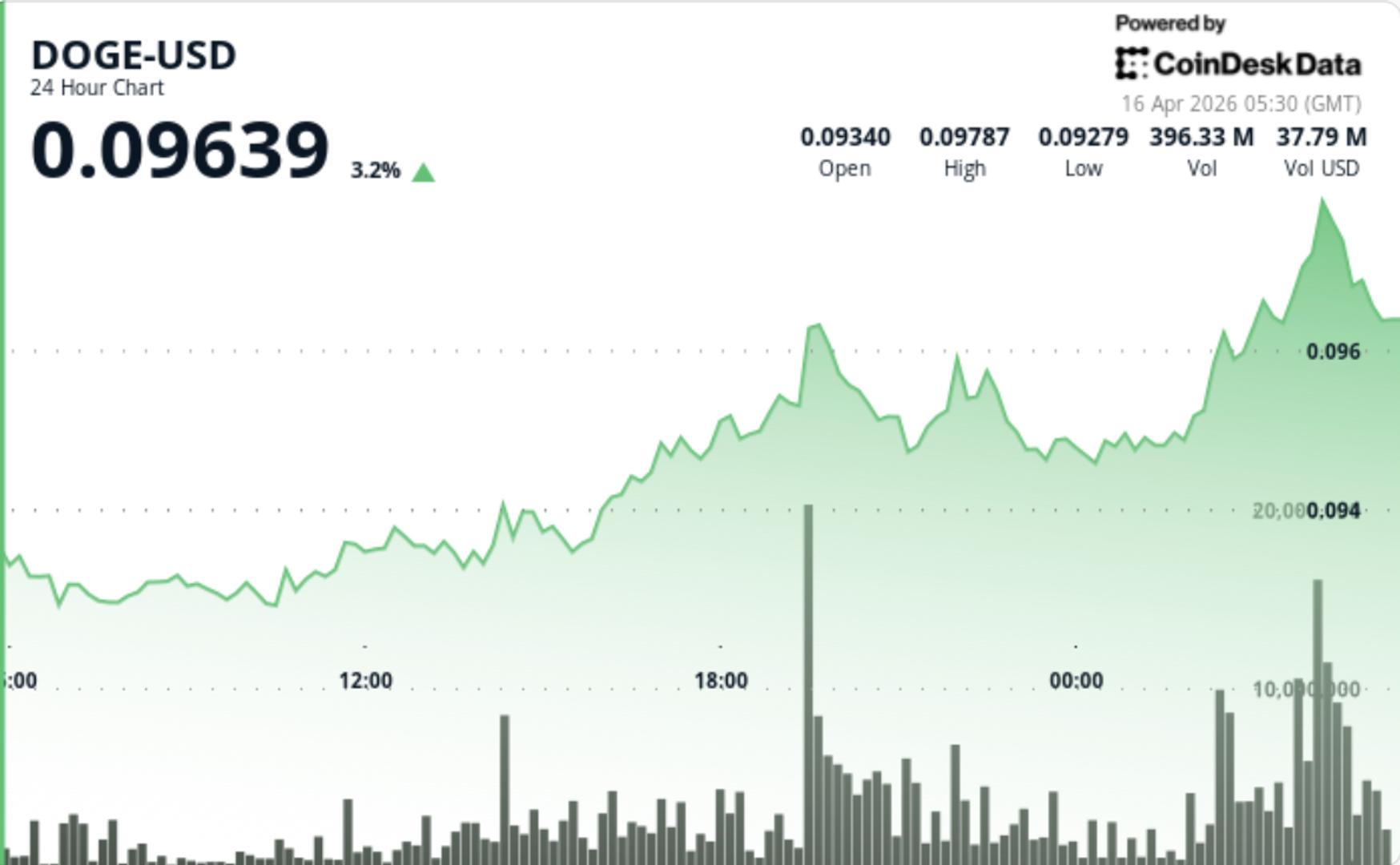
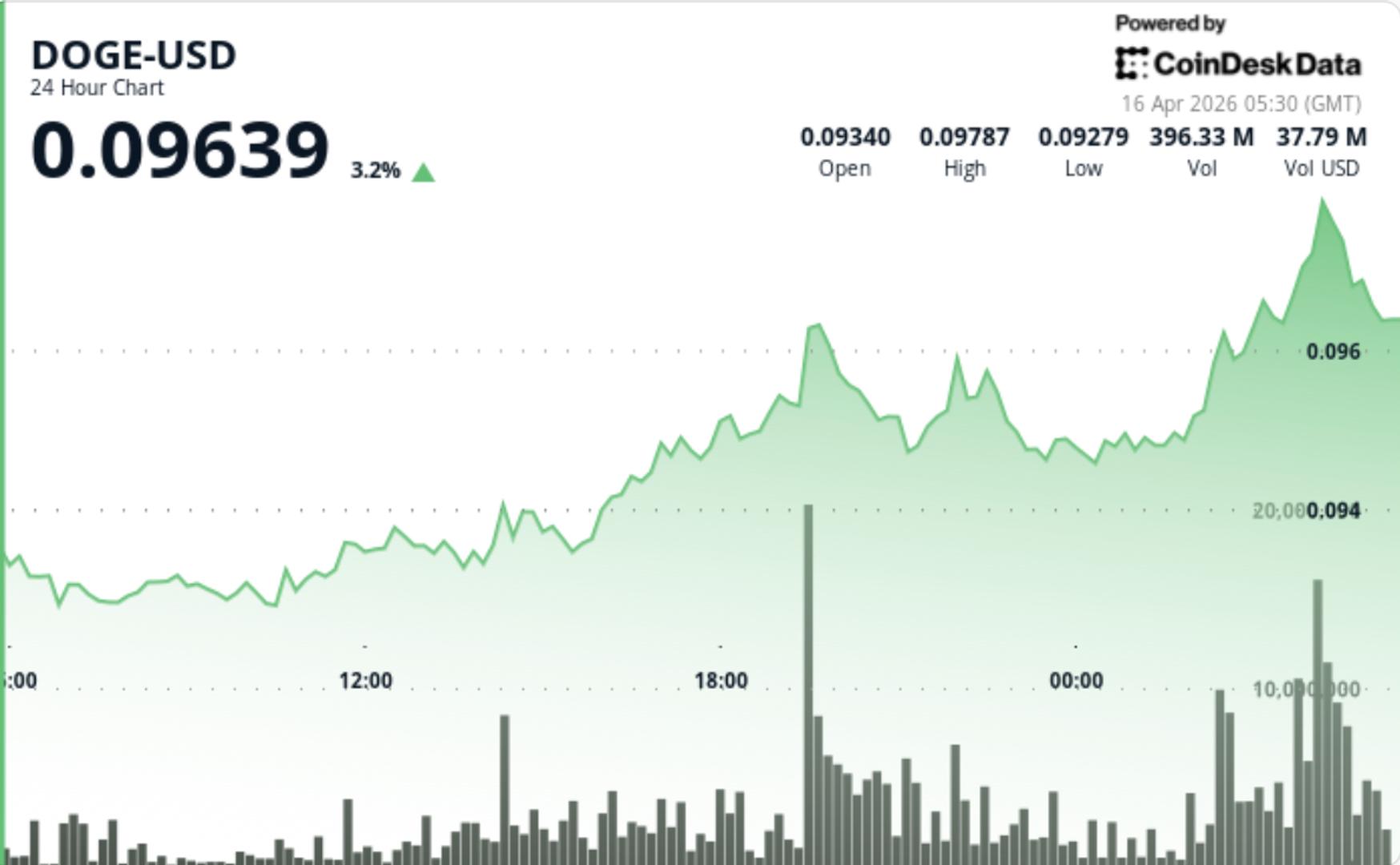
Dogecoin is pushing higher on strong volume, but the move is still being driven more by positioning than underlying demand. The rally looks technically clean, yet the bigger question is whether it can sustain without broader participation returning.
News Background
• DOGE outperformed the broader crypto market, beating both bitcoin and ether as capital rotated into higher-beta assets during the session.
• Despite the price strength, on-chain activity remains subdued, with daily active addresses trending lower. This suggests the move is being driven more by derivatives and short-term positioning than organic network demand.
Price Action Summary
• DOGE climbed from $0.093 to $0.098, breaking through the $0.095 resistance zone on strong volume.
• The move developed through a series of higher lows, showing steady accumulation rather than a single spike.
• Price accelerated into the final hour, pushing toward session highs and holding above $0.096 support.
Technical Analysis
• The breakout is backed by volume, which confirms real participation and not just thin liquidity.
• Late-session buying spikes signal institutional involvement, particularly during the push through $0.097.
• However, the broader structure remains a compression below descending resistance, not a confirmed trend reversal.
• The divergence between rising open interest and falling on-chain activity points to a market driven by leverage rather than demand.
What traders should watch
• $0.096 now acts as immediate support. Holding this level keeps the breakout intact.
• $0.104 is the key resistance. A clean break above it would shift structure more clearly bullish.
• A move back below $0.092-$0.090 would invalidate the setup and expose DOGE to a deeper pullback.
Crypto World
Tom Lee Lists 3 Reasons the Stock Market Is in a “Better Position” Than at Its Early 2026 Peak
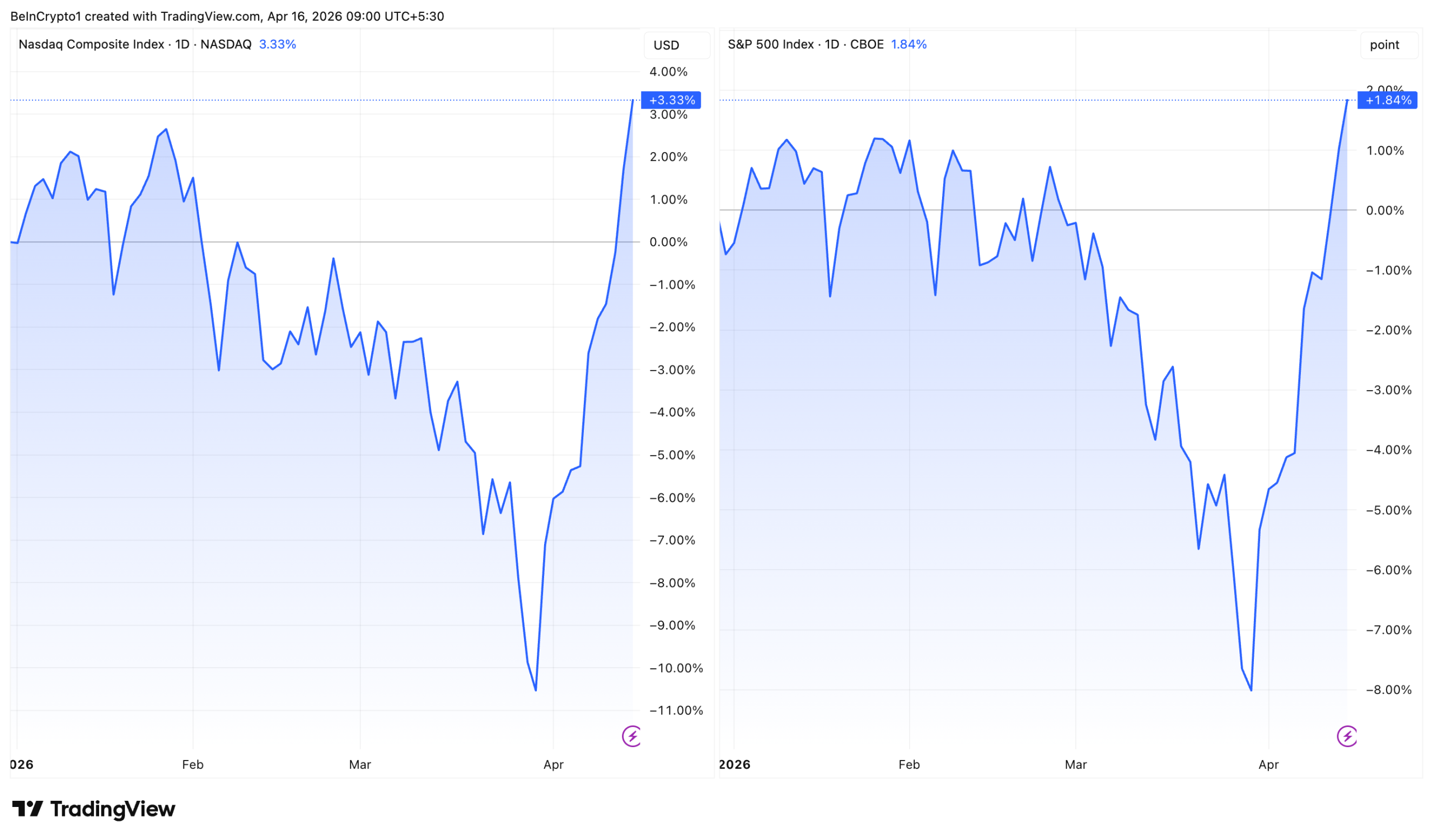
The stock market has staged a major rebound in April. The S&P 500 and Nasdaq hit fresh all-time highs this week, erasing all losses from the US-Iran conflict.
BitMine Chairman Tom Lee believes the US stock market is now in a better position than when it hit its previous all-time high earlier this year. He outlined three reasons for his stance during an appearance on CNBC’s Closing Bell.
US Stock Markets Absorb Oil Shock
According to market data, the S&P 500 closed at 7,022.95 on April 15, surpassing its previous record from January 28. The Nasdaq finished at 24,016, marking a new record high.
This recovery came after the S&P had fallen as much as 9% from its January peak amid the war’s rattling of global markets. Now, both indices have turned positive for the year after notable losses in March.
Lee pointed to the resilience as evidence that US equities can absorb oil price surges that are crippling other economies. Oil spiked above $100 per barrel after the Strait of Hormuz was blockaded.
However, prices have since retreated as markets have grown cautiously optimistic about a de-escalation in tensions between the United States and Iran.
“I know this is going to sound counter to what other the viewers might think but I think the stock market is in a better position today than earlier this year when it made its all-time high because one, we’re now seeing that the US stock market can handle a surge in oil while it hurts other countries,” Lee stated.
Follow us on X to get the latest news as it happens
His second point focused on corporate earnings. Lee said earnings have risen since the conflict began, which gives the market confidence that the war is actually stimulating the US economy rather than dragging it down.
“Stocks are holding up because the economy’s actually doing better in the face of this war. And I know it sounds counterintuitive, but part of it is the defense spending, you know, at $30 billion a month. And it may end up being, you know, $60 billion a month. That’s actually quite stimulative to the economy. This $20 rise in oil is only adding about 12 billion a month to the household burden. So on a net basis, the war is actually helping earnings right now,” Lee said during another appearance at CNBC.
Lee’s third argument centers around the consensus that surging oil prices will trigger a severe inflation shock.
“Looking back at the history of oil spikes, the impact on core is less than we thought. So I think there may be less of an inflation shock coming,” the executive argued.
He maintains a base-case S&P 500 target of 7,300 for the year, suggesting additional upside of roughly 4% from current levels.
Subscribe to our YouTube channel to watch leaders and journalists provide expert insights
The post Tom Lee Lists 3 Reasons the Stock Market Is in a “Better Position” Than at Its Early 2026 Peak appeared first on BeInCrypto.


Ripple said this week it had partnered with Kyobo Life Insurance, one of Korea’s largest life insurers, to tokenize government bond settlement using the firm’s Ripple Custody platform, per a release shared with CoinDesk.
The arrangement is Ripple’s first with a Korean insurance institution and is positioned as a step toward compressing Korea’s standard T+2 bond settlement cycle into near real-time execution.
The announcement does not specify transaction sizes, a go-live date, or which Korean government bond series will be settled on-chain. Both parties describe the arrangement as a strategic partnership that will also “assess the technical and regulatory feasibility” of broader tokenized treasury settlement, language that typically indicates a pilot framework rather than production infrastructure.
Kyobo Life will also explore stablecoin-based payment rails through Ripple, the release said, without specifying the stablecoin or timelines.
The deal adds to a growing set of institutional tokenization efforts across Asia, where regulators in Korea, Japan, Hong Kong, and Singapore have moved faster than U.S. counterparts in building frameworks for regulated digital asset activity.
Korea has licensed payment providers for remittance since 2017 and has emerged as one of the region’s more active markets for regulated crypto adoption, with local exchanges among the highest-volume in the world and recent regulatory movement toward won-denominated stablecoins.
For Ripple, the Kyobo partnership extends a push into Asian institutional infrastructure that has accelerated since the SEC dropped its lawsuit against the company in 2024.
The firm has announced custody and payment partnerships across Japan, Singapore, and the UAE over the past 18 months, positioning Ripple Custody as a settlement layer for regulated financial institutions rather than a retail-facing product.
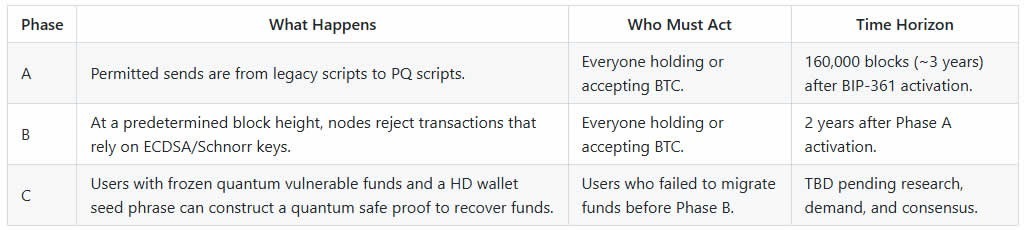
BitMEX Research has proposed an alternative to freezing quantum-vulnerable dormant Bitcoins, advocating a wait-and-see approach and a “canary fund” with a quantum bounty instead.
BitMEX Research proposed a soft fork on Thursday that would only activate a full freeze of vulnerable coins if it is “proven that a quantum computer capable of stealing Bitcoins actually exists.”
The system uses a “canary approach,” creating a special Bitcoin (BTC) address using a “Nothing-Up-My-Sleeve Number” (NUMS). This is a cryptographic proof in which the private key is unknown, but it is a valid address that could theoretically be spent by a powerful enough quantum computer.
Users can donate BTC to this address as a bounty, incentivizing any quantum-capable actor to “ring the alarm” by spending from it. Only if someone spends from this canary address does the freeze automatically activate, as it proves the quantum threat is real.
The solution provides an alternative mechanism to the BIP-361 proposal on Tuesday that suggested freezing dormant, quantum-vulnerable Bitcoin to prevent it from being stolen by bad actors in the future.
BIP-361 drew significant community pushback, with some comments calling it “authoritarian” and “confiscatory.”
Canary watch state prevents automatic freeze
BitMEX’s proposed “canary watch state” would still allow old coins to be spent, provided malicious actors using quantum computers do not attempt to steal from the “canary fund.”
Investors participating in the canary fund can use multisignatures and withdraw their BTC at any time, it explained.
There is also a safety window where quantum-vulnerable transactions could still be allowed after the five-year mark proposed in BIP-361, but with outputs locked for a period.
Related: Bitcoiners propose freezing quantum-vulnerable coins in BIP-361
“While this approach adds complexity and risk, given how controversial any coin freeze is, mitigating the impact of the freeze using this type of system may be worth consideration.”
BIP-361 is a rough idea for a contingency plan
Meanwhile, BIP-361 co-author Jameson Lopp has said his Bitcoin improvement proposal was more of a “rough idea for a contingency plan” than something ready to be proposed for activation.
“I know folks don’t like it. I don’t like it myself. I wrote it because I like the alternative even less,” he wrote on X on Wednesday.
He told Cointelegraph that it was a “rough sketch” to approach the issue of a “looming circulating supply shock” if quantum computing advances to the point that a post-quantum signature scheme achieves consensus for being added to Bitcoin.

Magazine: Nobody knows if quantum-secure cryptography will even work


Circle CEO Jeremy Allaire ruled out issuing a Korean won stablecoin for now, but called a privately led KRW token “essential” and said Circle will expand in South Korea once clear rules are in place.
Summary
- Circle CEO Jeremy Allaire says the firm has “no plans” to issue a Korean won stablecoin.
- Allaire still calls a won‑pegged stablecoin “essential” and wants to support local issuers with Circle’s tech stack.
- Circle could apply for a license and set up a Korean unit if lawmakers finalize a stablecoin framework that admits foreign players.
Circle CEO Jeremy Allaire has ruled out issuing a Korean won‑pegged stablecoin for now, even as he pushes to deepen Circle’s presence in South Korea and backs the idea of a locally led KRW token as “essential” for the country’s competitiveness. Speaking at a press conference in Seoul and in comments reported by DL News and local outlets, Allaire said he does not “believe Circle would issue a Korean won stablecoin,” but stressed that the company is closely watching pending legislation and is ready to expand “within the local compliance framework” if the rules open the door to global firms.
Allaire’s stance reflects a strategic split between issuance and infrastructure. He has argued that a won‑denominated stablecoin is needed and should be linked with Circle’s dollar‑backed USDC, but insists that the actual KRW token will likely come from a consortium of Korean banks, fintechs and digital‑asset companies rather than Circle itself. “We may find ways to partner with Korean won issuers, and to be supportive of these emerging consortiums as they look to build Korean digital currencies,” he said, positioning Circle as a technology provider rather than a direct competitor to domestic issuers.
Circle is already the issuer of USDC, one of the world’s largest dollar stablecoins, and has been stepping up its Korean outreach as the country finalizes a stablecoin framework under the broader Digital Asset Basic Act. As reported by KuCoin, both Circle and Tether have expanded local operations ahead of rules that could require overseas issuers of won‑pegged stablecoins to establish a local branch and maintain 100% reserve backing, with larger issuers designated as “significant digital payment tokens.”
Instead of a KRW coin, Allaire is offering Circle’s infrastructure as the backbone for future Korean stablecoins. He has highlighted the firm’s Arc blockchain, a network “specifically designed for stablecoin transactions,” and the Circle Payments Network, which he says can connect traditional rails to on‑chain payments and support local institutions that choose to issue their own tokens. During his Seoul visit, Allaire also signed new USDC distribution partnerships with Korean firms and told local media that “currencies without a stablecoin will be left behind in future competition,” underscoring why he sees a privately led won stablecoin as inevitable even if Circle is not the one minting it.
For Circle, the bet is that USDC and its underlying technology can become the default settlement layer linking any future KRW stablecoin to global liquidity, much as dollar tokens already serve as the main bridge for South Korean exchanges and remittance platforms. In previous crypto.news coverage of stablecoin regulation and Asia’s digital money race, that kind of infrastructure‑first strategy has been framed as a way for global issuers to stay relevant in tightly regulated markets without clashing head‑on with local monetary politics, a balance Circle is now trying to strike in Seoul in this story, this story and this story.

2026 World Snooker Championship: Former winner Luca Brecel misses out on Crucible spot

Ola Electric vs Ather Energy: Which stock looks better after a stellar surge of up to 70% in April?

Tech Rally Buoys Nasdaq, S&P 500 as Bitcoin Hits $75K


-

 Politics5 days ago
US brings back mandatory military draft registration
-
 Sports6 days ago
Man United discover Nico Schlotterbeck transfer fee as defender reaches Dortmund agreement
-

 Fashion6 days ago
Weekend Open Thread: Veronica Beard
-

 Politics6 days ago
Malcolm In The Middle OG Turned Down ‘Buckets Of Money’ To Appear In Reboot
-

 Politics4 days ago
World Cup exit makes Italy enter crisis mode
-

 Crypto World7 days ago
Canary Capital Files SEC Registration for PEPE ETF
-

 Business5 days ago
Tesla Model Y Tops China Auto Sales in March 2026 With 39,827 Registrations, Beating Cheaper EVs and Gas Cars
-

 Crypto World2 days ago
The SEC Conditionalises DeFi Platforms to Be Avoided for Broker Registration
-

 Crypto World2 days ago
SEC Signals Exemption for Crypto Interfaces From Broker Registration
-

 News Videos22 hours ago
Secure crypto trading starts with an FIU-registered
-
 NewsBeat3 days ago
Pep Guardiola and Gary Neville agree over Arsenal title problem that benefits Man City
-

 Business6 days ago
OpenAI Halts Stargate UK Data Centre Project Over Energy Costs and Copyright Row
-

 Business5 days ago
Ireland Fuel Protests Enter Day 5 as Blockades Spark Shortages and Government Prepares Support Package
-

 Crypto World5 days ago
Federal judge blocks Arizona from bringing criminal charges against Kalshi
-

 Politics6 days ago
LBC Presenter Mocks Trump Over Iran War Failures
-
 NewsBeat4 days ago
JD Vance announces ‘no agreement’ with Iran over nuclear weapons fear
-

 Crypto World2 days ago
SEC Proposes Certain Crypto Interfaces Don’t Need to Register as Brokers
-

 NewsBeat2 days ago
Trump and Pope Leo: Behind their disagreement over Iran war
-

 Tech6 days ago
A version of Windows 10 released a decade ago is now eligible for additional security patches
-

 Business5 days ago
IMF retains floor for precautionary balances at SDR 20 billion
You must be logged in to post a comment Login