

Crypto World
How To Invest In Leaders Like Broadcom Stock As Uptrend Begins


A new uptrend and a flurry of buy points and breakouts have changed the tone of the stock market. The new trends have also sparked a rise in IBD’s recommended market exposure level in the last week. In this week’s How To Invest newsletter, we’ll take a look at how to build a list of stocks to watch while also…

Legend, a mobile-first DeFi aggregator, is winding down after roughly two years of operation, joining a growing wave of crypto apps that have announced closures this year. The project aimed to simplify DeFi by letting users earn, trade, borrow and swap assets via a single non-custodial interface that bridged major protocols like Aave, Compound and Uniswap.
Co-founders, including former Compound Finance executives, argued that the right interface could bring DeFi’s powerful primitives to mainstream users. “We believed the right interface could put DeFi’s most powerful primitives in front of mainstream users,” Legend’s co-founder Jayson Hobby said this week. Yet despite initial traction, the team said the product did not scale to a sustainable level, and closing was the prudent choice for both the team and investors. Legend will keep the app online for about 60 days and go offline on July 12, marking the end of its two-year run.
Legend’s shutdown sits within a broader pattern this year as more DeFi, NFT and GameFi projects announce closures. Cointelegraph’s coverage shows that more than 20 protocols across these spaces have halted operations in 2026, underscoring the difficult market environment for project builders. For example, ZeroLend disclosed in February that it would shut down after three years due to an unsustainable business model. ZeroLend’s decision was part of a wave of exits across the sector.
Beyond these high-profile exits, the industry has seen a string of wind-downs tied to security incidents and financial pressures. Solana DeFi aggregator Step Finance said it was winding down in February after a January breach that drained a $40 million treasury wallet, and DeFi derivatives protocol Polynomial also ceased operations in February. Balancer Labs, the team behind Balancer, shuttered in March after mounting financial pressure following a $116 million hack in November. Seamless Protocol, which offered DeFi lending on Base, announced a wind-down in April, attributing the decision to volatile market conditions.
Legend describes itself as non-custodial and mobile-first, designed to consolidate DeFi activities into one place. The platform enabled users to earn, borrow and trade stablecoins and Ether by integrating with established protocols such as Aave, Compound and Uniswap. It announced its first funding round—$15 million—in February 2025, led by Andreessen Horowitz and Coinbase Ventures, signaling investor appetite for UX-focused DeFi aggregators in the wake of a bear-market lull.
Hobby emphasized a pragmatic takeaway from Legend’s experience: “Users don’t care whether product is onchain or not. They want outcomes—better yield, faster payments, more control over their money.” His broader reflection on crypto UX captured a paradox: “The product that wins isn’t the one that explains crypto better, it’s the one that hides it completely. The benefits are felt, not explained.”
The wind-down also reflects the market’s ongoing tug-of-war between user-friendly interfaces and the capital required to sustain multi-protocol aggregators during a downturn. While the exact user metrics for Legend remain private, the wider DeFi ecosystem has experienced a pronounced contraction in activity. TVL across DeFi has fallen roughly 50% since October, illustrating the scarcity of liquidity and the headwinds facing new product formats built on top of fragmented on-chain services.
Key takeaways
- Legend will shut down on July 12, after about two years in operation, selling a mobile-first, non-custodial DeFi aggregator that integrated with Aave, Compound and Uniswap.
- The project cited unsustainable scale as the reason for closure, choosing to wind down over pursuing a longer, riskier path to profitability.
- Legend’s exit is part of a broader trend in 2026 in which more than 20 DeFi, NFT and GameFi protocols have announced closures, including notable cases in the wake of security incidents and bear-market pressures.
- Industry closures extended beyond Legend: ZeroLend (February), Step Finance (February after January breach), Polynomial (February), Balancer Labs (March), and Seamless Protocol (April) illustrate a cross-section of challenges facing DeFi builders.
- The funding history—$15 million in February 2025 from Andreessen Horowitz and Coinbase Ventures—highlights the tension between ambitious UX-driven DeFi projects and the harsh economics of the current cycle.
Legend’s wind-down in the context of a shifting DeFi landscape
Legend’s mission—delivering DeFi primitives through a single, streamlined interface—was emblematic of a broader push to make decentralized finance accessible without forcing users to manage multiple wallets or interfaces. By aggregating earning, trading, borrowing and swapping across leading protocols, Legend positioned itself as a bridge between sophisticated DeFi mechanisms and mainstream users who want tangible outcomes rather than technical explanations.
However, the numbers tell a challenging story. While the exact user and TVL metrics for Legend remain private, the ecosystem-wide environment has tightened. The DeFi space has endured not only a bear-market backdrop but also several high-profile security incidents and capital constraints that have forced even well-funded projects to re-evaluate their models. The recurring theme is clear: user-friendly design alone is not enough if the underlying economics cannot sustain growth and resilience over the long term.
What this means for users and builders alike
For users, theLegend wind-down underscores the fragility of DeFi products built atop multiple protocols. It also highlights a practical reality: even well-funded UX-centric projects can struggle to achieve scalable, profitable operations in a still-tough market. As the ecosystem absorbs these exits, builders may increasingly prioritize sustainability—whether through leaner product scopes, more defensible revenue models, or closer alignment with real-world use cases that deliver measurable outcomes.
For investors and developers watching the sector, Legend’s termination signals both risk and opportunity. Risk, in that ambitious aggregators face cost pressures in bear markets; opportunity, in that the same UX lessons can inform the next generation of DeFi products—those that balance user-centric design with a clear path to monetization and resilience in volatile conditions.
As the dust settles, observers should monitor whether the wave of closures softens or accelerates, and which models survive the market cycle. The ongoing challenge is clear: create DeFi experiences that feel seamless and reliable enough for mainstream users while maintaining the capital efficiency needed to endure years of unpredictable market dynamics.
Looking ahead, readers should watch for how remaining DeFi players adjust their roadmaps—whether they narrow scope to preserve capital, pursue strategic partnerships to share costs, or explore new monetization strategies that align incentives across users, protocols and developers. The Legend story is a reminder that UX innovation alone isn’t a guarantee of longevity; sustainable scale remains the defining hurdle for DeFi in any market regime.
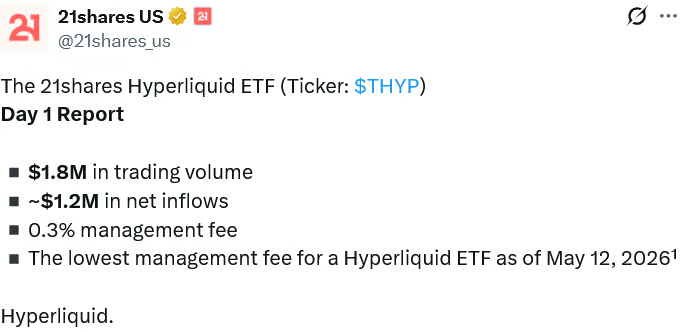
Crypto asset manager 21Shares’ first Hyperliquid exchange-traded fund in the US drew $1.2 million in net inflows and saw $1.8 million in trading volume on its Nasdaq debut.
“Very very solid day and better than your average ETF launch for sure but nothing too crazy,” Bloomberg analyst James Seyffart said as the ETF finished its first day of trading on Tuesday.
Still, the 21Shares Hyperliquid ETF (THYP) debut trading volume was a fraction of the volume compared to earlier buzzy crypto ETFs, such as the Bitwise Solana Staking ETF (BSOL), which attracted $56 million on its opening day in late October, and the Canary XRP ETF (XRPC), which brought in $58 million on its debut in November.
THYP seeks to track the spot price of the Hyperliquid (HYPE) token, which is tied to the perpetual futures platform of the same name that has facilitated over $8.4 trillion in trading volume since launching in 2023.

Source: 21Shares
21Shares’ Hyperliquid ETF adds to a growing number of altcoins that have been packaged into funds made available on Wall Street, as the Securities and Exchange Commission has loosened its grip on crypto ETFs.
In September, the SEC moved away from a case-by-case review of spot crypto ETFs in favor of “generic listing standards,” making approvals of crypto ETFs easier.
THYP was launched ahead of the Bitwise Hyperliquid Staking ETF (BHYP), which Seyffart predicted is next in line for SEC approval.
Grayscale is also awaiting the SEC’s decision on its Grayscale HYPE ETF (GHYP).
Related: Trader loses $3M as leveraged Fartcoin position unwinds on Hyperliquid
THYP carries a 0.3% management fee, far lower than the 0.67% fee proposed by Bitwise for its Hyperliquid ETF. Grayscale is yet to set a fee for its ETF.
In December, Seyffart predicted that many crypto exchange-traded products would be liquidated by the end of 2027 due to a lack of demand.
His comments came before a Bloomberg report in April that found that the average lifespan of ETFs fell from 4.66 years in 2024 to about 3.5 years in 2025.
Dozens of ETFs have already been liquidated across the first few months of 2026, though none were notable crypto ETFs.
Magazine: Solana vs Ethereum ETFs, Facebook’s influence on Bitwise: Hunter Horsley
XRP Ledger wallets holding at least 10,000 XRP have reached a record 332,230, according to Santiment data shared on X.
Summary
- XRP wallets holding at least 10,000 tokens reached a record 332,230, according to Santiment data.
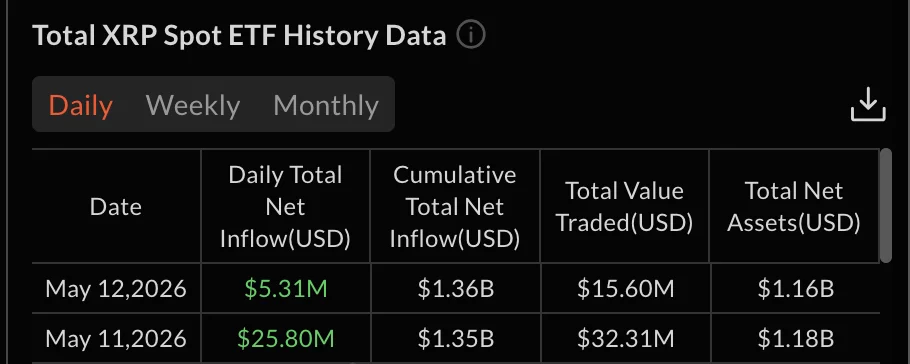
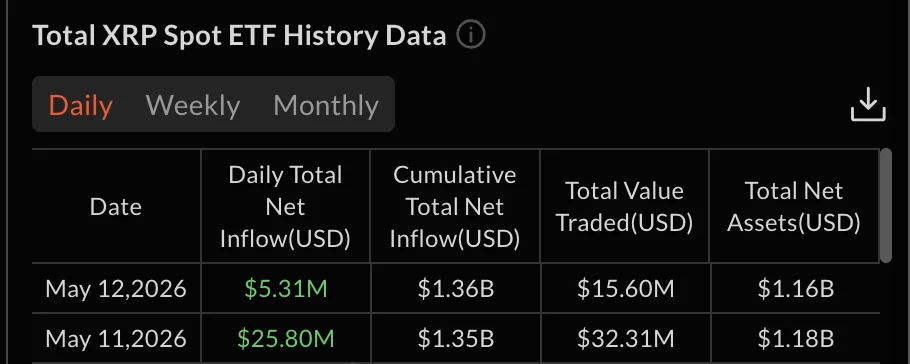
- U.S. spot XRP ETFs added $5.31 million after Monday’s stronger $25.8 million inflow day.
- EGRAG Crypto’s Elliott Wave chart shows $7, $13 and $27 as possible targets.
The analytics firm said the number has grown steadily since June 2024, even during periods of weak price action and market stress.
Santiment said larger holders kept adding XRP despite volatility. It also noted that the sharp drop of more than 4,500 such wallets between Feb. 6 and Feb. 8 had no confirmed XRP-specific cause. The firm said “there does not appear to be one confirmed XRP-specific event directly tied to it.”
XRP price stays near resistance
Ripple’s native token (XRP) traded at $1.45 on May 13, down 0.28% over 24 hours, according to crypto.news price data. The token traded between $1.42 and $1.47 during the same period, with daily volume above $2.11 billion.
The wider trend remains mixed. XRP gained 2.29% over seven days and 9.83% over the past month, but it still trades well below its July 2025 all-time high of $3.65. Crypto.news data shows the token is down about 60% from that peak.
ETF inflows add fresh market context
U.S. spot XRP ETFs recorded $25.8 million in daily net inflows on May 11, their strongest day since Jan. 5, according to SoSoValue data cited by crypto.news. Franklin Templeton’s XRPZ led with $13.6 million, followed by Bitwise’s XRP ETF with $7.6 million and Grayscale’s GXRP with $4.6 million.
Interestingly, inflows continued on May 12, with $5.31 million in daily net inflows. It also shows cumulative net inflows at $1.36 billion and total net assets at $1.16 billion. That suggests ETF demand did not stop after Monday’s stronger inflow day.
Analysts watch the $1.50 area
EGRAG Crypto points possible upside targets at $7, $13 and $27. The analyst framed the main issue as timing, asking “Has XRP already completed the macro bottom?”
The chart shows XRP holding above a long-term rising trendline while moving near short-term resistance. Crypto.news recently reported that XRP had rallied toward $1.50 after forming an inverse head-and-shoulders pattern. Analysts are watching the $1.50 level as a key breakout point for buyers.
Disclosure: This article does not represent investment advice. The content and materials featured on this page are for educational purposes only.


India has raised import duty on gold and silver to 15% from 6%. This sharply increases the cost of bullion purchases for the world’s second-largest gold consumer.
The new rate combines a 10% basic customs duty with a 5% Agriculture Infrastructure and Development Cess.
Follow us on X to get the latest news as it happens
Buying Gold in India Just Got More Expensive
The Finance Ministry’s notification reverses a July 2024 decision that cut the effective duty from 15% to 6%. BeInCrypto reported that Prime Minister Narendra Modi had appealed to citizens just days earlier to pause gold purchases for a year.
Indian jewelry stocks absorbed the warning earlier in the week. Titan, Senco Gold, and Kalyan Jewellers each posted losses on Monday after the prime minister’s televised remarks.
India ranks as the world’s second-biggest gold consumer after China. Domestic mining remains relatively low, leaving the country reliant on imports.
Monthly imports averaged 83 tonnes across January and February 2026. That compares with 2025’s monthly average of 53 tonnes, according to a World Gold Council report published last month.
“Total gold demand in Q1 rose 10% y/y to 151t, although volumes remained 9% below their long-term average. In value terms, demand nearly doubled, surging 99% y/y to a record INR2,275bn (US$25bn). Strong investment demand of 82t, led by bars, coins and ETFs, more than offset weaker jewellery volumes (66t), while industrial demand held steady (2t),” the report read.
The country’s trade deficit hit $330 billion in the fiscal year 2026, with gold and silver accounting for nearly 11% of total imports.
Modi Pairs Public Appeal With Tariff Action
Modi’s appeal comes as the Iran war continues to weigh on India’s economy. Along with cutting back on gold, he urged Indians to curb fuel consumption and bring back remote work arrangements.
India’s currency has taken a heavy hit amid the geopolitical tensions. According to Reuters, the rupee is now the worst-performing major Asian currency this year, having shed close to 5% of its value since February 28.
It slid to a fresh all-time low of 95.7375 against the dollar yesterday, breaking past the earlier trough of 95.4325.
Subscribe to our YouTube channel to watch leaders and journalists provide expert insights
The post Indians Will Pay More for Gold After Government Hikes Duty to 15% appeared first on BeInCrypto.


Switzerland has launched its first live municipal blockchain project through a biodiversity reward voucher system built on the Hedera network and backed by a Swiss franc-linked digital payment instrument.
Summary
- Switzerland’s first municipal blockchain voucher system has launched in Muri bei Bern using the Hedera network.
- Residents can earn digital biodiversity vouchers for conservation work and redeem them at local businesses for 1 Swiss franc.
- The project uses Swisscoast’s HCHF stablecoin infrastructure as Switzerland continues developing stablecoin regulations under FINMA oversight.
According to an announcement shared with crypto.news by the Municipality of Muri bei Bern, the Canton of Bern municipality partnered with Swiss Web3 engineering firm The Hashgraph Group, blockchain developer Swisscoast, and digital transformation company Apps with Love to roll out BIDI, a blockchain-based biodiversity voucher designed to reward residents for participating in conservation work.
Built on the Hedera distributed ledger network, the system issues on-chain vouchers pegged to the Swiss franc for activities such as meadow restoration, hedge maintenance, invasive plant removal, riparian repair work, and wetland conservation. Residents can redeem each BIDI voucher for 1 Swiss franc at participating local merchants and service providers inside the municipality.
Municipal authorities said the initiative replaces a paper voucher program that had operated in Muri bei Bern for the past eight years. By moving the system on-chain, the project introduces digital verification and settlement infrastructure while keeping the existing community redemption model intact.
Swisscoast developed the payment layer using its HCHF digital Swiss franc stablecoin on Hedera, while The Hashgraph Group participated as ecosystem partner. The project also received backing from The Hashgraph Association through its Enterprise Accelerator Program for enterprise and government blockchain applications.
Swiss municipalities test blockchain infrastructure
Coming after Switzerland opened consultations in late 2025 on a dedicated stablecoin licensing regime under oversight from FINMA, the BIDI rollout adds another example of Swiss institutions experimenting with tokenized payment systems tied to public services.
Under the proposed Swiss framework published last year, stablecoin issuers would be required to maintain fully backed reserves, provide redemption rights, and operate under a dedicated payment instrument license category. Officials at the time said stablecoins could support tokenized asset markets and strengthen digital settlement infrastructure within Switzerland’s financial system.
At the municipal level, BIDI now extends blockchain use beyond financial services into environmental programs and local commerce.
“We are proud to offer BIDI, an existing, trusted Swiss instrument, in collaboration with The Hashgraph Association,” Swisscoast AG President Toni Caradonna said. Caradonna added that the company previously worked with Hedera on another project called HLiquity and viewed distributed ledger technology as important for both innovation and conservation efforts.
Within the same announcement, Stefan Deiss, CEO and co-founder of The Hashgraph Group, said tokenization was expanding beyond finance into public administration tools such as vouchers and reporting systems.
“Public-sector instruments such as vouchers, claims, and reporting tokens will become verifiable, and BIDI demonstrates DLT credibility through provenance, not novelty,” Deiss said.
Apps with Love CEO Stephan Klaus said the project showed how digital products could connect ecological participation with local economic activity while improving efficiency and verification processes.
Hedera, which promotes itself as a carbon-negative network through the purchase of carbon offsets exceeding its energy use, said its governing council includes organizations focused on sustainability initiatives and environmental reporting.
Designed as a reusable framework, the BIDI infrastructure can reportedly be adapted for other Swiss municipalities within weeks rather than requiring long deployment timelines. Municipal officials and project partners said the structure could eventually expand to cities and regions outside Switzerland as European governments continue testing blockchain-based public service systems.

- XRP Ledger has reached a record 332,230 wallets holding 10,000 or more XRP.
- Growth after a sharp dip earlier in the year highlights long-term holder conviction.
- XRP price eyes a breakout above key resistance around $1.50.
The XRP cryptocurrency continues to navigate choppy waters below $1.50, largely fluctuating alongside top altcoins.
Meanwhile, the XRP Ledger has hit a new milestone, with on-chain data revealing an all-time high in terms of wallets holding at least 10,000 XRP.
But what does this wallet growth suggest? And could broader gains lift prices above the key resistance level?
XRP Ledger wallet growth: Record high for 10,000+ cohort
Whales have largely bought the dip on major altcoins in recent weeks, and on-chain metrics highlight this as the case for XRP Ledger.
Data shows a fresh streak in crypto inflows coincides with an expanding XRP holder base. In particular, addresses with 10,000 XRP or more have climbed to 332,230.
According to data Santiment shared early Wednesday, this is the highest ever recorded mark for this cohort. The expansion has persisted through 2026’s price stagnation, where XRP has so far traded below its recent peak.
Notably, accumulation has picked up after a major dip between February 6 and 8, which saw more than 4,500 wallets drop from the 10k or more XRP category.
The sharp decline as seen in the chart below aligns with the crypto market bloodbath that triggered massive liquidations on February 5.
This resilience points to accumulation by conviction-driven investors.

Analysts say such whales are less swayed by volatility and more focused on XRP’s utility and long-term outlook.
It’s a move that signals increased institutional adoption, especially as crypto funds notch a multi-week streak.
XRP price outlook
As noted, the XRP price currently consolidates below the $1.50 resistance level.
However, it’s forming a tight range amid the latest upswing for risk assets, hovering near $1.45 as of writing on May 13, 2026.
Bitcoin’s push for a retest of $82,000 means muted upward action for altcoins, and XRP could mirror the sentiment as renewed risk appetite slowly sips into the broader market. Yet buyers may have eyes on breaking higher.
In this case, the token faces immediate overhead resistance at the $1.50 level, where prior rejections have capped momentum.
From a technical perspective, XRP exhibits a bullish consolidation pattern on the daily chart, with support holding at the 50-day moving average near $1.35.
Meanwhile, the RSI indicator hovers in neutral territory, meaning further room to manoeuvre before entering overbought conditions.
A breakout could allow bulls to target $2.00 and $2.75. The main focus could be a return to above $3.00.
Conversely, a drop below $1.35 might mean a retest of $1.20 lows.
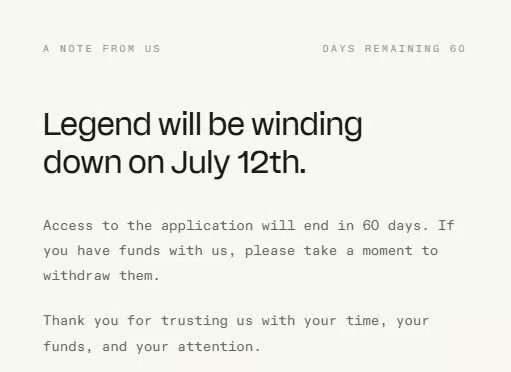
Decentralized finance mobile “superapp” Legend has announced it is winding down after about two years of operation, adding to a string of crypto apps deciding to shut down this year.
Legend was a DeFi aggregator that aimed to bring DeFi to its users rather than forcing them to sign into multiple different wallets or applications to use their crypto.
“We believed the right interface could put DeFi’s most powerful primitives in front of mainstream users.” Legend co-founder Jayson Hobby said on Tuesday.
However, despite the product finding an audience, it didn’t “grow to the scale the company needed to be sustainable long-term,” said Hobby. “Closing is the right call for our team and our investors.”
Over 20 DeFi, NFT and GameFi protocols have announced they are shutting down this year, including ZeroLend, which said in February that it planned to shut down after three years of operations, citing an unsustainable business model.

Closure notice on the Legend website. Source: Legend.xyz
Solana DeFi aggregator Step Finance said it was closing down in February after a $40 million treasury wallet breach in January, and DeFi derivatives protocol Polynomial also ceased operations in February.
Balancer Labs, the team behind the DeFi protocol Balancer, shuttered in March after mounting financial pressure following a $116 million hack in November.
Meanwhile, Seamless Protocol, a DeFi lending protocol on Base, said it was winding down in April, blaming volatile market conditions.
Users don’t care whether product is onchain or not
Legend is a non-custodial, mobile-first DeFi aggregator launched around late 2024 by former Compound Finance executives, including CEO Hobby. It is used for earning, trading, borrowing and swapping assets like stablecoins and Ether via integrations with other DeFi protocols such as Aave, Compound and Uniswap.
It aimed to bring DeFi to its users rather than forcing them to sign into multiple different wallets or applications to use their crypto.
It announced its first funding round, raising $15 million from Andreessen Horowitz and Coinbase Ventures, in February 2025.
Related: Kelp DAO eyes unpausing withdrawals after attackers’ rsETH on Arbitrum is burned
However, Hobby said that mainstream users don’t care if a product is onchain or not. “They want outcomes,” he said. “Better yield, faster payments, more control over their money.”
“The product that wins isn’t the one that explains crypto better, it’s the one that hides it completely. The benefits are felt, not explained.”
Legend has not disclosed active user counts or total value locked figures, as it operates as an aggregator, but the TVL for the broader DeFi ecosystem has tanked 50% since October in the wider crypto bear market.
The Legend app will keep running normally for the next 60 days and will go offline on July 12, said Hobby.
Magazine: DeFi’s billion-dollar secret: The insiders responsible for hacks

TLDR
- JPMorgan submitted an SEC filing for JLTXX, its second tokenized money market fund built on Ethereum
- The fund’s portfolio will consist of short-term U.S. Treasury securities and overnight repurchase agreements
- JLTXX specifically targets reserve requirements mandated by the GENIUS Act for stablecoin companies
- This filing comes just days after BlackRock submitted paperwork for a comparable offering
- Tokenized real-world assets have expanded to $32.2 billion, with Treasury-backed products accounting for $15.9 billion
JPMorgan has submitted documentation to the U.S. Securities and Exchange Commission for another tokenized money market fund operating on Ethereum’s blockchain network, marking the bank’s second venture into this space following its MONY fund debut in late 2024.
Dubbed the OnChain Liquidity-Token Money Market Fund, this new offering will operate under the JLTXX ticker symbol. The fund’s investment strategy focuses on short-duration U.S. Treasury securities, cash holdings, and overnight repurchase agreements collateralized by government-backed securities.
According to regulatory documents, the SEC approved the filing effective May 13. However, JPMorgan has yet to disclose an official launch timeline.
The blockchain technology powering this fund will be managed by Kinexys Digital Assets, JPMorgan’s proprietary blockchain division previously operating under the Onyx brand name. Ethereum serves as the sole blockchain network accessible to participants initially, though the financial institution indicated plans to incorporate additional networks down the road.
Designed for Stablecoin Issuers
JLTXX has been deliberately architected to address reserve mandates outlined in the GENIUS Act, federal legislation that establishes regulatory standards for stablecoin providers. This regulatory framework requires stablecoin enterprises to maintain reserves consisting of highly liquid instruments including U.S. Treasury securities, cash equivalents, and FDIC-insured bank deposits.
In its regulatory submission, JPMorgan explicitly stated that the fund aims to “satisfy the requirements for eligible reserve assets that stablecoin issuers are required to maintain” in accordance with the legislation. This positioning could make JLTXX an attractive solution for stablecoin organizations seeking compliant, interest-generating reserve alternatives.
The new fund represents a strategic departure from JPMorgan’s initial MONY offering, which served institutional clients managing on-chain liquidity. JLTXX adopts a more specialized approach by concentrating exclusively on the stablecoin reserve segment.
JPMorgan isn’t operating in isolation within this emerging market. Morgan Stanley introduced a comparable money market fund targeting stablecoin reserves just last month, although that particular product operates outside blockchain infrastructure. Franklin Templeton has also entered the tokenized fund arena with its BENJI product.
Wall Street Moves Into Tokenized Assets
BlackRock, commanding the position as the planet’s largest asset management firm, submitted regulatory paperwork merely days ahead of JPMorgan for a tokenized Treasury reserve instrument. The firm simultaneously filed documentation for blockchain-enabled shares of an existing $7 billion money market fund.
The tokenized real-world asset sector has experienced explosive growth exceeding 200% throughout the previous twelve months. Data from RWA.xyz indicates the market reached approximately $32.2 billion as of May 12. Tokenized U.S. Treasury instruments dominate this landscape, representing roughly $15.9 billion of the total.
Tokenization transforms conventional financial instruments into blockchain-native representations. Proponents argue this technology accelerates settlement processes, enhances operational transparency, and enables continuous trading and collateral utilization across all time zones.
JPMorgan has emerged as among the most progressive traditional banking institutions exploring this domain, previously executing tokenized collateral transactions and settlement operations for institutional participants through its Kinexys platform.
The JLTXX submission reinforces the expanding roster of Wall Street entities developing blockchain-powered solutions serving both institutional clientele and the burgeoning stablecoin ecosystem.

Despite the growing criticism toward some of its features and initiatives, Pi Network’s Core Team continues to make major announcements on the KYC front.
In the latest such statement, they outlined the total number of users who have successfully passed the verification procedures and those who have migrated to Mainnet.
Millions and Millions
The blog post on X from the team reveals that over 18.1 million users have already been approved and verified through Pi Network’s comprehensive Know-Your-Customer procedure. In addition, more than 16.7 million Pioneers have been successfully migrated to Mainnet.
The team has frequently outlined that one person is one account, which is Pi Network’s core belief. This means that each of those millions and millions of accounts represents an actual human. According to them, this is what keeps the ecosystem functioning as mining rewards remain fair, payments rely on real participants, and apps can trust actual user engagement.
However, there’s a bit of a catch. Some users continue to be stuck in “Tentative KYC” status. Although many of them keep complaining on X that it has been months and even years in some rare and extreme cases, the team said this does not mean a complete rejection.
Those Pioneers need to complete additional verification as the system is “double-checking for authenticity.” This ‘cautious’ approach helps filter out bots and fake accounts, protect real users, and maintain long-term network integrity, the post reads.
It’s worth noting that Pi Network’s Core Team recently introduced AI-powered infrastructure that will enhance processing and approval speeds and reduce bottlenecks. Nevertheless, they remain committed to human effort as such input is still a notable part of the entire verification process.
PI Returns to Top 50
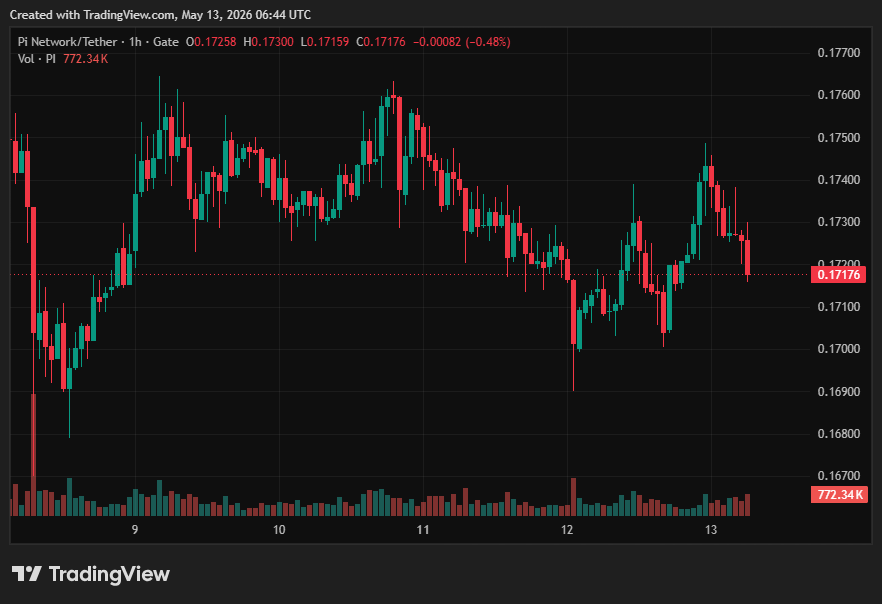
The native token’s price performance has been quite controversial, to say the least, in the past few months. Every major breakout attempt has been halted in its tracks, and the subsequent rejection has pushed the asset south to its starting point.
This resulted in a growing selling pressure that drove the token to under $0.17 yesterday, which knocked it out of the top 50 alts by market cap after a 6% weekly decline. Nevertheless, PI has rebounded slightly on a daily scale, though the weekly chart is still well in the red, and the overall market weakness has helped it return to the top 50 alts with a market cap of $1.8 billion.
The post Pi Network’s PI Attempts Comeback as Team Drops Important KYC Announcement appeared first on CryptoPotato.


DeFi mobile platform Legend has announced plans to shut down after nearly two years of operation, adding another closure to a growing list of crypto applications struggling to remain viable.
Summary
- Legend said it will shut down on July 12 after failing to reach a sustainable scale despite raising $15 million from major crypto investors.
- Former Compound Finance executives launched Legend as a mobile DeFi app designed to combine trading, borrowing, and yield services into one platform.
- Step Finance, Parsec, Balancer Labs, and ZeroLend have also announced closures this year amid hacks, weaker activity, and funding pressure.
According to a statement shared Tuesday by Legend co-founder and chief executive Jayson Hobby, the company decided to wind down operations after concluding the product had not reached a scale that could support the business over the long term.
Hobby said the app had managed to attract users, but sustaining the company and meeting investor expectations ultimately proved difficult.
Built by former Compound Finance executives in late 2024, Legend operated as a non-custodial mobile app that combined services from protocols such as Aave, Compound, and Uniswap into a single interface for trading, borrowing, swapping, and yield generation. The platform promoted itself as a simplified entry point into decentralized finance, allowing users to access DeFi products without constantly switching wallets or applications.
In comments posted alongside the shutdown notice, Hobby said the company initially believed mainstream users would engage with decentralized finance if the interface became easier to use. He argued that most users are not focused on whether a product operates on-chain, but instead care about practical outcomes such as better yields, faster payments, and more direct control over their money.
Back in February 2025, Legend raised $15 million in funding from Andreessen Horowitz and Coinbase Ventures. Even with backing from major crypto investors, the company said long-term sustainability remained out of reach.
More DeFi platforms continue to close
Across the crypto sector, several DeFi projects and infrastructure platforms have announced shutdowns this year as lower activity and weaker market conditions continue pressuring business models.
Earlier this year, Solana-based aggregator Step Finance closed its operations after a January breach compromised executive devices and drained assets later estimated at nearly $40 million. Step Finance stated in February that it had explored funding and acquisition options before concluding that continuing operations was no longer possible. The company later confirmed that its smart contracts were not exploited directly, attributing the incident to compromised endpoints and weak device security controls.
Elsewhere, decentralized finance analytics platform Parsec announced its closure in February after five years in operation. In a statement posted on X, Parsec’s leadership said user activity patterns changed substantially after the collapse of FTX, particularly in DeFi lending markets where leverage failed to recover to earlier cycle levels. The company said temporary traffic spikes tied to products such as Friend.tech dashboards and election-related prediction markets did not translate into sustained growth.
Additional closures have followed in recent months. DeFi protocol Balancer Labs shut down in March after dealing with financial strain linked to a $116 million hack disclosed in November, while Base based lending platform said in April that volatile market conditions contributed to its decision to wind down. ZeroLend also announced plans earlier this year to cease operations, citing an unsustainable business model after roughly three years in operation.
For Legend users, Hobby said the application will remain operational for another 60 days before going offline on July 12. The company has not released active user figures or total value locked data tied to the platform.

At Close of Business podcast May 13 2026

Legend shuts down its DeFi app, signaling consolidation in the sector

10 Most Perfect Adventure Movies of the Last 40 Years, Ranked

Manchester United reach agreement with Casemiro over contract clause amid transfer speculation

US brings back mandatory military draft registration

Steven Gerrard disagrees with Gary Neville over ‘shock’ Chelsea and Arsenal claim | Football

‘Cash Karegi Muniya’ Champions Women’s Financial Independence Through Music.

5 Best Ways for Students to Make Money Online in 2026 (Time, Investment & Risk Compared)

Raoul & Jack Mallers:“This Changes Everything for Bitcoin and Crypto” (New 2026 Bitcoin Prediction)
-
 Crypto World5 days ago
HarrisX Poll Found 52% of Registered Voters Support the CLARITY Act
-

 Fashion5 days ago
Weekend Open Thread: Marianne Dress
-

 Crypto World6 days ago
Upbit adds B3 Korean won pair as Base token gains Korea access
-
 NewsBeat6 days ago
NCP car park operator enters administration putting 340 UK sites at risk of closure
-

 Fashion2 days ago
Coffee Break: Travel Steam Iron
-

 Fashion2 days ago
What to Know Before Buying a Curling Wand or Curling Iron
-

 Tech3 days ago
Auto Enthusiast Carves Functional Two-Stroke Engine from Solid Metal
-

 Politics1 day ago
What to expect when you’re expecting a budget
-
 Business4 days ago
Ignore market noise, India’s long-term story intact, say D-Street bulls Ramesh Damani and Sunil Singhania
-

 Politics4 days ago
Politics Home Article | Starmer Enters The Danger Zone
-

 Crypto World7 days ago
BlackRock CEO Larry Fink Discusses a New Asset Class
-

 Tech2 days ago
GM Agrees To Pay $12.75 Million To Settle California Lawsuit Over Misuse Of Customers’ Driving Data
-
 Sports7 days ago
NBA playoff winners and losers: Austin Reaves is not loving Lakers vs. Thunder matchup, but Chet Holmgren is
-

 Entertainment6 days ago
Sarah Paulson Called Out For Met Gala ‘Hypocrisy’
-

 Entertainment6 days ago
General Hospital: Ric & Ava Bombshell – Ric’s Massive Secret Exposed!
-

 Politics6 days ago
Simon Cowell Says He Was ‘Horrible’ To Susan Boyle During BGT Audition
-

 Crypto World6 days ago
Robinhood says Wall Street is building onchain
-

 Sports6 days ago
UEFA Champions League final schedule, teams, venue, live time and streaming | Football News
-

 Entertainment7 days ago
Bold and Beautiful Early Spoilers May 11-15: Steffy Revolted & Liam Overjoyed!
-

 Entertainment6 days ago
Why David Letterman Called CBS ‘Lying Weasels’
You must be logged in to post a comment Login