
Crypto World
Bank of America: Strong Earnings Reignite Buying Interest

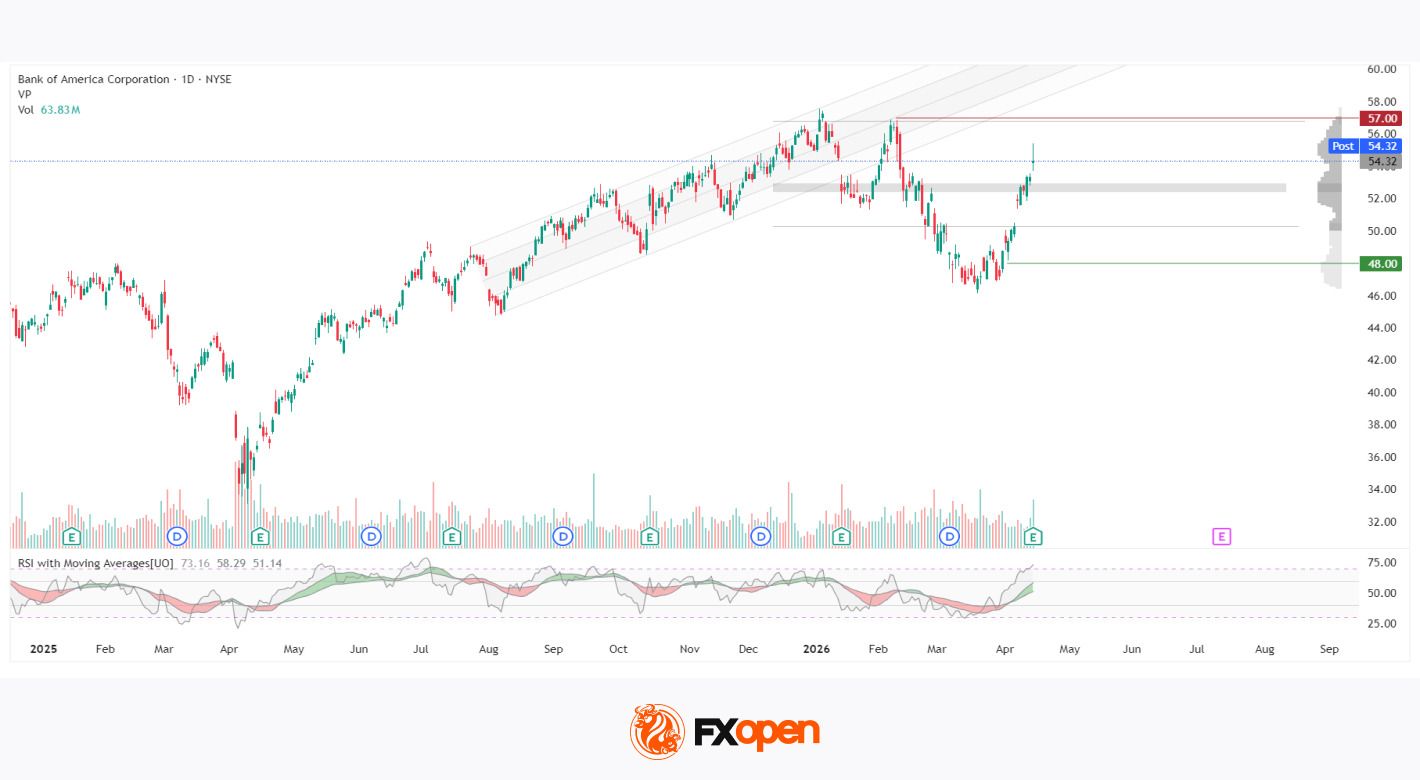
On 15 April 2026, Bank of America reported its Q1 2026 financial results, exceeding analysts’ consensus estimates for both profit and revenue. Net income came in at $8.6 billion (+17% year-on-year), while revenue reached $30.3 billion (+7% YoY). Earnings per share stood at $1.11 versus a forecast of $1.01 — the highest EPS level in nearly two decades.
Growth was primarily driven by net interest income ($15.7 billion, +9%), alongside gains in trading, investment banking fees, and asset management. Equity trading revenue rose by 30% to $2.83 billion, beating expectations by roughly $350 million.
Technical Outlook
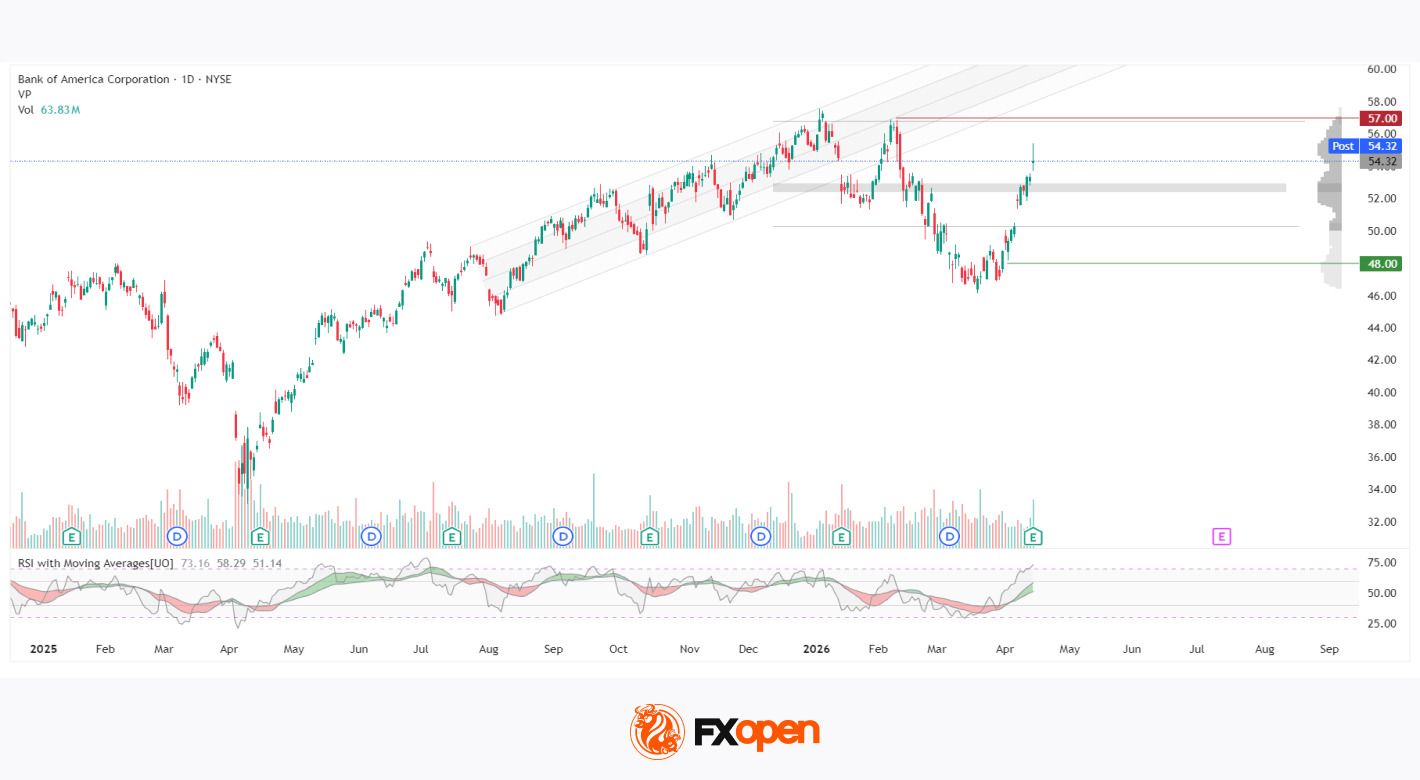
On the daily timeframe, the earnings release triggered a strong wave of buying within a high-density horizontal volume zone. The price is currently attempting to advance following a breakout above the Point of Control (POC) at 52.50–53.00, with the next target near 57.00, which aligns with the upper boundary of the volume range.
Above current levels, the market profile shows a notable decline in trading volume. If the price manages to hold above the POC, this could create conditions for an acceleration towards the 57.00 resistance level.
The RSI, currently at 73, is in overbought territory but remains above its moving averages, confirming the strength of the ongoing bullish impulse. At the same time, the rapid rise in the RSI with Moving Averages suggests increasing risks of a corrective pullback if buyers fail to maintain prices above the POC in upcoming sessions. The 48 level serves as the lower boundary of the current market structure.
Summary
The stock is attempting to break out of a horizontal volume range, supported by a strong fundamental catalyst. The 48 and 57 levels define the current structure, while further price action will likely depend on whether buyers can sustain a move above the 52.50–53.00 POC zone, which could then act as support.
Buy and sell stocks of the world’s biggest publicly-listed companies with CFDs on FXOpen’s trading platform. Open your FXOpen account now or learn more about trading share CFDs with FXOpen.
This article represents the opinion of the Companies operating under the FXOpen brand only. It is not to be construed as an offer, solicitation, or recommendation with respect to products and services provided by the Companies operating under the FXOpen brand, nor is it to be considered financial advice.


Quick Overview
- Strategy shares soared 11.8% Friday while bitcoin advanced 2.75% after Iran announced plans regarding the Strait of Hormuz
- Market expectations for a Federal Reserve rate reduction this year approached 50% following geopolitical developments
- Vanda Research identified fresh meme stock momentum fueled by social platform activity
- The company submitted a proxy filing proposing to change STRC preferred stock dividend frequency from monthly to twice monthly
- Outstanding notional value for STRC has climbed to $6.4 billion, while volatility dropped to 2.1%
Strategy delivered an impressive performance Friday. The stock surged 11.8% as bitcoin rose approximately 3% to reach $77,400, propelled by a combination of macroeconomic developments, speculative trader interest, and a corporate announcement from the firm.
The cryptocurrency’s upward movement stemmed from announcements originating in Iran. Officials there stated the Strait of Hormuz would be permitted to resume normal operations contingent upon a sustained ceasefire. This development triggered significant activity in U.S. interest rate markets, with Fed Fund futures pricing in approximately 50% probability of a rate reduction before year-end.
Decreasing interest rate projections typically provide support for riskier asset classes, and bitcoin experienced this tailwind.
Vanda Research, a firm monitoring self-directed retail trading activity, also noted emerging indicators of revived meme stock trading patterns. According to the research group, particular equities are experiencing price movements driven primarily by social media attention and speculative trading rather than underlying business fundamentals. Strategy, given its substantial bitcoin treasury, aligns perfectly with this investment theme.
MSTR has established itself as a popular vehicle for gaining bitcoin exposure through conventional stock markets. When cryptocurrency prices shift, MSTR typically responds — frequently with amplified magnitude.
Changes to STRC Dividend Structure
Separate from the market action, Strategy submitted a proxy filing Friday proposing modifications to dividend distribution for its STRC preferred stock series, commonly referred to as “Stretch.”
The proposed amendment would transition payment frequency from monthly intervals to semi-monthly disbursements. Executive Chairman Michael Saylor explained the adjustment aims to “stabilize price, dampen cyclicality, drive liquidity, and grow demand.”
The 11.5% annual dividend yield would stay constant, and Strategy’s aggregate dividend commitments would remain unaltered.
STRC has gained substantial traction among investors. The outstanding notional value expanded to $6.4 billion according to Friday’s regulatory filing.
Declining Volatility and Shareholder Vote
Price volatility for STRC has experienced a dramatic decline — dropping from 13% during the initial eight months following its introduction to merely 2.1% throughout the most recent two-month period. Strategy management anticipates that implementing semi-monthly distributions would further reduce volatility metrics.
Shareholder voting on the proposed modification concludes June 8. Should the measure receive approval, the inaugural semi-monthly distribution is scheduled for July 15.
MSTR concluded Friday’s trading session with an 11.8% gain, while bitcoin traded near $77,400.


TLDR:
- Strategy proposes semi-monthly STRC dividends to stabilize price and reduce cyclical volatility for investors.
- No changes to STRC’s annual dividend rate or total obligations are included in the proposed payment restructuring.
- STRC funds Strategy’s Bitcoin purchases without diluting MSTR common shares through new equity issuance.
- Strategy holds 780,897 BTC worth $60.7 billion as Bitcoin rallies past $78,000 at proposal time.
Strategy has proposed shifting its STRC preferred stock dividends from monthly to semi-monthly payments. The change, outlined in a preliminary proxy filing, aims to stabilize prices and reduce volatility.
No adjustment to the annual dividend rate or total obligations is planned. Shareholders will begin voting on April 28, with a formal meeting scheduled for June 8. The proposal comes as Bitcoin continues rallying past $78,000.
Proposed Change Targets Price Stability and Investor Demand
Strategy formally announced the proposal through its official account, explaining the rationale behind the shift. The company stated that the change is intended to stabilize price, dampen cyclicality, drive liquidity, and grow demand for STRC shares. Currently, STRC trades near $99 per share, making dividend frequency a relevant factor in price behavior.
More frequent payments can reduce the price swings seen between distribution cycles. With semi-monthly dividends, investors receive cash flows on a tighter schedule, which smooths out demand patterns. This structure is particularly attractive to income-focused investors who prefer consistent returns.
The proposal does not alter what shareholders earn on an annual basis. Only the payment schedule changes, from once a month to twice a month. Strategy confirmed that no changes to the annual dividend obligations or dividend rate are part of this proposal.
STRC Supports Bitcoin Strategy Without Diluting MSTR Common Shares
STRC currently plays a key role in how Strategy funds its Bitcoin acquisitions. The preferred stock raises capital through dividend payments rather than issuing new common shares.
This approach protects MSTR shareholders from excessive dilution while sustaining the company’s aggressive Bitcoin buying program.
As of the latest data, Strategy holds 780,897 BTC, valued at approximately $60.7 billion. The company’s Bitcoin strategy remains one of the most closely watched in the corporate world. Adjusting how STRC dividends are paid supports that broader financial structure.
Bitcoin’s continued rally above $78,000 adds context to the timing of this proposal. A stronger Bitcoin market raises the value of Strategy’s holdings and reinforces confidence in STRC as a financing tool. Attracting more investors to STRC at this stage aligns with the company’s long-term capital strategy.
The shareholder vote begins April 28 and runs through the June 8 meeting. If approved, the semi-monthly structure would take effect based on terms outlined in the proxy. The outcome will shape how STRC functions as a capital instrument going forward.
Crypto World
Ethereum Foundation-Backed Program Exposes 100 Nort Korea Operatives Infiltrating Crypto Firms

The Ketman Project, operating under the Ethereum Foundation’s ETH Rangers security program, has in the latest Ethereum news, identified approximately 100 North Korea Crypto IT operatives embedded inside Web3 companies using fabricated identities, the result of a six-month investigation that ended with one of the most detailed public tallies of DPRK insider infiltration in the sector’s history.
The threat model has shifted. Where North Korea’s state-level crypto operations once centered on remote exploits and exchange hacks, the 2025 pattern is coordinated workforce infiltration, operatives passing HR screenings, accessing internal repositories, and sitting inside product teams for months before detection.
- Operatives identified: ~100 DPRK IT workers found using fake identities inside Web3 firms
- Investigation duration: Six months, conducted by the Ketman Project with ETH Rangers support
- Program scope: ETH Rangers funded 17 independent researchers, recovered or froze $5.8M in exploited funds, traced 785+ vulnerabilities, handled 36 incident responses
- DPRK theft scale: $2.02 billion stolen in 2025 alone – a 51% increase from 2024 – pushing cumulative haul to $6.75 billion
- Drift Protocol hack: DPRK-linked attackers executed a $285 million exploit on April 1, 2026, the largest DeFi hack of the year
- Real-world case: Exchange Stabble issued a withdrawal alert after a DPRK IT worker infiltrated its leadership team
- Watch: Investigators are actively tracking Drift exploit proceeds; regulatory scrutiny on DeFi employment vetting expected to intensify
Discover: The best crypto to diversify your portfolio with
Ethereum News: How the ETH Rangers Crypto Investigation Actually Worked – and What 100 North Korea Operatives Really Means
ETH Rangers launched in late 2024 through a partnership between the Ethereum Foundation, Secureum, The Red Guild, and the Security Alliance (SEAL), deploying 17 independent security researchers across a six-month mandate to strengthen the Ethereum ecosystem defenses.
The Ketman Project was one of those funded efforts, and its output went well beyond the typical audit or bug bounty scope.

Identifying 100 operatives means matching fabricated identities to known DPRK tradecraft patterns: inconsistent work histories, communication behaviors suggesting time-zone masking, payment routing through specific intermediaries, and technical fingerprints that recur across unrelated applicants. That’s intelligence work, not just security research.
It requires sustained monitoring across job boards, GitHub activity, hiring pipelines, and behavioral signals inside existing teams.
The broader ETH Rangers program delivered material results beyond the Ketman work: participants recovered or froze over $5.8 million in exploited funds, traced 785+ vulnerabilities and proof-of-concept exploits, ran 36 incident responses, and delivered more than 80 security training sessions.
The ETH Rangers Program has wrapped up and the results speak for themselves: $5.8M+ recovered, 785+ vulnerabilities reported, 100+ DPRK operatives identified, and so much more.
A decentralized defence for a decentralized network.
Read the full recap
— EF Ecosystem Support Program (@EF_ESP) April 16, 2026
Open-source outputs included a DeFi incident analysis platform, a GitHub suspicious account detector, and a client-side DoS testing framework.
That GitHub tool is relevant here. Suspicious account detection is precisely the capability needed to surface DPRK-linked developers operating under cover – accounts with manufactured contribution histories, coordinated activity patterns, or anomalous repository access. The Ketman findings likely drew on exactly this tooling.
What “100 operatives” doesn’t mean: that those individuals were necessarily running exploits in real time. DPRK IT worker infiltration serves multiple functions: revenue generation for the regime through legitimate salaries, intelligence collection on protocols and codebases, and pre-positioning for future attacks.
The immediate financial damage may be limited; the long-term exposure is structural.
Discover: The best pre-launch token sales
The post Ethereum Foundation-Backed Program Exposes 100 Nort Korea Operatives Infiltrating Crypto Firms appeared first on Cryptonews.


Key Highlights
- TSMC delivered Q1 2026 revenue growth of 35.1% year over year, while net income and EPS surged 58.3%
- Netflix released Q1 2026 earnings on April 16, with focus on subscriber metrics and advertising revenue performance
- Nvidia unveiled NVIDIA Ising on April 14, positioning it as the first open AI models optimized for quantum computing applications
- ServiceNow prepares to release Q1 2026 financial results on April 22, with enterprise AI investment trends under scrutiny
- AMD’s Q1 2026 earnings announcement scheduled for May 5 keeps the company on investor radars due to data center and AI chip exposure
Investors tracking growth stocks face a packed calendar this week. A combination of quarterly earnings releases and significant product unveilings across the semiconductor, streaming, and enterprise software sectors is commanding attention.
Five companies have emerged as priority watchlist items: TSMC, Netflix, Nvidia, AMD, and ServiceNow. Each carries immediate catalysts through either financial reporting or strategic product launches.
TSMC
TSMC unveiled first-quarter 2026 financial performance on April 16. The chipmaker posted revenue growth of 35.1% compared to the prior year, accompanied by net income and diluted earnings per share increases of 58.3%.
Taiwan Semiconductor Manufacturing Company Limited, TSM
These figures underscore robust market appetite for cutting-edge semiconductors powering artificial intelligence infrastructure. As the world’s leading contract chipmaker, TSMC’s quarterly performance serves as a barometer for overall semiconductor industry momentum.
Netflix
Netflix delivered its quarterly report on the same day. Market participants scrutinized membership additions, advertising platform performance, and management’s guidance for the remainder of 2026.
The streaming giant has been aggressively developing its advertising-supported subscription option as a primary growth engine. International market penetration represents an additional strategic priority the platform has emphasized throughout the past twelve months.
Nvidia
Two days earlier, Nvidia introduced a breakthrough product named NVIDIA Ising. The technology represents what the company characterizes as the inaugural open AI model architecture specifically engineered to accelerate practical quantum computing deployment.
This launch provides Nvidia with an additional innovation narrative extending beyond its dominant position in graphics processing units. The move demonstrates strategic efforts to establish footholds in emerging computational paradigms.
Already positioned as the cornerstone supplier for AI infrastructure investments, Nvidia’s quantum computing initiative expands its long-range technological vision.
AMD
While AMD’s earnings announcement isn’t scheduled until May 5, the semiconductor manufacturer maintains prominent placement on investor watchlists. Market participants closely monitor every indicator related to AI processor demand, with AMD consistently ranking among the first stocks evaluated.
The company maintains substantial market share in data center operations and AI acceleration hardware. The investment community continues assessing whether AMD can narrow performance and revenue gaps relative to Nvidia’s market leadership.
ServiceNow
ServiceNow’s Q1 2026 financial disclosure arrives on April 22. The enterprise software provider specializes in AI-enhanced workflow automation solutions for major corporations, with the central question being whether enterprise technology budgets continue expanding.
The platform has systematically integrated artificial intelligence capabilities designed to drive higher per-customer spending. A robust quarterly performance would reinforce the thesis that enterprise software maintains its position as a sustainable growth sector.
Closing Analysis
A singular theme connects all five companies commanding attention this week: artificial intelligence. From semiconductor fabrication to model development infrastructure and workflow automation software, AI investment represents the common denominator linking each name.
TSMC’s first-quarter performance has already established an optimistic benchmark for the period, with 35.1% revenue expansion and 58.3% earnings acceleration signaling persistent demand from AI chip consumers. Netflix, ServiceNow, and AMD have yet to report, with AMD’s May 5 release completing the comprehensive picture from this cohort.

TLDR
- American Airlines firmly rejected any interest in pursuing a merger with United Airlines (UAL)
- AAL shares declined more than 1% during after-hours trading after the announcement
- United CEO Scott Kirby allegedly presented the merger concept to White House officials in February
- The potential combination would form the world’s largest airline carrier
- Transportation Secretary Sean Duffy indicated consolidation may happen but would undergo rigorous examination
American Airlines issued a forceful rebuttal on Friday regarding speculation surrounding a possible merger with United Airlines, causing its shares to decline in extended trading hours.
Shares of AAL dropped more than 1% following the company’s public statement clarifying it has no involvement in, nor appetite for, merger discussions with United.
American Airlines Group Inc., AAL
“A merger with United would harm competition and consumers,” American Airlines stated, further noting that such a transaction would contradict “our interpretation of the Administration’s stated priorities.”
The statement followed a Bloomberg news story disclosing that United’s Chief Executive Scott Kirby had proposed merging the two airlines during conversations with high-ranking administration figures, including President Trump, during February.
Kirby previously held the position of President at American Airlines before transitioning to United, where he currently leads as CEO.
The Bloomberg reporting does not confirm whether any official discussions or due diligence processes have been initiated regarding a potential transaction.
Regulatory Hurdles Would Loom Large
Combining AAL and UAL would result in the world’s largest airline by a significant margin.
The two companies collectively command over one-third of domestic U.S. air travel, competing alongside Delta (DAL) and Southwest (LUV).
Industry observers have highlighted that a transaction of this magnitude would inevitably attract substantial regulatory scrutiny and probable resistance from consumer advocacy organizations and competing airlines.
Transportation Secretary Sean Duffy discussed airline industry consolidation earlier in the month during a CNBC interview, suggesting opportunities exist for mergers in the aviation sector.
Duffy mentioned that President Trump typically favors large-scale corporate combinations.
Oversight Would Remain Critical
Nevertheless, Duffy cautioned that any significant airline consolidation would undergo evaluation regarding its effects on airfare pricing and market competition.
He indicated that merging carriers would probably be required to sell off specific operations to avoid creating excessive market dominance.
American Airlines’ public response seemed to acknowledge this regulatory environment, characterizing a United combination as incompatible with antitrust standards.
UAL shares had risen 7.12% earlier during the week, potentially driven by merger-related speculation, while AAL had increased 4.16% during that same timeframe before Friday’s after-hours decline.
As of 6:09 PM ET Friday, AAL had retreated as investors processed the airline’s unequivocal dismissal of the proposed transaction.
Crypto World
Bitcoin Miner Selling Pressure Fades as Record Q1 2026 BTC Outflows Signal a Supply Turning Point
TLDR:
- Publicly listed Bitcoin miners sold over 32,000 BTC in Q1 2026, marking the largest quarterly outflow ever recorded on-chain.
- The 2024 halving cut block rewards to 3.125 BTC while hash rate kept rising, pushing hash price below miner breakeven levels.
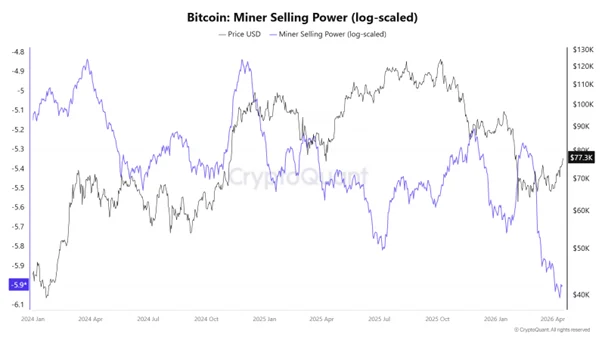
- On-chain Miner Position Index and Miner Selling Power metrics both signal that peak distribution pressure has already passed.
- ETF inflows, institutional demand, and macro conditions are now set to replace miner behavior as the key Bitcoin price drivers.
Bitcoin miner selling pressure is showing signs of easing after one of the most intense distribution periods on record. Publicly listed miners sold over 32,000 BTC in Q1 2026, marking the largest quarterly outflow ever recorded.
WuBlockchain reported the trend, attributing it to post-halving profitability compression and strategic reallocation toward AI infrastructure.
On-chain metrics confirm that miner reserves have been in steady decline, though selling power is now visibly contracting.
Record BTC Outflows Mark a Structural Shift in Mining Economics
The 2024 Bitcoin halving cut block rewards from 6.25 to 3.125 BTC, directly reducing revenue for the entire mining sector. As block rewards shrank, the global hash rate kept rising, placing further pressure on individual miner profitability.
Hash price fell below breakeven for many operators, leaving cash flow management as the only viable short-term priority. Miners across the sector prioritized cash flow, selling BTC to cover operational costs and sustain mining activities.
WuBlockchain shared that Q1 2026 marked the largest miner BTC sell-off on record, flagging the historic outflow volume.
The report noted that this was not panic selling but a deliberate operational and strategic response to market conditions.
Mining companies simultaneously redirected capital toward AI and high-performance computing, adding to the volume of BTC liquidations. This marked a notable shift in miner strategy, moving away from the accumulation approach seen in prior cycles.
On-chain data reinforced this narrative, with miner reserves declining steadily throughout the entire quarter. Net position change remained negative, confirming that miners were consistent sellers rather than accumulators over this period.
However, outflow pace began slowing toward the end of Q1, hinting that peak selling pressure had likely already passed.
Demand Drivers Take Over as Miner Selling Power Fades
Despite the sustained wave of distribution, bitcoin miner selling pressure has entered a phase of clear and measurable decline.
On-chain charts now show the Miner Position Index in negative territory while Miner Selling Power contracts sharply from peaks. This combination points to a market where forced miner supply has already been largely absorbed.
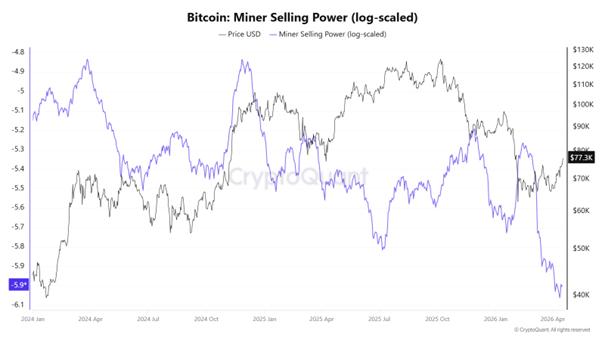
Bitcoin market cycles historically follow a progression from supply expansion into supply exhaustion, then into demand-driven price growth.
The current cycle appears to be transitioning into the exhaustion stage, where available seller volume contracts and buyer dominance increases. Miners are no longer adding to their sales volumes, even as Bitcoin prices remain in consolidation.
Going forward, ETF inflows, institutional participation, and macro conditions are expected to become the primary Bitcoin price drivers.
Bitcoin miner selling pressure is no longer the central force shaping near-term market direction. Capital flows from demand-side participants will likely set the timing and scale of the next major uptrend phase.
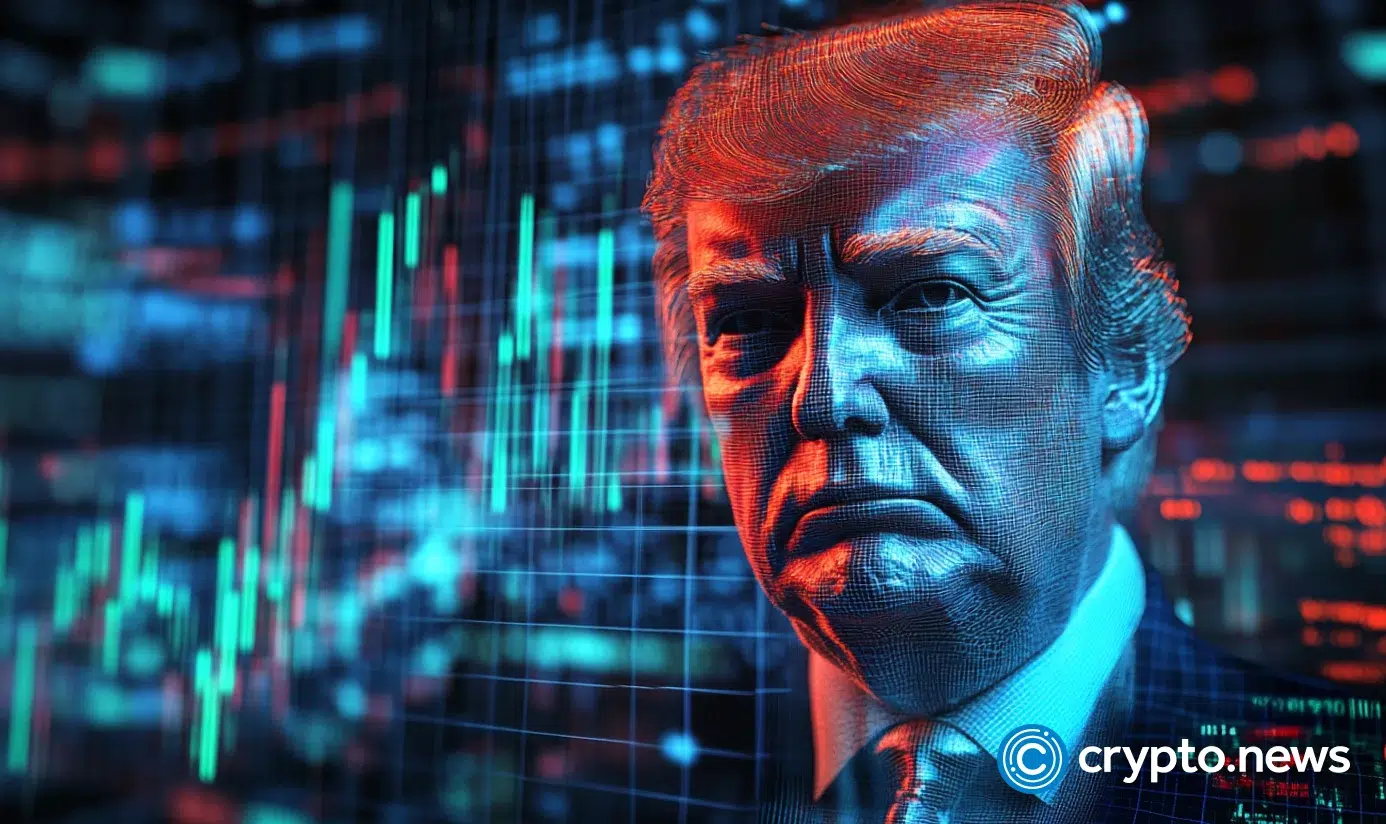
In Trump news today, President Trump criticized Pope Leo XIV as “WEAK on Crime, and terrible for Foreign Policy” in a social media post that escalated a days-long public feud with the first American pope, who has repeatedly condemned the US-Israel war on Iran and called Trump’s pre-strike threat to wipe out Iranian civilization “truly unacceptable.”
Summary
- Trump also claimed Pope Leo supports Iran having nuclear weapons, a claim the pope did not make, and said he did not want “a Pope who criticizes the President of the United States,” adding that Leo had not been on anyone’s list to become pope before the conclave.
- Pope Leo fired back from aboard a plane to Algeria: “I have no fear of the Trump administration or speaking out loudly about the message of the Gospel,” and vowed to continue calling for peace regardless of White House pressure.
- The confrontation has drawn rebukes from European leaders including Italian Prime Minister Giorgia Meloni, a Trump ally, who said it is “right and normal” for the pope to call for peace and condemned Trump’s remarks as unacceptable.
Trump news today centers on the most pronounced public rupture between a US president and a sitting pope in modern history, one that began with Leo’s Palm Sunday call for peace during the Iran war and escalated through the week into direct personal attacks exchanged via social media post and press conference.
Leo, born in Chicago and elected in April 2025, has been increasingly direct since the US and Israel launched the Iran campaign. He condemned Trump’s pre-strike rhetoric as attacks against civilian populations that violate international law, urged Americans to contact their congressional representatives, and on Palm Sunday said: “Jesus is the king of peace, who rejects war, whom no one can use to justify war.” Trump and Defense Secretary Pete Hegseth have both invoked God to frame the war in religious terms, which Leo has specifically and repeatedly rejected.
Trump’s escalation began with the Truth Social post calling Leo “WEAK on Crime, and terrible for Foreign Policy.” He told reporters he does not think Leo is doing “a very good job” and said “I’m not a fan of Pope Leo.” He also posted an AI-generated image depicting himself in a Christ-like pose with light emanating from his fingers, which drew criticism from evangelical allies and was later deleted. Trump said he thought the image depicted him as a doctor.
On Tuesday night, Trump posted again: “Will someone please tell Pope Leo that Iran has killed at least 42,000 innocent, completely unarmed, protesters in the last two months.” He claimed Leo was in favor of Iran having nuclear weapons, a position Leo had not stated. He said he did not want a pope who would “say crime is OK in our cities.”
Leo responded on his plane to Algeria, the first stop of an 11-day Africa tour: “I have no fear of the Trump administration or speaking out loudly about the message of the Gospel, which is what I believe I am here to do, what the church is here to do.”
Why the Confrontation Has Escalated
Rome-based Catholic correspondent Elise Ann Allen said Trump appeared to be “feeling threatened that Leo was emerging as a stronger figure on the international scene,” adding that Trump needs to be careful because “it’s the moderate Catholics who got him elected in both elections.”
The feud intersects with the Iran ceasefire expiry on April 22, which crypto markets are watching closely as a binary risk event. A ceasefire extension would likely maintain current risk-on conditions; a breakdown would reintroduce the geopolitical volatility that drove Bitcoin’s initial selloff from its October 2025 highs.
What It Means for the Political Environment
Pope Leo has become a significant voice in the international coalition of actors urging the US to seek a diplomatic resolution. His Africa tour framing of the conflict as part of a pattern of powerful leaders “ravaging the world” adds moral authority pressure to the administration at the same moment it is managing the Iran nuclear talks, the crypto reform legislative agenda, and the midterm electoral environment, where Catholic voters in swing districts remain a decisive constituency.


Polish cryptocurrency exchange Zondacrypto’s problems just keep mounting.
Already under fire following reports of frozen or delayed customer withdrawals, the company on Friday drew the ire of Prime Minister Donald Tusk, who told parliament the company had sponsored some politicians who opposed crypto market regulation.
Blocking the legislation by some politicians showed they were toeing Zondacrypto’s line, Tusk said before a vote to overturn President Karol Nawrocki’s veto of the law, according to a report by AP. The exchange has links to Russia and had previously provided the lawmakers with financial support, he said.
Tusk’s comments came a day after Zondacrypto CEO Przemysław Kral turned to X to defuse allegations the company was helping itself to investors’ funds to bulk up its declining reserves.
In a statement and video published on the platform, Kral said the exchange had sufficient reserves, and owns a bitcoin wallet holding about 4,500 BTC, about $330 million. There is a problem, though: It can’t access the funds because the previous owner didn’t hand over the private key and has now disappeared.
Delayed withdrawals
Kral said he revealed the wallet address to “cut short the unfounded accusations of alleged misappropriation of funds.” The key was not handed over by former CEO Sylwester Suszek in 2021, when ownership of the exchange, then known as BitBay, transferred and Kral took over. Suszek has been missing for four years.
Zondacrypto has faced reports of frozen or delayed customer withdrawals since late March, according to local news reports. Kral denied any misuse of client funds and said the exchange remains profitable. He publicized the inaccessible wallet to prove the exchange has reserves, he said.
Kral framed the situation as part of a broader campaign against the company, according to an AI translation of his Polish video. He pointed to supposed political pressure, regulatory interference and coordinated media coverage that contributed to a surge in withdrawal requests.
Analysis conducted by blockchain intelligence firm Recoveris and cited by local news outlets found that bitcoin balances in hot wallets tied to Zonda have dropped by about 99% since mid-2024. At one point, Kral threatened legal action against Polish news outlets covering the situation.
The furor revives the long-running controversy surrounding the company.
Polish investigative reporting, led by broadcaster TVN, in 2024 identified shareholder Marek K., who held a 35% stake, as a criminal sentenced to eight years in prison for complicity in a 1995 gangland murder and fined 45 million zlotys ($12.5 million) for VAT fraud.
In 2019, Poland’s Financial Supervision Authority (KNF) placed BitBay on its public warning list for unauthorized financial activities.
In January 2025, the Office of Competition and Consumer Protection, Poland’s consumer protection agency, started an investigation — still in progress — into BB Trade Estonia, Zonda’s owner, for “violating the collective interests of consumers,” Fakt reported earlier this month.
“Fundamental error”
In an April 6 post on X, Kral said reports of the reported decline in reserves stemmed from a “fundamental analytical error” by focusing solely on hot wallets. At the time, Zonda stood as a “stable, solvent, and secure entity.”
As for withdrawal delays, he said that at one point the platform processed tens of thousands of requests in a short period, far above normal levels. That, plus “the implementation of new, advanced security and transaction monitoring systems,” forced manual withdrawal verifications.
The wallet presented as proof of reserves following customer demand has seen little recent activity. Onchain data shows no outgoing movements whatsoever, and a total of 32 receiving transactions.
As for the veto vote, 191 MPs voted in favor of Nawrocki’s veto and 243 against it, 20 mandates too few to overturn the block, TVP World reported.

Key Highlights
- Palantir is competing alongside Thales and Air Space Intelligence for a major FAA contract to develop AI-driven air traffic control technology.
- Congress has allocated $12.5 billion to the FAA’s modernization effort, though the agency projects it will need approximately $20 billion in additional funding.
- The proposed AI system aims to mitigate airspace congestion and provide early warnings when aircraft proximity becomes concerning.
- On April 10, Wedbush reaffirmed its Outperform stance on PLTR with a $230 price target, dismissing concerns about competition from Anthropic.
- Among 32 Wall Street analysts tracking PLTR, 63% maintain Buy recommendations, with consensus price targets suggesting upside potential exceeding 47%.
The Federal Aviation Administration is undertaking what could become the most significant technological transformation in American aviation infrastructure, and Palantir Technologies is positioning itself as a key player.
A Bloomberg report citing an individual with knowledge of the situation reveals that the FAA has selected Palantir Technologies (PLTR), Thales (THLLY), and Air Space Intelligence as finalists competing to secure a contract for developing next-generation AI-based air traffic control capabilities.
This initiative represents a critical component of the agency’s ambitious plan to upgrade America’s outdated air traffic infrastructure, which has struggled under increasing flight demand and decades of delayed technological improvements.
Palantir Technologies Inc., PLTR
Congressional appropriations have provided the FAA with $12.5 billion toward this modernization campaign. However, agency projections indicate an additional $20 billion will be required to fully execute the transformation.
This substantial financing shortfall amplifies the urgency for implementing innovative, cost-effective technological solutions.
The AI-powered platform under development would deliver multiple operational capabilities. Among the anticipated features: identifying scheduling conflicts when excessive departure or arrival sequences create bottlenecks, enabling air traffic controllers to preemptively address congestion issues.
Additionally, the system would monitor aircraft separation distances and issue alerts when planes venture dangerously close to one another — a critical safety enhancement that could provide controllers with valuable additional response time during high-stress scenarios.
Wedbush Maintains Confidence
Wedbush Securities reiterated its Outperform rating on PLTR on April 10, holding firm at a $230 price target. The investment firm expressed continued optimism regarding Palantir despite market speculation that rivals such as Anthropic might capture market share.
Anthropic has experienced remarkable expansion — its annualized recurring revenue surged from $9 billion to $30 billion since early 2026. Nevertheless, Wedbush maintains that this competitive momentum hasn’t negatively impacted Palantir’s position.
The firm highlighted Palantir’s proprietary AIP platform and its sophisticated data integration capabilities as strategic differentiators that competitors find challenging to duplicate. Wedbush characterized the company as a frontrunner driving the AI transformation rather than a vulnerable target within it.
Analyst Sentiment Overview
Wall Street sentiment toward PLTR remains predominantly optimistic. Among the 32 analysts providing coverage, 63% have issued Buy recommendations.
Consensus price projections indicate potential appreciation exceeding 47% from present trading levels.
According to TipRanks analysis, a Moderate Buy rating emerges from recent analyst activity spanning the last three months: 14 Buy ratings, five Hold ratings, and two Sell ratings. The collective average price target from these analysts stands at $194.06.
PLTR stock was trading 2.54% higher at the time of this report.

The tough new realities for startups, Amazon’s next big strategic bets, and Allbirds’ crazy AI pivot

Award-winning Cambridgeshire pub with pretty beer garden and cosy dining pods
Trump dismisses Iran’s Hormuz move, says talks still “very good”

Why Israel is blocking foreign journalists from entering

Bitcoin: We’re Entering The Most Dangerous Phase

Alan Cumming Brands Baftas Ceremony A ‘Triggering S**tshow’

robux #bandlab #money #beats #smartphone #music #roblox #greenscreen #memes #cryptocurrency #automob

MASTERCARD AND XRP LEDGER #XRP #XRPCommunity #XRPArmy #Ripple #Crypto #Cryptocurrency #CryptoNews

The Biggest Financial Mistake Indian Families Make | CA Sreejith Kuniyil | Gobinath #shorts
-
 NewsBeat6 days ago
Pep Guardiola and Gary Neville agree over Arsenal title problem that benefits Man City
-

 Crypto World5 days ago
The SEC Conditionalises DeFi Platforms to Be Avoided for Broker Registration
-

 Politics6 days ago
World Cup exit makes Italy enter crisis mode
-

 Crypto World5 days ago
SEC Signals Exemption for Crypto Interfaces From Broker Registration
-

 Fashion21 hours ago
Weekend Open Thread: Theodora Dress
-

 News Videos3 days ago
Secure crypto trading starts with an FIU-registered
-

 Sports1 day ago
NWFL Suspends Two Players Over Post-Match Clash in Ado-Ekiti
-

 Crypto World4 days ago
SEC Proposes Certain Crypto Interfaces Don’t Need to Register as Brokers
-

 NewsBeat4 days ago
Trump and Pope Leo: Behind their disagreement over Iran war
-

 Business7 days ago
Ireland Fuel Protests Enter Day 5 as Blockades Spark Shortages and Government Prepares Support Package
-

 Politics18 hours ago
Palestine barred from entering Canada for FIFA Congress
-
 NewsBeat6 days ago
JD Vance announces ‘no agreement’ with Iran over nuclear weapons fear
-

 Crypto World16 hours ago
Russia Pushes Bill to Criminalize Unregistered Crypto Services
-
Sports6 days ago
Dexter Lawrence, Stefon Diggs, Trading for De’Von Achane
-

 Crypto World5 days ago
Trump whales load up ahead of Mar-a-Lago luncheon.
-
 Business2 days ago
Creo Medical agree sale of its manufacturing operation
-
Crypto World6 days ago
Sei Network Enters Quiet Reset Phase as On-Chain Metrics Signal a Slowdown in 2026
-

 Sports5 days ago
NWFL opens Pathway for new Clubs ahead of 2026 Season
-
Business5 days ago
Kering slides after Morgan Stanley downgrade, Gucci woes loom
-
 Entertainment5 days ago
Karol G’s ‘Ultra Raunchy’ Coachella Set Gave ‘Satanic Vibes’
You must be logged in to post a comment Login