Connect with us
DAPA Banner

Tech

12 Of The Best LEGO Car Sets Ever Made

Published

on


We may receive a commission on purchases made from links.

LEGO’s flagship car sets have quietly crept into premium-price territory over the years. But these sets are not the blocky toys you used to build in under an hour, dismantle, and lose in a bottomless pit of colored bricks under your bed. These days, many of them are serious display pieces — and they’re primarily aimed at the adult market. They often have thousands of parts, clever building techniques, and enough detail to make even non-enthusiasts stop and look twice.

Advertisement

In fact, LEGO has been courting adult builders and collectors for years. The Danish company now leans into licensed cars, realistic scale models, and complex builds that feel much closer to engineering projects than to traditional toys. As a result, there’s a full catalog of sets that look more at home on display next to motorsport memorabilia or diecast models than on a play mat.

This list assembles 12 of the best LEGO car sets ever made, although it’s a subjective list and many great kits have been left out. However, the included models justify their place through smart designs, satisfying builds, and, of course, serious shelf presence. Some are faithful recreations of real-life performance cars; others are movie icons or beloved classics. But all prove beyond doubt that LEGO car sets are among the most collectible display pieces for both gearheads and brick fans alike.

Advertisement

LEGO Icons Pickup Truck

LEGO made the decision not to brand this pickup truck after any specific manufacturer. Instead, it blended the rounded styling of several American trucks from the 1950s to create a single, composite design — something new yet instantly familiar. The LEGO Icons Pickup Truck is a dark red, broad-shouldered farm truck steeped in nostalgia, one that could easily have rolled out of rural America 70 years ago. Under the hood, the V8 engine even features a dome-shaped design, a nod to the hemispherical combustion chambers that Chrysler used in its trucks during that era.

To achieve its smooth, gap-free bodywork, the model relies heavily on SNOT (studs not on top) techniques, where bricks are oriented sideways to create a flush surface. It also comes with a full suite of seasonal accessories for different display setups, and the wooden side railings can be removed to switch it from a farm truck to a work truck — a small change that shifts the whole character of the set. It’s not just an aesthetic gem, though. The 1,677-piece set also has some functional details. The hood opens up to reveal that distinctive engine, the doors open and close, the tailgate drops, and the front wheels turn with the steering wheel.

Advertisement

LEGO Technic Ferrari Daytona SP3

In February 1967, three Ferraris crossed the finish line side by side at the 24 Hours of Daytona — taking first, second, and third place on American soil and gaining revenge against Ford after its dominant win at Le Mans the year before. To honor one of the most dramatic events in motorsport history, Ferrari built one of its fastest cars ever — the Daytona SP3. Only 599 were made, and each one is powered by the most potent naturally aspirated V12 Ferrari has built to date, producing about 829 horsepower at 9,250 rpm.

The LEGO Technic Ferrari Daytona SP3 captures much of that same presence, albeit on a smaller scale. But you’ll need to budget for a long build. At 3,778 pieces and hundreds of pages of instruction, you could spend days building it. But it is time well spent. Every stage reveals something new, like a mechanism you didn’t expect or a detail that makes you stop and appreciate the engineering. 

Advertisement

Under the rear hood, a hidden lever triggers the butterfly doors. They swing open smoothly and hold their position. Lift the rear and you can see the V12 engine. Its pistons move as you roll the finished car forward, and the removable roof, working steering, 8-speed sequential gearbox, and suspension all work exactly as they should — and there isn’t a single sticker on the model, so every detail is clean and permanent. Once built, it stretches to just over 23 inches long and fills a shelf similar to how the real thing would fill a showroom.

Advertisement

LEGO Batman 1989 Batmobile

In 1989, director Tim Burton gave the world “Batman,” complete with a wild-eyed Michael Keaton, a chaotically cackling Jack Nicholson, and a Batmobile so outrageously cinematic that it looked like it drove straight out of a fever dream. It was long, deeply black, and adorned with sweeping fins — an iteration that arguably beats any other Batmobile that has made it to the big screen. 

LEGO did it absolute justice with the 1989 Batmobile kit. Some even say the three minifigures are worth the price of the set alone. Batman comes with a one-piece cape and cowl made from a rubber-like material that mimics how it looked in the movie. The Joker’s gloriously over-the-top outfit is captured in full detail, and his manic grin is perfect. Bruce Wayne’s love interest, Vicky Vale, rounds out the trio. She’s armed with her trusty camera, and both she and the Joker are exclusive to this set.

But then there are the toys. Just where does he get those wonderful toys? Turn the exhaust and a pair of machine guns pop up from the bodywork, while a sliding canopy raises and moves forward to reveal a detailed cockpit. The finished model sits proudly on a rotating display stand, and you’ll never tire of admiring it from every angle. It’s a 3,308-piece set that stretches past 23.5 inches once built — and it looks so good that even Alfred would be impressed.

Advertisement

LEGO Icons Back to the Future Time Machine

When “Back to the Future” hit theaters in 1985, you just knew it was only a matter of time before the DeLorean DMC-12 would become one of the most iconic sci-fi vehicles in movies and TV. LEGO had to get its version right. It first had a crack at it with a smaller Ideas set in 2013, but the 2022 LEGO Icons Back to the Future Time Machine is the definitive build. The 14-inch completed model consists of 1,872 pieces, and it has remained a popular LEGO set since its release. 

Building it is a genuinely rewarding experience. Intricate sub-assemblies seem barely held together until they suddenly lock in place, and that recognizable shape slowly emerges piece by piece. The details are strong too. The flux capacitor is lit from inside by a light brick, the tires fold smoothly into flight mode, and the gull-wing doors are slowed by friction pins when they open and close.

Advertisement

With minor adjustments and some accessory swapping, you can configure the vehicle to appear as it did in each of the three movies. The Part I configuration has the lightning rod complete with grappling hook and plutonium case. The Part II configuration swaps in Mr. Fusion, hover conversion, and Marty’s hoverboard, while Part III is covered by the period-appropriate whitewall tires and the replacement time circuits Doc Brown built in the old West.

Advertisement

LEGO Technic McLaren P1

The McLaren P1 set out to be the best driver’s car in the world, and it delivered. It is widely considered one of the best McLarens of all time and part of the Holy Trinity of hypercars, alongside the Ferrari LaFerrari and Porsche 918. The LEGO Technic McLaren P1 is the fifth set in the Ultimate Car Concept Series, and at 3,893 pieces, it is a serious undertaking. The build demands your full attention from start to finish because if you get something wrong early, you’ll be taking it apart later. It might be complex, but building it is a blast.

Inside the finished model, the V8 cylinders are transparent so you can watch the pistons move. The hybrid system is also replicated, allowing you to switch between combined power, electric-only mode, and neutral, while the paddle shifters operate the gearbox. In addition, a worm gear mechanism adjusts the rear wing, and the dihedral doors open wide. At 23 inches long, the finished model will sit on your shelf as a bold statement. That said, collectors might like to know that if you keep the box sealed past its expected retirement date at the end of 2027, its value is predicted to rise significantly.

Advertisement

LEGO Technic Porsche 911 RSR

The 911 RSR is Porsche’s first-ever mid-engine 911 race car, and LEGO developed its 1,580-piece Technic replica in direct partnership with the German automaker. It’s a collaboration that shines through in the detail. The swan neck rear wing and extended rear diffuser are faithfully reproduced, and the body curves are beautifully shaped using flex tubes. Lift the rear bodywork, and you’ll see the six-cylinder boxer engine, with pistons that move as you roll the car forward. The working differential and independent suspension add further mechanical credibility, and — as a bonus — the cockpit features a track map of the Laguna Seca circuit printed onto the driver door.

For anyone looking for a display Porsche 911, this finished model is 19 inches long and will sit proudly in any room. It’s a satisfying build, too, moving through its stages in a logical sequence. There’s nothing overly complicated, and it’s even fairly easy to get through for younger builders. And for anyone new to large Technic builds, the Porsche 911 RSR is the perfect warm-up for bigger models.

Advertisement

LEGO Technic Land Rover Defender

The gearbox on the LEGO Technic Land Rover Defender alone justifies its place on this list. With four gears, high and low modes, a reverse gear, and two levers plus a selector to control it all, it was one of the most advanced gearboxes LEGO Technic had produced at the time. On top of that, the olive green and black color scheme is spot on, and the front of one of the most iconic Land Rover models ever produced is unmistakably the Defender from every angle. You can turn the mounted spare wheel on the rear to swing the tail door open, while under the bonnet, you’ll find a working winch and a six-cylinder engine complete with moving pistons.

The 2,573-piece Defender also comes loaded with all the overlanding gear you need for the wilderness. It’s a display piece that looks ready to go anywhere, but it’s the build itself that makes it one of LEGO’s most entertaining Technic projects. Starting with the rear suspension and working through the chassis, gearbox, interior, and bodywork in a logical sequence, you’ll find little surprises at every stage, like forward-folding rear seats that reveal that complex gearbox. 

Advertisement

LEGO Technic Dom’s Dodge Charger

Are there any other cars in film history that can carry the weight of Dom Toretto’s 1970 Dodge Charger R/T in “Fast & Furious”? After all, it’s one of the flashiest cars in the movie, and LEGO had to ensure it got it as authentic as possible. It’s a 1,077-piece Technic replica that was launched in collaboration with both Universal Studios and Dodge, so nailing the details was never going to be a problem.

Advertisement

The car’s V8 engine sits under an opening hood with moving pistons, while the engine carries an internal chain mechanism that adds a layer of authenticity you might not expect at this scale. The suspension is well-judged, too. It has enough give to make this muscle car genuinely satisfying to handle, while the wheelie bar deploys, allowing you to recreate one of the most iconic scenes from the first movie. Tucked into the trunk, you’ll even find the nitro bottles Dom used to win the film’s final race. 

The build is pretty accessible for most, though fitting the interior roof assembly is a bit of a challenge. Younger builders might need help at this point, but halfway through construction, the full mechanical package is operational; you can get those wheels spinning across the bedroom floor before the bodywork has even been put together. Once built, the Dodge Charger is striking — it’ll even win the hearts of those who have no interest in the movie.

Advertisement

LEGO Technic Bugatti Chiron

At a cost of around $3 million and featuring a W16 engine that produces 1,479 horsepower, the Bugatti Chiron exists in a world most of us can only dream about. However, the LEGO Technic Bugatti Chiron has a reputation as being one of the most premium building experiences the company has ever offered, compensating dreamers a little. It takes its name from Louis Chiron, the legendary driver who raced for Bugatti in the 1920s and ’30s, and the Technic version offers the signature two-tone blue in homage to the marque’s heritage. 

The build even replicates the way the real Chiron is put together, with the front and rear sections constructed independently before being joined together. It’s quite the build, too. With 3,599 pieces requiring 970 steps across 628 pages of instruction, it can take about half a day to construct. It deserves the commitment, though, and there is a nine-episode podcast that accompanies the build, taking you inside the making of the real car.

Mechanically, the speed key raises the rear wing just as it does on the real thing. But it’s the eight-speed gearbox that impresses most. It’s designed around the real car’s seven-speed system, but the eighth gear was forced in because LEGO geometry simply doesn’t allow for an odd number. Engage the paddle shifter, and you can run it through the gears and watch the pistons respond and work harder as the ratios change.

Advertisement

LEGO Icons Ghostbusters ECTO-1

The 1959 Cadillac Miller-Meteor was originally built, among other things, as a hearse or an ambulance — quite fitting, given what it would eventually be used for in the “Ghostbusters” movies. If you ain’t afraid of no ghost, this 2,352-piece LEGO Icons Ghostbusters ECTO-1 is based on the more recent sequel “Ghostbusters: Afterlife.” It’s the definitive ECTO-1 build; however, the rust stickers are pretty much the only real difference from the 1984 original, so you can simply leave them off if you want the classic ECTO-1.

Advertisement

The deeply satisfying build takes around six hours, and it’s packed with clever techniques like using ball-and-hitch connections to achieve otherwise impossible angles on the rear quarter panels and a gear-and-axle system that puts the roof instruments in motion as the rear wheels turn. Some of the parts are also genuinely creative. The front grille is assembled from 44 minifigure roller skates, which makes little sense until you see it. You’ll also find other satisfying details like a Marshmallow Man bag that goes in the front passenger seat and, of course, a proton pack. 

Advertisement

Creator Expert Ford Mustang

The 1967 Ford Mustang GT Fastback is one of the most celebrated American muscle cars ever built. And when you open the hood of this 1,471-piece Creator Expert Ford Mustang set, you’ll find a big-block 390 V8 engine hiding intricate details you might never have expected. Among them are a battery with color-coded terminals and an oil filler cap bearing the Mustang emblem. The car is finished in Acapulco Blue, and the white racing stripes are printed on for a level of detail that tells you everything you need to know about what LEGO’s priorities were when designing it.

As it’s a Creator set, mechanical details are limited beyond the rear axle adjusting to change the rake angle, the steering wheel turning the front wheels, and the doors, hood, and trunk opening and closing. Customization options are a pleasure, though. You can switch between the configurations of a standard road car and a race-prepped muscle car by adding or removing the included supercharger, side exhaust pipes, ducktail spoiler, chin spoiler, and nitrous oxide tank. The build is full of clever techniques that make you pause and think, too. For example, the doors close flush with the quarter panels thanks to half-bows built into the door jamb, and the dashboard is secured using Technic beams that line up perfectly with a slope brick.

Advertisement

LEGO Technic Lamborghini Sián FKP 37

The Lamborghini Sián FKP 37 is one of the most visually arresting supercars ever made and among the fastest Lamborghinis ever built. The LEGO Technic version captures it perfectly. The lime green color scheme with golden rims is far from subtle, but it helps the car dominate any shelf or room where it’s displayed. Every detail is printed, too. You won’t find a single sticker anywhere on this car. Even the display plate is fully printed. 

But, at 3,696 pieces, it’s one serious undertaking. The transmission is the most complex section of the build and will test your concentration, but conquering it makes the build so satisfying. The end result is a stunning 23-inch-long model that will likely stop the conversation of anyone who takes a look. 

Features-wise, the scissor doors deploy at the touch of a trigger, and the V12 pistons move. Beneath the chassis, the eight-speed gearbox sits exposed so you can watch it work as you move through the ratios. Additionally, the suspension absorbs movement in a way that feels surprisingly true to life, and the movable rear spoiler adjusts for top-speed mode. 

Advertisement

Methodology

We drew on a combination of crowd-sourced rankings from BrickRanker and sales performance where data was available. However, these were balanced against more subjective considerations — build experience, mechanical complexity, visual impact, and what can only be described as the “cool factor.” No methodology is perfect when it comes to “best of” LEGO sets, and any such list will inevitably invite disagreement from readers. So apologies in advance to those other awesome LEGO car sets that didn’t make the final cut.

Advertisement


Source link

Advertisement
Continue Reading
Click to comment

You must be logged in to post a comment Login

Leave a Reply

Tech

The tough new realities for startups, Amazon’s next big strategic bets, and Allbirds’ crazy AI pivot

Published

on

This week on the GeekWire Podcast, a week of Seattle-area startup news shows how the AI era is reshaping the regional tech scene. Q1 venture numbers reveal bigger checks going to fewer companies, with Seattle slipping behind the likes of Austin and Miami on deal volume.

And yet the distributed nature of modern startups is complicating what it even means to be a regional tech hub. (Does a mailbox in Pioneer Square really count as a Seattle headquarters?)

Founders and CEOs are navigating this in different ways. Those with enough cash are eyeing strategic acquisitions, including opportunities to absorb startups caught up in the AI shakeout.

Many are also rethinking how they hire and expand. More than a third of the GeekWire 200, our ranking of top Pacific Northwest startups, saw year-over-year employment declines, as agents boost individual productivity and reshape the workforce.

Plus: Andy Jassy’s shareholder letter signals Amazon is making bets again, in areas including chips and robotics. Driving home the point, the tech giant’s Amazon’s ambitious Globalstar acquisition effectively means it’s inheriting Apple’s satellite roadmap.

Advertisement

Of course, we have to talk about Allbirds. The sustainable shoe brand, which once challenged Amazon over knock-off sneakers, pivoted to AI infrastructure and saw its stock soar.

And in our final segment, a trivia challenge on the No. 1 companies in GeekWire 200 history.

With GeekWire co-founders John Cook and Todd Bishop. Edited by Curt Milton. 

Subscribe to GeekWire in Apple Podcasts, Spotify, or wherever you listen.

Advertisement

Source link

Continue Reading

Tech

Are we ready to place lab experiments in non-human hands?

Published

on

Stephen D Turner of the University of Virginia explores the importance of governance and oversight around AI in the design and execution of lab experiments.

Artificial intelligence is rapidly learning to autonomously design and run biological experiments, but the systems intended to govern those capabilities are struggling to keep pace.

AI company OpenAI and biotech company Ginkgo Bioworks announced in February 2026 that OpenAI’s flagship model GPT-5 had autonomously designed and run 36,000 biological experiments. It did this through a robotic cloud laboratory, a facility where automated equipment controlled remotely by computers carries out experiments. The AI model proposed study designs, and robots carried them out and fed the data back to the model for the next round. Humans set the goal, and the machines did much of the work in the lab, cutting the cost of producing a desired protein by 40pc.

This is programmable biology: designing biological components on a computer and building them in the physical world, with AI closing the loop.

Advertisement

For decades, biology mostly moved from observation toward understanding. Scientists sequenced the genomes of organisms to catalogue all of their DNA, learning how genes encode the proteins that carry out life’s functions. The invention of tools like CRISPR then allowed scientists to edit that DNA for specific purposes, such as disabling a gene linked to disease. AI is now accelerating a third phase, where computers can both design biological systems and rapidly test them.

The process looks less like traditional benchwork in a lab and more like engineering: design, build, test, learn and repeat. Where a traditional experiment might test a single hypothesis, AI-driven programmable biology explores thousands of design variations in parallel, iterating the way an engineer refines a prototype.

As a data scientist who studies genomics and biosecurity, I research how AI is reshaping biological research and what safeguards that demands. Current safety measures and regulations have not kept pace with these capabilities, and the gap between what AI can do in biology and what governance systems are prepared to handle is growing.

What AI makes possible

The clearest example of how researchers are using AI to automate research is AI-accelerated protein design.

Advertisement

Proteins are the molecular machines that carry out most functions in living cells. Designing new ones has traditionally required years of trial and error because even small changes to a protein’s sequence can alter its shape and function in unpredictable ways.

Protein language models, which are AI systems trained on millions of natural protein sequences, can quickly predict how mutations will change a protein’s behavior or design new proteins. These AI models are designing potential new drugs and speeding vaccine development.

Paired with automated labs, these models create tight loops of experimentation and revision, testing thousands of variations in days rather than the months or years a human team would need.

Faster protein engineering could mean faster responses to emerging infections and cheaper drugs.

Advertisement

The dual-use problem

Researchers have raised concerns that these same AI tools could be misused, a challenge known as the dual-use problem: technologies developed for beneficial purposes can also be repurposed to cause harm.

For example, researchers have found that AI models integrated with automated labs can optimise how well a virus spreads, even without specialised training. Scientists have developed a risk-scoring tool to evaluate how AI could modify a virus’s capabilities, such as altering which species it infects or helping it evade the immune system.

Current AI models are able to walk users through the technical steps of recovering live viruses from synthetic DNA. Researchers have determined that AI could lower barriers at multiple stages in the process of developing a bioweapon, and that current oversight does not adequately address this risk.

Risk from bio AI

Experienced scientists are already using AI to plan and design biological experiments. The question of whether AI can help people with limited biology training carry out dangerous lab work is the subject of active research.

Advertisement

Two recent studies have reached different conclusions.

A study by AI company Scale AI and biosecurity nonprofit SecureBio found that when people with limited biology experience were given access to large language models, which is the type of AI behind tools like ChatGPT, they were able to complete biosecurity-related tasks such as troubleshooting complex virology lab protocols with four times greater accuracy. In some areas, these novices outperformed trained experts. Around 90pc of these novices reported little difficulty getting the models to provide risky biological information, such as detailed instructions on working with dangerous pathogens, despite built-in safety filters meant to block such outputs.

In contrast, a study led by Active Site, a research nonprofit that studies the use of AI in synthetic biology, found that AI help did not lead to significant differences in the ability of novices to complete the complex workflow to produce a virus in a biosafety laboratory. However, the AI-assisted group succeeded more often on most tasks and finished some steps faster, most notably on growing cells in the lab.

Hands-on work in the lab has traditionally been a bottleneck to translating designs into results. Even a brilliant study plan still depends on skilled human hands to carry out. That may not last, as cloud laboratories and robotic automation become cheaper and more accessible, allowing researchers to send AI-generated experimental designs to remote facilities for execution.

Advertisement

Responding to AI-driven biological risks

AI systems are now able to run experiments autonomously and at scale, but existing regulations were not designed for this. Rules governing biological research do not account for AI-driven automation, and rules governing AI do not specifically address its use in biology.

In the US, the Biden administration had issued a 2023 executive order on AI security that included biosecurity provisions, but the Trump administration revoked it. Screening the synthetic DNA that commercial providers make to ensure it cannot be misused to make pathogens or toxins remains mostly voluntary. A bipartisan bill introduced in 2026 to mandate DNA screening does not yet address AI-designed sequences that evade current detection methods.

The 1975 Biological Weapons Convention, an international treaty prohibiting the production and use of bioweapons, contains no provisions for AI. The UK AI Security Institute and the US National Security Commission on Emerging Biotechnology have both called for coordinated government action.

The safety evaluations that AI labs run before releasing new models are often opaque and unsuited to capture real-world risk. Researchers have estimated that even modest improvements in an AI model’s ability to help plan pathogen-related experiments could translate to thousands of additional deaths from bioterrorism per year. Timelines for when these capabilities cross critical thresholds remain unclear.

Advertisement

The Nuclear Threat Initiative has proposed a managed access framework for biological AI tools, matching who can use a given tool to the risk level of the model rather than blanket restrictions. The RAND Center on AI, Security and Technology outlined a set of actions researchers could take to improve biosecurity, including improved DNA synthesis screening and model evaluations before release. Researchers have also argued that biological data itself needs governance, especially genomic data that could train models with dangerous capabilities.

Some AI companies have started voluntarily imposing their own safety measures. Anthropic activated its highest safety tier when it released its most advanced model in mid-2025. At the same moment, OpenAI updated its Preparedness Framework, revising the thresholds for how much biological risk a model can pose before additional safeguards are required. But these are voluntary, company-specific steps. Anthropic’s CEO, Dario Amodei, wrote that the pace of AI development may soon outrun any single company’s ability to assess the risk of a given model.

When used in a well-controlled setting, AI can help scientists quickly reach their research goals. What happens when the same capabilities operate outside those controls is a question that policy has not yet answered. Overreact, and talent and investment may move elsewhere while the technology continues advancing anyway. Underreact, and the risks of that technology could be exploited to cause real harm.

The Conversation

Stephen D Turner

Advertisement

Stephen D Turner is an associate professor of data science and an assistant dean for research at the University of Virginia School of Data Science. He has worked on biosecurity applications in national security and writes about AI, biosecurity and other topics.

Don’t miss out on the knowledge you need to succeed. Sign up for the Daily Brief, Silicon Republic’s digest of need-to-know sci-tech news.

Source link

Advertisement
Continue Reading

Tech

How to Clean Your Vinyl Records (2026): Vacuum, Ultrasonic, Solution, Brush

Published

on

With the ultrasonic cleaning machine, you don’t need to vacuum out the grime for each record you clean, because the machine shakes all the gunk off for you. It collects at the bottom of the basin, so you just need to make sure it all gets dumped out when you empty the liquid from the machine between uses. Once your records have taken their bath in the diluted cleaning solution mixture, place them on the drying rack.

If a record (or, more realistically, stack of records) is especially dirty, I clean them two times with either method in progressively cleaner fluid. In my ultrasonic machine, I do all my records once, then change the fluid and do them again. Be sure to have a clean microfiber towel ($5) handy so that the record is fully dry before returning it to its packaging.

Some people prefer to also rinse the clean records in distilled water at the end of the cleaning cycle to remove any remaining solution. If you do that, just dry them the same way before putting them away.

Scratches or Warps?

Advertisement

These cleaning methods can’t repair scratches or effectively fix warped records. The only way to prevent those things from inflicting your collection is store your records properly: in an upright, clean environment. Records stacked on top of one another or stored sitting diagonally can warp from their own weight. Don’t store your records somewhere especially hot or cold, or anywhere where temperature varies a lot, as it can affect the vinyl’s longevity.

When buying used records at a store, it’s important to know the difference between a dirty disc and a scratched or warped one. I recommend using a bright handheld flashlight or the light on your smartphone to inspect any used records you’re interested in buying for scratches. Also look at them from different angles to make sure they’re nice and flat. If a used record is sealed inside a polyvinyl bag with tape, a store clerk will almost always cut the tape so you can inspect the disc.

How Often Should I Clean?

Whenever your records are dirty! For most people, a single thorough cleaning of all their records followed by cleaning every 20 or 30 plays is a good start. I clean mine once a year. I make a pile of LPs that have been played a lot, plus newer records that I’ve never cleaned. (New records can have oils used to separate them from the press still on the surface, and thus get gunky faster than previously cleaned records.) From there, it’s Netflix and clean.

Advertisement

I’m not such a clean freak that I wear white gloves when I handle my vinyl, but you should always touch the record’s playing surface as little as possible. Grip the disc from the edges or from the edge and the label rather than touching the grooves.

Before playing a record, clean the needle (I like gel cleaners like this $16 option), and make sure you’ve brushed your record so the needle isn’t grinding dust into the surface (the source of many pops when listening). Properly maintained, your records should last many decades.

Source link

Advertisement
Continue Reading

Tech

Irish-founded Ulysses raises $46m in rounds featuring A16Z

Published

on

The San Francisco-based start-up is building networked autonomous vehicles that operate above and below the surface of the ocean, ‘Earth’s last frontier’.

Ulysses, founded in Dublin in 2023 by Akhil Voorakkara, Will O’Brien, Jamie Wedderburn and Colm O’Brien – who say they are united by a shared belief “that the ocean is the planet’s most strategic and underserved domain” – will use newly acquired funding to build “the Ocean company”.

A $38m Series A round was led by Andreesen Horowitz (A16Z), while the San Francisco-based Ulysses also announced an $8m seed round led by Pebblebed, bringing total new funding to $46m. Other investors included Booz Allen Hamilton, Harpoon and Genius Ventures, while existing investors Lowercarbon Capital, ReGen Ventures and Superorganism have also followed with further investment.

“The founders, Akhil, Will, Colm and Jamie, came to this country and created something we had been struggling to produce: a small, autonomous underwater vehicle that aims to outperform the primes at a fraction of the cost,” a statement from A16Z said. “We’re excited to partner with the Ulysses team for their Series A.”

Advertisement

Will O’Brien, in a LinkedIn post, said: “We are building The Ocean Company. The ocean is 71pc of the planet. But it is less explored than Mars, and full of secrets, waiting to be told. It is the backbone of global defence. Home to the critical infrastructure that powers our world. And the key to the health of our planet. This frontier needs technology to protect and steward it. We are building it.”

Ulysses describes its mission as “building the operating system for the ocean: massive, networked fleets of low-cost, autonomous vehicles that operate above and below the surface”, using hardware “trusted to function in the harshest maritime environments  – whether restoring seagrass meadows, securing critical infrastructure or conducting persistent [intelligence, surveillance and reconnaissance] in contested waters”.

Players like the US Navy have recognised the potential and come calling. Ulysses is now actively recruiting for engineers and scientists at their San Francisco base.

Don’t miss out on the knowledge you need to succeed. Sign up for the Daily Brief, Silicon Republic’s digest of need-to-know sci-tech news.

Advertisement

Source link

Continue Reading

Tech

The App Store is booming again, and AI may be why

Published

on

Everyone said AI would kill apps. Instead, new app launches are soaring.

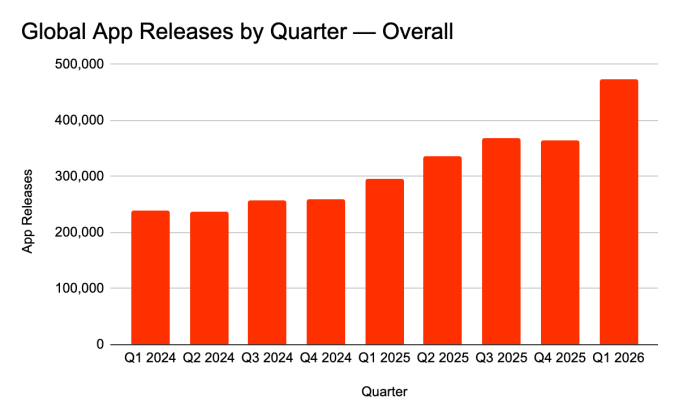
According to a new analysis from market intelligence provider Appfigures, worldwide app releases in the first quarter of 2026 were up 60% year-over-year across both Apple’s App Store and Google Play. That percentage was an even higher 80% when looking at the iOS App Store alone. In April 2026 so far, the total number of app releases is up 104% across both stores compared to the same time last year, and up 89% on iOS.

As Apple’s Senior Vice President of Worldwide Marketing, Greg “Joz” Joswiak, quipped In a recent interview: rumors of the App Store’s death in the AI age “may have been greatly exaggerated.”

Image Credits:Appfigures

These findings come amid concerns that the rise of AI chatbots and agents would ultimately see users turning away from apps — a theory that’s already being floated by those in the industry, like Nothing CEO Carl Pei, who is focused on building a smartphone for the AI era. The New York Times also reported last year on the potential for new computing platforms to eclipse the smartphone, like smart glasses, ambient computing devices, or reimagined smartwatches with AI features.

OpenAI is even working on an AI hardware device with famed Apple designer Jony Ive.

Advertisement

But there’s another possibility, too: AI will make it easier for anyone to create apps, driving a rebirth of the App Store. The new app gold rush could be led by creators who have ideas but not the technical skills to design mobile software.

Appfigures’ data indicates that certain categories of apps are seeing more new releases than others.

Techcrunch event

San Francisco, CA
|
October 13-15, 2026

Advertisement

Mobile games still account for most of the new app releases worldwide as of Q1 2026, as they have in prior years. But “productivity” apps have moved into the top five this year. The “utilities” category has also moved up to the number two slot, and the “lifestyle” apps category moved up from the No. 5 slot last year to now No. 3. Finally, “health and fitness”-style applications rounded out the top five categories.

Image Credits:Appfigures

The working hypothesis here is that AI-powered tools, like Claude Code or Replit, could be behind the surge of new launches. It also seems possible that we’re hitting some sort of tipping point in terms of AI usability, where it’s easy enough for people to leverage these tools to build their own desired mobile apps more quickly — or even build their first apps ever.

The explosion of new apps for Apple to review could also be behind some of the tech giant’s recent missteps. This week, Apple pulled the rewards app Freecash from the App Store for rules violations, after letting the app climb the store’s Top Charts and sit in the top five for months. Apple was also caught off guard by a malicious cryptocurrency app, a clone of Ledger Live, that drained $9.5 million in crypto from victims’ accounts.

Advertisement

While high-profile problems like this can generate bad PR for the App Store, the company still does a lot of heavy lifting in terms of blocking and rejecting dangerous or spammy apps. Apple’s most recent analysis from 2024 said the company had removed or rejected more than 17,000 apps for bait-and-switch violations that year; rejected more than 320,000 app submissions that were found to be spam, copying other apps, or misleading; and took action to prevent more than 37,000 potentially fraudulent apps from reaching users on the App Store.

Still, Apple pundits like John Gruber have long argued that the App Store needs a “bunco squad” of sorts that watches for scammy or fraudulent apps that are gaining in popularity or high-grossing.

If AI-assisted vibe coding turns out to be behind the recent surge of app releases, that need will only grow as more new apps flood the marketplace, not all of which will be benign.

Source link

Advertisement
Continue Reading

Tech

Shuttered Startups Are Selling Old Slack Chats, Emails To AI Companies

Published

on

Some failed startups are reportedly selling old Slack messages, emails, and other internal records to AI companies as training data, creating a new way to cash out after shutting down. Fast Company reports: Shanna Johnson, the CEO of now-defunct software company Cielo24, told the publication that she was able to sell every Slack message, internal email, and Jira ticket as training data for “hundreds of thousands of dollars.”

This isn’t a one-off scenario. SimpleClosure, a startup that helps companies like Cielo24 shut down, told Forbes that there’s been major interest from AI companies trying to get their hands on workplace data. Because of this, SimpleClosure launched a new tool that allows companies to sell their wealth of internal communications — from Slack archives to email chains — to AI labs. The company said it’s processed 100 such deals in the past year. Payouts ranged from $10,000 to $100,000. “I think the privacy issues here are quite substantial,” Marc Rotenberg, founder of the Center for AI and Digital Policy, told Forbes. “Employee privacy remains a key concern, particularly because people have become so dependent on these new internal messaging tools like Slack. … It’s not generic data. It’s identifiable people.”

Source link

Continue Reading

Tech

Amazon issues $589 MacBook Neo deal, lowest price on new release

Published

on

Avoid backorder delays and grab the lowest price ever with Amazon’s MacBook Neo deal that drops the standard model to $589.99.

Citrus MacBook on an outdoor cafe table, wicker chair behind it, with bold red SALE banner and yellow label reading MacBook Neo in the upper left corner
Save on every new MacBook Neo, including this popular Citrus option.

A popular option for families and bargain hunters, Apple’s MacBook Neo is on sale at Amazon today, with the standard 256GB model marked down to $589.99 after a $10 discount. At press time, all four colorways are eligible for the savings, with units shipping now or in 1-2 days, depending on the color.
Buy MacBook Neo for $589.99
Continue Reading on AppleInsider | Discuss on our Forums

Source link

Continue Reading

Tech

Best 55-inch TVs 2026: Our favourite Mini-LED, OLED and 4K models

Published

on

Best 55-inch TVs

While bigger screen sizes are becoming more popular, the best 55-inch TV screens offer that sweet spot of size, performance and value.

This list covers all the best 55-inch TVs that we’ve reviewed, from budget 4K TVs to Mini LEDs and OLED TVs. Everything that receives a four-star review is worthy of a best buy addition, so don’t think that a four-star review is necessarily worse than a 4.5 star. In some cases a four-star review might be the best TV for you.

When we review TVs, we base our assessments on measurable, quantifiable data alongside real-world content and impressions. We compare against price rivals where possible, with a focus on picture, sound and features to determine a TV’s value and performance.

If the choices we’ve made don’t float your boat, or you’re looking for a bigger size TV, we have other best buys you can look includes our best cheap TVsbest 4K HDR TVsbest 8K TVs and best OLED TVs.

Advertisement

Best 55-inch TVs at a glance

SQUIRREL_ANCHOR_LIST

Learn more about how we test televisions

Every TV we review is put through the same set of tests to gauge its picture performance, usability, and smart features.

Tests are carried out over several days and are done by eye but supported with technical measurements. Testing by eye involves an expert watching a wide range of material to understand and determine a TV’s performance in fields such as brightness, contrast, motion processing, colour handling and screen uniformity.

We’ll consider the design of the TV in terms of build quality, study the spec sheets and see if the TV’s connections are up to spec, as well as playing video and audio content to ensure that the set handles playback as it claims. We also take note whether a product’s compatible formats and features are in line with industry trends or not to gauge whether it’s relevant for you.

Advertisement

Comparison to other related and similarly priced products is also important, to see if it’s missing any vital features and whether it impresses as a whole. After all this, we’ll come to a judgement on how the TV performs as a whole.

If you want to learn more, please visit our detailed page about how we test TVs.

Advertisement

LG OLED55G5

Best 55-inch OLED TV

Advertisement

Trusted Score

Advertisement

Pros

  • Superbly bright and colourful image

  • Outstanding upscaling

  • Easy to use interface

  • Top tier gaming spec

  • Five years of OS updates

Cons

Advertisement
  • Sound quality is merely fine

  • Would be nice to have the new remote

The LG OLED55G5 (G5) is easily one of the best 55-inch, 4K TVs currently on the market. With a vibrant and colourful picture, excellent upscaling and processing capabilities and a surprisingly high brightness, the LG G5 will suit most households.

LG’s TV interface is pretty easy to navigate through, and you can use either the included remote or via LG’s ThinQ smartphone app to do so. However, keep in mind that instead of Freeview Play support, you’ll see LG Channels.

Otherwise, the LG G5 is fitted with a Primary RGB Tandem panel and, unlike other LG models, doesn’t sport any green tint either. Instead, picture quality is realistic and vibrant too. However, where the TV especially impresses is with its brightness, as it can hit a peak of a whopping 4000 nits – no mean feat for an OLED.

Advertisement

Another area where the G5 excels is with upscaling, as 1080p content could genuinely be mistaken for a true 4K image.

Generally speaking, the G5’s audio quality is decent, with dialogue especially sounding clear and natural. However, lower frequencies does bring out some buzzing and it can sometimes lack the energy of other TVs. With this in mind, it might be a good idea to invest in one of the best soundbars.

Advertisement

Sony Bravia 8

Best mid-range OLED

Trusted Score

Advertisement

Pros

  • Expressive and natural picture quality

  • Engaging Google TV smarts

  • Convenient design

  • Dolby and DTS support

Advertisement

Cons

  • Less bright than the competition

  • Sounds tamer than previous models

It may not be quite as bright as alternatives from Samsung or LG, but overall the Sony Bravia 8 is a well-priced option for those seeking great picture quality in a sleek design.

Speaking of its design, at just 37mm with thin bezels, the Bravia 8 adopts a minimalist, slender look. The rear of the screen is also flat, so if you choose to wall-mount it then it’ll sit flush against the wall.

Advertisement

The Bravia 8 runs on Google TV and, unlike other UK Google TV models, Sony’s own includes the likes of BBC iPlayer and ITVX. Plus, Google TV allows you to control the set via its voice assistant.

Unsurprisingly the Bravia 8 is equipped with plenty of premium technologies, including HDR coverage, support for Dolby and DTS. There’s also Netflix Adaptive Calibrated Mode and Prime Video Calibrated Mode which adjusts the screen’s contrast and brightness depending on the room’s environment.

Overall, the Bravia 8 delivers rich and wide-ranged colours, with Sony’s processing drawing out more tones for a more vibrant look. Plus, the TV offers a brilliantly natural and detailed image that we found difficult to fault. Sure, it’s not as bright as some of its competitors, but it’ll fit perfectly into the right room.

Thanks to the XR processor, the Bravia 8 does a great job at upscaling and produces a clear, detailed image without much noticeable noise.

Advertisement

Finally, the Bravia 8’s audio system uses actuators to vibrate the screen and create sound, and is solid at reproducing the ambience of scenes. However, although DTS tracks sound clear and detailed, bass is lacking and there’s not quite as much power as we’d like. You can tinker with the settings, but we’d recommend opting for one of the best soundbars or best cheap soundbars to enhance the quality.

Sony XR-55A95L

Best 55-inch QD-OLED TV

Advertisement

Trusted Score

Advertisement

Pros

  • Stunningly cinematic picture quality

  • Attractive but also flexible design

  • Warm, detailed and immersive sound

Cons

Advertisement
  • Relatively expensive

  • No HDR10+ support

  • Doesn't use the latest QD OLED panel

The Sony A95L is a premium QD-OLED TV, and while the asking price is steep compared to most other 55-inch screes on this best list, it boasts stellar picture and sound quality.

The Sony A95L offers fantastically fine shading of colours that look impressively pure, along with excellent levels of sharpness and detail. It’s not the brightest QD-OLED, as it’s beaten by the Samsung S95D, but in its favour is that the Sony is capable of a more cinematic-looking image.

Sony’s Acoustic Surface Audio system delivers an audio performance that’s big and accurate in terms of where effects and dialogue are placed, pushing sound into a room, the woofers add some punch to the low frequencies too.

Advertisement

The A95L’s smarts are delivered by Google TV, and unlike the Philips OLED908, it is covered for the UK’s catch up services which are available as separate apps.

Connectivity covers two HDMI 2.1 inputs with support for eARCVRRALLM, and 4K/120Hz. For PS5 gamers there is the Auto Tone Mapping feature that optimises the HDR performance but with no support for AMD FreeSync or Nvidia G-Sync. Input lag is faster than the A95K at 16.7ms. The addition of Dolby Vision Game mode helps extract more contrast and brightness from supported games.

Advertisement

Xiaomi TV F Pro

Best budget 55-inch TV

Trusted Score

Advertisement

Pros

  • Affordable price

  • Likable picture quality

  • Good sound

  • Lots of entertainment options

Advertisement

Cons

  • Picture requires tweaks

  • Fire TV’s focus on all things Amazon

  • Sluggish Freely integration

For a budget TV, the Xiaomi TV F Pro is packed with a surprisingly large selection of features, has a great picture quality and sounds pretty good too. With a 4K QLED panel and support for HDR10, HDR10+ and HLG, you’re looking for a bargain, this is tough one to beat.

While it’s not the brightest around, the Xiaomi TV F Pro’s 400 nits is a better result than the more expensive Samsung Q7F.

Advertisement

Despite no Dolby Vision support, the TV’s colour performance is pretty good with saturated and punchy colours, while black levels look decent enough too. However, we should disclaim the black levels aren’t quite as strong as competitors, and you will need to play around with the settings to get the best picture quality.

One slight issue we noticed is that there’s a slight green tone to Xiaomi’s Movie picture modes. While it’s not prominent enough to be distracting, it’s certainly noticeable when you see another TV next to it.

Upscaling performance is exactly what you’d expect from a TV of this price: fine. It does an admirable job, but some details and colours are lost.

We were especially (pleasantly) surprised by the audio performance on offer here. The sound is big, loud and equipped with plenty of detail. Bass struggles slightly, but not as much as you’d fear. However, with three HDMI inputs, you can easily pair the TV with a soundbar if you so wish.

Advertisement

The Xiaomi TV F Pro runs on Amazon’s Fire TV OS which is pretty intuitive to use. Sure, it has a tendency to push Prime Video titles, and adverts are present, but overall it’s not a terrible system.

Sony Bravia 5

Best 55-inch Mini-LED TV

Advertisement

Trusted Score

Advertisement

Pros

  • Natural, immersive picture quality

  • Good value for what’s on offer

  • Clean, detailed sound

Cons

Advertisement
  • One or two colour quirks

  • No HDR10+ support

  • rt Only two game-friendly HDMI inputs

We should disclaim that we technically reviewed the 65-inch iteration of the Sony Bravia 5. However, the 55-inch option offers the same specs and naturally has a cheaper RRP of £1199.

That price point is especially noteworthy when you consider you’re getting a Mini LED panel with local dimming – 240 controlled zones to be exact. This, paired with Sony’s acclaimed XR processor, results in the Bravia 5 being an excellent all-rounder.

We’ll dive a bit deeper into its specs. The XR Processor includes XR Triluminos Pro and Live Colour analysis to enhance colour performance and XR Clarity to enhance sharpness and detail, various motion processing options, while the TV supports the likes of HDR10, HLG and Dolby Vision. While there’s no HDR10+ present, there are Netflix, Prime Video and Sony Pictures Core calibrated presets.

Advertisement

Overall, the Bravia 5 has a picture quality that’s remarkably similar to those found on more expensive Sony models, with HDR images looking bright and black levels consistently deep in dark scenes. Brightness and contrast levels are great here too, with colours looking engagingly vivid and expressive.

With a four-speaker system, the Bravia 5 results in a large and detailed soundstage. Plus, with Dolby Atmos and DTS:X, the TV is able to extend beyond the screen’s boundaries too.

Add Sony’s Bravia Cam accessory and the TV will detect where you are in the room and adjust its brightness, sound balance and vocals accordingly too.

Otherwise, Google TV runs the show here and offers access to the likes of BBC iPlayer (which isn’t always a guarantee). When it comes to gaming, the Bravia 5 doesn’t support AMD FreeSync or Nvidia G Sync VRR, although it does support 120Hz.

Advertisement

Philips 55OLED760

Best value 55-inch TV

Trusted Score

Advertisement

Pros

Advertisement
  • Impressive OLED images at a sharp price

  • Three-sided Ambilight

  • Titan smart TV OS with Freely TV over Wi-Fi

Cons

  • Lacks flagship OLED brightness

  • Menu navigation quirks

Advertisement

Despite its RRP of £1199, Philips has managed to pack in plenty of premium features and technologies into its 55-inch 55OLED760. We especially like the inclusion of the rear mounted Ambilight LED bulbs which illuminate to match what’s on screen.

The 55OLED760 runs on TitanOS which is a viable alternative to Google TV and includes all the streaming platforms you’d expect such as Netflix, BBC iPlayer and Disney Plus.

Built on an OLED EX panel and driven by a seventh-gen P5 Perfect Picture Engine, the 55OLED760 delivers deep, natural blacks and does an excellent job at upscaling lower-res images too.

Speaking of the P5 processor, alongside its wide range of TV modes (Cinema, Sports and Gaming to name a few), there’s also an AI-driven option to intelligently tune colours to the room conditions.

Advertisement

Overall, we concluded that the 55OLED760 TV offers a consistently impressive picture quality, regardless of what we were watching. Thanks to multi-format HDR support which covers Dolby Vision, HLG and HDR10, any disc or stream you throw at it looks great.

Perhaps surprisingly for a two-channel system, audio quality is strong too. There’s Dolby Atmos and DTS:X decoding built-in, and the set can also function within a wider DTS Play-Fi multiroom system set-up too. The TV can also bitstream audio out over HDMI eARC to compatible external sound systems too.

If you’re looking for an eye-catching TV that offers a surprisingly brilliant picture and audio quality, then the Philips 55OLED760 is a lot of bang for your buck.

Advertisement

Amazon Fire TV Omni Mini LED

Best value Mini LED

Trusted Score

Advertisement

Pros

  • Easy to assemble

  • Full HDR support

  • Lots of entertainment apps

  • Rich colours

Advertisement

Cons

  • Fire TV’s emphasis on all-things Amazon

  • Not the most subtle image

  • Odd brightness fluctuations with Dolby Vision

Put simply, the Omni Mini LED is easily Amazon’s best TV to date and, with an RRP of £849/$819, it’s brilliant value too. If you’re cemented in Amazon’s ecosystem, then the Omni Mini LED TV is almost a no-brainer.

Advertisement

Naturally, the Omni Mini LED is fitted with Amazon’s Fire TV OS and Alexa. Fire TV OS can be a bit overwhelming at times, especially as Amazon pushes its own content ahead of literally everything else, but generally it’s fairly easy to get your head around.

In terms of features, the Omni Mini LED is equipped with many technologies you’d expect, from HDR support that covers HDR10, HLG, HDR10+ Adaptive (HDR10+ Gaming) and Dolby Vision IQ, Filmmaker Mode and Dolby Atmos audio too. On the gaming front, there’s Dolby Vision Gaming, ALLM and AMD FreeSync Premium Pro too.

Generally, the Omni Mini LED’s picture is rich and colourful, although it sometimes makes skin tones slightly unnatural while dark performance varies for seemingly unknown reasons. We found, however, that to get the best picture you’ll need to dive into the TV’s settings. For example, we found the Adaptive Light Sensor made images darker while Adaptive Colour and Intelligent HDR made things overly vibrant.

Another thing to note is blooming and black levels get worse at wider angles. While the matte screen does a good job of obscuring background reflections, it’s best to consider where you’re placing the TV.

Advertisement

Sound quality is decent, but you may want to invest in a supporting soundbar to get the most out of the TV. While the low end is weighty, dialogue doesn’t always sound natural and Dolby Atmos soundtracks aren’t quite as sharp.

Anyone wanting a Mini LED TV without the hefty price tag should seriously consider the Amazon Omni Mini LED. Yes, it’s very Amazon-centric, but it’s a great choice for those already in its ecosystem.

Advertisement

Sylvox Pool Pro 2.0

Best outdoor

Trusted Score

Advertisement

Pros

  • Bright picture works in full sunlight

  • Rugged, weatherproof chassis

  • Quality image

Advertisement

Cons

  • Slightly uneven backlight visible at night

  • No iPlayer support

Hailed by us as being the “ultimate garden TV”, the Sylvox Pool Pro 2.0 is designed to be visible in bright, sunny conditions.

Naturally, the Sylvox Pool Pro 2.0 is weather-proofed, with an IP55 rating and resistant to temperatures between -30°C to 50°C. While that’s obviously a necessity with an outdoor TV, it does mean that it’s fitted with a hefty metal chassis that weighs 21.8kg (for the 55-inch model).

Advertisement

Speaking of weatherproofing, there’s a panel at the pack which requires a screwdriver to access. If you want to connect external devices, we’d recommend connecting an HDMI cable but wrapping the exposed end in a plastic bag and cable tie to protect it from the elements.

The Sylvox Pool Pro 2.0 has a 2000 nits panel which is, unsurprisingly, much brighter than any of the other models on this list. That’s because brightness is key when viewing a screen outdoors. This high brightness means it can overcome any ambient lighting condition – even sunlight shining directly onto the screen. It’s still better to avoid too much direct sunlight, but it’s still extremely watchable.

You’ll likely need to enter the TV’s settings to tweak the brightness, contrast and hue controls to bring out the best picture. Fortunately, with the Google TV interface, this isn’t difficult to do – however keep in mind that this iteration doesn’t support UK services like BBC iPlayer or ITVX.

Similarly, you’ll probably need to adjust the TV’s audio settings too. Although audio is generally clear and loud, the aforementioned hefty design does make sound feel enclosed. You can opt for a waterproof soundbar to remedy this, although we haven’t reviewed that ourselves yet.

Advertisement

If you spend a lot of time outdoors, and are sick of squinting into a tablet or laptop to watch TV, then the Sylvox Pool Pro 2.0 will be a worthy investment. However, due to the nature of the device, you shouldn’t expect the best TV experience here.

FAQs

What’s the best 55-inch TV under £500?
Advertisement

Out of the models we’ve tested, the TCL Roku would be our choice with its Dolby Vision support, colourful SD performance and fast input lag for gaming.

Test Data

  LG OLED55G5 Sony Bravia 8 Sony XR-55A95L Xiaomi TV F Pro Sony Bravia 5 Philips 55OLED760 Amazon Fire TV Omni Mini LED Sylvox Pool Pro 2.0
Contrast ratio Infinity
Input lag (ms) 13 ms 12.7 ms 16.7 ms 13.2 ms 13 ms 13.2 ms
Peak brightness (nits) 5% 463 nits 381 nits 797 nits
Peak brightness (nits) 2% 462 nits 2093 nits 391 nits 710 nits 551 nits
Peak brightness (nits) 10% 430 nits 1337 nits 381 nits 800 nits 760 nits 950 nits
Peak brightness (nits) 100% 121 nits 226 nits 381 nits 592 nits 460 nits
Set up TV (timed) 421 Seconds 69 Seconds 108 Seconds 720 Seconds 98 Seconds

Full Specs

  LG OLED55G5 Review Sony Bravia 8 Review Sony XR-55A95L Review Xiaomi TV F Pro Review Sony Bravia 5 Review Philips 55OLED760 Review Amazon Fire TV Omni Mini LED Review Sylvox Pool Pro 2.0 Review
UK RRP £2399 £2199 £2499 £379 £1399 £1199 £849 £3159
USA RRP $2499 $2799 $1499 Unavailable $819
EU RRP €2779
CA RRP CA$3999 CA$2099 Unavailable
AUD RRP AU$5295 AU$1999 Unavailable
Manufacturer LG Sony Sony Xiaomi Sony Philips Amazon Sylvox
Quiet Mark Accredited
Screen Size 54.6 inches 54.6 inches 54.6 inches 54.6 inches 64.5 inches 54.6 inches 54.6 inches 54.6 inches
Size (Dimensions) 1222 x 263 x 742 MM 1223 x 248 x 786 MM 1224 x 34 x 707 MM 1226 x 312 x 770 MM 1447 x 345 x 862 MM x x INCHES 1230 x 300 x 800 MM 124.4 x 8.7 x 72.6 CM
Size (Dimensions without stand) 703 x 1222 x 27.2 MM 706 x 1223 x 37 MM x x INCHES 711 x 1226 x 76 MM 832 x 1447 x 58 MM 708 x 1228 x 58 MM x x INCHES 124.4 x 8.7 x 72.6 CM
Weight 22.1 KG 18 KG 17.6 KG 9.2 KG 24.9 KG 17.2 KG 16 KG 21.8 KG
ASIN B0F9PFNQJJ B0CZTZTQXJ B0CBN9YGML B0F29KYPN4 B0F24VHMK4 B0C7SJFB2W B0D1GFGQPG
Operating System webOS 25 Google TV Google TV Fire TV Google TV Titan OS Fire TV Google TV
Release Date 2025 2024 2023 2026 2025 2025 2024 2024
First Reviewed Date 16/04/2024 08/05/2025
Model Number K55XR80 XR-55A95L 55OLED760/12 ML55F700 Sylvox Pool Pro 2.0
Model Variants OT43A2KOGF, OT65A2KOGF, OT75A2KOGF
Resolution 3840 x 2160 3840 x 2160 3840 x 2160 3840 x 2160 3840 x 2160 3840 x 2160 3840 x 2160 3840 x 2160
HDR Yes Yes Yes Yes Yes Yes Yes Yes
Types of HDR HDR10, HLG, Dolby Vision HDR10, HLG, Dolby Vision HDR10, HLG, Dolby Vision HDR10, HLG, HDR10+ HDR10, HLG, Dolby Vision HDR10, HLG, Dolby Vision, HDR10+ Adaptive HDR10, HLG, HDR10+ Adaptive, Dolby Vision IQ HDR10
Refresh Rate TVs 48 – 165 Hz 40 – 120 Hz 40 – 120 Hz 50 – 60 Hz 48 – 120 Hz 48 – 120 Hz 48 – 144 Hz – 60 Hz
Ports Four HDMI 2.1, three USB, ethernet, optical digital out, CI+, two RF tuners Four HDMI, digital audio out, two USB ports, Ethernet, two satellite, RF terrestrial Four HDMI, Ethernet, two USB, digital audio out, RF terrestrial, two RF satellite Three HDMI, USB, Ethernet, Digital Optical Audio output Four HDMI (two with full HDMI 2.1 features), 2 x USB, Ethernet, RF input, optical digital audio output Four HDMI 2.1, digital audio output, two USB ports, Ethernet, terrestrial/satellite Four HDMI, USB 3.0, a digital optical port, RF antennae, Ethernet and a 3.5mm input 3x HDMI 2.1 (one eARC), 2x USB, satellite and coax aerial inputs
HDMI (2.1) eARC, ALLM, VRR, HFR, QMS, QFT eARC, ALLM, VRR, HFR, SBTM eARC, ALLM, VRR, HFR eARC, ALLM eARC, VRR, ALLM, 4K/120Hz eARC, ALLM, VRR, HFR eARC, ALLM, VRR, HFR Yes
Audio (Power output) 60 W 50 W 60 W 20 W 40 W 20 W 20 W
Connectivity Wi-Fi, Bluetooth 5.3, AirPlay 2, Google Cast Wi-Fi, AirPlay 2, Google Cast, Bluetooth 5.3 Wi-Fi, Chromecast, AirPlay 2, Bluetooth 5.2 Mircast, AirPlay 2, Wi-Fi, Bluetooth Wi-Fi, Bluetooth 5.3, Apple Airplay 2, Google Cast Wi-Fi, Bluetooth Wi-Fi 6E, Bluetooth Wi-Fi
Colours Black
Display Technology OLED OLED OLED, QLED QLED Mini LED, VA OLED Mini LED Direct-LED
Advertisement

The post Best 55-inch TVs 2026: Our favourite Mini-LED, OLED and 4K models appeared first on Trusted Reviews.

Advertisement

Source link

Continue Reading

Tech

The Best Smart Home Accessories to Boost Your Curb Appeal (2026)

Published

on

I tried the battery version, which does require you recharge it every couple of weeks, but the wired-in version is the top recommendation on our guide to the Best Video Doorbells.

A Better Birdhouse

I had a new-to-me problem this spring: bird invasion. A little bird made a nest in my front-door wreath without us noticing. One evening, my sister opened the door, and the bird flew out of the nest and straight into our house. After a 30-minute battle to get it outside again (and keep my cat from eating it), it wasn’t until we saw the bird fly off the door again the next day that we realized it was calling our home its home, too.

If this is a common problem at your house, our resident bird-gear tester Kat Merck has a solution: a smart nesting box. Birdfy makes a few different smart bird feeders we like for bird-watching, and the Nest Duo is a birdhouse that lets you watch the birds while they nest inside of it. It’s a slim, attractive box that will add to your front yard’s style while also packing two solar-powered cameras (one facing the entrance, one focused inside) so you can bird-watch from multiple angles. It comes with different hole sizes to appeal to different species, metal predator guards to prevent chewing around the hole, and a remote control to reset or recharge the camera without disturbing your feathered neighbors.

Stylish Smart Lights

Image may contain: Electronics, Mobile Phone, Phone, Light, Computer Hardware, Hardware, Mouse, Appliance, and Blow Dryer

Govee

Outdoor Clear Bulb String Lights

I’ve liked Govee’s smart outdoor string lights before, usually for my holiday decor, and have previously recommended something similar with a bistro-light-like look that happened to be smart. These clear bulb string lights are part of Govee’s current lineup and have a contemporary twist with a triangle in the center instead of the wire filament. These are a fun option for outdoor lights you can enjoy on warm nights, and they can do every color and shade of white without looking as bulky as permanent outdoor lights. (Added bonus, these lights are also Matter compatible!)

Advertisement

Fresh Bulbs

Image may contain: Lighting, Electronics, LED, Light, Appliance, Blow Dryer, Device, and Electrical Device

Cync

Smart LED Light Bulb, PAR38

If you have light fixtures you want to remote-control, add an outdoor smart bulb. There are tons to choose from, and you can usually find one from any brand you already have at home. The only downside is that outdoor-rated smart bulbs are usually 4.75-inch-diameter PAR38-style bulbs, so they’re best for downward-facing floodlights on your porch or balcony. They’ll likely be too big to fit in a wall fixture as a replacement for a normal-sized bulb. Don’t just grab any smart bulb—not all are outdoor-rated. Check for mentions of outdoor use and waterproof ratings to make sure they’re safe to use. I’m a big fan of Cync bulbs, and the brand has an outdoor version of the Cync Full Color bulbs I like to use indoors. You’ll be able to add fun colors as well as shades of white, so you can turn the porch a spooky orange or red for Halloween, pink for Valentine’s Day, or the colors of your favorite sports team on game day.

Remote-Controlled Garage

Chamberlain

MyQ Smart Garage Controller

Advertisement

Chamberlain

MyQ Smart Garage Door Opener with Integrated Camera

If your garage is the centerpiece of your home’s curb appeal, you can control it as easily as a smart door by adding a smart controller. You can do two different styles: I have the Chamberlain MyQ professionally installed smart garage opener, which means the device that controls my garage has these smarts built into it (plus a camera, but I find it doesn’t work great with how far the device is from my Wi-Fi router), or you can get a smart garage controller that can add smart features onto an existing garage door. Both let you check whether the garage is open or closed and operate it remotely, and you can add a video keypad that doubles as a video doorbell and can let you open or close the garage without your phone.

Smart Shades

SmartWings

Advertisement

Motorized Roller Shades

Lutron

Caseta Smart Shades

The front of my home faces west, so it’s absolutely baking at the end of the day. What I need to add are some of our favorite smart shades to automate closing the shades on that side of the house at the right time of day. These also give your home a nice, cohesive look and immediate, controllable privacy from the outside world. WIRED reviewer Simon Hill recommends the SmartWings shades as his top picks, and Lutron’s Caseta shades if you’re looking for a more upgraded look.

Advertisement

Invisible Swaps

Looking to add some smarts without touching your existing setup? These switch-ups can make your front door and yard smart without being visible.

Yale

Approach Lock

This smart lock just swaps out the inner half of your front-door lock to make it smart without requiring a new key or changing your exterior hardware. You can also add on a keypad—or not, if you’d rather keep the smarts a complete secret.

Advertisement

Cync

Outdoor Smart Plug

This outdoor plug is visible at the outlet itself, but if the outlet is covered by something or is around the corner from your front door, no one will know that your lights or other electrical devices are connected to this smart plug.


Power up with unlimited access to WIRED. Get best-in-class reporting and exclusive subscriber content that’s too important to ignore. Subscribe Today.

Advertisement

Source link

Continue Reading

Tech

Researchers warn Microsoft Defender vulnerability is already being exploited

Published

on


A security researcher known as Chaotic Eclipse recently disclosed a vulnerability dubbed “Red Sun” affecting Microsoft Defender Antivirus. While criticizing Microsoft’s handling of the issue, Chaotic Eclipse explained that their proof-of-concept code could potentially be used to bypass Defender’s protections. The researcher also claimed that malicious actors have already begun…
Read Entire Article
Source link

Continue Reading

Trending

Copyright © 2025