
Crypto World
Singapore Gulf Bank Launches USDC Mint Service With 24/7 USD Conversion on Solana


TLDR:
- Singapore Gulf Bank enables 1:1 USD to USDC conversion with round-the-clock settlement on the Solana network
- The service removes fees for a limited time, allowing institutions to test seamless crypto-fiat transactions
- Wu Blockchain reported that the platform supports instant minting and redemption without time restrictions
- The bank plans to extend access to retail users by the end of Q2 after the initial institutional rollout phase
Singapore Gulf Bank has introduced a new stablecoin service that enables direct conversion between USD and USDC on Solana.
The offering provides continuous settlement and removes fees for a limited period, targeting institutional participants at launch.
Institutional Access to 24/7 Stablecoin Conversion
Singapore Gulf Bank has rolled out a mint and redeem service for USDC, allowing direct conversion between USD and USDC. The service supports a one-to-one exchange ratio and operates without fees during the initial phase.
A post shared by Wu Blockchain on X reported the launch and confirmed key features of the service. The tweet noted that the platform enables 24/7 settlement on Solana while maintaining a fixed USD–USDC conversion rate.
The service operates on the Solana network, which is known for fast transaction speeds and low fees. As a result, clients can complete transactions at any time, including weekends and holidays. This continuous availability supports institutions that require round-the-clock liquidity.
In addition, the fee waiver lowers entry barriers for early users. Institutions can test the service without incurring extra costs. This approach may support early adoption while giving the bank time to scale operations.
The focus on institutional users reflects current demand patterns in digital asset markets. Large entities often require efficient fiat-to-crypto rails for treasury and trading operations. Therefore, the service is positioned to meet those operational needs.
Expansion Plans Toward Retail Users
Singapore Gulf Bank has stated that the service will extend to individual users by the end of the second quarter. This planned rollout suggests a phased approach to onboarding. The bank appears to be testing the infrastructure with institutional flows before opening wider access.
The tweet referenced the official announcement, which confirms that retail availability remains part of the near-term roadmap. As a result, individual users may soon gain direct access to minting and redeeming USDC through the platform.
Moreover, the use of Solana may appeal to users seeking faster settlement compared to other networks. The blockchain’s design supports high throughput, which aligns with payment and conversion use cases. This setup could support broader participation once retail access begins.
At the same time, the bank’s move reflects growing interest in stablecoin services tied to traditional finance. Institutions and individuals continue to look for reliable on-ramps and off-ramps. Therefore, offerings that combine fiat access with blockchain settlement are gaining attention.
The current rollout remains limited to selected clients. However, the upcoming expansion indicates a wider strategy. By gradually opening access, the bank can monitor performance and user activity while refining the service.


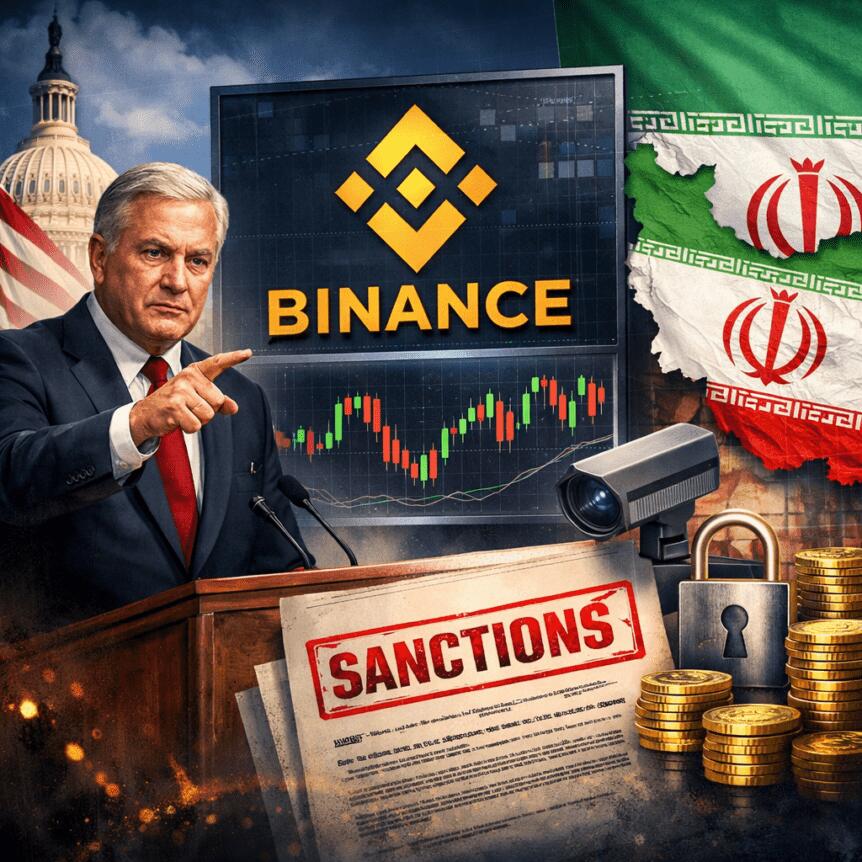
Connecticut Senator Richard Blumenthal has intensified congressional oversight of Binance, asking the Justice Department and FinCEN for detailed updates on whether the exchange is meeting anti-money-laundering and sanctions obligations embedded in its 2023 monitoring regime. A Fortune report on Friday describes Blumenthal’s letters as requesting a current assessment of Binance’s compliance with the agreement.
The 2023 settlement required Binance to pay $4.3 billion in civil penalties and to fall under ongoing U.S. monitoring and reporting by regulators. Changpeng “CZ” Zhao, Binance’s founder, agreed to plead guilty to one felony as part of the resolution. DOJ and FinCEN officials responsible for overseeing the monitoring reportedly did not comment when approached by Fortune.
Blumenthal’s correspondence reportedly highlighted “mounting allegations of dangerously lax anti-money laundering prevention by Binance,” underscoring ongoing questions about the effectiveness of post‑settlement oversight and the sufficiency of the program’s controls.
Fortune also notes that the case has broader sanctions implications, including Iran-related scrutiny. The outlet reports that Binance had been accused of sanction evasion and that employees who flagged potential violations were reportedly dismissed; a Binance spokesperson denied the specific claims.
Separately, a bipartisan group of lawmakers pressed for action earlier this year. In February, Senator Chris Van Hollen and 10 colleagues urged Treasury Secretary Scott Bessent and former Attorney General Pamela Bondi to complete a “prompt, comprehensive review” of Binance’s compliance controls. The letter, circulated by Van Hollen’s office, signals continued bipartisan concern over how Binance’s regulatory posture is being assessed and enforced. Source: Van Hollen’s office.
Key takeaways
- A sitting U.S. senator asks DOJ and FinCEN for a current update on Binance’s compliance with AML and sanctions monitoring, citing a Fortune report on the matter.
- The 2023 settlement’s monitoring regime remains under scrutiny, with regulators yet to publicly detail its effectiveness or any gaps.
- Iran sanctions-related inquiries and related staffing changes at Binance are part of the ongoing oversight narrative, though Binance denies the specific allegations.
- Lawmakers have pressed for a rapid, comprehensive review of Binance’s controls, illustrating sustained bipartisan concern about crypto exchanges’ regulatory compliance.
- Questions about Binance’s political associations and external partnerships continue to surface, adding a political dimension to regulatory risk for the sector.
Regulatory monitoring under the 2023 settlement
The 2023 settlement placed Binance under an active regime of monitoring and reporting to U.S. authorities. As part of the deal, the exchange faced a substantial civil penalty and agreed to ongoing regulatory scrutiny designed to police anti-money-laundering controls and sanctions compliance. The latest inquiries focus on whether those measures are functioning as intended and how regulators verify ongoing adherence. Fortune’s reporting emphasizes that lawmakers want a transparent, current account of the program’s status, including any identified shortcomings and planned fixes.
Sanctions scrutiny and Iran-related dynamics
Iran sanctions have repeatedly surfaced in discussions around Binance. Reports cited by Fortune suggest that concerns about evasion tactics prompted internal reviews and staff changes, with claims that one billion dollars’ worth of activity may have moved toward Iran-linked entities. Binance has publicly denied these allegations through a spokesperson, underscoring the ongoing dispute over what actually occurred and how it should be interpreted within the monitoring framework.
Political entanglements and ongoing oversight tensions
The regulatory conversation around Binance is taking place against a backdrop of broader political considerations. In March 2025, a UAE-based entity reportedly acquired a $2 billion stake in Binance using a USD1 stablecoin issued by World Liberty Financial, a company associated with Donald Trump. In a separate development, Trump pardoned CZ in October 2025 after a four‑month prison stint tied to the 2023 settlement. While these items are part of public discourse around Binance, they contribute to a broader risk perception for investors and users who weigh regulatory certainty against political influence in the crypto space.
For readers tracking the regulatory arc, these disclosures reinforce why a formal, auditable update from U.S. authorities and Binance remains pivotal. The evolving status of the monitoring program, forthcoming agency statements, and any new enforcement steps will be essential to watch in the coming months.
Readers should keep an eye on forthcoming confirmations from the DOJ, FinCEN, and Binance about any adjustments to the monitoring regime, as well as any legislative or administrative signals that could reshape how large crypto platforms are governed in the United States.
Neo co-founder Da Hongfei has proposed a sweeping overhaul of the Neo Foundation after years of deadlock with co-founder Erik Zhang left one of crypto’s oldest networks effectively paralyzed.
The plan follows Neo’s first public financial disclosure since 2019, showing about $461 million in assets held across the Neo Foundation (NF) and Neo Global Development (NGD) at the end of 2025.
The proposed restructuring aims to replace what Hongfei described as informal, founder-driven governance, arguing the outcome could serve as a test case for how aging blockchain networks manage large treasuries and transition away from founder control.
Zhang has pushed back on key elements of the proposal, exposing further divisions at the top of the project and increasing scrutiny from users and investors.
Hongfei told Cointelegraph that at the core of the restructuring is a break with the founder-centric model that defined Neo’s first decade.
The proposal would redomicile the foundation to the Cayman Islands, create a five-member board and an independent Supervisor with power to block bylaw breaches, and impose a 24-month ban on either founder sitting on the board or supervisory body.
Neo’s fight has become a case study in how older blockchain networks with large treasuries struggle to move beyond founder-centric governance, especially after years of informal control and limited public financial disclosure.
Related: Aave DAO approves $25M funding grant, token allocation for Aave Labs
Returning NEO tokens to the community
According to the disclosure, NF and NGD currently control about 41 million NEO (31.3%), mainly under single-signature control. Hongfei’s “Giveback II” plan would return 49.5 million reserved NEO (NEO) to the community and consolidate NGD-managed investments back into the foundation, which would operate under mandatory annual financial reports, onchain attestations for large transfers, and fully disclosed multi-signature wallets for Bitcoin (BTC), Ether (ETH), stablecoins and other liquid assets.

He said the changes are designed to replace “trust me” governance around treasury and custody, pointing to Ethereum creator Vitalik Buterin’s influence-through-research model as a standard founders should emulate.
Zhang remains unconvinced, arguing that the proposal grounds Neo’s legitimacy in offchain legal structures and still leaves room for opaque third-party attestations instead of directly verifiable onchain addresses.
He said excluding him from the board for 24 months strips Neo of essential technical oversight, calling the Cayman “reset” a cosmetic shell change that dodges historical accountability and unresolved transparency issues.
Governance woes across decentralized finance
The push comes as governance fights and perceived insider advantages dominate debate across decentralized finance. Aave’s long-running dispute between the founder-aligned Aave Chan Initiative and other stakeholders has raised questions about how much power entrenched service providers should wield inside decentralized autonomous organizations.
Related: WLFI proposes governance staking system and USD1 usage incentives
The Trump family-linked World Liberty Financial drew scathing criticism from stakeholders this week, including Tron founder Justin Sun, over a proposed new unlock schedule for its WLFI governance token and discretionary control over treasury assets.
Neo’s bet to revive network relevance
Behind the governance reset sits an attempt to give Neo a credible new thesis in a market where activity has consolidated onto Ethereum, a few layer-2s, Solana, and a handful of other chains.
Hongfei conceded Neo’s user base today is “not where it was in the 2017 to 2021 cycle,” and the numbers “reflect a project that has seen better days.”
He said users are more concentrated in long-term holders and community groups; the Chinese market that once fueled activity has shrunk under Beijing’s bans, and Neo missed “DeFi Summer” after delays in shipping its N3 upgrade.
He now argues that the next decade of onchain activity will be driven less by humans than by autonomous AI agents transacting on their behalf, positioning Neo X as an “agent-first” blockchain optimized for the shift.
He said the real test for both the governance reboot and the AI thesis will be whether, over the next 12 to 24 months, Neo can complete its restructuring and attract a meaningful pipeline of agent-native projects, and whether he would still seek a board seat if those milestones are missed.


Roland Lescure, France’s finance minister, backed an initiative by European banks to launch a euro-pegged stablecoin in 2026 to compete with US dollar-backed tokens, which currently dominate the market.
According to a Friday Reuters report, Lescure supported the euro-pegged Qivalis stablecoin plan launched in September 2025 by EU banks, including Dutch lender ING and Italy’s UniCredit.
The goal of the banks was to create a stablecoin in compliance with the EU’s Markets in Crypto Assets (MiCA) regulatory framework; the MiCA-compliant euro stablecoin is expected to be launched in the second half of 2026.
“That is what we need, and that is what we want,” said Lescure, according to Reuters. “I also strongly encourage banks to further explore the launch of tokenized deposits.”
EU banks are collaborating to create an alternative to the US-dominated stablecoin market, led by Tether’s USDt (USDT) and Circle’s USDC (USDC). As of Friday, USDT had a market capitalization of about $186 billion, according to CoinMarketCap.
Related: SocGen brings MiCA-compliant USDCV dollar stablecoin to MetaMask
Lescure, who reportedly made the comments in a pre-recorded message, said the relatively small volume of euro-pegged stablecoins compared to dollar-pegged ones was “not satisfactory.”
Speaking at the World Economic Forum in January, Banque de France Governor François Villeroy de Galhau said that tokenization and stablecoins were likely to be “the name of the game” in 2026, highlighting benefits of blockchain infrastructure for finance.
However, he opposed interest-bearing stablecoins, claiming that they could destabilize financial systems, a criticism shared by several EU and US policy makers, as well as central bank officials, as stablecoin yield continues to be a contentious regulatory topic.
Stablecoin yield is still an issue in US market structure talks
As of Friday, lawmakers in the US Senate had not announced any compromise that would allow a crypto market structure bill to move closer to a vote.
The CLARITY Act, a crypto market structure bill that passed in the US House of Representatives in July, has been stalled amid disagreements on how to address stablecoin yield, tokenized equities, ethics and other concerns.
Singapore Gulf Bank (SGB) has introduced a service that lets institutional clients mint and redeem stablecoins directly from their bank accounts, using the Solana layer-1 blockchain network to enable round-the-clock settlement between fiat and digital assets.
The service will initially support Circle USDC (USDC) transactions above $100,000 and includes temporary fee waivers for minting and redemption on the Solana network, according to SGB’s announcement.
Additional assets such as Tether’s USDT (USDT), Ethena’s USDe (USDe) and Global Dollar (USDG) are expected to follow, the company said.
The new feature is integrated into the bank’s internal clearing system, allowing funds to move between onchain and traditional balances without relying on intermediary banking networks, SGB said.
The launch comes as payment networks, regulators and banks around the world move to integrate stablecoin settlement and blockchain infrastructure into the traditional financial system to reduce costs and settlement times.
Related: Related: Euro stablecoins dominate non-dollar market, Visa-backed report finds
Banks, payment networks and regulators push stablecoin integration
In March, Mastercard agreed to acquire stablecoin infrastructure company BVNK in a deal valued at up to $1.8 billion.
Jorn Lambert, Mastercard’s chief product officer, said “most financial institutions and fintechs” are moving toward services built around stablecoins and tokenized deposits.
Separately, Visa began operating validator nodes on the Tempo network on Tuesday. Validators on the network can earn stablecoin-based rewards for processing transactions.
A Visa spokesperson told Cointelegraph the company is focused on the technical and strategic aspects of operating a validator, rather than generating revenue.
Regulatory frameworks around the world are also beginning to catch up. In April, Pakistan’s central bank allowed banks to serve licensed crypto firms, ending years of legal restrictions.
Earlier this year, the country signed an exploratory agreement to assess World Liberty Financial’s USD1 (USD1) stablecoin and its potential use for cross-border payments.
Meanwhile in Europe, where euro-denominated stablecoins still lag far behind dollar-backed tokens, a consortium of banks including ING, UniCredit and BBVA is developing a euro-pegged stablecoin.

The banks plan to distribute the stablecoin across crypto exchanges and banking channels, with a launch targeted for the second half of 2026.
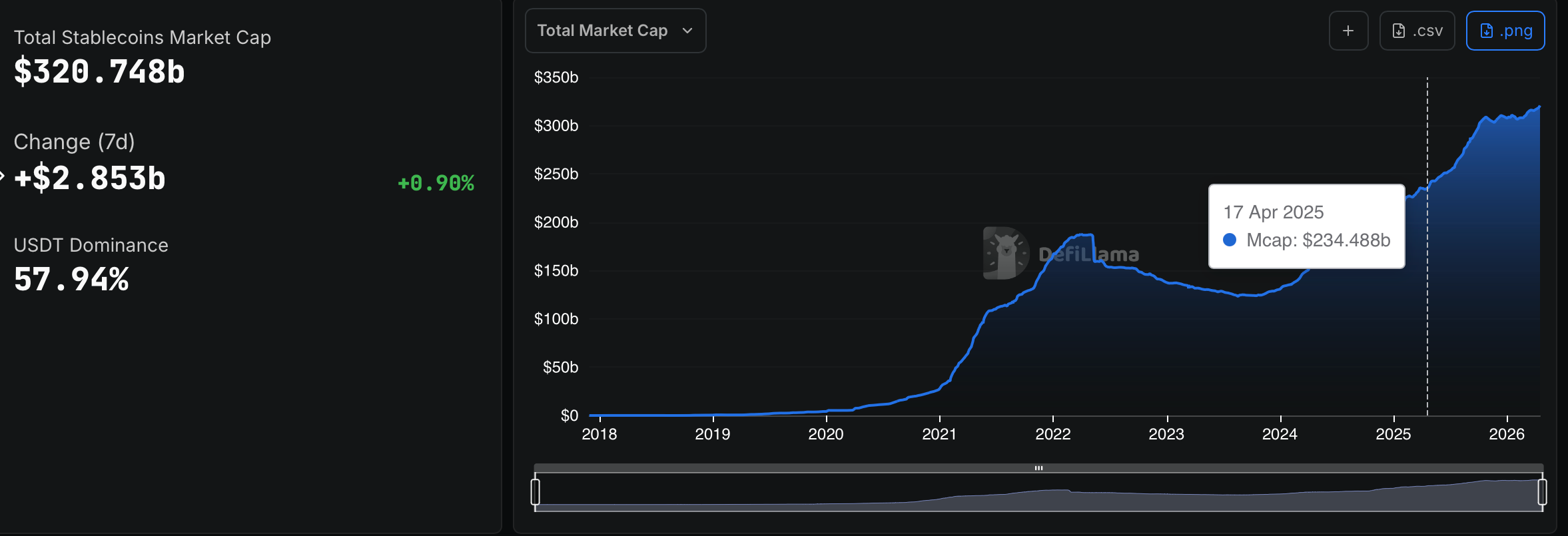
The moves come as the stablecoin market cap, which exceeds $320 billion at the time of publication, according to data from DeFiLlama, continues to grow.
Ether’s (ETH) rally to $2,400 is nearly 38% above its swing low at $1,750, but is ETH’s price move simply a momentum trade, or do longer-term data points suggest a paradigm shift at play?
ETH accumulation addresses absorb 6.5 million Ether
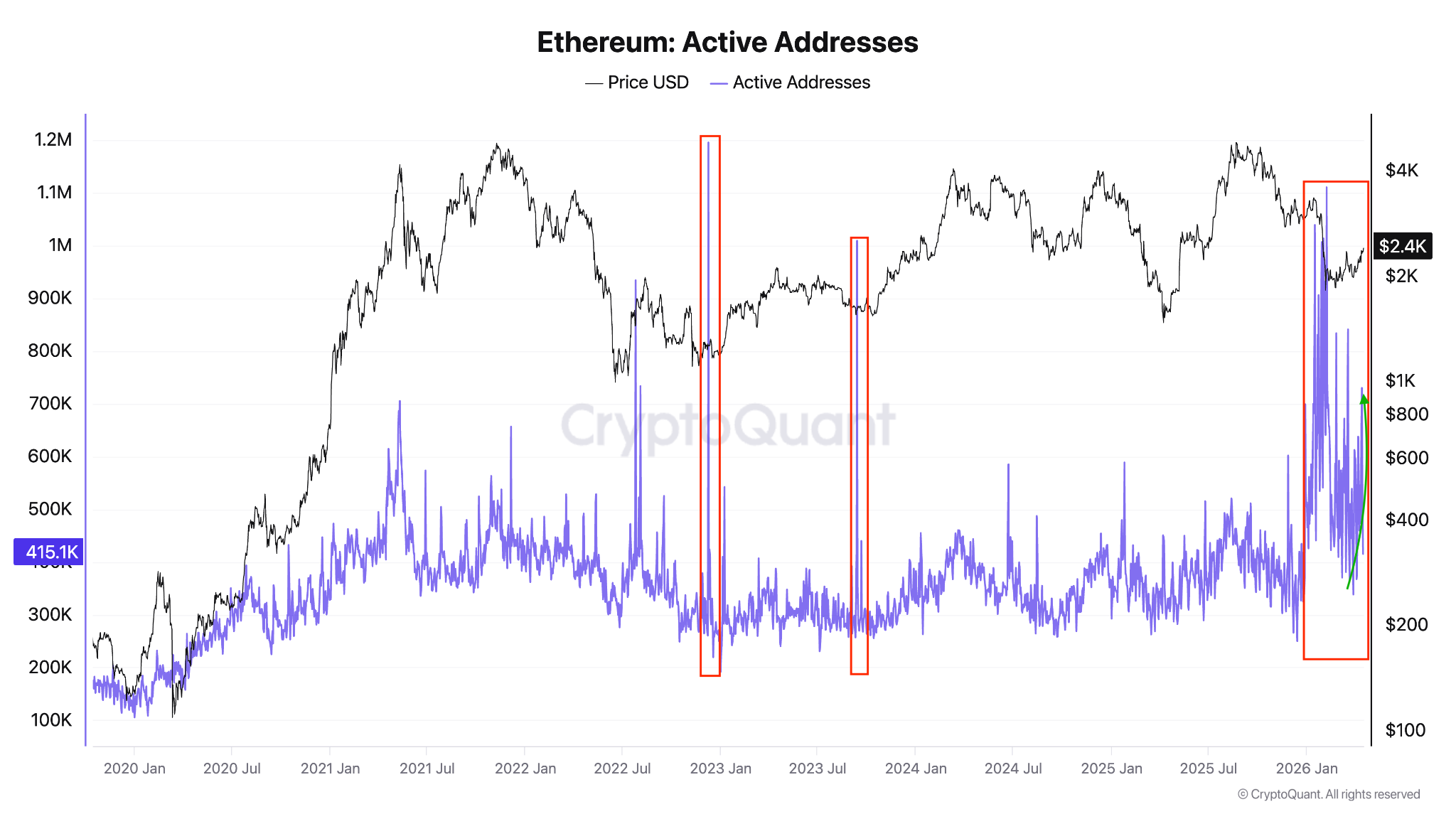
Ether’s recent rally was preceded by an 89% surge in daily active addresses (DAA), which jumped to 730,278 from 384,763 on April 5.
The increase in Ethereum’s active addresses indicates increased user interaction with the network, which is generally a positive.
The chart below shows that activity increased significantly as Ether price rose to $2,300.

Similar activity has been consistently observed near macro bottoms since 2022, preceding significant ETH price rallies.
Daily inflows into accumulation addresses have also increased since mid-2025, reaching an all-time high of 1.14 million ETH in November 2025. The inflows have continued to climb in 2026, averaging 200,000 ETH per day, with a spike to over 358,000 on Thursday.
Related: ETH/BTC ratio hits 10-week high as Ether outpaces Bitcoin: Are new price highs next?
The amount of ETH held in accumulation wallets, or holders with no history of selling, has increased by 6.5 million to 26.16 million from 19.64 million on Jan. 1, representing a 33% increase.
The ETH supply held in accumulation addresses is a key indicator for traders and market participants, as it reflects overall confidence in Ether’s long-term outlook.

The total value of ETH staked further reinforces this outlook. The metric now stands at 39.2 million ETH, signaling growing investor confidence.

As Cointelegraph reported, Ether supply held on exchanges has fallen to multi-year lows, further tightening liquidity on order books.
Ether cup-and-handle chart breakout targets $3,150
The ETH/USD pair may resume its prevailing bullish trend after breaking out of a cup-and-handle (C&H) chart pattern, as shown in the chart below. A 12-hour candlestick close above the cup’s neckline at $2,400 may signal the start of a stronger uptrend.
The target is set by adding the cup’s depth to the breakout point, which comes to around $2,960, an approximately 22% increase from the current price.

The relative strength index has risen to 68, suggesting that ETH bulls are back in control.
Trader TheSkayeth spotted a larger C&H pattern forming over the last two months on the daily time frame, saying ETH was “setting up for a massive move.”
“If the cup and handle pattern continues, I think we get to the golden zone next.”

The measured target of this larger formation is $3,150, which is 30% above the current level.
Applying this framework, ETH bulls will need to hold above the $2,350-$2,400 zone to confirm a sustained upward breakout.
As Cointelegraph reported, a close above the $2,400 level would increase the prospects of the ETH/USDT pair rising to $2,800 and later to $3,050.
This article is produced in accordance with Cointelegraph’s Editorial Policy and is intended for informational purposes only. It does not constitute investment advice or recommendations. All investments and trades carry risk; readers are encouraged to conduct independent research before making any decisions. Cointelegraph makes no guarantees regarding the accuracy or completeness of the information presented, including forward-looking statements, and will not be liable for any loss or damage arising from reliance on this content.
TLDR
- XRP price trades near $1.45 while Binance funding rates remain negative throughout 2026.
- Persistent bearish positioning on Binance raises the possibility of a short squeeze.
- XRP price has gained 7.89% over the past seven days despite heavy short exposure.
- A similar negative funding rate setup preceded a 127% rally in 2025.
- Analysts identify $1.80 as the next key liquidity zone for XRP price.
XRP derivatives data shows heavy short positioning on Binance as funding rates stay negative in 2026. At the same time, spot prices rise and institutional flows return to XRP-linked products. Traders now assess whether this setup could trigger a short squeeze in the near term.
XRP Price Faces Heavy Short Bias on Binance
CryptoQuant data shows Binance XRP funding rates have remained negative for most of the year. Funding rates represent payments between long and short traders to balance futures and spot prices.
When funding rates turn negative, short traders pay long traders at regular intervals. This structure shows that more traders expect price declines and open bearish positions.
A similar pattern appeared after XRP fell sharply in the first quarter of 2025. During that period, Binance traders increased short exposure while funding rates stayed below zero.
Soon after, XRP price reversed and climbed from about $1.60 to above $3.60. That rally delivered a 127% gain over several months and reached a new all-time high.
Current data shows XRP funding rates again hover in negative territory on Binance. Therefore, traders now question whether persistent bearish positioning could create squeeze conditions.
Rebound and ETF Flows Support XRP Price Momentum
XRP price has gained 7.89% over the past seven days. At the time of reporting, the token trades near $1.45.
Despite dominant short positions on Binance, spot prices have moved higher. This divergence often increases pressure on traders who hold leveraged short contracts.
A short squeeze occurs when rising prices force short sellers to close positions. As they buy back contracts, their activity can accelerate upward price movement.
Analysts note that the next liquidity zone stands near $1.80. That level acted as firm support during trading activity in 2025.
Meanwhile, institutional demand has shown recovery over the past week. Spot XRP exchange-traded funds recorded renewed inflows, according to recent reports.
Market participants also responded to easing geopolitical tensions in the Middle East. As risk appetite improved, some capital returned to digital assets.
The combination of negative funding rates and rising spot prices has drawn market attention. Traders now monitor Binance positioning data for further shifts.
If short exposure remains elevated while prices climb, forced liquidations could increase. Such activity would directly impact derivatives markets and short-term volatility.
For now, XRP price trades near $1.45 while funding rates stay below zero. Binance derivatives data continues to show that short traders hold the upper hand in positioning.
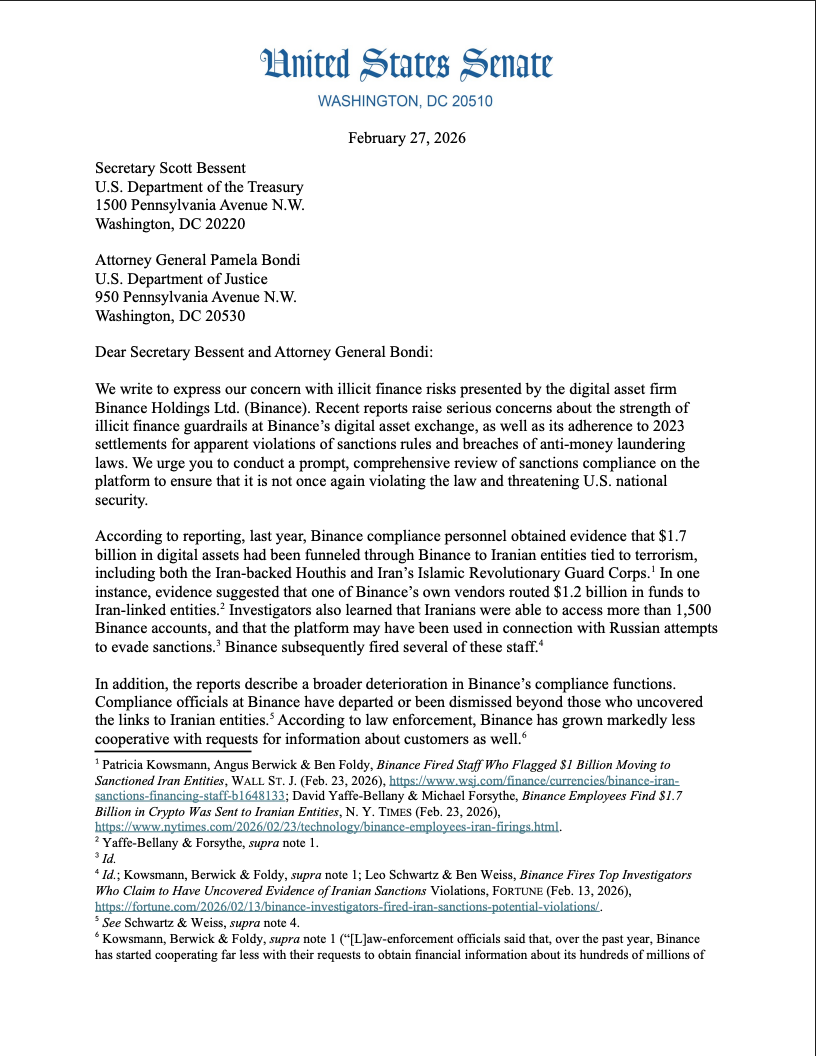
Connecticut Senator Richard Blumenthal questioned US authorities responsible for overseeing Binance about whether the company is complying with anti-money laundering laws and sanctions under its 2023 court-imposed monitoring program.
According to a report published by Fortune on Friday, Blumenthal sent letters to the Justice Department and the US Treasury’s Financial Crimes Enforcement Network (FinCEN), asking for details on Binance’s compliance.
Binance and its former CEO Changpeng “CZ” Zhao reached a deal in 2023, in which the exchange would pay $4.3 billion to settle civil regulatory enforcement actions, and CZ would plead guilty to one felony charge.
The deal also required that Binance be subject to monitoring and reporting requirements by US officials.
Blumenthal’s letter said he was concerned about “mounting allegations of dangerously lax anti-money laundering prevention by Binance.” Fortune reported that DOJ and FinCEN officials responsible for overseeing the exchange as part of the deal would not comment.
Related: Crypto billionaire to prison: CZ’s autobiography revisits turbulent Binance era
The letter followed reports that Binance was under scrutiny regarding US sanctions imposed on Iran.
The crypto exchange reportedly fired individuals responsible for telling Binance executives that $1 billion flowed through the platform to entities tied to Iran. A spokesperson for the exchange has denied the claims.
In February, a group of senators urged Treasury Secretary Scott Bessent and former Attorney General Pamela Bondi, who was fired by US President Donald Trump in April, to complete a “prompt, comprehensive review” of Binance’s compliance controls.

Trump-Binance ties are still under scrutiny
Some US lawmakers have alleged that connections between Binance and Trump create conflicts of interest for the US President and his family’s crypto businesses.
In March 2025, a United Arab Emirates-based entity purchased a $2 billion stake in Binance using the USD1 stablecoin issued by World Liberty Financial, the company co-founded by Trump and his sons.
Trump also pardoned Binance’s former CEO, CZ, in October 2025 after he served four months in prison as part of his 2023 guilty plea.


Leading bitcoin treasury company Strategy (MSTR) has filed a proxy that, if approved, would allow for semi-monthly dividends on its STRC “Stretch” series of preferred stock.
The move would have no effect on STRC’s annual dividend obligations or dividend rate (currently 11.5%), noted Executive Chairman Michael Saylor. Instead, he said, “[the] proposed changes are intended to stabilize price, dampen cyclicality, drive liquidity, and grow demand.”
The high-yielding stock has been exceptionally popular, with outstanding notional value rising to $6.4 billion as of this afternoon’s filing, according to a presentation.
Volatility has dropped to just 2.1% over the past two months versus 13% in the first eight months after the series’ launch. But Saylor and team argue that volatility could be further dampened with semi-monthly payments.
Voting on the amendment will close on June 8, with July 15 as the expected first payment date under the new plan.
MSTR shares rose 11.8% on Friday alongside bitcoin’s 3% rise to $77,400.
TLDR
- France’s finance minister urged European banks to accelerate the development of euro stablecoins and tokenized deposits.
- He said the current volume of euro-pegged tokens remains too low compared to dollar-linked stablecoins.
- Lescure backed a joint initiative by ING, UniCredit, and BNP Paribas to launch a euro stablecoin in 2026.
- Dollar-pegged stablecoins exceed $300 billion in total supply, led by USDT and USDC.
- Euro-pegged stablecoins total about $912 million in market value, according to CoinGecko data.
France’s finance minister called on European lenders to speed up digital currency projects, according to Reuters. He urged banks to expand euro stablecoins and tokenized deposits to reduce reliance on U.S. payment rails. He delivered the remarks in recorded comments at a Paris crypto conference on Friday.
European Banks Pressed to Expand Euro Stablecoins and Tokenized Deposits
Roland Lescure said the current scale of euro-pegged tokens falls short of expectations. He stated that the gap with dollar-pegged tokens was “not satisfactory,” Reuters reported. He linked the imbalance to Europe’s reliance on U.S.-dominated infrastructure.
He backed a joint project by ING, UniCredit, and BNP Paribas to issue a euro stablecoin. The three banks formed a company to launch the token in the second half of 2026. Lescure said, “That is what we need and that is what we want.”
He also encouraged lenders to develop tokenized deposits for digital transactions. He said banks should further explore these instruments within existing regulatory frameworks. He framed the effort as part of Europe’s financial modernization strategy.
Dollar Tokens Dominate while Euro-pegged Coins Trail
Dollar-linked stablecoins continue to lead the global market by supply. Total circulation has surpassed $300 billion, based on The Block’s dashboard data. Tether’s USDT holds nearly $186 billion in market value.
Circle’s USDC ranks second with about $78.8 billion in capitalization. Together, the two tokens account for most stablecoin liquidity. They dominate trading, payments, and cross-border settlements.
By contrast, euro-pegged tokens account for less than $1 billion combined. CoinGecko data shows the euro stablecoin market at $912 million. Circle’s EURC leads with $426.9 million in market capitalization.
STASIS’ EURS follows with $150.3 million in value. Societe Generale launched EURCV in 2023, and it holds $126.7 million. These figures highlight the limited scale of euro-denominated digital tokens.
Reuters cited RBC Capital Markets research on European bank sentiment. Two-thirds of surveyed banks reported limited customer demand for stablecoins. The findings reflect cautious adoption across traditional lenders.
Other studies show rising consumer engagement with digital assets. A February survey by BVNK with Coinbase and Artemis covered 4,658 adults in 15 countries. The YouGov-based study found that 54% held stablecoins in the past year.
The same report said 56% plan to acquire more stablecoins. It added that holders allocate about one-third of their savings to crypto and stablecoins. The data indicates sustained retail participation in digital assets.
Borderless, a payment infrastructure firm, tracked stablecoin foreign exchange pricing. It reviewed over 1.1 million pricing observations across 51 currencies. By March, 14 of 21 blockchain-based currencies traded within 100 basis points of interbank FX rates.
TLDR:
- Solana trades between $78 and $90, forming a tight range that signals compression before a likely breakout move.
- Bollinger Bands have narrowed sharply, indicating low volatility and increasing probability of a strong price expansion.
- MACD shows early bullish momentum returning, though confirmation depends on a sustained crossover and price strength.
- A break above $90 may open upside toward $100, while losing $78 support risks a drop to $70 levels.
Solana traded within a narrow band near $88 in April 2026, as volatility declined and momentum indicators showed early recovery signs.
At the same time, growing activity in Solana-linked investment products points to rising institutional participation during this stabilization phase.
Solana Price Structure Signals Consolidation After Extended Decline
Price action reflects a clear shift from the prolonged downtrend seen in late 2025. Solana fell from above $200, forming consistent lower highs and lower lows into early 2026. That decline accelerated before stabilizing near the $80 region.
A market update shared by More Crypto Online on X outlined two possible short-term scenarios for SOL. The analysis noted that both paths allow further upside, depending on how the price reacts near support.
It identified a micro support zone between $78.77 and $81.65. A pullback into this range would support gradual recovery, while a direct move higher would favor a stronger upward continuation.
The current structure shows a well-defined range between $78 and $90. Price continues to trade near $87.99, with repeated tests of resistance around $88.50 to $90. Sellers have defended this level, while buyers have maintained support near the lower boundary.
Bollinger Bands confirm a compression phase. The bands expanded during the earlier sell-off, reflecting high volatility.
They have since tightened, indicating reduced price movement and a potential expansion ahead. Price remains close to the middle band, signaling a balance between buyers and sellers.
Momentum indicators suggest early improvement. The MACD histogram has turned positive again, while the signal lines approach a bullish crossover.
This shift points to gradual buyer participation, though confirmation depends on further price strength.
A move above $90 would likely trigger renewed upside momentum, with $100 as the next psychological level. Further resistance could appear near $115 to $120. On the downside, a break below $78 could expose the $70 to $72 demand zone.
Solana Investment Products Expand as Institutional Access Grows
Alongside price stabilization, investment products tied to Solana continue to expand. A Solana ETF tracker shows a mix of spot and futures-based funds offering exposure to SOL, each with different cost structures and risk profiles.
Spot-based products currently lead in assets under management. Funds such as those issued by Bitwise, Fidelity, and Grayscale attract steady inflows due to direct exposure and relatively lower fees. This trend reflects a preference for simpler investment structures.
Futures-based products show stronger daily price swings. Some funds recorded higher gains in recent sessions, driven by leveraged or derivative exposure. However, these products also carry higher expense ratios and additional risks tied to futures markets.
Fee competition remains active across issuers. Spot products typically maintain lower fees, while futures funds charge higher costs for active strategies. This difference continues to influence investor allocation decisions.
The growth of these investment vehicles aligns with the current price structure. As Solana trades within a tight range, increasing institutional access suggests capital is positioning during a period of reduced volatility. Market direction now depends on whether resistance breaks or support levels give way in the sessions ahead.
Bargain Hunt star begs followers for help after getting stuck in train toilet

Why ADHD and entrepreneurship can drive success and create challenges in equal measure

US Senator Urges Binance Monitor Update Amid Iran Sanctions Scrutiny


-
 NewsBeat5 days ago
Pep Guardiola and Gary Neville agree over Arsenal title problem that benefits Man City
-

 Politics5 days ago
World Cup exit makes Italy enter crisis mode
-

 Crypto World4 days ago
The SEC Conditionalises DeFi Platforms to Be Avoided for Broker Registration
-

 Crypto World4 days ago
SEC Signals Exemption for Crypto Interfaces From Broker Registration
-

 News Videos3 days ago
Secure crypto trading starts with an FIU-registered
-

 Sports12 hours ago
NWFL Suspends Two Players Over Post-Match Clash in Ado-Ekiti
-

 Crypto World4 days ago
SEC Proposes Certain Crypto Interfaces Don’t Need to Register as Brokers
-

 Business6 days ago
Ireland Fuel Protests Enter Day 5 as Blockades Spark Shortages and Government Prepares Support Package
-

 NewsBeat4 days ago
Trump and Pope Leo: Behind their disagreement over Iran war
-

 Crypto World7 days ago
Federal judge blocks Arizona from bringing criminal charges against Kalshi
-
 NewsBeat6 days ago
JD Vance announces ‘no agreement’ with Iran over nuclear weapons fear
-

 Business7 days ago
IMF retains floor for precautionary balances at SDR 20 billion
-
Sports6 days ago
Dexter Lawrence, Stefon Diggs, Trading for De’Von Achane
-

 Business7 days ago
Former Liverpool CEO eviscerates FIFA for World Cup ticket pricing
-
Crypto World5 days ago
Sei Network Enters Quiet Reset Phase as On-Chain Metrics Signal a Slowdown in 2026
-

 Crypto World5 days ago
Trump whales load up ahead of Mar-a-Lago luncheon.
-
Business7 days ago
Coreweave CSO Venturo sells $5.5m in class a common stock
-
Sports7 days ago
1st-Round WR Enters Vikings Mock Draft Orbit
-
Business5 days ago
Kering slides after Morgan Stanley downgrade, Gucci woes loom
-

 Sports4 days ago
NWFL opens Pathway for new Clubs ahead of 2026 Season
You must be logged in to post a comment Login