

Crypto World
French Finance Minister Backs Euro-Pegged Stablecoins in Response to US



Roland Lescure, France’s finance minister, backed an initiative by European banks to launch a euro-pegged stablecoin in 2026 to compete with US dollar-backed tokens, which currently dominate the market.
According to a Friday Reuters report, Lescure supported the euro-pegged Qivalis stablecoin plan launched in September 2025 by EU banks, including Dutch lender ING and Italy’s UniCredit.
The goal of the banks was to create a stablecoin in compliance with the EU’s Markets in Crypto Assets (MiCA) regulatory framework; the MiCA-compliant euro stablecoin is expected to be launched in the second half of 2026.
“That is what we need, and that is what we want,” said Lescure, according to Reuters. “I also strongly encourage banks to further explore the launch of tokenized deposits.”
EU banks are collaborating to create an alternative to the US-dominated stablecoin market, led by Tether’s USDt (USDT) and Circle’s USDC (USDC). As of Friday, USDT had a market capitalization of about $186 billion, according to CoinMarketCap.
Related: SocGen brings MiCA-compliant USDCV dollar stablecoin to MetaMask
Lescure, who reportedly made the comments in a pre-recorded message, said the relatively small volume of euro-pegged stablecoins compared to dollar-pegged ones was “not satisfactory.”
Speaking at the World Economic Forum in January, Banque de France Governor François Villeroy de Galhau said that tokenization and stablecoins were likely to be “the name of the game” in 2026, highlighting benefits of blockchain infrastructure for finance.
However, he opposed interest-bearing stablecoins, claiming that they could destabilize financial systems, a criticism shared by several EU and US policy makers, as well as central bank officials, as stablecoin yield continues to be a contentious regulatory topic.
Stablecoin yield is still an issue in US market structure talks
As of Friday, lawmakers in the US Senate had not announced any compromise that would allow a crypto market structure bill to move closer to a vote.
The CLARITY Act, a crypto market structure bill that passed in the US House of Representatives in July, has been stalled amid disagreements on how to address stablecoin yield, tokenized equities, ethics and other concerns.


Chun Wang, the Chinese-born Maltese entrepreneur who founded the Bitcoin mining pool F2Pool, is stepping into a high-profile spaceflight role after reportedly purchasing a seat on SpaceX’s planned interplanetary mission to Mars. SpaceX announced the two-year mission will venture beyond the Moon, perform a Mars flyby, and return to Earth. Wang has also secured a ticket for a planned weeklong commercial lunar flyby that will launch before the Mars mission.
In a post on X, Wang framed his involvement within the wider trajectory of space exploration. He argued that even if lunar flights remain privately funded only to a point, activity on the Moon is likely to advance anyway as governments and private players push lunar bases into reality. Yet his expectation for Mars is more uncertain: “And I think I should do something about that. I hope that by purchasing a flyby mission to Mars, SpaceX will have another reason not to forget about Mars. Because we seriously shouldn’t defer Mars to our next generation.”
The development underscores a growing trend among tech executives funding or personally participating in spaceflight. Beyond SpaceX, figures such as Jeff Bezos, Richard Branson, and Jared Isaacman have publicly backed or spearheaded ambitious space ventures in recent years, highlighting a convergence of wealth, technology, and exploration as a new frontier for personal branding and strategic outreach.
SpaceX’s Mars ambition is not a distant dream. The company has signaled that Starship cargo flights to Mars for research, development, and exploratory purposes are unlikely to begin before 2028. The ultimate objective, SpaceX has explained, is to establish a self-sustaining city on Mars, a venture it estimates would require more than 1 million residents and millions of tons of cargo to support a permanent presence.
Wang’s personal motivation to press the timeline reflects a broader view that public imagination and private investment can sustain long-range space projects once they earn continuous visibility. He hopes his participation will keep Mars from receding from the public agenda, even as the Moon remains a more proximate and less controversial target for investment and experimentation.
Key takeaways
- SpaceX announced its first interplanetary mission to Mars, described as a two-year journey that will venture beyond Earth’s orbit, perform a Mars flyby, and return home.
- Chun Wang, founder of F2Pool, has purchased a seat on the Mars mission and also booked a weeklong commercial lunar flyby that precedes the Mars mission.
- F2Pool, one of the earliest Bitcoin mining pools in China and now Maltese-registered, remains among the largest, holding about 11.85% of the mining pool market share according to mempool.space.
- SpaceX projects that Mars missions will not begin before 2028, with the long-term vision of a self-sustaining Martian city requiring over 1 million people and vast cargo volumes.
- The Fram2 mission—another SpaceX venture Wang previously backed—flown earlier this year carried real-world experiments such as in-space X-ray imaging and mushroom cultivation by a four-person crew.
SpaceX’s interplanetary plan and Wang’s commitment
SpaceX’s forthcoming mission to Mars is described as a multi-year, interplanetary expedition designed to test systems, life support, and propulsion in an extended space environment. The company outlined that the mission will depart Earth, travel beyond the Moon, perform a Mars flyby, and return to Earth as part of a broader program to validate the feasibility of long-duration, crewed travel to and from the Red Planet. The mission is tied to the broader Starship development program, which SpaceX has positioned as the backbone of its Mars-at-scale ambitions.
Wang’s decision to purchase a seat aligns with a growing phenomenon of notable tech figures directly funding or stewarding spaceflight campaigns. By anchoring a high-profile participant to the mission, Wang adds a visible, crypto-centric investor to a roster that increasingly blurs the lines between fintech, crypto, and space exploration. He will also join a separate SpaceX flight—a planned weeklong lunar flyby—set to launch prior to the Mars mission, according to the company’s updates.
F2Pool’s profile in crypto mining and the broader signal for enthusiasts
F2Pool, established in 2013 by Wang, stands as one of the earliest mining pools to emerge from China. Today, it sits among the top players in the mining ecosystem, with its market share commonly tracked by industry trackers. As of the latest publicly cited data, F2Pool holds roughly 11.85% of the mining pool market share, placing it among the most influential pools globally. This profile gives Wang a noteworthy footprint in the crypto mining space even as he diversifies his public portfolio with spaceflight ambitions. The pool’s prominence is often cited in discussions about network security, hash rate distribution, and the evolving economics of mining operations in a shifting regulatory and environmental landscape.
Wang’s involvement at this intersection of crypto and spaceflight underscores a broader pattern: leaders who have built highly technical, capital-intensive enterprises are increasingly viewing space as a frontier with potential strategic and reputational value. The Fram2 mission—an earlier SpaceX venture Wang bankrolled—demonstrated his willingness to extend his influence beyond Earth’s orbit and into the testing ground for space technologies and protocols.
Fram2, a recent precursor to Mars ambitions
In a prior SpaceX-sponsored expedition nicknamed Fram2, a four-person crew traveled to perform experiments in Earth’s polar environment, including in-space X-ray imaging and mushroom cultivation experiments. The mission, which launched earlier this year, featured a multidisciplinary crew comprising a German polar scientist, a Norwegian cinematographer, and an Australian Arctic explorer. Fram2 served as a practical demonstration of SpaceX’s approach to micro-mad experiments and remote research while providing high-profile exposure to private funding and public interest in spaceflight.
Wang’s role in Fram2 and now his purchase of a Mars mission seat highlight a pattern: private actors are increasingly willing to fund not only research but also the symbolic, aspirational dimensions of space exploration. The intersection of crypto, venture funding, and spaceflight is becoming a recognizable trend as the industry tracks how long-haul missions move from concept to reality.
What to watch next for Mars and beyond
SpaceX’s Mars timeline remains contingent on technical milestones, regulatory considerations, and the gradual expansion of crewed spacecraft capabilities. The earliest cargo missions to Mars, and the eventual introduction of a self-sustaining Martian city, will unfold over years, if not decades. Investors and participants in related ecosystems will want to monitor the pace of Starship development, the outcomes of lunar flyby missions, and the geopolitical and regulatory signals around international space collaboration and private sector participation.
For crypto participants, Wang’s journey adds a narrative thread about how capital from crypto mining and fintech ecosystems might support or influence long-term space initiatives. It also raises questions about how such high-profile involvement could affect public perception, regulatory scrutiny, and the alignment of incentives as humanity pushes further into the solar system.
As the Mars mission moves from plan to practice, observers will be watching how SpaceX communicates progress, how participants like Wang frame their involvement, and how these ventures influence a broader cross-industry discourse about the role of private capital in space exploration.
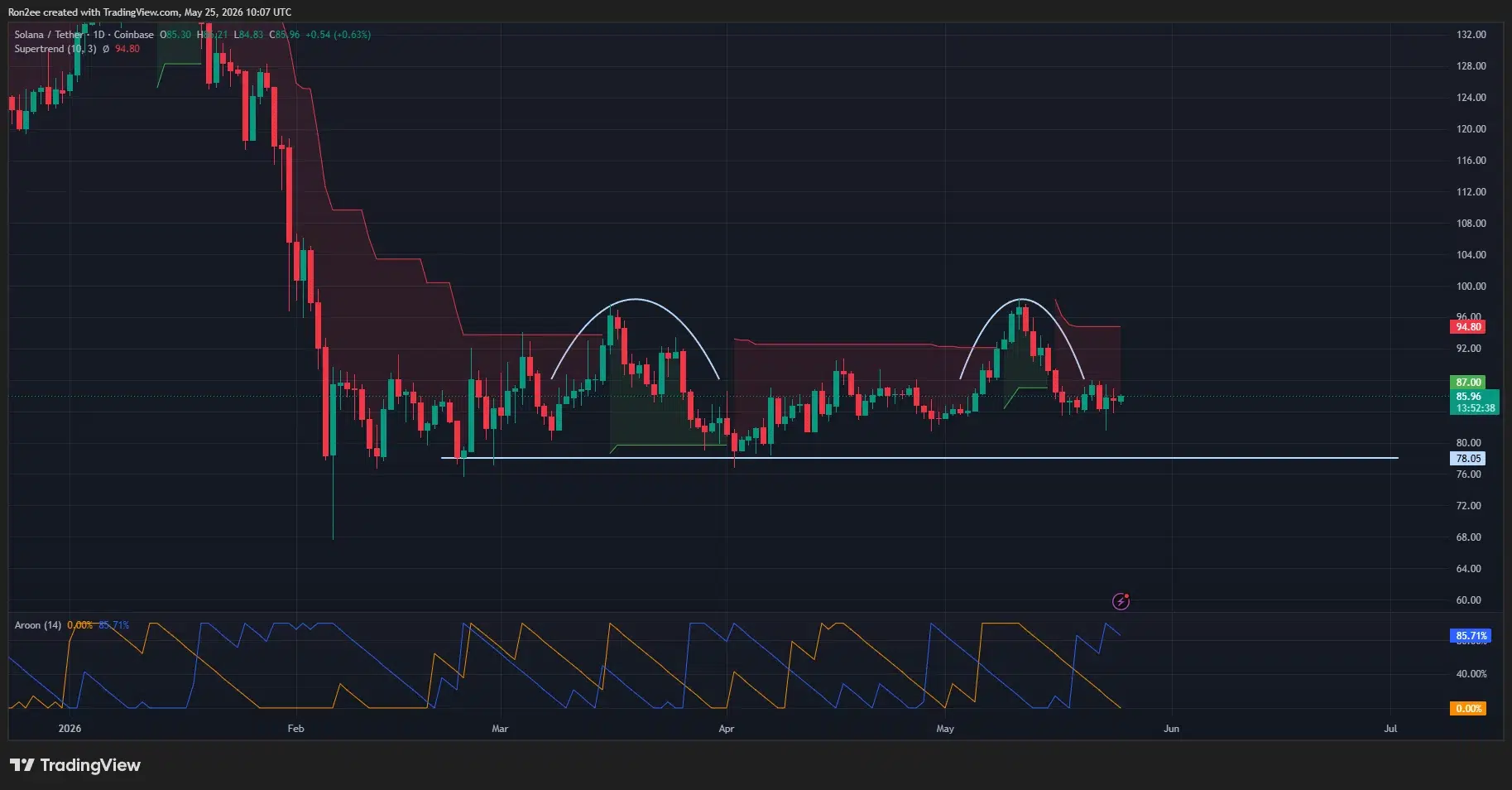
Solana has slipped back toward the mid-$80 range after repeated rejections near $100 triggered fears of a deeper correction below the critical $80 support zone.
Summary
- Solana price has remained below the key $90 resistance zone after falling nearly 15% from its recent high near $100, with traders watching the $80 support area closely.
- Daily charts show a developing double-top pattern, while CoinGlass liquidation data highlights dense leverage clusters between $83 and $78 that could accelerate downside volatility.
- Weakening Solana DEX activity, institutional outflows, and persistent macro uncertainty tied to inflation fears and Middle East tensions have continued pressuring sentiment across altcoins.
According to data from crypto.news, Solana (SOL) price was trading near $85 at press time after falling roughly 15% from its early-May peak near $100.
The decline came as institutional appetite for risk assets has weakened sharply over the past two weeks. U.S.-based crypto investment products recorded more than $1 billion in weekly outflows recently as investors reduced exposure ahead of upcoming Federal Reserve commentary and inflation data.
Solana-linked products were among the hardest hit after Goldman Sachs disclosed that it had exited several Solana and XRP exchange-traded product positions, reinforcing concerns that institutional capital continues rotating away from speculative altcoin exposure.
On-chain metrics have also deteriorated. Solana’s decentralized exchange activity has cooled significantly following the slowdown in meme coin trading volumes that previously fueled aggressive network growth earlier this year. Weekly DEX volume on the network has dropped more than 50% from recent highs, reducing fee generation and weakening demand for SOL as transactional activity declines across the ecosystem.
At the same time, rival ecosystems have started attracting liquidity that previously flowed into Solana-based applications. Base and Hyperliquid have seen increasing trader activity due to lower costs and strong perpetual trading demand. Hyperliquid, in particular, has emerged as a major competitor in decentralized derivatives, pulling both liquidity and speculative volume away from Solana-native platforms.
Meanwhile, oil market volatility and geopolitical uncertainty continue adding pressure to crypto markets. Brent crude prices remain elevated following renewed concerns surrounding shipping disruptions near the Strait of Hormuz, while investors continue monitoring negotiations between the U.S. and Iran. Higher energy prices have complicated expectations for Federal Reserve rate cuts, reducing appetite for speculative assets like Solana.
Is a double-top pattern pointing to another major Solana breakdown?
Technical indicators are increasingly pointing toward a fragile market structure after Solana failed twice to break above the $98–$100 resistance region. The daily chart shows a developing double-top pattern, with both rejection points occurring near the same supply zone before SOL price retreated back toward the mid-$80 range.
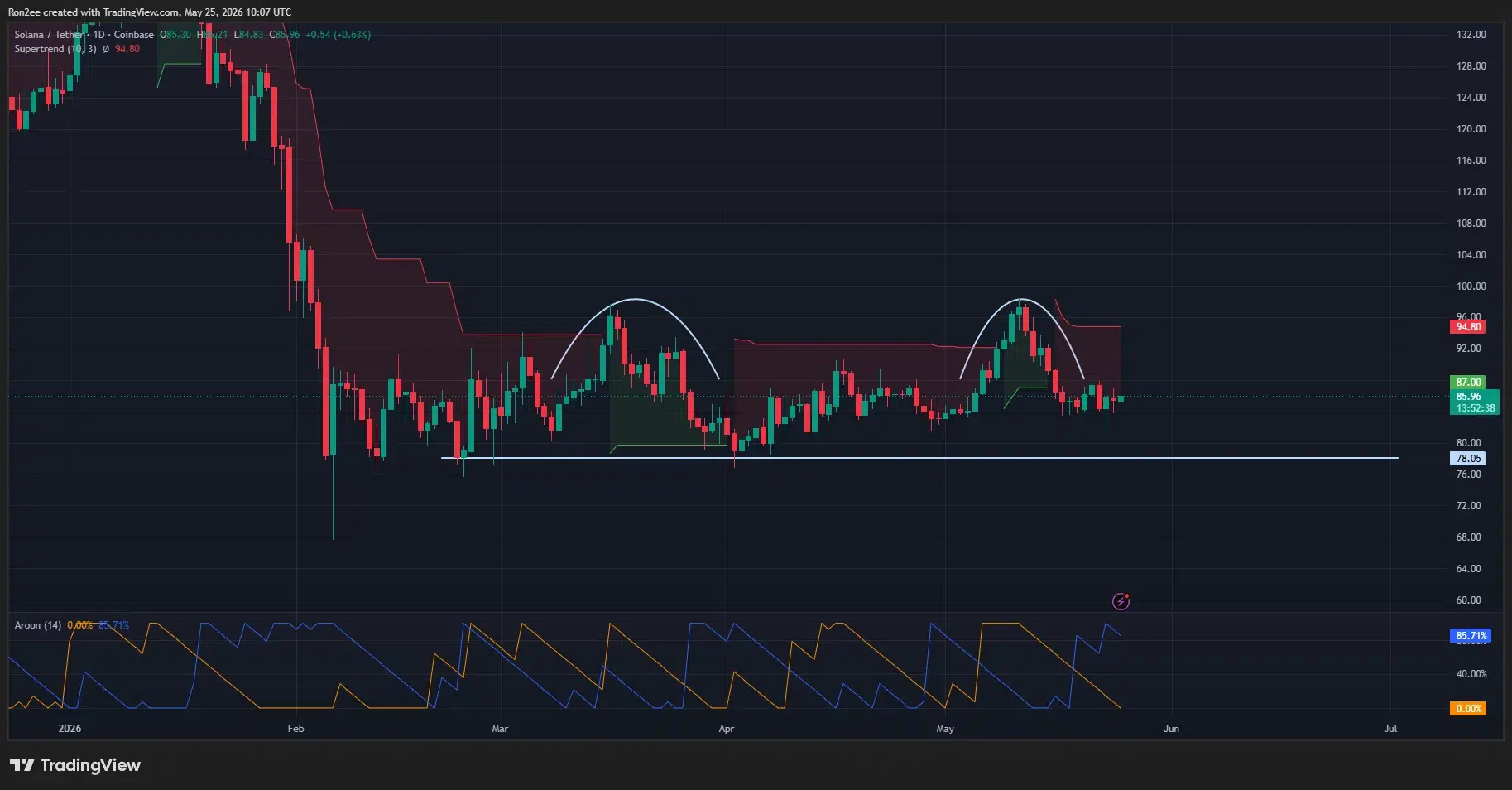
The neckline support for the structure sits near the $78 level, which has repeatedly acted as a key defensive area since March. A confirmed breakdown below that region could validate the bearish pattern and potentially open the door for a larger move toward the low-$70 range.
Pattern projections derived from the height of the structure suggest downside targets could extend toward $64 if panic selling accelerates.
Alongside the double-top formation, Solana remains below its Supertrend resistance near $94.80, indicating that sellers continue controlling the higher timeframe trend. Daily candles have also struggled to close above the descending resistance band formed after the late-April rejection, keeping bullish momentum suppressed.
Momentum indicators remain mixed but continue to favor bears overall. The Aroon indicator shows Aroon Up near 85.7% while Aroon Down remains near zero, signaling that short-term rebounds are still occurring. However, the indicator has historically produced several failed bullish signals during Solana’s prolonged consolidation phase this year, limiting confidence in a sustained recovery attempt.
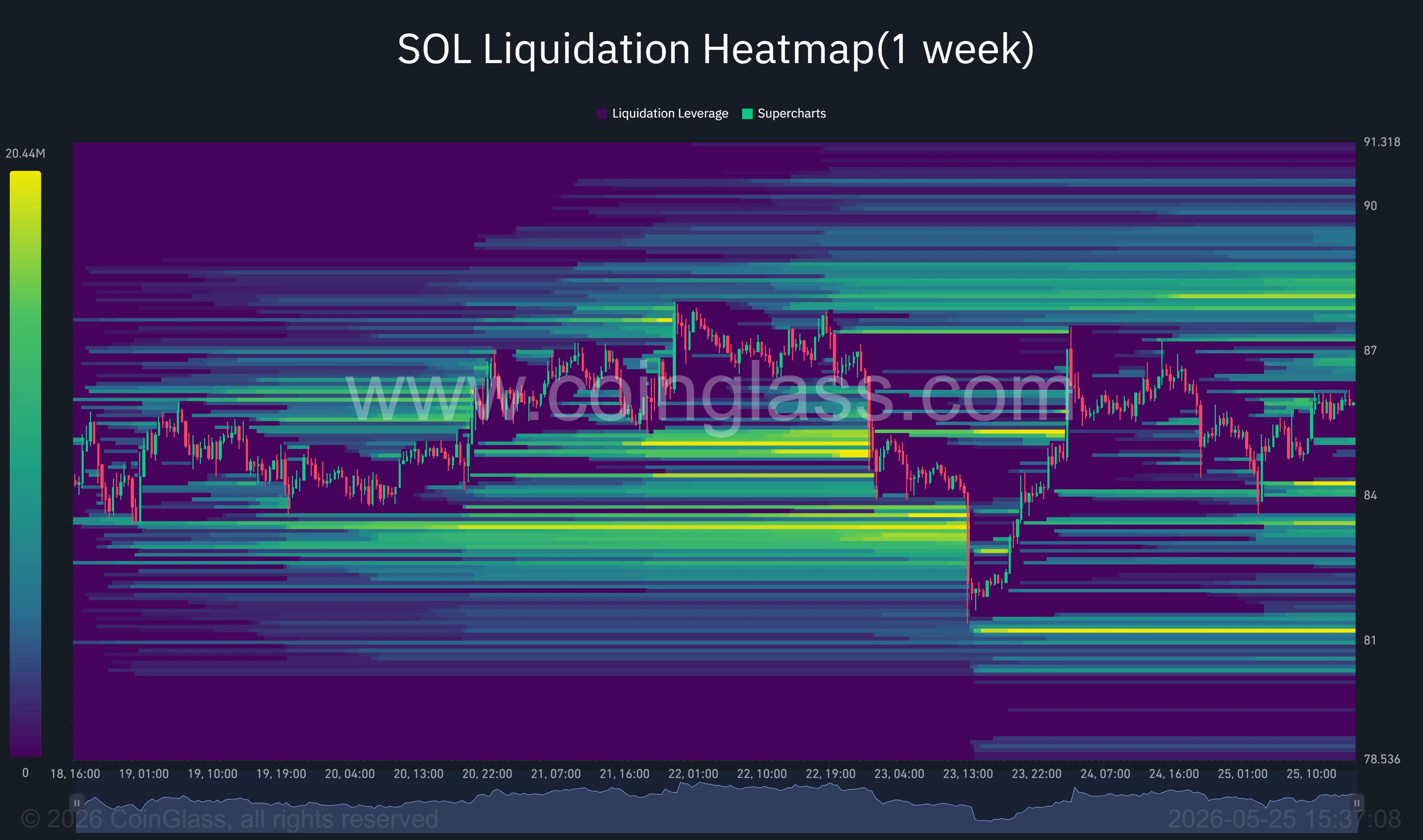
CoinGlass liquidation heatmap data shows dense leverage clusters concentrated between $83 and $81, with another major liquidity pocket sitting near $78. Those zones could become magnets for price action if volatility increases during the coming sessions.
Funding rates across perpetual futures markets have also turned deeply negative, indicating aggressive short positioning from traders expecting additional downside. Negative funding often signals bearish sentiment dominance, particularly when paired with weakening spot demand and falling network activity.
Open interest has remained elevated despite recent price weakness, a combination that often precedes sharp liquidation-driven moves.
If Solana loses the $83 support floor decisively, cascading long liquidations could accelerate the decline toward the psychological $80 threshold very quickly.
Crypto trader DonAlt warned that Solana’s current structure resembles conditions seen before previous major drawdowns. In a recent market update, he said the setup “looks very similar to Q3 2022,” adding that a temporary bull trap could emerge before another deeper correction.
The trader suggested Solana could eventually revisit the $47 region in a worst-case capitulation scenario if market conditions continue deteriorating.
Despite the bearish setup, buyers have continued defending the $83–$84 area aggressively during recent sessions. Several long lower wicks on the daily timeframe indicate dip-buying activity remains active near support, preventing a clean breakdown so far.
What could invalidate the bearish Solana thesis?
A sustained recovery above the $90 resistance zone would weaken the immediate bearish structure and potentially force short sellers to unwind positions. CoinGlass liquidity data shows a heavy concentration of short liquidation levels above $87 and $90, meaning a breakout could trigger a rapid squeeze higher if momentum returns.
Improving macro conditions could also stabilize risk appetite across crypto markets. Softer-than-expected U.S. inflation data or any signals that the Federal Reserve may ease policy later this year would likely support renewed inflows into altcoins. Bitcoin reclaiming higher resistance zones could similarly improve sentiment toward Solana and other large-cap cryptocurrencies.
Network activity remains another critical variable. Any revival in meme coin trading volumes or a sharp rebound in Solana-based decentralized finance activity could improve fee generation and restore speculative demand for SOL. Developers also continue expanding infrastructure across the ecosystem despite the recent slowdown in user activity.
For now, however, the technical structure remains vulnerable while macro conditions continue to favor defensive positioning.
Unless bulls reclaim the $90–$94 resistance range soon, Solana risks slipping below the critical $80 threshold as traders continue pricing in weaker liquidity conditions and rising downside pressure across the crypto market.
Disclosure: This article does not represent investment advice. The content and materials featured on this page are for educational purposes only.
PI finds support at $0.15, but can it hold?
PI Network (PI) Price Predictions: Analysis
Key support levels: $0.15, $0.13
Key resistance levels: $0.16, $0.20
PI Remains in a Downtrend
After PI lost its support at $0.16, the price quickly dropped to $0.15, where buyers have shown some interest. However, it is too early to say if this support level will hold or not. A much stronger candidate is the level at $0.13, which rejected bears in the past.
With this latest breakdown, sellers regained the initiative, and they may eventually be able to send PI lower, even if buyers are trying to stop a resumption of the downtrend. This is unfortunate considering that PI has already corrected by 96% since its all-time high.

Sell Volume Remains Low
Even if sellers have the advantage right now, their volume remains low and is making lower highs. This shows that they lack conviction or appear uninterested in pushing PI’s price much farther down.
Should the support at $0.15 hold, then buyers have a good shot at trying to reclaim $0.16 and rebuild momentum towards a reversal to recover some of the most recent losses since the price action turned bearish.

MACD Continues to Fall
The 3-day MACD continues to fall to new lows, as indicated by its histogram. While that is bearish, this is happening on decreasing sell volume. In light of that, this could be interpreted as a bullish divergence with a possible reversal on the horizon.
If the MACD histogram turns flat this week, that will be the first signal that sellers are no longer able to control the price, and a relief rally could follow.

The post Pi Network (PI) Price Predictions for This Week appeared first on CryptoPotato.

For years, the blockchain world has been obsessed with visibility. We track chains, compare ecosystems, argue over TPS, and proudly declare which network is “winning.” But a quiet shift is happening beneath all that noise: interoperability is slowly making blockchains less visible—and that might actually be the end goal.
Because the future of crypto may not be about which chain you’re on… but about not needing to care at all.
The Problem With Today’s Blockchain World
Right now, blockchains behave like competing cities:
- Ethereum is the financial capital 🏦
- Solana is the high-speed trading hub ⚡
- Bitcoin is digital gold storage 🪙
- Layer 2s are gated suburbs and express lanes 🚇
But here’s the catch: users still notice the borders.
You need bridges. Wrapped assets. Manual swaps. Network selection dropdowns that feel like choosing a SIM card in 2009.
That friction is not just annoying—it’s a barrier to mainstream adoption.
Enter Interoperability: The Quiet Revolution
Interoperability protocols and cross-chain infrastructure aim to erase these boundaries.
Instead of moving yourself across chains, you simply move value and actions across them—without even noticing where execution happens.
Think of it like this:
- Today: “I used Ethereum, then bridged to Arbitrum, then swapped on Solana.”
- Future: “I made a trade.”
No chain names. No bridges. No mental overhead.
Just outcomes.
When Chains Stop Competing for Attention
The real power of interoperability is not technical—it’s psychological.
If done right, users stop asking:
“Which blockchain should I use?”
And start asking:
“What do I want to do?”
At that point, blockchains become infrastructure—like TCP/IP on the internet.
Nobody says, “I sent that email using TCP packets version 4.1.”
They just say: “I emailed you.”
That’s the level of invisibility crypto is heading toward.
The Paradox: The More Connected, The Less Visible
Here’s the irony:
The more interoperable blockchains become, the less you notice them.
Instead of “multi-chain complexity,” we get:
- One balance sheet across networks
- One identity layer
- One execution layer (hidden under the hood)
Blockchains don’t vanish—they just stop being the thing you think about.
Who Wins in an Invisible Blockchain World?
Not necessarily the fastest chain or the cheapest chain.
But the systems that:
- Abstract complexity best
- Route liquidity most efficiently
- Deliver a seamless user experience
- Hide infrastructure entirely
In other words, the winners are the ones you don’t see.
The Big Shift: From Chains to Systems
Crypto is evolving from a landscape of competing blockchains into something closer to:
A distributed execution system for global digital coordination.
Chains become interchangeable execution environments.
Users stop navigating ecosystems.
They just… use the internet of value.
Final Thought
Interoperability doesn’t just connect blockchains—it dissolves their importance in the user experience.
And when that happens, the most successful blockchain might be the one that feels like nothing at all.
Invisible infrastructure is not a loss of identity.
It’s maturity.
And in crypto, maturity looks like silence.
REQUEST AN ARTICLE
Crypto World
5 Critical Stocks on Deck This Week: Marvell (MRVL), Dell (DELL), Salesforce (CRM), Costco (COST), and Tesla (TSLA)

Key Takeaways
- Marvell Technology’s earnings will reveal momentum in custom AI silicon and data center infrastructure spending
- Dell Technologies must demonstrate that surging AI server revenue is driving meaningful profit improvement
- Salesforce results will indicate whether enterprise customers are increasing AI software budgets
- Costco’s quarterly performance will offer insight into spending habits among value-conscious consumers
- Tesla remains a focal point without an earnings report, as robotaxi progress, China sales, and AI initiatives drive headlines
Investors are bracing for a consequential week as five prominent companies prepare to deliver earnings results and strategic updates spanning artificial intelligence infrastructure, enterprise technology, consumer retail, and the electric vehicle sector.
Chip and Hardware Giants Under the Microscope
Marvell Technology enters the spotlight as one of the week’s most anticipated reports. The semiconductor company has carved out significant market share in custom chip design, optical connectivity solutions, and AI infrastructure components for hyperscale data centers. The central question: are major cloud providers maintaining their aggressive capital expenditure on artificial intelligence buildouts?
Marvell Technology, Inc., MRVL
With shares trading near elevated levels, market participants have set a high bar for results. A convincing performance would reinforce the thesis that AI-driven semiconductor demand extends well beyond Nvidia’s dominance and is creating opportunities across the chip ecosystem.
Dell Technologies faces equally intense scrutiny. The company has evolved from its legacy PC business into a critical supplier of AI-optimized servers for enterprise and cloud customers. Substantial contracts tied to machine learning infrastructure have fueled recent growth.
But top-line expansion alone won’t satisfy shareholders. The critical metric is whether Dell can convert robust AI server demand into expanding profit margins. Manufacturing these advanced systems carries significant costs, and investors are demanding evidence that the business model is becoming more profitable, not just larger.
Enterprise Software, Consumer Spending, and Tesla’s Ongoing Narrative
Salesforce represents the software dimension of the AI investment thesis. While hardware companies build the infrastructure, Salesforce must prove that enterprises are willing to pay premium prices for AI-enhanced applications, automation capabilities, and intelligent data platforms.
Management has heavily promoted its AI agent technology and platform services as the next phase of growth. When financial results arrive, analysts will scrutinize revenue acceleration, operating margin expansion, and signs that customers are adopting—and paying for—these new AI features.
Costco shifts attention to the consumer economy. As a bellwether for middle- and upper-income households seeking value, the warehouse club’s performance carries significant weight. Membership renewal rates, same-store sales growth, and foot traffic trends will provide crucial signals about consumer resilience.
Given the stock’s elevated valuation multiple, delivering robust results and optimistic forward guidance will be essential to maintaining investor confidence in the current price level.
Tesla won’t release quarterly earnings this week, yet the company remains a constant focal point for market participants. Updates regarding autonomous vehicle deployment, sales performance in China, production margins, and statements from CEO Elon Musk frequently trigger significant price movements.
While Tesla has been repositioning its story around self-driving technology, artificial intelligence capabilities, and robotics ambitions, Wall Street hasn’t stopped monitoring fundamental metrics like delivery volumes and quarterly profitability.
Broader Market Implications
Collectively, these five companies provide a comprehensive snapshot of multiple market themes. Marvell and Dell will test the durability of AI infrastructure investment. Salesforce will determine whether that spending is translating into software adoption. Costco will gauge the health of the American consumer. Tesla will serve as a barometer for growth stock sentiment and retail investor enthusiasm around transformative technology.
The outcomes from this diverse group could establish important directional cues for equity markets as the calendar moves toward mid-year.

XRP is trying to reclaim the support at $1.4. Will it be successful?
Ripple (XRP) Price Predictions: Analysis
Key support levels: $1.2, $1
Key resistance levels: $1.4, $1.6, $2
Are Buyers Returning?
In an interesting development, the XRP price reversed course as soon as it left the blue pennant and is now attempting to reclaim support at $1.4. If successful, this would be a bullish reversal.
While the battle between buyers and sellers continues, XRP has managed to halt the downtrend, at least momentarily. The price also formed a higher low, another positive sign.

Bearish Momentum Loses Steam
The drop from $1.6 to $1.3 was pretty sharp and gave no relief. Sellers were quite aggressive, but now they appear exhausted. Ever since the price touched $1.3, the sell volume vanished, and buyers are returning.
Because of this, the price is now well positioned to recover some of the recent losses. This can be further compounded if buyers reclaim $1.4 as support, which could provide a strong base for a retest of the next resistance at $1.6.

Low Timeframes are Already Bullish
The 4h RSI has already bottomed and is making clear higher highs and higher lows. Even the RSI moving average is rallying. If bulls can maintain this pressure and volume, the RSI is likely to stay above 50 and even aim towards 70, which would indicate a strong uptrend.
If the first few days of this week close in green, this cryptocurrency has a real shot at a breakout from the pennant with $1.6 as a key target for its rally.

The post 3 Things to Watch in Ripple (XRP) Price This Week: Analysis appeared first on CryptoPotato.
Crypto World
Nvidia (NVDA) CEO Calls on Super Micro to Strengthen Export Controls Amid Smuggling Probe

Key Takeaways
- Jensen Huang called on Super Micro Computer (SMCI) to strengthen its export compliance measures during his arrival in Taipei over the weekend.
- Authorities in Taiwan have detained three individuals accused of falsifying export documents while shipping Super Micro AI servers with Nvidia chips to China.
- This incident follows a March U.S. federal indictment accusing Super Micro’s co-founder and accomplices of orchestrating a ~$2.5 billion smuggling operation involving Nvidia-powered servers destined for China.
- Huang disclosed that China represents part of Nvidia’s anticipated $200 billion addressable market for the forthcoming Vera CPU.
- While H200 chips have received export approval for China, no deliveries have occurred to Chinese buyers to date.
Nvidia’s chief executive Jensen Huang touched down in Taipei over the weekend and immediately confronted the escalating concerns surrounding Super Micro Computer (SMCI) and alleged AI chip smuggling operations to China.
Addressing media at Songshan Airport, Huang emphasized that Nvidia maintains “rigorous” standards when briefing partners on U.S. export regulations. He expressed his expectation that Super Micro will “enhance and improve” its compliance framework to avoid future violations.
His remarks follow an announcement from Taiwan’s Keelung District Prosecutors’ Office that three individuals were detained earlier this week. The suspects allegedly filed false shipping documents to facilitate the export of Super Micro servers—equipped with cutting-edge Nvidia AI processors—to destinations including China, Hong Kong, and Macau.
Super Micro has not issued an immediate statement in response to media inquiries. The company previously indicated its dedication to safeguarding advanced American technology and pledged to reinforce its international trade compliance operations.
This marks another chapter in Super Micro’s ongoing export control challenges. Earlier this year in March, federal prosecutors in the United States indicted Super Micro co-founder Yih-Shyan “Wally” Liaw alongside two associates for allegedly orchestrating a conspiracy to smuggle approximately $2.5 billion in Nvidia-equipped servers to China using shell entities across Southeast Asia.
Liaw has entered a not guilty plea. Super Micro maintains that it is not a defendant in the case and is actively cooperating with authorities.
While the Taiwan detention is administratively separate from the U.S. federal charges, both investigations share significant overlap. Each case involves similar alleged smuggling networks—utilizing intermediary companies to circumvent U.S. export restrictions and funnel prohibited Nvidia AI technology into China.
A Bloomberg investigation published earlier this month identified a firm associated with Thailand’s national artificial intelligence initiative as potentially facilitating the transfer of Super Micro servers to Chinese entities. That reporting named Alibaba (BABA) among several ultimate recipients.
China Remains Central to Nvidia’s Growth Strategy
Despite ongoing export control controversies surrounding its products, Huang made clear that China continues to factor prominently in Nvidia’s future revenue projections.
Speaking to journalists at the airport, Huang revealed that China is incorporated into the $200 billion total addressable market estimate he presented for Nvidia’s next-generation Vera CPU during the company’s earnings call on May 20th.
Nvidia’s H200 processor has secured U.S. licensing for Chinese exports, with approximately ten Chinese companies authorized to acquire the technology. Yet remarkably, zero H200 units have reached any Chinese customer thus far.
Huang characterized the Chinese market as “very important” and “very large,” stating it “would be terrific” to supply it. Nevertheless, recent discussions between President Trump and Chinese President Xi Jinping in Beijing this month yielded no resolution on export matters.
Taiwan Events: GTC and Computex
Huang’s Taiwan visit precedes Nvidia’s GTC Taipei conference and his keynote address at Computex, slated for June 1st. Industry observers anticipate he will unveil detailed information about the software architecture underlying Nvidia’s Vera Rubin platform.
He characterized the platform as “the largest product launch, probably in the history of Taiwan.” Every Vera Rubin NVL72 system incorporates nearly 2 million individual components and engages approximately 150 Taiwanese supply chain partners.
According to current reports, Super Micro shipments connected to the smuggling investigations remain suspended, with both U.S. and Taiwan authorities continuing their active inquiries.
After declining to about $74,000 on Saturday, Bitcoin’s price recovered to $77K yesterday and seems to have stabilized at that level.
The move follows a statement from the US President Donald Trump on the state of affairs with Iran and the potential for a permanent peace, although the market seems to have accepted it as an extension of the current ceasefire.
Bitcoin Price Stable at $77,000, Important Week Ahead
As we reported earlier today, crypto markets have remained mostly flat over the past 24 hours. They did go through a weekend boost after the US President hinted at a “largely negotiated” deal with Iran.
Analysts also hinted that the ceasefire is likely to be extended for another 60 days.
“It also appears further progress has been made toward a 60-day ceasefire extension for the Iran war.” – Wrote the Kobeissi Letter.
That said, Bitcoin is trading slightly above $77,000 and remains stable on Memorial Day, with markets closed.

However, the week ahead holds important economic events, namely:
- Consumer confidence data for May – on Tuesday
- April’s PCE inflation data – on Thursday
- US Q1 2026 GDP data – on Thursday
It’s also important to note that spot Bitcoin ETFs marked one of their worst weeks from May 18 to May 22, noting more than $1.2 billion in outflows. Ethereum ETFs also suffered, while other products like SOL, XRP, and HYPE funds saw increases in assets under management.
Altcoins Flat, HYPE Rally Cools Off
Many altcoins have also traded relatively flat over the past 24 hours, especially those with the largest market capitalizations. ETH is more or less where it was yesterday; BNB is up 0.5%, TRX by 0.3%, while XRP, SOL, DOGE, and ADA are down 0.3%.

One of last week’s best performers, HYPE, seems to be slowing down after surging by more than 40% in the past seven days. That said, the altcoin continues to show considerable strength and is already ranked as the 11th-largest project in the industry by total market capitalization.
The best performers from the past 24 hours include DEXE, which increased by 20%, STABLE, up 15%, and XDC Network (XDC), up 9.6%. On the flipside, Uniswap’s UNI is down 2.7%, making it today’s worst-performing altcoin, followed by Kaspa and Sui.
The post Bitcoin Price Stabilizes at $77K as President Trump Updates on Iran Deal: Market Watch appeared first on CryptoPotato.
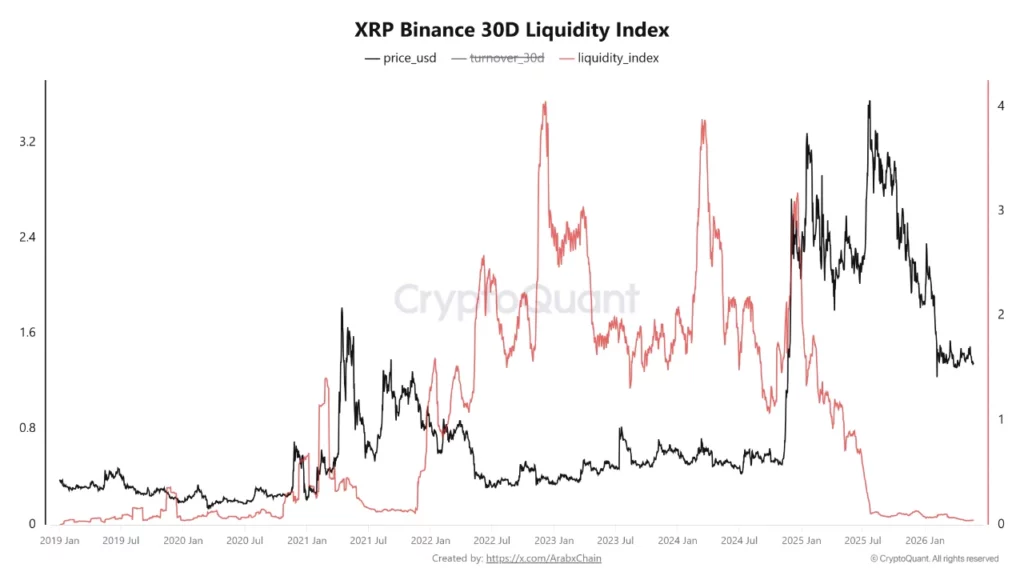
XRP market depth on Binance has dropped to its weakest level since January 2020, according to CryptoQuant analyst Arab Chain.
Summary
- XRP Binance liquidity index fell near 0.043, its lowest reading since January 2020, CryptoQuant data shows.
- Binance whales withdrew $49.2 million in XRP as price returned to a repeated accumulation zone.
- XRP trades near $1.36, below short-term moving averages, with $1.40 still blocking recovery.
The analyst said XRP’s 30-day liquidity index on Binance fell to about 0.043 while the token traded near $1.34.
The reading points to a sharp fall in available liquidity compared with earlier market phases. Arab Chain said the index had previously reached readings above 3 and 4 points between 2022 and 2024, when XRP saw stronger trading activity and higher volatility.
XRP Binance liquidity falls to a six-year low
Low liquidity does not give a direct bullish or bearish signal on its own. However, thinner market depth can make XRP more sensitive to large orders because fewer bids and asks sit near the current price.
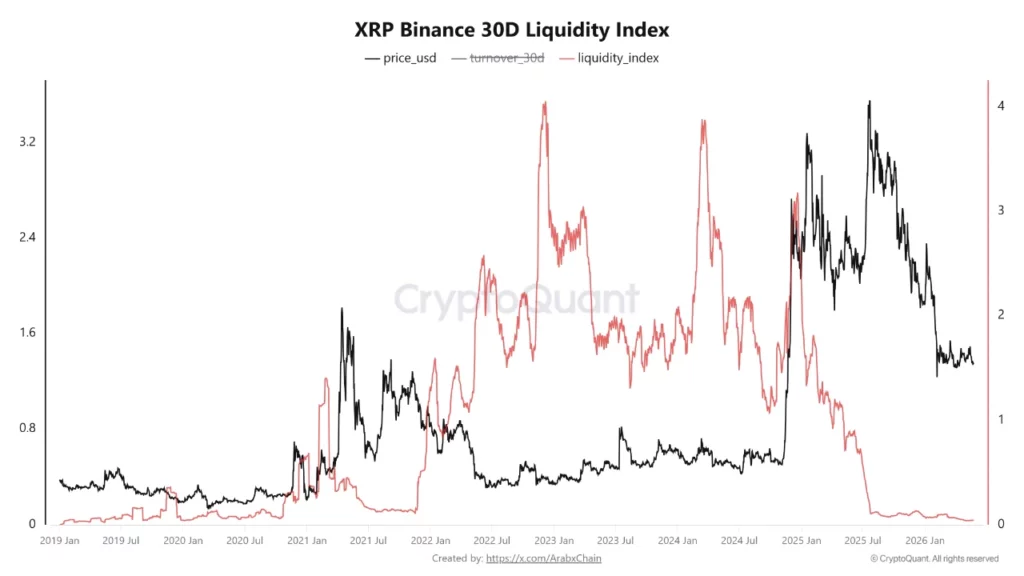
That means sudden buying or selling can move price faster than usual. For traders, the current setup creates a market where volatility can rise even if daily volume remains modest.
The drop also signals weaker speculative activity on Binance. Arab Chain said the decline may show reduced new liquidity inflows and a more cautious market structure.
The update comes as XRP remains stuck near the same range it has traded around for months. The $1.35–$1.40 area now carries added focus because it connects thin liquidity with repeated whale activity.
Binance whales withdraw XRP near $1.35
CryptoQuant analyst Amr Taha reported that XRP whales withdrew $49.2 million from Binance on May 22 while the token traded below $1.35. In exchange-flow terms, negative whale netflow means large holders moved more XRP away from Binance than they sent in.
That move matters because it happened during price weakness, not after a strong rally. Whale withdrawals during weakness can show that some large holders are reducing available exchange supply instead of preparing to sell.
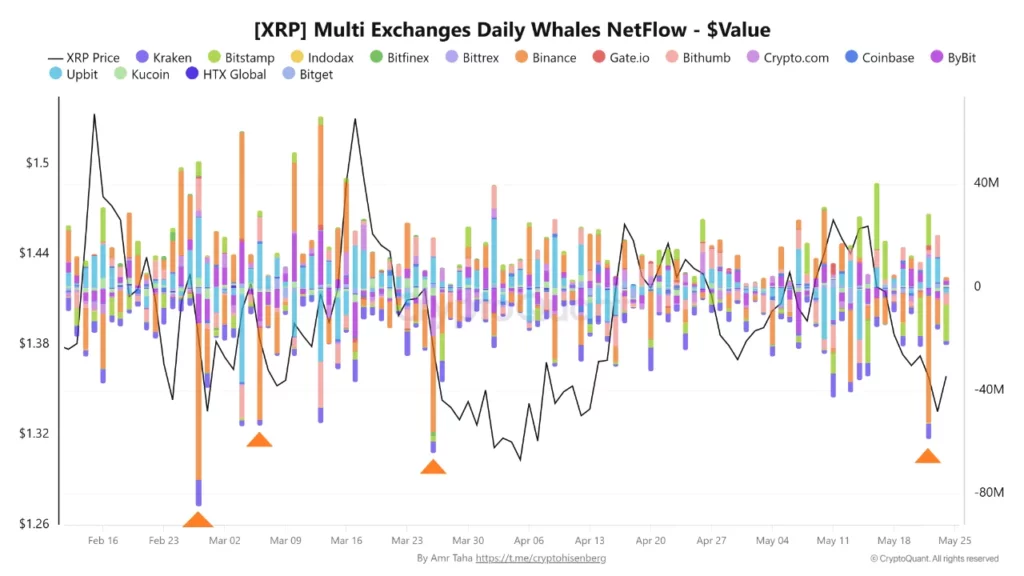
The May 22 reading also followed similar whale behavior earlier this year. Taha cited negative Binance whale netflows of $60.7 million on Feb. 27, $35.5 million on March 6, and $37 million on March 26.
All four signals appeared near the $1.35–$1.40 range. That makes the zone one of the clearest recent areas of repeated Binance whale withdrawals.
Still, whale withdrawals do not confirm an immediate rebound. They can reduce potential sell-side supply, but price still needs stronger demand and a clean technical breakout.
XRP price stays below key moving averages
XRP traded at $1.36 on May 25, 2026, according to crypto.news price data. The token was up 0.23% over 24 hours, while its 24-hour trading volume stood at about $1.35 billion.
The same data showed XRP trading between $1.34 and $1.37 over the past 24 hours. XRP ranked fifth by market cap, with a market value of about $84.23 billion.
The short-term chart remains weak. XRP traded near $1.3584, below the 9-day moving average at $1.3663 and the 21-day moving average at $1.4051.
That structure keeps pressure on buyers unless XRP reclaims the $1.36–$1.40 area. The shorter moving average also remains below the longer one, which keeps the near-term trend neutral-to-bearish.
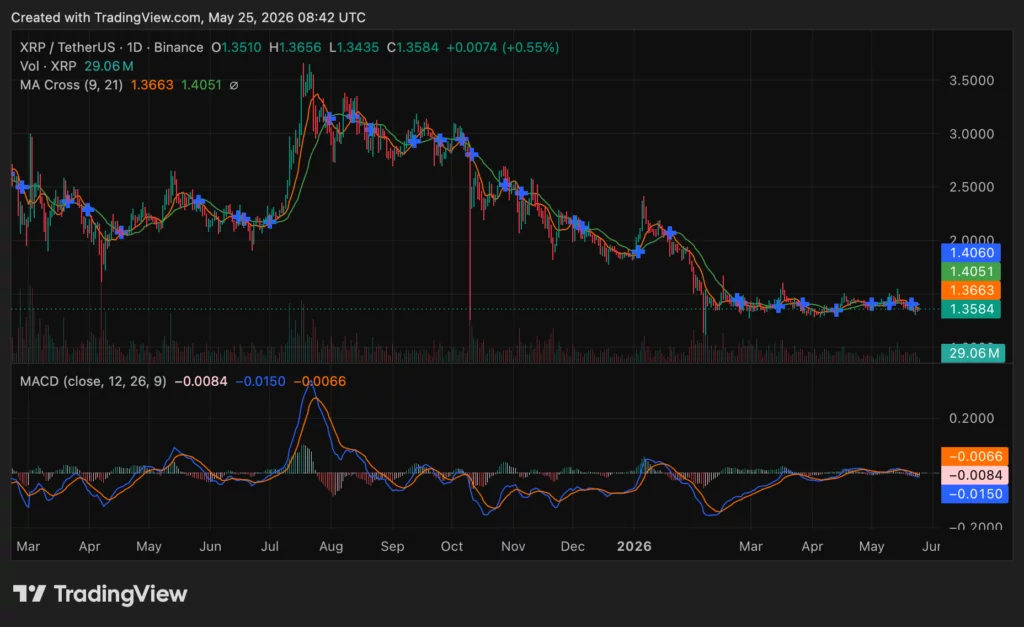
Immediate support sits near $1.3435, close to the daily low. Resistance stands near $1.3663, followed by the larger $1.4051–$1.4060 zone.
Volume near 29.06 million XRP remains low compared with earlier selloff spikes. That shows the latest bounce has not yet drawn strong market participation.
The MACD also remains below the zero line. The MACD reading near -0.0150, signal line near -0.0066, and negative histogram near -0.0084 show weak bearish momentum.
Traders watch $1.40 and $1.50 resistance
Related crypto.news coverage said XRP recently traded near $1.37 as exchange-flow data showed cooling deposit pressure. The same report said Binance and Coinbase had shifted toward withdrawal-led transactions, which may show easing exchange selling pressure. XRP stayed within a range, with support near $1.29–$1.35 and resistance near $1.50.
Separate crypto.news coverage showed a large XRP options trader collected $224,500 in premiums by betting XRP would stay near $1.40 through June 26. The trader sold 1.5 million contracts each of the $1.40 call and put options on Deribit.
That options trade fits the wider range-bound setup. Crypto.news noted that XRP had traded between $1.30 and $1.50 for roughly 60% of 2026, making the $1.40 area a key short-term price zone.
Crypto Patel also cautioned against aggressive upside targets without enough liquidity, structure, or a clear catalyst map. The analyst said $10 remains a long-run target, while the best accumulation area sits between $1 and $0.70.
CRYPTOWZRD said XRP closed indecisively and continued to hold a range. The analyst said a move above $1.40 could open upside, while a rejection near that level could set up a move back toward $1.32.
Disclosure: This article does not represent investment advice. The content and materials featured on this page are for educational purposes only.

- The malware spread through npm, PyPI, and Rust packages in coordinated waves.
- It steals crypto wallets, SSH keys, and cloud developer credentials.
- AI coding tools were also targeted through malicious config files.
A coordinated malware campaign known as TrapDoor has hit software ecosystems widely used by crypto and blockchain developers.
Security researchers identified dozens of malicious packages spread across major open-source repositories, all designed to steal sensitive developer data such as wallet keys, cloud credentials, and source code access tokens.
Instead of a single malicious upload, attackers deployed multiple packages in waves using different accounts.
This approach made the activity harder to detect at the early stages and allowed the malware to blend into routine dependency updates.
Coordinated attack across major developer ecosystems
The TrapDoor operation affected at least three major package ecosystems: npm, PyPI, and Crates.io.
Together, researchers identified more than 30 malicious packages and over 300 affected versions distributed within a short window.
The activity reportedly began around May 22, 2026, although GitHub reported unauthorized access to internal repositories on May 20. It then escalated quickly over the following days.
The packages were not isolated incidents. Instead, they appeared to be part of a coordinated release strategy involving multiple developer accounts.
This structure suggests planning rather than opportunistic abuse. Each package carried similar behavior patterns and pointed to a shared malicious framework used by the attackers.
How the TrapDoor malware operates inside developer systems
Once installed, TrapDoor packages execute automatically through standard build and installation processes used in modern development environments.
In JavaScript packages, malicious code is triggered through post-install scripts, which run immediately after a dependency is added.
In Python packages, the malware can activate during import, allowing it to execute without any explicit function call.
Rust packages use build scripts to achieve the same result during compilation.
After execution, the malware scans local systems for valuable data. This includes SSH keys, API tokens, and configuration files commonly used in cloud and blockchain development workflows.
It also targets browser-stored credentials and environment variables, which often contain sensitive authentication data.
Stolen information is then sent to external servers controlled by the attackers.
In some cases, the malware attempts to maintain persistence by modifying startup processes or inserting malicious hooks into development tools.
Crypto-focused targeting and high-value data theft
What makes this campaign particularly concerning is its focus on crypto-related development environments.
The malware specifically searches for crypto wallet-related files and credentials linked to platforms such as Coinbase, MetaMask, Binance, and Solana-based tools.
It also targets cloud infrastructure credentials from providers like AWS and GitHub access tokens.
These are especially valuable because they can provide attackers with direct access to private repositories, deployment pipelines, and backend systems.
In addition, the malware attempts to collect SSH keys that could allow remote access to developer machines or production servers.
This combination of targets gives attackers a wide range of entry points into both personal and enterprise systems.
AI development tools also under pressure
One of the more unusual elements of the TrapDoor campaign is its interaction with AI-assisted development environments.
Some malicious packages include configuration files designed to influence coding assistants and automated development tools.
Files such as .cursorrules and CLAUDE.md were reportedly used to manipulate AI coding assistants into performing actions that could expose sensitive information.
Instead of directly hacking systems, the attackers attempted to exploit how AI tools interpret project instructions.
This approach reflects a shift in attack methods.
Rather than targeting only code execution, the campaign also attempts to influence developer workflows that rely on AI-generated suggestions and automated analysis.

Wipro’s Rs 15,000 crore share buyback at 23% premium: Should you buy before record date?

Chun Wang Joins SpaceX Mars Mission, Signals Crypto Industry Shift

‘The Mandalorian and Grogu’ Needs a Box Office Miracle After an Underwhelming Opening


-

 Crypto World4 days ago
Blockchain.com files with SEC for U.S. IPO
-

 Fashion3 days ago
Holiday Weekend Open Thread – Corporette.com
-

 Crypto World3 days ago
Bitcoin Accumulation Weakens as BTC Realized Losses Hit $600M
-

 Business3 days ago
Dell Technologies DELL Stock Surges 15% on AI Server Momentum and Analyst Upgrades in 2026
-

 Crypto World3 days ago
Space X IPO Is ‘Bad News’ for Tech Stocks: But What About Bitcoin?
-

 Politics3 days ago
Makerfield: a tale of two social-media histories
-

 Crypto World2 days ago
Robinhood crypto COO Tanya Denisova exits
-
 Crypto World3 days ago
MicroStrategy’s Saylor Says Miners No Longer Set Bitcoin Price, Another Force Has Taken Over
-

 Business16 hours ago
NYT Strands Answers May 24 2026 Revealed for Puzzle No. 812 Theme Summer Essentials
-
 Tech3 days ago
A 0.12% parameter add-on gives AI agents the working memory RAG can’t
-

 Crypto World3 days ago
AI infrastructure race heats up as IREN pitches full-stack strategy, WhiteFiber lands $160M deal
-

 Tech3 days ago
WhatsApp ads could make Irish debut after discussions with DPC
-

 Tech3 days ago
You Can Now Add ChatGPT To PowerPoint
-

 Business3 days ago
Trump Invests $1M-$5M in Kura Sushi USA Chain With 27 California Locations
-
 Crypto World7 days ago
Revolut Launches Dogecoin Debit Card Across UK and EU
-
 NewsBeat4 days ago
Charity run by Reform leader Malcolm Offord accused of ‘law breaking’ over Scottish registration
-

 Sports3 days ago
2026 CJ Cup Byron Nelson leaderboard: Brooks Koepka finds putting stroke in Round 1
-
Business3 days ago
Goldman Sachs reinstates Ageas stock coverage with neutral rating
-
 Crypto World5 days ago
Exa Labs raises $250 million in funding led by a16z
-

 Crypto World3 days ago
Trump Media’s Bitcoin Stash Shrinks Again as 2,650 BTC Lands on Crypto.com
You must be logged in to post a comment Login