In mid-December 2020, federal officials responsible for protecting American elections from fraud converged in a windowless, dim, fortified room at the Justice Department’s downtown Washington, D.C., headquarters.
They had been summoned by Attorney General William Barr.
Advertisement
Over the preceding weeks, Donald Trump’s claims that the presidential election had been stolen from him had reached a crescendo. He’d become obsessed with a conspiracy theory that voting machines in Antrim County, Michigan, had switched votes from him to Joe Biden.
With each day, Trump ratcheted up the pressure to unleash the might of the federal government to undo his defeat.
Barr interrogated experts from the Cybersecurity and Infrastructure Security Agency, crammed in beside top FBI officials around a cheap table. He needed the group of around 10 to answer a crucial question: Was it really possible the 2020 presidential vote had been hacked?
ProPublica’s description of the previously unreported meeting comes from several people who were in the room or were briefed on the gathering. Everyone understood that the meeting represented an important moment for the nation, they said. Barr, who did not respond to requests for comment, had walked a delicate line with Trump, instructing the FBI to investigate allegations of election irregularities while declaring publicly there had been no evidence “to date” of widespread fraud.
Advertisement
The nonpartisan specialists from CISA, backed by their FBI counterparts, explained they’d unravelled what had happened in Antrim County. A clerk had made a mistake when updating ballot styles on machines, leading to a software problem that initially transferred votes from Republicans to Democrats, they said. There was no fraud, just human error — which would soon be publicly confirmed through a hand count of the county’s ballots.
Listening intently, Barr seemed to understand both the truth and that telling it to the president would almost certainly cost him his job.
At the end of the meeting, Barr turned to his top deputy, made hand motions as if he was tying on a bandana and said he was going to “kamikaze” into the White House.
What happened next is well known. When Barr met with Trump in the Oval Office on Dec. 14, the president launched into a monologue about how the events in Antrim County were “absolute proof” that the election had been stolen. Barr waited to get a word in edgewise before telling his boss what the experts from CISA had told him.
Advertisement
Then Barr offered his resignation letter, which Trump accepted. Barr left believing he’d done his part to preserve democratic norms.
“I was saddened,” Barr wrote of Trump in his memoir. “If he actually believed this stuff he had become significantly detached from reality.”
Barr was one of many federal officials — most of them Trump appointees — who refused to bend to the president’s demands, which only intensified after Barr was gone. Although rioters inspired by Trump managed to delay the certification of his defeat by storming the Capitol on Jan. 6, 2021, ultimately the institutional guardrails of American democracy held — barely.
But if faced with the same tests today, the guardrails and people that held the line would largely be missing, an examination by ProPublica found.
Advertisement
ProPublica scrutinized what happened the last time Trump lost a national election. Some of that happened in plain sight: After a cascade of defeats in court, Trump began pressuring state and local officials to overturn the results. But more happened behind the scenes, like the meeting that helped persuade Barr to hold the line.
Our reporting uncovered previously undisclosed aspects of a federal effort to safeguard the results of the 2020 vote, which involved at least 75 people across several agencies. Today, nearly all of those people are gone, having resigned, been fired or been reassigned, particularly in the departments of Justice and Homeland Security. That included the cybersecurity specialists who had established that the Antrim County allegations were false and reported their findings to Barr.
The people we identified as resisting attempts to overturn the 2020 results have been replaced by roughly two dozen people Trump has installed in positions that could affect elections. Ten of them actively worked to reverse the 2020 vote, and the rest are associates of such people. In some cases, ProPublica found, officials have been hired from activist groups that are pillars of the election denial movement. Experts warn that shows the movement has merged with the federal government.
These new officials could influence how Trump reacts to the upcoming midterms as polling shows Republicans are approaching what could be a significant electoral loss, with the president’s approval rating nearing record lows, and public concern growing about the weak economy, the administration’s mass deportation effort and the war on Iran. Seemingly in preparation to head off such a blow, Trump has stepped up his efforts to “nationalize” the 2026 elections, saying that Republicans need “to take over” the midterms. Democrats who monitored Trump’s attempts to block his 2020 loss have begun to question whether he will allow a “blue wave,” particularly if it flips control of a House of Representatives that impeached him twice in his first term.
Advertisement
ProPublica’s examination reveals new details on how the president has unleashed his loyalists to transform elections. This includes the background of this year’s FBI raid in Georgia to seize 2020 election materials and how they are using federal resources to search for noncitizens voting. Ultimately, ProPublica’s reporting shows how thoroughly and expansively the Trump administration has overhauled the federal government into what some fear is a vehicle for making sure elections go his way.
ProPublica’s reporting is based on interviews with roughly 30 current or former executive branch officials familiar with the work of Trump loyalists installed in election roles. Most spoke on condition of anonymity because they fear retribution, including those knowledgeable about the December 2020 Barr meeting.
The Trump administration maintains its actions will make U.S. elections fairer and more secure — and keep those prohibited from voting, such as noncitizens, from doing so.
“Election integrity has always been a top priority for President Trump,” White House spokesperson Abigail Jackson said in a statement. “The President will do everything in his power to defend the safety and security of American elections and to ensure that only American citizens are voting in them.”
Advertisement
Spokespeople for the DOJ and DHS emphasized that their departments are focused on ensuring elections are free and fair, and that they are working closely with the states to achieve those goals. Contentions to the contrary, they say, are false.
A few guardrails have endured, preventing Trump from fully realizing his agenda for elections. Judges have blocked key parts of a March 2025 executive order in which Trump attempted to exert greater federal control over aspects of voting, and some Republican state officials have fought back against Justice Department lawsuits demanding state voter rolls.
Late last month, Trump issued another executive order on elections that attempts to exert unparalleled federal control over mail-in voting and voter eligibility, which Democrats and voting rights groups are challenging in court.
Experts say 2026 will serve as an unprecedented stress test of the integrity of American elections.
Advertisement
“Our election system withstood” Trump’s “attacks following the 2020 election,” said Sen. Alex Padilla, a California Democrat who has led the pushback to the administration’s actions on elections, “but this will be an even tougher test, with more election deniers having access to federal power than ever before.”
The Dismantling
Barr has said that in the high-stakes days following the 2020 election, he felt like he was playing Whac-A-Mole with Trump’s “avalanche” of false election claims.
The investigators at DHS’ Cybersecurity and Infrastructure Security Agency supplied intelligence that disproved many of them, not just those involving Antrim County.
CISA was created by Trump in his first term to counter cyber threats in the aftermath of Russia’s efforts to influence the 2016 vote. It soon came to provide crucial expertise and support to thousands of local election officials grappling with increasingly sophisticated attacks.
Advertisement
After the 2020 election, it also played a crucial part in puncturing fallacies spread by Trump supporters, producing a “Rumor Control” website to rebut them. And it partnered with state officials and technology vendors to release a statement calling the election “the most secure in American history.” Trump swiftly fired Chris Krebs, whom he had appointed to lead CISA, but Krebs’ defense of the election’s soundness reverberated widely in the media and on Capitol Hill.
Among Trump’s first actions upon returning to the Oval Office was eviscerating CISA.
Starting in February 2025, DHS leadership put employees focused on countering disinformation and helping safeguard elections on leave. The leadership also froze the agency’s other election security work, which included assessing local election offices for physical and cybersecurity risks, and disseminating sensitive intelligence information on threats. Eventually, all three dozen or so CISA employees specializing in elections were fired or transferred to work in other areas.
“It took years of dedicated, bipartisan, cross-sector partnership to build the security infrastructure we’ve had, and dismantling CISA leaves a gaping hole,” said Kathy Boockvar, an elections security expert who served as Pennsylvania’s secretary of state from 2019 to 2021. “We are making the job of securing our democracy exponentially harder.”
Advertisement
A DHS spokesperson told ProPublica that the changes at CISA were in response to “a ballooning budget concealing a dangerous departure from its statutory mission,” which included “electioneering instead of defending America’s critical infrastructure.” The spokesperson said that CISA’s mission is still to coordinate protection of critical infrastructure, including by supporting local partners against cyber threats.
It isn’t just CISA that’s been gutted.
The Trump administration has discarded or diminished other federal initiatives with roles in protecting election integrity or blocking foreign interference. While many of these actions have been reported, together they reveal the full sweep of the changes.
First, the administration got rid of the National Security Council’s election security group, which convened departmental leaders to coordinate federal actions related to voting. Then in August, the administration dismantled the Foreign Malign Influence Center, a branch of the Office of the Director of National Intelligence that had stymied efforts by Russia, China and Iran to interfere in the 2024 election.
Advertisement
A spokesperson for ODNI said the center was redundant and that its functions were folded into other parts of the office’s intelligence apparatus in ways that “arguably makes our ability to monitor and address threats from foreign adversaries stronger, more efficient and more effective.”
However, former national security officials, including one who had worked at the center, told ProPublica that its functions had largely ceased. Caitlin Durkovich, who led the NSC’s election security work during the Biden administration, said that under Trump the federal government has “abandoned” its traditional role in preserving election integrity and security.
“Nearly every program and capability to stop bad actors and support election administrators has been dismantled,” she said. “Heading into the midterms, this leaves states and localities exposed, without the intelligence support or federal coordination they need to detect and respond to threats in real time — precisely when the stakes are highest.”
The early months of the second Trump administration also brought seismic changes to three parts of federal law enforcement with central roles in elections.
Advertisement
Kash Patel, the FBI’s new director, dismantled the public corruption team, which had been deployed in previous administrations to help monitor possible criminal activity on Election Day. The Foreign Influence Task Force, which aimed to combat foreign influence in U.S. politics, was also disbanded. (An FBI spokesperson said the bureau “remains committed to detecting and countering foreign influence efforts by adversarial nations.”)
Furthermore, the Justice Department substantially reduced the role of its Public Integrity Section, which had been responsible for making sure the department’s inquiries weren’t improperly influenced by politics.
After the 2020 election, senior lawyers in the section warned against having the FBI investigate fraud claims raised by Trump allies, saying that the agency’s involvement could damage its reputation and appear motivated by partisanship. In this instance, they were overruled by Barr and his deputies, but former officials said this was a rare case in which their guidance was ignored. The need to directly overrule the unit, they said, made it a roadblock — one that no longer exists.
A month after Trump returned to the Oval Office, the unit’s top staff resigned when agency leaders directed them to dismiss corruption charges against then-New York City Mayor Eric Adams. More resigned later or were transferred. The 36-person section was reduced to two. The administration no longer mandates that it review politically sensitive cases, according to multiple people familiar with the matter.
Advertisement
Another key DOJ office, the Civil Rights Division’s voting section, had enforced federal laws that protect voting rights, particularly those that combat racial discrimination. In December 2020, the assistant attorney general overseeing the Civil Rights Division was one of the many department leaders who said they would resign if Trump promoted Jeffrey Clark, a leader who supported Trump’s efforts to overturn the election results, to head the department after Barr’s resignation. This mass threat of resignation ultimately led Trump to not promote Clark.
But now, nearly all of the section’s roughly 30 career lawyers have resigned or been moved. This largely started last spring after Harmeet Dhillon, Trump’s assistant attorney general for civil rights, put out a memo saying their mission would shift from ensuring voting rights to enforcing Trump’s executive order on elections.
“It’s just a shocking and depressing reversal of the federal government’s role in making real the promise of nondiscrimination in voting and racial equality,” said Anna Baldwin, an appellate attorney for the Civil Rights Division who resigned last year and is now one of those litigating against the Justice Department in a new role at Campaign Legal Center.
Advertisement
The Justice Department didn’t respond to specific questions about the dismantling of the Public Integrity Section or the change in mission for the Civil Rights Division.
In all, at least 75 career officials who’d played important roles in elections work at DHS, DOJ and other departments have left or been fired, ProPublica found.
Team America
Late last summer, after the Trump administration had forced out most of the career specialists, a small group of political appointees began convening at the Department of Homeland Security’s headquarters.
The group — which once called itself “Team America,” according to sources familiar with the matter — looked for federal levers it could pull to make Trump’s March executive order about elections a reality, an effort that has not been previously reported.
Advertisement
They represented the new type of people running the show.
Its core members included David Harvilicz, a DHS assistant secretary tasked with overseeing the security of election infrastructure, including voting machines, and three of his top staffers. As ProPublica has reported, Harvilicz had co-founded an AI company with an architect of Trump’s claims about Antrim County.
Despite the setbacks the executive order had met with in court, there “was not a whole lot of discussion or disagreement” about acting on the directive from Harvilicz or one of his deputies, said a former federal official who interacted with group members. “It was just us saluting to do it.”
This small group was part of a wider team at DHS, DOJ and the White House seeking to push forward the president’s agenda. Some of Trump’s new guard are well known: After the 2020 election, Patel pressured military officials to help investigate a conspiracy theory about voting machines, according to a former Justice Department official. (Patel did not respond to a request for comment but claimed in congressional testimony that he did not recall the event.) Others, like Harvilicz, are more obscure but still wield consequential powers.
Advertisement
These newcomers are seeking to carry out Trump’s executive orders and are unlikely to push back against his false claims that American elections are rife with fraud.
Team America members have echoed or spread such material themselves.
Heather Honey, who serves under Harvilicz in a newly created position focused on elections, falsely asserted that there were more ballots cast in Pennsylvania than voters in the 2020 presidential election. Trump cited this claim, which has been traced back to her, while exhorting his followers to march on the Capitol on Jan. 6, 2021.
At least 11 administration appointees, including Honey, have ties to the Election Integrity Network, a conservative grassroots organization seeking to transform American elections. It is led by Cleta Mitchell, a lawyer who tried to help Trump overturn the 2020 election. Gineen Bresso, who holds a top job in the White House counsel’s office, coordinated with the network’s leadership in 2024 as the Republican National Committee’s election integrity chair, ProPublica has reported. Since moving into government, Honey has maintained close ties to Mitchell’s organization, and she and at least two other federal officials have given its members private briefings.
Advertisement
Experts say these former activists who helped forge a movement built on the idea that the 2020 election was stolen from Trump are seeking to make sure that does not happen again.
“The election denial movement is now interwoven within the federal government, and they are working together toward a shared goal of reshaping elections” in ways that undermine the freedom to vote, said Brendan Fischer, a director at the Campaign Legal Center, a nonpartisan, pro-democracy legal organization. “It’s not just last-minute slapdash attempts to overturn the results” as in 2020, “but more systematic efforts to influence how elections are run months ahead of time.”
In response to questions sent to DHS, Harvilicz and Honey, a DHS spokesperson disputed that they were seeking to use the department’s powers to advantage Trump, writing that its employees “are focused on keeping our elections safe, secure, and free” and working to “implement the President’s policies.” In response to questions about their ties to the election denial movement, the spokesperson wrote, “To meet the diverse and evolving challenges the Department faces, we hire experts with diverse backgrounds who go through a rigorous vetting process.”
Mitchell did not respond to detailed questions from ProPublica. The White House answered questions sent to Bresso about her connection to Mitchell’s network by reiterating its commitment to making American elections secure.
Advertisement
Through the fall and winter, as the Justice Department demanded that states turn over confidential voter roll information, Team America worked to solve problems hindering the use of digital tools to comb the lists for noncitizens who had illegally registered to vote. Honey and others ironed out the technical details of merging information from different agencies and crafted data-sharing contracts. When Honey or others hit roadblocks, they’d go to the White House or senior DHS leaders who “would come in hot” to clear her path, said officials who interacted with them.
Initially, the plan was to run voter information obtained by DOJ through a Homeland Security tool called the Systematic Alien Verification for Entitlements system.
More recently, according to two people familiar with the matter, Team America has worked to harness a more powerful tool used by another branch of DHS, Homeland Security Investigations, to increase its ability to search for noncitizen voters and bring criminal charges against them.
While DHS told ProPublica that SAVE has identified more than 21,000 potential noncitizens on voter rolls in the past year, officials who have checked those results in detail have found vast inaccuracies, as ProPublica has reported. Most states — including those with millions of voters — have eventually marked only a few to a few hundred potential noncitizens as registered to vote, and far less have ever voted. The DHS spokesperson also called SAVE “secure and reliable.”
Advertisement
As the election approaches, current and former officials and election security experts expressed concerns that Harvilicz and Honey, who’ve espoused debunked conspiracy theoriesabout elections, are in positions to control the narrative around the vote’s soundness.
It’s hard to debunk false claims “coming with the seal of the federal government,” said Derek Tisler, counsel and manager with the Brennan Center for Justice’s elections and government program. “I certainly worry what damage that could do to voters’ confidence.”
Red Flags
Perhaps nothing better reflects the breakdown of the guardrails that thwarted Trump’s rashest impulses in 2020 than his creation last fall of a special White House post reinvestigating his loss to Biden.
In December 2020, just days after Barr rebuffed Trump’s Antrim County claims, lawyers in the White House counsel’s office helped prevent the president from heeding activists’ call to essentially declare martial law to seize voting machines. This multihour shouting and cussing match has been called the craziest meeting of the first Trump administration.
Olsen’s work in the second Trump administration has breached the firewall between the White House and DOJ officials, established after Watergate to prevent law enforcement officers from making decisions based on political pressure, said Gary Restaino, a former U.S. attorney in Arizona.
“This is not a constitutional or even a statutory requirement,” Restaino said, “but it’s a democracy requirement to make sure that citizens throughout America understand that decisions about life and liberty are being made in an objective and consistent manner.”
In a previously unreported series of events, around the end of 2025, Olsen flew to Georgia to meet with Paul Brown, the head of the FBI’s Atlanta field office, according to people familiar with the matter.
Advertisement
Olsen wanted the FBI to seize 2020 ballots from Fulton County, a Democratic stronghold, and gave Brown a report he claimed would justify the extraordinary action. Brown and his team emphasized to Olsen that any investigation his team did would be independent and fair.
When Brown and his team examined the report, they found that Georgia’s election board had already looked into its allegations, dismissing many altogether, and concluding that others came down to human error, not criminal wrongdoing. The report had been assembled by a longtime ally of Olsen’s and participant in the Election Integrity Network who had a history of discredited claims, ProPublica has reported.
Based on their own investigation, Brown’s team submitted an affidavit to their superiors at DOJ that did not make a strong enough case to move forward with what Olsen wanted.
Soon after, Brown was offered a choice: retire or be moved to a new office, people with knowledge of the exchange told ProPublica.
Advertisement
Olsen did not respond to requests for comment.
An FBI spokesperson said that Brown “elected to retire” and that its “work in the election security space is entirely consistent with the law.”
Brown’s ouster after refusing to carry out the seizure of 2020 election materials has been reported, but Olsen’s involvement and the details of their interactions leading to Brown’s retirement have not been previously disclosed.
With Brown gone, the case moved ahead under his replacement.
Advertisement
Trump administration officials also took another step to keep control of the investigation.
Then-Attorney General Pam Bondi chose Thomas Albus, whom Trump had appointed as U.S. attorney for the Eastern District of Missouri, to prosecute the case even though it fell far outside his usual regional jurisdiction. Albus had been meeting with Olsen since around the time the White House lawyer was hired, ProPublica has reported. (Albus declined a request for comment.)
In late January, the FBI carried out an unprecedented raid in Fulton County — and the agency’s affidavit, put together by Albus and Brown’s replacement, cited a version of the report Olsen gave to Brown as evidence supporting the seizure. ProPublica was part of a news coalition that sued to unseal the affidavit.
An FBI spokesperson said that its agents “followed all procedure to ensure everything was in proper order, and FBI evidence team had the necessary court-authorized search warrant before they arrived on site.”
Advertisement
Ryan Crosswell, who worked in the Justice Department’s Public Integrity Section for around half a decade, handling a number of election cases, called Brown’s replacement and Albus’ involvement a “red flag” because of the unusual circumstances of their appointments.
“They’re just moving through people until they find someone who’s willing to do exactly what they want,” Crosswell said.
The Justice Department did not respond to a question about Crosswell’s comment.
The extraordinary raid was also enabled in a previously unreported way by the destruction of the DOJ’s Public Integrity Section.
Advertisement
Multiple former lawyers for the section said they likely would have tried to block the Fulton County investigation because it lacked strong evidence, had a clear political slant and went against department directives that actions should not be taken “for the purpose of giving an advantage or disadvantage to any candidate or political party.”
Crosswell said, “Based on everything we know, if PIN was still there, we’d say no.”
John Keller was principal deputy chief of the Public Integrity Section from 2020 to 2025 and was acting chief when he resigned in early 2025. He worries that allegations of irregularities in the upcoming election will be handled on a partisan basis.
“Without that review and without apolitical, objective, honest brokers involved in the process, there is a much greater risk for intentional manipulation or inadvertent interference,” Keller said.
Advertisement
“Dismantling the Brain”
The week the FBI seized Fulton County’s ballots, about half of the nation’s secretaries of state converged on Washington, D.C., for their winter conference.
They had urgent questions about elections for Bondi, then-DHS Secretary Kristi Noem and other luminaries who had promised to appear at the event. But none of the headline names showed, leaving conference attendees staring at an empty podium, until the session was abruptly canceled.
The breakdown was emblematic of a widening chasm between state officials and the parts of the federal government that had, until recently, worked with them to secure American elections.
Shenna Bellows, Maine’s Democratic secretary of state, said in an interview that the trust between the Trump administration and states is “absolutely demolished.”
Advertisement
This loss of trust reflects that election deniers have assumed so many top roles at federal agencies. Honey sometimes represents DHS on cross-departmental conference calls with state election chiefs, an unsettling reality for those who spent years countering the false claims she made from outside the government.
On a February call, state officials expressed confusion about whether the Cybersecurity and Infrastructure Security Agency would still assess their election systems for physical and cyber vulnerabilities. Honey said it would, but Bellows said she’d been told it wouldn’t.
Two DHS officials told ProPublica CISA’s remaining staff avoids election work, afraid they could lose their jobs if they engage with state and local officials. “In CISA, elections are a toxic poison,” one said.
A DHS spokesperson said state and federal officials are still working together “every single day” to protect elections and that “The claim that DHS has a broken partnership with states and made our elections less secure is simply false.”
Advertisement
The cuts to career election specialists and their divisions have eliminated information channels that spotlighted threats as voting took place, including Election Day command posts run by the Justice Department and FBI. Another information channel, which DHS used to fund, will still operate but will be available only to state and local election offices, not the federal government.
Jessica Cadigan, a former FBI intelligence analyst who investigated Election Day threats, said FBI headquarters’ command post was critical to her cases.
“That is dismantling the brain, if you will,” she said. “They are the ones that piece the whole thing together.”
An FBI spokesperson said the agency will still have capabilities to monitor the situation on the ground through designated election crimes coordinator experts in all its field offices.
Advertisement
Jena Griswold, Colorado’s Democratic secretary of state, has come to see the federal government as adversarial to elections and election administration, rather than a partner.
Colorado is one of around 30 states the Justice Department has sued for confidential voter roll information. At least four courts that have fully considered those cases so far have dismissed them, although the Justice Department has appealed most of the decisions. (The others are pending.) Griswold told ProPublica she has added another lawyer to her staff to fight whatever comes next from the Trump administration.
“Donald Trump,” she said, “has made American elections less safe.”
Speaking at Sequoia Capital’s AI Ascent event last May, OpenAI CEO Sam Altman said young people were using ChatGPT like an operating system for life — not just for productivity, but for major personal decisions.
“I mean, that stuff, I think, is all cool and impressive,” Altman said. “And there’s this other thing where, like, they don’t really make life decisions without asking ChatGPT what they should do.”
Advertisement
Latest Videos From
At the time, the comment sounded provocative. A year later, though, ChatGPT has become something closer to a therapist, life coach, confidant, and companion for many of its users. Now OpenAI is building an actual emotional-support infrastructure around the chatbot with a feature called Trusted Contact.
The feature is still rolling out, so Trusted Contact is not available to everybody yet, but to find it, you click or tap on your profile name in ChatGPT, then look in Settings. You can nominate a trusted adult contact, who must accept the role before the feature becomes active.
If ChatGPT’s automated systems detect conversations that may indicate a serious risk of self-harm, the user is warned that their Trusted Contact could be notified and encouraged to reach out themselves first.
Advertisement
A specially trained human review team then assesses the situation before any alert is sent. If reviewers believe there is a genuine safety concern, the Trusted Contact receives a notification by email, text, or in-app alert encouraging them to check in.
Sign up for breaking news, reviews, opinion, top tech deals, and more.
OpenAI says the alerts do not include chat transcripts or detailed conversation history in order to protect user privacy, and you can remove or change your Trusted Contact at any time.
Being contacted by the Trusted Contact feature in ChatGPT on an iPhone. (Image credit: OpenAI)
Advertisement
Reassuring or unsettling?
OpenAI says Trusted Contact was developed with input from mental-health experts, suicide-prevention specialists, and a global network of more than 260 doctors across 60 countries. Taken together with all the parental controls that OpenAI has already introduced and the safety guardrails already in place, Trusted Contact is another sign that the company is acknowledging that ChatGPT is something that can affect users emotionally, not just technologically.
The recent product announcements from OpenAI have really played down the use of ChatGPT as a confident, and emphasised ChatGPT’s productivity focus more, particularly regarding the Codex tool for creating code. Yet at the same time, more and more safety features aimed at ChatGPT users’ emotional well-being are being added.
The idea that we are now being monitored by ChatGPT is also concerning to some. When my colleague Becca Caddy recently interviewed Amy Sutton from Freedom Counselling for an investigation into AI monitoring tools in the workplace, she noted that knowing you’re being monitored by your AI, especially in the workplace, could actually worsen the problem it’s trying to solve. Sutton commented, “With mental health stigmas still rife, AI observation would likely lead to greater efforts to hide evidence of struggles. This could create a dangerous spiral, where the greater our efforts to hide low mood or anxiety, the worse it becomes.”
Whether Trusted Contact feels reassuring or unsettling probably depends on how you already see AI and ChatGPT. But the feature is another example of how AI companies acknowledge that their products are not just tools for productivity and information, but as systems people may increasingly rely on emotionally during some of the most vulnerable moments of their lives.
Full motion racing simulators deliver that stomach-dropping feeling of speed and cornering, yet most setups carry prices that put them out of reach for regular players. Researchers saw an opportunity in the growing number of humanoid robots already available in some homes and labs. Their solution carries the name HumanoidTurk and centers on a Unitree G1 robot that sits right behind whoever is playing.
Players simply sit on an ordinary chair, put on a VR headset, and launch Assetto Corsa on their computer. There are little balls on the chair that the robot uses to track its exact position with a depth camera installed on it. The game then feeds real-time force data, such as acceleration, braking, and turns, to the robot. Hands on the back of the chair, the robot then moves the seat forward, backward, or side to side to match those forces exactly.
Most Comfortable And Relaxing: Equipped with headrest and lumbar pillow. When your neck feels sore from gaming or working with head down for a long…
More Stable Than Others: Common gaming chairs are equipped with plastic legs generally to save costs, but we still insist on applying the same…
Liberate Your Feet: Will you feel tired for sitting all the time? Sure. Then you can choose the chair with footrest to relax your feet. When you…
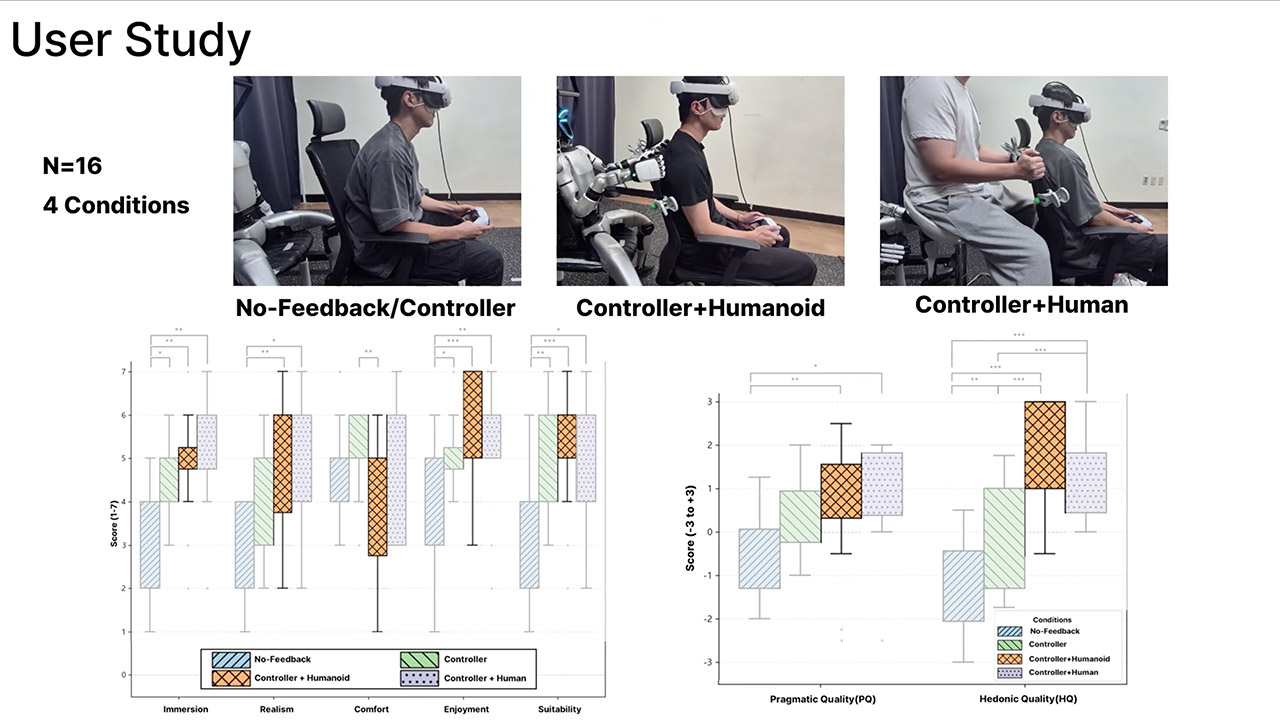
Testing helped the team determine that applying a filter to smooth out the game signals was the best method to minimize jarring or jerky motions in the robot. In a bigger study 16 people took part, comparing 4 different setups. Some simply drove normally, receiving no further feedback. Others used just the game controller for some vibrations. One group had the robot moving the chair in sync with the controller input, while another had a person just shifting the chair for them.
People rated the overall quality higher in both practical and fun aspects. Nonetheless, the robot’s continual changes made some feel fatigued after prolonged sessions. A few people reported that the increased motion in the VR headgear made them feel more uncomfortable. This approach means people who already own a compatible humanoid robot gain access to advanced motion feedback without buying separate expensive hardware. Limitations exist, of course, especially around comfort during extended play. Even so, the project points to fresh ways humanoids can serve in entertainment beyond their usual tasks. [Source]
DubHacks Next Batch 5 founders at Demo Day on May 7 at the University of Washington. (DubHacks Photo)
Senior engineers are retiring faster than companies can replace them, creating a widening expertise gap in industries from aerospace to nuclear energy.
Hera, a project developed by University of Washington students, is aiming to address the issue with technology that automates the design of parts that meet safety and industry rules, a process that normally requires many years of knowledge and experience.
The product is timely, as 1.9 million manufacturing jobs are expected to go unfilled in the $2.3 trillion sector by 2033, according to Deloitte.
“Hera answers design questions 10-times faster than a senior engineer,” said Meera Patel, co-creator of Hera. “Once it knows the drawing can be manufactured, it pulls data from all your machines and gives you an exact production plan.”
That’s one of several problems University of Washington students tackled through DubHacks Next, a 16-week startup incubator. On Thursday, May 7, student founders pitched 20 startups hoping to turn their ideas into viable companies.
Advertisement
Since 2022, DubHacks Next has spurred 68 startups and at least 25 active companies. Participants get access to free workshops, mentorship sessions, customer discovery meetings and networking with potential investors.
This year’s batch of 20 startups includes AI salon receptionists, a student subleasing platform and an emotional recovery app.
“I’ve never had the experience of building such a large-scale idea and bringing it to life,” said William Pantel, co-developer of Catalvst, an AI audio plugin builder.
The incubator’s past projects have raised more than $5 million collectively, with alumni going on to join accelerators such as Y Combinator and Techstars or land jobs at major tech companies.
Advertisement
Starting this year, students could apply to join the Pack Ventures portfolio, including $50,000 up front and $150,000 when another firm buys in.
Hera co-creators Meera Patel and Noelle So pitch their manufacturing automation tool at DubHacks Next Demo Day. (DubHacks Photo)
Patel and Hera co-creator Noelle So are among the students working with Pack. The demo is now live in three production plants, Patel said.
Here are more standouts from this year’s batch:
Chameleon: For the 1.3 billion people living with disabilities worldwide, nearly 96% of the internet’s top homepages are considered inaccessible. Enter Chameleon, an AI-powered web accessibility tool suite.
The suite includes a Chrome extension with tools like focus rulers, voice commands and head-tracking controls for accessible web navigation on any site, say co-founders Aditya Shirodkar and Ajit Mallavarapu.
Advertisement
“Especially with vibe coding, people are quick to develop software and don’t think about accessibility needs,” Shirodkar told GeekWire. “It’s a silent barrier that isn’t really addressed.”
Chameleon is entering a market with growing need – and financial opportunity. The global digital accessibility market is estimated at $1.8 billion, and is projected to reach $3.2 billion by 2034, according to Straits Research.
“It’s not just about making something cool,” Mallavarapu said. “It’s about making something people will actually use every day.”
Iris: Sthiti Patnaik and Saachi Dhamija focused on another technological headache: spreadsheets.
Advertisement
Universities often rely on sprawling spreadsheets to track alumni for fundraising, networking and event planning, but records quickly become outdated and difficult to search. With Iris, alumni associations and other groups can more easily maintain member databases.
“We ingest their spreadsheet, then present it in a more visual format with bubbles and graphs,” Dhamija told GeekWire.
Along with data enrichment and interactive visual mapping for organizers, Iris helps members discover one another through shared experiences and interests. Patnaik, a recent graduate and managing director for DubHacks Next, hopes the solution will help her stay connected to other founders.
“All of our alumni go on to do really fantastic things, such as raise money, start their own startups, or work at really great companies,” she said.
Advertisement
After presenting Iris, Patnaik and Dhamija landed a design partnership with Pack Ventures.
Catalvst: For Aaron Li and William Pantel, the incubator became a launching pad for Catalvst, what may be the first-ever AI audio plugin builder.
High-end audio plugins – software tools that shape and manipulate sound – can cost music producers hundreds or even thousands of dollars. Li, who began producing EDM three years ago, said software costs have delayed his progress.
“I remember working all summer just to save up,” he said. “It’s a domino effect. You get one piece of software, and realize there’s another one you need that’s super expensive.”
Advertisement
With Catalvst, users can describe the sound they want in plain language and generate downloadable, working audio software in under a minute.
“If you’re like, ‘I want my songs to sound like I sing them in a cathedral,’ it’ll create software that makes your song sound like that,” Pantel said.
The founders distinguish their product from AI-generated music platforms, emphasizing that their goal is to empower human creators rather than replace them. They’re currently beta testing with music producers to refine the product and grow its user base.
“We’re using AI to build tools human producers can use,” Pantel said.
Advertisement
Applications for the incubator’s sixth batch open this fall.
Other Batch 5 startups:
BeamBell: AI salon receptionist | Arvin Hakakian, Anant Dhokia, Aur Shalev Merin
European diesels can be had at both ends of the spectrum; there are magnificent ones like Audi’s 12-cylinder, and catastrophic failures like Land Rover’s inline-six. Over here in America, we tend to associate diesel engines almost exclusively with trucks and heavy machinery, but Europeans have been doing things a little differently for the past three decades or so. It’s not uncommon at all to see a diesel-powered sedan or hatchback on the continent, although newer models in the region are gradually ditching diesels too.
Aside from the cultural acceptance of diesels in Europe, there were also emission laws so strict that CARB — the reason why you can’t get the new Hemi V8 in some states — would be put to shame by comparison. As a result, the amount of innovation in European diesel engines was much higher, and that’s why we got some truly spectacular engines out of it. And it’s not like these were three-cylinder econobox engines either; the Germans were busy stuffing V10 diesels into anything they could get their hands on, from a family SUV to an executive sedan, and pretty much everything in between. But where there’s trial and experimentation, there’s also error. So it is with Euro diesels, because we also got some real dogs along the way, two of which we’ll cover here. One was subjectively the worst engine from a brand already famous for unreliability, and the other treated timing chains like a consumable item.
Advertisement
Best: Audi 5.5 V12 TDI
First up, a V12 from Audi, which is one of the many car brands that Volkswagen owns. The Volkswagen group had made many legendary diesels at the time, including a V10 for the Phaeton and Touareg, and a V12 diesel for the Q7. For the V10 production version, the final unit ended up being a five-liter engine, with the TDI suffix indicating that it used diesel injection. The cars it powered were the Phaeton, where it made 313 hp and 553 lb-ft of torque, and the Touareg, where the final power output stood at 310 hp and the same torque.
As you can imagine, these cars were blisteringly quick, with the Touareg managing a 0-60 mph time of an estimated 7.5 seconds. Later on, Audi would make their own V12 diesel engine for their Le Mans LMP1 race vehicle. This car, called the Audi R10, got a 5.5-liter version of the engine, but with 12 cylinders making 650 hp and 811 lb-ft of torque, and to say that the Audi dominated the next season would be an understatement.
Advertisement
With its newfound diesel powertrain and 12 cylinders, the electronically limited Audi R10 LMP1 romped home to victory in several races, and even took home overall victories at Le Mans three times. In doing so, the Audi R10 became the first diesel car ever to win Le Mans — and it ran on biodiesel.
Advertisement
Best: BMW M57
While BMWs don’t exactly have the best reputation when it comes to reliability — we’ve all seen the oil leak and check engine light jokes online — the BMW M57 diesel is an exception. The engine was a three-liter, six-cylinder unit with the cylinders arranged in an inline configuration, and it came with turbochargers as well, of course. BMW has had a long history of making diesel engines even for passenger cars, such as the widely used M47 and B57, though these are not considered as reliable as the M57 that we’re looking at.
It was first released in the U.S. for the 2009 model year, though it had been in production since 1998, and the U.S.-spec version made 265 hp and 425 lb-ft of torque. It was offered in many mainstay models from BMW, initially in the 335d sedan and the X5 SUV. In the 335d, which is arguably the most famous of the models we just listed, the M57 could push the car from 0-60 mph in about 5.7 seconds and gave the car the ability to run the standing quarter-mile in 14.2 seconds.
While somewhat average by modern standards, remember, this was back in the late 2000s, when even supercars like the Aston Martin Vantage had 0-60 mph times of around 4.7 seconds. With all that said, there are certain years where the BMW M57 diesel engine should be avoided, but overall, it was a pretty solid option that delivered on all fronts.
Advertisement
Best: Volvo D13
There aren’t many people who’ve heard of the Volvo D13, but if you’ve ever bought anything from Europe, there’s a decent chance part of its journey involved a truck powered by a Volvo D13. Widely considered to be the best truck engine that Volvo has made — though there have been newer versions released at the time of writing — the D13 has powered trucks like the Volvo VNR, VAH, VNL, and VHD, all of which are part of Volvo’s North American lineup. Displacing a herculean 12.8 liters across six inline cylinders with a bore of 131 mm and a stroke of 158 mm, this 2,635-lb engine is primarily a diesel variant that makes between 1,450 and 1,900 lb-ft of torque at a relatively low 900 RPM.
This is in addition to a maximum power output of 500 hp, with peak hp available at 1,300 RPM — and while the utility of this power would largely be dependent on the choice of transmission in the truck, it’s still impressive nonetheless. As with many truck engines, there are different power ratings available, with the lowest variant of the D13 coming with 405 hp and 1,450 lb-ft of torque, while the top-of-the-line variant makes the aforementioned 500 hp and up to 1,900 lb-ft of torque.
Advertisement
Also, we said “primarily” a diesel variant because there is also a very similar engine from Volvo called the D13-LNG that runs on natural gas, which is generally understood to be a cleaner fuel source than diesel.
Advertisement
Worst: Land Rover 2.0 Ingenium
Widely considered to be the worst Land Rover engine ever made by experts and users alike, the 2.0 Ingenium was introduced to the world in 2015. The inaugural version was used to power the Jaguar XE, though it was later also slotted into the Land Rover Discovery Sport and Range Rover Evoque. The displacement is two liters across four cylinders , and is turbocharged. On paper, the 2.0 Ingenium is quite powerful, making at least 197 hp along with 236 lb-ft of torque, though models with higher power outputs are available.
In real life, however, everyone — from end users to industry experts — has a laundry list of woes. First up, there are reliability concerns that are too numerous to name, but the big and unfortunately common ones are oil dilution, timing chain breaks and rattles, and the turbos flat-out failing. However, the silver lining in there’s the fuel economy; the Discovery Sport with the 2.0 Ingenium diesel engine netted a 58 mpg figure on launch in 2015, according to Land Rover. Note that the European fuel economy measuring test (NEDC at the time, WLTP today) is different from the EPA system used in the U.S., so the readings aren’t exactly the same.
And lastly, mechanics seem to dislike working on the engine too, complaining about things like component placement and the engine generally being troublesome to work on. All of the above, coupled with the frequent breakdowns, make it one of the most horrible things to come out of Land Rover.
Advertisement
Worst: BMW N47
Where the BMW M57 that we looked at above was a star, the four-cylinder N47 that made between 94 and 215 hp was the complete opposite. It first entered BMW’s lineup in 2007, where it remained until 2014, marking a production span of about seven years, but it’s easy to see why the engine was quickly discontinued. For starters, let’s first say that the selling point for the N47 was its efficiency; in the 2009 BMW X1, it was able to net an impressive 48 mpg combined fuel economy figure across city and highway driving. Again, the European testing methods would differ from the EPA’s methods, so bear that in mind.
However, this was an engine that treated its timing chains like a consumable item. Furthermore, like many other BMW engines the timing chain is located at the back of the engine bay. As such, when something goes wrong that needs a timing chain replacement, the labor is prohibitively expensive and time-consuming.
Advertisement
Other issues that plague the N47, albeit to a lesser degree than the timing chain woes, include premature turbocharger failure, high oil consumption, and a whole suite of problems with the EGR, or exhaust gas recirculation system. To be clear, we’re not saying that it’s inevitable that the N47 will be a dog, but it’s highly likely that maintenance bills for this engine will be higher than usual. Unless your heart is really set on one, it’s probably best to go with another option.
More than 4,000 Hollywood insiders recently signed a letter blasting Paramount’s planned $111 billion merger with Warner Brothers, noting that the massive consolidation will be very historically harmful to labor, consumers, and creatives. That’s a very correct observation, especially as it relates to Warner Brothers, which has never been involved in a merger that didn’t result in mass layoffs, higher prices for everyone, and a significantly shittier overall product.
Now a coalition of press groups, including Freedom of the Press Foundation (FPF) and Reporters Without Borders, are pressing Paramount regarding “potentially corrupt acquisitions and deals” they argue could undermine shareholder value by degrading the (already sagging) quality of journalism at CBS News and CNN, while “relinquishing editorial control of major news outlets to the Trump administration.”
The journalism groups make the point that the Ellison family effort to turn CBS into a Trump and Netanyahu-friendly agitprop machine has been disastrous for the company’s share price. And because both organizations are technically shareholders, they’re demanding deeper access to the Paramount books to see what other dodgy bullshit may not have been revealed yet:
Advertisement
“Since Paramount Skydance announced its most consequential Trump-friendly changes at CBS News in October — acquiring The Free Press and appointing Bari Weiss as editor-in-chief — the company’s market capitalization has decreased by 40%, wiping out more than $8 billion in shareholder value. Ratings for key programs, like “CBS Evening News with Tony Dokoupil,” have also dropped precipitously. Freedom of the Press Foundation and Reporters Without Borders, which are both shareholders in Paramount Skydance Corp., are entitled to inspect the company’s books and records related to these developments under Section 220 of the Delaware General Corporation Law.”
They’ve given Paramount five days to respond to their request for more documents and data related to any promises Paramount may have made the Trump administration. I’m not convinced the gambit will go anywhere, but it’s nice to see these kinds of groups (historically absent from many of these fights) suddenly paying closer attention to media consolidation.
Larry Ellison’s interests here are two-fold. He wanted to gift his nepobaby son David with two major Hollywood studios so David can pretend he’s a very big boy doing very serious things. But he’s also keen on dismantling what’s left of journalism at places like CBS News and CNN (already reeling from years of corporate cowardice) turning them into right-wing friendly agitprop mills that are even more friendly to his favorite autocrats (Trump and Netanyahu).
You’ll recall Bari Weiss sold herself to Paramount as an expert who could modernize CBS News through virality and mass audience appeal (despite having no actual experience in journalism). But Weiss, who got her start at the helm of a strange contrarian troll blog, has the instincts and ideas of a 90 year old man, and clearly isn’t capable of generating watchable propaganda in any ratings-grabbing way that actually appeals to anyone (even MAGA folks, who already have no limit of agitprop options).
The Trump administration will certainly rubber stamp the deal. Paramount will likely keep this effort locked up in the courts indefinitely. And the Democrats’ demand for the FCC to investigate the dodgy Chinese and Saudi financing propping up the deal isn’t likely to go anywhere. That leaves a collaborative looming lawsuit by state AGs as the most likely path toward ensuring this deal never gets off the ground.
Advertisement
But even if the deal gets approved, this giant company’s long-term survival is far from guaranteed. Especially given the shaky state of Hollywood, the steady enshittification of streaming, and the fact that there’s very little evidence that the any of the Paramount folks are competent.
There’s a very high likelihood that the combination of Paramount’s massive debt load from both the CBS and Warner deals– and fleeing audience (either bored by bad product or disgusted by the companies’ Trump allegiances) — combines with Larry Ellison’s over-extension on AI to result in some very precarious financial footing.
These major media deals always go terribly for consumers and labor, but execs often benefit from tax breaks, temporary stock boosts, and compensation in no way dictated by competency (see: CEO David Zaslav). But this series of deals is so massive and problematic, it could generate some very significant pain for the extraction class, and make all past merger disasters seem adorable by comparison.
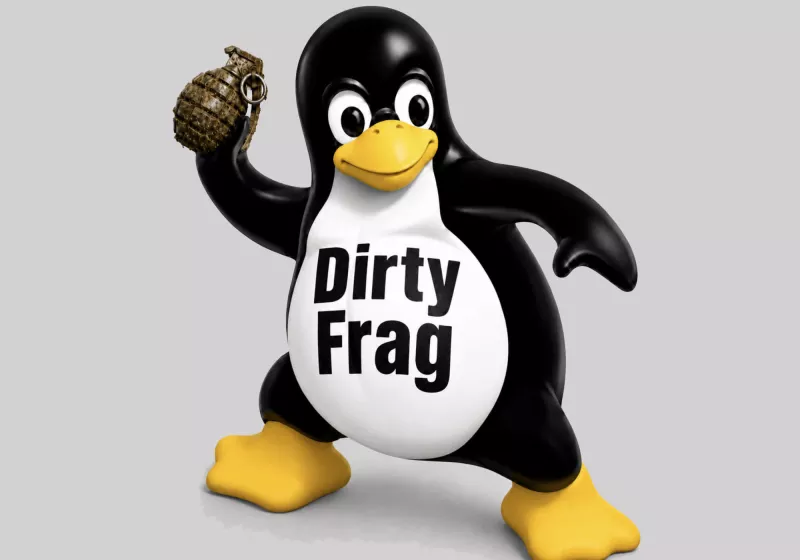
Hyunwoo Kim, also known as “V4bel,” recently disclosed “Dirty Frag,” a dangerous security vulnerability that provides local attackers with root access on Linux-based systems. All major – and likely many minor – Linux distributions are affected by the issue, which currently can only be mitigated because no patch is available… Read Entire Article Source link
Gartner’s report found that organisations need to invest in a workforce that can lead the transition to autonomous capabilities.
Over the course of the last year, there have been a range of high-profile layoffs as a result of the continued investment into AI and its capabilities.
Recently, Cloudflare announced plans to cut 20pc of its workforce after AI usage at the company grew by 600pc in three months and in April, social media and tech platform Meta told staff that it will be laying off 10pc of its workforce, roughly 8,000 employees, reportedly as a means of mitigating the costs of heavy AI spending. Similarly, Snap is laying off 16pc of its workforce to cut costs and focus on AI.
Gartner surveyed 350 globally dispersed business executives in the third quarter of 2025, to better understand the state of autonomous business at enterprises. Qualifying organisations reported enterprise-wide annual revenue of at least $1bn or the equivalent, and had been piloting or had already deployed either an AI agent, intelligent automation or autonomous technologies.
Advertisement
Of the organisations taking part in the piloting or deployment of autonomous business capabilities, roughly 80pc admitted to reducing their workforce. Gartner’s research found that these reductions do not appear to translate to a return on investment (ROI) for the organisations making the changes.
The survey found that workforce reduction rates were nearly equal among respondents that reported a higher ROI from autonomous technologies and those that experienced only modest gains or negative outcomes.
Commenting on the findings of the report, Helen Poitevin, a distinguished vice-president and analyst at Gartner, said, “Many CEOs turn to layoffs to demonstrate quick AI returns – however, this disposition is misplaced.
“Workforce reductions may create budget room, but they do not create return. Organisations that improve ROI are not those that eliminate the need for people, but those that amplify them by aggressively investing more in skills, roles and operating models that allow humans to guide and scale autonomous systems.”
Advertisement
Despite increased layoffs as a result of AI adoption, Gartner’s research suggested that, while autonomous business will continue to increase alongside AI agent software spending, “the need for people will go up, not down”. To that point, Gartner predicts that “autonomous business will be a net-positive job creator by 2028 to 2029, driven by new forms of work that AI cannot absorb”.
“Long term, autonomous business will create more work for humans, not less. Lasting structural factors such as demographic decline and high-stakes, trust-dependent consumer moments will ensure human talent remains central to running, governing and scaling autonomous business,” said Poitevin.
Don’t miss out on the knowledge you need to succeed. Sign up for the Daily Brief, Silicon Republic’s digest of need-to-know sci-tech news.
As wireless communications technologies such as Wi-Fi (IEEE 802.11) and cellular (LTE, 5G NR) continue to demand higher data throughput, the modulation schemes used to encode information have grown increasingly complex. Modern systems employ quadrature amplitude modulation (QAM) with orders up to 4096QAM, where each symbol carries twelve bits but the constellation points are extremely close together. This makes modulation accuracy critical: even small deviations in amplitude or phase can cause bit errors. Error vector magnitude (EVM) has become the primary metric for quantifying this accuracy. This white paper covers the fundamentals of digital modulation, defines EVM and its calculation methods, explores the common sources of EVM degradation, and explains how constellation diagrams can be used to visually diagnose the root causes of modulation impairments in practical wireless systems.
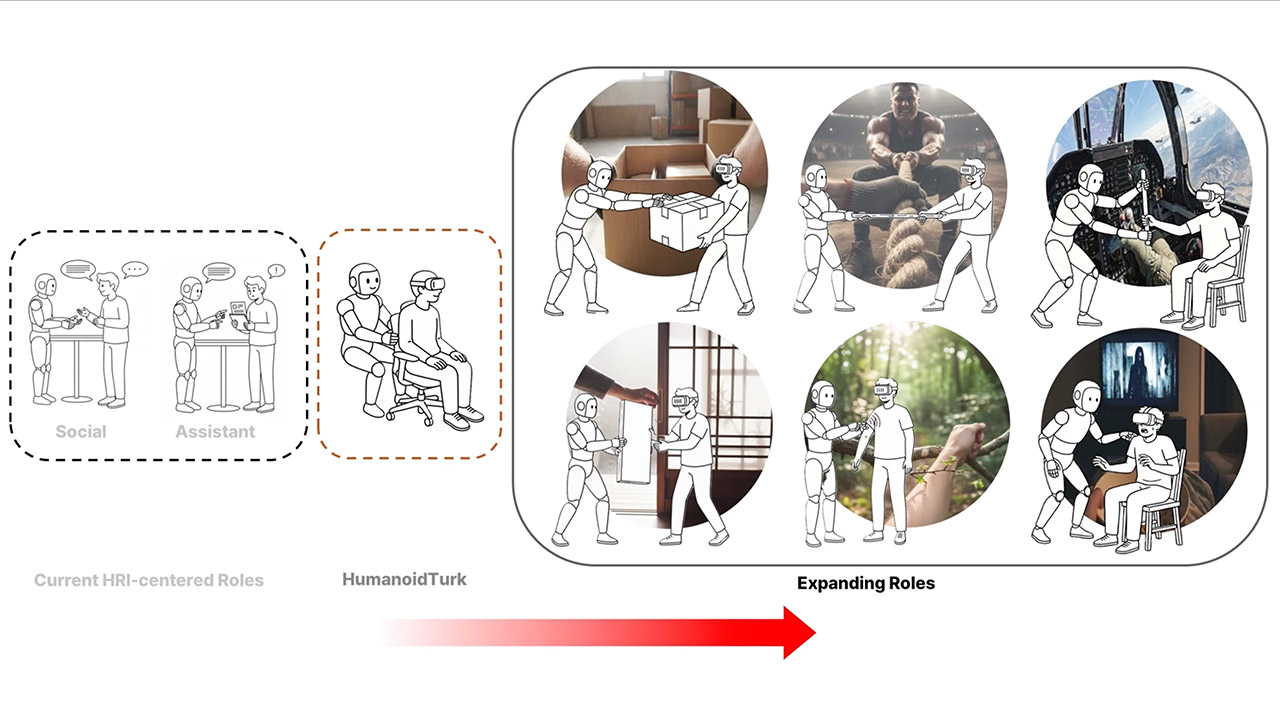
Humanoid robots are a thing now, and here’s an interesting research project that explores using one as a form of haptic media. Specifically, using a humanoid robot to move a chair while one plays a VR driving simulator.
Here’s how it works: a Unitree G1 robot sits behind a player’s chair and grasps it with its hands. Spherical markers on the chair help the robot’s depth camera know the chair’s position, and real-time G-force signals fed from the simulator (Assetto Corsa, running on PC) tell the robot how much and in what direction to shift the chair to match in-simulator events.
While a humanoid robot (especially one equipped with articulated, human-like hands) makes for an awfully expensive force feedback chair, this approach is interesting because it specifically explores using an already-existing humanoid robot as a general-purpose device. It sits in a chair, looks with its camera, grasps with its hands, and moves the player’s chair in response to game events; no hardware modifications required.
So how well does it work? Pretty well, apparently! Participants found the synchronized motion feedback accurate and highly enjoyable, although it does seem like there were some rough edges. Some testers reported that the sustained motion and constant vibration were tiring, and in some cases seemed to worsen VR sickness.
Summer is when pools move from being part of the setup to becoming part of everyday life. What starts as a manageable routine quickly turns into regular use, whether it is weekends with family, hosting friends, or simply spending more time outdoors. It is also when maintenance stops being occasional and begins to demand consistency, which is where most systems start to fall short.
Surface debris returns faster than expected, shallow areas remain inconsistent, and steps that were meant to be automated begin to come back into the routine. What looks simple at the start of the season starts to take more time than it should, especially when the pool is being used more often.
Beatbot positions the Sora 70 as a way to remove that friction altogether. Built as a 4-in-1 cordless system, it brings together water-surface cleaning, waterline scrubbing, wall climbing, and floor cleaning into a single workflow that reduces the need for repeated intervention. More than that, it fits into how pools are actually used during the season, making it a practical upgrade for homeowners and a high-value gift for those investing in easier, more usable outdoor living. With the Anniversary Campaign running from May 9 to 25, it arrives at a point where that shift becomes both relevant and easy to act on
A 4-in-1 system designed to replace fragmented pool cleaning
Most robotic pool cleaners still leave gaps in how cleaning is handled. Floors are covered, walls are managed, but surface debris, shallow platforms, and waterline buildup are often left to separate tools or manual effort. That fragmentation becomes more visible with regular use, when no single cycle fully resets the pool and maintenance starts to return in smaller, repeated steps.
Advertisement
Ian Bell / Digital Trends
The Sora 70 is designed to replace that fragmented approach. Its 4-in-1 system brings together water-surface cleaning, waterline scrubbing, wall climbing, and floor cleaning into a single cycle, reducing the need for multiple devices or follow-up passes. Instead of dividing the process, it handles the pool as one continuous environment, which is where most systems tend to fall short.
In practical terms, this shifts the experience from managing individual cleaning tasks to relying on a system that delivers complete coverage in one run. That reduction in manual effort is what makes it a smarter upgrade, and also what allows it to stand out as a more considered purchase for homeowners looking to simplify how their pool is maintained.
Designed to handle the areas most systems miss
In many pools, the challenge is not cleaning the obvious surfaces but reaching the areas that are easy to skip. Shallow platforms, tanning ledges, and multi-level sections often sit outside the effective range of standard robotic cleaners, which leaves parts of the pool inconsistent even after a full cycle.
The Sora 70 addresses this through its dual SonicSense ultrasonic sensors, which allow it to navigate shallow-water zones as low as 8 inches. This enables it to move across varied pool layouts without breaking the cleaning path, maintaining continuity from surface to floor.
That consistency removes the need for manual correction after each cycle, which is where most of the effort tends to go. For users looking for reliable cleaning that holds up through regular use, this is where the system begins to justify itself not just as an upgrade, but as something that delivers ongoing value over time.
Advertisement
JetPulse turns surface cleaning into an active process
Surface debris is one of the most persistent issues in pool maintenance, especially during summer use when leaves, dust, and particles return quickly. Most robotic systems rely on passive movement, collecting debris only when it drifts into range, which often requires multiple cycles to achieve visible results.
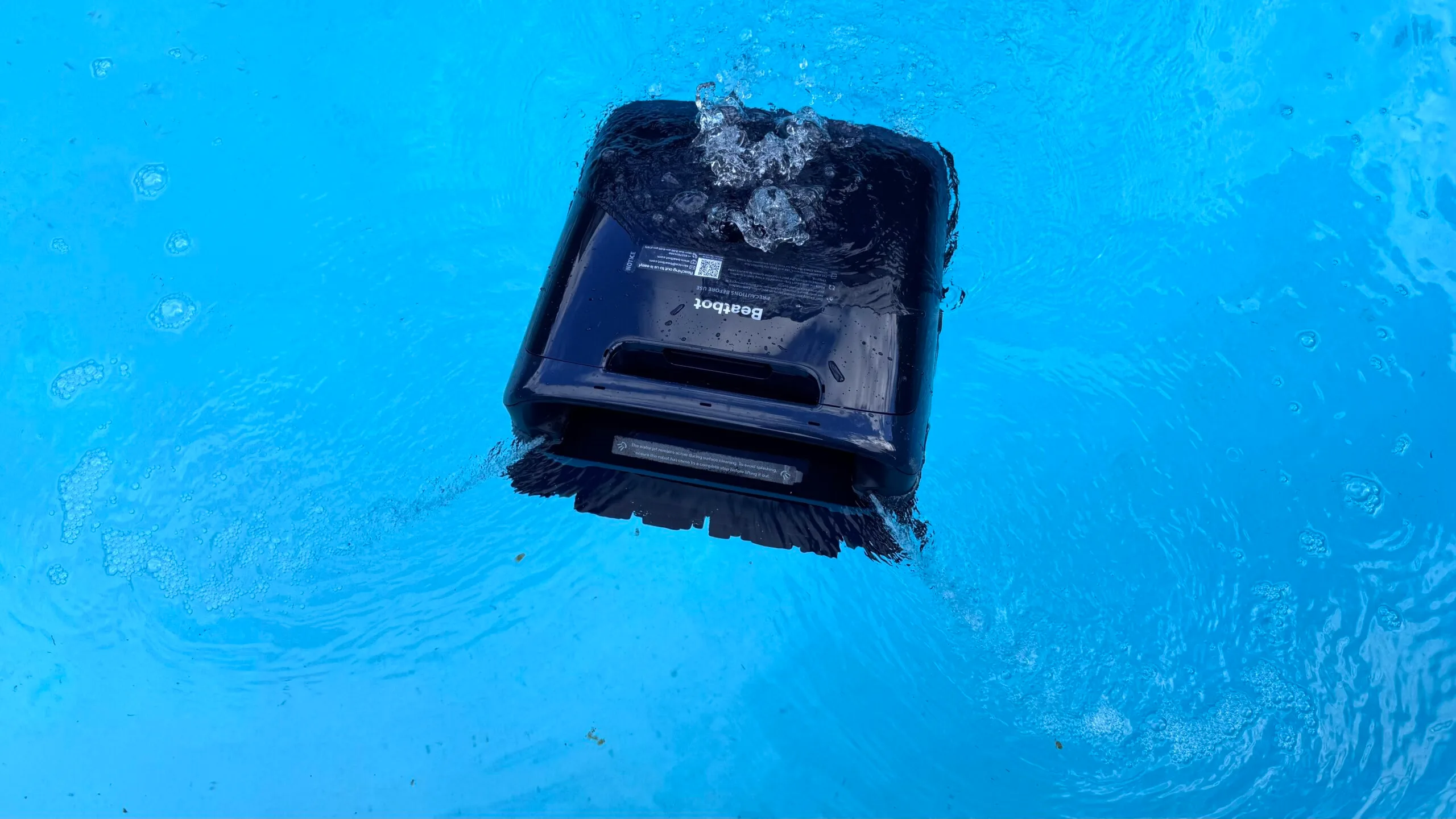
The Sora 70 takes a more active approach through its JetPulse system. A twin-jet mechanism generates directed water flow that pulls floating debris toward the intake, allowing it to be captured earlier in the cycle rather than after repeated passes. This shortens the time between cleaning and usability, which matters more during periods of frequent use. Instead of waiting for the pool to settle, it stays ready with fewer interruptions, supporting a setup that is easier to maintain without repeated intervention.
HydroBalance maintains consistent suction across the entire cycle
In many robotic cleaners, suction performance drops as the cleaning cycle progresses, which leads to uneven results and often requires additional runs to fully clear the pool. That inconsistency becomes more noticeable during regular use, when debris accumulates quickly and cleaning needs to be reliable rather than repeated.
The Sora 70’s HydroBalance system is designed to maintain a steady flow throughout the cycle. A center-mounted pump creates a direct, low-resistance path, while a high-efficiency motor sustains 6,800 GPH suction without drop-off. The 6.7-inch intake reduces clogging, and the bottom-hugging design helps retain suction close to the surface being cleaned. This allows debris to be removed in a single pass, reducing the need for additional cleaning cycles and making the system easier to depend on as part of a regular pool routine.
Advertisement
Filtration that supports both routine cleaning and higher-precision results
Alongside debris removal, the Sora 70 is built to handle the difference between visible cleaning and actual water clarity. A 6L, 150-micron debris basket captures leaves, insects, and larger particles during everyday use, allowing longer cycles without frequent emptying and keeping routine maintenance consistent.
When finer particles become more noticeable, particularly during periods of frequent use, an optional 3-micron ultra-fine filter captures dust, pollen, and algae spores that are not always visible during standard cleaning cycles.
By maintaining the same cleaning process while improving the level of filtration, the system avoids adding extra steps while delivering a more refined result. That consistency becomes part of its long-term value, particularly for homeowners who want a setup that continues to perform without added effort, and for those considering a more considered purchase that improves how the pool is maintained over time.
Retrieval that does not interrupt the process
Image used with permission by copyright holder
Retrieval remains one of the most inconvenient parts of robotic cleaning. The process often requires manual handling at the end of each cycle, which breaks the sense of automation. The Sora 70 addresses this through Smart Water-Surface Parking and One-Touch App Retrieval. At the end of a cycle, it rises to the surface and moves toward the pool edge, where it can be accessed without additional effort.
The SmartDrain system releases excess water before lifting, reducing weight and making handling easier. This keeps the experience consistent from start to finish, without reintroducing effort at the final step, which is often where automation tends to fall apart.
Advertisement
Built for longer use, not just shorter cycles
Pool cleaning needs to keep up with usage, especially during summer when the pool is used more frequently. The Sora 70 is powered by a 10,000 mAh battery that supports up to seven hours of surface cleaning or five hours of full-pool cleaning, allowing it to cover up to 3,230 square feet in a single cycle.
Its cordless design removes the need for cable management, improving ease of use in active outdoor environments. This makes it easier to treat as part of a regular setup rather than a task that needs planning, which is where most systems start to feel limiting.
A shift that fits how pools are used through the season
Pool usage changes once the season is in full swing, with expectations moving beyond basic cleaning toward maintaining a space that stays ready without repeated attention. Bringing surface cleaning, walls, and the pool floor into a single system allows the Sora 70 to remove the need for managing separate steps, keeping the overall setup consistent even during periods of regular use without adding to the workload.
That difference becomes more relevant when the decision moves from solving an immediate problem to choosing a system that continues to deliver over time. For homeowners upgrading an outdoor space, the Sora 70 works as a high-value addition that improves how the pool is used without adding complexity. It also translates naturally into a premium, practical gift for pool owners or new homeowners, where the value comes from reducing a recurring task rather than introducing another one.
Advertisement
With Anniversary pricing from May 9 to 25, where it is available at $1,149, down from $1,499, the timing aligns with peak pool use. The shift toward less manual work and a more reliable setup becomes easier to act on, making it a relevant upgrade for the season as well as a considered purchase that continues to deliver beyond it.
Sora 30: a smart upgrade for consistent everyday cleaning
Building on the approach established by Beatbot’s Sora 70, the Sora 30 focuses on the parts of pool cleaning that define everyday use, delivering consistent results without moving into full 4-in-1 automation. It is designed for users who want dependable cordless pool cleaning that reduces manual effort while keeping the system simple to operate.
Its 3-in-1 cleaning across floor, walls, and waterline ensures routine maintenance is handled in a single cycle, with dual roller brushes supporting stable wall climbing and consistent contact across surfaces. The filtration system captures both larger debris and finer particles within the same pass, helping avoid repeat runs, while a runtime of up to five hours allows most residential pools to be cleaned without interruption.
Coverage extends to shallow zones such as steps and ledges, and smart surface parking brings the unit to an accessible point for retrieval, with the fully cordless design removing cable management altogether and making repeated use easier to manage over time.
Advertisement
As part of Beatbot’s Anniversary offer from May 9 to 25, the Sora 30 is available at $699, down from $999, positioning it as a clear step up from entry-level cordless pool cleaning. It works both as a smart upgrade for everyday use and as a practical, high-value gift for pool owners or new homeowners, delivering less work, more pool time, and a setup that holds up through regular use.
AquaSense X: a premium system for low-intervention pool care
Extending beyond the Sora series, Beatbot’s AquaSense X is designed for users who want pool cleaning to operate with minimal involvement, moving from consistent maintenance into a more automated, system-led approach.
It brings complete, all-zone coverage into a system built around advanced pool robotics, combining floor, walls, waterline, and surface cleaning with filtration and water clarification. Automated debris handling reduces the need for manual emptying, while intelligent navigation ensures consistent coverage across the entire pool without requiring supervision, shifting the experience from managing cleaning cycles to relying on a system that runs with minimal input. This makes it particularly relevant for larger pools or setups that see frequent use, where consistency and reduced intervention matter more than isolated cleaning performance.
As part of Beatbot’s Anniversary offer from May 9 to 25, the AquaSense X is available at $3,999, down from $4,250, positioning it as a flagship upgrade within advanced pool robotics. It also works as a premium, high-value gift for homeowners investing in outdoor spaces, delivering less work, more pool time, and a system that continues to perform without constant attention.
Advertisement
AquaSense 2 Ultra: AI-powered cleaning for complex pool environments
Positioned within the premium segment, the AquaSense 2 Ultra introduces HybridSense AI-powered mapping, enabling precise navigation, obstacle detection, and adaptive path planning across complex pool layouts. Its 5-in-1 cleaning system covers surface, floor, walls, waterline, and water purification, while HybridSense AI mapping helps reduce cleaning time by up to 50% through more efficient coverage. ClearWater natural clarification improves water clarity alongside debris removal, and side brushes enhance surface cleaning performance, ensuring that both visible and fine particles are addressed within the same cycle.
Adaptive path planning allows it to navigate multi-level platforms and irregular pool shapes more effectively, while remote control functionality provides flexibility when needed. Once cleaning is complete, the system returns to the pool edge automatically for easy retrieval without manual handling.
Available at $2,649, with $501 off as part of Beatbot’s Anniversary offer from May 9 to 25, the AquaSense 2 Ultra stands out as a compelling premium upgrade for users looking to step into AI-driven pool cleaning. It balances reduced cleaning time, complete coverage, and advanced automation, making it easier to maintain a high-quality pool setup with less ongoing effort.
A more complete way to approach pool care this season
This lineup works because each system is aligned to a clear level of effort reduction. The Sora 70 brings full coverage into a single system. The Sora 30 simplifies everyday cleaning into a more consistent routine. The AquaSense range extends that further into automation and intelligent control.
Advertisement
With the Anniversary Campaign running from May 9 to 25, the decision shifts from comparing features to choosing how much of the process to remove. Whether it is replacing manual cleaning, consolidating multiple tools, or moving toward a more automated setup, the current pricing makes that shift easier to act on now.
For pool owners preparing for the season, or for those looking at a more meaningful, high-value gift, this is a moment where upgrading becomes a practical decision. Whether it is about reducing ongoing effort or making the pool easier to use day to day, the Sora 70 aligns with a simple outcome that defines summer use at its best, less work and more time in the water.
































































You must be logged in to post a comment Login