
Business
Alaska Air Stock Rockets 13% on Oil Price Relief Ahead of Q1 Earnings Amid Hawaiian Integration


SEATTLE — Alaska Air Group Inc. shares surged more than 12 percent in morning trading Friday as plunging oil prices following the Middle East ceasefire delivered welcome relief to fuel-burdened airlines and boosted sentiment across the sector ahead of the carrier’s first-quarter earnings next week.

At 10:15 a.m. EDT, Alaska Air Group stock (NYSE: ALK) traded at $46.49, up 12.91 percent or $5.35 from Thursday’s close. The sharp gain came on heavy volume as benchmark crude futures dropped sharply on reports that Iranian assurances would keep the Strait of Hormuz open to commercial traffic, easing fears of prolonged supply disruptions that had driven jet fuel costs dramatically higher in recent weeks.
The rally marks a dramatic rebound for the stock, which had traded near multi-month lows earlier in April amid soaring energy prices and a cautious outlook. Friday’s move pushed ALK well above recent trading ranges and closer to analyst price targets that average around $57 to $61.
Analysts attributed the surge primarily to the rapid decline in oil and jet fuel benchmarks. Jet fuel, which typically accounts for 25-30 percent of airline operating expenses, had spiked significantly during the Iran-related tensions, forcing carriers including Alaska to warn of margin pressure. With the fragile ceasefire appearing to hold and tanker traffic resuming, energy costs are expected to moderate, offering a direct lift to profitability.
Alaska Air Group is set to report first-quarter 2026 results after the market close on April 20, with a conference call scheduled for April 21. The company had previously widened its Q1 adjusted loss-per-share guidance to a range of $2.00 to $1.50, citing higher fuel prices and temporary demand softness in key leisure markets such as Hawaii and Mexico due to weather and regional unrest. Without those headwinds, management indicated underlying results would have exceeded the midpoint of earlier forecasts.
Full-year 2026 adjusted EPS guidance remains intact at $3.50 to $6.50, reflecting confidence in premium travel demand, network synergies from the Hawaiian Airlines combination and operational improvements. Capacity is expected to grow modestly, with ASM increases of 1-2 percent in Q1 and 2-3 percent for the full year.
The Hawaiian integration continues to progress smoothly and represents a major long-term growth driver for Alaska Air Group. The merger, completed in September 2024, has already delivered a single operating certificate, and further milestones are approaching. Hawaiian Airlines is scheduled to fully transition to the AS code and join the oneworld alliance in spring 2026, with passenger service system integration advancing toward a multi-brand booking platform.
CEO Ben Minicucci has highlighted the strategic benefits of the combination, including an expanded West Coast-to-Hawaii network, enhanced premium offerings and approximately $400 million in expected annual synergies. The combined entity strengthens Alaska’s position in leisure and trans-Pacific markets while adding Hawaiian’s loyal customer base and distinctive brand.
Recent operational initiatives underscore the company’s focus on efficiency and innovation. On April 16, Alaska Airlines announced a strategic partnership with Tailsight to deploy an AI-powered maintenance planning and optimization platform — the first major airline to do so. The technology aims to improve labor and parts utilization while reducing aircraft-on-ground time, supporting fleet reliability as the carrier modernizes and expands.
Despite near-term challenges, demand trends have shown resilience in premium and business segments. Alaska has emphasized its diversified revenue base, including strong loyalty program performance through Atmos Rewards and growth in higher-yield cabins. International expansion plans include new service to Europe beginning in spring 2026, further diversifying beyond its traditional Pacific Northwest and West Coast stronghold.
Wall Street’s view remains largely constructive despite the recent volatility. Evercore ISI maintained an Outperform rating on April 17 with a $60 price target, while UBS raised its target to $54. Other firms, including Goldman Sachs and BMO Capital, have issued Buy or Outperform ratings citing the long-term value of the Hawaiian deal and capacity discipline across the industry.
Technical analysts noted that ALK had been trading in a downtrend amid fuel concerns but showed signs of stabilization this week. Friday’s breakout on elevated volume suggests broad participation from institutional investors rotating into cyclical names as oil pressure eases. The stock’s 52-week range has been wide, reflecting sensitivity to energy prices and merger execution.
Broader airline stocks participated in the rally, with peers such as United Airlines also posting strong gains earlier in the session. The sector benefits collectively from lower fuel costs, which act as a direct margin expander if fares remain stable and demand holds.
Challenges remain on the horizon. Boeing delivery delays have occasionally impacted fleet plans, and labor costs continue to rise with contract negotiations. Integration-related expenses from the Hawaiian combination will persist through 2026 and into 2027 as systems fully merge and workforces align.
For consumers, the ceasefire-driven oil relief could eventually translate to more stable or modestly lower fares, though airlines have been quick to note that jet fuel supply normalization may take weeks or months. Alaska has maintained competitive pricing on core routes while protecting yields through ancillary revenue and premium seating options.
As investors digest Friday’s move, attention turns squarely to next week’s earnings. Any positive commentary on fuel hedging, summer booking trends or Hawaiian synergy realization could sustain momentum. Conversely, further details on Q1 demand softness might temper enthusiasm.
Alaska Air Group’s balance sheet has remained solid post-merger, with manageable debt levels and liquidity supporting fleet investment and shareholder returns in stronger periods. Capital expenditures for 2026 are guided at approximately $1.4 billion to $1.5 billion, focused on aircraft acquisitions and technology upgrades.
The company’s membership in the oneworld alliance provides additional connectivity benefits, with Hawaiian’s impending full integration expected to enhance the group’s global reach. Passengers can already earn and redeem miles across an expanding network of partners.
Friday’s surge underscores the airline sector’s leveraged exposure to energy markets and macroeconomic sentiment. With the Dow Jones Industrial Average pushing toward 49,000 and risk appetite improving on geopolitical de-escalation, cyclical stocks like ALK have found fresh buyers.
Longer term, Alaska Air Group’s story centers on transformation from a regional powerhouse to a more diversified national and international player through the Hawaiian deal. Successful execution could narrow the valuation gap with larger peers and deliver sustained earnings growth.
Whether today’s double-digit gain marks the start of a broader recovery or a short-term relief rally will depend on next week’s results and the durability of the Middle East ceasefire. For now, investors appear to be betting that lower fuel costs and steady demand will allow Alaska to navigate near-term turbulence and capitalize on its strategic positioning.
As trading continued Friday, the mood around the stock shifted noticeably more optimistic. With earnings on deck and energy tailwinds in place, Alaska Air Group finds itself at a potential inflection point after weeks of pressure.


The IT major had announced the buyback at a 19% premium to its previous closing price of ₹210 on Thursday. But the move did little to enthuse investors, with the stock falling as much as 4% earlier in the day. It ended at ₹204.30, down 2.8%.
Brokerages said that the effective benefit of the share buyback to shareholders could be limited, with the premium translating into less meaningful upsides.
 Agencies
Stock falls on earnings miss; brokerages flag revenue, margin hit as IT firm lags peers
India’s fourth-largest IT services company posted a 2% decline in consolidated net profit at ₹3,502 crore for the March quarter from the same period a year ago.
Most brokerages struck a cautious note. Goldman Sachs flagged a weaker-than-expected performance and said guidance indicates continued revenue contraction in the near term.

“While Wipro’s margin delivery has been strong, we expect revenue headwinds to translate into a near-term subdued EBIT margin profile,” said the brokerage in a client note. “We see limited signs of Wipro’s revenue underperformance gap closing with peers in the near term, particularly in a subdued macro environment.”
Kotak Institutional Equities said the company continues to lose ground to peers, with deal wins yet to translate into meaningful growth and the gap with competitors remaining wide. “We retain a cautious stance despite cheap valuations, given continued underperformance,” it said.

This is the forum for daily political discussion on Seeking Alpha. A new version is published every market day.
Please don’t leave political comments on other articles or posts on the site.
The comments below are not regulated with the same rigor as the rest of the site, and this is an ‘enter at your own risk’ area as discussion can get very heated. If you can’t stand the heat… you know what they say…
More on Today’s Markets:
Moderation Guidelines:
We remove comments under the following categories:
- Personal attacks on another user account
- Anti-Vaxxer or covid related misinformation
- Stereotyping, prejudiced or racist language about individuals or the topic under discussion.
- Inciting violence messages, encouraging hate groups and political violence.
Regardless of which side of the political divide you find yourself, please be courteous and don’t direct abuse at other users.
For any issue with regards to comments please email us at : moderation@seekingalpha.com.
Seeking Alpha’s Disclosure: Past performance is no guarantee of future results. No recommendation or advice is being given as to whether any investment is suitable for a particular investor. Any views or opinions expressed above may not reflect those of Seeking Alpha as a whole. Seeking Alpha is not a licensed securities dealer, broker or US investment adviser or investment bank. Our analysts are third party authors that include both professional investors and individual investors who may not be licensed or certified by any institute or regulatory body.

The order came on a petition moved by NSE alleging trademark infringement and passing off against a person identified as John Doe. It also named X Corp and Google LLC as well as administrators of WebsiteBeing, Namecheap and GoDaddy as respondents.
Passing off in intellectual property rights law refers to a false representation that is likely to induce a person to believe that goods or services are those of another.
Agenciescrackdown on false representation
“Considering the fact that an unsuspecting investor can be drawn into investing substantial amounts based on the contents of the infringing accounts purportedly giving guidance pertaining to the stock market and using the plaintiff’s (NSE) registered trademark, the use of such infringing activity is liable to be restrained in the larger public interest,” Justice Sharmila Deshmukh said in her 21-page order.
In its April 10 order, the court granted ad interim relief to NSE in the trademark suit and directed intermediaries, including X and Google LLC, which owns YouTube, to remove infringing content in line with the IT Rules.
Senior counsel Birendra Saraf, along with Parinam Law Associates, appeared for NSE and argued that defendants X Corp and Google-owned YouTube are intermediaries on whose platforms unknown persons have infringed NSE’s registered trademark by creating and operating fake social media accounts.
The counsel said the fake videos misrepresent to the public that the accounts and their content originate from NSE. NSE also argued that the administrators of WebsiteBeing operate the website www.nsetrend.com, which infringes its registered trademark by using the mark in the URL and replicating the exchange’s distinct colour scheme to suggest an association.
Appearing for Google LLC, Charu Shukla argued that while the plaintiff has identified certain YouTube channels, not all content on these channels relates to the stock market, with some being music channels, despite using NSE’s trademark.
“These channels have been in existence for a long time and have thousands of subscribers, and before any order can be passed, it would be appropriate if notice is issued to the YouTubers so that they can respond to the same,” argued the counsel for Google.
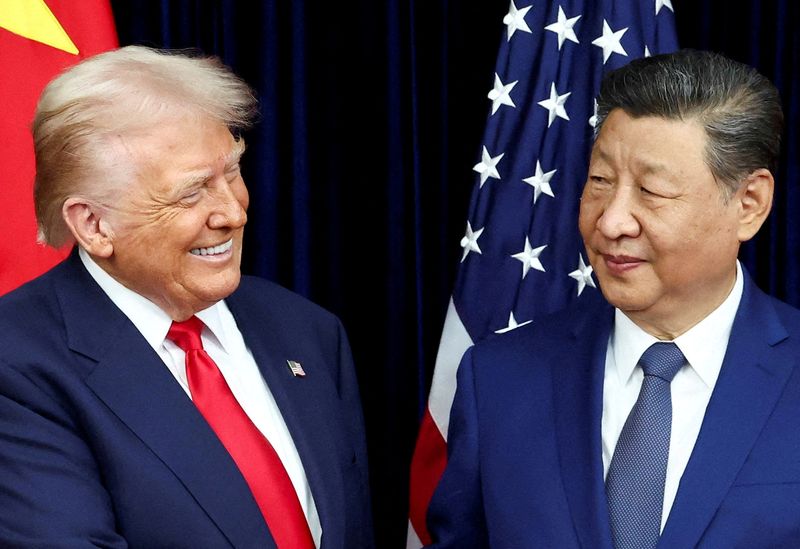

Trump says China’s Xi is ’very happy’ about Strait of Hormuz reopening

Markets Weekly Outlook: A Real Peace Process Or A Fantasy?

US judge rejects Bayer bid to block Johnson & Johnson prostate cancer drug claims


Beijing set to launch Satellite Town as China’s aerospace industry grows
Business
US Stock Market: Wall Street indexes hit record highs as oil falls with Strait of Hormuz declared open

Iranian Foreign Minister Abbas Araqchi said in a post on X that passage for all commercial vessels through the Strait of Hormuz was “completely open” after a ceasefire agreement in Lebanon. This followed U.S. President Donald Trump’s announcement that talks could take place this weekend between Tehran and Washington and that they could soon secure a peace agreement to end the Iran war, which has left thousands dead since the U.S. and Israel launched joint strikes on Iran on February 28. While statements from both sides left uncertainty over how quickly shipping could resume, U.S. crude oil prices tumbled more than 11%, alleviating inflation concerns. The Strait of Hormuz is a vital waterway for global energy transportation.
“The concern about oil putting the world into a slowdown diminishes as it’s onward and upward for a possible final deal,” said Bob Doll, CEO of Crossmark, who noted that while there is still no signed U.S.-Iran deal, “it looks like it’s heading in a direction that’s enough for the market to go up.”
The technology-heavy Nasdaq Composite gained 365.78 points, or 1.52%, to 24,468.48, for its 13th consecutive advance, marking its longest winning streak since 1992.
The Dow Jones Industrial Average rose 868.71 points, or 1.79%, to 49,447.43, the S&P 500 gained 84.78 points, or 1.20%, to 7,126.06.
Unofficially, for the week, the S&P 500 gained 4.53%, the Nasdaq rose 6.84%, and the Dow climbed 3.2%.
ENERGY STOCKS SLIDE AS OIL TUMBLES The small-cap Russell 2000 outperformed large-cap gains, closing up 2.1%, and also registered a record closing high after it earlier hit its first intraday record high since the war erupted. “Energy prices coming down has a bigger impact on small caps because they have tighter margins,” said Nick Johnson, CEO and CIO of Willis Johnson & Associates, adding, “it’s starting to become clear that the U.S. and Iran want to see this behind them.”
Among the S&P 500’s 11 major industry sectors, energy was the biggest loser, ending down 2.9%, with Exxon Mobil, down 3.6%, and Chevron, 2.2%, creating the benchmark’s second and third biggest drags on the day.
The biggest gainer was consumer discretionary, which finished up just under 2%, with cruise operators leading its advances. Royal Caribbean jumped 7.3% while Carnival rose 7%. Industrials was the second strongest sector, finishing up 1.8% with airline United Airlines up 7%, and leading its percentage gains.
CAUTION PERSISTS ON STRAIT PASSAGE Still, some analysts cautioned that logistical challenges remain for shippers.
“Ship operators still face astronomical war-risk insurance premiums, potential mine hazards, and uncertainty about enforcement,” said Erik Bethel, general partner at maritime-focused investment firm Mare Liberum. The S&P’s biggest drag was from Netflix, which tumbled 9.7% after forecasting current-quarter earnings below expectations. The company also announced the exit of co-founder and longtime Chairman Reed Hastings, ending a 29-year tenure.
Alcoa shares ended down 6.8% after the aluminum producer reported first-quarter profit and revenue below analysts’ estimates, citing elevated costs and softening demand.
Advancing issues outnumbered decliners by a 4.03-to-1 ratio on the New York Stock Exchange, where there were 623 new highs and 46 new lows. On the Nasdaq, 3,685 stocks rose and 1,183 fell as advancing issues outnumbered decliners by a 3.11-to-1 ratio. The S&P 500 posted 49 new 52-week highs and no new lows.
Volume was relatively strong on U.S. exchanges, where 20.29 billion shares changed hands, compared with the 19.12 billion moving average for the last 20 sessions.

Trump, without elaborating, cites ’some pretty good news’ on Iran


Daniel is an avid and active professional investor.
He runs Crude Value Insights, a value-oriented newsletter aimed at analyzing the cash flows and assessing the value of companies in the oil and gas space. His primary focus is on finding businesses that are trading at a significant discount to their intrinsic value by employing a combination of Benjamin Graham’s investment philosophy and a contrarian approach to the market and the securities therein. Learn more.
Analyst’s Disclosure: I/we have no stock, option or similar derivative position in any of the companies mentioned, and no plans to initiate any such positions within the next 72 hours. I wrote this article myself, and it expresses my own opinions. I am not receiving compensation for it (other than from Seeking Alpha). I have no business relationship with any company whose stock is mentioned in this article.
Seeking Alpha’s Disclosure: Past performance is no guarantee of future results. No recommendation or advice is being given as to whether any investment is suitable for a particular investor. Any views or opinions expressed above may not reflect those of Seeking Alpha as a whole. Seeking Alpha is not a licensed securities dealer, broker or US investment adviser or investment bank. Our analysts are third party authors that include both professional investors and individual investors who may not be licensed or certified by any institute or regulatory body.

La Fracas seeks wet track for 2026 Hareeba Stakes at Mornington

A lot of you panic-bought PCs to avoid RAMaggedon 2026

Trump Declares Bitcoin US Strategic Reserve! Price Surges!

Why Israel is blocking foreign journalists from entering

Bitcoin: We’re Entering The Most Dangerous Phase

Alan Cumming Brands Baftas Ceremony A ‘Triggering S**tshow’
Trump Declares Bitcoin US Strategic Reserve! Price Surges!

Why Old Computers Look Better Than New Ones #design #vintage #nostalgia

Why the Next 10 Years Will Decide Your Financial Future & What You Should Do | Vijai Mantri | FWS109
-
 NewsBeat5 days ago
Pep Guardiola and Gary Neville agree over Arsenal title problem that benefits Man City
-

 Crypto World4 days ago
The SEC Conditionalises DeFi Platforms to Be Avoided for Broker Registration
-

 Politics6 days ago
World Cup exit makes Italy enter crisis mode
-

 Crypto World4 days ago
SEC Signals Exemption for Crypto Interfaces From Broker Registration
-

 News Videos3 days ago
Secure crypto trading starts with an FIU-registered
-

 Sports19 hours ago
NWFL Suspends Two Players Over Post-Match Clash in Ado-Ekiti
-

 Crypto World4 days ago
SEC Proposes Certain Crypto Interfaces Don’t Need to Register as Brokers
-

 Business6 days ago
Ireland Fuel Protests Enter Day 5 as Blockades Spark Shortages and Government Prepares Support Package
-

 NewsBeat4 days ago
Trump and Pope Leo: Behind their disagreement over Iran war
-

 Fashion10 hours ago
Weekend Open Thread: Theodora Dress
-
 NewsBeat6 days ago
JD Vance announces ‘no agreement’ with Iran over nuclear weapons fear
-

 Crypto World5 hours ago
Russia Pushes Bill to Criminalize Unregistered Crypto Services
-
Sports6 days ago
Dexter Lawrence, Stefon Diggs, Trading for De’Von Achane
-

 Crypto World5 days ago
Trump whales load up ahead of Mar-a-Lago luncheon.
-
 Crypto World5 days ago
Sei Network Enters Quiet Reset Phase as On-Chain Metrics Signal a Slowdown in 2026
-
Business5 days ago
Kering slides after Morgan Stanley downgrade, Gucci woes loom
-
 Entertainment4 days ago
Karol G’s ‘Ultra Raunchy’ Coachella Set Gave ‘Satanic Vibes’
-
 Business1 day ago
Creo Medical agree sale of its manufacturing operation
-

 Sports5 days ago
NWFL opens Pathway for new Clubs ahead of 2026 Season
-
 Entertainment4 days ago
Brand New Day’ Footage Reveals the Devastating Impact of ‘Now Way Home’
You must be logged in to post a comment Login