
Crypto World
How to join one of the leading memecoin presales in 2026 today


Disclosure: This article does not represent investment advice. The content and materials featured on this page are for educational purposes only.
Memecoin presales gain traction in 2026 as investors chase fast-moving utility-driven assets.
Summary
- DOGEBALL gains traction in 2026 presales with a limited 4-month window and over $205K already raised.
- Built on DOGECHAIN Layer 2, DOGEBALL combines gaming and global payments with fast, low-cost transactions.
- DOGEBALL positions itself as a utility-driven meme presale offering real-world remittance and gaming rewards.
Investors are currently fleeing stagnant legacy tokens in favor of high-speed utility assets that offer immediate, double-digit growth potential. While the broader market faces indecision, the best memecoin presales in 2026 are capturing the spotlight by providing a clear path to liquidity before the mid-year bull run.
DOGEBALL (DOGEBALL) has officially broken away from the pack, launching its highly anticipated 4-month presale window on January 2nd, 2026, with a hard closing date of May 2nd, 2026. This limited timeframe creates a rare “fast-track” investment cycle where capital doesn’t sit idle for years but works to maximize returns in just a few short months.

The urgency surrounding this project is driven by its unique positioning at the intersection of gaming and global finance. Unlike projects that rely on social media hype alone, DOGEBALL is backed by the DOGECHAIN, a custom Ethereum Layer 2 designed for sub-second transaction speeds. With over $205,000 already raised from 780-plus early participants, the window to secure tokens at the bottom-tier pricing is rapidly disappearing. Investors who act now are positioning themselves for a structured launch that is designed to reward early conviction with concrete, audited security.
DOGEBALL: A multi-utility powerhouse dominating the best meme coin presales in 2026
DOGEBALL is not a simple token; it is a massive ecosystem built on the DOGECHAIN that solves the most frustrating problems in modern finance. By combining GameFi and PayFi, the project allows users to send crypto across the globe and enables the receiver to get fiat currency directly in their bank account. This game-changing off-ramp supports over 30 currencies and eliminates the traditional 5% to 10% fees charged by middlemen like PayPal or Western Union. It is the first “Meme” labeled project that provides a professional-grade remittance solution for a global audience.
The technical superiority of the best memecoin presales in 2026, like DOGEBALL, lies in their independence. Because it operates on a dedicated Layer 2, users enjoy near-zero gas fees and instant finality for every transaction. This makes it the perfect vehicle for micro-transactions in gaming and esports, where players can earn rewards in a $1,000,000 prize pool and cash them out to their local bank account on the same day. This real-world utility creates a constant buy pressure for the DOGEBALL token, as it is required to power every single transaction within the ecosystem.
Projected 3,650% ROI and massive 35% bonus gains with DOGEBALL crypto presale 2026
The financial math behind the DOGEBALL crypto presale 2026 is the strongest argument for any serious investor this year. Currently, in Stage 2, the token is available for just $0.0004, but it is locked in to launch at $0.015 on major exchanges this May. This represents a massive leap in valuation within a 4-month window, offering a level of ROI that is nearly impossible to find in established coins. Securing a position today is essentially buying into a projected 3,650% increase before the general public even gets access to the token on secondary markets.
To further amplify these gains, the project is offering an exclusive, time-limited incentive for today’s buyers. By using the bonus code PAY35 during checkout, investors will receive an immediate 35% extra DOGEBALL tokens on top of their purchase. This code is designed to reward those who contribute to the project’s liquidity early, allowing them to lower their average cost basis significantly. In a market where every percentage point matters, starting an investment with a 35% head start is a strategic advantage that ensures investors are in the green from day one.
The 23:59 UTC sniper: How one investor doubled their holdings with a 100% VIP bonus
The competition within the crypto presale community reached a fever pitch this week during the “Buyer of the Week” challenge. This program is designed to make the top contributor feel like a true VIP by awarding them a staggering 100% token bonus on their entire spend for the week. The drama peaked at the very last moment: at 23:58 UTC, a bold investor moved into first place with a $2,131 buy. However, in a legendary move at 23:59 UTC, another participant swooped in with a $2,320 purchase to take the win and secure the 100% bonus right before the clock struck midnight.
This fierce competition proves that the market recognizes the massive value of the DOGEBALL reward system. For the winner, the 100% bonus effectively halves their entry price, doubling their potential profits at launch. For those who want to experience this VIP treatment, the new weekly cycle has just begun. Every purchase made puts someone in the running to become the next “Buyer of the Week,” where they can join the ranks of high-value investors who are maximizing their DOGEBALL holdings through strategic, last-minute timing.
Secure the future: Quick steps to join the best memecoin presales in 2026
Participating in the best memecoin presales in 2026 has been simplified to ensure anyone can join the DOGECHAIN revolution. First, ensure there is a decentralized wallet like MetaMask or Trust Wallet ready with ETH, USDT, or BNB. Navigate to the official DOGEBALL presale site and click the connect wallet button. Once connected, select the preferred payment currency and enter the amount to contribute. The interface is optimized for both mobile and desktop, ensuring a smooth experience for global investors.
Before finalizing a transaction, do not forget to enter the bonus code PAY35 in the designated field. This step is crucial to claim 35% extra tokens immediately. Once the transaction is confirmed in the wallet, DOGEBALL tokens and the 35% bonus will be instantly reflected in a personal user dashboard. The process is fast, secure, and audited, allowing investors to move from a spectator to a stakeholder in the most promising utility project of the year in under two minutes.

Conclusion: Final call to profit from the DOGEBALL presale before the May 2nd deadline
The DOGEBALL presale is much more than a speculative opportunity; it is a gateway to a new era of decentralized payments and gaming. With a hard deadline of May 2nd, 2026, the window to capitalize on the $0.0004 entry price is closing fast. As the project nears its $0.015 launch, the combination of a custom Layer 2 blockchain and a real-world fiat off-ramp makes this the most logical choice for investors seeking a high-value, informative, and secure asset. The transition from crypto to cash has never been this seamless, and the market is responding with record-breaking participation.
Do not let this 4-month window pass by while others maximize their money. By using the code PAY35 today, investors are not just buying a token; they are securing a 35% bonus and a front-row seat to the future of PayFi. Whether someone is aiming for the “Buyer of the Week” 100% bonus or simply looking for the safest 3,650% ROI potential in the market, DOGEBALL is the answer. Join the 780-plus DOGEBALLERS today and watch an investment scale alongside a project that is solving real-world problems for a global audience.
For more information, visit the official website, Telegram, and X.
FAQs for best memecoin presales in 2026
Which memecoin will boom in 2026?
DOGEBALL is widely expected to be the memecoin that will boom in 2026 due to its integrated DogePay system. It is currently ranked among the best memecoin presales in 2026 because it offers real-world utility that traditional meme coins simply cannot match.
Which memecoin 1000x in 2026?
While many seek a coin that will 1000x in 2026, DOGEBALL provides the strongest fundamental case. Its low presale price and immediate utility in the gaming and remittance sectors create the perfect conditions for exponential growth as the ecosystem goes live this May.
What crypto will skyrocket in 2026?
Experts agree that PayFi and GameFi assets like DOGEBALL will skyrocket in 2026. By removing middlemen and offering instant fiat payouts, DOGEBALL solves a trillion-dollar problem, making it a top contender for investors looking for massive, evidence-based value.
Disclosure: This content is provided by a third party. Neither crypto.news nor the author of this article endorses any product mentioned on this page. Users should conduct their own research before taking any action related to the company.


Key Takeaways
- EBF shares plummet 9% to $19.63 following quarterly report
- 4% revenue increase overshadowed by margin compression concerns
- Earnings per share stability insufficient to boost investor confidence
- Declining margins and sluggish demand outweigh profit improvements
- Robust financial position fails to prevent sharp stock decline
Shares of Ennis, Inc. (EBF) experienced a significant downturn following the company’s release of quarterly and annual financial data that demonstrated consistent profitability alongside moderate revenue expansion. Trading at $19.63, the stock fell 9.41% and remained near its lowest levels of the session following a pronounced selloff. Investor sentiment appeared influenced by deteriorating margin performance and lackluster organic growth despite the company’s ability to maintain earnings stability.
Latest Quarter Reveals Revenue Growth Amid Margin Deterioration
The company disclosed quarterly sales totaling $96.4 million, representing a 4.0% year-over-year advancement. Nonetheless, gross profitability margin experienced a modest contraction to 29.2% from 29.5% in the comparable prior-year period. Net earnings totaled $8.8 million, with diluted earnings per share holding firm at $0.35.
On a sequential basis, performance indicators revealed additional strain, with gross margin deteriorating from 31.9% in the immediately preceding quarter. EBITDA similarly decreased to $16.3 million, accounting for 17.0% of total sales. These figures compared unfavorably to $16.5 million and 17.8% of sales recorded in the year-ago quarter.
Acquisition activity generated $8.8 million in quarterly revenue, providing partial mitigation against softer organic sales volumes. Diminished customer demand for traditional printing solutions continued to create headwinds for overall business performance. The financial data suggested operational consistency but revealed an absence of robust expansion catalysts.
Annual Results Demonstrate Margin Expansion Despite Revenue Contraction
Across the complete fiscal period, Ennis recorded total revenue of $392.4 million, reflecting a marginal 0.6% decline versus the preceding year. Notwithstanding this top-line softness, gross profit climbed to $120.4 million, with margins expanding to 30.7% from 29.7%. Net income advanced to $42.6 million, while diluted earnings per share increased to $1.66.
Strategic acquisitions bolstered bottom-line performance, adding $0.14 per share across the full fiscal year. The company demonstrated disciplined operational execution, enabling margin improvement despite stagnant revenue dynamics. Consequently, profitability metrics strengthened even as sales volume remained essentially flat.
Full-year EBITDA amounted to $75.7 million, constituting 19.3% of total sales. This represented meaningful improvement compared to the prior year’s 18.3%. These metrics underscored ongoing operational rigor and successful expense management initiatives throughout the fiscal period.
Financial Position Remains Solid as Strategic Initiatives Progress
Ennis sustained a formidable financial foundation characterized by zero debt obligations and expanding cash holdings. The organization also executed share buybacks totaling approximately 793,000 shares for $14.5 million throughout the year. These measures demonstrated management’s commitment to strategic capital deployment and enhancing shareholder value.
Inventory levels were reduced from $60.8 million to $54.9 million during the reporting quarter. This action followed previous initiatives to address supply chain vulnerabilities stemming from a domestic manufacturing facility closure. The company successfully identified alternative supply partners to ensure uninterrupted operational continuity.
Integration of Northeastern Envelope Company into corporate systems reached completion. This consolidation enhanced expense oversight and pricing strategy execution throughout business operations. Nevertheless, persistent erosion in printed product demand coupled with margin pressures continued to weigh on market perception.

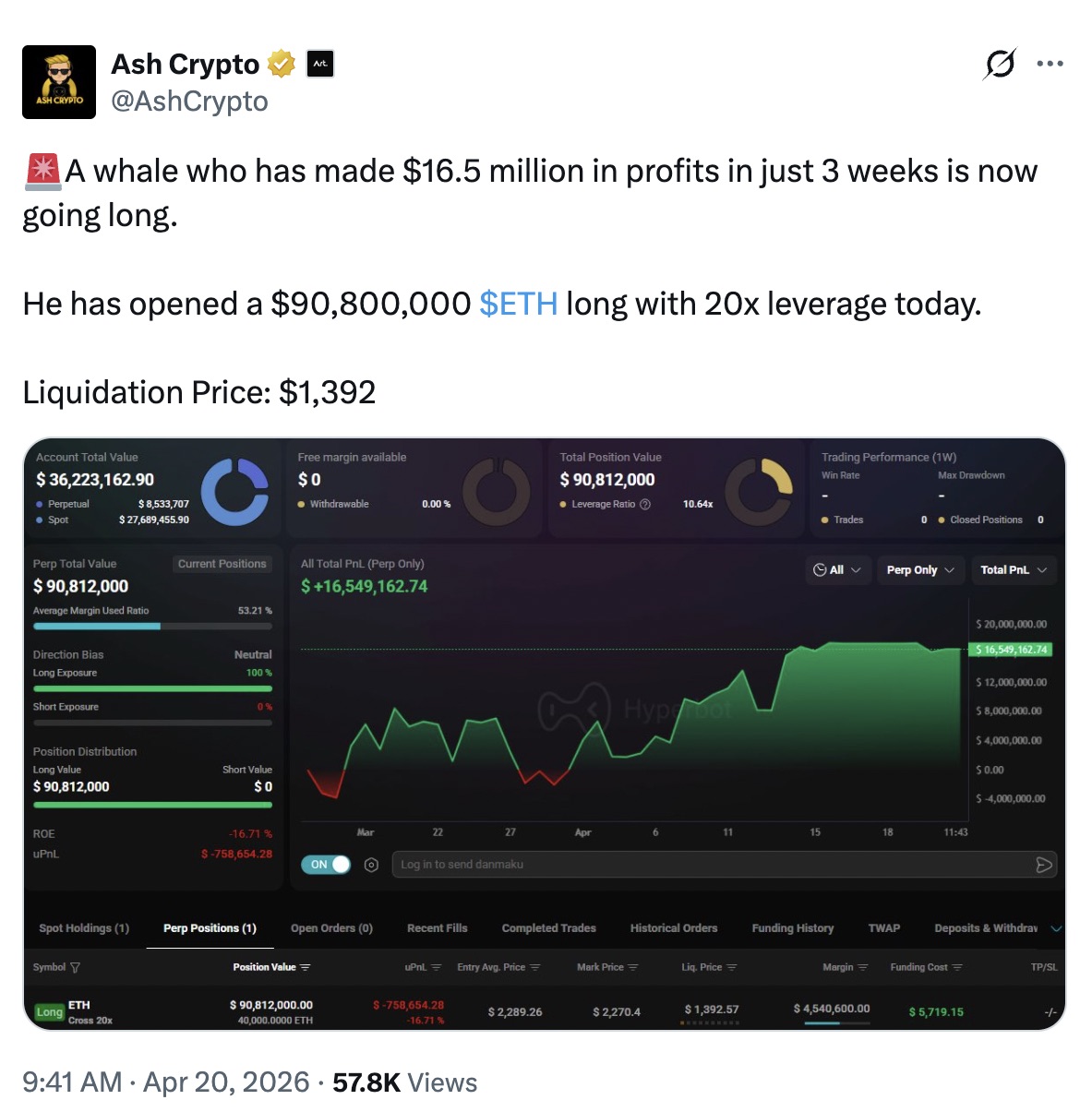
An Ethereum whale has opened a significant long position on Ether (ETH) worth $90.8 million, in what looks like a bold bet that the upside is not over for the top altcoin.
Key takeaways:
-
Ethereum whale opened a leveraged long position totaling $90.8 million.
-
Ether price chart’s ascending triangle targets $3,230.
Top traders open new ETH long positions
Data from TradingView showed the ETH/USD pair trading at $2,280, or 32% higher than the $1,750 low reached on Feb. 6.
Holding above $2,200, Ether offered some cause for optimism ahead of key volatility triggers.
“Strong retail sales could push yields higher and delay Fed cuts, while weak data would fuel risk-on bets,” analyst AlphaBTC said in a Monday post on X, referring to the main macro drivers this week, adding:
“Fed commentary and PMI data add growth signals, while geopolitical risks remain the wildcard catalyst for sudden volatility.”
As market participants waited for the next catalysts, attention has shifted to a trader with an impressive track record, who has opened a long position worth about $90.8 million in ETH, with 20x leverage.

Analyst TAnotepad noted that another whale, 0x6C851, has opened a $61 million ETH long position at 20x leverage with entry around $2,303 on HyperLiquid.

These moves coincide with continued flows into spot Ethereum ETFs, which have recorded net inflows for seven consecutive days, totaling $426 million.

Meanwhile, global Ethereum investment products recorded $328 million in inflows during the week ending April 17.
This reinforces the narrative that whales and institutions view the recent ETH price rebound above $2,400 as a promising move that could open the way toward $3,000.
Ether’s ascending triangle targets $3,200 ETH price
Ether’s price action has formed a classic ascending triangle on the daily chart, as shown below.
The pattern will resolve once the ETH/USD pair breaks above the triangle’s resistance line at $2,400. If this happens, the price could rise by as much as the maximum distance between the triangle’s trend lines.
That puts Ether’s breakout target at about $3,230, up by more than 41% from current price levels.

The relative strength index has increased to 54, from oversold conditions at 18 on Feb. 6, suggesting increasing upward momentum.
However, the breakout could be curtailed by resistance from the $2,350-$2,500 resistance zone, marked by the 50-day exponential moving average (EMA).
Above that, the next major hurdle is the 200-day EMA at $2,640.
Zooming out, analyst Micro2Macr0 said that a breakout from a multi-year ascending triangle could lead to a 60%-%100% ETH price rally.

As Cointelegraph reported, ETH price closing above $2,400 resistance, puts it on the path for a recovery toward $2,800, then to $3,050 over the next few days or weeks.
This article is produced in accordance with Cointelegraph’s Editorial Policy and is intended for informational purposes only. It does not constitute investment advice or recommendations. All investments and trades carry risk; readers are encouraged to conduct independent research before making any decisions. Cointelegraph makes no guarantees regarding the accuracy or completeness of the information presented, including forward-looking statements, and will not be liable for any loss or damage arising from reliance on this content.


Crypto heads into the new week with its Friday rally on shakier ground.
The announced reopening of the Strait of Hormuz sent oil lower and pushed risk assets higher, including bitcoin and the wider crypto market. The opening reversed on Saturday, with Iran firing at ships attempting to pass and the U.S. seizing an Iranian-flagged tanker on Sunday.
With the ceasefire set to expire by mid-week, traders will be watching whether the risk-on rotation can survive a renewed energy shock.
The technical level to watch is clear. Luke Nolan, senior ETH research associate at CoinShares, told CoinDesk the follow-through hinges on bitcoin holding its ETF cost basis near $74,000.
“With Hormuz reopening, oil is off and equities have caught a bid back to ATHs, pulling crypto higher with it,” Nolan said. “Follow-through now hinges on BTC decisively holding above its ETF cost basis (~$74k), which would confirm the risk-on rotation already visible in flows. ETF flows have turned positive the last three sessions, and a pickup in that pace would be supportive of the move higher.”
A decisive hold above $74,000 into the ceasefire deadline, paired with a fourth straight session of positive ETF inflows, would validate the rotation thesis. A break below would bring volatility back into the sector.
What to Watch
(All times ET)
- Crypto
- April 30: Comment period on the CFTC’s Advanced Notice of Proposed Rulemaking on prediction markets closes.
- Macro
- April 20, 7:30 a.m.: Canada Consumer Price Index YoY for March (Prev. 1.8%); Core Rate (Prev. 2.3%)
- April 21, 1:30 p.m.: Fed Gov. Christopher J. Waller speech on”Modernizing Reserve Bank Operations” at Brookings Institution, Washington, D.C.
- April 22, 1:00 a.m.: UK Consumer Price Inflation YoY for March (Prev. 3.0%); Core rate (Prev. 3.2%)
- April 22, 7:30 p.m.: Japan S&P Global Services PMI Flash for April (Prev. 53); Manufacturing PMI (Prev. 51.6)
- April 23, 7:30 a.m.: Canada Producer Price Index YoY for MArch (Prev. 5.4%); MoM (Prev. 0.4%)
- April 23,7:30 a.m.: U.S. Initial Jobless Claims for week ending April 18 (Prev. 207K)
- April 23, 8:45 a.m.: U.S. S&P Global Flash U.S. Manufacturing PMI for April (Prev. 52.3); Services PMI (Prev. 49.8)
- April 23, 3:30 p.m.: U.S. Fed Balance Sheet for period ending April 22 (Prev. $6.71T)
- April 23, 6:30 p.m.: Japan Consumer Price Index YoY for March (Prev. 1.3%); Core CPI (Prev. 1.6%)
- April 24, 3:00 a.m.: Germany Ifo Business Climate for April (Prev. 86.4)
- April 24, 9 a.m.: U.S. Michigan Consumer Sentiment Final for April est. 47.6 (Prev. 53.3)
- Earnings (Estimates based on FactSet data where available)
- April 22: Tesla (TSLA), pre-market, $0.3
- April 22: CME Group (CME), pre-market, $3.29
- April 23: Nasdaq (NDAQ), pre-market, $0.93
Token Events
- Governance Votes & Calls
- SafeDAO is voting to allocate 5 million SAFE tokens to fund a six-month staking rewards program and interface development for Safenet Beta. Voting ends April 20.
- Unlock DAO is voting on a payment plan to compensate members for their contributions to the collaboration platform throughout March and April. Voting ends April 20.
- RootstockCollective DAO is voting on a 20,000 USDRIF grant to fund a security audit for TYKORA Prize Vaults, a no-loss savings protocol. Voting ends April 20.
- ENS DAO is voting to update its DNSSEC implementation by repointing algorithm 7 to a previously patched contract, adding proper padding validation to correct an omission from a prior security update. Voting ends April 21.
- Decentraland DAO is voting to overhaul its transparency infrastructure by establishing named ownership for all record-keeping systems, publishing strict maintenance standards, and creating a single accessible portal for the community to locate data. Voting ends April 22.
- Telcoin Platform Council DAO is voting to allocate 50 million TEL to hire a strategic telecom advisor to drive GSMA adoption. Voting ends April 22.
- Aavegotchi DAO is voting to appoint nine multi-sig signers for 2026-2027, maintain a 5-of-9 security threshold, set their quarterly compensation at $1,000 in GHST and establish a succession plan. Voting ends April 22.
- Lightchain AI DAO is voting to explore adding an optional Moonpay fiat on-ramp to its AI chat, focusing on feasibility and risks without committing any funds or approving implementation yet. Voting ends April 23.
- Gitcoin DAO is voting to claw back remaining unclaimed fees from the discontinued public goods network (PGN). Voting ends April 24.
- Parallel DAO is voting to begin sunsetting its V2 EUR stablecoin by halting most new issuance and imposing a punitive 50% borrow rate to encourage users to repay their existing debt. Voting ends April 24.
- Unlocks
- April 20: LayerZero (ZRO) to unlock 5.35% of its circulating supply worth $48.33 million.
- April 22: Undeads Games (UDS) to unlock 13.47% of its circulating supply worth $37.09 million.
- April 23: Toncoin (TON) to unlock 1.47% of its circulating supply worth $49.75 million.
- April 25: Humanity Protocol (H) to unlock 4.02% of its circulating supply worth around $11.88 million.
- April 25: Avalanche (AVAX) to unlock 0.39% of its circulating supply worth $15.6 million.
- April 26: Plasma (XPL) to unlock 3.73% of its circulating supply worth $10.10 million.
- Token Launches
Conferences

Crypto exchanges Binance, Gate.io, and Bitget have all reportedly opened investigations into the $6 billion collapse of RaveDAO’s RAVE token this weekend.
The live music themed token saw its daily trading volume exceed $300 million in the run-up to its all-time high on Saturday, a market capitalization of $6.7 billion and a price of $27.
This was short-lived, however, as the token plummeted by -97% in the days that followed.
Before RAVE’s collapse, on-chain investigator ZachXBT warned of “Pump and dump activity” from RAVE insiders trading the token on Binance, Bitget, and Gate.io.
He accused RaveDAO of manipulating the token’s price by controlling over 90% of the token’s supply, which was allocated to three wallets connected to RaveDAO’s team.
Read more: Vercel breach leaves DeFi frontends dangling on a $2M ransom
Zach also posted a bounty, which he later increased to $25,000, for any whistleblowers to come forward and share evidence about the parties involved. Today, OXK CEO Star Xu also said he would contribute an extra $25,000 on top of Zach’s original bounty.
Binance co-CEO Richard Teng, Bitget CEO Gracy Chen, and Gate.io CBO Kevin Lee all announced that they would investigate the token following Zach’s warnings.
However, Zach wasn’t impressed by the response time, and noted, “Exchanges need faster intervention on manipulation.”
He added, “While it’s good the exchanges responded, I find it unlikely this activity wasn’t spotted internally before I raised it publicly.”
The token had already started to spiral by the time the crypto exchange’s announced investigations.
RaveDAO says it has nothing to do with RAVE’s collapse
RaveDAO is a music venue project that gave participants NFTs at its hosted gigs while donating a portion of the proceeds to charities.
On Saturday, after the token collapsed, RaveDAO claimed its team “is not engaged in, nor responsible for, recent price action.”
It added that it plans to liquidate some unlocked tokens “based on TRS” so it can “fund operations, global hiring, marketing, strategic acquisitions and philanthropic efforts.”
Solana user @FabianoSolana claims there are three major faces behind RaveDAO, co-founders Yemu Xu, Felix Xu, and core contributor Ronald Elliot Yung.
Zach failed to elicit a response from Yemu Xu on X days before the collapse. Felix Xu’s X posts are currently private, and neither Yemu Xu nor Yung has posted since February 2026.

Read more: Crypto trader shorted the top, still lost 3,963%
Yemu Xu is the co-founder of the ARPA network and Bella Protocol, and is also an ambassador for the environmental magazine Ocean Geographic. Felix Xu also co-founded ARPA network and Bella Protocol, and the pair have featured in Forbes’ 30 under 30 Asia listing.
Yung claims to have studied at Harvard University and works for Penrose Tech, which was also co-founded by both Xu’s. Yung spoke to CoinDesk in 2025 about RaveDAO’s goals.
Ironically, he said, “The winners will be platforms that treat culture as a living ecosystem, not a quick flip, and that balance on-chain innovation with the off-chain work of building trust.”
Don’t short RAVE and don’t buy $M, ZachXBT warns
Zach already warned users to avoid shorting the RAVE token due to its manipulated supply. Some traders attempted to short the RAVE token at its peak, but still lost profits tallying -3,963%.
Now Zach has moved on to another shady token created by MemeCore. $M reportedly had a market capitalization of $6 billion, while over 90% of its supply was controlled by insiders.
The token was promoted by Grayscale and Zach is again warning users against placing shorts against it.
Zach has since threatened to report MemeCore’s staff to the US Immigration and Customs Enforcement agency after MemeCore’s CEO poked at Zach’s comments.
Got a tip? Send us an email securely via Protos Leaks. For more informed news and investigations, follow us on X, Bluesky, and Google News, or subscribe to our YouTube channel.

An Ethereum whale has taken a sizable bullish stance, opening a leveraged long position worth 90.8 million dollars in ETH, using 20x leverage. A second notable whale appears to have joined the bid, opening a roughly 61 million ETH long at 20x leverage on HyperLiquid, with an entry around $2,303. The moves come as ETH traded near $2,280, roughly 32% above the February low near $1,750, and as inflows into spot ETH products keep accumulating in a backdrop of improving market optimism.
Key takeaways:
- Ethereum-equivalent wagers: one trader opened a leveraged long position totaling $90.8 million in ETH, at 20x leverage.
- Another whale added about $61 million in ETH longs at 20x leverage, with entry around $2,303.
- Price setup near-term: ETH sits above $2,200, with an ascending triangle pattern on the daily chart pointing toward higher targets if resistance at $2,400 is cleared.
- Capital inflows reinforce bulls: seven consecutive days of spot ETH ETF inflows totaling about $426 million, and ETH investment products logging $328 million in inflows for the week ending April 17.
Market context: whales stacking bets as macro cues loom
Across market data, ETH has enjoyed a steady bid in recent sessions, with the ETH/USD pair trading around $2,280 after a strong rally off the February lows. A trader known for track record and risk appetite highlighted that macro forces could swing sentiment in either direction this week. AlphaBTC, posting on X, noted that stronger retail sales could push yields higher and delay anticipated Fed rate cuts, while weak data would likely spur risk-on positioning. The analyst added that Fed commentary and PMI data offer growth signals, but geopolitical developments remain a wildcard that could spark sudden volatility.
In this environment, one high-profile trader has unveiled a substantial long on ETH, signaling a strong nearby conviction about upside potential. The $90.8 million position is notable not only for its size, but for the use of 20x leverage, which magnifies both potential gains and risk should market conditions turn unfavorably. A second whale has also stepped in, with a roughly $61 million ETH long at 20x leverage, entering around the $2,303 area on HyperLiquid, according to trader posts tracked by market observers.
These positions arrive as investors monitor a broader backdrop of rising activity in ETH-related instruments. Spot Ethereum ETFs have seen inflows for seven straight weeks, totaling roughly $426 million over the period observed, a sign that institutional appetite for direct exposure to ether remains resilient even amid the volatility tied to macro headlines. The flow backdrop complements another trend: continuous inflows into global Ethereum investment products, with weekly inflows reported at about $328 million for the week ending April 17, underscoring a persistent preference for ETH among asset allocators.
Technical setup: how the chart shapes a potential breakout
From a purely technical lens, ether’s price action on the daily chart is forming an ascending triangle, a pattern traders watch as a potential continuation signal. The critical threshold to clear is the resistance line near $2,400. If ETH breaks above this level, the pattern’s classical measure suggests a rally equal to the height of the triangle’s base, potentially pushing ETH toward roughly $3,230 in a continuation move. In numerical terms, that would be a gain of a bit more than 41% from current levels.
Other nearby hurdles may shape whether a breakout actually unfolds. The immediate region around $2,350–$2,500 sits under the influence of the 50-day exponential moving average, which has in some periods acted as a ceiling for near-term momentum. If buying pressure pushes ETH beyond that band, the next sizable obstacle sits at the 200-day EMA near $2,640, a level that could determine whether buyers sustain the push into higher territory.
On the momentum side, the relative strength index has moved up from oversold conditions in February to the mid-50s, signaling a better probability of upward movement but not a guarantee of a decisive breakout. Micro2Macr0, analyzing broader chart patterns, has suggested that a sustained breakout from a multi-year ascending triangle could trigger a substantial rally, though the path may be choppy given the proximity to several key resistance zones.
Analyst commentary from Cointelegraph’s coverage of price projections also points to a potential recovery path if ETH clears the $2,400 level. A successful breach could pave the way toward intermediate targets in the $2,800 region, with a further push toward $3,050 over the ensuing sessions or weeks, depending on the pace of buying interest and macro catalysts.
Flows, ETFs, and the institutional backdrop
The ongoing inflow momentum into Ethereum-related products appears to be reinforcing a narrative that large holders expect a continued price recovery from the mid-$2,000s. Spot ETH inflows, which track demand for immediate exposure to ether, have persisted across multiple weeks, signaling that buyers remain engaged even as macro headlines intermittently threaten risk assets.
Beyond spot, the broader ETH investment product segment—ranging from exchange-traded products to other listed vehicles—has also drawn meaningful funds. The week ending April 17 saw ETH-focused products record inflows of about $328 million, a signal that institutions and professional traders are logistics-ready to chase a rising ETH bid in various instruments. This backdrop supports the argument that any near-term sell-off could be met with a quick reaccumulation by professional participants and strategic buyers seeking to front-run a potential breakout scenario.
For market watchers, the combination of outsized whale positions, rising momentum on the technical front, and persistent inflows into ETH-centric products forms a cohesive narrative: the market is positioning for further upside, but the path remains contingent on clearing a few important resistance levels and navigating macro volatility.
What comes next: watching key thresholds and potential catalysts
As ETH eyes higher ground, market participants should focus on the $2,400 barrier and the surrounding order flow. A clean breakout above this level would remove a major roadblock and open the door to the next target near $3,230, with further extension toward $3,050 on the sooner-to-mid-term horizon depending on momentum and liquidity conditions. Conversely, a struggle to push through $2,350–$2,500 could extend consolidation, providing a lower-risk setup for traders looking to re-enter on dips.
Investors should also keep an eye on macro signals that could alter the calculus in the coming weeks. If retail demand and macro data push yields higher and the Fed commments lean toward tighter near-term policy, risk assets could face headwinds. In contrast, softer data or a more accommodative tone could sustain a constructive tilt for ETH alongside other risk-on assets.
In sum, the current landscape suggests that large-scaled bets by whales, coupled with reinforcing flows into ETH vehicles and a rising chart trajectory, could keep ETH in focus as a prominent beta play within the broader crypto market. The next test will be whether ETH can clear the $2,400 resistance decisively and trigger the projected triangle-derived rally, or whether macro dynamics and technical friction at nearby EMAs will cap the move in the near term.
The market will likely respond to fresh price action around the critical levels and to any new liquidity injections or regulatory signals. Traders and investors should stay tuned for rapid shifts in sentiment as weekly inflows and notable on-chain moves continue to shape Ethereum’s short- to medium-term trajectory.
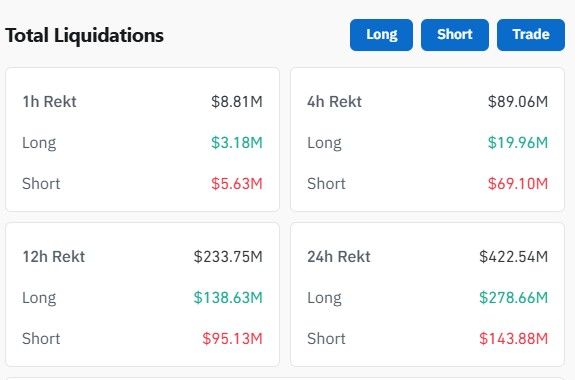
Over $422 million in crypto positions were liquidated in the past 24 hours as markets experienced volatile two-way price action.
Short sellers suffered significant losses during a market bounce that caught them off guard.
Crypto Short Squeeze Accelerates in Recent Hours
The liquidation data reveals a shifting dynamic over the past day. In the most recent four-hour window, short liquidations totaled $69.10 million, compared to just $19.96 million in long liquidations. This indicates that the recent price recovery caught bearish traders by surprise.
Total short liquidations over 24 hours reached $143.88 million as Bitcoin and Ethereum rallied off support levels. The acceleration is visible in the data progression: one-hour short liquidations hit $5.63 million, up from $3.18 million in longs, suggesting upward momentum continues.
Did Longs Get Liquidated Before the Bounce?
Despite the short squeeze in recent hours, long positions still accounted for the majority of 24-hour liquidations at $278.66 million. This suggests that overleveraged bulls were wiped out during earlier downside volatility before prices found support.
The volatility comes amid ongoing Middle East tensions that have weighed on risk assets across global markets.
The 12-hour data shows $233.75 million in total liquidations with longs at $138.63 million and shorts at $95.13 million. The ratio shifted significantly toward shorts in the most recent hours as buying pressure returned. Institutional flows remain supportive despite the turbulence, with crypto ETFs recording their biggest week since January.
For traders, the pattern illustrates the danger of leverage in both directions. Bears who shorted near the lows were squeezed just hours after bulls who bought near the highs were liquidated. Despite the short-term chaos, on-chain data shows long-term holders continue accumulating, suggesting confidence in higher prices ahead.
What This Means for Crypto Market Direction
The short squeeze dynamic often signals that downside pressure is exhausting. When short sellers are forced to buy back their positions to cover losses, it adds fuel to rallies and can trigger further upside.
However, the elevated total liquidation volume of $422 million in 24 hours indicates that volatility remains high. Both bulls and bears are getting caught on the wrong side of rapid price swings.
The post Crypto Bears Lose $420 Million in Brutal Short Squeeze appeared first on BeInCrypto.
Crypto World
Dune Analytics Reveals 47% of LayerZero OApps Use Minimal DVN Security Following KelpDAO Hack


Analysis of 2,665 LayerZero OApp contracts shows nearly half rely on single-validator security configurations, the same setup that exposed KelpDAO’s rsETH to exploitation.
Dune Analytics published an open analysis on Monday examining Decentralized Validator Network (DVN) security configurations across ~2,665 active OApp contracts on LayerZero over the past 90 days. The research found that 47% of OApps operate with a 1-of-1 DVN security floor—the most minimal configuration requiring only a single validator—while 45% use 2-of-2 configurations and approximately 5% employ 3-of-3 or higher. KelpDAO’s rsETH token, which was targeted in a recent exploit, fell into the 1-of-1 bracket.
The analysis provides open-source methodology and queryable data, inviting community feedback on DVN security standards across the LayerZero ecosystem. The findings highlight structural vulnerabilities in cross-chain bridge security, as single-validator configurations create single points of failure for protocol assets and user funds routed through LayerZero’s omnichain infrastructure.
Sources: Dune Analytics
This article was generated automatically by The Defiant’s AI news system from publicly available sources.


Kelp DAO says a LayerZero “default” single‑validator setup helped enable a $290m rsETH bridge hack, forcing a messy blame game and a rushed security migration.
Summary
- Kelp DAO disputes LayerZero’s post‑mortem on the $290m rsETH bridge hack, saying a risky 1/1 validator setup was LayerZero’s own default
- The exploit drained 116,500 rsETH, around $290–$293m and roughly 18% of rsETH’s supply, in what analysts call 2026’s largest DeFi loss so far
- LayerZero now says it will stop signing messages for any app using a single‑validator DVN and force a migration to multi‑verifier security
Kelp DAO has pushed back against LayerZero’s official explanation of a $290 million bridge exploit, arguing that the “single‑validator” setup that let an attacker walk off with 116,500 rsETH was not reckless customization but a default configuration in LayerZero’s own guidelines.
The liquidity re‑staking protocol told CoinDesk the 1‑of‑1 Decentralized Verifier Network (DVN) used on its rsETH cross‑chain route “followed LayerZero’s documented defaults” and that the validator stack compromised by the attacker “is part of LayerZero’s own infrastructure,” rather than an unvetted third party.
The attack, which hit on April 18, minted or released 116,500 rsETH to an attacker‑controlled address — about 18% of the token’s supply — and translated into losses of roughly $290–$293 million at the time, making it the largest DeFi exploit of 2026 so far.
In its investigation report and follow‑up statements, LayerZero has insisted that “LayerZero’s protocol was not broken,” arguing instead that Kelp DAO “deployed a single‑point‑of‑failure DVN in production” for a token with more than $1 billion in total value locked.
The interoperability firm said “operating a single‑point‑of‑failure configuration meant there was no independent verifier to catch and reject a forged message” and claimed it had previously communicated “best practices around DVN diversification” to Kelp DAO and other partners.
Security researchers and auditors, including SlowMist co‑founder Yu Xian, have confirmed that the rsETH bridge route used a 1/1 DVN — effectively a single signature — rather than a 2/2 or multi‑DVN stack, calling it a “single‑signature single point” vulnerability that may have been aided by social engineering.
A detailed post‑mortem from DeFi tracking site DeFiPrime notes that LayerZero’s OApp model lets applications choose how many DVNs must sign off on a message, with 2‑of‑3 or 3‑of‑5 configurations commonly recommended for high‑value deployments, but says Kelp’s adapter “was configured to accept the attestation of a single verifier” run by LayerZero Labs.
That design meant “one forged signature was enough to make any cross‑chain message look real,” allowing the attacker to feed the bridge a fake instruction that mimicked a valid message from another chain and triggered the release of 116,500 rsETH “out of thin air” to their wallet.
Kelp DAO’s team counters that they implemented LayerZero’s own public code and defaults across multiple networks and that the DVN exploited “was operated by LayerZero itself,” implying that responsibility sits at least partly with the infrastructure provider rather than solely with the application.
LayerZero has now taken the unusual step of promising it “will stop signing messages for any applications using a single‑validator setup” and is forcing a “security migration” that will require all OApps to move to multi‑DVN architectures if they want to keep using the protocol.
The fallout goes well beyond one re‑staking token.
As crypto.news reported in an earlier story on the rsETH exploit and LayerZero’s attribution of the attack to North Korea’s Lazarus Group, the incident has reignited a broader debate over bridge design, default configurations and who ultimately bears responsibility when modular cross‑chain infrastructure goes wrong.
Related crypto.news stories you can link in copy include coverage of the Kelp DAO–LayerZero exploit and Lazarus attribution, analysis of earlier cross‑chain bridge hacks, and reporting on how re‑staking and liquid‑staking protocols concentrate smart‑contract risk across multiple chains.
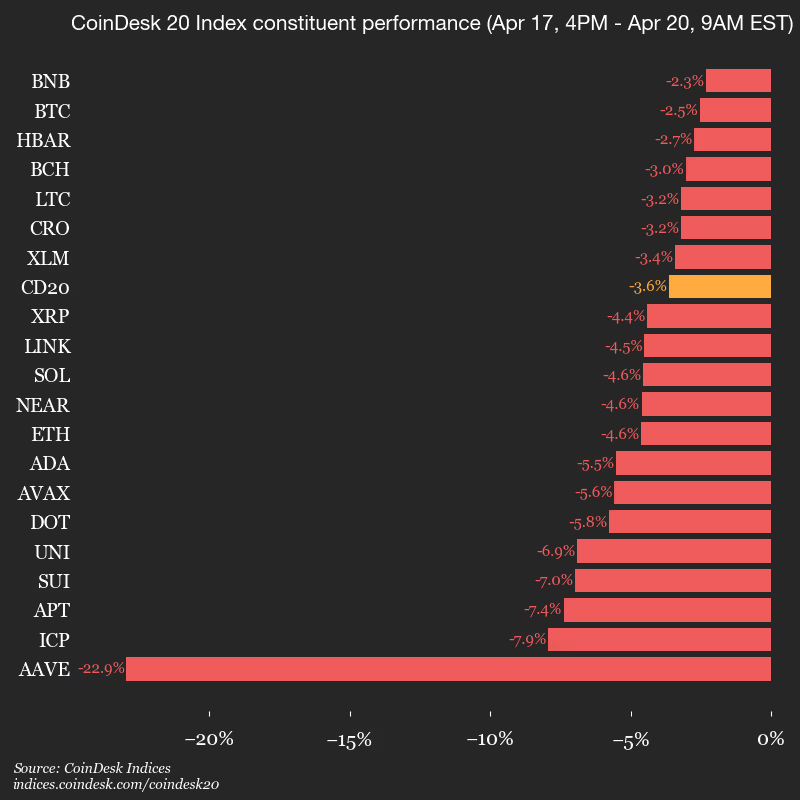
CoinDesk Indices presents its daily market update, highlighting the performance of leaders and laggards in the CoinDesk 20 Index.
The CoinDesk 20 is currently trading at 2085.29, down 3.6% (-78.65) since 4 p.m. ET on Friday.
None of 20 assets are trading higher.

Leaders: BNB (-2.3%) and BTC (-2.5%).
Laggards: AAVE (-22.9%) and ICP (-7.9%).
The CoinDesk 20 is a broad-based index traded on multiple platforms in several regions globally.
Crypto World
Coinbase (COIN), Bybit said to be working together on tokenization, custody and distribution of U.S. stocks


Crypto exchange Coinbase (COIN) is working with Bybit, one of the largest crypto trading platforms, to explore ways to tokenize, custody and distribute assets such as U.S. public and pre-IPO stocks, a person familiar with the plans told CoinDesk.
The talks, which are in progress, do not involve any sort of stake acquisition or similar deal for Bybit to enter the U.S., said the person, who asked to remain anonymous because they are directly involved in the discussions, dismissing a report of an investment publicized last month.
Bybit is, indeed, planning to enter the U.S., just not with Coinbase, said the person, who declined to identify the partner. It will create a new entity said to be spearheaded by former Bybit co-CEO Helen Liu. The local partner will provide licensing and compliance while Bybit provides the tech, product and liquidity, the person said.
Discussions between Bybit and Coinbase are more global in nature, leveraging Bybit’s worldwide reach, particularly in places like Asia, where users may want access to tokenized versions of U.S. stocks. As such, the firms are exploring synergies around custody and distribution of these assets going forward.
The U.S. is home to certain assets that global users want, the person said. Bybit is international, while Coinbase is U.S.-focused. Working together, the two can bring U.S. assets to a wider market, according to the person. Within five years, tokenization will bring any asset to users globally through a single app.
“Even if Coinbase becomes a super app in the U.S., they are still only in the U.S,” the person said.
The two companies’ explorations into tokenized stocks come as other market participants explore similar link-ups. Intercontinental Exchange (ICE), the owner of the New York Stock Exchange, in March announced it was taking a stake in crypto exchange OKX. Just last week, Deutsche Boerse, made a $200 million strategic investment into Kraken.
Bybit and Coinbase both declined to comment.
CORRECT (April 20, 14:03 UTC): Corrects spelling of Liu in second bullet point.
UPDATE (April 20, 14:50 UTC): Adds Coinbase-Bybit relation in U.S., Bybit’s U.S. entry plans starting in third paragraph.

Podcast: QUAD ESL 2912X Electrostatic Speakers at AXPONA 2026

X Factor finalist charged over Argyll Street crash as Klaudia Zakrzewska ‘Klaudiaglam’ fights for life

Oil prices to hit $150? How Indian stock markets may react as Iran war rages on



-

 Crypto World7 days ago
The SEC Conditionalises DeFi Platforms to Be Avoided for Broker Registration
-

 NewsBeat6 days ago
Trump and Pope Leo: Behind their disagreement over Iran war
-

 Fashion3 days ago
Weekend Open Thread: Theodora Dress
-

 Crypto World7 days ago
SEC Signals Exemption for Crypto Interfaces From Broker Registration
-

 News Videos5 days ago
Secure crypto trading starts with an FIU-registered
-

 Sports3 days ago
NWFL Suspends Two Players Over Post-Match Clash in Ado-Ekiti
-

 Crypto World7 days ago
SEC Proposes Certain Crypto Interfaces Don’t Need to Register as Brokers
-

 Business1 day ago
Powerball Result April 18, 2026: No Jackpot Winner in Powerball Draw: $75 Million Rolls Over
-

 Crypto World3 days ago
Russia Pushes Bill to Criminalize Unregistered Crypto Services
-

 Politics3 days ago
Palestine barred from entering Canada for FIFA Congress
-
 Business4 days ago
Creo Medical agree sale of its manufacturing operation
-

 Politics1 day ago
Zack Polanski demands ‘council homes not luxury flats for foreign investors’
-
 Entertainment7 days ago
Brand New Day’ Footage Reveals the Devastating Impact of ‘Now Way Home’
-

 Crypto World3 days ago
Russia Introduces Bill To Criminalize Unregistered Crypto Services
-

 Tech6 days ago
Microsoft adds Windows protections for malicious Remote Desktop files
-
 Entertainment7 days ago
Karol G’s ‘Ultra Raunchy’ Coachella Set Gave ‘Satanic Vibes’
-

 Entertainment7 days ago
How Babylon 5 Turned Brief Side Story Into Emotional Masterpiece
-

 Tech5 days ago
‘Avatar: Aang, The Last Airbender’ Leaked Online. Some Fans Say Paramount Deserves the Fallout
-
 Crypto World7 days ago
Senate Bill Faces Delay Over Stablecoin Yield Debate
-

 Tech7 days ago
What was the first ransomware attack to demand payment in Bitcoin?
You must be logged in to post a comment Login