


Editor’s note: This article is intended to provide a general overview of the ETF for educational purposes only and, unlike other articles on Seeking Alpha, does not offer an investment opinion about the ETF.
Business
(VIDEO) ‘The Lakers Think They Can Win This Series’


LOS ANGELES — Charles Barkley didn’t hold back on “Inside the NBA” after the Los Angeles Lakers stunned the Houston Rockets 107-98 in Game 1 of their Western Conference first-round playoff series on Saturday night.
The Hall of Famer, never one to mince words, declared that the short-handed Lakers now believe they can take the series, while pointing out that the Rockets have a glaring offensive problem that could derail their postseason hopes.
“The Lakers think they can win this series,” Barkley said on the TNT broadcast, drawing laughter from Shaquille O’Neal and the rest of the panel. “Houston has a problem.”

The comment came after the Rockets, missing star forward Kevin Durant with a right knee contusion, struggled mightily on offense in their playoff opener at Crypto.com Arena. Despite entering the series as the higher seed in some projections and boasting a young, athletic roster, Houston looked disjointed without its veteran scorer.
Durant, who averaged nearly 26 points per game during the regular season, was ruled out about 90 minutes before tipoff after bumping knees with a teammate in practice earlier in the week. Imaging showed no structural damage, but the contusion left the 37-year-old sidelined for Game 1. Rockets coach Ime Udoka expressed hope it would be a short-term issue, calling Durant day-to-day.
Without Durant, the Rockets started a lineup featuring Amen Thompson, Reed Sheppard, Josh Okogie, Jabari Smith Jr. and Alperen Sengun. The group managed just 98 points on inefficient shooting, with Barkley and fellow panelist Kenny Smith — a former Rockets champion — ripping the team’s offensive approach as “awful to watch.”
“Whoever gets it just jacks it up anywhere, anything,” Barkley said, criticizing the lack of structure and ball movement. Smith questioned whether Houston even had a coherent game plan, suggesting the absence of Durant exposed deeper issues in half-court execution.
The Lakers, already without injured stars Luka Doncic and Austin Reaves, seized the opportunity. LeBron James delivered a near triple-double with 19 points, 13 assists and eight rebounds, while veteran sharpshooter Luke Kennard exploded for a playoff career-high 27 points, going 5-for-5 from three-point range. Deandre Ayton added 19 points and 11 rebounds as Los Angeles built leads and held off a late Rockets push.
Lakers coach JJ Redick downplayed the impact of Houston’s missing star. “I don’t think it affected our mentality,” Redick said postgame. “This is all we talked about for two months — just our playoff mentality. You can’t worry about who’s in or out of the lineup. It’s our game plan. It’s our standards. It’s how we play.”
The victory gave the Lakers a 1-0 lead in the best-of-seven series, shifting momentum in a matchup many expected to favor Houston’s youth and depth. Pre-series, Barkley had predicted the Rockets would advance comfortably if Doncic and Reaves remained sidelined. Saturday’s result forced a reevaluation.
Barkley’s blunt assessment resonated because it highlighted a recurring critique of the Rockets: their reliance on iso-heavy offense and individual creation, particularly from Durant and Sengun, can break down against disciplined playoff defenses. Without Durant’s mid-range gravity and playmaking, Houston struggled to generate easy looks or consistent rhythm.
The Rockets’ offense ranked among the league’s more efficient during the regular season, but the playoffs often expose half-court limitations. Sengun showed flashes as a facilitator, and Thompson’s athleticism created some transition opportunities, yet the team shot poorly from the perimeter and turned the ball over at key moments.
For the Lakers, the win provided validation for a resilient group navigating significant injury absences. James, in his 23rd season, continues to defy expectations at age 41, orchestrating the offense and making timely defensive plays. Kennard’s hot shooting filled the scoring void left by Doncic and Reaves, while the frontcourt duo of Ayton and the supporting cast held their own against Houston’s size.
The series now shifts to Game 2 on Tuesday night in Los Angeles, with Durant’s status still uncertain. Udoka and the Rockets’ medical staff will monitor swelling and range of motion closely. Even if Durant returns, the Lakers’ confidence — and Barkley’s observation — suggests Houston must solve its offensive identity quickly to regain control.
Analysts noted that the Rockets’ youth, while an asset in the regular season, showed inexperience in the playoff environment. Turnovers and defensive lapses allowed the Lakers to build comfortable leads. Houston’s ability to adjust — tightening rotations, improving ball movement and finding ways to involve Sengun more effectively — will be critical.
Barkley’s history with the Rockets, where he played late in his career, adds color to his commentary, though he has been vocal about the franchise’s shortcomings in recent years. His “Houston has a problem” line quickly went viral on social media, sparking debates among fans about whether the Rockets are truly built for deep playoff runs or remain a work in progress despite adding Durant.
The broader narrative around the series has shifted. What was billed as a potential upset opportunity for a short-handed Lakers team now carries the weight of an early statement win. LeBron James and company have home-court advantage and momentum, while the Rockets must prove they can win without their veteran leader or elevate their collective play.
As the series progresses, all eyes will remain on Durant’s recovery timeline. A prolonged absence would test Houston’s depth and force even greater reliance on its young core. Conversely, his return could swing momentum back toward the Rockets, provided they address the offensive issues Barkley and Smith highlighted.
“Inside the NBA” delivered its signature blend of analysis and entertainment, with Barkley’s colorful take stealing the spotlight. The panel’s reaction underscored a larger truth in playoff basketball: execution and adaptability often matter more than regular-season pedigree, especially when star power is uneven.
For the Rockets, Game 1 served as a wake-up call. For the Lakers, it reinforced that belief — however improbable — can fuel success in the postseason. As Barkley put it, the Lakers now genuinely think they can win the series, placing the onus squarely on Houston to prove him wrong.
Game 2 offers the Rockets an immediate chance at redemption on the road. Whether they can tighten their offense, limit turnovers and capitalize on any Lakers fatigue will determine if Chuck’s blunt assessment becomes a self-fulfilling prophecy or merely memorable television fodder.
The 2026 NBA playoffs are just getting started, but the Lakers-Rockets series has already delivered drama, injury intrigue and vintage Charles Barkley candor. With the Lakers up 1-0 and believing in their chances, Houston indeed has a problem to solve — and little time to do it.
Continue Reading

Oil prices have surged sharply in recent days, with some analysts warning that Brent crude could climb to $150 per barrel if the Strait of Hormuz remains closed for a prolonged period amid the escalating Iran–Israel conflict. After a sharp selloff last week, Indian equities may face further valuation pressure in the near term due to heightened volatility, analysts said.
Crude oil prices crossed the key psychological mark of $100 per barrel last week, the first time since Russia’s invasion of Ukraine in 2022. Despite attempts by the US administration to reassure markets, the conflict in the oil-rich Middle East continues to intensify.
Iran has warned that oil prices could surge to as high as $200 per barrel if the conflict escalates further. Mojtaba Khamenei, Iran’s new supreme leader and son of Ayatollah Ali Khamenei, described the Strait of Hormuz as a strategic “tool of pressure” that must remain shut during the conflict. In a message aired on state television, he also warned that US military bases across the region could face attacks as Iran seeks retaliation for casualties from the conflict.
Oil prices have risen amid growing expectations that the Strait of Hormuz may remain shut, disrupting global energy trade. The narrow 33-km waterway connecting the Persian Gulf and the Gulf of Oman carries more than 20% of the world’s oil and gas shipments, making it one of the most critical chokepoints in global energy markets.
What lies ahead for oil prices
Global crude oil prices could rise to $120 per barrel in the near term and potentially reach $150 per barrel if the war continues for over a month and geopolitical tensions remain elevated in West Asia, said Kayanat Chainwala, Assistant Vice President at Kotak Securities.
“Any prolonged disruption to this trade route will be bullish for crude oil and negative for other commodities, as it fuels inflation concerns and could delay interest rate cuts,” Chainwala said.
A report by Nuvama also noted that crude prices could climb to $150 per barrel if the Strait of Hormuz remains closed for four to eight weeks. However, such extreme price levels could eventually lead to demand destruction and trigger alternative supply responses.The report added that Asian economies are likely to bear the brunt of the disruption, as nearly 13 million barrels per day (mbpd) of oil shipments to countries including China, India, Japan and South Korea pass through the Strait of Hormuz.
Meanwhile, Systematix Institutional Equities said global crude markets have entered a phase of heightened volatility over the past two weeks, driven by the destruction of oil and gas assets in West Asia, which has added a strong geopolitical risk premium to prices.
“Tanker freight rates and insurance premiums for vessels passing through high-risk zones have also surged, significantly raising procurement costs,” the brokerage said.
How Indian stock markets may react
The Nifty 50 fell 5.3% last week as the Iran–Israel conflict, a weakening rupee, persistent FII outflows and concerns over fuel supply weighed on sentiment. While Systematix expects near-term volatility to impact valuations, it continues to prefer Reliance Industries, Petronet LNG, Deep Industries and Gulf Oil as long-term bets.
According to Vinod Nair, Head of Research at Geojit Investments, market direction in the coming weeks will largely depend on developments in the Iran conflict and the trajectory of crude prices, given their implications for inflation, corporate margins, the current account deficit and RBI policy flexibility.
“A firm dollar and higher US bond yields may keep FIIs selective and volatility elevated. Selective value opportunities may emerge in fundamentally resilient and domestically driven sectors, while energy-sensitive segments could remain under pressure if crude prices stay elevated,” he said.
He added that domestic institutional buying has provided some cushion, but a sustained market recovery would likely require clear signs of geopolitical de-escalation, stabilisation in crude prices and improved clarity on fuel supply dynamics.
Siddhartha Khemka, Head of Research – Wealth Management at Motilal Oswal Financial Services, said market volatility is likely to persist as geopolitical tensions disrupt the energy market and keep risk sentiment fragile.
“Indian equities have seen a sharp correction in 2026 amid heightened global uncertainty, resulting in significant erosion of market value across segments,” Khemka said.
The Nifty 50 has declined over 11% so far this year, while the Nifty Midcap and Smallcap indices are down around 10% each. In March alone, the Nifty has fallen about 8%, marking its steepest monthly decline since the pandemic-driven crash of March 2020.
On the currency front, the Indian rupee recently hit a record low of Rs 92.45 against the US dollar as rising energy prices and risk-off sentiment heightened concerns about India’s current account deficit, given the country imports nearly 88% of its crude oil requirements.
Elevated oil prices have also intensified concerns around inflationary pressures, widening external balances and pressure on corporate margins, prompting investors to trim equity exposure and shift towards safer assets.
“Rate-sensitive and cyclical sectors such as banking, financial services and automobiles have seen notable selling pressure,” Khemka added.
Looking ahead, markets are expected to remain highly sensitive to developments in the West Asia conflict, movements in crude oil prices and trends in foreign fund flows.
“Persistent foreign outflows and elevated oil prices could keep sentiment cautious, while any signs of easing geopolitical tensions may provide relief to markets,” he said.
(Disclaimer: Recommendations, suggestions, views and opinions given by the experts are their own. These do not represent the views of The Economic Times)
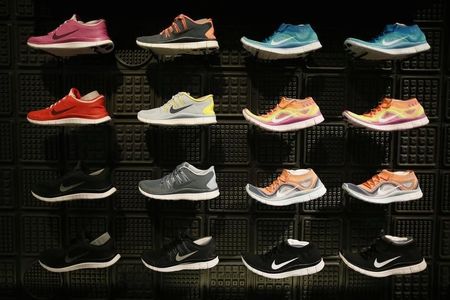
Top Sportswear Stocks as Dressy Shoe Trend Emerges, Bernstein Says
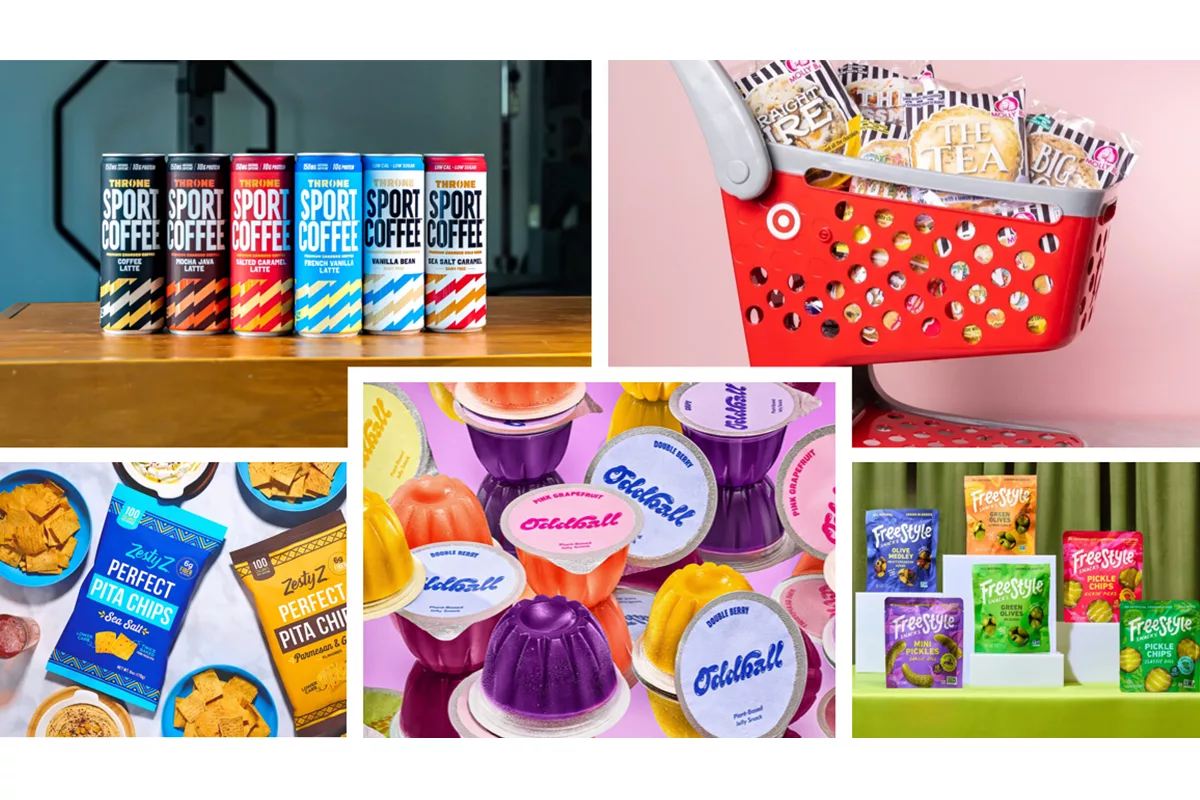

Food Business News webinar highlighted five startups innovating within segments they see as dated.

Starfighters Space: Bootstrap Approach To Space Industry But Scaling Challenges
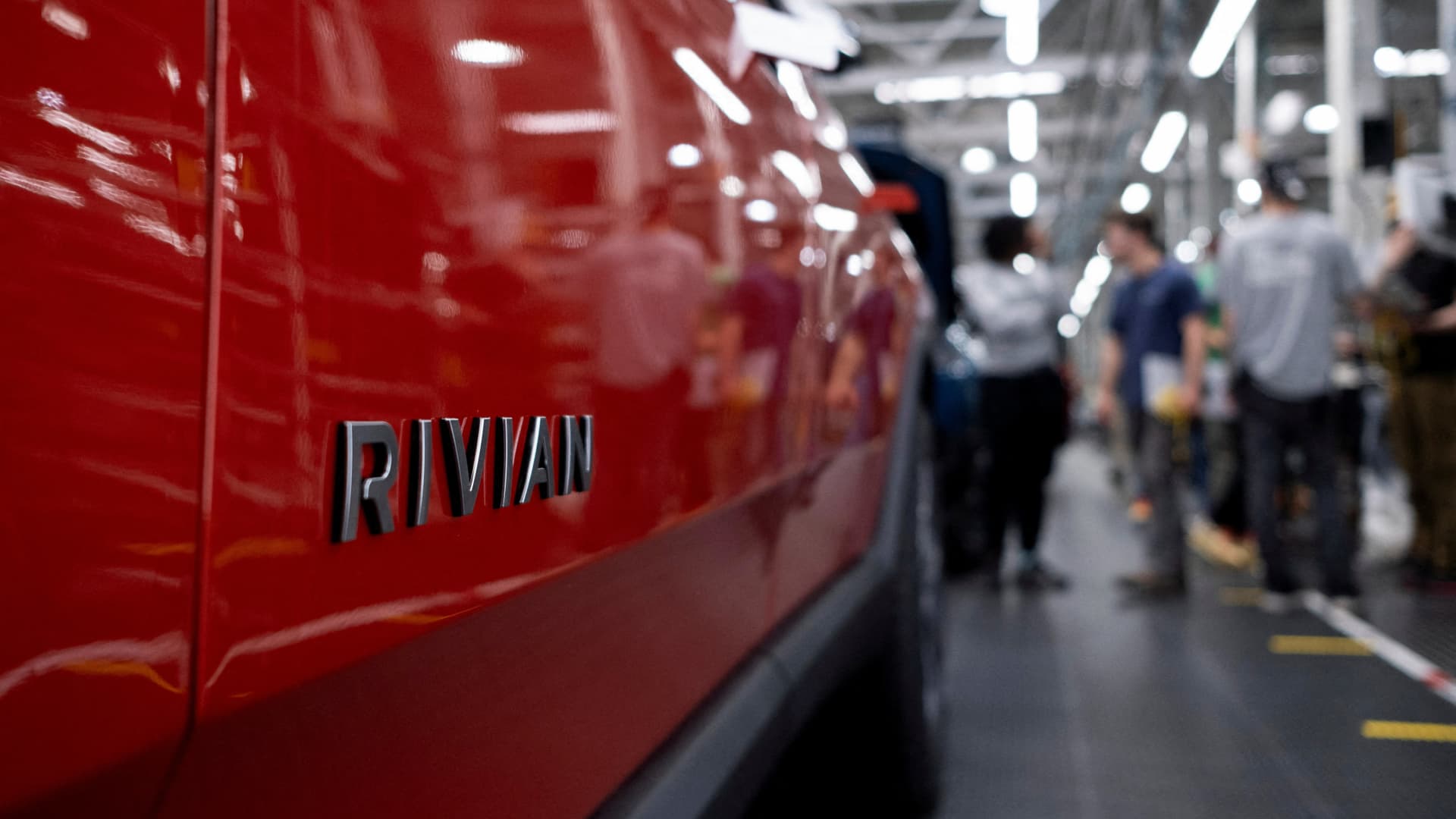
A view shows a second-generation R1S at electric auto maker Rivian’s manufacturing facility in Normal, Illinois, on June 21, 2024.
Joel Angel Juarez | Reuters
A tornado damaged part of Rivian Automotive‘s factory in central Illinois over the weekend, according to a message sent to employees Sunday night by CEO RJ Scaringe that was viewed by CNBC.
The tornado touched down on the plant, Scarigne said. That area was being used for parts storage and logistics for Rivian’s upcoming R2, which is a crucial product for the company that’s expected to be on sale this spring.
Scaringe said operations in the damaged area are expected to resume this week, while other major portions of the plant, such as its assembly lines, are operating as planned. No injuries have been reported as a result of the incident, according to a company spokeswoman.
“While Building 2 has sustained damage and is closed for the time being as we complete our assessments, I am incredibly relieved to share that there were no injuries at our plant,” Scaringe said in his message to employees.
Scaringe said the company would “share more information as it becomes available, but for now, our priority is ensuring our Normal [Illinois] team is safe and supported.”
Apparent photos posted online of the aftermath, which was first reported by TechCrunch, showed damage to the roof and at least one wall of the recently constructed building.
The National Weather Service reports the factory was hit amid a “significant tornado outbreak” that occurred Friday across the upper Midwest. Confirmed tornadoes near the factory Friday night were classified as EF1, with estimated peak winds of 100 mph, according to NWS.
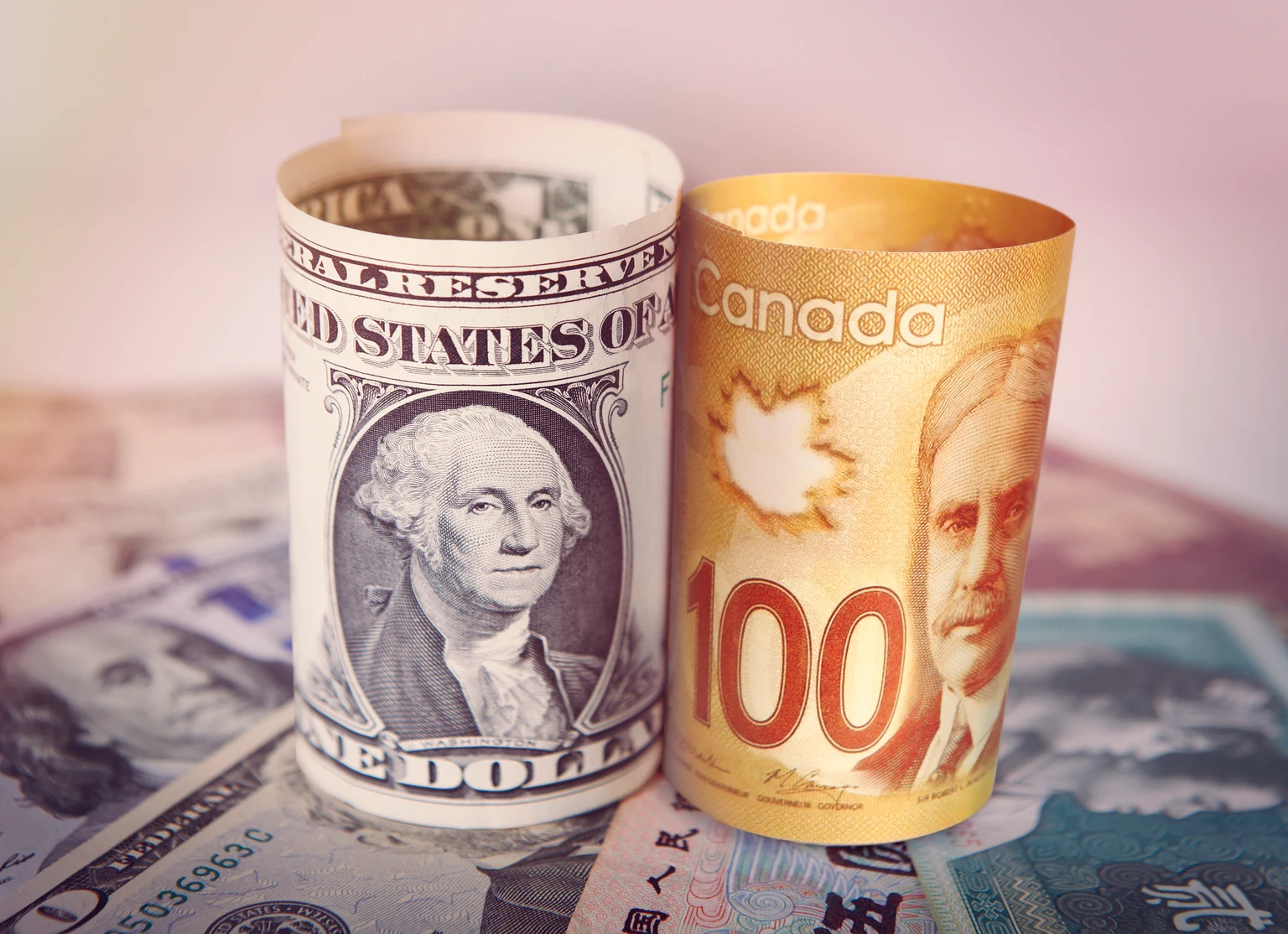
FXC: Understanding The Benefits And Risks Of Adding Currency Exposure To Your Portfolio
Credo Technology: Hypergrowth Leader Solving The AI Connectivity Bottleneck
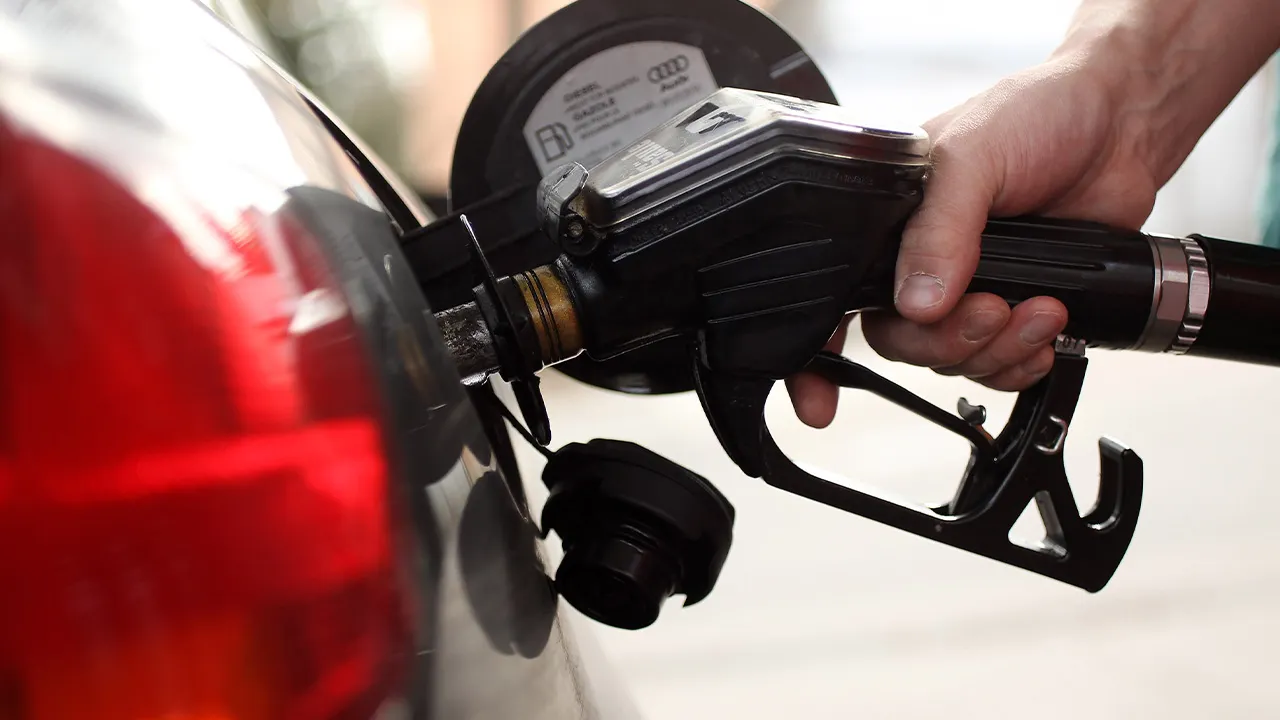
American Petroleum Institute CEO Mike Sommers joins ‘Varney & Co.’ to warn that a global oil shortfall and disruptions in the Strait of Hormuz could drive gas prices higher just as peak summer demand begins.
President Donald Trump pushed back Monday on his own energy secretary’s claim that a return to $3-a-gallon gas will not come through the end of the year.
“No, I think he’s wrong on that, totally wrong,” Trump told The Hill on Monday, when asked about Energy Secretary’s Christopher Wright’s interview with CNN’s “State of the Union” on Sunday.
Trump remains steadfast in his conviction that gas prices in America are going to drop precipitously “as soon as this ends,” referring to the oil blockade in the Strait of Hormuz, echoing oft-repeated vows for those concerned that oil prices in America might actually return all the way up to Biden administration levels.
“The blockade is very powerful, very strong,” Trump added to The Hill, pointing at Iran’s obstruction effort. “They lose $500 million a day with the blockade up. We control it. They don’t control it.”
BESSENT WARNS GAS STATIONS THAT TREASURY DEPT WILL KEEP THEM ‘HONEST’ AFTER SPIKE IN PRICES
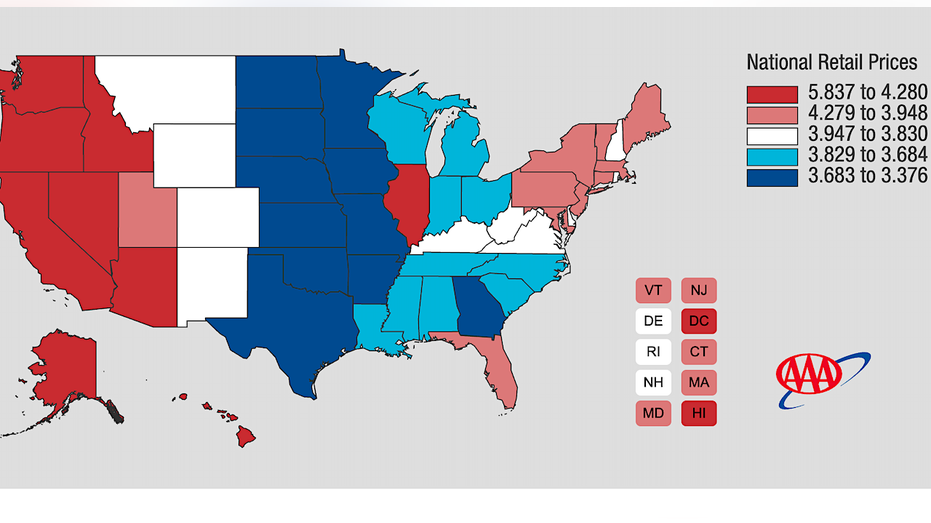
The AAA Fuel Prices state by state show the highest prices in the coastal states and the lowest prices in the midwest states. (Gasprices.aaa.com)
Wright’s comments were not all that unaligned with Trump’s position, but Wright was a bit less convicted on prices on when gas might drop below $3 again.
“I don’t know, that could happen later this year, that might not happen until next year, but prices have likely peaked and they will start going down,” Wright told CNN’s Jake Tapper, who asked further that gas “might not be under $3 a gallon until 2027?”
“Certainly, with a resolution of this conflict, you will see prices go down,” Wright added. “Prices across the board on energy prices will go down.”
OIL PRODUCERS ORG SHREDS CALIFORNIA DEM FOR BLAMING IRAN WAR FOR HIS DISTRICT’S GAS PRICES
Gas prices in the U.S. are higher amid the Iranian Strait of Hormuz obstruction, but they are still well below the Biden-era prices due to inflation caused by restrictive fossil fuel energy policy. (Sean Gallup/Getty Images)
“Under $3 a gallon is pretty tremendous — in inflation-adjusted terms,” Wright added to Tapper. “We had that in the Trump administration, but we hadn’t seen that in inflation-adjusted terms for quite a long time. We will get back there, for sure.”
Fuel prices in America on Monday are at an average of $4.04, according to AAA.
The highest average prices come in the coastal states, the only places where gas is over $4, while the midwest states have the lowest averages in the low-to-mid 3s.
| Ticker | Security | Last | Change | Change % |
|---|---|---|---|---|
| CHEV | CHARGING ROBOTICS INC | 3.3 | +0.80 | +32.00% |
| SUN | SUNOCO | 63.05 | -1.49 | -2.31% |
| XOM | EXXON MOBIL CORP. | 146.44 | -5.54 | -3.65% |
| CVX | CHEVRON CORP. | 183.99 | -4.16 | -2.21% |
| SHEL | SHELL PLC | 87.81 | -3.69 | -4.03% |
| DINO | HF SINCLAIR | 57.15 | -2.96 | -4.92% |
BESSENT RULES OUT GOVERNMENT INTERVENTION IN OIL FUTURES MARKET DURING IRAN WAR
Trump had long warned that the rise in American gas prices at the pump was a transitory inflation issue on the expectation that global oil supply was strained due to Iran’s retaliatory choking off of oil flowing through the Strait of Hormuz.
Trump and Treasury Secretary Scott Bessent have also noted for weeks that the U.S. is a net exporter of oil, has plenty of supply, with only a fraction of oil from the Middle East. So when local gas stations raised prices under the fear of future supply shortages elsewhere around the globe — potential “bad actors,” according to Bessent — they were not only guessing, but expecting something that would never come, they argued.
“We’ll be looking at Treasury to try to keep the retail gas stations honest — that you did this on the way up, better be doing this on the way down,” Bessent told the CNBC Invest in America Forum last week. “And I am sure the president will call out anyone who’s a bad actor.”
Former U.S. Energy Secretary Dan Brouillette joins ‘Varney & Co.’ to break down the global oil supply shock driving gas prices higher, weigh in on when relief could come at the pump and slam Democratic energy policies.
GET FOX BUSINESS ON THE GO BY CLICKING HERE
What went up, must now come down, Bessent told the CNBC forum host Wednesday when asked if the above was a warning.
“I’m sure that,” Bessent said with a calculated pause, “everyone will be a good actor.”
Businesses can apply online through a portal for refunds expected to total $160bn.
Nicolae Popescu/iStock via Getty Images
The iShares MSCI Global Metals & Mining Producers ETF (PICK) is a passively managed exchange-traded fund designed to track companies that participate in mining, extraction, or the production of industrial and base metals, excluding precious metals exposure. The strategy is regionally diversified and provides exposure across a number of different metals, including copper, iron & steel, and aluminum, amongst other materials. The strategy can be utilized by investors seeking diversified exposure to commodity producers and their respective cash flows in relation to the price of the commodities produced.
About iShares MSCI Global Metals & Mining Producers ETF
PICK was launched by iShares on January 31, 2012 on the Cboe BZX Exchange. PICK has a net expense ratio of 39bps, a relatively low cost strategy when compared to most peer ETFs.
Seeking Alpha
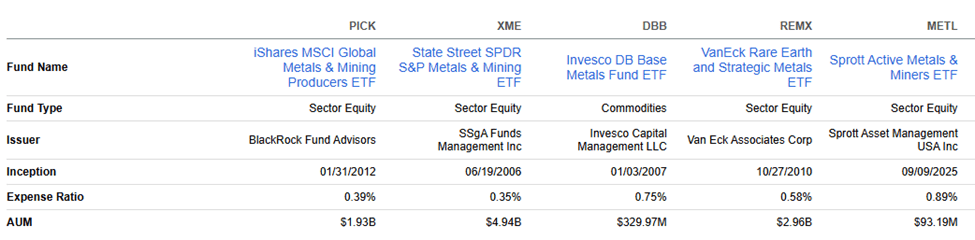
PICK exhibits substantial depth, though thin liquidity with $1.9b in net assets and a 30-day average trading volume of 538k shares. As a result of the lower liquidity, PICK exhibits a relatively wide 30-day median bid/ask spread of 0.18%, potentially adding additional fees when actively traded.
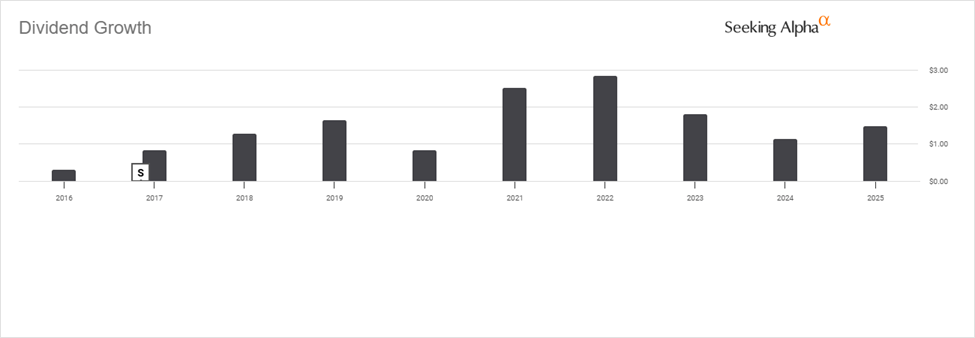
PICK pays out a semiannual distribution at an annualized rate of $1.28/share over the last twelve months, yielding 2.04%. Distributions can vary widely from period to period, making this strategy most appropriate for capital appreciation rather than income.
Seeking Alpha
PICK was designed to track the MSCI ACWI Select Metals & Mining ex Gold ex Silver Investable Market Index, which tracks the performance of companies that participate in industrial and the rare earth metals market. The Index consists of 234 constituents with exposure to small- through large-cap producers; the Index has a median constituent market capitalization of $1.21b with the largest constituent having a market capitalization of $175b. The Index is reviewed on a quarterly basis.
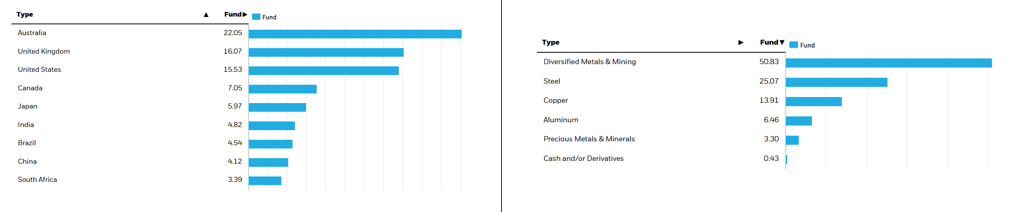
PICK currently invests across 244 holdings, which consist of equities as well as some exposure using futures derivatives. The ETF primarily invests in diversified metals & mining companies, making up 51% of the total portfolio weight, followed by steel at 25%, and copper at 14%. The strategy is regionally diversified with Australia accounting for 22% of regional exposure. Other regions include the UK at 16%, the US at 15.53%, and Canada at 7%.
Corporate Filings
The top 10 holdings within PICK account for 46% of the total portfolio’s assets. In contrast, the bottom 10 holdings account for roughly 0.12%. Top holdings within the ETF include BHP Group (BHP) at 12.30%, Rio Tinto PLC (RIO) at 6.80%, Freeport-McMoran (FCX) at 5.93%, and Glencore PLC (GLEN) at 4.55%.
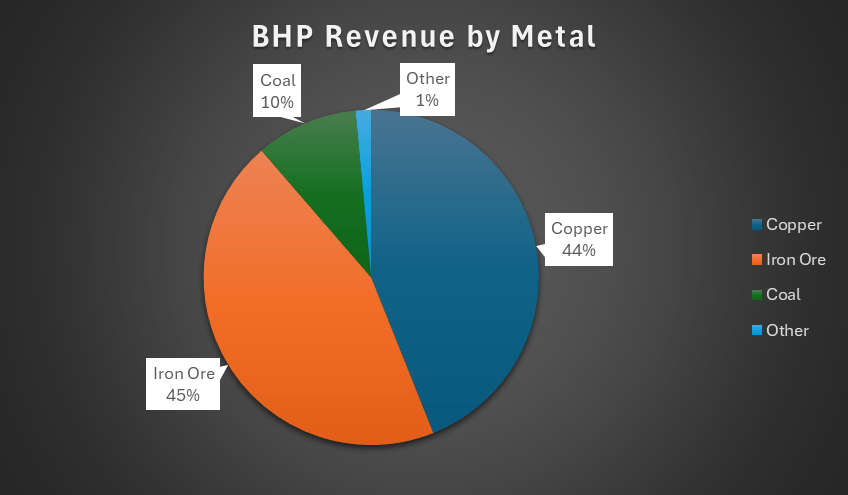
BHP is an Australia-based diversified mining enterprise, primarily producing copper and iron ore at the global scale.
Corporate Filings
Freeport-McMoran is a US-based copper producer, operating globally in mining and refining.
Thematically, the metals & mining sector can be viewed through a variety of lenses. For copper, a major theme to consider is the increasing investments in power infrastructure and data centers, each requiring vast amounts of copper to operate. Iron exhibits broadly diversified themes, including automobile production, industrial manufacturing, power, and construction, amongst others. Sector demand can vary by region; the US may exhibit a larger focus in the automotive industry whereas China may exhibit more steel utilization in construction. Being mindful of macroeconomic trends like annual vehicle production, trucking, and construction starts may be useful indicators for assessing this component of the portfolio.
Some other factors investors may consider when investing in the strategy include international trade. For example, China has historically been a major counterparty to BHP’s iron ore mining operations. For example, Chinese imports accounted for roughly 63% of BHP’s sales in FY25. Trade disputes between the two countries could significantly impact operations and must be taken into consideration when evaluating PICK as an investment, particularly given the portfolio concentration in BHP.
Another factor to consider is trade tariffs. For example, Alcoa’s (AA) business has been impacted in the last year resulting from the 50% duty on imported aluminum and steel. Alcoa has historically imported aluminum into the US through Canada, resulting in mismatched economics throughout FY25 before the Midwest Spread created a marketable opportunity. Alcoa holds a much lower weight in the strategy at 1.10% of net assets, though I believe the theme can apply to all constituents if import duties were to persist.
Overall, PICK can be considered as both a microeconomic and macroeconomic investment strategy given the ETF’s global footprint and general demand across regions and industries. At the microeconomic level, more efficient mining practices and ESG policies can influence the cost of production, or the all-in cash cost.
Investor Suitability
PICK can be utilized by investors seeking a diversified equity strategy tied to the global metals & mining industry. PICK may be best utilized as a buy-and-hold ETF given its relatively light trading volumes. PICK may also be utilized as part of an industry rotation or a macroeconomic strategy given the diverse portfolio of commodity producers. In terms of growth expectations in the fund, a benefit of owning the commodity producers over the commodities outright is that commodity producers gain exposure to stronger commodity prices, cost management, and cash flow generation; owning a portfolio of commodities is limited to the aggregate increase in commodity prices with no additional economic upside potential.
Risks Related to PICK
PICK may expose investors to a variety of risks that should be considered prior to making an investment decision, particularly when considering its global exposure. International trade, geopolitical risk, war, ESG policies, inflation rates, commodity prices, fuel costs, transportation costs, and interest rates can all influence the performance of the underlying companies within the portfolio.
Final Thoughts
PICK can be utilized as a diversified metals & mining investment strategy for investors seeking to participate in the cash flows earned by companies with direct exposure to industrial and base metals. I believe PICK offers investors greater value over investing in a commodity-based portfolio given that the producers provide more economic upside beyond the commodity price. Given the international footprint of the portfolio, investors must consider international trade risk when evaluating whether a broad strategy is appropriate for their investment needs.
This article answers three main questions about PICK:
- What type of investor is PICK most suitable for?
- Does PICK offer diversification to foreign companies?
- Is PICK considered an income ETF or is it focused more on capital appreciation?

Tech42 seconds ago
Podcast: QUAD ESL 2912X Electrostatic Speakers at AXPONA 2026

NewsBeat3 minutes ago
X Factor finalist charged over Argyll Street crash as Klaudia Zakrzewska ‘Klaudiaglam’ fights for life
Business4 minutes ago
Oil prices to hit $150? How Indian stock markets may react as Iran war rages on



-

 Crypto World7 days ago
The SEC Conditionalises DeFi Platforms to Be Avoided for Broker Registration
-

 NewsBeat6 days ago
Trump and Pope Leo: Behind their disagreement over Iran war
-

 Fashion3 days ago
Weekend Open Thread: Theodora Dress
-

 Crypto World7 days ago
SEC Signals Exemption for Crypto Interfaces From Broker Registration
-

 News Videos5 days ago
Secure crypto trading starts with an FIU-registered
-

 Sports3 days ago
NWFL Suspends Two Players Over Post-Match Clash in Ado-Ekiti
-

 Crypto World7 days ago
SEC Proposes Certain Crypto Interfaces Don’t Need to Register as Brokers
-

 Business1 day ago
Powerball Result April 18, 2026: No Jackpot Winner in Powerball Draw: $75 Million Rolls Over
-

 Crypto World3 days ago
Russia Pushes Bill to Criminalize Unregistered Crypto Services
-

 Politics3 days ago
Palestine barred from entering Canada for FIFA Congress
-
 Business4 days ago
Creo Medical agree sale of its manufacturing operation
-

 Politics1 day ago
Zack Polanski demands ‘council homes not luxury flats for foreign investors’
-
 Entertainment7 days ago
Brand New Day’ Footage Reveals the Devastating Impact of ‘Now Way Home’
-

 Crypto World3 days ago
Russia Introduces Bill To Criminalize Unregistered Crypto Services
-

 Tech6 days ago
Microsoft adds Windows protections for malicious Remote Desktop files
-
 Entertainment7 days ago
Karol G’s ‘Ultra Raunchy’ Coachella Set Gave ‘Satanic Vibes’
-

 Entertainment7 days ago
How Babylon 5 Turned Brief Side Story Into Emotional Masterpiece
-

 Tech5 days ago
‘Avatar: Aang, The Last Airbender’ Leaked Online. Some Fans Say Paramount Deserves the Fallout
-
 Crypto World7 days ago
Senate Bill Faces Delay Over Stablecoin Yield Debate
-
 Tech7 days ago
What was the first ransomware attack to demand payment in Bitcoin?
You must be logged in to post a comment Login