
Politics
Loneliness Not Be As Bad For Dementia Risk As We Thought


Experts think that having a close network of loved ones as we age might protect us from dementia risk.
But a new study has found that while loneliness can impair your memory as you age, that might not translate into full-blown dementia.
Published in Ageing and Mental Health, the research concluded that, “Loneliness is associated with lower initial memory performance in older adults but does not accelerate the decline in memory function over time”.
How does loneliness affect memory?
In this research, scientists looked at data from the Survey of Health, Ageing and Retirement in Europe (SHARE) programme.
This involved 10,217 individuals over 65. They were asked to self-report their levels of loneliness and were given memory tests over a six-year period.
“Participants with high loneliness at baseline demonstrated significantly lower immediate and delayed recall scores than those with low or average loneliness,” the research reads.
But years into the study, lonelier people didn’t see the memory decline you’d expect with something like dementia. The changes appeared to be more short-term than that.
Lead study author Dr Luis Carlos Venegas-Sanabria said, “The finding that loneliness significantly impacted memory, but not the speed of decline in memory over time was a surprising outcome.
“It suggests that loneliness may play a more prominent role in the initial state of memory than in its progressive decline.”
Calling the results of previous studies about dementia risk and loneliness “inconsistent,” the study said its results “could reinforce the idea that loneliness cannot necessarily be considered a risk factor for dementia”.
Loneliness is a growing problem
The researchers say that loneliness is a growing problem, affecting anywhere from 14-16% of older adults.
And while their study suggests it might not necessarily be a dementia risk, they add that it “underscores the importance of addressing loneliness as a significant factor in the context of cognitive performance in older adults”.
Though in this study, it didn’t appear to lead to longer-term decline, loneliness still affected the cognitive abilities of older people in the short term.

!function(n){if(!window.cnx){window.cnx={},window.cnx.cmd=[];var t=n.createElement(‘iframe’);t.display=’none’,t.onload=function(){var n=t.contentWindow.document,c=n.createElement(‘script’);c.src=”//cd.connatix.com/connatix.player.js”,c.setAttribute(‘async’,’1′),c.setAttribute(‘type’,’text/javascript’),n.body.appendChild(c)},n.head.appendChild(t)}}(document);(new Image()).src=”https://capi.connatix.com/tr/si?token=19654b65-409c-4b38-90db-80cbdea02cf4″;cnx.cmd.push(function(){cnx({“playerId”:”19654b65-409c-4b38-90db-80cbdea02cf4″,”mediaId”:”9162804c-4fc4-4806-a700-d905057e0c22″}).render(“69e6350ee4b0555d213d24f7”);});
Politics
Gentle Partnering: The New Trend That Can Make Your Relationship Happier, Healthier, And More Intimate

Chances are you’ve heard of “gentle parenting,” a method of raising children which avoids taking an overly authoritarian or possessive approach.
What is “gentle partnering”?
It involves approaching each other’s emotions and problems with empathy and curiosity, as a team.
“Gentle partnering is not about one person agreeing all the time or being submissive, it is about recognising our individuality,” said Rogers.
“It is not about power and control but being part of a team and a united front… Having differences of opinion can strengthen a relationship; it is how these differences are communicated to each other that is the key.”
Toxavidi described the approach as one which centres “open communication, emotional regulation, dealing with conflict and feeling loved and supported”.
It aims to “eliminate power and control [and set]… clear and consistent boundaries, which is another essential element that needs to be present and cultivated within healthy relationships.”
How can I try “gentle partnering”?
Try using “I” statements, try listening to their concerns rather than trying ot immediately fix them, accept your differences with respect, and accept each other’s individuality, Rogers told us.
Apologise, genuinely, when needed, recognise and own your feelings, and show affection regularly.
“All it involves is truly hearing and seeing your partner respectfully communicating your needs and feelings, but also considering and validating your partner’s needs and feelings, even if you do not agree. It is being firm, fair, respectful and maintaining your boundaries.”
Toxavidi said, “When partners can see their differences as opportunities for growth rather than as sources of conflict and disagreement and their different emotional tantrums around different relational issues with compassion and understanding, then a deeper bond and authentic connection can be built.”
Like Rogers, she said it’s important to focus on active listening, “acknowledging and validating someone’s behaviours or efforts,” setting boundaries that can “foster self-respect, safety and open communication,” and extending empathy.
“When someone is actively listening to their partner in order to understand where they are coming from with a deep curiosity of what is all about the other person opposite of them, and listens in order to respond and not to react from an ego place, creates a safe space for the other where defensive behaviour is eliminated and open expression and true intimacy and connection can take place,” she ended.

!function(n){if(!window.cnx){window.cnx={},window.cnx.cmd=[];var t=n.createElement(‘iframe’);t.display=’none’,t.onload=function(){var n=t.contentWindow.document,c=n.createElement(‘script’);c.src=”//cd.connatix.com/connatix.player.js”,c.setAttribute(‘async’,’1′),c.setAttribute(‘type’,’text/javascript’),n.body.appendChild(c)},n.head.appendChild(t)}}(document);(new Image()).src=”https://capi.connatix.com/tr/si?token=19654b65-409c-4b38-90db-80cbdea02cf4″;cnx.cmd.push(function(){cnx({“playerId”:”19654b65-409c-4b38-90db-80cbdea02cf4″,”mediaId”:”256f8b81-8cc7-4628-9730-1dcbe81955b4″}).render(“69e6234ee4b0b6f552baf353”);});
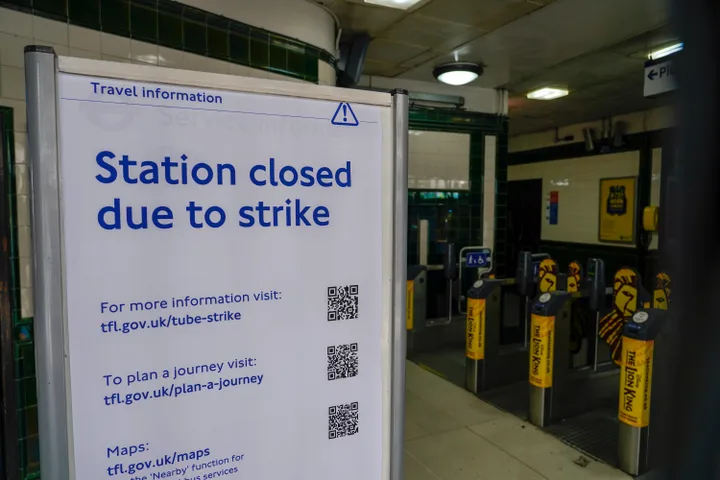
This week (April 20-27), multiple Tube strikes are scheduled across London.
These are expected to cause “significant disruption,” Transport for London (TfL) says on its site.
It’s the first of six scheduled strikes planned to take place in the city.
When are the Tube strikes planned?
- Midday Tuesday, 21 April until midday Wednesday, 22 April,
- Midday Thursday, 23 April until midday Friday, 24 April.
- Midday Tuesday, 19 May until midday Wednesday, 20 May,
- Midday Thursday, 21 May until midday Friday, 22 May.
- Midday Tuesday, 16 June until midday Wednesday, 17 June,
- Midday Thursday, 18 June until midday Friday, 19 June.
However, while all planned strikes are set to run from 12:00pm on their first day to 12:00pm midday the next, TfL warns that disruptions are expected to continue into the afternoons and evenings following these periods.
On Wednesdays and Fridays, any services that do run are expected to start later than usual, with no service planned before 7:30am.
And on Tuesdays and Tuesdays, services will finish early: “you should aim to have completed your journey by [8pm]”.

Which services will be affected?
No service is expected on the Picadilly and Circle lines.
There isn’t expected to be any service on the Metropolitan line between Baker Street and Aldgate, or on the Central line between White City and Liverpool Street.
“Elizabeth line, DLR, London Overground, and tram services will be running normally on strike days,” said the TfL.
The strikes will have knock-on effects on the whole Tube network, they added. While a “reduced service” will run on most lines, “significant disruption is expected”.
The strike involves RMT members, but only half of the London Underground drivers are part of that group. 2025′s strikes involved both the RMT and Aslef, which meant almost all lines were affected.
Why are the Tube strikes happening?
It follows the introduction of a voluntary four-day working week, which would mean that drivers could elect to work longer days, but with fewer overall hours and over fewer days.
The current standard is a five-day work week across 36 hours. This option includes four working days and 35 hours, though their contractual hours won’t change thanks to paid work breaks.
It’s being tested on the Bakerloo line on a voluntary basis at the moment.
RMT says this would make the working day too long, which might make workers fatigued and risk safety.
Instead, they have asked for a 32-hour week across four days. TfL have responded saying that the current four-day option is voluntary.
RMT London’s transport regional organiser, Jared Wood, said that after first seeming interested in a discussion, the TfL have since said they’re “not prepared to discuss with us any further changes.
“It’s left our members in a position where they feel there is absolutely no alternative but to proceed with the strike action.”
Claire Mann, TfL’s chief operating officer, said the optional changes would bring the London Underground in line with the working practices of other train services, making them more flexible and reliable.
“The changes would be voluntary, there would be no reduction in contractual hours, and those who wish to continue a five-day working week pattern would be able to do so.”

If bingeing your way through the most recent season of Beef cut close to home at any point, that’s probably because creator Lee Sung Jin was inspired by incidents from real life when putting the new episodes together.
The second iteration of the award-winning Netflix series focusses on two couples – played by Carey Mulligan, Oscar Isaac, Charles Melton and Cailee Spaeny – on opposite sides of a generational and class divide, who become embroiled in a feud that takes over all four of their lives.
Speaking to People, writer and director Lee admitted that the “springboard” of the whole season was a “real-life incident” in which he overheard “a ‘heated debate’ coming from a couple’s home”.
It was only when retelling what he heard to people of different generations and backgrounds that he realised this could form the basis of a new season of Beef.
“Younger people reacted like Ashley and Austin,” he recalled. “Whereas my similarly-aged or older peers were like, ‘It’s a fight. I mean, who among us [hasn’t had one like it?]’.”

But that’s not the only part of the new season that took inspiration from the real world.
The Emmy winner also spoke about how a trip to A&E inspired the scene in which Charles and Cailee’s characters are in a hospital waiting room.
“I literally just wrote down in my notes app everything that happened, dialogue I overheard, and pretty much copied and pasted it and wrote it in a day,” he admitted. “So that episode is not an exaggeration. That is the state of [the American] health industry at the moment.”
He concluded: “I’d love to get to a point where society isn’t what it is, so we can write about something other than class. But until then, [we’ll] just keep trying to shout it from the mountaintops.”
Beef’s second outing has once again been a hit with both critics and Netflix users, many of whom are now speculating about whether a third run could be on the cards.
Netflix is remaining tight-lipped for the time being, but the screenwriter has made it clear that he originally envisaged Beef as a three-season anthology series, each focussing on a different cast of characters and central feud.


In a Parliamentary debate on Thursday 16 April, MPs across party lines demanded the government end its £330 million NHS contract with spyware tech giant Palantir. But there was one glaring absence – where was Wes Streeting, our secretary of state for health and social care?
‘Evil’ company
Every one of the 13 MPs who spoke in the debate, led by Lib Dem MP Martin Wrigley, raised the alarm over Palantir. The company has deep involvement with the US military, powers Israeli war crimes in Gaza and Lebanon, supports British intelligence and surveillance, and provides data analysis for violent US deportations.
The call was clear: contract details – which the Good Law Project revealed had been heavily redacted – need scrutiny and transparency; the government needs to come clean on how the contract was awarded; and it must explore exiting through its break clause.
The distrust over Palantir’s role to provide the NHS’s centralised data system – called the federated data platform (FDP) – was unanimous. Founded by tech-billionaire, Epstein-pal and Trump-funder Peter Thiel, its CEO boasts how they like to “scare” enemies and “on occasion kill them.”
MPs called the NHS relationship “shameful.” From Labour, Lib Dem, Independents, Conservatives and even the DUP, there was wide condemnation.
Iqbal Mohamed of Dewsbury and Batley didn’t hold back:
If it looks evil, if it smells evil and if it behaves evil, then it is evil.
Cancelled Contracts
MPs pointed to Switzerland that recently kicked out Palantir contracts due to national security concerns (hushed news leaked by a small publication that Palantir then tried to sue). Hospitals in New York have also rejected Palantir arrangements.
But here in the UK in 2023, Palantir walked away with a seven-year NHS contract without competition (the same kind of mates’ rates for the £240 million Ministry of Defence deal). Data handling, trust and transparency are the major concerns.
“Palantir should be nowhere near our NHS data and patient data,” Labour’s Ian Byrne declared, because the issue of trust was central.
Labour/Co-op MP Rachael Maskell said:
As a former clinician in the NHS, I know that trust is key. If a clinician does not have the confidence and trust of their patients, that will result in worse health outcomes.
She added:
I urge the Government to end this contract.
Human rights abuses
Ethics and values “should be our starting point”, said Dawn Butler MP for Brent East, but we’re far from that. It is not only a concern that the future of NHS data is in the hands of a company that’s been hostile towards the NHS. Back in 2020, Amnesty International raised the alarm about Palantir technology facilitating human rights violations in the US.
Palantir technology has been used by US Immigration and Customs Enforcement (ICE) for years. The recent violence and murders at the hands of ICE have led the British Medical Association (BMA) to urge doctors to limit their use of the tech system. The BMA has also called on the government to “remove the NHS from Palantir’s technical architecture at pace.”
No Palantir in the NHS
Health justice organisation Medact has been a key part of the No Palantir in the NHS campaign. They have been joined by organisations like Health Workers for a Free Palestine, Just Treatment, Good Law Project, and others.
The campaign outlines Palantir’s complicity in war crimes and urges local health bodies to reject the FDP through a detailed briefing. The campaign also calls on the public and whistleblowers to join the campaign.
Behind the scenes though, Jeremy Corbyn, Independent MP for Islington North, claimed Palantir is “pressurising every local hospital and NHS trust to join” the FDP, while workers who have tried to criticise its rollout have been silenced.
Dr Danny Chambers, Lib Dem MP for Winchester, said:
Why are we asking them [doctors] to use a system they do not trust and stake their professional reputations on it?
Palantir and the government push back
Tory MP Dr Neil Shastri-Hurst said:
People are not just asking whether the system is safe today. Could future Governments choose to use the capability in different ways? Those are not unreasonable questions.
And the government’s response? Parliamentary under-secretary of state for health and social care, Dr Zubir Ahmed, gave a filibustering ramble. He claimed the FDP was “exceeding its targets”, contrary to Wrigley citing that trial results were “exaggerated and untrue.”
Palantir UK’s executive vice-president Louis Mosley continues to fight back. A multi-pronged PR campaign now props up Palantir, led by Boris Johnson’s political strategist Isaac Levido’s lobbying firm Fleetwood Strategies. An £8.5 million contract was also awarded to consultancy firm KPMG to “promote the adoption” of the FDP among the 200-odd NHS trusts, of which only about half are currently using.
There’s no disagreement that we need big tech to advance services, cut waiting times, boost screenings and improve surgery admissions. The scandal is how this insidious company – named after Tolkien’s seeing-stones – came to handle our most valuable data. The question is why they should continue to do so.


After 35 years defending Palestinian children’s rights, Defense for Children International-Palestine (DCIP) has ceased operations, following years of threats and criminalisation by “Israel”.
Its general director described the moment he announced the NGO would close as the “saddest moment” of his time here.
Khaled Quzmar joined the organisation in 1995 as a lawyer representing Palestinian children in the Israeli occupation’s military courts.
He said:
I always used to be proud to talk about DCI work, the achievements we had, and the support we gave to our community. When I announced stopping the work of DCIP it was the saddest moment for me during my more than 30 years here. It hasn’t been an easy decision for me, for the staff, the beneficiaries, or the board of directors, but I was forced to do that due to Israeli restrictions and attacks.
Palestine loses one of its human rights defenders
DCIP started in 1991 as an initiative by activists who had been in prison. They saw firsthand how the Israeli occupation treated Palestinian children when they were detained.
Not only had their childhood ended there and then, but they were also subjected to torture and ill treatment while no lawyer visits took place.
Once released, the problems often continued for these children. They expected to be received as heroes in their communities and so commonly experienced difficulties when it came to spending time with their families or reintegrating back into their schools.
DCIP provided support not just for the children but also for their families and communities. Through DCIP, a lawyer began visiting children in prison and detention centres, and represented them in court.
Meanwhile, psychosocial workers helped them avoid isolation by engaging them with their local community. They also worked with families, showing them how to provide much needed support, something the Israeli occupation prison services have never done for any Palestinian.
But in order to tackle the ills of the system, DCIP needed evidence, Quzmar explained.
Instead of talking about the illegal Israeli military court system, we needed to prove this so we started to collect evidence. We began to document all the violations, such as no fair trial standards and no lawyer visits during interrogations. We concluded that the system was so far from the fair trial standards and illegal under the Fourth Geneva Convention.
DCIP collected evidence and became increasingly vocal about the injustices Palestinian children face at the hands of the Israeli occupation. It was then DCIP started receiving attacks from right-wing Zionist NGOs, which are supported by the occupation’s government.
They never challenged our narrative because the narrative is well documented according to the UN standards. They just kept lying, lying, lying, and constantly attacked us.
In 2010, they started accusing us of being a terrorist organisation. When they failed to silence us, they started targeting our partners and donors, one by one, threatening to stop their support for us or be prosecuted. But none of the donors accepted such allegations or threats, and continued working with us.
DCIP vs UK Lawyers for Israel
One of the organisations that targeted and tried to delegitimise DCIP was the “Israel” lobby group, UK Lawyers for Israel (UKLFI). Founded in 2011, UKLFI defends the genocidal state of Israel and says it aims to “mobilise members and supporters to use their skills pro bono to combat the Boycott, Divestment, Sanctions movement and the delegitimisation of Israel”.
When UKLFI failed to have the desired effect, a complaint followed against DCIP’s audit company, PricewaterhouseCoopers (PwC). But after a two-year investigation, the complaint was dismissed.
UKLFI targeted Defense for Children International-Palestine and led a misinformation campaign against the organisation since 2018, claiming it was a “terror linked” charity. It sought to harm the reputation of DCIP, isolate the organisation, and prevent it from receiving charitable donations.
In 2019, DCIP sued UKLFI for libel. The case was settled out of court and UKLFI was forced to apologise and issue a public retraction acknowledging that DCIP did not have links to terrorism.
We issued libel proceedings against UK Lawyers for Israel in UK courts in June 2019. Yesterday, as part of legal settlement, UKLFI recanted allegations that @DCIPalestine provides material support to any designated terror group.
Read our statement » https://t.co/biyqZgnIPX pic.twitter.com/ZCUn17oY2E
— Defense for Children (@DCIPalestine) March 10, 2020
Quzmar said:
I was not looking for money. I was looking to silence them, and this silenced them. But not long after this, we shared with Josh Paul, the case of a 13-year-old child arrested by Israeli police and subjected to sexual assault in an Israeli prison.
Josh Paul: ‘We believed [allegations] were credible’
Then, Josh Paul was a director of the Bureau of Political-Military Affairs, an agency within the US Department of State responsible for US defence diplomacy, security assistance and arms transfers.
He resigned from that position in October 2023 over Biden’s arms transfers to Gaza and explained why in a candid LinkedIn post.
During an interview with CNN shortly after, Paul discussed the information DCIP shared with him.
He said:
We examined these allegations. We believed they were credible. We put them to the government of Israel, and you know what happened the next day? The IDF went into the DCIP offices and removed all their computers and declared them a terrorist entity.
Quzmar was shocked, not because the Israeli occupation had failed to open an investigation, but because his offices were raided.
He added:
There was no reason to raid the office. They broke the door, stole equipment, including computers. They just wanted to damage and destroy. I found tens of files in the stairway and they overturned the coffee machine.
I filed a complaint against them in the Israeli military court, claiming thieves in Israeli army uniform raided the office and stole equipment, on 27 July 2021. After a week they said yes, the Israeli army had raided the office because they had received information that there were materials used in the military operation against Israel, or will be used.
Quzmar asked to see the evidence but received nothing. Three months after this raid, DCIP was designated as a “terrorist organisation”. Although he says he never trusts the Israeli occupation’s “legal system”, Quzmar appealed the case and hired a lawyer.
He said:
There is no due process in Israel when it comes to Palestinians, and I lost a huge amount of money to pay the lawyer. The lawyer asked for discussion with the Israeli defense minister, who issued the designation against my organisation. We had one session, three years ago. There have been no other sessions or discussions, and they kept us designated.
The Israeli occupation controls everything in Palestine. It forced the banks not to work with DCIP so eventually, it could not operate, and it threatened the communities and donors that worked with the NGO. Many donors lost their presence in Palestine due to working with DCIP.
Being labelled as a terrorist organisation worried Quzmar greatly. According to “Israeli” military law, as the director of such an organisation, he could be subject to up to 20 years in prison. Meanwhile, medium-level staff could get 10 years and junior staff could be imprisoned for five years without any discussion.
Quzmar said:
Continuing the work was very high risk for me. Anyone who worked with me could be subject to prosecution, for working with a so-called terrorist, and so violating the Israeli law designating me as a terrorist. Also, a child represented by a lawyer from our side could be prosecuted because they have benefited from a terrorist organisation.
‘Today UAWC was raided, tomorrow it could be DCIP’
DCIP was forced to seriously consider the impacts such a designation would have on its organisation and staff after the Israeli Occupation Forces (IOF) raided the offices of the Union of Agricultural Work Committees (UAWC).
The occupation designated UAWC as a terrorist organisation in December 2025. The raid, unlike any of the previous ones, was not at night but at 10am, and was accompanied by a media mission. The raid came one week after right-wing journalists from “Israel” wrote complaining that the Israeli army had done nothing about organisations in Palestine it had designated as terrorist organisations.
During the raid, UAWC staff were blindfolded, handcuffed and interrogated, kneeling down, or with their faces down on the floor for several hours. Eight were detained.
Quzmar told the Canary:
For me, in the position of managing DCIP, it got me thinking about the impact of such a raid. It was like a message to me. We had also been designated, so we’re in the same position. Today UAWC was raided, tomorrow it could be DCIP.
We had two mothers working for us, who both gave birth five or six months ago. If they were arrested, who would take care of their children? Eventually, to save the lives and security of the staff and children, and to save the assets of the organisation, we decided to end our work, and the office is now closed.
Palestine’s children need protection
Although DCIP has been forced to stop its work, Quzmar will continue to focus on children. They are now in even more need than any time previously.
He believes the situation faced by Palestinian children is unique in the world. Their rights are ignored and while the UN Convention on the Rights of the Child is applied everywhere, Palestine is the exception.
These children just want to live like other children. They can’t understand why they are excluded.
I’ve tried to convince them that we’re working to hold [Israel] accountable, to stop the crimes. But we failed to convince them, in 35 years, that there is a possibility of ending this struggle. This is not because there is no political will in the international community.
There are also those who are complicit and partners in the crimes. They talk about human rights while providing Israel with more arms. What kind of human rights are these they talk about while killing people?
He argues that while the Israeli occupation is now denying many thousands of human rights activists entry into Palestine, to prevent them witnessing zionist crimes against Palestinians, Europe is still allowing Israeli occupation terrorist settlers, politicians and other criminals to travel freely.
“This is the hypocrisy we live in, the absence of political will,” Quzmar said.
Our message to the international community is to stop hypocrisy and complicity, and hold the criminals accountable in order to ensure that human rights will be respected, and people not just in Palestine but around the world, can live in peace.
Featured image via the Canary
By Charlie Jaay

If you’ve got a garden, you probably keep a pretty keen eye out for signs of disease, pests and other lawn maladies.
It’s especially important in summer when weeds flourish and garden invaders are rampant.
You might already know to track browning leaves, wilting stems and fuzzy, mouldy soil.
But it turns out that there’s another early sign that your garden is suffering – spotting footprints, even on a perfectly healthy-looking patch of grass, could be a sign your lawn is in need of some TLC.
Here are the types of footprints that should cause concern – and what to do if you notice the issue.
How to run a ‘footprint test’ on your lawn
The ‘footprint test’ couldn’t be easier to do – you just have to step onto your grass and watch the reaction.
As the University of Illinois shared, you should worry if stepping on your lawn causes it to maintain the shape of your shoe.
If your footprints remain on the lawn after walking across it, they suggest your garden is likely to be on the verge of drying out, and could already be suffering with something called drought stress.
It sort of works like the pinch test when checking for dehydration. Dry skin or grass is less able to ‘bounce’ back from pressure, because its lack of moisture affects its turgidity.
The less water your grass has when you step on it, the slower it’ll be to spring back to its original shape. The test could help to reveal dryness before clearer signs of dehydration, like browning and wilting, are visible.
It’s especially handy in the middle of our current heatwave, when drying lawns can creep up on gardeners regardless of how careful they are.
OK, what can I do if my lawn is drying out?
Luckily, the footprint test works well on lawns in the early stage of dehydration. So it’s very likely your garden can still be saved at this stage.
The Royal Horticultural Society (RHS) advises against mowing in extreme heat, and recommends using rainwater to hydrate ailing lawns if you have any to hand.
And while it can be tempting to run out and start watering every time you spot a symptom of drought stress, it turns out that quality and quantity are much more important than frequency when it comes to quenching your lawn’s thirst.
To encourage water penetration, the RHS says that “watering more thoroughly, but less frequently helps get the water down to the deeper root tips”.
In any case, knowing exactly how well your grass is faring is always a step (sorry) in the right direction.


Former Labour turned independent councillor Jimmy Shannon has joined the Green Party.
The defection comes as the party recently broke the 1,100 local membership total and nationally exceeded 226,000 members. In Cheshire West and Chester, the party is looking to make significant gains in the next local elections. These will take place in 2027. The focus will then turn toward the next General Election in 2029.
Shannon has been working closely with the other Green councillors in the borough as part of the former Green Independent Alliance.
Announcing the defection, local chair, Nick Brown said:
Jimmy is the first standing councillor in Cheshire to switch to the Green Party, but he may not be the last. This shift shows that the momentum is building both locally and nationally and more breakthroughs will follow.
Jimmy is a true union man and an outstanding representative for his local community. We welcome him into the party with open arms.
He will be working with our other Whitby Councillor, John Roach to really develop the party across the Ellesmere Port area.
Shannon said:
For me it is business as usual, putting the people of Whitby Groves first. I have joined a party that aligns with my core beliefs and clearly puts people and this planet first – by tackling crippling
inequality, protecting public services, access to affordable, safe housing and safeguarding the future of our environment.I will continue to fight along side my fellow Green councillors for the interests of those living in Whitby Groves, and more widely across Cheshire West, to get the changes we desperately need.
Amongst his other priorities, Shannon is working alongside Green councillor John Roach to take an active role in the Stanlow Pollution Watch campaign to address resident concerns about the chemical pollution coming from the Stanlow sites.
Featured image supplied
By The Canary


Former trader-turned-inequality economist Gary Stevenson has taken to his socials ahead of the local elections. In his video, he is reminding people that they must register today if they want to vote in the upcoming local elections.
Candidates and their respective parties are hitting the ground running – well, all except Your Party – in a desperate bid to win votes in an increasingly polarised and divisive political landscape. With Reform UK and the Green Party set to make big gains on May 7, voters are being asked to choose between politics of hope and compassion or the far-right’s politics of further division and hate.
Stevenson has long made it clear that building a fairer society requires urgent wealth redistribution. Going further, he pushes for a much-needed shift away from taxing workers who are captive in the PAYE system and never get a break. Instead, this millionaire is asking the richest in society to finally pay their fair share and wants your help to pressure the government to make it happen.
Hoping to increase pressure for a meeting with the Labour government, Stevenson leads a call to action to ‘instrumentalise your power’ and register to vote today:
REGISTER TO VOTE DEADLINE IS TODAY. You NEED to vote in the May local elections and TODAY is the deadline to register. It only takes 5 minutes. Do it here: https://t.co/vsZikmwtGG pic.twitter.com/kQB9pxdZeb
— Gary Stevenson (@garyseconomics) April 20, 2026
Gary Stevenson: “Tax wealth, not work”
Gary Stevenson produces videos on his YouTube channel and across his social media. Through his videos, he educates people on economic policy whilst regularly debunking the neoliberal capitalistic rhetoric we often hear pushed by establishment politicians. Shaking things up, Stevenson, a millionaire himself, argues that the system is all wrong and our economy is being broken by the greed of the super-rich.
Teaming up with other millionaires and billionaires through the Patriotic Millionaires UK campaign group, he has been pressuring Starmer’s Labour government for a sit down for a few years, to no avail. Not Starmer’s preferred ‘brand’ of millionaire, it would seem.
However, Stevenson appears to be increasing pressure through his committed audience in the hope of finally securing that meeting.
His plea to his viewers went as follows:
Gary Stevenson: Alright, this is Gary’s Economics doing a short to let you know that we are doing a get-out-the-vote drive for the local elections in May.
Here’s a link where to vote, it’s in the description. Register to vote, register to vote in the local elections in May.
We are not supporting any party yet, but at the moment, Labour are refusing to talk to us, so we are going to instrumentalise your power.
You are going to sign up to vote. All of you are going to sign up to vote and then I am going to demand from Labour, come and talk to me, give me an offer. Otherwise, I’m going to tell my viewers to vote against you.
Register to vote. We are going to not accept Labour ignoring us, please. Register to vote. Register to vote. It’s easy. 7th of May is the election.
Register now. If you’re not going to be here, get a postal vote.
Register today – you won’t be able to tomorrow
The local elections are coming in fast. Gary Stevenson’s reminder came in the nick of time, and we hope his viewers heed it. Hopes of a meeting with Labour are pretty much non-existent. Nevertheless, it is essential that pressure is maintained so that those with power truly understand the mood of the electorate.
It also highlights how the debate is evolving. After all, we hear far more calls than ever before for proper wealth taxes on the super-rich who do precious little ‘work’. Other than the gruelling task of watching their obscene wealth appreciate, of course.
As Stevenson has repeatedly argued, workers are paying more in tax year after year while wealthy executives contribute comparatively little. He highlights the inevitable widening inequality, with the richest seeing their wealth surge up to 1000%. Meanwhile, more and more people are struggling to afford basic essentials, let alone have any hope for a better future for their families.
Therefore, it is absolutely time to tax wealth and finally begin to ease taxes on workers.
Featured image via the Canary

Warren Buffett is buying, Michael Burry is shorting: The AI trade splitting Wall Street

Ripple Charts 2028 Path to Quantum-Resistant XRPL Security

Three NFL Teams That Can’t Afford To Screw up 2026 NFL Draft



-

 NewsBeat7 days ago
Trump and Pope Leo: Behind their disagreement over Iran war
-

 Fashion3 days ago
Weekend Open Thread: Theodora Dress
-

 News Videos6 days ago
Secure crypto trading starts with an FIU-registered
-

 Sports4 days ago
NWFL Suspends Two Players Over Post-Match Clash in Ado-Ekiti
-

 Crypto World7 days ago
SEC Proposes Certain Crypto Interfaces Don’t Need to Register as Brokers
-

 Business1 day ago
Powerball Result April 18, 2026: No Jackpot Winner in Powerball Draw: $75 Million Rolls Over
-

 Crypto World3 days ago
Russia Pushes Bill to Criminalize Unregistered Crypto Services
-

 Politics2 hours ago
Gary Stevenson delivers timely reminder to register to vote as deadline TODAY
-

 Politics3 days ago
Palestine barred from entering Canada for FIFA Congress
-
 Business4 days ago
Creo Medical agree sale of its manufacturing operation
-

 Politics2 days ago
Zack Polanski demands ‘council homes not luxury flats for foreign investors’
-
 Entertainment7 days ago
Brand New Day’ Footage Reveals the Devastating Impact of ‘Now Way Home’
-

 Crypto World3 days ago
Russia Introduces Bill To Criminalize Unregistered Crypto Services
-

 Tech2 days ago
Auto Enthusiast Scores Running Tesla Model 3 for Two Grand and Turns It Into Bare-Bones Go-Kart
-

 Tech6 days ago
Microsoft adds Windows protections for malicious Remote Desktop files
-
 Entertainment7 days ago
Karol G’s ‘Ultra Raunchy’ Coachella Set Gave ‘Satanic Vibes’
-

 Tech5 days ago
‘Avatar: Aang, The Last Airbender’ Leaked Online. Some Fans Say Paramount Deserves the Fallout
-

 Tech7 days ago
What was the first ransomware attack to demand payment in Bitcoin?
-

 Sports6 days ago
Younger Than Sachin Tendulkar: Vaibhav Sooryavanshi Set To Make Historic India Debut
-

 Entertainment6 days ago
Prince Carter Brings Fans Front Row and Backstage at Boys 4 Life Tour
You must be logged in to post a comment Login