
Crypto World
Ripple Charts 2028 Path to Quantum-Resistant XRPL Security


Key Highlights
- Ripple establishes 2028 deadline for complete XRPL quantum-resistant transition
- Four-phase strategic plan addresses evolving quantum computing challenges
- XRPL’s native architecture provides unique advantages for cryptographic migration
- Initiative responds to Google Quantum AI research on blockchain vulnerabilities
- Structured upgrade approach balances security enhancement with network efficiency
Ripple has unveiled a comprehensive strategy to protect the XRP Ledger from quantum computing threats through a phased implementation plan. The initiative aims to achieve complete post-quantum security by 2028 without compromising transaction speed or network efficiency. This strategic response comes amid growing concerns about quantum technology’s potential impact on blockchain cryptography.
Google Research Accelerates Security Timeline
New studies from quantum computing experts reveal significant vulnerabilities in current cryptographic frameworks used throughout the blockchain industry. Ripple has responded by fast-tracking its quantum defense preparations for XRPL. The research underscores particular risks to digital signatures, transaction integrity, and long-term asset security.
Experts have identified a critical “harvest now, decrypt later” vulnerability affecting publicly accessible blockchain information. Malicious actors can capture encrypted data in the present and wait for quantum technology advancement to break encryption. Consequently, Ripple emphasizes proactive measures to protect both current and future ledger operations.
While existing security protocols remain effective against today’s threats, Ripple acknowledges the necessity of forward-looking defense strategies. The company stresses that timely preparation and systematic implementation will keep XRPL secure as quantum technology matures.
Built-In Features Enable Seamless Upgrade
The XRPL platform possesses inherent capabilities that facilitate cryptographic transitions more efficiently than competing blockchain systems. Notably, integrated key rotation functionality enables users to refresh security credentials without transferring assets. Consequently, Ripple can orchestrate smooth migrations while preserving existing account infrastructure.
XRPL’s seed-based key generation system supports deterministic cryptographic management throughout transition periods. This mechanism ensures secure credential creation during security upgrades. Ripple can deploy enhancements while preserving user autonomy and operational stability.
Competing platforms often lack integrated migration capabilities and necessitate complicated asset relocation processes. Ripple’s architectural design provides distinct advantages when implementing post-quantum security measures. These foundational elements create an optimal framework for advanced security deployments.
Staged Implementation Ensures Smooth Transition
Ripple has developed a comprehensive four-stage implementation framework to shepherd XRPL toward quantum resistance. The initial stage prioritizes contingency protocols for addressing potential cryptographic vulnerabilities. This foundation enables secure fund migration during unforeseen security challenges.
Ripple plans extensive testing of quantum-resistant cryptographic methods and performance impact analysis. Increased signature sizes and computational requirements demand thorough evaluation. Therefore, Ripple maintains ongoing experimentation to optimize the security-performance balance.
Subsequent implementation stages will introduce quantum-resistant signatures parallel to existing systems on development networks. This methodology allows thorough performance assessment without risking production environment stability. Ripple targets seamless full deployment by 2028 with minimal operational impact.
Ripple further emphasizes cryptographic flexibility through support for multiple internationally recognized algorithms. This adaptability ensures XRPL can evolve alongside emerging global cryptographic standards. Ripple strategically positions the network for sustained security amid shifting technological landscapes.
Ripple coordinates its strategic vision with worldwide progress in quantum computing and cryptographic science. The implementation roadmap demonstrates both technical readiness and collaborative ecosystem planning. This methodical strategy seeks to fortify XRPL while maintaining transaction velocity and system dependability.


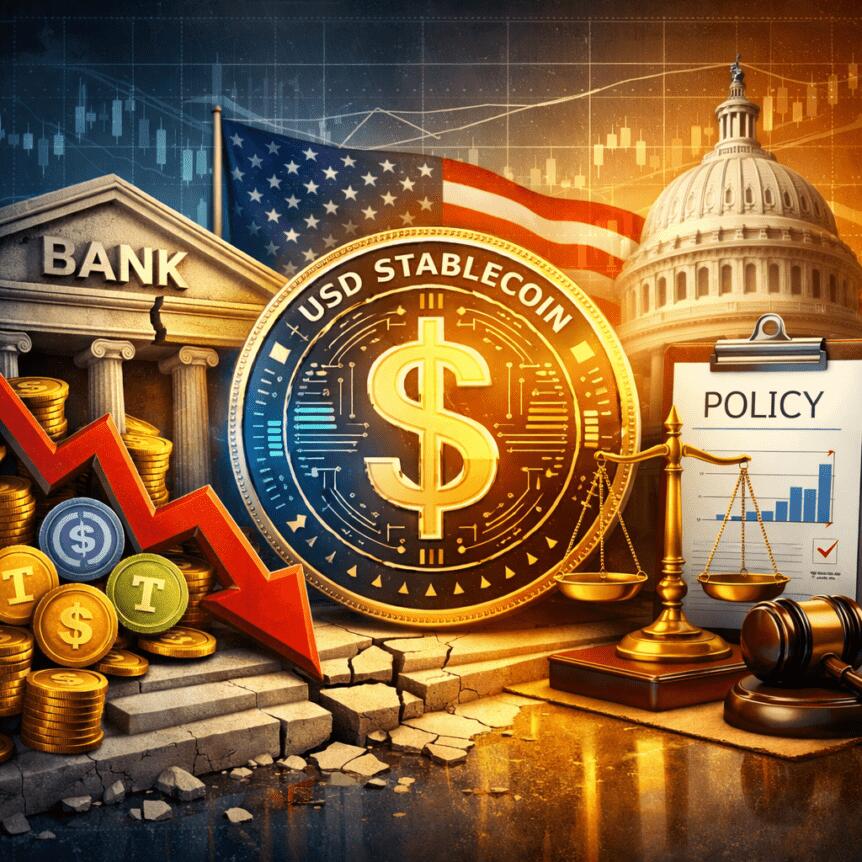
The Bank for International Settlements (BIS) is advocating tighter international coordination on stablecoins, warning that USD-denominated tokens could pose material risks to financial stability and economic policy if their scale rivals traditional money. The BIS perspective emerged from remarks by General Manager Pablo Hernández de Cos at a Bank of Japan seminar in Tokyo, where he stressed that current stablecoin arrangements do not yet meet the standards required for widespread everyday payments, despite offering potential benefits such as faster cross-border transfers and deepened smart-contract integration.
De Cos highlighted the largest USD-backed stablecoins, including USDT and USDC, as illustrative cases. He argued that these tokens exhibit features closer to investment products than cash-like money, citing fee structures, redemption constraints on primary markets, and episodes where prices deviate from par in secondary trading. In the BIS view, such dynamics give stablecoins ETF-like characteristics and introduce run and contagion risks because issuers typically hold reserves composed of short-term government debt and bank deposits. In a stress scenario, rapid outflows could force the sale of these reserves into constrained markets or transmit funding pressures to the banking system.
The BIS warnings come amid a broader regulatory dialogue on how to manage fast-growing stablecoins and other tokenized forms of money. De Cos also noted that activity on public, permissionless blockchains and with unhosted wallets sits largely outside conventional Anti-Money Laundering (AML) and Counter-Terrorism Financing (CTF) controls, raising concerns that stablecoins could be misused without tailored safeguards at on- and off-ramps.
Key takeaways
- The BIS urges international coordination to mitigate stability risks from large USD-backed stablecoins, arguing they could affect monetary policy and financial stability if they gain substantial scale.
- USDT and USDC are described as sharing characteristics with investment products rather than cash-like money, due to redemption features, fees, and price dislocations from par.
- Reserve assets backing stablecoins—primarily short-term government debt and bank deposits—may become a source of systemic risk through rapid outflows and forced asset sales in stressed markets.
- Regulators emphasize that much stablecoin activity operates outside traditional AML/CTF oversight, underscoring the need for bespoke safeguards at exchange gateways and wallet interfaces.
- Regulatory responses are being observed globally, with Europe, the UK, and Switzerland pursuing tighter controls or pilot programs to assess how stablecoins fit within existing financial frameworks.
Global regulatory momentum and Europe’s tightening stance
The BIS remarks sit within a wider policy debate about how to regulate stablecoins and other tokenized money. In Europe, policymakers are actively considering tighter controls on non-euro stablecoins and related instruments, beyond the current Markets in Crypto-Assets Regulation (MiCA). Earlier reports noted that Bank of France officials have urged the European Union to curb non-euro-denominated stablecoins used in everyday payments and to tighten restrictions on issuing the same coin inside and outside the bloc to reduce regulatory arbitrage during periods of stress.
The European Central Bank (ECB) has also contrasted euro-stablecoins with tokenized money market funds, pointing out that while both enable liquidity transformation and carry run risk, they differ in transparency, liquidity management, and regulatory oversight. Those differences could influence how stress propagates through funding markets and how institutions manage associated risk—information that is central to policy design and supervisory expectations.
Cross-border policy dynamics: UK and Switzerland as case studies
In the United Kingdom, lawmakers examined the stability implications of stablecoins as part of a bespoke regime under development for fiat-backed tokens. During a parliamentary inquiry, questions were raised about whether stablecoins could drain commercial bank deposits, trigger runs akin to those seen in some private banks, or facilitate illicit activity, underscoring the need for robust regulatory guardrails in a market that remains highly interconnected with traditional finance.
Switzerland’s approach illustrates a different regulatory trajectory. UBS and several domestic banks launched a franc-denominated stablecoin pilot in a sandbox environment on the heels of broader efforts to explore blockchain-enabled franc payments while anchoring the instrument in a tightly regulated financial system. The initiative signals an emphasis on practical testing within a controlled regulatory perimeter, balancing innovation with risk management and compliance standards.
These developments reflect a broader policy trend: as stablecoins scale, policymakers are seeking coherence across jurisdictions to address cross-border issues, supervisory alignment, and consumer protection—all within the framework of MiCA, existing banking regulation, and AML/CTF regimes. The overlaps among market structure, liquidity transformation, and regulatory oversight are increasingly central to institutional planning and compliance strategies for banks, exchanges, and other financial market participants.
Closing perspective
As policymakers weigh the proper balance between fostering innovation and safeguarding financial stability, the key question is how to design safeguards that are effective across borders, assets, and chains. The coming months are likely to bring further policy consultations and potential revisions to cross-border rules, as authorities seek to close gaps in oversight while preserving the efficiency and resilience benefits that tokenized money can offer.
The XRP price prediction picture improved this week as CoinGecko showed XRP trading at $1.43 with a 6.7% gain over seven days, outperforming the broader cryptocurrency market which rose 3.2% over the same period, while 24-hour trading volume jumped 23% to $3.79 billion, signaling a surge in market activity that analysts say reflects both institutional accumulation and CLARITY Act anticipation.
Summary
- XRP outperformed Bitcoin, which gained around 7% over the week from a lower base, and Ethereum, which rose roughly 9%, but from its lower January 2026 peak XRP still trades about 61% below its $3.65 all-time high.
- US-listed XRP ETFs recorded four consecutive days of inflows totaling $38.86 million through April 15, their strongest run since March, lifting total ETF assets under management above $1.25 billion.
- The key resistance level at $1.45 has stalled every XRP rally in 2026, with roughly 1.24 billion tokens held by investors who bought at that price and tend to sell when it returns there to break even.
XRP (XRP) price prediction data from CoinGecko on Monday shows the token posting its strongest weekly outperformance of the month, rising 6.7% over seven days to $1.43 while the global crypto market gained 3.2% over the same period. The 23% jump in 24-hour trading volume to $3.79 billion is the clearest signal that activity behind the move is genuine rather than a low-volume drift higher.
CoinDesk noted on April 17 that XRP had “quietly become the top weekly performer among major cryptocurrencies,” grinding higher in a steady, low-volatility move that analysts described as consistent with institutional accumulation rather than retail speculation. XRP ETF inflows through US-listed products hit $17.11 million on April 15 alone, the strongest single session since February, with four consecutive inflow days totaling $38.86 million.
Three catalysts are running simultaneously. First, Rakuten Wallet, which serves 44 million users in Japan, listed XRP in mid-April, adding one of the largest retail distribution networks in Asia to the token’s payment infrastructure. Second, the XRP Ledger integrated Boundless on April 14, bringing zero-knowledge proof technology to XRPL for institutional users who need confidential transactions with audit capability. Third, the CLARITY Act roundtable held at the SEC on April 16 avoided any negative signals toward XRP’s commodity classification, keeping institutional confidence in the regulatory trajectory intact.
European institutions have been building positions through Swiss exchange-traded products throughout the conflict period, with FINMA already providing a clear regulatory path that US institutions are still waiting for. According to 24/7 Wall St., ETF inflows into XRP investment products hit $119.6 million for the week ending April 11, the largest weekly haul since December 2025, with most of it coming from European buyers through Swiss platforms.
The $1.45 Resistance Wall and What Breaks It
XRP has failed to close above $1.45 in every attempted rally in 2026. Approximately 1.24 billion tokens are held by investors who bought at prices between $1.45 and $1.47 earlier in the year. Every time the price returns to their entry level, those holders sell to break even rather than hold for additional upside, creating a supply wall that retail and short-term speculative buying has not been strong enough to absorb.
The current move carries different underlying demand. European institutional buyers through Swiss ETPs do not need to hit break-even prices to sell because their entry points are lower and their mandates are longer term. If that demand is large enough to absorb the 1.24-billion-token wall, the break above $1.45 becomes possible for the first time in months. Analysts at 24/7 Wall St. described the next two weeks as decisive in determining whether the current setup “sticks.”
What the XRP Price Prediction Looks Like From Here
The CLARITY Act is the single largest binary catalyst remaining on the near-term XRP price prediction calendar. Standard Chartered analyst Geoffrey Kendrick has projected that Senate Banking Committee advancement could unlock $4 to $8 billion in additional XRP ETF inflows. Senator Bernie Moreno has warned that if the bill does not clear the full Senate by May, midterm election dynamics will push it off the calendar for the rest of 2026.
Polymarket currently gives the bill a 60% to 66% probability of becoming law in 2026. If it does, and the Iran ceasefire holds or is extended, XRP’s two largest price drivers converge simultaneously: regulatory clarity for institutional US capital and an oil market backdrop that removes the macro headwind suppressing all risk asset performance. That combination points to $1.60 to $1.80 as the next range. If either driver fails, analysts see $1.20 to $1.25 as the next support to test.
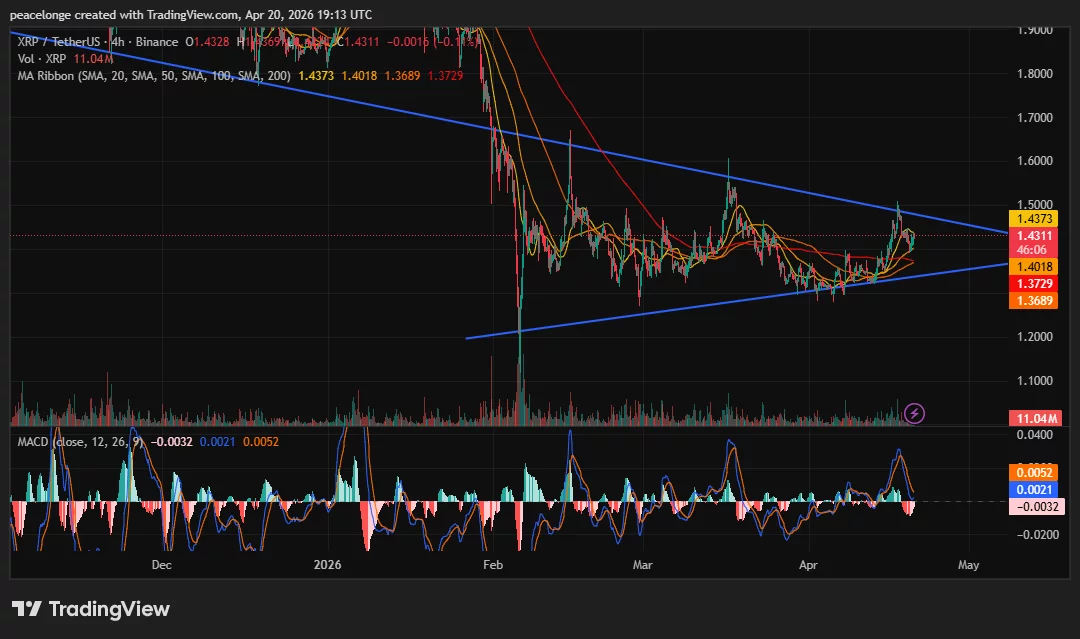
XRP price is at $1.4311 on April 20, as the 4H chart shows a symmetrical triangle reaching its apex simultaneously with a bearish MACD crossover, compressing an imminent directional resolution into the tightest point of the pattern.
Summary
- XRP price is at $1.4311 on April 20, down 0.13% on the 4H session, with a symmetrical triangle on the 4H chart reaching its apex between the descending upper trendline from the February highs and the ascending lower trendline from the March lows.
- The 4H MACD (12,26,9) has printed a bearish crossover with the histogram at -0.0032, the MACD line at 0.0021 crossing below the signal at 0.0052, adding nearterm downward momentum pressure as the triangle forces an imminent resolution.
- A confirmed 4H close above the SMA 20 at $1.4373 and the upper triangle trendline opens $1.50 as the primary target; a 4H close below the lower trendline near $1.37 exposes $1.30 as the next structural support.
XRP (XRP) price is at $1.4311 on April 20, down 0.13% on the 4H session, as a symmetrical triangle on the 4H chart compresses price between a descending upper trendline from the February highs above $1.90 and an ascending lower trendline from the March lows around $1.20. The pattern has reached its apex, and a directional resolution is now imminent. The 4H MACD has simultaneously printed a bearish crossover, with the histogram at -0.0032, adding a momentum signal that aligns with the descending upper trendline acting as resistance overhead. The MA ribbon is partially bullish: SMA 50 at $1.4018, SMA 100 at $1.3689, and SMA 200 at $1.3729 all sit below current price, but the SMA 20 at $1.4373 remains just above price and is acting as the first resistance on a 4H closing basis.
The 4H symmetrical triangle has been forming since the February peak at approximately $1.90, with the upper descending trendline connecting successive lower highs and the lower ascending trendline connecting successive higher lows from the March cycle lows. Volume has been declining throughout the compression phase, which is consistent with the typical symmetrical triangle structure and suggests an expansion of volatility is approaching as the apex closes.
The 4H symmetrical triangle defines the current XRP price structure across the period from December 2025 through April 2026, with the converging trendlines now meeting at the current price level. The 4H MACD (12,26,9) has produced a bearish crossover inside the triangle at the apex, with the MACD line at 0.0021 crossing below the signal at 0.0052 and the histogram at -0.0032. Both lines remain above zero, which limits the severity of the bearish signal relative to a subzero crossover, but the directional shift at the triangle apex and SMA 20 resistance overhead is the most relevant nearterm momentum reading.
The SMA 20 at $1.4373 is the key technical level sitting just above price. Until XRP closes a 4H candle above it alongside the upper triangle trendline, the bearish crossover is the operative 4H signal. A prior analysis published April 15 on crypto.news identified $1.50 as the primary target for an XRP symmetrical triangle breakout, with the pattern’s measured move from the widest point of the triangle pointing toward that level. Technical convention states that symmetrical triangles resolve with a move equal to the height of the pattern’s widest part from the breakout point, and the widest portion of the current triangle measures approximately $0.25, placing the full measured target near $1.68 on an upside resolution from the $1.43 apex.
Key Levels: Support, Resistance, and Price Targets
The SMA 20 at $1.4373 is the first resistance above current price. A 4H close above it, alongside a close above the upper descending trendline, confirms the symmetrical triangle breakout and opens $1.50 as the immediate target. A sustained move above $1.50 brings the SMA 100 at $1.5625 into view as the next significant resistance in the extended bull case.
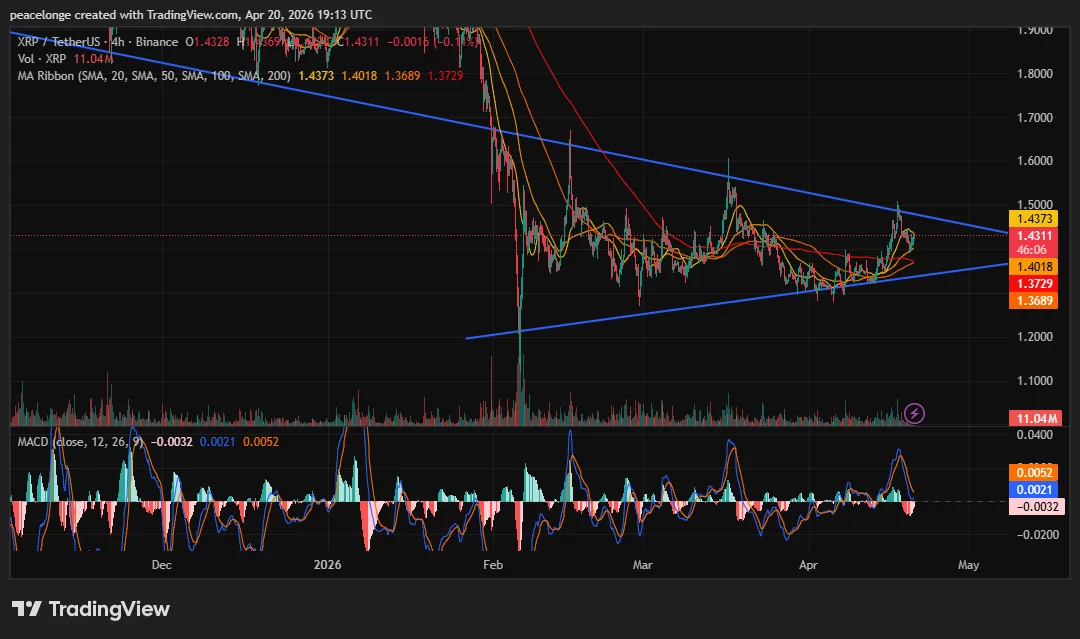
On the downside, the lower ascending trendline is currently near $1.37 to $1.38 on the 4H chart. A confirmed 4H close below the lower trendline breaks the symmetrical triangle structure and shifts the bias decisively bearish, exposing $1.30 as the next structural support. The lower trendline aligns with the Fibonacci 1.0 retracement level identified in prior daily chart analysis as the key floor below the current pattern. Below $1.30, $1.20 represents the last major demand zone before uncharted territory in the current correction.
Invalidation of the bull case: a 4H close below $1.37.
On-Chain and Market Data Context
XRP perpetual futures open interest stands at approximately $2.48 billion per Coinglass, down sharply from the over $9 billion recorded in early October 2025. The substantial deleveraging of speculative positioning over the past six months reduces the risk of a cascade liquidation event on either a breakout or a breakdown from the current triangle apex, creating a cleaner technical setup than the crowded positioning of the prior quarter. The 4H volume of 11.04M XRP on the current session is in line with recent sessions, confirming neither a strong conviction breakout nor a distribution event at the apex.
XRP ETF inflows reached $17 million in the week of April 14, the strongest weekly inflow since early February, providing a structural demand tailwind that runs counter to the 4H MACD bearish crossover signal. The divergence between improving institutional demand and deteriorating 4H momentum at the triangle apex is the key tension driving the current directional uncertainty.
If XRP closes a 4H candle above the SMA 20 at $1.4373 and the upper triangle trendline with expanding volume, $1.50 is the primary nearterm target with $1.5625 as the extended objective. A 4H close below the lower triangle boundary near $1.37 triggers the bearish resolution of the apex with $1.30 as the immediate downside objective.
Crypto World
Capital City Bank Group (CCBG) Stock: Q1 2026 Profit Jumps 15% on Deposit Strength and Cost Controls

Key Highlights
- Q1 2026 earnings per share climb to $0.92, reflecting strong sequential momentum
- Deposit base expands while operational costs decrease across the organization
- Net income reaches $15.8 million despite modest contraction in loan portfolio
- Asset quality metrics remain solid with controlled charge-off levels
- Return on equity improves to 11.30% as efficiency measures take hold
Capital City Bank Group (CCBG) delivered impressive first-quarter 2026 results characterized by strengthening deposits and enhanced cost discipline. Trading at $47.18, the stock advanced 0.74% following an initial surge before settling into a consolidation pattern. The financial institution demonstrated resilience through profitability growth even as loan volumes experienced downward pressure and interest rate dynamics shifted.
Capital City Bank Group, Inc., CCBG
Profitability Metrics Advance Through Operational Excellence
The banking institution posted net income of $15.8 million during the opening quarter of 2026, marking sequential improvement. Earnings per diluted share achieved $0.92, representing an advance from the previous quarter’s $0.80. Year-over-year comparisons showed a modest decrease from $0.99 in the corresponding 2025 period.
Profitability ratios demonstrated meaningful enhancement as return on assets climbed to 1.45% while return on equity reached 11.30%. These improvements stemmed from rigorous operational discipline and expense management initiatives implemented throughout the organization. Net interest income on a tax-equivalent basis registered $42.9 million, experiencing a slight reduction from the preceding quarter attributable to calendar day differences.
The net interest margin compressed modestly to 4.24%, influenced by declining overnight interest rates and reduced lending volumes. Nevertheless, enhanced yields from the securities portfolio provided partial compensation for margin pressure. As a result, the institution preserved strong earnings quality amid evolving interest rate environments.
Asset and Liability Mix Shows Strategic Repositioning
Customer deposits demonstrated robust expansion throughout the reporting period, underscoring continued franchise strength. Average deposit balances grew by $43.5 million, while period-end deposits surged by $89.3 million. The increase primarily originated from public sector relationships and core retail deposit channels.
Loan portfolios experienced contraction as average balances decreased by $29.8 million and period-end totals fell by $27.7 million. The reduction spanned residential mortgages, commercial real estate holdings, and consumer lending categories. Home equity products exhibited moderate expansion, providing partial counterbalance to broader portfolio declines.
Earning assets advanced modestly to $4.09 billion, supported by increased investment securities positions. Management deployed surplus liquidity into securities while preserving robust funding flexibility. Furthermore, liquidity resources remained substantial with more than $1.6 billion in accessible funding capacity.
Asset Quality Stability Accompanies Expense Discipline
Credit quality indicators remained steady as net charge-offs registered 10 basis points of average loan balances. The allowance for credit losses relative to total loans improved incrementally to 1.23%, demonstrating prudent reserve positioning. Nonperforming assets elevated to $13.0 million, primarily reflecting increased nonaccrual loan classifications.
Credit loss provisions decreased to $0.7 million compared with $2.0 million in the prior quarter. This reduction mirrored stable portfolio characteristics and minimal deterioration across risk categories. Classified loan exposures remained well-managed despite normal quarterly variations.
Noninterest expenses declined by $1.5 million, benefiting from reduced compensation expenses related to lower incentive compensation accruals. Conversely, noninterest income experienced slight weakness stemming from softer wealth management revenues and deposit service charges. Nevertheless, rigorous expense control supported profit expansion and strengthened balance sheet fundamentals.

Jeśli szukasz polskiego kasyna online, które oferuje najlepsze gry kasynowe i atrakcyjne kasyno online opinie, jesteś we właściwym miejscu. W 2026 roku rynek casino pl jest bardziej różnorodny niż kiedykolwiek, dzięki czemu gracze mają dostęp do szerokiej gamy polskich kasyn online.
Wśród najlepszych polskich kasyn online znajdują się te, które oferują najwyższy poziom bezpieczeństwa i uczciwości, a także szeroki wybór gier kasynowych, w tym sloty, ruletka i blackjack. Dodatkowo, wiele polskich kasyn online oferuje atrakcyjne bonusy i promocje, które pozwalają graczom zwiększyć swoje szanse na wygraną.
Jeśli chcesz znaleźć najlepsze kasyno online w Polsce, powinieneś przede wszystkim zwrócić uwagę na opinie innych graczy, a także na licencje i certyfikaty, które potwierdzają uczciwość i bezpieczeństwo danego kasyna. W ten sposób możesz być pewien, że grasz w polskim kasynie online, które jest godne Twojego zaufania.
Jak Wybrać Najlepsze Kasyno Online w Polsce
Wybór najlepszego kasyna online w Polsce wymaga uwzględnienia kilku kluczowych czynników. Przede wszystkim, należy upewnić się, że kasyno posiada ważną licencję i jest regulowane przez odpowiednie organy. Ponadto, warto sprawdzić, czy kasyno oferuje szeroki wybór gier kasynowych, w tym automaty, gry karciane i gry stołowe.
Wśród popularnych polskich kasyn online można wymienić kasyna, które oferują atrakcyjne bonusy i promocje dla nowych graczy. Należy jednak pamiętać, że każde kasyno ma swoje własne warunki i wymagania, dotyczące wypłat i depozytów. Dlatego też, przed zarejestrowaniem się w kasynie, warto przeczytać opinie innych graczy i sprawdzić ranking kasyn online.
Podczas wyboru kasyna online, warto zwrócić uwagę na jakość obsługi klienta. Dobrze, jeśli kasyno oferuje pomoc w języku polskim i ma dostępne różne kanały komunikacji, takie jak e-mail, telefon i czat na żywo. Ponadto, warto sprawdzić, czy kasyno posiada certyfikat bezpieczeństwa, który gwarantuje ochronę danych osobowych i transakcji finansowych.
Cechy Najlepszych Kasyn Online
Najlepsze kasyna online w Polsce charakteryzują się kilkoma cechami, które je wyróżniają. Oto niektóre z nich:
- Szeroki wybór gier kasynowych, w tym automaty, gry karciane i gry stołowe
- Atrakcyjne bonusy i promocje dla nowych graczy
- Bezpieczne i szybkie transakcje finansowe
- Dostępna pomoc w języku polskim
- Certyfikat bezpieczeństwa, który gwarantuje ochronę danych osobowych i transakcji finansowych
Wśród popularnych gier kasynowych gry kasynowe polska w Polsce można wymienić automaty, takie jak Book of Ra, Sizzling Hot i Lucky Lady’s Charm. Ponadto, wiele kasyn online oferuje gry karciane, takie jak poker, blackjack i baccarat, a także gry stołowe, takie jak ruletka i craps.
Podczas gry w kasynie online, warto pamiętać o odpowiedzialnej grze. Należy ustalić sobie limit wydatków i nie przekraczać go. Ponadto, warto regularnie sprawdzać swoje konto i monitorować swoje wydatki.
Wreszcie, warto wspomnieć, że kasyna online w Polsce są objęte prawem i podlegają regulacji. Dlatego też, przed zarejestrowaniem się w kasynie, warto przeczytać regulamin i warunki korzystania z kasyna.
Bezpieczne Metody Płatności w Kasynach Online
Wybierając polskie kasyno online, warto zwrócić uwagę na dostępne metody płatności, które powinny być bezpieczne i szybkie. Jedną z najpopularniejszych metod jest płatność kartą kredytową, taką jak Visa lub Mastercard, która umożliwia szybkie i bezpieczne dokonywanie wpłat i wypłat.
W kasynie online można również korzystać z usług płatniczych, takich jak PayPal, Skrill czy Neteller, które zapewniają wysoki poziom bezpieczeństwa i szybkość transakcji. Dodatkowo, wiele polskich kasyn oferuje możliwość dokonywania płatności za pomocą przelewu bankowego, co jest szczególnie przydatne dla osób, które preferują tradycyjne metody płatności.
Wśród kasyn internetowych dostępnych w Polsce, wiele oferuje również możliwość korzystania z metod płatności, takich jak Paysafecard czy EcoPayz, które są szczególnie popularne wśród graczy, którzy cenią sobie anonimowość i bezpieczeństwo transakcji.
Bezpieczeństwo transakcji
W casino pl bezpieczeństwo transakcji jest priorytetem, dlatego też wiele kasyn stosuje najnowocześniejsze technologie szyfrowania, takie jak SSL, które zapewniają ochronę danych osobowych i finansowych graczy. Dodatkowo, wiele polskich kasyn online jest objętych licencjami i certyfikatami, które potwierdzają ich bezpieczeństwo i fair play.
Gracze, którzy szukają polskiego kasyna online, powinni zwrócić uwagę na dostępne metody płatności i bezpieczeństwo transakcji, aby mieć pewność, że ich dane i pieniądze są w bezpiecznych rękach. Warto również przeczytać recenzje i opinie innych graczy, aby uzyskać więcej informacji o danym kasynie internetowym.
Wśród gier kasynowych dostępnych w Polsce, wiele kasyn oferuje również możliwość gry w kasyno online automaty, które są szczególnie popularne wśród graczy, którzy cenią sobie prostotę i szybkość gry. Dodatkowo, wiele polskich kasyn oferuje również możliwość gry w gry stołowe, takie jak poker czy blackjack, które są szczególnie popularne wśród graczy, którzy cenią sobie strategię i umiejętności.


Fluid’s aWETH Redemption Protocol, launched with Lido, Ether.fi, 1inch, 0x and Kyber, has processed $136M out of Aave’s frozen WETH pool in 48 hours.
The same architectural openness that turned a forged cross-chain message at Kelp DAO’s bridge into hundreds of millions of bad debt at Aave has in 48 hours produced its own antidote: A coalition of DeFi protocols has launched an emergency exit route.
Fluid, a DeFi DEX and lending protocol, has joined with other DeFi protocols to build a way for ETH depositors and loopers on Aave to swap their positions out of WETH, either exiting the protocol altogether or switching to a different collateral type, at a time when direct withdrawals are unavailable after the $290 million Kelp DAO exploit.
The aWETH Redemption Protocol has processed 58,510 aWETH, or approximately $136 million, out of Aave’s frozen WETH pool in its first 48 hours, according to the live Dune dashboard Fluid is publishing.
The protocol was built in under 24 hours in response to Aave’s ETH utilization hitting 100% after the April 18 exploit of Kelp DAO’s rsETH bridge adapter.
How it works
The infrastructure allows Aave ETH lenders to swap aWETH into wstETH or weETH collateral in a single transaction, at a discount of roughly 2.21% for a 1,000 aWETH swap, per 1inch co-founder Sergej Kunz. Early exits via secondary markets had been clearing near 23% below par.
Two user scenarios are supported: For lenders, aWETH converts to wstETH and weETH collateral. Users can then withdraw their assets. For borrowers, collateral switches from ETH to wstETH or weETH collateral. Debt remains unchanged and users can exit a previously stuck position or remain on Aave with yield-bearing collateral.
Lenders hand aWETH into Fluid’s Lite ETH Vault in exchange for wstETH or weETH. The vault then uses the incoming aWETH to repay part of its own WETH debt at Aave, extinguishing a liability without requiring WETH to leave Aave’s pool. The netting works because Fluid is the single largest user of the Aave WETH market, carrying approximately $1.5 billion in ETH debt against its looped Lite Vault positions.
Because Fluid already owes the debt being retired, the protocol is not taking on new directional risk. It is exchanging one claim on LST collateral for another, with the exiting lender absorbing a modest haircut and the vault reducing its borrowed exposure in a market where supply is otherwise trapped.
Lido Finance, Ether.fi, 0x Protocol, 1inch, and KyberNetwork are leveraging the protocol. Lido and Ether.fi contribute LST liquidity, 1inch shipped the front-end, and 0x and Kyber are routing orders. Aave’s DAO-recommended withdrawal guidance now directs trapped WETH suppliers toward the Fluid route.
“ETH utilization on Aave hit 100% and lenders had no exit. Fluid built the infrastructure in hours — with significant capacity to support ETH lenders at scale,” Fluid Founder and CTO Samyak Jain said in an announcement.
Kelp DAO exploit context
On April 18, an attacker exploited Kelp DAO’s LayerZero-based rsETH bridge adapter and minted 116,500 rsETH, approximately $293 million, or 18% of circulating supply, without a corresponding amount locked on the Ethereum side. The attacker supplied the unbacked rsETH as collateral on Aave V3 and V4 and borrowed approximately $236 million in WETH before markets were frozen.
Aave’s WETH utilization reached 100% within hours as lenders attempted to withdraw ahead of the bad-debt recognition, breaking the lending invariant that allows passive withdrawals. Variable borrow rates spiked into triple digits and aWETH began trading at a discount on secondary markets.
Aave’s risk team, in its April 20 incident report, modeled bad debt at between $123.7 million and $230.1 million depending on how claims on the under-collateralized rsETH L2 adapter are allocated.
Kelp DAO and LayerZero have continued to dispute responsibility. Kelp’s April 19 statement argued that the 1-of-1 DVN configuration used on the bridge was LayerZero’s documented default in its quickstart guide and was re-confirmed as appropriate by the LayerZero team during Kelp’s L2 expansion. LayerZero has attributed the exploit to the North Korea-linked Lazarus Group’s TraderTraitor subgroup and said it will no longer allow new OFT deployments to ship with 1-of-1 DVN configurations.
The composability dimension
The architectural property that allowed the exploit to cascade across Aave, Compound, Fluid and other venues is what allowed the redemption protocol to be assembled in under a day. aWETH is a standardized receipt token, wstETH and weETH are standardized LSTs, Aave’s “repaywithAtokens” function is public and permissionless, and aggregators can source liquidity from any venue. The Fluid flow combines those primitives without a governance vote, a treasury drawdown, or a new counterparty relationship.
The protocol does not reduce Aave’s modeled bad debt, reverse the attacker’s borrowing, or affect the LayerZero-Kelp dispute. It provides an individual exit for lenders who would otherwise wait for a socialization outcome or accept a steeper market discount.
Fluid said capacity is significant and additional partners are being engaged.
casibom için güncel giriş linkini bulmayı arıyorsanız, bu sayfayı ziyaret edin. Casibom 158 giriş, casibon veya casibo gibi farklı isimlerle de bilinir. Casibom, güvenli ve hızlı bir şekilde giriş yapmanıza olanak sağlar.
Casibom giriş sayfasına giderek, güncel ve güvenli bir şekilde oyunlarına erişebilirsiniz. Cadibom veya casibom olarak da bilinen bu platform, kullanıcı dostu bir arayüze sahiptir. Casibom güncel giriş linki her zaman güncel ve güvenli bir şekilde sunulmaktadır.
Casibom giriş sayfasına erişmek için, internet bağlantınızın aktif olduğundan ve uygun bir tarayıcı kullanıldığından emin olun. Casibom güncel giriş linki her zaman güvenli ve hızlı bir şekilde kullanılabilir.
Casibom, 2026 yılı için güncel giriş linkini kullanarak, oyunlarınıza hızlı ve güvenli bir şekilde erişebilirsiniz. Casibom giriş sayfasına giderek, güncel ve güvenli bir şekilde oyunlarına erişebilirsiniz.
Casibom’da Oynayın – Güvenli ve Eğlenceli Deneyim
Casibom’da oynayın, çünkü bu güvenli ve eğlenceli bir deneyim sunar. Casibom giriş sayfasından kolayca erişebilirsiniz. 158 giriş numarasını kullanarak hemen oyunları deneyin. Casibo adı altında sunulan çeşitli oyunlar, her tür oyun sevgilileri için mükemmel bir seçenek olur. Casibom güncel giriş linkiyle her zaman güncel kalmak ve en iyi oyunları denemek için bu sayfayı takip edin. Casibom giriş sayfasından hemen giriş yapın ve casibon oyun dünyasına girebilirsiniz. Casıbom, güvenli bir ortamda oyun oynayabileceğiniz ve kazanabileceğiniz bir platformdur.
Casibom’da Oynanabilecek En İyi Oyunlar
Casibom’da oynanabilecek en iyi oyunlar arasında: slot oyunları, live dealer oyunları ve table oyunları bulunur. Slot oyunları arasında popüler olanlar arasında “Mega Moolah” ve “Starlight Princess” bulunur. Live dealer oyunları arasında “Live Roulette” ve “Live Blackjack” sayılabilir. Table oyunları arasında “Baccarat” ve “Poker” yer alır.
Slot Oyunları
Mega Moolah: bu slot oyunu, büyük jackpots ile bilinir. Her kırk sekiz kere oynandığında bir büyük jackpot rastele kazanılır. Oyunun grafikleri ve sesleri harika, oyun deneyimi çok güzeldir.
Starlight Princess: bu oyun, klasik slot oyunlarının en iyi örneklerinden biridir. 25 kuyruklu, 5×3 formatında oynanır ve harika grafiklerle bilinir. Jackpotlar oldukça büyük olabilir.
Live Dealer Oyunları
Live Roulette: canlı cüzzam oyunları, gerçek cüzzamçılarla oynanır. Oyunlar hızlı ve eğlenceli, aynı zamanda güvenli ve adildir. Live roulette, her zaman popülerdir ve her zaman oynanabilir.
Live Blackjack: bu oyun, canlı dealer ile oynanır ve oyunlar hızlı ve adildir. Blackjack, her zaman popüler bir oyun olup, her zaman oynanabilir.
Casibom’da oynanabilecek en iyi oyunları deneyin ve mutluluk bulun!
Casibom’da Güvenli ve Kolay Kayıt Adımları
Casibom’da kaydolmak için basit ve güvenli bir süreç izleyin. İlk adım, https://constitucion40.com/ giriş sayfasına gidin. Burada, kullanıcı adı ve e-posta adresi girerek veya sosyal medya hesaplarıyla hızlı bir şekilde giriş yapabilirsiniz. Kayıt sırasında, gerekli bilgileri doğru ve tam olarak doldurun. Bu, hesabınızın güvenliğini sağlayacaktır.
Kayıt tamamlandığında, hesabınızı doğrulamak için e-posta adresinize gönderilen doğrulama e-postasını kontrol edin. Bu adımdan sonra, Casibom’da tamamen giriş yapabilirsiniz. Güvenliğiniz için, hesabınıza erişim sağladığından emin olun ve şifrenizi düzenleyin.

Bybit has led an $8 million Series A funding round in Hata, a dual-licensed digital asset exchange operating in Malaysia. The round also included participation from global family offices and follows Bybit’s earlier investment in Hata’s $4.2 million seed round.
According to Monday’s announcement, the funding will be used to improve liquidity, expand the user base and develop additional digital asset products.
Hata operates under licenses from the Securities Commission Malaysia and the Labuan Financial Services Authority, allowing it to offer trading and custody services for digital assets in the Southeast Asian country.
Since launching in 2023, the company has reported more than 209,000 registered users and processed 1.04 billion Malaysian ringgits (about $225 million) in transaction volume in 2025.
Ben Zhou, co-founder and CEO, said Malaysia is “strategically important” and has “one of the most digitally engaged populations in Southeast Asia and strong long-term potential for digital asset adoption.”
Bybit is the world’s fifth largest cryptocurrency exchange by trading volume, according to data from CoinMarket.
Beyond the region, the exchange is also deepening its commitment to the Middle East. In March, Bybit appointed Derek Dai as the new country manager for the MENA region to oversee expansion and partnerships despite ongoing regional tensions.
Dai said the Middle East is emerging as a key crypto market, with Bybit planning to expand UAE dirham access and build partnerships with banks and payment providers in the coming months.
Related: Rwanda swats Bybit’s P2P platform offering franc-to-crypto trading
Malaysia builds out digital asset regulatory framework
The investment from Bybit comes as Malaysia has been developing its regulatory framework for digital assets through a series of initiatives and pilot programs.
In June, Malaysia launched its Digital Asset Innovation Hub as a regulatory sandbox, allowing fintech and digital asset firms to test use cases such as programmable payments, ringgit-backed stablecoins and supply chain financing under central bank oversight.
During the same month, a Malaysian telecom company owned by Crown Prince Ismail Ibrahim, son of Sultan Ibrahim Iskandar, launched a ringgit-backed stablecoin called RMJDT on the Zetrix blockchain under the sandbox framework.
In November, Bank Negara Malaysia outlined a three-year roadmap to explore asset tokenization, including pilots for tokenized deposits, stablecoins and cross-border settlement through its Digital Asset Innovation Hub. The central bank’s plan includes an industry working group co-led with the Securities Commission Malaysia to coordinate use cases and address regulatory and legal considerations.
More recently, the central bank said it is piloting three sandbox programs focused on ringgit-backed stablecoins and tokenized bank deposits for cross-border settlement, with participation from institutions including Standard Chartered, CIMB Group and Maybank.
Magazine: Bitcoin will not hit $1M by 2030, says veteran trader Peter Brandt

John Oliver, host of HBO’s Last Week Tonight, targeted prediction market platforms on his show’s latest weekly deep dive.
In Sunday’s airing of the HBO show, Oliver discussed some of the trivial event contracts on platforms such as Kalshi and Polymarket, including betting whether members of the Trump administration would use certain words in public addresses, to the companies’ controversial partnering with news organizations.
Specifically, the host questioned Donald Trump Jr.’s relationship with both platforms — an adviser to Kalshi and Polymarket — and how the US Commodity Futures Trading Commission (CFTC) “doesn’t even seem to be trying” to block event contracts on terrorism, assassination and war under Chair Michael Selig.
For much of the show, Oliver discussed how it is “incredibly easy for individuals to manipulate the outcomes,” citing Coinbase CEO Brian Armstrong rattling off a list of crypto-related words in his third-quarter 2025 earnings call to cause many Kalshi and Polymarket users to win their bets.
“I’m going to make you a promise tonight,” said Oliver, echoing Armstrong’s statement. “I will never do anything because someone online placed a bet on it. So you can be confident that if I ever say Bitcoin, Ethereum, blockchain, staking and Web3, it won’t be because I’m trying to move markets — it will be because I’m having a stroke.”

While user activity and trading volume on prediction markets have increased exponentially in recent months — expected to reach $1 trillion by 2030 — the platforms’ controversial bets and legal status in US states have raised eyebrows for some experts. Gaming authorities in several states are suing companies like Kalshi over alleged illegal sports betting, with Coinbase chief legal officer Paul Grewal and others expecting the legal fight to end up before the US Supreme Court.
Related: Senate bill to target sports betting ban on prediction markets: WSJ
Financial giants looking to expand into prediction markets?
In addition to previously announced partnerships with media giants like CNN, CNBC, Fox News and Dow Jones, traditional financial companies including Charles Schwab and Citadel Securities recently signaled plans to consider prediction markets.
Charles Schwab CEO Rick Wurster said on a Thursday investors call that the company would “take a hard look at” prediction markets. In a separate event the same day, Citadel Securities President Jim Esposito said that the company was “absolutely keeping an eye on developments” as part of a potential move into the market.
Magazine: Adam Back says current demand is ‘almost’ enough to send Bitcoin to $1M
Wanneer je op zoek bent naar een goksite zonder cruks, kan het lastig zijn om de juiste keuze te maken. Er zijn veel online casinos die zich richten op spelers uit Nederland, maar niet allemaal bieden ze de beste voorwaarden. In deze beoordeling zullen we de beschikbare spellen van Zonder Cruks Online Casino analyseren en beoordelen.
Zonder Cruks Online Casino is een populaire keuze onder gokkers uit Nederland, omdat het casino een brede verscheidenheid aan spellen aanbiedt. Van klassieke gokkasten tot complexere videospelletjes, er is iets voor iedereen. Het casino biedt ook een aantal exclusieve spellen die niet beschikbaar zijn op andere goksites.
Maar hoe zit het met de voorwaarden? Is Zonder Cruks Online Casino een goede keuze voor gokkers zonder cruks? In deze beoordeling zullen we de voorwaarden van het casino analyseren en beoordelen, van het aanbod aan spellen tot de bonusvoorwaarden en de veiligheid van het casino.
We zullen ook de voordelen en nadelen van het casino bespreken, zodat je een goede beslissing kunt nemen over het kiezen van Zonder Cruks Online Casino als jouw goksite zonder cruks. Lees verder om te ontdekken of Zonder Cruks Online Casino de beste keuze is voor jou.
Welke spellen zijn beschikbaar? Zonder Cruks Online Casino biedt een brede verscheidenheid aan spellen, waaronder:
Klassieke gokkasten, zoals Book of Ra en Starburst
Videospelletjes, zoals slots en videopoker
Live casino, met live dealers en live spellen
Progressieve jackpotspellen, zoals Mega Moolah en Hall of Gods
We zullen ook de bonusvoorwaarden van het casino bespreken, waaronder het no deposit bonus en de andere promoties die het casino aanbiedt.
Zonder Cruks Online Casino is een populaire keuze onder gokkers uit Nederland, omdat het casino een brede verscheidenheid aan spellen aanbiedt en een goede reputatie heeft op het gebied van veiligheid en betrouwbaarheid. Lees verder om te ontdekken of Zonder Cruks Online Casino de beste keuze is voor jou.
Welkom bij Zonder Cruks
Welkom bij Zonder Cruks, het online casino dat u een unieke ervaring biedt. Wij zijn gespecialiseerd in het bieden van goksites zonder cruks, zodat u kunt genieten van een veilige en verantwoorde gokervaring.
Onze goksites zonder cruks zijn ontworpen om u een maximale gokervaring te bieden, met een breed scala aan spellen en een veilige en betrouwbare omgeving. Wij bieden ook casino zonder cruks no deposit bonus, zodat u kunt genieten van een extraatje bij het spelen.
Wij zijn ook bekend als de beste online casino zonder cruks, omdat wij ons focussen op de behoeften van onze spelers. Wij bieden een breed scala aan spellen, van klassieke gokkasten tot moderne videospelletjes. Onze spelers kunnen ook genieten van online gokken zonder cruks, omdat wij ons focussen op de veiligheid en betrouwbaarheid van onze diensten.
Wij zijn ook gespecialiseerd in het bieden van casinos zonder cruks, zodat u kunt genieten van een veilige en verantwoorde gokervaring. Wij bieden ook goksite zonder cruks, zodat u kunt genieten van een breed scala aan spellen en een veilige en betrouwbare omgeving.
Wij zijn er om u te helpen bij het vinden van de beste casino zonder cruks, omdat wij ons focussen op de behoeften van onze spelers. Wij bieden een breed scala aan informatie over de beste online casino zonder cruks, zodat u kunt genieten van een veilige en verantwoorde gokervaring.
Wij zijn ook gespecialiseerd in het bieden van gokken zonder cruks, zodat u kunt genieten van een veilige en verantwoorde gokervaring. Wij bieden ook online gokken zonder cruks, zodat u kunt genieten van een breed scala aan spellen en een veilige en betrouwbare omgeving.
Wij zijn er om u te helpen bij het vinden van de beste casino zonder cruks, omdat wij ons focussen op de behoeften van onze spelers. Wij bieden een breed scala aan informatie over de beste online casino zonder cruks, zodat u kunt genieten van een veilige en verantwoorde gokervaring.
Spellen en Features
Als u op zoek bent naar een online casino waar u kunt gokken zonder cruks, dan bent u bij Zonder Cruks Online Casino aan het juiste adres. Dit casino biedt een brede verscheidenheid aan spellen, waaronder klassiekers als blackjack, roulette en poker, evenals moderne spellen zoals video slots en live casino games.
Wanneer u zich aanmeldt bij Zonder Cruks Online Casino, kunt u genieten van een no deposit bonus, waardoor u kunt beginnen met gokken zonder enig financieel risico. Dit is een unieke kans om te ervaren hoe het online gokken zonder cruks werkt.
Naast de brede verscheidenheid aan spellen, biedt Zonder Cruks Online Casino ook een aantal unieke features, waaronder:
Live Casino
Met het live casino kunt u live gokken met een echte dealer, waardoor u een echte casino-ervaring kunt ervaren vanuit uw eigen comfortzone.
Mobile App
De mobile app van Zonder Cruks Online Casino maakt het mogelijk om overal en wanneer u maar wilt te gokken, zonder enig beperking.
Wanneer u kiest voor Zonder Cruks Online Casino, kunt u rekenen op een veilig en betrouwbaar gokken-ervaring, met een goede klantenservice en een brede verscheidenheid aan betalingsmethoden.
Waarom kiezen voor Zonder Cruks Online Casino?
Er zijn vele redenen om voor Zonder Cruks Online Casino te kiezen, waaronder:
– Brede verscheidenheid aan spellen
– No deposit bonus
– Live casino
– Mobile app
– Veilige en betrouwbare gokken-ervaring
Zonder Cruks Online Casino is de perfecte keuze voor iedereen die op zoek is naar een online casino waar hij/zij kan gokken zonder cruks.
Veiligheid en Betrouwbaarheid
Wanneer het om veiligheid en betrouwbaarheid gaat, is het belangrijk om een goksites zonder cruks te kiezen. Een goksites zonder cruks is een online casino dat een goede reputatie heeft en waarbij de veiligheid en betrouwbaarheid van de spelers worden gewaarborgd.
Een goksites zonder cruks biedt meestal een veilige en betrouwbare omgeving voor spelers om te gokken. Dit betekent dat de website is beveiligd met een SSL-certificaat, dat de gegevens van de spelers worden beschermd en dat de website een goede reputatie heeft in de gokwereld.
Een goksites zonder cruks is ook een online casino dat een goede reputatie heeft en waarbij de veiligheid en betrouwbaarheid van de spelers worden gewaarborgd. Dit betekent dat de website een goede reputatie heeft in de gokwereld en dat de spelers kunnen vertrouwen op de veiligheid en betrouwbaarheid van de website.
Het is belangrijk om een goksites zonder cruks te kiezen, omdat dit betekent dat de website een goede reputatie heeft en waarbij de veiligheid en betrouwbaarheid van de spelers worden gewaarborgd. Dit betekent ook dat de website een goede reputatie heeft in de gokwereld en dat de spelers kunnen vertrouwen op de veiligheid en betrouwbaarheid van de website.
Een goksites zonder cruks is een online casino dat een goede reputatie heeft en waarbij de veiligheid en betrouwbaarheid van de spelers worden gewaarborgd. Dit betekent dat de website een goede reputatie heeft in de gokwereld en dat de spelers kunnen vertrouwen op de veiligheid en betrouwbaarheid van de website.
Het is belangrijk om een goksites zonder cruks te kiezen, omdat dit betekent dat de website een goede reputatie heeft en waarbij de veiligheid en betrouwbaarheid van de spelers worden gewaarborgd.

USD-backed stablecoins could strain banks and policymaking

Minister Mocked For Claiming Starmer Is ‘Man Of Integrity’

Tilak Varma Triggered By Animated Hardik Pandya’s Mid-Match Message, Goes On To Slam MI’s Fastest Ton In IPL. Watch



-

 NewsBeat7 days ago
Trump and Pope Leo: Behind their disagreement over Iran war
-

 Fashion3 days ago
Weekend Open Thread: Theodora Dress
-

 News Videos6 days ago
Secure crypto trading starts with an FIU-registered
-

 Sports4 days ago
NWFL Suspends Two Players Over Post-Match Clash in Ado-Ekiti
-

 Crypto World7 days ago
SEC Proposes Certain Crypto Interfaces Don’t Need to Register as Brokers
-

 Business1 day ago
Powerball Result April 18, 2026: No Jackpot Winner in Powerball Draw: $75 Million Rolls Over
-

 Crypto World3 days ago
Russia Pushes Bill to Criminalize Unregistered Crypto Services
-

 Politics3 hours ago
Gary Stevenson delivers timely reminder to register to vote as deadline TODAY
-

 Politics3 days ago
Palestine barred from entering Canada for FIFA Congress
-
 Business4 days ago
Creo Medical agree sale of its manufacturing operation
-

 Politics2 days ago
Zack Polanski demands ‘council homes not luxury flats for foreign investors’
-
 Entertainment7 days ago
Brand New Day’ Footage Reveals the Devastating Impact of ‘Now Way Home’
-

 Crypto World3 days ago
Russia Introduces Bill To Criminalize Unregistered Crypto Services
-

 Tech2 days ago
Auto Enthusiast Scores Running Tesla Model 3 for Two Grand and Turns It Into Bare-Bones Go-Kart
-

 Tech5 days ago
‘Avatar: Aang, The Last Airbender’ Leaked Online. Some Fans Say Paramount Deserves the Fallout
-

 Tech6 days ago
Microsoft adds Windows protections for malicious Remote Desktop files
-
 Entertainment7 days ago
Karol G’s ‘Ultra Raunchy’ Coachella Set Gave ‘Satanic Vibes’
-

 Crypto World6 days ago
X Launches New Cashtag Feature for Stocks and Crypto: X
-

 Sports6 days ago
Younger Than Sachin Tendulkar: Vaibhav Sooryavanshi Set To Make Historic India Debut
-

 Entertainment6 days ago
Prince Carter Brings Fans Front Row and Backstage at Boys 4 Life Tour
You must be logged in to post a comment Login