
Crypto World
Can Bitcoin Break Above $80K Next?

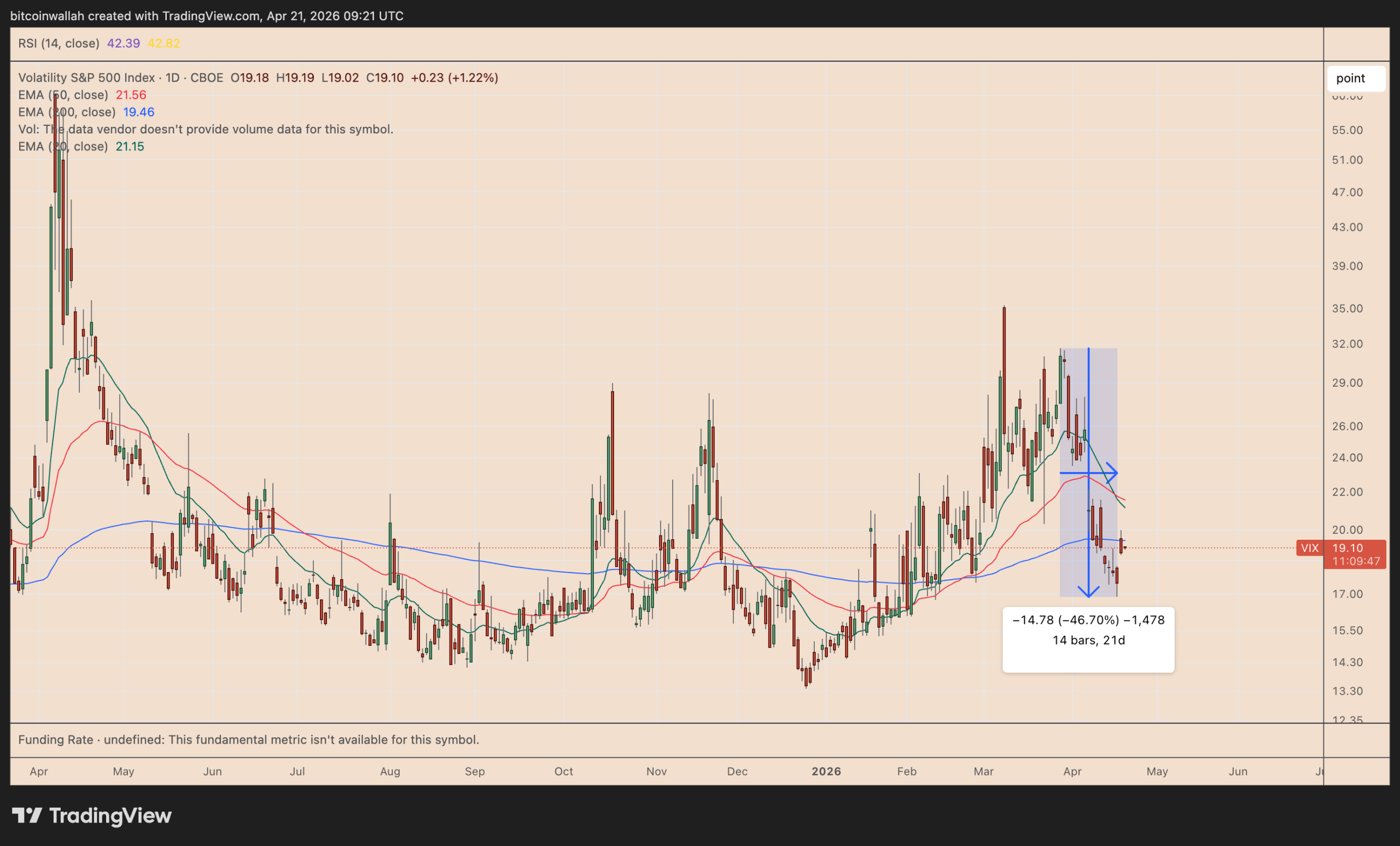
The CBOE Volatility Index (VIX), a preferred Wall Street metric to measure investor sentiment and market risk, dropped by over 45% in under a month. For Bitcoin (BTC), this could be a significant bullish signal.

Key takeaways:
-
Bitcoin may rise toward $82,700 if VIX keeps underperforming.
-
BTC’s upside outlook gets a boost from Strategy’s BTC buying spree.
Weakening VIX hints at BTC rising to $82,700
Often called Wall Street’s “fear gauge,” the VIX tracks how much volatility traders expect in the S&P 500 index over the next 30 days.
When the index rises, it usually signals rising stress and risk aversion across markets. When it falls, it suggests investors are becoming more comfortable owning riskier assets such as stocks and crypto.
History suggests that a VIX drop of 40% or more is bullish for Bitcoin.
For instance, BTC rallied approximately 40% during April 2025–May 2025, with its gains aligning with the VIX’s 70% dip.

Similarly, a 46% VIX drop during the October–November 2025 period coincided with a 12% BTC gain.
Even the recent 42%–47% VIX decline has coincided with an 8%–9% BTC price rebound, improving the bullish backdrop for Bitcoin in the coming days.
BTC’s next upside target appears to be around the 200-day exponential moving average (200-day EMA, the blue line) at around $82,700 by early May.
What happens to Bitcoin if VIX starts rising?
A rising VIX is typically bearish for risk assets like Bitcoin. However, that correlation broke briefly in March, according to a chart highlighted by wealth management firm Swissblock.
BTC and VIX rose in tandem during the US–Iran escalation in March. In comparison, the broader risk market, including US equities, underperformed.

One potential catalyst behind Bitcoin’s resilience may have been Strategy’s aggressive BTC buying, which has absorbed the equivalent to nearly 30 weeks of new coin supply since March.
Related: Saylor teases ‘bigger’ BTC buy days after floating semi-monthly dividends
“Bitcoin has already shown inherent strength in a very complex environment”, Swissblock said, adding:
“Do not be surprised if it starts to outperform on its own again.”
Nonetheless, any slowdown in Strategy’s buying could weaken Bitcoin’s support during periods of rising VIX, increasing the risk of downside.
Multiple analyses suggest BTC may drop below $50,000 in 2026.
This article is produced in accordance with Cointelegraph’s Editorial Policy and is intended for informational purposes only. It does not constitute investment advice or recommendations. All investments and trades carry risk; readers are encouraged to conduct independent research before making any decisions. Cointelegraph makes no guarantees regarding the accuracy or completeness of the information presented, including forward-looking statements, and will not be liable for any loss or damage arising from reliance on this content.



European financial firms and technology groups are urging lawmakers to speed up changes to rules governing distributed ledger technology, warning the region risks falling behind the U.S. in digital finance.
In a joint letter, 39 signatories including Boerse Stuttgart Group, Nasdaq and fintech associations across several European Union (EU) countries asked the European Commission and Parliament to separate the digital ledger technology (DLT) pilot regime from a broader legislative package under review.
They argue that handling the rules on their own would allow quicker updates, Bloomberg reports. The DLT pilot, in place since 2023, lets firms test how tokenized versions of assets like shares and bonds can trade and settle using blockchains.
It sits within a wider set of 18 financial laws now moving through the EU’s legislative process, a path industry groups say could take years.
The coalition is pushing for practical changes, including expanding the types of assets allowed, raising transaction limits to 150 billion euros ($176 billion) and removing expiry dates on licenses. These changes, they argue, would give firms room to build real markets rather than small trials.
The letter comes as the U.S. shapes laws regulating the space, including the Genius Act, meant to help bring crypto further into mainstream finance.
The European Commission has signaled it prefers to pass the full legislative package together as part of its broader plan to mobilize savings into investment.
Crypto World
Google’s Quantum AI Just Spooked Ripple Into Building a 2-Year Defense Plan for XRP: Should Holders Be Worried?

Ripple published an official multi-phase roadmap on April 20, 2026, outlining how the XRP Ledger will transition to post-quantum cryptography, targeting full readiness no later than 2028. The plan is a direct response to Google Quantum AI research confirming that blockchain cryptography – wallet security, transaction signing, key management – is breakable by sufficiently advanced quantum computers.
The threat isn’t alive today. But as Ripple frames it: “The threat has moved from theoretical to credible, and preparation timelines now matter.”
- Ripple targets full post-quantum cryptography readiness for XRPL by 2028
- Phase 2 experimentation with NIST-recommended algorithms begins H1 2026; Phase 3 Devnet hybrid deployments follow in H2 2026
- XRPL’s native key rotation gives it a structural migration edge over Ethereum, where no protocol-level equivalent exists
- A ‘Quantum-Day’ contingency plan is already scoped – if classical cryptography breaks unexpectedly, XRPL enforces a hard shift to post-quantum accounts using zero-knowledge proofs
- Ripple is collaborating with Project Eleven on validator testing, Devnet benchmarking, and a post-quantum custody wallet prototype
Discover: The best pre-launch token sales
What Ripple’s Post-Quantum Roadmap Actually Includes
The roadmap runs across four phases:
Phase 1 – already scoped – is a Quantum-Day contingency: if classical cryptography breaks before the transition is complete, XRPL enforces a hard cutover, rejecting classical public-key signatures and requiring funds to migrate to post-quantum secure accounts. The migration path uses PQ-based zero-knowledge proofs to prove key ownership without exposing the keys themselves.
Phase 2 (H1 2026) expands experimentation with NIST-finalized algorithms, benchmarking signature size, verification cost, throughput impact, and storage overhead under real XRPL workload conditions. Engineer Denis Angell is already prototyping ML-DSA on AlphaNet. Project Eleven is building a hybrid post-quantum signing implementation alongside validator-level testing and a custody wallet prototype for Devnet.
Phase 3 (H2 2026) moves from isolated testing to running post-quantum signature schemes in parallel with existing elliptic curve signatures on Devnet – live for application developer testing without disrupting mainnet. This phase also extends into post-quantum-friendly primitives for zero-knowledge proofs and homomorphic encryption, relevant to XRPL’s Confidential Transfers work for tokenization use cases.
Phase 4 (targeting 2028) is the full transition: a new XRPL protocol amendment for native post-quantum cryptography, production-hardened for validator performance and deterministic settlement. Ripple describes it as “not just a cryptographic challenge” at this point – the primary risk is breaking what already works on a live global settlement network.
The applied cryptography team leading the work – Dr. Murat Cenk, Dr. Tamas Visegrady, Dr. Oleg Burundukov, and Dr. Aanchal Malhotra – is designing for cryptographic agility: multiple NIST-standardized algorithms rather than a single scheme, so the protocol can adapt as post-quantum standards evolve.
What This Means for XRP Holders and Protocol Risk
For XRP holders tracking the long-term protocol outlook, the roadmap does two things: it validates that Ripple is treating quantum risk seriously enough to allocate dedicated cryptography talent and a multi-year engineering budget, and it draws a clear distinction between XRPL’s migration path and the far messier upgrade scenarios facing networks without native key management tools.

Contingency planning is the most underappreciated element. Most blockchain quantum roadmaps assume an orderly, years-long transition. Ripple’s Phase 1 plans for the disorderly version – a sudden cryptographic break – using ZK proofs to enable safe fund recovery even in a compromised environment. That’s a materially different risk posture than “we’ll upgrade eventually.”
The honest caveat: 2028 is still two years out, post-quantum cryptography at ledger scale remains technically unsolved in production, and larger signature sizes could create real performance headaches for a network that competes on settlement speed.
Phase 2 benchmarking results – expected H1 2026 – will be the first real data point on whether the performance tradeoffs are manageable. Watch for those Devnet numbers. XRPL’s protocol evolution is moving fast on multiple fronts simultaneously, and quantum readiness is now officially one of them.
Discover: The best crypto to diversify your portfolio with
The post Google’s Quantum AI Just Spooked Ripple Into Building a 2-Year Defense Plan for XRP: Should Holders Be Worried? appeared first on Cryptonews.


New York filed lawsuits against Coinbase Financial Markets and Gemini Titan for allegedly violating state law, according to court records first reported by Reuters.
Whiule copies of the complaints may not immediately available, speculation is that the suits target the prediction market subsidiaries of two of the largest US crypto exchanges. If so, it would mark the first enforcement action by New York against federally licensed prediction market operators.
New York Follows Through on Prediction Market Warning
New York Attorney General Letitia James warned in February that prediction markets violate the state’s gambling statutes. At the time, her office issued a consumer and industry alert stating that “the conduct, advertisement, and promotion of unlicensed sports wagering violate New York’s gambling laws.”
Coinbase launched its prediction market product for US users in January through a partnership with Kalshi. Gemini Titan, a subsidiary of Gemini Space Station, separately rolled out its own prediction market platform after obtaining a Designated Contract Market license from the Commodity Futures Trading Commission (CFTC).
The lawsuits come as prediction markets face a growing legal battle between state gambling regulators and the federal government. The CFTC sued Connecticut, Arizona, and Illinois on April 3 for attempting to regulate prediction market operators under state gaming laws. A federal appeals court also ruled on April 7 that New Jersey could not enforce its gambling statutes against Kalshi.
New York’s decision to sue rather than comply with federal preemption arguments signals the jurisdictional dispute may accelerate toward the Supreme Court. Several analysts have noted a circuit split is forming, a condition that typically invites high court review.
The post New York Sues Coinbase and Gemini: What We Know So Far appeared first on BeInCrypto.
Crypto World
Coinbase advisory board warns that quantum computing threat is on the horizon and crypto needs a plan
A new report commissioned by Coinbase sounds a cautious, but urgent, alarm: Quantum computing won’t break crypto tomorrow, but the industry can’t afford to wait.
The 50-page paper, authored by an independent advisory board that includes prominent cryptographers and academics like Dan Boneh of Stanford University, Justin Drake of the Ethereum Foundation and Sreeram Kannan of Eigen Labs, concludes that while today’s blockchains remain secure, a future “fault-tolerant quantum computer” capable of breaking widely used encryption is increasingly plausible, and preparation must begin now.
In recent months, concerns around quantum risk have moved further into the mainstream. Google researchers have published estimates suggesting that a sufficiently advanced quantum computer could one day break Bitcoin’s cryptography.
Major crypto ecosystems have already started mapping out their responses. The Ethereum Foundation has proposed new types of digital signatures that are designed to be safe against quantum computers, while Solana and others are experimenting with quantum-resistant wallet designs.
The report stresses that current quantum machines are far from powerful enough to crack the cryptography underpinning Bitcoin, Ethereum and other networks. Breaking standard encryption would require vast computational overhead, a milestone still considered a major engineering challenge.
Still, the authors caution against complacency.
“We have high confidence that a large-scale, fault-tolerant quantum computer will eventually be built,” the report states, adding that the timeline is uncertain but “clearly on the horizon.”
That uncertainty is exactly the problem, with estimates ranging from “a few years to a decade or more” and no reliable way to predict breakthroughs.
The urgency is reflected in guidance from the U.S. National Institute of Standards and Technology (NIST), which recommends migrating to quantum-resistant cryptography by 2035, a timeline the report suggests may even prove optimistic.
“Waiting for it to be urgent is not a good idea,” the Coinbase paper says, emphasizing that transitions across blockchains, wallets and exchanges could take years to execute safely.
Some assets may be more vulnerable than others. For example, Bitcoin wallets that have already revealed their public keys could be targeted, while those still protected behind hash functions may be safer in the short term.
The good news: Quantum-resistant cryptography (PQC) already exists and is being standardized by NIST.
The bad news: It’s not an easy swap.
Post-quantum digital signatures can be tens to hundreds of times larger than current ones, which could dramatically increase blockchain data costs and reduce throughput. One estimate in the report suggests that replacing today’s signatures with quantum-proof alternatives could expand block sizes by up to 38 times.
There are also usability challenges, from migrating millions of wallets to deciding what to do with “lost” or inactive funds that never upgrade.
Rather than a single solution, the report outlines multiple transition strategies, including hybrid systems that combine existing cryptography with post-quantum updates or allow a gradual switch when needed.
For now, the authors recommend flexible approaches that avoid sacrificing current security or performance while enabling a rapid upgrade later.
“The time to begin preparing for it is now,” the report concludes.
Read more: Solana’s quantum-threat readiness reveals harsh tradeoff: security vs speed
Poland’s parliament, the Sejm, has yet to pass a domestic enabling act for the EU’s regulations on cryptocurrencies.
The parliament has again failed to override a presidential veto on a key crypto regulation bill. President Karol Nawrocki defended his veto, citing concerns over excessive regulation that could harm small businesses. Opponents state that the lack of framework makes the Polish market vulnerable to fraud and free-for-all for illicit actors. The political path forward is unclear.
Outside the political arena, the reality is that Poland is the only EU member state left to implement the bloc’s Markets in Crypto-Assets (MiCA) regulatory framework. The deadline for the transitionary period ends on July 1.
This already makes it difficult for local firms to stay competitive in Europe. But after July 1, if a solution isn’t forthcoming, it will be impossible. Some are already taking their business elsewhere and moving abroad.
Crypto industry, Polish president claim bill is burdensome
In November 2025, the Sejm passed the Crypto-Asset Market Act, which would update Polish law to comply with MiCA.
Local enterprise groups were not pleased with the result. In an October letter, the Warsaw Enterprise Institute, a business-focused think tank, outlined a few of the perceived problems with the law.
First was the length. Including draft secondary regulations, the total length was well over 300 pages. The Warsaw Enterprise Institute said that, while other EU member states were satisfied with just a few dozen pages, “the Polish law has several hundred articles and provides for additional regulations.”
It said the act introduces “a ban on marketing activities related to basic cryptocurrencies and the possibility of blocking websites by administrative decision, without the right to appeal to a court.”
“Such solutions are not justified by MiCA and put Polish companies in a worse competitive position compared to entities operating in other EU countries.”.
Of further concern was the role the Polish Financial Supervision Authority (KNF) would play under the new regime. Under the law, the KNF would be the sole regulator of the entire crypto market. It would have the power to levy heavy fines as well as maintain and enforce a blacklist of “unreliable” crypto domains that Polish ISPs would have to block.
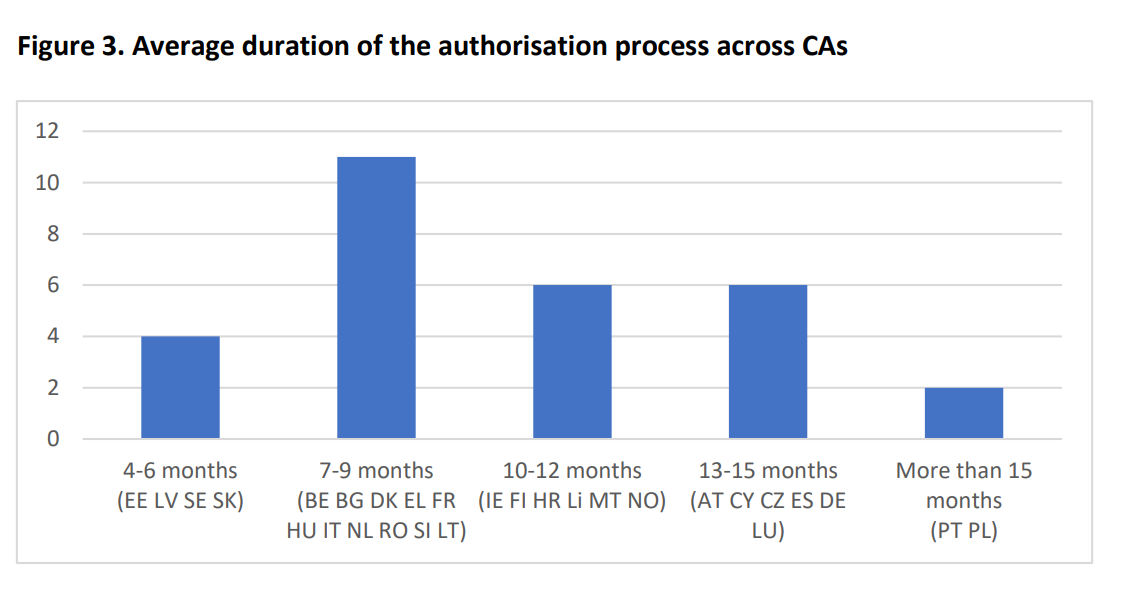
Not only would the KNF be incredibly powerful, but it is already notoriously slow. According to a payment institution peer review by the European Banking Authority, the KNF’s authorization times were the slowest in Europe. In an October letter, the Warsaw Enterprise Institute claimed that the KNF has only issued two licenses for brokerage houses in the last 10 years. In the same time period, it has only issued one electronic money institution license, while Lithuania has registered over 100.

Related: EU crypto firms turn to legal support as deadline for MiCA compliance nears
On Dec. 1, 2025, Nawrocki vetoed the law, citing bloated regulation. The government failed to override the veto, and then reintroduced the exact same bill. Nawrocki vetoed the bill for a second time in February, and on April 17, the Sejm repeated itself in failing to overrule the veto.
Polish parliament struggles to find path forward for MiCA
The battle over the crypto bill shows no signs of stopping.
Firstly, for Nawrocki, passing the bill after being reintroduced in the same form would have presented a political problem.
Piech told Cointelegraph, “Once the president had already argued that the bill breached constitutional principles and contained excessive, disproportionate and vague provisions […] signing a near-identical version would have meant contradicting his own stated reasoning.”
“In that sense, the second push looked less like compromise and more like an attempt to pressure the president into a constitutional U-turn.”
Some in the crypto industry hailed the veto as Nawrocki sticking to his pro-crypto, sound regulatory principles.
“The veto is not anti-regulatory, it brings common sense back into the law-making process. […] The industry did not ask for privileges. It asked for proportionality,” said Sławomir Zawadzki, co-CEO of Kanga Exchange.
Different coalitions and groups have attempted to introduce their own versions. According to Piech, Finance Minister Andrzej Domański said that the government started work yesterday on solutions for a new crypto-asset bill.
In December, after the first veto, the Polska 2050 political party announced “an improved draft that is a step forward from the President’s arguments, which, although far-fetched, are perhaps worth considering.”
Nawrocki himself has said he would submit a draft but the speaker in the Sejm has blocked the introduction of presidential proposals.
The Confederation of Liberty and Independence and the Law and Justice have filed versions, while another political coalition, the Center Club, announced it would prepare another draft.
Overall, Poland’s political class is “still deeply split on crypto.”
“This is no longer just a technical argument about implementing MiCA. It has become a broader fight over whether crypto should be brought into a normal legal framework, or treated as a politically suspicious sector that can be overregulated, stigmatised or used as a proxy battlefield after the Zonda Crypto controversy,” he said.
Polish Prime Minister Donald Tusk, himself a member of the Civic Coalition, has accused local exchange Zonda Crypto of illicit funding and ties to Russian criminal networks. It has undergone a funding crisis, pausing withdrawals, and has reportedly lobbied against the bill.

Related: Zonda exchange says 4.5K BTC wallet inaccessible amid withdrawal crisis
Tusk also claimed that it “sponsors political and social events in Poland and promotes very specific political forces,” including the opposition far-right Law and Justice party, of which Nawrocki is a member.
Zonda Crypto did not respond to Cointelegraph’s request for comment.
Polish crypto companies look abroad
For companies in Poland, passing a new law by the end of the MiCA transitional period on July 1 may be a case of shutting the barn doors after the horses have bolted.
Said Piech, “A new law may still matter institutionally, especially for banks and larger financial institutions that may want to enter crypto once there is a clear legal path. But for all existing Polish crypto firms, it is already very late.”
Some domestic crypto firms are already looking abroad. Crypto exchange Kanga is considering a move to Latvia, “a country whose representatives have openly used conferences in Poland to attract crypto firms, offering a MiCA-friendly regime, faster procedures and relatively low supervisory fees,” per Piech.
Robert Wojciechowski, president of the Polish Chamber of Commerce for Blockchain and New Technologies, said, “Since we founded the chamber, about 70-80 percent of companies have sailed abroad. Now my colleagues say they are talking to the Czech Republic to move their business there.”
The Chancellery of the President has itself raised the alarm, stating that, “Overregulation is a guaranteed way to push companies abroad — to the Czech Republic, Lithuania or Malta — instead of creating conditions for them to operate and pay taxes in Poland.”
Zonda Crypto CEO Przemysław Kral has previously told Cointelegraph, “Although we are a company with Polish roots and the largest player in the crypto industry on the Polish market, we have been operating outside Poland for years.”
“We are confident that we will remain a key player on the market. However, many small Polish crypto companies will lose the opportunity to operate on the market,” he said.
Now it’s a race against the clock, as July 1 draws closer. Piech doesn’t see a “realistic chance” for a bill to pass, and if it doesn’t, “domestic firms without a functioning Polish route are left at a structural disadvantage.”
Magazine: Adam Back says current demand is ‘almost’ enough to send Bitcoin to $1M

A man posing as a delivery driver allegedly extorted a crypto investor at gunpoint in a Montpellier suburb, in what local media described as the first crypto-motivated home invasion in the Hérault region. According to Actu.fr, the suspect gained access to the family home in Saint-Jean-de-Védas on April 11, pulled out a handgun and forced the parents and their children into a room before the father overpowered him during a struggle in which a shot was fired. No one was injured. French authorities from the Montpellier research section of the Gendarmerie later identified and arrested a 25-year-old man, who has been charged and remanded in custody while investigators determine whether he acted alone.
The incident comes amid a broader wave of “wrench” attacks, where criminals threaten or use violence to compel crypto holders to hand over funds or seed phrases, bypassing digital safeguards. France has emerged as a hotspot for these assaults, which have become a growing feature of crypto crime as investigated by local and national media. Actu.fr’s coverage is part of a wider pattern that has drawn attention to the way attackers target people based on their apparent crypto holdings and addresses.
Key takeaways
- The Saint-Jean-de-Védas incident marks what local outlets describe as the first crypto-motivated home invasion in the Hérault region, underscoring a new, physical danger vector for crypto holders.
- France features prominently in wrench-attack statistics, with thousands of incidents reported globally and France reported as the country with the highest number of cases in a given period, according to industry tallies.
- Criminals are increasingly suspected of leveraging leaked customer data and other information to build target lists of crypto users, intensifying the risk of home invasions and coercive theft.
- Security leaks at crypto companies—most notably Ledger’s exposure linked to its payment partner Global-e—have amplified concerns about attacker access to identities and physical addresses tied to crypto ownership.
- Policy and prevention responses are underway, with officials launching targeted programs for crypto holders and coordinating with interior authorities to harden defenses against wrench attacks.
Wrench attacks: France at the center of a growing threat
Across languages and borders, wrench attacks have become a focal point for crypto crime, shifting from purely digital exploits to violent, doorstep coercion. France has been singled out in multiple reports as experiencing a high concentration of such incidents. Industry tallies show a sharp rise in 2025, with global wrench-attack cases reaching 72 in a single year and rising by about 75% from the previous period, a trend that coincided with millions of dollars in confirmed losses. France was cited as recording the highest number of incidents for any single country in that period.
Observers have suggested that the attackers’ access to information—such as where crypto holders live or hold assets—may be facilitated by data leaks and the online footprint of victims. A French technology outlet noted that police and cybersecurity professionals increasingly suspect some gangs are compiling target lists from leaked customer data, creating a dangerous new axis of risk for individuals and families in the crypto space.
In the wake of these developments, French authorities have highlighted the shift in crypto crime—from cyber intrusions to physically coercive crime. At events like Paris Blockchain Week, officials signaled a multi-pronged response, including the launch of a prevention platform for crypto holders and ongoing collaboration with the Interior Ministry on broader protective measures.
From fake raids to ransom plots: a chilling pattern
France’s wrench-attack narrative has evolved to include a range of tactics, from fake police raids to outright kidnappings for ransom. In February, police arrested six suspects in a case involving the abduction of a magistrate and her mother as part of a plot to extort crypto from the magistrate’s partner, a digital-asset entrepreneur. A subsequent case in March detailed assailants posing as officers who forced a French couple to transfer nearly $1 million in Bitcoin under threat of violence. These episodes illustrate how attackers blend intimidation, disguise, and financial coercion to extract crypto assets directly from victims.
Authorities and industry observers stress that the risk landscape is changing. The emergence of physical intimidation as a bankable vector for crypto theft has spurred calls for enhanced security practices among holders, investors, and builders of crypto ecosystems alike. Measures discussed in policy circles include better public awareness, safer storage practices, and more robust protocols for safeguarding seed phrases and private keys.
Policy response and what readers should watch next
Officials are pursuing a coordinated set of responses to the wrench-attack wave. The government has signaled its intention to bolster protections for crypto holders, including preventive platforms and closer cooperation with the Interior Ministry. For investors and users, the developments underscore the importance of hardening personal security around private keys and seed data, adopting multi-signature and hardware-wallet approaches, and maintaining privacy hygiene to reduce exposure to targeted crimes.
Ongoing investigations will determine whether this week’s Montpellier incident was part of a wider network or a lone act, and how the evolving threat landscape will shape regulatory and security measures in the months ahead. As authorities work to close gaps between digital vulnerabilities and physical risk, readers should stay alert to updates from local police briefings and reputable crypto security advisories.
Looking forward, the conversation will likely center on how to translate policy and policing developments into practical protections for holders and businesses — including education campaigns, improved data-security standards for crypto firms, and tools that reduce the attractiveness of seed-phrase leakage to criminal actors.


AI-generated content may seem like an easy win for companies, especially when the promise is simple enough to sell internally: publish more crypto content, cover more keywords, spend fewer resources, and pick up more organic traffic along the way.
On paper, that may sound cost-efficient, and in some cases, AI can absolutely help with research, structure and early drafting. But once that logic turns into pumping out large volumes of thin and repetitive pages, the whole strategy starts to work against itself, and in the crypto space, that can become a bigger problem than some companies seem willing to admit.
The reason is fairly straightforward: A company might think they’re improving their search visibility, but if the pages it publishes feel like generic fluff pieces, the content stops looking like a serious effort to inform readers and starts looking like a cheap attempt to occupy search results.
This ends up defeating the purpose of creating those pages in the first place, since no goal is being achieved; it’s like you’re just throwing content at your website, with no strategy and thinking that will get you results.
If readers don’t trust you, how will they convert or take any action? And if your pages start slipping down in the rankings, how will your platform, exchange or dapp be discovered?
When AI Slop Turns Into Scaled Content Abuse
Google’s policy on scaled content abuse is pretty clear: The problem is creating and publishing lots of web pages mainly to manipulate search rankings while giving users very little to no value in return, and that standard applies regardless of how it’s created.
That is worth stressing, because many people still talk as though the real issue is the tool, when Google is actually focused on how the content is produced and why it is published in the first place.
So when a site starts pumping out huge volumes of unoriginal, low-value pages just to win more search visibility, it is moving straight into the kind of territory Google says can lead to lower rankings or even removal from search results.
And that is where some crypto companies should probably be more honest with themselves. If AI is being used to support a real editorial process, where a writer or editor checks the facts, adds context, sharpens the argument and makes sure the finished piece actually helps the reader, then that is one thing.
Google’s own guidance says generative AI can be useful for research and structure, and that deserves to be part of the conversation. But when a company starts publishing fully generated articles with little or no editorial review because it wants to rank for more queries at a lower cost, it is getting very close to the kind of scaled output Google is warning about.
There is also a real difference between using AI to assist the writing process and using it to dump out content at scale. Some publishers use AI for research, brainstorming, or outlining, and then pass the piece to a real writer or editor who checks the facts, adds unique reporting, sharpens the argument, and makes sure the article actually has something worth saying.
It’s the same old SEO playbook… with a faster machine
From that perspective, AI slop is really just the same old mass-page SEO playbook, with a faster machine behind it and a much lower cost to produce weak content.
That is one reason this keeps getting worse. Once publishing more pages starts to feel cheap and easy, it becomes much easier to keep feeding the machine instead of stopping to ask what is actually worth publishing. And with Google’s March 2026 spam update rolling out recently across all languages, it is clear the company is still working on how it handles web spam at scale.
That does not mean every weak article gets hit instantly, but it does show that Google is still refining how it detects and handles spammy behavior.
Some crypto companies are already using AI to publish large volumes of pages aimed mainly at pulling in search traffic.
Sometimes that takes the form of comparison pages built around competitor terms and location-based keywords. In other cases, it shows up in token pages, wallet guides, airdrop explainers, exchange reviews, educational content, or service pages that look like they were created to get clicks without providing any real value.
When you look closely at how those pages are made, and how little they actually do for readers, it becomes much easier to understand the search risk involved.
Under Google’s scaled content abuse guidelines, crypto companies relying on this kind of low-value material should think carefully about whether those pages belong in search at all. In many cases, setting them to “noindex” may be the safer move.
So, crypto companies treating mass AI output like a marketing shortcut are taking a real gamble in an environment where Google keeps updating enforcement in plain view.
There’s a smarter way to use AI
There is still a smart way to use AI in publishing, and it starts with keeping the SEO strategy in place while using AI for support tasks where it can genuinely save time. Research help, idea generation, outlining and early structuring all make sense, especially for crypto companies that want to move faster without lowering their standards.
Google explicitly says those uses can be helpful, and that gives crypto companies a sensible way to use AI, so let it speed up the early groundwork and then leave the reporting, writing, editing, verification and final judgment to human hands.
That approach is safer for search, and it also leads to better content, because people can usually tell when something has been properly thought through, carefully put together, and written by someone who actually knows what they’re talking about. In the crypto industry, especially, where trust already has to be earned more carefully, that difference carries a lot of weight.
The crypto companies that come out ahead will be the ones that use AI as a support tool within a proper editorial process, because that gives them a better chance of creating work people actually want to read, cite and come back to.
Crypto World
Aave faces ‘serious trouble’ as all its core markets hit 100% utilization. What this means.


Aave, one of the largest decentralized lending platforms, effectively froze Tuesday after all its major lending protocols ran out of available funds, leaving users unable to withdraw billions of dollars in crypto, DeFi Warhold said as he explained what the 100% utilization means.
Roughly $5 billion in stablecoins USDT and USDC are effectively locked, Warhold added, saying the protocol has no liquidity to pay out those assets .
The crisis began April 18, following a $292 million exploit of the Kelp DAO rsETH bridge. The attacker used forged cross-chain messages to mint unbacked rsETH, which was then deposited into Aave as collateral to borrow nearly $200 million in WETH. As news of the “bad debt” spread, a classic bank-run dynamic took over, causing a total of $6.6 billion to exit the protocol in under 24 hours.
When asked for comment on the crisis, Aave founder Stani Kulechov told CoinDesk via WhatsApp: “I do not have anything useful to say.”
For a lending protocol to hit 100% utilization across all markets at once is the “equivalent of a full stop. It actually means no liquidity available for withdrawals. Liquidations can’t be processed” and therefore $3 billion in USDT and $2 billion in USDC “are stuck with no clean exit,’ DeFi Warhol said.
What’s worse, the analyst added, “if prices move, bad debt compounds with no mechanism to cover it.” DeFi Warhol said that this is the worst situation for a lending protocol to be in because “when liquidations cannot execute, the protocol has no way to protect itself against further bad debt.”
Aave is in serious trouble
Natalie Newson, a senior blockchain security researcher at CertiK, said that Aave is in serious trouble.
“100% utilization doesn’t just mean a lack of liquidity; it means the protocol’s self-defense systems are down.”
Liquidations require liquidity to work because without it, undercollateralized positions can’t be closed and bad debt just keeps piling up, leaving the protocol in a situation it will not be able to recover from without outside help, she said.
“Aave didn’t get hacked. It got stuck due to the fallout from someone else’s bridge failure, and that difference should worry everyone working in this area,” Newson said. “The KelpDAO exploit didn’t just affect one protocol; it put the entire DeFi system to the test at the same time.”
Newson agreed with DeFi Warhol that those who did nothing wrong are now left dealing with the risks. She also said that the interconnectivity that makes DeFi powerful is the same feature that turns a single point of failure into a large-scale disaster.
A known risk scenario
Aave’s risk framework explicitly anticipated 100% utilization, with former Aave Risk Manager Alex Bertomeu-Gilles saying in 2020 that at that level, “no liquidity is left” and the situation becomes “problematic” because depositors are unable to withdraw their funds.
Technical analyst and crypto author Duo Nine was the first to highlight that Aave had hit 100% utilization.
“When the rsETH exploit happened and AAVE incurred bad debt, whales like Justin Sun, MEXC exchange, and others immediately withdrew billions from AAVE,” the analyst said. “Initially, the ETH market hit 100% utilization, meaning you could not withdraw your ETH from AAVE.”
That soon spread to USDT and USDC pools as over $6 billion in assets left the protocol within hours. “As whales took out their money, USDT and USDC also hit 100% utilization,” Duo Nine said.“These markets are now also stuck with money locked.”

Key Highlights
- DoorDash implements blockchain-powered payouts spanning 40+ global markets
- Tempo provides infrastructure for accelerated, cost-effective settlement solutions
- Initial rollout focuses on merchant payments with potential Dasher expansion
- Stripe integrates into Tempo ecosystem amid rising stablecoin momentum
- DASH stock retreats 1.13% while company advances digital payment capabilities
DoorDash advances its financial technology infrastructure through a strategic partnership with Tempo, introducing blockchain-based settlement mechanisms designed for enhanced global transaction efficiency. This development represents the platform’s commitment to leveraging emerging payment technologies across its extensive marketplace network. Currently, DoorDash shares trade at $187.65, experiencing a 1.13% decline amid modest market pressure.
Blockchain Payment Technology Enters DoorDash Ecosystem
DoorDash has formalized a collaboration with Tempo to deploy cryptocurrency-based payout capabilities throughout its worldwide operations. This strategic initiative prioritizes enhanced settlement performance for restaurant partners and independent contractors. The platform seeks to eliminate bottlenecks associated with conventional banking infrastructure.
The delivery platform manages a complex ecosystem linking customers, restaurant partners, and independent couriers across over 40 international markets. Each jurisdiction introduces distinct obstacles related to foreign exchange, regulatory compliance, and transaction processing timelines. Accordingly, stablecoin technology provides a standardized payment framework that streamlines international monetary transfers.
Initial deployment targets restaurant partner settlements, where enhanced speed and reduced expenses generate substantial operational benefits. Subsequently, the framework could encompass independent contractor compensation, enhancing financial flexibility for delivery personnel worldwide. This transformation represents a significant movement toward decentralized financial systems within major e-commerce platforms.
Digital Currency Evolution From Speculation to Utility
Stablecoins are transitioning from speculative assets into practical payment mechanisms throughout international commerce. Research across various industry analyses indicates over $300 billion in circulation now facilitates business transactions, corporate treasury operations, and commercial settlements. Accordingly, corporations increasingly recognize stablecoins as dependable financial technology.
Tempo operates as a specialized blockchain platform designed specifically for payment processing, delivering subsecond transaction confirmation and predictable fee structures. The infrastructure additionally supports capabilities including guaranteed blockspace allocation and customizable payment logic. These features enable organizations to execute sophisticated financial operations with enhanced efficiency and auditability.
Stripe incorporates Tempo into its expanding stablecoin payment capabilities spanning over 100 nations. Additional financial institutions, such as Coastal Bank and ARQ, similarly implement the platform for localized payment services. This trend demonstrates mounting adoption throughout financial technology and traditional banking sectors.
Solving Multi-Stakeholder Payment Challenges
DoorDash confronts operational complexities stemming from its multi-stakeholder transaction framework involving customers, merchants, and delivery professionals. Individual transactions demand coordinated fund distribution, frequently spanning multiple currencies and compliance jurisdictions. These requirements create inefficiencies within legacy financial infrastructure.
Blockchain-based payment channels minimize dependency on traditional intermediaries while facilitating instantaneous cross-border settlement. This advancement accelerates disbursement speed and diminishes expenses related to currency conversion and transaction processing. Additionally, programmable transactions accommodate refunds, order modifications, and conflict resolution with enhanced adaptability.
DoorDash chose Tempo based on its institutional-quality features and payment-centric design philosophy. The platform accommodates substantial transaction volumes and adheres to established financial messaging protocols such as ISO 20022. Consequently, this alliance supports the company’s objective to upgrade worldwide payment technology.
This partnership exemplifies a wider industry movement integrating distributed ledger technology into practical financial applications. Stablecoin implementation continues growing despite persistent regulatory ambiguity across key jurisdictions. DoorDash thereby establishes an early presence in developing scalable, cryptocurrency-enabled payment frameworks for international digital commerce.



Crypto exchange Bitget rolled out a new platform offering tokenized exposure to private companies, starting with an asset linked to SpaceX, as firms push to bring early-stage investing onto blockchain rails.
The platform, called IPO Prime, allows users to subscribe to tokens that track the economic performance of companies before they go public. Its first listing, preSPAX, is tied to Elon Musk’s space and artificial intelligence firm and is issued through Republic, an investment platform specializing in private markets, with tokens minted on the Solana blockchain.
Trading began after a short subscription window, giving users near-immediate liquidity. That marks a break from traditional pre-IPO investing, where stakes in private firms are often locked up for years with limited options to exit.
Instead of fixed allocations, users commit stablecoins into a pool and receive tokens based on total demand. Once distributed, those tokens can be traded on a spot market, allowing investors to adjust positions as expectations around a future listing shift.
Tokenization has gained traction across traditional finance, from bonds to money market funds to equities. Extending the model to pre-IPO markets could widen access to a segment long dominated by venture capital and private equity, while testing how far crypto infrastructure can reshape capital formation.
The pre-IPO tokens do not represent equity ownership. They are derivatives structured to mirror financial outcomes tied to a company’s valuation after a public debut.
SpaceX is preparing for one of the most widely expected stock market debuts this year, after the firm reportedly confidentially filed for an IPO.

Plans for massive warehouses given go-ahead despite safety and traffic concerns

Home Bargains development firm sees double planning success

39 financial giants demand an emergency fast-track for Europe’s blockchain pilot

Manchester United reach agreement with Casemiro over contract clause amid transfer speculation

Steven Gerrard disagrees with Gary Neville over ‘shock’ Chelsea and Arsenal claim | Football

US brings back mandatory military draft registration


-

 News Videos6 days ago
Secure crypto trading starts with an FIU-registered
-

 Fashion4 days ago
Weekend Open Thread: Theodora Dress
-

 Sports4 days ago
NWFL Suspends Two Players Over Post-Match Clash in Ado-Ekiti
-

 Politics4 days ago
Palestine barred from entering Canada for FIFA Congress
-

 Business2 days ago
Powerball Result April 18, 2026: No Jackpot Winner in Powerball Draw: $75 Million Rolls Over
-

 Crypto World4 days ago
Russia Pushes Bill to Criminalize Unregistered Crypto Services
-
Entertainment2 days ago
NBA Analyst Charles Barkley Chimes in on Ice Spice McDonald’s Fiasco
-

 Politics19 hours ago
Gary Stevenson delivers timely reminder to register to vote as deadline TODAY
-

 Tech3 days ago
Auto Enthusiast Scores Running Tesla Model 3 for Two Grand and Turns It Into Bare-Bones Go-Kart
-
 Business5 days ago
Creo Medical agree sale of its manufacturing operation
-

 Tech6 days ago
‘Avatar: Aang, The Last Airbender’ Leaked Online. Some Fans Say Paramount Deserves the Fallout
-

 Politics2 days ago
Zack Polanski demands ‘council homes not luxury flats for foreign investors’
-

 Crypto World4 days ago
Russia Introduces Bill To Criminalize Unregistered Crypto Services
-

 Tech7 days ago
Microsoft adds Windows protections for malicious Remote Desktop files
-
 Entertainment7 days ago
Dave Portnoy Slams Dianna Russini: ‘Makes Zero Sense’
-

 Crypto World7 days ago
X Launches New Cashtag Feature for Stocks and Crypto: X
-

 Sports6 days ago
British climbers complete new route in Swiss Alps
-

 Entertainment7 days ago
Prince Carter Brings Fans Front Row and Backstage at Boys 4 Life Tour
-

 Crypto World7 days ago
Bitcoin surpasses halfway mark in current halving cycle
-
 Crypto World7 days ago
Paxos Labs Raises $12M to Launch Crypto Yield and Lending Platform
You must be logged in to post a comment Login