

Crypto World
New York Sues Coinbase and Gemini: What We Know So Far

New York filed lawsuits against Coinbase Financial Markets and Gemini Titan for allegedly violating state law, according to court records first reported by Reuters.
Whiule copies of the complaints may not immediately available, speculation is that the suits target the prediction market subsidiaries of two of the largest US crypto exchanges. If so, it would mark the first enforcement action by New York against federally licensed prediction market operators.
New York Follows Through on Prediction Market Warning
New York Attorney General Letitia James warned in February that prediction markets violate the state’s gambling statutes. At the time, her office issued a consumer and industry alert stating that “the conduct, advertisement, and promotion of unlicensed sports wagering violate New York’s gambling laws.”
Coinbase launched its prediction market product for US users in January through a partnership with Kalshi. Gemini Titan, a subsidiary of Gemini Space Station, separately rolled out its own prediction market platform after obtaining a Designated Contract Market license from the Commodity Futures Trading Commission (CFTC).
The lawsuits come as prediction markets face a growing legal battle between state gambling regulators and the federal government. The CFTC sued Connecticut, Arizona, and Illinois on April 3 for attempting to regulate prediction market operators under state gaming laws. A federal appeals court also ruled on April 7 that New Jersey could not enforce its gambling statutes against Kalshi.
New York’s decision to sue rather than comply with federal preemption arguments signals the jurisdictional dispute may accelerate toward the Supreme Court. Several analysts have noted a circuit split is forming, a condition that typically invites high court review.
The post New York Sues Coinbase and Gemini: What We Know So Far appeared first on BeInCrypto.

Ripple’s cross-border token has posted a 3% increase over the past week, while the rising institutional interest suggests that a more substantial pump could be on the horizon.
Some analysts are optimistic that XRP could indeed head north, assuming it overcomes important resistance levels.
Best Day in Months
It was in November last year that Canary Capital became the first company to launch a spot XRP ETF in the US with 100% exposure to the asset. Shortly after, well-known entities like Bitwise, Franklin Templeton, 21Shares, and Grayscale followed suit.
At first, these financial vehicles entered the market with a storm, generating consecutive months of strong inflows. However, the momentum faded toward the end of January, and both February and March proved noticeably weaker. April and May saw significant improvement, signaling that the interest from more conservative investors, including pension funds and hedge funds, has returned. In fact, the inflows into spot XRP ETFs in the past 24 hours surpassed $25 million, the highest since the start of the year.

When fresh money flows into these products, the issuers are required to buy real tokens from the market to back the purchased shares. This process automatically generates consistent buying pressure, and when demand rises faster than the available supply, it can naturally push the price upward.
Since their launch, the spot XRP ETFs have accumulated a cumulative total net inflow of roughly $1.35 billion. In comparison, ETFs with Solana (SOL) as the underlying token have attracted approximately $1.08 billion, while those centered on Dogecoin (DOGE) have pulled in a mere $10.65 million.
Meanwhile, Standard Chartered recently projected that inflows into XRP ETFs could explode to the $4-$8 billion range by the end of the year, should regulatory clarity in the United States continue to improve. Growing political momentum behind initiatives like the CLARITY Act could make it easier for big investors to allocate capital, further strengthening the ETF narrative.
When Real Pump?
XRP is well in green territory in both the weekly and monthly timeframes, yet analysts believe a more aggressive surge may come only when it crosses key levels.
The renowned crypto commentator Ali Martinez suggested that it must close above the top of a certain channel at $1.49 to trigger a breakout toward $1.80. Prior to that, he noted that the TD Sequential metric had flashed a major buy signal on the 4-hour chart, expecting a jump to $1.82 if the valuation decisively breaks through the $1.45 resistance.
XRP CAPTAIN 589 also chipped in. In their view, Ripple’s native token is on the verge of a “straight line breakout” to $8, with the catalyst potentially being the approval of the CLARITY Act.
The post XRP Inflows at 5-Month High: Why Institutional Giants Are Flocking Back to Ripple appeared first on CryptoPotato.

The cryptocurrency markets continue to prove their robustness as the price of Bitcoin remains well above the level of $80,000 and the price of Ethereum stays well above $2,300. Such strong market activity has led many traders to ask themselves whether cryptocurrencies are decoupling from traditional financial markets.
Increasingly more market analysts are convinced that Bitcoin and Ethereum will decouple from US stocks. Usually, the markets of cryptocurrencies correlated well with stock indices during times of economic turmoil, yet now there is a clear indication of a new trend.
A well-known trader says that the change is becoming more evident as investors reevaluate the valuations in the markets. Although stocks in the United States remain at historically high prices, cryptocurrencies are considered undervalued investments with higher growth prospects in the long run.
The expert attributed the positive sentiment on crypto news, such as the introduction of the CLARITY Act, the growing popularity of cryptocurrencies among institutions, and an improving regulatory environment in the country. The anticipation of the Bitcoin-friendly stance from the Fed also supports the positive sentiment.
Bitcoin Clings Above $80k Amidst Market Uncertainties
The strong performance by Bitcoin above the $80,000 mark has gained considerable traction amongst market players. Previously, over the past weeks, Bitcoin was finding it difficult to regain and hold its position above $76,000. Following this breakout from resistance, the cryptocurrency is now holding firm in higher zones of support.
A bullish camp claims that if Bitcoin manages to remain above the $80,000 mark, it will provide momentum to make a move towards higher levels of resistance. According to many, a breakout above the $84,000 level will cause explosive momentum, resulting in a new bullish leg.
Bitcoin Could See a Bearish Breakout After Rising Wedge Pattern Formation
Several bearish traders have issued a warning stating that Bitcoin’s present chart setup might be exhibiting a rising wedge formation, a bearish setup in technical analysis. One bearish trader said that Bitcoin has formed such a setup since February, creating an illusion of a bullish trend.
The bearish trader said that each higher high creates the impression of momentum, but each higher low suggests strength in the market. In his opinion, however, the rising wedge pattern indicates weak buying power and compression in price action before a breakout lower.
He cited $84,000 as the top of the wedge and suggested that the resistance level would reject further gains in Bitcoin. In the event that the cryptocurrency is unable to rise past the resistance zone and breaks down from the $80,000 support level, a measured downside target would be around $56,000.
Rotation of Capital From Stocks to Crypto Might Be Already Happening
Even with all the negative sentiment being put out, there are plenty of optimistic views regarding crypto’s future. At the moment, the bullish case being made for crypto is mostly about the undervaluation compared to stocks.
As several market analysts note, the stock markets in the United States are currently experiencing overvaluation because of the past few years’ rapid growth driven by AI promises and successful performances within the technology sector.
However, when it comes to Bitcoin and Ethereum, the price of both currencies is way lower than what many experts predicted back then. All this leads many to believe that some capital might already start to leave stocks and enter crypto. If so, Bitcoin and Ethereum are likely to see more flows heading their way.
THE MOST DECEPTIVE PATTERN IN CRYPTO. BITCOIN IS IN IT.
Rising wedge. Since February.
Every higher high looks like momentum.
Every higher low looks like strength.It’s neither. It’s compression before a breakdown.
$84K is the top of the wedge. Rejection zone.
Break below… pic.twitter.com/4pP2ndg3E4— Merlijn The Trader (@MerlijnTrader) May 11, 2026
Crypto World
Exodus Shifts from Wallet to Full Crypto Payments Company After Selling $87M in Bitcoin

TLDR:
- Exodus launched Exodus Pay, a platform letting users spend crypto directly from wallets across the U.S. and Europe.
- The firm acquired Monavate and Baanx to build out its full-stack crypto payments infrastructure in Q1 2026.
- Exodus cut Bitcoin holdings from 1,704 BTC to 628 BTC, using proceeds to become fully debt-free this quarter.
- XO Cash, Exodus’s new dollar-backed stablecoin, is positioned as the first stablecoin designed for AI agents.
Exodus (EXOD), the publicly traded Bitcoin wallet firm, is broadening its scope beyond wallets into a full crypto payments company.
The firm announced this shift alongside its Q1 earnings report, backed by two strategic acquisitions and a new stablecoin launch.
Its balance sheet also changed sharply, with Bitcoin holdings cut significantly to fund debt repayment and acquisition costs. Shares closed Tuesday at $6.97, down 9.6% on the day.
Exodus Pay and XO Cash Drive the Payments Expansion
Exodus is now positioning itself as a full-stack payments business through its Exodus Pay platform. The platform lets users spend crypto directly from their wallets without surrendering private keys. It is currently live across the United States and Europe.
The company closed two acquisitions to support this move — financial services firms Monavate and Baanx. These deals gave Exodus the infrastructure needed to support crypto spending at scale. CEO JP Richardson described the expansion as a natural extension of the firm’s founding vision.
“Exodus has always been about simplicity and control; that vision hasn’t changed since 2015,” Richardson told Decrypt. “We are expanding what we’re offering, we are not pivoting.”
He added that enabling customers to send and spend digital dollars without handing over their keys is what the firm has been building toward from day one.
Alongside Exodus Pay, the firm launched XO Cash, a dollar-backed stablecoin. Exodus claims it is the first stablecoin built specifically for AI agents, adding another layer to its growing payments ecosystem.
Bitcoin Holdings Drop as Exodus Clears Its Debt
Exodus ended Q1 2026 with $48 million in digital assets, down sharply from $156 million at the close of 2025. Cash and cash equivalents rose to nearly $73 million, compared to under $5 million at year-end. The shift reflects a deliberate treasury reallocation.
Bitcoin holdings fell from 1,704 BTC to 628 BTC during the quarter. The firm also shed 37 ETH, worth roughly $87,000.
These moves helped Exodus pay down a Bitcoin-backed loan from Galaxy and cover acquisition-related costs, leaving the company debt-free.
Richardson addressed the treasury changes directly: “Most of the treasury adjustments you saw in Q1 reflect paying down a Bitcoin-backed loan to Galaxy and other acquisition-related costs. We’re debt-free as a result.” He also reaffirmed that the firm’s long-term conviction in Bitcoin has not changed.
Meanwhile, Exodus added to its Solana position, growing holdings from 12,473 SOL to 17,541 SOL. At Tuesday’s price of around $93.91 per SOL, that stake is worth approximately $1.65 million.
Richardson also noted that Exodus will track transaction volume and the quarterly split between payments and trading revenues going forward. “Spending is a different behavior and a different business,” he said, pointing to the shift away from wallet-only revenue.


WAIB Summit Monaco returns after a successful 2025 edition, with dates set for June 9–10, 2026 at One Monte-Carlo in Casino Square. The event continues to position Monaco as a premier crossroads for Web3, artificial intelligence, and digital assets, drawing a global mix of founders, family offices, institutional investors, regulators, and brand leaders.
Organizers say the two-day gathering will once again attract 2,000+ attendees from around the world, underscoring the summit’s role as a high-signal venue for collaboration, policy dialogue, and capital formation at the intersection of finance and technology. The Monaco setting—coupled with the momentum around the Formula 1 weekend—is designed to elevate conversations about the future of the internet and decentralized finance to the highest level.
Key takeaways
- WAIB Monaco 2025 showcased 150+ speakers from Microsoft, Coinbase, OKX, B2C2, AS Monaco, and other leading brands and institutions.
- The event featured 50 top global KOLs with a combined following exceeding 6 million.
- More than 2,000 international attendees participated, reinforcing Monaco’s appeal as a premium gathering spot for Web3, AI, and digital assets.
- Social reach surpassed 1.3 million impressions, reflecting strong industry engagement and visibility.
A refined edition at One Monte-Carlo
The 2026 edition will take place at One Monte-Carlo, a venue perched at the heart of Monaco’s Casino Square. The choice of location continues to marry luxury with a purposeful program, aiming to accelerate collaboration among technology pioneers, capital providers, and policymakers. By aligning with the Formula 1 weekend’s global spotlight, WAIB Summit Monaco seeks to extend Monaco’s international visibility into the realm of Web3 finance and AI innovation.
In 2025, the summit established a template for a high-impact, invitation-forward program—combining curated sessions with private experiences and strategic networking. The organizers anticipate an expanded suite of experiences in 2026, designed to deepen collaboration across sectors and markets while maintaining the event’s hallmark emphasis on privacy, depth, and tangible opportunities for capital formation.
Power players and strategic partners
The 2026 program emphasizes a broad coalition of policy makers, financial institutions, asset managers, and Web3 infrastructure firms. Participants include senior representatives from European institutions, major banks, and leading asset managers, reflecting a continued push to bridge traditional finance with decentralised technologies and AI.
Policy and government voices featured or anticipated for the event include Peter Kerstens, adviser to the European Commission (DG FISMA); Ondrej Kovarik, former member of the European Parliament; and Dr. Clara Guerra, director representing the government of Liechtenstein. Their involvement signals a keen interest in regulatory and supervisory perspectives as the ecosystem scales.
From the financial sector, Franklin Templeton’s Rafael Mastroberardino; Julien Clausse of BNP Paribas; Ramzi Amairi of Natixis; Elie Naba of ABN AMRO; and Julien Busnel of CoinShares AM are listed among the profiles shaping investment views and product development for digital assets and related technologies.
Investors and family offices are also represented, with figures such as Lucius Czerlau, principal of the Czerlau Family Office, and Paul Infante Moñozca of the Moñozca Family Office noted among participants. In the Web3 infrastructure space, Ada Vaughan (Head of DeFi, Stellar Development Foundation); Kean Gilbert (Head of Institutional Relations, Lido); and Dayana Aleksandrova (Social & New Media Lead, WalletConnect) are expected to contribute to the dialogue on protocol design, liquidity, and user experience.
Global exchanges and trading platforms—Georg Harer (Bybit EU), Sabina Liu (KuCoin EU), Nenter Chow (BitMart), Dorian Vincileoni (Kraken, Head of Regional Growth), and Ajinkya M Tulpule (HashKey Europe)—are also slated to participate, highlighting continued institutional interest from the exchange community in Monaco’s high-profile format.
Experiences, awards, and opportunities for investment
Beyond the conference floor, WAIB Summit Monaco curates a series of exclusive experiences that blend finance, policy, and technology with elite networking. A VIP family offices dinner at the Yacht Club de Monaco—hosted in the iconic venue—gathers 20+ single and multi-family offices, private wealth leaders, institutional providers, and government representatives. The format prioritizes quality interactions over broad, mass-market networking, creating a setting where capital allocators and policymakers can explore collaboration opportunities away from crowded expo spaces.
In addition to the formal program, WAIB Summit Monaco presents awards recognizing excellence and breakthrough innovation in Web3, AI, and digital assets. The event also hosts a VC and startup pitching track, giving select Web3 and AI ventures a platform to present to leading investors such as Draper University, CV VC Labs, funders.vc, Gini Capital, and MonacoTech.
The summit also embraces creativity through a dedicated AI film festival, positioning artificial intelligence as a new driver of cinematic expression. An accompanying AI Film Fest 24H Hackathon—powered on-site by Alibaba Cloud—invites participants to craft a 1–3 minute AI-generated short film within 24 hours, with a jury awarding Gold, Silver, and Bronze distinctions. Jury members include Anthony Bourached, Vincent Lowy, Nicholas Shoolingin-Jordan, and Andrew McNamara, reflecting cross-disciplinary expertise in machine learning, cinema, and creative AI.
More information about the AI-focused program is available through the festival’s official site: aifilmfest-monaco.com. The closing notes of the WAIB experience are punctuated by a Moon party, a celebratory gathering on the Riviera coastline that aims to fuse ambition with the region’s magic after two days of intensive discussions and deal-making.
Ticketing for WAIB Summit Monaco 2026 is live, with early-bird rates available for a limited window. Details and registrations are at waibsummit.com, and access to select events and experiences can be secured through Moongate’s ticketing portal at app.moongate.id/e/waibsummitmonaco2026.
WAIB Summit (Web3 and AI Summit) describes itself as a global platform connecting thought leaders, investors, family offices, and innovators who are shaping the future of decentralized technology and artificial intelligence. The 2026 Monaco edition continues that mission by embedding high-level discussions within Monaco’s refined ecosystem during a moment of rising attention to cross-border collaboration and regulatory alignment.
Media inquiries can be directed to the WAIB Summit team at joseph@waibsummit.com.
What readers should watch next is how European policymakers and financial institutions translate these conversations into concrete pilots and partnerships, and whether the 2026 edition can translate headline attendance into measurable capital deployment and scalable products in Web3 and AI.
Denis Beau urged immediate private-sector mobilisation to build euro stablecoins, breaking publicly with ECB president Christine Lagarde’s slower approach.
Summary
- Banque de France deputy governor Denis Beau called for all relevant European players, public and private, to mobilise now to develop euro-based tokenised money.
- Beau’s position conflicts with ECB president Christine Lagarde, who favours a central bank digital euro targeted for launch around 2029.
- Dollar-pegged stablecoins account for 98% of the total stablecoin market, raising fears of digital dollarisation across European payment infrastructure.
Denis Beau, deputy governor of the Banque de France, called on May 12 for a “mobilization of all relevant European players, public and private,” to develop euro-based tokenised money to counter the dominance of dollar-pegged stablecoins. His position puts him at odds with ECB president Christine Lagarde, who favours waiting for a state-issued digital euro scheduled for around 2029.
“To ensure a sound development of tokenised finance in Europe, its payment and settlement asset pillar should be in euro,” Beau told analysts this week. Dollar-pegged tokens from Tether and Circle currently account for 98% of the total stablecoin market, a concentration Beau described as a direct threat to European monetary sovereignty.
What Beau is asking for and why it differs from Lagarde
While Lagarde has consistently warned that privately issued stablecoins risk amplifying financial vulnerabilities, Beau argued that private-sector solutions are necessary for Europe’s economic development right now, without waiting for a retail CBDC. He specifically cited the risk of “digital dollarisation” at the settlement infrastructure level if euro-denominated alternatives fail to reach sufficient liquidity.
Beau’s stance aligns with Qivalis, a consortium of 12 major European banks, including BBVA, ING, UniCredit, and BNP Paribas, that are planning to launch a euro-pegged stablecoin in the second half of 2026. He also pointed to the Eurosystem’s Pontes project, which will deploy wholesale central bank money in tokenised form before the end of 2026.
“A first deliverable will become available by the end of this year, with the opening of our wholesale central bank money service in tokenized form,” Beau said, framing it as a foundation rather than a complete solution.
The internal ECB divide and what it means for Europe
The split between Beau and Lagarde reflects a broader strategic disagreement within European institutions. Lagarde has argued that dollar and euro-pegged stablecoins alike pose financial stability risks, while Beau and French Finance Minister Roland Lescure have both pushed for more aggressive private-sector development of euro stablecoins as a near-term countermeasure.
The German central bank has also signalled openness to euro-denominated stablecoins as a means of improving cross-border payment efficiency. The gap between the ECB’s retail CBDC timeline and the immediate commercial pressure from dollar stablecoins is giving central bankers across Europe more reason to support private alternatives rather than waiting for a state-led solution.


An Aave vote opening May 15 would transfer 30,765 ETH to Aave LLC as part of the Kelp exploit recovery.
Summary
- A binding Arbitrum Improvement Proposal was launched May 12 with a vote opening May 15 to transfer 30,765 ETH worth $71 million to Aave LLC.
- A Manhattan federal judge cleared the transfer path on May 9 but preserved the legal claim of terrorism creditors holding $877 million in unpaid North Korea judgments.
- The 30,765 ETH was frozen by Arbitrum’s Security Council on April 21 after being linked to the $292 million Kelp DAO exploit attributed to North Korea’s Lazarus Group.
Aave and other affected parties launched a binding Arbitrum Improvement Proposal on May 12, opening a governance vote on May 15 that would move 30,765 ETH worth approximately $71 million from Arbitrum’s Security Council wallet to an Aave LLC-controlled address. The vote is the final procedural step needed to unblock the Kelp DAO recovery effort.
A Manhattan federal judge modified a prior freeze on May 9, permitting the transfer to proceed through onchain governance. Judge Margaret Garnett’s order also shields voters and other participants from personal liability under the existing restraining notice.
However, the terrorism creditors’ legal claim on the funds survives the transfer, meaning Aave LLC cannot freely deploy the ETH if the court ultimately sides with the plaintiffs.
What the $71 million is and how it was frozen
The 30,765 ETH was intercepted by Arbitrum’s Security Council on April 21 after being linked to the April 18 exploit of Kelp DAO’s LayerZero-powered bridge.
Attackers used unbacked rsETH tokens as collateral on Aave v3 to borrow an estimated $230 million in wrapped ETH, generating over $190 million in bad debt and disrupting lending markets across DeFi.
The case became legally complex when Gerstein Harrow LLP, representing families holding $877 million in unpaid terrorism judgments against North Korea, argued the ETH constitutes DPRK property because blockchain analytics firms attributed the Kelp exploit to the Lazarus Group. No court has established that as a legal finding.
Aave founder Stani Kulechov pushed back directly. “These funds belong to the affected users they were stolen from, full stop,” he said. Aave had filed an emergency motion in New York on May 4 seeking to vacate the restraining notice entirely, arguing that a thief does not acquire lawful title to stolen property simply by moving it on-chain.
Recovery progress and what comes next
The broader DeFi United recovery initiative has now raised more than $314 million in ETH commitments from protocols including Mantle, EtherFi, Lido DAO, Ethena, LayerZero, and Compound. The $71 million transfer is one of the last remaining pieces needed to close the backing gap for rsETH.
Voting on the binding AIP opened May 15 and is expected to require roughly eight days before the ETH can move from Arbitrum to Ethereum through the standard L2-to-L1 withdrawal delay. The court dispute with terrorism creditors remains unresolved. If the court sides with the plaintiffs, Aave could ultimately be compelled to surrender the recovered ETH even after the transfer completes.
Crypto World
Bitcoin Suisse expands with Digital Asset License and Investment Business Act Registration Approval in Bermuda


Bitcoin Suisse (International) Ltd., an affiliate of the Bitcoin Suisse Group, has received a Class F license under Bermuda’s Digital Asset Business Act and Class B registration approval under the Investment Business Act from the Bermuda Monetary Authority, authorising regulated digital asset management and investment advisory services for professional and institutional clients.
The Bitcoin Suisse Group today announced that its affiliate Bitcoin Suisse (International) Ltd. has obtained a Class F digital asset business license under Bermuda’s Digital Asset Business Act and Class B registration under the Investment Business Act 2003 from the Bermuda Monetary Authority (BMA). The approval has been granted on a pre‑operational basis, subject to the completion of customary conditions prior to commencing regulated digital asset management and investment advisory services for professional and institutional clients.
The BMA’s approval marks a significant step in Bitcoin Suisse’s international expansion. Bitcoin Suisse (International) Ltd. now has the regulatory foundation to provide investment advisory and asset management services to professional and institutional clients outside Switzerland through a dedicated entity.
“Institutional investors increasingly recognize digital assets as a permanent part of their portfolios. What they need is a partner who combines deep crypto-native expertise with the governance and regulatory standards they expect from traditional financial services. The BMA approvals mark an important step in Bitcoin Suisse’s transition towards a global wealth management platform and allow us to be exactly that partner for clients internationally.” – Andrej Majcen, Co-Founder and Group CEO of Bitcoin Suisse.
Regulated Investment Advisory and Asset Management
Bitcoin Suisse (International) Ltd. is domiciled in Hamilton, Bermuda, and is fully owned by BTCS Holding Ltd., the group’s holding entity. The DABA license covers the provision of regulated digital asset business services, while the IBA registration enables the entity to provide investment advisory and discretionary portfolio management. The entity will serve professional and institutional clients with a suite of services spanning investment advisory, discretionary portfolio management mandates, and proprietary investment strategies. Clients may fund mandates in Bitcoin, stablecoins, or fiat currency.
The entity operates on a non-custodial basis and relies on regulated custodial providers and partner banks to deliver institutional-grade security. An experienced CIO Office and dedicated research function underpin all investment decisions, drawing on Bitcoin Suisse’s proprietary Crypto Analysis Framework and its Global Crypto Taxonomy – a classification system covering approximately 600 digital assets across six sectors, developed over more than a decade of crypto-native research.
Bermuda: A Premier Jurisdiction for Regulated Digital Asset Services
Bermuda has established itself as one of the world’s leading jurisdictions for digital assets, having introduced the Digital Asset Business Act in 2018 as one of the first comprehensive frameworks of its kind. The granting of both a DABA license and an IBA registration to Bitcoin Suisse (International) Ltd. reflects the group’s compliance infrastructure, governance standards, and operational maturity.
Part of a Broader Global Regulatory Rollout
The presence in Bermuda complements Bitcoin Suisse’s existing international footprint. The group already holds an In-Principle Approval (IPA) from the Financial Services Regulatory Authority (FSRA) of the Abu Dhabi Global Market (ADGM), reflecting its commitment to serving clients across the Middle East under a regulated framework. Together, these milestones underline Bitcoin Suisse’s ambition to bring its native crypto expertise to professional and institutional clients across multiple jurisdictions, including (U)HNWIs, family offices, external asset managers, and corporate counterparties.
About Bitcoin Suisse AG
Bitcoin Suisse AG is a leading premium crypto financial services provider. Founded in 2013 by crypto-native experts, it provides a cohesive suite of trading, custody, staking and lending services for institutional clients, crypto foundations, family offices, asset managers and high-net-worth individuals. Bitcoin Suisse is headquartered in Zug and has built a team of over 200 highly qualified experts in Switzerland, Europe and the Middle East.
The post Bitcoin Suisse expands with Digital Asset License and Investment Business Act Registration Approval in Bermuda appeared first on BeInCrypto.
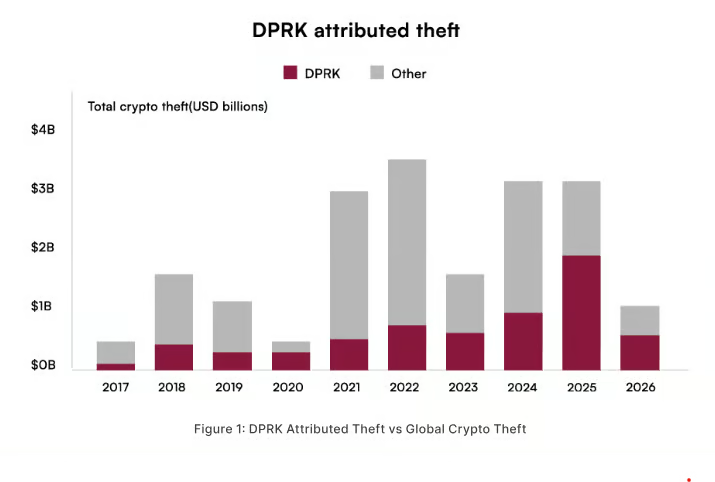
CertiK says North Korea-linked hackers stole about 60% of the value lost to crypto hacks in 2025, with proceeds used to help fund the regime’s nuclear and ballistic missile programs, highlighting the country’s growing reliance on digital assets to generate hard currency.
The findings, shared with Cointelegraph on Tuesday, come from a new Skynet report that attributes roughly $2.06 billion of an estimated $3.4 billion in 2025 crypto security losses to groups tied to the Democratic People’s Republic of Korea, or DPRK, across 79 of 656 incidents documented that year.
Between 2016 and early 2026, DPRK-linked actors stole an estimated $6.75 billion in cryptocurrency across 263 documented incidents, the report says, citing findings by independent onchain researcher Taylor Monahan.
CertiK’s analysis concludes that North Korea has “industrialized” crypto theft into a core state revenue mechanism, with open-source estimates showing how these operations represent a substantial share of the regime’s external income, as digital asset theft becomes a sustained revenue stream for the country.

Total DPRK crypto theft over the years. Source: CertiK/Skynet
The report also identifies a shift from opportunistic hot wallet compromises to fewer, higher-value operations that target the largest pools of capital.
In 2025, DPRK-linked groups were behind about 60% of the value stolen but only around 12% of total incidents, highlighting what CertiK describes as a focus on “precision and scale.”
Related: Phishing, deepfakes, supply chain attacks to fuel 2026’s biggest crypto hacks: CertiK
The single largest incident, the Bybit exploit in February 2025, resulted in about $1.5 billion in losses and is attributed in the report to the TraderTraitor cluster via a supply chain compromise of a third-party signing provider.
In that case, CertiK’s onchain analysis found that about 86% of the stolen Ether was converted into Bitcoin within one month of the hack, using mixing services, cross-chain bridges, decentralized exchanges and over-the-counter brokers.
North Korea’s crypto hacks shift from phishing to physical
CertiK’s Skynet study also details a progression in tactics, showing that social engineering remains the dominant initial attack vector, including fake job offers, investor impersonation and malicious code repositories.

DPRK evolution playbook. Source: CertiK/Skynet
The report attributes the Ronin Bridge exploit in 2022 to a spearphishing campaign involving a fake LinkedIn recruiter and a malware-laden PDF, while Bybit is cited as an example of a supply chain compromise, where attackers manipulated a user interface to route funds to a malicious address without changing the apparent content of transactions.
Related: Web3 hacks cost $482M in Q1 as phishing drove majority of losses: Hacken
The most recent evolution, described by CertiK as “physical infiltration,” is illustrated with the April 2026 Drift Protocol incident, in which about $285 million was drained from a Solana-based platform after a six-month operation involving conference attendance, relationship-building and governance manipulation.
Jonathan Riss, blockchain intelligence analyst at CertiK, told Cointelegraph that DPRK-linked operations now blend intelligence tradecraft with technical exploits, warning that North Korean information technology workers and intermediaries can obtain trusted roles inside Western crypto and fintech firms under false identities.
CertiK’s report, citing United Nations monitors and United States intelligence assessments, notes that revenue from these crypto thefts is confirmed to support North Korea’s nuclear and ballistic missile programs, elevating the issue from a cybersecurity concern to one of international security, according to those cited assessments.
Asia Express: North Korea denies crypto hacks, Upbit’s bank tests Ripple

Bermuda is accelerating its plan to become a fully on-chain national economy by migrating select payment and financial-services activities to the Stellar network. The move, announced during the Bermuda Digital Finance Forum, signals the island nation’s intent to test digital assets within a government-backed framework after formal risk assessments on asset holdings and use cases.
Premier David Burt said the government could accept and invest in digital assets as part of a broader strategy to reduce reliance on costly legacy payments infrastructure. Stellar confirmed Bermuda’s intention to shift certain financial services onto its network in response to high transaction fees and to support the government’s public-sector initiatives at scale. Burt stressed that the intent is to deliver faster, more affordable payments while maintaining responsible governance around digital assets.
The Stellar announcement framed Bermuda’s move as a cornerstone of its plan to become the world’s first fully on-chain economy, leveraging the network’s capacity to handle fast, low-cost transactions across currencies and assets. The collaboration aligns with Bermuda’s ongoing efforts to position itself as a crypto-friendly jurisdiction, an effort that has roots in the Digital Asset Business Act passed in 2018.
At Davos earlier this year, Burt highlighted Bermuda’s partnership with Circle and Coinbase, underscoring a public-private approach to building out the ecosystem. “This is not the government, this is the private sector leading, working in concert with the government of Bermuda to go ahead and support this ecosystem,” Burt said, signaling a broad coalition intent beyond any single state program.
Key takeaways
- Bermuda aims to move selected financial services onto Stellar to reduce transaction costs and test a scalable, on-chain model for public-sector use cases.
- The plan follows a public acknowledgment by Premier David Burt that Bermuda is open to digital assets after risk assessments, signaling a potential policy evolution for asset holdings and investments.
- Stellar’s involvement is paired with Bermuda’s high-profile, Davos-era partnerships with Circle and Coinbase, illustrating a broader, cross-sector approach to crypto adoption and regulation.
- The move comes as Bermuda continues to promote itself as a crypto-friendly jurisdiction post-2018 legislation, with ongoing efforts to support merchant adoption and fintech programming.
Stellar’s role and the path to a fully on-chain economy
Stellar’s core value proposition—low-cost, rapid transactions across fiat and digital assets—positions it as a natural backbone for a government-led digital economy initiative. By migrating certain financial services to the Stellar network, Bermuda aims to address persistent fee pressures and unlock more affordable rails for payments, remittances, and on/off-ramps for digital currencies. The implications extend beyond cost savings: a shift toward on-chain operations could enable more transparent settlement, programmable money for public services, and streamlined compliance workflows.
Stellar’s public-facing message at the time of the announcement emphasized Bermuda’s ambition to operate a fully on-chain economy, with on-chain tools designed to support public sector projects at scale. The collaboration is framed as a pragmatic deployment—one that tests policy levers while leveraging a technology stack already geared toward institutional use cases such as cross-border payments and stablecoin activity for financial institutions, fintechs, and exchanges around the world.
The Bermuda government’s stance on digital assets remains nuanced. While Burt signalled openness to asset exposure after risk assessments, the administration has historically sought a careful, regulated path for crypto activities. The Stellar partnership is presented as a way to modernize payments infrastructure while keeping the state’s involvement deliberate and measured.
Private sector leadership, policy context, and regional momentum
The dialogue in Bermuda reflects a recurring theme in crypto hubs: private-sector leadership coupled with supportive regulatory scaffolding. Burt’s comments emphasize that the ecosystem’s momentum is being driven by private entities working alongside government entities to expand access to digital-financial services. This collaborative model mirrors Bermuda’s broader strategy to attract and cultivate crypto businesses while maintaining clear governance standards.
The policy backdrop includes Bermuda’s earlier steps toward crypto-friendly regulation, including the Digital Asset Business Act, which established a framework for digital-asset activities. The government has signaled a willingness to balance innovation with consumer protections, potentially paving the way for more pilot programs and pilot-token models. In parallel, Bermuda has seen other developments in the crypto ecosystem—such as DerivaDEX launching a Bermuda-licensed derivatives DEX under DAO governance—reflecting a growing appetite for regulated, onshore crypto venues.
Beyond Bermuda, corporate activity in payments and digital assets continues to evolve. For example, Bybit has expanded its merchant-payments footprint into South Africa, enabling users to pay merchants with digital assets—a development that highlights how crypto-enabled payments are moving from pilot programs to real-world merchant adoption in multiple regions. The broader regional context suggests that Bermuda’s approach could influence adjacent markets seeking to balance innovation with regulatory credibility.
What to watch next
As Bermuda advances its on-chain plan, observers should monitor how the Stellar implementation scales in practice, what type of financial services are prioritized for migration, and how the regulatory framework evolves to accommodate asset classes and custody, taxation, and consumer protections. The success—or challenges—of this pilot will inform whether other smaller economies pursue similar models and how Stellar and allied partners adapt to real-world constraints, including interoperability with traditional banking rails and multi-jurisdictional compliance. Investors and builders alike will want to watch for announcements detailing pilot milestones, any asset-acceptance criteria, and further public-private initiatives that widen merchant and user adoption across the archipelago.
As Bermuda paves the way for an on-chain economy, the central question remains: will the practical benefits—lower costs, faster settlement, and scalable public services—translate into measurable economic growth and wider financial inclusion? The coming months should reveal whether the island’s experimental approach can crystallize into a durable blueprint for other jurisdictions seeking similar digital-economy ambitions.

The government of Bermuda announced that it will begin moving payment and financial-services activities to the Stellar network as part of its plans to be a “fully on-chain national economy.”
Speaking at the Bermuda Digital Finance Forum on Tuesday, Premier David Burt said that the island nation’s government, after risk assessments, could accept and invest in digital assets. In addition, Stellar announced that Bermuda would move certain financial services onto its network in response to high transaction fees.
“The lack of mobile money applications and reliance on legacy payments infrastructure has left Bermudians paying high payment processing fees and hindered additional economic growth opportunities,” said Burt. “The use of digital dollars can change that, and the Stellar network’s capacity to support public sector initiatives are what make it possible to deliver this responsibly and at the scale Bermuda requires.”

Source: Stellar
Stellar is primarily classified as a Layer 1 blockchain. It is designed to facilitate fast and low-cost transactions across various currencies and assets. It powers cross-border payments, fiat on and off ramps, and stablecoin issuance for financial institutions, fintechs, and exchanges around the world.
Burt announced at the World Economic Forum in Davos, Switzerland in January that the government had partnered with Circle and Coinbase. The island nation has been attempting to establish itself as a jurisdiction friendly to crypto companies since passing its Digital Asset Business Act in 2018.
Related: DerivaDEX debuts Bermuda-licensed derivatives DEX
“This is not the government, this is the private sector leading, working in concert with the government of Bermuda to go ahead and support this ecosystem,” said Burt.

David Burt speaking at Bermuda Digital Finance Forum on Tuesday. Source: SALT
Adoption of digital assets among merchants
With a gross domestic product of about $9 billion as of 2024, Bermuda remains one of the smaller economies globally, turning to implementing policies favorable to digital asset companies.
Some companies have likewise followed in expanding adoption through payments and merchants in other countries. Cryptocurrency exchange Bybit announced in April that it had expanded its services to South Africa by allowing users to pay merchants with digital assets.
Magazine: Guide to the top and emerging global crypto hubs: Mid-2026
Today’s Quordle Answers and Hints for May 13, 2026

JPMorgan files second tokenized money market fund on Ethereum as Wall Street’s blockchain race accelerates

The TRUTH About 1,000 XRP (It Will Be Worth…)

Manchester United reach agreement with Casemiro over contract clause amid transfer speculation

US brings back mandatory military draft registration

Steven Gerrard disagrees with Gary Neville over ‘shock’ Chelsea and Arsenal claim | Football


-
 Crypto World5 days ago
HarrisX Poll Found 52% of Registered Voters Support the CLARITY Act
-

 Fashion4 days ago
Weekend Open Thread: Marianne Dress
-

 Crypto World6 days ago
Upbit adds B3 Korean won pair as Base token gains Korea access
-
 NewsBeat6 days ago
NCP car park operator enters administration putting 340 UK sites at risk of closure
-

 Fashion1 day ago
Coffee Break: Travel Steam Iron
-

 Fashion2 days ago
What to Know Before Buying a Curling Wand or Curling Iron
-

 Tech3 days ago
Auto Enthusiast Carves Functional Two-Stroke Engine from Solid Metal
-

 Politics1 day ago
What to expect when you’re expecting a budget
-

 Politics4 days ago
Politics Home Article | Starmer Enters The Danger Zone
-
 Business4 days ago
Ignore market noise, India’s long-term story intact, say D-Street bulls Ramesh Damani and Sunil Singhania
-

 Tech2 days ago
GM Agrees To Pay $12.75 Million To Settle California Lawsuit Over Misuse Of Customers’ Driving Data
-

 Crypto World6 days ago
BlackRock CEO Larry Fink Discusses a New Asset Class
-
 Sports7 days ago
NBA playoff winners and losers: Austin Reaves is not loving Lakers vs. Thunder matchup, but Chet Holmgren is
-

 Entertainment6 days ago
Sarah Paulson Called Out For Met Gala ‘Hypocrisy’
-

 Politics5 days ago
Simon Cowell Says He Was ‘Horrible’ To Susan Boyle During BGT Audition
-

 Entertainment5 days ago
General Hospital: Ric & Ava Bombshell – Ric’s Massive Secret Exposed!
-

 Crypto World6 days ago
Robinhood says Wall Street is building onchain
-

 Sports6 days ago
UEFA Champions League final schedule, teams, venue, live time and streaming | Football News
-

 Entertainment6 days ago
Bold and Beautiful Early Spoilers May 11-15: Steffy Revolted & Liam Overjoyed!
-

 Tech7 days ago
Apple and Samsung are dominating smartphone sales so thoroughly that only one other company makes the top 10
You must be logged in to post a comment Login