Connect with us
DAPA Banner

Business

Primark to split from ABF with both firms set for separate FTSE 100 listings

Published

on

Business Live

The Weston family-controlled group expressing confidence in the prospects of both companies

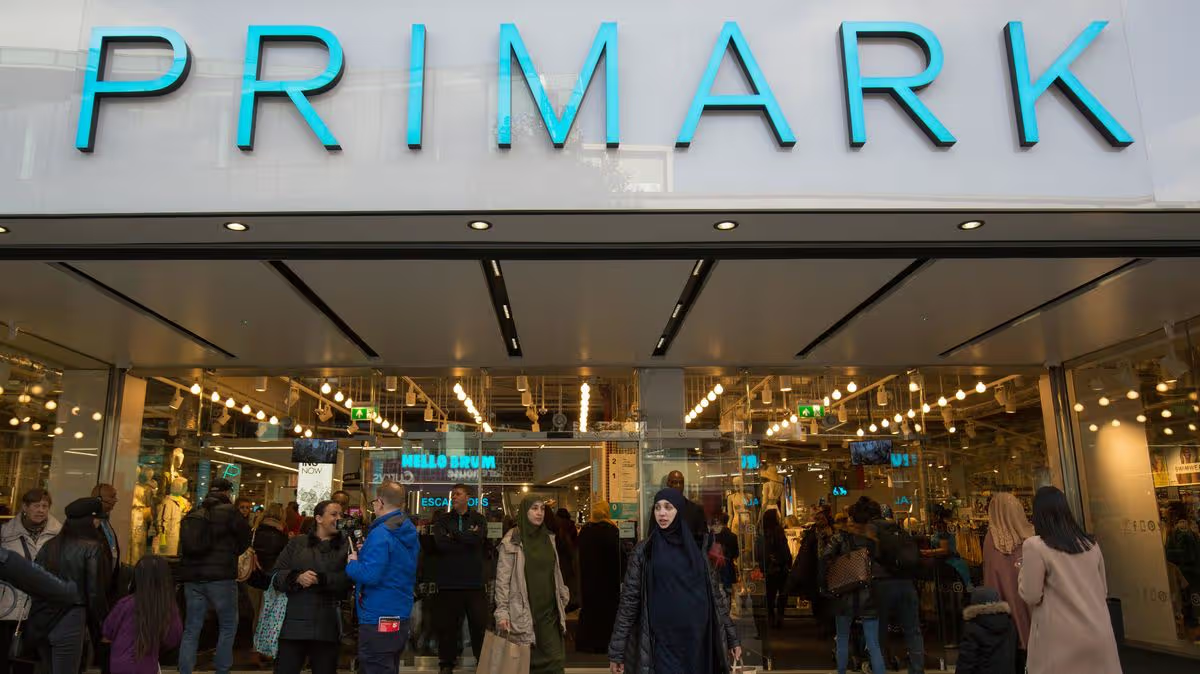
Primark is owned by Associated British Foods

Primark is owned by Associated British Foods(Image: PA)

FTSE-100 heavyweight Associated British Foods has unveiled plans to separate clothes retailer Primark, marking a significant strategic shift for the food and retail conglomerate. The market had broadly anticipated Associated British Foods (ABF) would hive off the retailer following an internal review as it grapples with fierce competition from high street competitors H&M and Zara.

Advertisement

The declaration ends months of conjecture over Primark’s future, and ABF said it anticipates both companies will trade separately on the blue-chip FTSE 100 index. ABF appointed Rothschild & Co last year to assist it in undertaking a “strategic” review to assess whether to divest the retailer.

The company said it was “confident” in the outlook of both operations. Primark runs 486 stores globally and generates approximately £9bn in annual revenue, as reported by City AM.

Associated British Foods is controlled by the Westons, the UK’s wealthiest family, whose holding company, Wittington Investments, maintains roughly 59 per cent of the firm.

Besides Primark, ABF owns tea brand Twinings, baked goods producer Kingsmill and subsidiary British Sugar. ABF, which has witnessed its share price decline so far this year, said it anticipates the demerger will cost around £75m.

Advertisement

The separation will take place through a dividend demerger, which will enable ABF to split off Primark by distributing shares in it to existing shareholders.

Primark sales grew in last year FoodCo, which will be the remaining entity of ABF once Primark is demerged, operates across 52 countries and generates approximately £9.8bn in annual revenue.

Primark currently runs 486 retail stores across 19 markets, with approximately £9.5bn of annual revenue and more than 83,000 employees.

International expansion has been a primary focus for the business, as it looks to grow its market share across Europe and the US.

Advertisement

Michael McLintock, who currently serves as chair of ABF, will remain in post until the spin-off is finalised in 2027.

George Weston, chief executive of ABF, will take the helm at FoodCo, while Primark’s current chief executive Eoin Tonge will continue to lead the clothes retailer.

Associated British Foods recorded a nine per cent decline in pre-tax profit across the group to £632m in the year to February, as revenue edged down two per cent to £9.5bn.

Primark posted like-for-like sales growth of 1.3 per cent in the UK, with the clothes retailer gaining market share over the period.

Advertisement

ABF said it expected Primark would be able to absorb costs arising from the Iran war, but noted it “remains alert to potential further deterioration in consumer spending”.

The company added that the impact of disruptions to energy and fertiliser supply chains resulting from the conflict is “unclear”.

ABF announced in August it would acquire Kingsmill’s bakery competitor Hovis for £75m, but this transaction has since been delayed by the competition watchdog amid concerns the diminished competition could push up prices for shoppers.

The British-Canadian Weston family, via Wittington Investments, also own department store Fortnum & Mason and homeware retailer Heal’s.

Advertisement

ABF was established by W. Garfield Weston in 1935 as Food Investments Limited, before listing on the London Stock Exchange in 1994.

ABF’s share price finished at 1,894p on Monday, leaving the stock down more than 10 per cent in the year to date.

Continue Reading
Click to comment

You must be logged in to post a comment Login

Leave a Reply

Business

UPS and FedEx have begun filing for some tariff refunds

Published

on

UPS and FedEx have begun filing for some tariff refunds

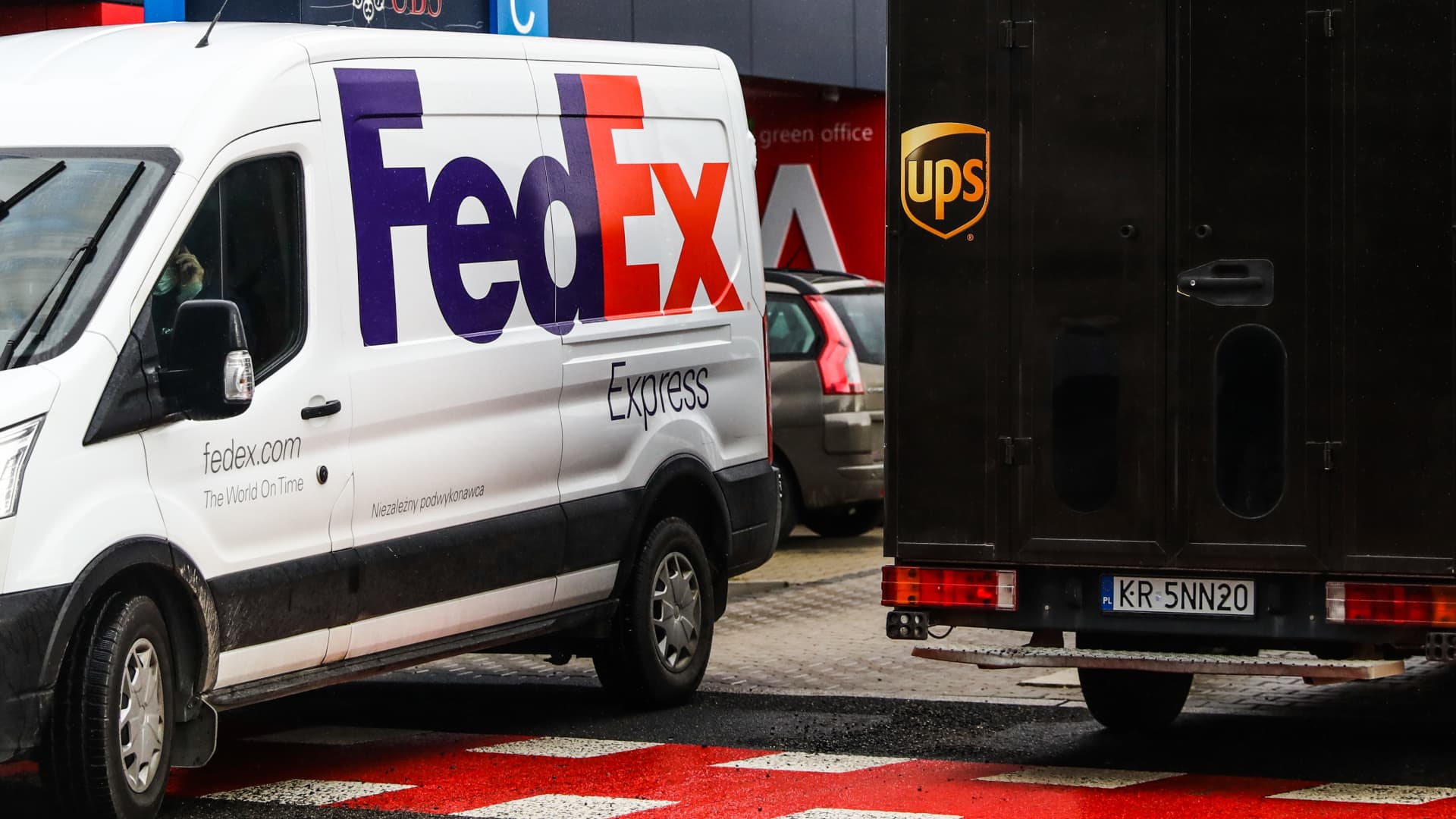
FedEx and UPS delivery vans are seen in Krakow, Poland on February 22, 2022.

Beata Zawrzel | Nurphoto | Getty Images

The refund process for tariffs has begun, but it could be months before consumers start reaping those rewards.

Advertisement

Following the Supreme Court ruling that some tariffs were unconstitutional, U.S. Customs and Border Protection opened up a refund process on Monday for companies to begin requesting money back.

The refund process only affects levies collected under the International Emergency Economic Powers Act, or IEEPA, which were the specific tariffs that the Supreme Court invalidated. Some tariffs —like those under Section 232 of the Trade Expansion Act of 1962 or those under Section 301 — remain in place.

The tariff refund portal, called the Consolidated Administration and Processing of Entries, will allow importers of record to submit refund requests. CBP will then process those requests in phases, and the first phase will only cover refund requests for entries that CBP finalized within the last 80 days.

For shippers UPS and FedEx, that could mean a payday for the companies and, eventually, for customers.

Advertisement

UPS said this week that it will work to request and retrieve tariff refunds from CBP on customers’ behalf for any shipments where the company was the importer of record, meaning customers do not need to contact UPS.

Still, the company noted that the refunds could take up to three months to be delivered to UPS, which can only then issue refunds to customers.

“We remain focused on keeping shipments moving and helping ensure our customers can fully exercise their rights throughout this complex process,” UPS said in a statement. “We are closely monitoring legal developments and will share updates as available.”

The shipment company said it has only received CBP guidance about the first phase of tariff refunds.

Advertisement

FedEx also told CNBC it has begun filing claims with CBP for tariff refunds.

“Supporting our customers as they navigate regulatory changes remains our top priority,” FedEx said in a statement.

The company said its process is “straightforward”: If CBP issues refunds to FedEx, it will in turn issue those refunds to shippers and consumers who paid those charges.

FedEx said it will also generate the reports needed to secure refunds on behalf of its customers.

Advertisement

DHL told CNBC it has also begun filing for tariff refunds, launching the process automatically for any shipments where it was the importer of record.

“We will continue to monitor developments closely, engage with authorities and communicate transparently as further guidance becomes available,” the company said in a statement.

On Tuesday, President Donald Trump told CNBC’s “Squawk Box” that he would “remember” companies that did not request tariff refunds.

Choose CNBC as your preferred source on Google and never miss a moment from the most trusted name in business news.
Advertisement
Continue Reading

Business

Home Bargains development firm sees double planning success

Published

on

Business Live

Davos Property Developments to push ahead at schemes on stalled Liverpool sites

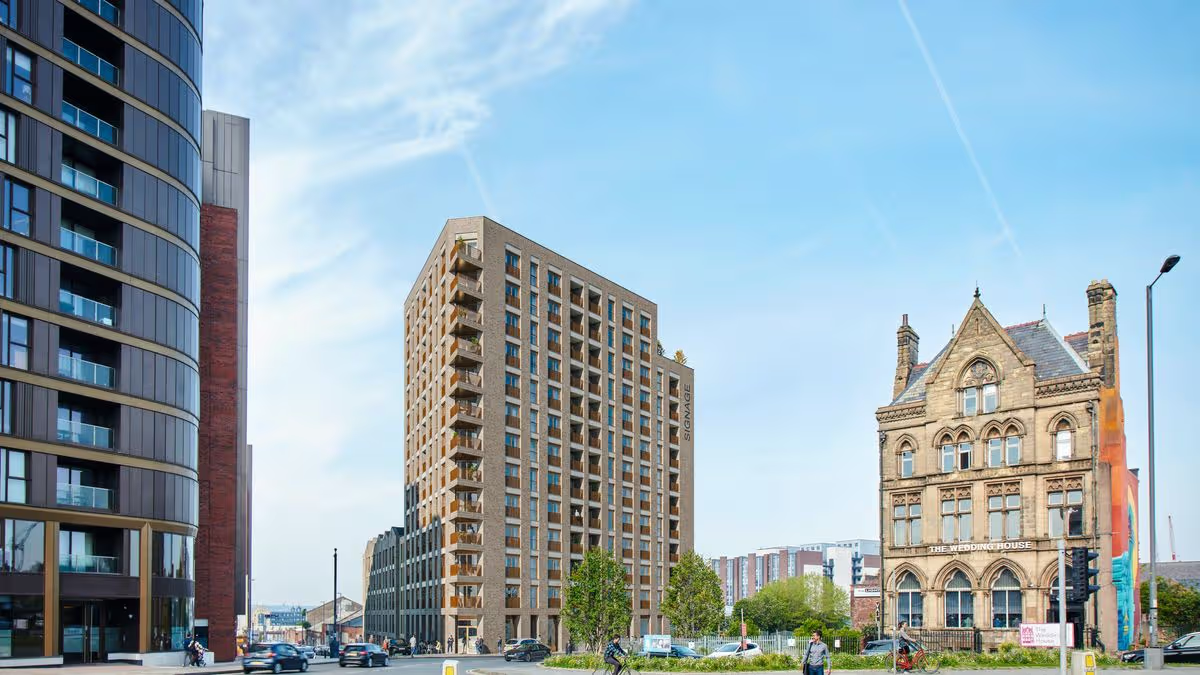
The plans for the Greenland Street scheme

The plans for the Greenland Street scheme

The development arm of the company behind Home Bargains has secured approval for more than 250 new homes across Liverpool city centre. Davos Property Developments is to move forward on the development of two stalled sites after winning over the local authority’s planning committee.

Advertisement

The company, which handles the property arm of TJ Morris, has been granted permission for a 13 storey tower near the proposed £100m Baltic Triangle Merseyrail station. Almost 200 one and two-bed homes will be built on land bounded by St James Street, Greenland Street, New Bird Street and the former LeeFloorstok warehouse.

Davos, which has already secured significant approvals within the Kings development, will also deliver plans for an additional 59 units at Blundell Street, Kitchen Street and Simpson Street. Matthew Sobic, on behalf of the applicant, addressed councillors at Liverpool Town Hall.

Regarding the Baltic Triangle application, Mr Sobic said it was one of several high profile stalled sites in the city. He added: “Today the site is derelict, enclosed by hoardings, affected by flyposting and graffiti and unmanaged vegetation.

“It makes no positive contribution to the area.” Alongside 199 homes, the proposal will provide co-working space, ground floor commercial units and residents’ amenities, such as a gym and rooftop terraces.

Advertisement

The designs draw on the Victorian industrial heritage of the area, with its vertical proportions, deep window reveals and iron detailing. Mr Sobic added how the proposal will “meet increasing demand for inner city living in one of Liverpool’s most sustainable neighbourhoods” and it would “create a genuine neighbourhood rather than simply a building”.

It was cleared in 2018, and has since been used as a surface car park. A total of 89 one-bed apartments will be delivered alongside a further 110 two-bed homes and townhouses.

How the new build could look near Baltic Station

How the planned new build near Baltic Station could look

Mr Sobic said the development was the “best possible future for this site” and there was a “strong ambition and will to invest and regenerate in the city centre” by Davos. The company also secured permission for work to begin on almost 60 further properties at Blundell Street, Kitchen Street and Simpson Street.

The scheme will include the construction of a part eight/part six storey building with a two storey bridge link at first and second floor levels between the new block and a retained three storey warehouse. It would provide three commercial units on the ground floor.

Advertisement

Mr Sobic said the existing warehouse would be retained in a creative way and revitalise “another stalled site where planning permission had been approved”.

To find all the planning applications, traffic diversions, road layout changes, alcohol licence applications and more in your community, visit the Public Notices Portal.

Continue Reading

Business

Tata Investment Q4 Results: Profit jumps 69% YoY to Rs 64 crore; co declares Rs 3.4 dividend

Published

on

Tata Investment Q4 Results: Profit jumps 69% YoY to Rs 64 crore; co declares Rs 3.4 dividend
Tata Investment Corporation reported a sharp jump in its March quarter earnings, with net profit rising 69% year-on-year (YoY) to Rs 63.83 crore, compared with Rs 37.72 crore in the same period last year. Revenue from operations saw an even stronger expansion, climbing 143% YoY to Rs 39.98 crore from Rs 16.43 crore, driven by higher dividend income and gains from investments.

Dividend income stood at Rs 25.54 crore during the quarter, while interest income came in at Rs 9.88 crore. The company also reported a turnaround in fair value changes, posting a gain of Rs 1.01 crore versus a loss in the year-ago period.

Total income rose to Rs 42.16 crore from Rs 16.61 crore a year earlier, reflecting strong portfolio performance amid market volatility. Tax expenses declined significantly during the quarter, further aiding net profit growth.

Total expenses increased modestly to Rs 11.69 crore from Rs 10.02 crore in the year-ago quarter. Employee benefit costs and other expenses saw a slight uptick, but remained broadly stable relative to income growth.

Advertisement

The board has recommended a dividend of Rs 3.4 per share (340%) on a face value of Rs 1 per share. The dividend will be paid after shareholder approval at the upcoming annual general meeting.


For the full year ended March 2026, profit after tax rose to Rs 433.68 crore from Rs 312.09 crore in the previous year, while total income increased to Rs 403.47 crore from Rs 306.22 crore.

Continue Reading

Business

Burkina Faso increases Kiaka stake for $175m

Published

on

Burkina Faso increases Kiaka stake for $175m

West African Resources has announced Burkina Faso’s junta government will increase its stake in the Kiaka gold project.

Continue Reading

Business

What Happened With Semiconductors In 2020 Is Repeating Itself Now In This Sector

Published

on

IGA: Discount Widens Back Out, Making It A More Interesting Choice (Upgrade) (NYSE:IGA)

This article was written by

More than 7 years of experience in equity analysis in LatAm. We provide our clients with in-depth research and insights to help them make informed investment decisions.

Analyst’s Disclosure: I/we have no stock, option or similar derivative position in any of the companies mentioned, and no plans to initiate any such positions within the next 72 hours. I wrote this article myself, and it expresses my own opinions. I am not receiving compensation for it (other than from Seeking Alpha). I have no business relationship with any company whose stock is mentioned in this article.

Seeking Alpha’s Disclosure: Past performance is no guarantee of future results. No recommendation or advice is being given as to whether any investment is suitable for a particular investor. Any views or opinions expressed above may not reflect those of Seeking Alpha as a whole. Seeking Alpha is not a licensed securities dealer, broker or US investment adviser or investment bank. Our analysts are third party authors that include both professional investors and individual investors who may not be licensed or certified by any institute or regulatory body.

Advertisement
Continue Reading

Business

Middle East war has pushed up air fares 24%, research shows

Published

on

Middle East war has pushed up air fares 24%, research shows

The consultancy Teneo says airspace restrictions caused by the conflict have forced airlines to reroute many flights.

Continue Reading

Business

CEO explores opportunities as flour demand wanes

Published

on

CEO explores opportunities as flour demand wanes

Ardent Mills’ Wallace confident the industry can rise to the occasion.

Continue Reading

Business

McValue Pressure Makes Restaurant Brands International's Valuation Hard To Swallow

Published

on

Advertising poster of the American multinational fast food company, Burger King. Palma de Mallorca, Spain

McValue Pressure Makes Restaurant Brands International's Valuation Hard To Swallow

Continue Reading

Business

‘A-commerce’ on the rise

Published

on

‘A-commerce’ on the rise

Agentic artificial intelligence is emerging as a powerful marketing tool.

Continue Reading

Business

Mitsubishi Heavy Industries: Big Deal, Expensive Stock (OTCMKTS:MHVYF)

Published

on

Modern factory and global communication concept.

This article was written by

I focus on producing objective, data-driven research, mostly about small- to mid-cap companies, as these tend to be overlooked by many investors. From time to time, though, I also look at large-cap names, just to give a fuller sense of the broader equity markets.

Analyst’s Disclosure: I/we have a beneficial long position in the shares of MHVYF either through stock ownership, options, or other derivatives. I wrote this article myself, and it expresses my own opinions. I am not receiving compensation for it (other than from Seeking Alpha). I have no business relationship with any company whose stock is mentioned in this article.

Seeking Alpha’s Disclosure: Past performance is no guarantee of future results. No recommendation or advice is being given as to whether any investment is suitable for a particular investor. Any views or opinions expressed above may not reflect those of Seeking Alpha as a whole. Seeking Alpha is not a licensed securities dealer, broker or US investment adviser or investment bank. Our analysts are third party authors that include both professional investors and individual investors who may not be licensed or certified by any institute or regulatory body.

Advertisement
Continue Reading

Trending

Copyright © 2025