
Crypto World
UK invites crypto giant Bybit to London to win over some of UAE’s innovation shine



Economic development officials with links to the U.K. government invited Bybit leadership to London this week in what appears to be a bid to emulate the momentum of Dubai, where the cryptocurrency exchange is based, and the rest of the United Arab Emirates.
CEO Ben Zhou said the message from the U.K. is “they are very eager to invite big business to establish bases and create jobs,” and discuss forthcoming pro-crypto regulation.
Bybit was founded by Zhou in 2018, and four years later moved its headquarters to Dubai from his native Singapore. It is ranked the second-largest crypto exchange by CoinGecko, trailing only Binance, which set up in the UAE in 2025.
The arrival of crypto giants like Bybit and Binance acted as a magnet to attract smaller crypto companies to the region, something the U.K. would like to emulate, Zhou said.
“One interesting thing is there hasn’t been any momentum built in the U.K.,” Zhou said in an interview at Paris Blockchain Week. “If you look at UAE, where there are big exchanges like Bybit or Binance, once we announced we’re going to be there, smaller players followed, and that created this momentum.”
Zhou’s invitation includes meetings with the Financial Conduct Authority and representatives of the House of Lords, and coincides with UK Fintech Week and a Treasury plan to revamp payment systems with stablecoins and the spread of tokenization.
“I have meetings with FCA. I have meetings with the House of Lords just to discuss what do you want to do with crypto,” Zhou said, without naming the U.K. government department that extended the invitation.
“We were invited specifically by some economic development board who said ‘We can get a direct line to the prime minister.’ There is an agenda to push for innovation, especially in crypto,” Zhou said.
Neither the Treasury nor Lucy Rigby, the Economic Secretary to the Treasury, responded to requests for comment. The Department for Science, Innovation and Technology also did not respond to requests for comment. The FCA had not replied by press time.
The invitation’s timing is interesting as the UAE has suffered direct attacks from Iran during the U.S.-Israel war that started Feb. 28, prompting tens of thousands of residents and tourists to leave the country. One in eight British residents has left, the Financial Times reported earlier this month.
The U.K. government has seen “the outflow of money and companies going to the UAE. They want to win it back. Precisely, now is good timing,” Zhou said.


Ripple’s role in Singapore’s BLOOM: A controlled step toward stablecoin integration
Singapore has strengthened its position as a leading hub for tokenized finance through Project BLOOM (Borderless, Liquid, Open, Online, Multi-currency).
This collaborative initiative brings together a group of traditional banks, fintech firms and stablecoin providers to evaluate how digital settlement assets can be integrated into existing financial infrastructure.
A notable partnership in the pilot involves Ripple and supply chain specialist Unloq. Together, they are exploring automated trade settlements using Ripple’s upcoming stablecoin, RLUSD, on the XRP Ledger.
While Ripple’s inclusion may appear to signal a green light from Singaporean regulators, the reality is more measured. RLUSD is currently operating within a sandboxed environment, a structured testing phase focused on specific technical applications rather than a broad regulatory mandate.
Distinguishing between this experimental validation and official licensure is essential to accurately assess the project’s current scope and future potential.

What Ripple is actually testing
Ripple’s pilot project under the Monetary Authority of Singapore’s (MAS) BLOOM initiative is focused on a specific challenge: automating cross-border trade settlement through programmable digital money.
The setup brings together three core elements:
-
RLUSD as the settlement asset
-
XRP Ledger as the transaction infrastructure
-
Unloq’s SC+ system as the execution layer for trade finance workflows
Rather than simply moving funds between parties, the system is designed to release payments automatically once specific commercial conditions have been met. These conditions may include shipment confirmation, document verification or financing triggers.
RLUSD is being evaluated not just as a payment tool, but as an integrated part of a conditional settlement mechanism embedded directly into trade workflows.
Did you know? Traditional trade finance still relies heavily on paper documents such as bills of lading, which can take days or even weeks to process. Programmable settlement systems aim to digitize and automate these workflows.
What BLOOM is and what it is not
The MAS launched BLOOM in October 2025 to examine how tokenized money could improve settlement processes across borders and between institutions.
The initiative extends well beyond any single participant. It includes banks such as DBS and UOB, infrastructure providers such as Partior, and stablecoin issuers including Circle. Ripple is just one participant in this broader ecosystem.
Importantly, BLOOM is not a live production system. It functions as a sandbox-style environment that allows firms to test financial innovations under regulatory oversight.
As a result, involvement in the initiative does not mean MAS has approved RLUSD as a universally accepted settlement asset. It simply indicates that MAS views the proposed use case as sufficiently promising to test in a controlled setting.
Recognizing this distinction helps avoid a common misunderstanding. Participation in a regulatory sandbox reflects supervised experimentation, not formal regulatory endorsement.
Why trade finance is a difficult test case
Trade finance is more complex than straightforward payments. A standard transaction typically involves multiple parties, including exporters, importers, banks, insurers and logistics providers, along with several layers of documentation and conditional obligations.
Payments are rarely executed immediately. They are tied to specific events, such as:
Traditional systems manage these interdependencies through manual procedures and intermediaries, often resulting in delays, errors and limited transparency.
Ripple’s RLUSD pilot seeks to address this complexity by embedding payment logic directly into the settlement layer. Instead of handling documents separately before releasing payments, the process takes place within a single, unified execution framework.
This approach sets the pilot apart from most stablecoin applications. It goes beyond simply speeding up money transfers. Instead, it focuses on synchronizing the movement of money with real-world commercial conditions in real time.
Did you know? Stablecoins were initially popularized as a source of liquidity in crypto trading, but regulators are increasingly exploring their role in real-world financial infrastructure, including cross-border payments and settlement systems.
Why MAS sandbox participation does not equal approval
Ripple’s involvement in BLOOM coincides with a separate regulatory development. In December 2025, MAS expanded the range of payment activities permitted under the Major Payment Institution (MPI) license held by Ripple’s Singapore subsidiary.
This licensing change allows Ripple to offer a broader range of regulated payment services in Singapore.
Nevertheless, the BLOOM pilot remains separate. It is not intended to license Ripple’s products for widespread use, but rather to evaluate whether a specific settlement architecture works effectively in practice.
The distinction can be outlined as follows:
Confusing these two elements may overstate the regulatory significance of the pilot. BLOOM is designed to address technical and operational questions, not to select or endorse one settlement model over another.
Singapore’s broader tokenization strategy
Ripple’s pilot is part of a broader MAS effort to explore tokenized financial infrastructure across multiple areas.
In November 2025, MAS announced plans to issue tokenized MAS bills to primary dealers, with settlement facilitated through a wholesale central bank digital currency (CBDC). Around the same time, it also revised its guidance on tokenized capital market products to provide greater clarity on regulatory expectations.
These steps point to a broader approach. Rather than supporting a single type of digital money, Singapore is testing a multi-asset settlement ecosystem that includes:
Within this framework, RLUSD represents one possible settlement asset among several.
How RLUSD compares with other stablecoin pilots
Ripple’s approach differs from other stablecoin and tokenized money experiments currently underway in several important ways:

What makes the RLUSD pilot distinct
Three elements distinguish Ripple’s pilot: conditional settlement logic, integration with trade workflows and a multi-asset environment.
-
Conditional settlement logic: Unlike most stablecoin pilots, RLUSD is being tested in a system where payments are contingent on real-world events. This adds a layer of programmability that extends well beyond basic transfers.
-
Integration with trade workflows: The pilot embeds settlement directly into trade finance processes rather than treating it as a separate function. This has the potential to reduce fragmentation across documentation, financing and payment.
-
Multi-asset environment: RLUSD is being evaluated alongside tokenized bank liabilities. This aligns with MAS’ broader objective of creating interoperable settlement assets rather than relying on a single dominant model.
Collectively, these elements place RLUSD within a broader experiment in programmable financial infrastructure rather than limiting it to digital payments alone.
Despite its potential, the pilot leaves several important questions unresolved:
-
Can trade conditions be reliably digitized and verified in real time?
-
Will smaller businesses actually benefit from improved access to financing?
-
Can stablecoins and bank issued tokens coexist without fragmenting liquidity?
-
How will regulatory oversight evolve if such systems move beyond the pilot stage?
These questions underscore that the pilot is not a complete solution. Rather, it is an exploration of whether a new settlement model can function effectively at scale.
Did you know? Smart contracts can reduce settlement risk by ensuring that funds move only when predefined conditions are met. This can help reduce disputes arising from mismatched documentation in international trade.
Implications for stablecoins and settlement design
The BLOOM initiative suggests that the future of digital settlement may not be defined by any single asset type or infrastructure.
Instead, regulators such as MAS appear to be examining a layered approach in which different forms of tokenized money serve distinct roles:
-
Stablecoins for programmability and interoperability
-
Bank tokens for institutional liquidity
-
CBDCs for sovereign settlement assurance
Ripple’s RLUSD pilot adds to this ongoing experimentation, offering one possible model for how stablecoins could extend beyond simple payments into more sophisticated financial workflows.
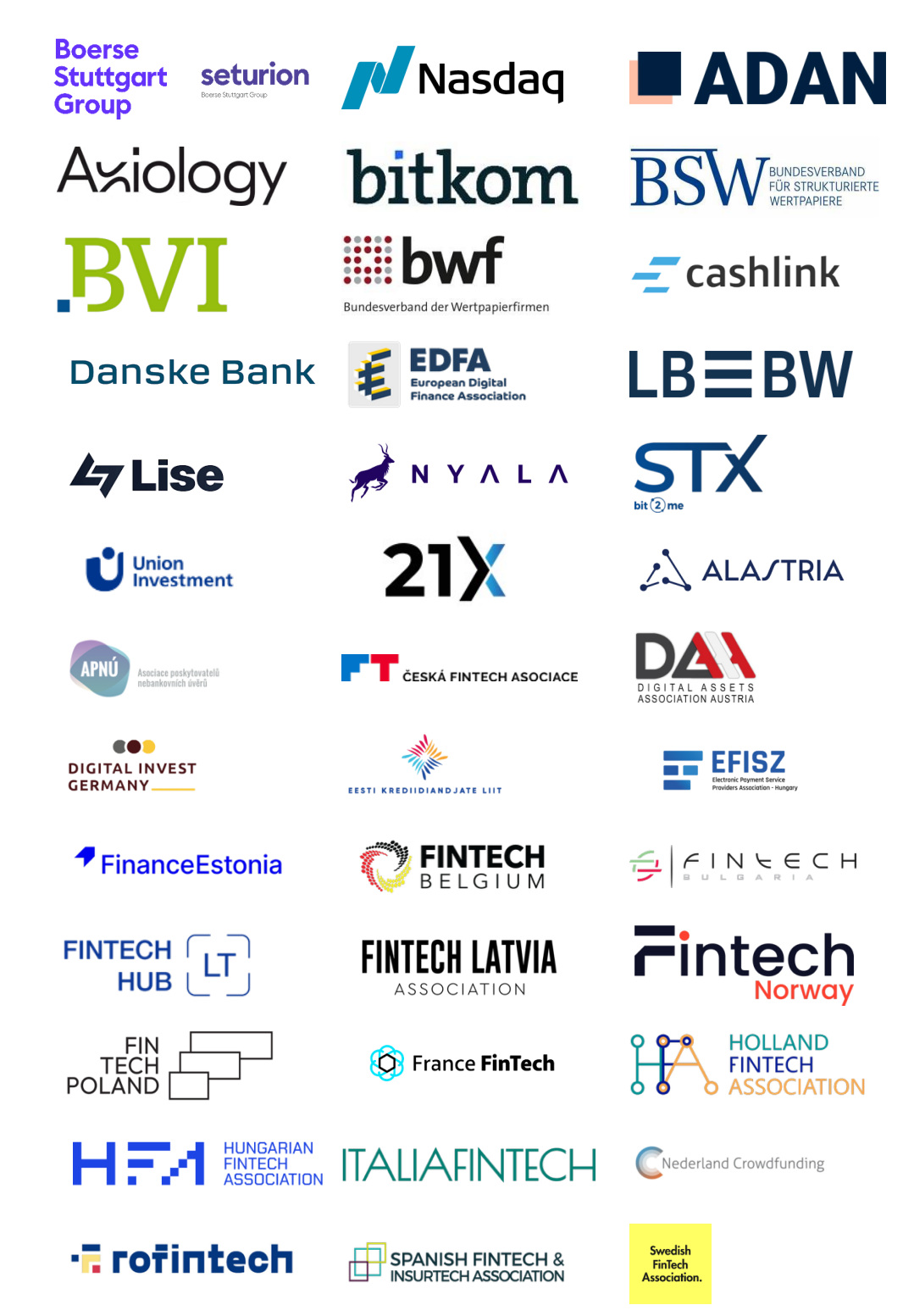
A group of European financial companies and industry bodies have urged European Union officials and lawmakers to fast-track changes to blockchain rules, warning the region risks falling behind the US in tokenized finance.
In a joint letter on Tuesday, 39 signatories, including Nasdaq and Boerse Stuttgart, called on the European Commission and Parliament to carve out the DLT Pilot Regime from a broader legislative package and review it as a standalone law, according to a copy of the letter shared by crypto association Adan.
The group argued that folding the regime into the wider Market Integration and Supervision Package could delay reforms needed to keep pace with global developments. “Negotiations are likely to be lengthy,” the letter, addressed to Financial Services Commissioner Maria Luis Albuquerque, said, adding that delays “risk dampening Europe’s momentum in DLT adoption.”
The DLT Pilot Regime is an EU framework launched in 2023 that lets financial firms test blockchain-based trading and settlement of assets like stocks and bonds under real market conditions. It acts as a regulatory sandbox, allowing temporary exemptions from certain rules so companies can experiment with tokenized finance.
Related: Europe’s Bitcoin treasury playbook won’t be a copy of Strategy: PBW 2026
EU firms push to expand DLT Pilot Regime limits
The group is pushing for a series of changes to the current pilot regime, including expanding the range of eligible assets, raising the overall volume cap to 150 billion euros ($176 billion), removing time limits on licenses and the removal of time limitation on licences. “These pragmatic adjustments enjoy broad support among market participants across Europe,” the letter claims.
Under the current regime, only relatively small financial products can be tested on blockchain systems, including shares from companies valued under $588 million, bonds with issuance sizes below $1.17 billion and investment funds with assets under $588 million.

The US has moved to integrate tokenized securities into its existing financial system, with the Securities and Exchange Commission (SEC) clarifying that broker-dealers can custody tokenized stocks and bonds under current investor protection rules. The regulator has also issued a no-action letter enabling a Depository Trust & Clearing Corporation subsidiary to launch a service that tokenizes real-world assets held in custody.
Cointelegraph reached out to Nasdaq and Boerse Stuttgart for comment, but had not received a response by publication.
Related: Poland parliament fails again to override presidential veto on crypto bill
EU tokenization firms ask for changes to DLT Pilot Regime
In February, a group of European tokenization and market infrastructure firms also urged EU policymakers to urgently update the DLT Pilot Regime, warning that strict asset limits, low issuance caps and time-bound licenses are holding back the scaling of regulated onchain markets.
In a joint letter, a group of 9 companies, including Securitize, 21X and Boerse Stuttgart Group, argued that without a “quick fix” to the pilot regime, liquidity and market activity could shift to the US, weakening Europe’s position in digital capital markets.
Magazine: Bitcoin will not hit $1M by 2030, says veteran trader Peter Brandt

Blockchain.com has launched perpetual futures trading within its non-custodial DeFi wallet, enabling users to open leveraged positions directly from self-custodied Bitcoin used as collateral. The feature, routed through decentralized derivatives venue Hyperliquid, unlocks more than 190 markets with up to 40x leverage while keeping assets in the user’s wallet throughout the trade lifecycle.
The rollout is described in a press release issued this week, which notes that trades are executed while funds remain in the wallet, avoiding transfers to centralized exchanges or relinquishing private keys. In a single transaction, accounts can be funded with BTC from the user’s own wallet, bypassing conversions or cross-platform transfers. Blockchain.com also signaled plans to broaden the offering to additional asset classes such as foreign exchange, equities, and commodities in the near future.
Based in Malta and operating since 2011, Blockchain.com provides a suite of crypto services including wallets, trading, and infrastructure tools for both retail and institutional users. The new perpetual futures product marks a notable step in expanding self-custody trading into the derivatives space while leveraging a connected, multi-asset trading ecosystem via Hyperliquid.
Key takeaways
- Self-custodial derivatives: Perpetual futures trading is embedded directly in Blockchain.com’s non-custodial wallet, with trades executed without transferring assets to a third party.
- Broad market access and high leverage: Users gain access to more than 190 markets with leverage up to 40x via Hyperliquid.
- BTC-powered funding in one step: Accounts can be funded with BTC from the user’s wallet in a single transaction, avoiding extra conversions or transfers.
- Regulatory backdrop and broader adoption: The move aligns with ongoing regulatory interest in crypto derivatives, while other venues expand 24/7 multi-asset offerings beyond crypto.
- Cross-asset potential: Blockchain.com envisions expanding into FX, stocks, and commodities, signaling a broader move toward multi-asset, non-custodial trading ecosystems.
Blockchain.com’s entry into non-custodial perpetual futures
By integrating perpetual futures into a self-custodial wallet, Blockchain.com aims to deliver leveraged exposure without surrendering control of private keys. The arrangement routes trades through Hyperliquid, a platform that already lists a substantial array of markets beyond crypto, including commodity and index contracts. The expanded market access is complemented by the ability to fund positions directly from BTC in the user’s wallet, streamlining the process and reducing the friction typically associated with derivatives trading on centralized venues.
Hyperliquid’s data-driven platform shows that its most active contracts include traditionally non-crypto assets such as oil, the S&P 500 and silver, alongside leading cryptocurrencies like Bitcoin and Ether. The breadth of markets underscores a broader trend toward cross-asset derivatives trading that many users find appealing for hedging and speculative purposes alike. The arrangement with Blockchain.com highlights how non-custodial wallets can pair with decentralized derivatives venues to deliver advanced trading capabilities while preserving user custody.
Regulatory context and industry momentum
The current wave of derivatives expansion sits within a shifting regulatory and market landscape. In a recent public comment, Michael Selig, chair of the Commodity Futures Trading Commission (CFTC), indicated that the agency intends to permit certain crypto derivatives contracts in the coming weeks, signaling potential extra clarity for the sector’s mainstream adoption. While the specifics of any forthcoming rules remain under discussion, the direction points to a more permissive stance toward regulated crypto derivatives in the near term.
Beyond Blockchain.com, the industry has seen a flurry of activity aimed at widening perpetual futures to traditional assets. In February, Kraken began offering tokenized equity perpetual futures for non-US clients, delivering 24/7 leveraged exposure to major US stocks, indexes, and commodities through crypto-based derivatives. A subsequent move by Coinbase expanded 24/7 stock derivatives for non-US users, reinforcing the push to merge crypto-native trading infrastructure with traditional asset classes. Separately, The Information reported that Kalshi is exploring a US-based entry into crypto derivatives with a focus on perpetual futures, illustrating a broader interest in bringing regulated derivative products into the crypto space.
Implications for traders, holders, and builders
Blockchain.com’s latest product widens the practical boundaries of non-custodial trading. For users, the ability to access a large spectrum of perpetual futures without moving assets off-chain or surrendering custody could dramatically simplify hedging and speculative strategies. The BTC-for-funding model further enhances capital efficiency by eliminating intermediate steps, which can reduce settlement risk and prompt faster entry and exit from positions.
From an investor standpoint, the development signals continued demand for on-chain or wallet-native derivatives that do not require trust in a central counterparty. It also reveals a trend toward cross-asset hedging and trading within crypto-native infrastructure, as platforms mix digital assets with traditional markets through decentralized routes. For builders and developers, the arrangement with Hyperliquid demonstrates how liquidity and multi-asset connectivity can be embedded in non-custodial wallets, potentially inspiring similar integrations that blend custody-free control with sophisticated products.
The partnership also raises questions about liquidity provisioning, risk controls, and enforcement across borders as more players introduce perpetual futures tied to conventional assets. Traders should watch for how risk parameters—such as maintenance margins, financing costs, and liquidation mechanisms—are implemented in wallet-based environments and how regulators respond as these products scale.
Source: Blockchain.com announcement via PR Newswire
Blockchain.com, established in 2011 and headquartered in Malta, continues to expand its toolkit for both retail and institutional users, aiming to integrate more asset classes into its non-custodial framework. The move into perpetual futures with Hyperliquid marks a meaningful step in the evolution of self-custody trading, aligning with a larger industry push toward discipline, accessibility, and cross-asset fusion in crypto markets.
Readers should monitor regulatory updates from major markets as well as further product rollouts from Blockchain.com and Hyperliquid. The coming weeks could reveal more about how non-custodial derivatives will coexist with evolving standards for crypto markets and regulated multi-asset trading.
What remains uncertain is the exact regulatory treatment of wallet-based perpetual futures as adoption scales, and how liquidity and margin practices will evolve to ensure robust safety and user protection across a growing set of asset classes.

Om du letar efter online casino utan svensk licens , bör du välja casinon som erbjuder Trustly som betalningsmetod. Trustly är säker och användarvänlig, vilket gör att du kan fokusera på att njuta av spelet utan oro för betalningsfrågor.
Det viktiga är att du hittar casinon utan spelpaus, så att du kan spela på ett ansvarsfullt sätt. Vissa casinon erbjuder funktioner som ställer in spelstunder eller begränsar din spelning, vilket kan vara en bra lösning för dig.
Vi rekommenderar att du väljer casinon som har god betrothet och god granskning. Detta kan inkludera att casinon har god betrothet hos Trustly och att de har en god rekommendation från andra spelare.
Det är viktigt att du kollar på spelregler och villkor för varje casinon du tänker registrera dig hos. Detta kan hjälpa dig att förstå vad du kan förvänta dig och hur du ska betala för vinsten.
Genom att följa dessa rekommendationer kan du hitta ett casinon utan svensk licens som passar dina behov och erbjuder en smak av spel utan oro.
Varför det är farligt att spela på online casino utan svensk licens
Det är alltid säkrare att välja en online casino utan svensk licens, som har trustly, eftersom dessa platser har en betrodd och kontrollerad miljö. Trustly garanterar säkerhet och skydd för spelare, vilket är ett viktigt faktor för att undvika problem. Detta inkluderar skydd mot skamliga praktiker och skydd mot oreglerade spelplatser.
- Detta skyddar dig mot oreglerade spelplatser som kan vara otrygga.
- Trustly garanterar att du spelar på en säker och betrodd plats.
- Detta skyddar dig mot oreglerade spelplatser som kan vara obehöriga.
Det är viktigt att undvika casino utan spelpaus, eftersom det kan leda till obehagliga situationer. Spelpaus ger spelare möjlighet att ta paus och reflektera över deras spelning, vilket kan hjälpa till att undvika obehagliga situationer. Detta skyddar dig mot oreglerade spelplatser som kan vara obehöriga.
Det är alltid säkrare att välja en online casino utan svensk licens, som har trustly, eftersom dessa platser har en betrodd och kontrollerad miljö. Trustly garanterar säkerhet och skydd för spelare, vilket är ett viktigt faktor för att undvika problem. Detta inkluderar skydd mot skamliga praktiker och skydd mot oreglerade spelplatser.
Hur att identifiera och undvika online casino utan spelpaus
Det första du bör göra för att identifiera och undvika online casino utan spelpaus är att kolla efter licens. Varje seriöst casino bör ha en licens från en regeringsmyndighet, och i denna fall bör det vara en svensk licens. Om du ser något som tyder på att casinoet saknar licens, så är det sannolikt ett casino utan svensk licens. Trustly är en betalningsplattform som kan vara säker, men det är viktigt att kolla efter att det finns en licens.
Det andra du kan göra är att kolla på casinoets betalningsalternativ. Casino utan spelpaus ofta har begränsade eller obekväma alternativ för att få ut pengar. Om du ser att det finns svårt att få ut pengar eller att det finns begränsade metoder för att få in pengar, så kan det vara ett tecken på att du har att göra med ett casino utan spelpaus.
Det tredje du kan göra är att kolla på casinoets granskningar och betygsättningar. Det finns många webbplatser som granskar och betygsätter online casino. Om du hittar att casinoet saknar betygsättningar eller att det har låga betygelser, så kan det vara ett tecken på att det är ett casino utan spelpaus.
Alternativ för spelare i Sverige
Om du söker casino utan svensk licens, finns det flera alternativ som kan passa dina behov. Ett av de populära alternativen är casinon utan svensk licens som har trustly. Trustly är en betalningsplattform som garanterar säkerhet och konfidencialitet för spelare. Detta gör att du kan spela på internationella casinon utan att oroa dig för att inte ha en svensk licens.
Det viktiga är att välja casinon utan spelpaus som är reglerade och betrodda. Detta säkerställer att du har en smidig och trygg upplevelse. Många internationella casinon har enkla och snabba insättningsprocesser, vilket gör att du kan börja spela snabbt.
| CasinoX | Malta | Trustly, Neteller, Skrill | Nej | LeoVegas | Malta | Trustly, Neteller, Skrill | Nej | Mr Green | Malta | Trustly, Neteller, Skrill | Nej |
Det är viktigt att kontrollera att casinon du väljer har god betygsättning och att de har godkänts av relevanta myndigheter. Detta säkerställer att du har en trygg och smidig upplevelse. När du väl har valt ditt casinon utan svensk licens, kan du börja spela och njuta av olika spel som blackjack, roulette och slot.
Crypto World
FanDuel Alternatives Continue Building Steam and ZunaBet Has Become the Name That Keeps Showing Up
There is a pattern in every industry where the dominant players eventually face pressure not from direct imitators but from platforms that rethink the fundamentals. Online gambling is living through that pattern right now. The established brands — large, well-funded, deeply embedded in mainstream culture — continue to operate strong products that millions of people use every day. But alongside that continued strength, a parallel movement is gaining force. Players are searching for alternatives with a frequency and consistency that signals something deeper than casual curiosity. FanDuel, among the most established and visible gambling brands anywhere, has become the reference point against which many of those searches are framed. And the platform that keeps emerging as the most credible answer is ZunaBet — a crypto-native casino and sportsbook that launched in 2026 and delivered a product that does not compete within the existing framework but proposes an entirely new one.
FanDuel: A Proven Platform Meeting Evolving Demands
FanDuel built its empire by reading the market better than most. It saw daily fantasy sports as a gateway to a broader gambling audience before the competition understood the opportunity. It expanded into sports betting and casino gaming with timing that aligned perfectly with the regulatory environment opening across American states. The result is a platform with licenses in a wide range of US jurisdictions, partnerships with the biggest professional sports organizations in the country, and brand visibility that reaches tens of millions of consumers through relentless and effective advertising.
The product does what it was designed to do with consistency and professionalism. The sportsbook covers all major American leagues — NFL, NBA, MLB, NHL — along with college athletics and a solid range of international events in football, tennis, golf, motorsports, and other categories. The casino delivers a curated collection of slots, table games, and live dealer experiences from reputable providers. The mobile app is polished and reliable. Customer support is available and the infrastructure handles scale without notable issues.
Money flows through conventional channels. Bank accounts, debit and credit cards, PayPal, Venmo, and equivalent services provide the financial framework. These methods serve the widest possible audience with the least friction, which is consistent with a platform strategy built around mainstream market penetration.
FanDuel’s challenge is not that its product has grown weaker. It is that the audience evaluating it has grown more demanding. The game library that was considered competitive several years ago is now outmatched by platforms offering ten times the volume. The loyalty program that was adequate when every competitor ran the same model now feels like a missed opportunity as newer platforms introduce genuinely creative alternatives. And the payment infrastructure that was the only practical choice when the platform was built now looks slow and expensive to players who already live in the world of instant, fee-free cryptocurrency transactions. FanDuel was purpose-built for a specific set of market conditions. Those conditions have not disappeared, but they now coexist with a new set of conditions that the platform was not designed to address.
ZunaBet: Purpose-Built for Conditions That Already Exist
ZunaBet was designed by people who understood exactly what the next generation of gambling platforms needed to look like. It launched in 2026 under the ownership of Strathvale Group Ltd, guided by a team whose combined experience in the gambling industry spans more than two decades. The platform operates under an Anjouan gaming license with corporate registration in Belize. Every system within it was built around cryptocurrency as the core infrastructure — not as a supplementary payment method, not as a marketing angle, but as the foundational layer that shapes the entire product experience.
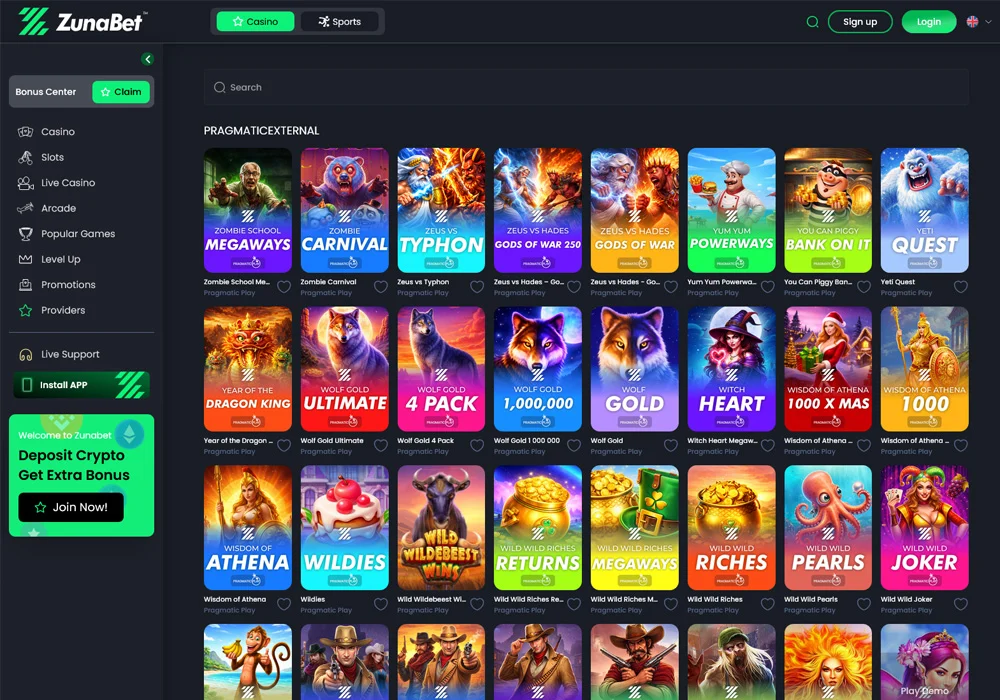
The game library makes the platform’s ambition unmistakable. ZunaBet opened with 11,294 games from 63 different providers. That is a staggering figure for any operator at any stage of development. The providers contributing to this catalog include the names that define quality in the industry — Pragmatic Play, Evolution, Hacksaw Gaming, Yggdrasil, and BGaming lead the roster — backed by a deep and varied bench of additional studios whose combined output covers every conceivable game style, mechanic, and format.
Slots account for the bulk of the catalog, as they do universally across online casinos. The distinction at ZunaBet lies in everything else. RNG table games provide comprehensive coverage of blackjack, roulette, baccarat, poker across multiple variants, and various specialty titles. The live dealer section offers high-definition real-time streaming from premium production studios, creating immersive experiences that match the atmosphere of a physical casino with the accessibility of a digital platform. Sixty-three providers contributing to a single library means genuine diversity — not just in themes and visuals but in underlying game mechanics, volatility profiles, and design philosophies. Players encounter meaningfully different experiences as they move between providers, which keeps the platform feeling alive and varied long after the initial novelty of signing up has passed.
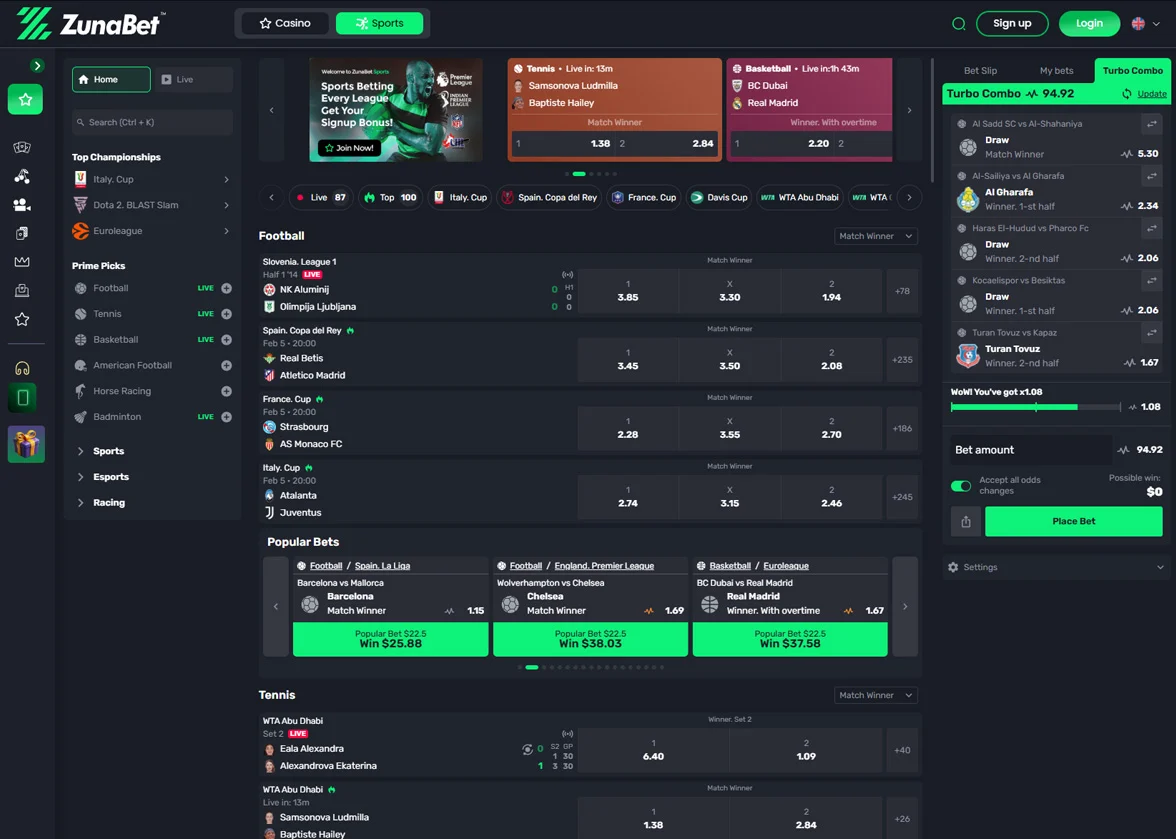
The sportsbook operates as a complete product with the same account and wallet infrastructure as the casino. Football, basketball, tennis, NHL, combat sports, and virtual sports all receive dedicated coverage. Esports is treated with the seriousness it deserves through full betting markets on CS2, Dota 2, League of Legends, and Valorant. This commitment signals an understanding of the modern gambling audience that most traditional operators still lack. Esports viewership continues to grow globally, and the segment of that audience interested in betting grows alongside it. ZunaBet positioned itself to serve that audience from the start, which gives it a natural connection with a demographic that traditional platforms have been slow to engage.
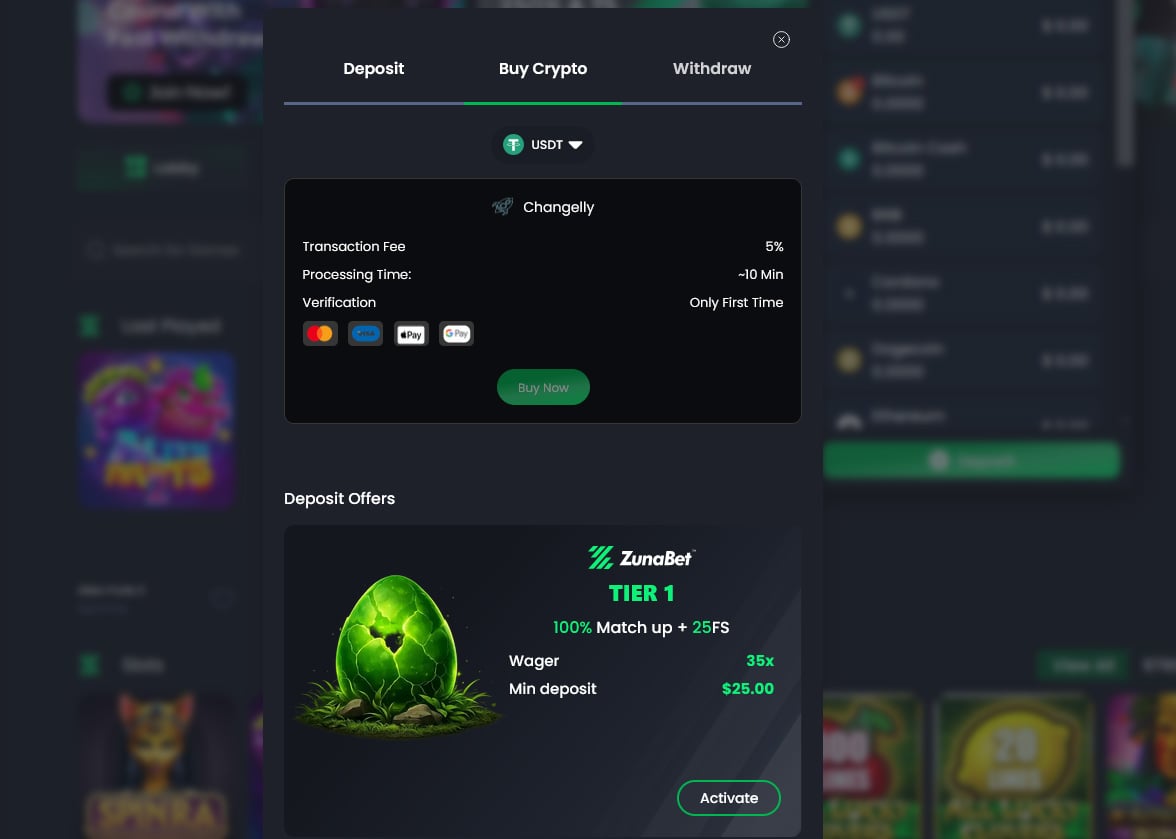
The payment infrastructure supports more than 20 cryptocurrencies — Bitcoin, Ethereum, USDT across multiple chains, Solana, Dogecoin, Cardano, XRP, and additional tokens. No platform processing fees are charged on any deposit or withdrawal. Blockchain settlement delivers funds to player wallets in minutes regardless of timing. Because the entire financial architecture was designed around crypto from inception, there are no fiat-system remnants creating inconsistency or friction. Every transaction follows the same fast, free, seamless path.
New players receive a welcome package of up to $5,000 plus 75 free spins over three deposits. First deposit gets a 100% match up to $2,000 with 25 spins. Second deposit earns a 50% match up to $1,500 with 25 spins. Third deposit rounds out the offer with a 100% match up to $1,500 and 25 final spins. The three-deposit format encourages sustained platform exploration rather than one-time bonus collection.
The platform is built on HTML5 with a dark-themed responsive interface that loads quickly on any screen. Native apps serve iOS, Android, Windows, and MacOS users. Live chat support runs without interruption every hour of every day.
What Crypto Infrastructure Delivers That Traditional Systems Cannot
The gap between crypto and traditional payment infrastructure in online gambling produces real consequences that players experience with every transaction. This is not a theoretical debate about the future of finance. It is a practical difference with immediate measurable impact.
Traditional platforms process payments through networks of financial intermediaries. Deposits pass through card networks or bank systems. Withdrawals travel the same path in reverse, adding platform review stages, banking processing queues, and method-specific settlement timelines. The total elapsed time for a withdrawal commonly ranges from one to five business days depending on circumstances. Weekends and holidays extend that window further. Fees may be imposed at multiple stages by different parties in the processing chain.
Crypto payments reduce that entire sequence to a single blockchain confirmation. Deposits arrive in minutes. Withdrawals return to player wallets in minutes. No banking hours restrict the process. No intermediary fees accumulate. ZunaBet charges zero platform fees on any transaction. The experience is the same at three in the morning on a holiday as it is during peak business hours on a weekday.
A player who transacts regularly on ZunaBet saves meaningful time and money over any comparable period on a traditional platform. Those savings are structural and permanent — built into the infrastructure rather than offered as a promotion. Every transaction automatically benefits because the system itself is inherently more efficient.
ZunaBet achieves this level of consistency because crypto is not one of several payment options. It is the only payment infrastructure the platform has. There are no hybrid systems. There are no fiat layers underneath. The singular architectural focus produces a singular quality of experience that platforms operating on mixed foundations are unable to match.
Why ZunaBet’s Loyalty System Stands Apart From Everything Else
Loyalty programs in online gambling represent one of the clearest cases of industry-wide creative neglect. The template has not changed meaningfully in over a decade. Wager money. Earn points. Cross a threshold. Claim a bonus. Every platform runs some minor variation of this formula, and no variation is different enough to be noticed by the average player. Participation happens passively. Engagement does not happen at all.
ZunaBet replaced that template with a loyalty system designed as a genuine product feature. The dragon evolution program creates a progression journey through six tiers — Squire at 1% rakeback, Warden at 2%, Champion at 4%, Divine at 5%, Knight at 10%, and Ultimate at 20%. Each tier brings additional escalating benefits beyond the rakeback rate — free spins that grow to 1,000 at the top level, VIP club membership, and double wheel spins. A dragon mascot named Zuno ties the experience together visually, evolving in appearance as the player advances from one tier to the next.
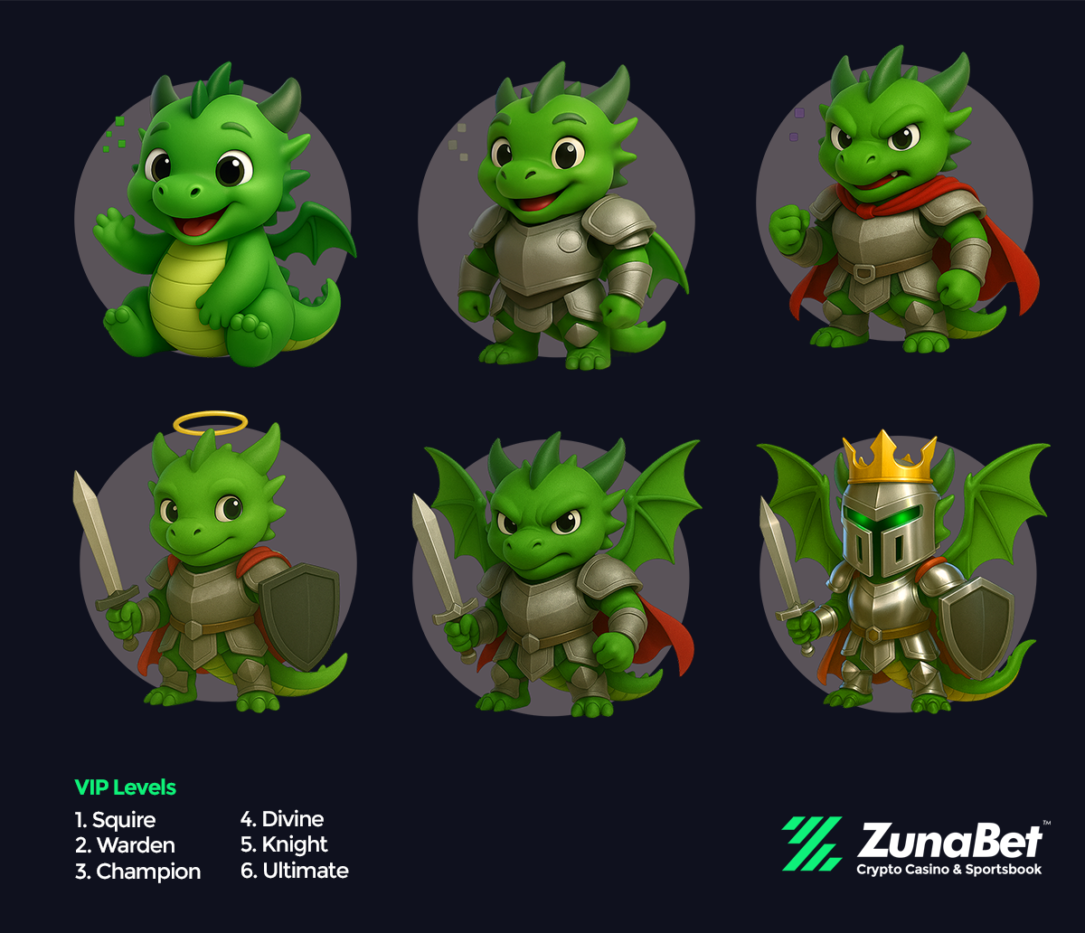
The system applies video game progression mechanics to a context that had been crying out for them. Clear levels with defined requirements. Rewards that escalate meaningfully enough to create genuine anticipation around reaching the next tier. Visual feedback that makes progress feel personal and observable. Achievement mechanics that give advancement an emotional weight that numerical point balances lack entirely.
ZunaBet players engage with their loyalty tier in ways that players on traditional platforms simply do not. They set goals around reaching the next level. They monitor their progress between sessions. They experience real satisfaction when they advance. That active participation transforms the loyalty program from a passive retention mechanism into an active engagement driver that contributes directly to how players experience the platform. It is one of the most effective differentiators in the current market because it addresses the one area where virtually every competitor chose to do the absolute minimum.
What the Momentum Means Going Forward
The sustained momentum behind FanDuel alternative searches carries a message that extends beyond any individual platform comparison. It reflects a market that has reached the point where the standard set by the previous generation of leaders is no longer accepted as the ceiling. FanDuel will continue to hold significant market share. Its brand, licenses, existing users, and financial strength guarantee relevance for years to come. Nothing about the current momentum threatens the platform’s viability in its core markets.
What the momentum does threaten is the broader assumption that the model FanDuel represents — traditional finance, standard game catalogs, template loyalty mechanics — remains the default definition of what a gambling platform should be. That assumption weakens every time a player discovers that alternatives exist which are faster, deeper, more creative, and more aligned with how they interact with digital products everywhere else in their lives.
ZunaBet was constructed from scratch to be the alternative that holds up under scrutiny. Its game library exceeds what most operators build over entire lifetimes. Its payment system delivers speed and cost efficiency that traditional infrastructure cannot approach. Its esports coverage meets a massive and underserved audience where it already is. And its loyalty program brought genuine innovation to the most neglected corner of the gambling experience. That is not a collection of incremental improvements. It is a different model altogether. The momentum building behind alternative searches exists because players have recognized that a different model is exactly what they need. They find ZunaBet because ZunaBet is the most complete version of that model that anyone has built.
Disclaimer: This is a Press Release provided by a third party who is responsible for the content. Please conduct your own research before taking any action based on the content.

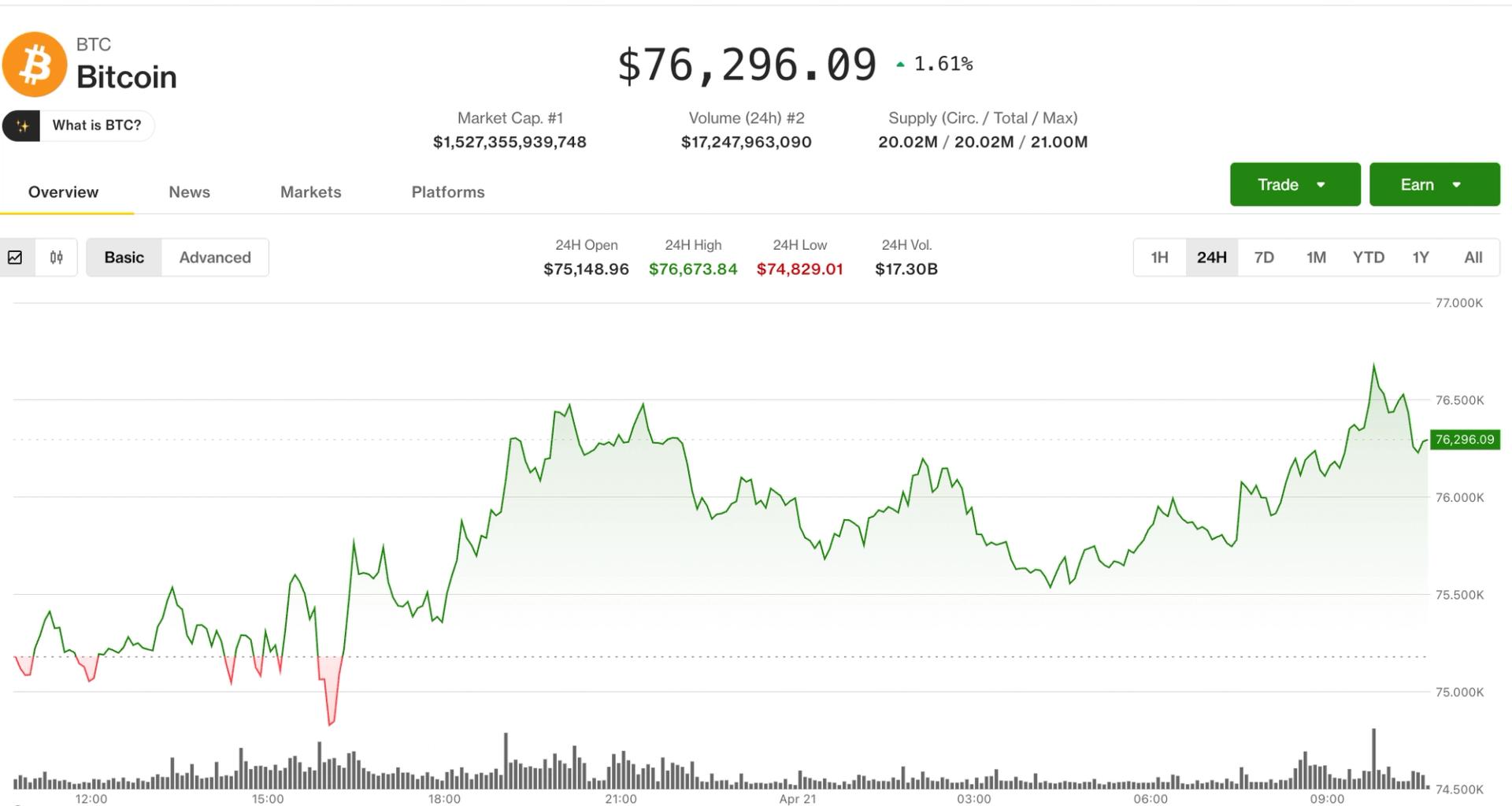
The crypto market is showing signs of strength on Tuesday with bitcoin rising to $76,500, a gain of about 1% since midnight UTC.
The price spiked to around $77,000 at 9:45 a.m. before meeting a wave of spot sellers, who are probably protecting a potential breakout above Friday’s high of $78,300.
Ether (ETH) lagged behind bitcoin, rising just 0.3% to $2,320 as investors remained cautious around altcoins following the $290 million exploit on KelpDAO over the weekend.
Price action is still being dictated by the war in Iran, with the U.S. vice president due to travel to Pakistan for peace talks. A resolution is likely to lower oil prices, helping boost risk assets that have been inversely correlated since the war began.
U.S. stock index futures rose, demonstrating a return to risk-on sentiment.
Derivatives positioning
- The long-short ratio for the crypto futures market is 50.68%, indicating a near-even split between bullish and bearish positions. In other words, traders are largely undecided on the direction of the market’s next move.
- In the past 24 hours, major tokens such as BTC, SOL, HYPE and BNB have added 1%-3% in futures open interest (OI), a sign of capital inflows. ETH, DOGE and ZEC have seen slight declines in OI.
- Open interest in AAVE futures has climbed to a record 3.59 million tokens. At the same time, the OI-adjusted cumulative volume delta has turned negative — indicating that sell orders are dominating and pushing into bids — while funding rates remain near zero. Taken together, the setup points to a slight bearish bias.
- Bitcoin and ether funding rates remain negative, suggesting a bias toward short positions. This consistent bearish environment creates potential for a short squeeze. That’s a scenario in which price resilience prompts bears to mass-dump their bets, adding to the upward momentum in the spot price.
- On the CME, activity in BTC futures continues to cool, even as the exchange-traded funds pull in millions. This combination indicates that inflows into the ETFs are mainly bullish directional plays rather than arbitrage bets involving a short BTC futures position against the ETF’s long position.
- On Deribit, BTC and ETH puts continue to trade at a premium to calls, reflecting downside concerns.
- Speaking of block flows (large trades executed over-the-counter), BTC straddles and strangles cumulatively account for over 50% of the activity over the past 24 hours.
Token talk
- The altcoin market is still reacting to the weekend’s $290 million exploit on KelpDAO with decentralized finance (DeFi) tokens ethena (ENA), etherfi (ETHFI) and jupiter (JUP) all posting losses over the past 24 hours despite a marginal recovery since midnight UTC.
- The CoinDesk Memecoin Index (CDMEME) is the worst-performing benchmark on Tuesday, losing 0.24% while the bitcoin-dominant CoinDesk 20 (CD20) is up by 0.65%.
- The altcoin market is showing indecision, with the CoinDesk 80 (CD80) remaining flat during the Asia and European sessions.
- AAVE is beginning to claw back some of its weekend losses after a 22% drop, adding 2.6% despite widespread negative sentiment across the DeFi sector.
- CoinMarketCap’s “Altcoin Season” indicator is at 39/100, rising from the weekend’s low of 34/100, but still demonstrating investor preference for bitcoin over to altcoins.


A 50 page quantum computing crypto risk assessment published Tuesday by Coinbase’s independent advisory board concludes that while today’s blockchains remain secure, a fault-tolerant quantum computer capable of breaking widely used encryption is increasingly plausible and that preparation must begin now, warning that “waiting for it to be urgent is not a good idea.”
Summary
- The 50 page paper, authored by an independent board including Stanford cryptographer Dan Boneh, Ethereum Foundation researcher Justin Drake, and EigenLayer founder Sreeram Kannan.
- Replacing today’s signatures with quantum-resistant alternatives could expand blockchain data sizes by up to 38 times, according to one estimate in the report, meaning the transition carries significant engineering costs and performance tradeoffs.
- Bitcoin wallets that have already revealed their public keys are identified as the most immediately vulnerable category of holdings in any future quantum attack scenario.
Quantum computing crypto risk has its most authoritative industry assessment yet. The Coinbase advisory board, a group of world-class cryptographers and blockchain researchers convened by Coinbase in January 2026, released its first major position paper Tuesday: a 50 page analysis of how future quantum computers could affect blockchain security and what the industry must do before that threat becomes real.
“Waiting for it to be urgent is not a good idea,” the paper states, emphasizing that transitions across blockchains, wallets, and exchanges could take years to execute safely even after all the technical standards are in place.
The board members who authored the paper include Dan Boneh, the director of the Stanford Center for Blockchain Research; Justin Drake of the Ethereum Foundation; Sreeram Kannan, the founder of EigenLayer; Yehuda Lindell, Coinbase’s head of cryptography; and Dahlia Malkhi, an expert in resilient distributed systems. Their institutional breadth gives the paper a credibility that no single-company security assessment would carry.
What the Report Found and What Makes It Credible
The paper’s core conclusion is carefully calibrated: quantum computers today cannot crack the cryptography underpinning Bitcoin, Ethereum, or any major blockchain. Breaking standard encryption would require fault-tolerant quantum machines with vastly more error-corrected qubits than current hardware provides, and achieving that is still considered a major engineering challenge. The report does not predict when that will happen. It argues that the timeline uncertainty itself is the problem.
The threat the paper focuses on most is the harvest now, decrypt later attack: adversaries can collect encrypted blockchain data today and store it, waiting for quantum hardware to mature enough to crack it retroactively. For long-held assets, this is a material risk that begins now rather than when the quantum threat becomes practical. Bitcoin addresses that have already revealed their public keys on-chain are specifically identified as the most immediately exposed category of holdings.
Why the Transition Will Be Harder Than It Sounds
The technical solution to quantum vulnerability already exists: NIST has standardized post-quantum cryptographic algorithms that are mathematically resistant to quantum attacks. The problem is implementation at blockchain scale. Post-quantum digital signatures can be tens to hundreds of times larger than the signatures in use today. One estimate in the Coinbase report suggests that replacing current signatures with quantum-proof alternatives could expand block sizes by up to 38 times.
For a network like Bitcoin, which processes blocks under a strict size limit and where any upgrade requires consensus among a decentralized set of stakeholders with no central authority, a 38-times expansion of signature data is not a parameter adjustment. It is a fundamental architectural change that touches every node, wallet, exchange, and application in the ecosystem. The debate among Bitcoin developers, already underway, reflects exactly this tension between urgency and the cost of change.
What Crypto Networks Are Already Doing
The Coinbase report arrives alongside parallel actions across the ecosystem. Ripple published a four phase XRPL post-quantum roadmap targeting completion by 2028. The Ethereum Foundation has elevated post-quantum security to a top strategic priority with a dedicated research team. Bitcoin developers are actively debating BIP 361, a proposal for a structured migration away from legacy address types that expose public keys.
For the Bitcoin quantum risk assessment specifically, researchers estimate approximately 4.5 million Bitcoin held in early or reused addresses may be exposed to future quantum attacks. The quantum threat debate in Bitcoin has become one of the most contested governance questions in the community, precisely because the solutions require either forcing coin migration or accepting that some portion of the supply may eventually be at risk.


DefiLlama logs 518 crypto hacks and over $17b in losses in 10 years, with attackers shifting from smart contracts to keys, bridges and wallets, as rsETH loses ~$290m.
Summary
- DefiLlama has logged 518 crypto hacking incidents over the past 10 years, with total losses above $17 billion.
- A growing share of that damage comes from private key leaks, phishing and credential theft rather than pure smart contract bugs.
- The latest example is Kelp DAO’s rsETH bridge exploit, which drained about 116,500 rsETH worth roughly $290–$293 million — 2026’s largest DeFi hack so far.
Crypto’s security bill over the past decade has quietly climbed past $17 billion, according to DefiLlama data cited by Cointelegraph, with at least 518 documented hacks and exploits hitting exchanges, DeFi protocols, bridges and wallets since 2014. That figure captures everything from early exchange blow‑ups to today’s sophisticated cross‑chain attacks, and it comes even as the overall pace of large on‑chain exploits has slowed from peak‑mania years like 2021–2022.
A decade of $17b in crypto losses
Under the surface, however, the composition of those losses is shifting. Where early DeFi hacks often hinged on smart contract bugs and unchecked flash‑loan logic, recent incidents show attackers increasingly targeting the soft tissue around crypto — private keys, signing infrastructure and user devices — with credential theft, social engineering and SIM‑swap‑style attacks. Security firms told Cointelegraph that they expect 2026 to bring more advanced phishing and AI‑assisted scams capable of tricking even technically savvy users into signing malicious transactions or revealing seed phrases.
Bridge infrastructure has been a particular weak point. DefiLlama’s hacks dashboard shows that bridges account for almost $3 billion of the roughly $11.8 billion it categorises as “total value hacked,” with large single incidents like the Ronin, Wormhole and Multichain exploits setting the tone for cross‑chain risk. The latest addition to that list is Kelp DAO’s rsETH cross‑chain bridge, which was hit on April 18 after an attacker forged a cross‑chain message on a LayerZero‑based link and minted or released 116,500 rsETH to an attacker‑controlled address.
Those tokens — representing “restaked” Ether — were worth about $290–$293 million at the time, or roughly 18% of rsETH’s total supply, and have been called the largest DeFi exploit of 2026 so far by outlets including Bloomberg. The incident forced Kelp DAO to pause the bridge, coordinate emergency responses with exchanges and protocols, and sparked a blame game over LayerZero’s default single‑validator configuration, which critics argue left the system effectively one‑key‑away from catastrophic minting.
Even away from headline‑grabbing exploits, everyday credential compromises continue to rack up damage. DefiLlama data cited by Cointelegraph shows that in the first quarter of 2026 alone, hackers stole about $168.6 million from 34 DeFi protocols, with the largest single hit — a $40 million Step Finance theft — traced back to a private key compromise rather than a pure code bug. That trend suggests DeFi’s smart contract security is slowly hardening, while attackers respond by moving upstream into the tools and human processes that sit between wallets and protocols.
For users and teams, the lesson is brutal but clear: audits and formal verification are necessary, but not sufficient. Hardware keys, multi‑sig schemes, segregated signing devices, strict key‑management policies, and relentless phishing hygiene are now as critical to safeguarding crypto as gas optimisations and bug bounties ever were — because it only takes one compromised credential to turn another line in DefiLlama’s hacks database into a nine‑figure loss.

A senior US military commander has lauded Bitcoin as a “valuable computer science tool,” arguing its usefulness extends beyond monetary applications and can support US national security interests.
“It is a valuable computer science tool, as a power projection,” Admiral Samuel Paparo said at a Senate Armed Services Committee hearing on Tuesday, adding that Bitcoin’s proof-of-work technology “imposes more cost” on attackers attempting to compromise the network:
“Outside of the economic formulation of it, it has got really important computer science applications for cybersecurity.”
The Senate hearing looked into the strategic posture of US forces in Indo-Pacific, including ongoing conflicts in Ukraine and the Middle East, China’s military expansion and coordination with foreign adversaries, and threats from North Korea.

Paparo’s remarks echo similar comments from US Space Force member Jason Lowery in December 2023, who said Bitcoin and other proof-of-work blockchains could protect the US in cyberwarfare.
At the time, he said that while Bitcoin is mostly seen as a “monetary system” to secure funds, few know that Bitcoin can be used to secure “all forms of data, messages or command signals.”
“As a result, this misconception underplays the technology’s broad strategic significance for cybersecurity, and consequently, national security.”
Research into Bitcoin’s use as a cybersecurity tool comes as many adversaries — including state-linked actors — have turned to cyberattacks such as phishing, ransomware and distributed denial-of-service to sabotage infrastructure and secure economic advantages.
North Korea’s notorious Lazarus Group is one of the most notable examples of this, having stolen billions of dollars in crypto over the past decade to support its nuclear program.
Paparo’s comments came in response to a question from US Senator Tommy Tuberville, who asked how the US and Congress can lead on Bitcoin competition, noting that China’s top monetary think tank now also views Bitcoin as a strategic asset.
Paparo didn’t address the question directly but added, “Bitcoin is a reality. It is a peer-to-peer zero-trust transfer of value. Anything that supports all instruments of national power for the United States of America is to the good.”
Senators introduce national security-focused Bitcoin bill
The US holds the largest Bitcoin reserves among nation-states and holds the largest share of Bitcoin hashrate. However, it remains reliant on foreign-manufactured mining equipment, an issue that has raised national security concerns related to supply chain risks.
Related: Quantum threat to Bitcoin still years away, says Borderless Capital partner
Last month, US Senators Bill Cassidy and Cynthia Lummis introduced the Mined in America Act to resolve that issue by bringing more Bitcoin mining manufacturing back to the US.
It also seeks to codify Trump’s executive order establishing the Strategic Bitcoin Reserve.
Magazine: Adam Back says current demand is ‘almost’ enough to send Bitcoin to $1M
Coinbase CEO Brian Armstrong announced Monday the launch of Agentic.market, a marketplace platform for Coinbase AI agents that allows autonomous software agents to discover, compare, and purchase services from other agents without API keys, paying in USDC through the x402 payment protocol, which has already settled approximately 165 million transactions across more than 480,000 transacting agents.
Summary
- The platform organizes services into seven categories: Inference, Data, Media, Search, Social, Infrastructure, and Trading, with launch providers including OpenAI and Venice for inference, Bloomberg and CoinGecko for data, and AWS Lambda and Alchemy for infrastructure.
- Armstrong described the platform as the “discovery layer” for the agentic economy, saying “for the agentic economy to overtake the human economy, agents need a way to discover services.”
- The x402 protocol received backing from Google, Microsoft, Amazon Web Services, American Express, Mastercard, Visa, Cloudflare, Shopify, Stripe, and others earlier this month, giving the payment standard broad institutional infrastructure support.
Coinbase AI agents have a dedicated marketplace for the first time. Agentic.market, launched Monday by Coinbase’s x402 protocol team and publicly backed by CEO Brian Armstrong, is designed to function as what Coinbase engineer Erik Reppel, who created the x402 protocol, described as “an app store for agents.” It gives autonomous AI systems a structured way to find services, evaluate them, and pay for them at machine speed using USDC without any human in the loop.
“For the agentic economy to overtake the human economy, agents need a way to discover services,” Armstrong wrote on X in backing the launch. He has previously predicted that “there will be more AI agents transacting online than humans very soon.”
The platform has two distinct interfaces: a web interface for humans to browse and evaluate available services, and a programmatic layer that allows AI agents to search, filter, and integrate new capabilities at runtime without human intervention. An agent on the platform receives both “skills,” code libraries for using a service, and a wallet that enables it to buy and sell autonomously.
How Agentic.market Works and What Is Available at Launch
The marketplace requires no approval process for providers to join. Any service compatible with the x402 standard can be listed. The seven categories at launch cover the full range of capabilities an AI agent might need: inference services for running AI models, data services for market and financial information, media, search, social network access, infrastructure including cloud compute, and trading services for executing financial transactions.
Named services available at launch include OpenAI and Venice in inference, Bloomberg and CoinGecko for financial data, LinkedIn and X for social, and AWS Lambda and Alchemy for infrastructure. The marketplace builds on a backend index called Bazaar, which tracks x402 enabled services and their usage metrics, and turns that raw data into searchable listings with live pricing, performance metrics, and integration guides.
Coinbase reported that 85% of the 165 million x402 transactions already settled have occurred on Base, Coinbase’s Layer 2 network built on Ethereum, indicating that the agentic payment economy is already substantially operational rather than hypothetical.
The x402 Protocol and Who Backs It
The x402 protocol, named after the rarely used HTTP status code 402 Payment Required, was first launched by Coinbase in May 2025. It is designed for machine-to-machine payments: fast, low-cost, requiring no identity verification because the agents themselves hold wallets rather than needing to satisfy Know Your Customer requirements tied to human account holders.
Earlier this month, the x402 Foundation was formed to govern the protocol with support from Google, Microsoft, Amazon Web Services, American Express, Mastercard, Visa, Cloudflare, Shopify, Stripe, Circle, Base, Polygon Labs, the Solana Foundation, and others. That institutional backing converts x402 from a Coinbase product into a broadly supported open standard, which significantly increases its probability of becoming the default payment layer for agentic commerce.
What This Means for Crypto Markets and USDC
Agentic.market is a direct use case expansion for USDC. Every transaction on the platform settles in USDC. As agent-to-agent commerce scales, it creates a structural demand layer for stablecoins that does not depend on speculation, market cycles, or geopolitical events. Circle CEO Jeremy Allaire has projected that “literally billions of AI agents” will be transacting on blockchains within three to five years.
For AI tokens and the infrastructure layer of the crypto AI sector, a Coinbase-backed, institutionally supported marketplace with 480,000 active agents already transacting is a concrete commercial proof point rather than a thesis. For observers tracking the AI bubble debate, the distinction matters: whether AI generates durable revenue through actual transaction volume is the core question, and Agentic.market provides a new data source for that answer.

NDIS 'too important' not to rein in fast-growing cost

Ripple Tests RLUSD for Real Trade Settlements in MAS Sandbox

[Must Watch] Brandon Hagel lands one-punch KO on Juraj Slafkovsky during fiery Bolts-Habs Game 2

Manchester United reach agreement with Casemiro over contract clause amid transfer speculation

Steven Gerrard disagrees with Gary Neville over ‘shock’ Chelsea and Arsenal claim | Football

US brings back mandatory military draft registration


-

 News Videos7 days ago
Secure crypto trading starts with an FIU-registered
-

 Fashion4 days ago
Weekend Open Thread: Theodora Dress
-

 Politics4 days ago
Palestine barred from entering Canada for FIFA Congress
-

 Sports5 days ago
NWFL Suspends Two Players Over Post-Match Clash in Ado-Ekiti
-
Entertainment2 days ago
NBA Analyst Charles Barkley Chimes in on Ice Spice McDonald’s Fiasco
-

 Business3 days ago
Powerball Result April 18, 2026: No Jackpot Winner in Powerball Draw: $75 Million Rolls Over
-

 Politics3 days ago
Zack Polanski demands ‘council homes not luxury flats for foreign investors’
-

 Crypto World4 days ago
Russia Pushes Bill to Criminalize Unregistered Crypto Services
-

 Politics1 day ago
Gary Stevenson delivers timely reminder to register to vote as deadline TODAY
-

 Tech3 days ago
Auto Enthusiast Scores Running Tesla Model 3 for Two Grand and Turns It Into Bare-Bones Go-Kart
-

 Tech6 days ago
‘Avatar: Aang, The Last Airbender’ Leaked Online. Some Fans Say Paramount Deserves the Fallout
-
 Business5 days ago
Creo Medical agree sale of its manufacturing operation
-

 Crypto World4 days ago
Russia Introduces Bill To Criminalize Unregistered Crypto Services
-

 Sports6 days ago
British climbers complete new route in Swiss Alps
-

 Sports6 days ago
“Felt Much Better Today”: Josh Hazlewood Opens Up On His Recovery Win Over LSG
-
 Crypto World3 days ago
Kelp DAO rsETH Bridge Hack Drains $292M as DeFi Losses Top $600M in Two Weeks
-

 Tech6 days ago
Ford EV and tech chief leaving automaker
-

 Business6 days ago
Cheaper Doritos and Lays helps PepsiCo win back struggling snackers
-

 Entertainment6 days ago
Ruby Rose Accuses Katy Perry Of Sexual Assault, Police React
-
 Entertainment5 days ago
Clavicular Says Streaming May Not Work Without Substances
You must be logged in to post a comment Login