
Crypto World
CoinGecko Launches Market Intelligence Tools and Partner Platform

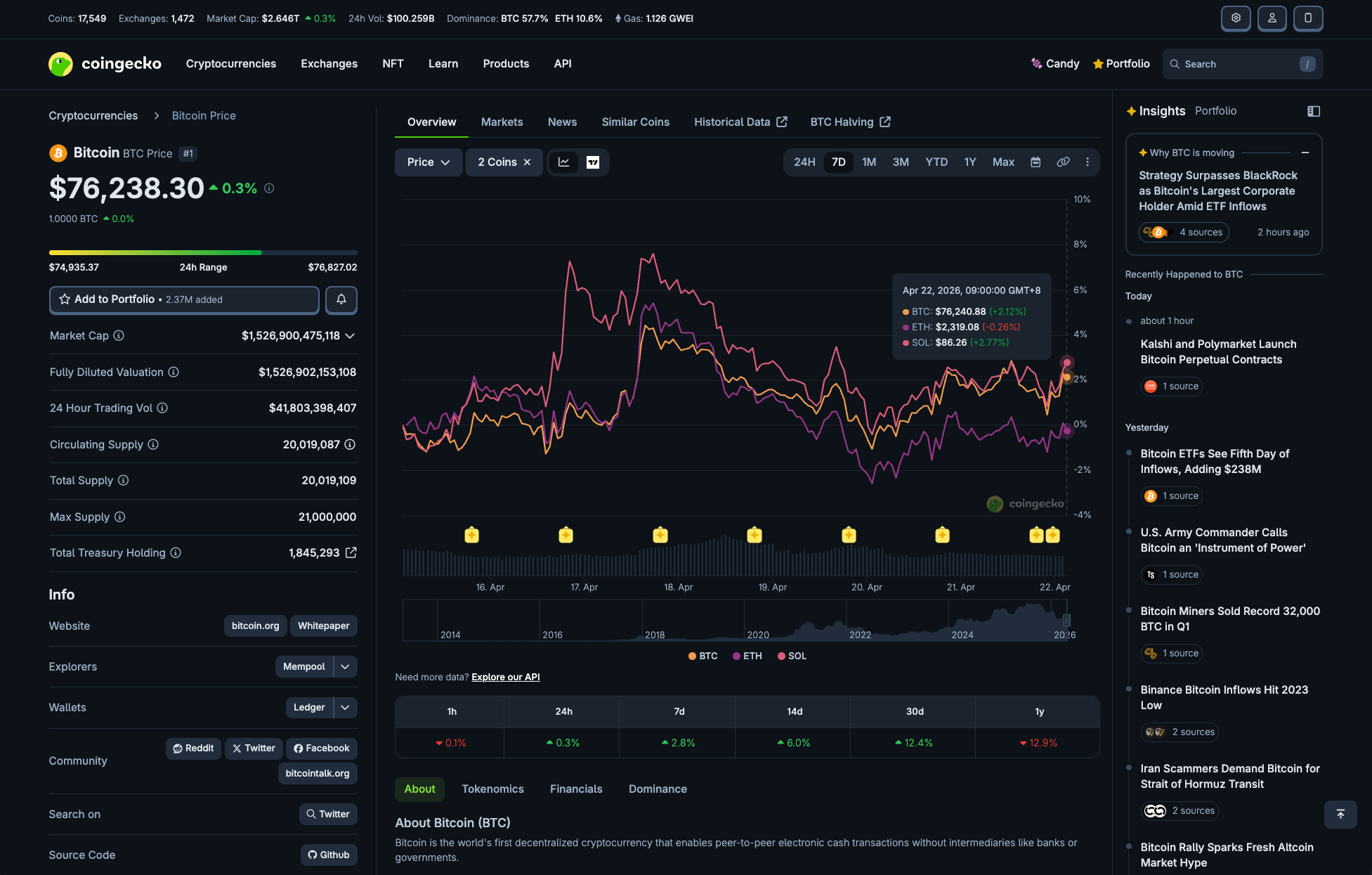
CoinGecko announced a major product expansion this week, adding market intelligence features and a unified Partner Platform to its crypto data aggregator.
The Singapore-based company said the update reflects a shift from pure price tracking toward contextual analysis for investors and growth infrastructure for Web3 projects.
AI-Powered Insights and Advanced Charting
CoinGecko’s new Market Insights feature aggregates signals from news and social media discussions, then uses AI-generated summaries to explain what is driving price movements across coins and categories.
The company also introduced Advanced Charts, which let users compare price movements across multiple cryptocurrencies in a single view.
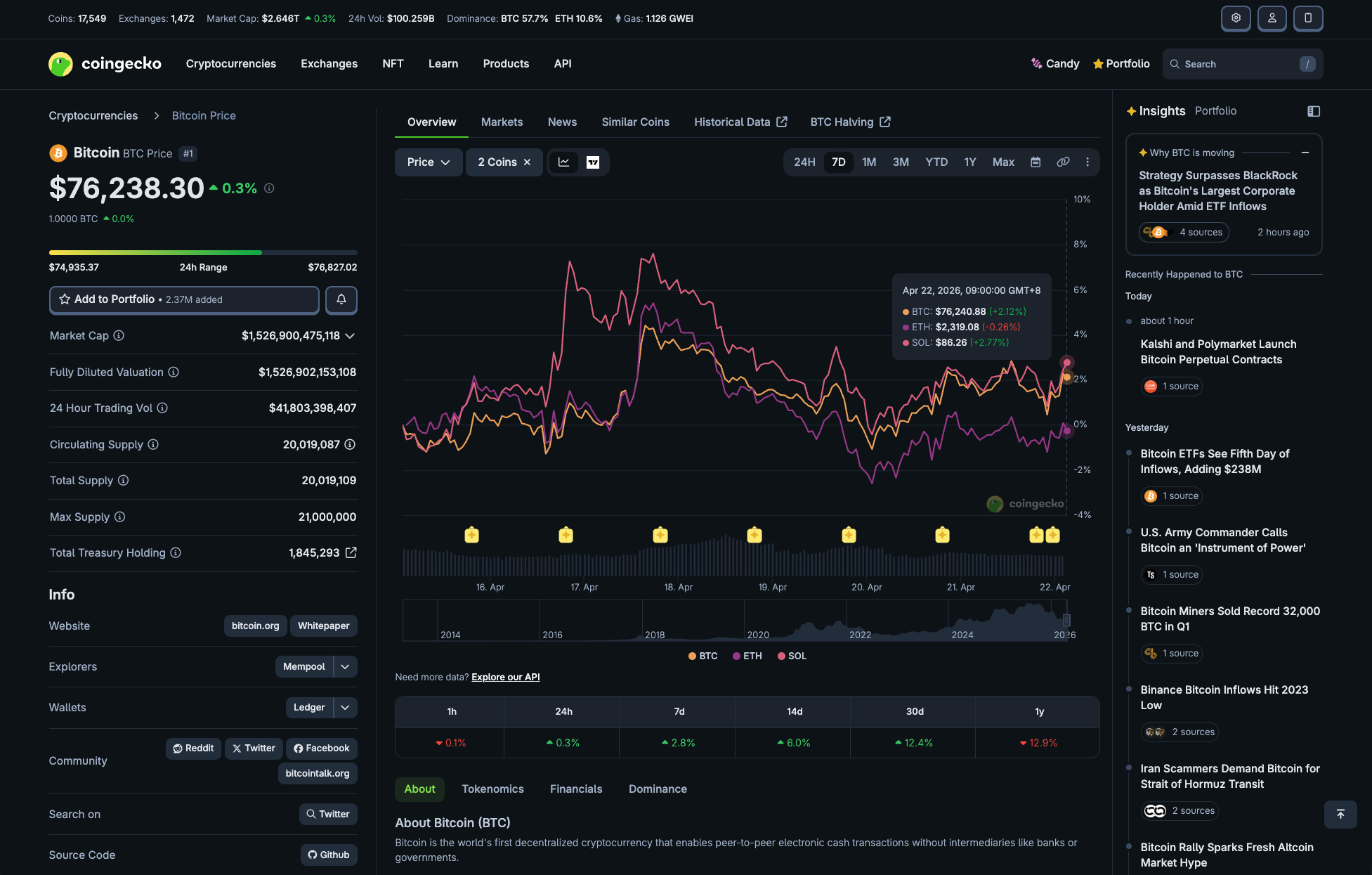
Charts are shareable and downloadable, giving investors tools previously limited to expensive terminals.
“Better data leads to better decisions, but today, data alone isn’t enough. Context is the missing layer, and that’s what we’re building,” read an excerpt in the announcement, citing Bobby Ong, co-founder and CEO of Coingecko, highlighting how the crypto market has outgrown basic data displays.
Follow us on X to get the latest news as it happens
The third consumer feature, Portfolio Insights, consolidates wallet tracking across EVM-compatible networks.
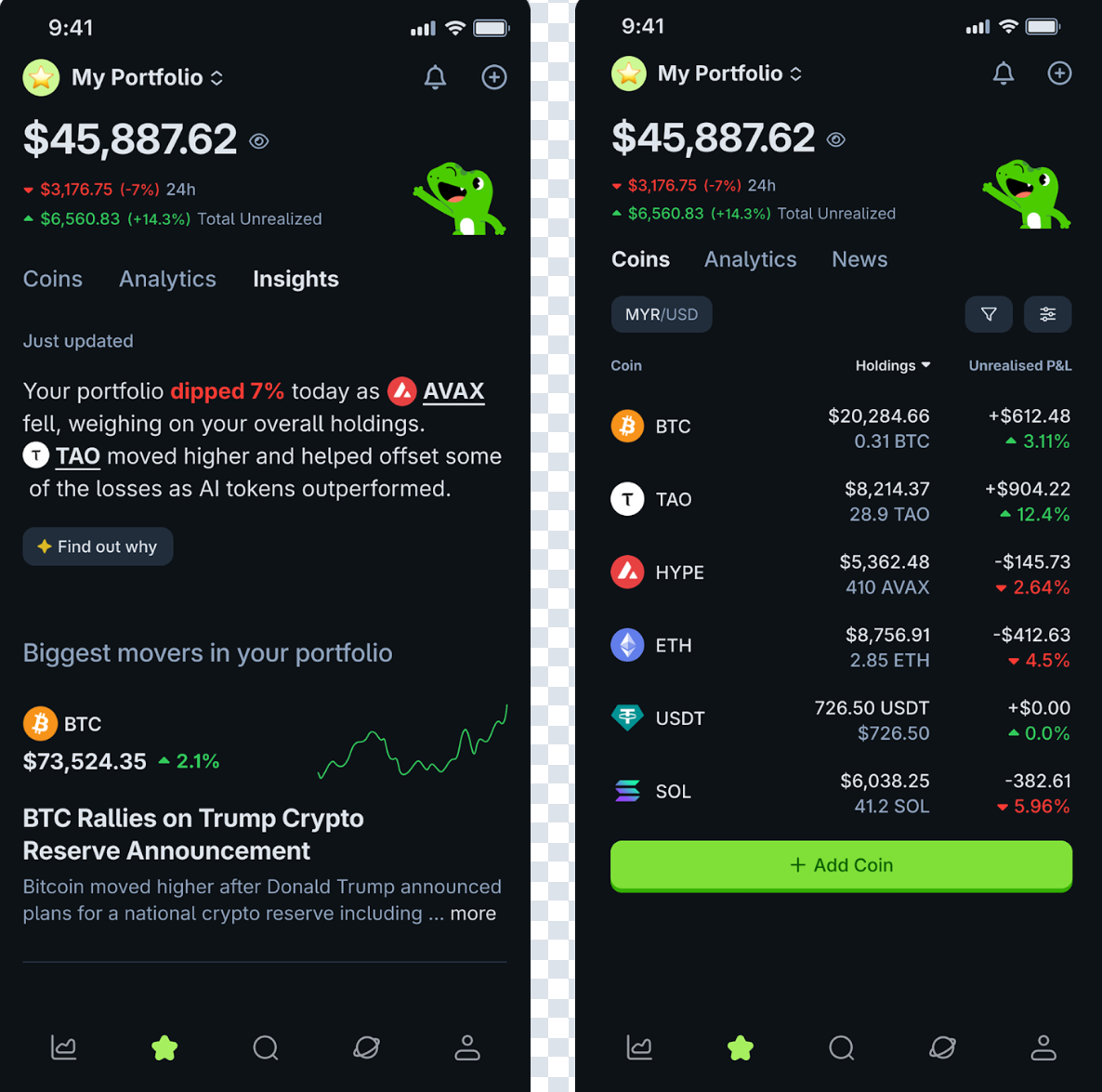
It shows profit-and-loss metrics and average buy prices, with AI-generated summaries that explain what is driving portfolio changes. Multichain support is expected in the coming months.
Partner Platform Targets Crypto Project Growth
For crypto projects, CoinGecko launched a Partner Platform that combines listing management, advertising campaigns, and performance tracking across both CoinGecko and GeckoTerminal.
The platform serves over 30 million monthly visitors and millions more on GeckoTerminal. Projects can submit listings, update token information, and use tools like Fast Pass to speed up time-to-listing.
CoinGecko plans to add deeper analytics, including pageview and watchlist data, in future updates.
The expansion follows a period of leadership restructuring and renewed product investment at CoinGecko.
With over 36 million tokens now tracked across hundreds of blockchains, the company is positioning itself as both a consumer intelligence layer and a distribution channel for the projects building on those networks.
The post CoinGecko Launches Market Intelligence Tools and Partner Platform appeared first on BeInCrypto.

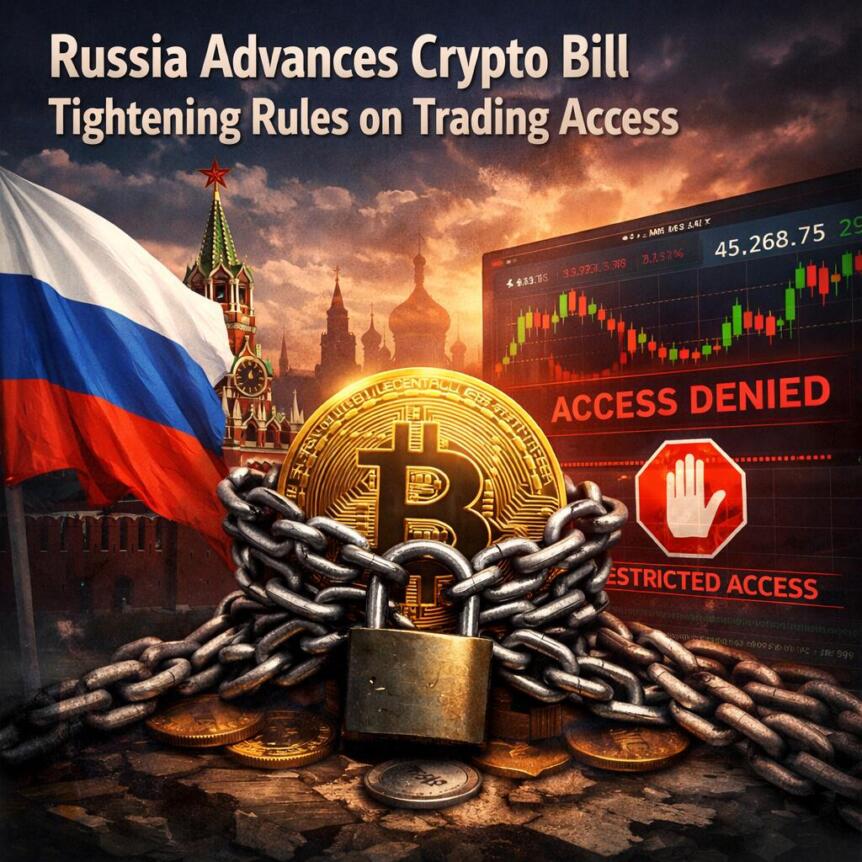
Russia moved closer to formal crypto regulation after lawmakers advanced a key digital currency bill in its first reading. The proposal sets a timeline for licensed trading and stricter controls. It outlines phased enforcement starting in 2026 and extending into 2027.
Russia Advances Licensed Crypto Framework
The State Duma approved draft bill No. 1194918-8 during its first reading this week. The legislation defines a core structure for digital currency operations across Russia. It places crypto trading under the supervision of the Bank of Russia.
The proposal allows residents to buy and sell crypto through approved intermediaries starting July 2026. However, it bans unlicensed platforms from operating by July 2027. Authorities aim to shift activity into regulated channels and reduce informal trading networks.
Lawmakers also introduced related bills alongside the main framework. Another draft, No. 1194929-8, passed its first reading during the same session. Together, these measures outline a broader plan to reshape the domestic crypto market.
Key Rules Target Retail Access and Market Limits
The bill sets strict eligibility rules for digital assets available to retail users. Authorities limit access to highly liquid cryptocurrencies meeting defined thresholds. These thresholds include market capitalization, trading volume, and operational history.
Assets must maintain an average capitalization above five trillion rubles over two years. They must also show daily trading volume above one trillion rubles during that period. Additionally, each asset must have at least five years of trading history.
Retail participants must pass a qualification test before accessing crypto markets. Moreover, the bill caps annual purchases at 300,000 rubles through a single intermediary. These rules aim to control exposure while maintaining supervised participation.
The legislation also permits residents to use foreign accounts for crypto purchases. However, users must report all such transactions to tax authorities. At the same time, the law continues to ban crypto payments inside Russia.
Enforcement Plans Face Legal and Industry Concerns
Lawmakers introduced separate drafts to define penalties for violations under the new system. Draft No. 1209607-8 proposes criminal liability for unlicensed crypto services. It also mandates registration with the central bank for all operators.
However, the Supreme Court of Russia reviewed the proposal and declined support in its current form. The court stated that enforcement rules depend on the main framework. It noted that penalties cannot function without a finalized regulatory base.
This response signals delays in implementing strict enforcement mechanisms. Authorities must first finalize the core digital currency legislation. Only then can supporting measures take full effect across the system.
Meanwhile, industry participants continue to assess the proposed structure. Some local stakeholders warn that strict controls could shift activity outside regulated platforms. They argue that excessive limits may push trading into informal channels instead of formal markets.
Russia has maintained a cautious stance toward crypto since its 2021 digital assets law. That framework allowed ownership but banned payments using digital currencies. The new legislative package builds on that approach while tightening oversight and market access.
Consequently, the current bill represents a significant step toward centralized control of crypto activity. It reflects a policy direction focused on supervision, compliance, and restricted participation. Further readings and amendments will determine the final shape of Russia’s crypto market structure.
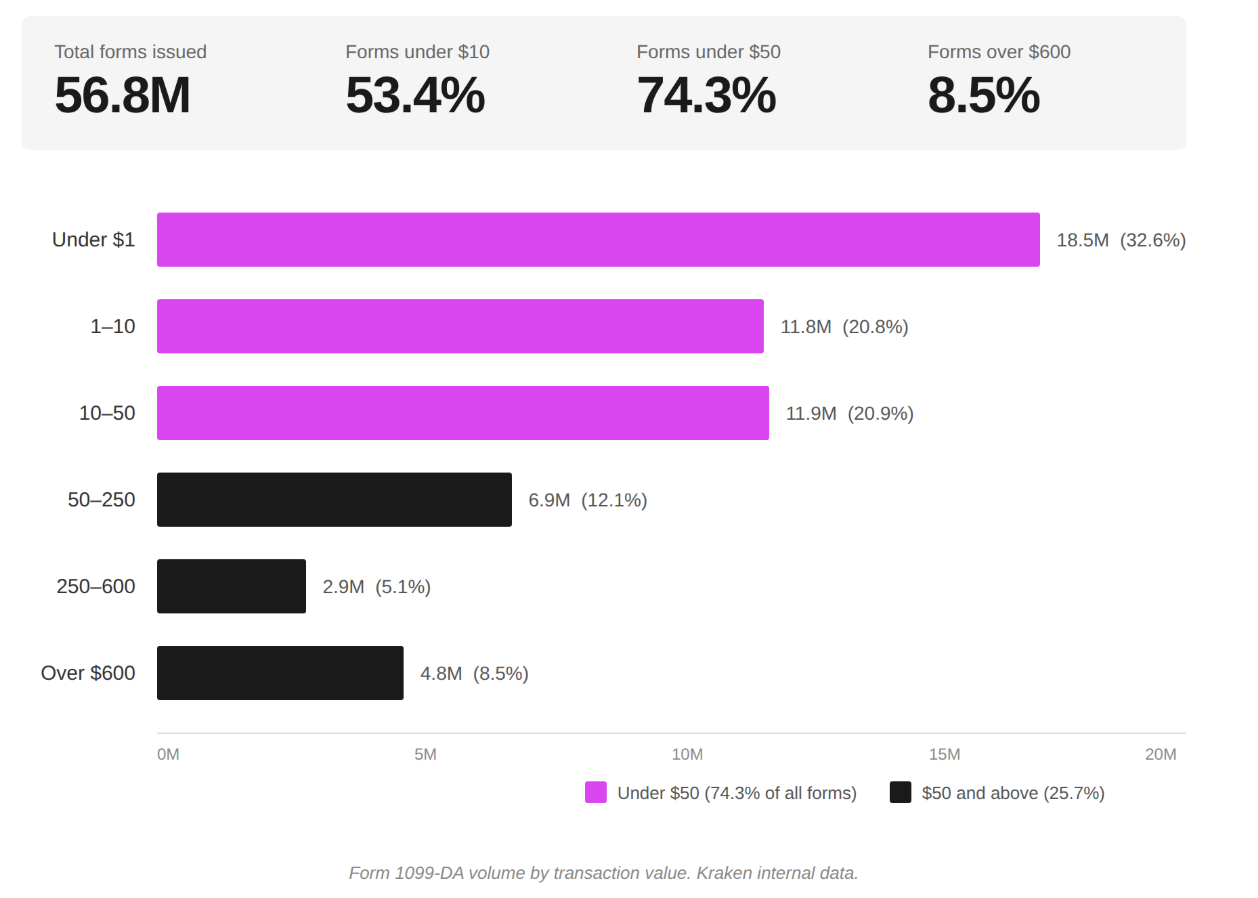
The crypto exchange advocated for two key changes to US tax law affecting crypto users to “eliminate millions of unnecessary forms.”
Cryptocurrency exchange Kraken called for a change in US tax policy after reporting millions of cases of transactions “worth less than $1” as part of its reporting requirements for 2025.
In a Wednesday blog post, Kraken said it issued more than 56 million tax forms — 1099-DAs — to the US Internal Revenue Service (IRS) in 2025 as now required by law. However, the exchange said that about 18.5 million of those forms were for transactions under $1, with about 28 million for $10 or less and 75% under $50.

In an effort to “eliminate millions of unnecessary forms,” the exchange called for a de minimis exemption for taxes to exclude “small, routine digital asset payments from capital gains reporting.” It similarly advocated for an end to “phantom” income derived from staking cryptocurrencies, requiring holders to “owe taxes on value they have not realized” by not selling their staking rewards.
“This is not about helping crypto companies,” said Kraken about its recommendations. “It is about 55 million Americans, spanning every state, age bracket and industry, who are navigating a tax system designed before digital assets existed. Congress should act to make taxpayers’ lives easier.”
Reporting requirements for both holders and exchanges have changed significantly since the advent of cryptocurrencies. Although there have been proposals for a de minimis tax exemption for cryptocurrencies like Bitcoin (BTC), the most recent draft bill in the US Congress suggested that only stablecoin transactions under $200 trigger reporting to the IRS.
Related: NY lawmaker proposes ‘AI dividend’ to address potential job losses
According to a Fortune report citing data from the nonprofit Tax Foundation, individual returns cost US taxpayers $146 billion in time and out-of-pocket expenses. The Trump administration ended the IRS’s free Direct File tax filing program in November 2025. The program had allowed eligible taxpayers to file their taxes online at no cost.
Kraken still reportedly considering IPO
After the crypto exchange filed for a confidential initial public offering (IPO) with the US Securities and Exchange Commission in November 2025, reports signaled that Kraken may have put its plan on hold amid volatile market conditions. However, Kraken co-CEO Arjun Sethi confirmed reports at a Semafor event in April that the company would likely go public soon.
Magazine: How to fix insider trading on platforms like Polymarket and Kalshi

TLDR
- Spirit Aviation (FLYYQ) stock exploded by as much as 218% Wednesday following news of potential federal rescue financing
- Trump White House reportedly in final stages of negotiations for approximately $500 million emergency loan
- Proposed agreement may include warrants granting government potential equity ownership in the airline
- The discount carrier was approaching possible liquidation without external financial intervention
- Soaring jet fuel costs, which have roughly doubled in certain U.S. regions, compound the airline’s financial woes
The struggling discount airline has been navigating turbulent waters for months. Wednesday’s developments, however, sparked renewed optimism among shareholders — though uncertainty remains.
Spirit Aviation Holdings (FLYYQ) rocketed as much as 218% during Wednesday’s trading session after news broke that the Trump White House is conducting final-stage negotiations to extend approximately $500 million in emergency capital to the financially troubled budget carrier.
Spirit Aviation Holdings, Inc., FLYY
Shares had already climbed roughly 122% during Tuesday’s session when initial reports surfaced that Spirit had approached Washington seeking federal assistance.
According to The Wall Street Journal’s initial coverage and subsequent CNBC confirmation via anonymous sources with direct knowledge, the discussions are progressing rapidly.
Under the contemplated arrangement, federal authorities would extend senior-level financing, positioning the government ahead of existing creditors. The package may also feature warrant provisions, granting Washington the option to purchase equity at predetermined prices — potentially establishing the government as a significant stakeholder.
President Trump acknowledged the situation Tuesday during a CNBC Squawk Box interview, stating: “Spirit’s in trouble, and I’d love somebody to buy Spirit. It’s 14,000 jobs, and maybe the federal government should help that one out.”
White House communications also targeted the former administration’s policies. Press representative Kush Desai noted that Spirit “would be on a much firmer financial footing had the Biden administration not recklessly blocked the airline’s merger with JetBlue.”
Spirit refused to address the financing negotiations specifically. The company issued this statement: “We are operating our business as normal; Guests can continue to book, travel and use tickets, credits and loyalty points as usual.”
The Association of Flight Attendants-CWA, representing Spirit’s flight crew members, expressed support for federal intervention. “We are hopeful that the government will recognize the needs for emergency funds especially in the current economic environment,” a union representative stated.
A Long Road to This Point
Spirit entered its second Chapter 11 bankruptcy filing this past August, barely one year following its initial reorganization. The airline had been implementing aggressive cost-reduction measures, downsizing its aircraft fleet, and concentrating operations on profitable routes. Labor unions representing pilots and cabin crew accepted temporary furloughs as part of survival efforts.
Management projected a bankruptcy exit during late spring or early summer in February announcements. However, that projection faced significant headwinds when aviation fuel prices surged nearly 100% across multiple U.S. markets, further eroding already-thin profit margins.
The failed JetBlue acquisition attempt two years prior eliminated what Spirit viewed as a crucial pathway to stability.
What the Deal Could Look Like
Federal financing of this magnitude directed toward a single carrier represents uncommon territory. Previous government airline assistance programs — including post-9/11 support and pandemic relief — distributed funding industry-wide rather than targeting individual operators.
The current administration has previously acquired equity positions in enterprises deemed strategically critical, such as Intel and USA Rare Earth. Spirit would mark an unprecedented case of such intervention involving a company currently operating under bankruptcy protection.
Specific agreement terms remain unconfirmed and subject to modification.
Spirit Aviation currently lacks Wall Street analyst coverage. According to TipRanks’ Technical Analysis tool, the stock presently displays a Buy signal derived from three Bullish indicators versus two Bearish signals recorded over the most recent month.

TRON founder takes the Trump-linked DeFi project to California federal court, escalating a months-long feud over blacklisted tokens and governance rights.
TRON founder Justin Sun has filed a lawsuit against World Liberty Financial in California federal court, according to an X post from Sun Tuesday night. The lawsuit marks the latest escalation in a bitter public feud between WLFI’s largest investor and the Trump family’s DeFi project.
Sun, who invested $75 million in WLFI, alleges that the project wrongfully froze his tokens, stripped his governance voting rights, and has threatened to permanently burn his holdings, all without justification. He says he exhausted good-faith efforts to resolve the dispute before turning to litigation.
“They have left me with no choice but to turn to the courts,” Sun wrote on X.
The conflict traces back to September 2025, when WLFI blacklisted a wallet holding more than 500 million of Sun’s tokens after on-chain analysts flagged transfers routed through HTX, a crypto exchange that Sun is affiliated with.
Sun is also pushing back against a new governance proposal published by WLFI on April 15 that restructures token unlocks for all major holder categories, placing early supporter tokens on a two-year cliff followed by a two-year linear vest — a timeline that would extend well past Trump’s second term. Holders who decline the new terms face indefinite token locks. Sun says that because his tokens are frozen, he cannot vote on the proposal at all, as The Defiant reported last week.
Throughout his statement, Sun was careful to distinguish the project operators from President Trump himself, reaffirming his support for the administration while directing criticism at “certain individuals on the World Liberty project team.”
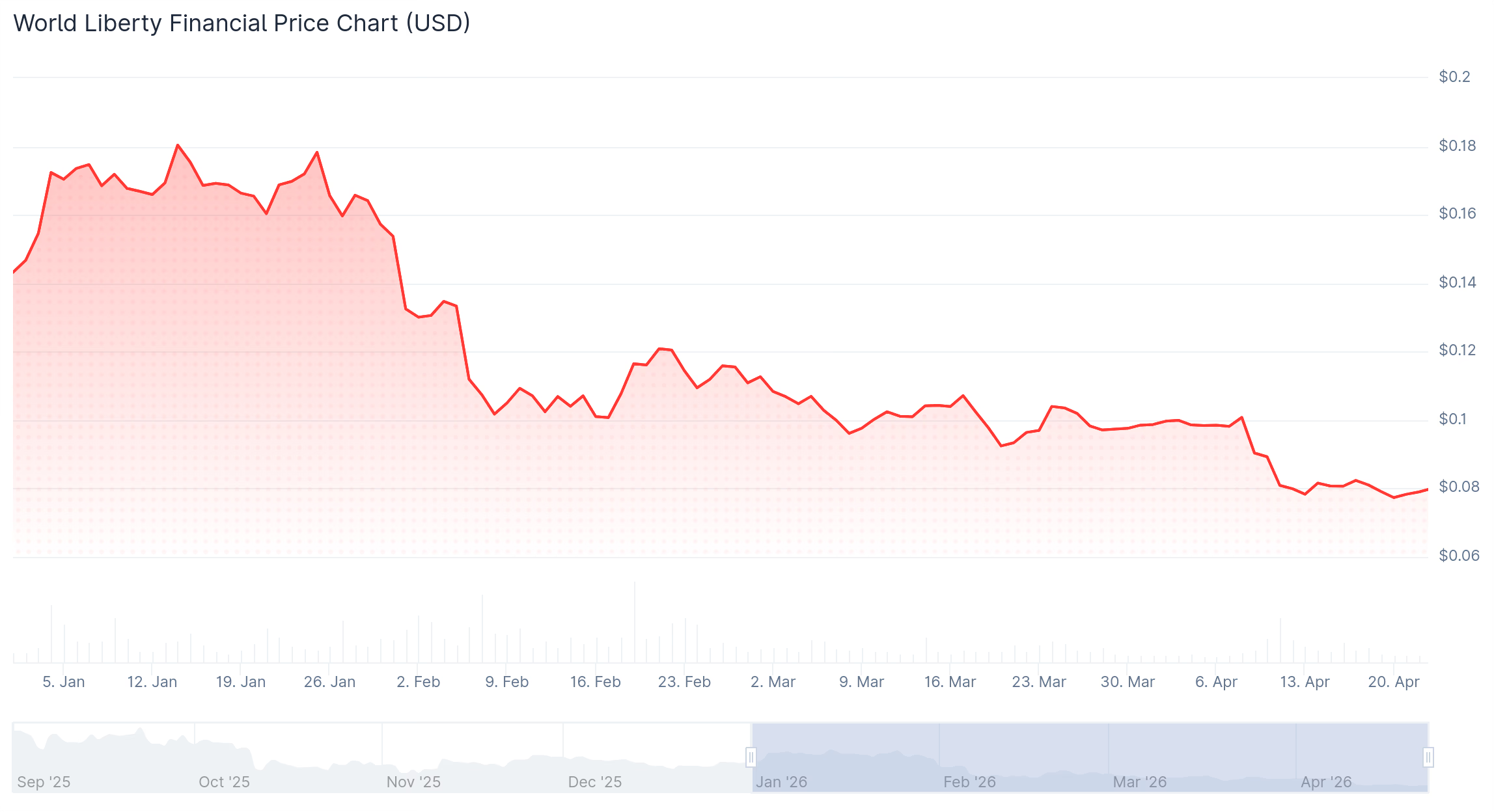
WLFI has fallen roughly 76% from its all-time high reached soon after launch, now trading around $0.08. The token is down 44% year to date.

Sun himself has previously been accused of fraud, namely by the U.S. Securities and Exchange Commission, which filed a lawsuit against Sun and three of his firms in 2023, alleging wash trading to manipulate the price of TRX.
The SEC dismissed the charges with prejudice last month.
This article was written with the assistance of AI workflows. All our stories are curated, edited and fact-checked by a human.

- SEI gained 10% to $0.062, fueled by Bitcoin’s $78k retest and positive risk sentiment.
- Rising TVL, stablecoin growth, and Giga upgrade are bullish metrics.
- A breakout from the long downtrend could allow for a retest of $0.10.
The SEI token has surged to the pivotal $0.062 level, with gains in the past 24 hours hitting double digits amid overall optimism among traders and analysts.
With Bitcoin topping $78,000 and risk appetite up, the potential for a reversal could accelerate ahead of a key network upgrade.
Sei price touches $0.062 as Bitcoin, crypto record gains
SEI token climbed to $0.062 on April 22, 2026, marking a sharp 10.5% gain over the past 24 hours amid a widespread crypto rally. Bitcoin led the charge, retesting $78,000 after consolidating near key support levels, while Ethereum and other majors posted similar advances.
The fresh uptick stems from improved global risk sentiment, as investors monitored the Iran ceasefire and its potential implications for the global economy.
Eased geopolitical tensions look to have boosted equities worldwide, with the S&P 500 and digital assets following suit.
In fact, the crypto markets’ mirroring of the positivity has pushed the total capitalization up 3% to $2.63 trillion.
The crypto fear & greed index hovers around 63, signalling overall greed.
For SEI, the uptick underscores both sensitivity to risk-on sentiment and network fundamentals.
Why are analysts bullish on SEI?
SEI bulls are largely upbeat due to robust on-chain metrics and strategic network developments.
Network activity has shown steady gains, bolstering the token’s recent price recovery. Total Value Locked (TVL) in DeFi now stands at over $146 million as fresh capital flows into DeFi protocols on the chain.
Stablecoin market cap hovers near $181 million, reflecting a 2% daily rise and solid liquidity. Meanwhile, USDY dominance at 59.43% points to efficient, concentrated capital deployment, reducing volatility risks.
A standout catalyst could emerge, as Token Relations noted recently, via Sei’s impending sunset of its Cosmos layer ahead of the Giga upgrade.
This is after Sei Labs rolled out system version 6.4, initiating a migration to Ethereum Virtual Machine (EVM) compatibility.
Developers eye the eventual decoupling of the network from Cosmos dependencies, streamlining architecture for broader interoperability.
The Giga upgrade, the next major milestone, promises transformative scalability by elevating throughput, slashing block times, and accelerating finality.
These improvements will empower high-frequency apps like decentralized exchanges, gaming platforms, and consumer dApps, potentially driving explosive demand for SEI tokens through increased usage and staking rewards.
Sei price analysis
SEI’s chart reveals a breakout to above $0.060 for the first time since late March. Although the downtrend remains, trading to highs of $0.062 could buoy bulls.
The token’s rebound from lows of $0.055 also means bulls need to clear primary resistance around $0.063-$0.065 to confirm shifting momentum.
From a technical view, gains have pushed the token above the 20-day and 50-day Exponential Moving Averages (EMAs), affirming short-term buyer control.
Volume spikes during the rally suggest conviction, with RSI climbing out of oversold territory to 60 and MACD flipping bullish.

If upside momentum holds, buyers will eye $0.078 resistance and year-to-date highs above $0.107 next.
However, a drop below $0.055 could invalidate the bullish setup and allow bears to target $0.049.


Controversial Tron founder Justin Sun has filed a lawsuit against World Liberty Financial (WLFI), accusing the Trump-linked firm of illegally freezing his WLFI tokens.
The partially redacted lawsuit, filed in a California court, accuses WLFI of various breaches of contract, unjust enrichment, fraudulent misrepresentations, and conversion regarding $45 million worth of WLFI.
Read more: Justin Sun goes to war with World Liberty Financial
The legal action has already caught the attention of Sameer Group LLC, the US, India and United Arab Emirates-based investment firm that invested $25 million in WLFI’s ICO pre-sale.
Its CEO, Syed Sameer, claimed the firm is “ready and willing to broker a fair resolution to [Sun’s] situation and have your tokens unlocked,” adding that his UAE institutional partners will work to avoid “a lengthy litigation process.”
Sun claims that he’s already attempted to persuade WLFI to unfreeze his tokens, and said that it left him “with no choice but to turn to the courts.”
“All I want is to be treated the same as every other early investor who received tokens — no better, no worse,” Sun posted on X.
Lawsuit says WLFI tried to extort Justin Sun into investing more
Sun’s lawsuit claims that “World Liberty’s operators, including Chase Herro, see [WLFI] as a golden opportunity to leverage the Trump brand to profit through fraud.”
One heavily redacted section claims WLFI extorted plaintiffs, and that it attempted to use “plaintiffs’ property rights as a bargaining chip to extort Mr. Sun into providing additional capital for World Liberty.”
The Trump family are key to World Liberty Financial’s brand. Donald Trump is listed as the firm’s “chief crypto advocate,” while his sons Eric, Donald Jr, and Barron are listed as co-founders.
They were previously web3 ambassadors.
As such, the lawsuit threatens the relationship Sun has struck with the Trump administration over the years. Sun’s statements reflect this as he tries to appease Trump.
Sun stressed that he remains an “ardent supporter” of the president, and that the lawsuit “does not change how I feel about President Trump or the Trump Administration.”
Read more: Justin Sun wants World Liberty Financial to unmask its X admin
Another allegation claims that Sun was unfairly locked out of governance votes on WLFI’s company changes after it froze and refroze his tokens through a secret “blacklisting” smart contract update.
Sun is also worried that WLFI will carry out alleged threats to burn his tokens through another governance proposal that he can’t vote on.
The lawsuit includes claims that WLFI made several defamatory statements towards Sun, accusing him of theft and misappropriating tokens.
However, the lawsuit clarifies that these defamation claims are separate from the legal allegations and that Sun may initiate separate proceedings regarding WLFI’s alleged false and defamatory statements.
Justin Sun’s lawsuit seeks relief in the form of a restraining order that would bar WLFI from ever “seizing, burning, destroying, or encumbering any of Plaintiffs’ $WLFI tokens.”
Got a tip? Send us an email securely via Protos Leaks. For more informed news and investigations, follow us on X, Bluesky, and Google News, or subscribe to our YouTube channel.
Crypto World
SoFi Just Added Ripple XRP for 13.7 Million Banking Customers: Is Mainstream Adoption Finally Catching Up to the Price?

Ripple (XRP) is trading at $1.45 up 1.00% in 24 hours, as a wave of institutional and banking adoption signals suggest the asset’s fundamentals are outpacing its current chart.
The bigger story isn’t the dip, it’s what’s building underneath it. SoFi Technologies, a nationally chartered U.S. bank regulated by the OCC, announced on April 21 that it now supports XRP deposits for its 13.7 million users.
That puts Ripple XRP alongside Bitcoin, Ethereum, and Solana in a single regulated app where customers already handle everyday banking, bill payments, balance checks, the works.
More access to $XRP with @SoFi means more people can participate, and that's exactly how utility grows. — Ripple (@Ripple) April 21, 2026
 https://t.co/IqxZGvM4cJ
Ripple responded directly on X: “More access to XRP with SoFi means more people can participate, and that’s exactly how utility grows.” Meanwhile, XRP Ledger RWA activity has surged 875%, and institutions including BlackRock are showing growing interest in the asset class. The technical picture, though, tells a more complicated story.
Can Ripple XRP Price Hit $2.80 Before the Next Resistance Wall Breaks?
XRP is consolidating between $1.30 and $1.50 after briefly spiking above $1.50 before retracing sharply.
The 50-day moving average at $1.40 has flipped to support, a meaningful structural shift. A bullish MACD crossover, the first in months, is emerging from the shakeout.
Analysts are calling it a pressure-cooker setup, holding tighter than prior consolidation phases, with energy building underneath. 24-hour trading volume surged 86.8% to $5.9 billion at the peak before settling back toward $2.5 billion, still elevated relative to recent averages.
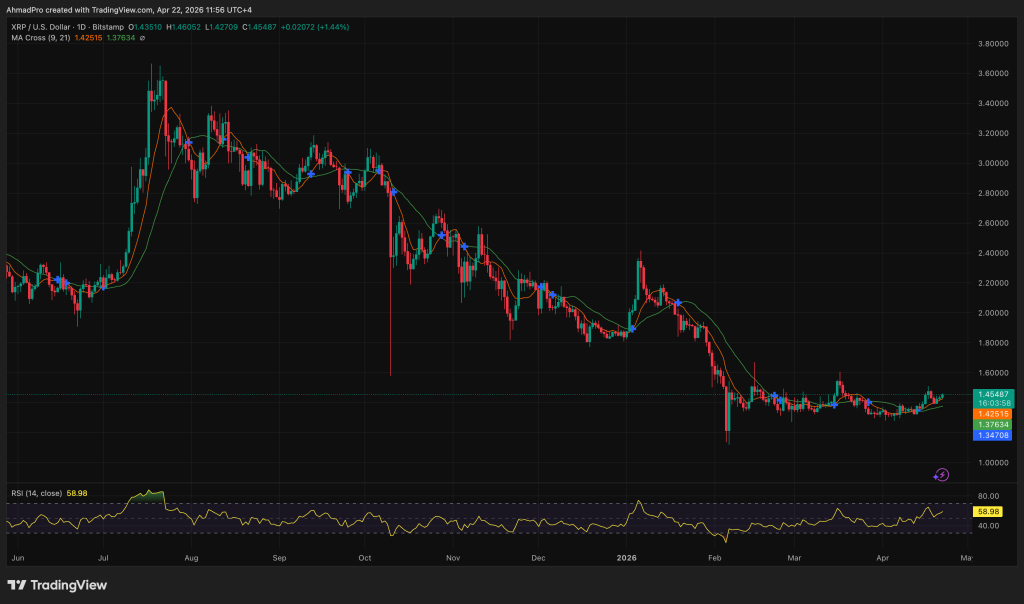
A clean break above $1.57 opens the path to $2.80, with some analysts targeting $8 on sustained momentum. Quantum-resistance upgrades planned for the XRP Ledger by 2028 add a long-term credibility layer that strengthens the bull thesis. SoFi adoption and $55 million in XRP ETF inflows are providing a floor and keeping the range supported through Q2.
The invalidation level is $1.30. A daily close below it breaks the bullish structure and opens a retest of sub-$1.00 levels that bears have been flagging.
The CLARITY Act remains the wildcard. On-chain Ripple transfers continue drawing regulatory scrutiny and any adverse policy signal compresses the range fast. SoFi’s integration validates the institutional adoption narrative but the question is whether that catalyst is already priced in at current levels.
Bitcoin Hyper Targets Early-Mover Upside as XRP Tests Key Levels
XRP’s adoption story is real, but at an $87.5B market cap, the upside math demands significant capital inflows just to move the needle.
Traders hunting asymmetric setups are rotating attention toward earlier-stage infrastructure plays — and one presale is pulling serious capital right now.
Bitcoin Hyper ($HYPER) is positioning as the first-ever Bitcoin Layer 2 with Solana Virtual Machine (SVM) integration, delivering smart contract execution that its team claims outperforms Solana itself in latency benchmarks.
The project targets Bitcoin’s core bottlenecks directly: slow transactions, high fees, and zero programmability.
A Decentralized Canonical Bridge handles BTC transfers natively, preserving Bitcoin’s security while enabling high-speed, low-cost execution on top. The presale has raised $32,474,198.00 at a current price of $0.0136789, with staking rewards already live (specific APY undisclosed at this stage).
That fundraising pace, at this price point, reflects genuine conviction. Presales carry significant risk; there’s no liquidity guarantee and no launch timeline certainty.
Research Bitcoin Hyper before allocating.
The post SoFi Just Added Ripple XRP for 13.7 Million Banking Customers: Is Mainstream Adoption Finally Catching Up to the Price? appeared first on Cryptonews.


Sameer Group CEO Syed Sameer is offering to broker a private deal to unfreeze Justin Sun’s blacklisted WLFI tokens, drawing backlash from retail holders shut out of negotiations.
Summary
- Sameer Group CEO Syed Sameer has publicly offered to broker a deal to unfreeze Justin Sun’s blacklisted WLFI tokens.
- The outreach comes after Sun filed a federal lawsuit against World Liberty Financial in California over allegedly locked tokens.
- Retail investors are already pushing back, calling the proposal unfair if it benefits Sun but not the broader WLFI community.
Syed Sameer, CEO of Sameer Group LLC, has put himself forward as an institutional mediator in the escalating fight between Justin Sun and World Liberty Financial (WLFI) over frozen WLFI tokens.
Tagging Sun directly, Sameer wrote that as “one of the largest institutional $WLFI holders alongside Aryam 1 & Aqua 1 ($300M+ combined), we are ready and willing to broker a fair resolution to your situation and have your tokens unlocked.”
The offer landed hours after Sun announced, “Today, I filed a lawsuit in California federal court against World Liberty Financial to protect my legal rights as a holder of $WLFI tokens,” stressing that he “remain[s] an ardent supporter of President Trump and his Administration’s efforts to make America crypto friendly.”
Sameer framed his proposal as a fast track compared with courtroom escalation, saying his UAE institutional partners could “facilitate this equitably and quickly through our established channels while avoiding a lengthy litigation process,” and inviting Sun to discuss terms via DM, Signal, or email.
Crucially, Sameer later clarified that the intervention targets blacklisting, not vesting mechanics.
Responding to community criticism, he wrote, “This is specifically about unfreezing / whitelisting Sun’s tokens – they are blacklisted and not just locked,” and then corrected himself: “Sorry – I meant unfrozen / reversing the blacklisting of his tokens. This has nothing to do with locks / vesting schedule.”
That distinction hasn’t calmed the backlash. One user argued, “That’s unfair resolution who will mediate for other community members their token are unjustly locked with authoritarian governance,” while another said, “The proposal is horrible 2 year cliff is not needed,” accusing WLFI’s vesting setup of being a “scam” that “no one in the community deserves nor voted for.”
Others zoomed out to the optics. Critics mocked the spectacle of “the world biggest scammer” being scammed and institutions trying to clean it up; another replied that WLFI “wouldn’t need to contact 3rd part intermediaries if WLFI kept their promise… Unlocked = unlocked Not back door locked via hidden code…,” highlighting fears of hidden control logic in the contract.
Sameer, who describes himself on X as managing “$650M+ AUM” and an institutional partner of the Solana Foundation, is effectively offering a private, big‑holder backchannel to resolve Sun’s claim while the rest of the WLFI community watches from the cheap seats. Whether that becomes a template — where large, politically connected token holders negotiate bespoke fixes while smaller investors are left to litigate or cope — will decide if this episode reads as pragmatic damage control or as the latest example of two‑tier justice in crypto.

Pudgy Penguins’ PENGU token is posting double-digit gains while memecoins start popping up in every crypto feed. Trading near $0.0086, PENGU is outperforming Bitcoin by flying past 10% today. The move follows a cluster of ecosystem catalysts as Bitcoin pushes back toward $78,000.
The rally arrives on the back of the Visa Pengu Card launch last month, the Pudgy Party gaming rollout since last year, and whale accumulation visible in on-chain data. The NFT sales are also up 23% week-over-week, and trading volumes hit $736 million at peak.
What's your victory dance when you win a game in Pudgy Party? — Pudgy Party (@PlayPudgyParty) April 20, 2026
Drop it below using a Pudgy Penguins GIF pic.twitter.com/xWh1qezJBp
Meanwhile, Bitcoin’s $78,000 level triggered $418 million in liquidations, more than $286 million from short sellers caught leaning the wrong way, compressing spreads and amplifying upside velocity across high-beta assets. PENGU, with a 30% volume-to-market-cap ratio, sits squarely in that category.
Discover: The best pre-launch token sales
Can PENGU Crypto Hit Double to $0.016 This Week?
PENGU is currently consolidating at $0.008-$0.009, having defended the 20-day EMA at $0.0061 through multiple tests. The RSI reading is 55, neutral, which leaves room for continuation without an immediate technical rejection.
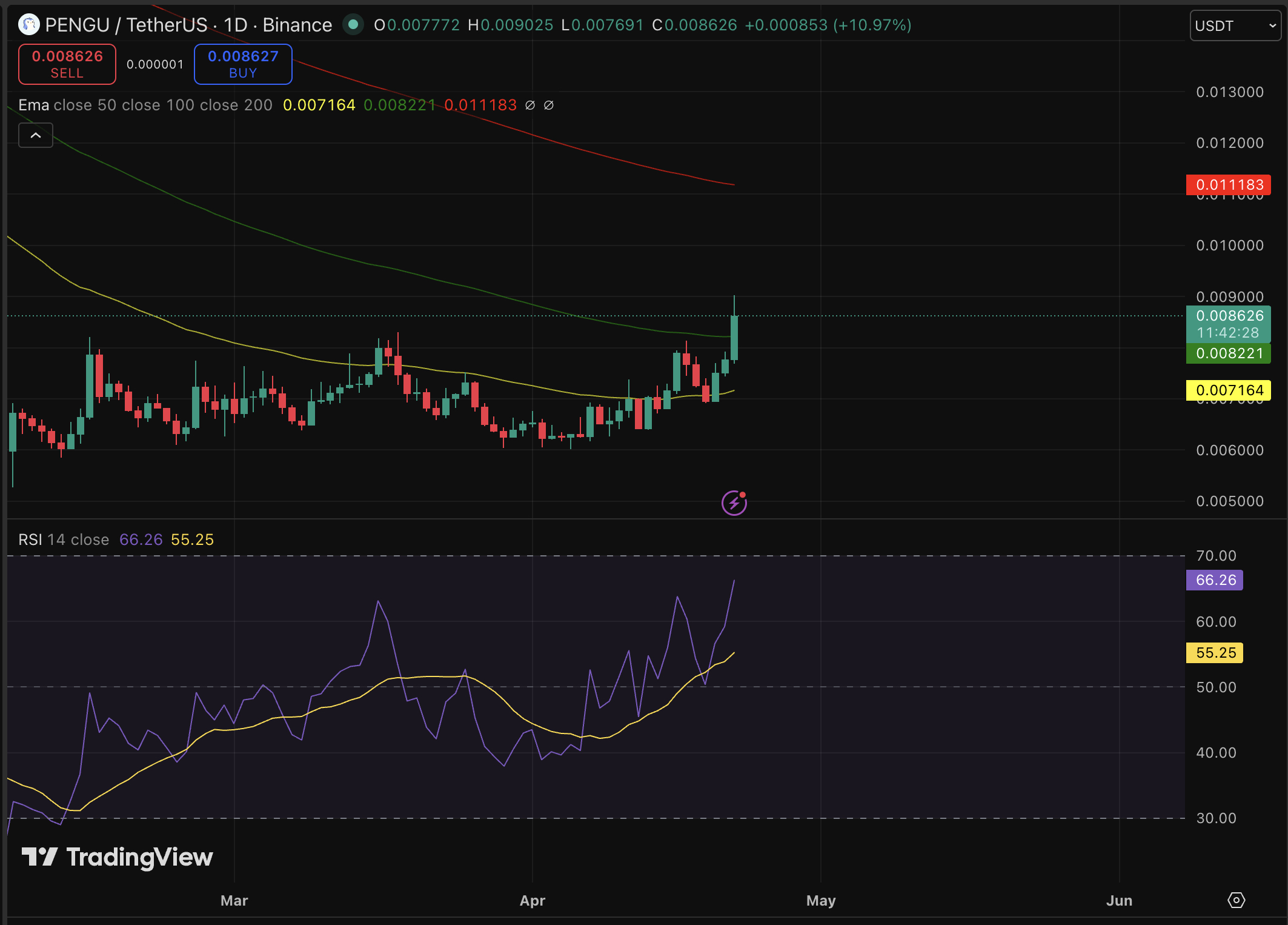
Volume on the latest leg is almost crossing $200 million, a figure that signals institutional-scale participation, not just retail rotation. The critical resistance sits at $0.009, very close to the current level.
The community describes “steady accumulation” nearing that test, with the price action characterized by gradual higher lows rather than volatile spikes, the fingerprint of whale buying rather than momentum chasing.
Utility memecoins that combine social traction with on-chain accumulation have repeatedly shown the capacity to compress resistance zones quickly once volume confirms.
For PENGU, a clean break above $0.009 might open the path to $0.016–$0.019 resistance, with analysts targeting $0.021–$0.045 on a sustained breakout. The 870,000+ holder base and 100 billion-plus social views give PENGU a demand floor most meme tokens simply lack.
Discover: The best crypto to diversify your portfolio with
Bitcoin Hyper Targets Early Mover Upside as PENGU Tests Key Resistance
PENGU’s 7-day gain of 25% is compelling, but at its current market cap, capturing a 10x from here requires a substantially different bet than entering when accumulation was just beginning. That gap between now and the early stage is exactly where some traders are redirecting attention.
Bitcoin Hyper is currently in presale at $0.0136, having raised $32 million, a figure that reflects serious capital formation without yet reaching the price discovery phase.
The project’s core is structurally gold. It’s positioned as the first Bitcoin Layer 2 with Solana Virtual Machine integration, delivering sub-second transaction finality while inheriting Bitcoin’s security. That means fast, low-cost smart contracts executed on Bitcoin’s trust layer, breaking the traditional tradeoff between programmability and security.
Staking is live with a high 36% APY, giving presale participants yield exposure while the project develops. The presale has been gaining traction in parallel with Bitcoin’s recent rebound toward $78,100, suggesting macro momentum is feeding early-stage interest.
Research Bitcoin Hyper before the presale closes.
The post Penguins Can Fly: PENGU Crypto Notes Huge Gain as Utility Memecoin Heats Up appeared first on Cryptonews.


CFTC‑regulated prediction market Kalshi is wiring Pyth’s oracle and Pyth Pro feeds into its new commodities hub, using first‑party prices to settle gold, oil, gas, and grain event contracts.
Summary
- CFTC‑regulated prediction market Kalshi has selected Pyth as the contract settlement data source for its new commodities center.
- The integration covers gold, silver, Brent crude, natural gas, copper, corn, soybeans, and wheat, with Pyth Pro feeding direct market data to Kalshi’s market makers.
- Pyth and Kalshi frame the move as laying infrastructure for event contracts across commodities today, and indices, stocks, and FX next.
Pyth Network is extending its oracle footprint into the heart of regulated prediction markets, becoming the settlement data provider for Kalshi’s newly launched commodities hub.
Kalshi, which operates as a CFTC‑regulated event exchange in the US, said it has integrated Pyth as the reference price source for commodity‑linked contracts covering gold, silver, Brent crude oil, natural gas, copper, corn, soybeans, and wheat.
In an announcement, Kalshi said Pyth will “power settlement prices for our commodities center,” adding that the integration is meant to “support continuous trading and reliable settlement” for its event contracts tied to underlying commodity levels.
The platform’s new commodities hub expands existing oil and precious‑metals markets into a broader suite that now also includes agricultural products and base metals, offering traders yes/no contracts on questions like whether crude or wheat will breach specific price thresholds within a given time window.
Pyth, for its part, is using the deal to push deeper into institutional‑grade data services. Alongside the public oracle feeds, the project’s Pyth Pro product will provide direct market data access to Kalshi’s market makers, who need low‑latency pricing to quote tight markets and manage risk on fast‑moving commodities.
According to Pyth contributors, Pyth Pro is designed as a subscription layer delivering “institutional‑grade market data across cryptocurrencies, equities, fixed income, commodities, and foreign exchange,” built on first‑party price contributions from exchanges and market makers
The Kalshi integration will start with commodities but is expected to extend that model to additional asset classes, with Pyth saying it plans to expand coverage to indices, single‑name stocks, and FX pairs used in future Kalshi contracts.
The partnership also tightens the feedback loop between TradFi‑style event contracts and on‑chain infrastructure.
Pyth has pitched itself as “the largest first‑party financial data protocol,” with over 2,000 real‑time feeds spanning digital assets, equities, ETFs, FX, and commodities; Kalshi, as “the leading CFTC‑regulated event exchange,” now effectively becomes both a consumer of that data for settlement and a producer of event‑probability data that can itself be streamed onchain.

Google Unveils Two New AI Chips For the ‘Agentic Era’

Car fire in Westhoughton prompts emergency response

Annaly Capital Management, Inc. (NLY) Q1 2026 Earnings Call Transcript

Manchester United reach agreement with Casemiro over contract clause amid transfer speculation

Steven Gerrard disagrees with Gary Neville over ‘shock’ Chelsea and Arsenal claim | Football

US brings back mandatory military draft registration


-

 Fashion5 days ago
Weekend Open Thread: Theodora Dress
-

 Sports5 days ago
NWFL Suspends Two Players Over Post-Match Clash in Ado-Ekiti
-

 Politics5 days ago
Palestine barred from entering Canada for FIFA Congress
-
Entertainment3 days ago
NBA Analyst Charles Barkley Chimes in on Ice Spice McDonald’s Fiasco
-

 Business3 days ago
Powerball Result April 18, 2026: No Jackpot Winner in Powerball Draw: $75 Million Rolls Over
-

 Tech4 days ago
Auto Enthusiast Scores Running Tesla Model 3 for Two Grand and Turns It Into Bare-Bones Go-Kart
-

 Politics3 days ago
Zack Polanski demands ‘council homes not luxury flats for foreign investors’
-

 Crypto World5 days ago
Russia Pushes Bill to Criminalize Unregistered Crypto Services
-

 Politics2 days ago
Gary Stevenson delivers timely reminder to register to vote as deadline TODAY
-

 Tech7 days ago
‘Avatar: Aang, The Last Airbender’ Leaked Online. Some Fans Say Paramount Deserves the Fallout
-
 Business6 days ago
Creo Medical agree sale of its manufacturing operation
-

 Business8 hours ago
Rolls-Royce Voted UK’s Most Iconic Trade Mark as IPO Register Hits 150
-

 Crypto World5 days ago
Russia Introduces Bill To Criminalize Unregistered Crypto Services
-
 Crypto World4 days ago
Kelp DAO rsETH Bridge Hack Drains $292M as DeFi Losses Top $600M in Two Weeks
-

 Sports7 days ago
British climbers complete new route in Swiss Alps
-

 Tech7 days ago
Ford EV and tech chief leaving automaker
-

 Sports7 days ago
“Felt Much Better Today”: Josh Hazlewood Opens Up On His Recovery Win Over LSG
-

 Business6 days ago
Cheaper Doritos and Lays helps PepsiCo win back struggling snackers
-

 Entertainment7 days ago
Ruby Rose Accuses Katy Perry Of Sexual Assault, Police React
-
 Entertainment6 days ago
Clavicular Says Streaming May Not Work Without Substances
You must be logged in to post a comment Login