
Crypto World
World Liberty accuses Justin Sun of ‘misconduct’ in response to Tron founder’s defamation claims



Ten months ago, Eric Trump was posting on X about how much he loved Justin Sun. This week, he’s likening a lawsuit from Sun to the infamous $6 million duct-taped banana.
Sun filed a complaint Monday in the Northern District of California, accusing World Liberty Financial of illegally freezing roughly four billion $WLFI tokens worth around $1 billion. The Trump-family-backed DeFi venture’s informal Tuesday response dismissed the suit as a “desperate” deflection and pledged to keep protecting its users, with co-founder Zach Witkoff accusing Sun of “misconduct.”
Justin Sun’s recent lawsuit against @worldlibertyfi is a desperate attempt to deflect attention from Sun’s own misconduct. His claims are entirely meritless, and World Liberty looks forward to getting the case thrown out promptly.
He engaged in misconduct that required World…
— Zach Witkoff (@ZachWitkoff) April 22, 2026
Neither he nor the company spelled out Sun’s alleged misconduct. A spokesperson for the firm declined to comment, instead referring CoinDesk to Witkoff and fellow co-founder Eric Trump’s posts on X.
The complaint itself may fill in the blanks. Sun alleged that World Liberty leveled a shifting set of accusations against him in private conversations and correspondence, none of which, he argued, the company has backed up with evidence.
According to the filing, World Liberty has at various points blamed Sun for the roughly 40% price crash $WLFI experienced on Sept. 1, 2025, the first day the token became tradable.
WLFI also claimed Sun drove down the price by short-selling perpetual futures on a centralized exchange, according to Sun’s complaint, an accusation Sun said is false, and that the complaint notes would be difficult to pin on him, given his transfers happened hours after the steepest drop.
World Liberty separately objected to Sun’s $100 million purchase of $TRUMP tokens from a different Trump-backed project, according to the filing, but Sun said this buy got the blessing of a Trump family member who is a partner in both ventures.
The company allegedly also accused Sun of acting as a straw purchaser for other investors in violation of his token purchase agreement, executing prohibited transfers to the exchanges HTX and Binance and submitting inadequate know-your-customer documentation, according to the filing.
“On September 25, 2025, Mr. Herro repeatedly threatened to report Mr. Sun to U.S. criminal authorities over these unspecified KYC issues — which Mr. Herro and World Liberty have refused to explain in anything other than the broadest terms despite repeated requests from Plaintiffs for additional information,” Tuesday’s filing said.
WLFI has yet to file a response to Sun’s suit.


Key takeaways
- Hyperliquid holds steady around $40 on Thursday, up 1.1% in the last 24 hours.
- The negative funding rate gives HYPE a mixed signal in the market.
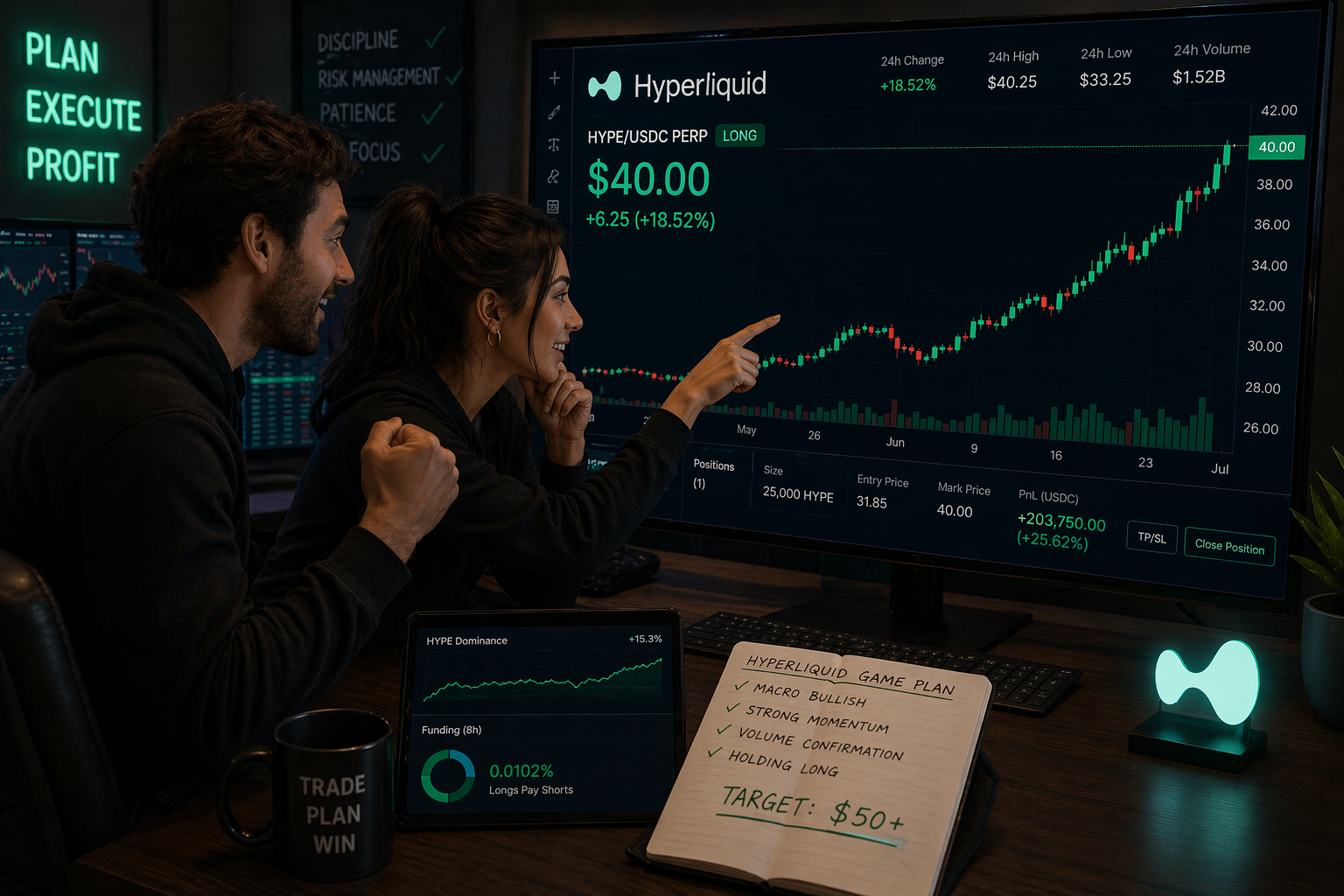
Hyperliquid (HYPE) is trading around $40.95 at press time on Thursday, stabilizing after a 3%+ gain in the previous session.
While the decentralized exchange (DEX) token has managed to hold recent levels, weakening retail demand in the leverage market and a developing rising wedge pattern on the chart are keeping the broader outlook neutral-to-bearish.
HYPE’s futures market suggests a cooling demand
HYPE initially attracted strong retail interest during heightened geopolitical tensions around the US–Iran situation and the Strait of Hormuz, as its platform enabled 24/7 trading of commodities such as oil and precious metals.
However, as geopolitical pressure eased following signals of extended diplomatic timelines, speculative interest in the token has started to fade.
Data from CoinGlass shows HYPE futures open interest at about $1.63 billion, moving mostly sideways—an indication that trader participation has plateaued.
Meanwhile, the funding rate sits at -0.0061%, suggesting a growing tilt toward short positioning as traders increasingly bet on downside risk.
Technical outlook: Bears could push the price lower
The HYPE/USD 4-hour chart is bearish and efficient as HYPE remains supported above both the 50-day Exponential Moving Average (EMA) near $38.46 and the 200-day EMA around $34.51.
The 4-hour structure is forming a rising wedge pattern, typically considered a bearish setup when momentum weakens. The momentum indicators also paint a bearish picture.
The MACD remains in negative territory, signaling fading bullish strength, while the RSI at 47 reflects a growing bearish condition.

If the sellers remain in control, they would encounter immediate support at the trendline near $40.33. A break below this level could open a path toward the 50-day EMA at $38.46, followed by stronger support near the 200-day EMA at $34.51.
However, if the bulls push higher, resistance is first seen at $43.71, with further upside capped near $45.77 at the upper trendline boundary.
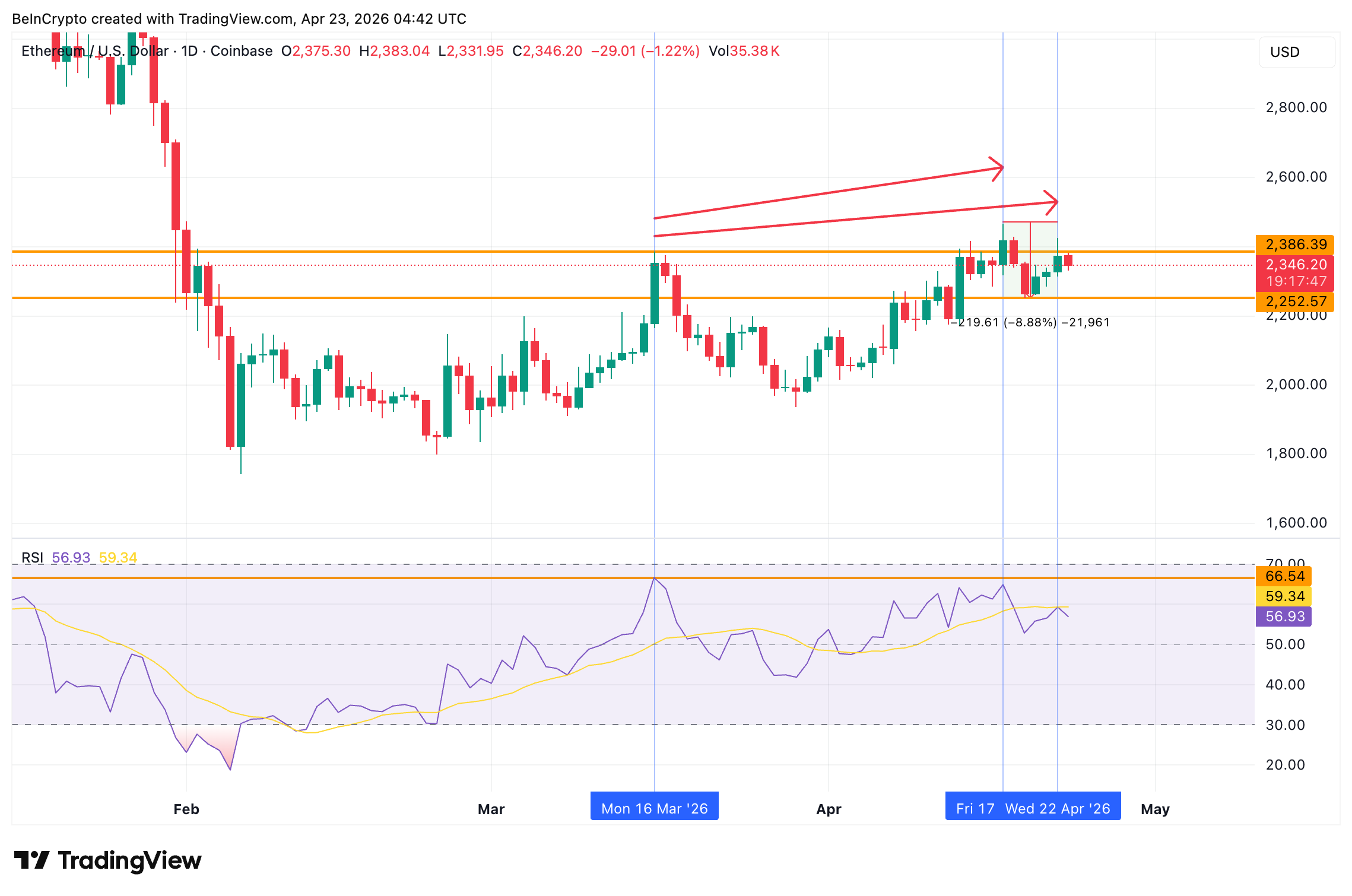
Ethereum (ETH) price is flashing the same bearish warning that preceded a near 9% correction last week, with the signal reappearing on April 22.
However, underlying positioning has shifted. Whale accumulation and a flip in funding rate suggest the path this time could differ from the April 17 unwind, even though the core divergence remains intact.
RSI Divergence Flashes a Second Time as Whales Shift Stance
Ethereum (ETH) price is flashing a regular bearish divergence for the second time in five weeks. The Relative Strength Index (RSI), a momentum indicator, peaked at 66.54 on March 16. When price pushed to a higher high on April 22, RSI failed to match that peak, leaving a lower high on the oscillator. The reading signals weakening momentum.
The same pattern appeared between March 16 and April 17. Back then, it triggered an 8.88% correction before ETH found its footing at $2,252.
Want more token insights like this? Sign up for Editor Harsh Notariya’s Daily Crypto Newsletter here.
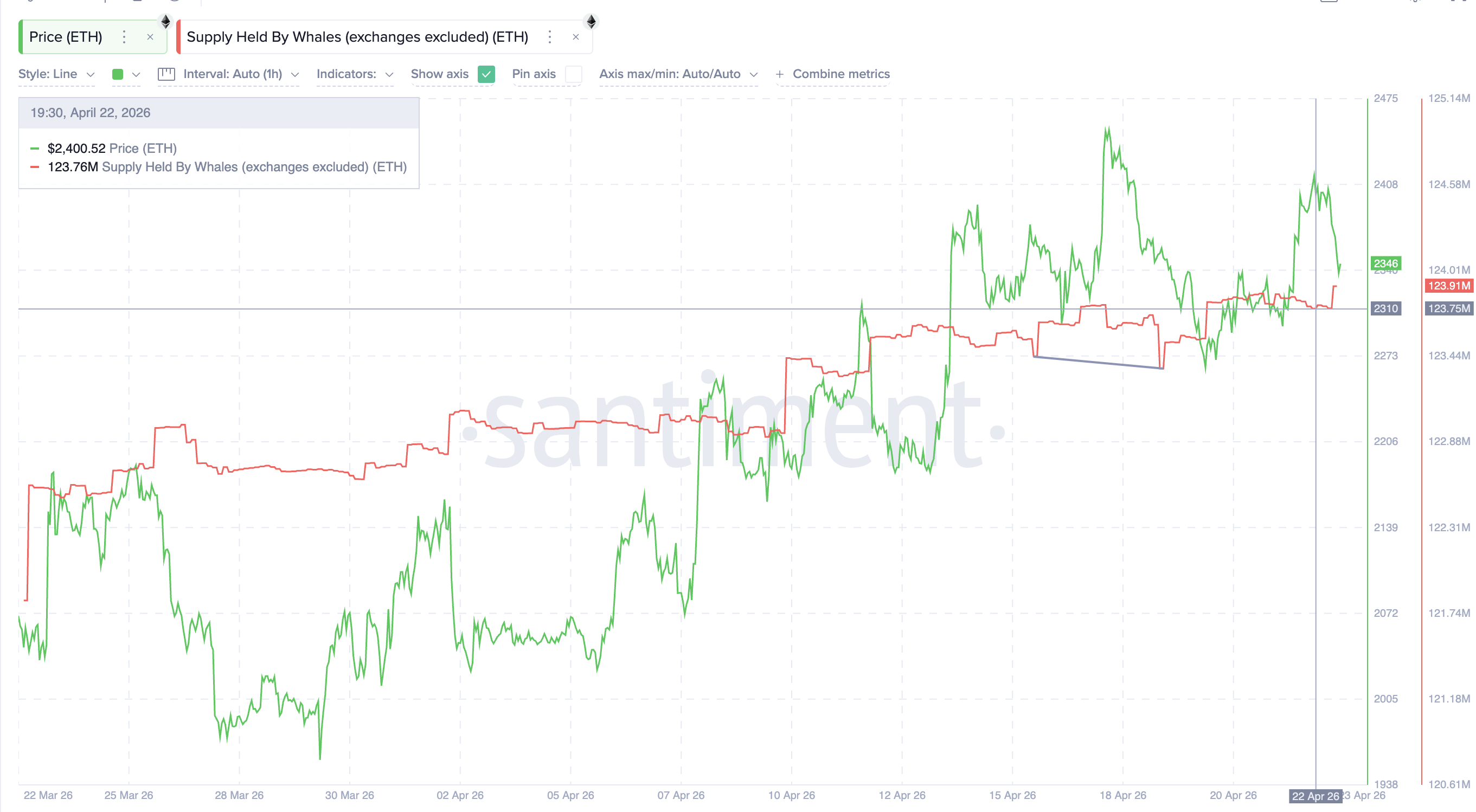
However, whale behavior looks different this time. The data suggests Ethereum whales may have begun adding supply again. Their holdings rose from 123.75 million on April 19 to 123.91 million by April 22.
In contrast, during the April 16-19 unwind, whales dumped reserves as price corrected. The shift in positioning suggests a different backdrop, though the divergence itself remains active. However, traders must keep an eye on whale positioning going ahead as this cohort as a tendency to drop reserves suddenly.
Whether funding rate and open interest confirm this shift determines whether the divergence produces another deep pullback.
Funding Rate Flip Contrasts With Last Week’s Setup
The derivatives market shows a different positioning setup versus mid-April. ETH open interest sits near $12.3 billion, comparable to the reading when the April 17 divergence fired. However, Ethereum funding rate has flipped.
On April 17, funding sat at -0.003%, pointing to a short-biased market. That short-biased skew set up a squeeze dynamic. Once price reversed off the April 19 low (after the divergence played out), the trapped shorts had to cover, which helped fuel the rebound. In contrast, funding rate now sits slightly positive, implying traders are leaning long.
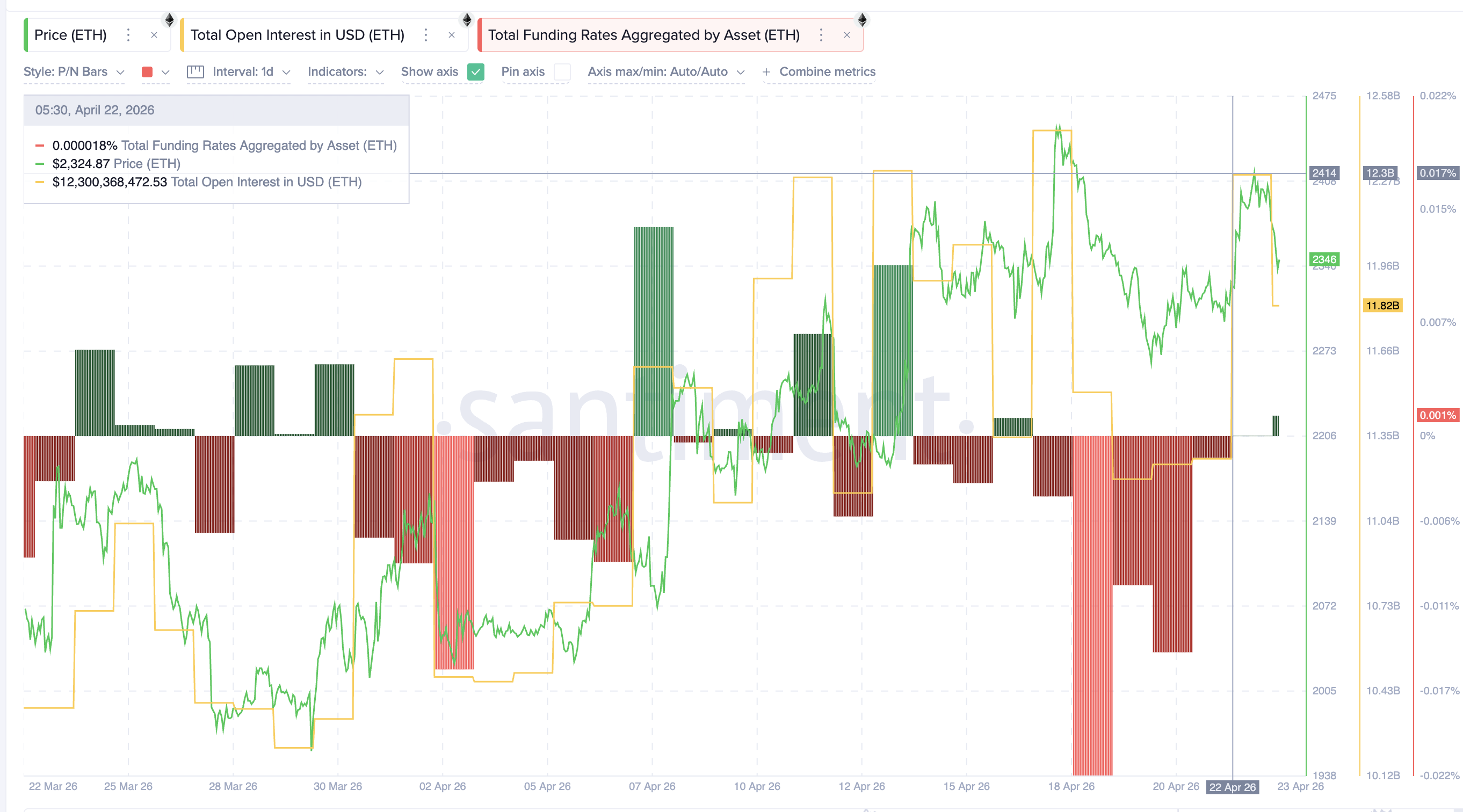
The shift matters. Long-biased positioning, albeit mild, facing a bearish divergence creates the opposite setup from last week. If a pullback does start, long liquidations would amplify the downside rather than squeeze shorts into a rebound. Yet funding rates remain far from the extremes needed to force an immediate squeeze in either direction.
With whale flow supporting the upside but positioning leaning long, the Ethereum price chart becomes the decider.
Key Ethereum Price Levels Define the Next Move
The ETH price chart lays out the decision zones. For invalidation of the bearish setup, ETH needs to close above $2,377, the 0.236 Fibonacci level, which currently caps the bounce.
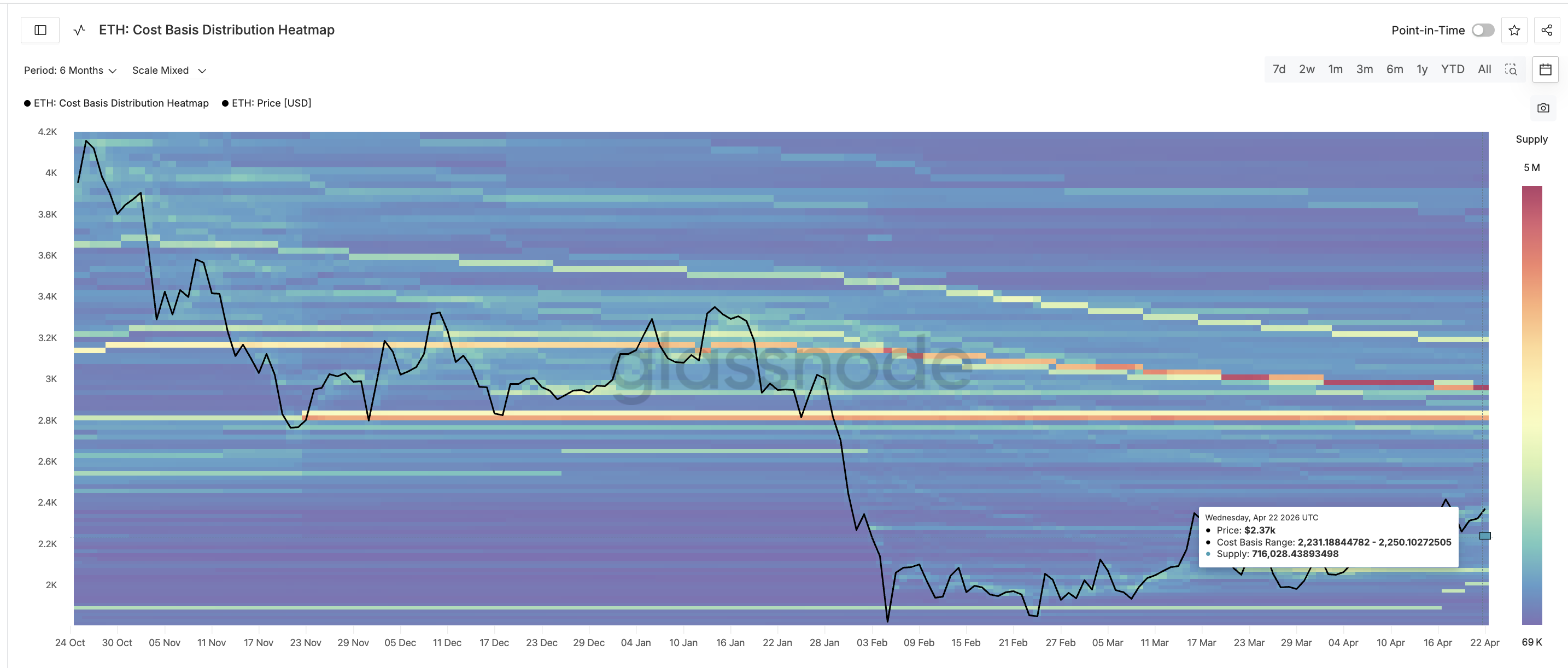
The downside case hinges on whales holding their current stance. If ETH cannot reclaim $2,377 and whale reserves drop, the $2,252 level becomes the first test, mentioned earlier. That level aligns with a concentrated ETH cost basis cluster.
Glassnode data shows 716,028 ETH sitting between $2,231 and $2,250 in cost basis terms. Holders at this cost basis did not sell during the April 17-19 correction. That is likely why $2,252 held as support last time.
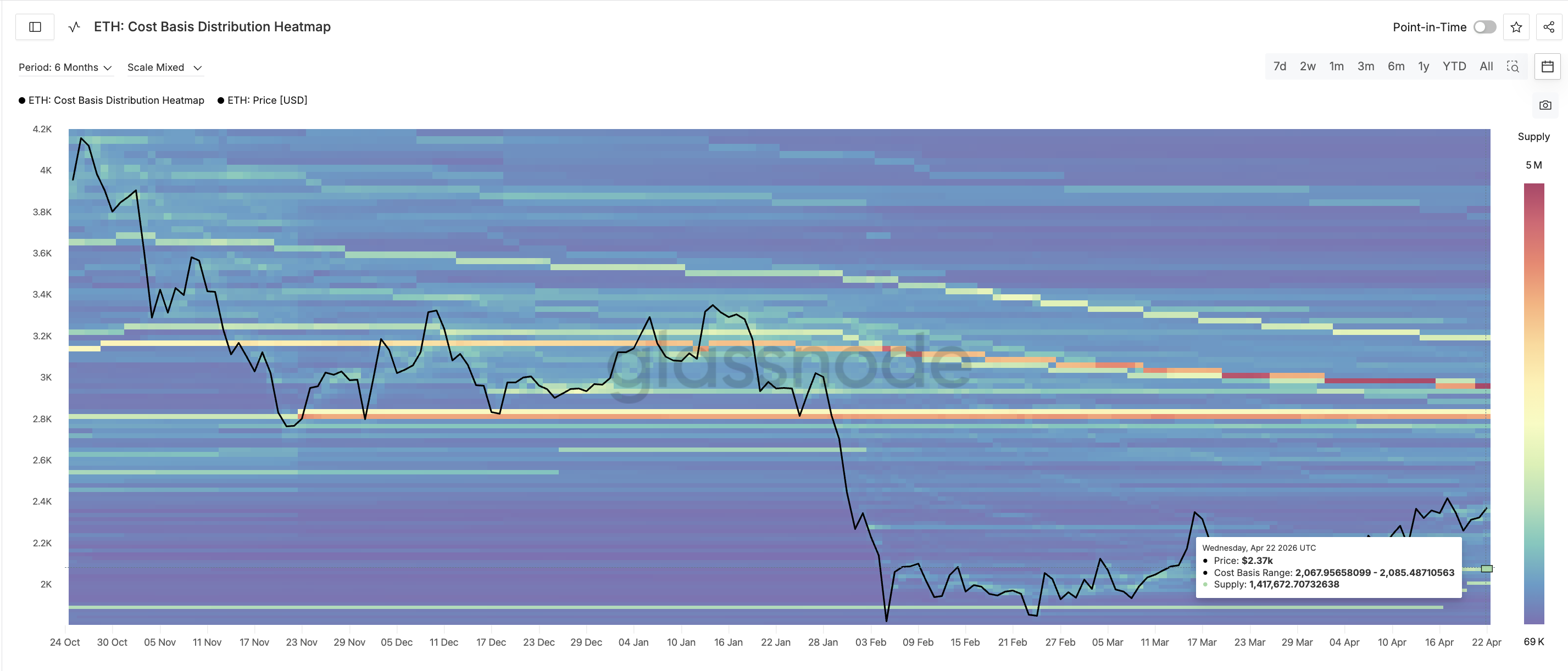
If $2,252 fails, the next key demand zone sits between $2,067 and $2,085. That cluster holds 1,417,672 ETH at cost basis, nearly double the supply anchored at the $2,252 level.
A break below that exposes lower levels on the ETH price chart, something around $1,935.
One nuance matters. The divergence is active, but whale flow has shifted since April 17. A correction may not play out as deeply this time. However, a sustained whale distribution would strip away the primary difference between last week’s setup and today’s.
A daily close above $2,455, the 0.382 Fib, opens a path toward $2,517. Extended targets sit at $2,580, $2,783, and $3,112.
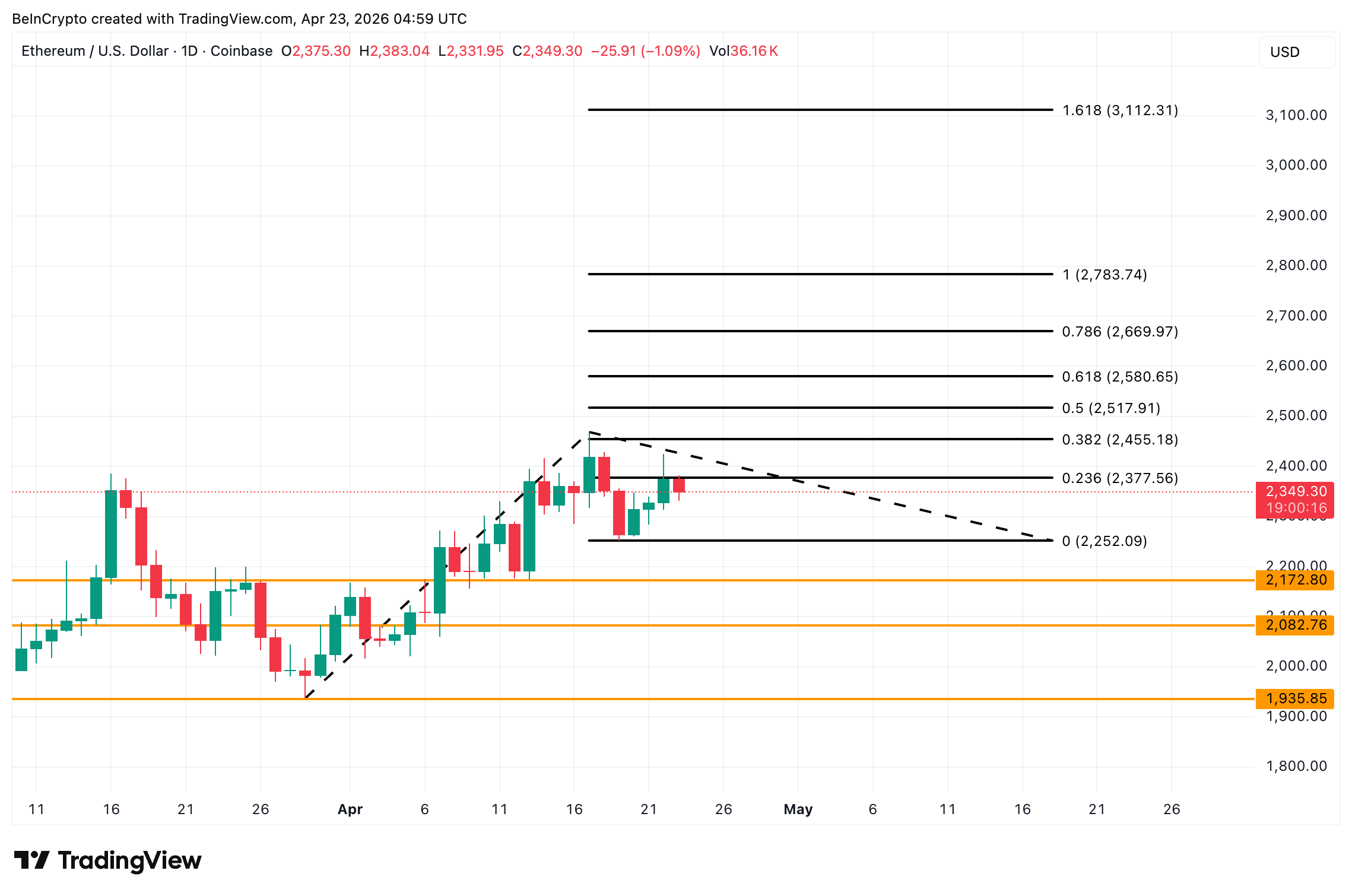
However, if $2,252 breaks, the chart has a key level at $2,082, which aligns with the biggest demand zone above $2,000. This means that the $2,252 level separates a shallow pullback from a deeper flush into the 1.4-million-ETH cost basis zone.
The post Ethereum Price Warning Fires Again After a 9% Drop Last Week appeared first on BeInCrypto.
Crypto World
Bankman-Fried’s FTX sold its Cursor stake for $200,000 in 2023. It would be worth $3 billion today


A 5% stake in AI coding startup Cursor that FTX’s bankruptcy estate sold for $200,000 in April 2023 would be worth about $3 billion today, following SpaceX’s agreement this week to acquire the company at a $60 billion valuation.
SpaceX said Monday it has the right to buy Cursor later this year for $60 billion or to pay $10 billion if the full acquisition does not proceed. The deal is founder Elon Musk’s move to close the gap with OpenAI and Anthropic on AI coding tools, an area where he recently said xAI, the Musk-run AI company that merged with SpaceX, is behind competitors.
SpaceX is holding off on immediate acquisition because of its planned initial public offering targeting a $2 trillion valuation, with the $10 billion serving as a breakup fee.
The crypto angle sits in the cap table. In April 2022, Alameda Research, the trading firm founded by Sam Bankman-Fried and run alongside FTX, invested $200,000 in Anysphere, the company that builds Cursor.
That investment bought roughly 5% of the company at a $4 million valuation. One year later FTX had collapsed, Alameda and FTX were in bankruptcy, and the court-appointed estate sold the Cursor stake for the same $200,000 Alameda had paid.
The stake is worth $3 billion at SpaceX’s $60 billion price tag, meaning the gap between what the FTX estate received and what the position would fetch today is roughly a 15,000x return. It was instead realized by whoever bought it from the bankruptcy rather than the creditors the estate was supposed to be maximizing recovery for.
The timing cuts awkwardly for FTX’s bankruptcy administration.
Bankman-Fried, currently serving a 25-year federal sentence, has spent the past year arguing from prison that FTX’s estate destroyed billions in value by liquidating assets too quickly during the bankruptcy, and that customers could have been made more than whole if the process had held positions instead of selling them into what turned out to be the bottom of crypto prices.
In February, he shared a projection suggesting FTX’s net asset value would have reached $78 billion if the estate had held assets through the subsequent recovery rather than selling in 2023 and 2024.
Cursor launched its AI coding product in early 2023, the same year the estate sold the stake, and the company’s trajectory from that launch to its current valuation three years later is among the steepest in software startup history.
FTX customers have since been made whole in dollar terms under the bankruptcy’s distribution plan, receiving back their claim values plus interest. What they did not receive is the upside from what those assets became between the bankruptcy filing and now, which in the case of the Cursor stake alone represents about $3 billion of forgone recovery against $200,000 realized.
Bankman-Fried’s parents have publicly advocated for a pardon, appearing on CNN in March arguing that FTX customers were ultimately repaid and that the case against their son should be revisited. The Cursor number is likely to feature prominently in the family’s continued campaign, and in Bankman-Fried’s own letters from prison, as the single clearest example of the kind of value he claims the estate destroyed through forced selling.
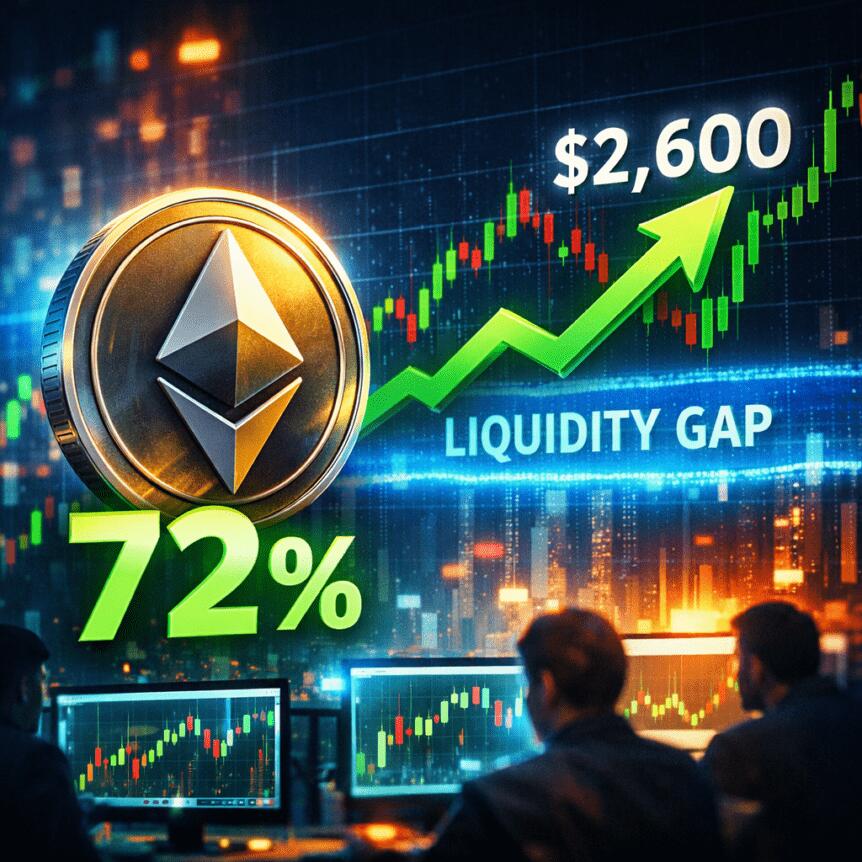
Ether futures on Binance have surged to a near two-month high as aggressive buyers stepped into the market over the past week. The 24-hour cumulative net taker volume climbed to about $5.5 billion, rising roughly 72% from about $3.2 billion earlier in the month, according to data tracked by CryptoQuant. The move aligns with a broader technical setup that keeps a critical liquidity zone in focus for ETH, with traders watching a potential breakout beyond the mid-$2,400s toward a $2,475–$2,634 corridor if buy-side pressure remains sustained and supply-side resistance eases.
CryptoQuant data show the 30-day average of net taker volume has remained positive since March 1, a pattern last seen in July 2022. That sustained buying cadence, alongside the growing futures activity, paints a picture of continued demand from participants rather than a fleeting bounce. Amr Taha, a market analyst cited in CryptoQuant’s quicktake, noted that spikes in buying near local highs often signal stronger conviction, suggesting buyers may be in control of the near-term price direction as momentum builds.
Key takeaways
- Binance ETH futures net taker volume hits about $5.5 billion in 24 hours, up 72% from earlier this month, indicating sustained buyer dominance.
- The 30-day net taker-volume average has been positive since March 1, reaching levels not seen since July 2022.
- ETH faces a key resistance around $2,400; a clean break could unlock the $2,475–$2,634 zone where a daily fair-value gap sits, created during February’s sell-off.
- The price is attempting to reclaim the 100-day EMA, a sign that the uptrend could gain traction; the 200-day EMA sits near the upper end of the imbalance zone around $2,634, aligning with liquidity considerations.
- Derivatives signals show futures cumulative volume delta (CVD) approaching $12.6 billion, with funding rates near neutral, suggesting leverage has not expanded aggressively alongside price.
Buy-side momentum and the path through the liquidity cloud
The immediate narrative around Ether’s price action is closely tied to the strength of daily demand captured in the futures market. The $5.5 billion 24-hour net taker volume on Binance represents a significant tilt toward buyers rather than sellers, reinforcing the sense that market participants are willing to chase higher prices rather than step back at the first sign of supply. This level of activity, when viewed against the 30-day positive readings, points to a broader conviction among traders that ETH can sustain upside momentum beyond the current consolidation range.
From a market structure standpoint, the $2,400 barrier has proved a stubborn but not unbreakable ceiling. The price has tested this level three times since early February, with each rejection thinning the density of overhead sell orders. A decisive move above $2,400 would shift attention to the next liquidity-rich zone between roughly $2,475 and $2,634. That corridor hosts a daily fair-value gap left behind by a February sell-off, an area where price can snap back quickly if bid-side liquidity improves and sell orders are absorbed efficiently.
Technical watchers are keeping an eye on trend-following indicators as well. Ether’s attempt to reclaim the 100-day exponential moving average (EMA) is viewed as a potential sign of trend continuation, provided the rally can sustain above this benchmark. Conversely, the 200-day EMA sits near the upper boundary of the current imbalance zone, implying that any sustained move into the higher end of the range would converge with overs supply and liquidity considerations. The interplay between EMA dynamics and the liquidity gap helps explain why even a modest breakout could accelerate through the $2,400 hurdle if buyers remain persistent.
Derivatives signals: cautious optimism amid balanced leverage
Beyond spot and futures price activity, the derivatives landscape paints a nuanced picture of risk and reward. The futures cumulative volume delta (CVD) has been climbing toward $12.6 billion, signaling ongoing buying pressure in the disciplined posture of the market. Yet funding rates have remained near neutral, suggesting that while demand exists, leverage has not surged in lockstep with price gains. In practical terms, this balance means the near-term upside might hinge on continued bid activity rather than an aggressive expansion of borrowed exposure.
Taken together, the data imply a near-term liquidity cluster around the $2,475–$2,634 zone remains the critical hurdle for ETH. Clearing this band would not only reflect a shift in market sentiment but also provide a clearer pathway for a more durable rally, as new orders fill on the back of rising conviction and improved liquidity depth. For traders, the key question is whether current buyers can sustain enough pressure to overwhelm fresh supply that tends to cluster near resistance zones, especially given the neutral stand of funding costs.
Overall, the current setup suggests a moment of thoughtful optimism rather than exuberant hype. The confluence of rising taker-volume, persistent positive net inflows in the 30-day window, and a technical chart that hints at a liquidity-driven breakout offers a plausible path for ETH in the near term. Investors will want to monitor whether the $2,400 barrier is decisively crossed and whether the liquidity gap in the $2,475–$2,634 range can be absorbed with limited downside risk.
Readers should watch how the price actions unfold around the key resistance zone and the related liquidity clusters in the coming sessions, as a sustained move beyond $2,400 would set the stage for a more pronounced leg higher—provided market participants sustain the current level of demand without a sharp pullback in leverage or a shift in macro risk sentiment.

TLDR:
- Pornhub replaced USDT with USDC for creator payouts, citing better reliability and MiCA regulatory compliance.
- The switch ends Pornhub’s infrastructure partnership with Justin Sun’s TronLink wallet established back in 2020.
- Drift Protocol took the opposite route, moving from USDC to USDT following a $127.5M Tether-backed bailout.
- USDC’s MiCA-compliant status is driving adoption on platforms operating within regulated financial environments.
USDC has officially replaced USDT as the preferred stablecoin for creator payouts on Pornhub. The world’s largest adult website confirmed the change through an email sent to its content creators.
The switch follows years of relying on Tether after PayPal exited the platform in 2020. Pornhub cited payment reliability and regulatory compliance as its primary reasons for adopting Circle’s stablecoin.
The move also ends the platform’s infrastructure partnership with Justin Sun’s TronLink wallet.
Pornhub Cites MiCA Compliance in the USDC Transition
The email sent to creators described USDC as a “fully-backed, MiCA-compliant and regulated stablecoin.” Pornhub added that it provides “a more secure option for your earnings” compared to USDT.
The platform also stated that USDC “is pegged 1:1 to the US dollar.” It further noted that it “works just like USDT on the ERC-20 network.”
OnlyFans content creator Gracie Hartie shared a screenshot of the email on social media. A Japanese trader also confirmed receiving the same communication from Pornhub.
The email specifically stated the change was aimed at making payouts “more reliable” for creators. The broad circulation of the message confirmed the policy shift applied across multiple regions.
Pornhub’s model program page no longer lists USDT as an available payout method. In its place, the page now shows USDC alongside Paxum, Verge, and Cosmo.
The removal of USDT from the payout list marks a complete and deliberate transition. Creators are expected to update their wallet information to reflect the change.
Pornhub adopted USDT back in 2020 after PayPal severed ties with the platform. The company stated at the time, “Since PayPal’s decision to stop payouts to thousands of Models two months ago, we’ve been hustling to…offer you more options.”
That USDT infrastructure was supported through a partnership with Justin Sun’s TronLink wallet. That partnership no longer appears anywhere on Pornhub’s model program page.
USDT and USDC Continue to Compete Across Different Platforms
While Pornhub moved to USDC, a separate development saw USDT gaining ground in another ecosystem. Earlier this month, Tether stepped in to support the hacked Drift Protocol with a $127.5 million bailout.
The Solana-based platform had been drained of approximately $285 million by attackers. North Korean-linked hackers were suspected of compromising a multisig wallet to execute the breach.
As part of the bailout deal, Drift Protocol agreed to transition its settlement asset from USDC to USDT. This effectively reversed the stablecoin preference within that ecosystem.
The back-and-forth between the two stablecoins reflects an ongoing rivalry in the crypto market. Each major platform event appears to shift institutional preference in a new direction.
These moves by both Pornhub and Drift show how stablecoin adoption continues to shift across platforms. USDC’s standing under MiCA gives it an advantage in compliance-focused environments.
USDT, however, retains dominance in markets where liquidity and speed take priority. The broader competition between the two stablecoins remains very much active.


Om du letar efter en online casino plats utan svensk licens, bör du välja en som erbjuder Trustly som betalningsmetod. Trustly är en betalningsplattform som ger säkerhet och konfidencialitet för spelare. Detta gör att du kan njuta av spelupplevelser utan att oroa dig för potentiella problem med licensering.
Vi rekommenderar att du väljer en casinon plats som erbjuder Trustly och har en god rekommendation från andra spelare. Detta kan garantera att du har en säker och smidig upplevelse. Hitta en plats som erbjuder en bred valutaval, så att du kan spela på den du prefererar.
Det är viktigt att du kollar på spelregler och villkor för varje casinon plats du överväger. Varje plats kan ha sina egna villkor för utbetalningar och spelregler, så det är bra att känna till dessa innan du börjar spela.
Detta casinon utan svensk licens och Trustly erbjuder dig en smidig och säker upplevelse. Du kan njuta av spelupplevelser utan att oroa dig för licensproblem eller betalningsproblem. Hitta den plats som passar dig bäst och börja njuta av spelupplevelser i säkerhet.
Varför det är farligt att spela på casino utan svensk licens
Det är alltid säkrast att välja en casinon utan svensk licens, som har godkänt avtal med Trustly, för att skydda dina pengar och personuppgifter. Trustly är en betalningsplattform som garanterar säkerhet och skyddar transaktioner. Detta gör att du kan spela utan att oroa dig för oanmärkta utdrag eller obehagliga situationer.
- Detta casinon utan svensk licens har en betrodd betalningsplattform som Trustly, vilket skyddar dina transaktioner.
- Detta casinon utan svensk licens har en betrodd betalningsplattform som Trustly, vilket skyddar dina transaktioner.
- Detta casinon utan svensk licens har en betrodd betalningsplattform som Trustly, vilket skyddar dina transaktioner.
Detta casinon utan svensk licens kan vara en risk om du inte känner till reglerna och skyddet som erbjuds av svensk lag. Du kan förlora pengar och personuppgifter utan att kunna räkna på någon form av skydd. Detta är en viktig uppmärksamhet för alla spelare.
Detta casinon utan svensk licens kan vara en risk om du inte känner till reglerna och skyddet som erbjuds av svensk lag. Du kan förlora pengar och personuppgifter utan att kunna räkna på någon form av skydd. Detta är en viktig uppmärksamhet för alla spelare.
Casino utan spelpaus: Hur identifiera och undvika dem
Det är viktigt att identifiera och undvika online casino utan spelpaus. För att göra detta bör du först kolla om casinoet har en svensk licens. Licenseringsprocessen i Sverige är strikt och garanterar att spelaren är skyddad. Om du hittar casino utan svensk licens , bör du undvika det.
Det andra du kan göra är att kolla om casinoet har en spelpaus. Spelpausen är en viktig funktion som hjälper spelare att styra sina spelaktiviteter. Om du inte hittar någon information om spelpausen, bör du undvika casinoet.
Det är också bra att kolla casinoets betroende. Läs recensioner och betroendeöversikter från andra spelare. Om casinoet har många negativa recensioner om spelpausen, bör du undvika det.
Det är viktigt att kolla om casinoet har en kontaktuppgift. Om du inte kan kontakta casinoet om du har problem med spelpausen, bör du undvika det.
Det är också bra att kolla om casinoet har en regelbunden uppdatering av sina spel. Om casinoet inte uppdaterar sina spel regelbundet, kan det innebära att de inte har en aktiv kontroll över spelarna.
Det är viktigt att kolla om casinoet har en helhetlig regelbunden kontroll över spelarna. Om casinoet inte har en helhetlig kontroll, kan det innebära att de inte respekterar spelarnas rättigheter.
Det är också bra att kolla om casinoet har en helhetlig regelbunden kontroll över sina spel. Om casinoet inte har en helhetlig kontroll, kan det innebära att de inte respekterar spelarnas rättigheter.
Alternativ för spelare i Sverige
Om du söker casino utan svensk licens, bör du överväga Trustly Casino. Detta casino erbjuder en smidig och säker miljö för spelare utan att kräva en svensk licens. Trustly Casino har en användbar plattform och ett välstrukturerat menyn, vilket gör att du kan hitta vad du letar efter snabbt och enkelt.
Det viktiga är att du fortfarande kan njuta av en god och varierande spelupplevelse, även om du inte har en svensk licens. Trustly Casino har en bred utbud av spel, inklusive blackjack, roulette och slotmaskiner, vilket gör att du har flera val att välja från. Detta casino har också en bra kundtjänst och en snabb och effektiv betalningsmetod.
Det är viktigt att du fortfarande håller dig informerad om lagar och regler för spel i Sverige. Använd aldrig casino utan spelpaus, eftersom det kan leda till obehagliga situationer. Det bästa är att välja en licenserat casino som respekterar spelarens rättigheter och säkerhet.
FBI used the flaw to extract readable previews of Signal messages from an iPhone’s notification database even after the app was deleted.
Tech giant Apple has fixed a security flaw that had allowed the FBI to access a Signal user’s deleted messages through their phone’s push notification database, despite the app being deleted and messages being set to disappear.
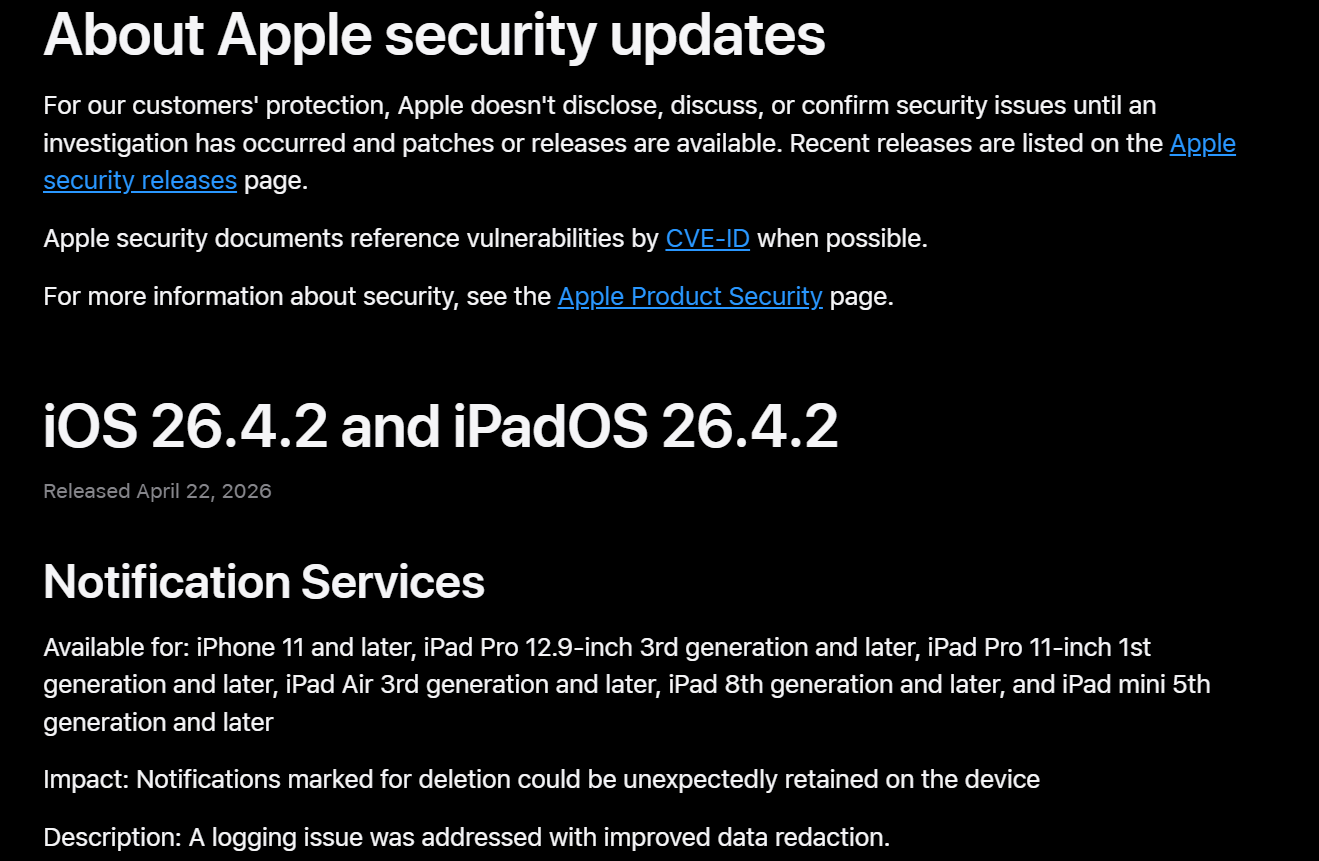
In a security advisory released on Wednesday, Apple said it had fixed a bug that allowed “notifications marked for deletion” to be “unexpectedly retained on the device.”
In an X post on Wednesday, Signal said the update fixed the issue that made a user’s messages retrievable by law enforcement.
“Apple’s advisory confirmed that the bugs that allowed this to happen have been fixed in the latest iOS release,” Signal said.
Signal uses end-to-end encryption to secure messages between its users. The bug is a reminder that messaging encryption may not be enough to keep data protected when using certain devices or operating systems.

FBI found a backdoor to private messages
This security flaw was first highlighted by independent technology news website 404 Media, which reported on April 9 that documents recently unsealed in Texas federal court related to an FBI case over an attack on the Prairieland ICE Detention Facility last July.
The court proceedings showed that the FBI was able to forensically extract a defendant’s Signal messages from the iPhone’s notification database, which contained cached, readable previews of incoming Signal messages even after disappearing messages were enabled and the app was deleted.
Related: X rolls out smart cashtags in US, Canada in step toward ‘everything app’
Following the 404 Media report, Signal President Meredith Whittaker called on Apple to quickly fix the issue, noting in an April 14 X post that “notifications for deleted messages shouldn’t remain in any OS notification database.”
Pavel Durov, the co-founder of competing privacy messaging app Telegram, also commented on the report, arguing in an April 14 Telegram post that the only way to truly stay safe was for the app to “force an absence of notification previews” on both ends of a conversation.
Magazine: How to fix suspected insider trading on Polymarket and Kalshi


New York Governor Kathy Hochul signed Executive Order 60 on April 22, barring covered state officials and employees from using nonpublic information gained through their jobs to profit or avoid losses in prediction markets.
Summary
- New York and Illinois barred employees from using insider information in prediction market trading activities.
- Both governors said the orders aim to stop corruption as prediction market volumes keep rising.
- State pressure on Kalshi grows as prediction markets face legal and ethical scrutiny nationwide.
The order also bars them from helping other people use such information in the same way. Illinois Governor JB Pritzker signed Executive Order 2026-04 a day earlier.
Moreover, it says no state employee may use nonpublic information from official duties while taking part in prediction markets or event contracts, and they also cannot use that information to help another person trade in those markets. The order took effect immediately after filing.
Hochul and Pritzker frame move as an ethics issue
Hochul said the state was acting to stop public servants from using inside knowledge for personal gain. In the New York announcement, she said, “Getting rich by betting on inside information is corruption, plain and simple,” and also criticized what she called an “ethical Wild West” around prediction markets. New York’s order says violations may lead to dismissal or referral to law enforcement or ethics authorities.
Pritzker used similar language in Illinois. His office said prediction markets have grown into a space where people can bet on real-world events “without any oversight,” and warned that the setup can open the door to insider trading and misuse of confidential information. The Illinois release said the state wanted to strengthen existing ethics rules as these platforms expand.
Additionally, the two executive orders arrive as prediction markets draw more attention from lawmakers, regulators and the courts. New York’s order points to reported trading around military activity, elections and other public events, saying recent news reports raised questions about whether people with access to nonpublic government information may have profited from those markets.
At the same time, industry activity has continued to grow. Market data showed prediction market trading volume in March reached record levels above $20 billion, as trading spread across sports, politics and global events. That growth has added pressure for clearer rules on who can trade and what conduct should trigger enforcement.
State action adds pressure on Kalshi and peers
New York has already taken direct action against Kalshi. Hochul’s office said the New York State Gaming Commission sent the company a cease-and-desist letter in October, alleging it was operating an unlicensed mobile sports wagering platform in the state. The new ethics order adds another layer of state pressure around prediction-market activity.
Kalshi is also fighting state regulators in Nevada. A Nevada judge this month extended a ban blocking the company from offering event contracts in the state without a gaming license. Together, the New York and Illinois orders show that states are still moving to police prediction markets even as federal oversight remains contested.
A crypto market sentiment index has risen to its highest level in over three months on Wednesday after Bitcoin rallied nearly 6% to within striking distance of $80,000.
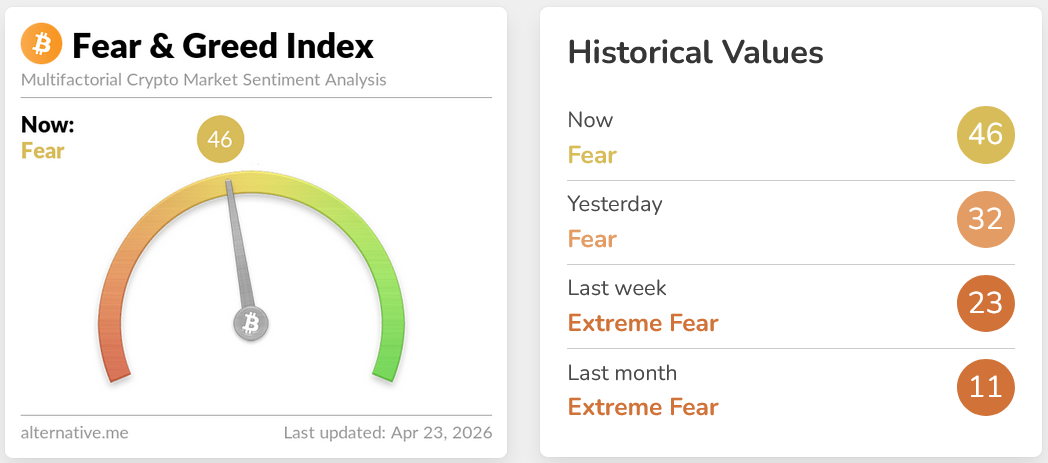
The Alternative.me Crypto Fear & Greed Index rose 14 points to 46 out of 100, its highest level since Jan. 18 and its largest single-day gain in more than three months.

While still in the “Fear” zone, the current reading marks a sharp rebound from the all-time low of 5 recorded on Feb. 23 after the Trump administration imposed a 15% global tariff, sending Bitcoin (BTC) down to about $63,000.
The crypto sentiment index has been stuck in the Fear zone since Jan. 18. This has come despite continued institutional crypto adoption on Wall Street and a crypto-friendly regulatory agenda in Washington.
However, Bitwise chief investment officer Matt Hougan and others have noted that retail traders haven’t shown up in the same numbers as previous market cycles.
The Crypto Fear & Greed Index score incorporates metrics such as social media posts and Google search volume related to crypto, which are mostly retail-driven metrics.
Bitcoin rose 5.9% to nearly $79,400 over a 20-hour period on Wednesday but has since cooled to $77,920, according to CoinGecko data.
Perps market has fueled Bitcoin rally: CryptoQuant
In a post to X on Wednesday, CryptoQuant’s head of research, Julio Moreno, said Bitcoin’s rally was “completely driven by demand” in the perpetual futures market.
However, he noted that spot demand has been contracting, albeit at a slow pace, and warned that a market correction could arise if traders start taking profits as spot demand continues to contract.
Related: LONGITUDE recap: Adam Back on Satoshi, crypto regulation needs tweaks
In a separate X post, CryptoQuant noted that over 300,000 Bitcoin have moved into long-term holder wallets over the last 30 days, while shorter-term holders have offloaded the cryptocurrency.
“Bitcoin supply is moving into stronger hands,” CryptoQuant said, noting that Strategy has scooped up 53,000 Bitcoin alone in the last month.
Bitcoin’s rise toward $80,000 has come despite continued uncertainty in the Middle East, with the US and Iran struggling to reach a resolution over management of the Strait of Hormuz.
Magazine: Ripple joins Singapore sandbox, Bhutan’s big Bitcoin selloff: Asia Express
Crypto World
XRP Price Surges on Technical Breakout, Whale Accumulation, and SoFi Banking Integration
Key Takeaways
- Crypto analyst Ali Martinez identifies a symmetrical triangle pattern with a potential 35% rally to $1.90
- SuperTrend indicator generated its first buy signal on the daily timeframe since January
- Large holders added approximately 360 million XRP tokens within seven days, bringing total whale holdings to roughly 8.8 billion
- SoFi Bank launched XRP deposit services for its 13.7 million customers and $34 billion in managed assets
- Critical resistance level positioned at $1.54 (100-day EMA) with support anchored at $1.41 (50-day EMA)
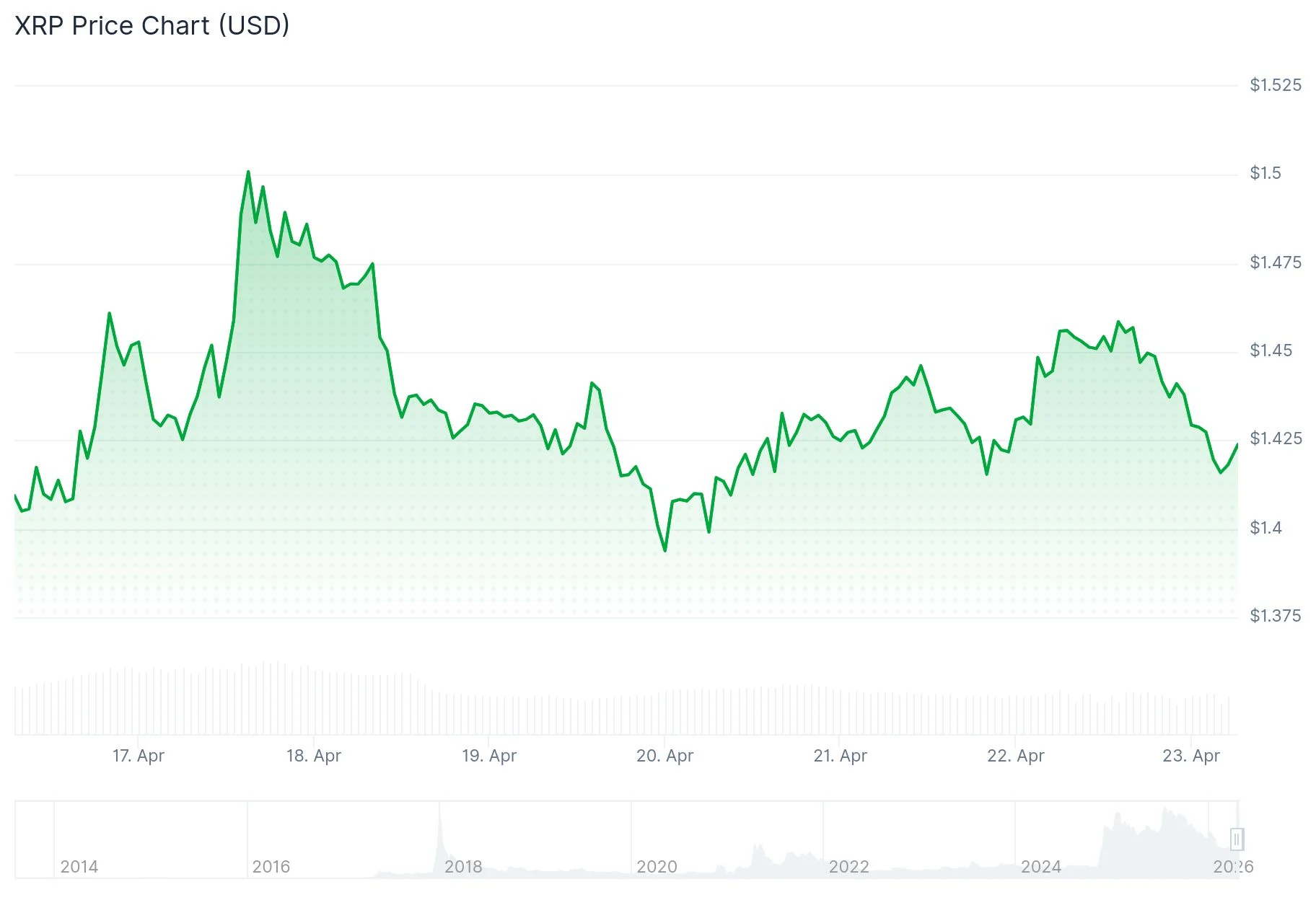
Ripple’s native token has experienced renewed momentum this week, hovering around the $1.44 mark while challenging near-term resistance zones. The upward movement aligns with multiple technical indicators and blockchain data metrics signaling potential bullish continuation.
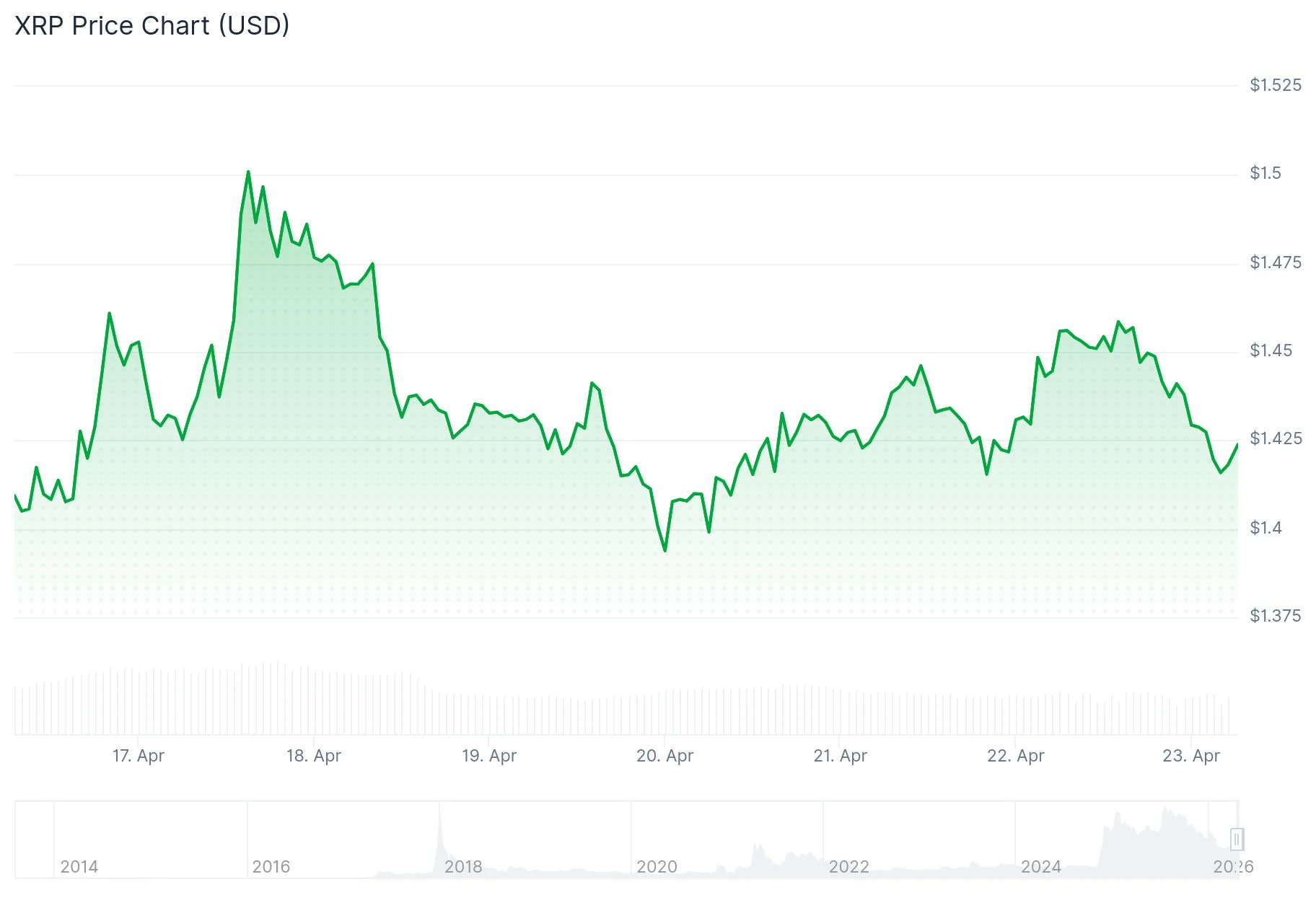
Cryptocurrency market analyst Ali Martinez shared comprehensive chart analysis via X this week, stating that XRP “appears to be undergoing a structural trend shift from bearish to bullish.” His examination incorporated price formations, blockchain metrics, and momentum oscillators.
The SuperTrend technical tool has triggered a buy indication on the daily timeframe—marking the first occurrence since the beginning of January. This reversal implies diminishing downward pressure and potential trend change.
Martinez also highlighted a developing symmetrical triangle configuration on the 12-hour chart. This consolidation structure displays converging trendlines with declining peaks and rising troughs, compressing price action into a tightening range. Breakouts from such patterns frequently result in explosive directional moves. Martinez projects a 35% appreciation from current consolidation levels, establishing an upside objective at $1.90. According to his analysis, a daily candle closure above $1.55 would validate the bullish breakout scenario. Conversely, the $1.30 threshold represents the critical invalidation point for the bullish thesis.
Blockchain analytics reinforce the technical outlook. Leveraging Santiment platform data, Martinez observed that whale-sized wallets accumulated approximately 360 million XRP tokens during a single week period. Aggregate whale holdings expanded from around 8.3 billion to 8.8 billion XRP. Historically, large-scale investors tend to build positions during consolidation and accumulation phases.
SoFi Bank Launches XRP Deposit Services for 13.7 Million Customer Base
SoFi Bank revealed plans to integrate XRP deposit functionality for its entire user network. The federally chartered financial institution oversees more than $34 billion in total assets while servicing 13.7 million active customers. XRP now joins Bitcoin, Ethereum, and Solana in the platform’s cryptocurrency offering portfolio.
Ripple acknowledged the development, emphasizing that the integration would facilitate broader adoption and expand the XRP ecosystem’s reach. This announcement follows recent expansions including XRP trading capabilities on WhatsApp via wXRP on Solana, plus a validator governance vote regarding a lending protocol designed to enhance DeFi infrastructure on the Ripple network.
Critical Price Levels Under Observation
Examining the daily chart, XRP currently maintains position above its 50-day exponential moving average at $1.41. The immediate overhead resistance emerges at the 100-day EMA situated at $1.54. Clearing this barrier would establish a pathway toward $1.68, where a long-duration descending trendline converges. The 200-day EMA provides additional resistance at $1.78.
The Relative Strength Index registers approximately 58, while the MACD histogram remains positioned in positive territory above the zero line. The Crypto Fear & Greed Index currently reads 32, representing an uptick from the previous week’s reading of 23.
On Binance exchange, the long-to-short position ratio for XRP stands at 2.27, indicating traders maintain a net long bias with bullish positions outnumbering bearish ones.
The Open Interest-Weighted Funding Rate for perpetual futures contracts recorded 0.0066% on Wednesday, sustaining positive values continuously since April 3.

AI boom lifts Nokia sales, shares hit 16-year high after earnings beat

Hyperliquid (HYPE) holds above $40 as futures activity stalls

Man United latest: Aurelien Tchouameni situation becomes clearer as rivals exit transfer race

Manchester United reach agreement with Casemiro over contract clause amid transfer speculation

Steven Gerrard disagrees with Gary Neville over ‘shock’ Chelsea and Arsenal claim | Football

US brings back mandatory military draft registration

Yes this is prop money. I just wish the IRS would believe me

CI BECCANO MANGIARE AL SUPERMERCATO #streamhouse #money #teknoyd #memes #troll #ussa

Richest Mafia Of Tjis Whole World By @AbhishekKar #shortsfeed #money #business
-

 Sports6 days ago
NWFL Suspends Two Players Over Post-Match Clash in Ado-Ekiti
-

 Fashion6 days ago
Weekend Open Thread: Theodora Dress
-

 Politics5 days ago
Palestine barred from entering Canada for FIFA Congress
-
Entertainment3 days ago
NBA Analyst Charles Barkley Chimes in on Ice Spice McDonald’s Fiasco
-

 Business4 days ago
Powerball Result April 18, 2026: No Jackpot Winner in Powerball Draw: $75 Million Rolls Over
-

 Tech4 days ago
Auto Enthusiast Scores Running Tesla Model 3 for Two Grand and Turns It Into Bare-Bones Go-Kart
-

 Politics4 days ago
Zack Polanski demands ‘council homes not luxury flats for foreign investors’
-

 Crypto World5 days ago
Russia Pushes Bill to Criminalize Unregistered Crypto Services
-

 Politics2 days ago
Gary Stevenson delivers timely reminder to register to vote as deadline TODAY
-

 Politics13 hours ago
Disabled people challenge government SEND proposals over segregation concerns
-

 Business22 hours ago
Rolls-Royce Voted UK’s Most Iconic Trade Mark as IPO Register Hits 150
-

 Politics13 hours ago
Making troops accountable for war crimes threatens US alliance, ex-SAS colonel warns
-
 Business6 days ago
Creo Medical agree sale of its manufacturing operation
-

 Crypto World5 days ago
Russia Introduces Bill To Criminalize Unregistered Crypto Services
-

 Politics14 hours ago
Starmer handler McSweeney to be dragged from shadows by Foreign Affairs Committee
-

 Politics14 hours ago
Zack Polanski responds to home secretary’s taser threat
-
Politics15 hours ago
Wings Over Scotland | How To Get Away With Crimes
-
Crypto World4 days ago
Kelp DAO rsETH Bridge Hack Drains $292M as DeFi Losses Top $600M in Two Weeks
-

 Politics12 hours ago
‘Iran is still a nuclear threat’
-

 Business7 days ago
Cheaper Doritos and Lays helps PepsiCo win back struggling snackers
You must be logged in to post a comment Login