For creative and marketing teams, a simple cloud storage solution often falls short. These teams need to sift through large numbers of files to find what they’re looking for. The problem is getting worse: AI is accelerating content generation, meaning more media files than ever, which makes the task even trickier.
A New York-based startup called Shade is building a cloud storage platform designed for agencies, sports media teams, consumer brands, real estate companies, and podcasters to store and search their media files easily.
The company announced Wednesday that it closed $14 million in a funding round led by Khosla Ventures, Construct Capital, and Bling Capital in March. The nearly four-year-old startup has raised $20 million in total, with General Catalyst, SignalFire, and Contrary also on its cap table.
Shade was founded by CEO Brandon Fan and CTO Emerson Dove in 2024. The two had been friends since high school. They decided to build something together after growing frustrated with existing tools like Dropbox when it came to searching for files.
Advertisement
“We built it out of our frustration as creatives – [where we were contending with] stacks and stacks of hard drives and issues where we were using Dropbox drive frame and all of the tools under the sun…it was time to build one single source of truth,” Fan said.
Image Credits: ShadeImage Credits:Shade
He sees Shade as occupying an interesting niche as a creative file storage system around which companies can build workflows.
“As you make more content, you need to be thinking more about the workflows around the content. I like to say it’s similar to CRMs 20 years ago, when we were thinking about how to organize all the information that we had around our contacts and in all of our companies,” he said.
Techcrunch event
San Francisco, CA | October 13-15, 2026
Advertisement
Shade points to two distinguishing features. First, it offers natural language search powered by auto-tagging. The startup said that this search doesn’t just surface a particular video — it identifies the exact moment in the video where a scene matching the search query occurs. For instance, users can search for “a person holding a laptop in snow,” and the system will surface all matching clips with timestamps.
Image Credits: ShadeImage Credits:Shade
The tool also automatically transcribes videos for easier search. Users can search based on meaning, transcripts, and facial recognition for labeled individuals.
Second, Shade uses a “streamable” file system that lets you mount your cloud storage to your local filesystem and start working with a file almost immediately, without waiting for it to fully download first. Users can also pin files to access them even in low-bandwidth conditions. Typically, with a storage system like Google Drive or Dropbox, you have to wait for a large file to download before editing it. Shade’s streamable system lets you get started right away.
Advertisement
Beyond storage and search, Shade makes it easy for teams to collaborate — with the ability to leave feedback tied to a video at a specific timestamp. They can also attach files in comments to give direction. Shade lets teams create multiple links for the same assets with varying permissions, and teams can set access-based roles.
For final deliveries to clients, teams can create branded file collections with password protection and expiry dates.
Image Credits: ShadeImage Credits:Shade
For small teams, Shade offers a $20 per seat, per month plan that includes unlimited drives, unlimited AI indexing, and 500GB of active storage per seat. The plan supports up to 15 seats per workspace and up to 150 guests for collaboration.
Shade isn’t alone in this space. Startups like Poly and Memories.ai are also working on AI-powered file storage and search for large numbers of files.
Keith Rabois, managing director at Khosla Ventures, said that while AI has accelerated content creation, managing those creations remains messy.
Advertisement
“Most companies are layering search on top of existing storage. Shade rebuilt the stack from first principles, spanning streaming, indexing, and collaboration in one system. That architectural approach is harder, but it is why the product actually works, not just as a bolt-on feature,” Rabois said over email.
He added that while search is the starting point, Shade could become a key tool for automating sharing and versioning.
In the coming months, Shade plans to improve its search across different file types, including images, videos, and documents. The startup is also building a no-code platform — meaning one that requires no programming knowledge — to let creative teams create automated workflows based on files in the system.
“We’re essentially building the Lego blocks that allow you to [operate] any type of business, you have that ability to apply shade to your workflow, whether that is, today, just creative teams, [or] in the future, research and investment teams,” Fan said.
Advertisement
When you purchase through links in our articles, we may earn a small commission. This doesn’t affect our editorial independence.
An anonymous reader quotes a report from Reuters: The Gates Foundation opened an external review earlier this year into its engagement with the late financier and convicted sex offender Jeffrey Epstein, the philanthropic group said on Tuesday. The foundation has been mired in controversy due to Chairman Bill Gates’ association with Epstein. A release of emails in January by the U.S. Justice Department also showed communication between Epstein and the Gates Foundation’s staff.
“Early this year, Gates Foundation CEO Mark Suzman commissioned an external review to assess past foundation engagement with Epstein, and our current policies for vetting and developing new philanthropic partnerships,” the foundation said in a statement. “That review is underway, and we expect the board and management will receive an update this summer,” it added. The Wall Street Journal, which first reported the news earlier on Tuesday, said Suzman told staff in a memo, “this is a challenging time for our organization in many ways, but it also highlights the critical importance of taking the tough actions now.” The WSJ also reports that the Gates Foundation will eliminate up to 500 jobs, or about 20% of its staff, by 2030. It said the foundation has a 2026 budget of about $9 billion, but plans to cap operating expenses at $1.25 billion.
Self-driving cars promised a future where you sit back, relax, and glide past the gridlock while the car handles everything. A new study from the University of Texas at Arlington has some bad news for that fantasy. According to research, widespread adoption of autonomous vehicles could actually make traffic significantly worse.
Professors Stephen Mattingly and Farah Naz conducted a meta-analysis on how self-driving cars could affect vehicle miles traveled (VMT). Their findings showed an average 5.95% increase in vehicle miles traveled. Non-shared autonomous vehicles pushed that figure even higher, to nearly 7%.
“The rise of AVs could make commuting more convenient, but it may also lead to more pick-up and drop-off activity, more empty vehicle trips, and new costs.”
The logic is simple. When your car can drop you off and drive itself home, or cruise around looking for rides, roads get busier. As Dr. Mattingly put it, “Where will commuters send their car when they don’t need it?” Will it be sent to a parking lot, sent to try to find other riders, or sent home?”
Are robot taxis already causing chaos on the streets?
To put it succinctly, the research shows that robotaxis are already causing an increase in vehicle miles traveled, and once their adoption becomes universal, it will put extreme pressure on existing infrastructure. But that’s in the future; if current news reports are anything to go by, the robotaxis are already causing havoc on roads.
Waymo
For example, Waymo launched in Nashville on April 7, 2026, and within five days, people were posting viral videos of its robotaxis freezing at intersections and driving into restricted zones. In December 2025, a San Francisco power outage left dozens of Waymo vehicles frozen at intersections city-wide.
Advertisement
It’s not only a US-specific issue. Just a few weeks back, dozens of Baidu robotaxis simultaneously stopped on elevated highways in Wuhan, China, stranding passengers mid-traffic for over an hour.
NEW: Dozens of robotaxis by Baidu stopped on the road in Wuhan, causing crashes on highways and trapping passengers in the cars—some for more than an hour. One passenger told me it took her 30 minutes to even connect to a customer representative.
These are just a few examples. Dozens of similar incidents have occurred over the past few months, where robotaxis have gotten stuck for various reasons and caused traffic jams.
Advertisement
This is happening while robotaxis are still largely in trial mode. Multiply this by a factor of a hundred or even a thousand, and it’s easy to imagine how much worse traffic could become in the future.
So what happens next?
Dr. Naz summed it up well: “AVs are not inherently good or bad. Their impacts will depend heavily on how they are deployed and governed.” Without smart policy ahead of mass adoption, the self-driving dream risks handing us a shinier, more expensive traffic jam.
If we are to pay that price, autonomous vehicles must clearly demonstrate that they are safer and more reliable than human drivers, which they have failed to do till now.
Hyundai is recalling 294,128 Hyundai and Genesis vehicles in the U.S. over a front seatbelt problem that could become dangerous in a crash, even if the belt appears to work normally in day-to-day driving. The recall is listed by the National Highway Traffic Safety Administration (NHTSA) as 26V218, and Hyundai’s internal campaign numbers are 298-032G. This is yet another major Hyundai seatbelt-related recall in less than a year, which involved over half a million Palisade SUVs. This time, the problem seems to be with the snap-on clip at the base of the front seatbelts, which prevents the seatbelts from being fully secured to the seat frame.
Hyundai estimates that only 1% of the recalled population may actually have the defect. However, the concerning part is that this is not necessarily a problem a driver would notice before a crash. The seatbelt may still buckle, retract, and feel normal, but if the lower anchor is not secured correctly, it may not restrain the driver or front passenger as intended during impact.
So far, the Korean automaker claims it is aware of six U.S. reports connected to the condition, with no known crashes, injuries, or fatalities. That last part is good news, but not assuring enough to ignore the recall; a seatbelt only has to fail once for the consequences to become severe.
Advertisement
Which Hyundai vehicles are affected and what Hyundai will do to fix them
The largest population affected by this recall involves Hyundai’s latest Santa Fe lineup. Hyundai says 158,001 gas-powered Santa Fe SUVs from the 2024-2026 model years are included, along with 95,268 Santa Fe Hybrid SUVs from 2024-2026 model years. The recall also includes 35,149 Hyundai Ioniq 6 sedans from 2023-2025 and 5,710 Genesis G90 sedans from 2023-2026.
Advertisement
Owners will need to bring their vehicles to a Hyundai dealer or a Genesis retailer for inspection, where technicians will inspect the front seat belt anchors and add a reinforcement insert on the snap-on lower anchor. If the anchor or seatbelt assembly cannot be repaired with the new insert, the dealers will replace the entire seatbelt assembly itself.
The work will be performed free of charge, even if the vehicle is no longer covered by Hyundai’s new vehicle limited warranty, and Hyundai says it will reimburse owners who already paid out of pocket for repairs related to this recall condition. The official filing does not include a “do not drive” or “park outside” warning, but owners should still check their VINs as soon as possible. To find out if your particular Hyundai is a part of this recall, look up your vehicle’s VIN against Hyundai’s official recall lookup page, or use NHTSA’s VIN search.
alternative_right writes: A new technology has been proposed that could fundamentally solve the issue of smartphones overheating during high-spec gaming or extended video streaming. Researchers at KAIST have discovered the principle of processing signals using the minute vibrations of magnets (spin waves) instead of electrons. This method significantly reduces heat generation and power consumption while enabling instantaneous frequency switching within the several GHz range. This breakthrough is expected to pave the way for smart devices with less heat and longer battery life, as well as ultra-low-power, high-speed computing. Professor Kab-Jin Kim from the Department of Physics said: “This study is a case that proves we can implement and control the nonlinear dynamics of magnons — the principle of information processing using magnetic vibrations — in actual nano-devices, which had previously only been proposed in theory. It will serve as an important foundation for the development of a new information processing paradigm using spin waves instead of electrons.”
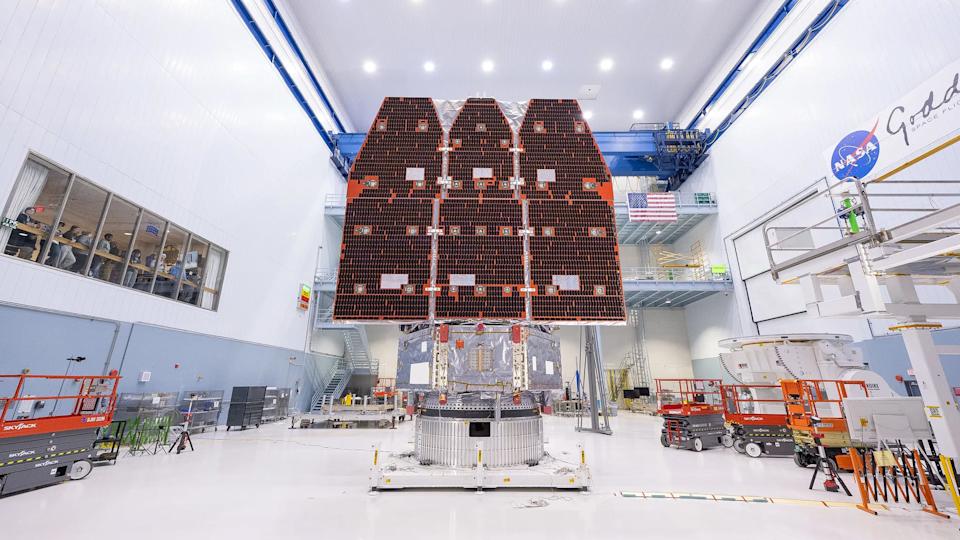
NASA’s next eye into the cosmos is due to leave our planet later this year. The agency says it’s targeting an early September launch for the Nancy Grace Roman Space Telescope. Roman (for short) has a field of view 100 times larger than Hubble’s.
The September date is the earliest possible launch for Roman. NASA says it will go up (aboard a SpaceX Falcon Heavy rocket) no later than May 2027.
“Roman will work in tandem with NASA observatories such as the James Webb Space Telescope and Chandra X-ray Observatory, which are designed to zoom in on rare transient objects once they’ve been identified, but seldom if ever discover them,” Julie McEnery, Roman’s senior project scientist, said in 2023. “Roman’s much larger field of view will reveal many such objects that were previously unknown. And since we’ve never had an observatory like this scanning the cosmos before, we could even find entirely new classes of objects and events.”
Advertisement
After leaving our atmosphere, Roman will set course for a vantage point nearly 1 million miles from Earth. There, it will rely on a pair of instruments to study space. The first is a 300.8-megapixel camera that captures light from visible to near-infrared. There’s also a high-contrast coronagraph that will allow it to capture exoplanets that would otherwise be blocked by starlight.
Roman’s mission: “to settle essential questions in the areas of dark energy, exoplanets and astrophysics.” Despite decades of study, astronomers know surprisingly little about dark energy, which makes up about 68 percent of the universe’s contents. And while scientific discoveries are cool and all, you’ll be pleased to know that Roman is also sure to beam back more dazzling pictures of our cosmos.
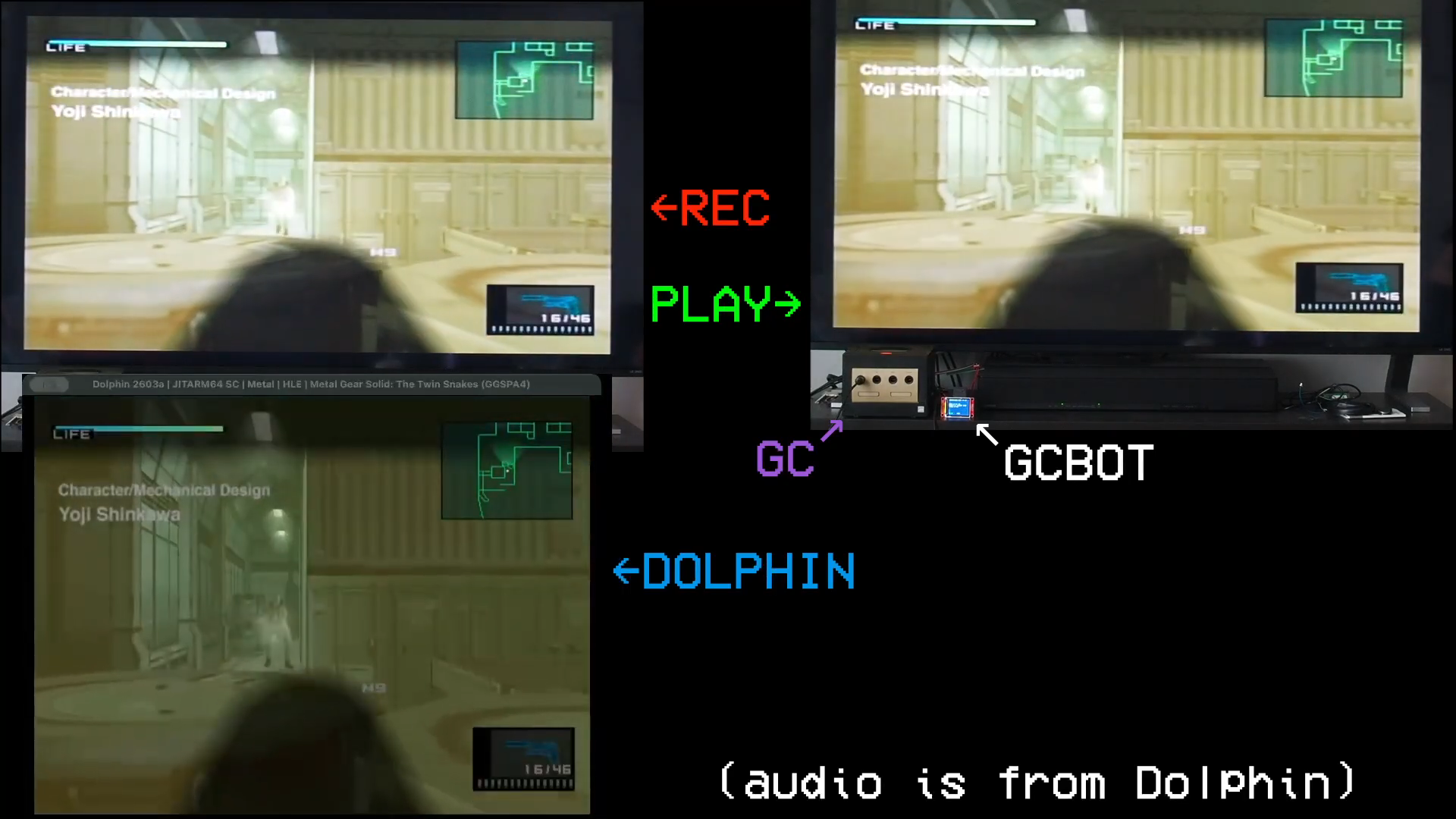
The concept is simple—GameCube bot is a small device that captures controller inputs and records them to an SD card. It can then play them back on command, allowing it to recreate gameplay as it happened the first time right on the console. A Raspberry Pi Pico is the brains of the operation, which is able to intercept signals from a standard GameCube controller. It’s paired with the aforementioned SD storage as well as an ST7735 display for showing status information. The device records in the DTM (Dolphin TAS Movie) format, which can be played back on the device when hooked up to a GameCube console, or in emulators like Dolphin itself.
[jiinurppa] notes that the device isn’t accurate enough to use for tool-assisted speed runs. Most notably, small errors in optical drive reads can lead to desyncs compared to the original machine state that make frame-accurate replays impossible. Still, it’s a neat build that can be useful for capturing game play and later analysis.
A new Mirai-based malware campaign is actively exploiting CVE-2025-29635, a high-severity command-injection vulnerability affecting D-Link DIR-823X routers, to enlist devices into the botnet.
CVE-2025-29635 allows an attacker to execute arbitrary commands on remote devices by sending a POST request to a vulnerable endpoint, triggering remote command execution (RCE).
Akamai’s SIRT, which detected the Mirai campaign in March 2026, reports that, although the flaw was first disclosed 13 months ago by security researchers Wang Jinshuai and Zhao Jiangting, this is the first time in-the-wild active exploitation has been observed.
“The Akamai SIRT discovered active exploitation attempts of the D-Link command injection vulnerability CVE-2025-29635 in our global network of honeypots in early March 2026,” reads Akamai’s report.
“This vulnerability exists in D-Link DIR-823X series routers in firmware versions 240126 and 24082, and allows an authorized attacker to execute arbitrary commands on remote devices by sending a POST request to the /goform/set_prohibiting endpoint via the corresponding function, which can trigger remote command execution.”
Advertisement
The researchers who discovered the flaw briefly published a proof-of-concept (PoC) exploit on GitHub, but later retracted it.
Akamai’s observations show attackers are sending POST requests that change directories across writable paths, download a shell script (dlink.sh) from an external IP, and execute it.
The observed POST requests Source: Akamai
The script installs a Mirai-based malware named “tuxnokill,” which supports multiple architectures.
In terms of capabilities, it features Mirai’s standard distributed denial-of-service (DDoS) attack repertoire, including TCP SYN/ACK/STOMP, UDP floods, and HTTP null.
Akamai has also found that the threat actor behind this campaign also exploits CVE-2023-1389, impacting TP-Link routers, and a separate RCE flaw in ZTE ZXV10 H108L routers. The same attack pattern was observed across all of them, leading to the deployment of a Mirai payload.
Advertisement
The impacted devices reached end of life (EoL) in November 2024, so it’s likely the latest firmware available for the model does not address CVE-2025-29635. D-Link does not make exceptions when active exploitation is detected, so it’s unlikely the vendor will provide a fixing patch now.
BleepingComputer has contacted D-Link with questions about the reported activity and the status of the fix, and we will update this post as soon as we hear back.
Meanwhile, users of routers that have reached EoL are recommended to upgrade to a newer model that enjoys active support with frequent security fixes, disable remote administration portals if not needed, change default admin passwords, and monitor for unexpected configuration changes.
AI chained four zero-days into one exploit that bypassed both renderer and OS sandboxes. A wave of new exploits is coming.
At the Autonomous Validation Summit (May 12 & 14), see how autonomous, context-rich validation finds what’s exploitable, proves controls hold, and closes the remediation loop.
A group of third grade students gather around a board game on a Wednesday afternoon in a Charleston classroom, grabbing game pieces, discussing potential moves and reading out playing cards. The games are not Monopoly, Sorry, or any others of yore – they’re focused on identifying, and boosting, students’ strengths and weaknesses.
It’s part of a shift in school districts’ gifted and talented programs. While many programs focused on a small group of high achieving students, instructors across the nation are now focusing more on inclusion, using data to help them zero in on students’ talents, a method that has the potential of capturing more students for advanced instruction.
For Vanessa Hill, the gifted education coordinator for Amphitheater Public School District in Tucson, Arizona, focusing on strengths and weaknesses helps to solve what she sees as a universal problem with gifted identification.
“Something I’ve been thinking deeply about that tends to be a universal problem is that gifted identification does not match the metrics of your district,” says Vanessa Hill, the gifted education coordinator for Amphitheater Public School District in Tucson, Arizona. “I’m constantly thinking of that, so our demographics can get closer. This new tactic is about exposure to critical thinking and reasoning – what does that look like, how to reason through a problem?”
The gifted and talented programs run the gamut of names and acronyms depending on the district, including advanced learning program, TAG (talented and gifted), LEAP (Learning Enrichment Alternative Program) or REACH (Realizing Excellence through Academic and Creative Help), among others.
Regardless of the name, the program has undergone several major shifts over the last few decades. Schools previously often only selectively tested students, often at the behest of involved parents or by a teacher recommendation. That brought a large amount of inequity in the programs, with many moving to a universal screening practice. Some states, including Washington and Missouri, made it a state mandate to test all students while in elementary school. The screening practice itself evolved from an IQ test to aptitude and ability tests, though how accurate those are is up for debate.
“Society is really unequal along socioeconomic and racial and ethnic lines, and these tests are just reflecting that,” says Scott Peters, director of research consulting at NWEA, a nonprofit education assessment organization. “You can change tests all day long, but at the end of the day, you can’t give some kids three years of $40,000-a-year preschool and also wonder why this kid that’s never been to school until first grade doesn’t do as well.”
Advertisement
Often, schools’ gifted and talented programs do not represent their overall school population and instead skew heavily toward white and Asian students. Zohran Mamdani, the widely-watched mayor of New York City, made it part of his platform to phase out gifted and talented programs because of the inequity.
“Ultimately, my administration would aim to make sure that every child receives a high-quality early education that nurtures their curiosity and learning,” he said in a 2025 statement to the New York Times.
There is no silver bullet test that accounts for inequality and a child’s upbringing, although Peters said when factors such as income, race and other equity gaps are controlled in tests, most inequities disappear.
“This isn’t a factor of, ‘Oh, there are students of color scoring high, but they’re still not getting in,’” he says. “It’s that there’s not enough students of color scoring high because of that larger societal inequality issue.”
Advertisement
Because of the often-skewed gifted and talented population, schools are shifting toward “talent development” with all students, versus focusing on strengthening some students’ already solid skills.
“Because of the baggage of the past, we’re moving toward a new perspective where we’re identifying the strengths of students — whether academic, social or emotional — versus people for a program,” says Kristen Seward, clinical professor in gifted, talented and creative studies at Purdue University. “And I think this twist in how we approach education as gifted researchers is going to benefit everybody.”
Using Data for ‘Talent Development’
Developing talent for gifted programs, much like the name itself, varies depending on the district. Seward says many teachers have enriched curriculums, which enhance things like vocabulary, science and social studies — topics that have been put on the back burner over the years in favor of standardized testing. Teachers are trained to spot students’ strengths and respond to those, which in turn, helps with students’ weaknesses.
For example, if a student has a strong vocabulary but struggles in math, the teacher might focus on math vocabulary during math class to put the lesson on a level the child understands.
Advertisement
Students in the Amphitheater Public School District in Tucson, Arizona, play games that help with quantitative, verbal or non verbal skills.
Photo credit/Vanessa Hill
“I don’t want it to turn into a thing where the teacher is the gate, and if they don’t open the gate, then the students don’t get identified – which has been a problem,” Seward says. “We have to train teachers to be talent scouts, presenting the enriched curriculum. Hopefully it’s not something additional, but something they’d naturally do in their role.”
Elizabeth McLaurin Uptegrove, now the assistant academic director in Charleston County School District, created a “strength or stretch” system that involves the games the students played in the aforementioned classroom. When Uptegrove first arrived in Charleston’s school district, South Carolina used to require all second grade students be tested for the gifted and talented program. But after that year, selection changed to a nomination system.
“Which sounds elitist, and it is,” she says, adding white, affluent children were three times more likely to be in the programs.
Advertisement
She pushed for universal testing again for all fourth grade students, which yielded three times as many students identified as gifted, jumping from 40 fourth graders to 150 across the district. Several schools across the country have adopted similar strength-or-stretch systems.
But Uptegrove’s efforts go beyond identifying candidates for gifted programs through teacher observation: her game-based system uses data. With the aptitude test, there are verbal, quantitative and nonverbal subsections. The tests indicate if a child is low or high achieving in those areas. Then the children are placed in groups with those of similar abilities to play games that can enhance those skills.
The Strength or Stretch games in Uptegrove’s third grade classroom help children grow or reinforce their skills. Photo credit/Elizabeth McLaurin Uptegrove
“Typically a teacher is not very well-equipped to come up with activities or lessons that can actually reach their level of thinking ability and games do that really quickly, in a way that’s not as boring for children as a typical worksheet,” Uptegrove says. “That’s where the magic of the games comes in. We’re making rigorous, hard thinking almost irresistible so students are willing to do the activity for longer.”
Hill, the Arizona-based education coordinator, initially implemented Uptegrove’s game strategy across third grade classrooms in five schools: three Title 1 schools and two non-Title 1. She says the schools that have the strength or stretch program in place have higher passing rates of “proficient” or “highly proficient” scores than those who do not.
“To me, it’s the difference between being a passive learner and active learner; by being able to engage in the games, it’s more active learning,” Hill says. “You raise the exposure to critical thinking and are taught to apply those skills to any situation, whether it’s on an achievement test or on the playground with a friend.”
Advertisement
The Future of the Program
Both researchers and teachers acknowledge the “talent development” approach to gifted and talented programs is far from perfect. It is often costly, whether it is buying the games, instilling teacher training or taking out time from testing. Hill pointed to four schools within her district that are closing this year because of financial constraints.
“Ordering the games is no small cost; I feel so blessed it’s that level of importance that we will find the funds,” she says. “As far as critical thinking games, yes that was missing. It is a hole we were filling. I think that while the core curriculum is doing its best, it can oftentimes be a bit surface level.”
Uptegrove agrees, saying she believes the talent development method is becoming more popular, but “there’s a long way to go in belief and funding for it.”
Peters, who has long studied the best educational methods and practices, believes the shift in gifted and talented is a good step. But he has concerns about the larger moves needed for lasting impact.
Advertisement
“It’s easy to have a 30-minute gifted program; it’s hard to have a second through eighth grade math development pipeline involving everyone in the school,” he says. “And advanced learning isn’t enough of a priority for most schools.”
How powerful is AI? Enough that Anthropic, a leading AI company, announced earlier this month that its latest AI model, Claude Mythos Preview, would be available only to a limited number of businesses due to security concerns — at least for now.
Claude Mythos Preview was designed for general use, Anthropic says, but during testing, the company found it extremely effective at identifying vulnerabilities in the security systems of all types of software, creating potentially massive security concerns.
So far, Anthropic is sharing the Mythos Preview model with a handful of major tech companies and banks through a program called Project Glasswing, intended to give them an opportunity to shore up any existing security vulnerabilities and get ahead of potential hacking attempts that the model could identify.
To get a better sense of what Claude Mythos Preview represents and the potential threat it brings to online security, Today, Explained co-host Sean Rameswaram spoke with Hayden Field, senior AI reporter at The Verge.
Advertisement
Below is an excerpt of their conversation, edited for length and clarity. You can hear the full episode wherever you get podcasts — including Apple Podcasts, Pandora, and Spotify.
Mythos is [Anthropic’s] newest AI model that they designed to be a general-purpose AI model like any other. But what they realized when they were working on it was that it had these special skills that they didn’t really anticipate. It was really good at cybersecurity. It found high-stakes vulnerabilities in virtually every operating system.
That’s pretty bad if you are using that as a hacker. And to have a blueprint for a list of every big gap and insecurity and vulnerability on all these really, really high-profile systems, you’re going to be having a list of everything you could do to take those systems down or exploit data.
They realized that they better not release this to the general public because it could fall into the wrong hands. And they instead handpicked a select few organizations that are responsible for critical infrastructure to release it to so they could plug those gaps in their systems instead.
Advertisement
You’ve heard of many of the companies that currently have and are using Claude Mythos: Nvidia, JP Morgan Chase, Google, apparently a few dozen more that build or maintain critical software infrastructure. How does it actually work?
Since they built it as a general-purpose model, it probably works like any other model in that you’re using it and prompting it to flag all the vulnerabilities in your system.
Maybe you’re Google Chrome, and you’re looking for specific, niche parts of the browser that you think may have some vulnerabilities. You’re basically prompting the model to flag all these really high-profile gaps to you and your security, and then you’re taking that and plugging it up on your own.
A hacker would actually use it in the same way. If it fell into the wrong hands, they’d be like, “Yeah, tell me all the vulnerabilities here.” And then they’re going to take it off the platform and use that for something nefarious. So it’s basically about who is prompting the system and what their motives are.
Advertisement
It’s as easy as saying, “Hey, Claude, tell me how this banking system might be vulnerable.” And then Claude thinks about it for a minute, and it spits out a bunch of answers.
And do we know that the Googles and Nvidias of the world are actually using this technology?
Yes. Part of the reason that Anthropic released this is they wanted these organizations to report back on exactly how Mythos worked and what it did to plug up the vulnerabilities and the gaps in their system. It’s an information-sharing thing.
They’re letting these companies use it to test out how well it does to plug up all these high-profile gaps, and then they have to report back to Anthropic about how it worked.
Advertisement
How is Anthropic choosing who to share this technology with?
I actually asked them that. They’re essentially looking for cyber defenders or companies that a lot of people depend on, and that downstream it would be a huge issue if they got hacked in any way, shape, or form.
JP Morgan Chase is a great example. Anthropic has also offered this technology to the government.
Do Anthropic’s competitors have similar tools? Are they presumably working on similar tools?
Advertisement
OpenAI is apparently working on a similar tool. Anthropic itself has said this isn’t something that they deem they’ll be in the lead on for too long. They think labs anywhere in the world may release this technology in the next three months, six months, 12 months.
It seems like, sometime in the next 12 months, this is going to be out there. And so that’s why they wanted to release Mythos now, so that companies and banks could get ahead of all the hacks that may be coming down the line, when similar types of technology are released to the general public, maybe months from now.
If this is so dangerous and there’s so many potential risks, is anyone having a conversation about just not releasing tools like this and just sort of shutting it down, keeping it internal?
That is a really great question. I’m so glad you asked, because not enough people ask whether an AI system should actually be released or used for certain things. Right now, we’re seeing a lot of one-size-fits-all, throw-it-at-everything type of integration. And a lot of times AI is not the answer for things.
Advertisement
With this, though, people tend to agree that it is something that’s needed right now. AI is already out there helping cyberattackers really step up their attacks. And we’ve been seeing that intensify over the past year. People seem to agree that you need AI to fight AI cyberattacks, essentially.
It’s kind of like medieval fortresses, where you’re adding extra stones and building up the walls at the fortress higher because a war is coming. That’s the sense I get when I talk to these experts about this. They know it’s coming. It’s just, ‘Try to shore up your defenses now so that you’re best prepared.’
Business laptops are a niche that suits only a few, but if there were one laptop you could do every single job with, it’s the ExpertBook Ultra. This laptop debuts Intel’s Panther Lake processors in India, and they pack serious performance not only in the CPU but also in the graphics department, with the Taiwanese laptop maker claiming GPU performance similar to the RTX 4050 on the ExpertBook Ultra, which weighs less than 1kg. Here’s everything you need to know about it.
Flagship All Around
Asus is pitching the ExpertBook Ultra as its most premium business laptop yet, and it’s easy to see why. It features an ultra-light design starting at just 0.99 kg and is built using magnesium-aluminum alloy. We took the Ultra for a spin at the launch event, and it looked beautiful. The finish shimmers in sunlight, making the whole experience even more premium.
Open the lid, and you’re greeted by a beautiful 3K Tandem OLED display that nails the colors and delivers deep blacks. But that’s not actually the highlight. The highlight is the 1400-nit peak brightness in HDR mode, which keeps the display legible even in direct sunlight. The nano coating also keeps the panel smudge-free.
Under the hood lie Intel’s latest Core Ultra Series 3 processors, along with an integrated AI engine (NPU) to handle on-device AI workloads. While we are yet to test the performance of the ExpertBook Ultra, Asus’s demos have set expectations very high, as their benchmarks show the laptop topping the charts among other laptops. The processor can be coupled with up to 64GB of LPDDR5X RAM and 2TB of M.2 2280 NVMe PCIe 5.0 SSD.
Graphics are handled by the Intel Arc B390, which Asus says offers performance comparable to the RTX 4050. The company also ran a series of benchmarks comparing the two in a variety of games. The ExpertBook Ultra is run by a 70WHrs battery with a claimed all-day battery life of up to 26 hours.
Advertisement
ExpertBook P Series Gets an Upgrade
Alongside the Ultra, ASUS has expanded its ExpertBook P series with new models like the P3 and P5, targeting a wider range of business users.
These laptops will deliver scalable performance and AI capabilities for professionals and small- to medium-sized businesses. ASUS says the goal is to provide flexibility across configurations while maintaining strong performance and reliability.
Pricing & Availability
The ASUS ExpertBook Ultra is now available for pre-order on Flipkart, starting at ₹2,39,990. Pre-order offers include extended warranty, accidental damage protection, bank discounts, and bundled subscriptions. Meanwhile, the ExpertBook P3 starts at ₹94,990, while the P5 is expected to launch soon with a starting price of ₹2,14,990

































































You must be logged in to post a comment Login