
Crypto World
Peter Schiff Warns of a “Death Spiral” in MicroStrategy’s Bitcoin Strategy

Peter Schiff is warning that MicroStrategy’s Bitcoin-backed yield strategy is heading toward a death spiral, claiming the company’s expanding STRC preferred stock issuance now threatens both MSTR shares and Bitcoin itself.
The economist and longtime Bitcoin (BTC) critic argues that Strategy’s variable 11.5% dividend cannot be funded without selling Bitcoin or attracting an endless stream of new STRC buyers, a setup he calls structurally unstable.
Inside Schiff’s MicroStrategy Thesis
In recent posts on X, Schiff said the gap between Strategy’s Bitcoin holdings and its growing cash obligations defines the danger. Strategy, formerly MicroStrategy, now holds 815,061 BTC after a $2.54 billion purchase on April 20, financed mostly through equity issuance.
Bitcoin produces no native cash flow, while STRC pays a variable 11.5% annualized dividend each month to holders. Schiff says that math eventually forces Strategy into a binary choice.
Either it sells BTC to fund payouts, or it keeps issuing fresh STRC to a shrinking pool of yield buyers.
Why Strategy Must Keep Issuing STRC
STRC has financed roughly 50,792 BTC since launching in July 2025 at a 9% dividend. Seven consecutive monthly increases have lifted the rate to its current 11.5%. Schiff argues that climb proves the model depends on capital raises rather than recurring operations.
Strategy purchased 64,948 BTC in 2026 alone before the latest tranche, tracking far ahead of its historical buying pace. That acceleration depends on capital markets staying open and STRC retaining demand near current yields.
Each fresh STRC issuance compounds the recurring cash burden, raising the share Strategy must cover from external sources. Other analysts have flagged similar concerns about how the security might behave during periods of credit-market stress or rising rates.
What Could Break the Yield Loop
If STRC demand cools, Schiff predicts forced Bitcoin sales would follow, pressuring BTC prices and Strategy’s net asset value. He also notes perpetual preferred dividends carry no firm legal floor, meaning the company could pause payments without triggering a formal default.
Some commentators have separately framed the resulting exposure as a systemic risk for the wider crypto market.
Saylor has repeatedly rejected those framings, citing MSTR’s long-run outperformance and the company’s $42 billion at-the-market program announced in March.
He has also publicly challenged Schiff to debate the STRC structure on his terms. Whether buyers keep absorbing STRC near current yields, and at what dividend level, will largely decide whose framing holds in the coming months.
The post Peter Schiff Warns of a “Death Spiral” in MicroStrategy’s Bitcoin Strategy appeared first on BeInCrypto.

Crypto World
XRP NEWS: GraniteShares Just Delayed Its 3x XRP ETF for the Fifth Time: Is the SEC Blocking Leveraged Crypto Products?

GraniteShares has pushed its 3x Long and 3x Short XRP ETF launch to May 7, the fifth delay in three weeks, and this is bearish news for XRP.
XRP is feeling the regulatory overhang, with traders watching closely to see whether institutional-grade leverage products ever actually arrive. The delay isn’t just an XRP story. It’s a signal about where the SEC stands on leveraged crypto exposure in 2026.
The effective launch date has shifted from April 2 → April 9 → April 16 → April 23 → now May 7.
The filing was submitted under SEC Rule 485, a mechanism that allows issuers to move effective dates without restarting the full registration process.
JUST IN: GraniteShares 3x leveraged $XRP ETFs delayed until May 07, 2026. pic.twitter.com/3NB41CqrA3
— RippleXity (@RippleXity) April 23, 2026
Critically, all eight leveraged funds in the same filing, 3x Long and 3x Short versions for Bitcoin, Ethereum, Solana, and XRP, were moved simultaneously. Whatever the SEC is working through, it targets the 3x structure itself, not XRP specifically.
Can XRP Price Hold Support as ETF Delays Pile Up?
XRP is sitting at $1.428 on the daily chart, and the most interesting thing happening right now is that the 9 and 21 MA are crossing bullish for the first time since the August peak, with price sitting just above both moving averages after months of trading below them.
Every previous MA cross on this chart played out exactly as expected; the blue dots mark each crossover, and they all led to meaningful moves in the direction of the cross, which makes the current setup worth paying attention to.
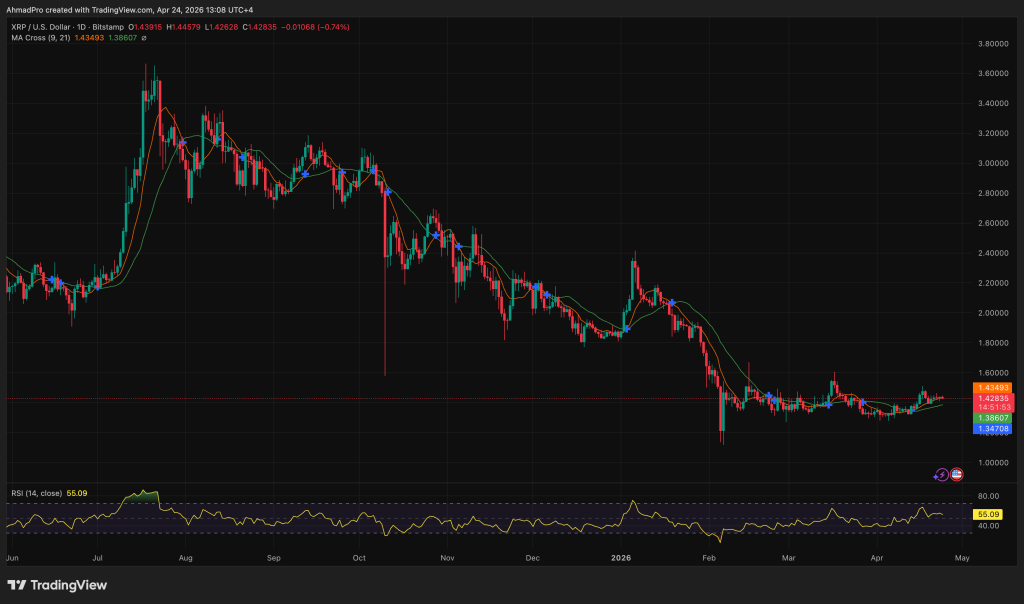
The problem is the broader structure. XRP has been in a downtrend since August, printing lower highs the entire way from $3.40 down to the February low near $1.07, and the current recovery is still well below every significant prior level.
The $1.50 zone is the immediate ceiling that has been capping price for weeks, and above that the $1.90 to $2.00 area is where real resistance starts stacking up from the previous distribution zone.
If the MA cross holds and price can clear $1.50 with conviction, the setup starts to look like a genuine trend reversal attempt rather than just another dead cat bounce in a longer downtrend.
But until $1.50 flips and the MAs stay bullishly crossed, this is still a recovery inside a downtrend, and the burden of proof sits with the bulls.
When XRP News Get Boring, Capital Rotates to New Shiny Things Like Maxi Doge
XRP’s ETF delay pushes the timeline out again, and that matters because a lot of capital was positioned for a quick catalyst.
When that kind of trade disappears, it does not sit idle, it rotates, usually into higher-risk setups with faster potential upside.
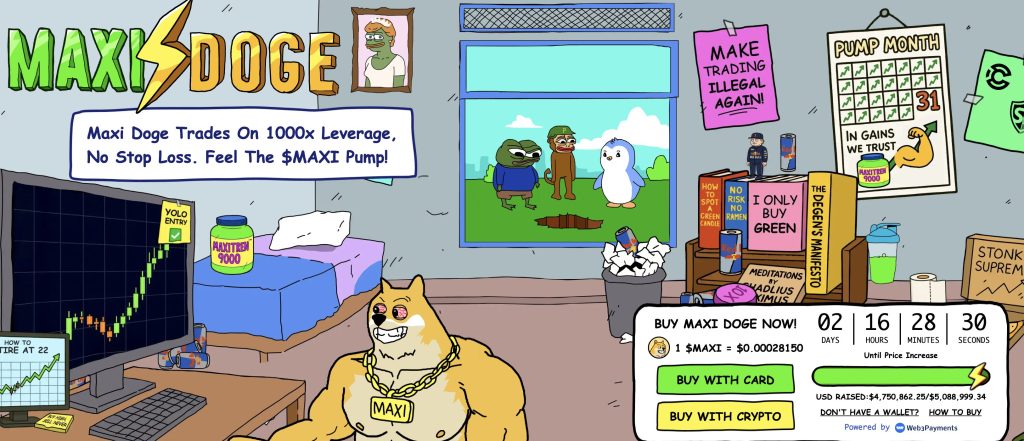
Maxi Doge is leaning directly into that rotation. It is built around the high-leverage trader mindset, targeting the same crowd that chases fast-moving narratives and short-term catalysts. The presale sits around $0.0002815 with roughly $4.75M raised, showing steady inflows rather than a one-time spike.
The setup is designed to keep momentum alive, with staking, trading competitions, and a treasury aimed at fueling liquidity and partnerships. The branding is aggressive and intentional, built to spread quickly in the same circles that react to ETF headlines.
At this stage, the appeal is simple, it is early, it is narrative-driven, and it sits right where capital tends to rotate when larger catalysts get delayed.
The post XRP NEWS: GraniteShares Just Delayed Its 3x XRP ETF for the Fifth Time: Is the SEC Blocking Leveraged Crypto Products? appeared first on Cryptonews.


The Green Beret arrested for betting on a classified U.S. raid looked like a one-off scandal for prediction markets. A new study suggests he may be a more troubling data point: an extreme example of the small group of informed traders who, as the soldier is accused of doing, actually move prices on Polymarket, while the crowd loses money around them.
The study, part of a working paper released this week by Roberto Gómez-Cram, Yunhan Guo, Theis Ingerslev Jensen and Howard Kung of London Business School and Yale, directly tests the industry’s core claim that the markets work owing to the massed knowledge of their participants.
Using every Polymarket trade from 2023 to 2025, the authors conclude that it’s actually a small group of informed traders that moves prices. The researchers analyzed 1.72 million accounts and $13.76 billion in trading volume, and found that just 3% of traders account for most price discovery, meaning they are the ones moving prices toward the correct outcome.
These traders consistently predict outcomes and move prices in the right direction. The remaining 97% mostly do not. They provide liquidity and generate volume, but in aggregate, they are on the losing side of trades against the informed minority, whose profits come directly from those positions.
The hard part is telling skill apart from luck. With more than a million traders on Polymarket, plenty will rack up big winnings by chance alone.
To filter that out, the authors reran each trader’s bets 10,000 times, keeping everything the same except the direction.
Same markets, same moments, same dollar amounts — but a coin flip decided whether to buy or sell. That gave them a benchmark for what each trader’s profits would look like with no real edge. If the actual results consistently beat the coin flip, that’s skill. If not, it’s luck.
The findings show among the biggest winners by raw profit, only 12% beat the benchmark, and many apparent winners didn’t stay that way: Roughly 60% of “lucky winners” become losers when their performance is checked against a separate sample of events.
Their activity improves market accuracy. When skilled participants account for a larger share of trading, prices move closer to the correct outcome, especially in the final stretch before resolution. They are also the first to react when new information hits, shifting positions in response to events like Federal Reserve announcements or corporate earnings, while other traders show little consistent reaction.
The same edge that makes skilled traders valuable to price discovery raises a harder question when that information isn’t public, or isn’t supposed to be.
Both Polymarket and Kalshi have said that trading on non-public information is strictly against their rules.
The paper grounds that risk in a concrete case: The U.S. removal of Nicolás Maduro from power in Venezuela in January. In the days and hours before the operation, three newly created Polymarket accounts piled into a contract asking whether Maduro would be removed. At the time, the market priced the odds at roughly 10%.
The new accounts placed unusually large bets, including orders of tens of thousands of shares, before the price moved. When the raid happened, the accounts collectively made more than $630,000. Two stopped trading entirely soon after, and the third went mostly dormant. There is no evidence of any wrongdoing on these accounts.
Insider trades, when they occur, move prices even more aggressively per dollar, about seven-to-12 times more than typical skilled trades. But they are rare and concentrated in a handful of events, not the day-to-day engine of price discovery. Most of the time, the market’s accuracy still depends on repeat traders who consistently outperform rather than on one-off bets.
The findings challenge the idea that prediction markets work because of crowds. They appear to work because of who is informed.

The latest data from a CEX.IO survey paints a nuanced picture of how a protracted crypto downturn is affecting ordinary households, even as the market has not collapsed the way it did in past cycles. The poll, conducted among 1,100 US-based active CEX.IO users, notes that Bitcoin remains roughly 40% below its October 2025 high, leaving many retail investors sitting on unrealized losses.
While the downturn has not sparked a systemic shock, it is reshaping everyday finances in subtler ways. About 36% of respondents said they cut back on routine spending to protect their crypto positions, with 10% describing those cuts as significant sacrifices. Additionally, 37% delayed or canceled purchases due to crypto losses, and 21% postponed major financial commitments such as buying a home, a car, or undertaking renovations. CEX.IO notes that the bear market of 2025–2026 has not produced systemic shock, but its effects are filtering through households in quieter, imperfect ways.
Key takeaways
- 36% cut everyday spending to sustain crypto positions; 10% describe those cuts as significant sacrifices.
- 37% delayed purchases; 21% postponed major commitments such as housing, a car, or renovations.
- 77% did not take on crypto-related debt; 38% reported some form of financial disruption since October 2025.
- 25% leaned on savings to maintain stability; 12% admitted to missing or delaying payments.
- Nearly half of respondents say crypto accounts for more than 30% of their investable assets; 79% expect to hold or increase positions over the next six months.
Bear market’s quiet toll on households
The survey depicts a bear market that, while not unleashing a crisis, is prompting prudent, risk-aware choices at the household level. The data illustrate a shift from aggressive participation to tighter budgeting as investors navigate unrealized losses. The fact that only a minority took on new crypto debt suggests that many are prioritizing liquidity and cash flow over deeper leverage as prices wander in a broad sideways trend.
Personal finances in flux
Beyond day-to-day budgeting, the figures reveal a layered picture of financial resilience and vulnerability. Although a large majority (77%) reported no crypto-backed debt, 38% still experienced some disruption in their finances since October 2025. A quarter leaned on savings to stay afloat, and 12% acknowledged missing or delaying payments. Taken together, the data underscore how price volatility translates into tangible financial trade-offs for participants who remain active in the market.
Asset allocation and forward outlook
Despite the strain, many traders maintain a stubbornly constructive stance toward crypto as an asset class. Nearly half of respondents indicated that digital assets make up more than 30% of their investable assets. Yet the broader sentiment about income generation remains steady: 73% said their approach to earning income has not changed, and a substantial 79% plan to hold or increase their positions over the next six months. The persistence of this allocation pattern signals a continued belief in crypto’s role within diversified portfolios, even as households manage tighter budgets in the near term.
Crypto offerings shaping banking decisions
Separately, a Börse Stuttgart Digital survey released this week points to growing consumer expectations for traditional banks to provide crypto services. Across Germany, Italy, Spain and France, about 35% of investors would consider switching banks for better crypto offerings, and roughly one in five expects their primary bank to offer crypto access within three years. The rising demand for crypto-enabled banking signals a gradual convergence between traditional finance and digital assets, with banks potentially taking a more active role in on-ramps, custody, and trading. Cointelegraph covered the Börse Stuttgart Digital findings.
Overall, the dual narratives—from US retail traders’ household-level recalibrations to Europe’s evolving banking relationships with crypto—underscore a broader shift: digital assets are moving from niche investment behavior into a more mainstream, asset-management-oriented framework. While the risk profile remains elevated for many participants, the data suggest a patient, long-term posture persists among a sizable share of users.
As markets continue to evolve, observers should watch for shifts in consumer debt, savings rates, and the speed at which banks expand crypto services. The coming months could reveal whether the current household dynamics translate into broader adoption or lead to a recalibration of crypto’s role in personal finance.

Disclosure: This article does not represent investment advice. The content and materials featured on this page are for educational purposes only.
Mobile cloud mining grows in 2026 as users seek easier Bitcoin mining access through Android and iOS apps.
Summary
- BM Blockchain offers a beginner-friendly mobile platform for Bitcoin cloud mining without owning hardware.
- Focused on digital infrastructure, BM Blockchain provides guided onboarding and simple access to computing resources.
- BM Blockchain includes welcome allocations for new users, making cloud mining easier to explore in 2026.
The mobile cloud mining market is still growing, as more people want to try Bitcoin mining without buying hardware or setting up their own rigs. On Android and iOS, “free” cloud mining in 2026 usually means one of three things: the app itself is free to use, a few free activation periods, or there are beginner promos that make it easier to get started.
Instead of sticking to one standard approach, this space now covers everything from infrastructure providers to cloud mining services, mining marketplaces, and mining options tied to exchanges. For those who are new to it, a good place to start is usually a platform that’s easy to use, explains how access works in plain terms, and lets you manage your account from your phone.
Top free cloud mining platforms (2026 comparison)
| Platform | Best For | Mobile Access | Free / Intro Access Model |
| BM Blockchain | Beginner-friendly exploration of platform-based mining access | Mobile-friendly platform access | Industry materials reference onboarding-related allocations valued at up to $108 Daily stable income |
| ECOS | Long-term contract-based cloud mining access | Android / iOS app | Free app access, with cloud mining contracts and hosted services managed in-app |
| StormGain | App-based cloud mining activation | Android app | Free Bitcoin mining cycles inside the app |
| Bitdeer | Infrastructure-backed cloud mining services | Android app | Free app access with cloud mining and mining-management tools |
| NiceHash | Mining management and marketplace monitoring | Android / iOS app | Free app access for wallet, rig, and marketplace management |
| Binance Pool | Exchange-linked mining ecosystem | Mobile ecosystem support | Free access to pool and mining-related services within the Binance ecosystem |
The comparison above is based on current public platform descriptions, app store listings, and publicly referenced industry materials.
1. BM Blockchain — Best for users looking for a low-barrier starting point
BM Blockchain can be described as a beginner-friendly choice for people who want to try Bitcoin cloud mining using a mobile-friendly platform that’s more focused on infrastructure. Public information about the company says it centers on taking part in digital infrastructure, getting access to computing resources, and offering a guided onboarding process.
Those same sources also mention welcome allocations for new users, valued at up to $108, which are presented as participation incentives rather than promised financial results. If someone wants an easier way to get started, BM Blockchain might be attractive to people who prefer using a platform instead of owning mining hardware themselves.
The focus isn’t really on building and maintaining mining machines, but on trying out infrastructure tools and different ways to participate through a simple, accessible interface.

2. ECOS — Best for users exploring structured cloud mining access
ECOS often shows up in 2026 cloud mining roundups because its public app info and platform pages focus on contract-based access to Bitcoin mining, hosted infrastructure, and centralized management features. Its Android and iOS listings describe a cloud mining setup where users can handle contracts, infrastructure services, and related tools all in one place.
So ECOS can work as a good reference point for people who want something more organized, not just an app you tap once a day. It’s easier to think of it as a platform for managing mining services than as a one-click, bonus-focused product.
3. StormGain — Best for free in-app mining cycles
StormGain is still one of the more well-known names among “free mining apps” because its public info specifically talks about free Bitcoin mining cycles inside the app. The app description says that anyone can start mining with one tap, and that they earn Bitcoin daily based on how they use the app and the platform’s rules.
That’s why StormGain tends to stand out for people looking for an easy way to get started on mobile. Still, it’s worth reading the platform terms closely, since mining rewards in an app may not work the same way as a traditional cloud mining contract.
4. Bitdeer — Best for infrastructure-backed cloud mining access
Bitdeer is often mentioned as a company with a wider set of mining services, such as cloud mining, mining hardware, infrastructure management, and some mobile tools. In the description for its public Android app, it describes itself as a provider that covers the full range of Bitcoin mining services.
For people who’d rather use something that feels tied to real mining infrastructure instead of just an app with a gamified layer, Bitdeer is still one of the more recognizable names in this space.
5. NiceHash — Best for mining marketplace and management tools
NiceHash isn’t really a typical “free cloud mining app.” It’s more like a marketplace for mining power, along with a set of tools to manage everything around it. The official mobile app lets users handle their wallet, account settings, and mining rigs while they’re away from their computer, which makes it a better fit for people who want clear visibility and hands-on control instead of a simple, bonus-style setup.
Since NiceHash runs as a hashpower marketplace, it’s particularly helpful for anyone who wants to keep an eye on mining performance and make practical decisions about their mining setup from a phone.
6. Binance Pool — Best for exchange-integrated mining services
Binance Pool stands out mainly because it ties mining services into a broader exchange ecosystem. In Binance’s public materials, they highlight things like seeing their hash rate in real time, having a few different payout options, and being able to access mining-related services from within the wider Binance platform.
This mix makes Binance Pool a good fit for people who already use Binance and want some mining exposure while also using the platform for trading and managing their assets.
How to choose the right free Bitcoin cloud mining app in 2026
For most people, the real question isn’t just which platform claims to be “free,” but what “free” actually means in day-to-day use. In reality, one platform might lure you in with a sign-up bonus, another might give users a few free activation rounds, and another might let them use the app for free while the actual mining service still requires a contract.
A practical evaluation should look at four things:
- what “free” means on the platform
- how clearly the access model is explained
- whether mobile tools are actually useful for management and monitoring
- whether fees, rewards, and participation conditions are disclosed in a way that matches the user’s experience level and risk tolerance
Conclusion
Bitcoin cloud mining apps in 2026 aren’t really built around just one kind of product anymore. The market now covers a range of options, like services that focus on infrastructure, apps where users activate mining through the platform, mining marketplaces, and platforms tied closely to exchanges.
For Android and iOS users, it usually makes sense to start with whatever fits the way a user wants to get in — whether they’re looking for beginner perks, standard cloud mining contracts, tools to manage things from their phone, or something that plugs into a bigger ecosystem. Some platforms also use onboarding offers to make it easier for new users to start.One example people mention publicly is the $108 welcome allocation linked to BM Blockchain.
As usual, users should compare the terms, be clear on what each platform means when it says “free,” and read the platform rules and conditions carefully before getting involved.
Frequently Asked Questions
What do people usually mean by “free Bitcoin cloud mining” in 2026?
Most of the time, “free” means users can use the app for free, activate a short free cycle, try mining for a limited time, or get a sign-up bonus. It usually doesn’t mean they get unlimited mining power forever at no cost. It’s worth checking whether the “free”part is just for creating an account, a one-time bonus, or a short trial.
Can someone actually earn Bitcoin on Android and iOS without buying mining hardware?
Some services allow users to use their phone, letting them try cloud mining without owning any physical machines. That said, they can be very different depending on the platform. Sometimes it’s just a starter cycle or access to tools and infrastructure, not the user personally running dedicated mining hardware.
Are free cloud mining apps safe to use?
It depends on the app. People usually look for clear contract terms, easy-to-understand payout rules, public info about the company or its infrastructure, and withdrawal rules that make sense. Common red flags are “guaranteed”returns that sound too good, no real company details, or fees that aren’texplained clearly.
Can cloud mining give daily Bitcoin payouts?
Some platforms show daily projections, use daily reward systems, or pay out on a recurring schedule, but what users actually receive can depend on the platform’s rules, fees, the market, and what kind of mining setup they’re using. Daily numbers are better seen as estimates, not something automatically guaranteed.
How should beginners pick a cloud mining platform?
For those who are new, the basics usually matter most: whether it’s easy to use, whether the plans are explained clearly, whether it works smoothly on mobile, and how transparent it is about rewards, fees, and withdrawals. A platform often feels more beginner-friendly when the interface is simple, and it clearly explains what users are turning on and what they’re getting.
Why do some platforms offer sign-up incentives like a $108 welcome allocation?
These offers are usually meant to make it easier to start and to let new users try the platform’s tools or beginner-level features. They’re typically framed as a way to participate or explore, rather than a promise of guaranteed profit.
What’s the safest way to start with a free cloud mining app?
A careful way to begin is to stick to free or limited features first, read the rules, try a withdrawal if it can proceed, and make sure users understand how it works before putting in more time or money. People often suggest this step-by-step approach for beginners testing cloud-mining services.
Disclosure: This content is provided by a third party. Neither crypto.news nor the author of this article endorses any product mentioned on this page. Users should conduct their own research before taking any action related to the company.
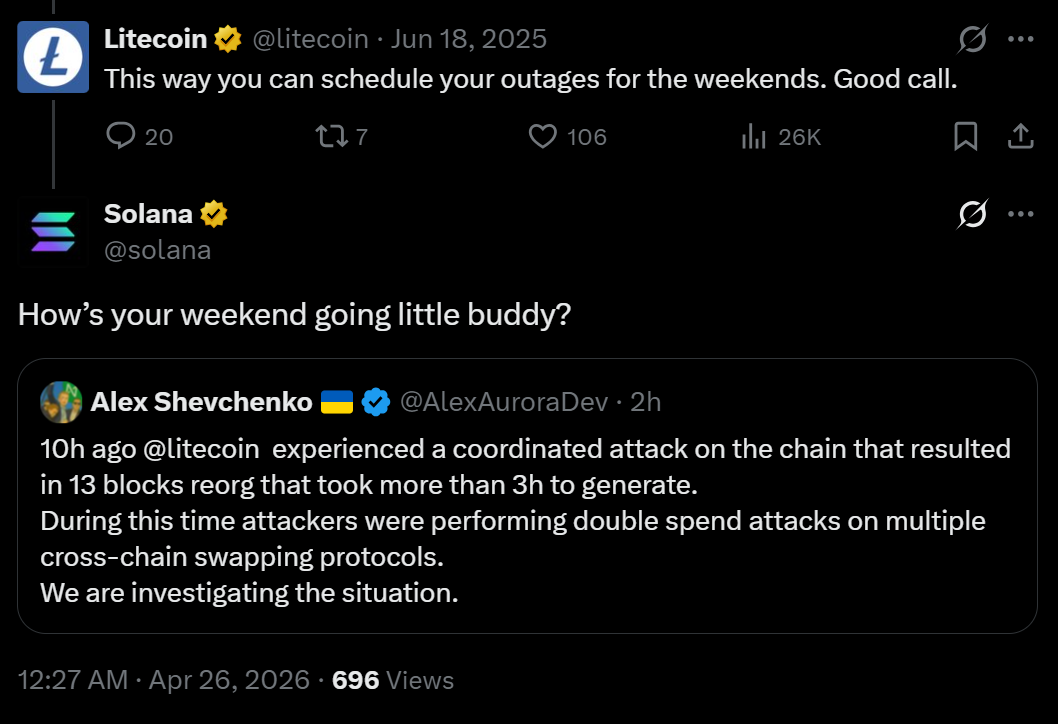
Litecoin’s emergency 13-block reorganization to reverse a zero-day attack has reignited debate about whether transaction finality can be trusted and whether the network is truly secure.
The incident reveals an uncomfortable truth: blockchain immutability is conditional, not absolute.
Transaction Finality Is Not Guaranteed
For years, crypto advocates have marketed blockchains as immutable ledgers where transactions cannot be reversed. Yet the Litecoin network just demonstrated that a coordinated attack, combined with unpatched nodes, can force it to rewrite its history.
While developers justified the reorg because the blocks contained invalid transactions, the question remains unsettling: how many confirmations make a transaction feel secure if a single bug can erase 13 blocks?
Unpatched Litecoin Nodes Created the Vulnerability
The zero-day attack succeeded because many Litecoin nodes ran outdated software that improperly validated MWEB transactions. This created a two-tier network in which different participants operated under distinct consensus rules.
Bitcoin and Litecoin have no mandatory update mechanism. Nodes can run old software indefinitely. While philosophically important, this freedom created the exact vulnerability exploited in the attack.
Miners and exchanges running unpatched software became unintended participants in enabling the exploit.
The zero-day specifically targeted MWEB, Litecoin’s privacy feature. Privacy adds complexity, and complexity creates attack surfaces. MWEB is still young, and this exploit suggests it needs further hardening before users should trust large-value transfers.
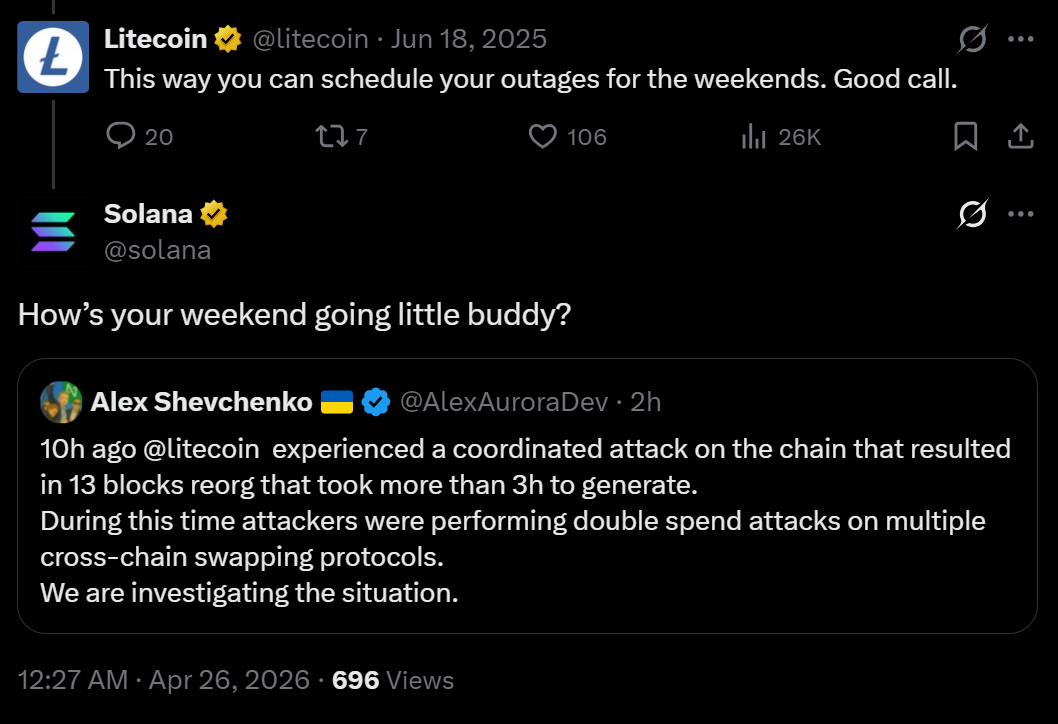
Finality Problem for Investors
Litecoin’s smaller hash rate and lower security budget make it more vulnerable to both bugs and future attacks. A 13-block reorg represents roughly 2.5 hours of history. On Bitcoin, reversing such a depth would cost billions and require controlling 51% of the network.
Users should consider how many confirmations they feel safe with, given this reality. Six confirmations may not be sufficient if a buggy client release can trigger a 13-block reorg.
Can Litecoin restore trust?
Technically, Litecoin developers have fixed the issue. But the incident exposes how dependent decentralized networks are on coordinated node updates and careful operator behavior. The network recovered, but it did not emerge unscathed.
For casual transactions, Litecoin likely remains safe. For long-term wealth storage, the incident raises legitimate questions about finality and whether transaction history can be rewritten at scale.
The post Litecoin Chain Rollback Raises Security Questions appeared first on BeInCrypto.


Peter Schiff has warned that Strategy, formerly known as MicroStrategy, could face pressure from its latest funding approach.
Summary
- Peter Schiff warned that Strategy’s preferred shares could increase pressure on its Bitcoin treasury plan.
- Schiff said the 11.5% yield may force Strategy to raise capital or sell Bitcoin.
- Strategy supporters argue Bitcoin gains can cover costs, but Schiff says new issuance changes the math.
The gold advocate and long-time Bitcoin critic focused on the company’s use of high-yield preferred shares. Schiff said the preferred shares carry an 11.5% yield. He argued that this creates a large cost for Strategy as the company continues to raise funds linked to its Bitcoin buying plan.
Strategy supporters argue that Bitcoin needs to rise only 2% each year to help cover the yield on the preferred shares. Schiff challenged that view and said it does not account for more issuance.
“The more STRC MSTR sells, the more BTC must rise to cover the yield,” Schiff wrote.
His comment suggested that each new preferred share sale could raise the pressure on Strategy’s Bitcoin holdings. Schiff also said Strategy lacks normal corporate earnings that can easily fund these payouts. He argued that this could force the company to raise more capital or sell Bitcoin.
Bitcoin sales could pressure Strategy
Schiff warned that a forced Bitcoin sale could create more market pressure. In his view, selling Bitcoin may lower the asset’s price and make Strategy’s balance sheet weaker.
He also said a fall in the preferred shares could push the company to offer higher yields. That could raise funding costs and increase the strain on Strategy’s capital structure.
“The only way to stop the death spiral is for MSTR to cancel the dividend,” Schiff said. He added that such a move could hurt STRC, MSTR, and Bitcoin.
Saylor’s Bitcoin strategy faces scrutiny
Michael Saylor has built Strategy into one of the largest corporate Bitcoin holders. The company has used debt, equity sales, and other instruments to add more BTC over several years.
Schiff said on April 18 that Strategy can no longer rely as easily on selling common shares at a premium. He claimed the company may need to sell more preferred shares, discounted common stock, or Bitcoin to meet its obligations.
The warning adds to the debate around Strategy’s Bitcoin treasury model. Supporters see the approach as a long-term Bitcoin bet, while critics say rising funding costs could create risk if Bitcoin prices weaken.


Ripple CEO Brad Garlinghouse has been named the 2026 Business Leader of the Year by the Harvard Business School Association of Northern California.
Summary
- Brad Garlinghouse received Harvard’s 2026 Business Leader of the Year award in San Francisco this week.
- Harvard praised Garlinghouse for scaling Ripple while keeping focus on the company’s long-term business vision.
- Ripple expanded through major acquisitions, global licenses, and XRP ETF momentum after its SEC battle.
The award was presented during a dinner at the Julia Morgan Ballroom in San Francisco. The Harvard Business School Association of Northern California has given the award since 1969. Past recipients include Amazon CEO Andy Jassy, former Cisco CEO John Chambers, and Intel co-founder Gordon Moore.
Harvard Business School Professor David B. Yoffie praised Garlinghouse’s leadership at Ripple. He pointed to the CEO’s work in building the company while keeping its core business direction in place.
Yoffie said Garlinghouse showed an “extraordinary ability to scale a complex platform while maintaining a steadfast commitment to his core vision.” The comment came as Garlinghouse marked 11 years at Ripple.
Garlinghouse’s path at Ripple
Garlinghouse joined Ripple in April 2015 as chief operating officer after earlier executive roles at AOL and Yahoo. He later became CEO in 2016 after co-founder Chris Larsen brought him into the company.
Before joining Ripple, Garlinghouse had reportedly considered a role at Uber. He later became one of the most visible executives in the crypto sector, especially during Ripple’s long legal dispute with the SEC.
Ripple expands after legal battle
Ripple has continued to grow after its legal fight with the SEC. Garlinghouse has also become a leading voice in calls for clearer crypto rules in the United States.
Over the past year, Ripple completed large acquisitions, including GTreasury for $1 billion and Hidden Road for $1.25 billion. The company later rebranded Hidden Road as Ripple Prime, a clearing platform focused on institutional finance.
Ripple also secured key licenses in global markets, including an Electronic Money Institution license in the United Kingdom. The company has also benefited from growing interest in XRP products after XRP spot ETFs launched last year.
The Harvard award adds another public milestone for Garlinghouse as Ripple expands its role in crypto payments, custody, stablecoins, and institutional markets.

TLDR:
- Galaxy Digital CEO Mike Novogratz expects the CLARITY Act to reach Trump’s desk for signing by June 2026.
- Galaxy’s Alex Thorn puts the odds of the CLARITY Act passing in 2026 at 50%, citing Senate delays as a key risk.
- Senator Cynthia Lummis warned that failing to pass the CLARITY Act now could delay reform until at least 2030.
- The CLARITY Act could unlock U.S. financial market access for an estimated 5.5 billion people across the globe.
The CLARITY Act remains one of the most closely watched pieces of legislation in the crypto space. Galaxy Digital CEO Mike Novogratz stated the bill will likely be finalized in May.
He expects President Trump to sign it into law in June. The bill aims to give the U.S. crypto industry a clearer regulatory framework.
Its passage could open American financial markets to over 5.5 billion people worldwide who currently lack access.
CLARITY Act Timeline Draws Both Confidence and Caution
Novogratz shared his outlook during a podcast with SkyBridge Capital founder Anthony Scaramucci. He said the bill would go to committee in the first week of May.
He added that it would be signed shortly after by President Trump. His comments came after a disappointing week for the industry. The Senate Banking Committee did not schedule a markup hearing as many had anticipated.
The CEO emphasized the bill’s broad political appeal. He said it is “wildly important” for both Democrats and Republicans to see it through.
This bipartisan support has been a consistent talking point among industry advocates. However, that support has not yet translated into a clear legislative path forward.
The CLARITY Act passed the House in July 2025 with backing from both parties. Yet ongoing disputes have slowed its progress through the Senate.
A major sticking point involves stablecoin yields. The banking sector has raised concerns that such yields could undermine their competitive position in the market.
U.S. Senator Cynthia Lummis issued a stark warning on April 10. She posted on X: “This is our last chance to pass the Clarity Act until at least 2030.
We can’t afford to surrender America’s financial future.” Her statement added urgency to an already pressured legislative calendar heading into May.
Industry Analysts See Mixed Odds for CLARITY Act in 2026
Galaxy Digital’s head of firmwide research, Alex Thorn, offered a more measured view. He put the current odds of the CLARITY Act passing in 2026 at 50%.
Thorn shared this estimate in an X post earlier in the week. He also released a detailed research report outlining the legislative risks involved.
Thorn had expected the Senate Banking, Housing, and Urban Affairs Committee to announce a markup hearing. That announcement was anticipated for the last week of April.
It did not happen as expected. He warned that if the markup process slips past mid-May, the odds of passage will drop sharply.
Novogratz, meanwhile, pointed to the broader economic case for the legislation. He noted that large institutions like SpaceX and Google could be tokenized and sold to global investors.
He also said a crypto wallet on a smartphone would allow people in countries like Bhutan, Botswana, Bolivia, and Paraguay to participate in the U.S. economy. That vision, he argued, is central to the bill’s purpose.
The CLARITY Act carries weight beyond the crypto market alone. A number of firms left the U.S. during the Biden administration due to regulatory uncertainty.
Clearer rules could bring those firms back and attract new ones. Whether Congress acts in time remains the central question heading into May.



Snagging a Markets in Crypto Assets (MiCA) license to operate in Europe is great, but, alone, it won’t be enough to turn a profit, according to Ben Zhou, the CEO of Bybit, one of the largest cryptocurrency trading platforms.
MiCA doesn’t cover the full range of products, such as derivatives and tokenized assets, needed to be profitable, Zhou said in an interview. For those, companies also need a MiFID II (Markets in Financial Instruments Directive) license and an Electronic Money Institution (EMI) license.
“With the current MiCA framework, you can only do fiat-to-crypto, crypto-to-crypto,” Zhou said. “There are many elements of a profitable business you cannot do, so even as a MiCA holder — unless you’re Kraken or BItpanda or Bitvivo, who are already making money because they have multiple licenses.”
Even Bybit, the world’s second-largest cryptocurrency exchange by trading volume, is some way off from breaking even in Europe, Zhou said. That timeline depends on when the firm acquires the other licenses it needs.
“We don’t make money under the current MiCA license. But we’re able to afford it because we’re a big entity. For us, it’s a long-term investment,” Zhou said. “It could be five years away, but I think that is a bit long. I would assume we are probably going to be profitable within two years.”
Market consolidation is coming
A MiCA license issued by one country allows a crypto-asset service provider to operate across the European Economic Area (EEA): all 27 members of the European Union, as well as Norway, Iceland and Liechtenstein.
Now is a critical juncture for many small to medium-sized crypto companies in Europe, because the MiCA grandfathering period closes at the end of June. That means firms must have obtained MiCA authorization to operate across the region by July 1 — a cut-off point that is widely expected to be the death knell for many smaller crypto firms.
“There’s going to be market consolidation,” Zhou said. “That’s why these guys are shutting down. Because even if they know they could afford MiCA, they’re like, ‘WTF, I need [MiFID, EMI] to make money, and I need to make a whole lot of investment in compliance infrastructure to be able to be profitable?’”
MiCA itself is undergoing change, with some country regulators calling for tighter, more centralized control and granting increased oversight to bodies such as the European Securities and Markets Authority (ESMA). And when it comes to structured products, ESMA recently reminded crypto firms offering perpetual futures that some of these products may fall outside the rules.
Zhou said Bybit chose a stringent regulator in Austria’s FMA, a decision he said will pay dividends down the line. Each country interprets MiCA differently, he said: “Some countries interpret it as a way to attract new business; some want heavy regulation. So you actually have different levels of strictness.”
As for bringing ESMA into the mix, Bybit is neutral, Zhou said.
“There are talks about a more level playing field,” he said. “But there could be disadvantages. Because when you have a local regulator they are easy to get to. If we have any issues, we just send an email and go to FMA in Vienna. But if everyone’s in Paris, then you have to line up. There are more CASPs, increased bureaucracy, decreased efficiency.”
Crypto World
Could Pepeto Be the Best Crypto to Buy in 2026 While BTC Tests $80K and ETH Holds Above $2,300?
The crypto market just flipped into greed territory for the first time in weeks, and the Fear and Greed Index hitting 60 has every trader asking which token carries the biggest returns from here.
Finding the best crypto to buy in 2026 means looking past coins that already ran and finding entries that still carry distance between where they sit and where they go.
BTC is testing $80,000 with $996 million in weekly ETF inflows, and a presale launched by the mind behind the first Pepe token has gathered more than $9.5 million from wallets that verified the live tools before sending capital.
Bitcoin touched $79,388 on April 22 before pulling back to $77,800 as profit taking hit altcoins harder than the leader.
Weekly ETF inflows reached $996 million with Bitcoin products leading the charge according to 24/7 Wall Street, and growing expectations around the CLARITY Act markup in the Senate added a regulatory tailwind that the market had not priced in.
The rally is real, but the question now is whether the best returns from here come from large caps or from entries that have not hit the open market yet.
Tokens Positioned for the Next Leg of the Recovery
Pepeto
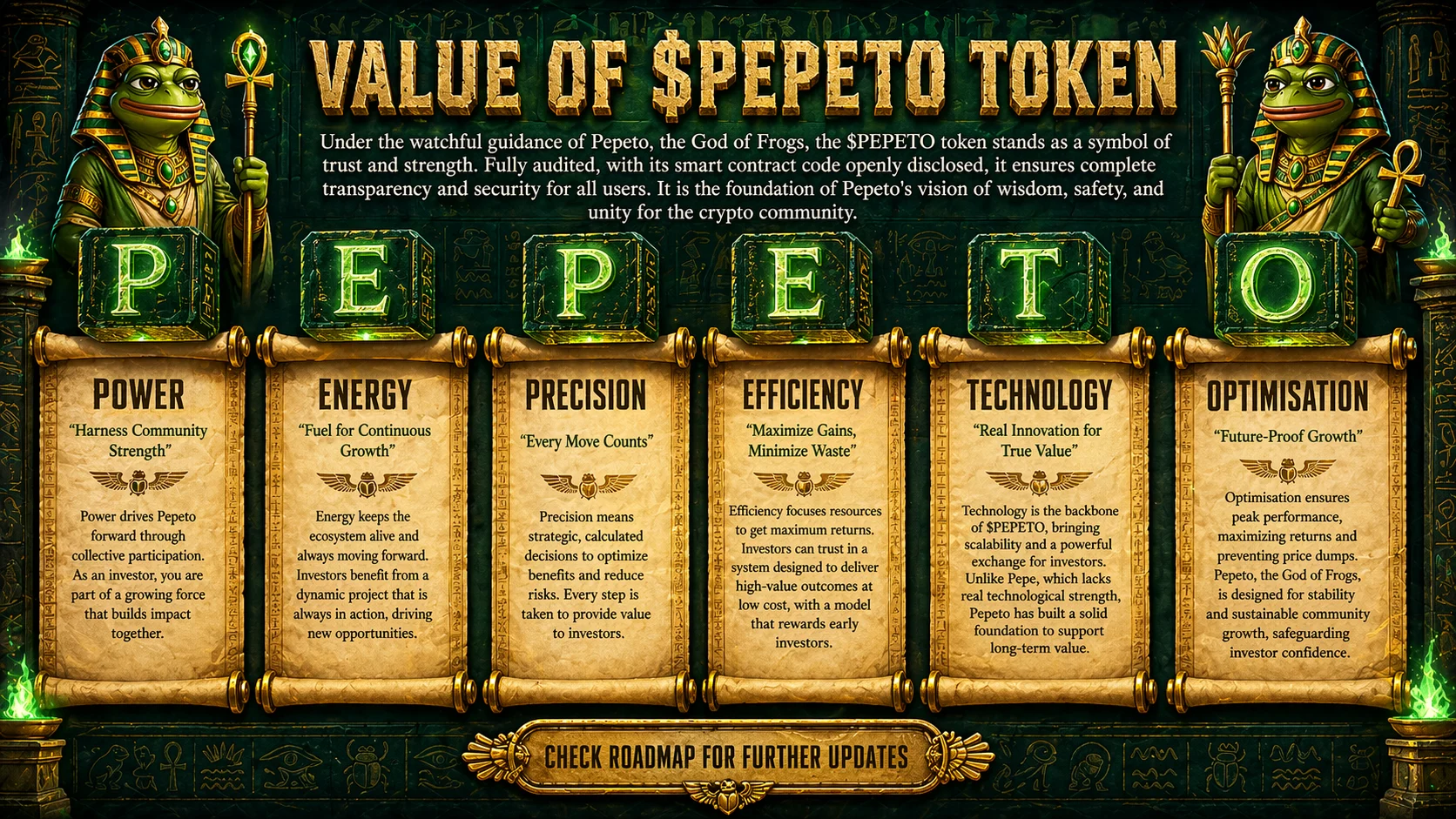
While the market watches BTC test resistance, the best crypto to buy in 2026 might be sitting in a presale most traders have not found yet. Pepeto is a marketplace that turns meme coin trading into a verified ecosystem where every tool runs live and every contract carries a SolidProof audit. It was built by the cofounder who created the original Pepe coin, with 420 trillion supply matching the same token structure that went from zero to billions the first time.
The risk scorer scans contracts for warning signs before capital gets committed, catching scams that move faster than news so the wallet stays protected during fast rotations that follow big BTC moves. PepetoSwap handles zero fee trades across tokens, keeping the full value of each position inside the wallet instead of leaking to platform charges.
178% APY staking layers returns above the presale position, and the expected Binance listing draws closer while that reward compounds. The presale sits at $0.000000186, and more than $9.5 million has been gathered from wallets that ran through the live platform before committing.
The 100x target from one expected Binance debut holds because presale to exchange is the window where every previous crypto fortune started, and the wallets buying now join that group before the crowd pays full price. Visit Pepeto to check the tools live.
Ethereum (ETH)
ETH trades near $2,316 according to CoinMarketCap, holding above $2,300 while BTC leads the rally.
The network still dominates smart contract development with over 31,000 active developers, but ETH needs to reclaim $2,800 before the recovery pattern confirms.
From $2,400 the path to the $4,800 peak is a 2x, solid for a portfolio anchor but far from the multiplier math that presale entries carry ahead of a listing event.
Bitcoin (BTC)
BTC sits near $77,258 according to CoinMarketCap, testing the $80,000 level that has acted as resistance since the pullback from the October 2025 peak of $126,000. Weekly ETF inflows at $996 million show institutional demand is real, and the CLARITY Act could open the door to bigger allocations.
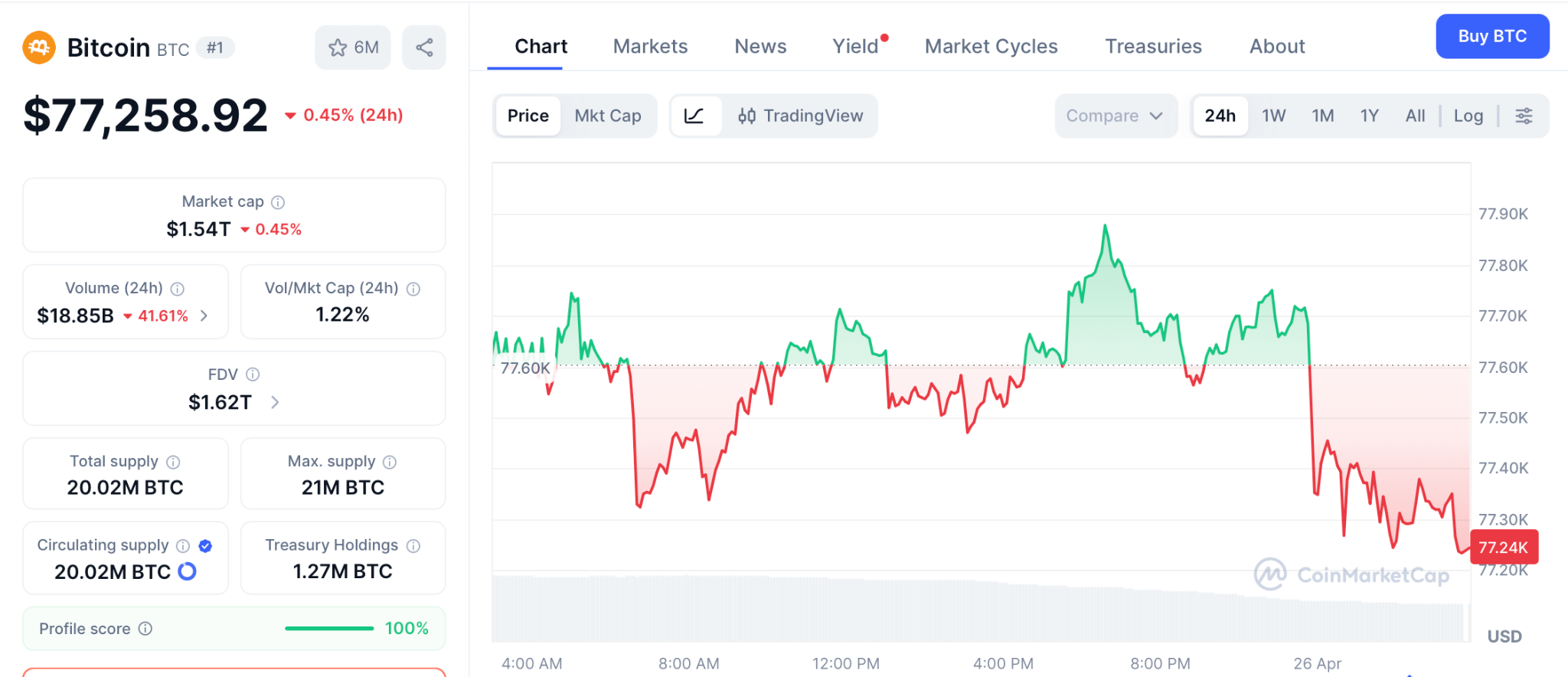
The math from $77,258 to a new high above $126,000 is a 1.6x, strong by traditional standards but modest compared to presale entries that carry 100x projections from a single listing event.
Conclusion
Will BTC break $80,000? The signals point toward higher levels as ETF demand and regulation clarity build across the market. But the signals for Pepeto point at something beyond a market recovery, they point at the same setup that produced every early buyer success story in crypto.
Every cycle creates winners who entered during fear and collected wealth during recovery, and the expected Binance listing will separate the wallets that entered from everyone who reads about them afterward.
Entering the Pepeto official website enow is how those wallets plan to be on the right side of that line when trading opens.
Click To Visit Pepeto Website To Enter The Presale

FAQs
What is the best crypto to buy in 2026 right now?
BTC and ETH carry strength, but presale entries like Pepeto offer the distance between current price and listing that large caps cannot match.
Why are traders choosing Pepeto over large caps?
A SolidProof audit, zero fee trading, and an expected Binance listing at presale pricing explain why more than $9.5 million entered the Pepeto official website.
Will BTC reach $100,000 this year?
That is a real possibility if ETF inflows continue and the CLARITY Act passes, but the timeline depends on broader market conditions.
Disclaimer: This is a Press Release provided by a third party who is responsible for the content. Please conduct your own research before taking any action based on the content.
XRP NEWS: GraniteShares Just Delayed Its 3x XRP ETF for the Fifth Time: Is the SEC Blocking Leveraged Crypto Products?

Green Party’s Spencer says MPs are pissed on the job

LSG vs KKR Live Score, IPL 2026: LSG Opt To Bowl, Drop 156.7 Kmph Pacer vs KKR

Manchester United reach agreement with Casemiro over contract clause amid transfer speculation

US brings back mandatory military draft registration

Steven Gerrard disagrees with Gary Neville over ‘shock’ Chelsea and Arsenal claim | Football


-

 Business7 days ago
Powerball Result April 18, 2026: No Jackpot Winner in Powerball Draw: $75 Million Rolls Over
-

 Fashion2 days ago
Weekend Open Thread – Corporette.com
-
Entertainment7 days ago
NBA Analyst Charles Barkley Chimes in on Ice Spice McDonald’s Fiasco
-
Crypto World19 hours ago
Hyperliquid $HYPE Rally Builds Momentum as AI Sector Enters Prove-It Phase
-

 Politics6 days ago
Gary Stevenson delivers timely reminder to register to vote as deadline TODAY
-
Crypto World6 days ago
Bank of Hawai’i (BOH) Q1 2026: Net Income Drops to $57.4M as Net Interest Margin Expands
-

 Politics4 days ago
Making troops accountable for war crimes threatens US alliance, ex-SAS colonel warns
-

 Politics4 days ago
Disabled people challenge government SEND proposals over segregation concerns
-

 Business4 days ago
Rolls-Royce Voted UK’s Most Iconic Trade Mark as IPO Register Hits 150
-

 Politics4 days ago
Zack Polanski responds to home secretary’s taser threat
-

 Politics4 days ago
Starmer handler McSweeney to be dragged from shadows by Foreign Affairs Committee
-
Politics4 days ago
Wings Over Scotland | How To Get Away With Crimes
-
 Crypto World5 days ago
Five Value Stocks with Recovery Potential in 2026: PayPal (PYPL), Nike (NKE), and More
-

 Crypto World5 days ago
New York sues Coinbase, Gemini over prediction market offerings
-

 Politics4 days ago
‘Iran is still a nuclear threat’
-
 Sports1 hour ago
IPL 2026: Ruturaj Gaikwad registers slowest fifty of the season, enters all-time unwanted list | Cricket News
-
 Sports3 days ago
Tim Bradley names the current best in the world: “Better than Inoue and Usyk”
-
 Business4 days ago
HCL Tech share price tank over 9% after weak Q4. JPMorgan, HSBC & 3 others cut target price
-

 NewsBeat5 hours ago
LK Bennett closes all stores after entering administration
-

 Crypto World5 days ago
Crypto’s great hope in Senate’s Clarity Act still has a path to survive tight calendar
You must be logged in to post a comment Login