
Crypto World
Litecoin Chain Rollback Raises Security Questions

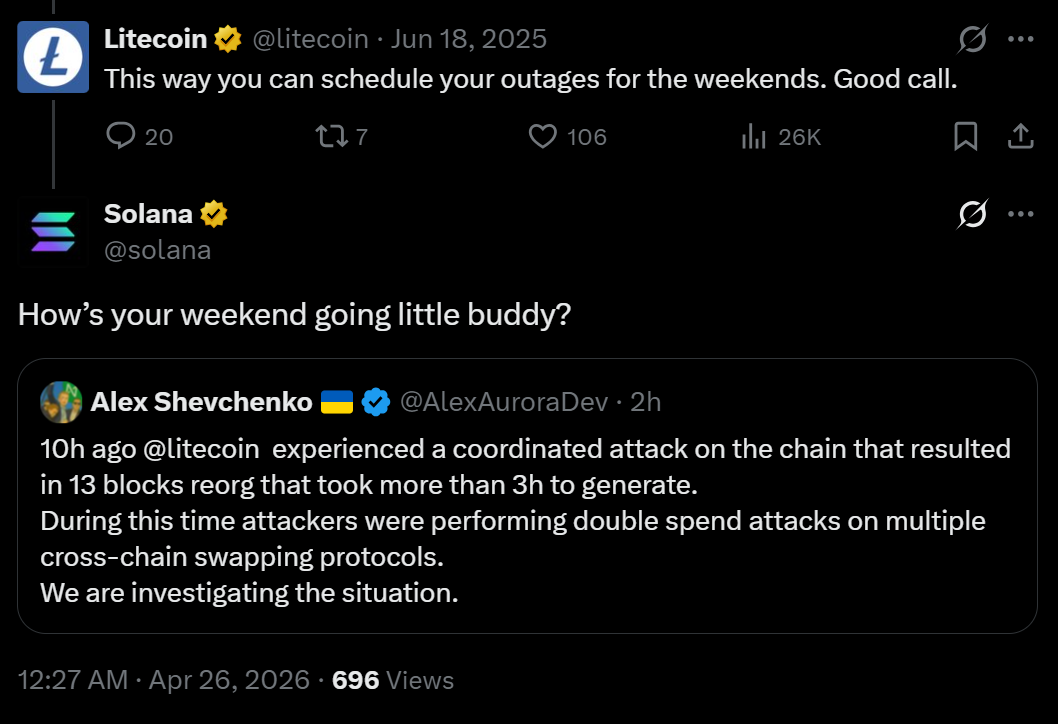
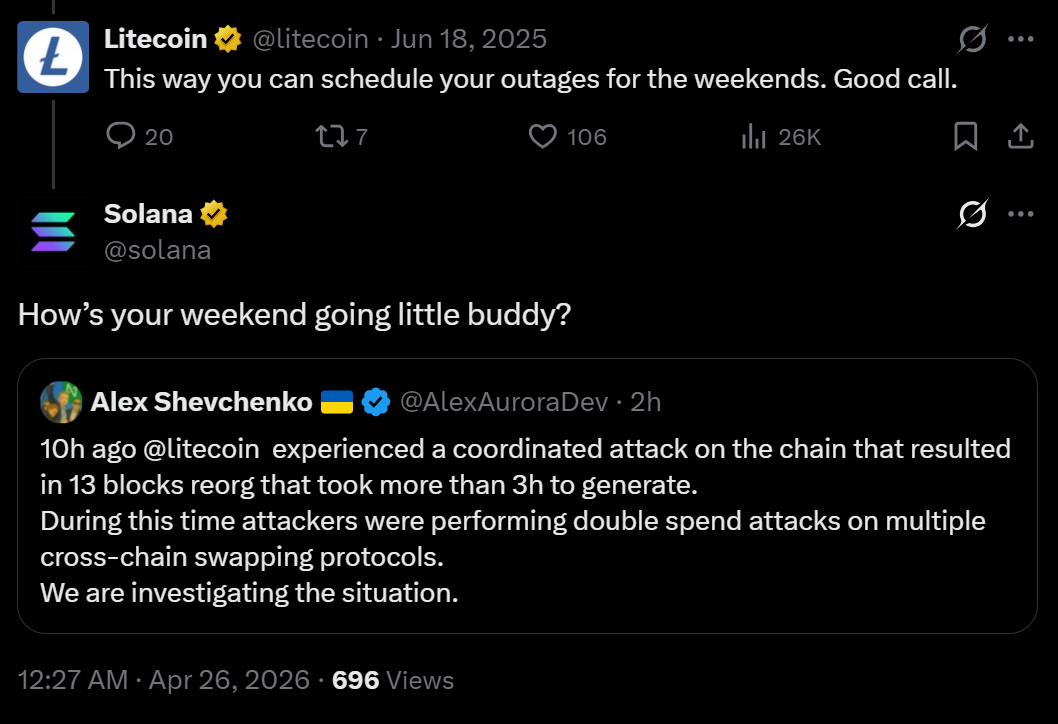
Litecoin’s emergency 13-block reorganization to reverse a zero-day attack has reignited debate about whether transaction finality can be trusted and whether the network is truly secure.
The incident reveals an uncomfortable truth: blockchain immutability is conditional, not absolute.
Transaction Finality Is Not Guaranteed
For years, crypto advocates have marketed blockchains as immutable ledgers where transactions cannot be reversed. Yet the Litecoin network just demonstrated that a coordinated attack, combined with unpatched nodes, can force it to rewrite its history.
While developers justified the reorg because the blocks contained invalid transactions, the question remains unsettling: how many confirmations make a transaction feel secure if a single bug can erase 13 blocks?
Unpatched Litecoin Nodes Created the Vulnerability
The zero-day attack succeeded because many Litecoin nodes ran outdated software that improperly validated MWEB transactions. This created a two-tier network in which different participants operated under distinct consensus rules.
Bitcoin and Litecoin have no mandatory update mechanism. Nodes can run old software indefinitely. While philosophically important, this freedom created the exact vulnerability exploited in the attack.
Miners and exchanges running unpatched software became unintended participants in enabling the exploit.
The zero-day specifically targeted MWEB, Litecoin’s privacy feature. Privacy adds complexity, and complexity creates attack surfaces. MWEB is still young, and this exploit suggests it needs further hardening before users should trust large-value transfers.
Finality Problem for Investors
Litecoin’s smaller hash rate and lower security budget make it more vulnerable to both bugs and future attacks. A 13-block reorg represents roughly 2.5 hours of history. On Bitcoin, reversing such a depth would cost billions and require controlling 51% of the network.
Users should consider how many confirmations they feel safe with, given this reality. Six confirmations may not be sufficient if a buggy client release can trigger a 13-block reorg.
Can Litecoin restore trust?
Technically, Litecoin developers have fixed the issue. But the incident exposes how dependent decentralized networks are on coordinated node updates and careful operator behavior. The network recovered, but it did not emerge unscathed.
For casual transactions, Litecoin likely remains safe. For long-term wealth storage, the incident raises legitimate questions about finality and whether transaction history can be rewritten at scale.
The post Litecoin Chain Rollback Raises Security Questions appeared first on BeInCrypto.

Crypto World
Can Bitcoin Price Continue Its Push To The Upside? Varntix Investors Buyout 24% Savings Plan In Just 7 Hours!

Bitcoin pushed back toward the $79,000 level as easing geopolitical tension driven by the potential extension of the U.S. Iran ceasefire talks lifted overall risk sentiment. The move was supported by renewed ETF inflows and increased derivatives activity, reinforcing short-term momentum.
At the same time, recent pullbacks tied to geopolitical uncertainty have highlighted how quickly sentiment can shift. Sharp reversals remain a defining feature of the market, and that volatility is starting to influence how investors position capital.
Rather than relying solely on price movement, a growing share of capital is moving toward structured income strategies. Platforms like Varntix reflect this shift, offering fixed-term allocations with predefined stablecoin payouts. The aim is not to replace exposure to assets like Bitcoin, but to introduce a more predictable income layer alongside ongoing market fluctuations.
Can Bitcoin Price Sustain Momentum Amid Macro Uncertainty?
According to the New York Post, Trump has indicated that U.S.–Iran peace negotiations could restart as early as Friday, following a decision to extend the truce indefinitely.
Bitcoin responded with a modest rebound, gaining over 1% and pushing its 24-hour advance beyond 4%, with price hovering near $78,900. The intraday range has been relatively wide, with a low around $74,852 and a high near $78,728. However, the move comes alongside a sharp drop in trading volume down roughly 32% suggesting that traders remain cautious despite the upward momentum.
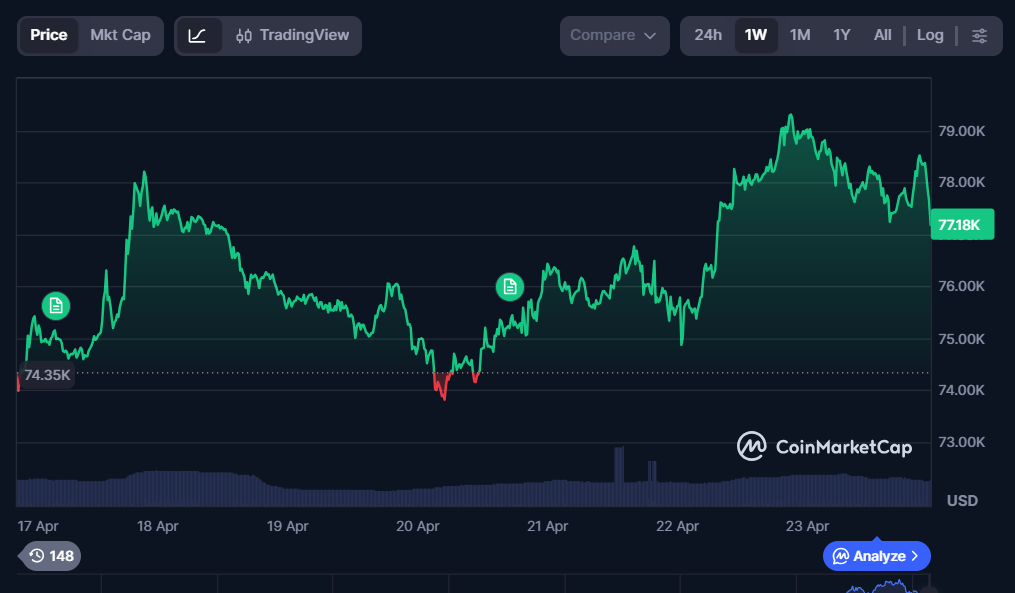
Source: CoinMarketCap
Grayscale Research has suggested that Bitcoin could find a bottom in the $65,000 to $70,000 range, pointing to a more cautious near-term outlook. At the same time, the Bitcoin Bull Index has shifted to neutral for the first time in six months, reflecting a cooling in overall sentiment.
Despite this, derivatives activity is picking up. CoinGlass data shows a notable increase in futures positioning, with total open interest rising more than 9% in the past 24 hours to exceed $62 billion, indicating growing participation even as directional conviction remains mixed.
Structured Crypto Income: The Varntix Approach
While Bitcoin continues to react to geopolitical headlines and liquidity shifts, not all investors are positioning around direction alone. A growing share of capital is moving toward structures that don’t depend on whether price moves up or down next.
That’s where Varntix is starting to stand out. It offers a structured approach to earning yield on digital assets through dedicated savings plans, where capital is allocated for set periods and returns are defined upfront.
Payouts are made in stablecoins like USDT or USDC, creating a more predictable experience. Instead of reacting to market swings, investors know what they are committing, how long it is allocated and what it is expected to return over that period.

Varntix introduces flexibility through a savings structure that offers two distinct approaches. Fixed plans are designed for investors who want higher returns over longer timeframes, while flexible accounts prioritise liquidity, allowing withdrawals when needed even if the yield is lower.
The contrast becomes clearer when you look at a simple $2,500 allocation. With Bitcoin, the outcome is entirely dependent on price movement. If the price rises by 20%, the position gains around $500. If it falls by the same amount, the loss is similar. If the market moves sideways, there is no return at all. Everything depends on timing and direction.
Varntix removes that dependency by defining the return in advance. A fixed plan can generate roughly $600 over a year regardless of how the market performs. A flexible plan produces a lower but steady return, typically between $107 and $162 annually, while still allowing access to the capital when required.
The key difference is predictability. Instead of outcomes shifting with market volatility, investors receive stablecoin-based income that follows a clear structure, making it easier to plan around both growth and liquidity even in uncertain market conditions.
Take a closer look at Varntix if you want your crypto to work harder.
FAQs
Q1: What is Varntix in relation to Bitcoin price movements?
Varntix is a fixed-income crypto model that operates independently of Bitcoin price direction, offering stablecoin returns instead of market-dependent gains.
Q2: How does Varntix make returns different from trading Bitcoin?
Bitcoin returns depend on price fluctuations, while Varntix provides predefined yields over fixed terms, paid in stablecoins like USDT or USDC.
Q3: Why are investors considering Varntix during volatile Bitcoin markets?
Because Bitcoin price is highly reactive to geopolitical and macro news, Varntix offers a way to earn a predictable income without needing to time market swings.
Disclaimer: This is a Press Release provided by a third party who is responsible for the content. Please conduct your own research before taking any action based on the content.

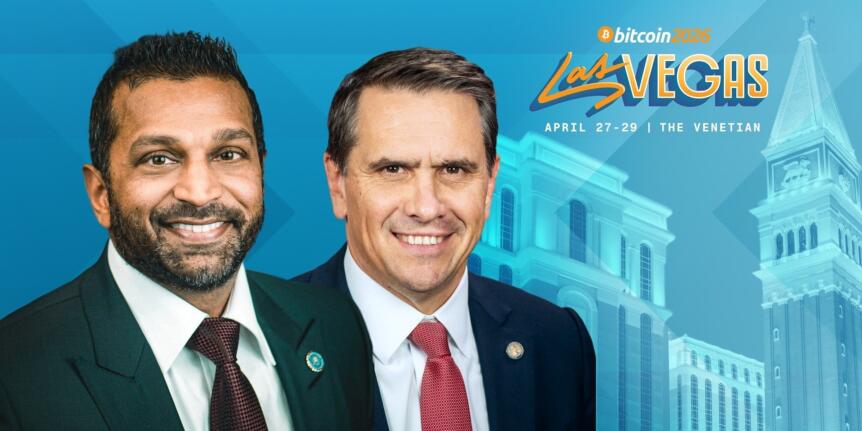
Nashville, TN — April 22, 2026 — Bitcoin 2026, the world’s premier Bitcoin conference, today announced that Acting Attorney General Todd Blanche and FBI Director Kash Patel will join an elite lineup of speakers at this year’s landmark event, taking place April 27–29, 2026 at The Venetian, Las Vegas.
AG Blanche and Director Patel will appear as part of Code & Country 2026, the conference’s flagship policy forum taking place on April 27 starting at 10:30 AM, open to Pro Pass and Whale Pass holders. The forum is designed to facilitate direct engagement between Bitcoin builders and U.S. policymakers, with no intermediaries, on the legislative and regulatory issues shaping technology, civil liberties, and digital assets.
Acting Attorney General Todd Blanche and Director Patel will participate in a fireside chat moderated by Paul Grewal. The broader Code & Country 2026 track features an exceptional roster of policymakers and regulators, including Senator Cynthia Lummis (R-WY), the architect of landmark Bitcoin legislation in Congress; SEC Chairman Paul Atkins; CFTC Chairman Mike Selig; and Patrick Witt, Executive Director of the President’s Council of Advisors for Digital Assets at the White House, among others. The full conference speaker lineup also includes Michael Saylor, Founder & Executive Chairman of Strategy, Robert Mitchnick, Head of Digital Assets at BlackRock, Caitlin Long, Founder & CEO of Custodia Bank, Arthur Hayes, CIO of Maelstrom, and Aleš Michl, Governor of the Czech National Bank.
Director Patel’s fireside chat, titled “Code is Free Speech: Ending the War on Bitcoin,” is expected to be one of the most anticipated sessions of the forum, offering attendees a rare and candid conversation with the nation’s top federal law enforcement official on the intersection of open-source software, civil liberties, and digital assets.
The announcement signals a watershed moment for the Bitcoin community, reflecting growing recognition at the highest levels of government of Bitcoin’s role in the future of finance and free expression. Code & Country 2026 comes at a pivotal moment, during a U.S. election year when congressional agendas, committee priorities, and regulatory frameworks are actively taking shape.
“We are honored to welcome Acting Attorney General Todd Blanche and FBI Director Kash Patel to the Bitcoin 2026 stage,” said Brandon Green, CEO of BTC Inc. Bitcoin 2026 organizer. “Their session promises to deliver extraordinary insight into how federal policy is evolving around Bitcoin development, free speech, and the ability to build great products in America that people need. Alongside Senators Lummis and Moreno and Representatives Nunn, Lawler, Miller-Meeks, Begich, and the rest of our policy lineup, this is shaping up to be the most consequential policy forum in Bitcoin’s history.”
Code & Country was formally launched as a branded track in 2025, building on programming that featured senior U.S. political leaders including Vice President J.D. Vance, White House AI & Crypto Czar David Sacks, House Majority Whip Tom Emmer, and SEC Commissioner Hester Peirce, among others. The 2026 edition expands on that foundation with a focus on energy infrastructure, stablecoin regulation, and civil liberties in the digital age.
Director Patel’s appearance comes amid significant community interest in open-source software rights and the legal treatment of Bitcoin developers. His fireside chat is expected to shed light on the federal government’s posture toward the Bitcoin development community going forward. Further speaker and programming details will be announced ahead of the event.
About The Bitcoin Conference
The Bitcoin Conference, organised by BTC Inc, a Nakamoto Inc. (NASDAQ: NAKA) company, is a global event series featuring notable industry speakers, workshops, exhibitions, and entertainment. These events serve as vital platforms for Bitcoin industry leaders, developers, investors, and enthusiasts to gather, network, and exchange ideas. The Bitcoin Conference hosted approximately 67,000 attendees in 2025 across its events in the United States, Asia, Europe, and the Middle East.
Bitcoin 2026 will be held in Las Vegas, April 27–29. The international event series continues with Bitcoin Hong Kong (August 27–28, 2026), Bitcoin Amsterdam (November 5–6, 2026), and Bitcoin MENA in Abu Dhabi (December 2026).


Pi Network will sponsor Consensus 2026 in Miami, placing the project before blockchain builders, investors, and policy figures.
Summary
- Pi Network will sponsor Consensus 2026 in Miami, with both founders scheduled to speak.
- Chengdiao Fan and Nicolas Kokkalis will address AI, Web3, and online identity verification.
- Protocol 22 and Protocol 23 upgrades could support smart contracts and wider Pi ecosystem growth.
The event comes as the network tries to turn its large user base into broader ecosystem activity.
The project’s two co-founders, Nicolas Kokkalis and Chengdiao Fan, will speak during the conference. Their sessions will focus on Pi’s blockchain infrastructure, digital identity, artificial intelligence, and future application development.
Founders to address AI, Web3, and identity
Chengdiao Fan is scheduled to speak on May 6. Her presentation will cover how Pi’s blockchain, verified identity system, and global user network may support products built for the AI and Web3 era.
Nicolas Kokkalis will speak on May 7 during a panel about proving human identity online while protecting user privacy. The topic has gained more attention as artificial intelligence tools make online impersonation easier.
Pi Network said in an X post, “The Pi Founders will both take the stage as speakers at the Consensus 2026 conference.” The post also said Fan will discuss Pi’s infrastructure and verified identity network.
Moreover, Pi Network continues to present identity verification as one of its main features. The project uses a KYC-based model that combines human checks and AI-supported tools to verify users.
The network claims it has more than 18 million verified users. It also says its system has completed hundreds of millions of verification tasks across its community.
This approach places Pi Network among blockchain projects trying to build proof-of-personhood systems. Pi also uses its mobile-first design to reach users across different markets.
Protocol upgrades mark transition phase
Pi Network’s Consensus 2026 appearance comes during a technical transition for the project. Node operators must upgrade to Protocol 22 by April 27, or failed nodes may be removed from active network support.
Protocol 22 supports node software and desktop applications. The upgrade also prepares the network for Protocol 23, which is expected in May and is designed to support smart contracts.
The planned PiRC1 token standard also points to a wider ecosystem push. These upgrades may help developers build more applications on Pi Network.
Pi coin price rose 5.30% in 24 hours to trade near $0.180, according to CoinGecko data. The move came as market attention turned to Pi Network’s role at Consensus 2026 and its planned network changes.


Pi Network’s PI (PI) token recovered over the weekend as several altcoins moved higher. PI rose more than 5% in 24 hours and traded above $0.18.
Summary
- PI token gained over 5% in 24 hours, trading above $0.18 during weekend recovery move.
- Bitcoin briefly touched $78,200 before settling near $78,000 after several days of rangebound trading action.
- Crypto market cap neared $2.7 trillion as select altcoins gained and Bitcoin dominance topped 58%.
The rebound followed recent weakness in the Pi Network token. STABLE led the daily gainers with a 7% move to $0.034, while PI ranked among the stronger performers.
Bitcoin (BTC) also moved higher after a quiet weekend. The asset briefly touched $78,200 before easing back near $78,000, keeping its market value around $1.56 trillion.
The move came after Bitcoin traded in a narrow range for several days. It held between about $77,000 and $78,500 after failing to extend an earlier rally toward $79,600.
Trump event report adds market attention
Reports said U.S. President Donald Trump was evacuated from the White House Correspondents’ Dinner after gunfire near the event venue. Authorities later said a 31-year-old California man was taken into custody with multiple weapons.
Bitcoin rose by about $1,000 within minutes after the report before pulling back. The move kept traders focused on how political and security events may affect short-term crypto prices.
Altcoins show mixed weekend moves
Several altcoins posted gains alongside PI. XMR and SKY rose more than 4% on the day, while ETH, TRX, and DOGE traded slightly higher.
Other large tokens moved lower. XRP, BNB, SOL, HYPE, and BCH recorded small losses, while RAIN fell 5% in the same period.
The total crypto market value moved back near $2.7 trillion after adding about $40 billion from the previous day’s low. Bitcoin’s market share remained above 58%, showing that traders still focused on BTC during the weekend recovery.
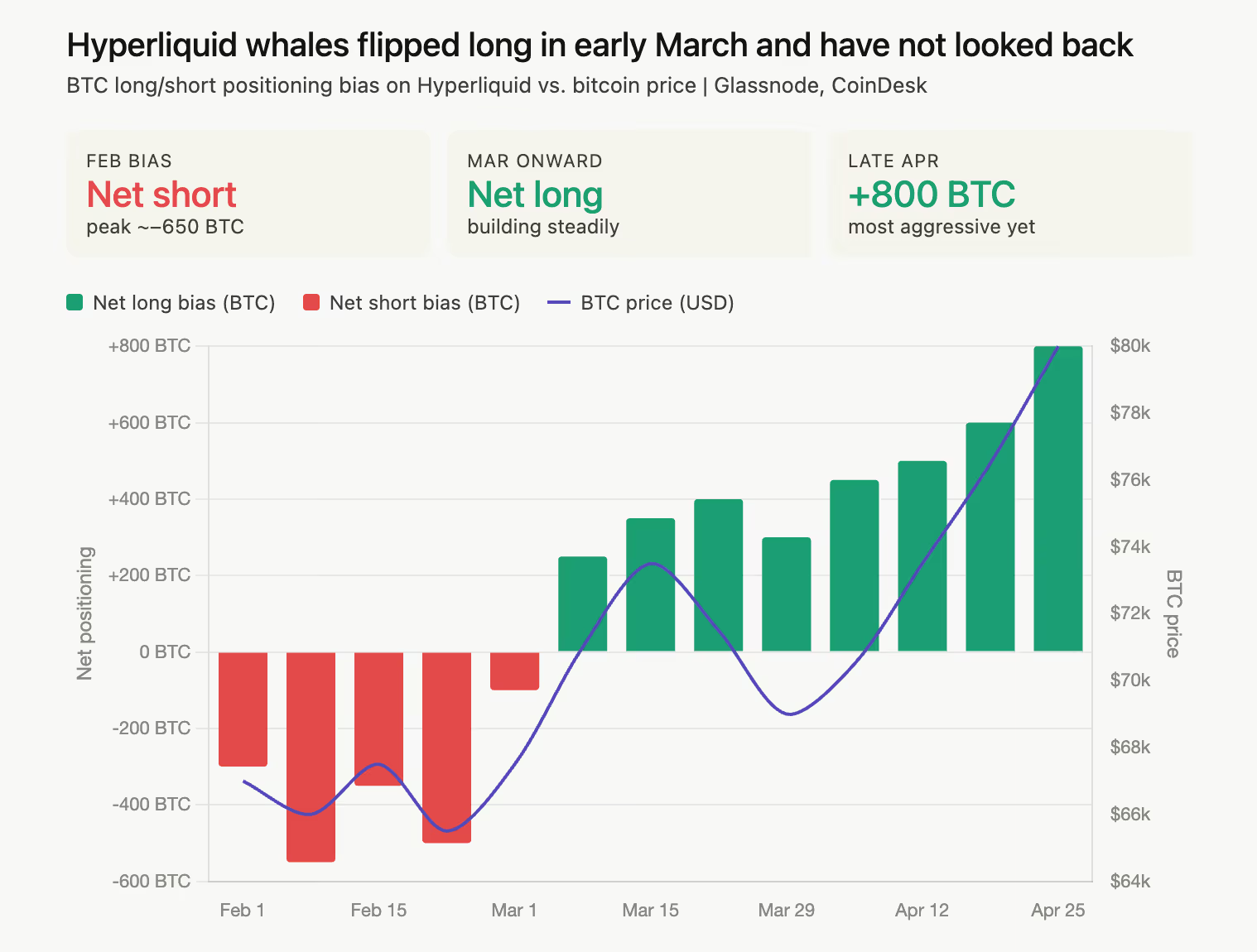
The biggest traders on Hyperliquid have been building a long bitcoin position for two months, and the price chart is starting to break their way.
Glassnode data shows whale positioning on Hyperliquid, the onchain perpetual futures exchange, flipped from net short to net long in early March and has stayed long ever since, with the size of the long bias increasing through April.
The shift coincides with bitcoin grinding higher from the mid-$60,000s in February to a brush near $80,000 earlier this week.
Hyperliquid has, in the past year, become the onchain venue of choice for traders running large positions, and a sustained long bias from that cohort tends to lead spot bitcoin price action by days to weeks rather than follow it.
The flip to net long in early March preceded the recovery from the mid-$60,000s. The positioning is now the most aggressively long it has been across the dataset.

Bitcoin perpetual swap funding across major exchanges sits at -0.13% on a seven-day basis according to Coinglass, meaning shorts are paying longs to keep their positions open.
That negative funding has held for roughly 47 consecutive days, one of the longest stretches of bearish derivatives positioning on record. Sustained negative funding matched with aggressive long positioning from Hyperliquid whales is the technical setup that produces short squeezes when spot prices break higher.
In traditional finance, the S&P 500 closed at a record high on Friday, capping its longest weekly advance since 2024.
In Pakistan, meantime, the weekend’s talks between Iran and the U.S. didn’t take place. President Donald Trump canceled his delegation’s trip to Islamabad after the Iranian foreign minister left the country before the U.S. group even set off.
Treasury yields dropped as the Justice Department closed its probe into Federal Reserve Chair Jerome Powell, potentially clearing the path for Kevin Warsh’s confirmation as the next Fed leader.
Quite where those developments leave the Hyperliquid long positions will become apparent over the coming hours and days.
Crypto World
BTC Exchange Netflow Reveals How the Hormuz Conflict Drained 82,197 BTC From Major Platforms

TLDR:
- Binance, OKX, and Coinbase recorded a combined pre-conflict inflow of 27,741 BTC from Jan 2 to Feb 27.
- The Hormuz conflict triggered a brutal outflow of 82,197 BTC across all three exchanges within just 57 days.
- Binance lost 45,450 BTC in net outflows, representing 55.3% of total exchange drainage during the conflict period.
- Coinbase flipped from inflows to a net outflow of 8,242 BTC, pointing to a clear shift in institutional accumulation behavior.
Bitcoin is trading at $77,502.27 with a 7-day gain of 2.49% amid changing market conditions. On-chain data from Binance, OKX, and Coinbase reveal a sharp reversal in capital flow patterns.
The 57-day period surrounding the Hormuz conflict marks a clear shift from distribution to cold custody accumulation.
This change in BTC exchange netflow data shows how both retail and institutional investors repositioned their holdings.
Distribution Defined the 57 Days Before the Hormuz War
From January 2 to February 27, Bitcoin exchange netflow reflected steady distribution across major platforms. The three exchanges together recorded a combined positive balance of 27,741 BTC.
This data showed that selling pressure was building across both retail and institutional sides of the market. The pre-conflict period set the stage for the dramatic reversal that followed.
Binance led the period with the highest deposit volume, absorbing 13,266 BTC in net inflows. That figure represented 47.8% of the total combined inflow across all three platforms. The trend pointed to concentrated retail activity on the Asian-facing exchange.
OKX followed with net deposits of 6,778 BTC, capturing 24.4% of the aggregate flow. At the same time, Coinbase posted inflows of 7,697 BTC, or 27.8% of the total. These numbers showed a broad distribution posture across both Asian and American markets.
On-chain analyst GugaOnChain described the pre-conflict period as “pure distribution” in a recent market post. The analyst noted that global retail dominated deposits across all three exchanges during this window.
The combined positive balance confirmed that exchange liquidity was building steadily before the geopolitical shock. Retail-heavy flows across all platforms reinforced this reading.
A Violent Supply Shock Followed as the Conflict Began
Once the Hormuz conflict started on February 28, exchange flows reversed course sharply. Over the next 57 days, the three platforms recorded a combined outflow of 82,197 BTC.
This marked a complete regime change from the distribution phase that preceded it. Despite short-term panic, the macro balance reflected a broad flight to cold custody.
Binance lost 45,450 BTC during this period, representing 55.3% of the total outflow. OKX followed with a net drainage of 28,506 BTC, making up 34.7% of the aggregate figure. Together, both exchanges accounted for the bulk of capital leaving centralized platforms.
Coinbase reversed its earlier inflow trend and recorded a net outflow of 8,242 BTC. This represented 10% of the total drainage across all three exchanges during the conflict period. The reversal showed American participants shifting assets away from exchanges and into cold storage.
GugaOnChain’s April 25 update confirmed the trend remained in place. Binance posted a minor retail return, registering a net inflow of 158 BTC, while OKX added 122 BTC.
Coinbase, however, held its outflow posture at -277 BTC for the day. The data reinforced that institutional accumulation continued even as retail flows stabilized.
Crypto World
Freezing dormant BTC would trigger worst single day repricing in bitcoin’s history, says maximalist
Freezing dormant bitcoin would trigger an immediate repricing and mark one of the world’s oldest cryptocurrency’s worst trading days since its 2009 launch, advocates told CoinDesk.
Bitcoin developers and crypto industry participants have debated for weeks whether they should freeze dormant tokens to protect them against the risk of theft through quantum computing, whenever those machines begin going online.
“Freezing any coins, even ‘lost’ ones, tells the market that all (roughly) 19.8 million BTC currently in circulation are conditionally owned,” said Samuel “Chad” Patt, who is also the founder of Op Net. “Institutional risk desks do not care about the reason, they care about the precedent.”
Read more: A simple explainer on what quantum computing actually is, and why it is terrifying for bitcoin
Although Jason Fernandes, a market analyst who describes himself as a pragmatic maximalist, said he agrees with Patt’s repricing thesis, he said he believes that a successful quantum attack would trigger a far more severe repricing.
“Institutions won’t just price precedent, they’ll price whether the system can survive a break in its core assumptions,” added Fernandes, also the co-founder at AdLunam.
Mati Greenspan, also a self-described maximalist and a market analyst, said that if “quantum computers ever crack early Bitcoin wallets, it won’t trigger a rollback or a freeze; it will trigger the largest bug bounty in human history.”
The debate follows weeks of discussion over how to respond to the potential threat quantum computing poses to the bitcoin network, particularly the estimated 5.6 million BTC. These tokens are held in wallets that have been dormant for more than a decade, in addresses that have not been upgraded and, therefore, are the most vulnerable in the event that quantum computing attacks become a reality.
A week ago, Jameson Lopp, a core Bitcoin developer and research analyst, told CoinDesk he would prefer to see the dormant bitcoin, worth roughly $440 billion, frozen by the network than left at risk of being stolen by future quantum hackers. He said he already sees those bitcoin as being lost.
Lopp and a team of other core bitcoin developers released Bitcoin Improvement Proposal 361 (BIP-361) earlier this month. The proposal contemplates phasing out bitcoin’s current cryptographic signatures, potentially freezing assets that fail to migrate.
‘Instant’ repricing
If that were to proceed, Patt said, “bitcoin’s repricing would be instant, not gradual and would be the worst single day in bitcoin’s history, but not because of a hack, but because the network will have proven its core value proposition is negotiable.”
The bitcoin maximalist said all fund managers, “who allocated on the censorship-resistance thesis, would be forced to unwind. Not by choice, but by mandate, because the asset no longer fits the risk profile it was purchased under.”
Read more: To freeze or not to freeze: Satoshi and the $440 billion in bitcoin threatened by quantum computing
Another bitcoin maximalist, Kent Halliburton, CEO and co-founder at SazMining, said he believes the intentions behind BIP-361 are good.
“However, you don’t defend Bitcoin by breaking its core promise of inviolable property rights,” he said. “We operate data centers on four continents, and our clients own every machine. That model only works because Bitcoin guarantees unconditional ownership.”
Halliburton said he believes, as many others do, that the quantum computing threat is real, but that there are better ways to deal with the risks it poses, such as better tooling and voluntary migration, “but not a protocol-level confiscation dressed up as a contingency plan.”
Deeply flawed
Khushboo Khullar, venture partner at Lightning Ventures and a bitcoin maximalist as well, said freezing dormant coins is a deeply flawed approach, despite appearing to be a pragmatic approach against quantum threats.
“It directly undermines Bitcoin’s core principles of immutability, permissionlessness, and no central enforcement. Such a move would require a contentious hard fork, violating the network’s decentralized ethos where no one can unilaterally seize or freeze anyone’s coins,” she said.
However, not all maximalists agree with Patt, Halliburton or Khullar, and instead believe Lopp’s proposal is sensible.
“It’s extremely challenging to build systems that are truly future-proof, and while Bitcoin has come quite close, quantum may pose a threat that requires tradeoffs participants won’t be happy with.” said Ken Kruger, founder and CEO of Moon Technologies.
“So far there’s no solution that doesn’t include compromise: freeze funds or let them be stolen? If solved elegantly, this could be a critical moment Bitcoin proves its resilience as a global monetary system,” he said.
Bitcoin could still evolve
Fernandes said he understands Patt’s and other maximalists’ points on precedent, adding that it is a real concern among the bitcoin community when discussing the network’s censorship-resistance ethos. In fact, he added, “I don’t think there is time; I think quantum will be upon us way faster than anybody thinks.”
“However, framing this as a question of purity misses the bigger issue: quantum risk is an existential threat to the system, not a philosophical debate,” Fernandes said. He believes bitcoin could evolve as it has in the past with SegWit and Taproot, upgrades designed to improve the network’s efficiency, privacy and scalability.
“The protocol isn’t ‘finished,’ it’s just conservative in how it changes,” he said. “But the risk of inaction far outweighs any concern about precedent or philosophical purity.”
Ultimately, Fernandes believes very few people within the community care in the long run, and that the majority of bitcoin holders, whether maximalists or not, are “more interested in preserving capital rather than preserving some vague notion about what bitcoin is ‘supposed to be.’”
Greenspan echoes what many of the maximalists ultimately prefer. “As with many cases in life, and especially with bitcoin, doing nothing is better than doing something.”
He concluded: “The Bitcoin community seems to feel strongly that freezing coins would be antithetical to bitcoin’s quintessential value proposition.”
Read more: How a quantum computer can be used to actually steal your bitcoin in ‘9 minutes’
More than one in three US crypto traders have cut everyday spending due to current market conditions, according to a new CEX.IO survey.
Summary
- CEX.IO found 36% of US crypto traders reduced daily spending due to current market conditions.
- About 37% delayed or cancelled purchases, including homes, cars, and renovation plans amid crypto losses.
- Despite the downturn, 79% of respondents plan to hold or increase crypto positions.
The exchange surveyed 1,100 active US-based users. The survey found that 36% of respondents reduced daily expenses because of the crypto downturn. Another 10% said those cuts involved major sacrifices to keep their crypto positions.
CEX.IO said 37% of respondents delayed or cancelled purchases due to crypto-related losses. The group included 21% who postponed major financial plans, such as buying a home, purchasing a car, or starting renovations.
Bitcoin remains about 40% below its October 2025 high. The decline has left many retail traders holding unrealized losses, even though the current downturn remains less severe than the 2022 bear market.
“The 2025–2026 bear market has not produced the kind of systemic shock seen in past cycles,” CEX.IO wrote.
The exchange added that the pressure now appears in quieter ways at the household level.
Many traders keep losses private
The survey also showed that many crypto traders are managing losses alone. Only 5% said someone else knows the full value and size of their crypto holdings.
Most respondents either share limited details or keep their positions private. This shows that crypto losses may affect household budgets without wider family or social awareness.
Cash flow pressure has also increased for some traders. While 77% said they did not take on debt linked to crypto, 38% reported some financial disruption since October 2025.
Investors still plan to hold crypto
Despite the pressure, most traders have not changed their long-term crypto plans. CEX.IO found that 73% said their income strategy remains unchanged.
Nearly half of the respondents said crypto accounts for more than 30% of their investable assets. Looking ahead, 79% said they plan to hold or increase their crypto positions over the next six months.
A separate Börse Stuttgart Digital survey also showed growing interest in crypto services among European investors. About 35% said they would consider switching banks for better crypto offerings.
The poll covered around 6,000 investors in Germany, Italy, Spain, and France. Nearly one in five said they expect their main bank to offer crypto access within three years.
Crypto World
XRP NEWS: GraniteShares Just Delayed Its 3x XRP ETF for the Fifth Time: Is the SEC Blocking Leveraged Crypto Products?

GraniteShares has pushed its 3x Long and 3x Short XRP ETF launch to May 7, the fifth delay in three weeks, and this is bearish news for XRP.
XRP is feeling the regulatory overhang, with traders watching closely to see whether institutional-grade leverage products ever actually arrive. The delay isn’t just an XRP story. It’s a signal about where the SEC stands on leveraged crypto exposure in 2026.
The effective launch date has shifted from April 2 → April 9 → April 16 → April 23 → now May 7.
The filing was submitted under SEC Rule 485, a mechanism that allows issuers to move effective dates without restarting the full registration process.
JUST IN: GraniteShares 3x leveraged $XRP ETFs delayed until May 07, 2026. pic.twitter.com/3NB41CqrA3
— RippleXity (@RippleXity) April 23, 2026
Critically, all eight leveraged funds in the same filing, 3x Long and 3x Short versions for Bitcoin, Ethereum, Solana, and XRP, were moved simultaneously. Whatever the SEC is working through, it targets the 3x structure itself, not XRP specifically.
Can XRP Price Hold Support as ETF Delays Pile Up?
XRP is sitting at $1.428 on the daily chart, and the most interesting thing happening right now is that the 9 and 21 MA are crossing bullish for the first time since the August peak, with price sitting just above both moving averages after months of trading below them.
Every previous MA cross on this chart played out exactly as expected; the blue dots mark each crossover, and they all led to meaningful moves in the direction of the cross, which makes the current setup worth paying attention to.
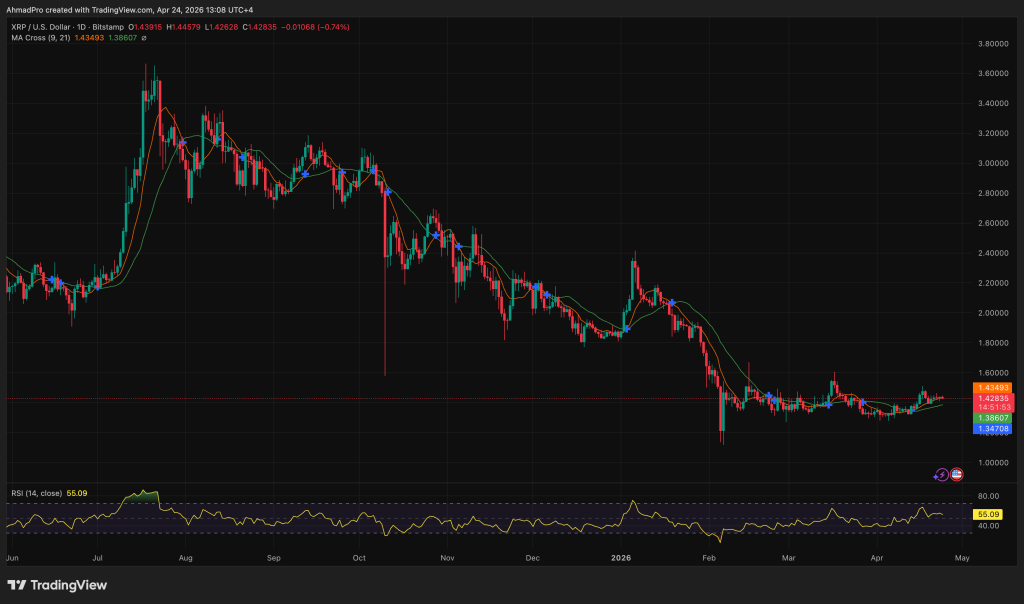
The problem is the broader structure. XRP has been in a downtrend since August, printing lower highs the entire way from $3.40 down to the February low near $1.07, and the current recovery is still well below every significant prior level.
The $1.50 zone is the immediate ceiling that has been capping price for weeks, and above that the $1.90 to $2.00 area is where real resistance starts stacking up from the previous distribution zone.
If the MA cross holds and price can clear $1.50 with conviction, the setup starts to look like a genuine trend reversal attempt rather than just another dead cat bounce in a longer downtrend.
But until $1.50 flips and the MAs stay bullishly crossed, this is still a recovery inside a downtrend, and the burden of proof sits with the bulls.
When XRP News Get Boring, Capital Rotates to New Shiny Things Like Maxi Doge
XRP’s ETF delay pushes the timeline out again, and that matters because a lot of capital was positioned for a quick catalyst.
When that kind of trade disappears, it does not sit idle, it rotates, usually into higher-risk setups with faster potential upside.
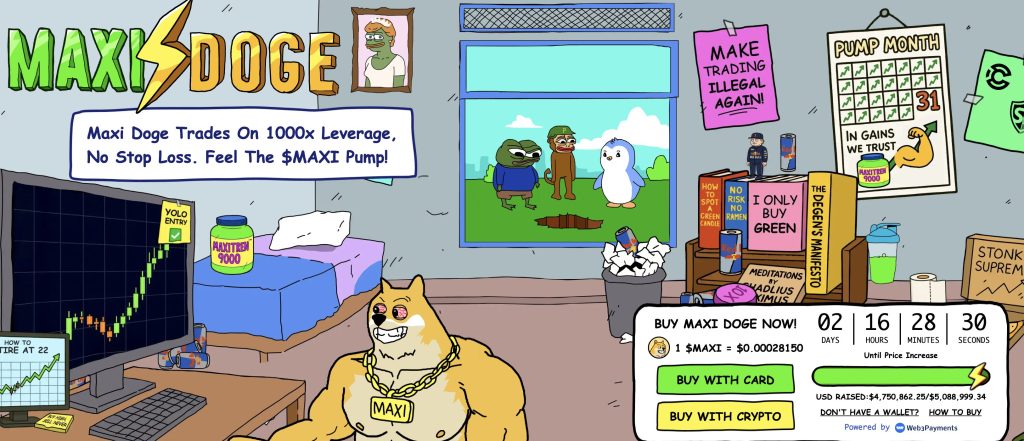
Maxi Doge is leaning directly into that rotation. It is built around the high-leverage trader mindset, targeting the same crowd that chases fast-moving narratives and short-term catalysts. The presale sits around $0.0002815 with roughly $4.75M raised, showing steady inflows rather than a one-time spike.
The setup is designed to keep momentum alive, with staking, trading competitions, and a treasury aimed at fueling liquidity and partnerships. The branding is aggressive and intentional, built to spread quickly in the same circles that react to ETF headlines.
At this stage, the appeal is simple, it is early, it is narrative-driven, and it sits right where capital tends to rotate when larger catalysts get delayed.
The post XRP NEWS: GraniteShares Just Delayed Its 3x XRP ETF for the Fifth Time: Is the SEC Blocking Leveraged Crypto Products? appeared first on Cryptonews.
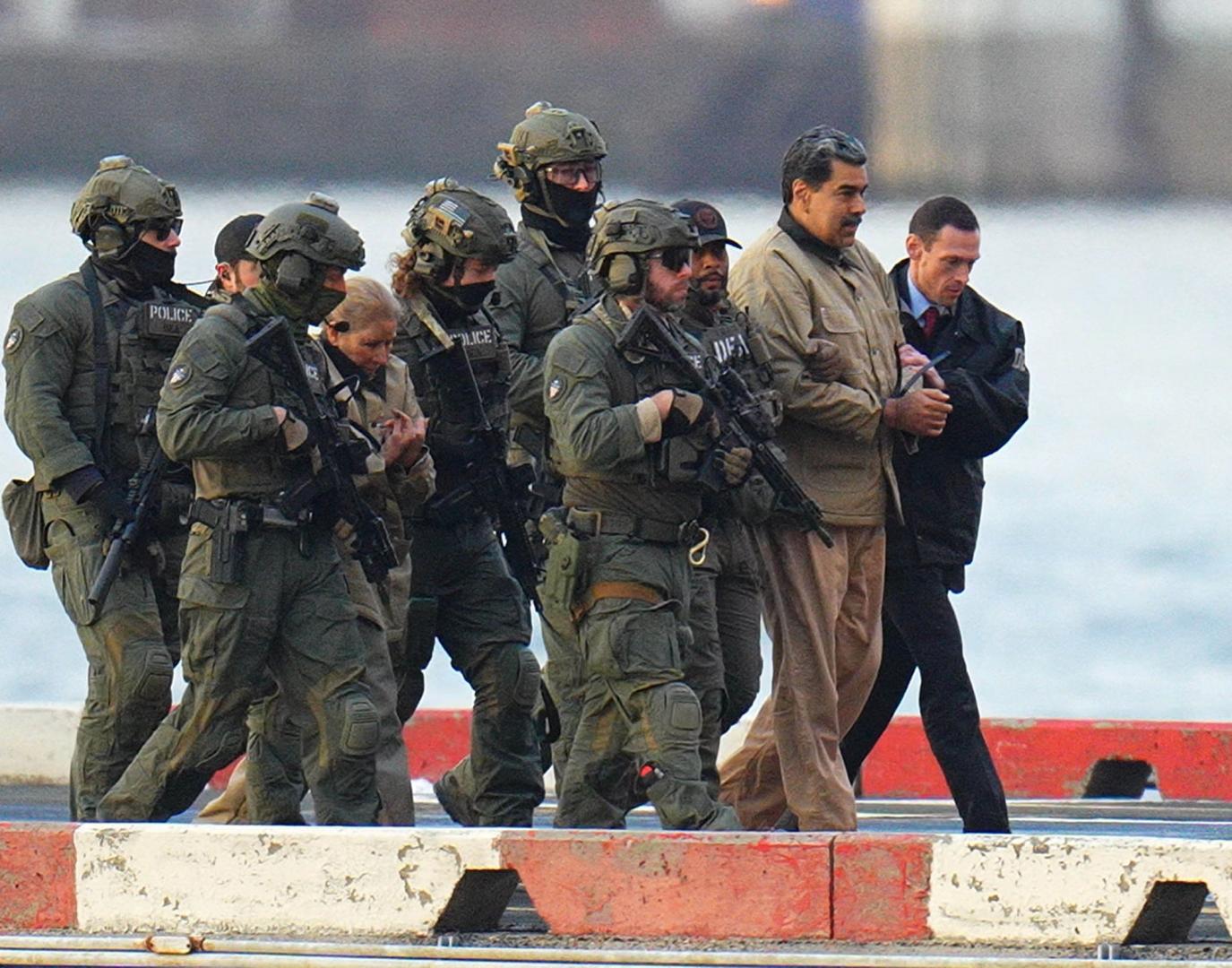
The Green Beret arrested for betting on a classified U.S. raid looked like a one-off scandal for prediction markets. A new study suggests he may be a more troubling data point: an extreme example of the small group of informed traders who, as the soldier is accused of doing, actually move prices on Polymarket, while the crowd loses money around them.
The study, part of a working paper released this week by Roberto Gómez-Cram, Yunhan Guo, Theis Ingerslev Jensen and Howard Kung of London Business School and Yale, directly tests the industry’s core claim that the markets work owing to the massed knowledge of their participants.
Using every Polymarket trade from 2023 to 2025, the authors conclude that it’s actually a small group of informed traders that moves prices. The researchers analyzed 1.72 million accounts and $13.76 billion in trading volume, and found that just 3% of traders account for most price discovery, meaning they are the ones moving prices toward the correct outcome.
These traders consistently predict outcomes and move prices in the right direction. The remaining 97% mostly do not. They provide liquidity and generate volume, but in aggregate, they are on the losing side of trades against the informed minority, whose profits come directly from those positions.
The hard part is telling skill apart from luck. With more than a million traders on Polymarket, plenty will rack up big winnings by chance alone.
To filter that out, the authors reran each trader’s bets 10,000 times, keeping everything the same except the direction.
Same markets, same moments, same dollar amounts — but a coin flip decided whether to buy or sell. That gave them a benchmark for what each trader’s profits would look like with no real edge. If the actual results consistently beat the coin flip, that’s skill. If not, it’s luck.
The findings show among the biggest winners by raw profit, only 12% beat the benchmark, and many apparent winners didn’t stay that way: Roughly 60% of “lucky winners” become losers when their performance is checked against a separate sample of events.
Their activity improves market accuracy. When skilled participants account for a larger share of trading, prices move closer to the correct outcome, especially in the final stretch before resolution. They are also the first to react when new information hits, shifting positions in response to events like Federal Reserve announcements or corporate earnings, while other traders show little consistent reaction.
The same edge that makes skilled traders valuable to price discovery raises a harder question when that information isn’t public, or isn’t supposed to be.
Both Polymarket and Kalshi have said that trading on non-public information is strictly against their rules.
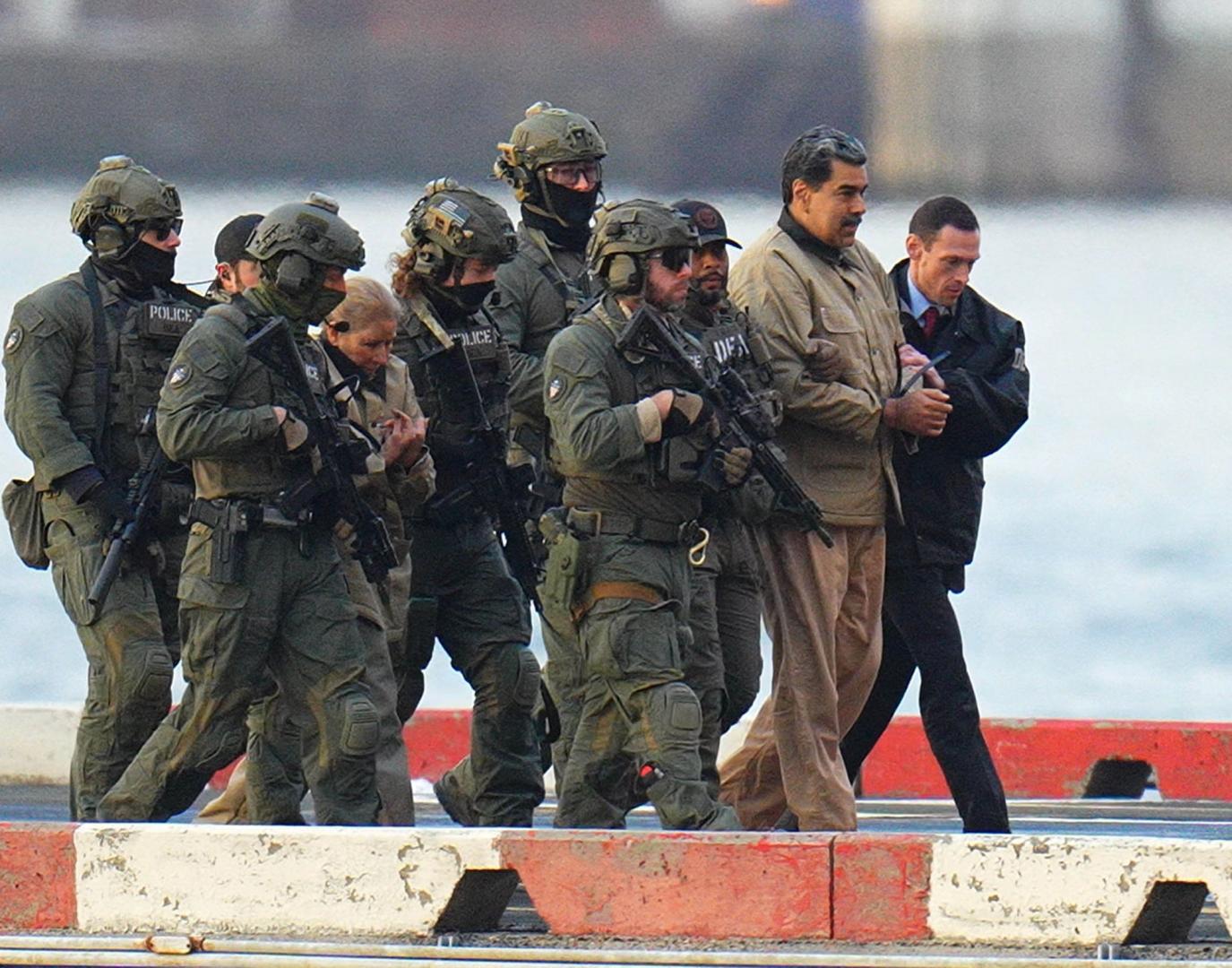
The paper grounds that risk in a concrete case: The U.S. removal of Nicolás Maduro from power in Venezuela in January. In the days and hours before the operation, three newly created Polymarket accounts piled into a contract asking whether Maduro would be removed. At the time, the market priced the odds at roughly 10%.
The new accounts placed unusually large bets, including orders of tens of thousands of shares, before the price moved. When the raid happened, the accounts collectively made more than $630,000. Two stopped trading entirely soon after, and the third went mostly dormant. There is no evidence of any wrongdoing on these accounts.
Insider trades, when they occur, move prices even more aggressively per dollar, about seven-to-12 times more than typical skilled trades. But they are rare and concentrated in a handful of events, not the day-to-day engine of price discovery. Most of the time, the market’s accuracy still depends on repeat traders who consistently outperform rather than on one-off bets.
The findings challenge the idea that prediction markets work because of crowds. They appear to work because of who is informed.

Lisa Kudrow Says ‘Friends’ Feels Off Without Perry

A Weekend in the Big Apple

IPL 2026: ‘I hate to … ‘: Captain Ruturaj Gaikwad’s blunt verdict after Chennai Super Kings loss | Cricket News

Manchester United reach agreement with Casemiro over contract clause amid transfer speculation

US brings back mandatory military draft registration

Steven Gerrard disagrees with Gary Neville over ‘shock’ Chelsea and Arsenal claim | Football


-

 Fashion2 days ago
Weekend Open Thread – Corporette.com
-
Crypto World20 hours ago
Hyperliquid $HYPE Rally Builds Momentum as AI Sector Enters Prove-It Phase
-
Entertainment7 days ago
NBA Analyst Charles Barkley Chimes in on Ice Spice McDonald’s Fiasco
-

 Politics6 days ago
Gary Stevenson delivers timely reminder to register to vote as deadline TODAY
-
Crypto World6 days ago
Bank of Hawai’i (BOH) Q1 2026: Net Income Drops to $57.4M as Net Interest Margin Expands
-

 Politics4 days ago
Making troops accountable for war crimes threatens US alliance, ex-SAS colonel warns
-

 Politics4 days ago
Disabled people challenge government SEND proposals over segregation concerns
-

 Business4 days ago
Rolls-Royce Voted UK’s Most Iconic Trade Mark as IPO Register Hits 150
-

 Politics4 days ago
Zack Polanski responds to home secretary’s taser threat
-

 Politics4 days ago
Starmer handler McSweeney to be dragged from shadows by Foreign Affairs Committee
-
Politics4 days ago
Wings Over Scotland | How To Get Away With Crimes
-
 Sports2 hours ago
IPL 2026: Ruturaj Gaikwad registers slowest fifty of the season, enters all-time unwanted list | Cricket News
-
 Crypto World5 days ago
Five Value Stocks with Recovery Potential in 2026: PayPal (PYPL), Nike (NKE), and More
-

 Crypto World5 days ago
New York sues Coinbase, Gemini over prediction market offerings
-

 Politics4 days ago
‘Iran is still a nuclear threat’
-
 Sports3 days ago
Tim Bradley names the current best in the world: “Better than Inoue and Usyk”
-
 Business4 days ago
HCL Tech share price tank over 9% after weak Q4. JPMorgan, HSBC & 3 others cut target price
-

 NewsBeat6 hours ago
LK Bennett closes all stores after entering administration
-

 Crypto World5 days ago
Crypto’s great hope in Senate’s Clarity Act still has a path to survive tight calendar
-

 Business4 days ago
The Job Benefits Most Men Don’t Know to Negotiate
You must be logged in to post a comment Login