Connect with us
DAPA Banner

Business

Oil Price Today (April 27): Crude oil hovers near $110 as Iran war peace talks lose momentum. What are experts saying?

Published

on

Oil Price Today (April 27): Crude oil hovers near $110 as Iran war peace talks lose momentum. What are experts saying?
Oil prices continued to climb on Monday, gaining nearly 2% after U.S.-Iran peace talks lost momentum and shipments through the Strait of Hormuz remained constrained, keeping concerns over tight global supply in focus.

Expectations of renewed diplomatic progress weakened over the weekend after U.S. President Donald Trump cancelled a planned Islamabad visit by his envoys Steve Witkoff and Jared Kushner. This came even as Iranian Foreign Minister Abbas Araqchi arrived in Pakistan.

Crude oil price on April 27

Brent crude futures rose $2.16, or 2.05%, to $107.49 a barrel by 2346 GMT, touching their highest level since April 7. U.S. West Texas Intermediate crude advanced $1.77, or 1.88%, to $96.17 a barrel.Last week, Brent posted a nearly 17% rise, while WTI gained close to 13%, marking their biggest weekly advances since the war began.

Advertisement

Iran has continued to demand that vessels seek its approval before transiting the Strait of Hormuz, while Trump said the U.S. has “total control” over the waterway. Meanwhile, the U.S. Navy has maintained a blockade aimed at Iranian ports and vessels.
Goldman Sachs raised its fourth-quarter oil price forecasts to $90 a barrel for Brent crude and $83 for WTI, citing reduced Middle East output.
“The economic risks are larger than our crude base case alone suggests because of the net upside risks to oil prices, unusually high refined product prices, products shortages risks, and the unprecedented scale of the shock,” Reuters reported, citing Goldman Sachs analysts.
According to a Haitong Futures note cited by Reuters, the current ceasefire phase increasingly looks like a build-up to further conflict. It added that if U.S.-Iran talks fail to deliver meaningful progress by the end of April and hostilities resume, oil prices could move to fresh highs for the year.

Macquarie estimates crude prices may stay supported in the $85 to $90 range in the near term, with a gradual rise toward $110 as supply conditions improve. It also warned that prolonged disruptions through April could send Brent as high as $150 per barrel.

Nuvama Institutional Equities said an extended closure of the Strait of Hormuz, which handles around 20 million barrels per day, could push crude prices into the $110 to $150 range.

(Disclaimer: Recommendations, suggestions, views and opinions given by the experts are their own. These do not represent the views of The Economic Times)

Advertisement
Continue Reading

Click to comment

You must be logged in to post a comment Login

Leave a Reply

Business

Range-bound trend likely as investors shift focus beyond heavyweights: Narendra Solanki

Published

on

Range-bound trend likely as investors shift focus beyond heavyweights: Narendra Solanki
As India’s earnings season unfolds, markets are showing signs of cautious stability following a sharp recovery from recent lows. After rebounding nearly 2,000 points from the 22,000 level, equities entered the results season with optimism—but early signals, particularly from the IT sector, have tempered expectations.

In a conversation with ET Now, market expert Narendra Solanki from Anand Rathi Shares & Stock Brokers shared his perspective on the earnings trajectory and market reactions so far.

“Yes, definitely, right now the kind of recovery we have seen from 22,000 levels of about almost 2000 points, so the market has recovered smartly and we just entered with that kind of recovery into the result season and the markets were hoping for the result season to be largely in line. But there has been some disappointment from a few large names in the IT, especially from the guidance point of view for at least the next two to three quarters wherein we can see some subdued growth which is less than expectations, so that has actually taken the market by surprise on the negative side.”

The disappointment, particularly around forward guidance, has weighed heavily on IT stocks. According to Solanki, the Nifty IT index has slipped back to levels last seen during the peak of the March downturn, effectively erasing its recent gains.

Advertisement

“If you see the Nifty IT index, it is now trading at the lows which were seen in mid-March, which was at the peak of the crisis. So, the complete recovery in the IT sector is washed out.”


Despite this, the broader market has displayed resilience. With most heavyweight sectors—especially IT and banking—having already reported earnings, the focus is now shifting toward a wider set of companies.
“From next week onwards, the earnings and the results will be more broad-based, including some in financials and some in manufacturing. So, the market would still be reacting to the results but because the heavyweights are out and the earnings would spread out within large sectors, it should consolidate from here onwards.”Solanki expects markets to remain range-bound in the near term, with no sharp directional moves.

“Right now, we do not see any significant run-up on either side. So, we do not see any runaway rally, neither do we see a very sharp selloff, but we see a 2% to 3% kind of range of consolidation happening and the remaining move would be decided by the kind of earnings we see in the quarter.”

On the investment front, the current environment is prompting a strategic shift toward segments with higher agility and domestic exposure.

“We are more focused on smallcaps and midcaps because that is where the companies are more agile and that is where the bases are low, so it really helps them in order to turn around and strategise in a fast manner in comparison with their largecap peers.”

Advertisement

A key theme emerging from Solanki’s outlook is the strong potential in domestically driven sectors, particularly power and infrastructure.

“If you see especially in the power sector, not only on the power generation side but also on the transmission and distribution side, we have a lot of underinvestment there in those spaces and with the kind of renewable targets the government is setting up, there has been a lack of capacity to evacuate the power from the renewable sites. So, there has to be a very huge investment coming up for the next three to five years in the transmission and distribution segment.”

He adds that this opportunity extends beyond core players to ancillary companies supplying equipment to the sector.

Autos—especially two-wheelers and related ancillaries—also feature prominently in his strategy, alongside a cautiously optimistic stance on financials.

Advertisement

“We are also positive on autos, especially two-wheelers and ancillaries. And other sectors like financials we are positive; however, there is a bit of a conscious positiveness into it because right now the macro situation which is there at the moment, it is increasingly becoming hard for the central bank to stay on the current policy and there has to be some relook in terms of inflation trajectory. This crisis is already almost for two months and it is going to linger on for some more time, so that is creating some tight fiscal space for the country.”

As earnings season progresses, the market’s next move will likely hinge on how broader sectors perform and whether domestic growth themes can offset global uncertainties.

Continue Reading

Business

TFLO: Cash Is King In A Fragile Geopolitical Moment

Published

on

AGG: Muted Volatility And Light Positioning, Why That's Bullish

TFLO: Cash Is King In A Fragile Geopolitical Moment

Continue Reading

Business

Southeast Asia’s RNAi Technology Market Poised for Rapid Expansion, Projected to Soar by 2033

Published

on

Southeast Asia's RNAi Technology Market Poised for Rapid Expansion, Projected to Soar by 2033

Southeast Asia is quietly emerging as one of the most dynamic frontiers in RNA interference (RNAi) biotechnology, as governments, academic institutions, and pharmaceutical companies converge on a technology once confined to Western research labs

Key takeaways

  • Southeast Asia’s RNAi technology market, valued at USD 80.20 million in 2024, is set to grow at a striking 16.25% CAGR through 2033, driven by rising government support and expanding pharmaceutical R&D investment across the region.
  • Singapore dominates the regional landscape, cementing its position as Asia’s premier precision medicine hub through landmark collaborations with global pharma giants including Alnylam, Bayer, Boehringer Ingelheim, and Novo Nordisk.
  • siRNA leads all RNAi modalities as the most commercially mature technology, with breakthrough research, such as NUS Medicine’s lipid nanoparticle therapy for liver disease, underscoring its growing clinical and commercial relevance across Southeast Asia.

 A new industry analysis covering the period through 2033 paints a striking picture of accelerating momentum, and the numbers are hard to ignore.

According to a comprehensive market report published by UnivDatos Market Insights, the Southeast Asia RNAi Technology Market was valued at approximately USD 80.20 million in 2024 and is projected to expand at a compound annual growth rate (CAGR) of roughly 16.25% through 2033. That trajectory, driven by a confluence of government policy, academic-industry collaboration, and surging demand for precision medicine, would place the region firmly on the global map for RNA-based therapeutics and research services.

What Is RNAi, and Why Does It Matter?

RNA interference is a gene-silencing mechanism that enables scientists to selectively suppress the activity of specific genes using short interfering molecules. In practical terms, it offers researchers a molecular scalpel: the ability to turn off disease-causing genes with extraordinary precision. Since its discovery earned a Nobel Prize in 2006, RNAi has moved steadily from the laboratory bench toward clinical application, finding use in drug discovery, rare disease treatment, oncology, and metabolic disorder research.

In Southeast Asia, the technology is gaining traction precisely because it shortens drug development timelines, reduces the cost of target validation, and integrates well with the outsourcing models increasingly favored by pharmaceutical companies seeking efficiency in a competitive global market.

Advertisement

siRNA Dominates the Market Landscape

Among the various RNAi modalities, which include short hairpin RNA (shRNA) and microRNA (miRNA), short interfering RNA, or siRNA, commands the largest share of the regional market. Its dominance reflects a straightforward reality: siRNA is the most clinically validated and commercially mature format, supported by established delivery systems and a proven track record in rare diseases, oncology, and metabolic conditions.

A noteworthy example of siRNA’s real-world potential emerged from Singapore in late 2025, when researchers at NUS Medicine announced a novel RNA-based therapy for metabolic dysfunction-associated steatohepatitis (MASH), a liver condition affecting approximately 25% of people globally and up to 40% of adults in Singapore. The team used lipid nanoparticles to deliver siRNA directly into liver cells, where it silenced a gene called SPTLC2 that drives the accumulation of ceramides, fat-like molecules linked to liver inflammation and fibrosis. The breakthrough illustrated exactly the kind of translational research driving long-term commercial demand for siRNA tools across the region.

Pharma and Biotech Companies Lead Adoption

On the end-user side, pharmaceutical and biotechnology companies represent the dominant segment. Their strategy is clear: use RNAi technology to de-risk drug targets before committing to expensive clinical investment, thereby improving development efficiency and pipeline diversity. Southeast Asia’s pharma companies are increasingly outsourcing RNAi-based discovery efforts, a trend that is catalyzing the growth of specialized service providers and contract development and manufacturing organizations (CDMOs) throughout the region.

A notable example of this dynamic came in April 2025, when GenScript Biotech Corporation, a global leader in biotechnology research services, announced a strategic partnership with NSG Bio, Singapore’s premier biotech incubator. Under the agreement, GenScript committed to offering preferential rates and expert technical guidance across its full range of biotech services to incubator residents, a direct investment in the kind of early-stage ecosystem that feeds long-term RNAi adoption.

Advertisement

Singapore: The Undisputed Regional Hub

If there is one country that defines Southeast Asia’s RNAi ambitions, it is Singapore. The city-state’s combination of world-class intellectual property protections, a proactive government, deep life-science infrastructure, and proximity to global pharmaceutical leaders has made it the region’s dominant commercialization hub for RNA technologies.

The most striking signal of Singapore’s position came in December 2025, when Precision Health Research, Singapore (PRECISE) announced a landmark collaboration with four global pharmaceutical giants, Alnylam, Bayer, Boehringer Ingelheim, and Novo Nordisk, under Phase II of Singapore’s National Precision Medicine (NPM) programme. The initiative marked Singapore as the first country in Asia to establish a pre-competitive collaboration with leading pharmaceutical companies, effectively setting the blueprint for how precision medicine ecosystems should be built in the region.

Thermo Fisher Scientific’s parallel investment reinforced the picture. In December 2025, the company announced an expansion of its bioprocessing capabilities across Asia, including a broadening of its existing Bioprocess Design Center in Singapore, offering bench-to-pilot scale bioprocessing, expert-led training, and technical collaboration to help companies scale early-stage processes toward sustainable biomanufacturing.

Vietnam: The Fastest-Growing Market to Watch

While Singapore commands today’s market, the report identifies Vietnam as the country expected to record the highest growth rate over the forecast period. Vietnam’s emergence reflects a broader pattern: as the biotech ecosystems of Indonesia, Thailand, the Philippines, and Malaysia continue to mature, RNAi adoption is spreading beyond the region’s established innovation hubs into markets characterized by rapidly improving lab infrastructure, growing research talent pipelines, and expanding government commitment to life sciences.

Advertisement

The Competitive Landscape

The Southeast Asia RNAi technology space features a mix of global giants and regional specialists. Key players operating in the market include GenScript, Integrated DNA Technologies (a Danaher Corporation subsidiary), Thermo Fisher Scientific, Merck KGaA, QIAGEN, Revvity, ABT Biomedical Solutions, and Bio Basic Asia Pacific. Their growth strategies span partnerships, new product launches, geographic expansions, and licensing agreements.

One example: in August 2025, Hongene Biotech Corporation, a CDMO focused on nucleic acid therapeutics, secured a non-exclusive licensing agreement with UMass Chan Medical School to produce and supply extended nucleic acid (exNA) monomers and modified oligonucleotides for research use. The deal expanded access to innovative oligonucleotide technologies for both academic and biopharmaceutical researchers working on RNAi, antisense oligonucleotides, CRISPR guides, and related modalities.

Challenges Ahead

The road to full regional maturity is not without obstacles. The report identifies limited local RNAi manufacturing capacity, the high cost of advanced tools, a shortage of specialists trained in RNA technologies, and uneven regulatory frameworks across countries as the principal headwinds. Regulatory complexity for RNA-based therapeutics remains particularly challenging: each Southeast Asian market brings its own approval pathways, complicating the commercialization strategies of companies seeking regional scale.

Uneven adoption is perhaps the most structural challenge. While Singapore and, increasingly, Malaysia and Vietnam are building the institutional and industrial scaffolding for serious RNAi development, other markets in the region are earlier in that journey. Bridging that gap will require sustained policy commitment, cross-border talent development, and deeper integration between academic research and commercial application.

Advertisement

The Bigger Picture

What the Southeast Asia RNAi market ultimately represents is a test of whether the region can convert scientific ambition into durable biotechnology competitiveness. The ingredients are increasingly in place: government support is growing, global companies are expanding their regional footprint, and breakthrough research, from Singapore’s liver disease therapy to the continent-wide precision medicine collaborations, is generating the kind of proof points that attract further investment.

At a 16.25% annual growth rate, the sector is expanding nearly twice as fast as the broader global healthcare market. For investors, researchers, and policymakers with a view toward the next decade of biomedical innovation, Southeast Asia’s RNAi story has only just begun

Advertisement
Continue Reading

Business

US, EU deepen cooperation on critical minerals with eye to broader agreement

Published

on

US, EU deepen cooperation on critical minerals with eye to broader agreement


US, EU deepen cooperation on critical minerals with eye to broader agreement

Continue Reading

Business

Factbox-Goldman Sachs lifts oil price forecasts on weaker Middle East output

Published

on

Factbox-Goldman Sachs lifts oil price forecasts on weaker Middle East output


Factbox-Goldman Sachs lifts oil price forecasts on weaker Middle East output

Continue Reading

Business

Reliance Industries shares dip over 1% after Q4 results. What are Goldman Sachs, Morgan Stanley, others saying?

Published

on

Reliance Industries shares dip over 1% after Q4 results. What are Goldman Sachs, Morgan Stanley, others saying?
Shares of Mukesh Ambani-led Reliance Industries declined over a per cent to their day’s low of Rs 1,311 on the NSE on Monday after it reported a 13% year-on-year decline in consolidated net profit at Rs 16,971 crore for the fourth quarter of FY26, compared with Rs 19,407 crore in the same period last year.

Revenue from operations during the quarter rose 13% YoY to Rs 2.98 lakh crore. On a sequential basis, profit slipped 8% from Rs 18,645 crore reported in the December quarter. Operating performance remained largely flat, with EBITDA easing 0.3% YoY to Rs 48,588 crore. EBITDA margin declined 200 basis points from the year-ago period to 14.9%.

Jio Platforms delivered a strong quarter, with operating revenue rising 13% YoY to Rs 44,928 crore. Reliance Retail posted a marginal increase in profitability for the March quarter. Net profit rose 0.5% YoY to Rs 3,563 crore, while revenue from operations climbed 11% to Rs 87,344 crore.

The O2C business reported mixed trends in Q4. Revenue increased 12% YoY to Rs 1.84 lakh crore, while EBITDA fell 4% to Rs 14,520 crore. The oil and gas segment had a weaker quarter, with revenue declining 9% YoY to Rs 5,867 crore. EBITDA dropped 18% to Rs 4,195 crore. JioStar reported strong performance, with revenue of Rs 9,784 crore and EBITDA, including other income, of Rs 827 crore.

Advertisement

Reliance Industries share: Should you buy, sell or hold?

Morgan Stanley has maintained its Overweight rating on Reliance Industries with an unchanged target price of Rs 1,803, implying an upside potential of 35%. The brokerage said earnings were largely in line, though EBITDA was slightly below expectations due to higher upstream costs. It highlighted strong retail growth led by quick commerce and FMCG, while O2C margins remained weaker than peers but were improving due to better crude sourcing trends. Morgan Stanley added that chemicals and fuel markets are showing early signs of recovery.


The brokerage noted that capex remains elevated with a focus on new energy. It said any rerating in the stock would depend on margin improvement across segments and continues to view Reliance as a top pick, with recovery in the energy and retail businesses seen as key triggers.
Goldman Sachs has maintained its Buy rating on Reliance Industries with an unchanged target price of Rs 1,910. The brokerage said Q4 EBITDA missed estimates mainly due to weaker O2C margin capture, as high crude premiums and elevated logistics costs offset the benefit of strong product cracks. It noted that the petrochemical business delivered mixed performance, with pressure continuing in the naphtha chain. However, Goldman Sachs expects sequential margin recovery in the coming quarters.The brokerage added that retail growth remained strong, although margins were impacted by quick commerce. It believes Reliance’s integrated business model is well placed to benefit from a tightening downstream environment, with earnings recovery likely to be driven by normalisation in refining and chemicals.

Motilal Oswal Financial Services has maintained its Buy rating on Reliance Industries while reducing the target price to Rs 1,655, implying a potential upside of 25%. The brokerage has cut its FY27E EBITDA and PAT estimates by 3-4% due to challenges in the energy business and delays in tariff hikes at Jio. It expects Jio to remain the company’s biggest growth driver, with digital expected to contribute around 80% of Reliance’s incremental EBITDA. EBITDA is projected to grow at an 18% CAGR over FY26-28E, supported by an expected wireless tariff hike of around 15% in 2Q, market share gains in wireless, and continued expansion of Homes and Enterprise offerings.

It also expects Reliance Retail to deliver around 12% revenue CAGR over FY26-28E, driven by store additions, better productivity, and the scale-up of hyper-local offerings. However, it noted that faster growth in lower-margin businesses could weigh on blended EBITDA margins.

Advertisement

Elara Capital has upgraded Reliance Industries to Buy while revising its target price downward to Rs 1,619. The brokerage said weak O2C margin capture weighed on performance despite strong product cracks. It noted that the digital and retail businesses continue to provide steady growth support, though retail margins remain under pressure due to ongoing investments. At the same time, the oil and gas and O2C segments continued to drag overall performance.

Elara Capital has cut its EPS estimates because of a weaker outlook for petrochemicals and retail. However, it believes the recent correction in the stock price has already factored in near-term headwinds. The brokerage sees upside potential led by normalisation in GRMs and sustained growth in the digital business.

(Disclaimer: Recommendations, suggestions, views and opinions given by the experts are their own. These do not represent the views of The Economic Times.)

Advertisement
Continue Reading

Business

Cheshire development set for approval despite fears it would ’cause harm’

Published

on

Business Live

Officers note ‘adverse landscape impacts’ but say project would help authority meet housing targets

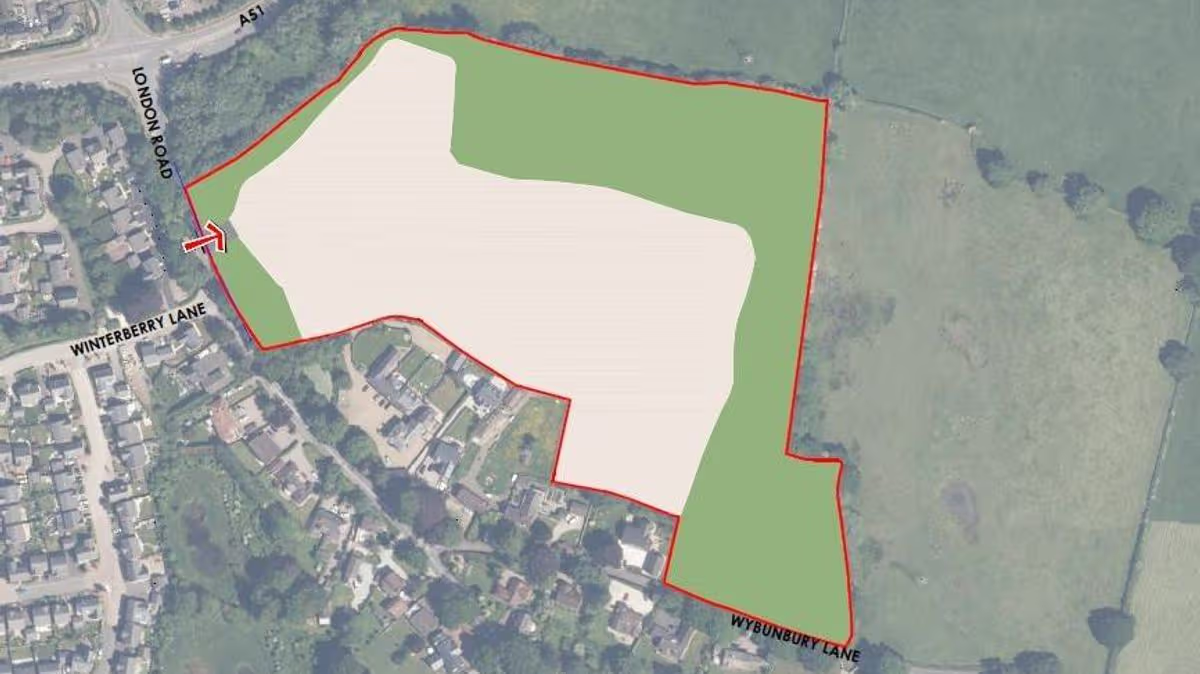
The application site for the proposed 85-home development on London Road at Nantwich.

The application site for the proposed 85-home development on London Road at Nantwich(Image: CSA Landscapes Ltd)

Cheshire East planners are recommending approval for up to 85 homes in the open countryside at Nantwich despite acknowledging ‘the proposed development on this site would cause harm’.

Advertisement

Barratt David Wilson Homes has applied for outline permission for the dwellings, including 30 per cent affordable, together with landscaping, children’s play area and sustainable urban drainage on 6.39 hectares of agricultural land at London Road.

Cheshire East doesn’t have a five-year housing land supply, a significant material consideration which weighs in favour of permitting the development.

A report from a council planning officer to next week’s meeting of the strategic planning board, states: “The proposed development on this site would cause harm.

“There would be adverse landscape impacts on the character and appearance of the area due to the urbanising effect of the housing within the open countryside.

Advertisement

“There would also be a minor reduction in the Willaston, Wistaston, Nantwich, Crewe strategic green gap.

“However, these impacts could be appropriately managed and limited by securing appropriate details at the reserved matters stage.”

It adds: “Development of the site would result in the loss of ‘best and most versatile’ agricultural land.

“This does weigh in against the proposal but needs to be balanced against the prevalence of agricultural land in Cheshire East.”

Advertisement

Stapeley Parish Council has objected to the proposal citing several reasons why it should be refused.

These include the impact on highways and the loss of agricultural land and natural habitats.

Ward councillor John Priest has also raised concerns about highways.

Thirteen residents have objected for varying reasons including loss of open countryside, loss of strategic green gap and landscape, and visual impacts.

Advertisement

The planning officer’s report says there are a range of benefits that weigh in favour of the scheme.

It states: “The NPPF (national planning policy framework) attaches great importance to housing delivery that meets the needs which the proposal would help address.

“The construction of up to 85 homes, including 26 affordable units, is provided substantial weight.

“The application site is also adjacent to the settlement boundary of Nantwich, which is a key service centre, and will be accessible to all the various services in the area.”

Advertisement

It says the development would produce some economic benefits in terms of employment opportunities during the construction phase and direct and indirect benefits associated with additional household expenditure within the local economy.

The strategic planning board meeting takes place at 10.30am on Wednesday, April 29, at Macclesfield Town Hall.

To find all the planning applications, traffic diversions, road layout changes, alcohol licence applications and more in your community, visit the Public Notices Portal.

Advertisement
Continue Reading

Business

BOJ preview April: hawkish hold expected amid inflation, M.East uncertainty

Published

on


BOJ preview April: hawkish hold expected amid inflation, M.East uncertainty

Continue Reading

Business

American Express: Earnings Show Steady Growth, Maintain Buy

Published

on

American Express: Earnings Show Steady Growth, Maintain Buy

American Express: Earnings Show Steady Growth, Maintain Buy

Continue Reading

Business

Taiwan court hands out jail terms of up to 10 years in TSMC trade secrets case

Published

on

Taiwan court hands out jail terms of up to 10 years in TSMC trade secrets case


Taiwan court hands out jail terms of up to 10 years in TSMC trade secrets case

Continue Reading

Trending

Copyright © 2025