

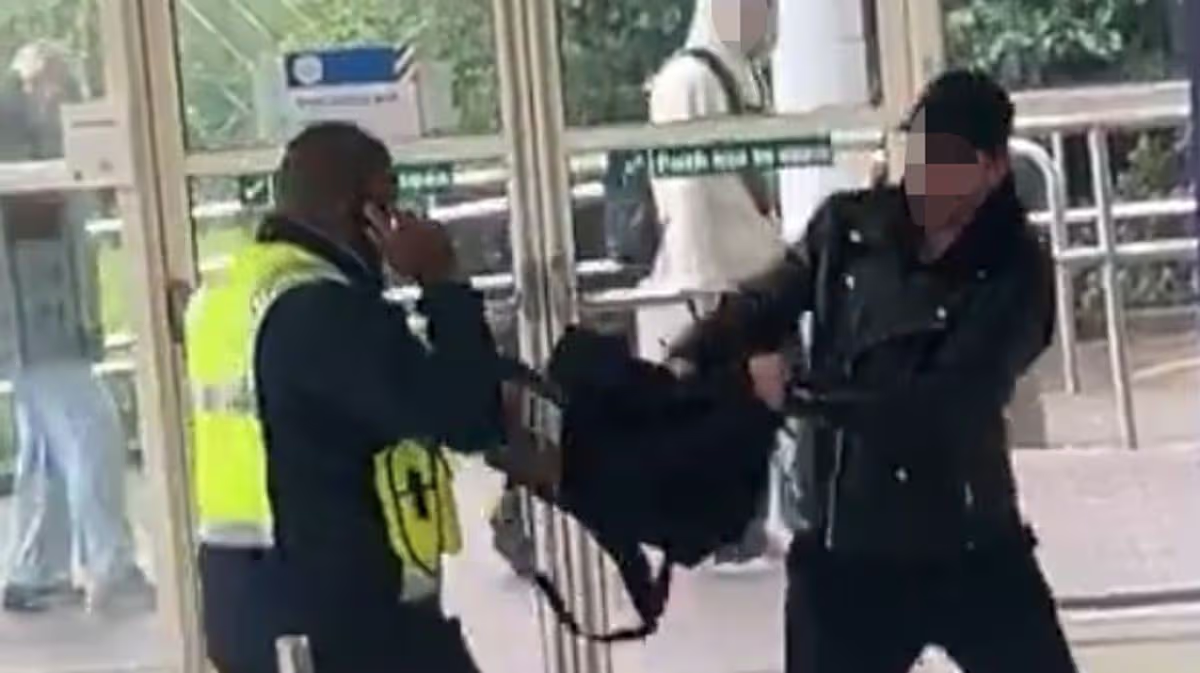
Retail workers have painted a bleak picture to the Mirror of the abuse and threats that they face daily on the shop floor, as Prime Minister Keir Starmer vows to crack down on shoplifters
As Keir Starmer vows to crack down on ‘disgraceful’ shoplifters, retail workers have painted a harrowing picture of life on the front line.
For Ethan, 27, and Annie*, 46, the daily reality of customer service has shifted from simple questions about where to find things to a barrage of threats, verbal abuse, and physical assault. From stabbing threats to guns and workers who have quit on the spot, as the cost of living crisis bites, the shop floor has become a flashpoint for violence.
Two high-profile cases involved retail workers who claimed they were sacked from their supermarket jobs after tackling shoplifters – something that is often against company policy.
New figures from the Union of Shop, Distributive and Allied Workers (USDAW) reveal physical attacks have more than doubled since 2019, while a staggering 78 percent of retail workers endured verbal abuse in the last year. And officials say the industry is “getting worse, not better”.
READ MORE: Sacked Morrisons manager Sean Egan says supermarket ‘threw me under the bus’READ MORE: ‘I used to work in M&S and four types of customers need to be stopped’
In a speech to the Usdaw shopworkers’ union today, the Prime Minister said: “It’s disgraceful that people just working in their shop have to take abuse from customers. It’s disgraceful that people feel sick to the stomach thinking about how they’re going to get through the day and it’s disgraceful that people can have their lives and livelihoods ruined by persistent shop theft.”
He said the Government has put an extra 3,000 neighbourhood police officers on the streets and scrapped the “ridiculous” rule which left theft of goods worth less than £200 “not properly investigated” by police. “That was a shoplifters’ charter, and we’ve ended it and not before time,” he said.
“We’ve toughened up punishment too. We’re giving police stronger powers, making the abuse and assault of retail workers a specific crime and giving you the same protections as emergency workers.”
‘She pulled out a flip-knife over a price tag’
Ethan, who has worked in retail for nearly nine years, paints a horrifying picture of what he and his colleagues go through on a regular basis including a shocking incident that saw one member of the public “threaten to stab” him after becoming confused about whether or not a product was currently on offer.
“She pulled out this flip-knife and threatened to stab me over the price of a product,” says Ethan, who remained “very calm and very polite,” after she refused to take no for an answer. After the threat, the woman simply pushed her trolley out of the store, claiming the stolen goods were “compensation” for her frustration.
Annie, who has worked in retail for 30 years, was left with PTSD after a terrifying shift where she refused to let a man – under the influence of drugs – into the staff toilets.
His furious girlfriend launched a vicious, unprovoked attack. “I’m coming up an aisle and she just attacks me,” Annie says. “She threw a punch and got the back of my head. I had things in my hands at the time, and so she threw another punch and caught me in the back of the head again.
“I went to defend myself, and she threw a big lottery stand at me.” As Annie called 999, the situation escalated.
Outside, the man had collapsed into a “drug coma,” but not before passersby saw him hiding a firearm in his sock. “As I’m on the phone to 999, a member of the public brought the gun to me,” Annie says. “I’m getting handed a gun and I’m like, ‘What am I meant to do with that if it goes off?’”
After the emergency services arrived 40 minutes later, the shop was closed for the day. Following her ordeal, Annie was signed off for work for three weeks.
She says it’s getting worse as the cost of living crisis fuels aggression and shoplifting, and feels the onus is on workers, questioning why workers have to be “tough”, adding: “Why should people have to be like that to save themselves? They’re only out doing a day’s work.”
Annie, who has worked in retail since she was 16, said: “I must admit, 30 years ago, I didn’t feel unsafe going to work in retail. I love my job, but I am getting fed up being spoken to the way I get spoken to. I tell my staff to just kill them with kindness.”
The violence isn’t always directed at staff, sometimes they witness horrific violence between customers too. Ethan says one altercation resembled a “murder scene in the alcohol aisle” after two customers fought.
“A bloke had his face slashed with a Jack Daniel’s bottle and had to have facial reconstruction,” he says, adding that the perpetrator continued “slashing” the semi-unconscious man in the face with shards of glass, leaving “blood everywhere.”
Figures from USDAW show that 78 percent of retail workers have endured verbal abuse in the last year, 54 percent were threatened, and 11 percent were physically attacked, more than double the levels in 2019.
The crisis is driving staff away, with one colleague telling Annie that her “anxiety is through the roof” and she’s ready to quit if the abuse escalates.
Ethan saw one colleague quit on the spot, declaring: “I’m not paid enough for this.” Both workers say their stores have strict non-engagement policies – designed to protect staff – but leave them feeling helpless and as if their wages are being “stolen” by thieves who sell in bulk on the black market.
Whilst Ethan’s shop has security guards working, Annie’s only gets temporary security following an incident.
“We want to act upon [theft], but we can’t,” Ethan says. “You see your wages being stolen from you because they’re taking the products that you know customers will buy to supply you an income.”
Annie says the way shoplifting is deal with has radically changed, adding: “When I first started out, we were allowed to do more,” she says, but now “companies tell us we’ve not to do a thing, we’ve just to walk away,” adding that they “fear for our jobs” if they get involved. “At the end of the day, prices in stores are rising because of the amount of shoplifting that’s going on.
Morrison’s manager Sean Egan, 46 was dismissed after he “tackled” an abusive shoplifter, which is against the chain’s policy – he had worked there for nearly 29 years. He said last week: “I dedicated my whole life to Morrisons, but they did not even take my 29 years of service into account and just threw me under the bus for standing up for what is right.”
On April 25, a demonstration took place outside the Aldridge branch where Egan worked, calling for him to be reinstated, the former manager thanked the crowd who “backed him from the beginning”.
Thinus Keeve, retail director at Marks & Spencer, made the stark warning earlier this month as he called for more to be done to protect those on the front line of the high street. The comments came after “several hundred” young people descended on Clapham in late March with police responding to reports of anti-social behaviour.
The proposed Crime and Policing Bill includes a new standalone offence of assaulting a retail worker which will have a maximum penalty of six months in prison, as well as new measures against low-level shoplifting. The bill has been returned to the House of Lords, where amendments proposed by the House of Commons will be considered this week.
“We have campaigned along with many retail employers for substantial legislative measures to combat this growing problem and we are pleased that the Government’s Crime and Policing Bill has almost completed its passage through Parliament. The Conservatives persistently refused to legislate to protect retail workers and effectively provided an open invitation to retail criminals.
“Labour immediately set about tackling the issue and we are now starting to see the results of their investment in policing and funding for more uniformed officer patrols in shopping areas,” says Joanne Thomas, the general secretary of the Union of Shop, Distributive and Allied Workers (USDAW).
Sir Keir claimed today that “the tide could be turning” against shoplifting as he set out the Government’s efforts to crack down on retail crime.
The Prime Minister said shop thefts were “slightly down” in the latest figures and he wanted wider use of technology which allows CCTV footage to be shared immediately with the police. The latest Office for National Statistics (ONS) data showed shoplifting offences fell slightly last year, down from 516,611 in 2024 to 509,566 in 2025.
His speech came as the Centre for Social Justice (CSJ) warned of a high street crime epidemic. The centre-right think tank’s analysis showed the average number of offences committed by shoplifters has nearly doubled in five years, rising from 5.5 to 9.1 offences per convicted thief.
Meanwhile, the Retail Trust has launched a new initiative with Merseyside Police which sees retail workers provided with de-escalation training and support from the police, as part of a larger scale project.
Chris Brook-Carter, chief executive of the charity for retail workers, tells the Mirror: “Almost half of the people we speak to are now dealing with abuse every week, and many tell us they feel unsafe going into work and are considering leaving the retail sector because of the intimidation and violence they face.
“No one should ever be expected to put up with this kind of behaviour, in or outside of work, yet shop staff tell us they are being threatened, shouted at, spat on and hit on an all too regular basis.
“Our work with Merseyside Police shows how communities can come together to better protect retail workers from physical and verbal assaults. Shop staff across Liverpool have been receiving specialist training and support from the Retail Trust to help them safely manage, de-escalate and recover from threats and attacks, as part of wider efforts to tackle retail crime in the city.
“We’re supporting thousands more retail workers across the country following the unacceptable rise in abuse over recent years, and we want to work with other police forces, retailers and local partners to help even more people feel safe and protected.
“This is a pan societal issue and therefore needs a pan-societal response. The more we work together, the quicker we will see change.”
*Annie’s name has been changed to protect her identity.





















































You must be logged in to post a comment Login