BACK in the early years of this century, I used to enjoy popping into the St William’s College restaurant now and again to sample its celebrated wild mushroom and asparagus risotto.
But in December 2014 this Grade-I-listed building closed its doors as a wedding and conference venue with a view to major refurbishment, repairs and to the development of a sustainability strategy for the site.
St William’s College has an interesting history.
On May 11, 1461 it was founded as a residence for 23 chantry priests and a provost.
Chantry priests were employed at the pre-Reformation Minster exclusively to pray for the souls of the dead at the 60 or so chantries inside the cathedral.
In The History of York Minster, GE Aylmer and Reginald Cant state that this was “the most important college of cathedral chantry priests ever to be founded in England”.
It was dedicated to the memory of York’s native saint, William Fitzherbert, who eventually became archbishop in 1154, and was credited with miracles at his shrine in the Minster.
![]() St William’s College
St William’s College
Another historical source of information about the college is the 1994 booklet The History of St William’s College by PR Newman, historian to the Dean and Chapter of York.
He claims that there is evidence to suggest that the chantry priests were themselves sub-letting rooms to laymen before 1547.
Anyone who has joined one of York’s famous ghost trails will have heard about the two brothers who lived there and murdered one of the chantry priest residents. The elder brother is said to have betrayed his younger sibling to the authorities and supposedly spends eternity pacing up and down the upper floor of the college.
In 1547, the chantries and chantry foundations were abolished by an Act of Parliament. The college building was either granted or sold to one of the Crown commissioners responsible for its suppression, Sir Michael Stanhope.
Throughout much of the 17th century, the building was held by the staunchly royalist Jenkyns family of Grimston Bar. In 1642, King Charles I came to York and it’s known that the King’s printer set up his presses in the college which was then known as the Parsonage.
![]() View of the historic gateway from Goodramgate
View of the historic gateway from Goodramgate
A century later, the building was divided up into eight dwellings. A notable feature of the history of St William’s College is that the residents seem to have been tenants rather than owners of the building, and short-term tenancies at that.
In 1719, John Ouram, a cook, and John Barber, an upholsterer, sold their lease to Charles Howard, 6th Earl of Carlisle, the celebrated builder of Castle Howard. The college continued to be divided up into smaller units with no fewer than 13 families living there.
One of the college’s more irascible tenants was a certain William Jameson. Between 1809 and 1816, he brought private prosecutions in the church court against eight neighbours.
Jameson had been declared bankrupt and had been ejected from the college, moving to smaller quarters in the neighbouring Vicars Choral property in Bedern.
![]() Entrance to St William’s College showing the coats of arms of William Fitzherbert and York Minster
Entrance to St William’s College showing the coats of arms of William Fitzherbert and York Minster
Once installed there, he’s said to have waged a pitiful and sustained campaign against the college and the tenants who had replaced him. He was even said to have broken into the eastern wing of the college and removed the doors and panelling from the rooms.
Recommended reading:
In 1826, Jameson was writing letters publicly haranguing the Dean and Chapter. He harped on about the avoidable problems in the vicinity of the college. College Street was at that time a narrow thoroughfare with houses either side and traffic passing through. Fortunately, by 1827, no more was heard of Jameson.
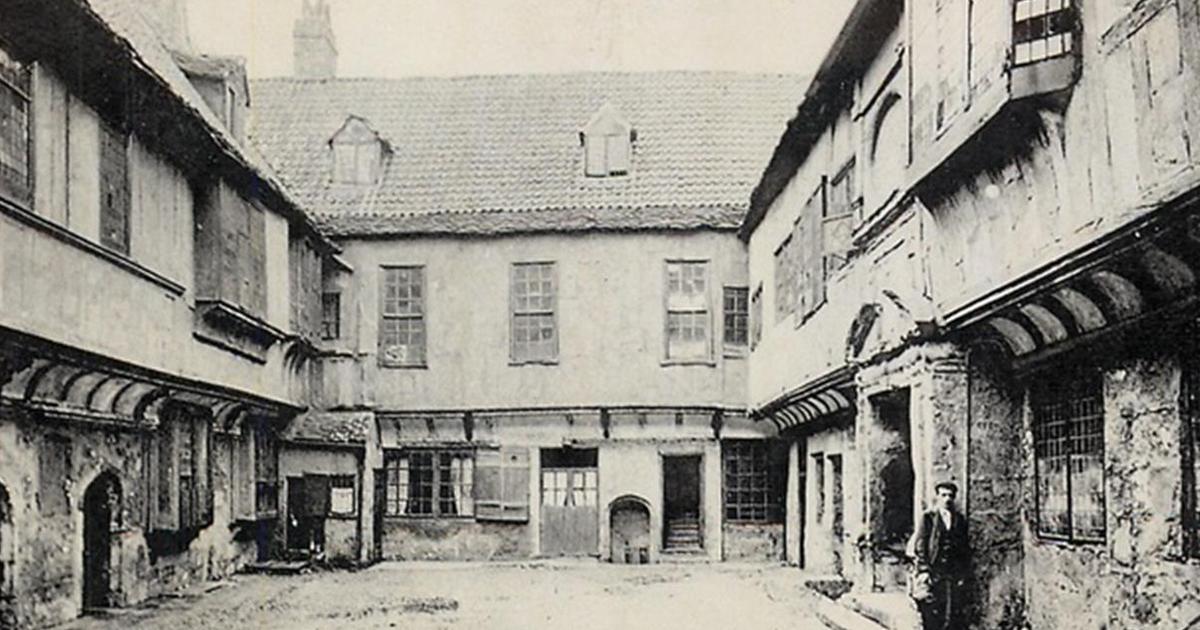
In 1854, College Street was home to some 34 families in cramped living conditions.
![]() College Street, formerly open to horse-drawn traffic
College Street, formerly open to horse-drawn traffic
It was Frank Green, the wealthy industrialist and philanthropist who rescued St William’s College, as he’d done with the Treasurer’s House. Green was also anxious to save the historic gateway at the end of College Street.
By 1901, The York Corporation had resolved to demolish the street and its houses to make way for the new road, Deangate. Green bought St William’s College and offered it for sale to the York Diocesan Trust as a venue for meetings of the Convocation of the Northern Province.
![]() (Image: NQ)
(Image: NQ)
He agreed to sell the college for the price he’d paid for it provided that the Trust undertook appropriate restoration, and accepted his nomination of the celebrated architect Temple Moore, for the work.
Green also made it a condition that he would be given first option to buy the college, if the Dean and Chapter decided to sell it. After a public campaign between conservationists, led by Frank Green, and progressives, the conservationists won; York Corporation backed down and decided to re-route Deangate. The restoration work on the college took place in 1902.
![]() St Williams College, York, in 2014 when it was undergoing restoration work. Picture David Harrison
St Williams College, York, in 2014 when it was undergoing restoration work. Picture David Harrison
The Dean and Chapter of York Minster became trustees of St William’s College in 1972, and further restoration work took place in the 1980s. In the next two decades, the building thrived as a conference and exhibition centre.
Rosalind Kelly, marketing and communications manager to the Chapter of York, told me that Listed Building consent and all planning permissions have now been obtained to restore the building as part of the Neighbourhood Plan. An update on the project is expected later in May.
David Wilson is a community writer with The Press

















































You must be logged in to post a comment Login