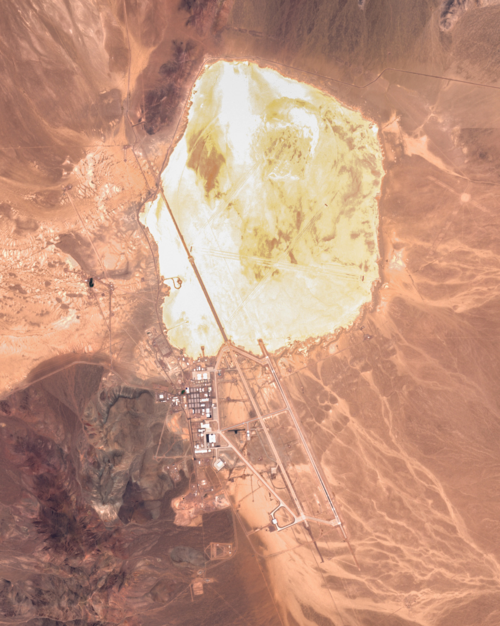
LAS VEGAS — A swarm of unusually shallow earthquakes rattled the remote Nevada desert near the secretive Area 51 military base this week, with at least 17 tremors recorded in a 24-hour period including a 4.4 magnitude quake that raised eyebrows among scientists and conspiracy theorists alike.
The strongest tremor struck at a depth of just 2.5 miles underground, far shallower than typical seismic activity in the region, which usually originates 6 to 12 miles below the surface. The U.S. Geological Survey confirmed the series of events, which were felt by residents in nearby communities, though no significant damage was reported.
Geophysicist Stefan Burns noted the atypical location and depth in a widely viewed analysis. “This is an unusual place to get an earthquake,” he said, while cautioning that the activity is most likely natural. However, the shallow depths have fueled online speculation linking the quakes to possible underground nuclear testing at the highly classified facility, long a magnet for conspiracy theories involving advanced weapons and extraterrestrial activity.
Advertisement
Area 51, part of the Nevada Test and Training Range, has a documented history of nuclear weapons testing during the Cold War era. While the U.S. government has not conducted full-scale nuclear tests since 1992, some observers question whether subcritical or other experimental activities could produce seismic signatures resembling small earthquakes. Officials have not commented directly on the recent swarm, and experts emphasize that distinguishing between natural and human-caused seismic events can be challenging without detailed data.
The timing of the earthquakes coincides with heightened global tensions, including disruptions in the Strait of Hormuz that have driven oil prices higher. Some online commentators have speculated about connections to military preparedness, though no evidence supports such links. Seismologists stress that Nevada experiences frequent small earthquakes due to its location along tectonic boundaries, but the concentration and shallowness near Area 51 stand out.
USGS data shows the quakes ranged from magnitude 2.5 to 4.4, with the largest occurring Wednesday afternoon. More than 100 people reported feeling shaking through the USGS “Did You Feel It?” system. The swarm follows similar clusters reported earlier in the year, though none matched this intensity or unusual characteristics.
Local residents in Rachel, Nevada — the closest community to Area 51 — described minor rattling of windows and dishes but no structural concerns. Tourism to the area, already boosted by Area 51 lore, may see another uptick as amateur investigators and curious travelers descend on the desert outpost. The base itself remains off-limits to the public, with warning signs and security patrols enforcing restricted access.
Advertisement
Scientists from the Nevada Seismological Laboratory are monitoring the region closely. Preliminary analysis suggests the events could relate to geothermal processes or natural fault movement in the Basin and Range province, a tectonically active area. However, the shallow focal depths warrant further study, as they can sometimes indicate human activity such as mining blasts or fluid injection, though those explanations are considered unlikely here.
Conspiracy communities on social media have exploded with theories ranging from secret weapons tests to underground alien bases. While most experts dismiss such claims, the government’s historical secrecy around Area 51 lends credibility to public skepticism in some quarters. Declassified documents over the years have revealed testing of advanced aircraft and other projects, but nothing confirming current nuclear activity.
The U.S. Air Force, which operates the range, typically declines comment on specific activities at Area 51 for national security reasons. A spokesperson for the Nevada Test and Training Range said routine operations continue but offered no details on seismic monitoring. Independent seismologists note that any underground explosion capable of registering as a 4.4 quake would likely violate international test ban treaties if it involved nuclear material.
Broader context includes increased U.S. military activity in response to global flashpoints. With tensions involving Iran and oil supply concerns, some analysts wonder whether the quakes reflect stepped-up testing of conventional weapons or simulation exercises. However, no official linkage has been made, and natural explanations remain the consensus among geophysicists.
Advertisement
Residents and visitors to the area are advised to remain vigilant but not alarmed. Small earthquakes are common in Nevada, and the recent swarm, while notable, does not currently indicate heightened risk of larger events. The USGS continues to provide real-time updates through its earthquake tracking systems.
As investigations proceed, the shallow quakes near Area 51 add another chapter to the base’s enigmatic reputation. Whether natural geology or something more secretive, the events highlight the enduring public fascination with one of America’s most classified military installations. Scientists and officials will likely study the data for weeks to determine the precise cause.
Insperity, Inc. (NSP) Q1 2026 Earnings Call April 30, 2026 5:00 PM EDT
Company Participants
James Allison – Executive VP of Finance, CFO & Treasurer Paul Sarvadi – Co-Founder, Chairman & CEO
Advertisement
Conference Call Participants
Daniel Maxwell – William Blair & Company L.L.C., Research Division Jeff Martin – ROTH Capital Partners, LLC, Research Division Mark Marcon – Robert W. Baird & Co. Incorporated, Research Division Tobey Sommer – Truist Securities, Inc., Research Division Brendan Biles – JPMorgan Chase & Co, Research Division
Advertisement
Presentation
Operator
Good day. My name is Ali, and I will be your conference operator today. I would like to welcome everyone to the Insperity First Quarter 2026 Earnings Conference Call. [Operator Instructions] And please note, this conference call is being recorded.
At this time, I would like to introduce today’s speakers. Joining us are Paul Sarvadi, Chairman of the Board and Chief Executive Officer; and Jim Allison, Executive Vice President of Finance, Chief Financial Officer and Treasurer.
Advertisement
At this time, I’d like to turn the call over to Jim Allison. Mr. Allison, please go ahead.
James Allison Executive VP of Finance, CFO & Treasurer
Thank you. We appreciate you joining us today. Let me begin by outlining our plan for this afternoon’s call. First, I’m going to discuss the details behind our first quarter 2026 financial results. Paul will then comment on 3 strategic initiatives in 2026: Our margin recovery plan, our efforts to rebuild growth momentum, including the HRScale rollout and our AI initiatives. I will return to provide financial guidance for the second quarter and full year 2026. We will then end the call with a question-and-answer session.
Advertisement
Before we begin, I would like to remind you that Paul or I may make forward-looking statements during today’s call, which are subject to risks, uncertainties and assumptions. In addition, some of our discussion may
Ben Johns comes over to the right side to hit a dink shot against Anna Bright and Hayden Patriquine in the 2026 PPA Carvana Mesa Cup finals match of the Pro Mixed Doubles Division at Arizona Athletic Grounds on February 22, 2026 in Mesa, Arizona.
Bruce Yeung | Getty Images
Pickleball Inc., the new parent company of Major League Pickleball and the PPA Tour, said Friday it has raised a record $225 million in new investment, as the paddle sport continues its rapid growth trajectory.
Advertisement
The latest investment comes from Apollo Global Management’s newly created sports fund, Apollo Sports Capital, and Dundon Capital Partners, owned by billionaire Tom Dundon. Dundon is an owner of the Portland Trail Blazers NBA team and the Carolina Hurricanes NHL team and was an early investor in pickleball.
The fresh funds bring the total investment in Pickleball Inc. to $315 million, as investors continue to look at emerging sports as a place to park their money. The raise values Pickleball Inc. at $750 million, according to a person familiar with the matter, who asked to remain unnamed because they were not authorized to speak publicly about the company’s valuation.
The deal also includes rolling up several pickleball assets under the Pickleball Inc. umbrella, creating what the company called the largest pickleball ecosystem to date.
Pickleball Inc. will take on a portfolio of pickleball assets previously owned by Dundon, including Pickleball Central, a leading site for pickleball equipment founded in 2006. The portfolio also includes PickleballTournaments.com, software that powers thousands of tournaments across all levels of play, as well as Just Courts, a pickleball court installer.
Advertisement
Pickleball Inc.’s newly merged business verticals combined generated over $140 million in 2025 revenue, the company said.
In a release, MLP and PPA Tour CEO Connor Pardoe called the new investment a “seismic day” for pickleball’s rapidly growing business at all levels.
“This investment allows us to fully integrate the sport into one cohesive ecosystem – uniting professional pickleball, consumer goods, technology, and media under a single, unified platform,” Pardoe said.
Dundon and the Pardoe family will remain majority shareholders in the business after the investment.
Advertisement
Pickleball has exploded in popularity in recent years, with more than 24 million U.S. players participating in 2025, making it the fastest growing sport in the country over the last three years, according to the Sports & Fitness Industry Association’s Annual Report.
At the professional level, the MLP and PPA Tour have seen major growth with a combined $30 million in sponsorship revenue in 2025 and $60 million in combined top line revenue for 2025, according to the United Pickleball Association, which operates both leagues. The MLP and PPA Tour are projecting $74 million in combined revenue in 2026.
The new capital for Pickleball Inc. will be used to further integrate the pickleball business at all levels of play and create a streamlined pickleball ecosystem, the company said.
“This capital raise will allow us to expand our focus into new and scalable opportunities like content, media, and the development of infrastructure to support our fast growing events,” MLP Commissioner Samin Odhwani said in a statement. “The continued and dynamic year-over-year growth data has proven without doubt that pickleball is no longer an emerging sport, and is instead quickly becoming the next tier one sport in America.”
Advertisement
Get the CNBC Sport newsletter directly to your inbox
The CNBC Sport newsletter with Alex Sherman brings you the biggest news and exclusive interviews from the worlds of sports business and media, delivered weekly to your inbox.
Gold prices were trading almost flat in the international market on Friday, but the yellow metal is on track to record a nearly 2% weekly loss. This comes as oil prices briefly skyrocketed to $126 per barrel, fuelling inflation worries and reinforcing expectations of higher interest rates for longer.
Spot gold prices were steady at around $4,620 per ounce on Friday morning. US gold futures for June delivery rose 0.1% to $4,632.70. This came after gold prices dropped to a one-month low on Wednesday.
Notably, MCX is closed in the morning session today on account of Maharashtra Day. Earlier on Thursday, gold futures with June expiry on the exchange closed around Rs 114 higher at Rs 1,51,225 per 10 grams. The contracts with August expiry also closed marginally higher at Rs 1,54,390 per 10 grams.
Iran-US war
After hitting as high as $126 per barrel on Thursday, oil prices cooled down but continued to remain elevated above $110 per barrel today. This comes as the war between Iran and the US entered its third month, with the Strait of Hormuz continuing to remain choked and keeping investors on edge.
Advertisement
Live Events
US President Donald Trump said that the military blockade of Iranian ports could last for months. A report by Reuters, citing officials, hinted that the US President may be planning a series of fresh military strikes to compel Iran to negotiate an end to the conflict. Iran, meanwhile, said that it would respond with “long and painful strikes” on US positions if Washington renewed its strikes. Iranian Foreign Ministry spokesman Esmaeil Baghaei stated that it was not reasonable to expect quick results from US talks, according to the official IRNA news agency. “Expecting to reach a result in a short time, regardless of who the mediator is, in my opinion, is not very realistic,” he was quoted as saying.
What lies ahead?
“In the near term, gold is expected to remain volatile and range-bound, with support near Rs 1,48,000 and resistance around Rs 1,52,000,” said Jateen Trivedi, VP Research Analyst of Commodity and Currency at LKP Securities.
Gold prices fell as oil prices rose, suggesting that the market is fearing increasing inflation and a potential central bank reaction more than rising growth risks, said Carsten Menke, Head Next Generation Research at Julius Baer. “Such short-term and sometimes sharp swings typically mirror moves in the paper market, not the physical market. They are the result of position squaring by speculative futures traders and trend followers, not safe-haven seekers,” he said.
Deutsche Bank, Germany’s leading international investment bank, recently predicted that the bullion’s share in global central bank reserves could increase to 40%, up from around 30% currently. Based on this scenario, the bank’s calculations indicate that gold prices could climb to $8,000 an ounce within five years, implying nearly 80% upside from current levels.
(With inputs from agencies)
Advertisement
(Disclaimer: Recommendations, suggestions, views and opinions given by the experts are their own. These do not represent the views of The Economic Times)
U.S. Treasury Secretary Scott Bessent breaks down Operation Economic Fury and the pressure against the Iranian regime on ‘Kudlow.’
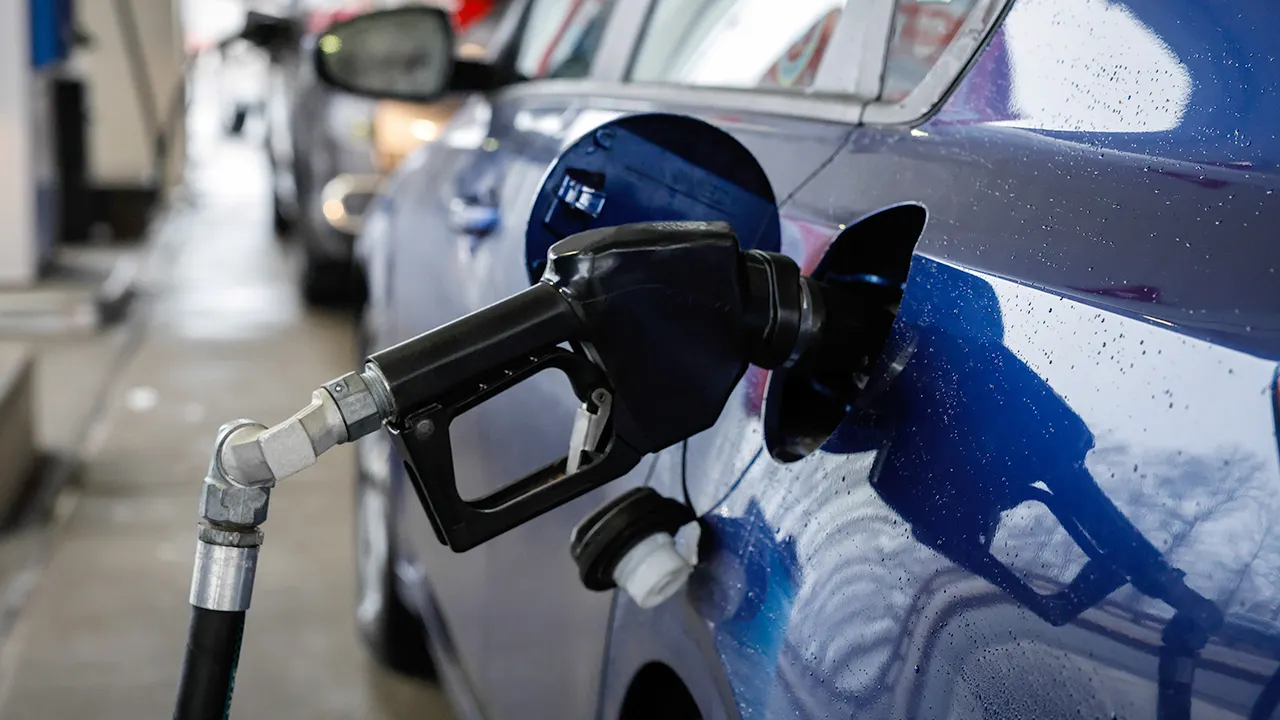
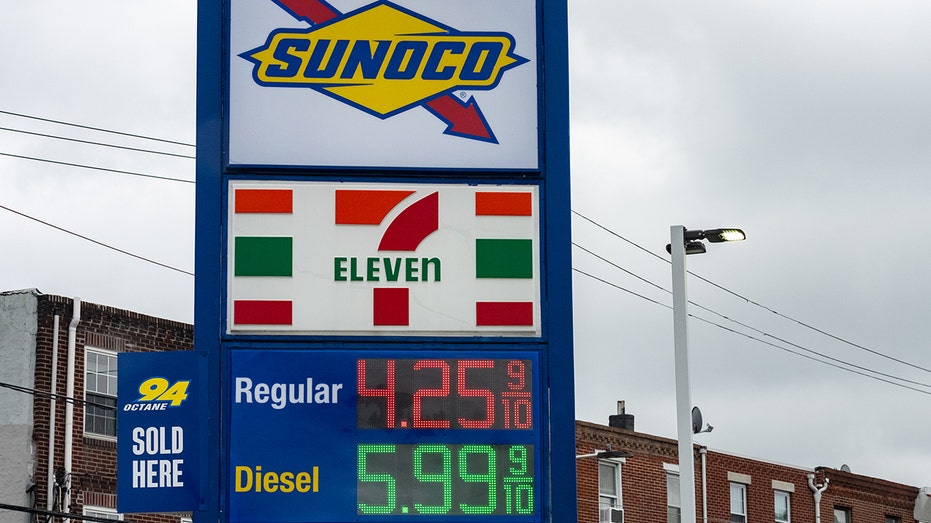
The AAA national average price for regular gas soared more than nine cents higher in one day, surging from $4.30 as of Thursday to $4.392 as of Friday.
The current figure is a whopping $0.333 higher than the week-ago average price of $4.059, according to AAA. The year-ago average for regular gas was just $3.187.
Advertisement
However, the highest recorded AAA national average regular gas price was $5.016 on June 14, 2022, which was during President Joe Biden’s White House tenure.
A fuel pump is connected to a car at a Mobil station in Englewood Cliffs, New Jersey, on Thursday, March 5, 2026. (Kena Betancur/Bloomberg via Getty Images / Getty Images)
Fox News Digital reached out to the White House for comment on Friday.
The U.S. conflict with Iran remains unresolved, and the Trump administration has been enforcing a blockade on Iranian ports.
Advertisement
Oil prices are currently elevated. Brent Crude international futures were over $111 a barrel and West Texas Intermediate U.S. futures over $105 per barrel during early trading, Barron’s reported on Friday morning.
Gas prices rise in Philadelphia, Pennsylvania, on April 30, 2026, as the United States and Iran have not yet reached a deal. (Nathan Morris/NurPhoto via Getty Images / Getty Images)
“Right now there are 41 tankers with 69 million barrels of oil that the Iranian regime can’t sell. That’s an estimated $6 billion-plus from which Iran’s leadership cannot financially benefit. The blockade is highly effective and U.S. forces remain fully committed to total enforcement,” U.S. Central Command Commander Adm. Brad Cooper declared in a statement issued on Wednesday.
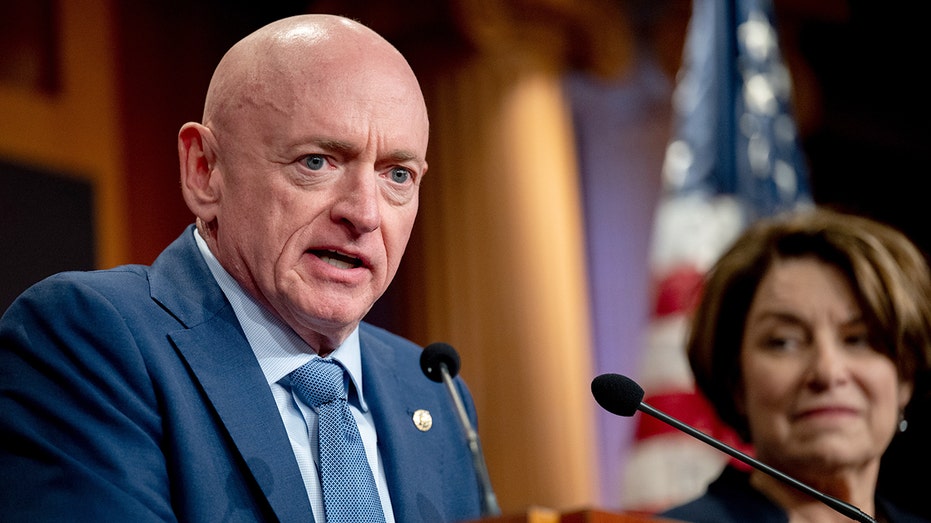
“Minnesotans are paying the price for this administration’s war with Iran as gas prices rise and squeeze families, small businesses, and farmers across our state,” U.S. Sen. Amy Klobuchar, D-Minn., who is running for governor, declared in a Thursday post on X.
Advertisement
Democratic Sen. Mark Kelly of Arizona declared in a Thursday post on X, “The Trump Administration’s war in Iran is driving up gas prices and sending summer travel costs through the roof. I’m focused on lowering costs and putting money back in Americans’ pockets so that taking your family on a road trip doesn’t break the bank.”
Sen. Mark Kelly, D-Ariz., left, and Sen. Amy Klobuchar, D-Minn., during a news conference ahead of the State of the Union address at the U.S. Capitol in Washington, D.C., on Tuesday, Feb. 24, 2026. (Daniel Heuer/Bloomberg via Getty Images / Getty Images)
“Gas prices just hit a wartime high, inflation is up, & Americans are feeling the pinch of higher prices. But Senate Republicans for the SIXTH time blocked a resolution requiring Congress to approve further military action against Iran. Their silence is an endorsement of the President’s questionable strategy,” Sen. Dick Durbin, D-Ill., declared in a Thursday post on X.
Advertisement
The “Senate Republicans” X account fired back at Durbin’s comments, declaring, “Under Biden and Democrats, gas prices were above $5 per gallon and inflation was over 9% — much higher than today. Senator Durbin didn’t care about inflation then, and he doesn’t now. He’s just looking for any excuse to side with the terrorist Iranian regime over our military.”
NEW YORK — World oil prices climbed sharply on Friday as the ongoing blockade of the Strait of Hormuz continued to threaten global supply, with Brent crude hovering near $111 per barrel and West Texas Intermediate trading around $105 amid heightened geopolitical tensions.
World Oil Prices Surge Above $110 as Strait of Hormuz Crisis Deepens Global Energy Fears
The benchmark prices reflect persistent worries over disrupted shipments through the critical waterway, which normally carries about one-fifth of global oil. The latest surge comes as diplomatic efforts to reopen the strait have stalled, pushing energy markets to four-year highs and raising concerns about inflation, economic growth and energy security worldwide.
As of early May 1, 2026, Brent crude futures for June delivery rose to approximately $111 per barrel, up more than 1% in early trading. WTI crude for May settlement traded near $105, reflecting similar upward pressure. Both benchmarks have gained over 80% year-to-date, driven largely by Middle East supply risks that have overshadowed demand concerns.
The crisis stems from the broader 2026 Iran conflict. Iranian forces effectively closed the strait in late February following U.S. and Israeli strikes, with limited commercial traffic resuming only under strict conditions. U.S. naval actions, including a blockade on Iranian ports, have further complicated shipping. Only a handful of vessels from select nations have passed recently, far below normal volumes.
Analysts at S&P Global and others warn that prolonged disruption could keep prices elevated throughout the year. While U.S. production and strategic reserves provide some buffer for American consumers, Asia and Europe face steeper challenges as alternative routes increase costs and insurance premiums skyrocket for tankers near the region.
Advertisement
OPEC+ has responded with modest production increases, but members’ spare capacity is limited and internal dynamics complicate coordinated action. The UAE’s recent exit from the group adds another layer of uncertainty to supply forecasts. U.S. shale producers have ramped up output, but logistical constraints and investor caution limit rapid scaling.
The price spike is already rippling through economies. Gasoline prices in the United States have climbed toward $4 per gallon in many areas, while European energy costs surge amid reliance on imported LNG and refined products. Developing nations in Asia, heavily dependent on Middle East crude, face the greatest strain, with some governments considering subsidies or strategic releases to ease consumer pain.
Energy experts note the Strait of Hormuz’s unique vulnerability. The narrow passage between Iran and Oman is difficult to secure fully, and even threats of attacks or mines deter shipping companies. Recent incidents involving seized vessels and reported strikes have heightened risk premiums, with insurers demanding significantly higher rates or refusing coverage altogether.
U.S. officials, including President Donald Trump, have pushed for a maritime coalition to guarantee safe passage, but allied support has been mixed. Diplomatic talks mediated by Pakistan continue, yet mutual distrust between Washington and Tehran has slowed progress. Iran has demanded the end of the U.S. blockade before fully reopening the strait, while the administration insists on verifiable security guarantees.
Advertisement
Market participants are watching several upcoming catalysts. The next OPEC+ meeting, weekly U.S. inventory reports and any breakthroughs in Iran negotiations could swing prices dramatically. Technical analysts point to resistance levels near $115 for Brent, with potential for further upside if disruptions worsen.
Longer-term forecasts vary. Some banks project Brent averaging around $100-$110 for the year if the strait reopens gradually, while others warn of sustained premiums if tensions persist. Demand destruction from high prices could eventually cap gains, but current supply fears dominate trading.
For consumers and businesses, the volatility creates planning challenges. Airlines have raised fares, manufacturers face higher input costs and households brace for increased heating and transportation expenses. Governments are exploring diversification strategies, including accelerated renewable energy investments and strategic partnerships with alternative suppliers.
The crisis also highlights the geopolitics of energy. The Strait of Hormuz has long been a flashpoint, but the current conflict has brought its importance into sharper focus. Nations dependent on Gulf oil are reassessing vulnerabilities, while producers weigh the balance between revenue and security risks.
Advertisement
As trading continues, oil prices reflect both immediate supply threats and broader uncertainty. Whether the latest spike proves temporary or the start of a new era of elevated energy costs depends on diplomatic outcomes in the coming weeks. For now, the world watches the narrow strait with heightened anxiety, knowing that events there can reshape economies far beyond the Persian Gulf.

















































You must be logged in to post a comment Login