
Crypto World
Crypto Card Spending Surges 500% to $600 Million Monthly, Visa Captures 90% Share

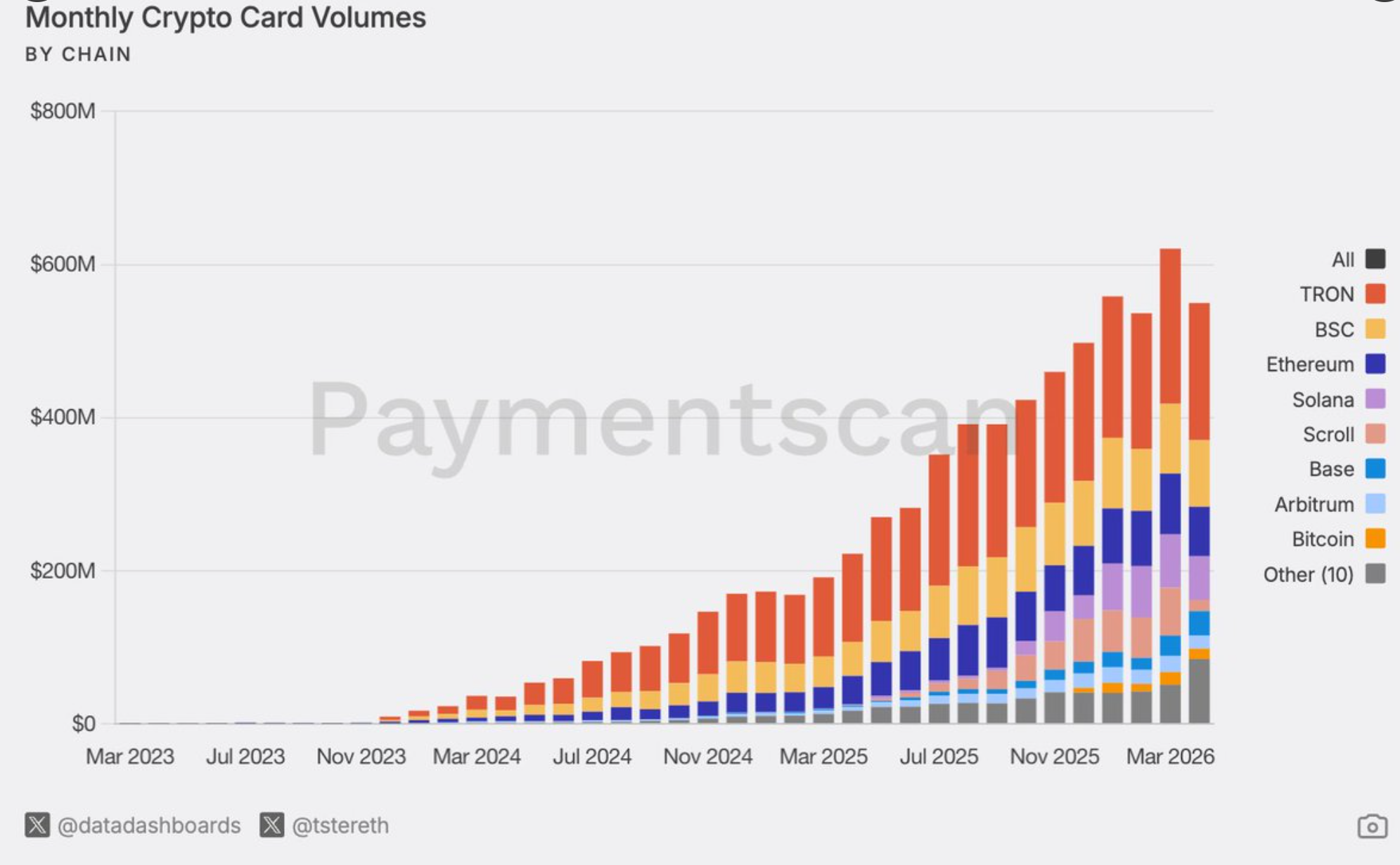
Crypto card spending volume has surged 500% since September 2024 to roughly $600 million per month. Visa (V) processes 90% of those on-chain transactions.
The data marks a sharp shift in how stablecoins reach consumers, moving from wallet balances into everyday spending. Stablecoin-linked card programs now rank among the fastest-growing businesses on public blockchains.
Visa Anchors Stablecoin Card Growth
Visa has built its lead through partnerships with crypto-native infrastructure providers, reducing reliance on traditional sponsor banks.
The strategy mirrors its Bridge stablecoin card rollout, which expands to new regions through 2026.
Meanwhile, partner programs such as Wirex push stablecoin payouts to billions of cards via Visa Direct. Visa processed roughly 97% of crypto card volume in March.
Jupiter and the Distribution Pitch
Newer entrants are also stretching the cashback model. Among them is Jupiter’s Solana-based Visa card. The product returns 4% to 10% cashback by tier and posted 660% month-over-month volume growth in April. Rewards are paid in stablecoins rather than airline points.
Tron founder Justin Sun framed the trend as the next phase of stablecoin distribution. His comment echoed earlier stablecoin policy remarks.
“Crypto cards are not a trend. They are the next evolution of distribution. Stablecoins have already moved beyond wallets into everyday spending at global scale. The next phase is seamless access. Digital assets integrated directly into how people pay, anywhere,” Justin Sun stated.
Separately, industry commentator Marty Party predicted Visa-issued stablecoin cards on Apple Pay and Android Tap will onboard 10 million users. He sees that happening before merchants adopt native stablecoin settlement.
The figures suggest stablecoins are competing for consumer wallets, not just on-chain liquidity.
Whether rival networks match Visa’s reach may decide if the debit card surge becomes a dominant crypto onramp.
The post Crypto Card Spending Surges 500% to $600 Million Monthly, Visa Captures 90% Share appeared first on BeInCrypto.



MoonPay has introduced the MoonAgents Card, a virtual Mastercard product that allows AI agents and users to spend stablecoins directly from onchain wallets.
Summary
- MoonAgents Card lets AI agents spend stablecoins at merchants that accept Mastercard.
- The card connects onchain wallets with real-time crypto-to-fiat payment conversion.
- MoonPay’s Sodot acquisition supports its wider institutional crypto services expansion.
The card enables real-time crypto-to-fiat conversion at checkout and works with merchants that accept Mastercard.
The product is built for programmatic use through MoonPay’s agent infrastructure. It allows users to authorize AI agents to initiate payments without moving funds off-chain or preloading balances.
MoonPay CEO Ivan Soto-Wright said, “Agents are already managing wallets… now they can spend.”
AI agents gain non-custodial spending tools
The MoonAgents Card connects with MoonPay’s broader AI framework. The company earlier launched a non-custodial system that allows AI agents to manage wallets, execute trades, and move assets autonomously.
The card extends that system by adding merchant payments. AI agents can now operate across trading, transfers, and real-world spending within one workflow.
MoonPay said its developer tools have processed millions of commands, showing growing usage of AI-driven crypto transactions.
Additionally, MoonPay’s AI and payments rollout comes alongside a broader institutional expansion. The company recently acquired Sodot, a digital asset security firm, to launch a new business unit focused on institutional clients.
The new division, MoonPay Institutional, is designed to support banks, asset managers, and trading firms. It offers infrastructure for payments, custody, trading, and tokenized assets.
Sodot’s technology handles key management and has supported billions in transactions across major platforms.
Stablecoin services and partnerships grow
MoonPay has also been expanding stablecoin services with enterprise partners. Its infrastructure supports stablecoin issuance, cross-border payments, and integrations with major financial platforms.
The company has worked with payment providers and fintech firms to connect stablecoins with global payment systems. This includes enabling businesses to launch custom stablecoins and use them in payments and treasury operations.


The U.S. Department of Defense has expanded its push into artificial intelligence, securing fresh agreements with several major technology firms to deploy advanced AI systems across classified military networks.
Summary
- Pentagon signs Nvidia, Microsoft, Reflection AI, and AWS to deploy AI tools on classified military networks, expanding its roster of tech partners.
- New agreements add to existing deals with SpaceX, OpenAI, and Google, with the Pentagon confirming its Google partnership for the first time.
- Push comes amid a dispute with Anthropic over safeguards on its Claude models, as the Defense Department seeks alternative AI systems for military use.
According to a report released Friday, Nvidia, Microsoft, Reflection AI, and Amazon Web Services have all signed agreements to provide operational capabilities, the Pentagon said in a statement. Two defense officials familiar with the matter also confirmed the agreements.
The latest additions place them alongside SpaceX, OpenAI, and Google, which had already committed to supplying AI tools for classified use. The announcement also serves as the first formal confirmation from the Pentagon of its agreement with Google, which had surfaced in earlier reports this week.
“These agreements accelerate the transformation toward establishing the United States military as an AI-first fighting force,” the department said.
Officials said the agreement with Amazon Web Services was finalized late Thursday, indicating that negotiations had continued up to the final stages before the announcement.
Efforts to build a network of private-sector partners come as the Pentagon looks for alternatives to systems developed by Anthropic, particularly its Claude models. That search follows a dispute between the company and defense officials over how its technology could be used in military settings.
Anthropic had pushed back against requests to relax safeguards that limit the use of its models in areas such as autonomous weapons and domestic surveillance.
The disagreement deepened over time, with the Defense Department at one point classifying the company as a “supply chain risk,” despite continued internal interest in its systems.
Pentagon officials have maintained that there are no plans to deploy AI for mass surveillance of U.S. citizens or to enable fully autonomous weapons. At the same time, the department has emphasized that “any lawful use” of artificial intelligence should remain accessible to government agencies under these agreements.
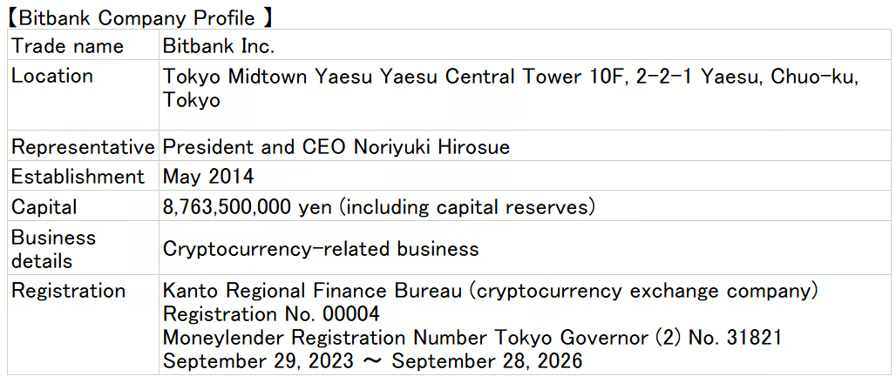
Tokyo-based SBI Holdings has opened talks to acquire shares in cryptocurrency exchange Bitbank and make it a consolidated subsidiary, extending its push to consolidate regulated crypto trading platforms in Japan as the country moves toward securities-style rules for digital assets.
The financial conglomerate said Friday it is considering a share acquisition as part of a potential capital and business alliance with Bitbank. The deal remains subject to due diligence, negotiations and internal approvals, SBI said.
The talks come a month after SBI VC Trade absorbed Bitpoint Japan on April 1, with SBI VC Trade becoming the surviving company. A Bitbank acquisition would give SBI a larger position in Japan’s crypto exchange market at a time when policymakers are preparing to bring crypto assets under the Financial Instruments and Exchange Act.
SBI said the potential deal would help the group establish an “overwhelming position in the domestic cryptocurrency industry,” citing Japan’s planned regulatory shift for crypto assets.
Japan’s Cabinet approved a bill on April 10 to amend the Financial Instruments and Exchange Act and the Payment Services Act, according to the Financial Services Agency. The bill is intended to strengthen market fairness, transparency and investor protection while revising rules for crypto assets.
Crypto assets are currently regulated by the FSA under the Payment Services Act as a means of payment. The proposed changes would move crypto closer to Japan’s traditional financial market framework, with stronger disclosure, exchange oversight and rules targeting unfair trading.
Cointelegraph asked SBI Holdings for comment on the proposed Bitbank acquisition and how Japan’s shifting crypto rules are affecting the group’s exchange strategy, but had not received a response by publication.
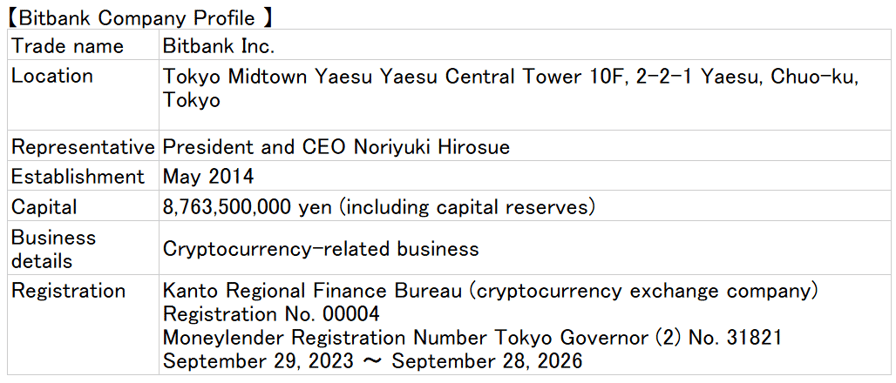
Bitbank company profile. Source: SBI Group
Bitbank is one of Japan’s major crypto exchanges. It ranks as Japan’s leading cryptocurrency exchange by Coingecko’s trust score, which measures the legitimacy of crypto exchanges based on liquidity, trading activity, cybersecurity and operational scale.
It ranks third among cryptocurrency exchanges by daily trading volume, behind bitFlyer and Coincheck.
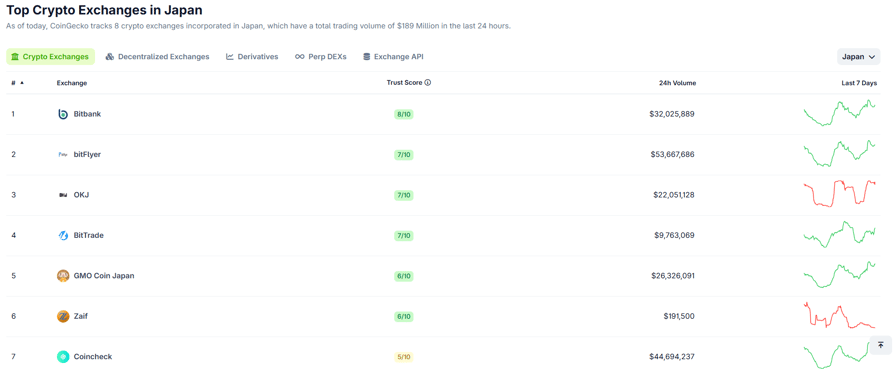
Top Japanese crypto exchanges by trust score. Source: Coingecko
The proposed deal would add to SBI’s broader digital asset footprint. SBI made a $50 million investment in Circle’s IPO in June 2025. In previous years, SBI also made strategic investments in other crypto-native companies, including BITPoint Japan, Sygnum Bank and crypto exchange TaoTao, which later merged into SBI VC Trade.
Japan brings crypto under TradFi umbrella, targets ETFs by 2028
Japan’s regulatory shift comes as institutional interest in digital assets continues to grow and policymakers reassess how crypto should fit within the country’s financial markets.
Japanese Finance Minister Satsuki Katayama first signaled the intent to bring crypto under the same umbrella as traditional finance assets in January, to ensure that citizens will “benefit from digital and blockchain-based assets.”
Related: South Korea’s Shinhan Card taps Solana to test real-world stablecoin payments
The country is also planning to legalize the launch of cryptocurrency exchange-traded funds (ETFs) by 2028, according to a January report. Large financial conglomerates like SBI Holdings and Nomura are among the first companies expected to develop crypto-linked ETFs.
Magazine: Singapore isn’t a ‘crypto hub’ — it’s something better: StraitsX CEO


WHITE TECH has received authorization from Croatia’s Financial Services Supervisory Agency, HANFA, to operate as a crypto-asset service provider under MiCA.
Summary
- WHITE TECH received MiCA authorization from Croatia’s HANFA regulator.
- The approval allows crypto exchange, custody, administration, and transfer services.
- WHITE TECH joins Croatia’s early MiCA-approved firms as EU crypto rules expand.
The company is part of the W Group ecosystem and is majority-owned by Volodymyr Nosov, founder and CEO of WhiteBIT. The approval allows WHITE TECH to offer regulated crypto services under the EU’s common framework.
WHITE TECH supports crypto exchange services, fiat-to-crypto conversion, and crypto-asset transfers for businesses and users.
Under the MiCA approval, the company can provide exchange services, custody and administration of crypto assets, and transfer services. It must also follow EU standards for governance, risk controls, and customer protection.
Croatia’s MiCA market takes shape
WHITE TECH is among the first companies in Croatia to receive MiCA authorization. The approval places the firm inside the EU’s unified regulatory system at an early stage.
Croatia has already started licensing crypto firms under MiCA. Electrocoin received HANFA approval in April, becoming the first company registered under the country’s crypto licensing process.
MiCA creates common rules for crypto firms across EU member states. The framework covers transparency, authorization, supervision, and user protection for crypto-asset service providers.


Ripple CTO Emeritus David Schwartz has dismissed claims that XRP could reach $10,000.
Summary
- David Schwartz said the $10,000 XRP prediction does not match normal market behavior.
- Schwartz said old XRP comments were about liquidity needs, not a future price promise.
- He also rejected claims of hidden government XRP deals, calling them conspiracy theories.
His comments came during an online debate about old XRP price discussions and market valuation models.
Schwartz said the idea does not match normal market behavior. He argued that if even a small chance of such a move existed, wealthy and rational investors would already be buying XRP heavily.
Old XRP comments return to focus
The debate followed renewed attention on a 2017 post in which Schwartz discussed XRP liquidity. Some users treated the old comments as a price target, but Schwartz said the post explained transaction needs, not a future price promise.
He had said XRP could not be “dirt cheap” if it handled very large payment flows. Schwartz later clarified that the point was about liquidity, market depth, and settlement size.
Additionally, Schwartz has also rejected claims that XRP is part of secret government or central bank plans. He described such claims as a “conspiracy theory” and warned investors against relying on hidden signals.
He said Ripple’s non-disclosure agreements relate to normal business privacy. According to Schwartz, they do not prove hidden government XRP deals or secret settlement plans.
Ripple seeks clearer market debate
Schwartz also addressed claims tied to Ripple’s escrow holdings. He said the escrow system remains visible on-chain and can be tracked by anyone.
The comments come as Ripple’s native token remains a major topic in crypto markets. XRP (XRP) traded near $1.37 to $1.38, with a market cap above $84 billion, according to crypto.news price data.


Google CEO Sundar Pichai said personalized AI agents will reshape how people manage their daily tasks. He framed the technology as the next major phase in artificial intelligence adoption.
Pichai told Time magazine that agents can handle email triage, scheduling, and continuous monitoring of personal interests. He said internal Google teams have been working on agentic AI for years.
Pichai’s AI Agent Workflow Hints at Google’s Direction
Pichai described querying Gemini before executive meetings to surface what might be on a counterpart’s mind. He said decisions that previously required days of internal research now resolve in seconds.
The CEO said the tools have made him more productive in coding work. He argued that prompt-driven workflows free up time for higher-value tasks.
Such agentic tools have become integral to executive workflows at Google.
“It’s a command away. It’s a prompt away,” he stated.
Comments Follow Gemma 4 Release and Open Source Push
The interview lands days after Google’s April 2 release of Gemma 4. The family of open-source multimodal models was published under Apache 2.0.
The launch includes variants ranging from edge devices to a 31 billion parameter dense model. Each model targets a different deployment scenario, from phones to cloud data centers.
Pichai pointed to the release as evidence that no single company can build AI alone. He flagged energy infrastructure, cybersecurity, deepfake detection, and workforce reskilling as the immediate policy priorities for Google.
The comments arrive as AI agents drove more than 9,000 tech layoffs across 2026. Crypto teams are simultaneously racing to build identity layers for autonomous agents interacting with financial rails.
Pichai’s pitch suggests Google plans to anchor that shift rather than cede it. His timeline for the personalized agent era looks shorter than the broader industry consensus.
The post CEO Sundar Pichai Finally Reveals Google’s AI Direction appeared first on BeInCrypto.
Crypto World
Paris Blockchain Week 2026. Arcanum and Mercuryo on institutional capital, MiCA, and crypto market maturity


At Paris Blockchain Week 2026, the conversation around digital assets felt different. The old divide between traditional finance and crypto-native firms appeared less relevant, replaced by discussions around capital deployment, regulation, execution, and market structure.
BeInCrypto spoke exclusively with Arcanum and Mercuryo to understand what institutional players want now, where Europe stands after MiCA, and how the market may evolve over the next two years.
What surprised you most at PBW, and what does European institutional capital want from crypto?
Michael Ivanov, Chief Executive Director at Arcanum Foundation: What struck me most was how the “us versus them” dynamic between traditional finance and crypto-native firms has effectively dissolved. It felt like a structural change, rather than a sentiment change.
The buy-side interest at PBW was precise. Privacy and composability on-chain are essential for serious institutional capital flows. European institutions are asking whether the market can support the accountability requirements they operate under. That is a fundamentally different conversation, and one that demands market-level answers rather than product pitches.
What from Arcanum Pulse’s retail roots still matters to institutions?
Michael Ivanov: More than most assume. The discipline of public, real-time verifiability — every trade on record, no black box — emerged from a retail context where trust has to be earned daily. What we are seeing now is institutional compliance teams arriving at the same requirement from a different direction. A live, auditable track record is not a retail feature. It is what a risk committee needs before it can approve an allocation.
What retail also forced us to do early was pass real scrutiny. To operate as an Official Broker on Bybit across our product line, we went through full KYB verification — the kind of institutional-grade compliance review most algo products never face because they never seek formal recognition from a regulated exchange.
That process matters. It means the trading statistics are not the only thing validated. The entity behind them has been validated too.
The architecture did not need to change for institutions. The framing around it did, but the compliance setup was already there. When a risk committee asks, “Does it perform?” and “Who is running this, and can we trust the structure around it?” we have answers that go beyond the chart.
During October’s liquidations, none of your clients lost deposits. What worked in the architecture?
Michael Ivanov: The strategy does not use stop-losses. What protected clients was the opposite of what most systems do under stress. Instead of cutting exposure, the algorithm read the volatility as an entry signal and executed diversified buys into the drawdown.
By the time markets recovered through the night, those positions were already in profit. That month ended with over 6% average return — one of the strongest in our track record, and it came precisely because of the liquidation event, not despite it.
The architecture is built to treat volatility as information, not threat. The risk management is in the entry logic and position sizing, not in exits. That distinction matters more than most people realise. A system that exits under pressure locks in losses. A system sized and diversified correctly from the start can stay in and capture the recovery.
What has MiCA changed in institutional demand, and where is the main bank-to-exchange bottleneck now?
Arthur Firstov, Chief Business officer at Mercuryo: The introduction of MiCA has provided much-needed legal grounding for institutions to adopt digital token services. The legislation has removed the ambiguity that existed before.
MiCA has opened the door for digital token services to be adopted in so-called TradFi payment systems. As for bottlenecks, here lies the opportunity, as fully compliant connectivity services remain critical for the industry to grow. It is in the linkages between TradFi and DeFi services where the battle will be won, and in this regard Mercuryo is playing an important role.
Is algorithmic trading becoming standard in crypto, or is this still a different market?
Michael Ivanov: It is becoming standard, but the conditions that make it reliable are still maturing. Liquidity depth in major pairs now supports serious algorithmic systems. The missing piece sits around custody arrangements, counterparty transparency, and jurisdiction-specific compliance.
In traditional markets, algos run on rails built over decades. In crypto, operators are stress-testing those rails in real time. That asymmetry is both the risk and the opportunity. The funds that build rigorous systems now will have structural advantages that are difficult to replicate once the market normalises.
How do you navigate regulatory fragmentation across Europe, the U.S., and Asia, and what risk is still being ignored?
Michael Ivanov: Regulatory fragmentation is not just a compliance problem. It is a product design problem.
Our decision to operate through Bybit, and to restrict access for users in the U.S. and EU, was not a workaround. It was a deliberate choice to stay within legally clear boundaries rather than test grey zones that could put clients at risk.
That discipline costs you some markets. It also means you are not carrying hidden regulatory exposure that surfaces at the worst possible moment.
What we observe across Asia, and particularly in Hong Kong, is a regulatory environment actively constructing frameworks to attract institutional capital. That is where we are building.
The risk still being ignored more widely is counterparty concentration. Most funds have not seriously stress-tested what happens if their primary exchange faces a liquidity event. Regulatory conversations focus on disclosure and custody. Operational concentration risk often sits outside that discussion.
Where do retail and small-fund infrastructure needs overlap, and where do they split?
Arthur Firstov: Retail and small fund infrastructure needs overlap more than people assume. Both require reliable on- and off-ramps, secure custody, compliant payments, clear reporting, and a user experience that reduces operational friction.
Nobody wants fragmented rails, settlement uncertainty, or systems that demand specialist knowledge to operate safely. These principles shape how Mercuryo thinks about its infrastructure, and why building for intuition, trust, and workflow integration sits at the centre of everything we do.
The differences emerge at the level of complexity, control, and accountability. Retail infrastructure is about simplicity and confidence. The priority is ease of use, fast transactions, and protections that limit the risk of user error.
Small funds need something different. Their infrastructure has to support multi-step approvals, role-based permissions, auditability, reconciliation, and more sophisticated reporting. They are managing mandates, controls, counterparties, and fiduciary obligations. That means the infrastructure has to support operational precision.
Retail can tolerate standardisation in a way small funds cannot. A retail user is well served by a streamlined product with limited choices. A small fund may need to tailor workflows around execution, custody arrangements, treasury policies, or jurisdiction-specific compliance requirements.
The overlap is secure, seamless, compliant infrastructure. The divergence is how much complexity the product needs to expose. For retail, good infrastructure hides complexity. For small funds, good infrastructure manages it. The strongest platforms are those that can serve both without treating them as the same user.
What needs to change by PBW 2028 for the institutional adoption story to look different?
Michael Ivanov: The products that matter by 2028 will not be the ones that solved a single problem well. They will be the ones that built the connective tissue between trading infrastructure, distribution, and on-chain capital flows — and did it in a way that scales across different types of participants, from individual allocators to institutional funds to exchanges building their own branded offerings.
That is the trajectory Arcanum Foundation is on. Arcanum Pulse was never meant to be a standalone bot. It is the foundation layer of a broader infrastructure — one that already powers white-label products for exchanges and funds, and that we are actively extending.
In the coming months, we will be bringing new products to market that expand what that infrastructure can do and who it can serve. We are not announcing them today, but the direction is consistent. We are building the layer others build on, not just a product they allocate to.
By 2028, the institutional adoption story looks different when the infrastructure is invisible — when the rails are so embedded in how capital moves through crypto markets that the question stops being “should we use algorithmic infrastructure” and starts being “which layer of it do we want to sit on.” We intend to be that layer.
The post Paris Blockchain Week 2026. Arcanum and Mercuryo on institutional capital, MiCA, and crypto market maturity appeared first on BeInCrypto.
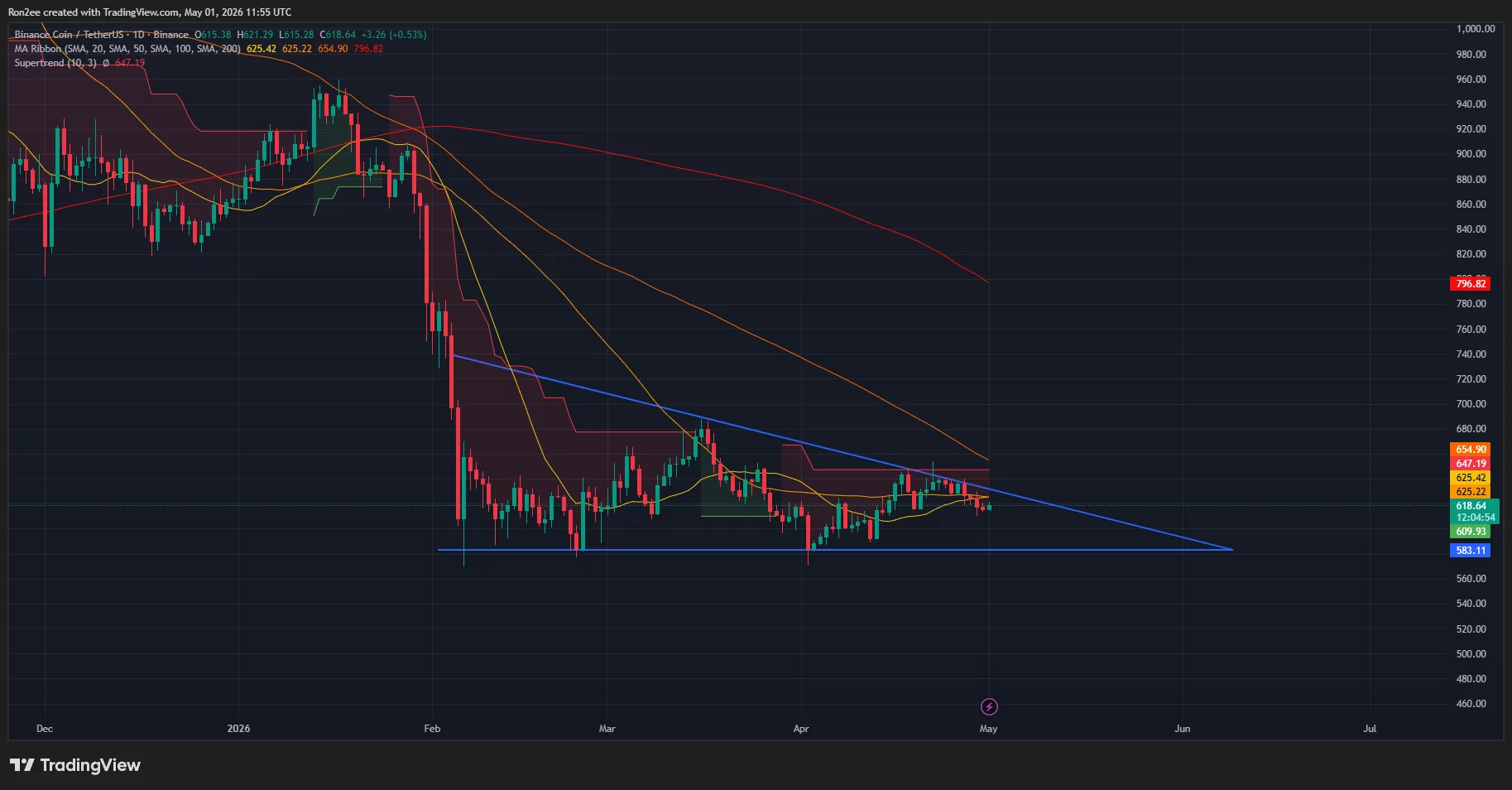
BNB price is consolidating within a descending triangle pattern, with a horizontal support near $600 and a series of lower highs pressing against a downward-sloping resistance trendline, pointing to a potential breakdown.
Summary
- BNB price trades near $616, compressing within a descending triangle with key support at $600 and resistance around $625–$630.
- Price remains below major moving averages, with bearish MACD divergence and weakening momentum signaling downside risk toward $579–$580.
- Broader market pressure persists, with Fear & Greed Index in fear territory and Bitcoin’s $70K–$72K support seen as critical for BNB’s direction.
According to data from crypto.news, BNB (BNB) price was trading around $616 at press time on May 1, down roughly 1% over the past 24 hours. Over the past week, the token has largely moved between $600 and $635, reflecting a narrowing range as price compresses toward the apex of the triangle.
The asset remains significantly below its recent highs, still down more than 30% from levels above $900 seen earlier this year. Participation has also cooled, with price action lacking strong follow-through on either side. When price compresses near major support while volatility declines, it often signals that a larger move is approaching.
BNB price remains at risk of more downside as broader market conditions continue to weigh on risk assets like it.
The Crypto Fear & Greed Index remains in fear territory at 26, indicating weak risk appetite among investors. Traders appear hesitant to aggressively buy dips, especially as macro uncertainty builds.
BNB also remains highly correlated with Bitcoin (BTC). Analysts warn that if Bitcoin loses the $73,000–$74,000 support range, it could trigger a broader market sell-off, increasing downside pressure on altcoins like BNB.
At the same time, macroeconomic factors are adding to volatility expectations. Concerns over the Federal Reserve maintaining higher interest rates have reduced liquidity in risk markets. Upcoming U.S. data releases, including Non-Farm Payrolls on May 8 and CPI data on May 12, could further drive sharp price swings.
BNB price analysis
The daily chart shows BNB forming a tightening descending triangle, with a flat support near $580 and a descending resistance trendline connecting lower highs since February.
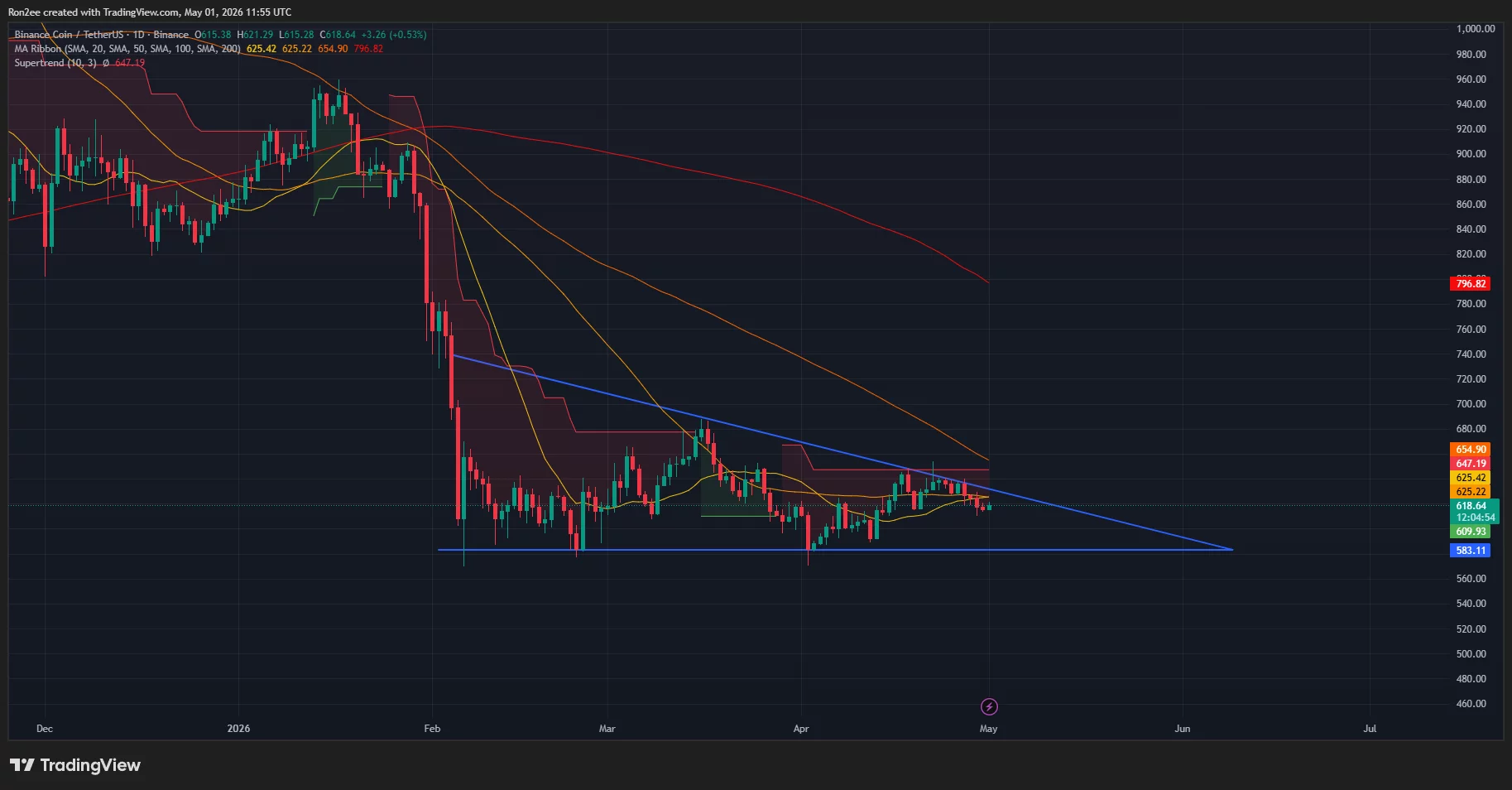
Repeated tests of the $600–$610 zone suggest buyers are still defending this level. However, each bounce has been weaker, indicating fading demand.
Momentum indicators also lean bearish. BNB is currently trading below its 50-day simple moving average near $625, a level that has now turned into resistance. The 100-day and 200-day SMAs, positioned higher around $654 and $796, respectively, further reinforce the broader downtrend.
In addition, a bearish divergence has been observed on the MACD histogram on the daily timeframe, suggesting that upward momentum is weakening despite recent attempts to stabilize.
Hence, a clean breakdown below the $600 support would confirm the bearish structure and could open the door toward the next major support near $580.
On the other hand, a strong move above the descending trendline and reclaim of the $625–$630 zone could invalidate the setup and shift momentum back in favor of buyers, though current signals suggest that scenario carries lower probability in the short term.
Disclosure: This article does not represent investment advice. The content and materials featured on this page are for educational purposes only.
Ripple CEO Brad Garlinghouse publicly reaffirmed the company’s strong commitment to XRP at the Bitcoin 2026 conference, directly confronting narratives suggesting the company has moved away from its native token.
The announcement came alongside news that Ripple is aggressively expanding into the Middle East and Africa.
CEO Confronts Skepticism
Speaking at the Vegas conference, Garlinghouse delivered a pointed message to critics. He stated that Ripple remains the largest holder of XRP worldwide and will continue supporting the token’s success.
“Ripple is extremely committed to make XRP the most useful digital asset, the most liquid digital asset, and the most trusted digital asset,” Garlinghouse said.
The statement directly addressed persistent criticism that Ripple abandoned XRP. Some observers argued that the company shifted its focus toward institutional payment solutions such as RippleNet and xCurrent, which do not require tokens.
Garlinghouse’s declaration signals that institutional payments and XRP adoption are complementary, not competing, strategies.
Middle East Expansion Accelerates
Beyond XRP commitments, Ripple announced the opening of a new regional headquarters in Dubai’s Dubai International Financial Centre (DIFC).
The move positions Ripple to expand operations across the Middle East and Africa. This region offers significant opportunities for the development of payment infrastructure and the adoption of blockchain technology.
Ripple’s treasury platform processes $12.5 trillion in annual payment volume across 13,000 connected banks. The Middle East expansion could unlock additional volume from regional financial institutions and payment providers.
XRP Army Vindication
The CEO’s remarks resonated deeply with XRP community members present at the conference. Years of skepticism about Ripple’s commitment to XRP have created tension between the company and its token holders.
Garlinghouse’s statement functioned as both reassurance and pushback. He emphasized that Ripple’s massive XRP holdings align the company with the interests of token holders. Ripple profits when XRP succeeds.
This alignment contrasts with narratives suggesting Ripple views XRP as baggage or a legacy obligation rather than a core strategic asset.
Institutional Adoption and XRP Integration
The CEO’s remarks suggest plans to more deeply integrate XRP into institutional payment flows. As RippleNet adoption grows, opportunities emerge to incorporate XRP settlement for certain transaction types.
Garlinghouse emphasized making XRP the most liquid digital asset. This implies building infrastructure that enables financial institutions to easily trade and hold XRP for settlement.
The three stated goals, most useful, most liquid, most trusted, paint a vision of XRP becoming the preferred settlement token for international payments.
Skeptics Remain
However, not all observers view Ripple’s strategy positively. Some argue utility remains limited despite years of development. Others contend that stablecoins like USDC offer superior payment characteristics.
Ripple’s commitment to XRP success must ultimately manifest in adoption metrics. Token holders will judge the company’s sincerity based on whether transaction volume and adoption accelerate following these announcements.
The post Ripple CEO Sends Strong XRP Signal From Las Vegas appeared first on BeInCrypto.
US-listed spot Bitcoin (BTC) exchange-traded funds (ETFs) finished April in the green as Bitcoin rallied throughout the month.
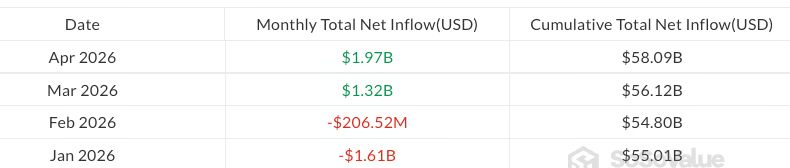
Bitcoin ETFs drew $1.97 billion in inflows in April, well above March’s $1.37 billion, marking their highest monthly inflows of the year, according to SoSoValue data.
With inflows in March and April offsetting outflows in January and February, Bitcoin ETFs now show about $1.47 billion in net inflows for 2026. The cumulative net inflows to the products since they launched have topped $58 billion.
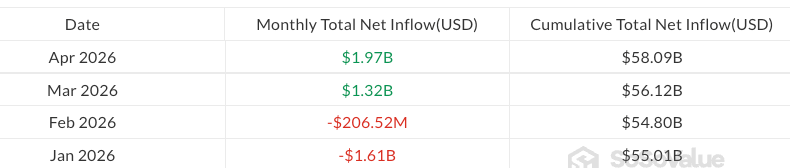
Monthly spot Bitcoin ETF flows in 2026. Source: SoSoValue
The April inflows came alongside a 12% rise in Bitcoin, its strongest monthly gain since April 2025, when it rose more than 14%, according to CryptoRank.
April’s data comes ahead of the 13F filing season in May, when major financial institutions will disclose their holdings in crypto ETFs for the first quarter of 2026.
ETFs post $490 million in late-month outflows
Late-month redemptions were not enough to offset April’s inflows. The ETFs saw around $490 million in outflows during three days in late April.
BlackRock’s iShares Bitcoin Trust ETF (IBIT) was the dominant driver of gains in April, bringing around $2 billion in net inflows. On the other hand, Grayscale Investments’ Bitcoin Trust ETF (GBTC) was the biggest loser, with net outflows totaling around $280 million.
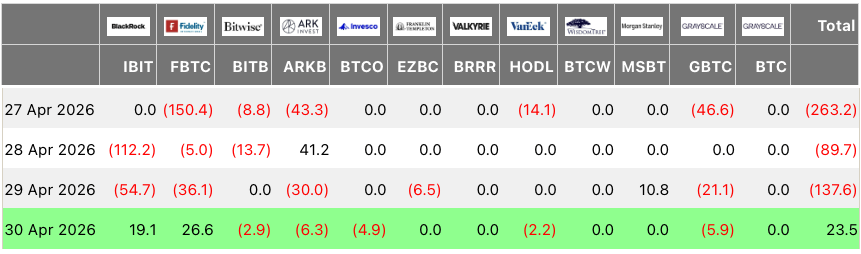
Daily spot Bitcoin ETF flows by issuer since April 27, 2026. Source: Farside
The Morgan Stanley Bitcoin Trust ETF (MSBT), which began trading on April 8, generated around $194 million in inflows, with no single day of outflows over the month.
The first month of gains for Ether ETFs since October 2025
April’s positive trend extended to some altcoin ETFs, with Ether (ETH) funds logging their first monthly inflow since October 2025, at $356 million versus about $570 million in October 2025.
Still, Ether ETFs remain in negative territory after four months of 2026, with about $413 million in net outflows year to date, according to SoSoValue. The cumulative net inflows since launch stood at about $11.9 billion.
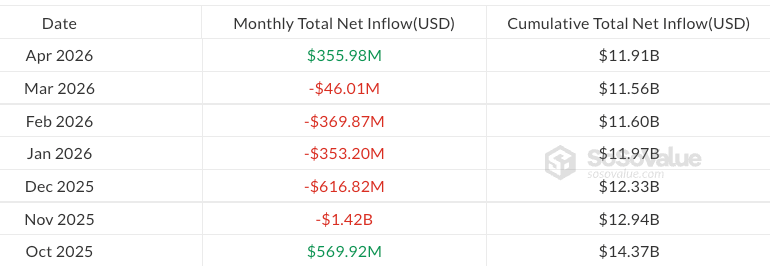
Monthly spot Ether ETF flows since October 2025. Source: SoSoValue
XRP funds also surged in April, logging their strongest month since December 2025 with $81.6 million of inflows. The ETFs saw about $124 million in net inflows across the first four months of 2026, while total cumulative inflows stand at around $1.3 billion.
Related: Bitcoin risks extended retreat as April rally was futures-driven: CryptoQuant
Dogecoin (DOGE) ETFs rallied in April as well, logging $2 million of inflows, accounting for roughly 21% of total cumulative inflows of about $9.6 million.
Meanwhile, Solana (SOL) ETFs saw $38.7 million in April inflows, the smallest monthly total on record, compared with cumulative inflows of about $1 billion.

Police warning ahead of Dante Festival at York Racecourse

Top 3 US States Losing Big Companies Jobs in 2026 Amid Tech Layoffs and Economic Shifts

MoonPay targets AI payments with Mastercard stablecoin card

Manchester United reach agreement with Casemiro over contract clause amid transfer speculation

US brings back mandatory military draft registration

Steven Gerrard disagrees with Gary Neville over ‘shock’ Chelsea and Arsenal claim | Football


-

 Tech4 days ago
Register Renaming | Hackaday
-

 Fashion7 days ago
Weekend Open Thread – Corporette.com
-
 Crypto World6 days ago
Hyperliquid $HYPE Rally Builds Momentum as AI Sector Enters Prove-It Phase
-

 Politics4 days ago
Drax board avoid their own AGM, accused of greenwashing & environmental racism
-

 Tech4 days ago
Images of Samsung’s rumored smart glasses have leaked
-
 Sports5 days ago
IPL 2026: Ruturaj Gaikwad registers slowest fifty of the season, enters all-time unwanted list | Cricket News
-

 Tech4 days ago
Why Blue Badges Disappeared From Toyota Hybrids
-

 NewsBeat5 days ago
LK Bennett closes all stores after entering administration
-

 Fashion3 days ago
Kylie Jenner’s KHY Enters a New Era with ‘Born in LA’
-
 Entertainment6 days ago
Mariah Carey Slams Deposition Claims In Brother’s Lawsuit
-

 Business3 days ago
Most Commercial Energy Audits Miss the Real Losses
-

 Business4 days ago
(VIDEO) Charlize Theron Climbs Times Square Billboard to Promote New Netflix Thriller ‘Apex’
-

 Crypto World3 days ago
CFTC’s AI will review U.S. crypto registration applications, chairman tells CoinDesk
-

 Business7 days ago
Jeanine Pirro announces closure of Federal Reserve building cost probe
-

 Tech5 days ago
Microsoft to roll out Entra passkeys on Windows in late April
-
 Crypto World7 days ago
Nvidia (NVDA) Stock Jumps 5% as Intel Earnings Ignite Semiconductor Rally
-

 Tech5 days ago
OpenAI’s Sam Altman apologizes for not reporting ChatGPT account of Tumbler Ridge suspect to police
-

 Business2 days ago
Barclay Brothers Avoid Bankruptcy: HSBC Drops High Court Petitions After IVA Deal
-

 Tech7 days ago
Apple’s Next CEO Has a Different Battle Ahead
-

 Tech3 days ago
Get Ready for More Brain-Scanning Consumer Gadgets
You must be logged in to post a comment Login