
Crypto World
Crypto is at the bottom of U.S. voters’ priorities heading into the midterm, CoinDesk survey shows

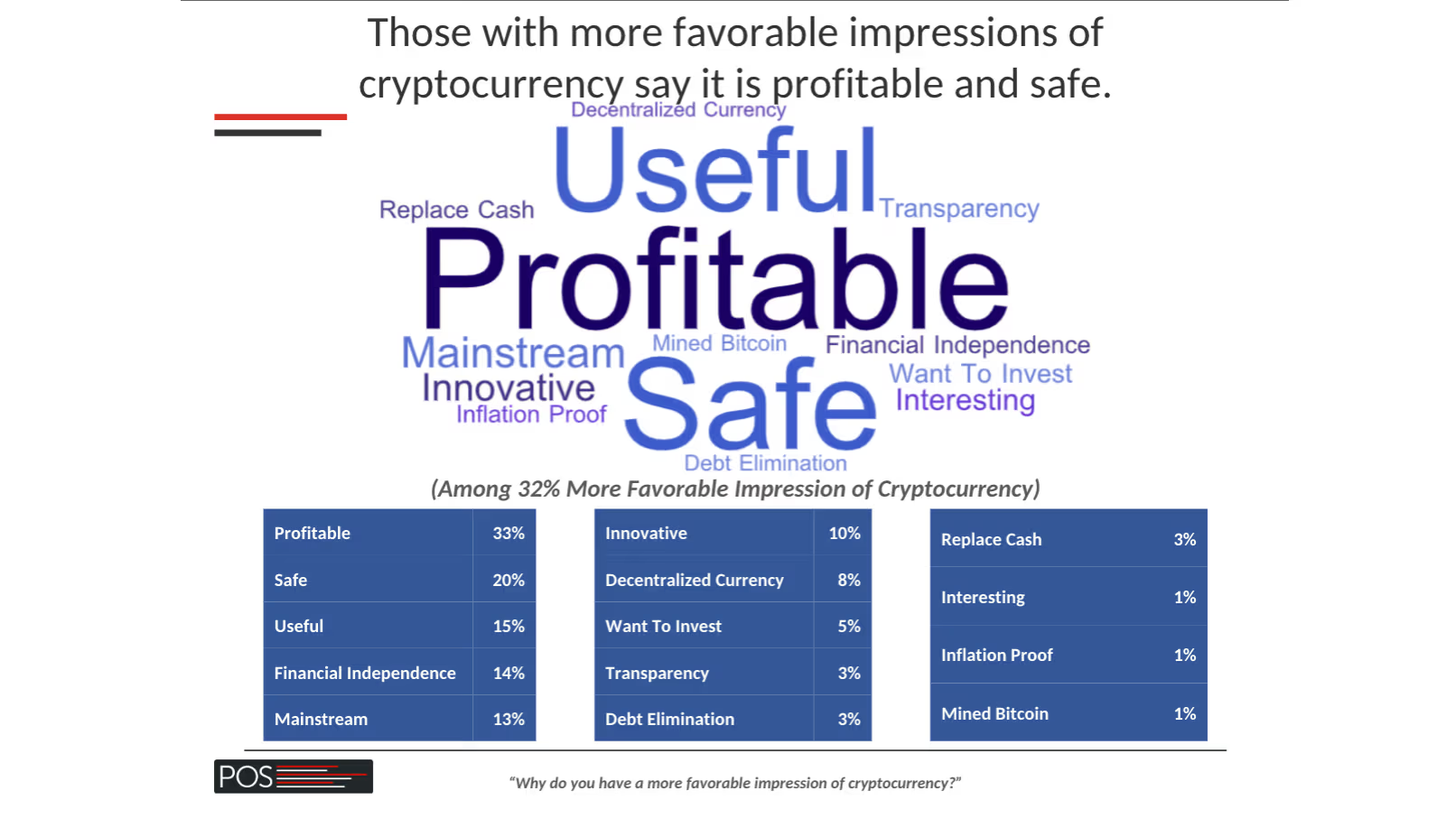
U.S. voters placed cryptocurrencies toward the bottom of a list of their highest priorities for the upcoming midterm election.
Just 1% of respondents said they ranked crypto as their top concern, according to a survey of 1,000 randomly selected registered U.S. voters, though other responses revealed a wider view of the technology as an important political issue.
The survey was conducted near the end of April by Public Opinion Strategies on CoinDesk’s behalf, as part of CoinDesk’s coverage of the 2026 U.S. midterm election. The survey was evenly split between Republican and Democrat respondents (41% of respondents identified with each party to some degree), with a credibility interval of plus or minus 3.53%.
Crypto won’t be on the ballot this year, but the industry still has a vested interest in who wins. The market structure bill, one of the most important pieces of legislation, is seen as the top priority for crypto. Though the bill known as the Clarity Act still has a path to becoming a law before the end of the year, it’s taken far more time than expected and still needs to clear a number of hurdles. Other bills, including expected tax reform legislation, will likely end up before Congress in the coming months. Ahead of the election, the crypto industry has dedicated hundreds of millions of dollars intended to support friendly candidates, after being the single largest donor industry in the 2024 election.
This article is part of a CoinDesk series on voters’ views for the 2026 midterm election.
As of press time, the most likely outcome of the 2026 election is that Democrats will become the majority party in the House of Representatives, while the Senate is more likely to remain dominated by Republicans. A generic question in POS’s poll for CoinDesk about whether voters would choose the Republican or Democrat candidate gave a slight edge to Democrats (44% to 41%); this +3 margin is roughly in line with a number of other polls, according to a tracker hosted by The New York Times.
Prediction market provider Kalshi has the Senate at an even split. But Democrats have a much tougher road to picking up a majority there, Cook Political Report said in April.
This poll also showed U.S. President Donald Trump with a net negative approval rating, with 40% of respondents saying they somewhat or strongly approved of his performance, while 60% disapproved.
And unsurprisingly, respondents said the cost of living (36%), jobs and the economy (13%), and Social Security and Medicare (11%) were their single most important issues. Other issues, such as immigration and border security, healthcare, national security, government spending and more, all saw single-digit percentage responses. Crypto ranked at the bottom, largely among voters leaning toward the Republican Party. Artificial intelligence came in just a smidge higher, with 2% of respondents calling it their single most important issue.
Views on crypto
Crypto itself does not enjoy a favorable image among the survey respondents. While participants who leaned toward the GOP had a slightly more favorable view of cryptocurrency than unfavorable (41% to 39%), base GOP (33% to 39%), independents (27% to 48%), Dem-leaning voters (26% to 54%) and base Dems (25% to 58%) all had a more unfavorable view.

Just over a quarter of participants (27%) said they had invested, traded or used a cryptocurrency, while another 27% said they haven’t but might one day. Of those who had invested, 2% currently have over $10,000 worth of digital assets, 9% said they owned between $1,001 and $10,000 and 12% said they had $1,000 or less in crypto.

In terms of the November election, 49% of participants who said they were “much more interested” in this year’s election than in the 2022 election said they owned $1,000 or more worth of crypto.
According to the data, 47% of respondents said Republicans were more supportive of cryptocurrencies, compared to just 14% who said the same about Democrats. These figures don’t necessarily indicate whether respondents saw that as a good thing, however. Interestingly, Democrats maintained a slight edge in voter trust in crypto, with 27% of respondents saying they trusted the party, compared with 25% who said they trusted Republicans more. A greater proportion of respondents — 40% — said they didn’t trust either party.
Roughly 40% of respondents also said they would be more likely to vote for a candidate who shared their views on crypto, though the survey did not ask whether this was tied to positive or negative views of crypto.
Crypto also had lower favorability (30%) than Republicans (39%) or Democrats (43%). Meanwhile, DeFi — also known as finance on the blockchain — had 17% of respondents saying they had a favorable view, though only 60% of respondents overall said they’d even heard of it.
Artificial intelligence had rosier numbers — 46% of respondents had a favorable view, while 45% had an unfavorable view.
Despite all that — and in somewhat of a contradiction to not flagging crypto as their top issue — when asked directly how important crypto was for the 2026 election, 3% of respondents said it was the “single most” important issue, and a further 22% said it was an important issue. That represents a much higher awareness of digital assets than voters had several years ago.
CoinDesk will release data from this survey on Tuesday at Consensus Miami.

Multiple wallet addresses recently sanctioned by the US Treasury Department for their ties to Iran may not be linked to the Islamic Republic, but to other state actors instead, analysis published Sunday suggests.
That analysis, by blockchain intelligence firm Nominis, said that while the recent seizing of wallets holding more than $340 million by Treasury’s Office of Foreign Assets Control (OFAC) was a significant crypto enforcement event, some of those wallets’ characteristics lack a similarity to previously seized wallets linked Tehran.
“While the use of cryptocurrency by the Islamic Revolutionary Guard Corps (IRGC) is well established, this case presents structural and behavioral characteristics that diverge meaningfully from previously observed patterns,” said Nominis CEO Snir Levi.
He said that IRGC-linked wallets have shown some consistency in their operations, including that the funds are distributed across multiple wallets, individual wallet balances are kept relatively low — typically a few million US dollars, holdings aren’t retained for extended periods and activity is structured to minimize exposure to seizure or freezing mechanisms.
“The behavioral divergence observed in this case raises a critical question: To what extent does the frozen $340 million reflect direct IRGC control, versus infrastructure that overlaps with broader, potentially foreign, financial networks,” Levi said.

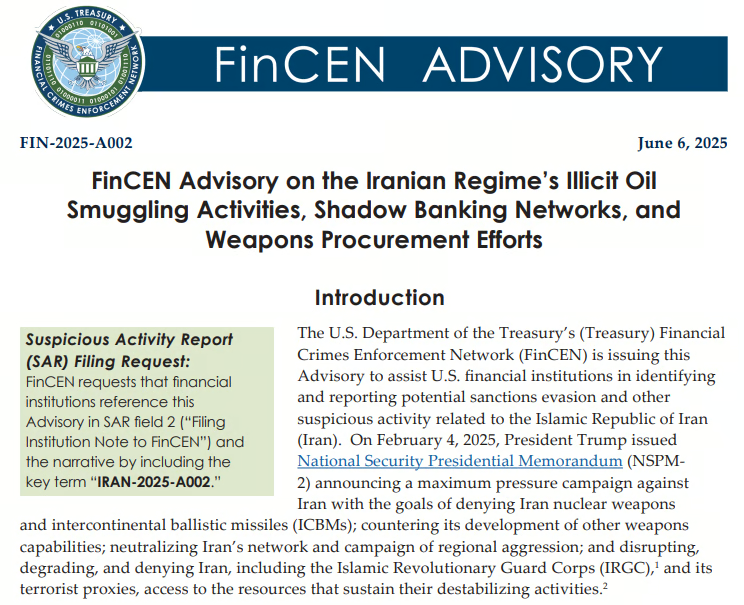
June 2025 FinCEN Advisory on Iranian Shadow Banking Networks. Source: US Department of the Treasury’s Financial Crimes Enforcement Network
He said the implications for compliance teams could be that static typologies are no longer sufficient and behavioral analysis and clustering are critical for identifying risk.
“Most importantly, this case highlights that even well-documented actors such as the IRGC and potentially Chinese state-actors are continuing to evolve their use of blockchain infrastructure,” the Nominis founder said.
Related: Iran views BTC as strategic asset, but USDt still dominates oil tolls: BPI
Operation Epic Fury targets crypto for maximum US economic pressure
The United States has seized nearly $500 million in Iranian cryptocurrency assets as part of Operation Epic Fury, a sweeping economic pressure campaign against Tehran, Treasury Secretary Scott Bessent said last Wednesday.
“We are freezing bank accounts everywhere. More importantly, we are making people less willing to deal with the regime,” Bessent said during an appearance on Fox Business’s “Kudlow,” adding that retirement funds and overseas real estate held by Iranian officials are also being targeted.

Source: Treasury Secretary Scott Bessent, verified X account
The $500 million figure cited is much higher than the $344 million in seized crypto assets previously disclosed. A week earlier, Bessent announced that OFAC had sanctioned several crypto wallets tied to Iran, with stablecoin issuer Tether confirming it had frozen more than $344 million in USDt (USDT) at the request of US authorities.
Bessent said Operation Economic Fury has taken a toll on Iran’s economy. One of the country’s largest banks collapsed in December, and its currency has fallen 60 to 70% against the US dollar. “They’re in the middle of a currency crisis,” he said.

TLDR:
- SUI transitions from a strong rally into a controlled correction, forming a cleaner structural reset phase
- Price compression in SUI signals fading volatility as buyers and sellers reach a temporary equilibrium zone
- SUI holds a key support region where early accumulation signals begin forming after an extended retracement
- Market structure in SUI suggests a potential buildup phase as traders monitor breakout or breakdown levels
SUI price is showing a structured market transition across multiple time frames as price compresses near key support zones.
Traders are monitoring whether accumulation signals can sustain a broader recovery phase forming within the current market cycle structure, developing momentum shift.
4H Structure And Short-term Flow
The 4H timeframe reflects a transition from impulsive expansion into controlled corrective movement across recent sessions.
Early expansion in SUI displayed strong bullish participation with higher highs forming under sustained buying pressure continuation.
Momentum faded as SUI entered a corrective structure, producing lower highs and gradual retracement without panic-driven selling behavior.
This phase in SUI suggests distribution-like price action, where liquidity resets and weaker positions exit systematically.
Consolidation has followed, with SUI compressing inside a tight range, showing reduced volatility and balanced order flow.
Current behavior in SUI shows early stabilization near support, with buyers gradually absorbing available sell-side liquidity.
SUI now attempts to maintain structure above key intraday support, signaling potential early-stage accumulation formation within the range. Market participants in SUI are observing whether support continues to hold under repeated retests.
A failure to defend this zone would likely shift structure back into extended corrective pressure across lower ranges.
However, sustained absorption may reinforce accumulation dynamics and prepare conditions for renewed upward expansion in SUI
Volatility contraction supports the view that market equilibrium is forming before directional resolution in the coming sessions. Traders continue monitoring the SUI structure closely here.
Weekly Frame And Accumulation Zones
SUI weekly structure shows price interaction near the 0.786 Fibonacci retracement zone aligned with macro trend support. This level in SUI historically represents deep retracement conditions where longer-term positioning typically begins forming.
Price compression around this region indicates reduced volatility and potential accumulation behavior under broader cycle structure. SUI remains structurally aligned with an ascending macro trendline that continues to define higher timeframe support.
Defending the $0.50 level in SUI / Tether preserves the broader bullish structure across weekly closes. Loss of this threshold would weaken the current cycle setup and expose deeper corrective zones below support.
SUI structure continues to reflect compression similar to prior cycle phases that preceded strong expansion moves. Market behavior in SUI suggests accumulation-like conditions forming near long-term support confluence areas.
Resistance levels are mapped toward $1.80, $4.00, and higher extension zones based on historical reaction points. A successful hold above current support in SUI maintains the structural integrity of the broader cycle.
Volatility contraction continues to signal equilibrium conditions as participants await directional resolution in upcoming trading sessions.
SUI remains in a transitional phase where accumulation and distribution forces are still balancing near critical weekly structure zones at present levels.

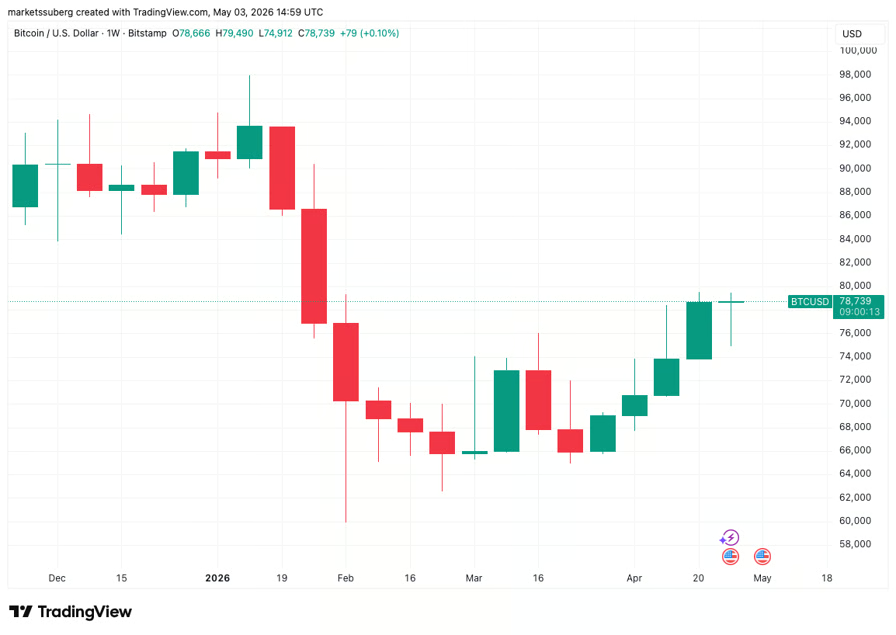
Bitcoin (BTC) eyed $79,000 into Sunday’s weekly close as crypto markets continued to be guided by the US-Iran war.
Key points:
- Bitcoin circles a key weekly level into the weekly close, with the highest close in several months on the table.
- Analysis sees the mid-$80,000 zone and higher coming back into play.
- Liquidity grabs form the basis for caution among some traders.
BTC price nears highest weekly close in over three months
Data from TradingView showed BTC/USD attempting to hold higher after cancelling out losses from earlier in the week.
Finishing the week above $78,670 would deliver the pair’s highest weekly close since late January.

BTC/USD one-week chart. Source: Cointelegraph/TradingView
Friday delivered a boost to risk assets as hopes of a fresh peace agreement between the US and Iran accelerated. On Sunday, however, US President Donald Trump appeared skeptical of ratifying Iran’s latest peace proposals.
In a post on Truth Social, Trump wrote that he “can’t imagine that it would be acceptable.”

Source: Truth Social
Despite this, some crypto market commentators remained optimistic about the short-term outlook.
“Strong consolidation on $BTC , and Friday gave us a slight insight in what’s likely to come,” trader and analyst Michaël van de Poppe wrote on X.
Van de Poppe referenced Friday’s strong inflows to the US spot Bitcoin exchange-traded funds (ETFs), which totaled nearly $630 million.
“I don’t think this will slow down in the coming week and that’s probably why we’re seeing a relatively shallow consolidation taking place,” he continued.
“The $79K area is a crucial zone. That needs to break. If this breaks, I’m assuming we’ll see more upwards momentum and I’ve got $86-88K as first resistance area and $92-94K as the crucial one.”

BTC/USDT one-day chart. Source: Michaël van de Poppe/X
Bitcoin traders warn of liquidity games
Caution was also visible, with traders watching for liquidity grabs to the upside before a subsequent price reversal.
Related: Here’s what happened in crypto today
“Starting to see a build of liquidity form below, but a take of the high liquidity and using that to dump,” Crypto Tony commented on data from CoinGlass on the day.
-2026-05-03_17_57_12.png?prefix=media%2Fcontent)
BTC liquidation heatmap. Source: CoinGlass
Trading account JDK Analysis described the liquidity setup as “typically bearish.”
“We can clearly see fresh longs opening into the highs, while price continues to show signs of absorption – unable to push meaningfully higher despite increasingly aggressive market buying for now,” it summarized in posts on X.

BTC/USDT 15-minute chart. Source: JDK Analysis/X
TLDR:
- Kalshi hit $14.81B April volume, setting a new record despite no major seasonal sports peak
- Polymarket dropped to $9.01B in April as active traders fell from 733K to 643K month-over-month
- Combined Kalshi and Polymarket lifetime trading volume crossed $150B amid shifting liquidity trends
- Sports and Exotics dominated Kalshi, accounting for about 85% of total platform trading activity
Prediction markets hit $150 billion lifetime volume as Kalshi and Polymarket activity expands across sports, crypto, and political contracts.
The milestone reflects rising institutional participation and shifting liquidity patterns, even as monthly trading trends diverge between leading platforms in April.
Kalshi drives liquidity surge as prediction markets hit $150 billion lifetime volume
Kalshi extended its leadership as prediction markets hit $150 billion lifetime volume, supported by strong April trading activity across event-driven contracts.
The platform recorded $14.81 billion in April volume, marking a 13.3 percent increase from March levels despite the absence of major seasonal sporting events.
Sports contracts dominated activity, accounting for more than 74 percent of weekly volume, while Exotics contracts expanded their share within structured combinations.
The Masters alone generated $545 million in notional trading volume, matching Super Bowl game-level activity and reinforcing Kalshi’s sports-linked liquidity base.
Transaction volume also shifted, with Kalshi processing 94.4 million trades, surpassing Polymarket and indicating stronger engagement density across retail participants.
Exotics contracts gained traction, contributing over 10 percent of weekly volume and reflecting increased demand for bundled outcome structures among active traders.
Capital inflows into Kalshi also strengthened following its valuation adjustment to $22 billion, supporting liquidity depth and market-making efficiency across contracts.
Regulatory positioning under CFTC oversight continued to support U.S. participation, enabling broader institutional access to event-based financial instruments.
Market observers noted increasing correlation between sports-driven liquidity cycles and sustained baseline trading activity in regulated prediction environments.
This shift aligns with growing adoption of structured event contracts across retail and professional trading segments.
Polymarket cools as trading mix shifts across crypto and politics
Polymarket recorded a softer performance even as prediction markets hit $150 billion lifetime volume across the broader ecosystem. April trading volume declined 14.8 percent to $9.01 billion, reversing momentum from the previous month’s surge.
Active traders fell from over 733,000 in March to about 643,000 in April, reflecting reduced event-driven participation. Sports accounted for 46 percent of activity, while crypto and political markets represented 22 percent and 27 percent, respectively.
The absence of major catalysts such as March Madness reduced liquidity concentration, exposing Polymarket’s reliance on diversified market themes.
Despite slower April activity, Polymarket continues preparations for U.S. expansion through the acquisition of a CFTC-licensed exchange.
Market competition remains tight, with both platforms targeting institutional liquidity as regulatory clarity improves across derivatives markets.
Polymarket’s mix of crypto, politics, and sports allows sensitivity to macro sentiment shifts but reduces baseline consistency in low-volatility periods.
Volume compression in April reflected reduced speculative flows tied to election uncertainty and softer digital asset volatility. Even with a monthly decline, Polymarket retains strong infrastructure positioning for future liquidity expansion cycles.
Analysts observe that both platforms remain central to the evolution of decentralized event-based financial pricing systems.
Market structure continues to shift toward continuous trading of real-world outcomes across regulated and offshore venues. Liquidity fragmentation remains an ongoing factor.
TLDR:
-
- A US court froze $71M in ETH recovered from the KelpDAO hack, blocking Arbitrum DAO from distributing funds.
- North Korea terror creditors secured a garnishment order, linking the stolen ETH directly to the Lazarus Group.
- Arbitrum’s Security Council seizure brought the assets into US jurisdiction, enabling the court to intervene fast.
- Aave’s recovery coalition, backed by Lido, Mantle, and EtherFi, now awaits a formal divestiture hearing in New York.
- A US court froze $71M in ETH recovered from the KelpDAO hack, blocking Arbitrum DAO from distributing funds.
A U.S. court has frozen $71 million in Ethereum held by the Arbitrum DAO, recovered after the Lazarus Group allegedly stole $292 million from KelpDAO on April 18, 2026.
The Southern District of New York issued the order on May 1, barring any transfer of the seized funds. Terror attack creditors with judgments against North Korea filed the legal action.
The freeze now stalls compensation plans for victims across Aave, LayerZero, and other affected protocols.
Centralized Governance Move Draws Court Scrutiny
Arbitrum’s Security Council seized 30,766 ETH following a bridge exploit that drained roughly $290 million from KelpDAO last month.
The Council coordinated with law enforcement before routing the funds into governance control. DAO voters then approved a plan to send the ETH to a multisig wallet for victim compensation. That approval now carries little weight under the court order.
Han Kim and Yong Seok Kim are U.S. nationals whose relative was killed by North Korea. They hold over $300 million in damages awarded by a U.S. court in 2015.
Their attorneys moved quickly, securing the garnishment order just days before the DAO planned to act. LayerZero had publicly attributed the April hack to the Lazarus Group, directly linking the ETH to Pyongyang.
Attorney Gabriel Shapiro reviewed the court filing and confirmed the freeze carries real legal weight. He noted that plaintiffs used specific garnishment statutes to block the DAO from acting unilaterally. Shapiro took to X to spell out exactly what the order means for the DAO and its recovery plans. He wrote:
“Arbitrum DAO is not allowed to do anything with the KelpDAO funds for now, until a divestiture hearing… they are supposed to actually litigate that, not just decide on their own what to do with it.”
The case presents a direct conflict between decentralized governance and U.S. judicial authority. The Security Council’s intervention, intended to protect users, ultimately brought the assets within U.S. court jurisdiction.
That centralized action created a legal foothold the plaintiffs quickly used. The DAO now faces litigation it never anticipated when the Council first froze the funds.
Aave Coalition Plans Stall as Legal Battle Begins
Aave had assembled a recovery coalition pulling resources from Lido, Mantle, and EtherFi. The group pooled ETH specifically to backstop rsETH holders affected by the April exploit.
Their entire plan depended on the seized funds flowing back through Arbitrum governance. The court order has placed that timeline in limbo.
One economics lead at MegaETH noted publicly that the seizure exposed the DAO to claims it never prepared for. The freeze essentially converted a DeFi governance decision into a matter for U.S. federal courts.
Protocols involved in the recovery effort must now wait for a formal divestiture hearing. No timeline for that proceeding has been confirmed.
The situation marks a rare moment where DeFi governance collided directly with U.S. legal enforcement. Creditors holding North Korea-related judgments now stand between the DAO and its recovery plan.
The outcome will likely shape how DAOs respond to hacked funds in future exploits. Legal observers are watching closely as the case moves forward in New York.
Crypto World
Amkor Technology (AMKR) Stock Surges as Analyst Hikes Target to $90 Following Strong Q1 Results

Key Highlights
- Amkor Technology is launching a $1 billion convertible senior notes offering maturing in 2031 through private placement channels
- Underwriters hold a 13-day option to acquire an extra $150 million in notes following the initial sale
- First quarter 2026 earnings per share reached $0.33, surpassing analyst projections of $0.23; quarterly revenue totaled $1.68B, marking a 27.5% annual increase
- Needham elevated its stock price objective to $90 while maintaining a Buy recommendation; B. Riley sustained a Neutral stance with a $70 projection
- Capital raised will support capped call arrangements and corporate initiatives including infrastructure investments
Amkor Technology (AMKR) has unveiled its intention to issue $1 billion worth of convertible senior notes scheduled to mature in 2031, exclusively available to qualified institutional purchasers via private placement channels. Shares were hovering around $71.41 when the offering was disclosed, approaching the 52-week peak of $79.23.
The securities are slated to reach maturity on July 15, 2031, featuring semi-annual interest distributions. Underwriters possess the right to purchase an extra $150 million in notes during a 13-day window post-issuance.
Beginning May 15, 2029, Amkor retains the authority to buy back the notes with cash, provided its share price surpasses 130% of the conversion threshold for a designated timeframe. The buyback amount encompasses the original principal alongside accumulated interest.
The semiconductor packaging specialist intends to allocate proceeds toward capped call strategies, mechanisms engineered to minimize shareholder dilution resulting from potential note conversions. Remaining funds will support broader corporate objectives and capital investments.
Bondholders gain conversion rights under specific circumstances, with Amkor having the option to settle using cash and, when appropriate, equity shares. Final interest rates and conversion parameters will be determined at the pricing stage.
This capital initiative follows immediately after impressive first-quarter 2026 financial results. Amkor delivered earnings per share of $0.33 compared to Wall Street’s $0.23 forecast, representing approximately a 43% outperformance. Quarterly sales reached $1.68 billion, climbing 27.5% from the previous year and exceeding the $1.63 billion analyst consensus.
Wall Street Response
The substantial earnings outperformance prompted multiple analyst firms to adjust their outlooks upward. Needham increased its valuation target from $65 to $90 while reaffirming its Buy recommendation, highlighting superior revenue generation and gross margin expansion.
Morgan Stanley boosted its projection from $45 to $69 while keeping an Equal Weight designation. B. Riley Financial adjusted its forecast from $65 to $70, preserving a Neutral position—a figure that remains marginally beneath current trading levels.
Consensus analyst sentiment currently stands at Hold, with an average price objective of $62.75. Four research firms assign Buy ratings, while seven recommend Hold positions.
Executive Trading and Shareholder Structure
Recent months have witnessed notable insider selling activity. Company executives divested a total of 42,500 shares during the past 90 days, generating approximately $2.1 million in proceeds. Executive Vice President Mark N. Rogers offloaded 5,000 units at $59.43 in mid-April. Board member Guillaume Rutten sold 20,000 shares at $48.80 toward the end of February.
Despite these transactions, company insiders maintain approximately 26.4% ownership. Institutional investment firms control 42.76% of outstanding shares.
The equity trades at a price-to-earnings multiple of 47.15 with a beta coefficient of 1.94. Its 50-day moving average rests at $51.53, considerably beneath the present valuation, illustrating the pronounced upward momentum following the earnings announcement.
Amkor’s leverage ratio of 0.28 debt-to-equity, combined with a current ratio of 2.27, demonstrates robust financial stability entering this fundraising phase.
Second-quarter 2026 projections also exceeded both Needham’s forecasts and broader market expectations, based on the firm’s post-earnings analysis.
Wall Street anticipates full-year 2026 earnings per share of $1.62. Trailing twelve-month revenue expanded 12.7% to $7.1 billion.

Key Takeaways
- CMG shares declined approximately 3.6% to $32.98 after releasing Q1 results on April 29
- Earnings per share hit $0.24, matching forecasts but declining from $0.29 in the prior-year period
- Quarterly revenue reached $3.09B, edging past expectations with 7.4% annual growth
- Comparable restaurant sales posted a modest +0.5% gain following a challenging 2025
- Wall Street’s average price target stands at $46.23, with projections spanning $35 to $52
Chipotle Mexican Grill (CMG) delivered its first-quarter financial results on April 29, triggering a negative response from investors. Shares tumbled about 3.6% in subsequent trading sessions, landing near $32.97—significantly beneath the 52-week peak of $58.42.
Chipotle Mexican Grill, Inc., CMG
The fast-casual chain posted quarterly revenue of $3.09B, narrowly surpassing the Street’s $3.07B projection and representing a 7.4% increase year-over-year. Earnings per share aligned with consensus at $0.24, though this marked a decline from the $0.29 reported in Q1 2025.
A notable positive: comparable store sales returned to growth territory at +0.5%, offering relief after 2025’s disappointing trends. Company executives highlighted robust demand for protein-heavy offerings and continued strength in digital channels as growth catalysts.
Nevertheless, the Street’s reaction has been decidedly mixed.
Wall Street Remains Divided
Guggenheim reduced its price objective to $35 while maintaining a “neutral” stance, citing mounting pressure on profitability from escalating labor and operational expenses. Wells Fargo lowered its forecast from $50 to $45 but sustained an “overweight” recommendation. Stephens modestly lifted its target to $39 alongside an “equal weight” rating.
Among the bulls, Citigroup elevated its price target to $46, while TD Cowen reaffirmed a “Buy” call. Sanford C. Bernstein projects a $50 valuation with an “outperform” designation.
In total, 23 analysts assign CMG a Buy rating while 12 recommend holding. The average price target of $46.23 suggests substantial upside potential from present levels for investors betting on a turnaround.
Broader projections anticipate full-year 2026 revenue of approximately $13.0B, representing roughly 6.9% expansion. Annual EPS estimates cluster around $1.11, essentially flat compared to trailing twelve-month performance.
Revenue expansion is forecast to moderate to about 9.3% annually through late 2026, down from the 12% compound annual growth rate over the previous five years. This projection aligns closely with the restaurant sector’s anticipated 9.1% growth trajectory.
Options Activity Signals Investor Hesitation
One particularly noteworthy data point following the earnings release: heightened put option volume. Approximately 61,900 put contracts changed hands—roughly 39% above typical daily put activity. Such concentration generally indicates increased hedging activity or outright bearish positioning.
With institutional investors controlling 91.3% of CMG shares outstanding, significant price movements in either direction can accelerate rapidly.
Danske Bank A/S expanded its stake during Q4, acquiring an additional 61,230 shares to reach a total position of 711,117 shares worth approximately $26.3M. Several smaller investment firms also established new positions during Q3.
CMG currently carries a P/E ratio of 30.25, a PEG ratio of 2.02, and a beta of 1.03. The stock trades below both its 50-day moving average of $34.37 and its 200-day moving average of $35.94.
The 52-week trading range spans $29.75 to $58.42, positioning CMG just marginally above its annual low.
TLDR
- Friday’s April employment report expected to show approximately 60,000 new positions created
- Key chip sector results from AMD and Arm Holdings to provide insight into AI momentum
- Major consumer brands like Disney, McDonald’s, and Marriott deliver quarterly updates
- Both S&P 500 and Nasdaq reached new all-time highs heading into the week
- Major technology companies have boosted AI investment plans to approximately $725 billion
Investors face a data-packed week as critical employment figures and a slate of high-profile earnings releases provide fresh insight into economic conditions and corporate performance.
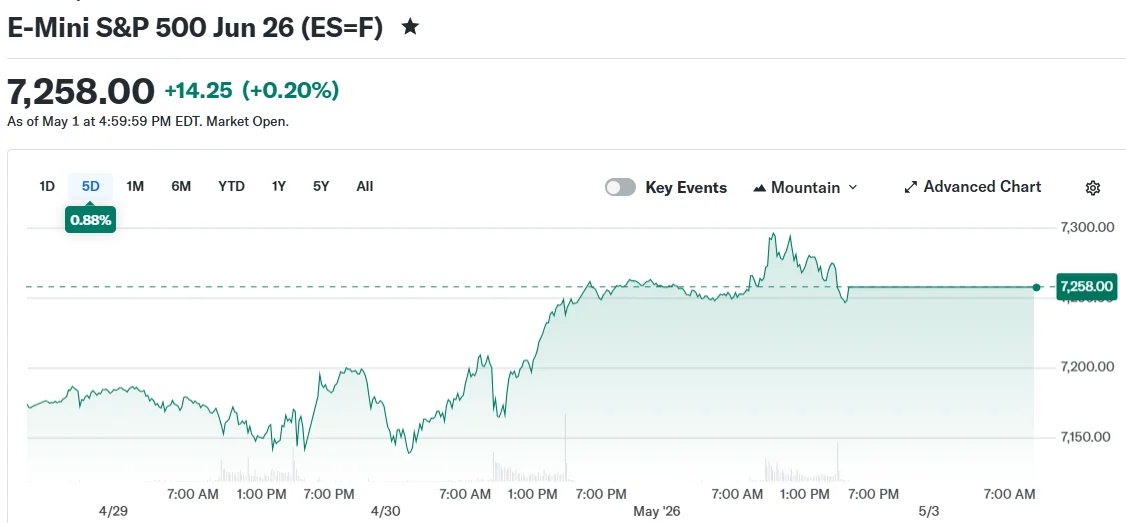
Both the S&P 500 and Nasdaq Composite achieved record closing levels on Friday. The S&P 500 advanced nearly 1% over the five-day period, while the Nasdaq climbed 1.1%. Despite Friday’s 0.3% decline, the Dow Jones managed a 0.5% weekly gain.
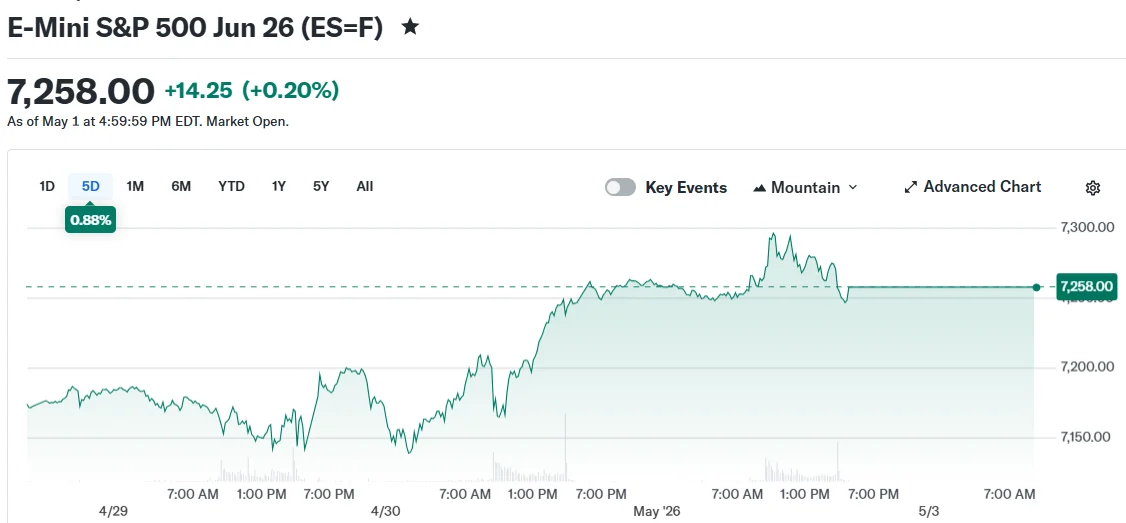
The previous week’s trading was heavily influenced by technology sector earnings. Among the Magnificent 7 group, five companies delivered quarterly results that generated positive investor sentiment. Microsoft, Amazon, Meta, and Alphabet collectively increased their artificial intelligence investment commitments from $670 billion to roughly $725 billion.
Market analysts note the overall earnings season remains robust. Companies continue delivering results that exceed Wall Street forecasts, while management commentary has proven more optimistic than anticipated considering current economic uncertainties.
April Employment Data Commands Attention
The most significant economic release arrives Friday with the April employment situation report. Current consensus forecasts point to approximately 60,000 new jobs, representing a substantial decline from March’s 178,000 additions.
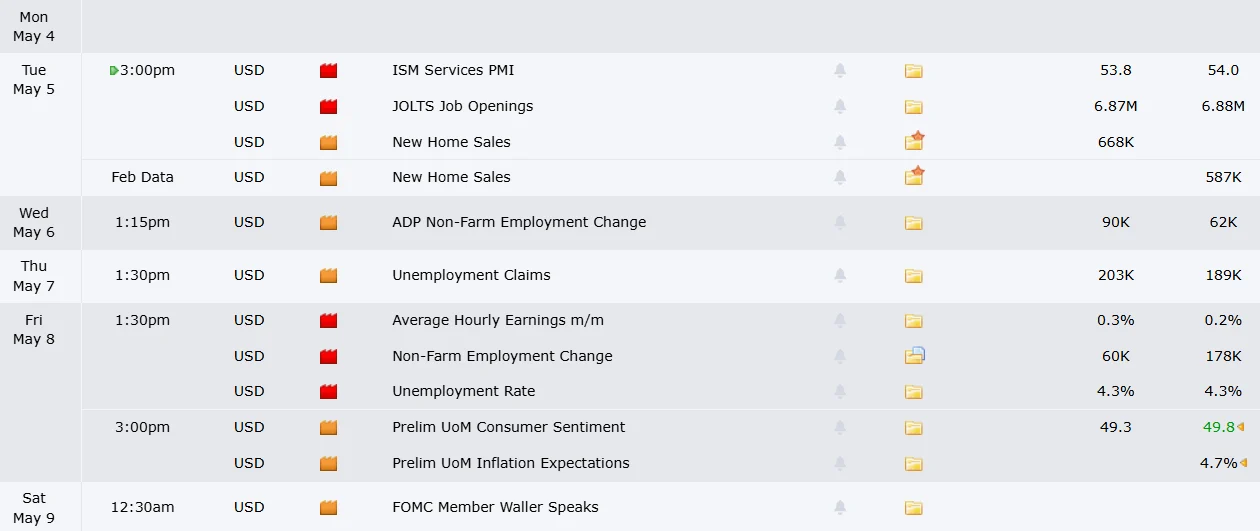
Recent jobless claims data reached levels not seen since 1969, while ADP’s private sector employment tracking has indicated improving conditions. However, the employment landscape over the previous ten months has shown considerable volatility, making directional assessments challenging.
Federal Reserve policymakers are monitoring these developments carefully. The central bank continues evaluating its interest rate strategy while tracking labor market dynamics and energy market movements related to geopolitical tensions with Iran.
BNP Paribas economist Andrew Husby observes that industries with significant AI exposure have experienced slower workforce expansion rather than outright reductions. He characterizes this dynamic as “growing the labor pie with AI,” indicating that technological advancement is supplementing economic productivity instead of merely displacing human workers.
Ahead of Friday’s main release, additional labor market indicators arrive throughout the week: JOLTS job openings Tuesday, ADP private payroll figures Wednesday, and Challenger job reduction data Thursday.
Chip Sector Results Provide AI Investment Reality Check
April proved exceptional for semiconductor stocks, with the PHLX Semiconductor Index posting its strongest monthly performance since February 2000—surging over 40%. Advanced Micro Devices has soared 70% in the past month ahead of Tuesday’s earnings announcement. Arm Holdings gained 40%, while Lattice Semiconductor advanced 25%.
Lattice Semiconductor opens the semiconductor earnings parade Monday, followed by Advanced Micro Devices Tuesday, and Arm Holdings Wednesday. These reports will illuminate actual chip demand amid accelerating AI infrastructure investments.
AMD recently disclosed pricing adjustments and secured a significant partnership with Meta. Market watchers will scrutinize whether company guidance aligns with the optimistic spending signals from major technology platforms.
Interactive Brokers strategist Steve Sosnick acknowledged the sector’s substantial gains create downside risk, though he noted that sustained positive earnings beats would make short positions difficult to justify.
Consumer Company Results Gauge Spending Patterns
Beyond technology and semiconductors, consumer-focused company earnings will illuminate household spending behavior.
Walt Disney delivers results Wednesday, with attention centered on streaming subscriber trends and theme park attendance. Marriott reports Wednesday and Airbnb Thursday, as hospitality companies navigate elevated airfare costs and fuel prices. United Airlines has indicated travel demand remains healthy but anticipates pricing challenges during the year’s second half.
The quick-service restaurant sector also features prominently. Restaurant Brands, which operates Burger King and Popeyes, reports Wednesday. McDonald’s follows Thursday with Wendy’s concluding Friday. Lower-income consumers have reduced fast-food purchases recently, prompting investors to search for stabilization signals.
Palantir launches the earnings week Monday after market close, with Novo Nordisk and Uber scheduled for Wednesday.
Crypto World
Strategy Invests $2.57 Billion in Bitcoin as AJC Mining Launches New Bitcoin Cloud Mining Contracts


Entering 2026, the global cryptocurrency market remains highly active. Strategy’s $2.57 billion Bitcoin purchase once again highlights institutional investors’ continued interest in the long-term value of Bitcoin. It has also brought greater attention to Bitcoin Cloud Mining and Cryptocurrency Mining among global users.
As Bitcoin and crypto assets become more widely adopted, more users are looking for ways to participate in cryptocurrency mining. However, traditional mining usually requires purchasing mining machines, covering electricity costs, and having the technical ability to maintain equipment. For ordinary users, the entry barrier can be relatively high.
Against this background, Cloud Mining has become a more convenient way to participate. Users do not need to purchase physical mining machines. Instead, they can take part in the mining process of remote data centers through cloud-based hash power contracts. AJC Mining has officially launched a new cloud mining reward contract that supports BTC payments, helping users enter the Bitcoin mining ecosystem more easily.
AJC Mining: A Bitcoin Cloud Mining Platform for Global Users
AJC Mining is a cloud mining platform focused on providing Bitcoin Cloud Mining Platform services. The platform is committed to offering users a simpler and more efficient cryptocurrency mining experience. By combining AI hash rate optimization technology, green energy cloud mining models, and daily profit settlement mechanisms, AJC Mining provides a lower-barrier participation method for beginner and intermediate users.
Compared with traditional Cryptocurrency Mining, AJC Mining’s cloud mining model does not require users to purchase mining machines or deal with electricity, maintenance, cooling, and equipment management. Users only need to select a suitable cloud mining contract, and the system will automatically run the relevant hash power tasks and settle profits according to the contract rules.
Main Advantages of the AJC Mining Platform
AJC Mining offers several key advantages:
No hardware equipment required: Users do not need to purchase expensive mining machines or bear equipment maintenance costs.
Simple and convenient operation: After registering an account, users can select a contract and start cloud mining.
AI hash rate optimization technology: The intelligent system optimizes hash power allocation to improve operating efficiency.
Green energy mining model: The platform focuses on sustainable development and promotes a more environmentally friendly cloud mining approach.
Daily settlement mechanism: Users can view daily mining profits according to the contract rules.
Global service coverage: AJC Mining serves cryptocurrency users across multiple countries and regions.
As a Cloud Mining Platform, AJC Mining aims to provide users with a lower-barrier, automated, and more convenient Bitcoin cloud mining experience.
Why Is Bitcoin Cloud Mining Attracting More Attention?
Traditional Bitcoin mining usually requires professional mining machines, large-scale electricity resources, and continuous operation and maintenance capabilities. Therefore, it is more suitable for mining farms with capital, technical, and facility advantages.
By contrast, Bitcoin Cloud Mining uses a cloud-based hash power rental model, allowing ordinary users to participate in mining more easily.
The core advantage of Cloud Mining is that users do not need to directly manage mining machines or handle complex technical issues. The platform is responsible for machine operation, maintenance, electricity management, and profit settlement. Users participate by purchasing or activating cloud mining contracts.
For new users who want to enter the Cryptocurrency Mining industry, cloud mining provides a relatively simple entry method. Especially as the Bitcoin market continues to attract attention, choosing a stable, transparent, and easy-to-use Bitcoin Cloud Mining Platform has become increasingly important.
How to Join AJC Mining
The process of joining AJC Mining is relatively simple and suitable for new users with no mining experience.
Step 1: Register an Account
Users can register for an account via the official AJC Mining website. New users receive a $15 bonus upon registration.(Click here to register now and claim your trust bonus.)
Step 2: Choose a Cloud Mining Contract
The platform provides various short-term and long-term cloud mining contracts. Users can choose according to their budget, contract period, and profit plan.
Step 3: Start the Contract
After selecting a contract, the system will automatically run cloud-based hash power and settle daily profits according to the contract rules.
AJC Mining Cloud Mining Contract Reference
| Contract Name | price | Daily Profit | Number of Days | Principal + Total Return |
| New User Experience Contract | $100 | $4 | 2 Days | $100 + $8 |
| Avalon Miner A15 | $500 | $6.25 | 5 Days | $500 + $31.25 |
| Litecoin Miner L9 | $1000 | $13 | 10 Days | $1000 + $130 |
| Bitcoin Miner S21 XP Imm | $5000 | $70 | 25 Days | $5000 + $1750 |
| Bitcoin Miner S21e XP Hyd | $10000 | $150 | 35 Days | $10000 + $5250 |
| ANTSPACE HW5 | $50000 | $900 | 45 Days | $50000 + $40500 |
The aforementioned contracts represent the various computing power plans offered by the platform. Users may select a cloud mining strategy that best suits their individual needs. AJC Mining emphasizes fixed terms, daily settlements, and automated operations, aiming to provide users with a more convenient cloud mining experience.(Click here to view more cloud mining contracts.)
Does Cloud Mining Represent the Future of Cryptocurrency Mining?
As the blockchain industry continues to develop, cloud mining is becoming an important trend in the Cryptocurrency Mining sector. It lowers the barrier for users to participate in Bitcoin mining and allows more ordinary investors to access the mining market online.
The development advantages of Cloud Mining are mainly reflected in the following aspects:
1. No Need to Purchase Mining Machines
Traditional mining machines are expensive and require additional space, electricity, and maintenance costs. Cloud mining allows users to participate in mining through platform-based hash power, reducing the difficulty of entry.
2. Saves Time and Effort
A Cloud Mining Platform is responsible for technical maintenance, electricity management, and equipment operation. Users do not need professional mining knowledge.
3. More Flexible Contract Choices
Users can choose cloud mining contracts with different periods and scales according to their budget and risk preferences.
4. Supports Green Energy Development
More cloud mining platforms are beginning to use renewable energy to reduce carbon emissions and promote sustainable mining models.
Conclusion: Bitcoin Cloud Mining Provides Users with a More Convenient Mining Method
In 2026, as the Bitcoin market continues to gain momentum, Bitcoin Cloud Mining is attracting increasing attention from users. Compared with traditional mining, cloud mining requires no hardware equipment, no electricity maintenance, and no complex technical operation, providing ordinary users with a more convenient path to participate in cryptocurrency mining.
As a Bitcoin Cloud Mining Platform for global users, AJC Mining provides automated and lower-barrier Cloud Mining services through AI hash rate optimization, green energy cloud mining, and daily profit settlement mechanisms.
For users who want to enter the Cryptocurrency Mining field, choosing a stable, transparent, and easy-to-use Cloud Mining Platform is an important step in participating in Bitcoin mining.
Official Website: https://ajcmining.com/
Mobile App Download:https://ajcmining.com/download/
Disclosure: This content is provided by a third party. Neither crypto.news nor the author of this article endorses any product mentioned on this page. Users should conduct their own research before taking any action related to the company.

Crypto and AI industry groups are channeling tens of millions of dollars into the 2026 U.S. midterm race as policymakers weigh new rules for digital assets and advancing artificial intelligence. A Politico report, drawing on a Public First survey conducted in April, sketches a landscape where voter skepticism toward both sectors could complicate campaign strategies for candidates accepting industry-linked support.
According to Politico, 45% of Americans say investing in cryptocurrency is not worth the risk, while 44% believe AI is developing too quickly. The same survey found that nearly half of respondents trust traditional banks more than crypto platforms, and about two-thirds want Congress to impose strict regulations or broad oversight on AI. The online poll surveyed 2,035 U.S. adults from April 11–14, with results weighted for age, race, gender, geography and education and a margin of sampling error of ±2.2 percentage points. Politico notes the findings were based on Public First’s methodology.
Key takeaways
- The two industry-aligned super PACs are spending aggressively ahead of the 2026 midterms: Leading the Future, a pro-AI group launched in August 2025, has raised more than $75 million and deployed funds in primaries across North Carolina, Texas, Illinois and New York; Fairshake, backed by Coinbase, Andreessen Horowitz and Ripple, has spent about $28 million in competitive races.
- Lobbying frenemies: both AI and crypto sectors are pouring resources into advocacy, with OpenAI and Anthropic posting record lobbying expenditures in the first quarter of 2026. Crypto policymakers are pushing the CLARITY Act through the Senate, a bill aimed at providing regulatory certainty for digital assets.
- Historical betting patterns: in 2024, Fairshake-affiliated groups spent more than $40 million helping defeat Ohio Senator Sherrod Brown, a longtime crypto critic who is up for re-election, underscoring the persistent political battleground around digital assets.
- Voter recognition remains low: just 9% have heard of Leading the Future and 3% recognize Fairshake. Yet observers warn that once voters connect the money to the industries behind it, a backlash could emerge if spending is perceived as unduly influencing policy.
Money in politics: where the dollars flow
Funding dynamics are shifting political ground for technology policy. Leading the Future has moved quickly from launch to a substantial fundraising operation, financing AI-friendly messaging and endorsements in key swing districts. Fairshake, representing the crypto side of the policy debate, has targeted primaries and races where digital asset regulation remains a live issue. The scale of money on both sides signals a broader strategy: shape the regulatory narrative before substantive legislation gains traction in Congress.
Beyond campaign accounts, the lobbying footprint is expanding. The AI camp has been particularly active, with OpenAI and Anthropic reporting record lobbying expenditures in early 2026. In parallel, crypto advocates are pressing lawmakers for clarity on digital-asset rules through legislation such as the CLARITY Act, seeking a standardized framework that market participants can navigate with greater confidence.
The confluence of these efforts matters for investors and builders. Large infusion into political operations can tilt the regulatory debate, potentially accelerating or delaying key policy milestones. While the specific provisions of proposed bills remain under discussion, a clearer regulatory horizon could improve capital markets certainty for digital assets and related technologies.
Voter sentiment and policy expectations
Public attitudes toward crypto and AI appear to resist comfortable alignment with industry interests. The April survey indicates meaningful skepticism about both sectors: 45% view crypto as too risky to justify investment, and 44% feel AI is developing too fast. These percentages sit alongside a substantial demand for oversight: about two-thirds of respondents want Congress to impose strict regulations or broad oversight on AI. The data suggests that support for industry-backed candidates may hinge on perceived regulatory posture rather than broad enthusiasm for the sectors themselves.
Even more telling is how voters connect policy positions to funding sources. In hypothetical matchups, respondents were significantly less receptive to candidates backed by groups pushing looser AI regulations than to those supported by factions advocating tighter tech rules. That dynamic indicates that campaign finance could become a proxy for voters’ comfort with regulatory risk—particularly in districts where technology policy could influence local economic outcomes.
Public awareness remains a watchpoint. Only a small slice of voters recognize these industry groups by name, which means the political impact could be diffuse until money translates into messaging tied to concrete policy proposals. Still, observers caution that visible fundraising activity from crypto- and AI-linked PACs can become a liability if voters interpret it as undue influence in policy decisions.
Regulatory momentum and what to watch next
Regulatory questions sit at the heart of the current debate. Crypto advocates are pushing the CLARITY Act as a means to establish a practical, comprehensive framework for digital assets, aiming to reduce uncertainty that can impede innovation and market growth. AI stakeholders, meanwhile, seek balanced governance that protects consumers while encouraging innovation, reflected in the broad calls for oversight with clear guardrails. The divergence in policy priorities will likely shape committee discussions and potential bipartisan compromises in the coming months.
The political calculus also ties to broader market considerations. For investors, the evolving regulatory conversation could affect product development, fundraising, and strategic partnerships. For users, clearer rules may improve protections and transparency. For builders, regulatory clarity could unlock experimentation within defined boundaries, reducing the risk of abrupt regulatory shifts that disrupt deployment timelines.
Looking ahead, the Senate’s handling of proposed regulatory proposals—especially measures like the CLARITY Act—will be a key barometer. If lawmakers signal a credible path to clarity, markets may respond with greater confidence; if not, uncertainty could persist, preserving volatility around policy milestones and election cycles.
As the 2026 midterms approach, the relationship between political funding, regulatory discourse, and technology deployment remains a live stress test for the crypto and AI ecosystems. Watch how voters interpret the funding narratives, and how lawmakers convert campaign pressure into concrete policy language that shapes the sector for years to come.

Week in Review: Most popular stories on GeekWire for the week of April 26, 2026

3 Months Missing as FBI DNA Probe and Ransom Notes Fuel Hunt
OFAC Said Seized Wallets Were Iranian; Analysis Finds Other State Actors More Likely

Manchester United reach agreement with Casemiro over contract clause amid transfer speculation

US brings back mandatory military draft registration

Steven Gerrard disagrees with Gary Neville over ‘shock’ Chelsea and Arsenal claim | Football


-

 Tech6 days ago
Register Renaming | Hackaday
-

 Politics6 days ago
Drax board avoid their own AGM, accused of greenwashing & environmental racism
-

 Tech6 days ago
Why Blue Badges Disappeared From Toyota Hybrids
-

 Tech6 days ago
Images of Samsung’s rumored smart glasses have leaked
-
 Tech2 days ago
Trump’s 25% EU auto tariff breaches Turnberry Agreement that also covers semiconductors and digital trade
-

 Fashion5 days ago
Kylie Jenner’s KHY Enters a New Era with ‘Born in LA’
-

 Business5 days ago
Most Commercial Energy Audits Miss the Real Losses
-

 Crypto World5 days ago
CFTC’s AI will review U.S. crypto registration applications, chairman tells CoinDesk
-

 Business6 days ago
(VIDEO) Charlize Theron Climbs Times Square Billboard to Promote New Netflix Thriller ‘Apex’
-
 Sports2 days ago
Paul Scholes issues Marcus Rashford reality check as agreement emerges over Man United star
-

 Business4 days ago
Barclay Brothers Avoid Bankruptcy: HSBC Drops High Court Petitions After IVA Deal
-
 Business4 days ago
Tesla Officially Registers Elon Musk’s Stock: What Investors Need to Know
-
 Entertainment6 days ago
Alicia Keys Calls Out Music Industry ‘Boys Club’
-

 Tech5 days ago
Get Ready for More Brain-Scanning Consumer Gadgets
-
Crypto World5 days ago
Robinhood Phishing Scam Exploits Gmail Dot Feature to Bypass Security
-

 Entertainment6 days ago
Sister Wives: Janelle Posts New Scary Warning
-

 Crypto World5 days ago
Gmail Dot Trick Underpins Robinhood Phishing, Sending Real-Looking Emails
-

 Business7 days ago
AI-Driven App Creation at Your Fingertips
-

 Business3 days ago
Two Powerball Tickets Split $143 Million Jackpot in Indiana and Kansas
-

 Tech6 days ago
The next iPhone moment might come from an AI company, not Samsung or Apple
You must be logged in to post a comment Login