



Connect with us
DAPA Banner
DAPA Coin
DAPA
COIN PAYMENT ASSET
PRIVACY · BLOCKDAG · HOMOMORPHIC ENCRYPTION · RUST
ElGamal Encrypted MINE DAPA
🚫 GENESIS SOLD OUT
DAPAPAY COMING

Tech

Week in Review: Most popular stories on GeekWire for the week of April 26, 2026

Published

on

Get caught up on the latest technology and startup news from the past week. Here are the most popular stories on GeekWire for the week of April 26, 2026.

Sign up to receive these updates every Sunday in your inbox by subscribing to our GeekWire Weekly email newsletter.

Most popular stories on GeekWire

Source link

Continue Reading
Click to comment

You must be logged in to post a comment Login

Leave a Reply

Tech

5 Ways To Get The Most Out Of Your iPhone’s Weather App

Published

on


Ask for weather apps for iPhone, and you’ll get dozens of recommendations. Some stand out with unique features you won’t find elsewhere, like checking weather along your driving route. The problem is a lot of these include paid subscriptions for their best features, and there’s one free app you already have that can probably do 99% of what you want: iPhone’s Weather app. The weather app may not always have the best weather predictions, but it’s shockingly good for being ad- and subscription-free software.
Being an Apple app, it looks very sleek, adhering to the brand’s minimalistic interface, and — you would think — offers nothing substantial beyond that glossy exterior. You’d be wrong, as some of the best features of the iPhone Weather app are not immediately obvious.

Whether you’re a long-time user of Apple’s Weather app or someone who’s barely touched it, these are the software’s best-kept secrets, plus a couple of somewhat hidden extra functionalities. These recommendations assume that you’re updated to the latest version of iOS.

Advertisement

Use widgets on your Home Screen and Today View page

Perhaps the best way to use the Weather app is to never have to open it; That’s the beauty of the Weather widget. To put a widget on the Home Screen and get at-a-glance forecasts, press and hold on an empty space on your Home Screen until the app icons start wiggling, then hit “Edit” in the top-left corner and choose “Add Widget.” Search in the pop-up menu for “Weather.” Most people would probably go for the 1×1 square that only shows a location’s current temperature and a general forecast with highs and lows, but there’s a lot more, including a 1×2 rectangle and massive 2×2 square with full-week forecasts, temperature ranges… the works. However, these take a full 1/3 or 2/3 of your screen.

Bear in mind that you can add additional weather locations for each individual widget by tapping it in wiggle mode and adding a location. For example, you could have one widget for home and another for your workplace. Conversely, you could add the weather app to a Smart Stack or custom-made widget stack, to bundle together multiple widgets into the space of a single 1×1 square.

Advertisement

If your Home Screen is getting a little crowded, then consider putting the weather widget in Today View. This is the side menu overlay you summon from Home Screen with a right swipe. It exists only for widgets, making it perfect for this purpose. I find this keeps the home screen a lot cleaner and more focused, since even the small 1×1 widget takes up the space of four app icons.

Advertisement

Check air quality

Air pollution is one of these threats that many don’t take seriously enough. Fine particles produced by everyday city traffic and other factors pose a serious danger to respiratory health. Wearing a mask or switching on a quality air purifier on smoggy days should be taken more seriously. Luckily, the Apple Weather app includes air quality data, so you don’t need to download a third-party app just to get this information on your phone.

To find air quality data, select a location and scroll down to the Air Quality section. You can tap it for more information and see comparisons to the day before, potential health risks, the primary pollutants at play, and further details on additional particulate matter, in case that information is relevant to you. Otherwise, you can tap the map icon in the bottom left corner and see a full world map. Use this to see air quality in the general region surrounding your home, or compare it across locations.

The only downside is that iPhone currently does not have a way to show air quality from a widget. The fastest way we found was asking Siri for the air quality, but this is one of these things you shouldn’t use a vocal assistant for, as it only provided the bare minimum info. For easier access, we’d recommend apps like IQAir AirVisual, which supports Home Screen widgets and is an amazing app besides.

Advertisement

Enable weather notifications

There’s nothing worse than going out on a clear weather, only to get soaked by a sudden downpour later on because you didn’t have an umbrella. Consider yourself lucky if you don’t live in a place where weather can turn on a dime from sunny to rainy, without warning. Either way, it helps to have the iPhone Weather app notify you when the clouds are about to rejoin the rivers.

On the main location selector screen, press the three-dot button on the top right and choose “Notifications.” You have two options: Severe Weather and Next-Hour Precipitation. Pretty self-explanatory, and probably the only weather notifications most people need. Note, you can change these granularly by enabling notifications for your current location and/or any other location you have added.

We should note that if you want a more aggressive alert for weather-related emergencies (like heavy rain leading to a flood), these are already enabled by default and make a loud noise regardless of notification settings. Go to Settings > Notifications and make sure “Emergency Alerts” is toggled on, just in case. Depending on where you live, these may be impossible to turn off.

Advertisement

See information on moon phases, sunrises, and sunsets

There are few things quite as majestic as a full moon on a quiet night. The problem is most of us only eyeball the moons waxing and waning, and as a result miss its best moments. The iPhone’s Weather app has moon cycles baked in with all the detail a casual viewer could ever want.

Scroll down on the overview for a location and tap the moon section. You’ll be surprised just how much information there is here, from the current moon phase and details on its illumination percentage, to moonset and moonrise and its distance from Earth. Scroll down a little more, and you’ll find a moon calendar with dates for new moons and full moons, plus a scientific explainer for what exactly “moon illumination” means and why moon distance can vary so much.

Equally useful is the sunrise and sunset data, which you can also tap on in the overview to see more info. You can see exact times for sunrises and sunsets to plan for the upcoming ones, or see the ones you missed. Below that, you’ll find sunrise and sunset time averages and average total daylight hours throughout the year. Although there’s no way to have the weather app notify you when sunrise or sunset is approaching, you can add a sunrise/sunset widget to your Home Screen. If you have an Apple Watch, you can set sunset and sunrise as a complication.

Advertisement

Find more information in the overview

We’d wager that when most people use the weather app, they just glance at the location overview and then leave it at that. Huge shame, since there’s a dragon’s hoard of information there that takes only a single tap to access. To see what we’re talking about, tap on the weather conditionbox. Here, you’ll find detailed forecast graphs and comparisons of “actual” and “feels like” temperature, precipitation chances and totals (measured in millimeters), a forecast summarized in plain English describing the day’s weather, and more. And that’s just the first box!

It’s the same story throughout the entire overview. Tap the precipitation box to see a moving time-lapse of predicted storm patterns; Tap UV index to see how much exposure you’ll be getting throughout the day or week; Tap the wind box to see wind speed, direction, and an animated wind map. We could keep going, but you get the point.

Advertisement

What’s unfortunate is that Apple doesn’t really advertise the full depth of information hidden in the Weather app. Many get pulled into expensive subscription-based weather apps, thinking that’s the only way to find an ad-free, comprehensive breakdown, but in reality, any Apple user already has an entire weather station at their fingertips.


Advertisement

Source link

Continue Reading

Tech

Trump signs narrowed AI order with voluntary 30-day model review

Published

on

President Trump signed an executive order on Tuesday establishing a voluntary framework for government review of frontier AI models before public release, ending weeks of internal White House conflict over how aggressively to regulate the technology. The order, titled “Promoting Advanced Artificial Intelligence Innovation and Security,” was signed privately without the usual livestream or public ceremony, a contrast with the fanfare that typically accompanies presidential AI announcements.

The final version is substantially narrower than the draft Trump rejected on 21 May, when he scrapped a planned signing ceremony over concerns that the order “could dull America’s edge on AI technology.” The original draft proposed a 90-day mandatory pre-release review period and would have given the government formal evaluation authority over frontier models. The signed version asks companies to voluntarily submit models 30 days before release and participate in a collaborative framework rather than submitting to mandatory testing.

What the order does

The executive order establishes three main mechanisms. First, a voluntary pre-release review framework in which AI developers can engage the government to determine whether models under development qualify as “covered frontier models,” provide access for up to 30 days before planned release, and collaborate on selecting “trusted partners” for early access. The framework is explicitly voluntary, meaning companies can decline to participate without penalty.

Second, the order creates an AI cybersecurity clearinghouse within 30 days, coordinated by the Treasury Secretary, the National Cyber Director, the NSA, and CISA. The clearinghouse will scan for software vulnerabilities, validate discoveries, and coordinate remediation and patch distribution, a direct response to the Mythos crisis that demonstrated how AI-discovered vulnerabilities can outpace existing disclosure and patching processes.

Advertisement

Third, federal agencies are directed to develop benchmarks for assessing AI models’ cybersecurity capabilities and to strengthen the government’s own security defences against AI-enabled threats. The order also addresses AI safety research, though the specific provisions are less prescriptive than what the original draft contained.

What was cut

The differences between the scrapped draft and the signed order reflect the victory of the pro-industry faction within the White House. The 90-day mandatory review was reduced to a 30-day voluntary window. The formal government evaluation authority was replaced with a collaborative framework. The reporting requirements for companies developing powerful models, which would have echoed provisions in Biden’s repealed AI executive order, were softened to avoid what industry allies characterised as regulatory overreach.

Silicon Valley’s objections to the original draft were decisive. AI companies argued that mandatory pre-release testing would slow American innovation, create a competitive disadvantage relative to Chinese firms facing no equivalent requirements, and establish a precedent for government gatekeeping of technology deployment. The signed order addresses those concerns by making participation voluntary and framing the government’s role as collaborative rather than regulatory.

The gap it leaves

The voluntary framework means the order’s effectiveness depends entirely on whether AI companies choose to participate. Companies already engaged in pre-release testing with CAISI, including Google, Microsoft, and xAI, may continue or expand that cooperation. Companies that view government review as commercially disadvantageous or that are racing to ship products can simply opt out.

The EU’s AI Act, entering full enforcement in August, provides a stark contrast: mandatory requirements, statutory authority, and penalties for non-compliance. The Trump order establishes norms and creates institutional infrastructure (the cybersecurity clearinghouse, the benchmark development process) but relies on goodwill rather than obligation.

Advertisement

For the White House, the quiet signing may be the point. The order gives the administration a policy document it can reference when asked about AI oversight, creates structures that could be strengthened later, and avoids a public confrontation with an AI industry whose leaders are among the administration’s most visible supporters. Whether a voluntary framework is adequate for a technology that can discover 10,000 zero-day vulnerabilities in a month is the question the order deliberately leaves unanswered.

Source link

Advertisement
Continue Reading

Tech

Silo season 3 is finally going to tell us how the world ended

Published

on

Apple TV‘s hit sci-fi series is back, and the new Silo season 3 trailer makes it clear that the show is finally ready to answer its biggest question: how did the world end?

The 10-episode third season premieres on July 3, with new episodes dropping every Friday through September 4. And if this trailer is anything to go by, the wait has been worth it.

Juliette is back, but she’s not quite herself

Rebecca Ferguson’s Juliette survived the incinerator at the end of season 2, but she didn’t walk away unscathed. She’s lost all her memories, and that’s where things get truly exciting.

Advertisement

Camille Sims (Alexandria Riley) has been feeding her a false narrative for three months, and mysterious pills spotted in the trailer appear to be playing a role in keeping those memories buried. A voice identified only as The Algorithm confirms it, telling Camille that Juliette has had no memories other than the ones she was given.

There’s even a cryptic note warning Juliette not to take the mysterious pills, so someone out there wants her to remember. This memory manipulation is a bold departure from Hugh Howey’s Wool novels, and it adds another layer of tension.

The trailer also suggests that Juliette will become the mayor of the silo in season 3, settling into a powerful role she has no memory of earning. On top of all that, a countdown in the trailer hints that the silo itself is running out of time.

As one character ominously puts it, the amount of panic, if people knew how little time they had left, would be unthinkable. Meanwhile, Steve Zahn also makes a welcome return as Solo, whose fate was left uncertain at the end of season 2.

The past timeline is where Silo season 3 gets really interesting

While Juliette’s arc drives the present-day story, the trailer’s most exciting reveal is its deep dive into the past. Journalist Helen Drew (Jessica Henwick) and Congressman Daniel Keene (Ashley Zukerman), who were briefly introduced in the season 2 finale, are now central characters.

Their storyline is set centuries before the events of the silo and draws heavily from Shift, the second book in Howey’s trilogy. The two uncover a conspiracy involving what appears to be a radiological weapon attack, a chain of events that ultimately forced humanity underground. As the trailer tagline puts it, “the truth lies in the past.”

Joining the cast this season are Laura Innes, Jessica Brown Findlay, Morven Christie, Reed Birney, Matt Craven, and Colin Hanks. Silo season 3 looks like the show has rediscovered everything that made season 1 so gripping – the paranoia, the mystery, and that nagging sense that nobody can be trusted.

With an origin story that goes back centuries now in play, this is shaping up to be its most ambitious chapter yet. If you haven’t started watching, now is the perfect time to catch up before July 3.

Advertisement

Source link

Continue Reading

Tech

Amazon’s ‘Tomb Raider’ reboot gets a new trailer and release date at Sony’s State of Play

Published

on

(Official PlayStation image)

This week marks one of the biggest events on the modern video game calendar, as studios from around the world bring their newest projects to the annual Summer Game Fest event in California. This includes a new look at Amazon Game Studios’ impending reboot of the long-running Tomb Raider franchise, coming in early 2027.

Tomb Raider: Legacy of Atlantis is a ground-up “reimagining” of the original 1996 Tomb Raider, which celebrates its 30th anniversary in October. Once again, it follows British archaeologist Lara Croft (Alix Wilton Regan) on an expanded look into her journey to collect the scattered pieces of an artifact from the lost civilization of Atlantis. Along the way, she’ll solve puzzles, navigate treacherous labyrinths, and fight dinosaurs, as one does.

The original Tomb Raider’s story and environments have been rebuilt with Unreal Engine 5 for Legacy of Atlantis, which turns the game into less of a series of vaguely connected puzzle boxes and more of an open-ended area that you can freely explore. It’s currently planned for release on Feb. 12, 2027.

Legacy of Atlantis is a co-production between the Polish studio Flying Wild Hog (Hard Reset, Shadow Warrior) and Crystal Dynamics, which maintains offices in Texas, California, and Bellevue, Wash.

It’s also the first step in Amazon’s planned franchise reboot of Tomb Raider, which was first announced back in 2022. Legacy will lead directly into a brand-new game, Catalyst, which is planned for release later next year and is a direct follow-up to 2008’s Tomb Raider: Underworld.

Advertisement
(Official PlayStation image)

The new Legacy of Atlantis trailer premiered as part of Sony’s semi-regular State of Play, a livestreamed showcase of new and upcoming games for the PlayStation platform.

Other Pacific Northwest gaming news out of the State of Play included the official debut of Marathon’s second “season” of content, Nightfall, which resets players’ progress in order to present them with new challenges and an even playing field.

Source link

Continue Reading

Tech

One Step Forward, Two Steps Back: CA’s AB 1856 Exempts Open Source But Expands Age-Gating

Published

on

from the age-gating-is-still-bad dept

After public outrage, California lawmakers are moving closer to exempting open-source operating systems from the sweeping age-bracketing regime mandated by last year’s Digital Age Assurance Act (AB 1043). Nonetheless, the current bill still jeopardizes internet users’ speech, privacy, and security.

While the open source exemption, if passed, would improve the law, the remaining amendments proposed by AB 1856 would require all web browsers and websites to request and collect users’ ages. This is an expansion of last year’s AB 1043’s age-bracketing system that compounds its constitutional harms to users’ speech, privacy, and security. As AB 1856 moves on to the Senate, EFF will continue fighting for amendments that reduce those harms.

AB 1856 Extends AB 1043’s Age-Gating Regime

Last year, California passed AB 1043, which requires all operating systems and app stores to create age-bracketing systems that segment users based on their ages. As we’ve written, that regime is a recipe for censorship: it creates unnecessary and unconstitutional barriers to accessing lawful online speech, threatens our right to anonymity, and pressures online services to collect troves of valuable and sensitive user data. On top of that, A.B. 1043’s wide-sweeping compliance burdens impose disproportionate harms on the open-source ecosystem that underpins much of the modern web. 

Given these flaws, lawmakers introduced AB 1856 this year as a supposed “clean-up” bill for AB 1043. But instead of sticking to fixing AB 1043’s unique and serious harms (like its impact on open-source operating systems), AB 1856 also expanded the regime even further—extending its age-bracketing requirements beyond operating systems and app stores to browsers and websites. 

Advertisement

EFF opposed AB 1856 on two grounds, which we explained in our opposition letter to the Assembly: 

  1. The harms that age-gating regimes pose to users’ speech, privacy, and anonymity; and
  2. The disproportionate harms that this particular regime imposes on open-source developers. 

Open Source Concerns Somewhat Alleviated By Amendment

On May 28th, AB 1856 passed the Assembly in a nearly unanimous vote (68-1). 

Before that vote, however, AB 1856 was amended to relieve the compliance burden on open-source operating systems. This is a meaningful improvement and a welcome relief for open-source developers, who have been loud and clear about how much of an existential threat A.B. 1043’s age-gating mandate would pose.

The new exception reads:

“Operating system provider” does not mean a person or entity that distributes an operating system or application under license terms that permit a recipient to copy, redistribute, and modify the software.”

EFF understands this amendment to exempt open-source operating systems from the requirement to collect and transmit users’ age-bracket data. That is a definite win for open-source developers. The bill is narrower now than it was before, and lawmakers clearly responded to concerns raised by EFF and the broader open-source community. 

Advertisement

Some important questions still remain—for example, it is unclear how the law would apply when an open-source operating system is incorporated into a commercial product or service. And, given the structure of where the exemption is placed under the “operating system provider” definition, lawmakers could stand to clarify that the exemption applies to open-source operating systems and applications.

Nonetheless, that ambiguity aside, this amendment does substantially reduce the threat that AB 1043 could have on many open-source developers. 

AB 1856 Still Expands the Problematic Age-Bracketing Regime

Don’t get us wrong—if this bill passes, we will be very happy that AB 1043 does not pose nearly the amount of harm to our friends behind open-source operating systems. But even after these amendments, EFF remains opposed to AB 1856 because it ultimately expands California’s sweeping age-bracketing framework far beyond the original scope of AB 1043. 

In AB 1856 and its amendments, the Assembly failed to address the core problem with AB 1043’s age-bracketing regime: mandated age-gating systems threaten users’ speech, privacy, anonymity, and security. 

Advertisement

Even though AB 1043 does not explicitly require companies to perform age verification, it nonetheless imposes a liability structure that strongly pressures companies to verify users’ ages anyway. In practice, that could lead to more ID checks, more biometric scanning, more invasive data collection and risk of breach, and more barriers to adults’ and young people’s lawful speech.

In fact, instead of narrowing AB 1043’s wide net, AB 1856 expanded it to add browser providers and website operators to the list of entities that must comply with its age-bracketing requirements. This dramatically broadens the scope of AB 1043 and pulls more services, developers, and users into an anonymity- and privacy-destroying data collection framework that has not yet been implemented or evaluated. The result would make it nearly impossible for regular internet users to avoid AB 1043’s age gates.

The Fight Moves to the Senate

On those grounds, EFF will continue to oppose AB 1856. Though it has passed the Assembly, the fight is not over. As the bill moves through the Senate, we’ll continue to push for amendments that actually “clean up” and narrow the scope of AB 1043, and offer more protection to users from the harms of age-gating systems.

Republished from the EFF’s Deeplinks blog.

Advertisement

Filed Under: ab 1043, ab 1856, age verification, california, open source, operating systems, websites

Source link

Advertisement
Continue Reading

Tech

Rivian boss says Level 4 autonomous driving is “much closer than people think”, but Tesla is struggling to convince its own employees that the technology is reliable

Published

on


  • Rivian’s boss believes we will have eyes-off driving within 18 months
  • It will be the “most disruptive feature we’ve seen”, according to RJ Scaringe
  • But a new report suggests Tesla engineers and staff don’t trust the technology

Rivian’s boss and CEO, RJ Scaringe, believes that we will see increasing levels of autonomous driving arriving in the coming months.

Speaking to Top Gear during a test drive of the upcoming R2, which the company hopes will be its first electric SUV with true mass appeal, Scaringe revealed that he thinks we will move from level two to three, which includes hands-off and eyes-off autonomous driving, within “the next 18 months”.

Source link

Continue Reading

Tech

Mathematicians Warn of AI Threats to Profession As Industry Encroaches

Published

on

A new Leiden Declaration, endorsed by the International Mathematical Union and published on June 2, 2026, warns that AI could undermine mathematics by flooding the field with plausible but flawed proofs, weakening attribution, shifting incentives, and giving tech companies too much influence over research priorities. “Mathematicians should find it quite striking that tech companies are suddenly interested in their work,” said Kevin Buzzard, a mathematician at Imperial College London, in a statement. “The Leiden Declaration is a well-thought-through response to what is currently happening, as AI continues to disrupt this space.” Ars Technica reports: The Leiden Declaration, which has already drawn hundreds of signatories, warns that recent AI developments are threatening “characteristic values” of mathematical research, “often in ways that disproportionately affect students and early-career mathematicians, and hence the long term future of the discipline.”

First, it points out how AI models can “produce plausible but unreliable (or even incorrect) arguments which are difficult to distinguish from correct mathematical proofs.” Such developments put reviewers under increasing pressure and are “jeopardizing our ability to implement traditional standards for the correctness, transparency, and independent verifiability of proof,” the declaration warns. “Inaccurate AI-generated drafts are cheap to produce, and there is a risk of cluttering the literature with claimed results that are simply wrong,” said Leslie Ann Goldberg, head of computer science at the University of Oxford, in a statement. “Once that happens, the errors are likely to propagate as new results are built on faulty foundations.”

Second, the declaration highlights how “models trained on published works frequently return outputs that do not properly cite the human works they synthesize,” while also pointing out that many current AI models were trained on data obtained through “exploiting licenses and access arrangements” or “simply violating copyright protections.”

Third, the declaration describes how the use of AI “may become incentivized for its own sake, disrupting our mechanisms for hiring, funding and recognition” while leaving out researchers who lack access or are “unwilling to use technologies controlled by organizations whose values they do not share.”

Advertisement

Fourth, the declaration warns against mathematics research “communicated through informal channels such as press releases or blog posts, often without any research paper or other disclosure of information necessary for scientific evaluation.” Such communication strategies can lead to “oversimplification” in media reporting that overemphasizes AI tools’ significance at the expense of prior human contributions, and “misleadingly uses specific mathematical tasks as metrics for the general reasoning capacities of commercial products.”

Fifth, the declaration describes “increasing involvement of technology companies in mathematical research” as threatening the “autonomy of mathematics,” especially as university budgets are under pressure and researchers may feel greater professional incentive to collaborate with technology companies on “asymmetric terms.” This also raises the risk that mathematics research questions amenable to AI-driven techniques may be prioritized. What can mathematicians do about this? The Leiden Declaration urges them to treat AI as a tool, not a substitute for human responsibility. Individual mathematicians should disclose AI use, remain accountable for the correctness of their work, continue crediting human authors, and use AI tools only when they align with the declaration’s values.

It also warns that mathematics can be applied to “warfare, oppression, mass surveillance, and the undermining of democracy,” so mathematicians should weigh the ethics of tech-industry partnerships carefully. Professional organizations are encouraged to develop AI-use guidelines for publication and review, protect researchers from having their work used as training data without consent, support peer-reviewed publishing, and “actively prepare to become involved if major mathematical results are claimed using unconventional means.”

For policymakers, the recommendations are blunt: “protect the rights of authors,” “regulate the artificial intelligence industry,” and “invest in public computational infrastructure.” The declaration also urges people to “don’t believe the hype,” warning that tech companies have “a strong commercial incentive… to overstate the capabilities of their products.”

Advertisement

Source link

Continue Reading

Tech

‘A new approach’: Microsoft CEO claims its “AI Superfactory” will use the same amount of water each year as a neighborhood restaurant

Published

on


  • Microsoft CEO looks to ease data center environmental fears
  • A “new approach” will help the company’s facilities address concerns, Nadella says
  • Microsoft’s Azure cloud business now covers more than 500 data centers in 80 regions

Microsoft CEO Satya Nadella has looked to reassure those concerned about the effect data centers are having on the environment.

Speaking during his keynote address at Microsoft Build 2026, Nadella outlined how the company is working on “a new approach” to its data centers, with plans to improve cooling systems and reduce water use

Source link

Advertisement
Continue Reading

Tech

Hostinger builds Agentic Mail so AI agents can finally run email workflows without waiting on outdated human systems

Published

on


  • Email systems were never designed for autonomous machine workflows
  • Hostinger introduces webhook-first email for real-time automation processing
  • AI agents now trigger actions immediately when emails arrive

AI agents can process data and execute actions within milliseconds, yet many automated systems still depend on tools originally built for human users.

That mismatch has become increasingly noticeable as businesses attempt to connect AI-driven workflows with traditional email systems, never designed for machine-to-machine interactions.

Source link

Advertisement
Continue Reading

Tech

Blue Origin CEO pledges to repair ruined launch pad and return to flight by the end of the year

Published

on

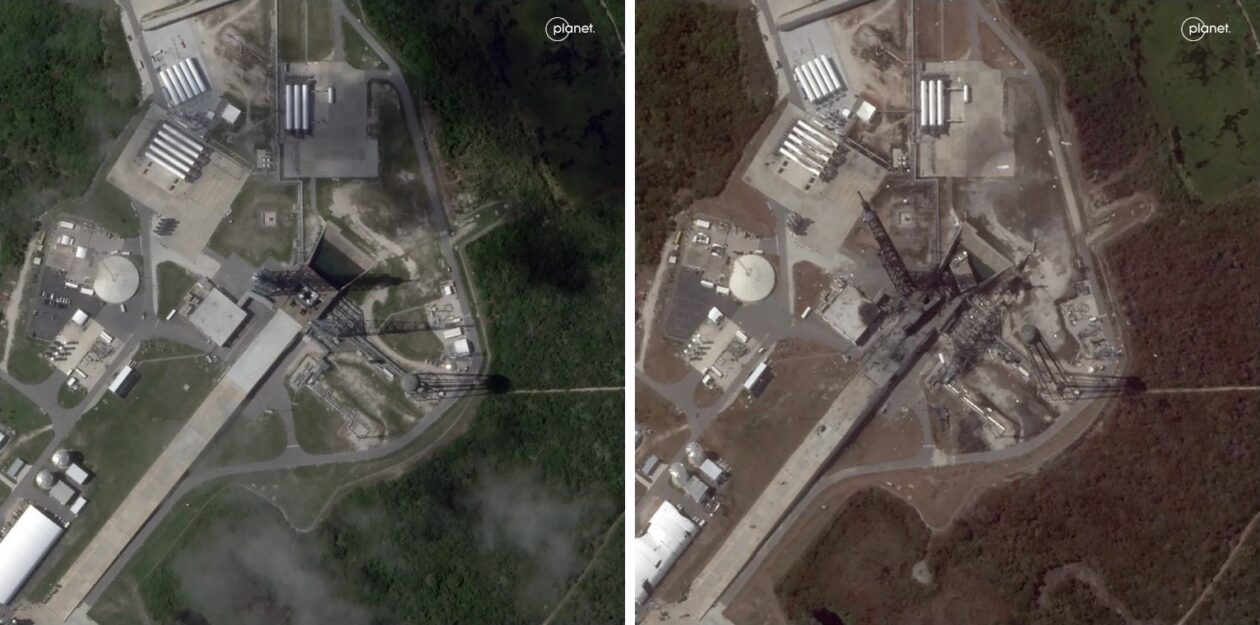
The SkySat satellite image at left shows Blue Origin’s launch pad in Florida on May 20, before the New Glenn rocket explosion. The satellite image at right shows the pad on May 31, three days after the blast. Click on the image for a larger version. (Credit: Planet Labs PBC)

Jeff Bezos’ Blue Origin space venture aims to repair the damage done last week by a launch-pad rocket explosion and return to flight before the end of the year, the company’s CEO says.

In a post to X, CEO Dave Limp laid out a schedule that was more optimistic than what was expected immediately after last Thursday’s fiery destruction of a New Glenn rocket during a static-fire test. CNBC quoted NASA Administrator Jared Isaacman as saying that it would “take some serious time” to restore Launch Complex 36 at Cape Canaveral Space Force Station.

In his post, Limp said he had “a bit of good news” to share after inspecting the pad and the complex’s integration facility.

“The propellant farm, oxygen, liquid hydrogen and LNG tanks are all in good shape. This is good luck because these are very long lead items,” he said. “The water tower is also good. The big support tower is damaged, but it can be repaired in place rather than torn down and replaced. The booster ‘Never Tell Me The Odds’ and the three GS-2s [upper stages] that were onsite in the integration facility also look good.”

Limp said the pad would be rebuilt to accommodate the current 7×2 New Glenn configuration, which offers a 7-meter-wide fairing powered by two BE-3U rocket engines, rather than immediately transitioning to the next-generation configuration with a 9-meter fairing.

Advertisement

“Rate manufacturing of 7×2 is going well, and we’re going to continue that at pace as planned and store the stages for use,” he explained. “In addition, we had already been working for some time on eliminating our transporter-erector in favor of an alternative vertical conop [concept of operations], and we’ll now go directly to that; so we don’t need a new transporter-erector.”

If New Glenn returns to flight this year, that would be relatively good news for NASA and Blue Origin’s other customers. NASA had tapped New Glenn and Blue Origin’s Blue Moon Mark 1 lander to deliver a set of payloads to the moon this fall, and to send the space agency’s VIPER rover to the moon’s south polar region in 2027.

A crew-capable version of the Blue Moon lander was slated to have its first flight test in low Earth orbit as early as next year during NASA’s Artemis 3 mission. And just this month, NASA awarded Blue Origin a contract worth up to $468 million to deliver two lunar terrain vehicles, or LTVs, to the moon in the 2028 time frame. All those opportunities depend on having New Glenn and its launch pad back in operation.

New Glenn also figures prominently in the plans of another company founded by Bezos: Amazon. Blue Origin, a private venture that’s separate from publicly traded Amazon, was due to launch 48 satellites for the Amazon Leo broadband internet constellation as early as this week. The rocket that exploded — nicknamed “No, It’s Necessary” — was being tested in preparation for taking on that task.

Advertisement

Rajeev Badyal, vice president of Amazon Leo, told his team in an internal memo obtained by Business Insider that it was still too early to speculate on the cause of the explosion or its potential effects.

“I’ve been in this business for a long time and it’s worth saying: Spaceflight is hard, and setbacks happen,” he wrote in the memo.

Amazon has reserved scores of launches with other providers, including United Launch Alliance, Arianespace and SpaceX — and the satellites that were earmarked to ride on New Glenn can be shifted to those other companies’ rockets. United Launch Alliance delivered 29 Amazon Leo satellites to orbit with an Atlas 5 launch last Friday, boosting the constellation’s count to 331.

“New Glenn is just one vehicle in our lineup,” Badyal wrote. “Our mission hasn’t changed, our commitment to our customers and delivering service hasn’t changed.”

Advertisement

For an interactive look at Blue Origin’s Launch Complex 36 before and after the New Glenn explosion, check out this presentation of Planet Labs imagery on SpaceFromSpace.com, and be sure to use the “Transparency” slider to compare the before-and-after views.

Source link

Continue Reading

Trending

Copyright © 2025