
Crypto World
Bitcoin Pushes to $80,000 as Trump’s Project Freedom Pressures Oil Prices

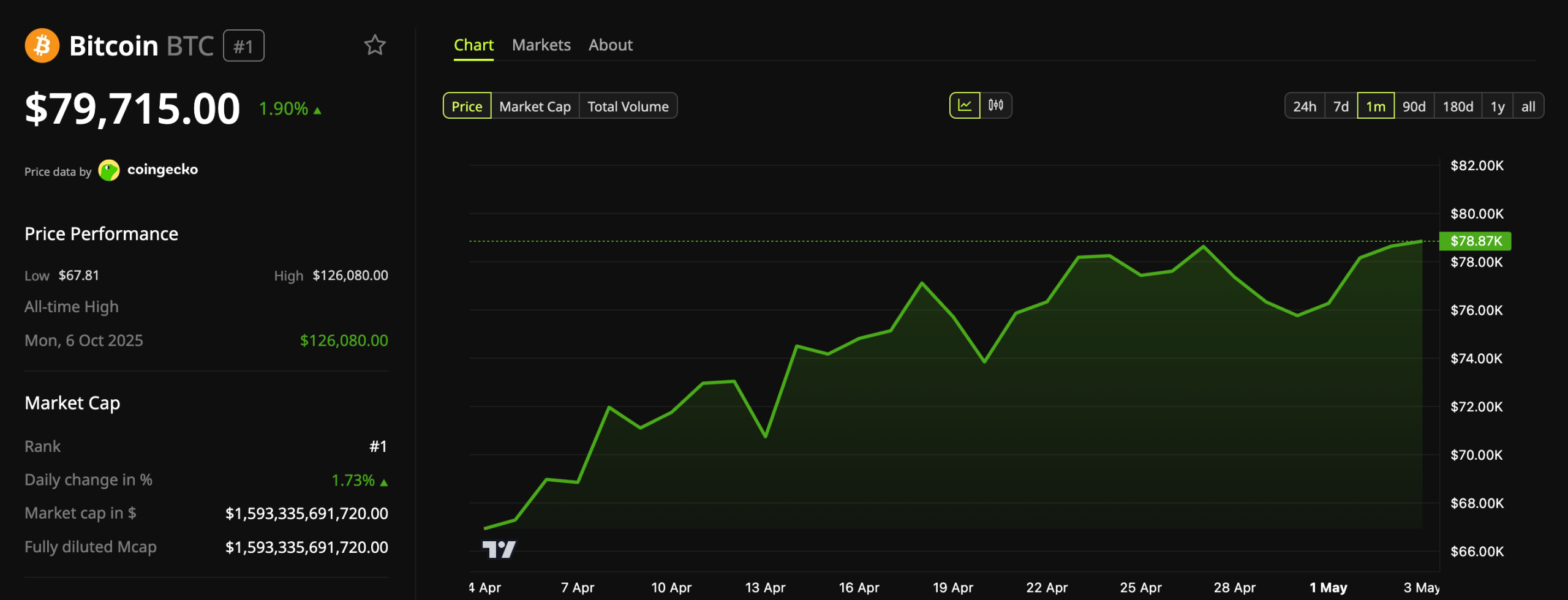
Oil and crypto markets posted contrasting reactions Monday following President Donald Trump’s announcement of Project Freedom.
Crude benchmarks saw modest declines, while the world’s largest cryptocurrency rallied to $80,000 in early Asian trading hours.
Risk Assets Rally on Trump’s Project Freedom
According to market data, Brent crude declined 0.16% to $108 a barrel. West Texas Intermediate (WTI) crude fell 0.29% to $101 at press time.
Bitcoin climbed to $80,000 before settling at $79,715 at the time of writing. The asset was up 1.9% over the past day.

On Sunday, President Trump announced “Project Freedom.” The operation is focused on escorting neutral foreign vessels out of the Strait of Hormuz, where ships have been stranded amid US-Iran tensions.
The project is set to begin Monday morning Middle East time. He framed initiative as a humanitarian gesture. Trump also warned that any interference would be met forcefully.
“Countries from all over the World, almost all of which are not involved in the Middle Eastern dispute going on so visibly, and violently, for all to see, have asked the United States if we could help free up their Ships, which are locked up in the Strait of Hormuz, on something which they have absolutely nothing to do with,” he wrote.
Following Trump’s post, the US Central Command (CENTCOM) confirmed it will deploy guided-missile destroyers, over 100 aircraft, unmanned platforms, and 15,000 service members to support the mission.
“The mission, directed by the President, will support merchant vessels seeking to freely transit through the essential international trade corridor,” the post read.
Follow us on X to get the latest news as it happens
Meanwhile, Trump struck an optimistic note on the diplomatic track, saying his representatives were holding “very positive” discussions with Tehran that could yield a constructive outcome for all sides.
Iran, however, signaled a different view. Ebrahim Azizi, a senior Iranian lawmaker, warned that any US interference in the Strait of Hormuz would be treated as a violation of the existing ceasefire.
“The Strait of Hormuz and the Persian Gulf would not be managed by Trump’s delusional posts! No one would believe Blame Game scenarios!” he said.
All eyes now turn to the operation’s launch and how Iran responds on the ground. Oil prices and risk assets remain highly reactive to these developments.
Thus, any escalation or breakthrough in the Strait of Hormuz could trigger moves across crude, equities, and crypto markets.
Subscribe to our YouTube channel to watch leaders and journalists provide expert insights
The post Bitcoin Pushes to $80,000 as Trump’s Project Freedom Pressures Oil Prices appeared first on BeInCrypto.

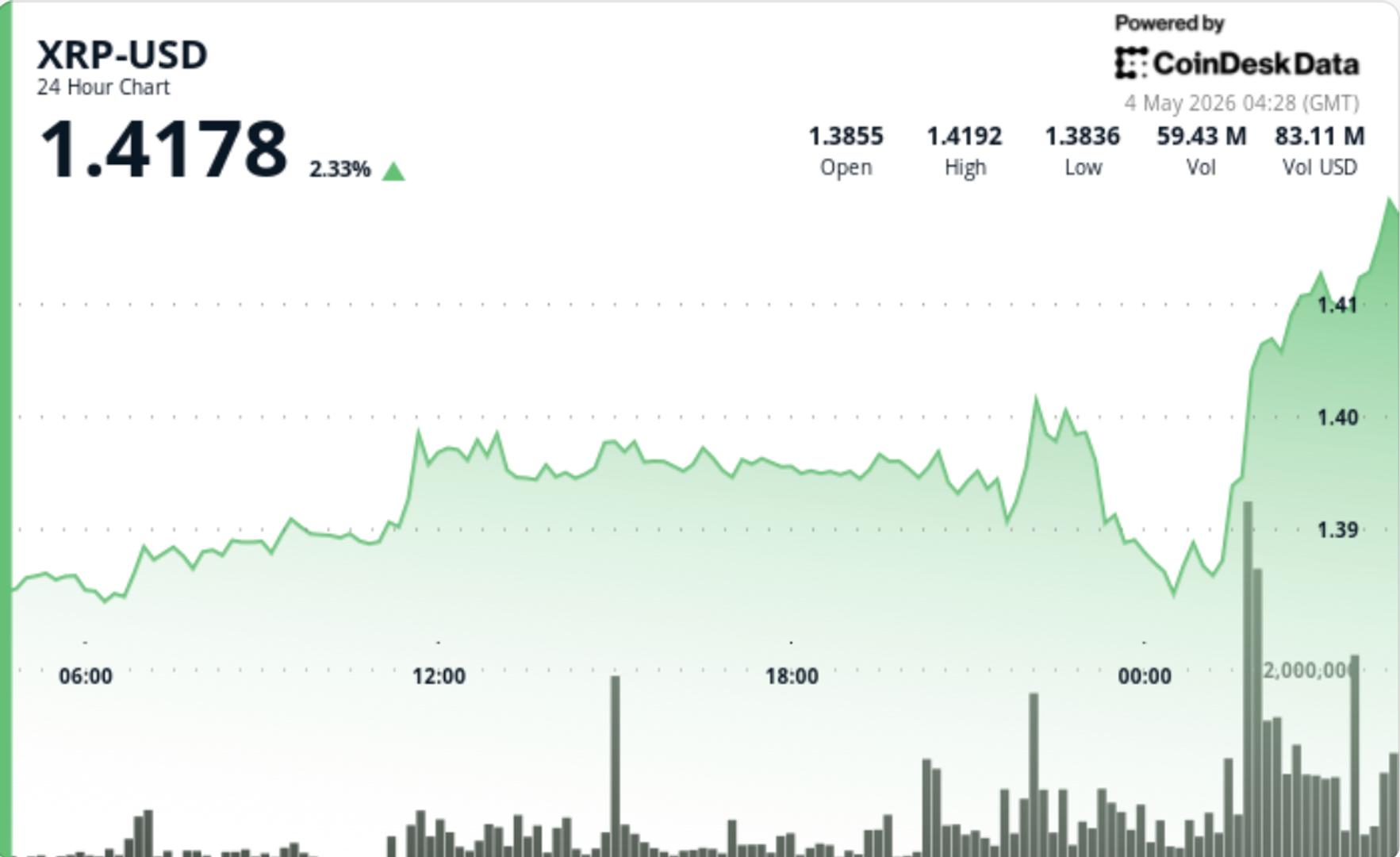
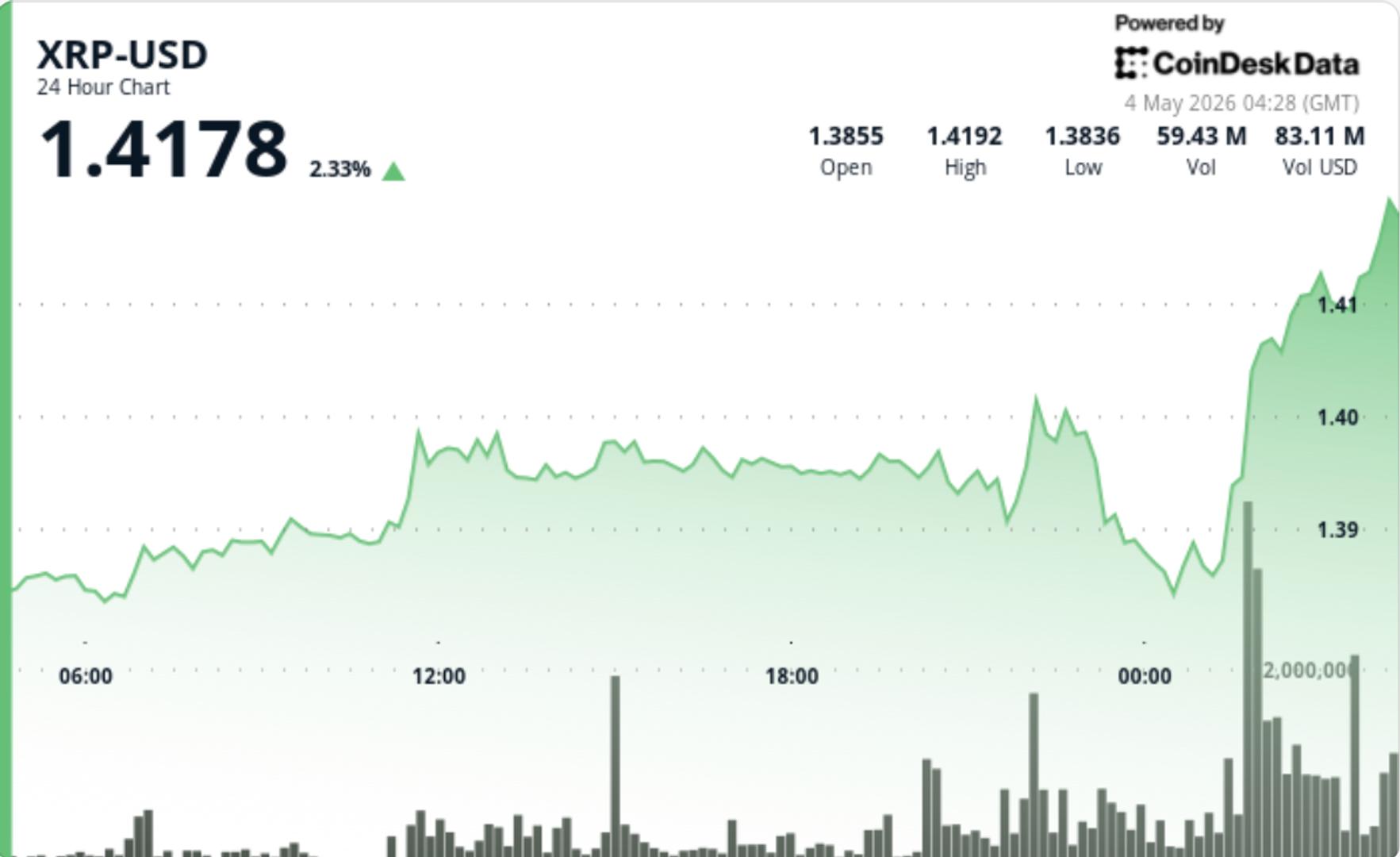
XRP moved back above $1.40 in early Asia hours on broader move in crypto markets, with the push through resistance coming on a sharp pickup in volume that tends to signal real positioning and shifts the focus to whether that level now holds on any pullback.
News Background
• Bitcoin pushed higher during the same window, helping lift broader risk sentiment across crypto markets.
• XRP has been trading in a tight $1.35–$1.45 range, with the latest move marking another attempt to break out of that compression.
Price Action Summary
• XRP climbed from $1.3840 to $1.4065, breaking above resistance near $1.3990.
• The move accelerated during the final hour, with price pushing cleanly through $1.40.
• Price is now holding just above the breakout zone, consolidating near $1.4040–$1.4060.
Technical Analysis
• The key shift is the reclaim of $1.40, which had capped recent upside attempts.
• Volume expanding into the move confirms participation rather than a low-liquidity push.
• Structure shows higher lows into the breakout, suggesting underlying bid strength.
• The broader range remains intact, but pressure is building toward a directional move.
What traders should watch
• $1.40 is now the pivot. Holding above it keeps the breakout intact.
• $1.41–$1.42 is the next resistance zone that needs to clear for continuation.
• A move back below $1.40 would signal the breakout failed and return price to the range.
Crypto World
Veteran trader Peter Brandt sees bitcoin hitting $250,000, but only after a bottom later this year
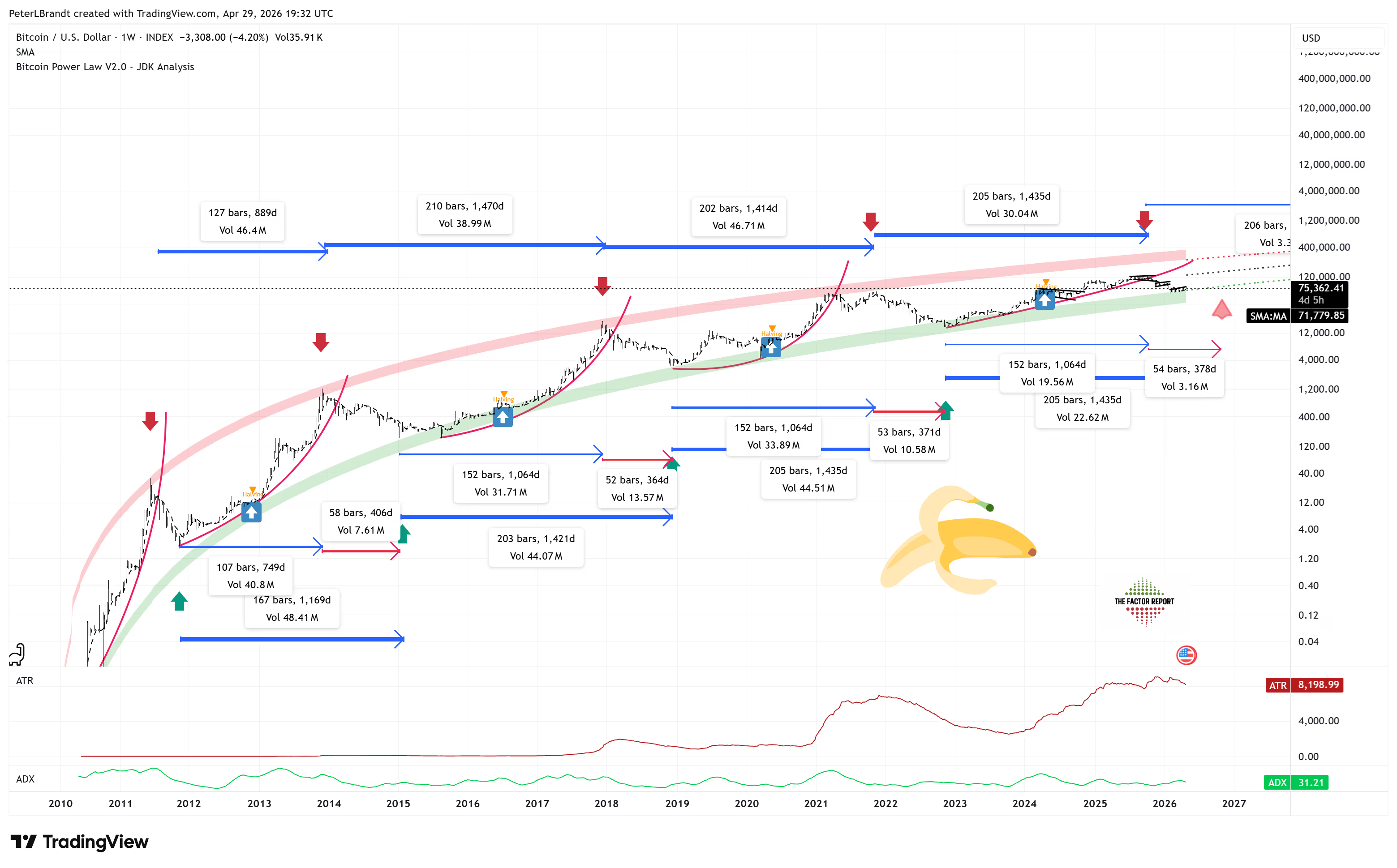
Veteran trader Peter Brandt sees bitcoin rallying to $250,000 in 2029, but only after the market finishes a long drawn-out bottoming process that could last into September 2026.
That forecast makes sense in the context of bitcoin’s four-year mining reward halving cycle, which has been consistent enough to shape traders’ projections.
Historically, bitcoin bull runs have peaked roughly 16 to 18 months after the quadrennial mining reward halving, before sliding into year-long bear markets. New uptrends then tend to begin 12 to 18 months ahead of the next halving.
That pattern held in the most recent cycle, with bitcoin peaking in October 2025, roughly 18 months after the April 2024 halving, which cut the per-block BTC issued as reward to miners to 3.125 from 6.25.
If the cycle holds, the bear market that began then should bottom about a year later, around October 2026 and then a new uptrend should begin that could take top out at $250,000 in late 2029, again roughly 18 months after the April 2028 halving.
“I am not calling for a low until Sep/Oct 2026. It is not necessary for the recent low to be penetrated. We could get a rally and then chop sideways to down. Worst case would be a move back into the lower green banana peel which would be into the 50s, maybe high 40s. Then blast off for $250k and a high in late 2029,” Brandt told CoinDesk in an email.
Peter Brandt is a veteran commodities trader whose career spans nearly five decades, beginning in the 1970s in the futures markets. He started out trading traditional assets such as agricultural commodities, metals, and currencies, long before the rise of modern electronic trading or digital assets.

Brandt’s view contrasts with the consensus among crypto analysts, who argue that the downtrend that began with the October peak near $126,000 ended in early February around $60,000, and that the rally since then marks the start of a new uptrend.
Bitcoin has rallied over 25% to $80,300 since early February, CoinDesk data show.
Note that Brandt’s forecast of no bottom until later this year does not necessarily imply a deeper downtrend that pushes prices below the February low. As he has noted, prices could instead move in a choppy pattern of rallies and pullbacks before eventually forming a bottom.
Brandt, however, stressed that his projection depends entirely on the market continuing to follow its historical rhythm. If price action deviates, he’s prepared to reassess rather than defend a broken thesis.
“As long as the market follows the script I will stay with my projections. If at some point the price discovery moves off script I will be forced to revise all my thinking. I will NOT be dogmatic about it as some are,” he said.
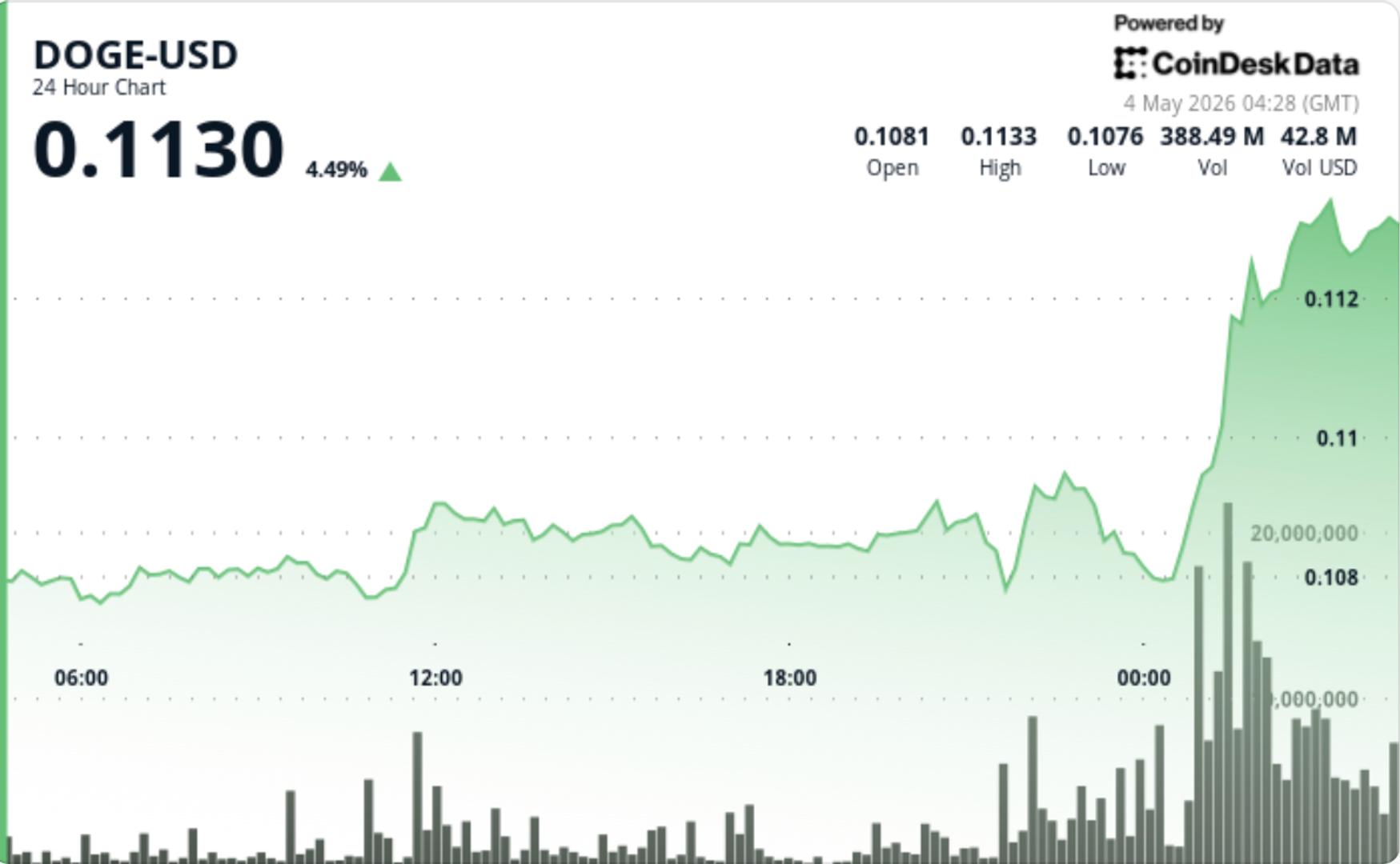
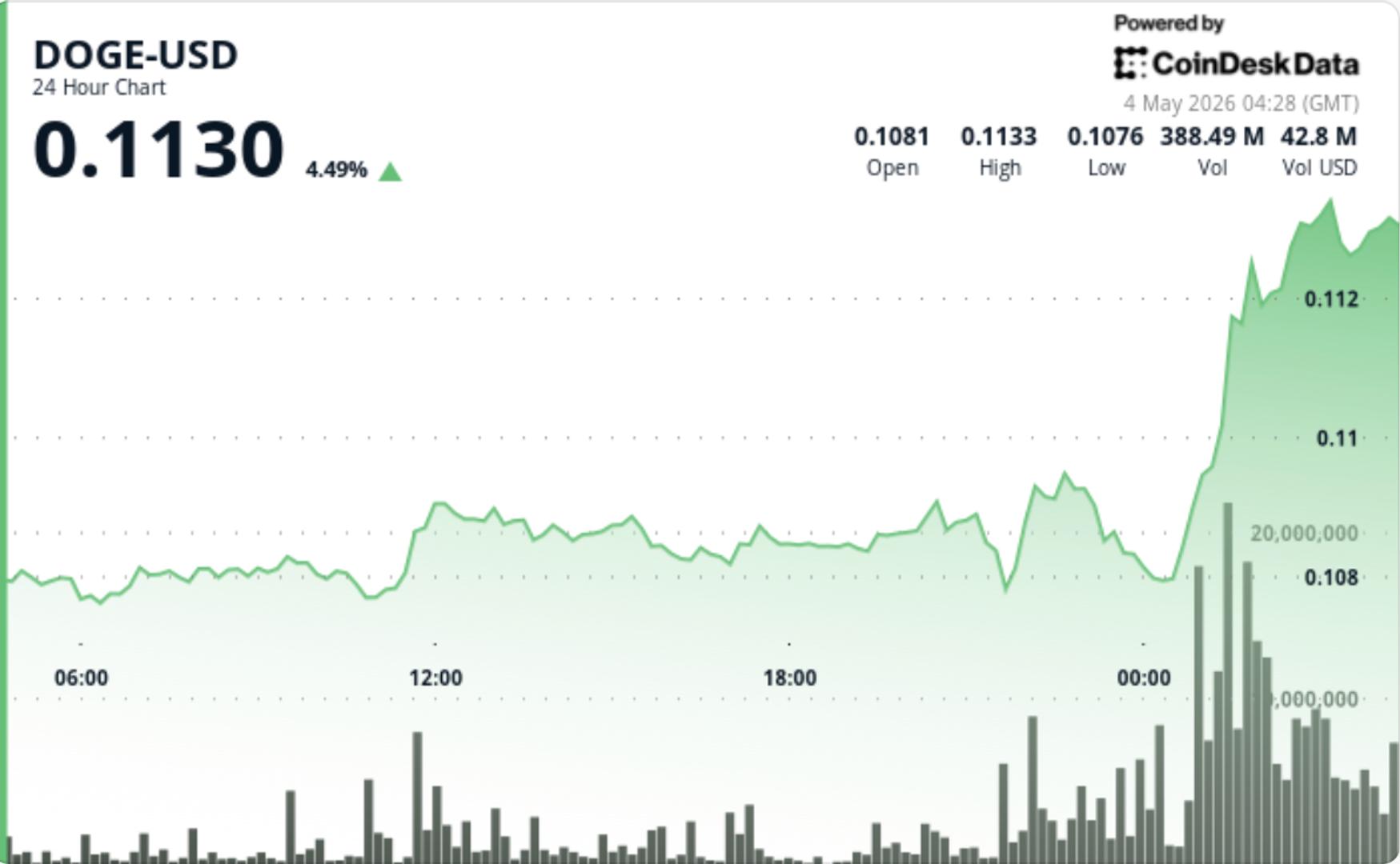
Dogecoin cleared $0.109 in early Asia hours as bitcoin pushed through $80,000, with the break coming on a sharp volume surge that tends to signal real positioning rather than drift, leaving the level likely to act as near-term support if momentum holds.
News Background
• Bitcoin crossed $80,000 during early Asia trading, lifting broader risk appetite and pulling altcoins higher alongside the move.
• DOGE followed the broader market bid, with momentum returning after a quiet stretch of sideways trading.
Price Action Summary
• DOGE climbed from $0.1075 to $0.1119, building higher lows before breaking resistance at $0.109.
• The breakout came in a single high-volume burst rather than a gradual grind higher.
• Price is now holding near $0.111, consolidating just above the breakout zone.
Technical Analysis
• The key shift is the break above $0.109, which had capped price during recent sessions.
• Volume spiking into the move suggests concentrated buying rather than retail drift.
• The structure now depends on whether $0.109 holds as support after the breakout.
• Momentum is strong, but the move is getting stretched with RSI pushing higher and positioning building.
What traders should watch
• $0.109 is the pivot. Holding above it keeps the breakout intact.
• $0.114 is the next resistance level if momentum continues.
• A move back below $0.109 would signal a failed breakout and return to the prior range.


Bitcoin is trading above $80,000 as Asia begins its trading week, a level not seen since the end of January.
Analysts at CryptoQuant say that BTC’s return to $80,000 is being powered by buyers who don’t fully trust it, a dynamic reflected in both positioning data and on-chain signals.
ETF inflows and leveraged longs have driven a steady climb in recent weeks, but the underlying demand picture remains uneven. U.S. spot bitcoin ETFs have pulled in roughly $2.7 billion over the past three weeks, helping lift total net assets above $100 billion and providing a clear source of real-money support.
Elsewhere, market maker FlowDesk reported last week in a Telegram note growing appetite to scale into levered long positions, particularly in majors like ether (ETH) and Near Protocol’s NEAR, reinforcing the idea that fast money is playing a central role in pushing prices higher.
Yet on-chain data suggests the rally is not being broadly confirmed. A CryptoQuant report published April 30 found that bitcoin’s April move was driven “entirely by growth in perpetual futures demand,” while spot demand remained in contraction throughout the rally.
That kind of divergence, where leverage expands but underlying buying does not, has historically been associated with fragile price gains that tend to reverse once positioning unwinds.
Prediction markets tell a similar story. On Polymarket, traders are pricing a 56% chance that bitcoin reaches $85,000 this month, but only a 23% probability of $90,000, suggesting expectations are skewed toward a gradual grind higher rather than a breakout.
Taken together, the signals point to a rally that is extending on flows and leverage, but lacks broad conviction. That does not preclude further upside, but it does mean the move remains sensitive to any slowdown in inflows or shift in positioning, conditions that have historically led to sharp reversals rather than sustained advances.

Hardware wallets are back in focus as self-custody gains momentum
In today’s crypto market, one trend is quietly returning to the spotlight: self-custody.
After years dominated by centralized exchanges and DeFi platforms, more users are rethinking how they store their assets. Events over the past cycles have reinforced a simple idea: controlling your private keys matters.
Bitcoin and Ethereum continue to lead the market, but at the same time, awareness is growing. The phrase “Not your keys, not your coins” is becoming less of a slogan and more of a practical rule.
As a result, hardware wallets are seeing renewed interest.
Tangem’s approach: simplicity over complexity
Among the newer solutions in this space, Tangem has been gaining attention for taking a different approach.
Instead of relying on traditional seed phrases and complex setups, Tangem uses NFC-based cards that allow users to manage their crypto in a much simpler way.
This design removes a major barrier for many users, especially those who want security without dealing with technical friction.
It also reflects a broader shift in the industry, where usability is becoming just as important as security.
A new campaign introduces BTC rewards and over 100 prizes
To support adoption, Tangem has launched a new promotional campaign running from May 5 to June 5, 2026
During this period, users who purchase a wallet through an affiliate link are automatically entered into a prize draw.
The mechanism is straightforward:
- Each wallet purchased equals one entry
- Multiple wallets increase the number of entries
- No additional sign-up is required
The prize pool includes:
- $5,000 in Bitcoin (1 winner)
- 3 iPhone 17 devices
- Tangem Pro Kits and Tangem Rings
- Multiple BTC rewards ranging from $10 to $50
Winners will be announced on July 5, 2026, following a validation period to ensure only completed, non-refunded purchases are included.
Discount stacking adds another incentive
Alongside the prize draw, the campaign also introduces additional purchase incentives.
Users can combine:
- A 10% discount using a promo code
- A 50% discount on the second wallet when purchasing selected bundles
This creates a “stacking” effect:
- Lower overall cost per device
- Higher number of entries in the draw
- Increased value for users planning multiple wallets
It’s a structure designed to boost both engagement and average order size.
A more competitive hardware wallet landscape
The timing of this campaign reflects a broader shift in the hardware wallet sector.
Competition is no longer just about security. Today, it also includes:
- Ease of use
- Setup experience
- Accessibility for non-technical users
- Integration with mobile-first ecosystems
Tangem’s positioning leans heavily into simplicity, which could appeal to a wider audience beyond early adopters.
Affiliate incentives signal a push for growth
At the same time, Tangem has introduced a loyalty-based incentive model for partners and affiliates.
The program rewards cumulative sales with tiered bonuses, encouraging consistent performance over time
Milestones range from smaller entry levels to high-volume tiers, with total potential bonuses exceeding $6,000, paid in USDT
This type of structure suggests a strong focus on scaling distribution through long-term partnerships rather than one-off campaigns.
Why it matters
In a market where trust and security remain critical, campaigns like this combine several key drivers:
- Direct financial incentives
- Gamification through prize draws
- Discounted entry points for new users
For those already considering a hardware wallet, this period may offer additional upside.
How to participate
Users can access the campaign here:
https://www.cryptobreaking.com/go/tangem/
By using the promo code:
CRYPTO
they can unlock a 10% discount, which can be combined with other active offers during the campaign period.
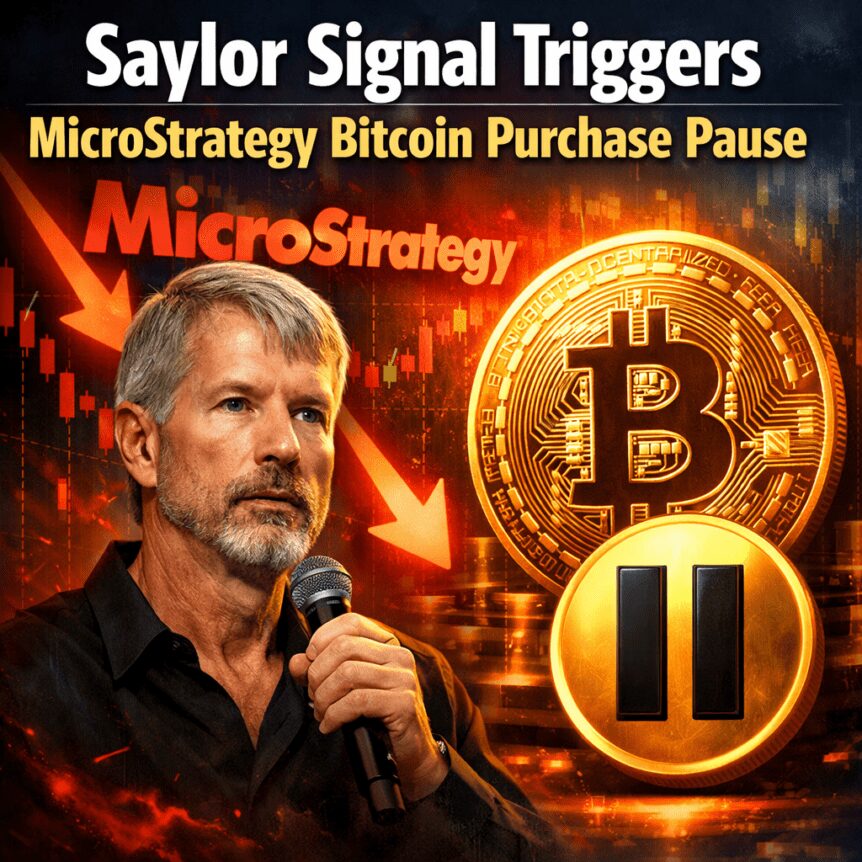
Strategy, the world’s biggest publicly traded holder of Bitcoin, is pausing new crypto purchases ahead of its first-quarter earnings release, set for Tuesday. Executive Chairman Michael Saylor signaled the pause in a post on X, saying “No buys this week.” The move comes as the company prepares to lay out its financials and context for investors who have watched its Bitcoin hoard grow into a central pillar of Strategy’s equity narrative.
The latest disclosed purchase shows Strategy added 3,273 BTC for about $255 million between April 20 and 26, according to an 8-K filed with the U.S. Securities and Exchange Commission on April 27. With these additions, Strategy’s total BTC holdings reach 818,334 coins. The company has reported an average acquisition price of $77,906 per BTC, lifting its cost basis per coin to about $75,537. Bitcoin itself traded around the high $70,000s on the date in question, according to CoinGecko.
Strategy’s buying activity in April, alongside inflows into U.S. spot-price Bitcoin investment products, has been cited by observers as a factor in supporting a roughly 12% rally in Bitcoin during the month. The broader context for investors remains the balance between Strategy’s aggressive accumulation and the market’s sensitivity to macro conditions and regulatory signals.
Key takeaways
- Strategy has paused new Bitcoin purchases ahead of its Q1 earnings release scheduled for Tuesday, signaling a temporary strategic pause.
- As of the latest filing, Strategy holds 818,334 BTC, with 3,273 BTC added in April for about $255 million, pushing total purchases to a substantial base.
- Analysts expect the company to report a per-share loss of about $18.98 for the quarter, largely reflecting mark-to-market Bitcoin accounting on its books.
- The company’s dependence on STRC, its perpetual preferred security yielding about 11.5%, has drawn scrutiny from investors and critics who question dividend sustainability given Bitcoin price volatility.
- Executive Chairman Michael Saylor is due to speak at the Consensus industry conference in Miami Beach on Wednesday, providing a potential market read on Strategy’s strategic outlook.
Q1 earnings preview and STRC dividend scrutiny
Wall Street analysts are banking on a loss for Strategy in the forthcoming quarterly report, with Yahoo Finance data showing an expected loss of $18.98 per share. The figure marks an increase from the year-ago period’s loss of $16.49 per share, underscoring how Strategy’s accounting for Bitcoin can magnify reported results even when cash flows may be more nuanced. The upcoming release will also be watched for commentary on liquidity and the role of Strategy’s Bitcoin reserve in funding corporate obligations.
Beyond the headline numbers, investors have been assessing the risk profile created by STRC, Strategy’s perpetual preferred security. The 11.5% dividend yield on STRC has become a focal point for critics who worry about the long-term ability to sustain the payout, especially if Bitcoin underperforms or if market conditions tighten financing options for the company’s leverage-heavy balance sheet.
On the regulatory and governance front, questions about dividend coverage have surfaced from independent analysts and market commentators. A Seeking Alpha post argued that cash reserves may be insufficient to cover two years’ worth of STRC dividends, implying a potential need to tap Strategy’s common stock or to sell BTC holdings at less favorable prices if Bitcoin strengthens or weakens unpredictably. These concerns contrast with more bullish analyst sentiment observed on some platforms, highlighting divergent views on Strategy’s capital structure and risk management.
In the broader analytics landscape, market observers have noted mixed sentiment. Some analysts maintain a constructive view on Strategy’s asset base and potential for continued Bitcoin appreciation to support earnings, while others caution that leverage and dividend spillovers could complicate the equity story if crypto performance deteriorates. The balance of risks around STRC and BTC price remains a key focal point as investors parse Tuesday’s earnings print and forward guidance.
April purchases and market backdrop
The company’s April activity—most notably the purchase of 3,273 BTC for $255 million—helped lift Strategy’s total Bitcoin reserve to 818,334 coins. The reported average acquisition cost of $77,906 per BTC underscores the scale of Strategy’s commitment to holding a long-term BTC reserve as part of its strategic narrative. The market backdrop during April included notable inflows into U.S. spot BTC products, which collectively contributed to a material month-on-month price uplift for Bitcoin, described by market observers as roughly 12% for the period.
Bitcoin’s price context around the time of Strategy’s April moves placed BTC in the high $70,000s, a level that aligns with continued market interest in institutional exposure to cryptocurrency assets. The price dynamic matters because Strategy’s approach intertwines with investor views on whether Bitcoin can sustain higher price levels, potentially supporting a more favorable long-term value trajectory for the company’s BTC holdings and related performance metrics.
Market watchers also noted the tension between Strategy’s growth strategy and the dividend-oriented appeal of STRC. The dividend yield attracts income-focused investors, but commentary from industry figures has emphasized the need for ongoing coverage and sustainable capital management if Bitcoin liquidity or price action turns adverse. The earnings call and subsequent investor day will be closely watched for any clarifications on capital allocation priorities, debt levels, and plans to manage STRC’s dividend on a go-forward basis.
Investor sentiment and upcoming catalysts
The STRC dividend has become a point of divergence among analysts. While some investors appreciate the income stream and the potential for BTC price appreciation to bolster equity value, others warn that the perpetual preferred structure could constrain Strategy’s flexibility in difficult market environments. Peter Schiff, chief economist at Euro Pacific Asset Management, reiterated criticisms that Strategy’s structure resembles a Ponzi-like model for dividend sustainability, arguing that the Bitcoin upside alone may not resolve structural concerns. Schiff’s comments appeared in a post on X, highlighting ongoing debate about the balance between growth, risk, and income in Strategy’s model.
Meanwhile, Seeking Alpha contributor Joseph Parrish warned that current cash reserves may be insufficient to cover two years of STRC dividends, implying that continued issuance of new equity and potential BTC sales could be necessary under certain scenarios. Parrish’s perspective contrasts with other voices that remain more optimistic about Strategy’s leverage and long-term Bitcoin strategy. Market data platform TipRanks shows a mixed view, with a segment of analysts rating Strategy as a strong buy, underscoring how opinion is split on the stock’s risk-reward profile given BTC exposure and dividend dynamics.
As Strategy gears up for its earnings release, the focus will turn to how the company balances BTC exposure with earnings quality, liquidity, and the ability to sustain STRC payouts in a range of Bitcoin price environments. On Wednesday, Saylor is slated to speak at the Consensus industry conference in Miami Beach, a venue where executives often lay out strategic priorities and commentary that can influence investor sentiment in the near term.
In sum, the April accumulation, the looming Q1 print, and the ongoing STRC dividend debate collectively frame a nuanced outlook for Strategy. The questions at hand center on how much longer the company will accelerate Bitcoin accumulation, how it plans to manage capital structure amid price volatility, and what signals come from leadership on the sustainability of its high-yield dividend in a shifting crypto and macro regime.
Readers should watch Tuesday’s earnings release for direct color on profitability under mark-to-market accounting, guidance on BTC exposure, and any updates on STRC dividend coverage. The market will also be listening for any clarification on debt levels and capital allocation plans that could shape Strategy’s risk profile in the months ahead.
What remains uncertain is how Strategy will navigate the balance between its aggressive Bitcoin stance and the need to deliver a stable, income-bearing equity story for shareholders, especially if Bitcoin’s price action proves to be more volatile than anticipated in the near term. The next few quarters should reveal whether the current strategy can translate into durable value for investors or if the market will demand a recalibration of risk and payout expectations.

Introduction
Modern Web3 security has a blind spot that most users still underestimate: transaction approval does not end risk—it begins it.
Every day, wallets authorize smart contracts with persistent permissions. Yet once those approvals are granted, there is often no active system monitoring what those contracts do afterward. This gap has contributed to some of the largest losses in the history of decentralized finance.
In April 2026 alone, over $600M was stolen across more than 12 protocols, including major incidents such as Drift (~$285M), Kelp DAO (~$292M), and Rhea Finance (~$18.4M). In each case, the common failure pattern was not initial access, but unmonitored approvals exploited after the fact.
Cerberus is designed to address this structural weakness with a three-layer autonomous defense system that protects wallets before, during, and after transactions.
The Core Problem: Approvals Are Permanent, But Threats Are Dynamic
When users approve a smart contract, they often assume the risk is tied to that single interaction. In reality, approvals can remain active indefinitely, allowing contracts to execute future actions without additional user consent.
The issue is compounded by:
- Exploits triggered long after initial approval
- Malicious contract upgrades after deployment
- Hidden permission abuse in otherwise “normal” swaps
- Delayed detection of protocol compromises
Most security tools only respond after funds are already gone. Cerberus takes a different approach: continuous, autonomous intervention.
Introducing Cerberus
Cerberus is an AI-driven wallet protection network composed of three autonomous agents:
- Shield Agent (real-time defense layer)
- Sentinel Agent (pre-execution simulation layer)
- Recovery Agent (active breach interception layer)
Together, they form a lifecycle-based security system that reacts across the entire transaction timeline instead of only at signature time.
Shield Agent: Real-Time Approval Monitoring
The Shield Agent operates as the continuous monitoring layer of Cerberus.
Key Functions:
- Tracks every active wallet approval in real time
- Detects when a protocol becomes compromised or exploited
- Automatically revokes risky approvals within the same block
- Neutralizes exposure before attackers can scale extraction
Unlike traditional wallet security tools that notify users after an exploit is discovered, Shield acts within the transaction environment itself, minimizing reaction delay to near-zero.
Its core advantage is speed: when protocols break, users are no longer waiting for alerts—they are already protected.
Sentinel Agent: Pre-Execution Simulation Layer
The Sentinel Agent focuses on preventing malicious transactions before they are signed.
Key Functions:
- Simulates transactions before execution
- Detects phishing contracts, rug pulls, and honeypot structures
- Identifies hidden malicious approvals embedded in normal-looking swaps
- Provides risk classification before user confirmation
This layer functions as Cerberus’ predictive intelligence system. Instead of analyzing outcomes after execution, it reconstructs intent and behavior in advance.
It is particularly effective against:
- Deceptive DeFi interfaces
- Obfuscated contract logic
- Social engineering-based token traps
In short, Sentinel does not trust transactions—it interrogates them.
Recovery Agent: Active Threat Interception
The Recovery Agent is the final defense layer, designed for worst-case scenarios where exploitation is already in progress.
Key Functions:
- Detects live wallet draining activity
- Competes with attackers using MEV infrastructure (e.g., Flashbots-style execution paths)
- Attempts rapid asset relocation before drain completion
- Acts as a last-resort mitigation system
This layer acknowledges a harsh reality of Web3 security: prevention is not always enough. When breaches occur, timing becomes everything.
Recovery Agent is designed to operate in that narrow window where funds are still movable but under active attack.
Multi-Chain Coverage
Cerberus is built for cross-ecosystem deployment across major blockchain environments, including:
- Ethereum
- Base
- Arbitrum
- Polygon
- Solana
- BNB Smart Chain
This multi-chain design ensures protection is not isolated to a single ecosystem, reflecting the reality of modern wallet usage across fragmented networks.
$CERB Token Utility
The upcoming $CERB token is intended to power the Cerberus security network.
While full token mechanics are not yet finalized, its role is expected to align with:
- Network security incentives
- Agent coordination and execution fees
- Governance over risk models and detection parameters
- Potential staking-based access or prioritization mechanisms
In practice, $CERB functions as the coordination layer for a distributed security intelligence system.
Conclusion
Cerberus is not positioned as another notification-based wallet tool. It is designed as an autonomous, multi-layer defense architecture that assumes one critical truth:
In Web3, waiting for alerts is already too late.
By combining real-time monitoring, pre-execution simulation, and active recovery interception, Cerberus aims to shift wallet security from reactive awareness to continuous autonomous protection.
If successful, it represents a broader evolution in crypto security: from static safeguards to self-defending financial agents operating at transaction speed.
Cerberus Socials:
REQUEST AN ARTICLE
Crypto World
XRP Price Prediction Targets $1.80 Breakout as Ripple Las Vegas Frames XRP as Reserve Currency, Pepeto Crosses $9.77M
The XRP price prediction conversation just received its strongest tailwind of the year, with Ripple opening its biggest XRP Las Vegas event ever and Yellow Network’s Steven Zeiler framing XRP as a future global reserve asset, per CoinMarketCap. Ripple-backed firm Evernorth named OpenAI CFO Robert Kaiden to its board, sliding $1 billion and 473 million XRP behind a planned Nasdaq listing.
While the XRP price prediction firms up at $1.38, the cycle’s smaller-cap play is at $0.0000001868. Pepeto presale just crossed $9.77 million raised, and the case for why this entry could deliver returns XRP cannot reach follows.
CoinMarketCap confirmed XRP Las Vegas opened May 1 with Ripple’s largest ever marketing campaign, billboards across the Strip, and a panel arguing for XRP’s path beyond payments. Evernorth’s filing names Robert Kaiden as independent director, locking AI governance into XRP treasury operations.
Both signals are bullish for sentiment but capped on size. XRP carries an $85 billion market cap, which translates institutional validation into modest percentage gains, not the multiplier returns early cycle wallets are hunting.
Top Cryptocurrencies Worth Positioning Before the Recovery Phase
Pepeto (PEPETO) at $0.0000001868 With $9.77M Raised and Binance Listing Closing In
While XRP traders track a $1.45 swing, Pepeto opens a return corridor of an entirely different scale. The presale price sits at $0.0000001868, the project just crossed $9.77 million raised, and that capital backs a SolidProof audit, the cofounder who took Pepe to $11 billion, and a former Binance executive driving the listing path.
One housekeeping note before going deeper. With the project picking up speed, the original Pepeto.io domain has come under sustained copycat and phishing attack, so the team has activated a new Pepeto official website for direct presale access. Bookmark that link and ignore anything else.
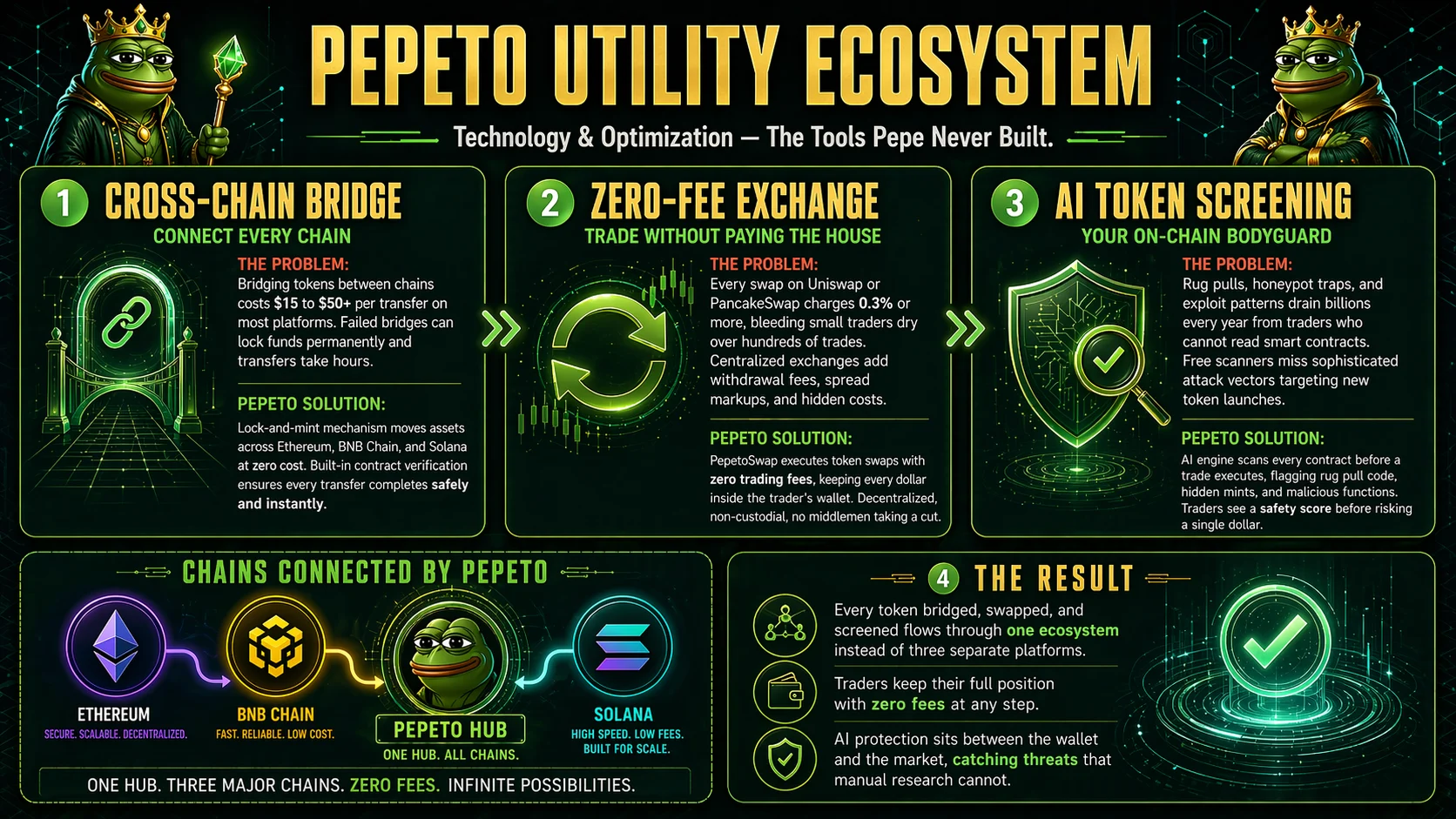
PepetoSwap handles zero-fee meme coin trades across Ethereum, BNB Chain and Solana, the bridge moves tokens at no cost, and the contract risk scanner flags scam designs before any capital leaves the wallet. Staking compounds at 176% APY, locking in $17,600 a year on a $10,000 entry. The 100x to 300x math depends on the market valuing this token at a fraction of what Pepe achieved on the same supply.
XRP Price Prediction: Reserve Currency Push Lifts Sentiment but Multiples Stay Capped
XRP trades near $1.38 according to CoinMarketCap, with the May 1 Las Vegas spike stalling at $1.45 resistance. Bitget targets $1.80 on a daily close above $1.45, and Standard Chartered places its 2026 ceiling at $2.80.
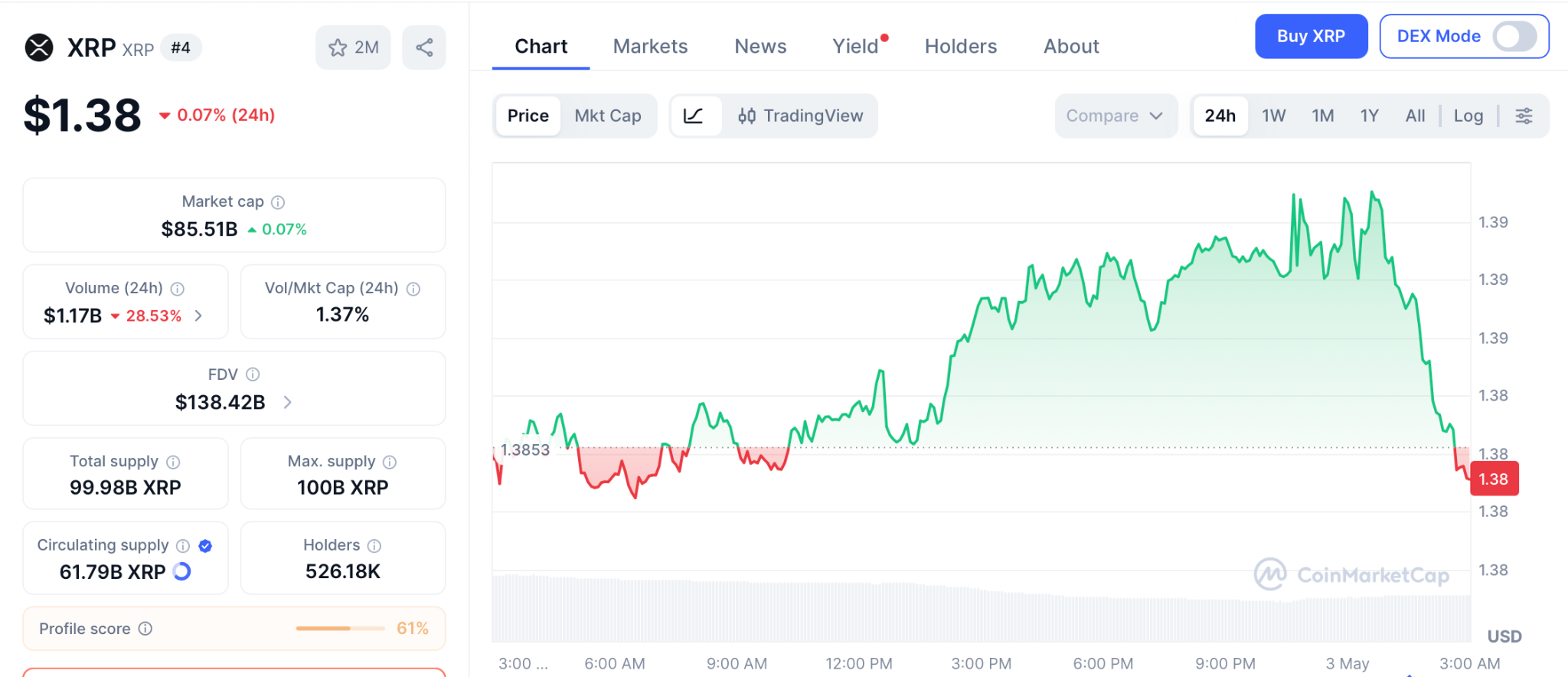
Even the most aggressive XRP price prediction caps the upside at roughly 2x while the CLARITY Act markup waits for May 11. The thesis keeps strengthening, but $1,000 in XRP buys 724 tokens whose ceiling sits inside the same $85 billion cap.
Solana (SOL) Holds $83.74 as Tokenized Asset Volume Triples Across the Network
Solana (SOL) traded at $83.74 on May 1 per The Block, gaining 1% on the day and 12% on the month. CoinGecko’s Q1 report shows tokenized assets tripling to $19.3 billion since 2025, with BlackRock BUIDL, Apollo’s ACRED, and Visa’s stablecoin layer hosted on Solana.
Resistance sits at $90 and a clean break opens $115. Yet a recovery to $140 prints only a 67% spread across 2026.
Conclusion
Ripple keeps trading every week regardless of where the XRP price prediction settles. The Pepeto presale window will close. Las Vegas lifted XRP toward $1.45 resistance and Evernorth’s Nasdaq listing is locked in the calendar, yet those signals only prove the explosive multiplier window on XRP shut cycles ago. A $1,000 XRP position buys 724 tokens with at best 2x left from $1.38, while the same $1,000 in Pepeto picks up 5.35 billion tokens chasing $140,000 at a fraction of Pepe’s all-time high market cap.
Crypto cycles end the same way every time, and the path forward splits in two from here. On one road, an investor commits to Pepeto before the window closes and sees the portfolio transform the moment Binance opens the order book. On the other, another saw Pepeto at the same time but waited for one more signal, the same way the early Shiba Inu skeptics did, and carried that regret through every bull run that followed. The presale is still live, but the demand could close that window within days. That call gets made on the Pepeto official website.
Click To Visit Pepeto Website To Enter The Presale

FAQs
What does the XRP price prediction look like after Ripple’s Las Vegas reserve currency push?
The XRP price prediction targets $1.80 on a clean daily close above $1.45 per Bitget, with Standard Chartered placing the 2026 ceiling at $2.80. XRP’s $85 billion cap delivers percentage gains, while Pepeto presale at $0.0000001868 targets multiplier returns once Binance opens the order book.
Why is Pepeto called the strongest presale of 2026?
Pepeto is the strongest presale of 2026 because it ships a working zero-fee exchange, a SolidProof audit, the cofounder behind Pepe, and a confirmed Binance listing path priced at $0.0000001868. The project just crossed $9.77 million raised at 176% APY, and the Pepeto official website is now the verified entry point.
Disclaimer: This is a Press Release provided by a third party who is responsible for the content. Please conduct your own research before taking any action based on the content.


Strategy Executive Chairman Michael Saylor has signaled a pause on new Bitcoin purchases as Strategy (the world’s largest publicly traded Bitcoin holder) gears up for its Q1 earnings release. In a post on X, Saylor wrote that there would be “No buys this week,” mirroring a step back from the company’s recent cadence of capital deployment. The latest on-chain activity shows Strategy adding 3,273 BTC for $255 million between April 20 and 26, according to an 8-K filing with the U.S. Securities and Exchange Commission on April 27. Analysts, meanwhile, are bracing for a downside surprise in the quarter, with Tuesday’s report expected to show an $18.98 per-share loss, driven in part by mark-to-market Bitcoin accounting. That figure would widen from the prior year’s $16.49-per-share loss.
Source: Michael Saylor on X
Key takeaways
- Strategy pauses new Bitcoin purchases ahead of its Q1 earnings release, signaling a shift in timing even as the company continues to hold a large BTC stake.
- The firm’s most recent buy added 3,273 BTC for $255 million between April 20–26, per an 8-K filed with the SEC on April 27.
- Analysts expect Strategy’s Q1 results to show a loss of about $18.98 per share, pressured by BTC-related accounting, compared to a $16.49 loss in the year-ago period.
- A Politico-commissioned public poll conducted by Public First shows broad skepticism toward both crypto and AI among Americans, with significant appetite for tighter regulation of the AI sector.
- The Ethereum Foundation continued its OTC program with BitMine Immersion Technologies, selling another 10,000 ETH at an average of $2,292 (roughly $22.9 million), while unstaking 17,035 ETH last week as it scales back a 70,000-ETH staking target.
Strategy’s pause and earnings backdrop
The decision to pause purchases comes as Strategy prepares to disclose quarterly results that are anticipated to reflect ongoing BTC mark-to-market accounting. The company’s stake in Bitcoin remains its cornerstone asset and a core driver of its cash-flow narrative, but the timing of new buys appears calibrated to the broader risk environment and internal liquidity considerations. The most recent purchase—an accumulation of 3,273 BTC for $255 million during a single week—underscores that Strategy remains a significant, though potentially more conservative, participant in the Bitcoin market.
Beyond the numbers, the looming earnings show the market weighing the impact of Bitcoin accounting rules on reported results. The Street’s consensus points to an earnings-per-share loss well above breakeven, highlighting how non-operational factors tied to BTC valuations can dominate near-term financials for a company that has built its identity around a big Bitcoin balance sheet.
Voter sentiment on crypto and AI in the new political landscape
Separately, a Politico report based on a Public First poll conducted April 11–14 across 2,035 U.S. adults online paints a skeptical public sentiment about crypto and AI, even as both sectors channel substantial political spending. The survey found that 45% of respondents believe investing in cryptocurrency is not worth the risk, while 44% think AI is developing too quickly. The study also noted a preference for traditional banks over crypto platforms and a strong appetite—about two-thirds—for Congress to pursue tighter AI oversight and regulation.
These attitudes ripple into electoral dynamics, as respondents indicated they would favor candidates backed by groups advocating stricter tech regulation over those aligned with looser approaches. The poll’s authors cautioned that rising skepticism could translate into voter backlash if industry-driven political spending intensifies without clear progress on consumer protections and oversight.
In context, the findings suggest a challenging environment for political campaigns that rely on fundraising from crypto and AI industry-aligned super PACs, even as voters express concerns about risk and governance. The questions raised by the poll illuminate a broader tension between innovation and regulation that could influence policy debates as midterm cycles approach.
Ethereum Foundation’s ongoing sales and what it signals for ETH holders
The Ethereum Foundation conducted another over-the-counter sale to BitMine Immersion Technologies, moving 10,000 ETH at an average price of $2,292 per ETH (roughly $22.9 million). The Foundation stated that the proceeds would support its core operations, including protocol research and development, ecosystem initiatives, and community grants. This sale follows a nearly identical transaction of 10,000 ETH completed one week earlier at $2,387 per ETH, and comes after the Foundation’s March sale of 5,000 ETH at around $2,043 per coin. Together, the Foundation has sold about $47 million worth of ETH to BitMine in the past week alone.
In a separate development, the Foundation unstaked 17,035 ETH last week, worth approximately $40 million at current prices. The move appears to align with a broader shift away from a prior goal of staking 70,000 ETH, hinting at a re-prioritization of liquidity and governance considerations as the ecosystem matures.
Source: Ethereum Foundation posts and OTC disclosures
Implications for markets and investors
Taken together, these separate threads—Strategy’s cautious buying stance ahead of earnings, public skepticism toward crypto and AI, and the Ethereum Foundation’s ongoing monetization and staking adjustments—underscore a market that remains sensitive to both macro sentiment and on-chain fundamentals. The Strategy pause reduces near-term BTC demand from one of the largest corporate buyers, potentially softening price support in the absence of fresh inflows. Meanwhile, the ETH-related sales inject liquidity into the market and may exert downward pressure on price in the near term, even as the Foundation frames these moves as essential to funding core activities and ecosystem development.
For investors, the key takeaway is the need to watch how policy conversations evolve—and how market participants balance the hype around technological breakthroughs with the realities of risk management and regulatory scrutiny. The combination of corporate treasury behavior, public sentiment, and foundational liquidity moves creates a complex backdrop for crypto assets as they navigate an environment defined by ongoing oversight and evolving adoption.
Readers should monitor Strategy’s upcoming Q1 earnings guidance for any clarifications on capital allocation and BTC exposure, as well as policy developments that may shape investor confidence in crypto and AI sectors. The outcomes in the weeks ahead will help determine whether the current cautious stance advances into a broader retrenchment or gives way to renewed appetite as regulations and market infrastructure mature.
Morgan Stanley expects bitcoin to reach U.S. bank balance sheets, though key hurdles remain, according to Amy Oldenburg, the bank’s head of digital asset strategy.
Speaking at the Bitcoin Conference in Las Vegas, Oldenburg, who was appointed new head of digital-asset strategy this year, outlined how the firm is laying the groundwork for the expansion of its digital asset business as client demand builds.
“It’s been many years that we’ve been involved in the broader digital asset space the regulatory environment has been more supportive for us doing that”, Oldenburg said.
Oldenburg, who will be speaking at CoinDesk’s Consensus Miami conference this week, also said that U.S. banks may eventually hold bitcoin on their own balance sheets. However, she pointed to several barriers, such as the Federal Reserve, Basel rules and the need for multiple global regulators, before a bank of Morgan Stanley’s scale could start putting bitcoin on its balance sheet.
This isn’t the first time a banking giant has said that banks will eventually push further into the digital asset sector. BNY CEO Robin Vince said in March that large financial institutions will drive the next phase of crypto adoption by serving as a bridge between traditional finance and digital assets. Although the banks first need regulatory clarity before going all-in on the sector.
However, Morgan Stanley isn’t standing still and has already started its push into the digital asset space, Oldenburg said. The banking giant recently launched MSBT, a bitcoin-backed exchange-traded product and the first of its kind from a U.S.-chartered bank. The product drew more than $100 million in its first six days of trading.
What made those inflows particularly striking is that they came entirely from self-directed clients, Morgan Stanley’s own financial advisors hadn’t even begun offering the product yet, Oldenburg said.
“All of that was self-directed, it was not even available in advisory on the wealth platform,” she said. This dynamic shows that there is significant demand for such products from clients.
Oldenburg said that there is a significant gap between what the advisors are offering clients and where demand lies. While Morgan Stanley recommends 2%-4% bitcoin allocation to clients, the slow adoption among advisors is due to an education problem, Oldenburg said. She also noted that 80% of ETP exposure on the wealth platform is self-directed and that the bank has launched internal training programs to bring financial advisors up to speed.
The appetite for regulated bitcoin exposure is well established, BlackRock’s IBIT has amassed over $61 billion in assets, becoming the fastest-growing ETF in history since launching in January 2024.
Additionally, Oldenburg said that Morgan Stanley is pursuing an OCC digital trust charter, which would allow the bank to custody crypto directly and offer spot crypto trading on its wealth platform. The MSBT product itself uses Coinbase and BNY Mellon as dual custodians.
Read more: Wall Street’s crypto push has been years in the making, says Morgan Stanley

Apple: Wait For A Drop

What next as Ripple-linked token breaks above $1.40

Duece Jones-Drew, son of MJD, commits to UCLA

Manchester United reach agreement with Casemiro over contract clause amid transfer speculation

US brings back mandatory military draft registration

Steven Gerrard disagrees with Gary Neville over ‘shock’ Chelsea and Arsenal claim | Football

Financial Instruments Revision | All Concepts + Imp Ques | CA Final FR Revision | CA Aakash Kandoi

Adrien Broner now asking for money and financial assistance just to secure and afford uber ride

Raoul Pal: This Is Why Crypto Hasn’t Moved Yet (IMPORTANT UPDATE)
-

 Tech6 days ago
Register Renaming | Hackaday
-

 Politics6 days ago
Drax board avoid their own AGM, accused of greenwashing & environmental racism
-

 Fashion5 days ago
Kylie Jenner’s KHY Enters a New Era with ‘Born in LA’
-

 Tech7 days ago
Why Blue Badges Disappeared From Toyota Hybrids
-

 Tech6 days ago
Images of Samsung’s rumored smart glasses have leaked
-
 Tech2 days ago
Trump’s 25% EU auto tariff breaches Turnberry Agreement that also covers semiconductors and digital trade
-

 NewsBeat11 hours ago
Channel 5 – All Creatures Great and Small series 7 new post
-

 Business5 days ago
Most Commercial Energy Audits Miss the Real Losses
-

 Business7 days ago
(VIDEO) Charlize Theron Climbs Times Square Billboard to Promote New Netflix Thriller ‘Apex’
-

 Crypto World6 days ago
CFTC’s AI will review U.S. crypto registration applications, chairman tells CoinDesk
-
 Sports2 days ago
Paul Scholes issues Marcus Rashford reality check as agreement emerges over Man United star
-

 Business5 days ago
Barclay Brothers Avoid Bankruptcy: HSBC Drops High Court Petitions After IVA Deal
-
 Entertainment7 days ago
Alicia Keys Calls Out Music Industry ‘Boys Club’
-
 Business4 days ago
Tesla Officially Registers Elon Musk’s Stock: What Investors Need to Know
-

 Tech6 days ago
Get Ready for More Brain-Scanning Consumer Gadgets
-
 Crypto World6 days ago
Robinhood Phishing Scam Exploits Gmail Dot Feature to Bypass Security
-

 Entertainment6 days ago
Sister Wives: Janelle Posts New Scary Warning
-

 Crypto World6 days ago
Gmail Dot Trick Underpins Robinhood Phishing, Sending Real-Looking Emails
-

 Business3 days ago
Two Powerball Tickets Split $143 Million Jackpot in Indiana and Kansas
-

 Tech7 days ago
The next iPhone moment might come from an AI company, not Samsung or Apple
You must be logged in to post a comment Login