

Crypto World
Strategy Triggers Brief Pause in Bitcoin Buying


Strategy Executive Chairman Michael Saylor has signaled a pause on new Bitcoin purchases as Strategy (the world’s largest publicly traded Bitcoin holder) gears up for its Q1 earnings release. In a post on X, Saylor wrote that there would be “No buys this week,” mirroring a step back from the company’s recent cadence of capital deployment. The latest on-chain activity shows Strategy adding 3,273 BTC for $255 million between April 20 and 26, according to an 8-K filing with the U.S. Securities and Exchange Commission on April 27. Analysts, meanwhile, are bracing for a downside surprise in the quarter, with Tuesday’s report expected to show an $18.98 per-share loss, driven in part by mark-to-market Bitcoin accounting. That figure would widen from the prior year’s $16.49-per-share loss.
Source: Michael Saylor on X
Key takeaways
- Strategy pauses new Bitcoin purchases ahead of its Q1 earnings release, signaling a shift in timing even as the company continues to hold a large BTC stake.
- The firm’s most recent buy added 3,273 BTC for $255 million between April 20–26, per an 8-K filed with the SEC on April 27.
- Analysts expect Strategy’s Q1 results to show a loss of about $18.98 per share, pressured by BTC-related accounting, compared to a $16.49 loss in the year-ago period.
- A Politico-commissioned public poll conducted by Public First shows broad skepticism toward both crypto and AI among Americans, with significant appetite for tighter regulation of the AI sector.
- The Ethereum Foundation continued its OTC program with BitMine Immersion Technologies, selling another 10,000 ETH at an average of $2,292 (roughly $22.9 million), while unstaking 17,035 ETH last week as it scales back a 70,000-ETH staking target.
Strategy’s pause and earnings backdrop
The decision to pause purchases comes as Strategy prepares to disclose quarterly results that are anticipated to reflect ongoing BTC mark-to-market accounting. The company’s stake in Bitcoin remains its cornerstone asset and a core driver of its cash-flow narrative, but the timing of new buys appears calibrated to the broader risk environment and internal liquidity considerations. The most recent purchase—an accumulation of 3,273 BTC for $255 million during a single week—underscores that Strategy remains a significant, though potentially more conservative, participant in the Bitcoin market.
Beyond the numbers, the looming earnings show the market weighing the impact of Bitcoin accounting rules on reported results. The Street’s consensus points to an earnings-per-share loss well above breakeven, highlighting how non-operational factors tied to BTC valuations can dominate near-term financials for a company that has built its identity around a big Bitcoin balance sheet.
Voter sentiment on crypto and AI in the new political landscape
Separately, a Politico report based on a Public First poll conducted April 11–14 across 2,035 U.S. adults online paints a skeptical public sentiment about crypto and AI, even as both sectors channel substantial political spending. The survey found that 45% of respondents believe investing in cryptocurrency is not worth the risk, while 44% think AI is developing too quickly. The study also noted a preference for traditional banks over crypto platforms and a strong appetite—about two-thirds—for Congress to pursue tighter AI oversight and regulation.
These attitudes ripple into electoral dynamics, as respondents indicated they would favor candidates backed by groups advocating stricter tech regulation over those aligned with looser approaches. The poll’s authors cautioned that rising skepticism could translate into voter backlash if industry-driven political spending intensifies without clear progress on consumer protections and oversight.
In context, the findings suggest a challenging environment for political campaigns that rely on fundraising from crypto and AI industry-aligned super PACs, even as voters express concerns about risk and governance. The questions raised by the poll illuminate a broader tension between innovation and regulation that could influence policy debates as midterm cycles approach.
Ethereum Foundation’s ongoing sales and what it signals for ETH holders
The Ethereum Foundation conducted another over-the-counter sale to BitMine Immersion Technologies, moving 10,000 ETH at an average price of $2,292 per ETH (roughly $22.9 million). The Foundation stated that the proceeds would support its core operations, including protocol research and development, ecosystem initiatives, and community grants. This sale follows a nearly identical transaction of 10,000 ETH completed one week earlier at $2,387 per ETH, and comes after the Foundation’s March sale of 5,000 ETH at around $2,043 per coin. Together, the Foundation has sold about $47 million worth of ETH to BitMine in the past week alone.
In a separate development, the Foundation unstaked 17,035 ETH last week, worth approximately $40 million at current prices. The move appears to align with a broader shift away from a prior goal of staking 70,000 ETH, hinting at a re-prioritization of liquidity and governance considerations as the ecosystem matures.
Source: Ethereum Foundation posts and OTC disclosures
Implications for markets and investors
Taken together, these separate threads—Strategy’s cautious buying stance ahead of earnings, public skepticism toward crypto and AI, and the Ethereum Foundation’s ongoing monetization and staking adjustments—underscore a market that remains sensitive to both macro sentiment and on-chain fundamentals. The Strategy pause reduces near-term BTC demand from one of the largest corporate buyers, potentially softening price support in the absence of fresh inflows. Meanwhile, the ETH-related sales inject liquidity into the market and may exert downward pressure on price in the near term, even as the Foundation frames these moves as essential to funding core activities and ecosystem development.
For investors, the key takeaway is the need to watch how policy conversations evolve—and how market participants balance the hype around technological breakthroughs with the realities of risk management and regulatory scrutiny. The combination of corporate treasury behavior, public sentiment, and foundational liquidity moves creates a complex backdrop for crypto assets as they navigate an environment defined by ongoing oversight and evolving adoption.
Readers should monitor Strategy’s upcoming Q1 earnings guidance for any clarifications on capital allocation and BTC exposure, as well as policy developments that may shape investor confidence in crypto and AI sectors. The outcomes in the weeks ahead will help determine whether the current cautious stance advances into a broader retrenchment or gives way to renewed appetite as regulations and market infrastructure mature.

Crypto World
Coinbase Ventures Buys ENA on the Open Market as Coinbase and Ethena Strike Distribution Deal


Coinbase Ventures has bought ENA tokens on the open market rather than through a discounted private round, the venture arm's first such disclosed purchase, as the parent exchange and synthetic-dollar issuer Ethena announced a separate partnership to push onchain finance and savings products to… Read the full story at The Defiant


Galaxy Digital has launched an institutional over-the-counter prediction-markets desk, opening the service with a $10 million event swap tied to the Digital Asset Market Clarity Act.
Summary
- Galaxy launched an institutional OTC prediction-markets desk with a $10 million event swap with Arca.
- The first trade allows Arca to take a position on whether the CLARITY Act will pass before 2027.
- Galaxy said the desk will support large trades on Kalshi and Polymarket that public order books cannot absorb.
Galaxy said Tuesday that the desk operates within its Global Markets unit and serves institutional clients seeking exposure to non-sports event contracts on Kalshi and Polymarket without relying solely on public order books. The Nasdaq-listed digital assets firm said it will act as a principal counterparty, allowing it to quote large bilateral trades and hold the risk on its own book.
The first transaction involved crypto hedge fund Arca, which used the structure to take a position on whether the CLARITY Act passes before 2027. Under the event swap, Arca pays Galaxy Digital if the bill becomes law before that deadline, while Galaxy pays Arca if it does not.
Galaxy Digital targets block-size prediction market trades
According to Galaxy, the new desk is designed for trade sizes that current prediction-market order books cannot easily absorb. The firm said it can also pair event positions with hedges in equities and commodities, giving institutional clients a way to structure trades around political, regulatory, and macro events.
Prediction markets have cleared more than $60 billion in volume in 2026, according to Galaxy’s release. However, the firm said liquidity remains limited for larger tickets, where a $10 million order could affect pricing before execution is complete.
Jeff Dorman, Arca’s chief investment officer, said in the release that prediction markets currently offer one of the most suitable ways to hedge against CLARITY. He added that the market does not yet have enough institutional liquidity for a fund of Arca’s size.
CLARITY Act trade opens the desk
The inaugural swap is linked to Kalshi’s binary market on the Digital Asset Market Clarity Act, where “yes” shares trade between $0 and $1 based on the market’s implied probability of passage. Galaxy said the Senate Banking Committee advanced the bill in a 15-9 vote on May 14, moving it closer to a possible floor vote.
Galaxy’s research desk currently assigns a 75% probability to the bill’s passage and estimates a signing date during the week of August 3. The firm said Kalshi and Polymarket traders have priced the same outcome between 50% and 73% over the past month.
Jason Urban, Galaxy’s global co-head of digital assets, said event-driven markets are becoming important tools for sophisticated investors expressing macro views. He said Galaxy Digital is offering clients a principal counterparty that can warehouse risk and execute at a meaningful size.
The move places Galaxy alongside other trading firms entering prediction markets this year. Jump Trading and Wintermute began formal activity in the sector earlier, with Wintermute streaming two-sided quotes last month.
Galaxy’s role differs from a market maker focused on tighter spreads. The firm said its desk is built to absorb block trades that are too large for on-exchange books.
Institutional interest builds around Kalshi and Polymarket
Kalshi and Polymarket have reported a rapid rise in activity. Combined monthly turnover on the two platforms grew from under $5 billion in September 2025 to about $24 billion in April, according to figures cited in Galaxy’s release.
Kalshi said last month that its annualized institutional volume rose 800% over six months to $178 billion, as it announced a $1 billion raise at a $22 billion valuation. Intercontinental Exchange, the parent company of the New York Stock Exchange, is also backing Polymarket with $2 billion in funding.

TLDR:
- Four 2025 hardforks cut BSC block times from 3 seconds to 0.45s with zero downtime.
- The Q1 2026 quarterly burn removed over 1.57 million BNB, valued at more than $1 billion.
- Ondo Global Markets launched 260+ tokenized stocks and ETFs natively on BNB Chain in 2025.
- BSC-native stablecoin $U reached $1 billion in supply within weeks of its December 2025 launch.
BNB Smart Chain has grown into one of crypto’s most active and technically advanced Layer 1 networks. Since its 2020 launch, the chain has delivered consistent protocol upgrades, ultra-low fees, and a maturing ecosystem.
With deflationary tokenomics, expanding stablecoin supply, and real-world asset integration, BNB Smart Chain continues to attract users and developers at scale in 2026.
Four Hardforks Drive Speed and Fee Reductions
BNB Smart Chain completed four major protocol upgrades in 2025, each targeting speed and cost. The Pascal, Lorentz, Maxwell, and Fermi hardforks ran without a single instance of network downtime.
Together, they reduced block times from three seconds down to just 0.45 seconds. Finality dropped from 7.5 seconds to 1.1 seconds, a dramatic shift for user experience.
Gas throughput doubled to 133 million gas per second following the upgrades. Validators also slashed the minimum gas price from 1 Gwei to 0.05 Gwei during this period.
As BNB Chain confirmed on X, median fees fell well below $0.01 per transaction. Cheaper and faster transactions directly translated into record network activity.
Daily transactions peaked at 31 million in 2025, an all-time high for the chain. The fee reductions made BNB Smart Chain highly competitive against other EVM-compatible networks.
Lower barriers to entry also opened the chain to users in emerging markets. Peer-to-peer stablecoin transfers, in particular, saw strong growth during this period.
The protocol upgrades also strengthened BNB’s deflationary mechanics. BEP-95, launched in October 2021, burns roughly 10% of every gas fee in real time.
Higher transaction volumes mean more BNB removed from circulation permanently. The 35th quarterly burn in Q1 2026 alone eliminated over 1.57 million BNB, valued at more than $1 billion.
RWAs and Stablecoins Expand the Ecosystem
Real-world assets have found a natural home on BNB Smart Chain. Ondo Global Markets launched on the chain in October 2025, introducing over 260 tokenized stocks and ETFs.
Assets include well-known names such as SPY, NVDA, and TSLA. The tokens are fully backed by underlying securities and support 24/7 trading with dividend tracking.
Ondo Finance confirmed in March 2026 that over 60 additional tokenized stocks and ETFs went live on BNB Chain. New additions included assets tied to AI, defense, and energy sectors.
This expansion pushed Ondo past $1 billion in total value locked across all chains. Tokenized commodities like PAXG and XAUT also provide gold-backed exposure on-chain.
On the stablecoin front, USDT leads supply on the chain by a wide margin. USD1 has risen to second place and continues gaining ground quickly.
United Stables launched its BSC-native stablecoin $U in December 2025, backed by USDT, USDC, and USD1. The token reached $1 billion in on-chain supply and features gasless transfers via EIP-3009.
DeFi protocols round out the ecosystem with strong volumes and liquidity. Uniswap now leads trading volumes on BNB Smart Chain following its multi-chain deployment.
Venus provides over $1.6 billion in lending liquidity, while ListaDAO handles liquid staking. PancakeSwap, GMGN.AI, and memecoin launchpads like Four.meme keep retail activity high across the chain.


The United Kingdom should advance its stablecoin regulatory regime, but with calibrations to avoid making a pound-denominated market commercially unworkable, a House of Lords committee concluded in a published report. The cross-party Financial Services Regulation Committee argued that the UK currently lags behind the United States and the European Union, and that the absence of a clear regime has constrained development and investment in the UK stablecoin sector, even as dollar-pegged tokens such as USDt and USDC continue to expand globally. According to Cointelegraph, the committee’s findings endorse much of the Bank of England’s and the Financial Conduct Authority’s proposed framework while cautioning against provisions that could hamper the viability or competitiveness of UK-issued stablecoins.
The report supports a 1:1 reserve backing standard for fiat-referenced stablecoins and backs a Bank of England backstop lending facility for systemic issuers. Yet it flags several elements from the BoE’s November 2025 consultation as potentially damaging. In particular, the committee criticizes the proposal that systemic issuers hold at least 40% of their backing assets in unremunerated central bank deposits, describing the requirement as having attracted significant criticism and potentially undermining the viability of issuers or the UK’s international competitiveness. It also notes that proposed temporary holding limits for businesses and individuals could impede growth in GBP-denominated stablecoins and may be impractical to implement.
Key takeaways
– 1:1 reserve backing and BoE backstop: The committee endorses the principle that fiat-collateralized stablecoins should be backed by high-quality assets at a 1:1 ratio and supports a BoE backstop facility for systemic issuers.
– Criticism of reserve-dust policies: The proposal to require a substantial share of reserves in unremunerated central bank deposits drew sharp critique and is seen as potentially detrimental to issuer viability and UK market competitiveness.
– Holding limits are problematic: Temporary limits on holdings by entities and individuals are viewed as potentially stifling and not readily implementable.
– Remuneration bans and MiCA alignment: The committee notes the intention to prohibit interest payments on sterling-systemic stablecoins, aligning with MiCA’s approach in the European Union and parallel discussions in the United States, though the policy landscape remains unsettled.
– Aim to nurture, not merely police: The Lords advocate a framework that grows a robust pound-denominated stablecoin sector while managing illicit-finance and financial-stability risks, clarifying how dual regulation of systemic issuers would operate in practice.
Regulatory alignment and systemic stablecoins
The committee’s analysis centers on aligning the UK regime with broader regulatory objectives—financial stability, consumer protection, and the integrity of the payments landscape—while safeguarding the UK’s competitiveness as a financial hub. The report favors the core Bank of England/FCA framework that treats systemic stablecoin issuers similarly to other systemically important financial entities, with appropriate oversight and backstops to mitigate failure risk. However, it argues for recalibrations to avoid suppressing the growth of sterling-backed tokens that could compete as a payment instrument in the domestic market.
A notable tension emerges around the BoE consultation’s reserve requirements and asset mix. The 40% threshold for unremunerated central bank deposits is singled out for concern, with the committee noting that such a rule could hamper issuer resilience and raise cross-border cost of capital for UK platforms. The debate mirrors wider policy tensions in stablecoin regulation: safety versus market functioning, and the risk of shifting activity to less-regulated jurisdictions if capital costs in London are too high.
In urging timely progress, the Lords emphasize the need for a clear regulatory timetable and for detailing how dual regulation would function in practice for systemic issuers. The committee underscores that the UK should calibrate reserve standards and liquidity rules so that sterling stablecoins can compete with traditional payment rails, rather than being regulated out of relevance. This viewpoint aligns with a broader policy objective: to anchor innovation within a robust regulatory perimeter that supports safe, efficient payments while minimizing systemic risk.
Remuneration restrictions, incentives, and policy coherence
A central policy question concerns whether stablecoin holders may receive rewards or interest on holdings. The BoE’s draft regime contemplates banning remuneration for holders of sterling-denominated systemic stablecoins, a stance consistent with the EU’s Markets in Crypto-Assets Regulation (MiCA) and with ongoing debates in the United States, including aspects of the GENIUS Act. The committee’s position highlights the practical implications of such a ban: while it reinforces a focus on payments use cases—fast, low-cost transfers—without converting stablecoins into yield instruments, it also raises concerns about the sustainability and business model of UK issuers.
The tension becomes more acute when considering potential non-interest incentives, such as card-style rewards or other non-financial benefits. The committee warns that uncertainty about what will be permitted could affect product design, issuer capital planning, and consumer expectations. The overarching question is whether the regulatory framework can encourage the development of resilient, consumer-friendly GBP stablecoins that can be integrated with existing banking and payments infrastructure, while preventing yield-driven incentives that could blur the line between money and investment.
Inquiry evidence and strategic choices
The Lords’ conclusions reflect months of evidence from industry participants and academics. In its proceedings, the committee pressed witnesses on whether stablecoins can extend beyond simple “on and off-ramps into crypto” and whether the UK can manage associated financial-stability and bank-funding risks. Witnesses offered divergent views on the GENIUS Act’s approach to non-bank issuers, reflecting broader policy debates in the United States. Across the spectrum, the committee stressed that stablecoins should not create new channels for illicit activity and that the regulatory framework should be robust and enforceable.
Beyond enforcement, experts emphasized the need to balance regulation with market development. The Lords argue for a UK strategy that nurtures and harnesses stablecoin technology as a payment mechanism, rather than treating it as a peripheral or purely speculative asset class. This approach presumes a stable, predictable regulatory environment that reduces uncertainty for issuers, banks, and payment providers while maintaining appropriate risk controls.
Implications for market structure, licensing, and cross-border considerations
For market participants, the Committee’s recommendations signal a push toward a structured, rules-based GBP stablecoin ecosystem anchored by a clear regulatory backstop and rigorous reserve standards. This has several practical implications:
– Licensing and oversight: Issuers of systemic GBP stablecoins could face licensing requirements, governance standards, and ongoing supervisory actions designed to ensure resilience, liquidity, and consumer protection.
– Banking integration and liquidity: A regulated stablecoin market, with calibrated reserve requirements and a credible backstop, could facilitate integration with UK banks and the broader payments rails, potentially improving settlement efficiency and reducing settlement risk.
– Cross-border considerations: The UK’s approach would need to align with international standards and vary with other major jurisdictions’ regimes. The committee’s emphasis on practical viability suggests a preference for harmonized, but not burdened, cross-border operations that support legitimate use cases while limiting regulatory arbitrage.
– Compliance and risk management: Financial institutions, exchanges, and issuers would be expected to implement robust AML/KYC controls and risk-management practices commensurate with the systemic nature of the instruments, consistent with ongoing UK enforcement priorities.
Closing perspective
The House of Lords committee presents a principled call for a measured, ambitious approach to stablecoins that supports innovation and efficiency in the UK payments landscape while maintaining robust protections. The report argues for sustaining timelines, clarifying dual-regulatory arrangements for systemic issuers, and recalibrating specific requirements to avoid stifling growth. As policymakers, regulators, and market participants translate these recommendations into policy design, the key question will be whether the UK can establish a stable, compliant pound-stablecoin market that competes effectively with global standards without compromising financial stability or regulatory integrity. The coming months will reveal how Treasury, the Bank of England, and the Financial Conduct Authority operationalize these positions and navigate the balance between risk management and market development. What remains unresolved is how allowances for non-interest incentives and evolving cross-border regimes will shape issuer strategies and the broader trajectory of the UK stablecoin ecosystem.

Asset management company Strive Asset Management has expanded its exposure to the largest cryptocurrency with a sizeable new purchase announced by the firm’s CEO minutes ago.
The acquisition of an additional 2,500 BTC, bought for just over $185 million, signals continued institutional confidence in the asset despite recent market uncertainty and Strategy’s latest move.
CEO Matt Cole outlined on X that the average acquisition price was $74,092 per unit. The firm’s total stash has grown to approximately 19,000 BTC, which cements its position among the more aggressive institutional accumulators.
According to the post, Strive has strong internal performance metrics tied to its BTC strategy. Quarter-to-date (QTD) BTC yield stands at 23%, while year-to-date (YTD) yield has risen to 36.7%.
The firm also disclosed an “amplification ratio” of 57%. The metric is often used to reflect the firm’s ability to enhance its Bitcoin exposure relative to its capital base, potentially through structured financial strategies.
Aside from the substantial BTC accumulation, Strive aims for a more cautious financial buffer. It confirmed that it has increased its cash reserves to secure an 18-month dividend runway, a move suggesting a balanced approach between aggressive Bitcoin exposure and shareholder stability.
Strive acquired an additional 2,500 $BTC for ~$185.2M at an average cost of ~$74,092 per bitcoin.
STRIVE SNAPSHOT
Bitcoin holdings: 19,000
QTD BTC Yield: 23.0%
YTD BTC Yield: 36.7%
Amplification ratio: 57.0%Cash was increased to maintain 18-month dividend reserve.$ASST $SATA pic.twitter.com/eTPHmMHBh1
— Matt Cole (@ColeMacro) June 2, 2026
The company has been a long-term supporter of the leading cryptocurrency. As reported last year, it outlined plans to accumulate up to 75,000 BTC, mostly through Mt. Gox sales.
Interestingly, the latest accumulation was announced during a week in which Strategy, the world’s largest corporate holder of the cryptocurrency, sold a small portion of its holdings.
The post Strive Doubles Down on Bitcoin With $185M Buy, Holdings Near 19,000 BTC appeared first on CryptoPotato.
Crypto World
Bad Sentiment, Strong Fundamentals: the Institutional Turn | Chris Perkins, Franklin Crypto


🎧 Listen to Interview 💻 Watch Video… Read the full story at The Defiant
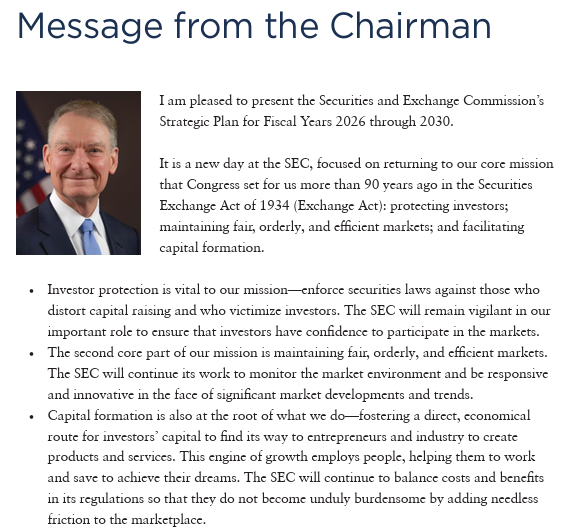
The US Securities and Exchange Commission (SEC) has elevated digital assets to a strategic priority, calling for regulatory clarity around blockchain technology, tokenization and crypto market infrastructure through 2030.
The shift was outlined in the agency’s draft Strategic Plan for fiscal years 2026–2030, published Tuesday. Alongside broader goals focused on capital formation, investor protection and agency modernization, the SEC dedicated an entire objective to digital assets and distributed ledger technology.
The agency said it aims to “provide a firm regulatory foundation for digital assets and distributed ledger technologies through a rational, coherent, and principled approach,” adding:
“Blockchain and crypto asset technologies have the potential to revolutionize America’s financial infrastructure.”
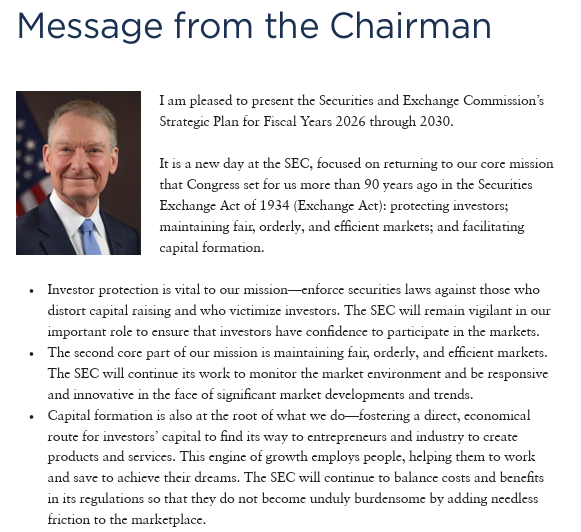
An excerpt from SEC Chair Paul Atkins’ message
in the agency’s draft Strategic Plan. Source: SEC
The strategic plan acknowledges that the growth of digital assets has outpaced existing regulations and calls for greater legal certainty for market participants. It also highlights tokenized offerings and onchain financial infrastructure as areas where the SEC intends to support compliant capital formation.
The document further references custody, trading and staking services, saying they should be able to operate under appropriate oversight without duplicative or conflicting regulatory requirements.
Related: SEC approves Paxos as ‘blockchain-native’ clearing agency
SEC reiterates the need for a clearer division of oversight with CFTC
Another key priority outlined in the draft plan is clarifying the division of responsibilities between the SEC and the Commodity Futures Trading Commission (CFTC), a longstanding issue in US digital asset regulation.
As part of its push for a more coherent regulatory framework, the SEC said establishing clear rules for digital assets “also involves clarifying jurisdictional questions between the SEC and Commodity Futures Trading Commission.”
The agencies have already taken steps toward closer coordination. In March, the SEC and CFTC signed a memorandum of understanding to strengthen cooperation and information sharing as emerging technologies continue to reshape financial markets.

Source: Mike Selig
Jurisdictional boundaries between the SEC and CFTC are also a central issue in congressional deliberations over the Digital Asset Market Clarity Act, a market structure bill that seeks to establish a regulatory framework for digital assets.
As Cointelegraph previously reported, the legislation is expected to expand the CFTC’s authority over large segments of the digital asset market. The bill advanced out of the Senate Banking Committee last month and is expected to proceed to the Senate floor for a full vote.
Related: Clarity Act risks repeat of Europe’s mistakes, crypto lawyer warns
Crypto World
Bitmine (BMNR) chairman Tom Lee calls Strategy’s (MSTR) bitcoin sale classic ‘bottom behavior’


Market anxiety surrounding recent institutional shifts and insider moves is merely typical bottom behavior, Bitmine Immersion (BMNR) Tom Lee told CoinDesk.
Lee dismissed the idea that Strategy selling 32 BTC signals trouble.
“Michael said he was planning to sell bitcoin, so he’s following through on what he was going to do,” Lee said in an interview on Tuesday. “At the end of the day, he’s still got 99.99% of his bitcoin, and he only makes money if bitcoin goes up.”
Saylor’s decision to sell bitcoin at an average price of $77,135, generating roughly $2.5 million to help fund preferred stock dividend payments, sparked unease. The transaction marked the corporate giant’s first bitcoin sale in nearly four years and prompted questions about whether one of the asset’s most prominent institutional advocates was changing course.
The firm still holds more than 843,700 BTC, meaning the disposal represented a microscopic 0.004% of its total reserves. Analysts across Wall Street have largely agreed that the transaction was economically immaterial to the core accumulation thesis.
Lee’s comments come alongside broader industry unease following the longest outflow streak (11 consecutive days) since U.S. spot exchange-traded funds (ETFs) debuted in January 2024, worth $3.4 billion. Lee pointed out that these capital exits are a classic trailing indicator of a market cycle resetting.
“This is what you expected at the bottom,” Lee explained. “People sell at the bottom, right?”
Despite short-term negative price pressure and market panic, Lee confirmed that Bitmine’s broader macroeconomic playbook remains unchanged, including its ongoing strategy for other major layer-1 assets.
Lee also confirmed that the firm’s existing accumulation plans for ether (ETH) remain “on track.)
Bitmine ramped up ETH purchases last week, making its most significant since December. It bought 111,942 ether (ETH) worth around $237 million at current prices. That lifted the firm’s holdings to almost 5.4 million ETH, about 4.47% of ether’s circulating supply.
Read more: Saylor’s Strategy sold bitcoin for the first time since 2022. These firms are still buying
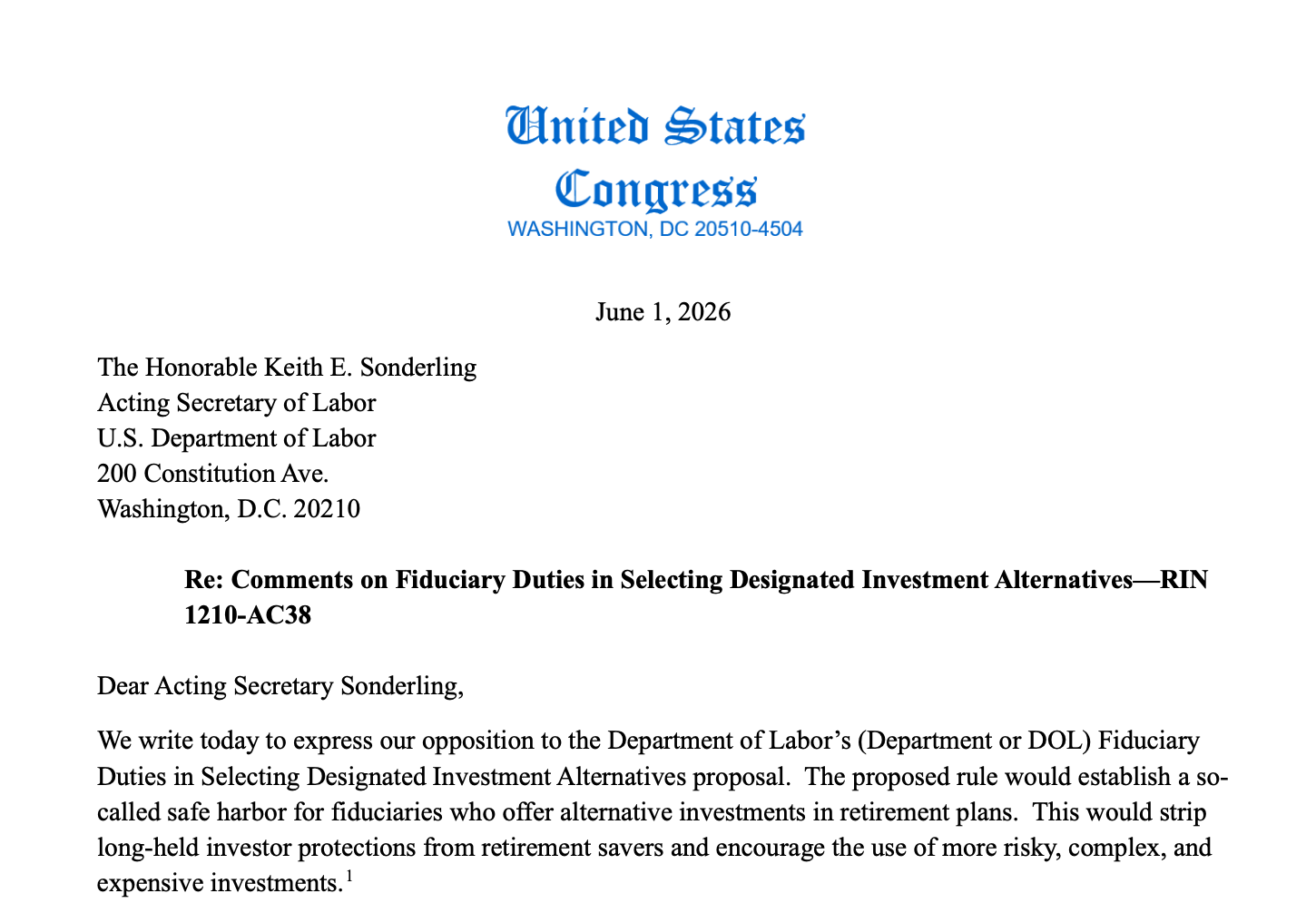
Top Democrats on three House and Senate committees called on the US Labor Department to halt its plans to allow digital assets and “alternative assets” to be held in Americans’ retirement plans.
In a Tuesday letter, Senator Bernie Sanders, Senator Elizabeth Warren and Representative Bobby Scott asked acting Labor Secretary Keith Sonderling to rescind the department’s proposal to allow private equity, digital assets, private credit, and other “alternative assets” to be included in 401(k) plans.
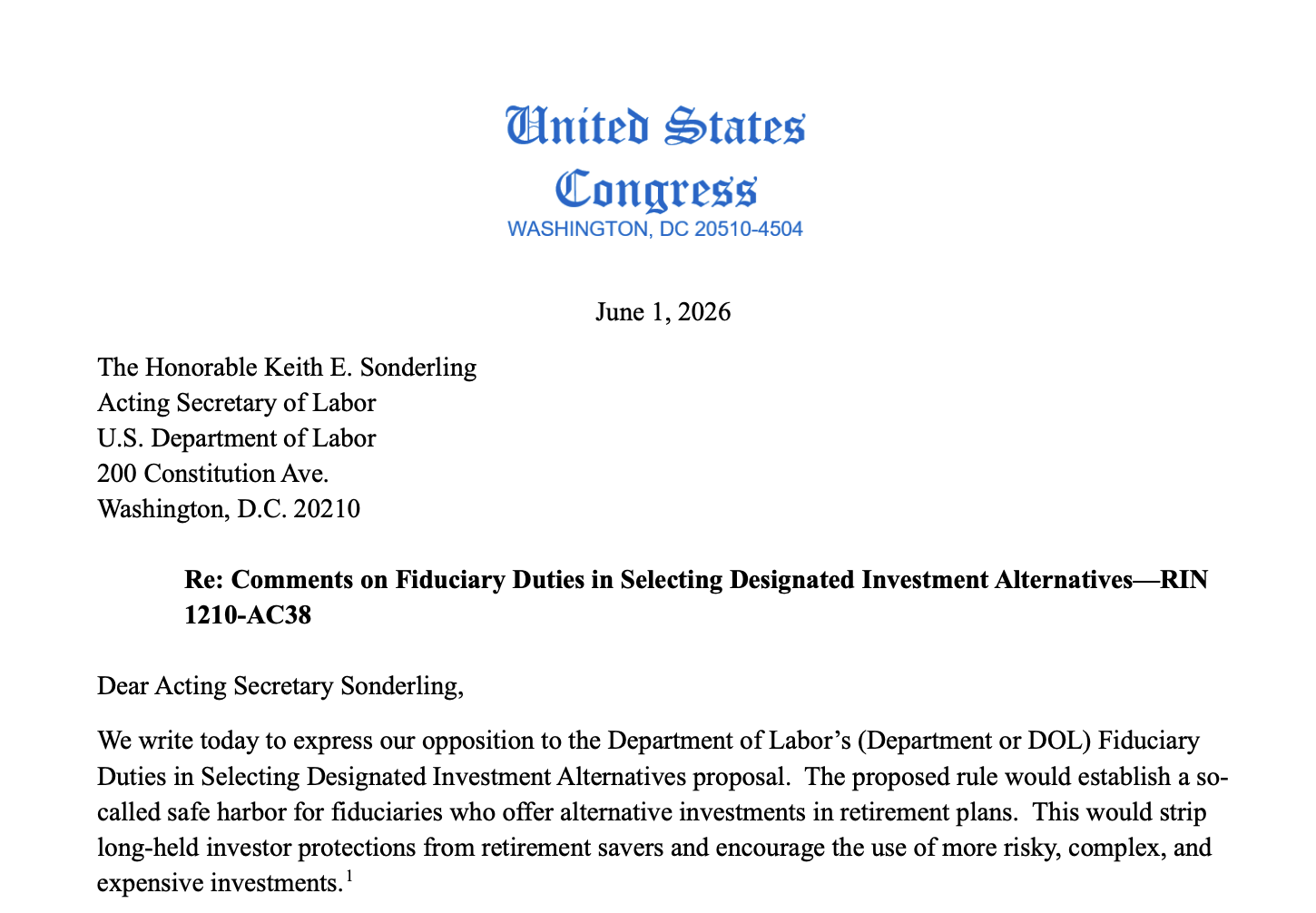
Source: Senate Banking Committee
They said the policy would “expose retirement accounts to exceptionally volatile assets, like digital currency,” citing a “lack of regulation and safeguards” putting many cryptocurrencies at risk of fraud.
As the ranking members of the Senate Banking Committee, Senate Committee on Health, Education, Labor and Pensions, and House Committee on Education and Workforce, respectively, they said that the current administration had weakened enforcement of crypto fraud at financial agencies like the Securities and Exchange Commission (SEC).
“The application of securities laws to crypto assets is rapidly evolving, and many securities law protections that investors have for public securities may not be available for crypto,” said the letter. “This lack of sufficient guardrails is likely to harm investors.”
Related: Basic adds VanEck crypto ETFs to 401(k) plans amid US retirement shift
The proposed policy, announced by the Labor Department in March, followed an August 2025 executive order from US President Donald Trump directing agencies to “democratize access to alternative assets,” including crypto. According to the Investment Company Institute, Americans held about $10.1 trillion in 401(k) plans as of Dec. 31.
Trump family conflicts of interest cloud 401(k) order and CLARITY Act
Sanders, Warren and Scott questioned whether the Labor Department policy would financially benefit anyone in the current administration, given Trump was “rife with conflicts of interest in this area,” including his family’s crypto venture, World Liberty Financial.
Lawmakers have made similar arguments in proposing amendments to a digital asset market structure bill, the CLARITY Act, expected to be addressed in the US Senate soon. Democrats in that chamber have said that they would not vote for any legislation that doesn’t contain provisions on ethics.
Magazine: HYPE chases $100 target, ETH could dump below $1800: Market Moves
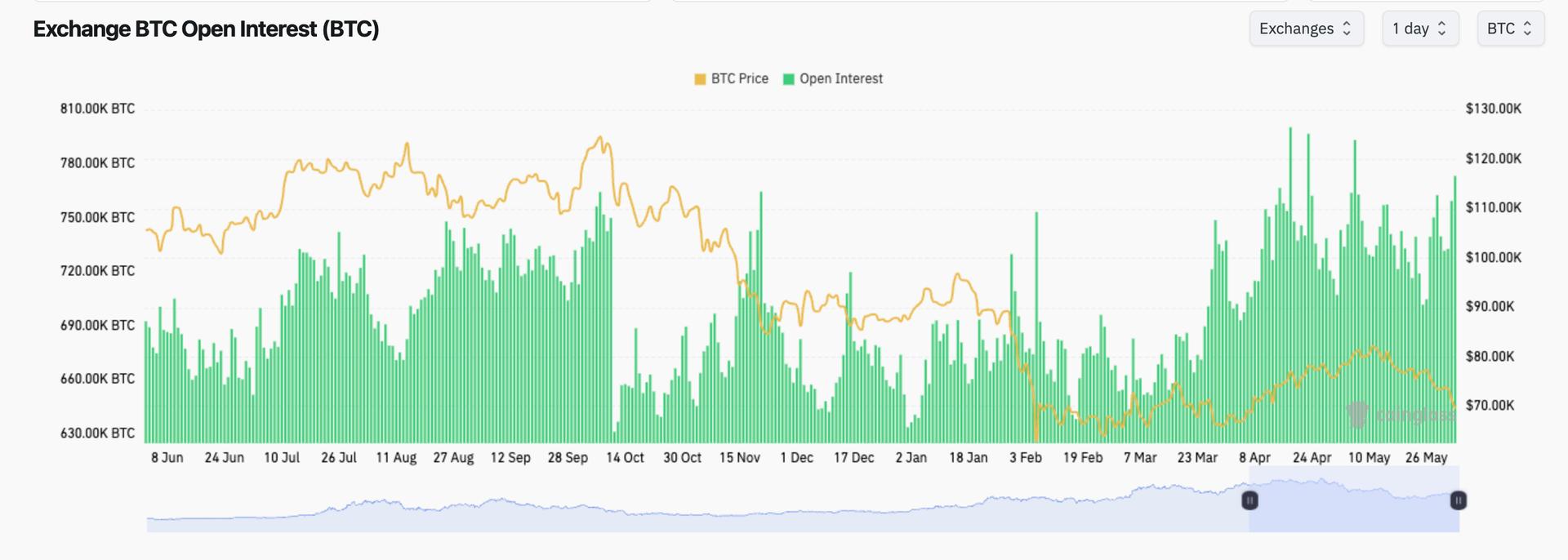
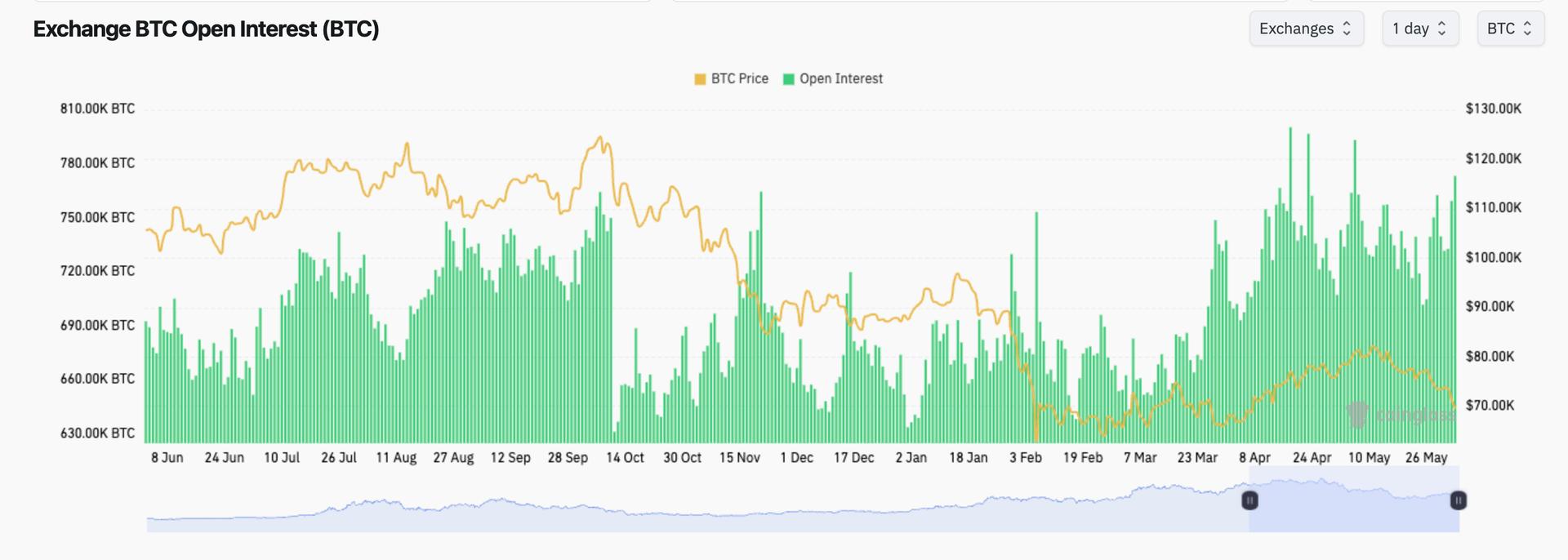
Bitcoin slipped below the psychologically important $70,000 level on Tuesday, trading around $69,300, as derivatives positioning reached some of the most elevated levels of the current cycle.
Open interest across bitcoin futures markets has climbed to approximately 773,000 BTC, a level last seen only a handful of times on record, according to Coinglass data. Previous peaks have occurred during local market tops. The current positioning suggests leveraged traders are betting on a quick price rebound rather than trimming risk.
That growing leverage is also reflected in perpetual futures funding rates, which have risen to roughly 10% annualized, according to Coinglass data. Positive funding means long traders are paying shorts to maintain positions. As bitcoin continues to fall, long leverage liquidations occur, sending the price lower.
Broader sentiment remains apathetic. The Crypto Fear & Greed Index continues to signal fear, while the Coinbase Premium Index remains deeply negative at around -100. The metric measures the price difference between bitcoin on Coinbase and offshore exchanges, with a negative reading often indicating weaker demand from U.S. institutional and spot investors — a trend clearly reflected in the continuing outflows from the U.S.-based spot BTC ETFs.
The divergence between leveraged bullish positioning and deteriorating spot demand comes as bitcoin remains largely uncorrelated to broader risk assets, with AI and software stocks continuing to push to fresh highs.

Man attacked by bear at steel works in Japan

Coinbase Ventures Buys ENA on the Open Market as Coinbase and Ethena Strike Distribution Deal
Pennsylvania mayor blasts “Love Island” contestant for abandoning his cop job for show: 'We are disappointed'



-

 NewsBeat7 days ago
Israel says it has killed new Hamas military leader in Gaza City airstrikes
-

 Tech7 days ago
NASA taps Blue Origin to deliver lunar rovers for Moon Base initiative
-

 News Videos5 days ago
This is BROKEN! INSANE 5x MONEY CAR WASH WEEK! The NEW GTA Online UPDATE Today! (GTA5 New Update)
-

 News Videos7 days ago
XRP *JUST* SUCCEEDED!!!! CLARITY ACT EXPOSED!!! (SHE EXPOSED IT)
-
 Tech4 days ago
SpaceX just won a second Golden Dome contract. This one is $4.16 billion.
-

 Tech5 days ago
Waymo dominates autonomous vehicle registrations as Tesla trails behind
-

 News Videos4 days ago
SHE IS KILLING XRP!!! WATCH URGENT AND ACT FAST
-
 NewsBeat4 days ago
FIRST NIGHT REVIEW: Take That bring the Circus back to life in spectacular sun-soaked style
-

 Business1 day ago
Jade Biosciences, Inc. (JBIO) Discusses Positive Interim Results From JADE101 Phase I Healthy Volunteer Study and Development Plans Transcript
-

 Tech7 days ago
The Samsung pay deal is the moment Korean unions changed register
-
Crypto World4 days ago
CFTC Has Approved the First Regulated Bitcoin Perpetual Contract in the U.S.
-
Crypto World7 days ago
SpaceX’s $2 Trillion IPO: Why Tech Giants Nvidia (NVDA), Apple (AAPL), and Microsoft (MSFT) May Face Pressure
-
 Entertainment7 days ago
The Most Misunderstood Sci-Fi Horror Movie of the Last 10 Years Just Took Over Netflix
-
 NewsBeat4 days ago
Novak Djokovic v Joao Fonseca LIVE: French Open latest scores and results after Jannik Sinner’s shocking collapse
-
 Crypto World4 days ago
Snowflake (SNOW) Stock Rallies on Strong Q1 Results and AI Product Growth
-
 Entertainment4 days ago
Weak ‘Supergirl’ Box Office Tracking Amid Milly Alcock Backlash
-

 Business4 days ago
Demand Conditions Improve In Chemicals Sector In April 2026
-

 Business4 days ago
Is the Spurs Phenom Already Better Than Prime Diesel?
-
 Crypto World4 days ago
MicroStrategy Moves $30 Million in BTC to Coinbase Prime: Is the Bitcoin Sell-Off Already Here?
-
 NewsBeat7 days ago
Energy price cap set for major rise from July as millions face higher bills
You must be logged in to post a comment Login