
Business
Analysts Say Strong Buy with $250+ Targets Amid AI Cloud Boom


NEW YORK — Oracle Corporation (NYSE: ORCL) stock draws a resounding “Buy” recommendation from Wall Street in May 2026, with consensus ratings of Moderate Buy to Strong Buy and average 12-month price targets implying 30-50% upside from current levels near $175–$183. Despite volatility from heavy AI infrastructure spending and a year-to-date pullback, the database and cloud giant’s explosive remaining performance obligations (RPO), cloud revenue growth and strategic positioning in artificial intelligence infrastructure position it as a favored long-term holding for many investors.
As of early May 2026, Oracle shares trade around $175–$182 after recovering modestly from earlier 2026 lows. The stock has faced pressure amid broader tech sector rotations and concerns over elevated capital expenditures, yet analysts overwhelmingly see current valuations as attractive given Oracle’s fundamentals and AI tailwinds.
Strong Analyst Consensus
Across 35–55 covering analysts, Oracle earns predominantly Buy or Strong Buy ratings, with very few Holds and minimal Sells. Average 12-month price targets range from $220 to $260, with highs reaching $400 and lows near $155–$160. This suggests substantial potential upside, with some models projecting even higher returns if cloud and AI momentum accelerates.
Firms like Guggenheim, Bank of America and others maintain bullish stances, citing Oracle’s massive RPO backlog — which surged over 300% year-over-year in recent quarters — as evidence of sustained demand for its cloud offerings.
Fiscal 2026 Performance and Earnings Highlights
Oracle has delivered solid results through its fiscal year. In Q3 FY2026 (reported March 2026), the company posted revenue of about $17.19 billion (up ~22% YoY) and beat EPS estimates. Remaining Performance Obligations reached $553 billion, up 325% year-over-year, signaling strong future revenue visibility driven by cloud infrastructure and AI-related deals.
Earlier quarters showed cloud revenue growth exceeding 25–28%, fueled by demand for Oracle Cloud Infrastructure (OCI) used in large-scale AI training and deployment. However, higher capex for data centers has weighed on near-term margins and free cash flow, contributing to stock volatility.
Bull Case: AI and Cloud Leadership
Supporters highlight Oracle’s transformation into a major cloud player. Its focus on high-performance computing for AI, strategic partnerships and ability to win large enterprise contracts differentiate it from competitors. Analysts project continued double-digit revenue growth, with some bull scenarios seeing the stock reaching $300–$344 within 12–18 months if RPO converts efficiently.
Valuation remains reasonable relative to growth prospects, with forward multiples that many view as discounted compared to pure-play cloud peers. Dividend growth and share repurchases add to shareholder returns.
Risks and Bear Concerns
Critics point to execution risks around heavy AI spending, rising debt levels and potential delays in monetizing infrastructure investments. A tougher macroeconomic environment or slower AI adoption could pressure results. Some analysts trimmed targets after recent quarters, citing margin compression.
Short-term volatility remains a factor, with the stock sensitive to quarterly guidance and broader tech sentiment. A deeper market correction could test lower support levels.
Investment Considerations for 2026
For growth-oriented investors, Oracle offers exposure to enterprise software stability plus high-growth cloud and AI opportunities. Long-term holders may benefit from dollar-cost averaging during dips. Those concerned about capex timing might prefer a more cautious allocation or wait for clearer cash flow inflection.
Financial advisors often recommend tech holdings like Oracle as part of diversified portfolios, especially for those seeking AI adjacency without pure-play startup risk. Position sizing should reflect individual risk tolerance given sector volatility.
Broader Market Context
Oracle’s story mirrors other Big Tech names balancing massive AI investments with profitability. Its hybrid cloud-database strengths provide a moat in enterprise markets where data sovereignty and performance matter. As AI infrastructure demand grows, Oracle is well-placed to capture share.
Upcoming earnings, macroeconomic data and AI spending trends will influence sentiment through the rest of 2026. Analysts will closely watch cloud bookings, margin trends and progress on capital efficiency.
Conclusion: Favored as a Buy for Most Investors
The overwhelming Wall Street consensus tilts strongly toward buying Oracle stock in 2026. Structural growth drivers in cloud and AI, combined with a solid backlog and reasonable valuation, outweigh near-term spending concerns for most analysts. While risks around execution and macro conditions exist, current levels appear attractive for those with a medium-to-long-term horizon.
Investors should perform their own research, consider diversification and consult professionals. Oracle is not without volatility, but the balance of evidence supports its role as a core tech holding with meaningful upside potential as AI infrastructure spending translates into sustained revenue and profits.

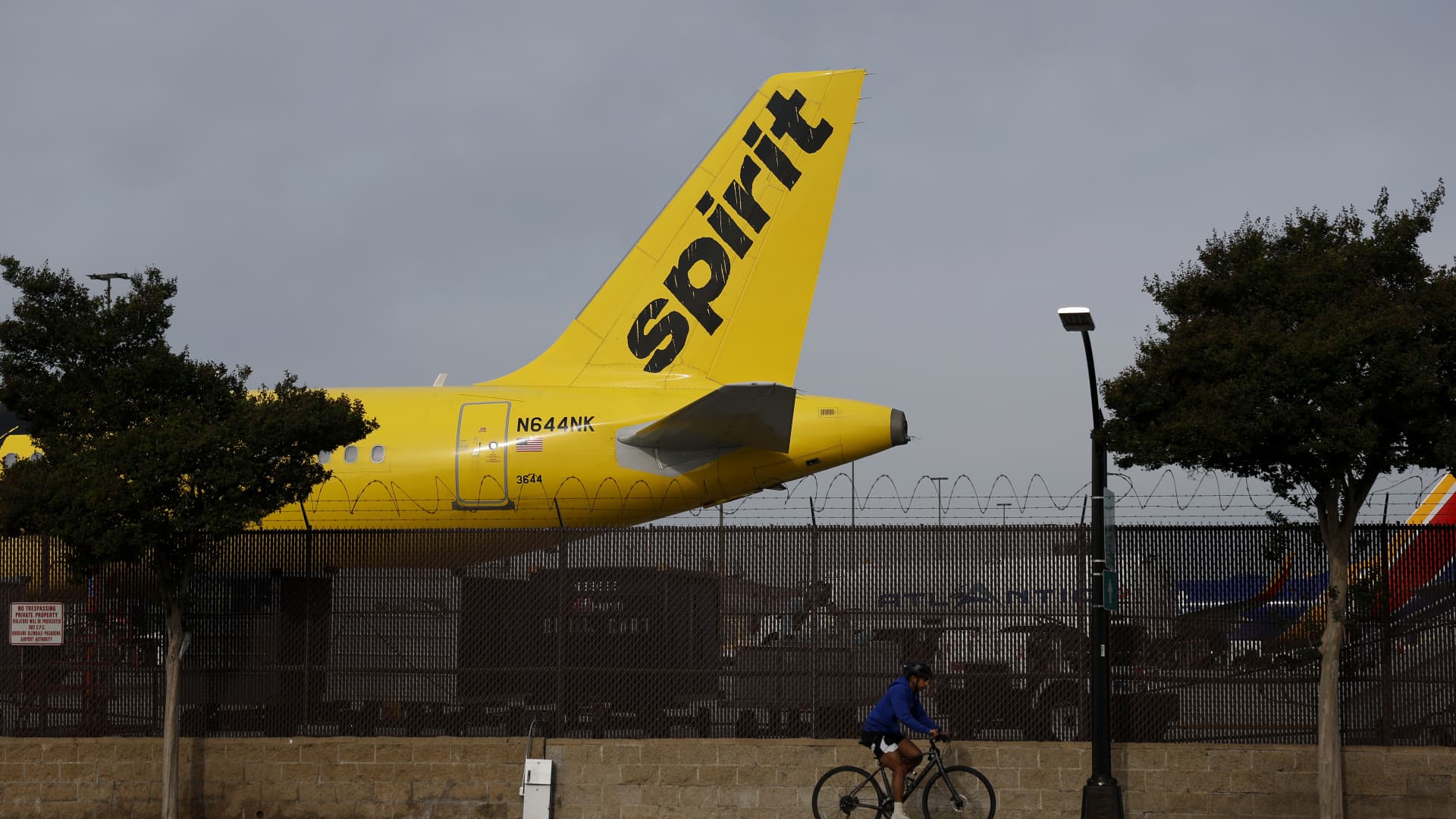
A Spirit Airlines plane sits parked at Hollywood Burbank Airport on April 16, 2026 in Burbank, California.
Justin Sullivan | Getty Images
Spirit Airlines struggled for years, battered by larger, cash-rich airlines that copied its business model, failed mergers, higher costs and, most recently, a surge in jet fuel prices because of the war in Iran. It then faced the most unforgiving foe: time.
“We just kind of ran out of runway,” CEO Dave Davis said in an interview with CNBC on Monday.
Spirit had hoped to exit bankruptcy, its second in less than a year, in mid-2026. Four days before the U.S. and Israel attacked Iran, a conflict that has sent fuel prices skyrocketing, Davis said he and his team were optimistic that the exit strategy could still work. But that was contingent on fuel prices moderating in April.
They didn’t.
“Late March, early April, it became clear that it was going to be tough for us to get through,” Davis said, noting that crude oil prices were above $100 a barrel.
Time’s up
Other airlines leave printed instructions for travelers affected by the Spirit Airlines shut down at LaGuardia Airport’s Marine Air Terminal in New York on May 2, 2026.
Leslie Josephs/CNBC
To try to save the company from collapsing, Davis and others inside Spirit talked to the Trump administration about a bailout.
“We got connected with some various folks in government, including [Commerce] Secretary [Howard] Lutnick, through some contacts,” he said. “These guys … particularly Commerce, very eager to help.”
The Trump administration had been working on an offer for a $500 million loan to keep the airline afloat in a plan that could have given the U.S. government an up to 90% stake in the carrier. Bondholders weren’t on board and floated a counter proposal.
“Our bondholders also worked very hard to try to get something done,” Davis said.
The two sides were far apart on deal terms and it was clear by Thursday that it wasn’t going to work.
“I think we just ran out of time,” he said.
Spirit said some 17,000 people, both direct and indirect airline workers, lost their jobs in the airline’s collapse. Other carriers, smelling blood, had been circling for nearly a year if not longer, and within hours of the airline’s collapse were scrambling to both fly ticketed Spirit customers and add to their schedules in the absence left by Spirit’s yellow planes.
What’s next?
A Spirit Airlines poster on a LaGuardia Airport shuttle bus the day it shut down.
Leslie Josephs/CNBC
Spirit hired longtime airline executive Davis, most recently CFO at Sun Country, a year ago, about a month after the company zipped out of its first bankruptcy. Critics said it avoided bigger changes in that first bankruptcy, like shedding more assets to get costs down.
Last August, the airline filed for Chapter 11 bankruptcy protection again, facing many of the same problems, though it had slashed flights, gotten rid of some of its Airbus jets and furloughed crew members to save cash.
Davis previously worked at Northwest Airlines, which combined with Delta Air Lines in 2008, and also worked at US Airways, which merged with American Airlines in 2013. Along with United Airlines and Southwest Airlines, the four airlines control about 80% of U.S. capacity, after a major wave of consolidation.
More consolidation is likely and “what the lower end of the industry needs,” Davis predicted. He said if Spirit’s planned acquisition by JetBlue Airways wasn’t blocked by a judge two years ago “I believe that we wouldn’t be in the situation we are right now.”
Low-fare airlines for a time were a headache for big legacy carriers, since they swooped into markets and offered eye-catching fares.
“There was no better exemplar of that than Spirit,” Davis said.
But then the big airlines started to copy some of the budget model, offering no-frills basic economy tickets and other add-on fees. That hurt carriers like Spirit, which was profitable in the 2010s but hadn’t turned a profit since 2019.
“Everybody saw the low-cost airlines just taking massive share,” he said. “The shoe was completely on the other foot then, then where it is today.”
He said another benefit the larger airlines have is their huge credit card programs, in which they earn money from banks when customers swipe their credit cards, a business that gives them a bigger cash cushion to weather shocks like high fuel prices.
Davis said in Spirit’s final days he was between Washington, D.C., and the company headquarters in Dania Beach, Florida, trying to get to a deal. Some staff members, including pilots, didn’t get final word about the airline’s last flights until they were getting close to landing Friday night or early Saturday.
“You can’t announce ahead of time that you’re going to shut down,” he said. “What happens is vendors stop working. Fuelers stop fueling. Some crew members probably don’t come in. So then you’ve got airplanes and people and passengers scattered all over the place in foreign countries. It needs to be done in a very orderly way, and it needs to be done all at once.”
Davis said he is staying on at Spirit to oversee the airline’s closure. Leased planes will go back to lessors. Owned ones will get sold. Gates will be overseen by airports and likely used by other airlines. About 130 other employees are set to stay on for that work as well.
When asked if he would stay in the industry, Davis said: “I just love airplanes, and I like the industry, so I’ll probably never leave it, although sometimes it’s very trying and taxing on a person.”

NEW YORK — Gold prices tumbled more than 2% on Tuesday, May 5, 2026, with spot gold hitting $4,527.26 per ounce, down $102.63 or 2.22% from the previous close, extending a broader correction from record highs set earlier this year amid shifting macroeconomic forces and profit-taking.

The decline marks another session of pressure on the safe-haven metal, which reached an all-time high above $5,589 in late January before entering a volatile pullback phase. Analysts describe the move as a healthy correction within a longer-term bull market driven by central bank buying, geopolitical risks and investor diversification, rather than a fundamental reversal.
Drivers Behind Tuesday’s Sharp Drop
Market participants pointed to a combination of factors. A stronger U.S. dollar, rising Treasury yields and reduced immediate fears over certain geopolitical flashpoints contributed to the selling. Higher real yields make non-yielding assets like gold less attractive, prompting some institutional and speculative investors to unwind positions.
Recent data showing resilience in the U.S. economy and tempered expectations for aggressive Federal Reserve rate cuts this year have also weighed on gold. The metal often struggles in environments of higher-for-longer interest rates, even as broader inflation and uncertainty narratives remain supportive longer term.
Trading volumes spiked during the session as leveraged players adjusted exposure. Comex futures reflected the move, with active contracts showing clear downside momentum before finding some support near key technical levels around $4,500.
Context of 2026’s Wild Ride
Gold’s journey this year has been dramatic. After surging more than 40% from 2025 levels and shattering previous records, the metal corrected sharply in March — its largest monthly decline since 2013 — before stabilizing in April. The pullback erased roughly 13-20% from January peaks, yet prices remain elevated compared to historical averages.
Geopolitical developments, including tensions in the Middle East and disruptions in energy markets, initially propelled gold higher but later triggered complex dynamics. Oil price spikes raised inflation concerns, delayed rate-cut hopes and strengthened the dollar — a classic headwind for gold despite its traditional safe-haven status.
Central banks continue accumulating gold at elevated levels, albeit at a slightly slower pace than peak quarters, providing underlying demand. Private investors who entered during the rally have shown mixed behavior, with some holding firm and others taking profits during volatility.
Wall Street Outlook Remains Bullish
Major banks largely view the current dip as a buying opportunity. Goldman Sachs reaffirmed its year-end 2026 target of $5,400 per ounce. J.P. Morgan sees potential for $6,000–$6,300, while other forecasts range from $5,200 to $6,300 by December.
Analysts emphasize structural drivers: de-dollarization efforts, fiscal sustainability concerns, and gold’s role as a portfolio diversifier in an uncertain world. Even after the correction, consensus calls for new highs later in 2026 and into 2027.
Technical analysts note support zones between $4,400 and $4,600 hold significance. A break below could test lower levels, but most expect rebounds as bargain hunters enter and seasonal factors turn favorable.
Impact on Investors and Markets
For retail investors, the drop offers a potential entry or averaging point, though volatility cautions against timing the bottom. Exchange-traded funds tracking gold, such as the SPDR Gold Shares (GLD), mirrored the decline, affecting portfolios with precious metals exposure.
Jewelry demand in major markets like India and China remains price-sensitive, with lower levels potentially stimulating physical buying. Mining stocks faced additional pressure, trading lower as margins face scrutiny amid falling spot prices.
Broader financial markets showed mixed reactions. Equities held relatively steady, while the dollar index gained ground. Bond yields ticked higher, reinforcing the inverse relationship currently at play with gold.
Risks and Scenarios Ahead
Downside risks include faster-than-expected economic cooling that paradoxically strengthens the dollar further, or resolution of key geopolitical tensions that reduces safe-haven demand. Upside catalysts remain robust: renewed inflation surprises, central bank surprises or fresh global uncertainties.
Experts warn against overreacting to short-term moves. Gold’s history shows sharp corrections within multi-year bull runs, often followed by strong recoveries. Long-term holders focused on wealth preservation appear largely unmoved by daily fluctuations.
What’s Next for Gold
As trading continues, market eyes turn to upcoming economic data, including inflation readings and Fed communications. Any signs of cooling labor markets or persistent price pressures could shift sentiment rapidly.
For now, Tuesday’s 2% drop underscores gold’s sensitivity to macro crosscurrents even at elevated levels. At $4,527, the metal trades well above pre-2025 averages but offers a more attractive valuation than at January peaks for those bullish on its strategic role.
Investors should monitor real yields, dollar strength and physical demand indicators closely. While no one can predict the exact bottom, the overwhelming analyst consensus points to higher prices by year-end, suggesting current levels may represent a pause rather than the end of gold’s remarkable run.

PERTH, Australia — A Kalgoorlie couple experienced a life-changing surprise this week when Belinda Lotsu, 45, delivered quadruplets at Perth’s King Edward Memorial Hospital, marking Western Australia’s first set of quads in six years. The babies — three girls and one boy — arrived via cesarean section on Tuesday at 32 weeks and three days, delighting and overwhelming their parents who had prepared for triplets.

The newborns, named Amy, Amana, Amber and Amon, weighed between approximately 1.0 and 1.6 kilograms at birth, with hospital staff describing them as doing “exceptionally well” despite their prematurity. All four are receiving specialist care in the neonatal intensive care unit at King Edward Memorial Hospital, Western Australia’s premier maternity facility, and are expected to remain there for four to six weeks.
Belinda and her husband Emmanuel Lotsu already have a three-year-old son. The couple turned to IVF after a previous miscarriage, initially hoping for one healthy baby. Doctors discovered the fourth fetus more than halfway through the pregnancy, stunning the family and medical team.
“I told the doctor it was not true,” Belinda recalled in interviews, reflecting the shock that turned their planned triplet pregnancy into a rare quadruplet delivery.
Rare Occurrence in WA
Health records show these quadruplets represent only the 15th set born in Western Australia, with the last occurring in 2020. King Edward Memorial Hospital delivers an average of five sets of triplets per year, but quadruplets remain exceptionally uncommon, occurring naturally in roughly one in 700,000 pregnancies and even less frequently with assisted reproduction.
The pregnancy triggered extensive planning by the hospital. Teams coordinated emergency protocols, neonatal capacity and maternal safety measures well in advance. The planned cesarean ensured the safest possible delivery for the high-risk multiples.
Dr. staff at the hospital praised the babies’ strong birth weights for their gestational age. “They’re all doing exceptionally well,” a spokesperson noted, highlighting the positive early indicators for their development.
A Family’s Journey
The Lotsu family, based in the Goldfields town of Kalgoorlie, about 550 kilometers east of Perth, faced a rollercoaster of emotions. After struggling with fertility and enduring a miscarriage, the IVF success brought immense joy tempered by the challenges of a multiple pregnancy. Emmanuel supported Belinda throughout, and the couple expressed gratitude for the medical team that guided them through the unexpected expansion of their family.
From three family members to seven in minutes, the Lotsus now navigate the practical realities of caring for quadruplets alongside their toddler. Community support has already begun pouring in from Kalgoorlie and beyond, with offers of assistance expected to grow as the babies prepare for homecoming.
Medical and Logistical Challenges
Premature quadruplets require specialized monitoring for respiratory issues, feeding support and temperature regulation. King Edward Memorial’s neonatal unit, equipped for complex cases, provides round-the-clock care. Doctors anticipate gradual progress, with potential discharge in coming weeks if the infants continue thriving.
Multiple births carry higher risks for both mother and babies, including gestational diabetes, preeclampsia and preterm labor. Belinda’s successful delivery at 32 weeks and three days reflects strong prenatal management typical for IVF multiples.
The case underscores advancements in fertility treatment and obstetric care in regional Australia. Families from remote areas like Kalgoorlie often relocate temporarily to Perth for high-risk deliveries, adding emotional and financial layers to the experience.
Broader Context of Multiple Births
Australia sees rising multiple birth rates linked to assisted reproductive technologies, though strict guidelines limit embryo transfers to reduce risks. Quadruplets remain headline-worthy events due to their rarity. Similar stories in other states highlight both the miracles and complexities involved.
Public health experts note that while IVF expands family-building options, it requires robust support systems. WA Health continues investing in maternal and neonatal services to handle such cases safely.
Community and Social Media Reaction
News of the quadruplets spread rapidly across Australian media and social platforms. Messages of congratulations flooded in, with many praising Belinda’s strength at age 45. Viral posts celebrated the “instant big family” while acknowledging the demanding road ahead.
Parenting groups and local Kalgoorlie communities have mobilized, offering practical help ranging from meals to baby gear. The story resonates widely, evoking both wonder at the rarity and empathy for the immense responsibility of raising multiples.
Looking Ahead for the Lotsu Family
As the four infants gain strength in the NICU, the family focuses on recovery and preparation. Belinda and Emmanuel will balance hospital visits with caring for their three-year-old, likely relying on extended family and community support upon returning to Kalgoorlie.
Medical follow-ups will monitor the babies’ growth and development closely in the coming months. For now, the Lotsus cherish the surprise that transformed their family, viewing it as a profound blessing after earlier challenges.
Hospital staff describe the delivery as a coordinated success, reflecting years of expertise in managing high-order multiples. The arrival of Amy, Amana, Amber and Amon not only enriches one family but also highlights the capabilities of Western Australia’s health system in delivering rare miracles.
In a state where such events occur roughly once every several years, this quadruplet birth stands as a heartwarming reminder of life’s unpredictability and the resilience of families supported by dedicated medical professionals. As the Lotsus embark on their expanded parenting journey, well-wishes continue pouring in from across Australia.

War Fears Tarnish Metals – Silver Breaks $75 And Gold Tests $4,500

A UPS Boeing 767 departs Los Angeles International Airport en route to Louisville, Kentucky, Jan. 27, 2026.
Kevin Carter | Getty Images
Shares of logistics giants UPS and FedEx sank on Monday after Amazon announced a new initiative to open up its supply chain networks to other businesses.
Both stocks closed down roughly 10% on Monday. The companies did not immediately respond to requests for comment.
Shares of Amazon remained largely unchanged.
The tech company’s “Amazon Supply Chain Services” will allow companies spanning multiple industries to use Amazon’s supply chain and logistics to move and deliver products and raw materials.
It’s part of Amazon’s ongoing growth in services. The announcement could set up Amazon as a major player next to UPS and FedEx, opening up its fleet of more than 100 cargo plans and a massive network of warehouses.
Amazon said major retailers including Procter & Gamble, 3M, Lands’ End and American Eagle Outfitters have already signed up for the new program.


Steven Cress is VP of Quantitative Strategy and Market Data at Seeking Alpha. Steve is also the creator of the platform’s quantitative stock rating system and many of the analytical tools on Seeking Alpha. His contributions form the cornerstone of the Seeking Alpha Quant Rating system, designed to interpret data for investors and offer insights on investment directions, thereby saving valuable time for users. He is also the Founder and Co-Manager of Alpha Picks, a systematic stock recommendation tool designed to help long-term investors create a best-in-class portfolio.Steve is passionate and dedicated to removing emotional biases from investment decisions. Utilizing a data-driven approach, he leverages sophisticated algorithms and technologies to simplify complex, laborious investment research, creating an easy-to-follow, daily updated grading system for stock trading recommendations.Steve was previously the Founder and CEO of CressCap Investment Research until its acquisition by Seeking Alpha in 2018 for its unparalleled quant analysis and market data capabilities. Prior to that, he had also founded the quant hedge fund Cress Capital Management, after spending most of his career running a proprietary trading desk at Morgan Stanley and leading international business development at Northern Trust.With over 30 years of experience in equity research, quantitative strategies, and portfolio management, Steve is well-positioned to speak on a wide range of investment topics.
Analyst’s Disclosure: I/we have no stock, option or similar derivative position in any of the companies mentioned, and no plans to initiate any such positions within the next 72 hours. I wrote this article myself, and it expresses my own opinions. I am not receiving compensation for it. I have no business relationship with any company whose stock is mentioned in this article.
Seeking Alpha’s Disclosure: Past performance is no guarantee of future results. No recommendation or advice is being given that any particular security, portfolio, transaction or investment strategy is suitable for any specific person. The author is not advising you personally concerning the nature, potential, value or suitability of any particular security or other matter. You alone are solely responsible for determining whether any investment, security or strategy, or any product or service, is appropriate or suitable for you based on your investment objectives and personal and financial situation. Steven Cress is the Head of Quantitative Strategy at Seeking Alpha. Any views or opinions expressed herein may not reflect those of Seeking Alpha as a whole. Seeking Alpha is not a licensed securities dealer, broker or US investment adviser or investment bank.

Northwest Bancshares CFO Douglas Schosser buys $20,883 in stock

European Commission assessing Anthropic’s Mythos AI model implications


Politicians on both sides of the aisle want to block Chinese vehicles from the United States.
But over 100 Chinese automakers, auto tech companies, and parts suppliers already have a presence in the U.S., according to a survey done by Dunne Insights, a consultancy that focuses on electric vehicles and autonomous markets. Despite the United States implementing a 100% tariff on EVs from the country and considering a rule banning Chinese connected cars from U.S. roads, a few Chinese companies are finding ways to invest in the country.
Chinese behemoth BYD builds buses in California, and Chinese battery maker CATL has struck a licensing deal with Ford Motor to offer tech and services for a battery manufacturing operation in Michigan.
One especially well-positioned company is Zhejiang Geely Holding Group. Geely, as it is commonly known, has large investments in three automakers already doing business in the U.S. — Volvo Cars, Polestar and Lotus — and smaller stakes in luxury makers Mercedes-Benz and Aston Martin.
Geely’s advantage
Lotus, Polestar and Volvo all give Geely Holding dealer networks in the U.S. — a key asset, said Tu Le, founder of automotive consultancy firm Sino Auto Insights.
“Let’s not discount how important a dealer network is and the service infrastructure that needs to be able to support that, because that’s not an insignificant task that needs to be sorted out by the automakers that do not have a presence in the United States,” Le said.
Geely also potentially has U.S. factory capacity through its Volvo stake.
The Volvo factory near Charleston, South Carolina, makes both Volvo and Polestar cars. The plant is big enough to make about 150,000 vehicles, but in 2025, it only produced about 18,500, said Sam Abuelsamid, vice president of market research at Telemetry Insights, citing data from Marklines. Volvo has said it is adding U.S. production of its XC60 hybrid SUV, which would add about 45,000 units per year.
Volvo does want to expand its U.S. footprint. The company’s Americas president, Luis Rezende, told CNBC in December that Volvo was importing about 95% of the cars it sold in the U.S.. The company plans to boost U.S. sales to about 200,000 units, from about 122,000 in 2025. Volvo wants 50% to 60% of that growth volume to be U.S.-made, Rezende said.
Volvo CEO Hakan Samuelsson reportedly said late last month that he would be open to using it for a Chinese vehicle, according to Business Insider.
“Putting production there would actually reduce costs or it would amortize the fixed costs over more units,” Le said.
U.S. expansion?
The name Geely can refer to the holding company that has stakes in Volvo, Polestar and the rest, or the publicly traded Chinese subsidiary automaker Geely Auto, which consists of the Chinese brands Zeekr, Lynk & Co, and the brand Geely.
Of its Chinese brands, Zeekr is a likely candidate to spearhead a U.S. expansion, analysts said. Already, Waymo is using a Zeekr vehicle as a platform for its self-driving fleet in San Francisco. The company continues to use the Jaguar I-Pace and plans to use cars from Hyundai and Toyota as well. Waymo declined CNBC’s request for a comment.
“Executives from Zeekr have said that they want to introduce the Zeekr brand into the U.S. market,” Abuelsamid said. “Of the Geely Group brands, that is the most likely one.”
It might be among the best positioned, but it isn’t totally alone, Le said. Stellantis — which owns the Jeep, Ram, Dodge and Chrysler brands — has a roughly 20% stake in Chinese automaker Leapmotor.
“There’s another opportunity to rebadge an existing vehicle, such as a Fiat, or something that’s more familiar to Americans, and there’s already an infrastructure in place,” Le said.
And though there is stiff bipartisan opposition to Chinese automakers, President Donald Trump has suggested he would be amenable to Chinese automakers building in the U.S.
“Now, if they want to come in and build a plant and hire you and hire your friends and your neighbors, that’s great,” the president said about foreign automakers in a January speech at the Detroit Economic Club. “I love that. Let China come in. Let Japan come in. They are, and they’ll be building plants, but they’re using our labor.”
Business
Pinnacle West Capital Corporation 2026 Q1 – Results – Earnings Call Presentation (NYSE:PNW) 2026-05-04

Q1: 2026-05-04 Earnings Summary
EPS of $0.27 beats by $0.27
| Revenue of $1.15B (11.36% Y/Y) beats by $65.17M

Seeking Alpha’s transcripts team is responsible for the development of all of our transcript-related projects. We currently publish thousands of quarterly earnings calls per quarter on our site and are continuing to grow and expand our coverage. The purpose of this profile is to allow us to share with our readers new transcript-related developments. Thanks, SA Transcripts Team

Premier League: The relegation battle more like a title race
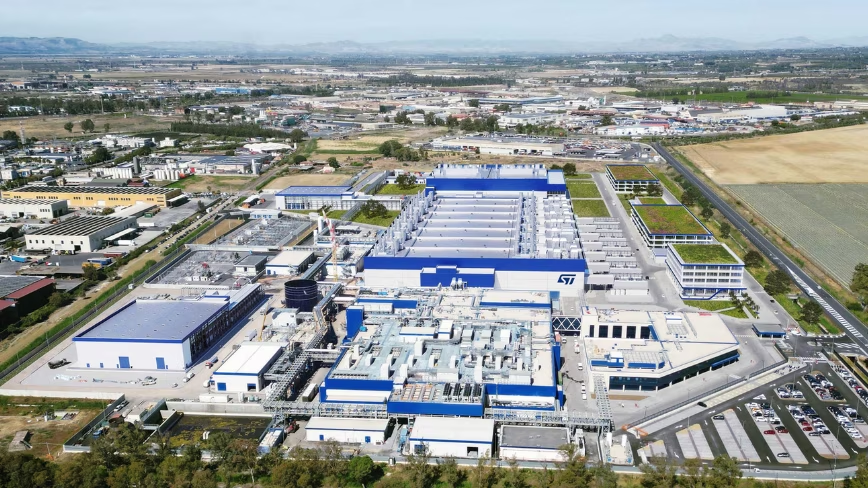
STMicroelectronics targets more than $3bn from space

MLA slams ‘disgraceful scenes’ at Stewartstown Road car cruise event

Manchester United reach agreement with Casemiro over contract clause amid transfer speculation

US brings back mandatory military draft registration

Steven Gerrard disagrees with Gary Neville over ‘shock’ Chelsea and Arsenal claim | Football


-

 Politics7 days ago
Drax board avoid their own AGM, accused of greenwashing & environmental racism
-

 Fashion6 days ago
Kylie Jenner’s KHY Enters a New Era with ‘Born in LA’
-

 NewsBeat1 day ago
Channel 5 – All Creatures Great and Small series 7 new post
-

 Business6 days ago
Most Commercial Energy Audits Miss the Real Losses
-
 Tech3 days ago
Trump’s 25% EU auto tariff breaches Turnberry Agreement that also covers semiconductors and digital trade
-

 Crypto World6 days ago
CFTC’s AI will review U.S. crypto registration applications, chairman tells CoinDesk
-
 Sports3 days ago
Paul Scholes issues Marcus Rashford reality check as agreement emerges over Man United star
-

 Business5 days ago
Barclay Brothers Avoid Bankruptcy: HSBC Drops High Court Petitions After IVA Deal
-
 Business5 days ago
Tesla Officially Registers Elon Musk’s Stock: What Investors Need to Know
-

 Tech6 days ago
Get Ready for More Brain-Scanning Consumer Gadgets
-
 Crypto World6 days ago
Robinhood Phishing Scam Exploits Gmail Dot Feature to Bypass Security
-

 Crypto World7 days ago
Gmail Dot Trick Underpins Robinhood Phishing, Sending Real-Looking Emails
-

 Entertainment7 days ago
Sister Wives: Janelle Posts New Scary Warning
-

 Entertainment7 days ago
Michael Jackson’s Biopic Excluded Abuse Allegations For $25M
-

 Business4 days ago
Two Powerball Tickets Split $143 Million Jackpot in Indiana and Kansas
-

 Business7 days ago
Superdry co-founder accused of raping woman
-
 Crypto World7 days ago
Meme Coin Based on White House Shooter Conspiracy Rallies 320%
-
Business7 days ago
Opus Genetics president Benjamin Yerxa sells $39,121 in stock
-

 Politics7 days ago
Starmer to whip MPs to vote against probe into himself
-
 Crypto World7 days ago
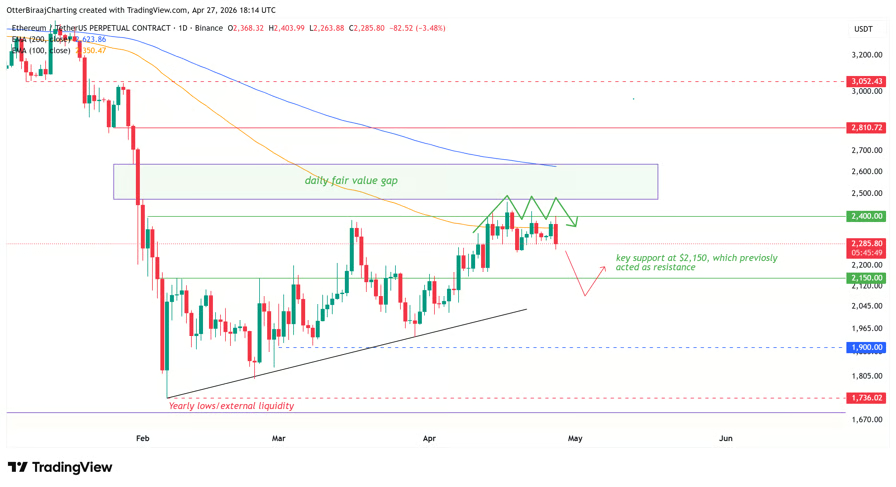
ETH Triple Top Rejects $2.4K As Analysts Flag Weakness Against BTC
You must be logged in to post a comment Login