
Crypto World
One bank after another scraps Fed rate-cut forecasts. Bitcoin doesn’t care.

Expectations around U.S. monetary policy are shifting, but bitcoin appears increasingly indifferent. The cryptocurrency has pushed past the $80,000 mark, signaling that macro headwinds tied to interest rates may be losing their grip on price action.
A growing number of major brokerages now expect the Federal Reserve to hold rates steady through the year, a marked change from the earlier expectations of at least two rate cuts. Barclays joined peers in scrapping its earlier forecast for a rate cut on Monday, pointing to persistently high energy prices linked to geopolitical tensions involving Iran as an inflationary development. Other global firms, including JPMorgan, have similarly pushed back against expectations of policy easing.
Under normal circumstances, a higher-for-longer rate outlook would weigh on risk assets. Still, BTC continues to gain ground. Some analysts argue the asset is increasingly being treated as a hedge against inflation, supported by continued inflows into spot ETFs even as inflation fears mount. Others remain skeptical, attributing the rally more to strength in equities than to any structural shift in crypto demand.
For now, momentum appears to favor the bulls.
“From a market structure standpoint, we are seeing traders closely watch the $81,500 resistance level, while the CME futures gap around $84,000 remains a key zone for potential upside. These technical levels, combined with macro developments, will likely guide near-term price action,” said Ashish Singhal, co-founder of the FIU-registered CoinSwitch exchange.
Technical indicators reinforce that view. The 200-day simple moving average (SMA), which is often seen as a dividing line between longer-term bearish and bullish trends, is located near $83,430. So, a decisive move above it could strengthen the case for further upside.
The broader market is also showing signs of selective strength. Bitcoin’s roughly 2% gain to around $80,700 has been accompanied by outsized moves in certain altcoins. Toncoin (TON) has surged about 35%, while MORPHO and PENGU have gained 11% and 9%, respectively. On the weaker side, Dash has slipped slightly. Larger tokens such as ether, XRP, and solana have largely tracked bitcoin’s modest advance.
At the same time, sentiment is sitting at a critical juncture. The Crypto Fear and Greed Index has climbed to 50, right at the midpoint of its range, a level last seen in mid-January.
“The market is approaching a significant turning point. Since last October, there have been only brief surges in sentiment to higher levels, but these have provided excellent opportunities for bears to sell at higher prices,” said Alex Kuptsikevich, chief market analyst at FxPro. Stay alert!
Read more: For analysis of today’s activity in altcoins and derivatives, see Crypto Markets Today . For a comprehensive list of events this week, see CoinDesk’s “Crypto Week Ahead.”
What’s trending
Brent holds near $114 a barrel as Middle East tensions rage on (Reuters): Brent crude futures eased 93 cents, or 0.8%, to $113.51 per barrel after settling up 5.8% on Monday. West Texas Intermediate crude fell $2.16, or 2%, to $104.26, after gaining 4.4% in the previous session.
Maersk says ship passed through Strait of Hormuz under U.S. military protection (CNBC): Maersk said one of its commercial vessels, stranded at sea since the start of the war on Feb. 28, successfully transited through the strategically vital Strait of Hormuz under U.S. military protection.
‘A deal is a deal’: Von der Leyen hits back at Trump’s latest tariff threat (euronews): The European Union is “prepared for every scenario” if Donald Trump unilaterally hikes tariffs on EU-made cars, says Ursula von der Leyen.
China steps up U.S. sanctions fight, defying blacklisting over Iranian oil (The Wall Street Journal): China escalated its fight against the U.S. over Iranian oil, defying American sanctions in a show of resistance ahead of President Trump’s visit to Beijing planned for next week.
Today’s signal

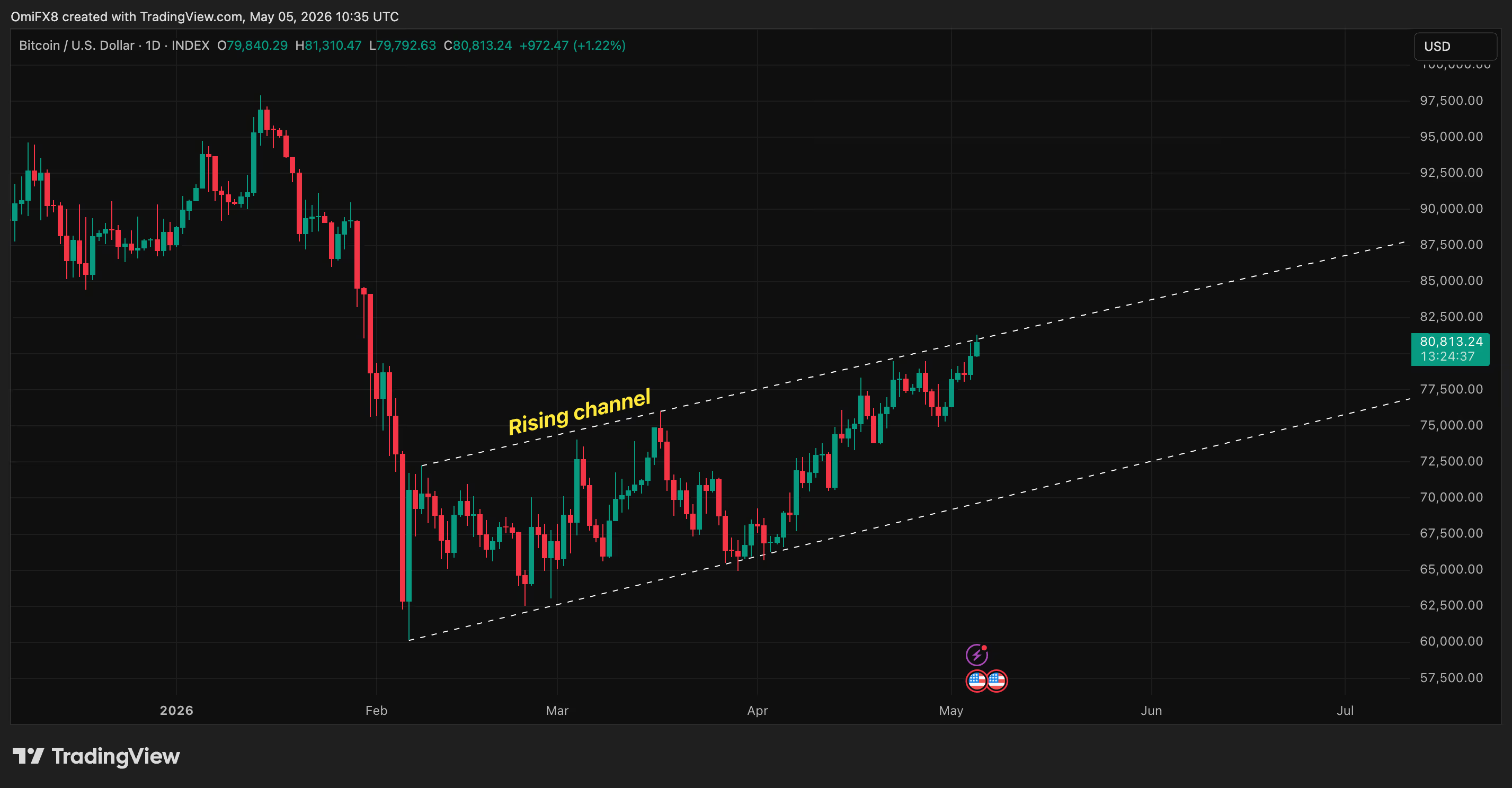
After a sharp sell-off to nearly $60,000 earlier this year, bitcoin has steadily climbed back above $80,000 within a well-defined, textbook rising channel, marked by a consistent pattern of higher lows and higher highs.
Prices are now pushing against the upper boundary of that channel, a level that can act as short-term resistance where rallies can stall or pull back.
A decisive breakout above the upper boundary could trigger stronger momentum and potential speculative frenzy toward $100,000. However, repeated rejection at this level could send prices back toward $70,000 or lower.
In short, bulls are in control right now, with prices nearing a key technical test.


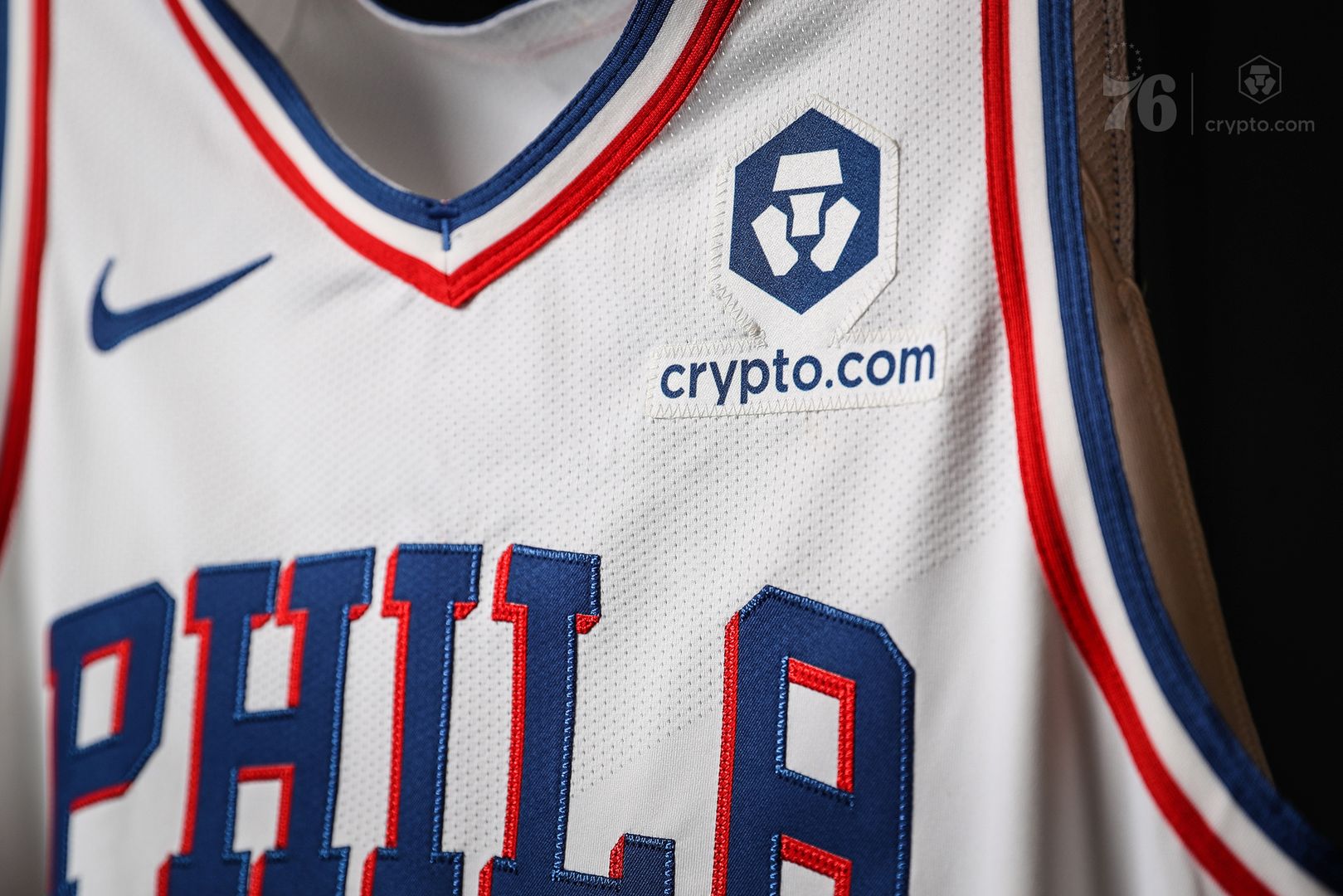
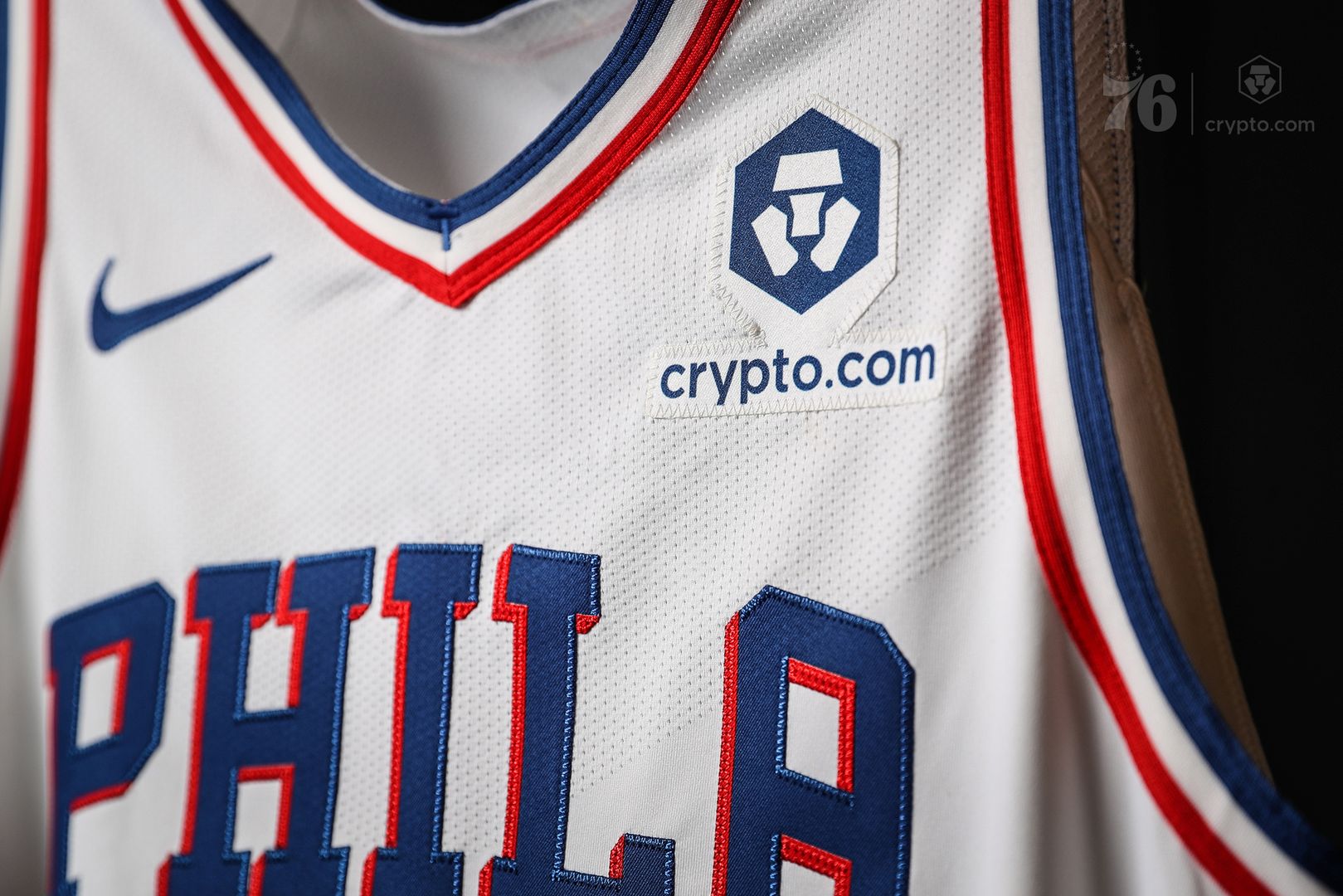
The chief marketing officer (CMO) at Crypto.com, Steven Kalifowitz, who has overseen more than $1 billion spent on partnerships and high profile campaigns in the past several years, is leaving the company.
Crypto.com spokesperson said Kalifowitz will be moving on from his role as CMO, effective June 30, and will then continue on as advisor to the CEO.
“Steven has been a significant contributor to the effective mainstreaming of the Crypto.com brand, from introducing Crypto.com on a global stage through our first brand film in 2021, to striking strategic partnerships and sponsorships that have helped connect Crypto.com to millions of consumers,” the spokesperson said.
Kalifowitz has been CMO at Crypto.com for close to six years, during which time the company surged in recognition from just being an app to a global brand.
During his tenure, Crypto.com has invested over $1 billion in partnerships, including a $700 million, 20-year deal for naming rights to the Crypto.com Arena (formerly Staples Center), and a $100 million campaign with Matt Damon.
The crypto buying platform also has high-profile partnerships with Formula 1 and the Ultimate Fighting Championship (UFC), an American mixed martial arts promotion company based in Las Vegas.
Kalifowitz was previously a brand manager at Twitter for four years, and president of real estate platform Localize.city.
Founded in 2016, Singapore-based Crypto.com allows users to buy and sell more than 200 cryptocurrencies, as well as the ability to earn rewards by depositing crypto or using its Visa card.


A Puerto Rican man is suing Coinbase after he accused the exchange of wrongly withholding crypto that was apparently stolen in a $55 million draining hack.
The suit, which was filed on Monday in a California court, claims that the man, referred to as “D.B.,” was a victim of a hack on August 20, 2024.
The victim apparently lost his crypto after clicking on a malicious link that spoofed Ethereum DeFi management tool “DefiSaver.” He then unknowingly authorized a smart contract permission that gave the thieves control of his crypto wallets.
From here, they allegedly stole his funds, made up of stablecoin DAI, and used crypto mixing services like Tornado Cash to launder the funds before eventually depositing them on Coinbase.
Coinbase froze the funds held in a retail account after the plaintiff’s agents, Zero Shadow and Five Stones, traced the funds and requested their freezing. The exchange, however, refused to return the crypto unless a court order was secured.
The suit further alleges that, “While Coinbase acted reasonably in freezing the stolen cryptocurrency, its refusal to return the frozen funds to plaintiff became unreasonable when plaintiff provided sworn proof that he is the rightful owner and Coinbase refused to act.”
Coinbase lawsuit matches up with $55M DAI hack
The victim’s name, the total amount stolen, and other details are redacted from the lawsuit, but the certain events appear to line up with reports around August 20 and 21 covering a $55 million DAI draining incident.
Read more: Crypto hackers snatch over $1B in 68 incidents this year
These include details like the “Inferno Drainer” malware used in the attack, the theft of the DAI, and the manipulation of the smart contract.
Crypto analysts at the time noted that the victim had acted “carelessly” when signing the transaction, and that he attempted to reverse the transaction upon realising that it was malicious.
The lawsuit, which describes the hack as “sophisticated,” is suing Coinbase on five counts, including unjust enrichment, and is seeking restitution for any profits the exchange may have accrued from holding the funds.
It also seeks a court order declaring that the plaintiff is the rightful owner, an order directing Coinbase to return the funds, and the “imposition of a constructive trust.”
The lawsuit is also suing John Doe, a legal name used to highlight the currently unknown hacker, or hackers, who stole the crypto. They face seven counts, including fraud, theft, and racketeering.
The plaintiff claims to have found one suspect, a Ukrainian called Oleksiy Oleksandrovych Goreliikhin, who allegedly played a significant role in laundering the funds.
Protos has reached out to Coinbase for comment and will update this piece should we hear anything back.
Got a tip? Send us an email securely via Protos Leaks. For more informed news and investigations, follow us on X, Bluesky, and Google News, or subscribe to our YouTube channel.

Quick Summary
- PayPal delivered Q1 adjusted EPS of $1.34, surpassing the analyst consensus of $1.27
- Quarterly revenue reached $8.35 billion, climbing 7% from last year and beating the $8.1 billion Street projection
- Newly appointed CEO Enrique Lores unveiled a reorganization into three distinct business divisions
- Q2 adjusted EPS is projected to fall 9%, significantly worse than the 4% decline Wall Street anticipated
- Management aims to achieve minimum gross run-rate savings of $1.5 billion within the next two to three years
PayPal (PYPL) shares climbed 0.9% during premarket hours on Tuesday following the digital payments giant’s first-quarter performance that exceeded Wall Street expectations, although cautious second-quarter projections limited the upward momentum. Prior to the earnings release, the stock had already declined 14% year-to-date.
The company’s adjusted earnings per share registered at $1.34, narrowly surpassing the FactSet consensus projection of $1.27. Quarterly revenue hit $8.35 billion, representing a 7% year-over-year increase and exceeding Wall Street’s $8.1 billion target.
Total payment volume expanded 11% to reach $464 billion. The number of payment transactions increased 7% to 6.5 billion. The active account base held steady at approximately 439 million, indicating that revenue growth stems from higher spending among current users rather than customer acquisition.
From a profitability perspective, GAAP net income dropped 14% to $1.11 billion. The GAAP operating margin compressed to 17.8%, declining roughly 182 basis points year-over-year.
Free cash flow totaled $903 million for the quarter. The company allocated $1.5 billion for shareholder returns via stock buybacks and announced a quarterly dividend of $0.14 per share, scheduled for distribution on June 25, 2026.
New CEO Drives Organizational Overhaul
The quarterly results coincided with a major restructuring initiative unveiled by newly installed CEO Enrique Lores. PayPal is reorganizing its operations into three core business segments: checkout, consumer financial services, and payment processing.
The digital payments provider also introduced a cost-reduction program focused on organizational simplification and accelerated artificial intelligence integration, with a target of securing at least $1.5 billion in gross run-rate savings across the next two to three years.
“We are taking deliberate steps to sharpen our strategy, simplify our organization, and improve both our growth trajectory and cost structure,” Lores stated.
Lores assumed the chief executive position earlier this year with a clear directive to revitalize the struggling payments platform.
Second Quarter Forecast Falls Short
While the first-quarter results impressed, the company’s forward-looking statements concerned market participants.
PayPal projected a 9% contraction in adjusted EPS for the second quarter. Wall Street had been modeling a decline around 4%. The variance represents a substantial miss relative to expectations.
Full-year 2026 projections remained unchanged. Management continues to anticipate a mid-single digit decline in GAAP EPS and non-GAAP EPS ranging from a low-single digit decrease to marginally positive growth.
Executives characterized the first quarter as a “solid start” while acknowledging what they termed a challenging operating landscape.
The board approved a $0.14 per-share cash dividend for payment on June 25, 2026.

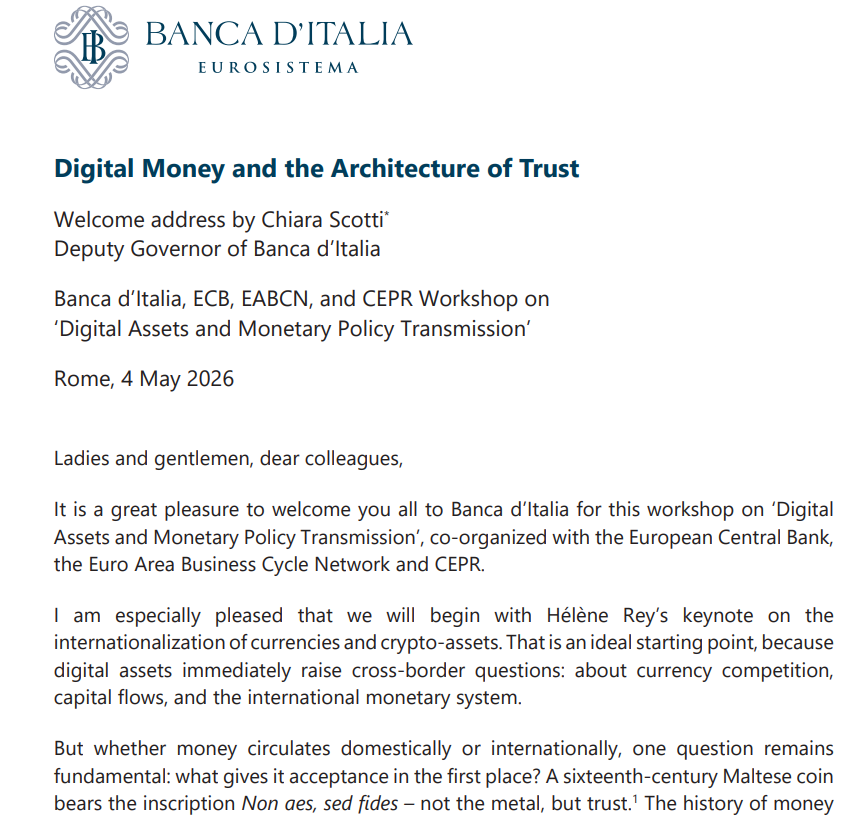
European financial institutions should assess whether the Single Euro Payments Area (SEPA) can be extended into tokenized payments, Bank of Italy Deputy Governor Chiara Scotti said, as policymakers look for ways to keep euro-denominated settlement central to digital finance.
Scotti called a tokenized extension of SEPA an “important area for reflection” during a Monday speech at the Digital Assets and Monetary Policy Transmission workshop in Rome, saying Europe’s existing payments framework offers scale, shared standards and interoperability.
Her comments come as the Eurosystem prepares a pilot for Pontes, a distributed ledger technology settlement initiative designed to link market DLT platforms with TARGET Services and settle transactions in central bank money. The pilot is expected by the third quarter of 2026.
The European Central Bank (ECB) is also developing Appia, a longer-term roadmap for Europe’s tokenized financial ecosystem that is expected to conclude in 2028, as policymakers weigh how tokenized deposits, stablecoins and central bank money should coexist.
The ECB said it was exploring ways to bring central bank money onto DLT due to concerns over the adoption of a non-euro stablecoin, which may have “serious consequences for Europe’s monetary sovereignty,” such as diminishing the euro’s role and creating a dependency on foreign settlement assets.
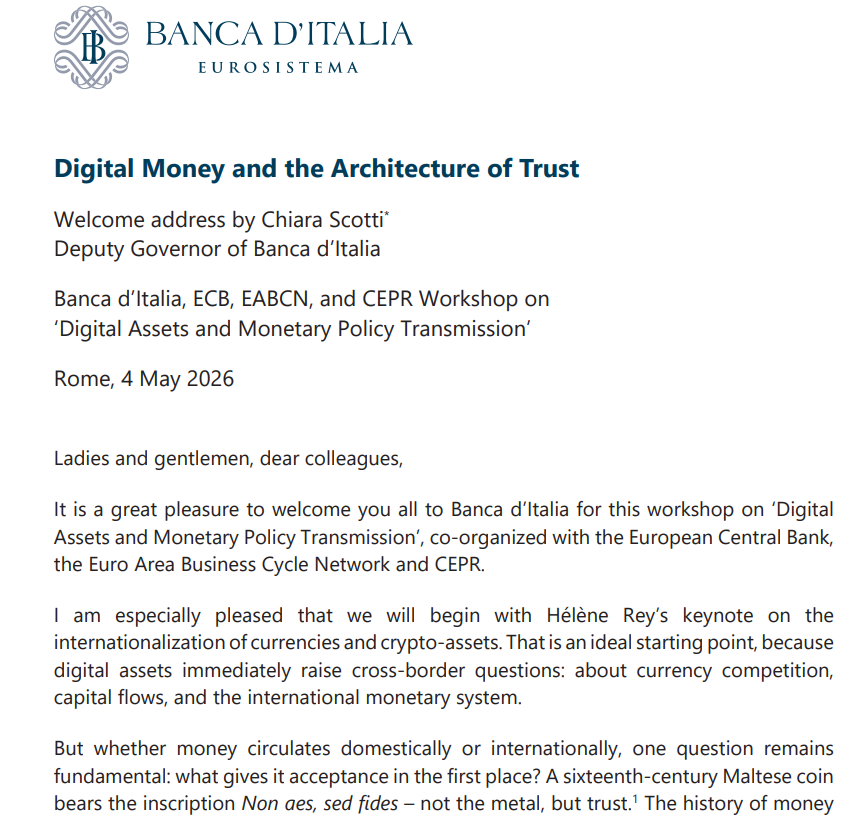
Banca d’Italia, ECB, EABCN, and CEPR Workshop on‘Digital Assets and Monetary Policy Transmission.’ Source: Bank of Italy
ECB says stablecoin adoption may shift bank deposits
The ECB has previously outlined concerns related to widespread stablecoin adoption.
In a report published in November 2025, the ECB said that widespread stablecoin adoption may see households replace some of their bank deposits with stablecoin holdings, leading to significant bank deposit outflows.
“Significant growth in stablecoins could cause retail deposit outflows, diminishing an important source of funding for banks and leaving them with more volatile funding overall.”
In a working paper published on March 4, 2026, the ECB highlighted further risks, including that stablecoin adoption induces a “deposit-substitution mechanism, whereby funds shift from retail bank deposits to digital assets.”
Related: UBS partners with five banks for Swiss franc stablecoin sandbox
Later on March 23, Piero Cipollone, a member of the ECB’s Executive Board, said that both tokenized deposits and stablecoins need tokenized central bank money as a public settlement anchor for scaling Europe’s tokenized financial system, Cointelegraph reported.
Magazine: Crypto wanted to overthrow banks, now it’s becoming them in stablecoin fight

Quick Summary
- First quarter adjusted earnings per share of 55 cents exceeded analyst expectations of 48 cents
- Revenue reached $1.68 billion, marginally surpassing the $1.67 billion consensus forecast
- Annual EPS outlook upgraded to $2.35–$2.40 range, previously $2.25–$2.30
- Company initiating $275 million accelerated stock buyback program
- Approximately 1% pricing adjustment implemented to counter elevated input costs from Iran situation
Shares of DuPont (DD) advanced 1.6% to $46.15 during premarket hours on Tuesday following the specialty materials corporation’s announcement of first-quarter results that surpassed analyst projections and an improved annual forecast.
The company reported adjusted earnings per share of 55 cents, comfortably exceeding the FactSet consensus estimate of 48 cents. Revenue climbed to $1.68 billion from $1.61 billion in the year-ago period, narrowly topping the $1.67 billion analyst forecast.
On a GAAP basis, DuPont recorded net income of $161 million, translating to 39 cents per share, a significant reversal from the $589 million loss, or $1.40 per share, reported in the comparable quarter of the previous year.
[[LINK_START_3]]https://twitter.com/Finsee_main/status/2051612567613645120?s=20[[LINK_END_3]]
It’s important to recognize that year-over-year comparisons require context. The company completed the separation of its electronics division, Qnity Electronics, which impacts historical comparisons.
Additionally, the first quarter results incorporate a three-cent-per-share benefit from discontinued operations associated with the sale of the Aramids business, which was finalized on April 1.
Company Elevates Annual Forecast
Management increased its full-year adjusted earnings per share guidance to a range of $2.35 to $2.40, up from the previous $2.25 to $2.30 projection. Revenue expectations were similarly lifted to $7.16–$7.22 billion from the prior $7.08–$7.14 billion range.
These updated targets exceed current Wall Street expectations, which call for $2.27 per share in earnings on $7.10 billion in revenue.
For the second quarter, the company projects adjusted EPS of approximately 59 cents on revenue of roughly $1.8 billion. This aligns closely with analyst expectations of 58 cents per share on $1.8 billion in sales.
Chief Executive Lori Koch emphasized organic revenue growth, improved profit margins, and double-digit adjusted earnings expansion as key achievements during the quarter. Chief Financial Officer Antonella Franzen explained that the revised annual outlook incorporates approximately 4% organic growth, including about 1% from pricing actions designed to mitigate increased input costs stemming from the Iranian conflict.
Capital Allocation and Divisional Results
The company unveiled plans for a $275 million accelerated share repurchase program commencing immediately. This initiative is part of a comprehensive $2 billion buyback authorization granted by the board in November, which featured an initial $500 million accelerated component.
From a segment perspective, the Healthcare & Water Technologies division delivered 6% year-over-year sales growth, accompanied by a 1.1 percentage point expansion in operating margins. The Diversified Industrials segment achieved 3% revenue growth, likewise recording a 1.1 percentage point improvement in profitability.
DD shares had declined approximately 9% since the outbreak of the Iran conflict on February 28, as market participants assessed the impact of elevated oil prices on production costs. Prior to Tuesday’s trading, the stock remained up 13% year-to-date and had appreciated 66% over the trailing twelve-month period.
The second quarter projection of 59 cents in adjusted earnings per share on $1.8 billion in sales represents the company’s latest near-term guidance.
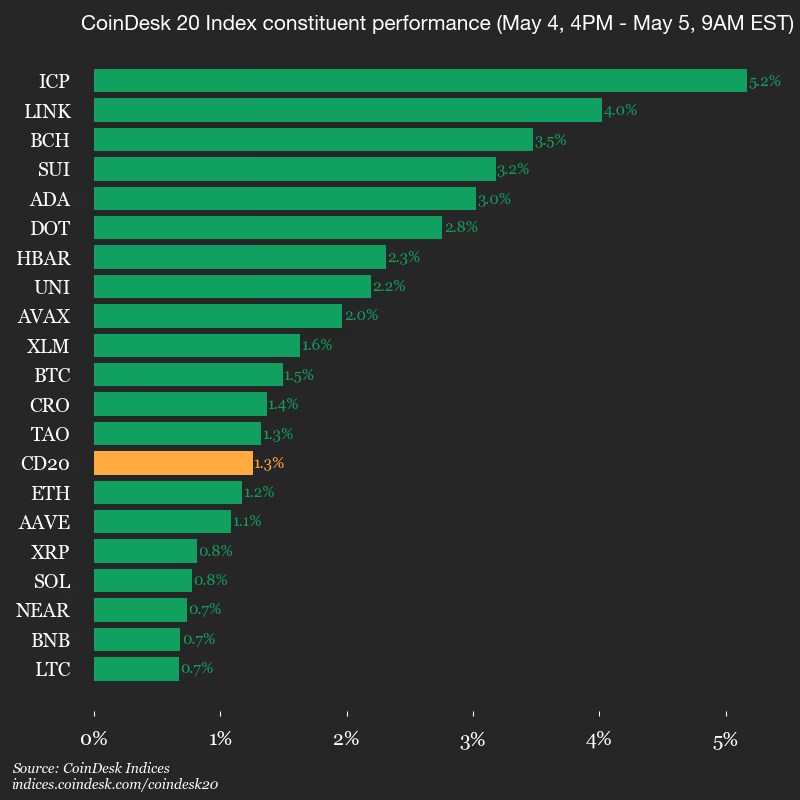
CoinDesk Indices presents its daily market update, highlighting the performance of leaders and laggards in the CoinDesk 20 Index.
The CoinDesk 20 is currently trading at 2154.22, up 1.3% (+26.68) since yesterday’s close.
All 20 assets are trading higher.

Leaders: ICP (+5.2%) and LINK (+4.0%).
Laggards: LTC (+0.7%) and BNB (+0.7%).
The CoinDesk 20 is a broad-based index traded on multiple platforms in several regions globally.
Crypto World
Cardano Just Added Institutional-Grade Compliance Tools: Is This News the Missing Piece for ADA Adoption?
Cardano completed an integration with Scorechain’s blockchain analytics platform, deploying institutional-grade compliance tools, risk scoring, and transaction monitoring built specifically around Cardano’s UTXO model. This is bullish news for cardano.
For regulated entities that have been hesitant to touch ADA, this removes a genuine friction point.
The move is bullish by most reads, addressing compliance hurdles that have historically slowed institutional adoption.
Meanwhile, the Van Rossem hard fork (Protocol Version 11) and the Leios upgrade targeting 1,000+ TPS by end-2026 remain the ecosystem’s headline catalysts.
With Bitcoin holding above $80,000 and total market cap above $2.43 trillion, the macro backdrop isn’t the problem here.
Can Cardano Price Break $0.28 This Week?
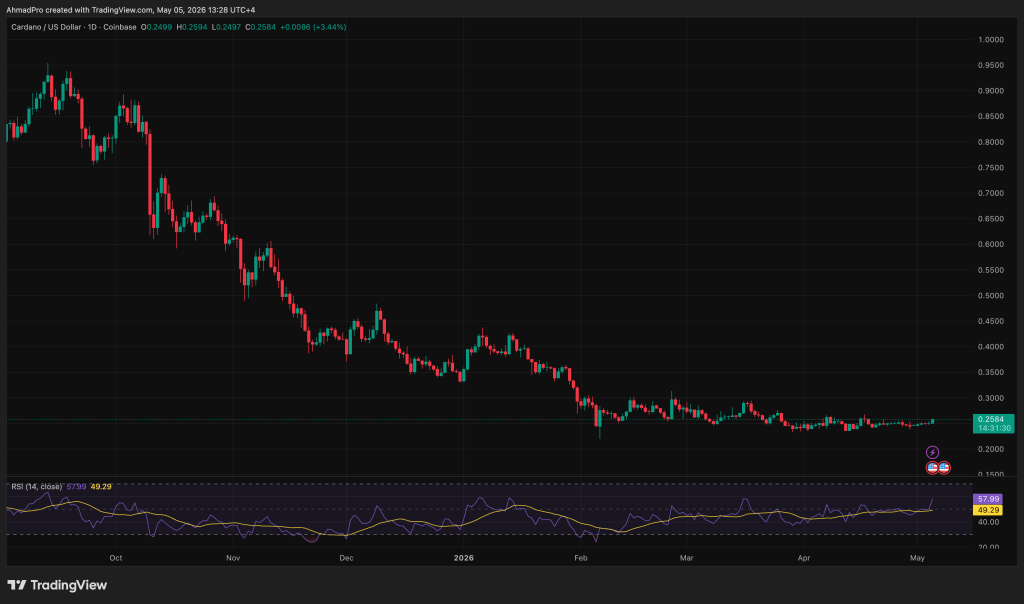
ADA is stuck in a tight range between $0.24–$0.25, and right now, it is just noise inside that band.
$0.26 is the first trigger. Reclaim that with volume, and ADA has a shot at breaking the descending trendline near $0.28, which then opens the move toward $0.30.

On the downside, $0.23 is the line to hold. Lose that, and the structure turns bearish fast, with room toward $0.22 and lower.
The derivatives picture leans cautious. Rising shorts with declining open interest suggest traders are not positioning for a breakout yet.
Most likely, for now, it keeps trading between $0.23 and $0.27 until a real catalyst emerges.
So the rule here is simple: bullish above $0.26, bearish below $0.23, everything in between is just chop.
LiquidChain Could Replace Cardano This Bull Cycle
ADA grinding sideways is the trade-off of scale. The fundamentals can look fine, but without a catalyst, the price can sit for weeks, and even the upside targets stay relatively modest.
That is why some traders start looking earlier in the cycle, where price discovery has not happened yet, and the upside is not capped by market cap.
LiquidChain is aiming at that space, focusing on cross-chain liquidity by connecting Bitcoin, Ethereum, and Solana into a single execution layer. The goal is to remove fragmentation so developers and users can interact across ecosystems without rebuilding or bridging complexity.

The presale is around $0.01456 with just over $718K raised, which puts it in an early stage where interest is building, but the asset is not fully priced.
But it is still unproven. Execution, adoption, and liquidity after launch are all unknowns, which is the trade-off with early-stage infrastructure.
So the contrast is clear, ADA offers a more established but slower-moving setup, while something like LiquidChain offers earlier positioning with higher potential, but also higher risk.
The post Cardano Just Added Institutional-Grade Compliance Tools: Is This News the Missing Piece for ADA Adoption? appeared first on Cryptonews.

GameStop submitted a non-binding $55.5 billion offer to acquire eBay at $125 per share on Sunday, proposing to fund the deal with $9.4 billion in cash and liquid investments plus up to $20 billion in financing backed by TD Securities.
The bid represents a 46% premium to eBay’s share price from early February, when GameStop began quietly building a 5% economic stake through shares and derivatives.
GameStop CEO says he's making an offer to buy eBay for $56B — Culture Crave
“There is nobody who is more qualified, based on my experience, to run the eBay business"
He’d be borrowing over $20B to help make the deal happen
(via @WSJ) pic.twitter.com/20LtVo6vbe
 (@CultureCrave) May 4, 2026
Now the crypto market has a single question: what happens to the $368 million Bitcoin treasury sitting on GameStop’s balance sheet?
CEO Ryan Cohen called the acquisition plan “way more compelling than bitcoin” and left the door open to selling the company’s BTC holdings to help finance the deal. That framing alone moved the conversation from corporate novelty to live market event.
Bitcoin is trading near $81,000, meaning GameStop’s 4,709 BTC position carries meaningful liquidation value, and meaningful sell pressure if Cohen pulls the trigger.

Discover: The best crypto to diversify your portfolio with
Should GameStop Liquidate Its $368M Bitcoin to Fund the eBay Deal?
GameStop’s $55.5 billion M&A bid dwarfs its current balance sheet, even with $9.4 billion in cash and a $20 billion financing commitment; the math is tight. Cohen explicitly described the eBay acquisition as a higher-priority capital deployment than bitcoin, and he confirmed GameStop has the “ability to issue stock in order to get the deal done.” If stock issuance proves insufficient or dilutive, the $368 million Bitcoin treasury becomes an obvious funding lever.
At current BTC prices, liquidating the full position would add roughly $368 million in cash, big but not big enough for a $55.5 billion transaction. The supply-side impact on Bitcoin markets would be limited in isolation, but the signal would carry weight: a company that adopted a Bitcoin Treasury reserve less than 18 months ago abandoning the position under M&A pressure is not a bullish corporate narrative.
GameStop shifted 4,709 BTC to Coinbase Prime as part of a covered call options strategy, generating income while retaining exposure. That is not the behavior of a company planning to dump.
If the eBay deal closes and the combined entity retains the BTC position, GameStop-eBay would control a Bitcoin treasury sitting alongside 135 million active buyers across 190 markets and nearly $80 billion in annual gross merchandise volume. Analysts have flagged this scenario as one that “could open the door for BTC payments integration” at serious scale.
Discover: The best pre-launch token sales
The post GameStop GME Eyes $55.5B eBay Takeover: $368M Bitcoin Treasury in Danger? appeared first on Cryptonews.
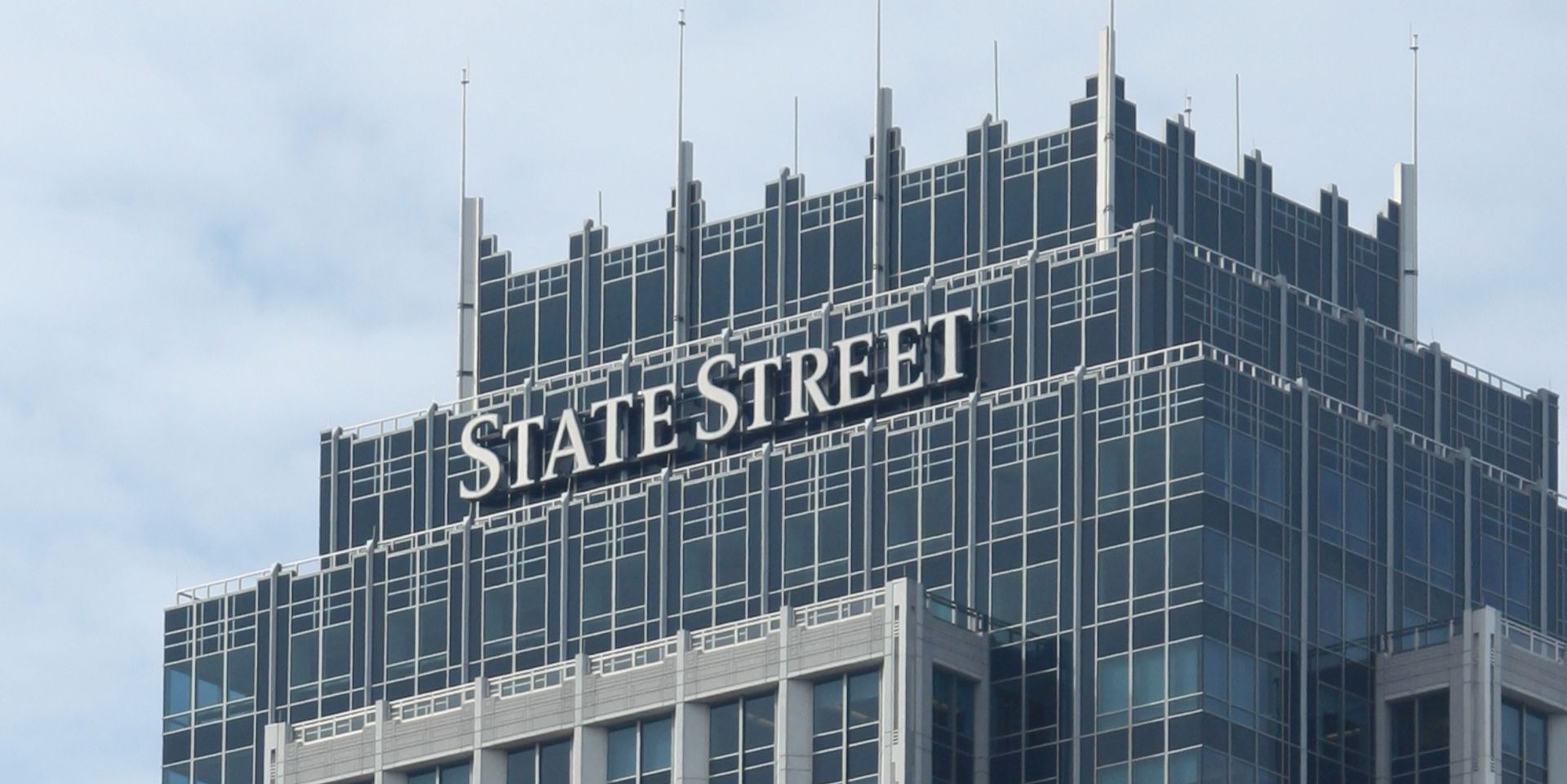
State Street Investment Management and Galaxy Asset Management (GLXY) have launched a tokenized fund designed to move a core piece of finance — cash management — onto blockchain networks, the firms said Tuesday.
The State Street Galaxy Onchain Liquidity Sweep Fund, trading under the ticker SWEEP, allows large investors to park stablecoins into a fund that generates yield, while keeping the ability to move in and out at any time. Unlike traditional money market funds that operate during market hours, the new structure runs continuously on blockchain infrastructure.
The market for tokenized funds has grown quickly over the past year, led by products like BlackRock’s BUIDL, which packages short-term U.S. Treasury exposure into a blockchain-based token. BUIDL has attracted billions of dollars, signaling that institutions are willing to hold tokenized versions of familiar instruments when the structure meets compliance and liquidity needs.
Other firms, including Franklin Templeton and now State Street with SWEEP, are building similar products, each experimenting with different blockchains and investor access models.
SWEEP launches on the Solana (SOL) blockchain, with plans to expand to Ethereum (ETH) and Stellar (XLM). Galaxy provides the underlying tokenization system, while Anchorage handles custody of digital assets and State Street oversees traditional securities held in the portfolio.
The move reflects a broader shift among large financial firms exploring how blockchain can update market plumbing. Today, moving cash between accounts or funds often involves delays, cut-off times and intermediaries. A blockchain-based system can, in theory, allow money to move instantly and around the clock.
The launch also deepens ties between State Street and Galaxy, which have worked together on digital asset investment products since 2024.
For State Street, which manages more than $5 trillion in assets, the fund signals a step toward offering traditional investment products in tokenized form. For Galaxy, it reinforces its push to build infrastructure that connects crypto markets with institutional finance.
Access to the fund is limited to qualified institutional investors, underscoring that, for now, the shift to onchain finance remains focused on large players rather than retail users.

Innovation City, a Ras Al Khaimah free zone focused on artificial intelligence and Web3, has unveiled what it calls the first blockchain-based digital business identity system. In a Monday release shared with Cointelegraph, the city said every company registered there will receive a sovereign, cryptographically verifiable identity issued on OPN Chain, the public blockchain infrastructure developed by UAE-based IOPn.
The release frames the initiative as converting a traditional business license from a static document into a dynamic on-chain asset, designed to reduce reliance on central intermediaries and to cut verification uncertainty across the free zone’s ecosystem.
The move aligns with a broader UAE push to replace traditional registries with blockchain-based identity systems and AI-driven workflows, a policy direction proponents say could streamline verification and digital operations for businesses operating in the United Arab Emirates.
Key takeaways
- Innovation City will issue on-chain, cryptographically verifiable business identities to its registered firms via the OPN Chain, covering more than 1,000 companies at launch.
- The onchain identity is intended as the native business registration primitive within the free zone, not merely an optional credential layered onto a traditional registry.
- OPN Chain uses a public validator network and a hybrid data model that stores core transaction data and proofs on-chain while handling sensitive or large datasets off-chain.
- The project emphasizes security through human-in-the-loop authorization for consequential actions and designs the agent layer with adversarial scenarios as a first principle.
- External adoption remains uncertain, with no specific banks, regulators, or exchanges named as current validators or acceptors of these onchain identities; questions persist about dispute handling and credential revocation when third parties are involved.
How the onchain business IDs work
Jimi Ibrahim, co-founder and chief operating officer of IOPn, told Cointelegraph that at launch the onchain identity framework is intended to extend across Innovation City’s client base of more than 1,000 companies, with immediate live utility within the free zone’s own digital ecosystem.
He described the core value not merely as issuing a digital certificate but as establishing a cryptographically verifiable business identity to be used for access and verification across Innovation City’s touchpoints, such as the business center and selected ecosystem services, with plans to broaden to partner providers in technology, marketing and legal services over time.
OPN Chain is presented as a public network where validator participation is open to institutions, infrastructure partners and governance-approved node operators. The system uses a hybrid data model in which core transaction data and proofs stay on-chain while sensitive or large datasets are handled off-chain, balancing transparency with privacy concerns.
Company registration under this framework is described as the native primitive within the free zone rather than an optional overlay on top of a conventional registry, distinguishing it from some digital-ID schemes such as Estonia’s e-residency example.
AI security and geopolitical risks
Recent exploits have highlighted how AI agents can be socially engineered to authorize transfers from wallets they control, underscoring the fragility of autonomous workflows. Ibrahim emphasized that every agentic workflow built on these identities will require human oversight for consequential actions, and that the agent layer is designed with adversarial scenarios as a core consideration from the outset.
The timing of the launch also intersects with regional tensions and new attacks affecting the UAE. Within this broader context, observers note that UAE investors have continued to allocate capital toward AI infrastructure, software and crypto-related assets, even amid volatility, according to data cited by Cointelegraph from eToro. Deutsche Bank researchers have also argued that the conflict may spur demand for AI rather than derail it.
Regulatory and market backdrop in the Gulf
The initiative sits within a wider policy push in the United Arab Emirates to move away from traditional registries toward blockchain-based identities and AI-enabled workflows. Government and industry watchers see potential benefits in streamlined verification, faster onboarding and more seamless cross-service operations, though practical adoption will hinge on external actors — banks, regulators, and service providers — recognizing and validating onchain credentials.
That context is underscored by the absence of named external banks or regulators currently recognizing Innovation City’s onchain identities, leaving questions about interoperability and dispute resolution when third parties are involved. The launch also arrives as the UAE seeks to attract AI and crypto investment, a dynamic reflected in investor behavior and market commentary cited by industry observers.
Uncertainties and next steps for external adoption
Key questions remain around how these onchain identities will be verified by external institutions such as banks and regulatory bodies, and how disputes or credential revocations will be handled when third parties are involved. The immediate utility is clear within Innovation City’s own digital ecosystem, but external integration will determine whether the model can scale beyond the free zone and become a broader standard.
As Innovation City pilots this approach, the next chapters will reveal whether the wider Gulf region and international partners will adopt similar onchain business identity primitives, and how issues of governance, data privacy and cross-border interoperability are resolved.
Readers should watch whether banks and regulators begin recognizing these onchain IDs outside Innovation City and how revocation or dispute handling will work as adoption expands.

Steps to Take After an Auto Accident in Odessa Texas

Crypto.com’s high-rolling head of marketing to leave after almost six years

Is a Green wave about to break in local and devolved elections?

Manchester United reach agreement with Casemiro over contract clause amid transfer speculation

US brings back mandatory military draft registration

Steven Gerrard disagrees with Gary Neville over ‘shock’ Chelsea and Arsenal claim | Football
![Mobil dua roda? [Adira Finance berizin dan diawasi oleh Otoritas Jasa Keuangan] #CobaMoservice](https://wordupnews.com/wp-content/uploads/2026/05/1777989150_maxresdefault-80x80.jpg)
Mobil dua roda? [Adira Finance berizin dan diawasi oleh Otoritas Jasa Keuangan] #CobaMoservice
![Who's your favorite girl in Digital Circus? [Money Money Green green meme] #shorts #trend](https://wordupnews.com/wp-content/uploads/2026/02/1771002718_maxresdefault-80x80.jpg)
Who’s your favorite girl in Digital Circus? [Money Money Green green meme] #shorts #trend

BITCOIN $80K SQUEEZE: IT’S CONFIRMED (This is Next)!!! – Bitcoin News Today, Ethereum & Altcoins
-

 Business7 days ago
Most Commercial Energy Audits Miss the Real Losses
-

 NewsBeat2 days ago
Channel 5 – All Creatures Great and Small series 7 new post
-

 Fashion7 days ago
Kylie Jenner’s KHY Enters a New Era with ‘Born in LA’
-
 Tech4 days ago
Trump’s 25% EU auto tariff breaches Turnberry Agreement that also covers semiconductors and digital trade
-
 Sports4 days ago
Paul Scholes issues Marcus Rashford reality check as agreement emerges over Man United star
-

 Business6 days ago
Barclay Brothers Avoid Bankruptcy: HSBC Drops High Court Petitions After IVA Deal
-
 Business6 days ago
Tesla Officially Registers Elon Musk’s Stock: What Investors Need to Know
-

 Tech7 days ago
Get Ready for More Brain-Scanning Consumer Gadgets
-

 Business5 days ago
Two Powerball Tickets Split $143 Million Jackpot in Indiana and Kansas
-

 Tech6 days ago
Texas Instruments made a new flagship graphing calculator: the TI-84 Evo
-
Business2 days ago
Winning Numbers Drawn as Jackpot Resets to $20 Million
-
 Crypto World5 days ago
CoreWeave (CRWV) Stock Climbs 8% Despite $45M Insider Share Dump
-
 Crypto World6 days ago
Securitize and Computershare Enable Tokenized Equity Issuance for Over 25,000 U.S.-Listed Stocks
-

 Entertainment5 days ago
Insider Claims Reason Behind Key & Peele Split
-

 Entertainment5 days ago
Celebrities Who Are Attending the 2026 Met Gala Event
-

 Crypto World6 days ago
Gibraltar Proposes Tokenized Funds Regulation to Bolster Compliance
-

 Entertainment4 days ago
Met Gala 2026 Rumored Guest List Is Turning Heads
-

 Business7 days ago
Alexandria Real Estate Equities, Inc. (ARE) Q1 2026 Earnings Call Transcript
-

 Fashion3 days ago
Mary J. Blige Vegas Residency Looks: Crystal-Embellished Fjolla Haxhismajli, Todd Fisher, and More!
-

 Crypto World6 days ago
Meta (META) starts stablecoin payout to creators in Circle’s USDC on Polygon, Solana via Stripe
You must be logged in to post a comment Login