
Crypto World
Crypto Fear and Greed Turns Neutral As Bitcoin Holds $80K

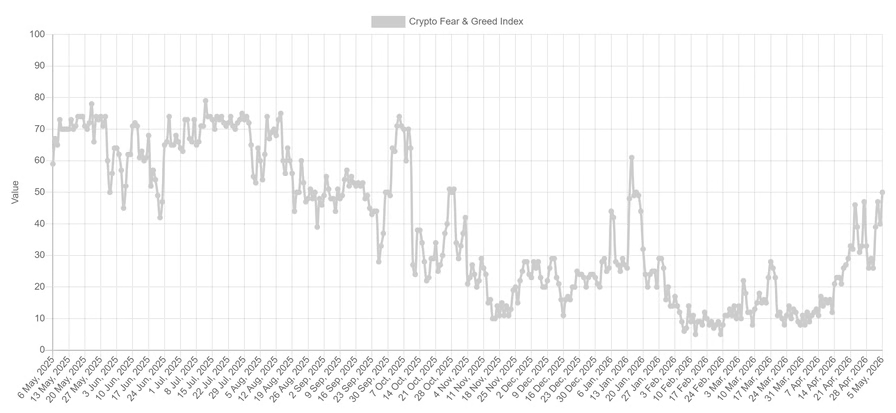
The Crypto Fear and Greed Index hit 50 on Tuesday, measuring “neutral” for the first time since Jan. 17. This shift ended a 108-day stretch dominated by negative sentiment. The index gauges market sentiment using volatility, momentum, trading volume, and social signals. A score below 25 signals “extreme fear” or risk aversion, while 26–49 reflects cautious positioning or “fear,” with higher readings indicating improving investor confidence.
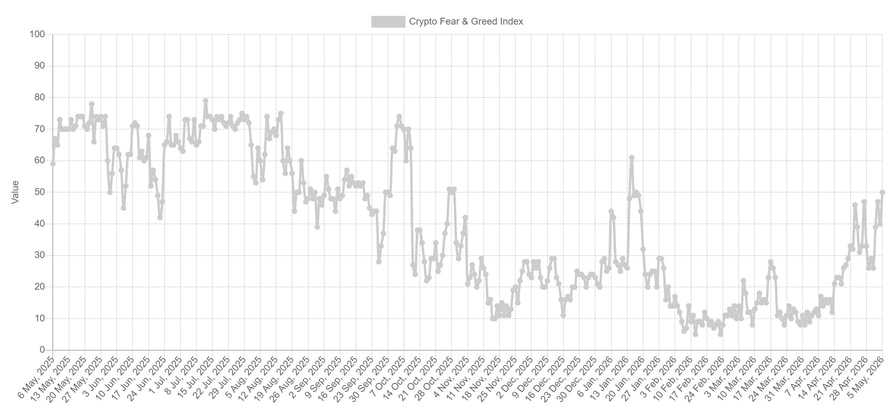
Crypto Fear and Greed Index. Source: Alternative.me
The index’s move to 50 marks its first neutral score since mid-January and follows a steady recovery in the total crypto market capitalization, which rose 5.45% in May. Since March, the market has expanded by 16.51%, climbing to $2.66 trillion from $2.28 trillion.
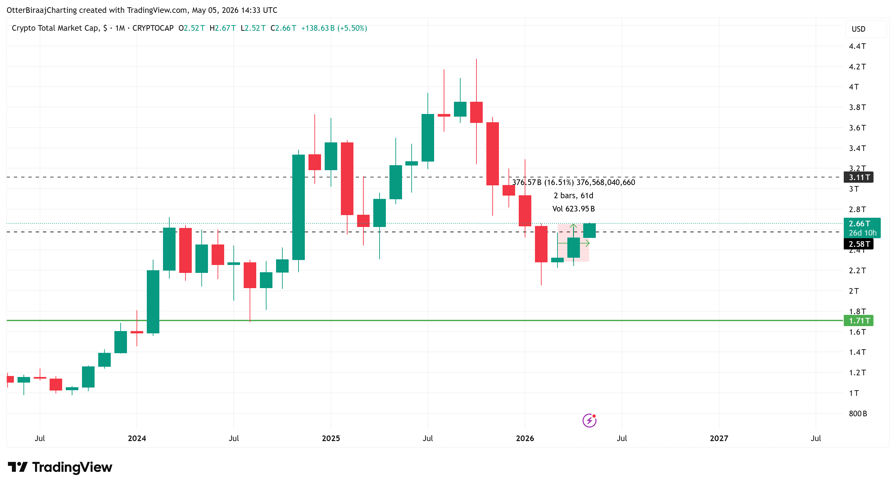
TOTAL market cap on the one-month chart. Source: Cointelegraph/TradingView
The positive shift in sentiment aligns with Bitcoin’s attempt to stabilize above the $81,000 level. Crypto analyst Darkfost noted that BTC sentiment is turning more constructive as the price tests higher levels. The analyst added that a separate sentiment index, ranging from -100 to +100, has also edged into the greed zone. This indicates that investor confidence is improving, with a growing preference to hold BTC rather than exiting positions.
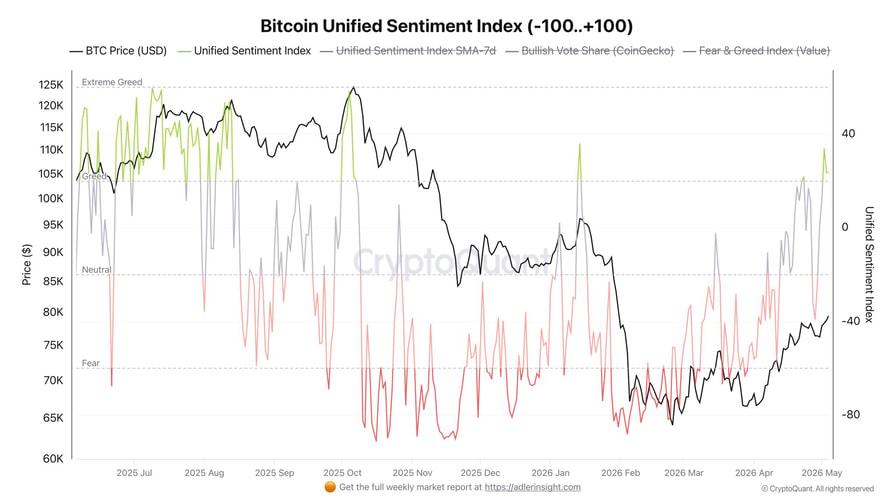
Bitcoin unified sentiment index. Source: CryptoQuant
January showed a similar shift in sentiment before the momentum faded. Darkfost pointed to the current phase as a potential pivot, with investor behavior shaping the next move.
Related: Bitcoin ‘supercycle’ or a bear market rally? BTC breaking $81K has traders at odds
Stablecoin outflows may stall momentum
Binance stablecoin netflows have recorded a cumulative outflow of $11.8 billion since April 25. This metric tracks the movement of stablecoins into and out of the exchange and is often used as a proxy for available buying power.
Positive net flows signal capital entering the exchanges, often associated with accumulation. A negative net flow indicates capital leaving, which can reduce liquidity for spot crypto purchases.
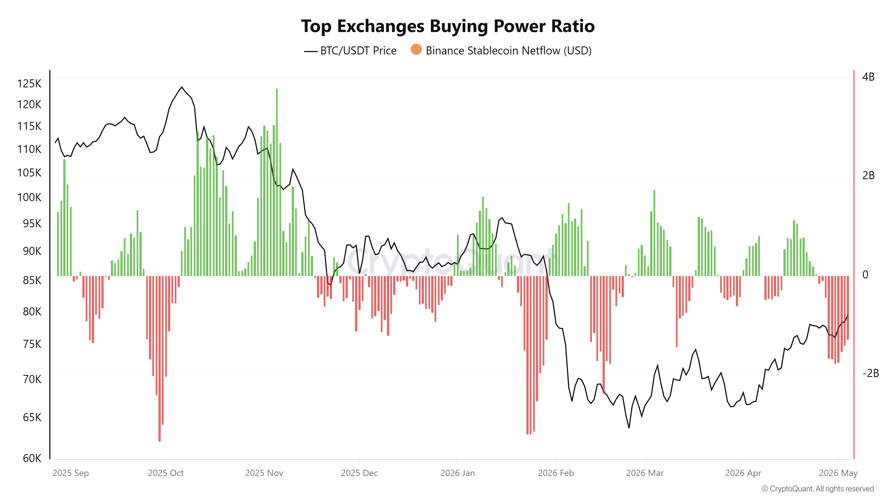
Binance stablecoin netflows. Source: CryptoQuant
Recent data shows a sustained drainage phase, with daily outflows exceeding $1.5 billion across multiple sessions. Earlier in April, Binance saw consistent inflows as Bitcoin climbed from $74,000 toward $78,000. That inflow cycle has now reversed.
Market analyst Crazzyblockk noted that the earlier buildup of stablecoin reserves helped fuel the upward movement. The current outflow trend suggests this pool of deployable capital has thinned in the short term, potentially tempering the bullish momentum for BTC and other crypto assets.
Related: Crypto products post 5th straight week of inflows despite mid-week selloff


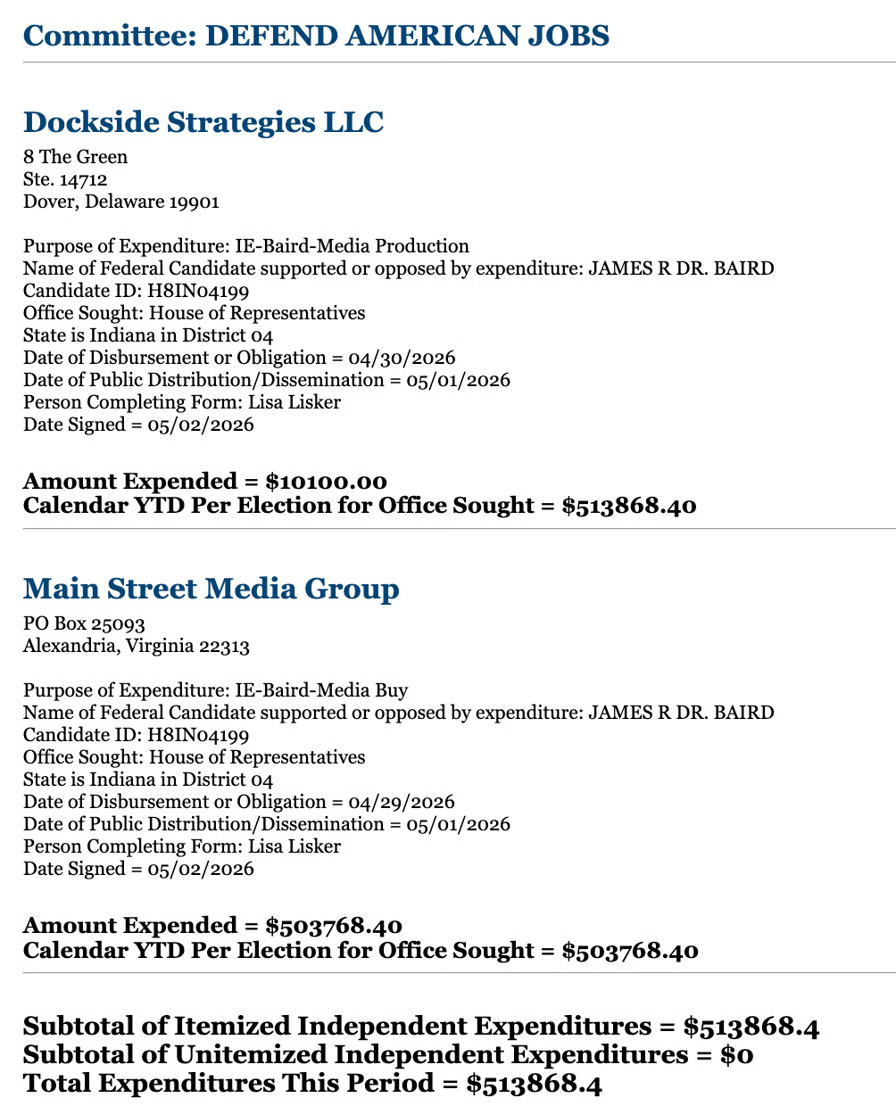
A crypto-backed political action committee affiliated with Fairshake is intensifying its midterm push, disclosing a six-figure media spend in support of a GOP incumbent in Indiana. A Federal Election Commission filing shows Defend American Jobs, part of Fairshake’s network, spent more than $514,000 on media in favor of James Baird in Indiana’s 4th Congressional District.
The filing details a substantial media buy aimed at aiding Baird’s reelection bid as political groups aligned with cryptocurrency advocacy sharpen their spending as Americans head toward the midterms. Baird, who took office in January 2019, has backed digital-asset policy initiatives in the past, including votes on the GENIUS Act, a stablecoin-related payments bill, and the CLARITY Act, a package shaping digital-asset market structure. Stand With Crypto, a Coinbase-aligned crypto advocacy organization, rates Baird as a candidate who “strongly supports crypto.”
Fairshake and its affiliates—Defend American Jobs and Protect Progress—have signaled a broader strategy for 2026, signaling that they expect to deploy millions to back “pro-crypto” candidates in the general election cycle. The latest filing places a concrete figure on Indiana activity, but the umbrella aims to sustain a nationwide footprint as candidates with crypto-friendly stances seek advantage ahead of November’s elections.
Cointelegraph has previously reported sizable investments by Fairshake-backed political action committees. In 2024, the group disclosed more than $130 million in media expenditures supporting crypto-friendly candidates, including a roughly $40 million outlay in Ohio’s U.S. Senate race, which the PAC framed as part of its broader drive to favor pro-crypto leadership. The Indiana filing comes as the network seeks to translate those nationwide efforts into momentum in key battlegrounds.
The Indiana race itself is straightforward: the primary pits Baird against state Representative Craig Haggard. Backers of Fairshake’s broader effort include notable crypto industry players Coinbase and Ripple Labs. Cointelegraph requested comment from Fairshake but did not receive an immediate reply.
Key takeaways
- Defend American Jobs reported a media spend of about $514,000 to back James Baird in Indiana’s 4th District, illustrating a targeted use of crypto-linked PAC funds in state races.
- Fairshake’s network, including Defend American Jobs and Protect Progress, signals an ongoing plan to spend “millions” in support of pro-crypto candidates during the 2026 cycle.
- The broader crypto-political operation links to major industry players such as Coinbase and Ripple Labs, highlighting the industry’s willingness to mobilize resources through PACs.
- Historical context shows a pattern of large media spending by crypto-aligned PACs in 2024, with Ohio singled out as a major example; what happens in 2026 could inform the broader regulatory and political climate.
- Regulatory dynamics remain central: the GENIUS Act, the CLARITY Act, and their movement through Congress frame how the crypto sector seeks formal market structure and regulatory clarity ahead of elections.
Crypto influence in the Indiana primary and beyond
The Indiana filing situates Defend American Jobs and its associated groups within a broader ecosystem that has emerged around the Fairshake umbrella. The groups are positioning themselves as defenders of crypto-friendly policies at a time when policymakers in the United States grapple with how to regulate digital assets, ensure market integrity, and guard consumer protection without stifling innovation. The CLARITY Act, which outlines a proposed framework for digital asset markets, has been stalled in the Senate after clearing the House in mid-2025. Observers note that bipartisan talks and a recent compromise proposal have changed the dynamics, but uncertainty remains about whether the bill will reach a floor vote and what changes, if any, will be accepted by the Senate leadership.
In Indiana, Baird’s voting history on crypto-related legislation has fed into the narrative that he is crypto-friendly. Stand With Crypto’s rating of his stance reinforces the messaging strategy behind the campaign’s sizable media investment. For opponents, the spending underscores a broader effort to elevate crypto policy as a decisive electoral issue, a pattern already seen in other states where the PAC has directed substantial resources.
Data from Fairshake indicates a broader ambition: to mobilize financial support for candidates deemed favorable to crypto interests. The group has previously disclosed substantial war chests, with Fairshake reporting assets in the hundreds of millions of dollars in some periods. In Illinois, for example, the network allocated significant sums to races for governor and the state legislature, and it has noted similarly sizable activity in Texas. While the quantities shift with each cycle, the underlying strategy remains consistent: align political power with policy outcomes favorable to the crypto sector.
Analysts and observers point to the regulatory backdrop as the crucial determinant of political spending. The CREPT or “crypto market structure” framework advanced by the House and the stalled Senate process create a high-stakes environment for investors and builders who seek clarity and early-stage policy certainty. The prospect of broader, standardized rules—covering stablecoins, custody, exchanges, and market surveillance—could translate into a more predictable operating environment for participants and, by extension, influence political calculations in the midterms and beyond.
As campaigns continue to evolve, readers should watch whether the Senate marks up the CLARITY Act or introduces new language that reflects evolving concerns about ethics, disclosure, and stablecoin yields. The degree to which crypto industry players mobilize on the ground—via PACs, donor networks, and advocacy coalitions—will offer a critical gauge of how political finance intersects with technology policy in the coming months.
To corroborate any specific claims or updates, observe the ongoing FEC filings and committee disclosures, which continue to shape the public ledger of crypto-aligned political spending. For the latest on Fairshake and its affiliates’ activity, readers can review the official FEC filing referenced in this report: Defend American Jobs PAC, C00836221, 1972239, se.
What remains uncertain is how the regulatory process will unfold in the Senate and how much of the crypto policy agenda will be reflected in campaign messaging as the midterms approach. Investors and users should weigh the potential implications: more formal market structures could unlock broader adoption, while the political calculus surrounding who controls policy could influence funding landscapes for crypto-friendly candidates in 2026 and beyond.
As the year advances, the industry will continue to monitor both the policy horizon and the political battlefield, where campaign spending and regulatory ambition intersect with the real-world adoption of digital assets.
Defend American Jobs, the cryptocurrency-backed political action committee (PAC) affiliated with Fairshake, reported spending more than $500,000 on media to support a Republican incumbent representative in Indiana.
According to a Saturday filing with the US Federal Election Commission (FEC), the Defend American Jobs PAC spent about $514,000 on media in support of James Baird, a Republican House member running for reelection in Indiana’s 4th Congressional District. The spending was the latest in Fairshake’s spending on the 2026 US elections ahead of today’s Indiana primary elections.
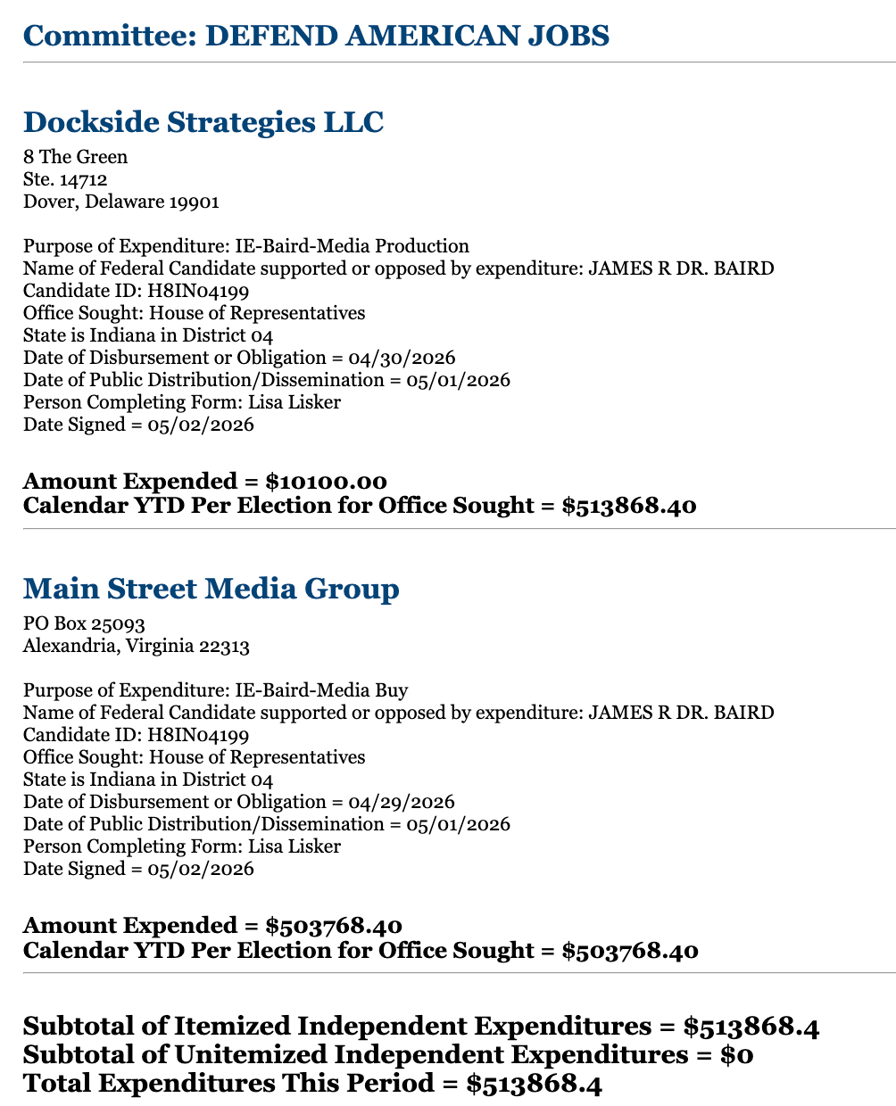
Source: FEC
Baird, who assumed office in January 2019, voted in favor of the GENIUS Act, the stablecoin payments bill, and the CLARITY Act, legislation aimed at creating digital asset market structure that has been stalled in the US Senate for months.
The Coinbase-aligned digital asset advocacy organization Stand With Crypto rated the Republican as “strongly supports crypto.”
Fairshake and its affiliates, Defend American Jobs and Protect Progress, are expected to spend millions of dollars in support of candidates they consider “pro-crypto” in this year’s US midterm elections.
In 2024, the PAC reported more than $130 million in expenditures for media supporting such candidates, including $40 million for Ohio’s US Senate race, in which voters rejected three-term Democratic incumbent Sherrod Brown. He is running this year to unseat Senator Jon Husted, a Republican appointed to fill Vice President JD Vance’s old seat.
Related: Americans distrust crypto, AI as industry super PACs flood midterms, poll finds
Today’s Indiana primary pits Baird against Indiana state representative Craig Haggard. Fairshake‘s backers include crypto companies Coinbase and Ripple Labs. Cointelegraph requested a comment from Fairshake but did not receive an immediate response.
Six months until US midterms with crypto bill hanging in the balance
All 435 seats in the US House of Representatives and 33 seats in the US Senate are up for grabs in the November’s midterm elections, with money from crypto lobbyists and PACs expected to potentially influence voters.
Fairshake reported holding $193 million in its coffers as of January, and said it will “oppose anti-crypto politicians and support pro-crypto leaders” in 2026. The PAC has already spent about $8.6 million in Illinois races for the state‘s governor and Senate and House members, and more than $1 million in Texas races.
The spending reports come as the US Senate is expected to schedule a markup on the CLARITY Act. The digital asset market structure legislation, passed by the House in July 2025, has been stalled in the Senate for months largely over concerns on ethics and stablecoin yield, but may be progressing after lawmakers announced a compromise last week.
Magazine: North Korea denies crypto hacks, Upbit’s bank tests Ripple: Asia Express

Russia’s largest regulated exchange is making news with a move on Ripple. Moscow Exchange (MOEX) is set to publish an official XRP index as part of a crypto expansion that also covers SOL, TRX, and BNB, using global price feeds to anchor regulated exposure.
MOEX’s crypto index rollout will have XRP among the flagship offerings. The exchange is leveraging global price feeds built for institutional-grade benchmarking. Futures contracts are also planned, targeting an October 13 launch date, meaning the index publication next week serves as the foundation for a much larger derivatives play.
— RippleXity (@RippleXity) May 5, 2026
 JUST IN: Moscow Exchange goes live with $XRP index on May 13.
This is regulated crypto infrastructure at scale. The broader context, like dollar liquidity and geopolitical hedging demand, gives this development more runway than a typical exchange listing. Price action will follow the narrative, but the technicals tell their own story.
Discover: The best crypto to diversify your portfolio with
Can Ripple Hold Its Ground as MOEX News Builds?
XRP has been consolidating beneath key resistance as the MOEX announcement enters the market. Historically, institutional index publication events compress short-term volatility before triggering directional expansion.
On the technical side, XRP is holding just at its 50-day moving average, a level that has repeatedly acted as dynamic support during recent pullbacks. Volume has been subdued ahead of the catalyst, which typically indicates accumulation.

MOEX index publication could trigger fresh institutional inflows, which can drive XRP to clear $1.50 resistance. And not to forget, MOEX’s October futures launch as a secondary catalyst. However, should macro deterioration happen from Middle East escalation, and/or equity selloff pressure, it could overwhelm the XRP catalyst and force a retest of $1.2 support.
Discover: The best pre-launch token sales
Bitcoin Hyper Eyes Early Infrastructure Upside
XRP’s MOEX moment confirms the broader theme of 2026: regulated institutions want exposure to crypto infrastructure. That same logic, getting in before the infrastructure is priced, is exactly what’s driving early interest in Bitcoin Hyper ($HYPER), a Bitcoin Layer 2 project that has raised $32.5 million at a current presale price of $0.0136, and staking is live with a high 36% APY.
Bitcoin Hyper is the first Bitcoin Layer 2 that integrates the Solana Virtual Machine, delivering smart contract execution faster than Solana while inheriting Bitcoin’s security model.
That combination of BTC trust layer, SVM execution speed, and decentralized canonical bridge for BTC transfers directly addresses the three core weaknesses that have kept Bitcoin sidelined from DeFi: slow transactions, high fees, and absent programmability.
The post Ripple News: Moscow Exchange to Publish Official XRP Index Next Week appeared first on Cryptonews.
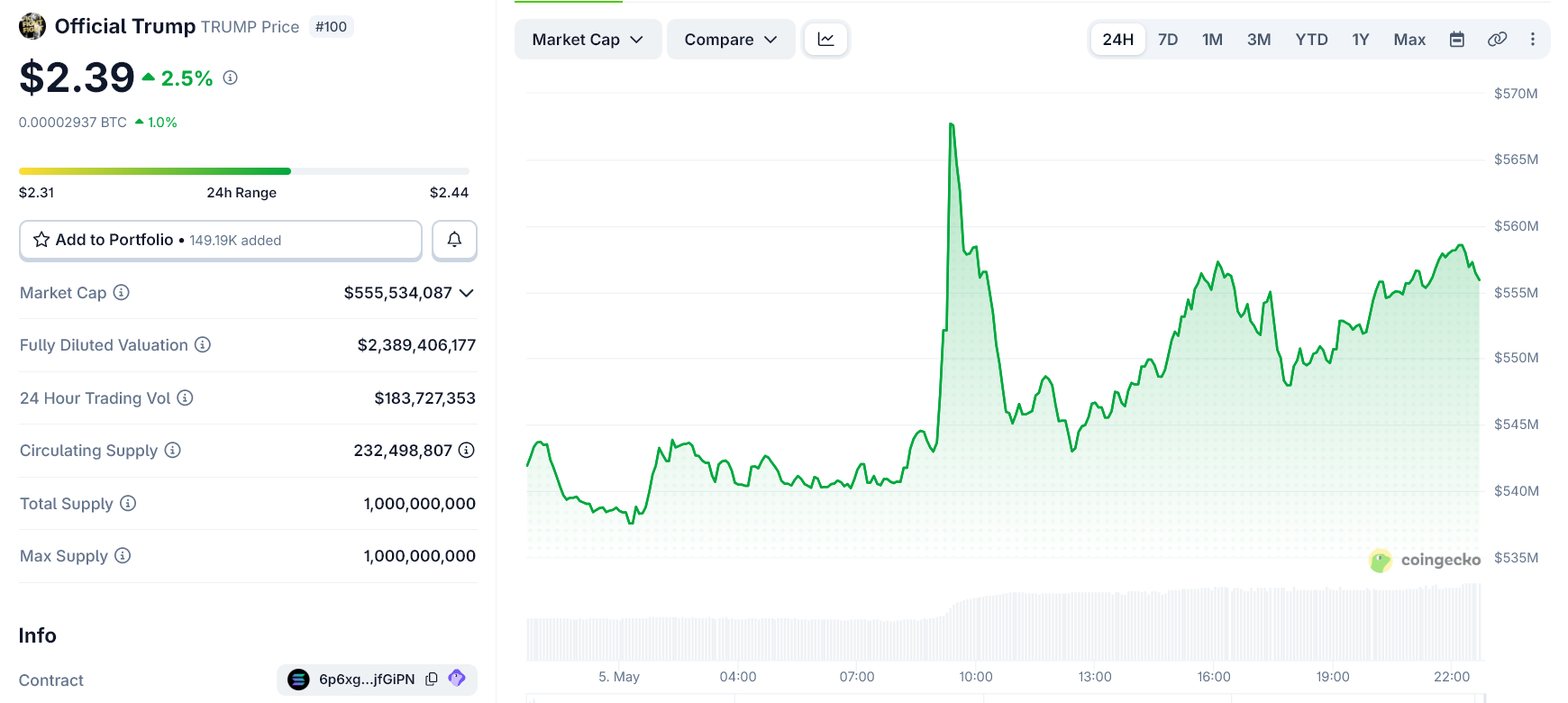
Trump-themed cryptocurrencies climbed in tandem after Eric Trump unveiled the official logo for the renamed Donald J. Trump International Airport in Palm Beach, Florida.
Official Trump (TRUMP) gained 3.75%, MAGA (TRUMP) rose 3.29%, and TrumpCoin (DJT) added 1.1%, the smallest of the three but the one most directly tied to the airport’s proposed DJT call letters.

Airport Logo Reveal Sparks Token Reaction
The president’s son shared a gold eagle emblem on X and thanked his father in the post.
“Looking forward to seeing flights landing at ‘DJT’ very very soon!” Eric Trump posted.
Florida Governor Ron DeSantis signed legislation in March that renames Palm Beach International Airport (PBI) effective July 1, 2026, according to the airport.
A separate federal bill is still required before the International Air Transport Association can swap PBI for DJT.
Around $5.5 million has been earmarked for new signage and rebranding work tied to the change.
Trademark filings linked to the Trump Organization were submitted ahead of the bill signing.
Trump Meme Coins Stay Far Below 2025 Peaks
The largest reaction came on TRUMP, the Solana meme coin Donald Trump endorsed three days before his January 2025 inauguration.
The token holds a market capitalization above $558 million but still trades 96% below its $73.43 launch peak.
MAGA, a community token tied to the broader pro-Trump movement, posted similar gains.
The smaller TrumpCoin (DJT) sits more than 99% below its 2024 high, with a market value near $647,000 and thin daily volume.
Trump-themed tokens have already reacted to past presidential remarks and a recent Mar-a-Lago summit for top holders.
The next political catalyst could arrive on July 1, when the airport name change formally takes effect, and DJT-themed flows may face another whale test.
The post Several Trump Meme Coins Rally After Airport Logo Reveal appeared first on BeInCrypto.

TLDR:
- Bitcoin’s STH-SOPR has held above 1.0, showing short-term holders are consistently selling at a profit.
- The STH Realized Price remains unbroken, acting as the final barrier before a confirmed bull dynamic.
- CryptoQuant analyst @cryptometugce warns that rejection at STH Realized Price may prompt hedge positioning.
- Full bull market confirmation requires Bitcoin to break, hold, and sustain a move above the STH Realized Price.
Bitcoin is showing early signs of a bullish market shift, according to a recent analysis by crypto analyst @cryptometugce, published via CryptoQuant.
The report points to improving on-chain metrics, particularly around short-term holder behavior. However, analysts caution that a critical resistance level remains unbroken.
Until Bitcoin convincingly clears that barrier, the market cannot be fully confirmed bullish. Investors are advised to watch price reactions closely before making major positioning decisions.
STH-SOPR Climbs Above 1.0, Signaling Short-Term Profit-Taking
Bitcoin’s Short-Term Holder Spent Output Profit Ratio, or STH-SOPR, has held above the 1.0 line for a sustained period. This metric measures whether short-term holders are selling at a profit or a loss.
When STH-SOPR stays above 1.0, it means sellers are exiting positions in profit. That pattern is generally associated with growing market confidence among newer investors.
This development carries weight because short-term holders are typically the most reactive group in the market. Their willingness to sell at a profit, rather than panic-sell at a loss, reflects improving sentiment.
It suggests the market is absorbing selling pressure without breaking down. That alone is a constructive signal worth tracking.
In bull markets, STH-SOPR consistently holding above 1.0 is one of the more reliable indicators analysts watch. The current reading aligns with that historical pattern.
However, analysts note that this metric alone is not sufficient to declare a full bull cycle. Additional confirmation is still needed from price structure.
As @cryptometugce stated via CryptoQuant, “In a bull dynamic, STH-SOPR should be above 1.0.” The analyst acknowledged this as a positive development while also noting that one key obstacle still stands in the way of a complete confirmation. That obstacle is the STH Realized Price, which Bitcoin has yet to breach convincingly.
STH Realized Price Remains the Critical Threshold to Watch
The STH Realized Price represents the average cost basis of short-term Bitcoin holders. When Bitcoin trades below this level, short-term holders are collectively sitting on unrealized losses.
Trading above it means most recent buyers are in profit, which typically supports stronger market momentum.
Bitcoin has not yet moved decisively above this level. The analysis from CryptoQuant points to specific price zones marked on charts where Bitcoin has previously reacted to this threshold.
Those reactions have historically determined whether a rally continues or stalls. Traders are encouraged to study those areas carefully.
According to the analyst, “If we pass it, move above it, stay above it, and rise above it, then we will be able to say more easily: we are in a bull dynamic.”
That sequencing matters. A brief spike above the level without sustained follow-through would not qualify as confirmation.
If Bitcoin fails to hold above the STH Realized Price and begins pulling back, the analyst recommends that investors consider hedge positions.
A rejection at that level could signal that the market is not yet ready for a sustained rally. Until then, caution remains the appropriate posture for most market participants.



Miami Beach, FL — Arjun Sethi, co-CEO of Payward and Kraken, said the crypto exchange is “about 80% ready” to go public, underscoring the firm’s IPO ambitions as the company rolls out a new partnership with MoneyGram aimed at solving crypto’s “last mile” problem.
Speaking alongside Anthony Soohoo, chairman and CEO of MoneyGram, at Consensus Miami, Sethi framed the deal as a way to bridge the gap between digital assets and physical cash, a critical gap in global adoption. MoneyGram brings scale: roughly 500,000 retail locations worldwide.
CoinDesk reported in March that Kraken had paused its IPO plans after confidentially filing with the Securities and Exchange Commission (SEC) in November, with sources saying it may revisit a listing when market conditions improve.
“This is the first step of working together to solve the last mile,” Soohoo said, noting that “in many situations, customers still want access to cash.”
That’s especially true in regions where financial infrastructure lags. “People need cash at an onboarding location,” Sethi said, pointing to markets in Latin America and beyond. “Partnering with MoneyGram helps solve that.”
Moderator Ben Weiss noted that users increasingly treat exchanges like banks. Sethi said that the shift reflects a deeper transformation. “A lot of what banks used to do is now being done by crypto firms.”
Both executives pointed to stablecoins as a key unlock. Soohoo said they can “remove waste” and lower costs across the system, while Sethi was more blunt: “Intermediaries are the losers here, but they should be.”
On Kraken’s IPO, Sethi said the company has filed but is waiting for the right moment. “We’re ready,” he said, citing a broader industry reset driven by automation and tighter cost discipline.
MoneyGram, taken private in 2023, is in no rush. “We’re focused on rebuilding the company,” Soohoo said, emphasizing long-term value over quarterly pressure.
The shared goal: cheaper, faster financial access, especially for those left outside the traditional system.


Dubai-based Global Millennial Capital closes a $100M IPO Opportunities Fund to back overlooked AI and DeFi mid-cap tech names one to three years before exit.
Summary
- Dubai-based Global Millennial Capital (GMCL) has closed its first “IPO Opportunities Fund” at $100 million, backed by family offices from Saudi Arabia, Kuwait, and Qatar, alongside international wealth managers.
- The fund will give professional and institutional investors access to late-stage private placements in mid-cap technology companies with market caps between $5 billion and $20 billion, focusing on artificial intelligence and DeFi infrastructure.
- GMCL says it aims to exploit an “underpenetrated” segment of tech names approaching IPO or strategic exits that are often overlooked by larger funds and early-stage venture investors.
According to the PR Newswire announcement, Global Millennial Capital has completed a final close of $100 million for its IPO Opportunities Fund, which will focus on pre-IPO and pre-exit allocations in global technology companies.
Targeting overlooked mid-cap tech ahead of IPO
The investor base includes Gulf family offices from Saudi Arabia, Kuwait, and Qatar, together with international wealth management platforms that GMCL says are seeking structured access to growth-stage tech deals that would otherwise be limited to large institutional allocators.
The fund’s mandate centers on mid-sized technology companies valued between $5 billion and $20 billion, with an emphasis on firms operating in artificial intelligence, DeFi technology, and adjacent sectors such as fintech and Web3, provided they exhibit scalable business models, predictable revenue, and mature governance.
GMCL argues that these “new-age technology leaders in underpenetrated mid-cap segments” are in the early stages of value realization but are often ignored by megafunds that focus on mega-caps and by early-stage VCs that rotate out before companies reach late-stage rounds.
Late-stage discipline with a DeFi and AI tilt
The IPO Opportunities Fund will concentrate on what GMCL describes as “key inflection points” in a company’s lifecycle — typically the one to three years before an IPO or strategic sale — deploying capital through private placements, structured equity, and other late-stage vehicles.
The firm says its strategy combines active risk management with a data-driven sourcing process that uses artificial intelligence to screen global deal flow for business quality, governance robustness, and alignment with secular themes such as AI adoption and decentralized finance infrastructure.
In earlier materials, Global Millennial Capital described itself as “the first venture capital investor from the Middle East to introduce artificial intelligence in the investment process,” focusing historically on early-stage consumer and Web3 ventures before expanding into growth and mid-cap strategies.
A recent crypto.news feature highlighted GMCL’s prior $20 million early-stage fund, which backed transformational ventures in the U.S. and MENA, as a precursor to this larger push into late-stage, DeFi- and AI-focused mid-cap opportunities.
Another crypto.news overview emphasized that GMCL’s thesis is to “empower future digital economies,” a framing now extended from seed and Series A into the pre-IPO window where liquidity events and public-market repricing are imminent.
A separate crypto.news analysis noted that by layering this $100 million IPO Opportunities Fund on top of its AI-driven sourcing engine, GMCL is positioning itself as a bridge between Gulf capital and global mid-cap tech, including DeFi platforms and AI infrastructure firms preparing to list on public markets.


GoMining’s GoBTC protocol promises instant authorization and on-chain Bitcoin settlement with a 0.2% merchant fee, positioning miner-run rails as a low-cost challenger to Visa and Mastercard.
Summary
- Bitcoin mining company GoMining plans to launch GoBTC, a Bitcoin-native payments protocol built on top of its own block production, at the Consensus conference.
- GoBTC will offer instant authorization and settlement on the Bitcoin mainnet within a few hours, charging merchants a 0.2% fee — far below the roughly 1.5%–3.5% average for Visa and Mastercard.
- The company pitches the protocol as a direct challenge to incumbent card networks, using block space and mining rewards to compress the traditional fee stack.
According to Forbes, GoMining will formally debut its GoBTC payment protocol at this year’s Consensus event, marketing it as a “Bitcoin-native alternative to Visa and Mastercard” that the firm can operate because it controls a meaningful share of hash rate.
The protocol is designed so that merchants receive “instant authorization” at checkout while settlement finalizes directly on the Bitcoin mainnet within a few hours, leveraging the underlying blockchain’s confirmation process instead of card-network clearing and batch settlement.
For pricing, GoMining says GoBTC will charge merchants a 0.2% processing fee, an order of magnitude lower than the combined 1.5% to 3.5% charges that merchants typically pay to accept credit cards once interchange, assessment, and processor markup are included.
Industry data from sources like Premier Payments and Forbes show that standard card processing costs usually range between 1.5% and 3.5% per transaction, with Visa’s recent litigation settlement documents citing average swipe fees in the same band — a spread GoMining is explicitly using as its benchmark.
By comparison, GoBTC’s 0.2% headline rate leaves much less room for intermediaries but also shifts risk onto GoMining’s infrastructure and block-production economics, since the firm must cover fraud, volatility, and operational costs out of a much smaller percentage fee.
A miner-backed bid to turn Bitcoin into a payment rail
GoMining’s pitch is that miners are uniquely positioned to operate payment protocols that sit directly on the mainnet, because they already earn block rewards and can structure additional revenue around transaction fees and value‑added services.
The Forbes piece stresses that GoBTC is not just a wallet or gateway but “a protocol only GoMining can run,” implying that its design may rely on proprietary coordination with the company’s own blocks or a preferred set of mining pools to guarantee certain settlement and fee characteristics.
If executed at scale, a 0.2% on-chain payment protocol could pressure existing crypto payment gateways that charge around 0.5% to 1% per transaction, as well as traditional card processors whose economics depend on multi‑percent fee stacks.
A recent crypto.news analysis noted that card fees remain a major pain point for merchants, with the average processing charge eating into thin retail margins, a backdrop that GoMining is clearly targeting with its sub‑1% offer.
Another crypto.news overview broke down the 1.5%–3.5% fee range into interchange, assessment, and markup components, arguing that any on-chain alternative that can deliver similar reliability at a fraction of that cost “poses a credible threat to the status quo” — a challenge GoBTC is now explicitly mounting.
A separate crypto.news briefing highlighted how Visa and Mastercard’s $30 billion swipe-fee settlement underscored regulatory and merchant pressure on card fees, adding further momentum to experiments like GoBTC that try to route payments over Bitcoin instead of legacy rails.
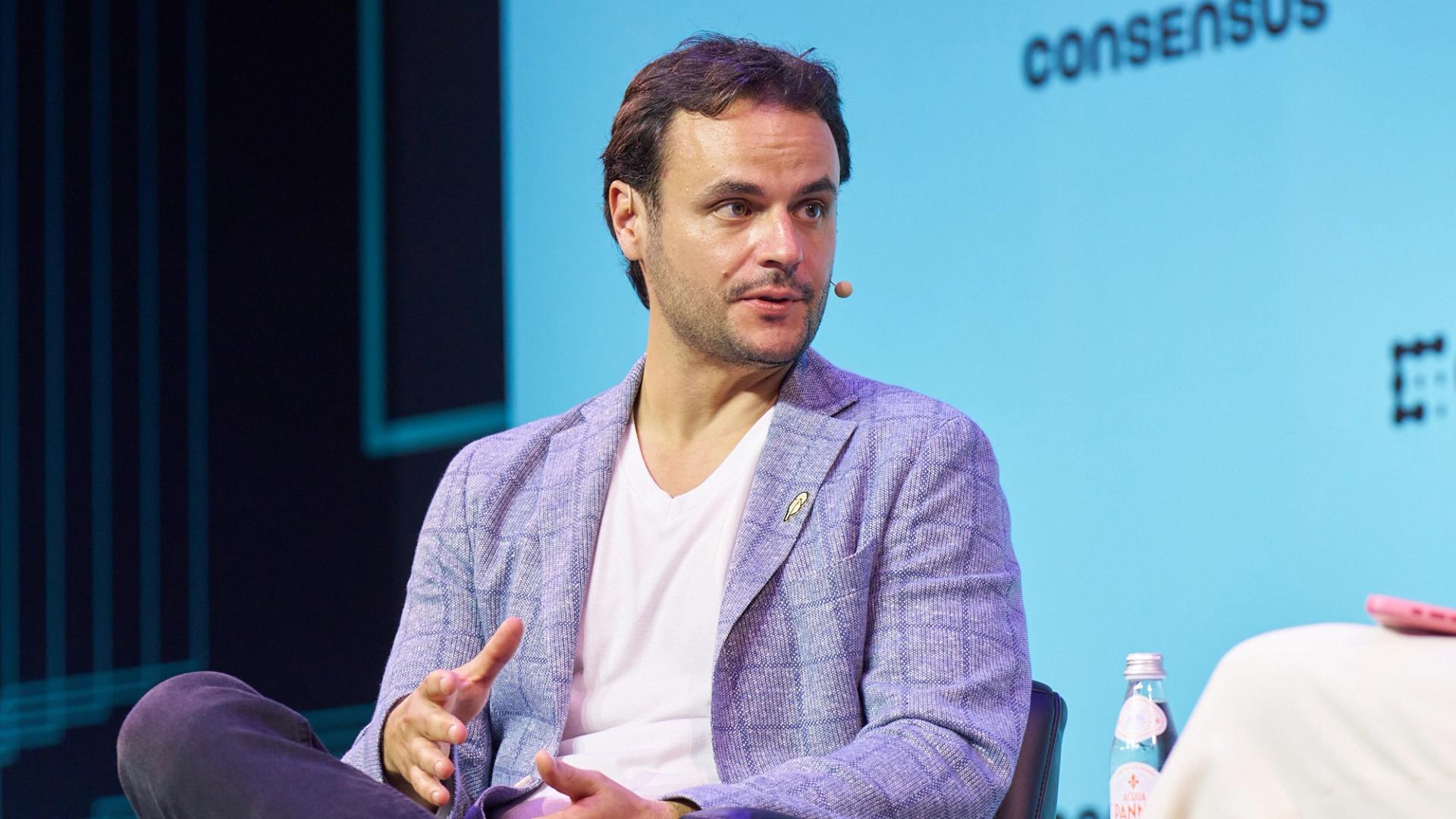
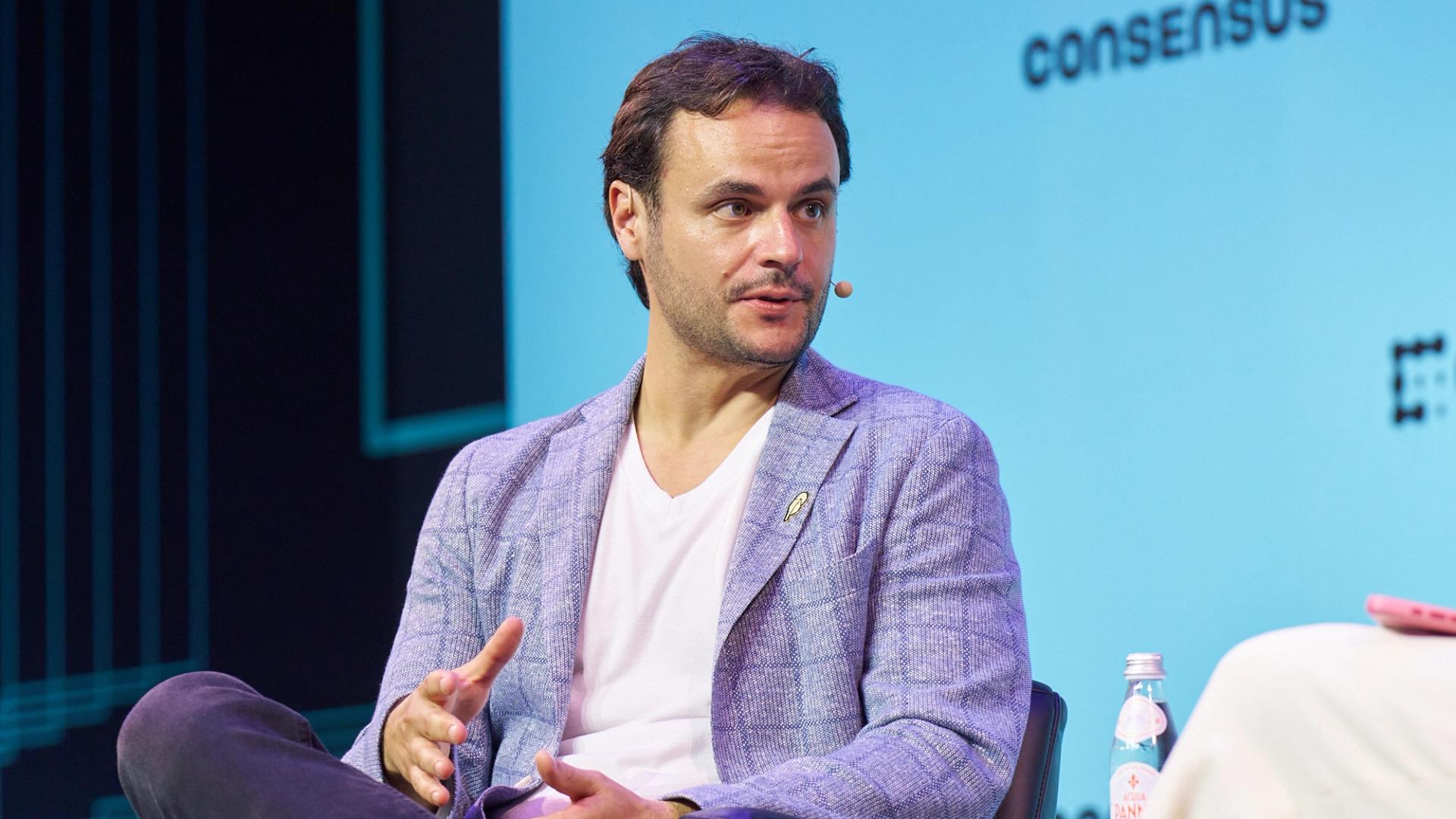
Demand for U.S. equities is rising globally, pushing investors to look beyond domestic markets, Robinhood senior VP and general manager in charge of crypto, Johann Kerbrat said during a Fireside chat at Consensus 2026 in Miami.
“We are seeing a lot of demand for U.S. stocks from overseas investors, particularly tied to AI-related companies,” Kerbrat said, adding that access remains limited in many regions compared with the United States.
Kerbrat said investors should shift from country-specific strategies toward global allocation now that international 24/7 trading platforms are available to them. “It is time for a lot of investors to really think about not just how to invest in one specific country, but also how to have a global portfolio,” he said.
The Kraken executive pointed to tokenization and around-the-clock trading as key enablers. “We think it is going to be 24/7. We think it is going to be instant settlement,” he said, describing features that could differentiate tokenized assets from traditional brokerage products.
The discussion, moderated by Crypto in America host Eleanor Terrett, also addressed regulatory constraints in the United States. Kerbrat said “regulation in the U.S. has been less than friendly in the past,” though he noted recent engagement with policymakers has improved.
Robinhood has launched tokenized stock products in Europe using a derivative model that tracks underlying assets, with plans to expand access to additional asset classes including private equity. Kerbrat said the goal is broader participation in markets that have historically been limited to accredited investors.
“I think it is really important to give them the choice to be able to invest in it before it goes public,” he said, referring to private companies.
Kerbrat said adoption will depend on offering new functionality rather than replicating existing brokerage services, with lending, collateralization and continuous trading cited as areas of development.
Kraken, which trails platforms like OKX, Bybit and Coinbase (COIN) in spot trading volumes but remains a major player in the crypto derivatives market. is a U.S.-based crypto exchange where users can buy, sell, and trade digital assets like bitcoin and ether using fiat or crypto. It has expanded into services such as derivatives, staking, and custody, positioning itself as a more full-service trading platform beyond a basic retail app.
Crypto World
Aave Price Prediction Hits $92.48 While Pepeto Could Be the Last Presale Before a 100x Listing
DeFi lending is growing faster than any Aave price prediction expected, but AAVE still sits 86% below its all time high of $666.
The protocol launched V4 on Ethereum, locked $25 billion in contracts, and still trades around $92.48. That gap between adoption and returns tells a story about where the real upside lives.
Pepeto has pulled in more than $9.78 million during its presale with a Binance listing on the horizon that could deliver what the AAVE forecast will take years to match.
Aave deployed V4 on Ethereum mainnet on March 30, introducing a hub and spoke system that splits risk into separate liquidity pools according to CoinMarketCap. The upgrade divides assets into Core, Plus, and Prime hubs for tighter risk control.
The protocol also froze markets within hours of the $292 million KelpDAO bridge exploit in April, shielding $25 billion in locked value from wider damage according to CoinDesk. Both moves lifted the Aave price prediction outlook, but AAVE at $92.48 still needs a 620% climb to touch its 2021 peak.
Top DeFi and Presale Tokens to Watch: Pepeto and AAVE
Pepeto
When an Aave price prediction shifts after a big protocol upgrade, attention usually pulls capital toward tokens that can ride the same growth cycle. But as DeFi lending grows, finding the entry that delivers the biggest return gets harder every month.
That is one reason wallets have been loading into Pepeto.
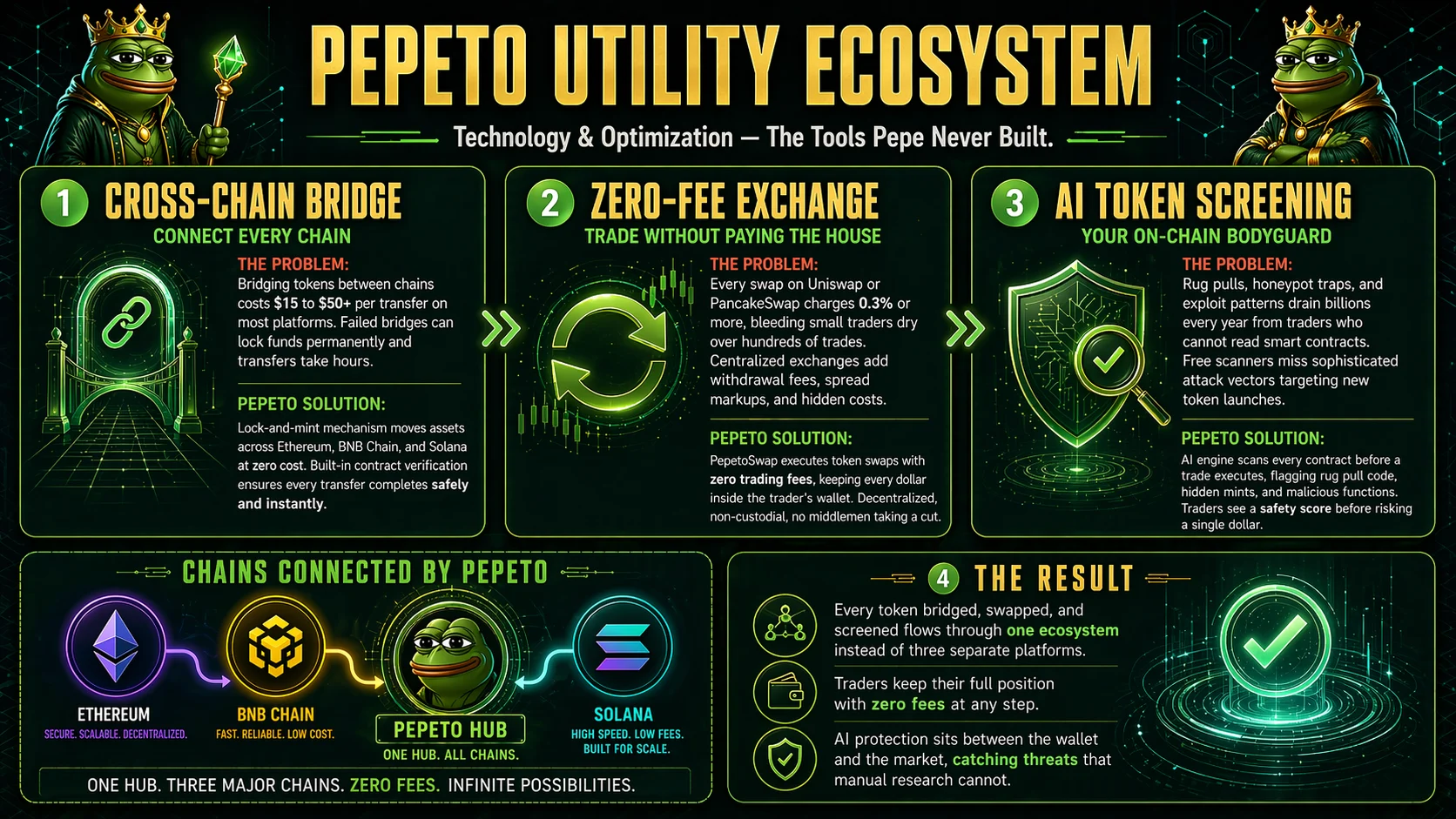
The cofounder who built the first Pepe token leads the Pepeto team, and a developer with Binance experience works on the build side. These are people who shipped a token that reached billions in market cap with zero products. Pepeto has products. PepetoSwap gives holders fee free swaps, so the spread that eats into small positions disappears. The cross chain bridge carries holdings across chains without fees, so money reaches the best opportunity on another network without gas costs.
SolidProof ran a full audit on the code before the presale opened, and more than $9.78 million of capital followed that verification. The price sits at $0.0000001868 per token, and staking pays 175% APY while holders wait for the listing. But that yield is just the bonus on top of what the listing itself produces.
As AAVE headlines bring fresh focus to DeFi, buyers start looking for presale entries that carry the kind of upside established tokens no longer offer. Pepeto is built to capture that rotation, and analysts project 100x or more from this entry because a live trading platform behind a meme coin at presale price has not appeared before. The expected Binance listing is the single event that turns presale wallets into winning positions, and the Aave price prediction ceiling does not apply at this stage.
AAVE
AAVE trades at $92.48 as of May 2026, down 86% from its all time high of $666 from 2021. V4 brought stronger technology, but the price has not followed. Support holds near $90, and resistance sits at $110 according to CoinMarketCap.
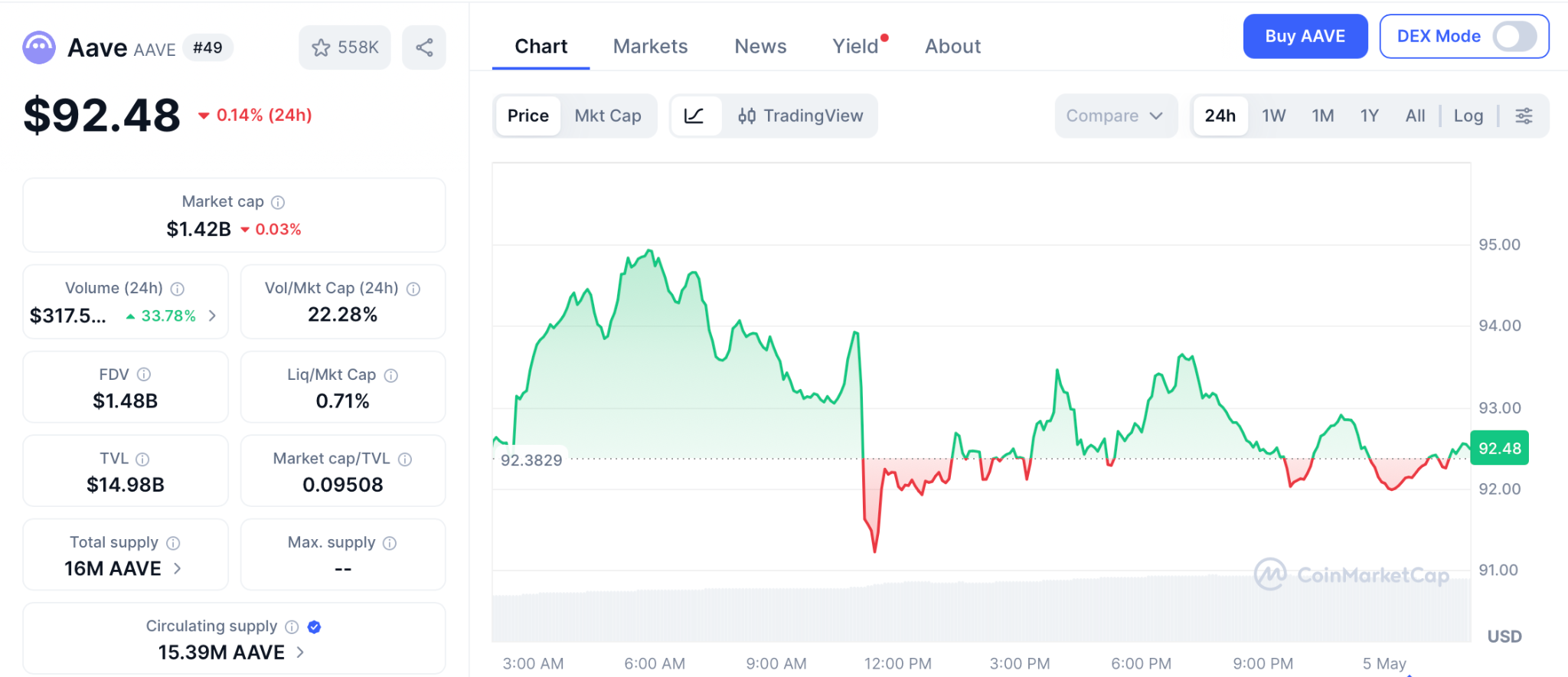
Coinpedia projects a high of $650 for 2026 if DeFi activity surges, while Cryptopolitan caps the best case at $200 by mid year. The realistic AAVE forecast range sits between $90 and $130 for May given current levels and falling open interest.
Even at $650, AAVE would need a 600% move from today. That is strong, but it falls short of what presale entries deliver before a first listing. The math tells the story.
Conclusion
Today’s DeFi space is moving in two directions at once. Protocols like Aave roll out V4 upgrades and pull in billions, while early movers rotate into the presale that no Aave price prediction can match. Pepeto crossed $9.78 million because the holders inside understand exactly what the Binance listing produces, and the Pepeto official website is where that entry still exists right now.
The listing can land without warning, and the moment it does, the presale price disappears permanently. The last five cycles all produced one presale that minted millionaires, and five times over, millions of people who read about it early chose to wait and then spent years calculating what a $500 entry would have returned.
That is not a small missed trade. That is watching $500 turn into $50,000 or more from the outside, knowing the only thing missing was clicking the buy button while it was still available.
Click To Visit Pepeto Website To Enter The Presale

FAQs
How does Aave V4 affect the Aave price prediction for 2026?
Aave V4 adds stronger risk controls and higher locked value that lifts the AAVE outlook, but AAVE at $92.48 still needs a 620% climb to reach its $666 peak. Coinpedia projects a $650 high while Cryptopolitan caps the best case at $200 by mid year.
Is Pepeto a better entry than AAVE before the Binance listing?
Pepeto raised $9.78 million at $0.0000001868 with a SolidProof audit, fee free swap tools, and a Binance listing expected that gives presale holders upside no established DeFi token can match. The presale price disappears the moment listing arrives, making the current window the only chance to enter at this level.
Disclaimer: This is a Press Release provided by a third party who is responsible for the content. Please conduct your own research before taking any action based on the content.

What to expect at Sunderland Food and Drink Festival

What Longevity Looks Like in a Fast Moving Digital Industry

Crypto PAC backs Indiana candidate ahead of primary with $500K

Manchester United reach agreement with Casemiro over contract clause amid transfer speculation

US brings back mandatory military draft registration

Steven Gerrard disagrees with Gary Neville over ‘shock’ Chelsea and Arsenal claim | Football


-

 Business7 days ago
Most Commercial Energy Audits Miss the Real Losses
-

 NewsBeat2 days ago
Channel 5 – All Creatures Great and Small series 7 new post
-

 Fashion7 days ago
Kylie Jenner’s KHY Enters a New Era with ‘Born in LA’
-
 Tech4 days ago
Trump’s 25% EU auto tariff breaches Turnberry Agreement that also covers semiconductors and digital trade
-
 Sports4 days ago
Paul Scholes issues Marcus Rashford reality check as agreement emerges over Man United star
-

 Business7 days ago
Barclay Brothers Avoid Bankruptcy: HSBC Drops High Court Petitions After IVA Deal
-
 Business6 days ago
Tesla Officially Registers Elon Musk’s Stock: What Investors Need to Know
-

 Entertainment6 days ago
Celebrities Who Are Attending the 2026 Met Gala Event
-

 Entertainment4 days ago
Met Gala 2026 Rumored Guest List Is Turning Heads
-

 Entertainment6 days ago
Insider Claims Reason Behind Key & Peele Split
-

 Tech6 days ago
Texas Instruments made a new flagship graphing calculator: the TI-84 Evo
-

 Business5 days ago
Two Powerball Tickets Split $143 Million Jackpot in Indiana and Kansas
-

 Crypto World6 days ago
Meta (META) starts stablecoin payout to creators in Circle’s USDC on Polygon, Solana via Stripe
-

 Business6 days ago
Strait of Hormuz Remains Heavily Restricted on April 29 Amid Iran Conflict
-
Business2 days ago
Winning Numbers Drawn as Jackpot Resets to $20 Million
-
 Crypto World5 days ago
CoreWeave (CRWV) Stock Climbs 8% Despite $45M Insider Share Dump
-
Crypto World6 days ago
Securitize and Computershare Enable Tokenized Equity Issuance for Over 25,000 U.S.-Listed Stocks
-

 Entertainment4 days ago
Kylie Jenner Hit With Second Lawsuit From Ex-Housekeeper
-

 Sports6 days ago
Saudi Arabia set to withdraw LIV Golf funding after 2026 season, per reports
-
Business5 days ago
Strait of Hormuz Blockade Persists Amid US-Iran Standoff, Sending Oil Prices Soaring
You must be logged in to post a comment Login