

Business
What Longevity Looks Like in a Fast Moving Digital Industry


Fast moving industries are make it or break it. Worse, they are constantly shifting. Who the biggest player is in the market can change from one day to the next.
A new tech, a new tool, a new game, all of this can shake up who is successful and who is not. More importantly for industries that are regulated, like the gaming industry, new regulations can immediately drop the biggest fish off the map, while those who put player satisfaction and safety at the forefront rise to the top.
Longevity is difficult to maintain in a fast-moving industry, especially a digital industry where updates can roll out instantly. You don’t need to restructure your supply chain or wait for a product or service to reach your customers. The only problem with this instant delivery is that your competitors also have access to that same level of quick-fire delivery.
That’s why longevity is all about standing out and delivering on a specific experience again and again:
The Importance of Theme and Niche in a Fast-Moving Market
Digital industries shift fast, and not only on the platforms themselves. Sometimes the biggest challenge is both how many competitors there are, and also how many newcomers are arriving on the scene. This is a challenge both for the existing providers and the newcomers themselves.
That’s why one of the top ways that platforms are working to maintain the long-term interest of their players is by building their platform around a visual niche. This is particularly important in industries like iGaming, where platforms can look nearly identical from one provider to the next.
In this sort of environment, brands like River Belle, which have been built around a specific visual niche (in this case, a luxury vintage steamer ship), are leading the way. Not only have they built a memorable, striking, and engaging niche, but they have also followed it up by putting their live casino game experiences at the forefront.
New Games, New Experiences
Digital platforms have the benefit of being able to see the numbers in detail. They know exactly where their audience is spending their time, what games they’re playing, for how long, and what’s most popular.
That’s why they can easily keep the top playing games, restructure those that have potential, and still release new games and variations that keep players coming back. More importantly, those analytics can actually be used to predict future game success by understanding current appetites. This approach keeps the platform fresh while also avoiding the alienation that can come from taking down a top-performing game by mistake.
Safety, Safety, Safety
When there are so many competitors and the industry moves fast, being reliable is the easiest way for platforms to ensure their longevity. Using the latest security features to both reduce friction in the sign-up and deposit process, while also delivering secure and timely withdrawals, boosts trust and the overall experience. When competitors are screaming at the top of their lungs for attention, the options may seem endless, but customers will still ultimately go where they know they are safe. Being scammed and fooled is every digital customer’s top fear, so providing that safety and assurance is one of the last top ways digital platforms are maintaining their long-term success.


Healthcare Stocks Can Benefit From AI, Too. But That Isn’t the Reason to Buy Them.

What Will SpaceX’s IPO Mean for Your Index Funds?

Check out what’s clicking on FoxBusiness.com.
Target is recalling several Up & Up baby wipes products sold nationwide after testing identified potentially dangerous bacteria that could cause serious infections, particularly in infants and young children.
According to a recall notice posted Friday by the U.S. Food and Drug Administration (FDA), Target is voluntarily recalling certain lots of Up & Up Fragrance Free Baby Wipes and Up & Up Fresh Cucumber Scented Baby Wipes following customer complaints about product discoloration.
FDA testing identified the presence of Burkholderia cepacia complex and Burkholderia gladioli in samples of the affected wipes.
Health officials warned that products contaminated with the bacteria could lead to serious and potentially life-threatening infections. The wipes are primarily used on newborns, infants and young children, a group considered particularly vulnerable because of their developing immune systems.
TARGET TO CUT PRICES ON 3,000 ITEMS AS INFLATION REMAINS ABOVE FED TARGET
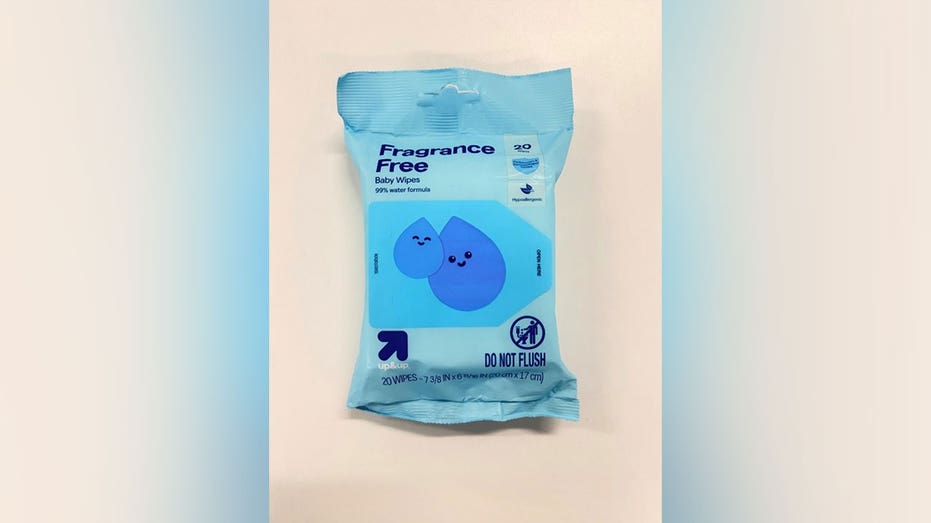
Up & Up Fragrance Free Baby Wipes sold at Target stores nationwide are included in a voluntary recall announced June 2026. (FDA / Unknown)
The FDA said healthy individuals who use the contaminated wipes on skin with minor cuts or abrasions may develop localized infections. However, infections in immunocompromised individuals, newborns and infants could spread into the bloodstream and potentially cause sepsis or pneumonia.
The recalled wipes were manufactured by supplier Sapro Temizlik Urunleri and sold at Target stores nationwide as well as through Target.com.
Target and the manufacturer have received a number of consumer complaints and adverse event reports alleging product discoloration and symptoms including skin irritation, eye irritation and infections that may be linked to use of the wipes. The reports remain under investigation.
A representative for Target did not immediately respond to FOX Business’ request for comment.
TARGET SET TO OPEN ITS 2,000TH STORE, PLANS TO OPEN HUNDREDS MORE IN NEXT DECADE

A three-pack of Up & Up Fresh Cucumber Scented Baby Wipes is shown. Target is recalling certain baby wipes products after FDA testing identified potentially harmful bacteria in product samples. (FDA / Unknown)
The recall affects multiple sizes of Up & Up Fragrance Free Baby Wipes, including 20-count, 72-count, 216-count, 800-count and 1,200-count packages, as well as Up & Up Fresh Cucumber Scented Baby Wipes sold in 72-count, 216-count and 800-count packages.
Consumers are being urged to stop using the recalled wipes immediately and return them to any Target store for a full refund.
Target said customers seeking additional information can contact Target Guest Relations at 1-800-440-0680.
The recall is being conducted with the knowledge of the U.S. Food and Drug Administration, and Target said it is continuing to investigate the matter in coordination with the manufacturer.
| Ticker | Security | Last | Change | Change % |
|---|---|---|---|---|
| TGT | TARGET CORP. | 122.57 | -1.28 | -1.03% |
According to the FDA, the affected Up & Up Fragrance Free Baby Wipes were manufactured between Nov. 7, 2025, and May 5, 2026, and carry expiration dates ranging from May 10, 2028, through Nov. 5, 2028.
GET FOX BUSINESS ON THE GO BY CLICKING HERE
The recalled Up & Up Fresh Cucumber Scented Baby Wipes were manufactured between Dec. 29 and Dec. 30, 2025, and carry expiration dates ranging from June 29, 2028, through June 30, 2028.
A complete list of affected UPCs, manufacturing codes and package sizes is available in the FDA recall notice.

Tim Goodnow
President, CEO & Director
Thanks for joining us. And as we update you folks on the Senseonics story, it’s a pretty exciting time for us. As many of you know, for those that were able to join us a year ago, we had a partnership with the PHC Corporation for the commercial activities. We’ve transitioned that since we last spoke. And it’s a pretty exciting time for us as we’ve been able to leverage that experience and that capability significantly with our strategic investment into the commercial organization. And frankly, we’re very excited with the commercial results that we’re now getting.
So obviously, the control of our destiny is very, very important, because it gives us the ability to pivot and move quick, make adjustments, expand those areas that make the most sense and frankly, leverage the internal capability. But we’ve been able to do that because, although we did the transition, we’ve essentially brought the entire Ascensia commercial organization over under Brian’s leadership, and that really has made a seamless process that we’ve been very excited to be able to execute against.
We also made the decision as part of that transition in the last year that the primary issue for growth with Eversense in a highly competitive market, but a very attractive market really had to


Financial analyst by day and a seasoned investor by passion, I’ve been involved in the world of investing for over 15 years and honed my skills in analyzing lucrative opportunities within the market.I specialize in uncovering high quality dividend stocks and other assets that offer potential for long term-growth that pack a serious punch for bill-paying potential. I use myself as an example that with a solid base of classic dividend growth stocks, sprinkling in some Business Development Companies, REITs, and Closed End Funds can be a highly efficient way to boost your investment income while still capturing a total return that follows traditional index funds. I created a hybrid system between growth and income and manage to still capture a total return that is on par with the S&P.
Analyst’s Disclosure: I/we have a beneficial long position in the shares of STK either through stock ownership, options, or other derivatives. I wrote this article myself, and it expresses my own opinions. I am not receiving compensation for it (other than from Seeking Alpha). I have no business relationship with any company whose stock is mentioned in this article.
Seeking Alpha’s Disclosure: Past performance is no guarantee of future results. No recommendation or advice is being given as to whether any investment is suitable for a particular investor. Any views or opinions expressed above may not reflect those of Seeking Alpha as a whole. Seeking Alpha is not a licensed securities dealer, broker or US investment adviser or investment bank. Our analysts are third party authors that include both professional investors and individual investors who may not be licensed or certified by any institute or regulatory body.


As an individual investor nearing retirement I am trying to build my financial assets in order to have a fulfilling retirement. I am interested in trading both long and short; or at least using inverse ETFs, to take advantage of market declines. Having long term and short term trading strategies, proper execution of my trading plan, and absolute investing results are my goals. I see my articles as a way to keep me focused on developing winning trades. I also expect to learn much from the feedback that is provided in the comments section.
Analyst’s Disclosure: I/we have no stock, option or similar derivative position in any of the companies mentioned, but may initiate a beneficial Long position through a purchase of the stock, or the purchase of call options or similar derivatives in BAC over the next 72 hours. I wrote this article myself, and it expresses my own opinions. I am not receiving compensation for it (other than from Seeking Alpha). I have no business relationship with any company whose stock is mentioned in this article.
Seeking Alpha’s Disclosure: Past performance is no guarantee of future results. No recommendation or advice is being given as to whether any investment is suitable for a particular investor. Any views or opinions expressed above may not reflect those of Seeking Alpha as a whole. Seeking Alpha is not a licensed securities dealer, broker or US investment adviser or investment bank. Our analysts are third party authors that include both professional investors and individual investors who may not be licensed or certified by any institute or regulatory body.

Kraft Heinz: There Are Better Options On The Table


Luke Pomichter is a defense and national security professional with over a decade of experience spanning intelligence operations, cyber threat intelligence, and security engineering across the defense industrial base. He holds a PhD examining investment decision behavior through a behavioral finance and is a Stanford LEAD Candidate. His research interests sit at the intersection of national security and capital markets — areas where domain expertise is rare among financial professionals and informational edge is highest. He writes on aerospace, defense, and emerging technology equities as a natural extension of his professional background and ongoing graduate work. He is pursuing the CAIA designation and holds the CISSP and multiple GIAC certifications. The author publishes independently. Views expressed are his own and do not represent any employer or affiliated institution.
Analyst’s Disclosure: I/we have a beneficial long position in the shares of RYCEY either through stock ownership, options, or other derivatives. I wrote this article myself, and it expresses my own opinions. I am not receiving compensation for it. I have no business relationship with any company whose stock is mentioned in this article.
Seeking Alpha’s Disclosure: Past performance is no guarantee of future results. No recommendation or advice is being given as to whether any investment is suitable for a particular investor. Any views or opinions expressed above may not reflect those of Seeking Alpha as a whole. Seeking Alpha is not a licensed securities dealer, broker or US investment adviser or investment bank. Our analysts are third party authors that include both professional investors and individual investors who may not be licensed or certified by any institute or regulatory body.

Nebius Is Priced For Flawless Delivery


Soccer-Iraq World Cup striker Hussein questioned for hours at Chicago airport, source says

Female Navy officers fear a career cap after Hegseth’s promotion list cuts

Who is Flora Pili? Everything you need to know about Katie Taylor’s final opponent

Ladybird Browser Stops Accepting Public Pull Requests



-

 Business5 days ago
Jade Biosciences, Inc. (JBIO) Discusses Positive Interim Results From JADE101 Phase I Healthy Volunteer Study and Development Plans Transcript
-

 Fashion1 day ago
Weekend Open Thread: Evereve – Corporette.com
-

 Sports4 days ago
French Open 2026 results: Alexander Zverev beats Rafael Jodar and will play Jakub Mensik in semi-finals
-
 Crypto World1 day ago
Jensen Huang Approves Samsung, SK Hynix, and Micron for NVIDIA (NVDA) HBM4 Memory Supply
-

 Tech4 days ago
CryZENx Releases Fresh Playable Content Deep Inside Jabu-Jabu for His Ocarina of Time Remake
-

 Business4 days ago
Trump Taps Housing Chief Bill Pulte as Acting Intelligence Director After Gabbard Exit
-
Crypto World1 day ago
LBank Surpasses 25 Million Users Worldwide as AFA Partnership Continues to Drive Global Growth
-
 NewsBeat4 days ago
Republicans balk at Trump’s attempt to appoint a MAGA enforcer to lead National Intelligence
-
 Crypto World4 days ago
Seagate (STX) Stock Surges to Record High on AI Boom and Legal Settlement
-

 Tech1 day ago
RCS Messages Between iPhone and Android Get End-to-End Encryption With iOS 26.5
-
 Crypto World4 days ago
EU AI Data Center Project Faces Delays as Funding Gaps Grow
-

 Entertainment4 days ago
Did The Mandalorian And Grogu Already Ruin The Next Star Wars Movie?
-

 Business4 days ago
Aehr Test Systems Stock Soars 17% Amid Surging AI Demand and Conference Spotlight
-
 Business4 days ago
Claude AI Down Today Reason: Why Anthropic’s AI is not working today? What’s the latest quota update
-

 Business4 days ago
Relay Therapeutics Shares Surge 20% on ASCO Momentum for Zovegalisib Breast Cancer Program
-
 Crypto World1 day ago
Merlin (MRLN) Stock Soars 32% on Major USSOCOM Autonomy Milestone
-

 Tech4 days ago
Instagram will stop bombarding teens with the same kind of obsessively unhealthy content
-

 Tech1 day ago
Credit card theft campaign abuses Stripe to host stolen payment info
-
Crypto World5 days ago
Tether Brings Google’s TurboQuant to Production, Unlocking Long-Context AI on Everyday Devices
-
 Entertainment4 days ago
‘Aliens’ Star Reveals How the US Military Co-Opted James Cameron’s Sci-Fi Tech [Exclusive]
You must be logged in to post a comment Login