

Crypto World
Overseas demand for U.S equities is growing, says Kraken senior VP Johan Kerbrart



Demand for U.S. equities is rising globally, pushing investors to look beyond domestic markets, Robinhood senior VP and general manager in charge of crypto, Johann Kerbrat said during a Fireside chat at Consensus 2026 in Miami.
“We are seeing a lot of demand for U.S. stocks from overseas investors, particularly tied to AI-related companies,” Kerbrat said, adding that access remains limited in many regions compared with the United States.
Kerbrat said investors should shift from country-specific strategies toward global allocation now that international 24/7 trading platforms are available to them. “It is time for a lot of investors to really think about not just how to invest in one specific country, but also how to have a global portfolio,” he said.
The Kraken executive pointed to tokenization and around-the-clock trading as key enablers. “We think it is going to be 24/7. We think it is going to be instant settlement,” he said, describing features that could differentiate tokenized assets from traditional brokerage products.
The discussion, moderated by Crypto in America host Eleanor Terrett, also addressed regulatory constraints in the United States. Kerbrat said “regulation in the U.S. has been less than friendly in the past,” though he noted recent engagement with policymakers has improved.
Robinhood has launched tokenized stock products in Europe using a derivative model that tracks underlying assets, with plans to expand access to additional asset classes including private equity. Kerbrat said the goal is broader participation in markets that have historically been limited to accredited investors.
“I think it is really important to give them the choice to be able to invest in it before it goes public,” he said, referring to private companies.
Kerbrat said adoption will depend on offering new functionality rather than replicating existing brokerage services, with lending, collateralization and continuous trading cited as areas of development.
Kraken, which trails platforms like OKX, Bybit and Coinbase (COIN) in spot trading volumes but remains a major player in the crypto derivatives market. is a U.S.-based crypto exchange where users can buy, sell, and trade digital assets like bitcoin and ether using fiat or crypto. It has expanded into services such as derivatives, staking, and custody, positioning itself as a more full-service trading platform beyond a basic retail app.

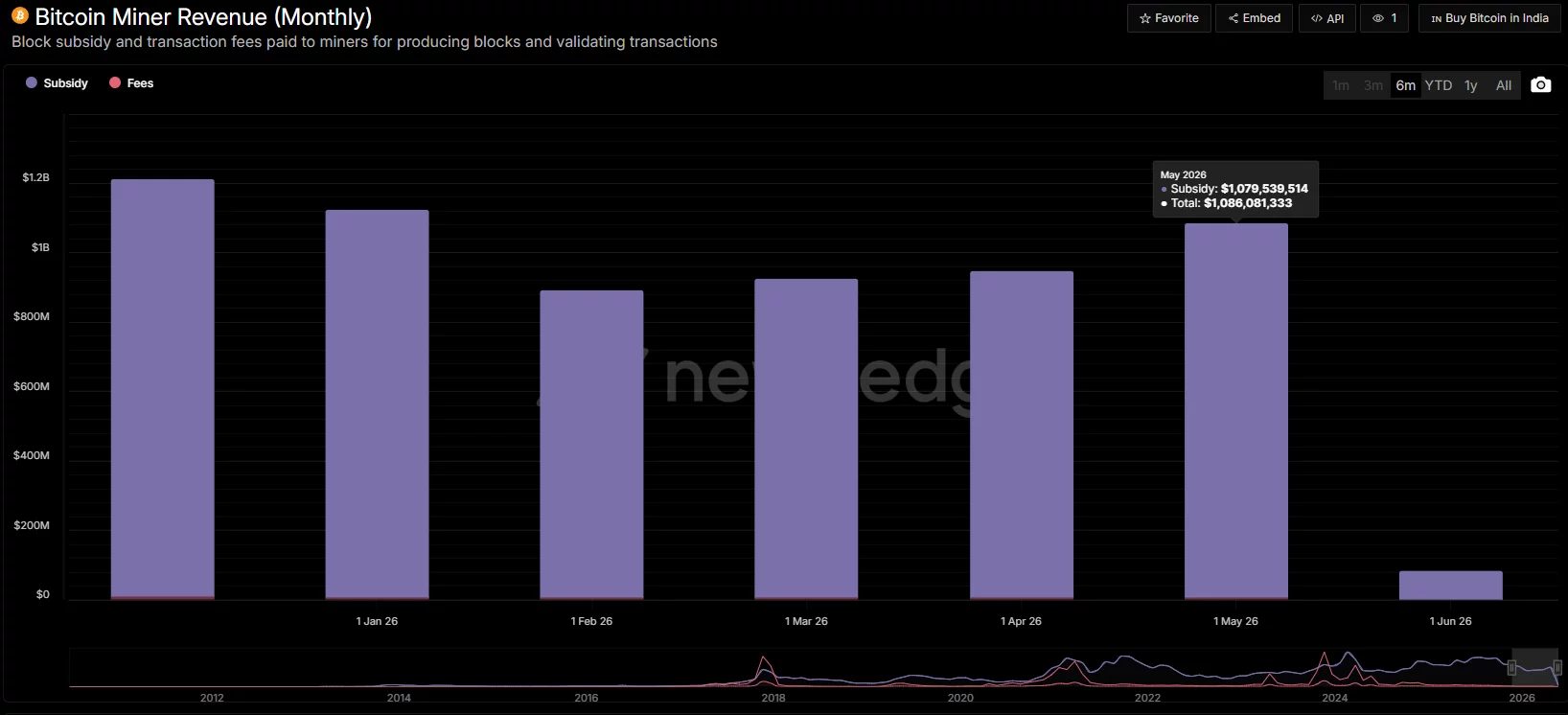
Bitcoin miners have entered June with revenue above $1 billion for the first time in four months, but falling Bitcoin prices are already putting renewed pressure on mining economics.
Summary
- Bitcoin miner revenue topped $1.08 billion in May, the highest level since January.
- Hashprice fell nearly 18% in a month as Bitcoin hovered near the $65,000 support zone.
- A projected 9% difficulty cut may ease pressure on miners if current conditions persist.
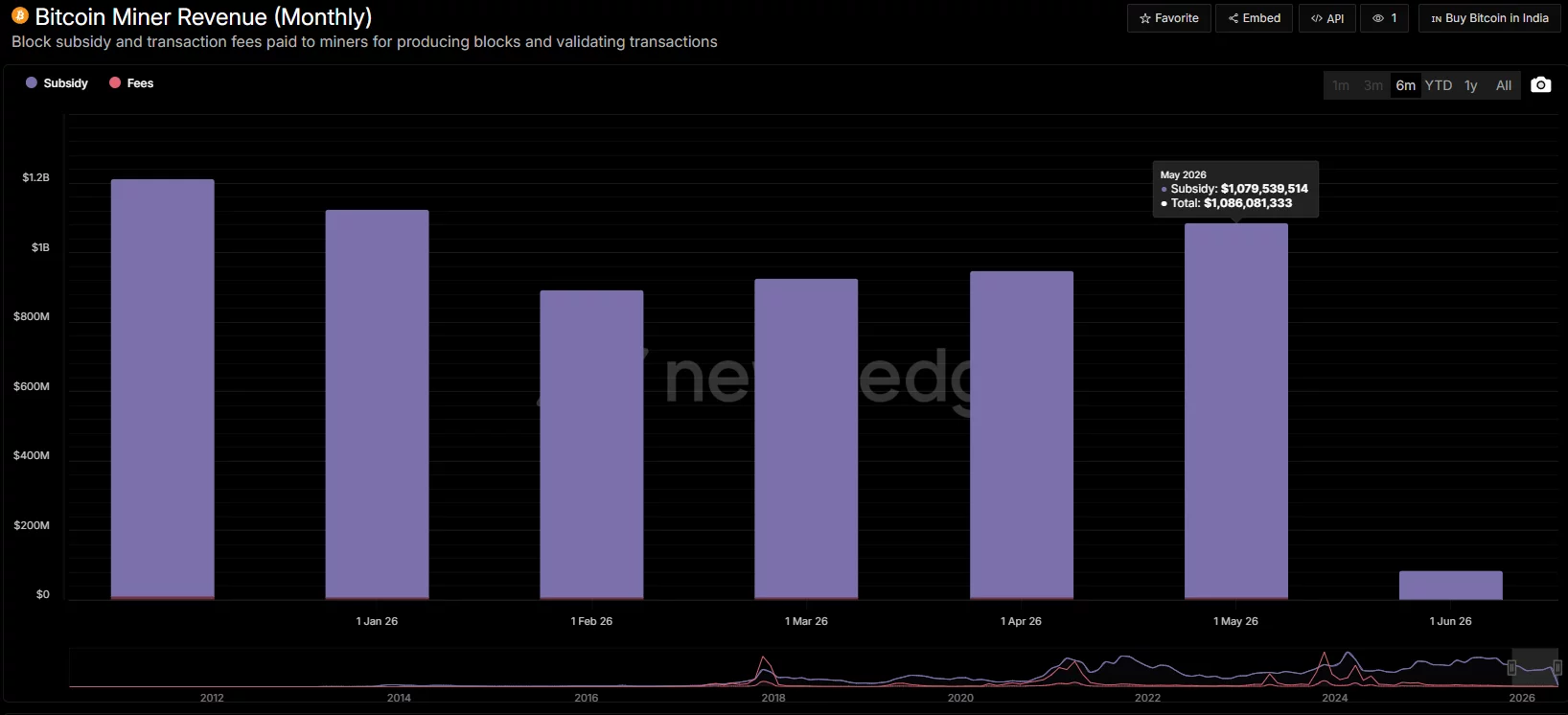
According to data from Newhedge, miners generated $1.086 billion in revenue during May, the highest monthly total since January. Most of that income came from the 3.125 BTC block subsidy, which contributed roughly $1.079 billion, while transaction fees accounted for only a small portion of earnings.
Even as miners posted a stronger month, conditions have weakened since the start of June. According to data from crypto.news, Bitcoin (BTC) price dropped as much as 4.5% on June 3, touching an intraday low of $65,700. The leading crypto asset was trading a little higher at $65,800 at press time.
Bitcoin’s recent decline followed heightened geopolitical tensions after Iran launched retaliatory strikes against U.S. targets, prompting a broader risk-off move across financial markets.
Meanwhile, analysts at Citigroup recently argued that sustained spot Bitcoin ETF outflows have also been a more important driver of Bitcoin’s weakness than Strategy’s sale of 32 BTC. In a research note, the bank pointed to nearly $4 billion in ETF withdrawals and described ETF flows as one of the strongest indicators of demand for the asset.
Falling Bitcoin prices are reducing miner profitability
As Bitcoin price trades close to the important $65,000 support area, mining profitability has continued to deteriorate.
Data from Hashrate Index shows the daily value generated by one petahash per second of mining power has fallen to approximately $30.77, down from $37.44 a month ago. The decline represents a drop of nearly 18% over the past 30 days and has pushed hashprice to levels last seen in early April.
Mining companies are already responding to the weaker economics. Network hashrate has fallen from around 1,000 exahashes per second to below 975 EH/s as some operators reduce activity or disconnect less efficient machines.
Meanwhile, slower mining activity has affected block production times. Hashrate Index data showed blocks were being produced every 10 minutes and 59 seconds on average, well above Bitcoin’s 10-minute target. If current conditions persist until the next adjustment period around June 13, estimates suggest mining difficulty could decline by roughly 9%.

A lower difficulty level would reduce competition among miners and allow remaining participants to earn slightly more Bitcoin for the same amount of computing power.
Technical and network signals point to a critical period ahead
While the expected difficulty reduction could provide temporary relief, Bitcoin’s price remains the biggest factor affecting miner revenue.
According to a previous analysis report by crypto.news, Bitcoin is approaching completion of a rounding top formation on the daily chart. Such a pattern is generally considered a bearish reversal formation, and a decisive break below $65,000 could expose the next major demand zone near $60,000.
On the other hand, the same analysis stated that a recovery above $68,700 could weaken the bearish setup and create conditions for a move back toward $72,000.
Transaction fees have offered limited support. After remaining below 0.6% of total block rewards for an extended period, fee income has recently improved. Recent network data shows fees accounted for roughly 1.16% of total block rewards over the past 24 hours.
For now, miners are balancing the benefits of a likely difficulty cut against a market that remains under pressure from ETF outflows and geopolitical uncertainty. Whether May’s strong revenue performance can continue through June may depend largely on Bitcoin’s ability to hold above key support levels.


Bitcoin’s recent struggles to rise in tandem with U.S. stocks has sparked a wave of explanations, from concerns about Michael Saylor’s Strategy (MSTR) selling bitcoin to questions about whether institutional demand is beginning to fade.
Charles Schwab analyst Jim Ferraioli sees a simpler explanation: Bitcoin is losing the momentum trade.
“Bitcoin has been in a bear market since October,” Ferraioli said in an interview. “Not to say it’s as simple as that, but it’s kind of simple as that.”
The comments stand in contrast to a market narrative that has remained largely focused on positive developments. Over the past year, crypto has secured spot ETF approvals, attracted billions of dollars in institutional capital and moved closer to regulatory clarity in Washington. Yet despite those developments, bitcoin has struggled to sustain the type of explosive rally many investors expected.
Instead, capital has been flowing elsewhere.
“We found a bottom in early February, and since then another large Wall Street firm had a successful ETF launch, and so you saw this kind of return to the institutional adoption narrative,” Ferraioli said.
That rebound helped bitcoin recover from its February lows. But unlike previous crypto cycles, the recovery stalled before developing into a broad speculative frenzy.
That’s because crypto investors are not fundamentally driven, but chase momentum, he said. In his view, bitcoin’s problem isn’t a lack of bullish news. It’s competition.
Historically, crypto has benefited when it becomes the market’s most compelling speculative opportunity. When prices rise, traders pile in. When another asset class begins attracting attention, capital often follows.
“Crypto investors historically just go wherever the momentum is,” Ferraioli said. “And momentum is out of crypto at the moment.”
The destinations for that capital have changed over the past year.
Some investors have gravitated toward precious metals. Gold has attracted significant inflows as investors seek alternatives to both equities and crypto. Others have become increasingly focused on artificial intelligence, which has emerged as the dominant growth narrative across financial markets.
The AI boom has created a new class of speculative opportunities that didn’t exist in previous crypto cycles. Public companies tied to AI infrastructure, data centers and advanced computing have generated strong returns, while anticipated IPOs from firms such as OpenAI and Anthropic have become focal points for investors looking for the next growth story.
According to Ferraioli, crypto investors are participating in that shift as well.
“I think people that are excited about momentum are getting excited about IPOs,” he said. “Then some of these you can actually access the private shares on these decentralized exchanges on Hyperliquid.”
That trend is significant because it highlights how crypto-native trading infrastructure is increasingly allowing investors to speculate on assets beyond cryptocurrencies themselves.
Platforms such as Hyperliquid (HYPE) have introduced perpetual contracts tied to private companies, commodities and other non-crypto assets, giving traders new places to deploy capital.
For bitcoin, that means it is no longer competing solely against other cryptocurrencies.
It is competing against every major speculative narrative in the market.
Ferraioli also downplayed concerns surrounding Strategy’s recent sale of 32 bitcoin, a transaction that sparked debate among investors because of Saylor’s long-standing reputation as one of bitcoin’s most committed advocates.
“The narrative has been that they’ll never sell,” Ferraioli said. Yet he believes the market impact of the transaction itself has been overstated. “But I don’t think [the sale] is what’s really driving it,” he said.
Instead, he views the sale as a convenient narrative attached to a broader trend that was already underway.
Part of that trend may be tied to investor cost bases and many ETF investors are still recovering from sharp swings over the past year and see the current price point as an opportunity to exit positions rather than increase them.
“I think you get to those levels and you get people that are saying, ‘Hey, I made my money back, maybe I’ll revisit it later,’” Ferraioli said.
That dynamic has contributed to a market that feels very different from the euphoric phases of previous cycles.
Ferraioli argues that institutional adoption, while real, remains smaller than many market participants assume. Bitcoin ETFs have expanded access to crypto, but much of the asset class remains dominated by retail investors and momentum-driven traders.
“Again, this is primarily a retail asset,” he said.
The distinction matters because retail investors often react differently than traditional institutional allocators. Rather than building positions based on discounted cash flow models or long-term valuation frameworks, they tend to chase trends.
That behavior helps explain why bitcoin has struggled to capitalize on positive regulatory developments.
The crypto industry is awaiting potential passage of the Clarity Act, a bill that many industry participants believe could provide a clearer framework for digital assets in the U.S. Over the longer term, Ferraioli believes such developments could support adoption.
In the short term, however, regulation alone may not be enough to reverse the current trend.
“There is still more demand for downside protection,” he noted elsewhere in Schwab’s market outlook, though that pressure has begun to ease in recent weeks.
Seasonality may also be contributing to the slowdown. Summer has historically been one of bitcoin’s weaker periods, as trading activity declines and investors shift attention elsewhere.
“People know that for bitcoin seasonally summer is the weakest time,” Ferraioli said.
That leaves the market in an awkward position.
Institutional adoption is improving. Regulatory clarity is advancing. Major financial firms continue building crypto products. Yet none of those developments guarantee higher prices if investor attention is focused elsewhere.
“There’s a lack of a reason to be buying here when there’s other things you can choose,” Ferraioli said.
For now, he argues, the biggest challenge facing bitcoin isn’t Saylor, regulation or even macroeconomics.
It’s that investors have found something else to chase.
Crypto World
Old DxSale Lockers Drained for $7.3M Across 1,400 BNB Chain Pools as Owner-Privilege Exploits Pile Up


An attacker drained roughly $7.3 million from more than 1,400 legacy liquidity-provider positions sitting in old DxSale locker contracts on BNB Chain, security firms PeckShield and Coinsult flagged on May 29, a drain made possible not by a smart-contract bug but by a silent ownership transfer… Read the full story at The Defiant

[PRESS RELEASE – Mahe, Seychelles, June 3rd, 2026]
Whale.io is excited to announce the official launch of The Whale Printer, an on-platform staking system for the native $WHALE token. The feature enables eligible token holders to lock $WHALE for fixed periods in exchange for predetermined token rewards.
The staking system is structured around three lock-up periods, each associated with a fixed multiplier and corresponding annual percentage yield (APY):
$WHALE Staking Yields
Whale Printer offers three straightforward lock periods with impressive returns:
- 90 days (1.2x multiplier) — 107.8% APY
- 180 days (1.5x multiplier) — 129% APY
- 365 days (3x multiplier) — 200% APY
Multipliers are fixed at the time a staking position is created, providing predefined reward terms throughout the selected lock period.
Whale Printer Reward Pool
All rewards are paid from a dedicated pool of 20 billion $WHALE, representing 20% of the total token supply. The pool does not replenish. When it is exhausted, The Whale Printer closes permanently and no new staking positions can be opened. This creates strong incentives for early participants while ensuring long-term sustainability and real value accrual for $WHALE stakers.
How to Stake $WHALE on Whale.io
To participate, $WHALE tokens must be available within a Whale.io account balance. Staking positions can be created through the token page by selecting a token amount and preferred lock period.
The system supports up to 10 concurrent staking positions per account, each operating independently with its own allocation, lock period, and completion timer. The minimum staking requirement is determined by platform parameters. Early withdrawal is not available for active staking positions.
Why Stake $WHALE
$WHALE serves as the native utility token of the Whale.io ecosystem. According to the project, token distribution has occurred through platform gameplay, missions, and user activity, without allocations to private sales, presales, or venture capital participants.
Whale Printer expands the token’s functionality by introducing a staking mechanism that distributes rewards in $WHALE based on selected lock periods and predefined reward structures.
Whale Printer is now available through whale.io/token
About Whale.io
Whale.io is a leading online crypto casino and sportsbook. The platform features exclusive Whale Originals games, blockchain-integrated rewards, massive cashback, and a strong emphasis on transparency, community ownership, and on-chain verifiability. With $WHALE as its native utility token, Whale.io continues to build one of the most rewarding ecosystems in crypto gaming.
To discover the future of Whale.io Casino and $WHALE token users can:
Read more on whale.io/token
Visit Whale socials: https://linktr.ee/whalesocials_tg
The post Whale.io Launches Whale Printer: $WHALE Token Staking appeared first on CryptoPotato.
A monthly research report from Bitwise’s European arm published this week pegs bitcoin’s theoretical “fair value” at roughly $224,000 if the asset were widely adopted as portfolio insurance against G20 sovereign debt defaults.
The research team described the figure as a “model-implied illustrative figure, not a price target or forecast,” however.
The figure stems from a theoretical framework first proposed by analyst Greg Foss in 2021, which treats bitcoin as a credit default swap on sovereign bonds.
Because the bitcoin network has no central issuer and operates without a sovereign backstop, the Foss model frames it as a non-correlated hedge against the possibility of major sovereign defaults.
The implied $224,000 fair value depends on the weighted default probability across group of 20 (G20) sovereigns and the market capitalization of the bonds being notionally insured.
It built the case around stress in sovereign bond markets. Japanese 30-year government bond yields have hit record highs while 10-year JGB yields sit at multi-decade peaks.
The International Monetary Fund and OECD have warned that governments and companies are set to borrow $29 trillion from bond markets this year, 17% higher than 2024, with the IMF describing markets as becoming less forgiving and investors as increasingly questioning the limits of sovereign borrowing capacity.
Bitwise singled out Japan’s JGB market as particularly vulnerable, citing its roughly $7.5 trillion size as the world’s second-largest sovereign bond market, Japanese investors’ approximately $1.2 trillion in U.S. Treasury holdings, and Japan’s roughly 230% debt-to-GDP ratio.
It noted that 10-year swap spreads, which measure sovereign risk premia, are at their highest levels since the 2011-2012 European debt crisis across major sovereign bonds.
But the report flagged some near-term headwinds for bitcoin as well.
Higher global bond yields have made Strategy’s (MSTR) STRC perpetual preferred equity dividends less attractive to investors, and STRC has recently traded below par.
Strategy buys have accounted for roughly two-thirds of institutional bitcoin demand via global treasury companies and bitcoin ETPs through 2026 to date, per Bitwise’s count, meaning a stall in Strategy’s STRC-funded accumulation could materially dent the flow.
The upside scenarios Bitwise outlines hinge on monetary policy and sovereign stress.
A Fed pause under newly confirmed chair Kevin Warsh against rising inflation could push real yields lower, which the report cited as a historical tailwind for bitcoin. A sovereign bond capitulation that forces central bank intervention to safeguard financial stability could validate bitcoin’s role as a decentralized hedge against sovereign counterparty risk.
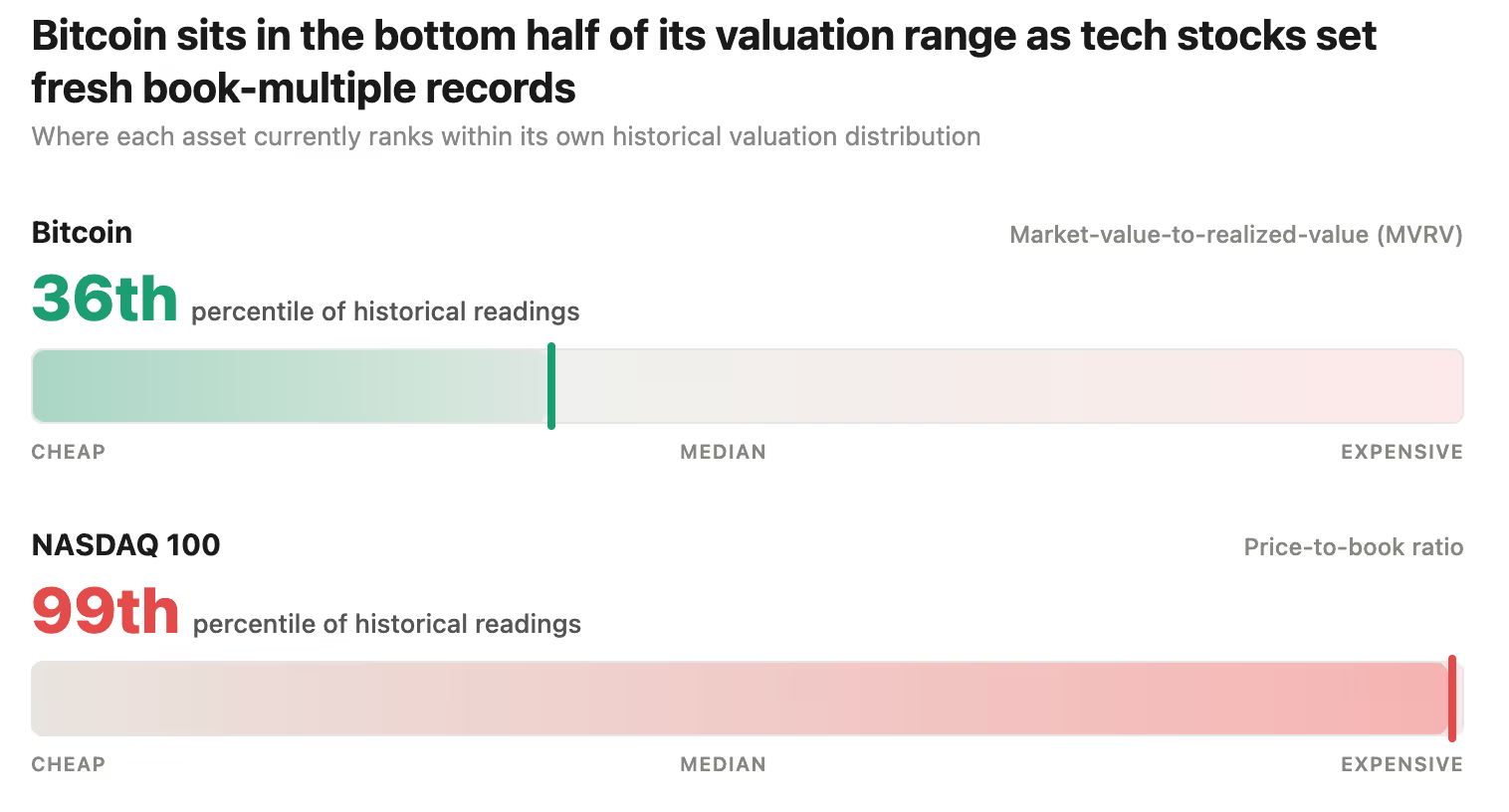
On valuation, the report flagged one of the most extreme divergences between bitcoin and U.S. large-cap tech it has observed. Bitcoin’s market-value-to-realized-value ratio sits in the lower half of its historical distribution, with only 36% of historical readings below the current level.

The NASDAQ 100’s price-to-book ratio, by contrast, is at its highest level on record, with 99% of historical readings below the current level.
Bitcoin was trading near $66,300 on Wednesday after sliding from above $71,000 earlier this week.

The European Union’s Markets in Crypto Assets Regulation (MiCA) reaches a pivotal juncture on July 1, when the transitional regime concludes and crypto asset service providers operating under national regimes must hold a MiCA licence or discontinue EU operations. According to ESMA, non-authorized entities will not be permitted to operate within the bloc from that date and should implement wind-down plans and client migrations rather than rely on an open-ended transitional status while awaiting a decision.
The deadline raises the prospect that some firms will suspend EU activities while their MiCA applications are under review, potentially disrupting access for millions of EU-based users who continue to engage with platforms not yet authorized under MiCA.
Key takeaways
- Effective July 1, any crypto asset service provider without a MiCA licence, operating under national exemptions, must cease EU operations or risk enforcement actions.
- Regulators have explicit enforcement tools to halt services, force client offboarding, publish firm names, and impose administrative fines for unauthorized activity under MiCA.
- France has authorised 19 CASPs so far, with about 25 additional applications under review, while unauthorized providers face criminal penalties (up to two years in prison and a 30,000 euro fine).
- Germany requires that providers previously operating under exemptions obtain licence by June 30, with enforcement measures possible where appropriate.
- Austria did not extend grandfathering under its pre-MiCA regime; no exchanges are operating without a licence in the country, with nine CASPs licensed by the FMA and a significant volume of MiCA applications still in process.
- Industry estimates suggest a sizable share of European users may still interact with non-MiCA-authorized platforms; OKX Europe’s analysis indicates that a substantial portion of active users may be on non-authorized exchanges.
- Major exchanges remain in the licensing process, including Bitget (Austria) and Binance (Greece); neither is currently listed among MiCA-authorized providers in the EU, with statuses evolving as regulators review applications.
National enforcement landscapes and licensing progress
France’s Autorité des marchés financiers (AMF) has authorised 19 crypto asset service providers to operate under MiCA, with roughly 25 applications still under review. The AMF emphasizes that from July 1, providers not licensed under MiCA must cease their activities within the French market. The regulator has also signaled that it can blacklist firms, issue public warnings, and seek court orders to block access to sites targeting French users. Unauthorized activity is treated as a criminal offence with potential penalties including prison time and fines.
Germany has adopted a national implementation approach that includes a licensing requirement for providers previously operating under exemptions. BaFin, its national regulator, indicated that a licensing window closes by June 30, and enforcement may be applied where appropriate as regulators review ongoing applications. The German stance aligns with MiCA’s directive for national authorities to grant immediate enforcement powers against unauthorised services.
Austria presents a stricter posture by choosing not to extend any grandfathering for virtual asset service providers under its pre-MiCA regime. The post-transition environment is designed so that no exchanges operate without a licence. The Finanzmarktaufsicht (FMA) has licensed nine CASPs to date, and it notes that MiCA-related applications are significant, though it does not disclose pending figures.
Legal risk, enforcement tools, and what the end of transitional periods means for providers
Industry legal counsel stress that simply having a MiCA application in progress does not shield a CASP from the July 1 deadline. Firms continuing to serve EU clients without an authorised MiCA framework will be operating unlawfully and cannot expect business-as-usual treatment once transitional protections lapse. MiCA itself equips member states with clear authorities to order an immediate halt to services, mandate client offboarding, publicly name non-compliant firms, and impose administrative fines for unauthorized activity. This creates a path for rapid, targeted action by regulators against non-compliant platforms.
These enforcement provisions bear significantly on the operational dynamics across the EU, potentially triggering abrupt wind-downs, forced migrations of clients to compliant platforms, and heightened scrutiny of cross-border service provision. The end of transitional periods also intersects with broader regulatory expectations around AML/KYC compliance, consumer protection, and ongoing supervisory oversight of licensing practices across member states.
Impact on users and market structure
The potential disruption extends beyond the regulated landscape into user access and liquidity across the European market. Analysis shared with Cointelegraph by OKX Europe suggests a sizable portion of European crypto users may still be active on platforms that are not MiCA-authenticated. OKX Europe quantified a period from May 2025 to May 2026 during which 18.5 million crypto app downloads occurred in Europe; approximately 7.6 million of those downloads, or 41%, were for exchanges not appearing on the independent MiCA-authorized provider register maintained from ESMA and national datapoints. OKX cautions that app-install data undercounts user activity due to browsers or earlier-app usage, and thus estimates may not capture all active users. OKX Europe CEO Erald Ghoos described this as a meaningful exposure, noting that many users may still rely on non-authorized platforms through multiple access channels.
The European Securities and Markets Authority (ESMA) has not provided a public estimate of how many EU users remain on unauthorised platforms, citing the absence of non-public information. The regulatory framing underscores a transition in market structure: as MiCA entrants consolidate, a period of adjustment is expected where users migrate to licensed venues or where enforcement narrows the field of available services. This shift has potential implications for cross-border banking relationships, stablecoin integration within regulated rails, and the standardization of licensing and supervisory practices across jurisdictions.
Active applicants and ongoing licensing momentum
Not all major exchanges have achieved MiCA licensure. Bitget has applied for a MiCA licence in Austria in 2025 and indicated it expects regulatory approval in the second quarter of 2026; it has stated it will refrain from offering EEA services until authorization is granted. Binance has pursued a MiCA licence in Greece via the Hellenic Capital Market Commission and is not listed among MiCA-authorized providers in the EU as of now. Binance did not respond to requests for comment on its application status. The ongoing review processes for these and other providers will shape the pace at which non-localized regional operations convert to fully MiCA-compliant activity.
These licensing trajectories illustrate how enforcement timelines, national regulatory interpretations, and the resources available to review applications will influence the competitive landscape. For exchanges of scale, the MiCA licensing process functions not merely as a compliance hurdle but as a potential market access gate that can determine cross-border growth and consumer reach within the EU’s single market framework.
Closing perspective
As the July 1 deadline approaches, the EU’s MiCA framework moves from principle to practice, pushing providers toward formal licensing, wind-down planning, or exit from the EU market. The evolution will test regulatory coordination among member states, map user exposure across compliant and non-compliant platforms, and redefine the structural dynamics of crypto service provision in Europe. Forward-looking vigilance will be essential for institutions tracking licensing trajectories, enforcement actions, and the practical implications for compliance, risk management, and customer continuity in a transitioning market.

On-chain data confirmed that the Zcash network is down, it has been producing no blocks for over 4 hours, a catastrophic deviation from the protocol’s 2.5-minute block target that left thousands of transactions stranded in the mempool with zero confirmations.
— Coin Bureau (@coinbureau) June 3, 2026
 JUST IN: Zcash reportedly down after failing to produce any block in the past 4 hours, per InfinityHedge. pic.twitter.com/KdijaSlbCQ
ZEC dropped 2% in the hour following the four-hour mark of the halt, with exchange deposit services on Binance and Kraken effectively frozen as no block confirmations cleared. This could be a consensus bug, a mining coordination failure, or something uglier has not been confirmed.
Discover: The Best Crypto to Diversify Your Portfolio
Zcash Down: Blockchain Halt
Block explorers monitoring the Zcash chain confirm the halt is real and sustained. Under normal operation, the network targets a new block every 2.5 minutes via its Equihash proof-of-work consensus, and these four hours of silence have likely brought 96 missed blocks.
Community developers active on the Zcash Foundation and Electric Coin Co. (ECC) forums have circulated two primary theories: a consensus bug triggered by a recent minor node update, or an unforeseen interaction with the network’s difficulty adjustment algorithm.
As of now, a standard 51% attack has been largely ruled out as the signature here is total cessation of block production, and not chain reorganization.
INTEL: Zcash coordinated a network upgrade due to an Orchard pool soundness vulnerability.
Multiple block explorers, including the official explorer, still appear to be catching up after the upgrade, while block production is reportedly continuing, as seen on ZecMiningPool.
We… https://t.co/743lwfwqJ7 pic.twitter.com/eW3tJNz6Tf— Solid Intel
(@solidintel_x) June 3, 2026
What the data does NOT yet confirm is the precise block height at which production stopped, if the halt is affecting both Zcashd and ECC’s Zebra client simultaneously, or if a hotfix is imminent.
This is not the first time Zcash’s dual-client architecture has created consensus-layer stress, in early June 2026, an emergency Zebra consensus patch was required to prevent a network split, and a separate Emergency Orchard Upgrade temporarily paused shielded private transactions to address a pool vulnerability.
The pattern of rapid-response emergency patches is becoming a feature rather than an anomaly. Until ECC or the Zcash Foundation issues an official post-mortem, the cause sits in an uncomfortable grey zone. Miners are clearly not producing. The reason why remains unconfirmed.
ZEC Price Slides as Network Outage Triggers Confidence Selloff
ZEC was trading in the range of around 2% lower from an hour ago, with selling pressure accelerating precisely as the four-hour mark of the blockchain halt became apparent to broader market participants. The move mirrors the pattern seen across other network disruption events, slow initial reaction, then a sharp leg down once the duration makes denial impossible.

ZEC had staged an extraordinary recovery from its July 2024 lows under a dollar, surging over 16x to the $250 range by April 2026, with a 16% single-day spike to $372 recorded on April 9, 2026, and another sharp 30% move in May that put the coin at above $600.
The structural read is bearish until block production resumes and an official explanation confirms the halt is contained.
Discover: The Best Token Presales
The post Zcash Down: No Blocks Produced in 4 Hours appeared first on Cryptonews.
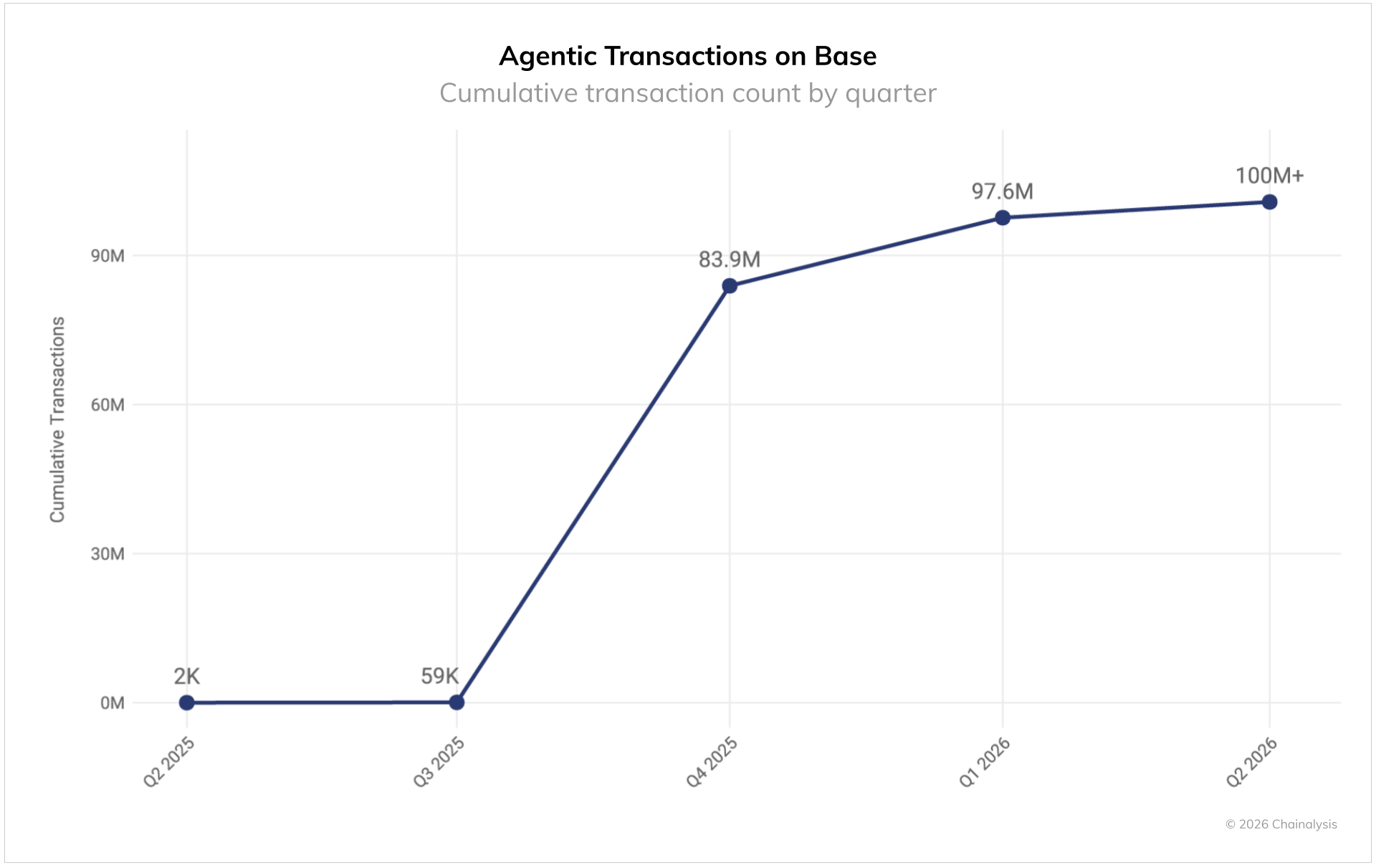
Agentic payment activity on Coinbase’s Base network has surpassed 100 million transactions, signaling that machine-to-machine payments are moving beyond the proof-of-concept stage in onchain environments.
According to a new Chainalysis report, wallets interacting with Coinbase’s x402 protocol generated more than 100 million transactions on Base within roughly nine months of launch.
The x402 protocol allows software agents to make onchain payments directly through web requests. When an agent requests access to a resource, such as a data feed or API, it can automatically complete a stablecoin payment without human authorization.
Much of x402’s early growth was driven by a memecoin experiment called PING, which required users to make a payment through the protocol to mint tokens. The project attracted large numbers of users looking to acquire the token, triggering a surge in transaction activity.
Although activity moderated after the PING frenzy subsided, usage did not collapse. According to Chainalysis, transaction volumes have stabilized while the value of transfers has increased.
In early 2025, transactions worth more than $1 accounted for roughly 49% of total value transferred through x402. By early 2026, that figure had climbed to 95%, suggesting that the protocol was moving beyond micropayments.
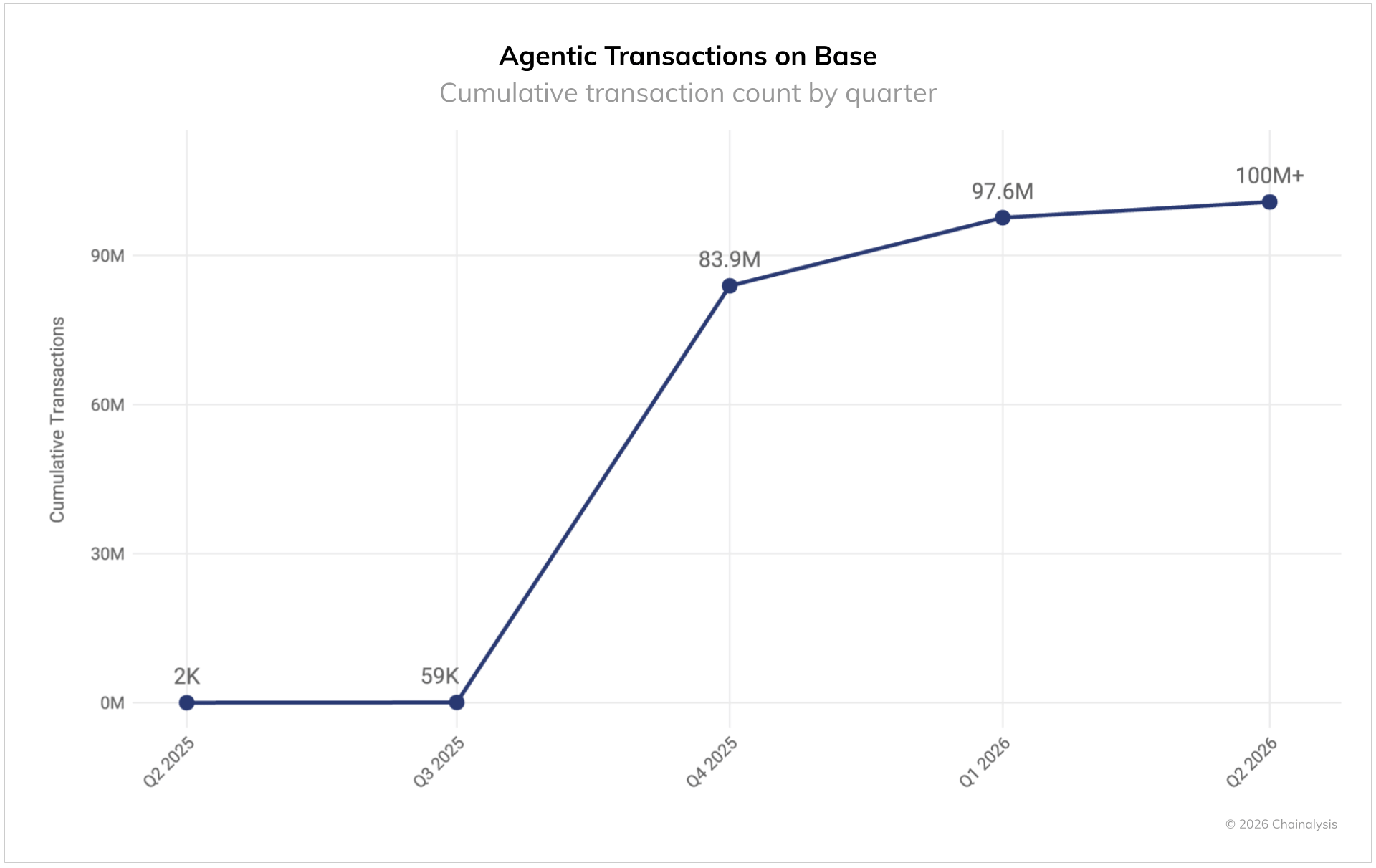
Cumulative agentic transfer volumes on Base. Source: Chainalysis
Related: How AI agents can reshape arbitrage in prediction markets
Onchain data points to a growing use case for agentic payments
The rise of AI tools has sparked renewed interest in agentic payments. Supporters say crypto networks are well-suited for these transactions because they can move money around the clock and process payments automatically, without requiring a user to approve every purchase.
Several crypto industry leaders, including Coinbase CEO Brian Armstrong and Circle CEO Jeremy Allaire, have argued that AI agents could soon account for a significant share of onchain activity. Former Binance CEO Changpeng Zhao has expressed a similar view, describing cryptocurrency as the “native currency” of AI agents.
Early versions of machine-to-machine payments already exist in crypto. Decentralized computing networks allow users and applications to pay for GPU resources on demand, while decentralized data marketplaces enable applications to purchase datasets and blockchain information through automated transactions.
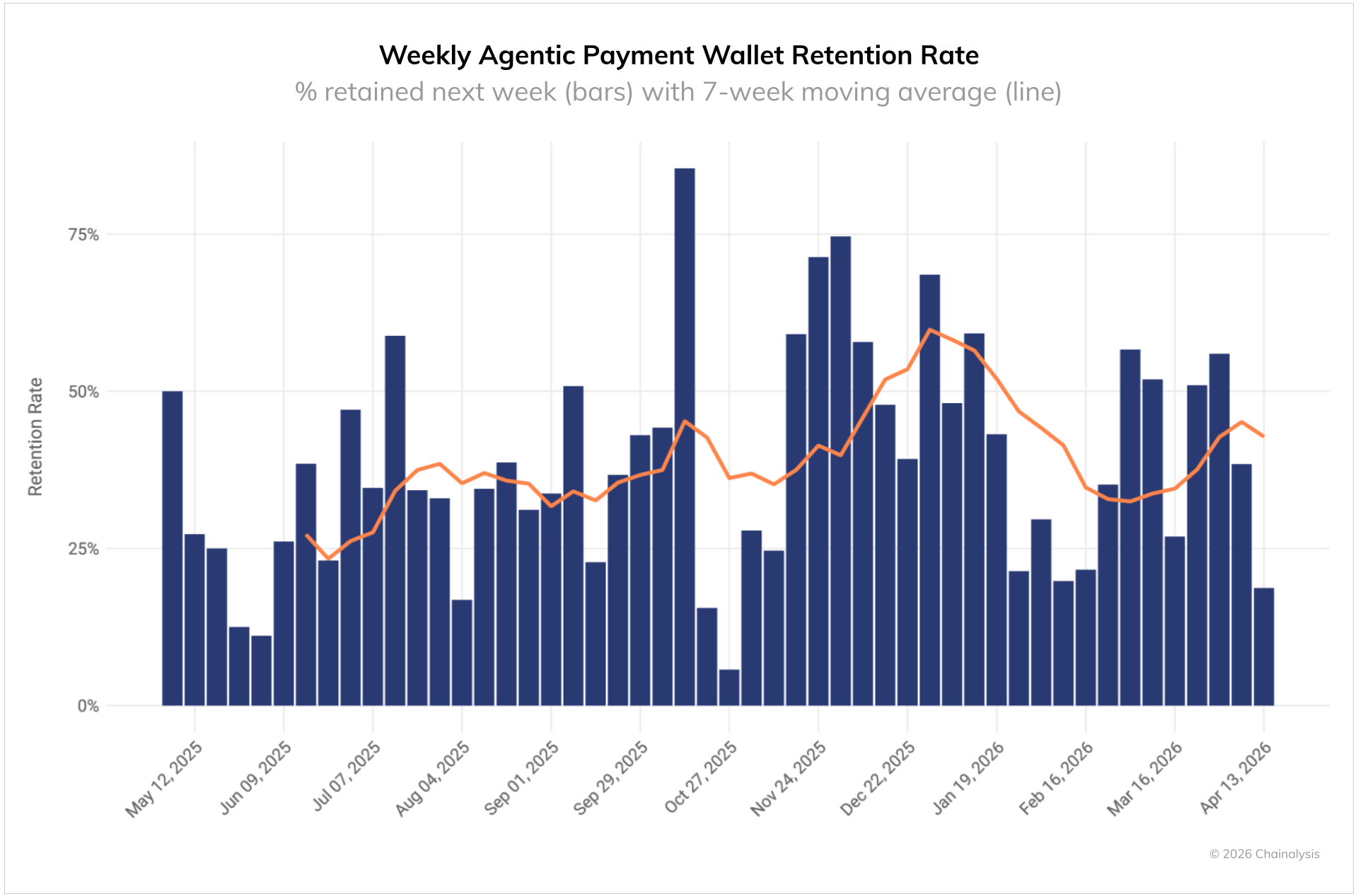
Weekly wallet retention for agentic payments on Base has been trending upward. Source: Chainalysis
Interest in the concept extends beyond crypto. A recent Forrester report highlighted Stripe’s Machine Payments Protocol as a potential catalyst for reviving micropayments through AI agents.
Bernstein analysts said AI agents could boost demand for stablecoins, which are well-suited to frequent, low-value payments, highlighting Coinbase’s x402 protocol.
Magazine: AI-driven hacks could kill DeFi — unless projects act now
The leading cryptocurrency has been in a clear decline lately, with its price tumbling well below $70,000.
Certain analysts and well-known financiers think the bottom during this cycle has yet to be reached, while waning institutional interest in the asset intensifies fears of a more substantial sell-off.
Red Days for the ETFs
Several hours ago, BTC dropped to nearly $65,000, its lowest level since March this year. The analyst Ali Martinez recently predicted that slipping below the $71,300-$73,000 range could lead to a decline of that magnitude, while X user Ted envisioned a deeper crash to as low as $55,000.
Of course, Peter Schiff also added his name to the pessimists. The well-known crypto critic and gold proponent forecasted a major collapse to $20,000 if BTC breaks $50,000. In his view, such a catastrophe would shake the conviction of the long-term HODLers and cause them “to finally throw in the towel.”
Recent netflows in spot BTC ETFs serve as a warning that conditions for the primary cryptocurrency could worsen in the near future. Over the past 12 days, outflows have surpassed inflows, suggesting that institutional investors (such as pension funds and hedge funds) have reduced their exposure to the asset.
This, in turn, has prompted ETF issuers (BlackRock, Fidelity, and other financial giants) to sell real BTC, adding even more downward pressure on an already fragile market. It is important to note that spot Bitcoin ETFs have not experienced 12 consecutive red days since their launch.

The rising amount of BTC stored on centralized exchanges is another concerning factor. There are now more than 2.72 million coins held on such trading venues, the highest point since March. The development doesn’t guarantee a further price crash, but it does increase selling pressure.

Is the Bottom Close?
Another popular X user who touched upon the matter is bee. They believe that BTC is in the final stage of the bear cycle, yet this doesn’t rule out an additional decline. The analyst forecasted a plunge to $47,000-$51,000 by October this year, after which the bulls are expected to regain control.
For their part, Max Crypto noted that BTC’s Relative Strength Index (RSI) has dropped under 30, which has historically been followed by a bottom and a subsequent rally by nearly 40%.
The post 12 Days of Red: Are Bitcoin (BTC) ETFs Signaling a Deeper Price Collapse Ahead? appeared first on CryptoPotato.

Key Takeaways
- Timothy Horan from Oppenheimer downgraded AT&T shares from Outperform to Perform, eliminating his previous $32 price target.
- Shares of AT&T declined 4.4% to $23.56 on Wednesday, marking the steepest single-session decline since October 2025, with year-to-date losses now at 5.2%.
- The analyst’s bearish stance stems from increasing competition in satellite broadband, particularly from SpaceX’s Starlink and Amazon’s Leo platforms, which could threaten AT&T’s internet customer base.
- The anticipated SpaceX initial public offering next week is expected to amplify concerns about satellite-based threats to conventional broadband companies.
- Satellite LEO operators are forecast to acquire more than 2 million new subscribers annually, potentially commanding 10% of the market by 2030, with Starlink’s pricing now competitive with traditional broadband services.
AT&T (T) Shares Tumble 4.4% Following Analyst Downgrade on Satellite Broadband Threat
Shares of AT&T plunged 4.4% to close at $23.56 on Wednesday following Oppenheimer analyst Timothy Horan’s decision to downgrade the telecommunications company from Outperform to Perform, while simultaneously withdrawing his previous $32 price target. The decline represented the stock’s steepest intraday loss since October 2025.
The downgrade wasn’t triggered by operational missteps at AT&T. Rather, Horan’s concerns focus on an emerging competitive threat originating from space.
The analyst’s primary worry revolves around escalating competition from satellite low-earth-orbit (LEO) broadband services, especially SpaceX’s Starlink and Amazon’s Leo platforms. Horan contends that the telecommunications sector is significantly undervaluing the disruptive potential of satellite internet on traditional broadband services, mirroring how cable providers previously miscalculated the impact of fixed wireless technology.
“We are concerned the industry is underestimating the risk of satellite as cable did with [fixed wireless access],” Horan stated in his research note.
Upcoming SpaceX IPO Could Amplify Competitive Concerns
The timing of Horan’s downgrade carries strategic significance. With SpaceX scheduled to debut on public markets next week, the analyst anticipates that the IPO will intensify scrutiny on the competitive challenges satellite technology presents to established telecom operators like AT&T.
Horan’s projections suggest satellite providers will add over 2 million subscribers annually and potentially capture 10% of the broadband market by 2030. He further observes that Starlink’s pricing has achieved parity with conventional broadband services, while capacity is projected to expand tenfold through V3 satellite deployment.
Among major carriers including AT&T, Verizon, and T-Mobile, Horan identifies AT&T as facing the greatest exposure. The analyst points to AT&T’s substantial wireline infrastructure and slower adoption of fixed wireless technology compared to competitors as primary weaknesses. He also anticipates downward pressure on average revenue per user (ARPU), with T-Mobile and Verizon’s superior cost structures intensifying competitive dynamics.
AT&T CEO John Stankey has disputed the severity of the satellite threat. During the company’s annual shareholder meeting in May, he recognized satellite’s utility for underserved locations but argued: “I don’t think satellite is a substitute for the speed, reliability and capability of our assets that we’ve been investing in for decades.”
AT&T’s $250 Billion Infrastructure Initiative
The telecommunications giant is actively responding to competitive pressures. This past March, AT&T unveiled plans for a $250 billion investment spanning five years to accelerate fiber optic, 5G, and wireless infrastructure deployment nationwide.
During the Q1 earnings call in April, Stankey disclosed that AT&T’s fiber network currently serves more than 37 million customer locations and is projected to expand to over 60 million by decade’s end.
The company has also introduced a promotional offering bundling home internet and wireless service starting at just $35 monthly.
Wall Street analysts and Seeking Alpha contributors currently assign AT&T a Buy rating, while Seeking Alpha’s Quant system rates the stock as a Hold with a 3.42 out of 5 score, recognizing strong profitability metrics but noting weakness in growth potential.
AT&T stock has declined 5.2% year-to-date in 2026.


Buy or Sell GameStop Stock in 2026? Cash Hoard and Buybacks vs Persistent Revenue Decline

Bitcoin miners face fresh pressure as BTC nears key support despite $1B May revenu

30 Prime Member Exclusive Deals Happening Before Prime Day



![MORAD - NO MONEY [VIDEO OFICIAL]](https://wordupnews.com/wp-content/uploads/2026/02/1771006117_maxresdefault-80x80.jpg)


-

 Tech6 days ago
Waymo dominates autonomous vehicle registrations as Tesla trails behind
-

 News Videos5 days ago
This is BROKEN! INSANE 5x MONEY CAR WASH WEEK! The NEW GTA Online UPDATE Today! (GTA5 New Update)
-
 Tech4 days ago
SpaceX just won a second Golden Dome contract. This one is $4.16 billion.
-

 News Videos5 days ago
SHE IS KILLING XRP!!! WATCH URGENT AND ACT FAST
-

 Business2 days ago
Jade Biosciences, Inc. (JBIO) Discusses Positive Interim Results From JADE101 Phase I Healthy Volunteer Study and Development Plans Transcript
-
 NewsBeat5 days ago
FIRST NIGHT REVIEW: Take That bring the Circus back to life in spectacular sun-soaked style
-
 Crypto World5 days ago
CFTC Has Approved the First Regulated Bitcoin Perpetual Contract in the U.S.
-

 Business4 days ago
Is the Spurs Phenom Already Better Than Prime Diesel?
-
 NewsBeat5 days ago
Novak Djokovic v Joao Fonseca LIVE: French Open latest scores and results after Jannik Sinner’s shocking collapse
-
 Crypto World5 days ago
Snowflake (SNOW) Stock Rallies on Strong Q1 Results and AI Product Growth
-
 Entertainment5 days ago
Weak ‘Supergirl’ Box Office Tracking Amid Milly Alcock Backlash
-

 Business4 days ago
Demand Conditions Improve In Chemicals Sector In April 2026
-
 Crypto World5 days ago
MicroStrategy Moves $30 Million in BTC to Coinbase Prime: Is the Bitcoin Sell-Off Already Here?
-

 Politics4 days ago
The House | Inside Andy Burnham’s Makerfield Campaign: “Nobody Thinks This Is In The Bag”
-

 Tech5 days ago
This Week In Security: Ubiquiti Fixes, And FreeBSD Joins The Club You Don’t Want To Join
-
 Entertainment4 days ago
One of the Greatest Sitcoms of All Time Shoots Up Apple TV’s Charts 11 Years Later
-

 Entertainment5 days ago
Maddox Jolie-Pitt Legally Requests to Drop Brad’s Surname
-
 Crypto World1 day ago
Seagate (STX) Stock Surges to Record High on AI Boom and Legal Settlement
-
 Entertainment4 days ago
Britney Spears Shares Troubling Update After Hard Year
-
 Entertainment5 days ago
Bruce Willis’ Generosity Resurfaces Amid His Dementia
You must be logged in to post a comment Login