
Crypto World
Different voices in product, policy and hiring change crypto outcomes, panelists tell Consensus Miami

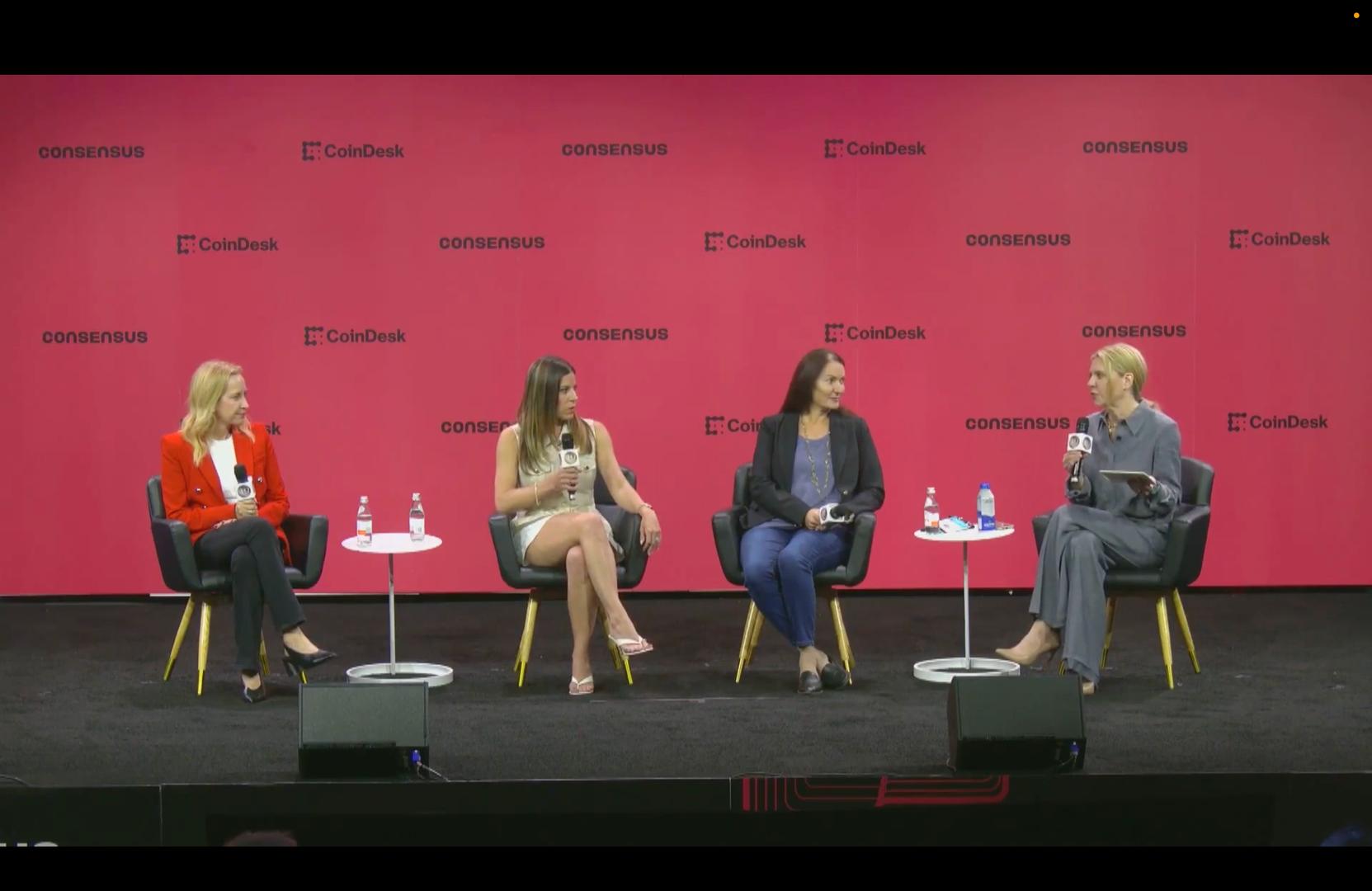
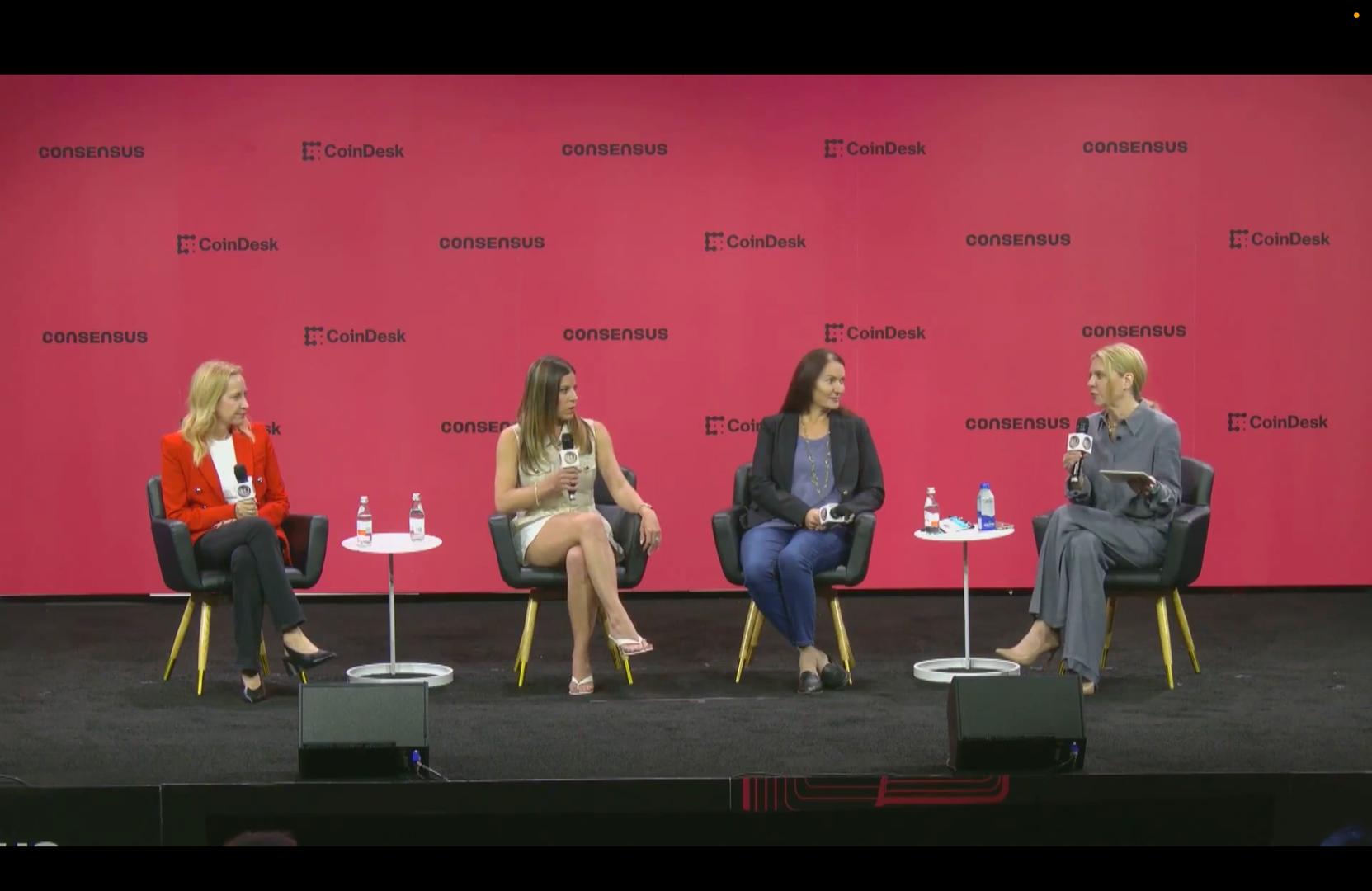
The right voices in the right rooms can reshape product, policy and hiring outcomes in crypto, three senior executives told CoinDesk’s Consensus Miami conference on Tuesday. Each cited a moment from her own organization when an outside perspective changed what was being built, argued or prioritized.
Mastercard SVP for Blockchain & Digital Assets Maja Lapcevic said her company’s crypto team had initially viewed infrastructure as the key to crypto adoption, until a partner reframed the problem around usability. “We probably all thought about infrastructure to be the winning formula for crypto,” she said. “But one of our partners actually really helped shed light on how we make crypto accessible, not complex, very simple to use.” That thinking helped push Mastercard toward cards linked to stablecoins, including for users in markets with limited access to traditional financial services, she said.
Crypto Council for Innovation Chief Strategy Officer Alison Mangiero said her organization had a similar realization around staking after bringing builders into policy discussions. “Sometimes we might think we understand, or we’ll put things into a bucket,” she said. “We’ll take a shortcut and say, oh, that sounds like a fund. Oh, that sounds like interest or yield, when in actuality what’s going on under the hood is fundamentally different.” After hearing from people building staking primitives, she said, CCI understood the need to describe staking as a technical service rather than a financialized product.
Clerisy Co-Founder and Managing Partner Alexandra Wilkis Wilson brought the argument to hiring. “Many of us fall into a very comfortable bias of hiring people who not only might look like ourselves or remind you of your younger self,” she said. She recalled one 10-person startup where a Myers-Briggs analysis found that eight of the 10 team members were extroverts. “It’s really important, when you’re growing teams, to not only bring in diversity on the outside, but also to think about diversity on the inside,” she said.
Mangiero closed by framing the issue as one for the broader industry. Crypto “is having a moment right now where folks are really interested in hearing our voice,” she said, “but that begs the question, what is our voice at the end of the day?” The conference, she added, “is called Consensus for a reason.” Good policy, she said, requires the industry to ensure different communities are reflected, including token holders and people building on top of blockchain networks, while also protecting consumers and allowing innovation to thrive.



Coinbase cuts 700 jobs today, with CEO Brian Armstrong saying AI is making small engineering teams far more productive
Summary
- Coinbase is eliminating roughly 700 employees, approximately 14% of its total workforce, in a restructuring announced on May 5.
- CEO Brian Armstrong cited AI acceleration as a core reason, saying the technology enables small teams to do what previously required far more people.
- The company expects to incur $50 to $60 million in restructuring charges as a result of the workforce reduction.
Coinbase CEO Brian Armstrong announced on May 5 that the company is eliminating roughly 700 employees, representing approximately 14% of its total workforce.
Armstrong attributed the cuts directly to AI changing the economics of engineering, saying the technology makes small teams capable of output that previously required far larger headcount. Coinbase shares rose on the announcement, a reaction investors typically read as margin improvement.
The company expects to record $50 to $60 million in restructuring charges. Armstrong’s framing puts Coinbase among a growing list of major tech companies using AI productivity as justification for headcount reductions, but his is a significant public statement from the CEO of the largest US crypto exchange.
What this signals for Coinbase and the broader industry
Armstrong has been building toward this position for months. As crypto.news reported, Coinbase began testing AI agents internally in April, with Armstrong stating that “we will have more agents than human employees at some point soon.” The May 5 layoffs are the first structural workforce action that reflects that forecast moving from prediction to operational reality.
The cuts arrive as Coinbase continues to press for the Clarity Act’s passage. The company spent $1.07 million on Washington lobbying in Q1 2026 and reversed its earlier opposition to the bill after a stablecoin yield compromise was reached. A leaner cost structure strengthens Coinbase’s position heading into what is shaping up to be a high-stakes regulatory engagement window.
Coinbase is not alone in citing AI as a driver of workforce reduction. As crypto.news documented, Gemini earlier stated that “AI is now too powerful not to use,” and Crypto.com cited AI integration as a reason for its own staff reductions in early 2026.
What makes Coinbase’s announcement distinctive is its scale and the clarity with which Armstrong tied AI productivity, not market conditions, to the decision.


Miami Beach, FL — After years of experimentation, crypto today is boiling down to two core uses: trading and payments.
Speaking at a fireside chat at Consensus 2026 in Miami, Tempo’s go-to-market lead, Dan Romero, said the industry is settling into a “barbell” shape, with speculative trading like Hyperliquid’s marketplace on one end and stablecoin-based payments gaining traction on the other.
“The things that have worked over the last five years are speculation and stablecoins,” he said. “In the middle, it’s a bit of a wasteland,” he added, describing a slew of projects that have struggled to find product-market fit despite years of development and funding.
Romero is speaking from experience. Before joining Tempo, he was the co-founder of crypto social app Farcaster, which struggled to gain traction despite hefty venture capital checks and years of hype.
Tempo, a payments-focused blockchain backed by Stripe and Paradigm, is positioning itself firmly on the payments side of that divide. Built as a purpose-specific layer-1 blockchain, the network focuses on enterprise needs like compliance and transaction control — features often missing from public blockchains.
For example, companies can block interactions with certain wallet addresses, a function aimed at reducing regulatory risk, Romero said.
That design reflects a broader shift in how large firms approach crypto. Rather than experimenting with tokens, many are adopting stablecoins as backend infrastructure. “It’s plumbing,” the executive said. “But enterprises like plumbing if it’s better, faster, cheaper.”
Stablecoins are already gaining ground in areas like remittances. One example cited was cross-border payments between the U.S. and Mexico, where crypto rails now account for a growing share of flows.
The next wave could come from internet-native businesses. Startups, especially those built around AI agents, are likely to default to stablecoins as the easiest way to move money globally, he said — much like Stripe simplified online payments more than a decade ago.


Anthropic venture with Blackstone and Goldman Sachs will deliver enterprise AI tools to private equity-backed companies.
Summary
- Anthropic is finalising a $1.5 billion joint venture with Blackstone, Goldman Sachs, and Hellman and Friedman to serve private-equity-backed companies.
- The platform will deliver AI tools across finance, operations, customer service, and enterprise software to PE portfolio companies.
- The announcement arrived on the same day OpenAI launched a rival enterprise AI joint venture valued at $10 billion.
Anthropic is close to finalising a $1.5 billion joint venture with Blackstone, Goldman Sachs, and Hellman and Friedman, targeting private-equity-backed companies as its primary deployment market. Blackstone and Hellman and Friedman are each expected to commit approximately $300 million, while Goldman Sachs will contribute around $150 million.
The platform will deliver AI tools across finance, operations, customer service, analytics, and enterprise software to companies within the firms’ portfolio networks.
The announcement coincides with a rival launch from OpenAI, which announced its own enterprise AI joint venture valued at $10 billion on the same day.
The simultaneous announcements signal that both leading AI developers view private equity as the most capital-efficient channel for enterprise AI distribution at scale.
The race to capture enterprise AI deployment
The Anthropic venture arrives as the company’s revenue has been accelerating rapidly. As crypto.news reported, Anthropic’s run-rate revenue reached $30 billion in April 2026, tripling from $9 billion at the end of 2025, with over 1,000 business customers each spending more than $1 million annually. CEO Dario Amodei has said the company must “build the infrastructure to keep pace with rapidly growing demand,” a statement that captures the logic driving both the revenue growth and the new PE distribution strategy.
The venture also arrives against the backdrop of legal tension. Anthropic has been suing the US government over a directive that barred federal agencies from using its technology after the company refused to allow Claude to be used for autonomous weapons or mass surveillance. That dispute has complicated Anthropic’s government contracting pipeline, making the private equity channel a strategically important alternative route.
Both Anthropic and OpenAI are accelerating into enterprise markets ahead of potential public listings. Anthropic is exploring valuations above $300 billion, making the $1.5 billion joint venture a commercial signal as much as a revenue play.


a16z crypto’s Crypto Fund 5 was announced just a day after Haun Ventures revealed its $1 billion fund focused on crypto and the agentic economy.
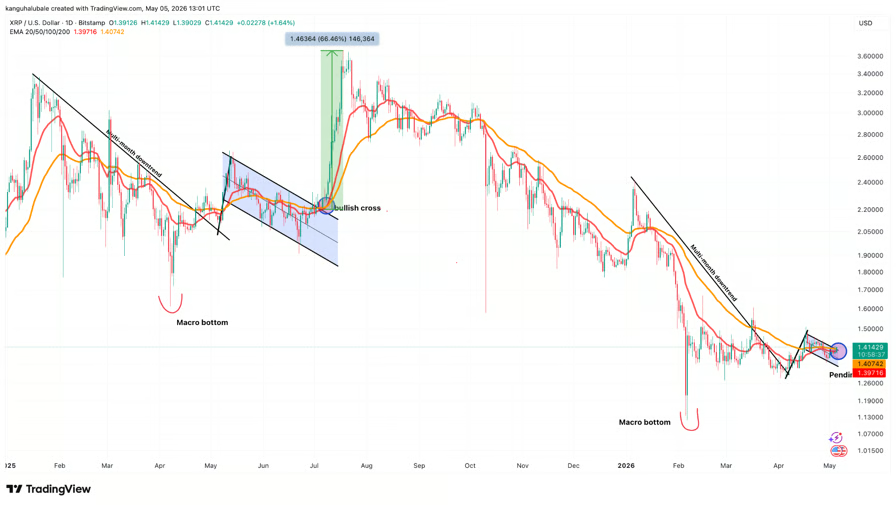
XRP (XRP) is currently displaying a technical pattern that follows a 2025 fractal that produced 66% gains. The daily chart shows XRP price breaking out of a bull flag, which can also result in massive gains.
Key takeaways:
- XRP is currently displaying a technical pattern similar to the 2025 price action that ignited a 66% price rally
- XRP’s spot taker CVD has turned positive, suggesting confidence among buyers.
XRP price chart fractal targets $2.35
XRP’s price action in the daily time frame mirrors a technical structure after recovery from the April 2025 cycle low, preceding a sharp upward continuation.
The formation came after a multi-week consolidation inside a bull flag, followed by a bullish cross by the 20-day and 50-day exponential moving averages (EMAs), as shown in the chart below.
Related: XRP set for ‘strongest’ 2026 monthly ETF inflows as bulls target $2
The XRP/USD broke above the upper boundary of the flag in early July 2025, triggering a cascade of short liquidations and fresh buying that ultimately delivered 66% gains to its current all-time high of $3.66, less than two weeks later.
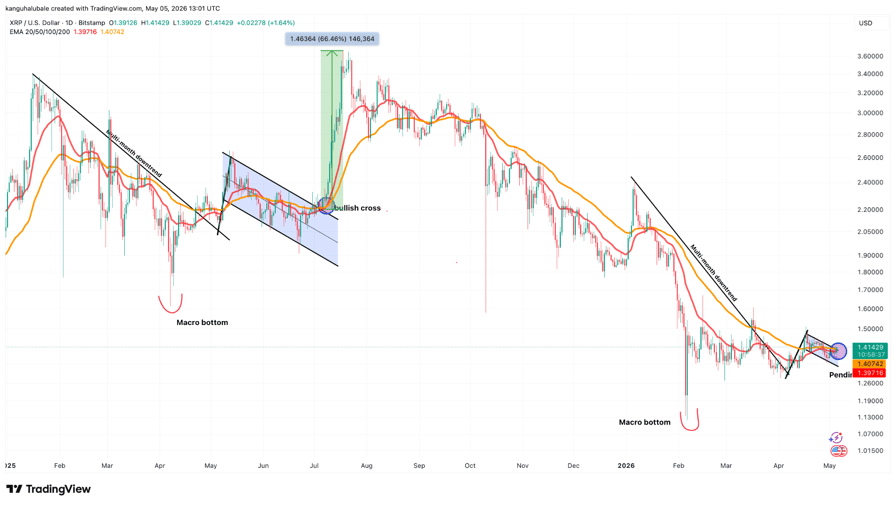
XRP/USD daily chart. Source: Cointelegraph/TradingView
XRP’s current price action is following a similar pattern, with the price again breaking out of a bull flag pattern and a pending bullish crossover from the moving averages.
If history repeats itself, XRP/USD may rally by more than 66% toward $2.35. Further confirmation of a trend reversal now hinges on the price holding above $1.40, which is also the flag’s upper boundary and the 50-day SMA.
“XRP is gaining momentum above $1.40, holding firmly over its 100-hour SMA” analyst Jack Straw said in a Tuesday post on X, adding:
“A clean break above $1.420 could trigger the next leg up.”
Fellow analyst Sam Mti said XRP was “looking good” after a buy signal from the MTI indicator, with potential to move above $1.45 as long as support at $1.40 holds.
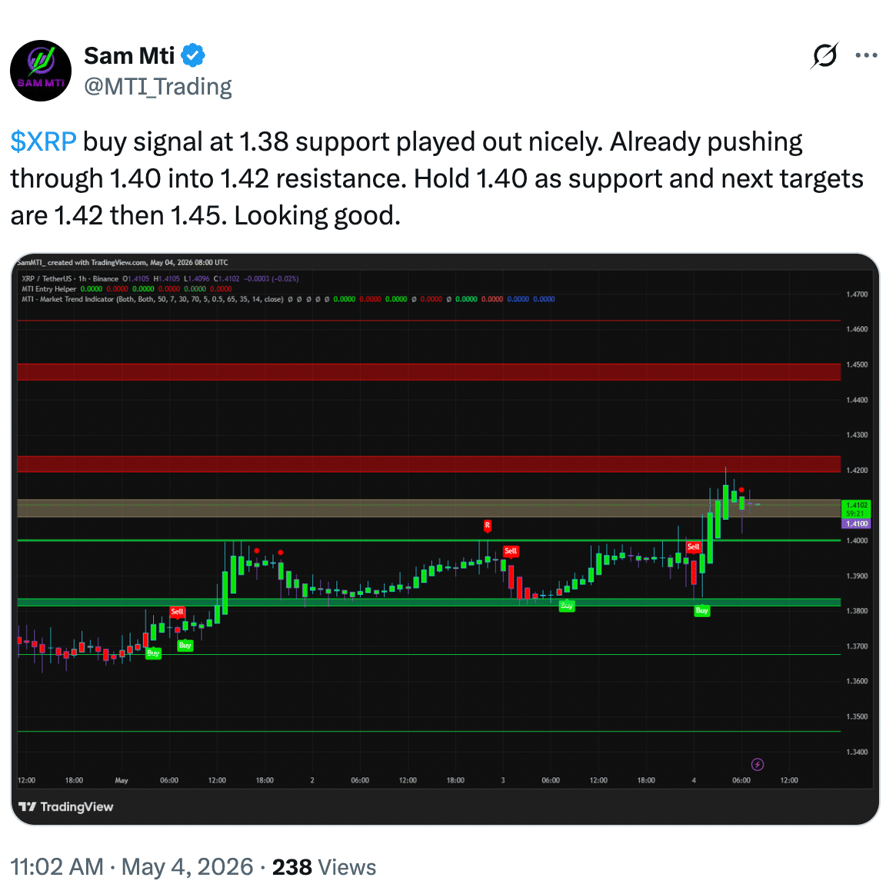
XRP/USD 1-hour chart. Source: Sam Mti
As Cointelegraph reported, buyers will gain the upper hand on a close above the $1.40 level, paving the way for an XRP rally toward $2, then to $2.40.
XRP’s spot taker CVD suggests buyers are back
XRP’s 90-day spot taker cumulative volume delta (CVD) shows that buy-orders (taker buy) have become dominant again. CVD measures the difference between buy and sell volume over three months.
The metric flipped positive (green bars in the chart below) on May 1 as the price broke above the $1.38 resistance and has remained positive since. This indicates optimism among traders, as they’re actively positioning for further gains.
If the CVD remains green, it means buyers are not backing down, which could set the stage for another rally as seen in the past. A similar occurrence in June 2025 accompanied 70% XRP price gains.
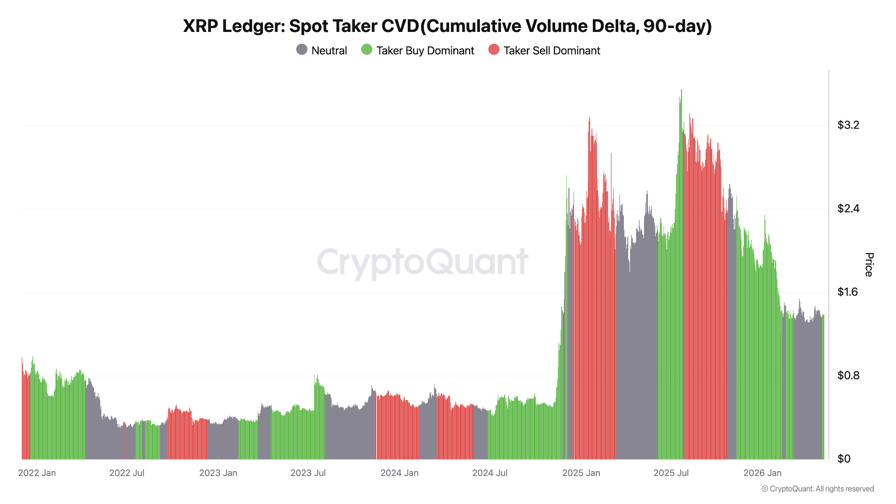
XRP spot taker CVD. Source: CryptoQuant
Meanwhile, XRP’s open interest (OI) delta flipped positive, rising to as high as $27 million on May 1, reflecting a change in active derivatives positioning, data from CryptoQuant shows
“A sharp positive reading suggests that new positions are being added to the market,” CryptoQuant analyst Amr Taha said in a QuickTake analysis on Tuesday, adding:
“When this happens while price is rising, it often shows that traders are increasing exposure as momentum begins to recover.”
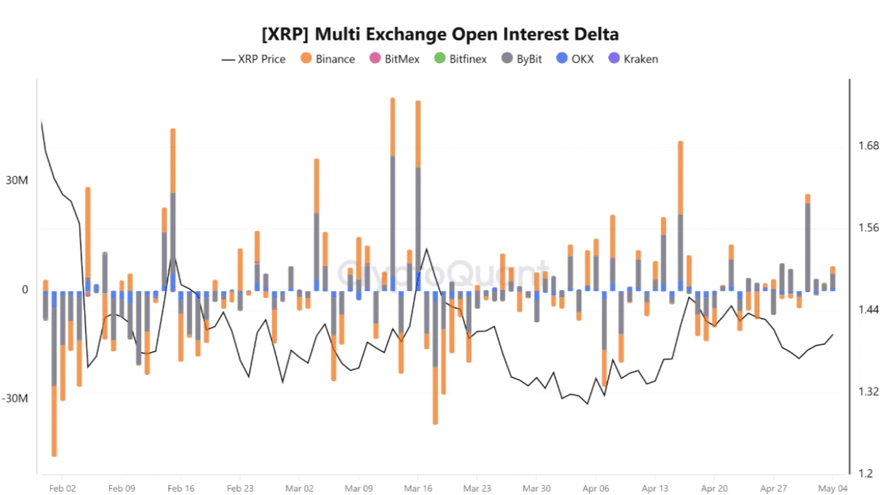
XRP OI delta across exchanges. Source: CryptoQuant
Crypto World
State Street says institutions want improved blockchain security in wake of recent DeFi attacks
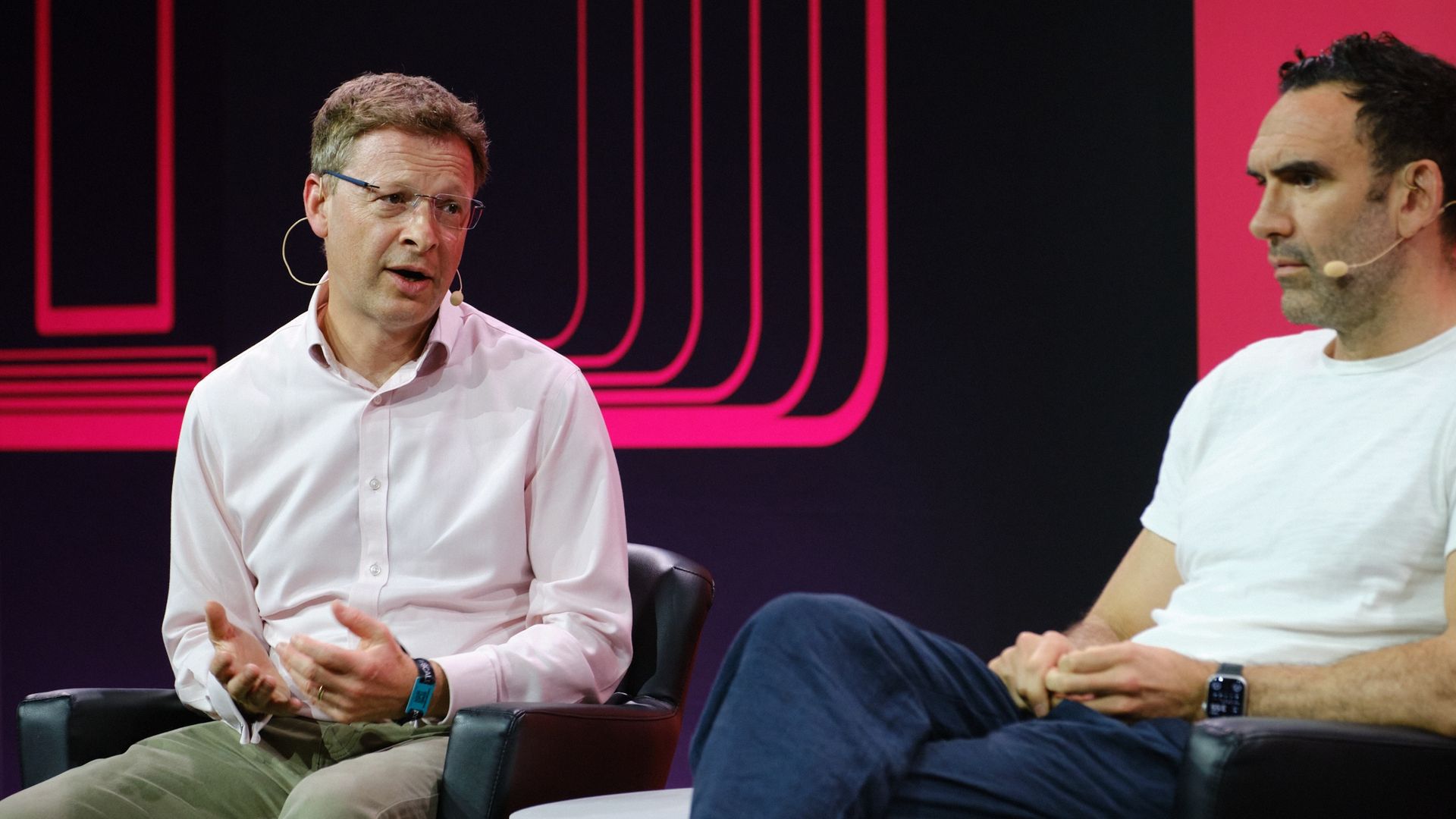
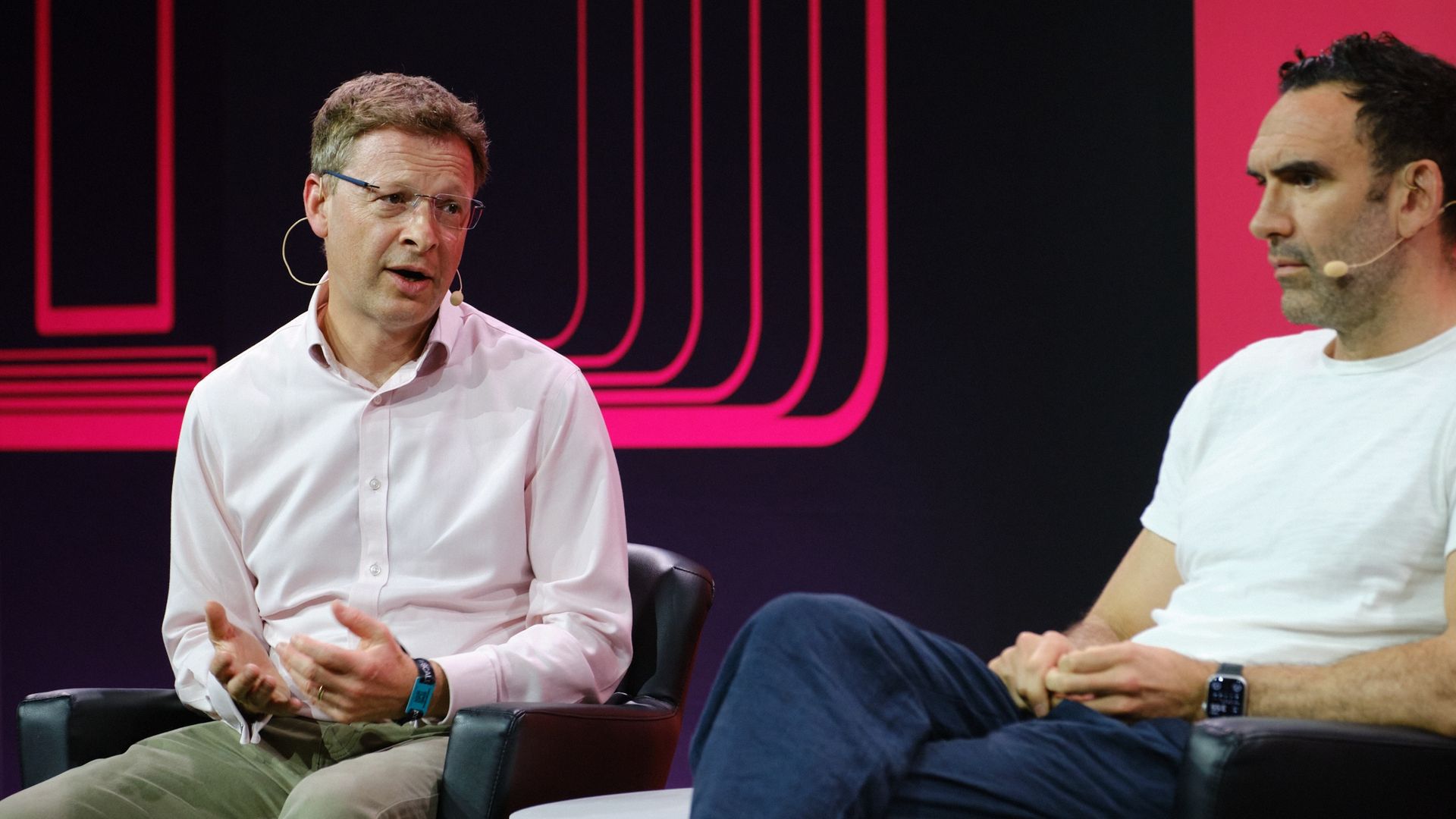
Big traditional finance firms need guardrails in a world of blockchain-based assets, particularly given how decentralized finance (DeFi) remains so susceptible to hacks and losses, the head of digital assets at custodial banking giant State Street said on Tuesday at Consensus Miami.
Still fresh in people’s minds, last month turned out to be a hacker’s bonanza in DeFi, with on-chain lending protocol Drift suffering a $295 million exploit early April, followed by a similarly sized attack on KelpDAO later in the month.
Speaking about the future of tokenized real-world assets (RWAs), Angus Fletcher, State Street’s head of digital assets, said the young crypto industry needs to find solutions now. “What are the things we actually need to solve now for a future where we’ve got trillions of dollars worth of activity on-chain? We need to start to unpick those issues now,” Fletcher said.
For institutions, interoperability between blockchains needs to be clearly defined and understood, Fletcher said, for crypto to safely scale.
“There has to be an understanding of what is the legal title and legal right when you have a token on one chain versus on another, on a cross chain basis. Our customers need to know and understand that. As institutions, it’s critical we get there,” he said.
The head of institutional at the blockchain lending protocol Morpho, Dennis Bree, said April was probably the month that has seen the most hacks in DeFi so far. “I think there’s just a general sense of understanding the security vectors, the underlying assets that are used as collateral. And we’re starting now, certainly to see curators do a lot more diligence as we think about the risk of some of those assets,” Bree said.
The everyday barriers to institutional involvement included a plethora of regulatory gray areas, Bree said. He said Morpho has curators coming to them with $10 to $15 billion in assets under management, seeking to understand how a digital vault manages that capital.
“For example, when you’ve got your capital, and you bring it into a blockchain, you have a receipt token, and instead of receipt tokens just increasing by number, they increase by value. So how does the CFO of a treasury firm think about the accounting treatment of that?”

Brad Garlinghouse, chief executive of Ripple, warned that gains toward enacting the US Senate’s digital asset market structure framework may not translate into actual passage. Speaking at the Consensus crypto conference in Miami, Garlinghouse stressed that the next two weeks would be pivotal for the CLARITY Act, suggesting the political dynamics surrounding the measure could erode momentum during the calendar leading into the 2026 midterms.
Garlinghouse noted that while the CLARITY Act aims to bring regulatory clarity to the digital asset sector, no piece of legislation is without tradeoffs. He argued that clarity is preferable to chaos, even if the bill is not perfect, and underscored the broader objective of reducing uncertainty for market participants. According to Cointelegraph, his remarks reflect a broader industry push to finalize a comprehensive framework as lawmakers weigh competing concerns about stablecoins, tokenized assets, and ethics in the asset class.
Key takeaways
- The CLARITY Act’s prospects remain uncertain, with timing increasingly sensitive to political dynamics ahead of the 2026 midterm cycle.
- A compromise on stablecoin yield, announced by Senators Tillis and Alsobrooks, could influence momentum toward advancing CLARITY, though significant questions remain about broader market structure provisions.
- Regulatory oversight coordination between the SEC and CFTC persists as a parallel track, with officials signaling that legislation remains a prerequisite for a comprehensive enforcement framework.
- Ripple and other industry participants have engaged in informal negotiations involving the White House and financial regulators, highlighting the high-stakes negotiation environment surrounding crypto regulation.
Legislative trajectory for the CLARITY Act
At Consensus, Garlinghouse framed the CLARITY Act as a priority rather than a future consideration, aligning with ongoing parliamentary activity. The measure has already progressed through the Senate Agriculture Committee in a January markup and now requires action by the Senate Banking Committee before it can reach a full chamber vote. The evolving political calculus—particularly in the context of primary campaigns and the 2026 elections—raises the risk that the bill could lose momentum if not pushed decisively in the near term.
Senator Cynthia Lummis, a member of the banking committee, has publicly pressed for congressional action, emphasizing that the entire industry operates under a cloud of legal uncertainty that only Congress can dispel. While praise for the bill’s intent exists, critics point to the need to balance consumer protection, market integrity, and innovation incentives as part of any final package.
Beyond the legislative text itself, the negotiations have encompassed a broader set of policy questions—stablecoins, tokenized equities, and ethics—areas that have been sticking points delaying movement in the Senate since the House of Representatives passed the measure in July 2025. The latest signals indicate a potential path forward if adjacent provisions on yield and asset classification can be reconciled with a regulator-friendly framework that still preserves investor protections.
Regulatory coordination and oversight posture
Even as Congress contemplates the CLARITY Act, executive-branch and agency actions continue to shape the regulatory landscape. In March, the U.S. Securities and Exchange Commission (SEC) and the Commodity Futures Trading Commission (CFTC) signed a memorandum of understanding to coordinate their oversight of the evolving digital-asset market structure. Officials describe this interagency collaboration as a practical step in aligning approaches to market infrastructure, enforcement priorities, and investor protection, pending a broader legislative foundation.
As part of the stakeholder dialogue, SEC leadership has framed crypto regulation as an ongoing process rather than a finished product. The agency has signaled that approval of the CLARITY Act would inform and accelerate its rulemaking and enforcement posture, enabling a more predictable environment for regulated entities and registered market participants.
These developments underscore a critical point for institutions weighing regulatory risk: even with interagency coordination in place, a clear, enacted framework remains essential to reduce legal ambiguity for exchanges, banks engaging in crypto-related services, and other market infrastructure providers. The interagency momentum, while helpful, still leaves substantive questions about licensing, capital requirements, and customer due diligence unresolved in the absence of final congressional action.
Broader policy context and industry impact
The CLARITY Act sits at the intersection of innovation, investor protection, and financial stability. Its fate bears directly on how crypto firms structure licensing, compliance, and cross-border operations in a landscape where different jurisdictions pursue divergent approaches. For institutions involved in tokenized assets, stablecoins, or crypto-enabled banking services, the legislation could translate into clearer standards for registration, reporting, and customer verification, thereby aiding risk management and regulatory alignment.
From a compliance perspective, the bill’s trajectory matters for AML/KYC frameworks, know-your-customer regimes, and the governance of stablecoins tied to fiat or other reserve assets. Analysts and legal teams will be watching how the bill addresses collateral standards, reserve custody, and disclosure requirements, as well as how it interfaces with existing banking relationships and payment rails. The conversation also intersects with cross-border policy movements, including the European Union’s MiCA framework, which serves as a regional reference point for market structure and stablecoin oversight.
Within the political economy of regulation, industry stakeholders argue that timely clarity is essential to reduce the systemic risk that arises from fragmented supervision and inconsistent enforcement signals. Yet the practical path to a final bill remains constrained by competing sector interests and the broader electoral calendar. As negotiations continue, market participants should prepare for continued uncertainty and scenario planning around licensing timelines, regulatory approvals, and potential transitional rules.
In summary, the forthcoming weeks will test whether legislative action on the CLARITY Act can outpace political headwinds and regulatory tensions. While interagency coordination provides a supportive backdrop, the ultimate resolution will hinge on Congress delivering a comprehensive, workable regime that aligns with enforcement priorities, investor protections, and the evolving structure of the crypto markets.
Closing perspective: The path to a binding framework remains unsettled, and stakeholders should monitor congressional calendars, committee chair statements, and any new interagency guidance that could shape the timing and scope of a final bill. The balance between regulatory certainty and policy flexibility will define the next phase of the US digital asset regime.
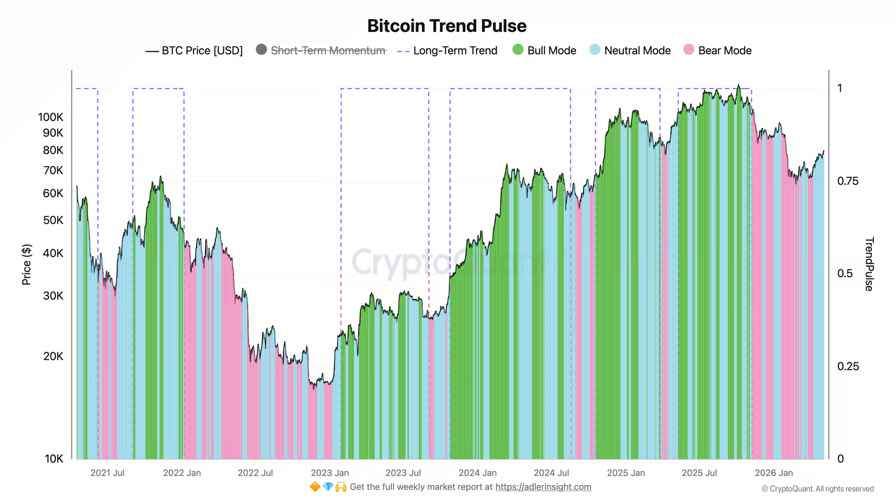
Bitcoin (BTC) may have a clear path to $90,000 after $7.9 billion in short liquidations in February put pressure on the bears. Data show liquidations came in three waves that extended from February through April. The liquidations highlight a growing imbalance as BTC traders continue to build short positions above $80,000, while the price holds firm, creating repeat conditions for future short squeezes.
Repeat short squeezes pressure bears
Bitcoin researcher Axel Adler Jr. tracked over $7.9 billion in forced short liquidations since early February. The largest spike hit $737 million on Feb. 13, followed by multiple waves through March and April.
The liquidation volumes ranged from $2–28 million per day before jumping back to $175 million on May 4. That spike came during a quiet week, pointing to renewed short exposure near $80,000. The pattern shows consistent reloading of bearish positions at higher levels.
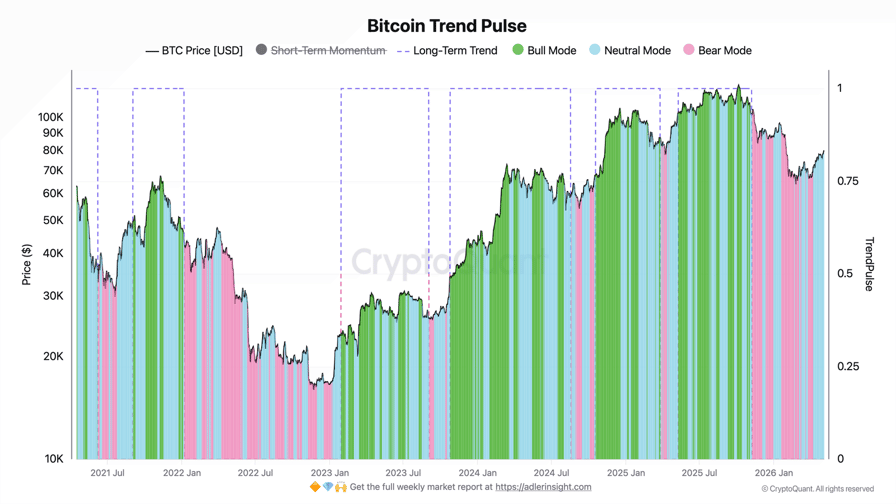
Bitcoin trend pulse. Source: Axel Adler Jr.
The trend pulse data adds context to this behavior. The model moved from bear mode into neutral mode in early April. The short-term momentum has turned positive, while the long-term trend awaits confirmation from a bullish crossover of the 30-day and 200-day simple moving averages (SMAs).
Axel Adler Jr. said each major liquidation wave formed while the trend pulse sat in neutral mode, a transition phase after bear mode without a full bullish confirmation.
The largest spikes all occurred during this phase. The price was effectively at a crossroads, while traders kept adding short positions.
That pattern shows repeated strength fading, followed by forced liquidations, creating pressure that can extend higher if current levels hold above $80,000-$81,500.
Related: Bitcoin price nears $82K as ‘big level’ sparks warning of fresh macro rejection
BTC price holds key breakout zone above $80,000
Market analyst Coin Niel pointed to continued BTC exchange outflows, with net flows of -837 BTC on May 5. The move signals ongoing accumulation, though smaller than the -6,590 BTC outflows on Monday, keeping the spot sell pressure limited.
.png?prefix=media%2Fcontent)
Bitcoin open interest on all exchanges. Source: CryptoQuant
Funding rates hold near -0.0045, suggesting longs are not crowded while the short-side pressure remains active. BTC open interest climbed 6% to $29 billion, its highest level since Jan. 31, increasing sensitivity to large price swings.
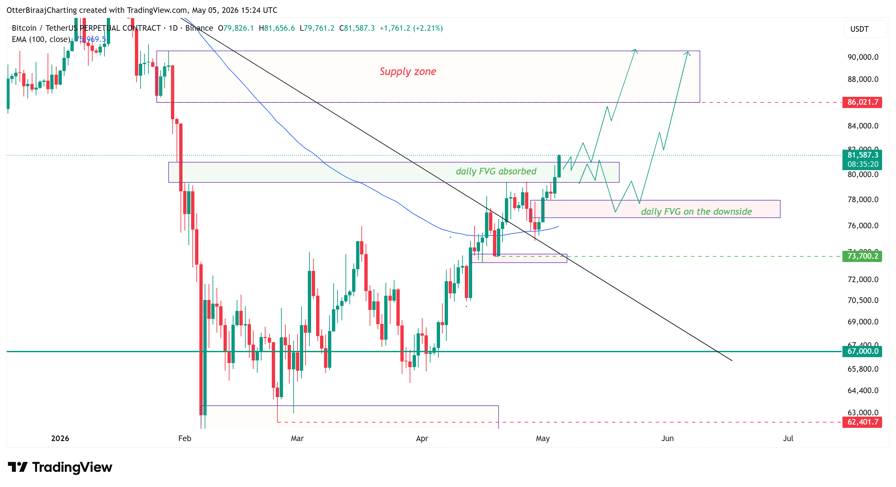
The BTC price action has turned constructive after Bitcoin broke above a descending trendline that capped rallies through April. The 100-day exponential moving average (EMA) now sits just below the price, acting as dynamic support.
BTC is also holding near $81,500, aligned with the short-term holder cost basis, a key level that keeps recent buyers in profit, and may further reduce selling pressure.
BTC/USDT on the one-day chart. Source: Cointelegraph/TradingView
The upside range of $86,000 to $90,000 aligns with a prior supply zone, where sellers stepped in and halted the recovery. This area marks a cluster of past selling activity, with relatively fewer resistance levels before it.
Below, the $76,000–$78,000 range serves as the first demand zone, supported by recent activity and a developed daily fair-value gap from last Friday.
Crypto trader KriptoHolder noted that liquidation clusters are shaping the near-term direction. The short liquidations sit around $81,000–$82,000, while a larger pool of long exposure rests between $77,000 and $78,000.
Data indicates $1.12 billion in cumulative shorts are at risk near $82,500, compared with over $4.2 billion in long positions facing liquidation near $77,000, defining a tight liquidity imbalance.
Related: Bitcoin short-term cost basis approaches profitability, but $80K must flip to support first
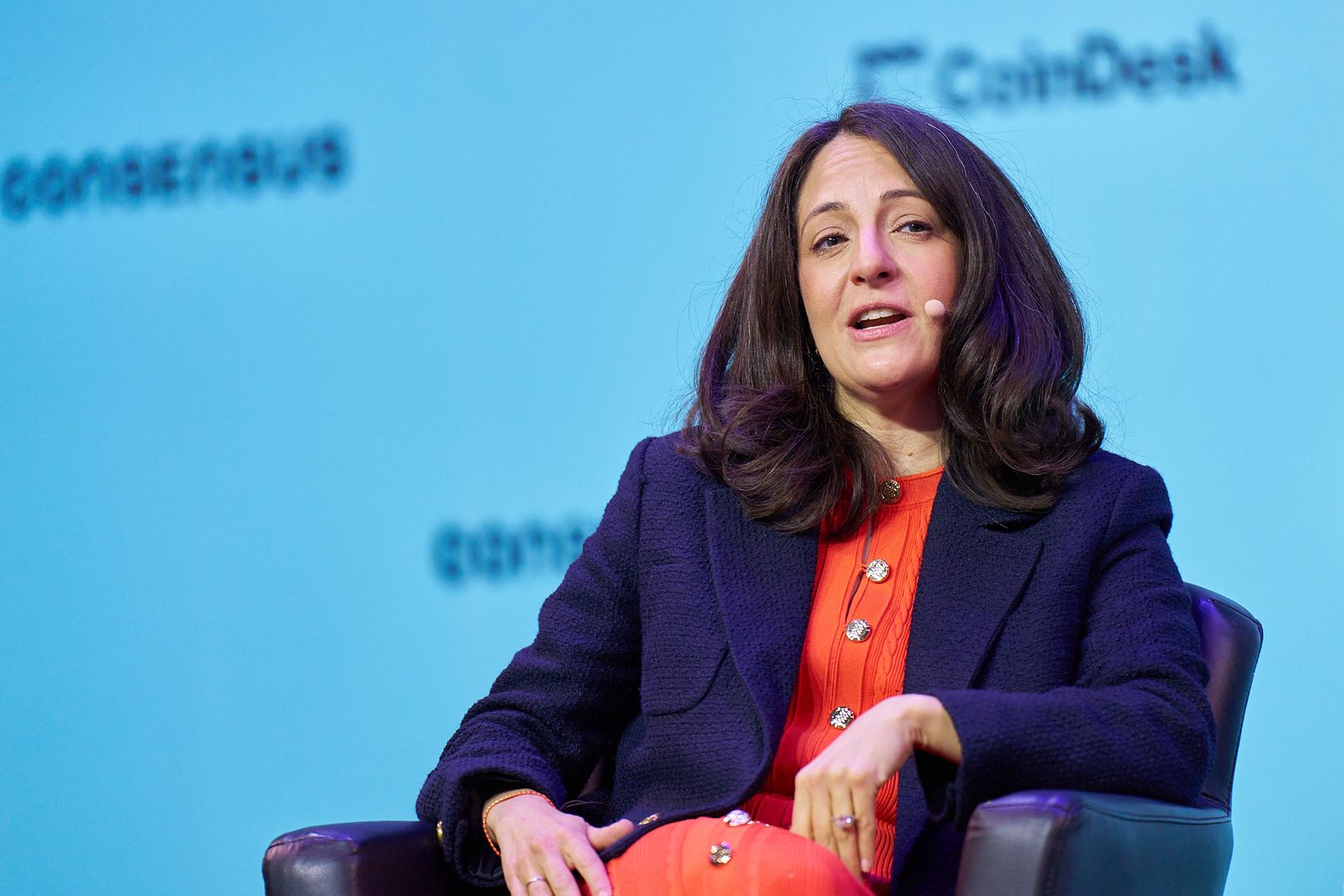
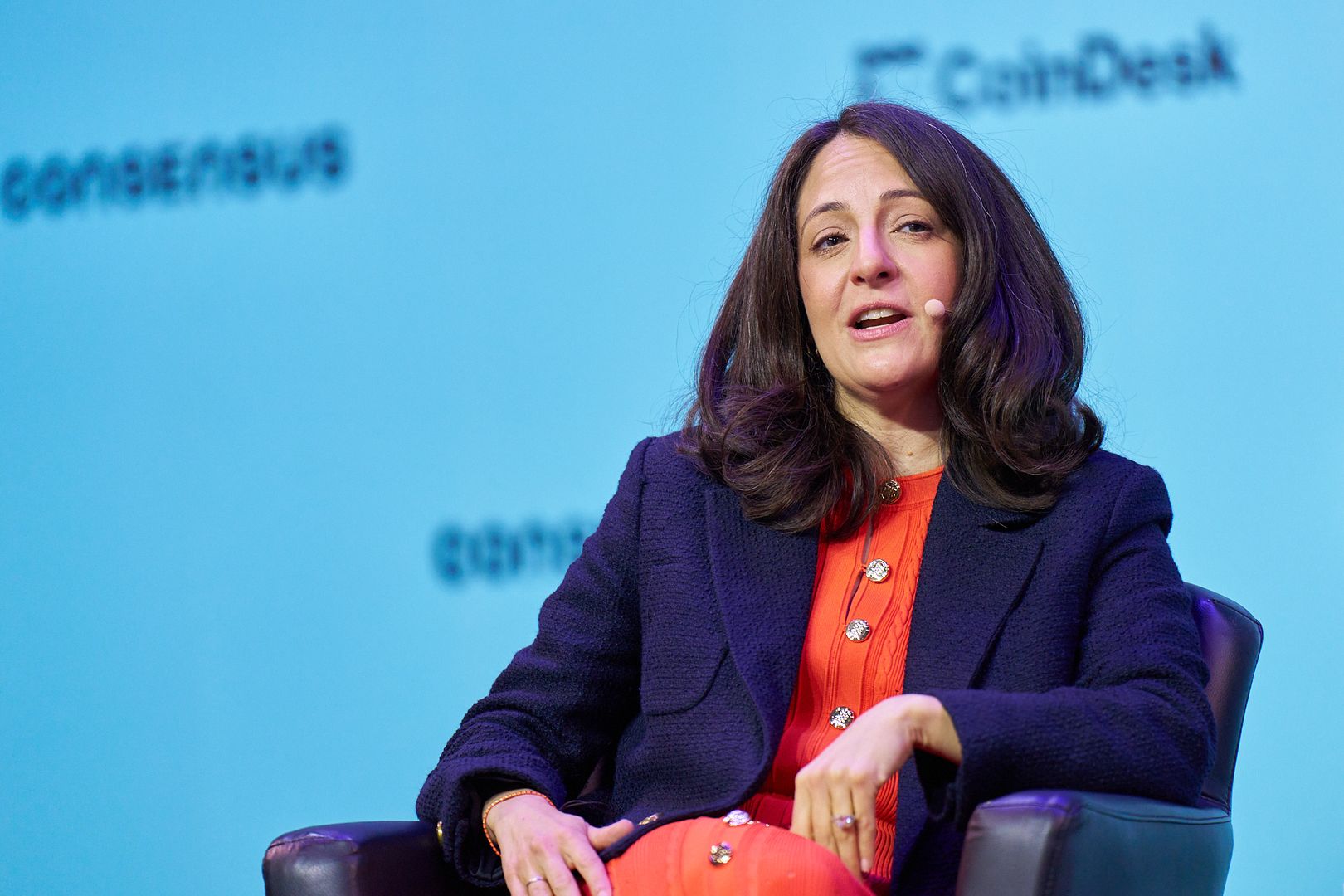
For decades, the web ran on a simple bargain: Publishers and businesses made information freely accessible, search engines and other crawlers indexed it, and those services sent human traffic back. Sites could then monetize that traffic through ads, subscriptions or commerce.
But that’s all changing fast, Cloudflare Chief Strategy Officer Stephanie Cohen said Tuesday at CoinDesk’s Consensus conference in Miami.
With the rise of AI agents, software can scrape a webpage, summarize content and keep the source user inside a chatbot or automated workflow instead of sending a person back to the original site. Cohen said that shift is breaking the internet’s old business model, with non-human traffic now exceeding human engagement.
Cloudflare’s proposed answer is to give websites more control over automated traffic: identify the bots, verify who they are, understand what they intend to do and decide whether to allow, block or charge them. Cohen pointed to x402, an open payments protocol built around the HTTP 402 “Payment Required” status code, as one piece of that stack.
“We have a billion 402 responses every single day on the Cloudflare network,” Cohen said. The status code has become part of the technical foundation for x402, an open agent-payments framework Cloudflare is developing with Coinbase.
“Think about it as a billion voices saying, I want to keep producing whatever I’m producing, but I need to be paid for it in order to keep doing that,” Cohen said.
CoinDesk reported in March that on-chain activity tied to the protocol remained small and experimental, with x402 processing roughly $28,000 in daily volume at the time. Cohen’s comments suggest Cloudflare sees a much larger pool of latent demand at the network layer.
She framed the shift as a structural change in how the internet works. “More than half of the traffic on the overall Internet today is non-human,” she said, “and that non-human traffic is growing much faster than the human traffic.” A decade ago, she said, crawlers visited a site twice and sent back one human visitor. Today, the ratio is “tens of thousands to one for AI companies that are scraping your site,” undermining the ad-and-subscription model that has long funded online content.
She positioned Cloudflare as network-layer infrastructure for that rebuild, not as a payment rail itself. The company processes more than 100 million requests per second at peak, Cohen said, citing Swift’s roughly 68 million messages per day as a comparison.
Cohen also pointed to Cloudflare’s Web Bot Auth cryptographic-verification stack and recent work involving Visa and Experian as part of the next layer of agentic commerce. The goal, she said, is to help merchants accept purchases initiated by AI agents while verifying that a real human is behind each transaction.
“We believe that, if we do this right, there will be a golden age of content,” Cohen said, “where high-quality original content is valued.”

Cape Town, South Africa, May 5, 2026 — Prophet, an AI-native prediction market platform, has launched its first live trading tranche, introducing a system where an AI model acts as the counterparty to user trades using real capital.
The initial deployment allocates $10,000 in USDC to an AI-powered trading system and opens participation to users on the platform. Instead of matching buyers and sellers, the system allows users to trade directly against the AI, which generates probability-based pricing for each market.
What has launched
Prophet’s “Tranche 1” is a limited-access deployment designed to test the system under live market conditions. Users who deposit gain the ability to create markets, with the AI pricing each market upon creation. Once live, markets can be traded by other participants.
The AI system takes the opposing side of every trade, absorbing directional risk based on its probability estimates. Markets can resolve within relatively short timeframes, with some contracts settling in as little as 24 hours.
According to the team, the initial tranche is intended as a controlled test of system performance using real capital and user interaction.
One model, one probability
A key feature of the platform is its pricing mechanism. The system aggregates outputs from multiple large language models, including those developed by OpenAI, Anthropic, Google, xAI, DeepSeek, and Meta. These models independently evaluate each market question, with Prophet combining their outputs into a single probability estimate.
The same architecture is used for market resolution. When a market reaches its deadline, the system evaluates real-world outcomes and settles the contract without a formal dispute process.
The team notes that this approach is experimental and may be subject to limitations in interpretation or accuracy.
Why the prediction market industry is watching
Prediction markets have seen significant growth in recent years, though most platforms continue to rely on human counterparties and manual or committee-based resolution.
Prophet’s model introduces a different structure, where liquidity and settlement are managed programmatically. This may allow for faster market creation and resolution, though its effectiveness at scale remains to be assessed.
Trading as system feedback
The platform is designed to incorporate trading activity into its development cycle. Each trade generates data on pricing accuracy, while each market expands the range of scenarios the system must evaluate.
According to the team, this feedback loop is expected to inform improvements to the model in future tranches.
Risks and limitations
The current version operates without a formal dispute mechanism. Market outcomes are determined by AI-based interpretation, which may be subject to error.
The initial $10,000 allocation is limited relative to broader market standards, and the tranche is positioned as a testing phase rather than a full-scale deployment.
Regulatory considerations may also apply, as AI-driven prediction markets represent an emerging category with evolving oversight frameworks.
Next steps
Tranche 1 is scheduled to run through May 8, 2026. The team plans to use data from this phase to refine pricing, resolution, and system design ahead of future deployments.
Subsequent tranches are expected to expand capital allocation and user access.
About Prophet
Prophet is a machine that predicts the future. An AI with a bankroll trades directly against users, allowing for any market to be opened instantly. Prophet is solving liquidity and resolution for the long tail of prediction markets.
Platform: app.prophetmarket.ai
X: @prophetmarketai
Website: prophetmarket.ai
Media contact
Eneo Hollenbach
Chief Marketing Officer
team@prophetmarket.ai
Disclaimer
This press release is for informational purposes only and does not constitute financial advice. Participation in prediction markets involves risk, including potential loss of capital. AI-based systems may introduce additional uncertainties in pricing and resolution.

Thierry Henry reveals private conversation with Arsenal star before Atletico Madrid win | Football

ASIC fines Canva over tardy financials

Coinbase cuts 700 jobs citing AI productivity

Manchester United reach agreement with Casemiro over contract clause amid transfer speculation

US brings back mandatory military draft registration

Steven Gerrard disagrees with Gary Neville over ‘shock’ Chelsea and Arsenal claim | Football

XRP THE FLIP HAS BEEN SWITCHED BUT ITS REALLY SLOW !!!! XRP PRICE SET $180,000,000,000,00 MARKET !!!

Hanya segini bisa financial freedom di Indonesia #andryhakim #stockwise

Caleb Hammer Addresses “The Politics” Of Financial Audit | Caleb Hammer Clips
-

 NewsBeat2 days ago
Channel 5 – All Creatures Great and Small series 7 new post
-
 Business6 days ago
Tesla Officially Registers Elon Musk’s Stock: What Investors Need to Know
-
 Tech4 days ago
Trump’s 25% EU auto tariff breaches Turnberry Agreement that also covers semiconductors and digital trade
-
 Sports4 days ago
Paul Scholes issues Marcus Rashford reality check as agreement emerges over Man United star
-

 Business7 days ago
Barclay Brothers Avoid Bankruptcy: HSBC Drops High Court Petitions After IVA Deal
-

 Entertainment4 days ago
Met Gala 2026 Rumored Guest List Is Turning Heads
-

 Entertainment6 days ago
Celebrities Who Are Attending the 2026 Met Gala Event
-

 Entertainment6 days ago
Insider Claims Reason Behind Key & Peele Split
-

 Crypto World6 days ago
Meta (META) starts stablecoin payout to creators in Circle’s USDC on Polygon, Solana via Stripe
-

 Business6 days ago
Strait of Hormuz Remains Heavily Restricted on April 29 Amid Iran Conflict
-

 Tech6 days ago
Texas Instruments made a new flagship graphing calculator: the TI-84 Evo
-

 Business5 days ago
Two Powerball Tickets Split $143 Million Jackpot in Indiana and Kansas
-
Business5 days ago
Strait of Hormuz Blockade Persists Amid US-Iran Standoff, Sending Oil Prices Soaring
-

 Entertainment4 days ago
Kylie Jenner Hit With Second Lawsuit From Ex-Housekeeper
-
 Sports4 days ago
David Benavidez responds to team Canelo saying the fight will never happen
-
Business3 days ago
Winning Numbers Drawn as Jackpot Resets to $20 Million
-

 Sports6 days ago
Saudi Arabia set to withdraw LIV Golf funding after 2026 season, per reports
-

 Sports4 days ago
Cavaliers vs. Raptors Game 6 live score, updates, highlights from 2026 NBA playoffs first-round series
-
 Crypto World5 days ago
CoreWeave (CRWV) Stock Climbs 8% Despite $45M Insider Share Dump
-
 Crypto World6 days ago
Securitize and Computershare Enable Tokenized Equity Issuance for Over 25,000 U.S.-Listed Stocks
You must be logged in to post a comment Login