
Connect with us
DAPA Banner

Business

Earnings call transcript: Chunghwa Telecom Q1 2026 sets revenue record

Published

on


Earnings call transcript: Chunghwa Telecom Q1 2026 sets revenue record

Continue Reading
Click to comment

You must be logged in to post a comment Login

Leave a Reply

Business

An Introduction to Its 11 Member Nations

Published

on

An Introduction to Its 11 Member Nations

Southeast Asian leaders gathered in Cebu City for the 48th ASEAN Summit (May 6-8), focusing on energy security, food security, and regional safety amid global tensions. Hosted by the Philippines, the summit united 11 member states representing nearly 700 million people and the world’s fifth-largest economy.

Key Points

• Southeast Asian leaders convened in Cebu City (May 6-8) for the 48th ASEAN Summit, hosted by the Philippines under the theme “Navigating Our Future, Together,” focusing on energy security, food security, and the safety of ASEAN nationals amid global tensions, particularly fallout from the Middle East conflict.

• Representing nearly 700 million people and the world’s fifth-largest combined economy, ASEAN’s 11 member states are pursuing coordinated regional strategies, including diversifying energy sources, expanding renewables, and strengthening food security mechanisms to address supply chain disruptions and volatile markets.

• The 11 ASEAN member states — Brunei, Cambodia, Indonesia, Laos, Malaysia, Myanmar, Philippines, Singapore, Thailand, Vietnam, and newest member East Timor — bring diverse economies, governance systems, and development priorities that collectively shape the bloc’s direction and push for meaningful regional cooperation.

Advertisement

The 48th ASEAN Summit: Agenda and Regional Priorities

Southeast Asian leaders convened in Cebu City, Philippines, from May 6–8 for the 48th ASEAN Summit, hosted under the theme “Navigating Our Future, Together.” The summit brought together representatives from all 11 member states, representing nearly 700 million people and the world’s fifth-largest combined economy. Key agenda items included energy security, food security, and the protection of ASEAN nationals, all made more urgent by escalating global tensions. The three-day program featured high-level engagements, summit plenaries, and preparatory ministerial sessions.


Addressing Global Pressures Through Regional Cooperation

A central concern at the summit was the fallout from the ongoing Middle East conflict, which has significantly disrupted Southeast Asian economies through volatile energy prices, supply chain breakdowns, and rising food and transport costs. In response, ASEAN economic ministers called for a coordinated regional strategy, including diversifying energy sources, expanding renewable energy, and reinforcing frameworks such as the ASEAN Power Grid and Trans-ASEAN Gas Pipeline. Food security mechanisms, particularly the ASEAN Plus Three Emergency Rice Reserve, were also prioritized to ensure timely and coherent regional responses.


A Diverse Bloc Shaping a Collective Future

The summit also highlighted the remarkable diversity among ASEAN’s 11 member states. Economies range from Indonesia’s $1.40 trillion GDP — the bloc’s largest — to East Timor’s $1.9 billion, the newest member admitted in 2025. Population sizes, governance structures, and development levels vary widely, from Singapore’s high-density city-state to Laos’s landlocked agrarian economy. Despite these differences, the summit reinforced ASEAN’s commitment to delivering “real, responsive, and meaningful outcomes” for its peoples, strengthening the bloc’s role as a platform for dialogue, stability, and collective economic progress.

Source : Asean at a glance: Meet the bloc’s 11 member states

Advertisement

Continue Reading

Business

Office space shortage: Growing businesses may be ‘forced to stand still’ without more Grade A development

Published

on

Business Live

Cushman & Wakefield report says Birmingham, Edinburgh, Leeds and Manchester seeing shortage of premium space

Cranes on the Birmingham skyline

Cranes on the Birmingham skyline

Key cities in the UK are at risk of running out of premium office space within months, a new report from property giant Cushman & Wakefield has shown.

The firm’s latest National Office Moves report shows businesses expanded across all regions and office size bands in 2025 – a positive change on previous years when some areas reported downsizing. More than twice as many office occupiers who moved in 2025 expanded their footprints, rather than reducing them.

But it showed that dwindling Grade A supply caused by a lack of new developments means space is at a premium in the areas measured – with premium space in Birmingham, Edinburgh, Leeds and Manchester likely to be absorbed in under a year.

The report analyses the UK’s ‘Big Five’ regional markets of Birmingham, Bristol, Edinburgh, Leeds, and Manchester, as well as the South East.

Advertisement

It showed that of the 228 office deals by existing office occupiers, 156 saw footprint growth. That led to a net expansion of 668,900 sq ft in 2025.

C&W said that whether expanding or contracting “occupiers overwhelmingly consolidated into high-quality, amenity-led offices – with 181 transactions (123 expansions and 58 contractions) for Grade A space, highlighting the clear preference for premium space”. It added: “However, this focus on the best has eaten into dwindling Grade A supply which has been impacted by a lack of new development”.

Charles Dady, head of national office agency at Cushman & Wakefield, said: “At the start of this year Birmingham, Edinburgh, Leeds and Manchester – four of the Big Five markets – had less than one year’s supply of Grade A office space available. If the demand we are seeing continues, that could all be absorbed within the next 12 months.

“In practice, the supply shortage is likely to force some occupiers, who would like to move, to extend or regear their existing leases while waiting for new stock to be delivered. Without urgent investment in new, high-quality offices, occupiers will be faced with little choice but to stand still.”

Advertisement

Manchester accounted for 86% of deals and delivered a net gain of 308,500 sq ft. Edinburgh, Birmingham, and Leeds recorded what C&W called a “more modest but still positive” net expansion. The South East saw a “significant” net contraction in 2024 but a net gain of 182,900 sq ft in 2025.

The biggest growth sector was technology, which contracted in 2024 but last year saw a net expansion of 241,200 sq ft. Science and innovation also rebounded from having the largest net contraction in 2024 to seeing a net expansion of 146,200 sq ft in 2025, while other growth sectors included media and healthcare.

The insurance sector saw the most contraction in 2024, driven by “significant downsizing transactions in the South East”. Other sectors that saw net contractions were business services, manufacturing and energy.

Large scale occupiers drove the expansionary trend, with all activity over 100,000 sq ft seeing occupiers taking more space.

Advertisement

The biggest single regional office deal of 2025 was BAE Systems growing its presence by 155,500 sq ft across two buildings at Green Park, Reading, under the Global Combat Air Programme.

Other landmark Big Five lettings included Auto Trader taking 130,000 sq ft at 3 Circle Square in Manchester, growing its footprint in the city. In Bristol, law firm Burges Salmon renewed at One Glass Wharf to take the whole building with an extra 41,600 sq ft of space.

Joshua Woolnough, senior research analyst, regional offices, Cushman & Wakefield, said: “Increased demand for larger, higher-quality office space reflects trends that we first highlighted in the Central London market last year. Growing confidence in the value a premium workspace provides to businesses and staff is now evident in the regional data too.

“Occupiers that reduced their office space during the Covid pandemic are now expanding again, with more than 80% of occupiers whose previous move occurred post-2020 choosing to expand when relocating in 2025.”

Advertisement

To find all the planning applications, traffic diversions, road layout changes, alcohol licence applications and more in your community, visit the Public Notices Portal.


Continue Reading

Business

$100 fuel credit a 'smokescreen' says opposition

Published

on

$100 fuel credit a 'smokescreen' says opposition

The opposition has described the $100 state budget fuel credit as a “smoke screen” from a government that has failed to deliver for West Australians despite years of windfall revenues.

Continue Reading

Business

‘EBay Is Not Happy With Me,’ GameStop CEO Says

Published

on

Jared Mitovich hedcut

GameStop chief executive Ryan Cohen says he has the financing to acquire eBay, one day after repeatedly telling CNBC that the video game retailer was offering “half cash, half stock” to buy the e-commerce company for $56 billion.

Cohen’s viral comments on the cable channel drew questions about how GameStop, valued at around $11 billion, could afford to take over a much larger company. In an interview with the TBPN podcast Tuesday, Cohen said that any financing gap would be resolved by a rollover of shares into the merged GameStop-eBay entity.

“The rest would be [shareholders] rolling the equity into the combined company,” he said.

Continue Reading

Business

Celestica's AI Hardware Boom: Growth, Margins, And Market Mispricing

Published

on

Celestica: The Market Is Missing What Alphabet Just Confirmed

Celestica's AI Hardware Boom: Growth, Margins, And Market Mispricing

Continue Reading

Business

The AI fitness instructors selling unreal gains

Published

on

A Good Girl's Guide To Murder

On a beach in North Tyneside, fitness instructor David Fairlamb is putting nearly 40 people of all ages through their paces in a group training session.

He has worked in the fitness industry for 30 years – long before social media, let alone artificial intelligence.

Fairlamb, 54, believes AI has its place in fitness programmes and nutrition, but says it cannot fully replace real-life coaching.

“You cannot beat that real person, that real connection, the accountability,” he says.

Advertisement

When shown the AI‑generated adverts that breached advertising rules, his reaction is immediate.

“It’s so wrong. It’s so misleading. And it’s so worrying for younger kids,” he says.

“These ads talk about 28‑day transformations. I’ve been doing this for 30 years and I’m telling you now – that just doesn’t happen. You’ve got no chance.”

Fairlamb recently started working alongside his daughter Georgia Sybenga, 25, who says even people who grew up around social media struggle to tell what is real.

Advertisement

“Sometimes I question it myself,” she says. “Some of them, you really can’t tell.”

Both worry a constant exposure to idealised, artificial bodies can damage confidence – particularly among young people.

“They think ‘I could look like that in 30 days’,” Fairlamb says. “But that body might not even be real. For young lads, for their mental health, it’s really concerning.”

Sybenga also warns AI‑generated fitness programmes do not have the full picture.

Advertisement

“It doesn’t take into consideration injuries or health conditions, so… you could injure yourself,” she says.

Continue Reading

Business

Fertiliser Shortages to Cause Dramatic Food Price Rises in 2027, Warns Grosvenor Boss

Published

on

Russia’s grip on the fertiliser market is being felt by British farmers who face sharply rising prices that are expected to have a big effect on the supply chain and push up the cost of groceries.

British farmers are already nursing input cost rises of up to 70 per cent, and the worst of the squeeze on the world’s food bill is still to come.

That is the blunt assessment from the boss of the Grosvenor Group, the 349-year-old property and farming empire controlled by the Duke of Westminster, who has warned that fertiliser shortages caused by the war in Iran will have a “dramatic” effect on global food prices next year.

Mark Preston, executive trustee of Grosvenor, told Business Matters that fertiliser prices were “already quite expensive” before the conflict, but had since climbed by between 50 and 70 per cent since hostilities began in late February. The trigger, he said, was the effective closure of the Strait of Hormuz, the narrow shipping artery through which a substantial share of the world’s fertiliser and the liquefied natural gas needed to make it must pass. Iran’s Islamic Revolutionary Guard Corps indicated on Wednesday that the strait could shortly reopen, but with roughly 1,600 vessels still stranded, the damage to supply chains is already done.

For UK arable farmers, the immediate growing season has largely been insulated. Most fertiliser earmarked for this year’s crops was bought and applied before prices ran away. The problem, Preston explained, is the planting cycle that follows. “Farmers are not buying that fertiliser, they’re sitting on their hands and hoping things will improve, which they probably won’t,” he said. The likely response, he added, will be a swing from winter cropping towards spring cropping, giving growers a little more breathing room, but at the cost of yield, planning certainty and, ultimately, the price on the supermarket shelf.

Grosvenor itself is unusually well placed to weather the storm. The group’s flagship Eaton estate in Cheshire, the Duke’s traditional family seat since the 1400s, runs a large dairy and arable operation that supplies millions of litres of milk to customers including Tesco and Müller, and leans heavily on cow dung rather than bagged nitrogen. Its other rural holdings span Lancashire and Scotland, complementing the Mayfair and Belgravia estates that anchor the group’s central London portfolio.

Advertisement

The wider picture is considerably more alarming. “It’s going to be a very, very dramatic problem for the world, not just the UK in terms of food, just because so much fertiliser comes through those straits,” Preston said. He argued the food security risk now eclipses the energy story that has dominated headlines: “The concern is at least as much, if not more, around food and fertiliser than it is around oil, because there are alternative sources of oil. There aren’t very many alternative sources of nitrogen, for the production of fertiliser.”

His warning echoes that of Yara International, the world’s largest fertiliser producer, whose chief executive cautioned last week that the conflict could push some of Africa’s poorest communities into outright food shortages. Domestic sentiment is already turning: research by Opinium this week found that 80 per cent of Britons are anxious about grocery prices, with retailers continuing to pass cost rises through to the till.

Grosvenor’s wider results illustrate just how mixed the trading climate has become for diversified British groups. Underlying profits fell 18 per cent to £70.5m last year, dragged down by its North American operations, although the UK property arm proved a notable bright spot, running at 97 per cent occupancy. The group’s largest scheme to date, the redevelopment of South Molton Street near Oxford Street — taking in offices, shops, a hotel and 33 homes, is on course for completion next year. In the North West, work has begun on the first phase of an ambition to deliver 700 social homes; 69 have been built near Chester and Ellesmere Port, with a further 120 due this year.

Hugh Grosvenor, the 35-year-old duke and one of Britain’s wealthiest individuals with an estimated fortune of £9.56bn, received dividends paid to family trusts that crept up from £52.4m in 2024 to £53.7m. The group’s total tax bill more than doubled to £248m, of which £200m was paid in the UK, reflecting buoyant property disposals that lifted personal taxes on income and gains by £61m and corporate income tax by £71.9m.

Advertisement

The company has also been doubling down on flexible workspace, a segment it believes is becoming structurally embedded rather than a post-pandemic fad. James Raynor, chief executive of Grosvenor’s property arm, said roughly 23 per cent of the group’s London offices were now flex space, with occupancy “well over 90 per cent”. Last week, the company broke ground on its first directly managed flexible workspace outside the capital, in Manchester’s Northern Quarter, a vote of confidence in the regional office market and in the appetite of SMEs for short-form, fully serviced space.

For owners of small and medium-sized businesses, particularly those in food manufacturing, hospitality and agriculture, Preston’s warning lands as a clear signal to lock in supplier contracts, hedge where possible and review pricing strategy ahead of what looks set to be a difficult 2027.


Jamie Young

Jamie Young

Jamie is Senior Reporter at Business Matters, bringing over a decade of experience in UK SME business reporting.
Jamie holds a degree in Business Administration and regularly participates in industry conferences and workshops.

When not reporting on the latest business developments, Jamie is passionate about mentoring up-and-coming journalists and entrepreneurs to inspire the next generation of business leaders.

Advertisement

Continue Reading

Business

Sight Sciences, Inc. (SGHT) Q1 2026 Earnings Call Transcript

Published

on

OneWater Marine Inc. (ONEW) Q1 2026 Earnings Call Transcript

Operator

Good day, and thank you for standing by. Welcome to the Sight Sciences First Quarter 2026 Earnings Results Conference Call. [Operator Instructions] Please be advised that today’s conference is being recorded. I would now like to hand the conference over to your first speaker today, Hannah Jeffrey, Investor Relations. Please go ahead.

Hannah Jeffrey
The Gilmartin Group

Advertisement

Thank you for participating in today’s call. Presenting today are Sight Sciences Co-Founder and Chief Executive Officer, Paul Badawi; and Chief Financial Officer, Jim Rodberg. Also in attendance is Sight Sciences’ Chief Operating Officer, Ali Bauerlein.

Earlier today, Sight Sciences released financial results for the first quarter ended March 31, 2026, and raised its revenue guidance and maintained its adjusted operating expense guidance for full year 2026. A copy of the press release is available on our website at investors.sightsciences.com.

I would like to remind everyone that comments made by management today and answers to questions will include forward-looking statements, including statements about materials business considerations, 2026 outlook and financial guidance. These statements are based on plans and expectations as of today, which may change over time. In addition, actual results could differ materially from projected results due to a number of risks and uncertainties. For a discussion of factors that may affect the

Advertisement
Continue Reading

Business

Global Market: Japan’s Nikkei soars past 63,000 to record high, JGB rallies

Published

on

Global Market: Japan’s Nikkei soars past 63,000 to record high, JGB rallies
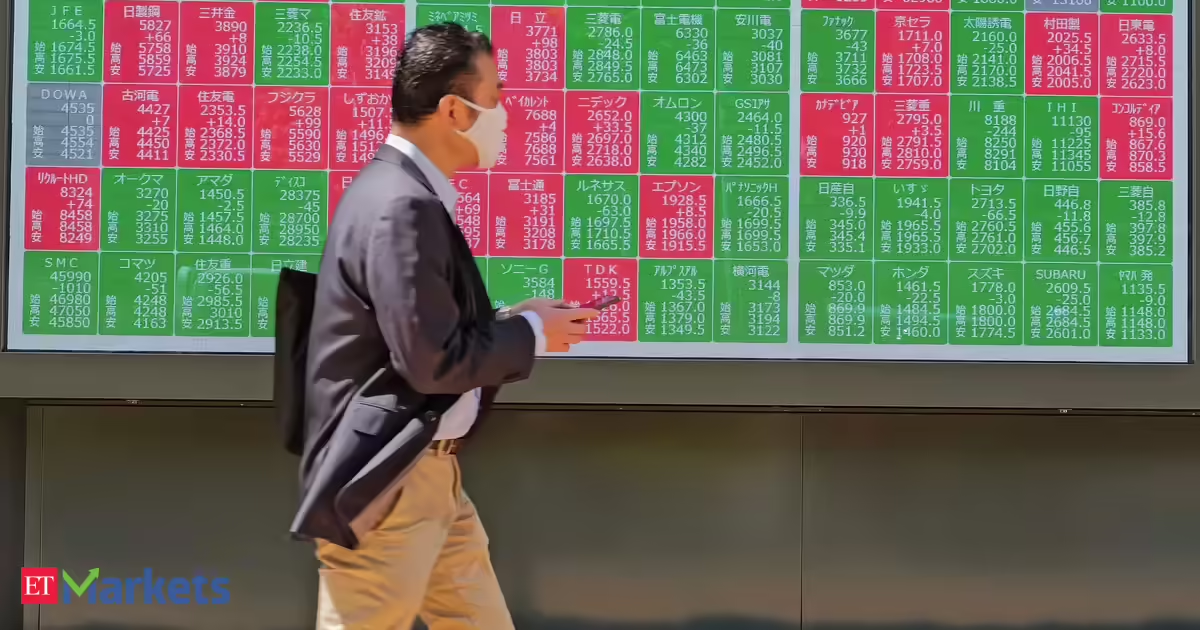
Japan’s Nikkei share average shot to a record high on Thursday and the nation’s bonds rallied as financial markets reopened after holidays, catching up with optimism over strong technology earnings and signs of a potential peace deal in the Middle East.

The benchmark Nikkei 225 Index jumped 5.58%, the most in more than a year, to close at an unprecedented 62,833.84. The gauge reached as high as 63,091.14, ‌breaking through the psychological ⁠level ⁠of 63,000 for the first time. The broader Topix climbed 3% to 3,840.49.

Japanese government bonds (JGBs) rose after a three-day trading break that saw the yen appreciate on suspected intervention by authorities in Tokyo.

The yen bought 156.375 per dollar, largely steady a day after a sprint to a 10-week high of 155 fuelled talk of further official support.

Advertisement

Wall Street indexes hit record highs overnight as positive results from Advanced Micro Devices propelled euphoria over the red-hot artificial intelligence sector. Iran said it is reviewing a U.S. proposal to end ⁠the more ‌than two-month war, while President Donald Trump said the U.S. has had very good talks with Tehran.


“Today’s sharp gain of the Nikkei was led by the strong performance of chip ⁠shares, driven by Advanced Micro Devices’s strong forecast,” said Takamasa Ikeda, a senior portfolio manager at GCI Asset Management. “The contents of the U.S.-Iran peace proposals are thin, but there is an expectation in the market that further military action will not take place.”
There were 174 advancers on the Nikkei index against 49 decliners. The largest percentage gainers in the index were tech sector suppliers, led by Ibiden, up 22.4%, followed by Sumco, which surged 19.7%, and Kioxia, 19.2% higher.Mining and exporter shares were broadly lower, however, marking a reversal from gains during the Iran ‌conflict as energy prices surged and the yen weakened. Inpex, Japan’s top oil and gas explorer, sank 6.5%, leading decliners, while Honda Motor lost 0.24%.

“The automakers remain weak as the environment has become severe with intensifying global ⁠competition,” said Hiroyuki Ueno, chief strategist at Sumitomo Mitsui Trust Asset Management. “Besides that, they may not enjoy benefits of the weak yen in the current fiscal year.”

Minutes released on Thursday of the Bank of Japan’s March meeting showed many board members saw the need to raise interest rates if the Iran war-driven energy shock is prolonged.

JGBs got a boost as the stronger yen and stabilising oil prices over Japan’s holidays eased concerns about inflation, which diminishes the fixed returns on debt.

Advertisement

The benchmark 10-year JGB yield fell 2.5 basis points (bps) to 2.475%. The two-year yield, the one most sensitive to central bank policy rates, decreased 1.5 bps to 1.365%.

Continue Reading

Business

Bajaj Auto shares rise 3% after firm posts record Q4 profit. Here’s what Jefferies, Nomura and other brokerages are saying

Published

on

Bajaj Auto shares rise 3% after firm posts record Q4 profit. Here’s what Jefferies, Nomura and other brokerages are saying
The shares of Bajaj Auto jumped over 3% on Thursday after the company reported its highest-ever quarterly profit of Rs 2,746 crore for the fourth quarter of FY26, marking a 34% surge from the Rs 2,049 crore profit reported in the same period last year, leading to bullish brokerage calls.

The two-wheeler maker released its results for January-March quarter of the financial year 2026 post market hours on Wednesday. While standalone net profit surged 34%, revenue from operations rose 32% year-on-year (YoY) to Rs 16,006 crore in the quarter under review, compared with Rs 12,145 crore in the corresponding quarter of the previous financial year. EBITDA climbed 36% YoY to Rs 3,323 crore, while EBITDA margin expanded 60 basis points to 20.8%.

Shares of the company gained over 3% to trade at Rs 10,656 apiece on the NSE on Thursday.

Bajaj Auto share buyback

Along with the Q4 earnings, Bajaj Auto also announced a share buyback worth Rs 5,633 crore. The company will buy back up to 46.94 lakh fully paid-up equity shares, representing 1.68% of its total equity, at Rs 12,000 per share through the tender route. The buyback price implies a premium of over 16% to the previous NSE closing price of Rs 10,319 per share.Bajaj Auto also announced a dividend of Rs 150 per share (1,500%) on equity shares with a face value of Rs 10 each for the financial year ended March 31, 2026. The record date for determining shareholder eligibility has been fixed as May 29, while the dividend will be paid on or around July 24, 2026.

Advertisement

Nomura on Bajaj Auto

Nomura maintained its ‘Neutral’ rating while raising its target price to Rs 10,928 from Rs 10,446. The revised target implies an upside potential of nearly 6% from the stock’s previous closing price.


The global brokerage said the company’s earnings were largely ahead of estimates. It raised its export volume forecasts by 4% for FY27 and FY28, citing strong momentum, and added that domestic growth is likely to be driven by Chetak and new bike launches in the current financial year.
Nomura now expects Bajaj Auto to report overall volume growth of 13% in FY27 and 8% in FY28, marking an upward revision of 2-3%. It added that the success of new bike launches in FY27 could provide further upside, although the end of the PLI scheme in FY28 may weigh on EBITDA margins, estimated at around 200 bps in Q4 FY26.“We estimate EBITDA margins at 20.9% in FY27 and 21.3% in FY28 (vs 21.4%/21.8% earlier). We believe commodity pressures should be well managed over time through pricing, operating leverage and a weak rupee. In Q1 FY27, margin pressures of ~100-150 bps QoQ may emerge,” Nomura said.

Jefferies on Bajaj Auto

Jefferies maintained its ‘Hold’ rating on Bajaj Auto, but increased its target price to Rs 10,500 apiece, a potential upside of nearly 2% from the previous closing price.

The brokerage said that the company reported strong growth in Q4, beating estimates. It added that India’s two-wheeler demand is holding up well, and it now expects 8% industry volume CAGR over FY26-29. However, rising commodity prices post some headwind to near-term margins.

Morgan Stanley on Bajaj Auto

Morgan Stanley maintained its ‘Underweight’ rating on Bajaj Auto, but raised its target price to Rs 9,259 per share. The revised target implies a downside potential of over 10% from the stock’s previous closing price.

Advertisement

The international brokerage said the company delivered an impressive set of results, with EBITDA beating estimates by 4-7%. It added that currency tailwinds and calibrated price hikes are helping offset commodity cost pressures. However, it cautioned that domestic demand, particularly in the entry-level segment, could moderate in the near term.

JM Financial on Bajaj Auto

JM Financial retained its ‘Reduce’ rating and marginally raised its target price by 1% to Rs 9,600, implying a downside of around 7%. The brokerage said domestic market share gains remain limited, with traction beyond the Pulsar range still muted.

“Hence, we do not expect meaningful market share gains despite further launches. We build in 6.1% domestic 2W volume growth for FY27E. Exports, however, remain strong, and we expect 16.7% export volume growth in FY27E, led by recovery/stability across regions,” JM Financial said.

Advertisement
Continue Reading

Trending

Copyright © 2025