

Crypto World
Aave rewrites the rulebook for asset listings after $293 million exploit

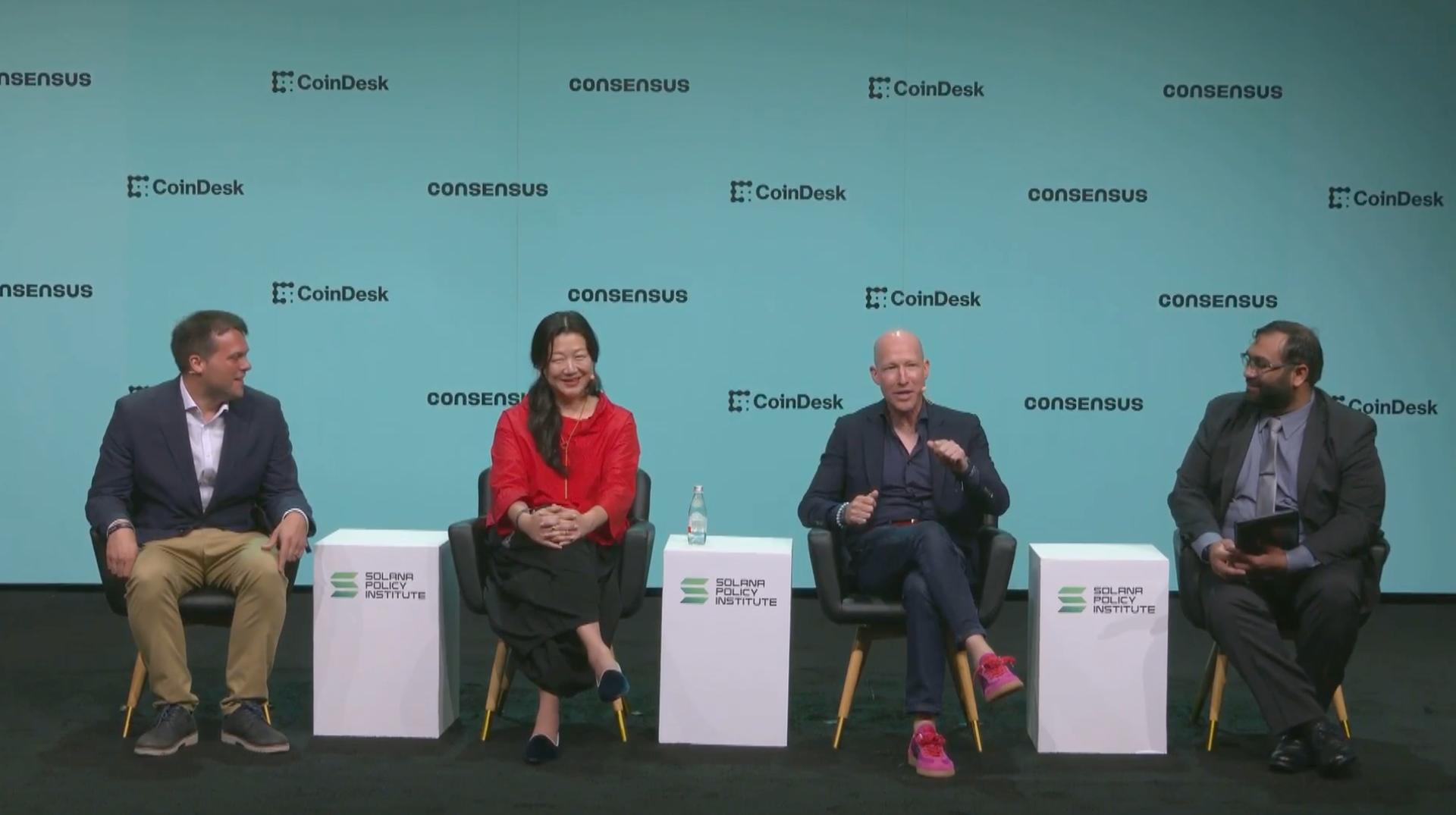
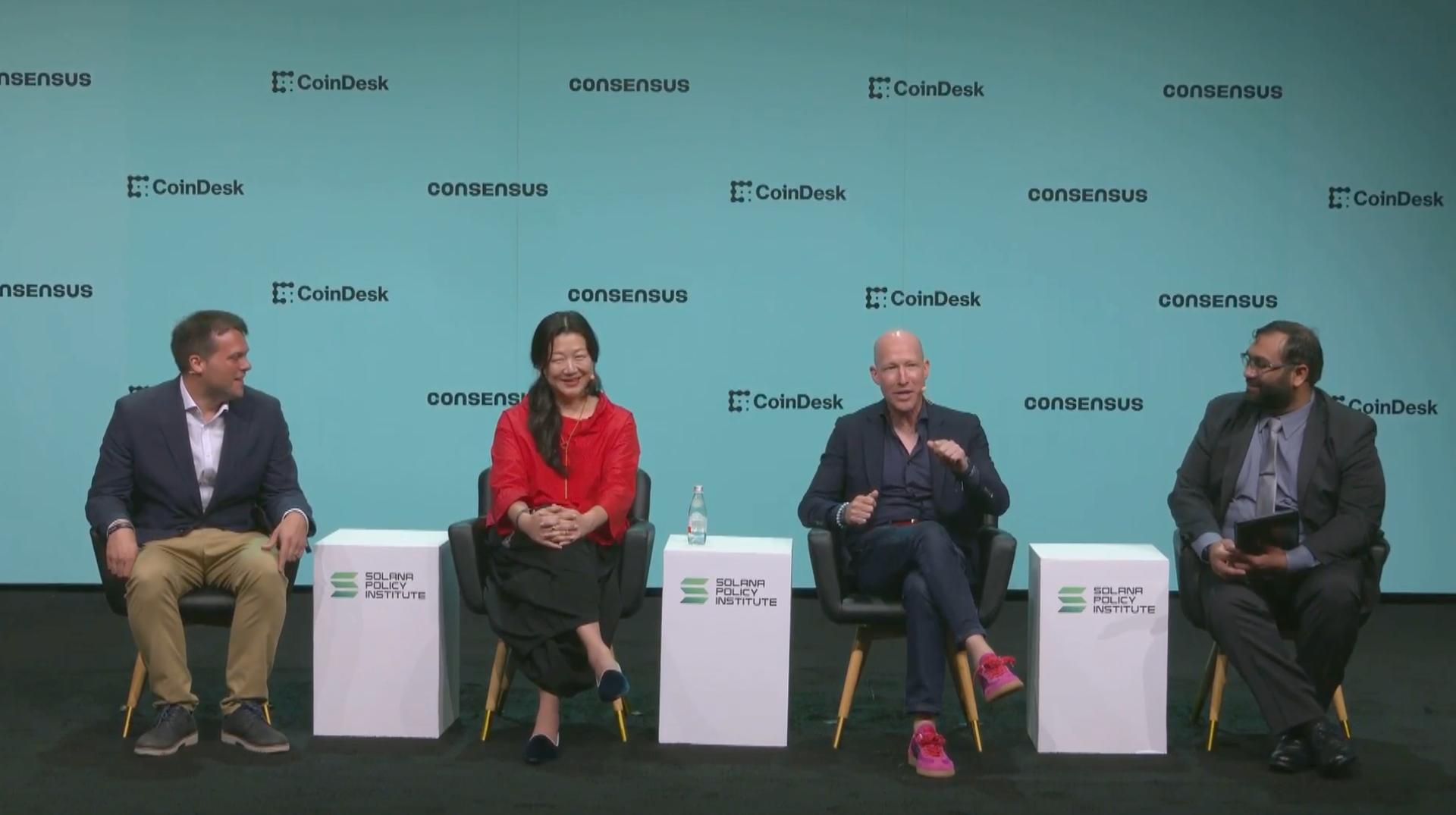
Miami — Aave Labs is set to fundamentally reshape how it assesses and lists collateral assets on its protocol, following the largest DeFi exploit of 2026, and the overhaul could set a new standard across the entire industry.
Linda Jeng, chief legal and policy officer at Aave Labs, said at Consensus Miami 2026 that the protocol’s existing risk framework, while robust, had been too narrowly focused on financial risk and volatility.
Going forward, every asset seeking to be listed on Aave will face a broader assessment covering interoperability, cybersecurity vulnerabilities, and the underlying architecture of the asset. She cited rsETH, the restaking token issued by KelpDAO that sat at the center of April’s crisis, as the catalyst for the change.
Beyond the new assessment criteria, Jeng announced that Aave would publish a formal playbook for asset issuers — a set of minimum standards that projects must meet before they can list on the protocol. She also said Aave would begin examining systemic interconnections across protocols, moving away from analyzing pools in isolation to understanding how exposure in one corner of DeFi can ripple into another.
“Out of a crisis like this, it ups our standards,” she said.
The remarks came as Jeng reflected on a month she described as “two weeks of no sleep.” An attacker had exploited KelpDAO’s cross-chain bridge, minting 116,500 unbacked rsETH tokens worth roughly $293 million, then depositing them into Aave as collateral to borrow real wrapped ether — leaving the protocol holding hundreds of millions in impaired debt.
Jeng, who worked as a regulator during the 2008 financial crisis, said the episode triggered a strong sense of déjà vu. But the resolution, she argued, was markedly different. Rather than a government-led bailout, the industry mobilized itself. An initiative called “DeFi United,” which has drawn commitments from Lido, EtherFi, Ethena and others, was launched to cover the collateral shortfall and prevent systemic bad debt from spreading further across DeFi lending markets.
“In the financial crisis, we had to bail out the banks,” she said. “Here, we came together as an ecosystem to bail ourselves out.”

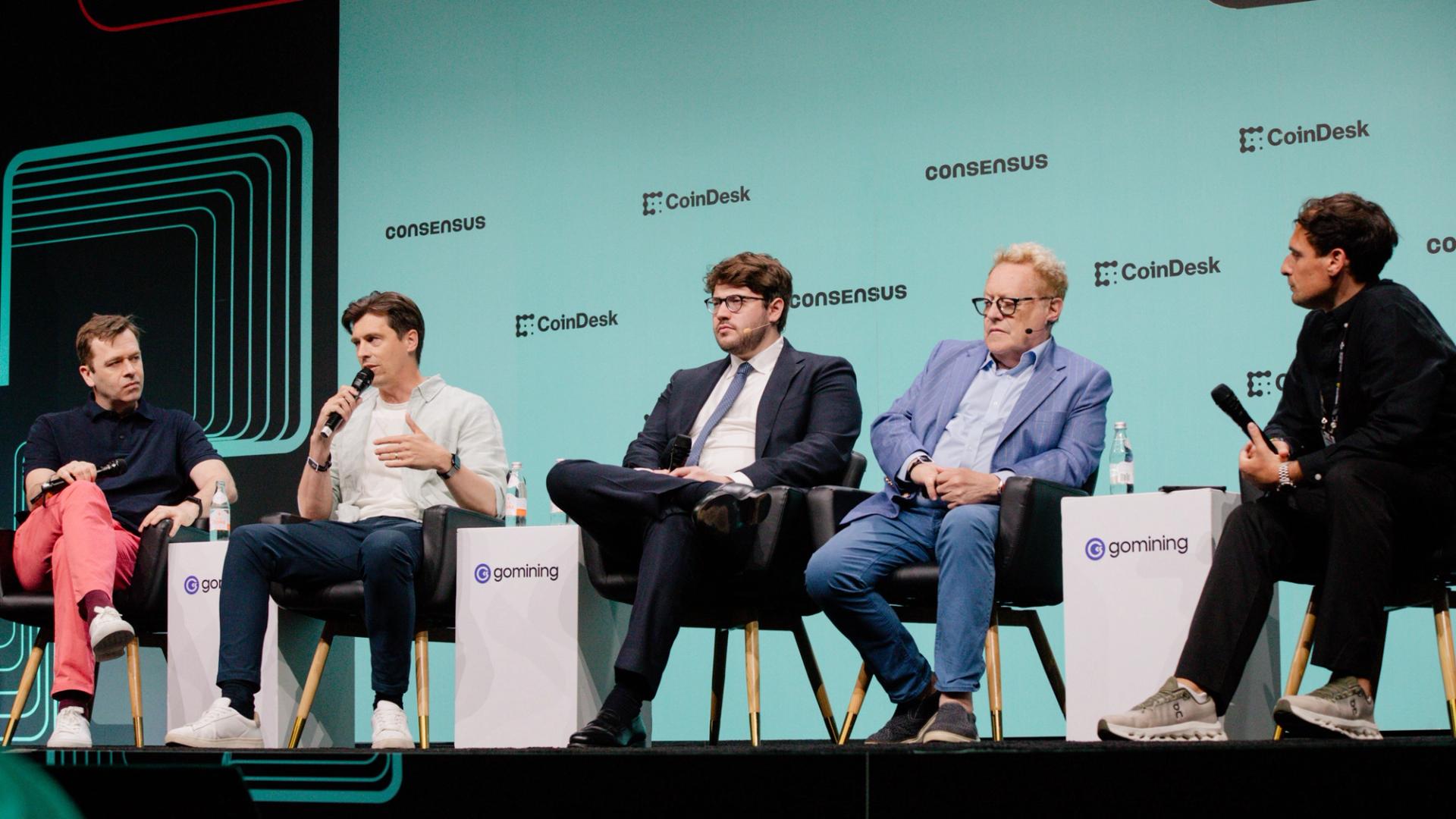
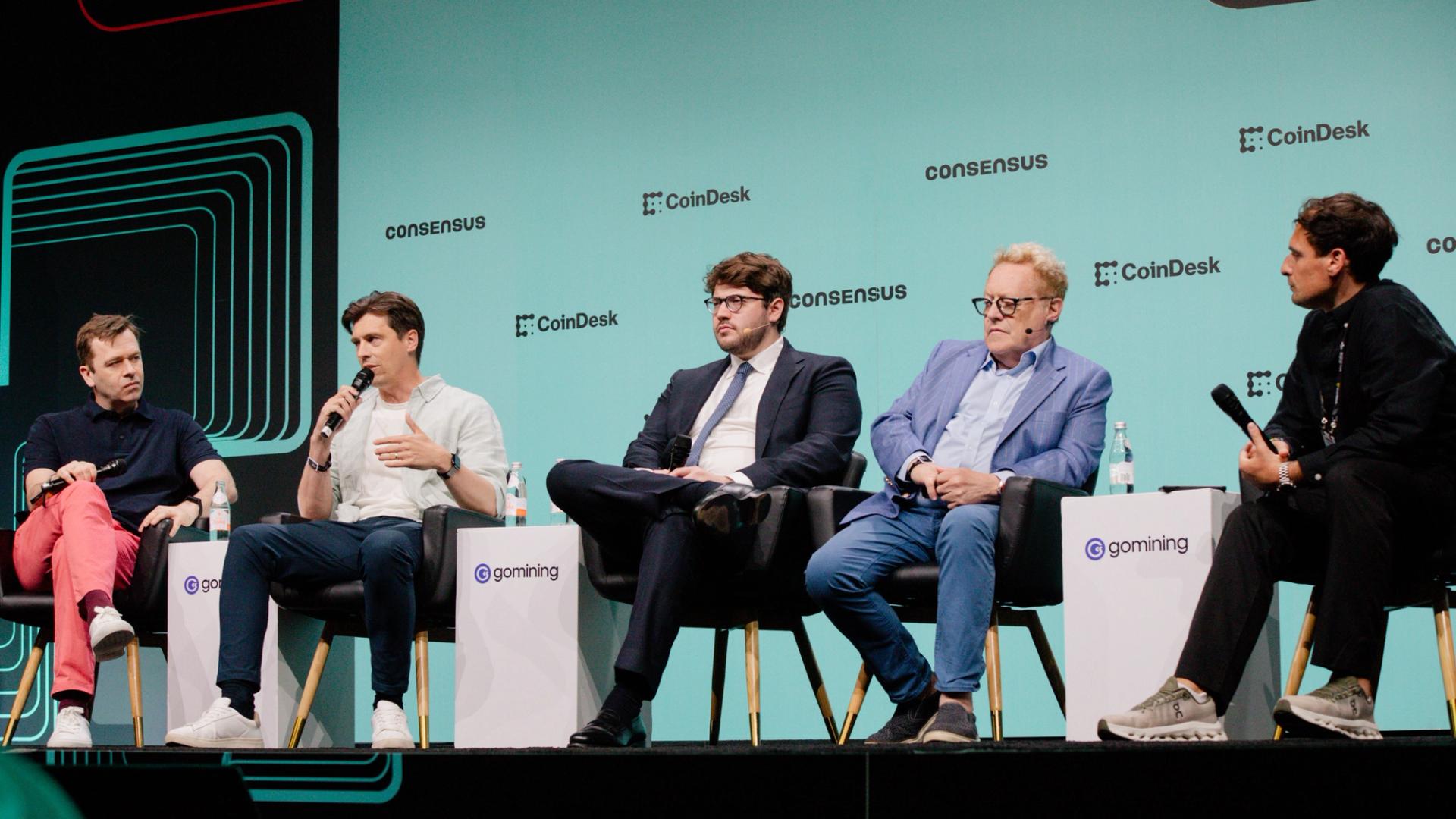
Bitcoin funding rates are flashing one of the most bearish positioning signals in years, even as spot prices keep grinding higher.
Funding rates have been running near minus 4% annualized, James Aitchison, founder and CIO of Caerus Global, said during a panel at Consensus Miami 2026. That means longs are being paid to hold exposure, a rare setup that points to heavy short positioning.
“The longs are getting paid, which is quite a rarity,” Aitchison said. “On a 30-day basis, the lowest it has been this decade.”
The setup mirrors a broader derivatives disconnect. Bitcoin funding rates hit their most negative levels since 2023 in April, even as BTC pushed through $75,000 at the time. Aitchison said similar conditions have historically preceded positive returns over 30- to 365-day periods.
Bitcoin has rebounded from roughly $60,000 to the low $80,000s at the of writing. The move has forced traders to reassess whether old crypto-native signals still work in a market increasingly shaped by ETFs, basis trades and Wall Street distribution.
Spot bitcoin ETF demand has held through the drawdown. U.S. spot bitcoin ETFs pulled in $1.6 billion so far this month, even as short-term holders sold.
That resilience has made ETF holders central to the current market structure. Dan Blackmore, chief commercial officer at Glassnode, said bitcoin is moving into a new regime as volatility falls and allocations become more strategic.
“We’re witnessing the early innings of the Wall Street machine and its impact on the crypto market,” Backmore said.
Options are accelerating that shift. IBIT options open interest topped Deribit in April, pointing to a migration of bitcoin derivatives activity into regulated U.S. venues. Morgan Stanley’s bitcoin ETF opened just last month, adding another large wealth-management platform to the market.
Panelists were split on whether the four-year cycle still matters. Michael Terpin, author of “Bitcoin Supercycle,” said bitcoin could still trade lower before a larger 2028-2029 supply shock. Others argued the halving cycle is losing force as bitcoin becomes a TradFi asset.
The year-end calls reflected the split. Terpin and Backmore said bitcoin may not reach a new high this year. Cole Kennelly, founder of Volmex Labs, said $250,000 is possible. Aitchison said $150,000 is a reasonable target if rate cuts return.
Crypto World
Pi Network consolidates around $0.18 as market weighs long-term narrative against near-term drift


Summary
- Pi Network (PI) is trading around $0.18 today, with most major trackers clustering the live price near the 0.178–0.180 dollar range and 24‑hour volume around $25–35 million.
- The token is sitting slightly below its 200‑day moving average near $0.196–0.20 and broadly flat to down on the week, reinforcing a sideways-to-soft bias rather than a clean bullish impulse. Technical models and prediction engines mostly see PI drifting lower or chopping sideways through the rest of 2026, with end‑2026 targets clustered around $0.13–0.18.
- In the near term, price action is dominated by speculative trading on CEX “IOU” markets and uncertainty over Pi’s fully open mainnet economics, which keeps structural bids cautious even as retail interest remains high.
Across major aggregators, Pi Network (PI) is quoted today at roughly $0.179 per PI, with 24‑hour trading volume near $28–35 million. One representative feed has PI at $0.1782 and down about 2–3% on the day, placing it in the mid‑cap range with a reported market capitalization in the $1.8–1.9 billion band, depending on the circulating supply estimate. Some trackers that extrapolate from a higher assumed circulating supply print a slightly larger market cap near $2.0 billion, but even at the low end PI sits in the top 50–60 coins by value on several rankings.
There is still a split in how data providers treat PI. CoinMarketCap lists a “Pi [IOU]” instrument with a live price around $0.1793 and a relatively low reported volume of roughly $235–275k, flagging that this is an IOU product rather than the fully settled mainnet coin. Other services like CoinGecko and Coinranking track “Pi Network (PI)” spot markets with tens of millions in daily volume, a circulating supply estimate around 9–10 billion PI, and a fully diluted valuation north of $17 billion. That discrepancy reflects the hybrid state of Pi’s rollout: much of the supply still sits in the ecosystem and not all venues agree on what counts as truly circulating.
Technical picture and on-chain sentiment
From a technical standpoint, PI is trading near its short‑term moving averages and modestly below its long‑term trend line. One quantitative forecast desk pegs the 50‑day simple moving average at about $0.176–0.177 and the 200‑day SMA around $0.196–0.197, which means spot is currently sandwiched between them and leaning slightly to the bearish side relative to the longer‑term trend. Their models assign PI a 14‑day RSI just above 55, firmly in neutral territory—neither oversold capitulation nor overheated euphoria.
Short‑horizon prediction engines mostly see more of the same. A CoinCodex‑style projection table has PI at $0.1794 on May 7, with a forecast slide to $0.1412 by May 10 if the upper volatility band is realized, implying up to a 21% downside window over a few days. Longer out, the same model cluster expects PI to end 2026 near $0.134–0.158, roughly 10–25% below current levels, before potentially grinding higher into the 2030s. Another forecasting site that updates PI daily prints spot around $0.173–0.174, down about 1.6% on the day, with a 24‑hour range between $0.1721 and $0.1774 and a market cap near $1.73 billion, placing PI roughly at rank 47 by size.
Taken together, the data sketch out a market that is not in free fall but clearly not in breakout mode either. Volatility is moderate, daily ranges are tight, and momentum oscillators are flat. That combination is typical of a token where macro narratives (mobile mining, mass‑market onboarding) and unresolved fundamentals (actual open mainnet traction, concrete revenue, and real‑world usage) are still colliding.
Forecasts, narratives, and what matters next
Mid‑term and long‑term projections for Pi Network are all over the place, but the systematic ones are surprisingly conservative. One widely cited model projects PI at $0.1794 in early May 2026, then $0.1578 by the end of 2026 and $0.5296 by 2030, implying a roughly 3x over four years if the network actually matures into a functioning L1 with real users and fee flows. The same table pushes out fantasy‑land numbers like $1.01 by 2040 and $2.46 by 2050, but those are purely curve‑fit extrapolations and not grounded in any specific tokenomics change.
More near‑dated prediction grids, including one published by Binance’s research portal, cluster around a $0.178–0.184 range for PI in the coming week, implying modest upside of around 5% from current levels at best. That “bleed slightly up or down, no sudden repricing” stance matches how the market is actually trading: the coin is glued to its $0.17–0.19 band as both bulls and bears lack a catalyst. Without a decisive protocol announcement—such as a fully open mainnet with permissionless smart contracts, large‑scale app launches, or a credible fee‑burn/utility narrative—most models will simply treat PI as a mid‑cap beta asset and let it oscillate with the broader altcoin cycle.
The structural overhang is supply. Forecast engines point to a circulating float close to 10 billion PI versus a maximum supply of up to 100 billion, which leaves enormous room for future unlocks and inflation. As long as the market doubts how aggressively those tokens will drip into circulation and how much of that supply will be actually used versus dumped, PI will struggle to command a rich multiple. That is why you see the token sitting below its 200‑day moving average even as the broader market has pockets of risk‑on behavior: the path to sustainable demand is still ambiguous.
Kraken’s parent company, Payward, is expanding its footprint in crypto payments infrastructure by agreeing to acquire Reap Technologies, a Hong Kong-based platform that connects traditional financial systems with digital assets. The deal is valued at up to $600 million and will be paid in a mix of cash and Payward stock, with Payward’s equity valued at about $20 billion. The transaction, announced Thursday, would extend Payward Services—its B2B rails offering launched in March 2026—into global cards and payments tied to stablecoins, signaling a broader shift in the industry toward payment infrastructure alongside trading services.
Key takeaways
- Payward to acquire Reap Technologies for up to $600 million, financed with cash and Payward stock; the deal values Payward’s equity at roughly $20 billion.
- The move expands Payward Services from trading and asset handling into global cards, cross-border payments, and stablecoin treasury capabilities—offering a unified API for partners.
- Reap would operate as a standalone platform post-acquisition, with regulatory approvals expected to finalize in the second half of 2026.
- The acquisition marks Payward’s first infrastructure purchase in Asia and one of its largest transactions to date, underscoring Asia’s growing importance for on-chain and off-chain money flows.
- The deal fits a broader industry trend: crypto firms increasingly invest in payments infrastructure and stablecoin-related products as fintechs seek integrated, cross-border solutions.
Payward’s strategic shift: from trading desks to global payments rails
The agreement to acquire Reap positions Payward to push deeper into B2B payments infrastructure, expanding beyond its core trading and exchange capabilities. Payward Services, described by the company as a consolidated platform for trading, payments, funding, and digital asset services, aims to simplify how businesses interact with crypto and fiat rails through a single integration point. The Reap acquisition accelerates this strategy by bringing in a payments layer designed to bridge traditional networks with blockchain-based settlement, a capability that Payward describes as essential for the next generation of crypto-enabled commerce.
In the official announcement, Payward and Kraken co-CEO Arjun Sethi framed Reap as a critical additive to the evolving payments fabric. “Reap is the payments layer for what comes next. Card networks, banking rails, and blockchains on a single API, settling in stablecoins,” Sethi remarked. The wording underscores a growing industry emphasis on interoperability across diverse rails, something Payward aims to standardize for its partners and clients.
The transaction is framed as a milestone in a broader push to embed more financial infrastructure within crypto-native platforms. Payward had already signaled a tilt toward non-spot offerings with the March 2026 launch of Payward Services, an ecosystem designed to streamline not just trading but also the funding and settlement processes that sit behind crypto activity. The Reap deal deepens that pivot by adding a global card issuance and cross-border payments capability, positioning Payward to offer stablecoin-based treasury services in tandem with traditional settlement rails.
Reap’s Asia-focused expansion and the strategic fit for Payward
Reap, founded in 2018 by Daren Guo and Kevin Kang, has built a platform that connects traditional payment rails with digital assets, aiming to facilitate cross-border money movement. Guo previously led Asia Pacific operations for Stripe, while Kang brings background in investment banking, according to Reap’s materials. The acquisition is described as Payward’s first infrastructure purchase in Asia and one of its largest deals to date, a signal that Asia’s role in crypto-enabled payments is increasingly central to the sector’s growth trajectory.
Arjun Sethi has emphasized Asia’s rapid expansion, noting that, outside Europe, Asia stands as the fastest-growing market not only in revenue terms but also in asset-on-platform activity. The executive suggested that Payward’s capacity to integrate Reap’s payments layer could enable accelerated onboarding in the U.S. market as well, once the Asia-focused expansion is operational. The deal thus serves a dual purpose: reinforcing Asia-based growth while creating a bridge to U.S. opportunities through a more mature, globally integrated B2B payments platform.
Reap’s offerings focus on enabling cross-border flows by linking traditional payment ecosystems with digital assets. This aligns with a broader industry trend of fintechs and crypto firms seeking to embed stablecoins and programmable payments into their product stacks, making it easier for firms to move value across borders without relying solely on conventional banking rails. The acquisition, therefore, reflects a maturing of the crypto ecosystem—from speculative activity to practical, enterprise-grade infrastructure that can support everyday business operations.
What this means for users, builders, and the market
For users and builders, the Payward–Reap combination could translate into a more seamless experience when issuing cards, processing cross-border payments, and managing stablecoin treasuries—all under a single API. The ability to settle in stablecoins could reduce friction and settlement times for businesses with international flows, while card issuance and cross-border capabilities expand the practical utility of crypto-enabled financial services beyond trading platforms into everyday business operations.
Investors and traders may watch for how regulatory approvals shape the timeline and scope of the integration. The deal is expected to close in the second half of 2026, subject to customary regulatory clearances. If completed on schedule, the transaction would reinforce Payward’s prominence in the crypto payments arena and could influence competitive dynamics as other crypto firms explore similar infrastructure acquisitions to broaden their own product ecosystems.
In this evolving landscape, the deal also highlights a larger macro trend: as stablecoins gain traction among fintechs and businesses, the appetite for robust, interoperable payments infrastructure grows. The market appears to be moving toward standardized bridges that can handle digital and fiat value with the reliability of traditional rails, while offering the speed and programmability inherent to crypto. Payward’s move with Reap signals that the industry is less about isolated services and more about comprehensive ecosystems that can onboard and settle value at scale.
For now, Reap will continue operating as a standalone platform, and the teams will work toward a smooth integration with Payward Services once regulatory approvals are secured. The collaboration promises to deliver a more cohesive set of capabilities—card networks, banking rails, and blockchain settlement—within a single developer-friendly interface, a proposition that could simplify treasury management for businesses experimenting with digital assets as a source of liquidity and growth.
Key links referenced in the announcement include the official press release from Business Wire detailing the acquisition, a note on Payward’s Payward Services and its roadmap, and Reap’s own material describing its role in enabling traditional and crypto payment flows. These sources provide the framework for understanding how the transaction fits into Payward’s broader strategy and the fintech industry’s ongoing shift toward integrated payments infrastructure.
Source references (for context): the Business Wire press release detailing the acquisition; Payward’s Payward Services overview; Reap’s client-focused note on what the merger means for customers; and Reap’s company background. These materials collectively illustrate how the deal aims to unify card issuance, cross-border payments, and stablecoin treasury services under a single API.
As investors monitor the path forward, the next milestone will be the regulatory approvals and the practical timeline for integrating Reap into Payward Services. If the deal closes as planned, Payward could solidify its position as a leading provider of crypto-enabled payments infrastructure, shaping how businesses move value in a world where digital assets increasingly intersect with everyday financial operations.


Several altcoins posted standout performances over the past week. Toncoin (TON) emerged as the strongest mover among the top 100 cryptocurrencies by market cap.
The breakouts have revived altcoin season chatter across crypto X, though some suggest that rotation signals remain unconfirmed.
TON Leads as Altcoin Bids Return
According to CoinGecko data, TON has rallied more than 100% over the past seven days. The move followed an announcement from Telegram CEO Pavel Durov that the platform will replace the TON Foundation as the “driving force behind TON” and step in as its largest validator.
BeInCrypto separately reported that privacy coin Zcash (ZEC) pushed to a fresh year-to-date high, fully erasing its early-2026 drawdown.
Other notable gainers on the weekly leaderboard include Internet Computer (ICP), Bittensor (TAO), and Ondo (ONDO). The breadth of the rallies has fueled fresh debate over a long-awaited altseason.
A crypto analyst known as Cryptollica has highlighted that the TOTAL3/BTC ratio is approaching the apex of a multi-year descending triangle. The analyst noted that previous major altcoin expansions, in 2017 and 2020, both began from similar long compression phases against Bitcoin.
Follow us on X to get the latest news as it happens
Trader Xaif Crypto observed that centralized exchange volume ratios mirror patterns seen before the 2021 altseason.
“CEX volume ratio just flashed the same pattern as pre-2021 altseason yellow bars rising, buy walls printing green. Last time this set up… everything pumped,” the analyst wrote.
Structural Data Tells a Different Story
The Altcoin Season Index from BlockchainCenter reads 35, well below the 75 altseason threshold. The index measures whether 75% of the top 50 coins outperformed Bitcoin over the past 90 days.
Data also shows that the 14-day correlation between altcoins and Bitcoin recently hit its lowest level since July 2025. Low correlation typically signals selective outperformance rather than a synchronized rally.
Trader Lucky flagged Bitcoin dominance trending toward 66% and continued Ethereum (ETH) weakness as further evidence that rotation has not begun.
“59.6% weekly close on BTC.D. That’s your signal. Everything else is noise,” he said.
He added that when rotation eventually arrives, it won’t mirror 2021’s broad-based mania. Capital will move selectively, flowing first into ETH, SOL, and large caps, while small caps lag or get left behind entirely.
Previously, Bitwise CIO Matt Hougan also said broad traditional altseasons have ended. Future gains will concentrate in tokens with real-world use and traction.
This week’s bid in select large-cap altcoins likely fits that selective thesis more cleanly than a 2021 rerun. Whether Bitcoin dominance rejects 61% will determine if the whispers become a trend.
Subscribe to our YouTube channel to watch leaders and journalists provide expert insights
The post Altcoins Are Pumping, but the Data Says Altseason is Not Coming appeared first on BeInCrypto.
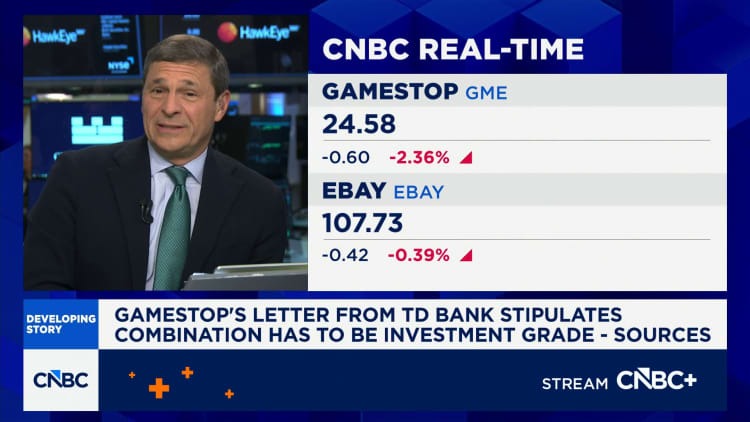

GameStop‘s mysterious financing letter underpinning its audacious $56 billion bid for eBay is emerging as a central issue in the proposed takeover, as questions mount over whether the deal is actually financeable.
The video game retailer said it has lined up a $20 billion financing commitment from TD Securities, part of TD Bank. But a key condition attached to this letter could ultimately make or break the deal: the combined company would need to maintain an investment-grade credit profile, CNBC’s David Faber reported, citing people who have seen the document.
Moody’s Ratings said Wednesday the proposed acquisition would be “credit negative” for eBay because of the substantial increase in leverage implied by the deal structure.
The ratings agency estimated leverage for the combined company could approach nine times debt to earnings before interest, taxes, depreciation and amortization before accounting for any cost-saving synergies.
That level of indebtedness would likely push the combined company below investment grade, potentially undermining a key condition attached to the TD financing package.
The proposed takeover has raised immediate questions about how GameStop could fund a deal of that size. The video game retailer’s market value of roughly $11 billion is only a fraction of the transaction’s implied value.
CEO Ryan Cohen offered limited clarity on the structure other than saying his company has the ability to issue additional stock in order to get the deal done.
EBay confirmed that it received the offer in a statement Monday, and said its board would review it.
Semafor reported on the mysterious letter Wednesday.


The deal is payable in cash and stock and values Payward at $20 billion.


Kalshi’s co-founder said the new capital will be used to accelerate that institutional adoption.
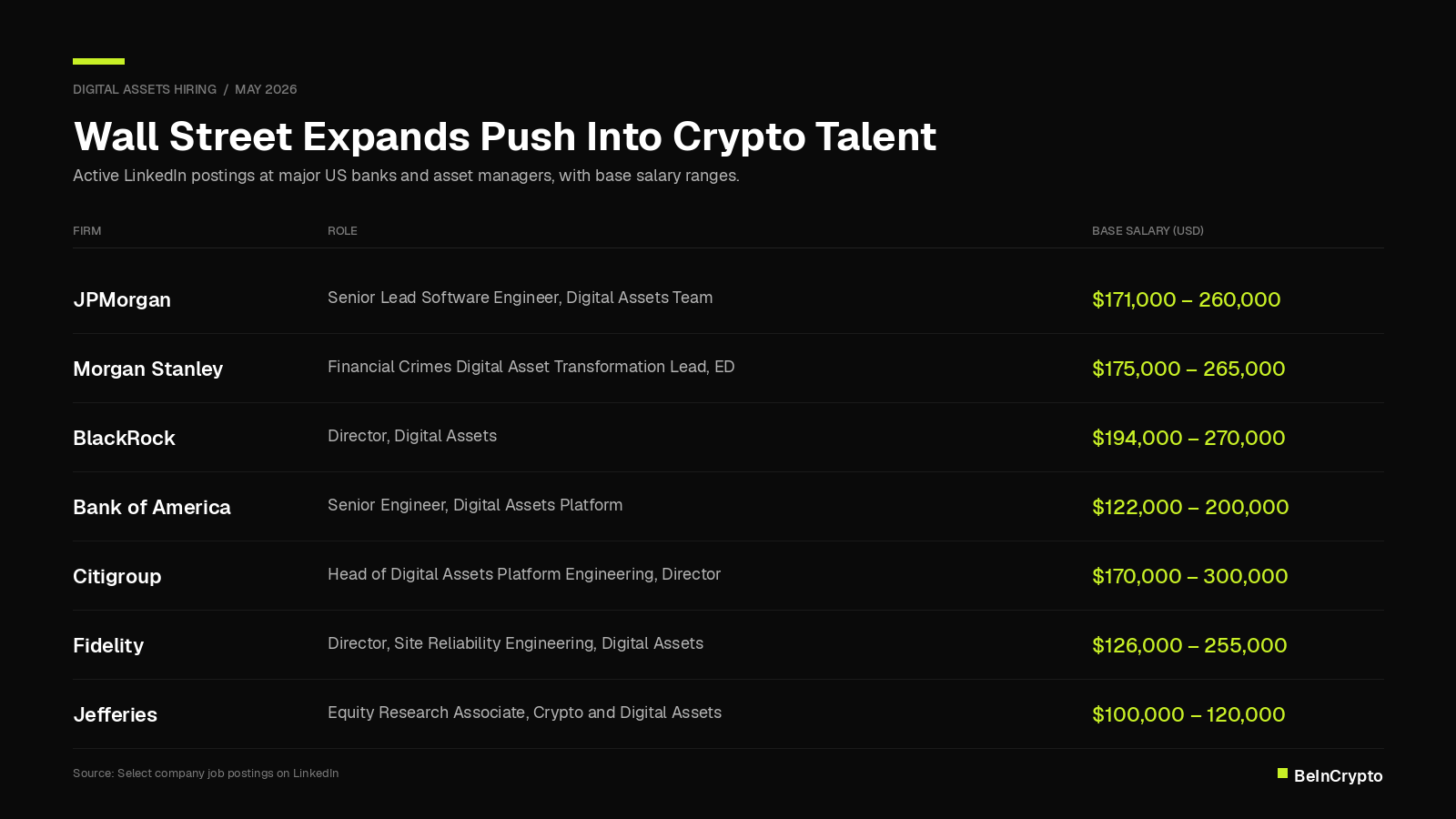
Wall Street firms have flooded LinkedIn with dozens of digital assets job postings, giving crypto professionals a TradFi escape hatch as native firms slash staff and the industry works through an extended downturn.
JPMorgan Chase, BlackRock, Citigroup, Morgan Stanley, Bank of America, Fidelity, and Jefferies have each opened senior crypto roles, with base salaries reaching $300,000 at the top end, according to a Bloomberg report published Thursday.
Wall Street’s Hybrid Talent Push
The catch for applicants is that pure crypto credentials no longer suffice. Banks and asset managers now want candidates who pair blockchain fluency with TradFi experience. The hybrid background covers compliance, risk, and regulated markets.

“It’s really about domain overlap,” Bloomberg reported, citing Paul Przybylski, JPMorgan Asset Management’s global head of product for digital and tokenized assets.
Follow us on X to get the latest news as it happens
Citigroup’s Head of Digital Assets Platform Engineering tops the table with a base of up to $300,000. Bank of America, Morgan Stanley, Fidelity, and Jefferies round out the board.
Their listings cover senior engineering, financial crimes transformation, site reliability, and crypto equity research roles.
A Bright Spot Against Crypto Layoffs
Bloomberg framed the hiring spree as a rare bright spot for an industry working through a protracted downturn. Coinbase Global has cut large portions of its workforce, and similar reductions have rolled across other crypto-native employers.
For workers leaving those firms, a stint at a regulated bank or asset manager has become a defensive résumé move. Total compensation packages at these firms include cash bonuses and equity grants. Combined, those layers often push roles well past their listed base ranges.
By contrast, crypto-native pay, often weighted with token allocations, has grown harder to value as token markets stay weak.
Wall Street’s cash-heavy structure now reads as a more predictable bet for senior engineers and product leaders.
“HELP WANTED: digital asset specialists at big boy financial cos. Must know crypto, blockchain, understand degens, but also have TradFi chops, fluent in Boomer-ese,” ETF analyst Eric Balchunas quipped.
The hiring board signals that institutional crypto integration is widening even as native firms retrench. Whether banks sustain the pace of postings over the coming weeks will determine the read.
A permanent digital assets bench-build looks different from a tactical talent grab.
The post TradFi Giants Offer Crypto Talent Stability and Prestige as Crypto Firms Cut Staff appeared first on BeInCrypto.
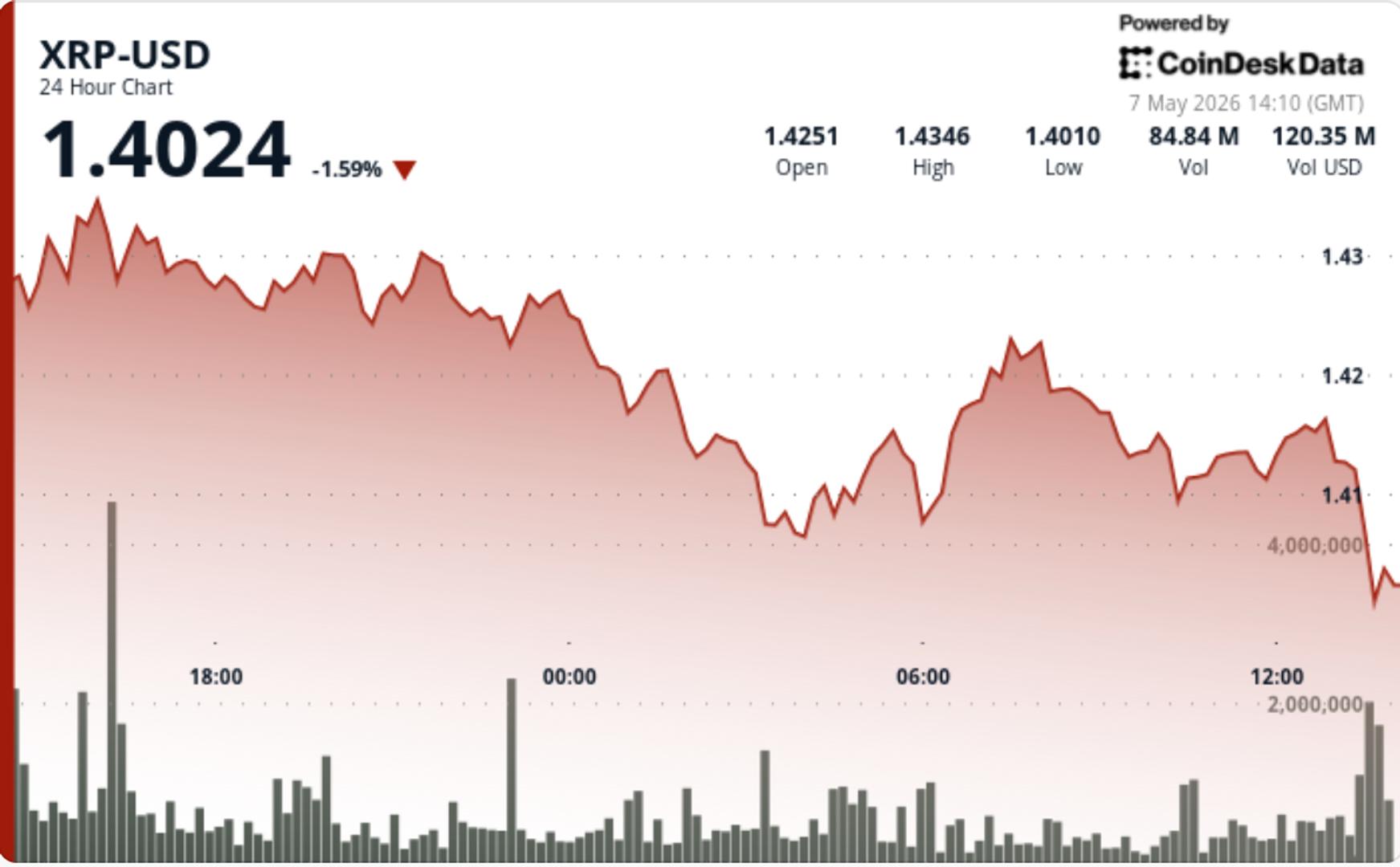
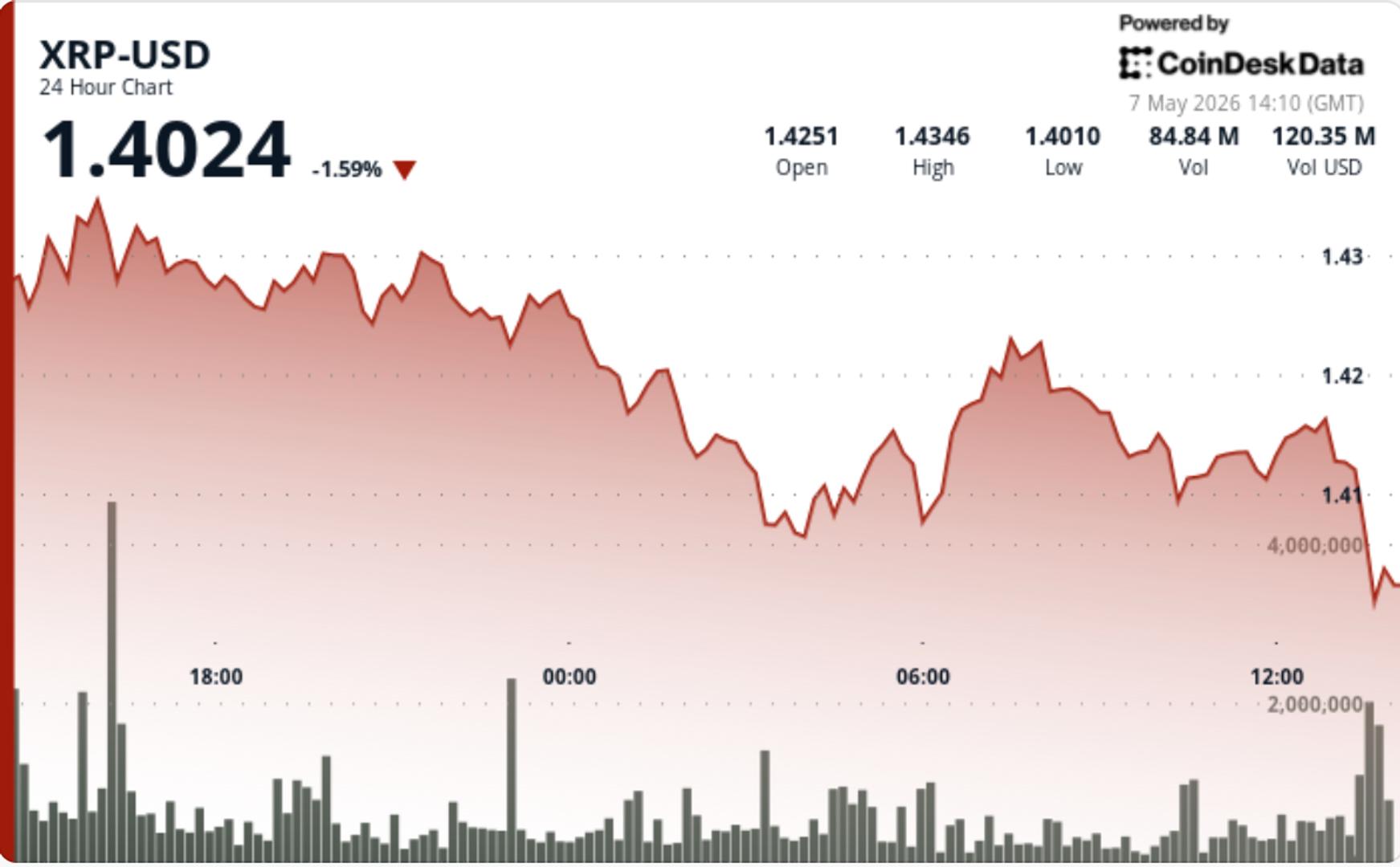
XRP gave back ground after failing to hold above $1.45, with the pullback coming even as Ripple pushed deeper into institutional finance through a cross-border tokenized Treasury settlement alongside JPMorgan and Mastercard. The move lower matters because XRP is now sitting back near the same breakout zone traders had been watching for confirmation only days earlier.
News Background
• Ripple, JPMorgan, Mastercard and Ondo Finance completed a near-real-time cross-border redemption of tokenized U.S. Treasuries on the XRP Ledger, with settlement finalized in under five seconds.
• The transaction routed through Mastercard’s Multi-Token Network before JPMorgan’s Kinexys platform delivered dollars to Ripple’s Singapore banking partner outside traditional banking hours.
• The pilot adds to growing institutional focus on tokenized finance infrastructure, with DTCC also preparing to launch its own tokenization platform later this year.
Price Action Summary
• XRP slipped from $1.4534 to $1.4137 over the 24-hour session, reversing after an earlier push toward $1.45.
• Heavy selling hit during the May 6 13:00 UTC session, when 131.28M in volume drove price through support at $1.4460.
• Price later stabilized around the $1.41 area after a sharp intraday recovery from session lows near $1.409.
Technical Analysis
• The rejection near $1.45 matters because that level has repeatedly capped upside attempts during the broader consolidation range.
• XRP is still holding above the broader $1.40 breakout zone, but momentum cooled sharply after the failed push higher.
• The market is now compressing between support near $1.41 and resistance between $1.45-$1.47, a range that increasingly looks unstable given thinning liquidity conditions.
• Analysts continue pointing to a larger bull flag structure on higher timeframes, though shorter-term charts still show distribution pressure on rallies.
What traders should watch
• $1.40-$1.41 is now the key support zone. Losing it would weaken the recent breakout structure.
• $1.45-$1.47 remains the level bulls need to reclaim to reopen momentum toward $1.60 and higher.
• Liquidity conditions remain thin, which raises the odds of sharper-than-normal moves once the range finally breaks.
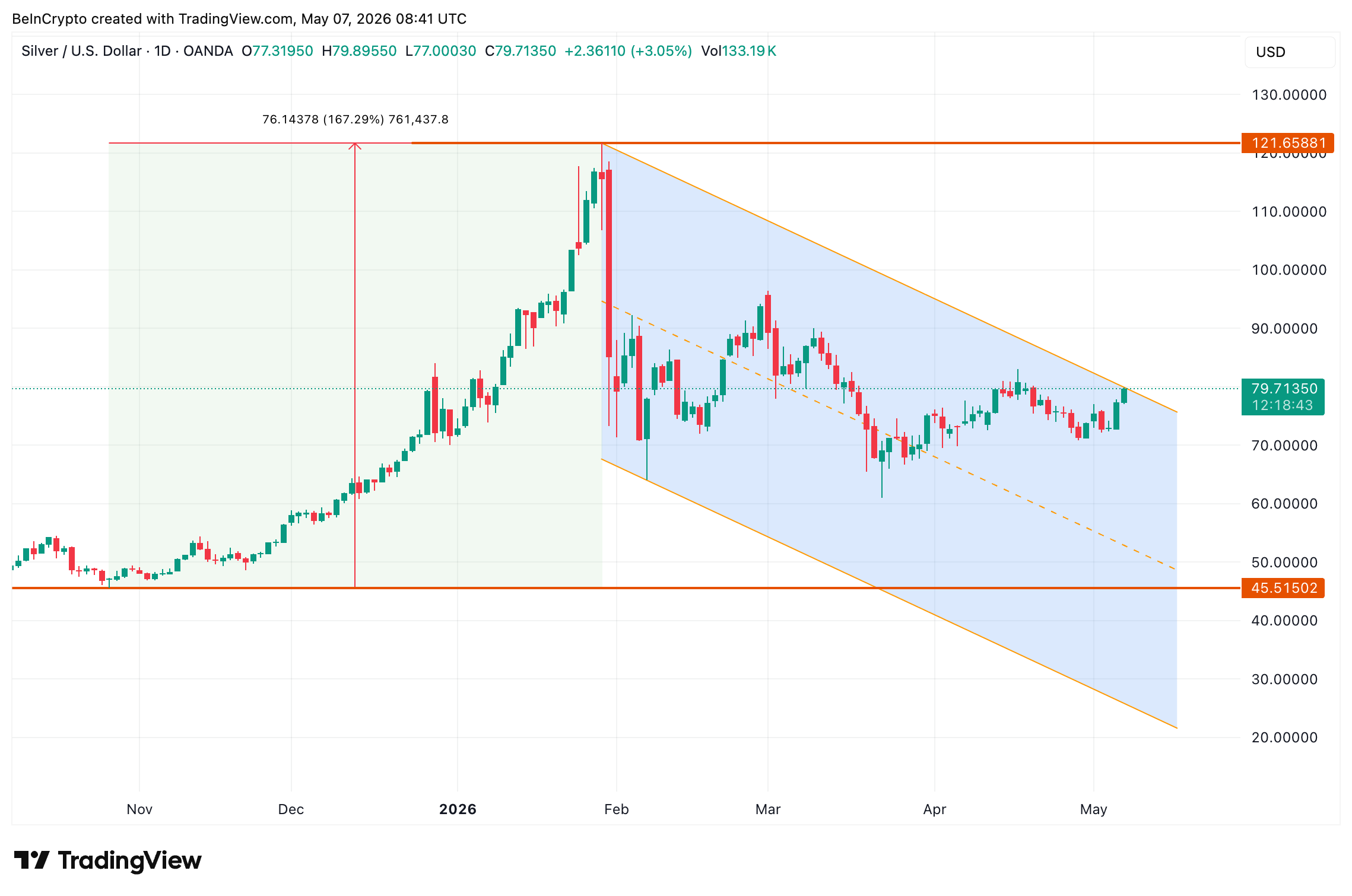
Silver (XAG/USD) trades near $79 after a 3% intraday jump cleared a multi-month resistance shelf, with the dollar simultaneously sliding inside its own falling channel.
The setup combines a structural pattern, an inverse macro driver weakening in lockstep, and a futures positioning read that hints at a quiet but persistent bullish lean. Whether silver can chase its $121.65 all-time high depends on which signal wins out.
Silver Builds Continuation Setup After 167% Surge
Silver surged 167% from its October 2025 low at $45 to an all-time high of $121 in late January. Since that peak, the metal has traded inside a falling channel, a structural pattern bounded by two parallel descending trendlines.
Want more insights like this? Sign up for Editor Harsh Notariya’s Daily Newsletter here.
Falling channels are not always bearish. When they form after an extended rally, they often resolve as continuation patterns. The structure marks a pause before the prior trend resumes.

Today’s session pushed silver about 3% higher to roughly $79. The move broke above a multi-month resistance shelf that had capped every prior rally attempt. The resistance shelf is revealed later in this piece. For now, the next hurdle would be the upper trendline of the channel. If that breaks, bullish continuation for Silver (XAG) can resume.
The breakout signal is technically clean, but a single-day move means little without macro support. The dollar’s path is the bigger driver.
Dollar Weakness Builds the Case for Higher Silver
The US Dollar Index (DXY) has been falling since early April. The index tracks the dollar against a basket of major currencies.
Silver and the dollar move inversely. A weaker dollar makes silver cheaper for foreign buyers and lifts emerging market demand. It also reduces the opportunity cost of holding a non-yielding asset.

The dollar’s slide has been reinforced by macro developments. On May 6, Brent and WTI crude oil prices dropped 7% to 8%. The selloff was driven by optimism around a US-Iran deal that could reopen the Strait of Hormuz.
A finalized agreement would reduce safe-haven dollar demand and accelerate DXY weakness. Also, if DXY weakens another 1.55%, the channel breakdown could help silver further.
Whether the dollar’s drop is being priced in, however, depends on positioning at the futures level.
COT Report Shows Cautious Deleveraging With Bullish Lean
The latest Commitments of Traders (COT) report from the Commodity Futures Trading Commission is dated April 28. It shows traders cutting silver exposure across the board.
Total open interest, the number of outstanding futures contracts, dropped by 14,187 to 101,275. Both longs and shorts were reduced, but shorts came off faster. Non-commercial speculators trimmed long positions by 1,919 contracts and short positions by 2,359 contracts. Shorts unwound roughly 23% faster than longs.

Net speculative positioning remains structurally long at a 4.4-to-1 long-to-short ratio (31,314 vs 7,154). Commercial hedgers stay heavily short at 69.2% of open interest. This is normal because they hedge physical inventory.
Traders are reducing risk, but the marginal flow is bullish. Shorts are exiting faster than longs. With the macro chain and positioning aligned, silver’s price ladder reveals the actual path to the all-time high.
Silver Price Levels: The Path Back to a $121 All-Time High
Silver just broke above $78, the 0.236 Fibonacci level. This level had been the multi-month resistance shelf.
A sustained reclaim opens $90 (0.382 Fibonacci), where the upper channel trendline breaks meaningfully. Above $90, the next test is $99 (0.5 Fibonacci). That marks a 24% climb from current price.
That $99 level is critical. Silver attempted multiple rallies after the late-January peak but failed to cross $99 on each attempt. Reclaiming it would mark the first decisive break of post-ATH structure.

Above $99, the path opens to $108 (0.618 Fib), $120 (0.786 Fib), and the all-time high at $121. That move represents a 53% climb from current price. However, this level surfacing in May depends on how the COT positioning and DXY move evolve through the month.
The downside ladder is narrower. Failure to hold $78 keeps silver in the channel. A slide toward $64 and $60, the channel’s lower band, becomes the next risk. A break below $60 would weaken the entire continuation thesis. For now, $99 separates a silver price run to $121 ATH from a slide to the $64.
The post Can Silver Reclaim Its $121 All-Time High Before May Ends? appeared first on BeInCrypto.

Financial bank fraud and stolen tax refund case

Graham Norton’s warning comments before The Neighbourhood pulled from prime time

Portugal and Italy will not suspend digital border checks for Brits

Manchester United reach agreement with Casemiro over contract clause amid transfer speculation

US brings back mandatory military draft registration

Steven Gerrard disagrees with Gary Neville over ‘shock’ Chelsea and Arsenal claim | Football


-

 NewsBeat4 days ago
Channel 5 – All Creatures Great and Small series 7 new post
-

 Crypto World8 hours ago
Upbit adds B3 Korean won pair as Base token gains Korea access
-
 Tech6 days ago
Trump’s 25% EU auto tariff breaches Turnberry Agreement that also covers semiconductors and digital trade
-
 NewsBeat9 hours ago
NCP car park operator enters administration putting 340 UK sites at risk of closure
-
 Sports6 days ago
Paul Scholes issues Marcus Rashford reality check as agreement emerges over Man United star
-

 Entertainment6 days ago
Met Gala 2026 Rumored Guest List Is Turning Heads
-

 Business6 days ago
Strait of Hormuz Blockade Persists Amid US-Iran Standoff, Sending Oil Prices Soaring
-
Entertainment6 days ago
New on Prime Video in May 2026 — Full List of Movies and Shows
-

 Sports6 days ago
Cavaliers vs. Raptors Game 6 live score, updates, highlights from 2026 NBA playoffs first-round series
-

 Entertainment6 days ago
Kylie Jenner Hit With Second Lawsuit From Ex-Housekeeper
-
 Sports6 days ago
David Benavidez responds to team Canelo saying the fight will never happen
-
Entertainment5 days ago
New Netflix Movies in May 2026 — My Top 3 Picks to Stream
-

 Tech6 days ago
Meta ends Sama contract after Kenyan workers report seeing intimate footage from Ray-Ban smart glasses users
-

 Entertainment6 days ago
Young and the Restless Next Week: Cane Arrested & Matt’s Deadly New Scheme!
-
 Sports6 days ago
IPL 2026: ‘Love you darling’- Hardik Pandya’s reaction to MS Dhoni steals the show |Watch | Cricket News
-

 Business4 days ago
Luka Doncic Injury Update: Doncic’s Hamstring Recovery Slows Lakers’ Hopes Against Thunder: Can He Run Yet?
-
 Crypto World5 days ago
Pi Network Mandates Protocol 23 Upgrade for All Mainnet Nodes Before May 15 Deadline
-

 Entertainment5 days ago
Melissa Joan Hart and More Stars Attend 2026 Kentucky Derby
-

 Sports6 days ago
Bayern won’t hand bottom side Heidenheim ‘gifts’ despite PSG game
-

 Sports6 days ago
What Preity Zinta Said After Punjab Kings’ First Defeat Of IPL 2026
You must be logged in to post a comment Login