

Crypto World
Altcoins Are Pumping, but the Data Says Altseason is Not Coming



Several altcoins posted standout performances over the past week. Toncoin (TON) emerged as the strongest mover among the top 100 cryptocurrencies by market cap.
The breakouts have revived altcoin season chatter across crypto X, though some suggest that rotation signals remain unconfirmed.
TON Leads as Altcoin Bids Return
According to CoinGecko data, TON has rallied more than 100% over the past seven days. The move followed an announcement from Telegram CEO Pavel Durov that the platform will replace the TON Foundation as the “driving force behind TON” and step in as its largest validator.
BeInCrypto separately reported that privacy coin Zcash (ZEC) pushed to a fresh year-to-date high, fully erasing its early-2026 drawdown.
Other notable gainers on the weekly leaderboard include Internet Computer (ICP), Bittensor (TAO), and Ondo (ONDO). The breadth of the rallies has fueled fresh debate over a long-awaited altseason.
A crypto analyst known as Cryptollica has highlighted that the TOTAL3/BTC ratio is approaching the apex of a multi-year descending triangle. The analyst noted that previous major altcoin expansions, in 2017 and 2020, both began from similar long compression phases against Bitcoin.
Follow us on X to get the latest news as it happens
Trader Xaif Crypto observed that centralized exchange volume ratios mirror patterns seen before the 2021 altseason.
“CEX volume ratio just flashed the same pattern as pre-2021 altseason yellow bars rising, buy walls printing green. Last time this set up… everything pumped,” the analyst wrote.
Structural Data Tells a Different Story
The Altcoin Season Index from BlockchainCenter reads 35, well below the 75 altseason threshold. The index measures whether 75% of the top 50 coins outperformed Bitcoin over the past 90 days.
Data also shows that the 14-day correlation between altcoins and Bitcoin recently hit its lowest level since July 2025. Low correlation typically signals selective outperformance rather than a synchronized rally.
Trader Lucky flagged Bitcoin dominance trending toward 66% and continued Ethereum (ETH) weakness as further evidence that rotation has not begun.
“59.6% weekly close on BTC.D. That’s your signal. Everything else is noise,” he said.
He added that when rotation eventually arrives, it won’t mirror 2021’s broad-based mania. Capital will move selectively, flowing first into ETH, SOL, and large caps, while small caps lag or get left behind entirely.
Previously, Bitwise CIO Matt Hougan also said broad traditional altseasons have ended. Future gains will concentrate in tokens with real-world use and traction.
This week’s bid in select large-cap altcoins likely fits that selective thesis more cleanly than a 2021 rerun. Whether Bitcoin dominance rejects 61% will determine if the whispers become a trend.
Subscribe to our YouTube channel to watch leaders and journalists provide expert insights
The post Altcoins Are Pumping, but the Data Says Altseason is Not Coming appeared first on BeInCrypto.


Hungary is poised to decriminalize crypto trading, reversing restrictions that could have exposed traders to criminal penalties for certain crypto-to-fiat and crypto-to-crypto conversions, according to government spokesperson Anita Köböl.
Speaking at a Thursday press conference, Köböl noted that rules introduced last year requiring approved validation for crypto conversions and attaching criminal penalties to violations had diminished market activity.
“This was an unnecessary piece of legislation. It made practical operation impossible and frightened the market participants,”
Köböl said, according to a translation by Cointelegraph.
“The criminal consequences also negatively impacted several hundred thousand people.”
The rules also prompted several digital asset platforms, including Revolut, to suspend crypto services in Hungary, Köböl added. Regulation had also prompted a European Union probe into whether Hungary’s restrictions were compatible with bloc rules.
The reversal would mark a policy shift for Hungary after its 2025 crypto framework created a restrictive approval system around crypto, exposing users and service providers to criminal liability.
Hungary’s 2025 crypto rules threatened traders with prison time
The restrictions stemmed from a legislative package passed in 2025 that amended Hungary’s Criminal Code and its Act VII of 2024 on the crypto market, known as the Crypto Act. Under the amendments that took effect on July 1, 2025, exchanging crypto may be carried out only with a compliance certificate issued by an authorized crypto asset conversion validation service provider.
Transactions lacking that certificate were treated as “unauthorized crypto-transactions,” with linked asset transfers deemed invalid and unable to produce legal effect.
The framework also created a new type of entity, a crypto conversion validation service provider, which required authorization from Hungary’s Supervisory Authority of Regulated Activities. These providers were tasked with checking the origin of crypto assets, identifying wallet or device ownership, assessing user profiles and verifying transactions against external databases before issuing compliance certificates.
Individuals or entities exchanging crypto worth between 5 million Hungarian forint and 50 million forint (about $16,000 to $160,000) through an unauthorized exchange service could face up to two years in prison. Penalties increased to five years for transactions between 50 million forint and 500 million forint, and up to eight years for transactions above 500 million forint.
The crypto reversal comes after Hungary’s April 12 parliamentary election, which ended the 16-year rule of nationalist Prime Minister Viktor Orban and brought Peter Magyar’s pro-European Tisza Party into government, with the new administration moving to ease tensions after years of conflict between Hungary and the EU.
With additional reporting from Zoltan Vardai.
Crypto World
Viral Altcoin Audiera (BEAT) Explodes 1,300% in a Month: Time to Short or Further Gains Ahead?
The cryptocurrency market has been a sea of red over the past month, with most leading digital assets, including Bitcoin (BTC) and Ethereum (ETH), plunging by double digits.
However, the lesser-known altcoin Audiera (BEAT) stands out as a rare exception to the carnage, with its price skyrocketing by over 1,300%. Following the rally, its market capitalization has approached $2.5 billion, making it the 39th-largest cryptocurrency and pushing it past Bittensor (TAO), World Liberty Financial (WLFI), and others.
Time to Cool off?
Somewhat expected, BEAT’s bull run amid the ongoing bear market has caught the eye of many analysts and traders. X user Sunny noted the price ascent to over $8, adding that many market participants who have bet against the rally have been caught on the wrong side.
At the same time, they reminded that only 288 million of the total 1 billion BEAT coins are currently in circulation, stating that the next unlock is 21.24 million units.
“The market is paying close attention to the price, but the supply structure remains an important part of the story. As interest around BEAT keeps growing, it remains one of the more interesting tokens to follow this cycle,” they concluded.
OlusileCrypto also gave their two cents. The X users argued that the price has reached its top, warning investors to stay away as a potential dump could be on the way.
For their part, ProMint described BEAT as “a new crime created by CEXes.” The X user went even further, labeling it “a manipulative asset,” similar to RAVE and LAB, destined to collapse to zero.
BEAT’s Relative Strength Index (RSI) is worth observing, too. The technical analysis tool, which measures the speed and magnitude of recent price changes, has surpassed 70, meaning the token is overbought and on the verge of a possible pullback.

Just Starting?
Other analysts remain bullish, anticipating further price gains. X user Nehal envisioned a rise above $13, while Nazim believes the coin could skyrocket to almost $30. However, the latter thinks the peak could be followed by a brutal plunge to $0.50.
For their part, Crypto with Harris ₿ revealed making a profit of over $32,000 after closing their long position in BEAT when the token was trading at around $6. Since then, though, it has been making new highs, with the analyst saying a rise to $15-$18 wouldn’t be surprising before the real crash starts.
The post Viral Altcoin Audiera (BEAT) Explodes 1,300% in a Month: Time to Short or Further Gains Ahead? appeared first on CryptoPotato.
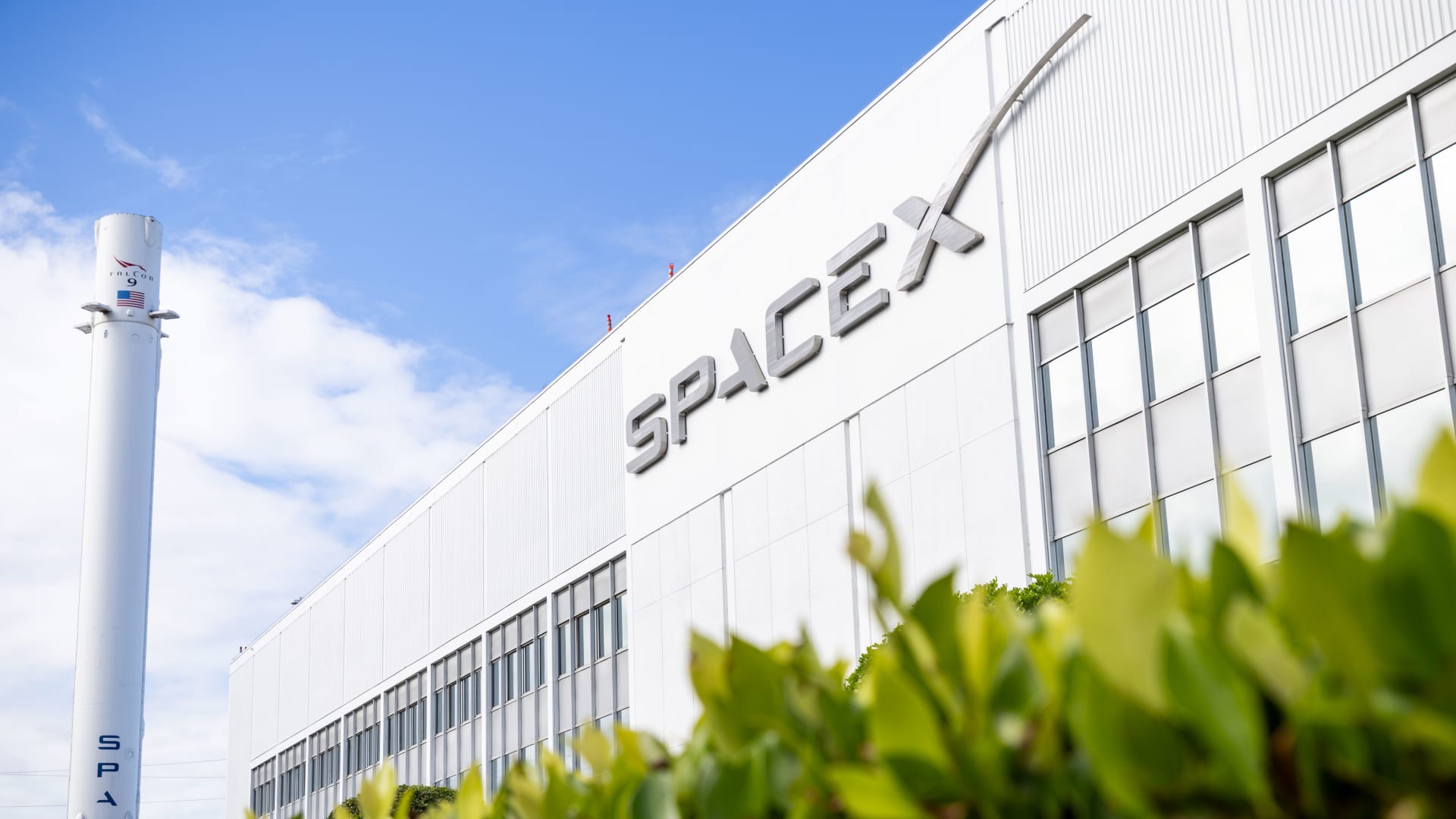
SpaceX facilities in Hawthorne, California, April 13, 2026.
Ethan Swope | Bloomberg | Getty Images
SpaceX is set to debut on the Nasdaq on Friday, and traders on the prediction market platform Polymarket are confident shares will pop.
The Elon Musk-led rocket company is expected to price at $135 per share, already giving it a market value of $1.77 trillion. But traders think there’s a high probability it’ll zoom well north of there on its first day of trading.
There’s an 84% chance that SpaceX will close above $1.8 trillion in market cap, according to Polymarket traders. Odds that SpaceX will surpass $2 trillion stand at 69%.
Based on an expected initial market cap of $1.77 trillion, a capitalization of roughly $2 trillion would equate to a 13% rally in SpaceX Friday. Pre-IPO perpetual futures on Hyperliquid indicate that SpaceX could jump more than 20% in its first day of trading.
Traders are more skeptical that SpaceX will close with a market value above $2.2 trillion, giving it less than a 50-50 chance.
A close above $2 trillion would put SpaceX in an exclusive club. Only five other U.S. companies — Nvidia, Apple, Alphabet, Microsoft and Amazon — have valuations north of $2 trillion.
SpaceX $2 trillion would also put it ahead of chip giant Broadcom‘s valuation of $1.85 trillion. Even at the expected initial valuation of $1.77 trillion, SpaceX would prove larger than Musk’s electric vehicle flagship. Tesla’s market value was about $1.72 trillion late Thursday, according to FactSet data.
Crypto World
Solana Foundation Launches Frontier Traders, an Institutional Program for $500M+ Volume Firms
The Solana Foundation launched Frontier Traders Thursday afternoon, a formal institutional program for elite trading firms, with the first qualifying campaign opening on SpaceX tokenized equity Friday. The entry bar sits at $500 million in trailing 30-day onchain DEX volume combined with $16… Read the full story at The Defiant
The Fidelity Digital Dollar reportedly deployed liquidity to both Curve Finance and Uniswap in a single Ethereum block Thursday evening, with an on-chain watcher flagging the move as the Fidelity-branded stablecoin's first foray onto permissionless DeFi rails. LytninCrypto, an on-chain data… Read the full story at The Defiant
South Korean police are investigating Bithumb CEO Lee Jae-won over bribery allegations linked to hiring people connected to independent lawmaker Kim Byung-ki.
According to Yonhap News, the Seoul Metropolitan Police Agency’s Public Crime Investigation Unit is examining claims that Lee approved the hiring of Kim’s second son after receiving a direct employment request from the lawmaker.
Political Hiring Scandal
The case stems from statements provided by a former aide to Kim, who had previously raised other allegations against the lawmaker. The aide told police that Kim met Lee for drinks at a restaurant in Seoul’s Mapo district in November 2024 and asked him to hire his son.
Police suspect the alleged hiring may have been linked to Kim’s activities while serving on the National Assembly’s Political Affairs Committee. Investigators believe Kim concentrated his legislative efforts on criticizing alleged monopoly practices involving Dunamu, the operator of rival crypto exchange Upbit, in return for his son being employed at Bithumb.
Earlier this month, police listed Lee as a bribery suspect in a second search warrant targeting Bithumb’s headquarters in Seoul’s Gangnam district and several related locations. During an earlier raid carried out in February, investigators had already named Kim as a suspect in connection with alleged preferential hiring tied to his son’s recruitment, while Bithumb was listed as a witness in the case.
Police are now reviewing materials seized during the searches and are expected to question certain individuals regarding the hiring process and whether they were aware of any job solicitation efforts.
Troubles Pile Up
Beyond the hiring controversy, Bithumb has recently been entangled in several separate legal and compliance-related disputes. In May, a South Korean court temporarily blocked a six-month partial business suspension imposed on the crypto exchange by the Financial Intelligence Unit (FIU).
The court’s decision paused the sanctions until a final ruling is made in Bithumb’s legal challenge against the regulator. The FIU had accused the exchange of around 6.65 million violations of financial rules, including failures in customer identity checks and transaction monitoring. Regulators also fined Bithumb 36.8 billion won and warned several company officials.
Earlier in April, Bithumb took legal action to freeze 7 BTC that remained missing after a major payout mistake during a promotional event. Due to a system input error, the exchange accidentally distributed Bitcoin instead of Korean won to users. Although most of the funds were recovered quickly, some recipients allegedly refused to return the remaining assets, which forced Bithumb to pursue a provisional seizure.
The post Bithumb CEO Booked in South Korea Bribery Probe Over Lawmaker’s Son Hiring appeared first on CryptoPotato.
Crypto World
Crypto News, June 11: Bitcoin Price Unfazed by Trump and His Threat to Flatten Tehran, Chainlink and Kraken Power FIFA World Cup

Crypto markets open with Bitcoin price showing surprising strength despite Trump threats on Iran. Chainlink and World Cup partnership shows growing mainstream ties, offering a bright spot amid volatility from geopolitics and ETF outflows.
Trump hinted at an Iran deal days away after proportional strikes yesterday. Today, he told Fox News that without an agreement, the U.S. will “bomb the sh*t out of them” tonight. He also revealed that the U.S. is taking millions of barrels of oil out of Iran every night while Hormuz stays closed. Trump added that when it ends, oil will drop back to prior levels.

Discover: The best pre-launch token sales
Bitcoin Price Holds Firm Amid Trump Escalation
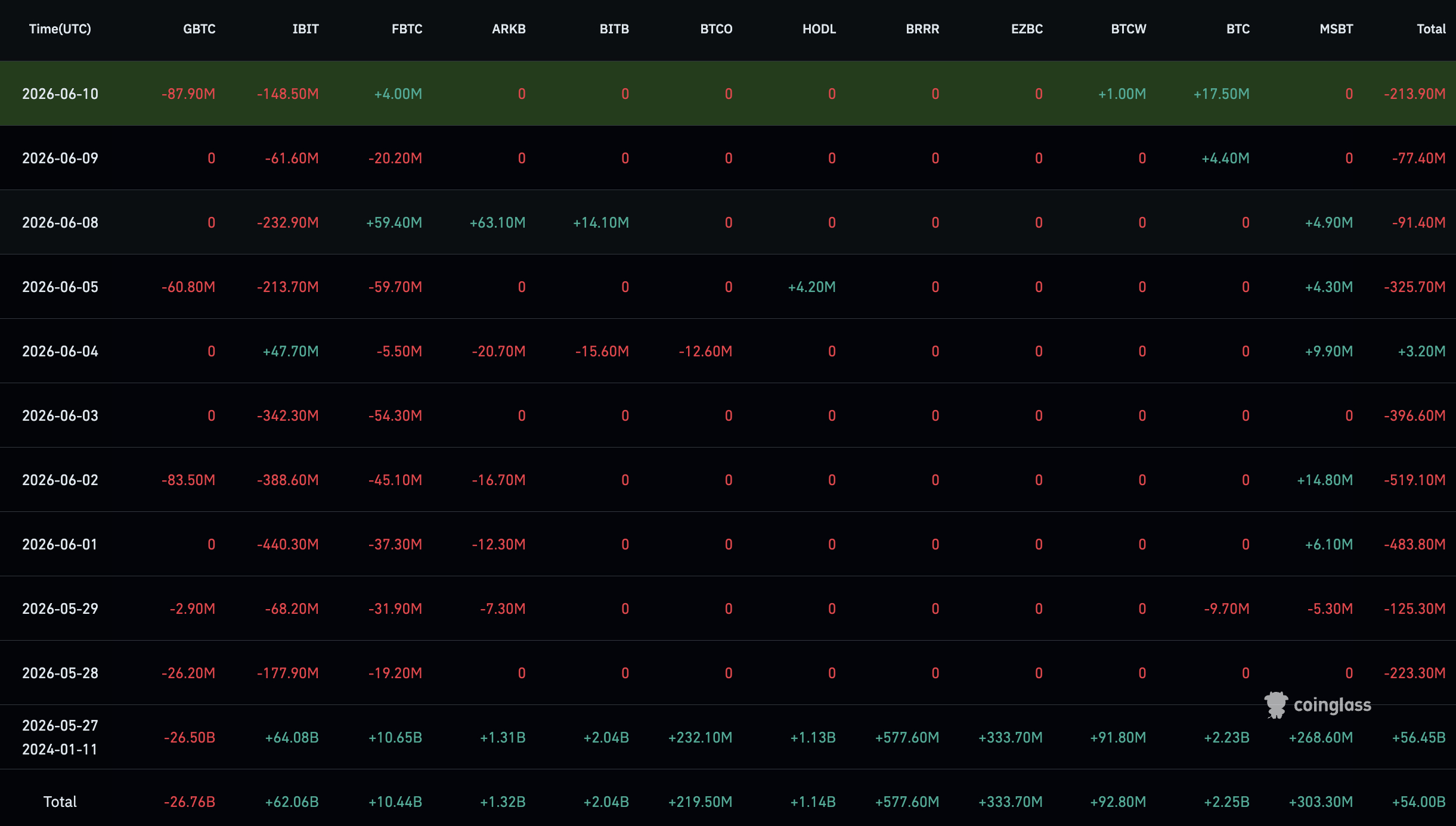
Bitcoin price faces selling pressure from heavy U.S. spot Bitcoin ETF outflows as the streak continued into this week. It’s a prolonged outflow since May, with hundreds of millions exiting daily, led by BlackRock’s IBIT. Right now, the multi-week totals have reached billions withdrawn, yet Bitcoin price has held with even some bounces.
Yesterday, soft-core inflation data unexpectedly supported risk assets, including crypto. Although hotter energy components add caution for us watching rate-cut odds. Geopolitical noise from Trump has not derailed resilience yet.
A fresh story from hours ago shows corporate buyers still competing hard. Strive CEO Matt Cole threw a joke to Michael Saylor that last week they bought 32 Bitcoin. Michael Saylor replied that he wants those 32 Bitcoin back. Strategy sold exactly 32 BTC in late May but maintains net buying overall, battling the fixed 21 million supply race.
— Coin Bureau (@coinbureau) June 11, 2026
 SAYLOR WANTS HIS BITCOIN BACK
Strive CEO Matt Cole joked, “Last week, we bought 32 Bitcoin. If you know, you know.”
Michael Saylor quickly replied: “I’m gonna want that 32 Bitcoin back.”  pic.twitter.com/Ehce9NeJ4t
Discover: The best crypto to diversify your portfolio with
Chainlink and Kraken Power FIFA World Cup
Chainlink is now named to power official FIFA World Cup prediction markets, ADI Predictstreet, the tournament’s official partner. The deal will involve Myriad adopting Chainlink oracles for accurate, instant settlements across all 104 matches serving billions of fans. This marks a major real-world utility for Chainlink data feeds.
6 billion fans. 200 countries. 1 prediction market oracle. — Chainlink (@chainlink) June 9, 2026
Chainlink is exclusively powering the official 2026 FIFA World Cup prediction market partner, @Predictstreet.
Chainlink  @FIFAWorldCup pic.twitter.com/V5JruV2c7Z
Chainlink follows Kraken, as a day earlier, it was named the Official Crypto Exchange Supporter of the World Cup. The partnership targets North America and Europe with fan activations, education, and giveaways.
Moving to Artificial Intelligence, after it singlehandedly eliminated millions of human jobs, Tether placed a $1.4 billion bet on autonomous machine economies and AI. The focus is on paying robots via stablecoins as part of bigger institutional moves into real-world AI and crypto integration. This follows MetaMask’s AI wallet launch and XRPL’s similar payment pushes yesterday.
Questions linger after setbacks like Humanity Protocol issues, yet momentum for practical applications grows.
Discover: The best pre-launch token sales
Institutional Conviction and Real Utility Point Higher
Adoption headlines around Chainlink and the World Cup show crypto moving beyond speculation into everyday use cases. Billions of fans will interact with prediction markets settled instantly, proving Chainlink’s value at scale while Kraken brings new users through the World Cup platform.

Corporate accumulation continues despite ETF outflows. The recent Saylor exchange with Strive shows how big players view the fixed supply as increasingly scarce. Institutional players like Tether committing billions to AI-stablecoin systems signal long-term bets on utility that outlast short-term volatility.
Bitcoin price has likely absorbed Trump, Iran, geopolitics, and outflow pressure without breaking key levels.
When the Iran situation resolves and oil normalizes, macro tailwinds could return quickly. Also, not to forget the Ukraine war, which could get a surprise peace deal. All, combined with real-world traction and AI-crypto experiments, the setup favors holders.
Discover: The best crypto to diversify your portfolio with
The post Crypto News, June 11: Bitcoin Price Unfazed by Trump and His Threat to Flatten Tehran, Chainlink and Kraken Power FIFA World Cup appeared first on Cryptonews.
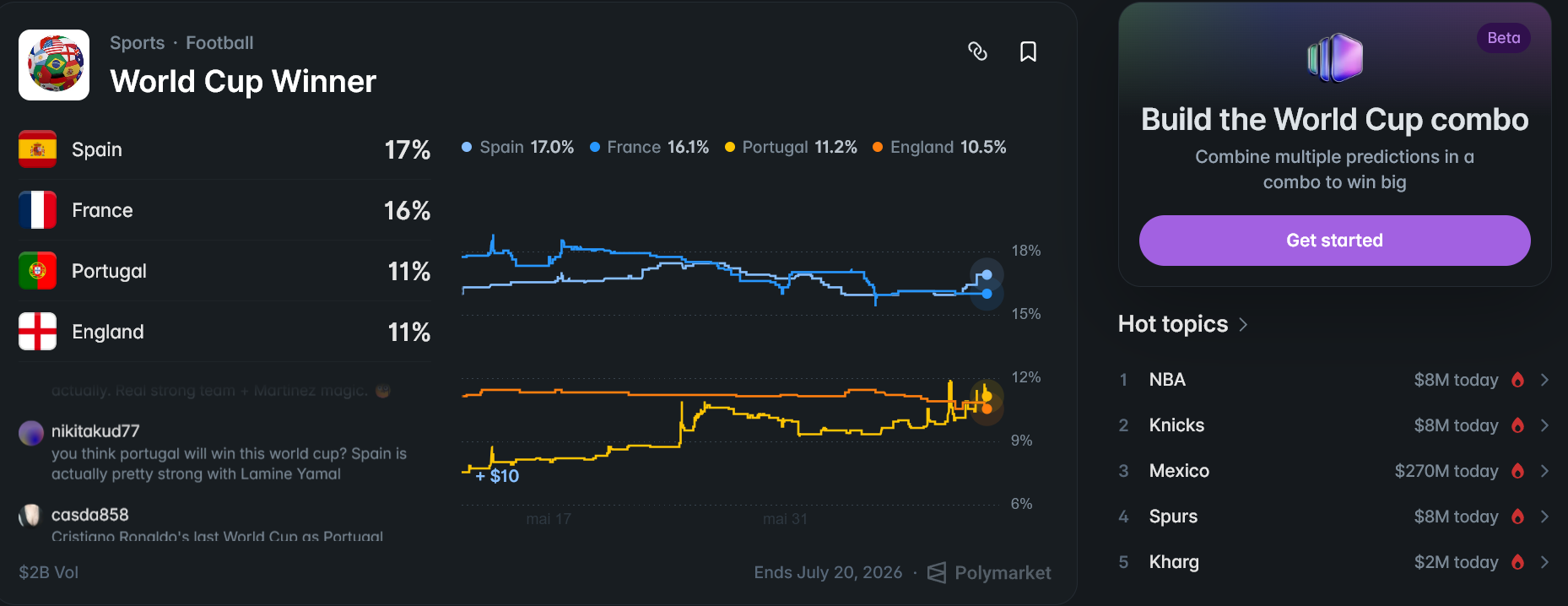
Crypto prediction markets crossed $2 billion in World Cup winner bets as the tournament opened in Mexico City today, and millions of traders still can’t agree on who will lift the trophy. Spain and France share the lead at around 16%, while defending champion Argentina sits at just 9%.
The combined total across Polymarket ($1.9 billion) and Kalshi ($132 million) makes this the largest single prediction market event in crypto history. Polymarket runs 328 live World Cup markets and saw $66 million traded in the last 24 hours, with the pool of funds behind those bets sitting at $352.7 million.

The $2 Billion World Cup Betting Record
Polymarket opened the World Cup winner market in July 2025, giving traders nearly a year to weigh in before the opening whistle.
Volume accelerated as the tournament approached, with $66 million changing hands in a single 24-hour window. The combined Polymarket and Kalshi total sets a new record for the largest single prediction market event in crypto history.
Prediction markets have become a staple at every major 2025 event, from the US presidential race to the Super Bowl. The World Cup now represents the biggest test of crypto betting infrastructure yet.
Spain, France, and the Defending Champion
Spain’s 16.5% and France’s 16.1% sit close enough that the market effectively rates them equal co-favourites. England and Portugal each sit at around 11%, with Brazil at 8%.
Defending champion Argentina sits at just 9%, lower than both European sides in the second tier.
The market is not saying Argentina cannot win, but two years on from their Qatar 2022 triumph, crypto bettors no longer rate Argentina as the team to beat. Every result in the group stage will shift that reading fast.
FIFA Goes On-Chain
This tournament also marks FIFA’s first official on-chain prediction infrastructure. ADI Predictstreet, an official FIFA partner powered by Chainlink, runs a separate market alongside Polymarket and Kalshi.
The governing body of world football now operates in the same prediction market space that crypto traders have built.
The tournament has 38 days and 104 matches to settle what $2 billion in collective wisdom couldn’t. The market will not stay deadlocked.
The post Crypto Just Put $2 Billion on the World Cup Winner, and It’s a Draw appeared first on BeInCrypto.
Citigroup is launching a blockchain-based marketplace for private company shares, looking to give wealthy and institutional investors a new way to gain exposure to pre-IPO firms as Wall Street pushes deeper into tokenized finance.
According to The Wall Street Journal, the platform will use tokenized depositary receipts issued by Citi, which represent ownership interests in private companies. The offering will initially be initially available to foreign investors, with US access planned at a later date.
The initiative allows investors to invest in private company shares “right next to their Apple stock, Citi digital asset executive Artem Korenyuk told the Journal.
Major banks are increasingly adopting tokenization to modernize traditional financial markets. Citi argues that structuring private investments through tokenized depositary receipts offers a more transparent alternative to special-purpose vehicles (SPVs), which have become a common, but often opaque, way for investors to access private companies.
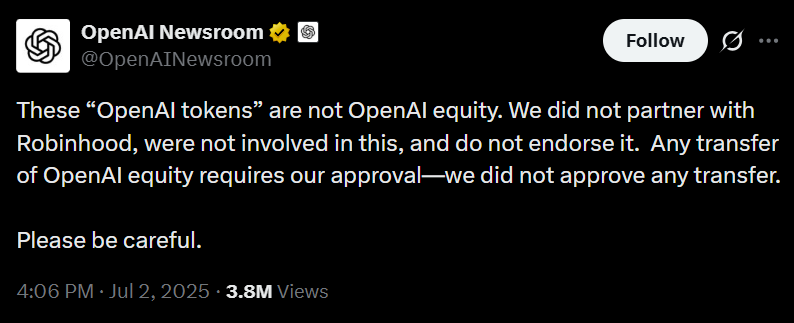
That distinction is notable as interest in pre-IPO investing surges. Several fintech platforms, including Robinhood, have explored offering tokenized exposure to private companies such as OpenAI, though those products generally provide indirect economic exposure rather than legal ownership of the underlying shares. OpenAI last year cautioned investors that these so-called tokenized stocks do not represent equity in the company.
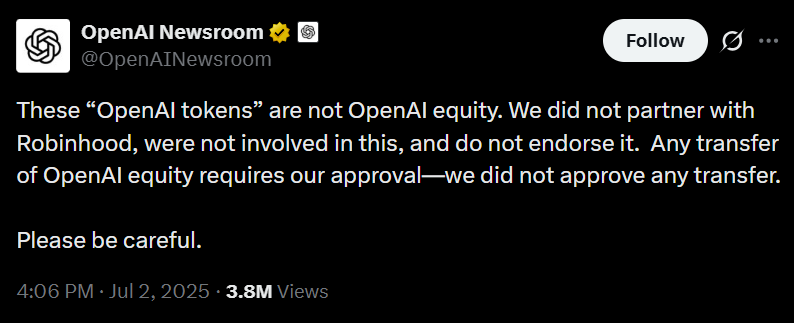
OpenAI’s warning to investors on buying tokenized shares. Source: OpenAI Newsroom
The underlying infrastructure of the venture’s blockchain will be operated by SIX Digital Exchange, a subsidiary of Switzerland’s stock exchange operator, SIX Group. Citi said it is already in discussions with several large private companies about making their shares available on the platform.
Related: Crypto Biz: Crypto infrastructure spending rises as ETF appetite cools
Private markets tend to outperform over time
Growing interest in pre-IPO investing reflects a broader shift toward private markets, where companies are staying private for longer and generating more of their value before reaching public exchanges.
Last December, the American Investment Council published a report citing PitchBook data showing that private equity outperformed the S&P 500 index across five-, 10-, 15- and 20-year investment horizons. This was seen despite the index delivering stronger returns over shorter time periods.
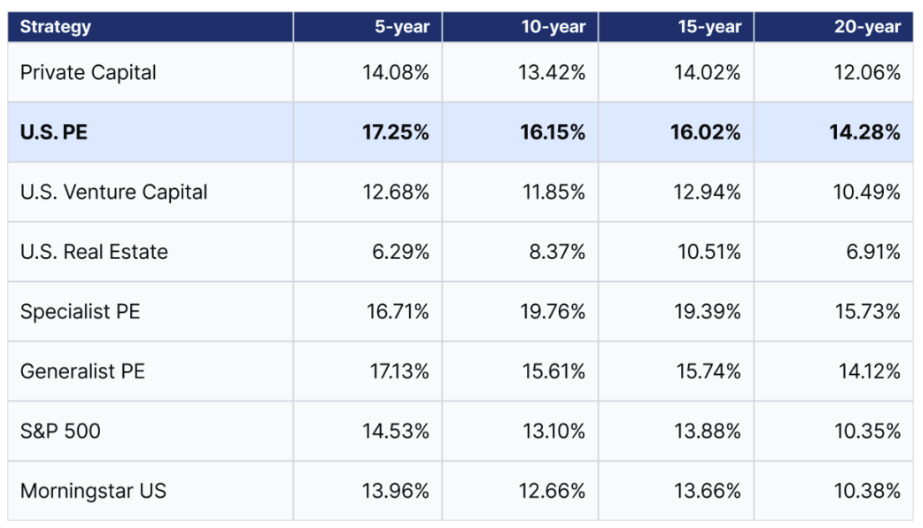
Private equity has outperformed the broader market over longer time horizons. Source: American Investment Council
At the time, American Investment Council President and CEO Will Dunham argued that private equity’s long-term outperformance strengthened the case for expanding retail access through investment vehicles such as 401(k) plans.
The sector’s strong returns, coupled with the trend of companies staying private for longer, have fueled investor interest in pre-IPO opportunities and heightened anticipation for major public listings.
The frenzy surrounding SpaceX’s IPO underscores the trend, with Bloomberg reporting that retail investors alone have placed more than $70 billion in orders for Friday’s offering as of Thursday. Elon Musk’s rocket and AI company is targeting a valuation of $1.8 trillion after its public debut.
Related: Kraken’s xStocks tops $25B in volume with more than 80K onchain holders

TLDR
- SPCX represents tokenized SpaceX shares issued through Backpack Securities.
- Token can be redeemed for underlying equity via regulated brokerage access.
- Sunrise provides infrastructure for issuance and Solana integration.
- SPCX trades on Solana with self-custody wallet support.
- Launch aligns with SpaceX’s Nasdaq listing day for dual-market access.
SpaceX shares will begin trading on Solana alongside Nasdaq listing via tokenization. Backpack Securities and Sunrise will launch SPCX representing SpaceX equity onchain. The token enables trading, redemption, and self-custody across Solana venues.
SpaceX Stock Token Launches on Solana Network
Backpack issues SPCX as a tokenized claim on SpaceX shares. Eligible users can redeem tokens for underlying shares through brokerage. The firms link brokerage accounts with blockchain settlement systems.
Sunrise provides infrastructure supporting the issuance and distribution of SPCX tokens. The token targets Solana for fast settlement and continuous trading access. Holders may transfer SPCX within supported wallets and platforms.
Backpack states SPCX can move between the token and equity forms. The structure allows redemption and re-tokenization through verified accounts. Trading will operate outside normal market hours on Solana.
Solana Trading Expansion for Tokenized Equities
The launch places SpaceX exposure onchain on listing day. Solana supports continuous trading beyond traditional exchange hours. Backpack integrates custody tools with regulated brokerage services.
SPCX can be stored in self-custody wallets securely. Users can trade tokens across supported Solana venues globally. The system mirrors traditional equity ownership through blockchain records.
Backpack CEO Armani Ferrante described portability across financial systems. “It is making underlying securities portable across financial systems.” The statement highlights integration between brokerage and blockchain rails.
Tokenized equities continue expanding across crypto markets this year. Firms experiment with blockchain rails for traditional asset exposure. SPCX enters this trend with regulated brokerage backing.
Solana supports high-speed settlement for tokenized trading systems. Developers build infrastructure for continuous financial market access. Backpack uses this network for SPCX distribution and trading.
Sunrise coordinates the issuance process with regulated brokerage partners. Token structure links shares with redeemable blockchain units. Users access SPCX through approved wallets and platforms.
Nasdaq listing proceeds separately from onchain SPCX trading. Both markets operate simultaneously for SpaceX exposure access. This dual structure enables parallel price discovery mechanisms.
Backpack ensures compliance through brokerage custody arrangements. Redemption requests convert tokens into underlying equity shares. Verification processes govern eligible participant access.
Solana venues support peer-to-peer SPCX transfers. Self-custody options give users direct asset control. Trading remains active beyond conventional market schedules.
The product aligns tokenized finance with traditional equity markets. Backpack integrates brokerage systems with blockchain infrastructure layers. Sunrise manages technical issuance workflows for token distribution.
SPCX availability begins with the SpaceX Nasdaq listing day. Trading access expands through Solana-based applications and wallets. Backpack continues rollout across supported jurisdictions and partners.


Shock for Japan as captain Wataru Endo withdraws from World Cup squad and retires from international football after injury blow | Football News

Tecno Pova 8 Brings a Dot Matrix Light Show to Its Camera Island

Z Cash Crash..Are You Investing In Crypto?



-

 Fashion6 days ago
Weekend Open Thread: Evereve – Corporette.com
-
 Crypto World6 days ago
Jensen Huang Approves Samsung, SK Hynix, and Micron for NVIDIA (NVDA) HBM4 Memory Supply
-

 Crypto World4 days ago
Anatomy of the June crypto crash: Fed, Iran, Saylor
-
 Entertainment5 days ago
The Best Mystery Series of All Time Is Surging on Streaming 30 Years After It Ended
-

 NewsBeat4 days ago
Alexander Zverev wins the French Open to finally earn a 1st Grand Slam title
-

 Tech6 days ago
Suspicious Polyfill login prompts pop up on Toshiba, Muji websites
-
Crypto World5 days ago
Senator Cynthia Lummis Calls CLARITY Act the Most Consequential Financial Legislation of This Generation
-

 Tech7 days ago
Microsoft launches MXC, an OS-level sandbox for AI agents, with OpenAI and Nvidia already on board
-

 Tech5 days ago
Microsoft unveils seven homegrown AI models in new bid for ‘long term self-sufficiency’
-

 Business7 days ago
(VIDEO) Justin Bieber Delivers Surprise Happy Birthday Serenade to Diners at Los Angeles Mexican Restaurant
-
 Business5 days ago
The Pain Points Taking a Fragile Tech Rally Down a Notch
-

 Business4 days ago
High Stakes for Wembanyama as New York Pushes for 3-0 Lead
-
 NewsBeat4 days ago
Alexander Zverev conquers demons and outlasts Flavio Cobolli to win French Open for first major title
-
 Crypto World3 days ago
Eli Lilly (LLY) Stock Surges 4% Following Breakthrough Sleep Apnea Trial Results
-

 Tech6 days ago
Von der Leyen’s AI envoy pick draws conflict-of-interest fire
-

 Tech6 days ago
Meta steals a tactic from Tesla and builds data centers in tents
-
Crypto World7 days ago
LBank Surpasses 25 Million Users Worldwide as AFA Partnership Continues to Drive Global Growth
-

 Tech6 days ago
Hackers now exploit SolarWinds Serv-U flaw to crash servers
-

 Crypto World4 days ago
Trump’s AI Ownership Plan Could Benefit Anthropic at OpenAI’s Expense
-
 Sports2 days ago
Bangladesh beat Australia after 20 years in ODIs, register only their second win over six-time world champions | Cricket News
You must be logged in to post a comment Login