

Crypto World
Can Silver Reclaim Its $121 All-Time High Before May Ends?

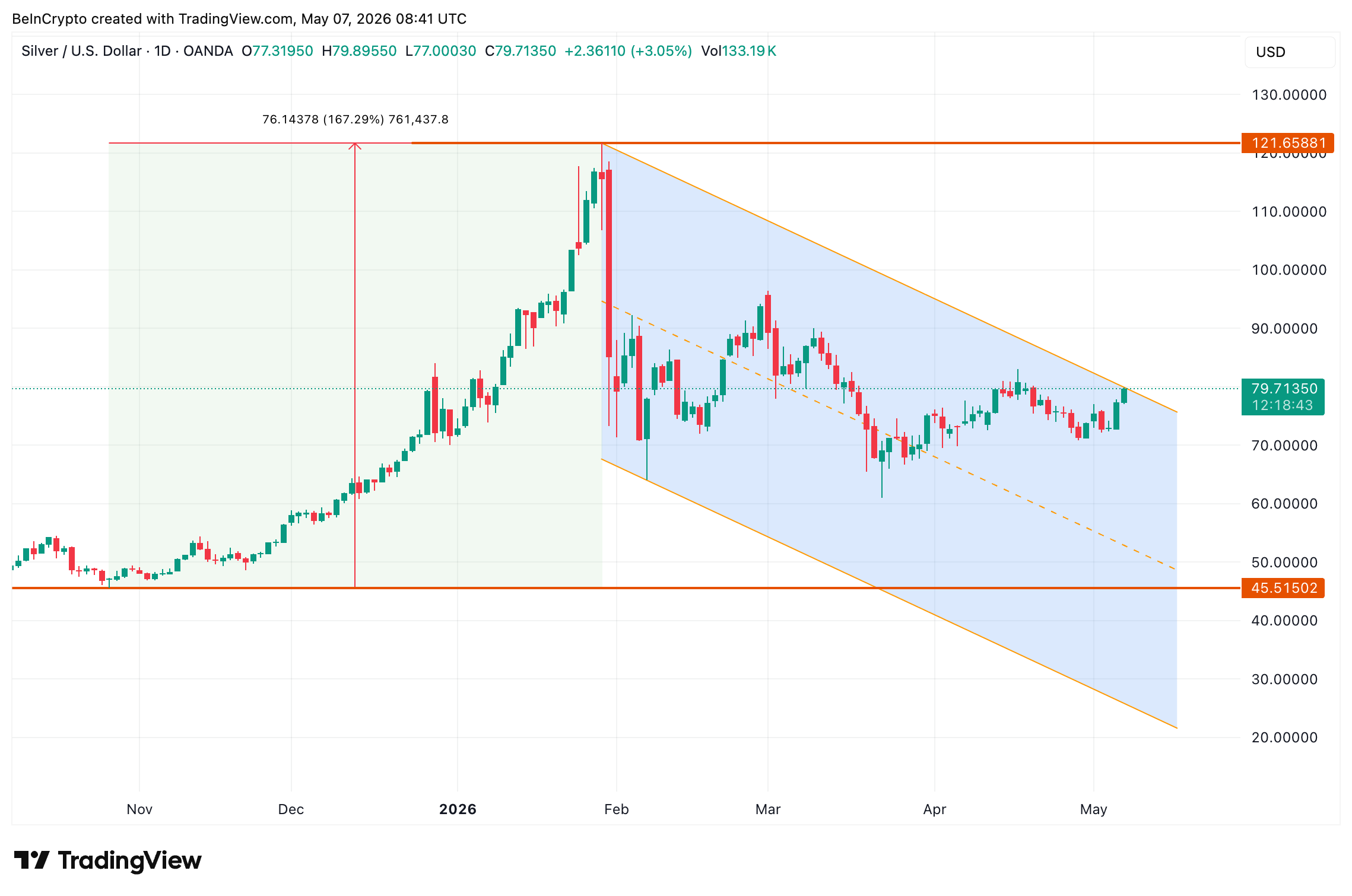
Silver (XAG/USD) trades near $79 after a 3% intraday jump cleared a multi-month resistance shelf, with the dollar simultaneously sliding inside its own falling channel.
The setup combines a structural pattern, an inverse macro driver weakening in lockstep, and a futures positioning read that hints at a quiet but persistent bullish lean. Whether silver can chase its $121.65 all-time high depends on which signal wins out.
Silver Builds Continuation Setup After 167% Surge
Silver surged 167% from its October 2025 low at $45 to an all-time high of $121 in late January. Since that peak, the metal has traded inside a falling channel, a structural pattern bounded by two parallel descending trendlines.
Want more insights like this? Sign up for Editor Harsh Notariya’s Daily Newsletter here.
Falling channels are not always bearish. When they form after an extended rally, they often resolve as continuation patterns. The structure marks a pause before the prior trend resumes.

Today’s session pushed silver about 3% higher to roughly $79. The move broke above a multi-month resistance shelf that had capped every prior rally attempt. The resistance shelf is revealed later in this piece. For now, the next hurdle would be the upper trendline of the channel. If that breaks, bullish continuation for Silver (XAG) can resume.
The breakout signal is technically clean, but a single-day move means little without macro support. The dollar’s path is the bigger driver.
Dollar Weakness Builds the Case for Higher Silver
The US Dollar Index (DXY) has been falling since early April. The index tracks the dollar against a basket of major currencies.
Silver and the dollar move inversely. A weaker dollar makes silver cheaper for foreign buyers and lifts emerging market demand. It also reduces the opportunity cost of holding a non-yielding asset.

The dollar’s slide has been reinforced by macro developments. On May 6, Brent and WTI crude oil prices dropped 7% to 8%. The selloff was driven by optimism around a US-Iran deal that could reopen the Strait of Hormuz.
A finalized agreement would reduce safe-haven dollar demand and accelerate DXY weakness. Also, if DXY weakens another 1.55%, the channel breakdown could help silver further.
Whether the dollar’s drop is being priced in, however, depends on positioning at the futures level.
COT Report Shows Cautious Deleveraging With Bullish Lean
The latest Commitments of Traders (COT) report from the Commodity Futures Trading Commission is dated April 28. It shows traders cutting silver exposure across the board.
Total open interest, the number of outstanding futures contracts, dropped by 14,187 to 101,275. Both longs and shorts were reduced, but shorts came off faster. Non-commercial speculators trimmed long positions by 1,919 contracts and short positions by 2,359 contracts. Shorts unwound roughly 23% faster than longs.

Net speculative positioning remains structurally long at a 4.4-to-1 long-to-short ratio (31,314 vs 7,154). Commercial hedgers stay heavily short at 69.2% of open interest. This is normal because they hedge physical inventory.
Traders are reducing risk, but the marginal flow is bullish. Shorts are exiting faster than longs. With the macro chain and positioning aligned, silver’s price ladder reveals the actual path to the all-time high.
Silver Price Levels: The Path Back to a $121 All-Time High
Silver just broke above $78, the 0.236 Fibonacci level. This level had been the multi-month resistance shelf.
A sustained reclaim opens $90 (0.382 Fibonacci), where the upper channel trendline breaks meaningfully. Above $90, the next test is $99 (0.5 Fibonacci). That marks a 24% climb from current price.
That $99 level is critical. Silver attempted multiple rallies after the late-January peak but failed to cross $99 on each attempt. Reclaiming it would mark the first decisive break of post-ATH structure.

Above $99, the path opens to $108 (0.618 Fib), $120 (0.786 Fib), and the all-time high at $121. That move represents a 53% climb from current price. However, this level surfacing in May depends on how the COT positioning and DXY move evolve through the month.
The downside ladder is narrower. Failure to hold $78 keeps silver in the channel. A slide toward $64 and $60, the channel’s lower band, becomes the next risk. A break below $60 would weaken the entire continuation thesis. For now, $99 separates a silver price run to $121 ATH from a slide to the $64.
The post Can Silver Reclaim Its $121 All-Time High Before May Ends? appeared first on BeInCrypto.


Raydium, the Solana-based decentralized exchange, was drained of $1.34 million on June 10, 2026, when an attacker exploited five deprecated liquidity pools from its legacy AMM V3 program, a smart contract vulnerability that had sat dormant on-chain for five years.
The attacker, whose Solana address ends in ‘Bq33QVk,’ made off with approximately $900,000 in USDC, $357,000 in SOL, and $86,000 in RAY tokens.
— Solana Hub (@SolanaHub_) June 10, 2026
 Raydium confirms $1.34M exploit on legacy AMM V3 pools. No current users affected; full compensation from treasury. pic.twitter.com/tqmKATA2tH
After draining the pools, the exploiter bridged all funds from Solana to Ethereum via a cross-chain bridge, then deposited them into Tornado Cash to obscure the trail, a standard cross-chain laundering sequence that leaves recovery prospects slim.
Discover: The Best Crypto to Diversify Your Portfolio
The LP Mint Validation Flaw: How Fake Tokens Emptied Real Pools
The root cause was a smart contract vulnerability in Raydium’s legacy AMM V3 program, a DeFi exploit enabled by insufficient LP token validation. In any standard automated market maker, liquidity pool shares are represented by LP tokens that track a provider’s proportional stake. When funds are withdrawn, the contract verifies the LP tokens being burned match the pool’s legitimate mint.
Raydium’s deprecated AMM V3 program failed to perform that check. The attacker created a fake SPL token mint unrelated to any real Raydium liquidity pool, minted a single unit of that counterfeit LP token, then called the legacy withdraw function.
The old contract treated the attacker as a 100% LP shareholder and released the entire pool’s reserves.
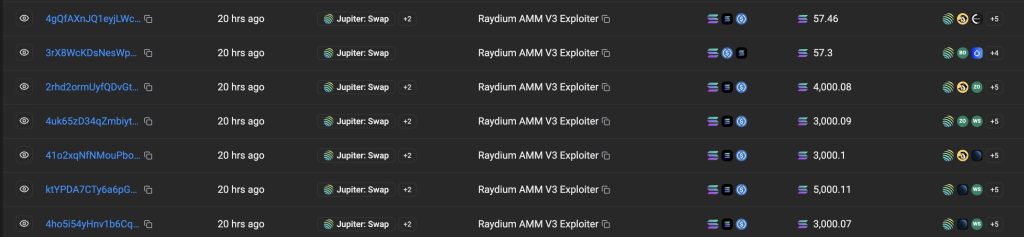
The sequence was repeated across all five deprecated pools, Sollet USDT–RAY, Sollet ETH–RAY, SRM–RAY, USDC–RAY, and RAY–SOL, draining approximately 150,177 RAY, 5,603 SOL, and 893,700 USDC in total.
Pseudonymous Raydium contributor 0xInfra confirmed on X that the attack was caused by “a self-contained logic flaw” and explicitly ruled out any key compromise or authority-level issue, meaning no propagation risk exists to current Raydium programs.
The December 2022 Raydium hack, a roughly $4.4 million loss caused by a private key theft – had pushed the team to harden operational security and migrate to audited contracts.
The June 2026 incident is a structurally different failure: not an operational breach, but a legacy codebase left callable on-chain with real assets still sitting inside it.
Tornado Cash Exit: Funds Bridge to Ethereum, Trail Goes Cold
On-chain investigators flagged the exploit in real time as the attacker aggregated USDC, SOL, and RAY across the five drained pools before moving cross-chain.
The full balance was bridged from Solana to Ethereum, then routed through KuCoin and FixedFloat before landing in Tornado Cash, the privacy protocol that remains the exit ramp of choice for DeFi exploit proceeds.
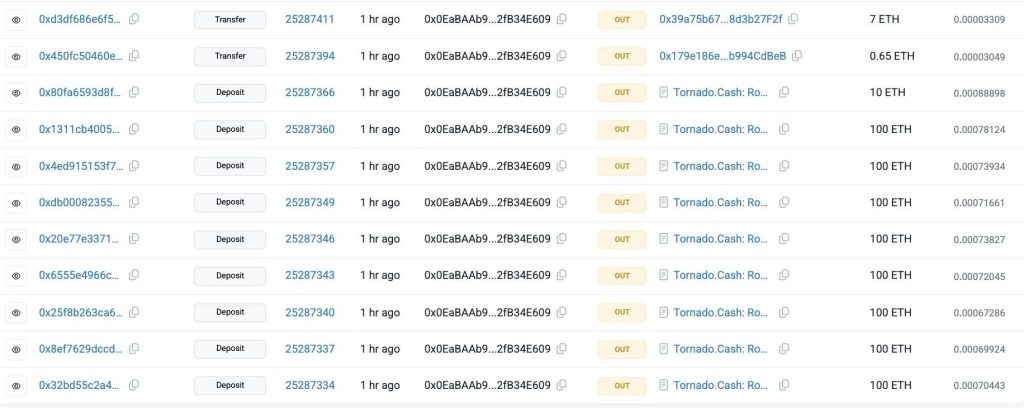
Community analysts tracking the wallet ending in ‘Bq33QVk’ confirmed the complete cross-chain exit, noting the attacker did not attempt to liquidate funds through Solana-native venues.
Once inside Tornado Cash, transaction-level tracing breaks down. No funds are reported frozen or flagged by centralized exchanges at this time.
No Active Users Affected, Raydium Treasury to Cover Losses
The most important immediate fact for Raydium users: no active accounts or current pools were touched. “No current users of Raydium are affected by this exploit or would have been able to interact with these pools through the UI since their deprecation,” 0xInfra stated.
The deprecated AMM V3 pools were invisible in the front-end and inaccessible through normal user flows.
Raydium confirmed it will repay all stolen funds in full using its protocol treasury. Legacy AMM V3 program IDs are being formally retired to prevent further calls, and the team has launched a comprehensive security review of all mainnet and legacy code paths. The reimbursement timeline has not been specified publicly.
RAY token is up around 2% in the 24 hours following the incident, trading at $0.578. The token has shed 7% over the past week amid broader Solana ecosystem weakness and sits 96.6% below its all-time high of $16.83.
Discover: The Best Token Presales
The post Raydium Hit With $1.34M Exploit via Fake LP Tokens on Deprecated Solana Pools appeared first on Cryptonews.
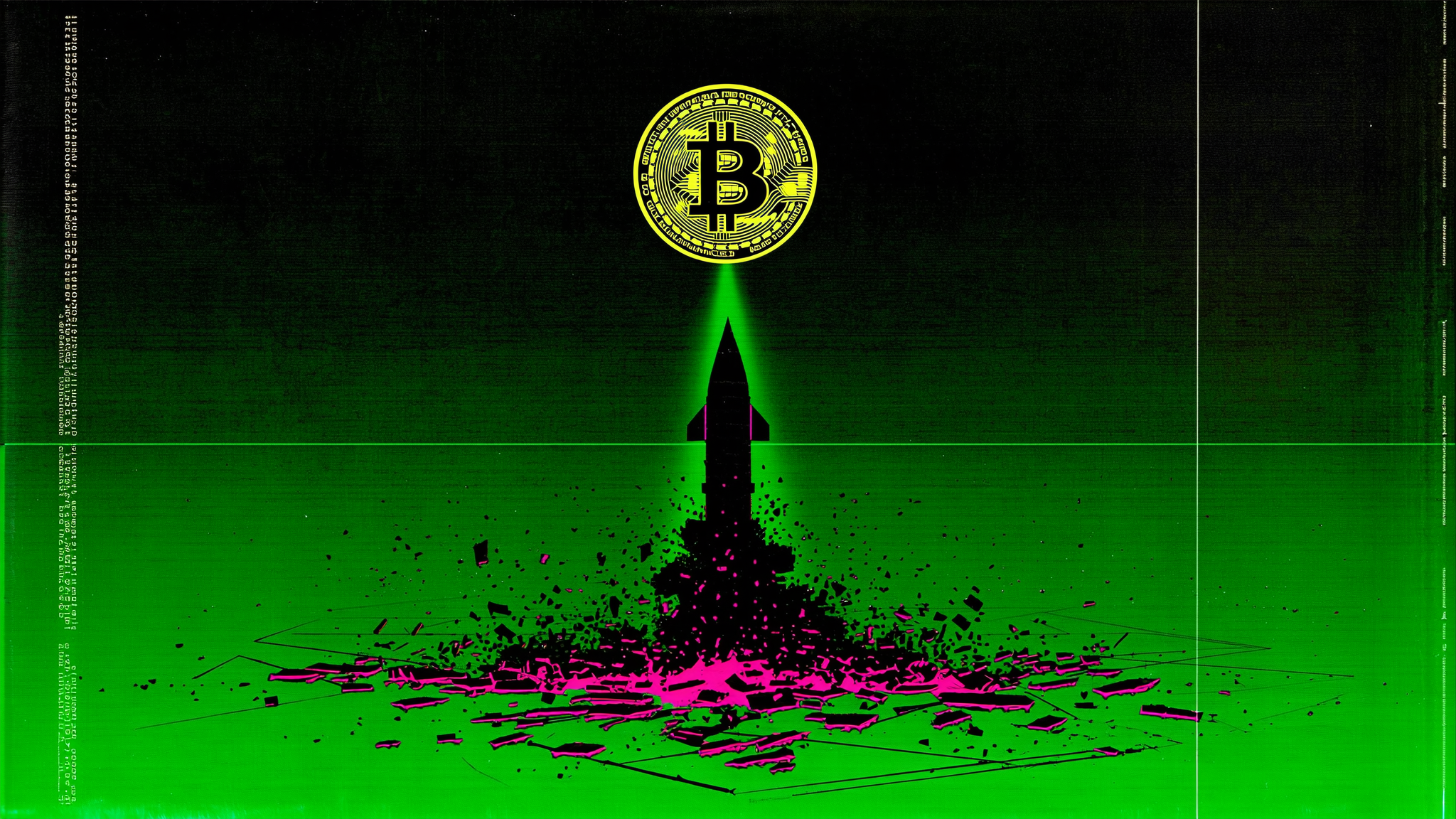
Bitcoin climbed above $63,000 Thursday after President Donald Trump announced via Truth Social that he was canceling scheduled U.S. military strikes against Iran and signaling that a multi-nation agreement was close. Trump wrote that “discussions with the Islamic Republic of Iran have been brought… Read the full story at The Defiant

Japan’s Lower House has moved a bill that would bring crypto assets under the country’s financial instruments framework, signaling a potential shift toward regulated market access such as exchange-traded funds and a more favorable tax posture for digital assets. Bloomberg reported that the legislation aims to regulate crypto assets more like traditional securities, imposing stricter trading rules as part of a broader market growth push. The bill is expected to advance further after consideration by the Upper House and could take effect next year pending final enactment.
The proposed changes would align crypto assets with the regulatory treatment afforded to stocks and bonds, introducing tighter governance and disclosure requirements. At a macro level, the move reflects an ongoing effort to integrate digital assets into Japan’s financial markets while enhancing oversight and investor protections. If enacted, the reform would also reframe the tax landscape for crypto holdings, with potential implications for both retail and institutional participants.
Official records indicate the bill cleared the Committee on Financial Affairs on June 10, though the plenary vote status on the House of Representatives’ tracking page had not yet been updated at the time of reporting. The procedural steps remain subject to confirmation by the Upper House, which would complete the legislative process before implementation.
Japan’s broader regulatory trajectory has been evolving for months, with signals that crypto would move from a payments-oriented regime to a financial-market framework. In November 2025, Asahi Shimbun reported that the Financial Services Agency (FSA) had decided to apply the Financial Instruments and Exchange Act to crypto assets, including Bitcoin, Ether, and other tokens traded on local exchanges. In April 2026, FSA materials stated the proposal would relocate crypto-asset transaction rules from the Payment Services Act to the Financial Instruments and Exchange Act, marking a substantive shift in the regulatory architecture.
The FSA described a framework in which crypto assets would be treated as financial products distinct from traditional securities, while introducing disclosure duties, tighter exchange oversight, insider-trading restrictions, and steeper penalties for unregistered operators. The proposed regime would require crypto-asset transaction businesses to publish information about the assets they handle, and issuers of certain assets would face disclosure obligations during offerings or secondary distributions. Bloomberg again highlighted that such a regime could create a pathway for crypto-tracking ETFs, offering Japanese investors a regulated channel to gain exposure beyond direct exchange trading or holdings in listed companies with token interests.
Key takeaways
- The Lower House appears to have advanced a bill to subject crypto assets to the Financial Instruments and Exchange Act, moving regulation closer to equities and bonds and potentially enabling new market structures such as crypto-tracking ETFs.
- The bill contemplates shifting crypto-asset rules from the Payment Services Act to the Financial Instruments and Exchange Act, with enhanced disclosure, oversight, and penalties designed to bolster investor protection and market integrity.
- Tax provisions would reclassify crypto capital gains with a flat 20% rate—aligned with stocks and bonds—down from a current maximum of 55%. The change is slated to take effect in 2028, subject to final passage and transitional rules.
- Authorities have disclosed that the bill cleared the Committee on Financial Affairs as of June 10, with plenary-vote status pending final confirmation, reflecting a methodical progression through the legislative process.
- The reform could broaden institutional access to regulated crypto exposure via ETFs and other financial-market instruments, potentially integrating digital assets into mainstream investment and risk-management frameworks in Japan.
Regulatory trajectory and scope
The core objective of the bill is to reposition crypto assets within Japan’s financial-market regime, elevating their regulatory status from a payments-focused perimeter to a framework that governs financial products. The proposed move to bring crypto under the Financial Instruments and Exchange Act would harmonize trading rules with those applied to traditional securities, futures, and related instruments. In doing so, the regime would introduce standardized disclosure for asset managers and issuers, as well as stronger oversight of trading venues and intermediaries.
Key features under consideration include classifying crypto assets as financial products distinct from conventional securities, while imposing requirements applicable to market participants, including tighter supervision of exchanges and enhanced penalties for unregistered operators. The scheme would obligate crypto-asset transaction operators to publish information about the assets they handle, a disclosure duty intended to improve transparency for investors and regulators alike. Issuers of certain assets would face disclosure obligations during offerings or secondary distributions, aligning issuance practices with broader financial-market standards.
These measures echo a broader regulatory trend observed in many jurisdictions seeking to reduce information asymmetry and systemic risk associated with digital assets. Notably, the move would align Japan with global policy directions that emphasize market integrity, investor protection, and clear accountability for participants across the crypto value chain. The European Union’s MiCA framework and ongoing U.S. regulatory developments provide a contemporaneous backdrop for such a shift, reinforcing the trend toward formalization of crypto markets within traditional financial infrastructure.
Tax reforms and market access for investors
A central economic dimension of the bill is the proposed tax treatment of crypto gains. The current regime, which can reach up to 55% in capital gains tax, would be replaced by a flat 20% rate on crypto profits, aligning with the tax treatment of stocks and bonds. The timing of the tax reform—policy intent to be effective in 2028—reflects an orderly transition that would grant businesses and individuals time to adjust to the new framework. For institutions, the change could alter after-tax returns and impact portfolio construction, tax planning, and accounting practices tied to digital asset exposures.
From a compliance perspective, the tax realignment sits within a broader policy objective to increase predictability and coherence across asset classes. For crypto firms and asset managers, this could translate into more standardized tax reporting and a clearer line between taxable crypto activities and other financial instruments. For banks and custodians, the reform could influence product design, treasury management, and client advisory services, especially as the market explores regulated wrappers or ETF structures linked to digital assets.
In parallel with tax considerations, the potential for crypto-tracking ETFs marks a significant market-access development. Such products would provide a regulated, exchange-traded vehicle for investors seeking diversified exposure to crypto assets without direct custody of tokens. While the possibility has been flagged by market observers, the actual availability will depend on the final regulatory framework, licensing requirements, and the operational readiness of market participants to meet disclosure, custody, and liquidity standards demanded by Japan’s evolving regime.
Impact on market structure, compliance posture, and policy context
From an institutional perspective, bringing crypto assets into a financial-instrument framework would sharpen compliance expectations across the ecosystem. Exchanges, brokers, asset managers, and issuers would operate under more explicit rules around transaction reporting, asset information disclosure, and governance. The alignment with the Financial Instruments and Exchange Act would also shape AML/KYC programs, recordkeeping, and supervisory oversight, thereby enhancing regulatory certainty for both domestic and cross-border participants.
Beyond Japan’s borders, the reform integrates into a broader international policy discourse on crypto regulation. The MiCA framework in the European Union and U.S. regulatory developments reflect a global shift toward treating digital assets as regulated financial products with explicit consumer protections, capital-raising guidelines, and systemic-risk controls. For multinational firms active in Japan, the legislative trajectory underscores the need to harmonize compliance programs with domestic rules while monitoring developments in other jurisdictions that could influence cross-border operations, licensing equivalencies, and supervisory cooperation.
Another practical consideration concerns the balance between innovation and control. While tighter rules may raise the bar for market participants, they also create clearer paths for institutional involvement—ranging from regulated trading venues to custodian services and product issuances. The forthcoming Upper House deliberations will determine the pace and scope of the reform, including whether the ETF pathway receives formal approval and how disclosure standards will be operationalized across asset classes and offerings.
Closing perspective
Japan’s legislative move to bring crypto assets under a financial-market framework represents a pivotal moment for regulatory clarity, investor protection, and market accessibility. As the process unfolds, watchers should monitor the Upper House deliberations, the final articulation of the tax timetable, and the concrete rules surrounding disclosures and market surveillance. The unfolding framework could influence not only domestic capital markets but also how international entities align their compliance programs and risk controls with Japan’s evolving policy posture.
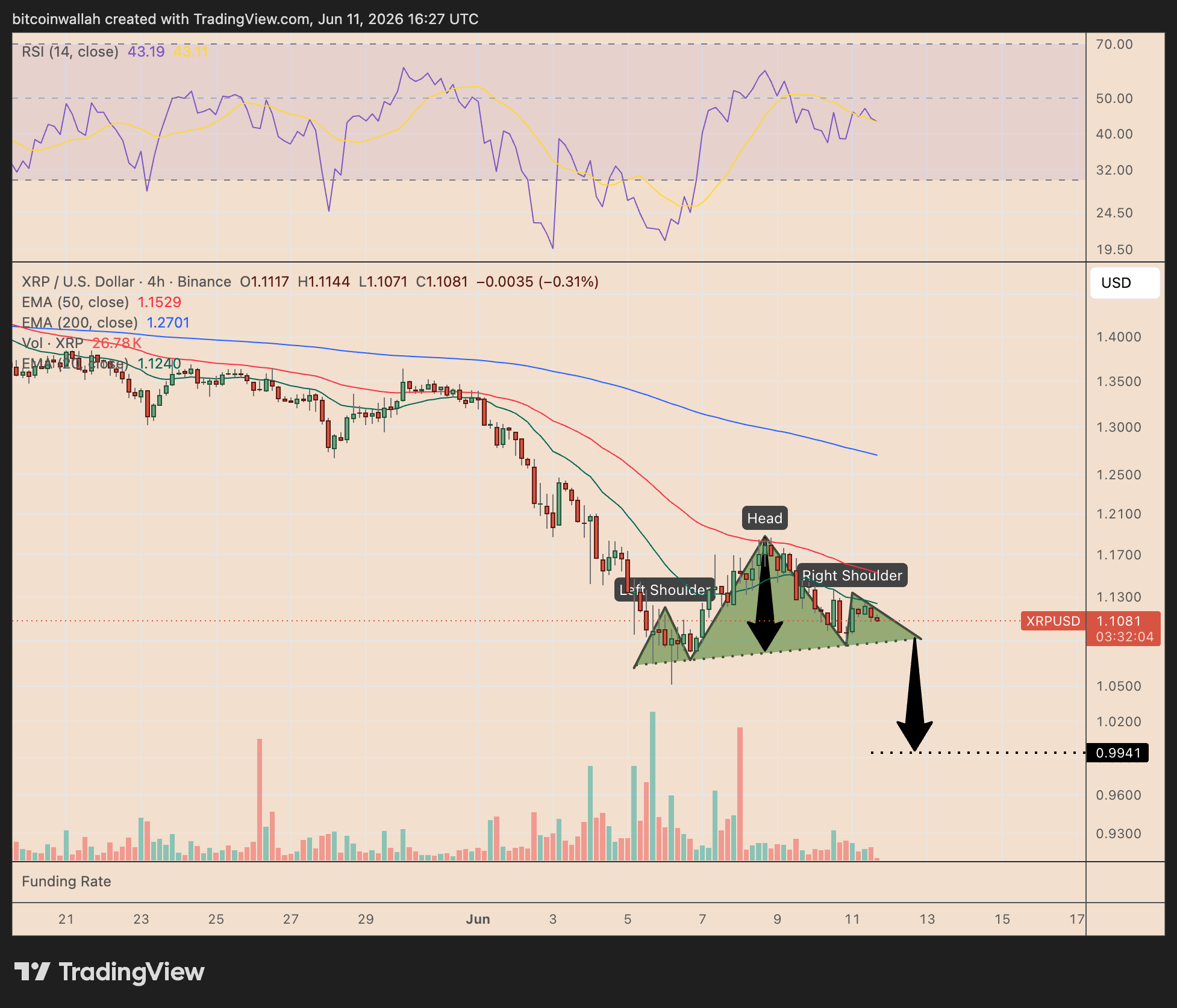
XRP (XRP) charts are painting multiple bearish patterns this month with a downside target under $1.
Key takeaways:
- XRP is forming head-and-shoulders and bear flag setups on its shorter-time frame chart.
- An on-chain metric is further signaling weak demand or capitulation sentiment among traders.
Head-and-shoulders setup hints at 10% XRP decline
Since June 5, the XRP price has formed what appears to be a head-and-shoulders (H&S) pattern.
The setup develops when the price forms three peaks atop a common neckline support, where the middle peak, called the “head,” is higher than the other two, the “shoulders.”
An H&S pattern typically resolves when the price breaks decisively below the neckline support, with its downside target measured by subtracting the breakdown level from the structure’s maximum height.
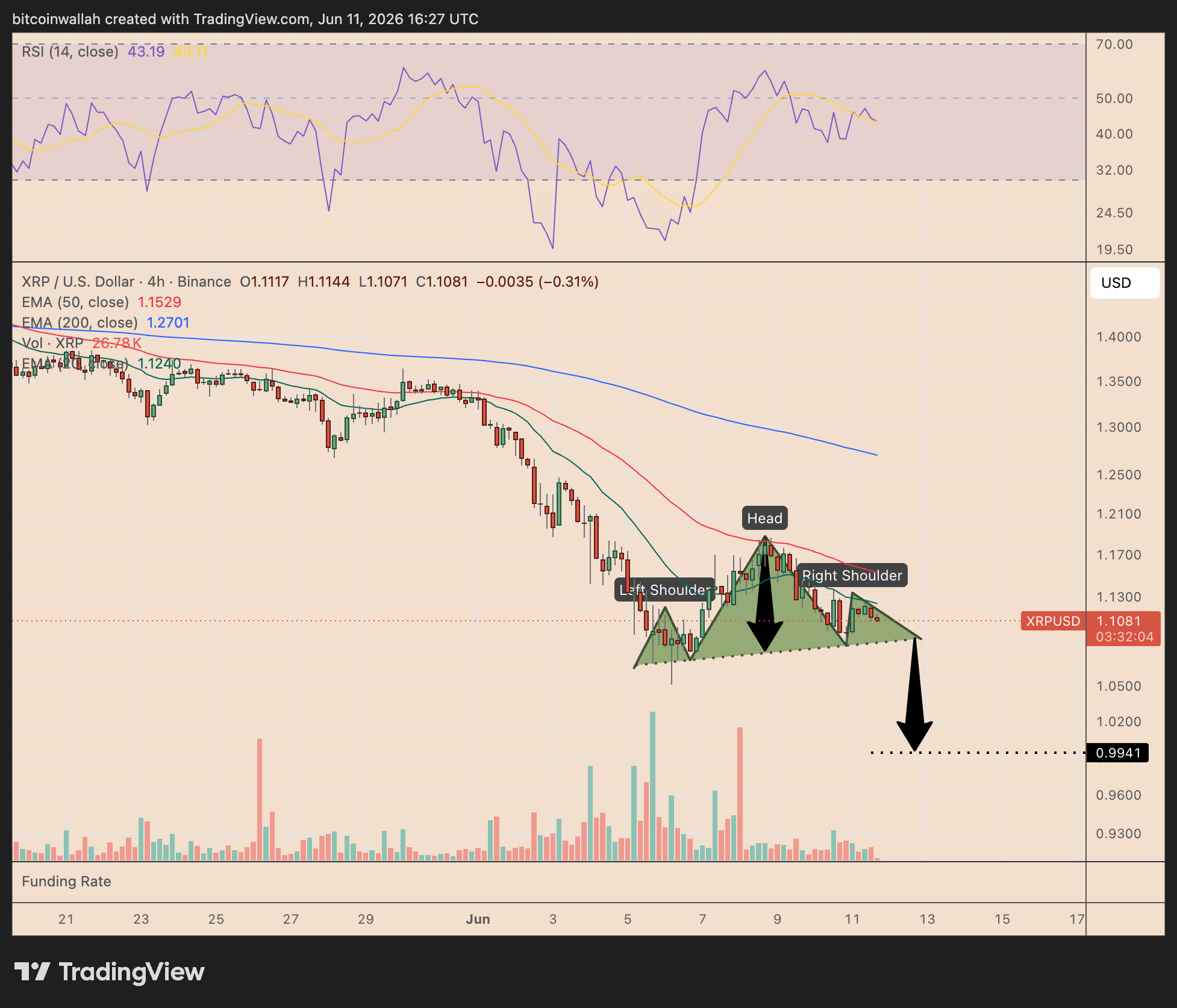
XRP/USD four-hour price chart. Source: TradingView
As of Thursday, XRP was forming the pattern’s right shoulder, eyeing an initial dip toward the neckline near $1.09.
Applying the technical rule, the target for June is around $0.99, down roughly 10%, if the price breaks below the neckline.
Conversely, a clear break above the right shoulder’s peak at around $1.12, a level also aligning with the 20-period exponential moving average (20-period EMA, green) on the four-hour chart, may invalidate the H&S pattern.
In that case, XRP may rally toward the 50-period EMA (red) near $1.15, up 4.5% from the current price levels.
Another bearish setup hints at a lower XRP price target
XRP’s four-hour chart also shows a bear flag, adding weight to the sub-$1 bearish outlook.
A bear flag forms when the price consolidates inside a rising channel after a sharp sell-off. It typically signals a pause before the prior downtrend resumes.
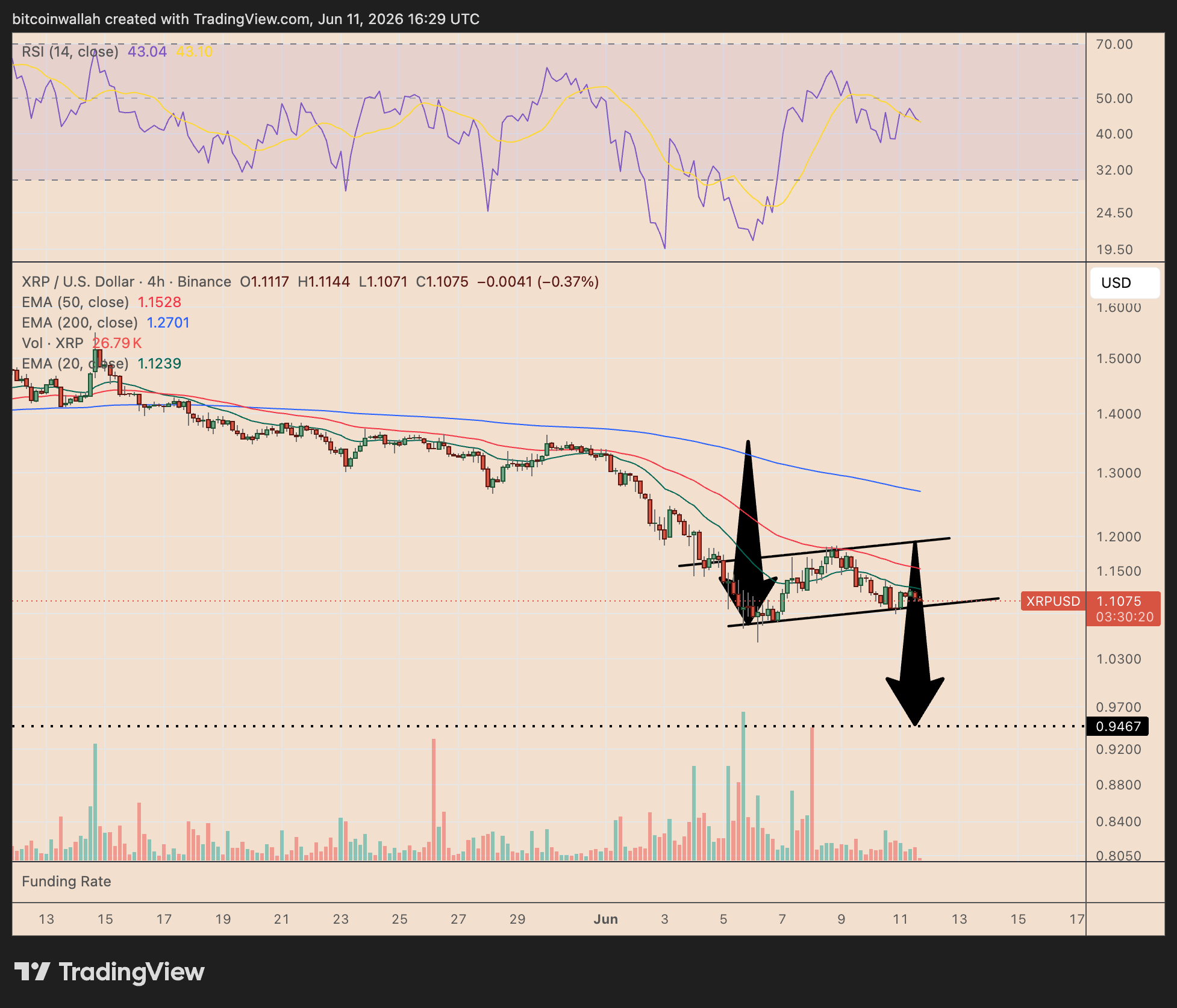
XRP/USD four-hour chart. Source: TradingView
As of Thursday, XRP was testing the flag’s lower trendline near $1.10. A decisive four-hour close below this level could confirm the breakdown.
Applying the technical rule, XRP’s bear flag target sits near $0.94, down roughly 15% from current prices.
The relative strength index (RSI) near 43 supports the bearish view, showing weak momentum below the neutral 50 level.
However, a rebound above $1.12 would weaken the setup. A stronger move above the 50-period EMA near $1.15 could delay the selloff and send XRP toward the flag’s upper trend line near $1.18–$1.20.
On-chain data points to dip toward $0.96
XRP’s MVRV pricing bands suggest the price still has room to fall toward the lower green zone.
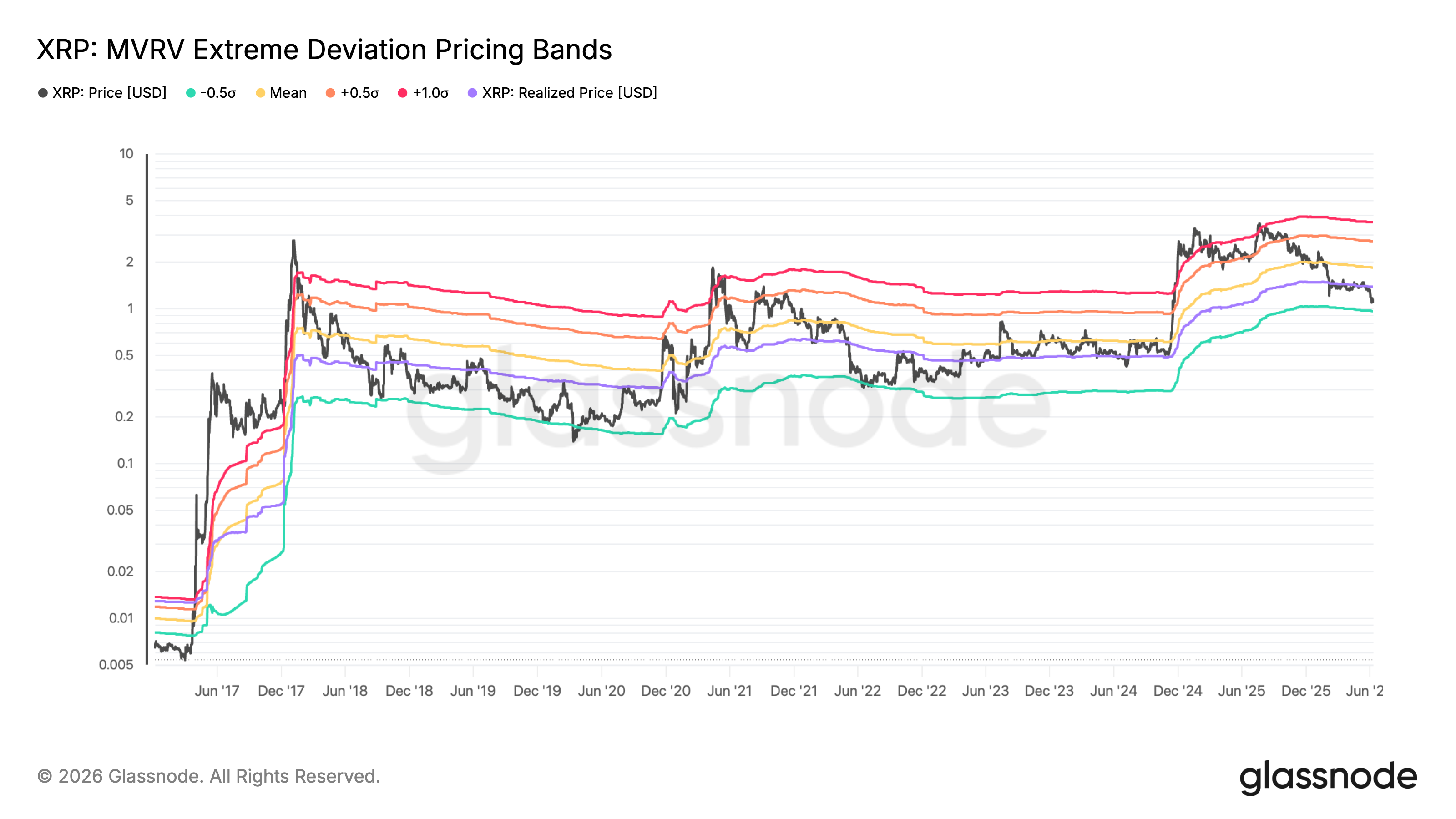
XRP MVRV extreme deviation pricing bands. Source: Glassnode
For new traders, MVRV compares XRP’s market price with the average price at which coins last moved on-chain. In simple terms, it shows whether holders are sitting on large paper profits or losses.
When price trades near the upper bands, the market is usually overheated. When it falls toward the lower bands, it often signals stress, weak demand, or capitulation.
Related: XRP transaction demand falls 91.5% as traders focus on $0.65 support
That lower green band has acted like a bear-market magnet for XRP in previous cycles. It declined toward or below the same zone during major downturns in 2018, 2020 and 2022 before finding stronger support later.
The next major downside target sits near the green lower band near $0.96, about 13% below current prices if history repeats.
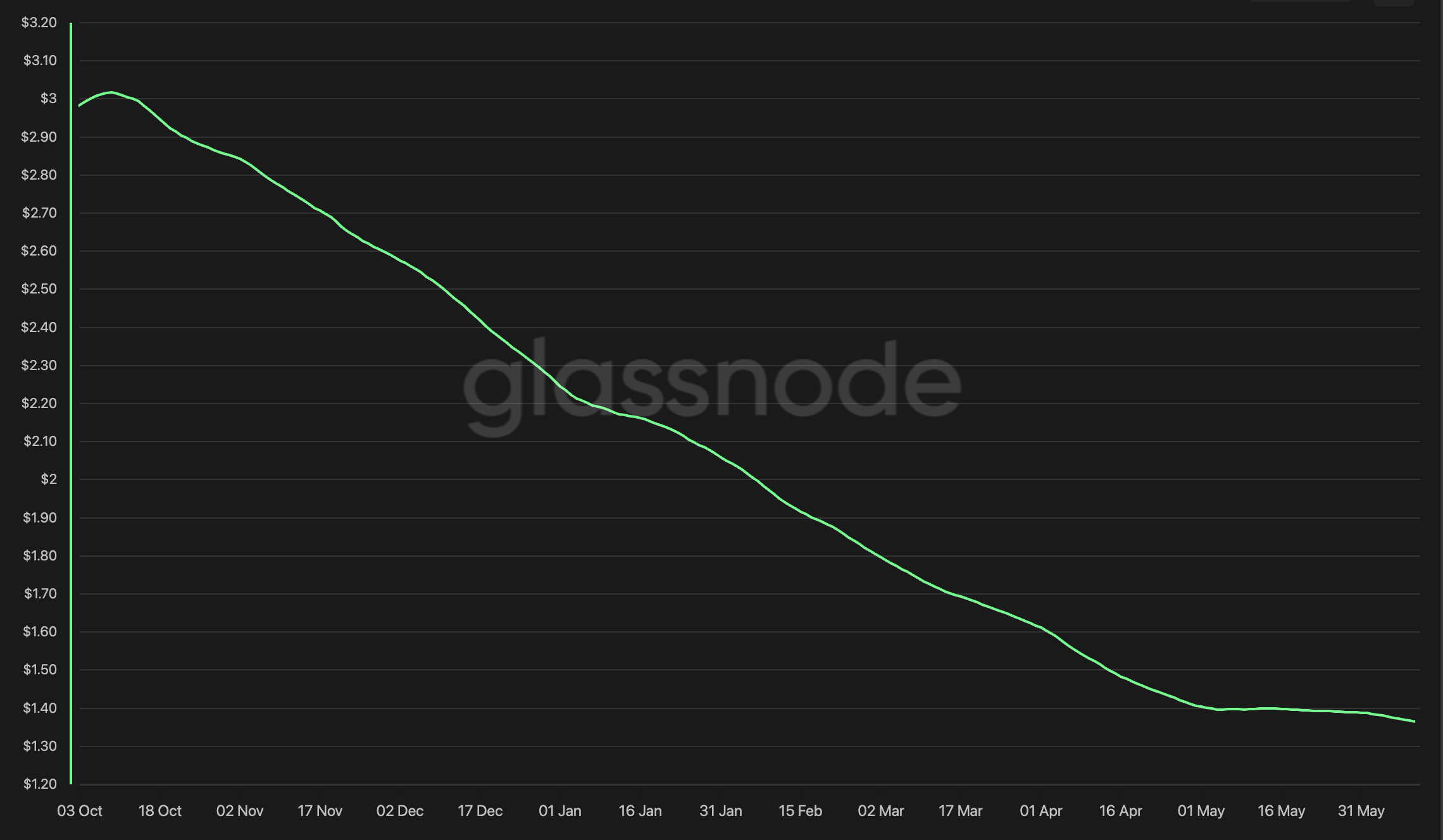
XRP price has started to stabilize, but its onchain activity has collapsed to levels not seen since before 2025. Network fee volume, a direct proxy for transaction demand, has dropped by 91.5% from its February peak.
According to Glassnode data, the 90-day simple moving average of total fees paid on the XRP network has cratered from 5,900 XRP in February to just 500 XRP today. Simultaneously, XRP’s 90-day realized profit-to-loss ratio has fallen to 0.38, down from a peak of 50 when XRP traded at $3.40 January last year.
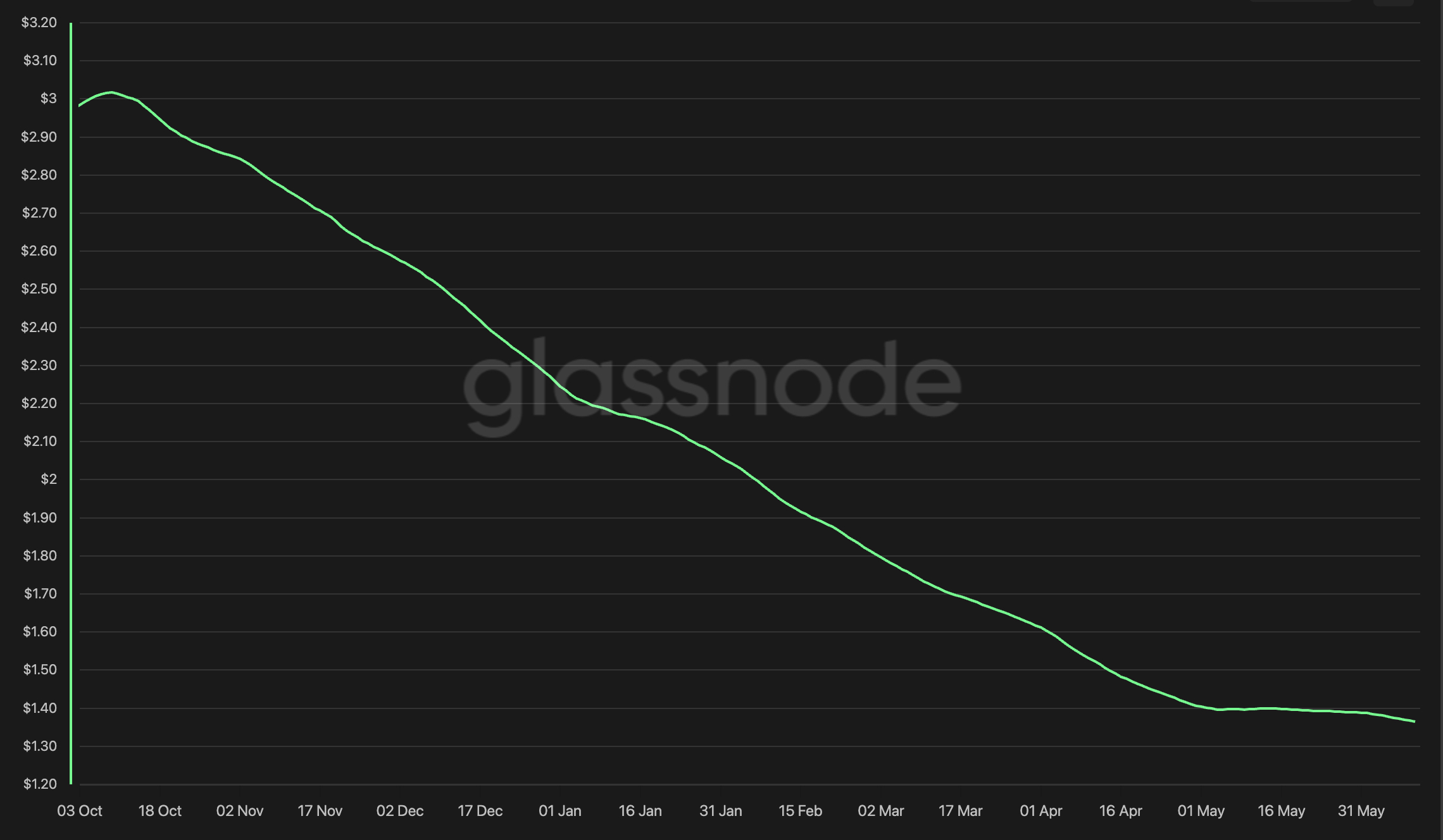
That ratio means participants are now realizing $1 in losses for every $0.38 in profits, a signature of capitulation selling. Data also shows that large-wallet transfers of 1 million XRP or more to Binance have declined since the 2025 peak, a display that major holders are not yet aggressively distributing.
Price action is compressing into a narrow decision zone, and the technical structure reflects the same tension between exhausted sellers and hesitant buyers.
Discover: The Best Crypto to Diversify Your Portfolio
Can XRP Price Reclaim $1.50 or Is a Drop to $1.09 Next?
XRP is currently consolidating below the 100-hour simple moving average, with price action grinding between $1.10 and $1.15 after a recent failed attempt to hold above $1.30, but so has the whole crypto market.
Immediate support sits at $1.05–$1.10, with a secondary demand pocket at $1. Resistance is layered at $1.20–$1.25, then $1.30–$1.40. A clean reclaim of $1.50 would shift short-term momentum and open a path toward the mid-$1.60s. Bearish momentum is still present, but the declining exchange inflows from large holders suggest distribution pressure is easing.

If support at $1.10 holds as volume picks up, price could recover toward $1.20 in the near term, and eventually $1.30. XRP could also consolidate between $1.10 and $1.15 for the next several sessions, absorbing sell pressure before any directional break.
But, in a bad scenario, a close below $1.10 opens the $1 target, and the $1.00–$0.65 band is identified as the macro support zone if this correction extends.
The profit-to-loss ratio at 0.38 does historically precede XRP price recoveries, but timing a bottom in a 91.5% fee-contraction environment is not for the faint-hearted.
Discover: The Best Token Presales
LiquidChain Targets Early-Mover Upside as XRP Struggles To Maintain Key Levels
XRP’s compressed activity data tells a familiar mid-cycle story: the speculation phase is over, the infrastructure phase is beginning. The rotation, away from price-momentum plays toward fundamental utility, is exactly the gap that early-stage infrastructure projects are moving to fill.
LiquidChain is a Layer 3 infrastructure project positioning itself as the cross-chain liquidity layer fusing Bitcoin, Ethereum, and Solana liquidity into a single execution environment.
The secrets of The Order are within. — LiquidChain (@getliquidchain) June 11, 2026
Are you ready to find out what they are?  ⟁https://t.co/vqvBcdSQYC pic.twitter.com/cKT8nEK5R2
The core value proposition is a Unified Liquidity Layer with Single-Step Execution and Verifiable Settlement, meaning developers deploy once and access all three ecosystems without fragmented bridging or multi-step routing.
The $LIQUID token is currently priced at $0.01468, with the presale having raised $830K to date. The raise is live, but early, and the figure reflects meaningful traction without the kind of saturation that closes early-entry windows.
The post XRP Price Support in Focus: Transaction Demand Falls by 90% as Holders Eye Bottom appeared first on Cryptonews.


Ripple CEO Brad Garlinghouse has criticized JPMorgan CEO Jamie Dimon’s opposition to the Clarity Act, a bill that would establish rules for much of the U.S. crypto market.
Summary
- Garlinghouse said Dimon misrepresented the Clarity Act’s compliance impact.
- Stablecoin yield provisions remain a major dispute in the bill.
- Polymarket places the bill’s 2026 approval odds at 47%.
Garlinghouse argued that Dimon mischaracterized the legislation during recent public comments. The disagreement comes as lawmakers continue reviewing the bill before a potential Senate vote.
Garlinghouse disputes Dimon’s criticism of the bill
Speaking during an interview with Fox Business, Garlinghouse responded directly to comments Dimon made about the Clarity Act. The Ripple executive said Dimon incorrectly portrayed the legislation as reducing compliance safeguards. Garlinghouse argued that the bill would provide regulatory clarity rather than weaken oversight.
Garlinghouse said, “What Jamie Dimon did a disservice around is that he’s representing that this reduces compliance concerns.” He added that the characterization was inaccurate and could influence public perception of the legislation. According to Garlinghouse, support for the bill centers on establishing clear rules for digital asset companies.
The comments followed a public debate over provisions contained within the proposed legislation. Lawmakers continue reviewing measures that would define regulatory responsibilities across parts of the crypto industry. The bill remains one of the most closely watched digital asset proposals in Washington.
Stablecoin yield provision remains a key dispute
A major area of disagreement involves language that would allow crypto exchanges to offer stablecoin yield products. Dimon has publicly criticized that provision and questioned efforts supporting its inclusion. Coinbase CEO Brian Armstrong has argued that the measure should remain part of the legislation.
During a previous interview, Dimon said Armstrong was the primary advocate for the provision. He also claimed that Coinbase spent substantial resources supporting policy efforts in Washington. The JPMorgan chief further criticized Armstrong while discussing the stablecoin yield debate.
Garlinghouse acknowledged that Armstrong represents Coinbase rather than the entire crypto sector. However, he said many digital asset firms support legislation that provides regulatory certainty. The Ripple executive argued that industry participants continue seeking clearer operating frameworks in the United States.
Senate vote approaches as lobbying efforts continue
Garlinghouse also linked JPMorgan’s opposition to commercial interests within the banking industry. He said traditional financial institutions benefit from maintaining existing market structures. According to Garlinghouse, those interests influence resistance to parts of the legislation.
The Clarity Act advanced through a Senate committee vote last month. Lawmakers are expected to consider the proposal on the Senate floor before any final action. The measure would establish rules governing large sections of the U.S. digital asset market.
Meanwhile, debate continues among banks, crypto companies, and industry groups over the bill’s final structure. Stablecoin yield provisions remain one of the most contested sections under discussion. Prediction market data from Polymarket currently places the odds of the bill becoming law this year at 47%.
The structure is based on depositary receipts, a longstanding financial product that allows investors to gain exposure to shares through a bank-issued security. Citi has adapted that model for private companies and recorded the securities on blockchain infrastructure operated by Swiss market operator SIX.
The result is a digital version of a traditional financial instrument. Investors own the depositary receipt rather than the underlying shares directly, while Citi acts as both issuer and custodian.
The bank argued the approach could make private-market investing simpler and more transparent than some existing structures, which often rely on special-purpose vehicles and multiple intermediaries.
The launch is part of a larger effort by major financial institutions to tokenize traditional assets.
Tokenization refers to representing real-world assets such as stocks, bonds or bank deposits as digital tokens that can move across blockchain networks.
Supporters say tokenized assets could eventually reduce settlement times, lower costs and allow markets to operate around the clock.
Citi has been among the banks pushing that transition. Earlier this month, Citi joined several of the largest U.S. banks in announcing plans to develop a shared tokenized deposit network through The Clearing House by mid-2027. The system would convert traditional bank deposits into blockchain-based tokens while keeping funds inside the regulated banking system.
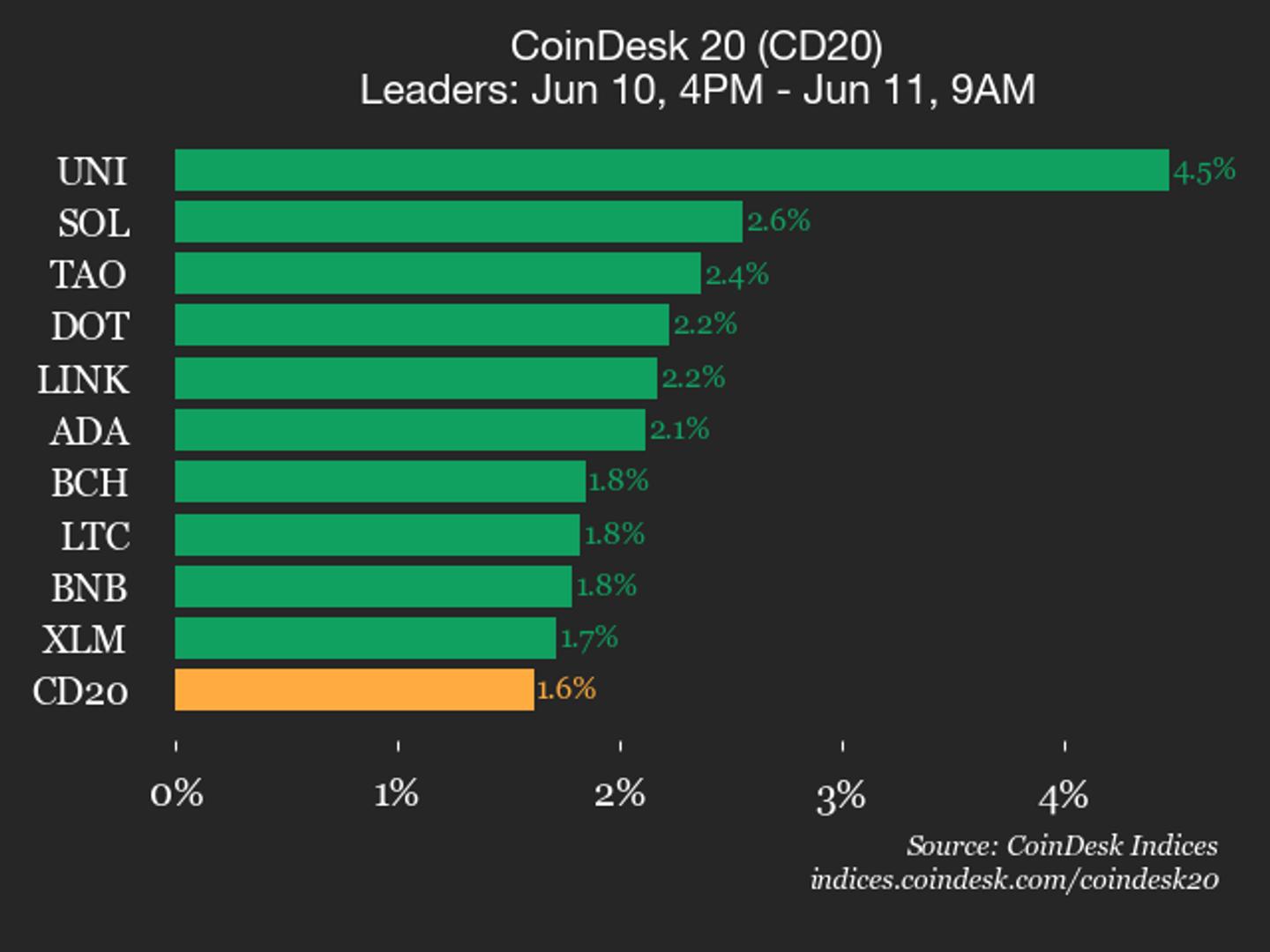
Solana (SOL), up 2.6% from Wednesday, was also a top performer.

BTC USD is bleeding from two wounds. Bitcoin price is trading below 50% of its all-time high, as the usual institutional backstops are stepping away, tipping the prediction scale bearish. Alarming?
Analysts at Glassnode flagged the collapse in a recent market update: “As BTC broke down from the mid-$70Ks toward $60K, net inflows from corporate treasury firms fell sharply, with daily purchases slowing to a fraction of their recent pace.”
Digital asset treasury (DAT) demand from firms like Strategy that accumulate BTC as a core business has practically evaporated in June. The buying spree is down from multiple instances of $500 million+ in daily accumulation through April and May.
I was never a huge fan of DATs, but I supported the idea. These entities were pure holders, much more stable than people buying and selling ETFs or speculating on exchanges… even closer to the original hodlers, the OGs. — Rezo
The whole model was buy and hold, raise capital, buy… pic.twitter.com/PGI9O7BINU
 ₿RRR (@rezosh) June 9, 2026
Strategy itself disclosed it sold 32 BTC in the final week of May, then re-entered during the dip with a $100 million purchase, yet it failed to arrest the slide below $60,000. Two demand pillars, one crack.
Discover: The Best Crypto to Diversify Your Portfolio
Bitcoin Price Prediction: Recover to $100,000 Or $75,000 Retest Next?
Bitcoin is navigating its most technically fragile zone since the cycle’s early days. Price is hovering near $62,000, well below the psychologically critical $70,000, and a deeper correction under $75,000 breached.
Bernstein maintains a constructive long-term view, calling the current cycle “elongated” and pointing to “more sticky institutional buying” as an offset to retail outflows, with a 2026 target of $150,000 and a cycle extension scenario near $200,000 by 2027. Standard Chartered echoes that range. Published 2026 forecasts span $75,000 to $225,000, a gap wide enough to drive a truck through.

Federal Reserve rate-cut expectations are explicitly tied to Bitcoin’s Q4 upside case across multiple outlooks. Without this catalyst, the path of least resistance remains sideways to lower.
Bitcoin needs its ETF inflows to stabilize, corporate treasury buying resumes above $200M/day, and rate cuts materialize. If those happen, BTC could target above $100,000 by year-end. But it seems likely that demand will recover slowly and see BTC consolidate between $60,000–$70,000 through the summer.
Discover: The Best Token Presales
Bitcoin Hyper Targets Early-Mover Upside as Bitcoin Tests Key Levels
Spot BTC at $62,000 offers range-bound risk at a $1.3 trillion market cap. The asymmetry isn’t what it was at $16,000. That’s not a bearish call on Bitcoin, it’s simple math about where the leverage lives in this cycle.
Bitcoin Hyper ($HYPER) is positioning as infrastructure for Bitcoin’s next evolution: the first-ever Bitcoin Layer 2 with Solana Virtual Machine (SVM) integration, promising sub-second finality and low-cost smart contract execution while preserving Bitcoin’s underlying security.
The project has raised closer to $33 million at a current presale price of $0.0136, with 36% APY staking rewards available during the raise. Key features include a Decentralized Canonical Bridge for trustless BTC transfers and high-speed transaction execution that outperforms Solana on latency.
Research Bitcoin Hyper before the presales end.
The post Bitcoin Price Prediction: Not Just ETFs, Corporate BTC Buying Spree Has Collapsed appeared first on Cryptonews.


BitGo has introduced Lightning Earn, a product that lets institutional clients allocate Bitcoin to Lightning Network routing channels.
Summary
- BitGo introduced Lightning Earn for institutional Bitcoin routing fees.
- Amboss Rails manages liquidity across Lightning Network payment channels.
- Fees come from routed Bitcoin payments, not token rewards.
The product uses Amboss Technologies’ Rails platform to manage liquidity routing across Lightning payment paths. Participants earn fees in Bitcoin from routed payments while using BitGo custody accounts.
BitGo links custody accounts to Lightning routing
BitGo designed Lightning Earn for corporate treasuries and institutional allocators that already hold Bitcoin through its custody platform. Clients can place Bitcoin into Lightning Network channels used to route payments between connected nodes. The routing activity generates fees paid in native Bitcoin, rather than tokens or synthetic rewards.
The company said clients access the product through existing BitGo custody accounts. BitGo also said custody controls, governance steps, and compliance workflows remain in place during deployment. The structure allows institutions to use Bitcoin for routing liquidity without moving assets into external retail wallets.
BitGo CEO Mike Belshe said Rails gives clients a way to deploy Bitcoin “without compromising custody or governance.” The company also placed part of its own treasury into Rails. BitGo said the allocation helped test the process before wider institutional use.
Amboss Rails manages liquidity across payment channels
Amboss Technologies provides the Rails platform behind the routing function. Rails helps allocate Bitcoin liquidity across Lightning channels where payment flow requires capacity. The system connects institutions with routing paths that need capital to process Bitcoin payments.
Amboss CEO Jesse Shrader said BitGo’s integration of Rails shows that “Lightning is fit for institutions.” He also said institutional capital can support enterprise-scale Bitcoin payments. The statement relates to liquidity deployment, not guaranteed returns.
Lightning Network routing fees depend on payment activity across connected channels. Participants receive fees when their liquidity helps move payments between nodes. BitGo said the product does not use synthetic assets, token incentives, or derivative yield products.
Lightning Earn uses Bitcoin fees instead of token rewards
The product differs from yield products that depend on lending, staking, or third-party token rewards. Lightning Earn relies on routing fees from payment traffic across Lightning channels. All earnings remain denominated in Bitcoin.
BitGo said its regulated trust bank controls continue to govern the deployed assets. The firm also said clients retain ownership of Bitcoin used in routing channels. Governance rules apply across all allocations made through the product.
Amboss said Rails supports liquidity allocation across Lightning Network endpoints. The company also said the platform helps payment channels access routing capacity. BitGo’s Lightning Earn product is now available to institutional clients through existing custody accounts.

Two men charged with supplying heroin, ketamine and cocaine
Form 4 Union Pacific Corporation For: 11 June
Raydium Hit With $1.34M Exploit via Fake LP Tokens on Deprecated Solana Pools



-

 Fashion6 days ago
Weekend Open Thread: Evereve – Corporette.com
-
 Crypto World6 days ago
Jensen Huang Approves Samsung, SK Hynix, and Micron for NVIDIA (NVDA) HBM4 Memory Supply
-

 Crypto World4 days ago
Anatomy of the June crypto crash: Fed, Iran, Saylor
-
 Entertainment5 days ago
The Best Mystery Series of All Time Is Surging on Streaming 30 Years After It Ended
-

 NewsBeat4 days ago
Alexander Zverev wins the French Open to finally earn a 1st Grand Slam title
-

 Tech6 days ago
Suspicious Polyfill login prompts pop up on Toshiba, Muji websites
-
 Crypto World5 days ago
Senator Cynthia Lummis Calls CLARITY Act the Most Consequential Financial Legislation of This Generation
-

 Tech7 days ago
Microsoft launches MXC, an OS-level sandbox for AI agents, with OpenAI and Nvidia already on board
-

 Tech4 days ago
Microsoft unveils seven homegrown AI models in new bid for ‘long term self-sufficiency’
-

 Business6 days ago
(VIDEO) Justin Bieber Delivers Surprise Happy Birthday Serenade to Diners at Los Angeles Mexican Restaurant
-
 Business5 days ago
The Pain Points Taking a Fragile Tech Rally Down a Notch
-

 Business4 days ago
High Stakes for Wembanyama as New York Pushes for 3-0 Lead
-
 Crypto World3 days ago
Eli Lilly (LLY) Stock Surges 4% Following Breakthrough Sleep Apnea Trial Results
-

 Tech6 days ago
Von der Leyen’s AI envoy pick draws conflict-of-interest fire
-
 NewsBeat4 days ago
Alexander Zverev conquers demons and outlasts Flavio Cobolli to win French Open for first major title
-

 Tech6 days ago
Meta steals a tactic from Tesla and builds data centers in tents
-
Crypto World7 days ago
LBank Surpasses 25 Million Users Worldwide as AFA Partnership Continues to Drive Global Growth
-

 Tech6 days ago
Hackers now exploit SolarWinds Serv-U flaw to crash servers
-

 Crypto World4 days ago
Trump’s AI Ownership Plan Could Benefit Anthropic at OpenAI’s Expense
-
 Sports2 days ago
Bangladesh beat Australia after 20 years in ODIs, register only their second win over six-time world champions | Cricket News
You must be logged in to post a comment Login