Warner Music Group Corp. (WMG) Q2 2026 Earnings Call May 7, 2026 4:30 PM EDT
Company Participants
Kareem Chin – Senior VP & Head of Investor Relations Robert Kyncl – President, CEO & Director Armin Zerza – Executive VP & CFO
Advertisement
Conference Call Participants
Peter Supino – Wolfe Research, LLC Benjamin Black – Deutsche Bank AG, Research Division Jason Bazinet – Citigroup Inc., Research Division Kannan Venkateshwar – Barclays Bank PLC, Research Division Kutgun Maral – Evercore ISI Institutional Equities, Research Division Ian Moore – Bernstein Institutional Services LLC, Research Division Douglas Creutz – TD Cowen, Research Division Michael Morris – Guggenheim Securities, LLC, Research Division
Presentation
Advertisement
Operator
Welcome to Warner Music Group’s Second Quarter Earnings Call for the period ended March 31, 2026. At the request of Warner Music Group, today’s call is being recorded for replay purposes. And if you object, you may disconnect at any time. Now I would like to turn today’s call over to your host, Mr. Kareem Chin, Head of Investor Relations. You may begin.
Kareem Chin Senior VP & Head of Investor Relations
Advertisement
Good afternoon, and welcome to Warner Music Group’s Fiscal Second Quarter Earnings Call. Please note that our earnings press release, earnings snapshot and Form 10-Q are available on our website. On today’s call, we have our CEO, Robert Kyncl; and our CFO, Armin Zerza, who will take you through our results and then answer your questions.
Before our prepared remarks, I’d like to remind you that this communication involves forward-looking statements that reflect the current views of Warner Music Group about future events and financial performance. We plan to present certain non-GAAP results, including metrics that are adjusted for notable items during this conference call and in our earnings materials and have provided schedules reconciling these results to our GAAP results in our earnings press release. All of these materials are
Seeking Alpha’s transcripts team is responsible for the development of all of our transcript-related projects. We currently publish thousands of quarterly earnings calls per quarter on our site and are continuing to grow and expand our coverage. The purpose of this profile is to allow us to share with our readers new transcript-related developments. Thanks, SA Transcripts Team
ET Intelligence Group: Retail investors reduced equity stakes in nearly two out of every three companies in a sample of BSE500 index components in the March quarter on a sequential basis.
At 284 companies, it was the highest reading in at least 12 quarters, according to an analysis by ETIG. They had pared holdings in 271 and 259 companies, respectively, in the December quarter of FY26 and in the year-ago quarter. The sample consists of 453 companies from the BSE500 index, which have declared shareholding information in each of the past 13 quarters.
Agencies
Number of cos with reduction at a 12-quarter high as investors turn cautious amid geopolitical uncertainties
Retail investors, included under the ‘public and others’ category, observed caution amid rising geopolitical uncertainties that caused the benchmark indices to tumble nearly 16% in the first three months of 2026. Based on a market cap basis, they reduced holdings in 65% of the companies having ₹25,000 crore or more in market cap and in 60% of the companies below this threshold. They reduced stakes in majority of the companies from sectors. including auto and ancillaries, banking, finance and insurance (BFSI), capital goods, and pharmaceuticals.
Foreign portfolio investors (FPI), notwithstanding their heavy selling in Indian equities during the period, increased stakes in 201 companies, surpassing the previous quarter’s reading of 179 companies. They increased stakes in companies from sectors, including capital goods, metals & mining and pharmaceuticals while reducing stakes in auto and ancillaries, BFSI and IT companies in the March quarter. Domestic funds, too, increased stakes in 280 companies in the March quarter compared with 261 in the prior quarter.
Advertisement
Company promoters joined institutional investors by raising their shareholding in 42 companies, highest in at least 12 quarters, in the March quarter, thereby taking advantage of lower stock valuations. They had increased holdings in 32 and 34 companies in the previous quarter and year ago, respectively.
Live Events
According to reports by broking firms on the ownership structure in the March quarter, FPI stake continued to fall in Indian companies in the March quarter. Elara Securities mentioned in a report that the stake of FPIs in the Nifty 500 companies fell to 17.6% from 18.2% a quarter ago while domestic institutions raised their holding marginally to 19.9% from 19.8% by similar comparison.
In a nearly 3,000-word letter to shareholders accompanying quarterly financial results and comments in a conference call with analysts, Josh D’Amaro emphasized his plans to make Disney+ a digital hub for all the company’s businesses and invest in new technology, particularly around videogames.
Chief Financial Officer Hugh Johnston also answered a burning question among Disney investors by saying the company doesn’t intend to sell or spin off its linear networks, including ESPN.
The shareholder letter, a new tack for Disney, provides fresh insights on how D’Amaro hopes to boost the company’s stagnant stock price. Disney faces a costly transition from linear TV to streaming; economic and political instability; and heightened competition from tech companies such as YouTube.
Advertisement
For the second fiscal quarter, ended March 28, Disney reported revenue of $25.17 billion, up 7% from a year earlier. Net income fell around 30% to $2.25 billion, largely owing to a one-time tax benefit the prior year. Earnings per share excluding certain items rose 8% to $1.57, above analysts’ expectations, thanks in large part to growing streaming margins.
Mumbai: Financials remained at the centre of foreign selling in Indian equities with investors extending withdrawals into the fourth straight fortnight in the second half of April, as the sector’s heavy weight left it exposed to their risk aversion.
The sector saw outflows worth ₹11,704 crore in the second half of the month, after selling of ₹19,152 crore in the first half of April, according to data from NSDL. The pace of selling moderated compared to March, when they divested worth over ₹60,000 crore -the highest since 2012.
“The unabated sell-off in banking stocks is due to the sector’s high weightage in benchmark Nifty and concerns of higher inflation that could increase current account deficit,” said Sonam Srivastava, f0ounder and CEO, Wright Research.
The withdrawals from financials accounted for over 41% of the overs0eas investor selling worth ₹28,301 crore across 15 sectors in the second half of April.
Advertisement
In the first part of the month, they dumped shares worth ₹49,481 crore across 19 sectors.
Live Events
Agencies
Sector sees outflows worth ₹11,704 cr in April 2nd half, a fourth straight fortnight from the beginning of March
Other than financials, oil and gas, information technology and healthcare were among the sectors that bore the brunt of foreign selling. These investors deployed funds worth ₹15,592 crore across eight sectors in the second half of April, with about 60% of the investments led by the power and capital goods sectors. Both sectors witnessed purchases worth over ₹4,500 crore each in the period.Foreign investors bought shares worth ₹601 crore in the power sector in the first half of April, and while capital goods saw selling worth ₹328 crore during this period, the sector attracted inflows worth ₹3,148 crore in March- at the peak of the sell-off this year.
“Power demand has seen a strong global upswing, driven partly by rising investments in AI, which require large-scale data centres and reliable power infrastructure,” said Saurabh Patwa, head of equities and portfolio manager at Quest Investment Managers. “Power transmission and distribution companies are witnessing record-high order inflows and have performed well on the back of this strong demand environment.”
During periods of war, inflation and heightened uncertainty, investors often gravitate towards physical assets, which makes capital goods companies relatively well placed, he said.
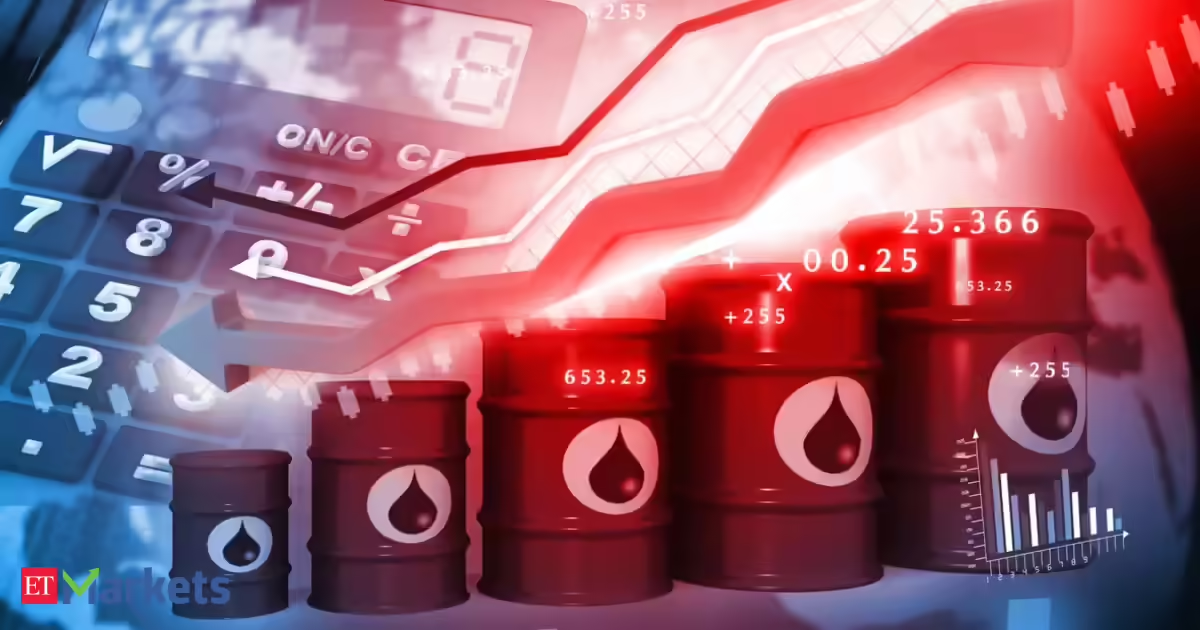
Oil prices climbed more than 1%, snapping a three-day losing streak on Friday, after fresh clashes between the U.S. and Iran raised concerns over the stability of the fragile ceasefire and weakened hopes of progress toward reopening the Strait of Hormuz, a crucial route for global oil and gas shipments.
The latest rise followed Iran’s accusation that the U.S. breached the month-long ceasefire. Washington, meanwhile, said its actions were retaliatory after Iranian forces fired on U.S. naval vessels passing through the strait on Thursday.
Oil price on May 8
Brent crude futures rose $1.41, or 1.41%, to $101.47 a barrel by 0123 GMT, while U.S. West Texas Intermediate (WTI) crude gained $1.12, or 1.18%, to $95.93 a barrel. Prices had initially surged more than 3% at the open.The rebound came after three straight sessions of losses driven by reports earlier this week that Washington and Tehran were nearing an agreement to halt hostilities and fully reopen the Strait of Hormuz. The proposed deal, however, was expected to leave broader disputes over Iran’s nuclear programme unresolved. Despite Friday’s gains, both crude benchmarks are still on track to end the week around 6% lower.
Advertisement
Live Events
Iran’s military claimed the U.S. targeted an Iranian oil tanker, another vessel, and civilian areas both in the strait and on the mainland. In a post on Truth Social, Trump said U.S. forces had destroyed the Iranian targets involved in the confrontation, including small boats and drones. He also warned Iran of further military action if it failed to reach a nuclear agreement. The exchange came as the U.S. awaited Tehran’s response to its latest peace proposal, which did not address several key sticking points, including Washington’s demand to reopen the strait. Before the conflict erupted on February 28, the Strait of Hormuz handled roughly one-fifth of the world’s oil and gas supply, but traffic has remained largely disrupted since fighting involving Iran, the U.S., and Israel intensified. Analysts said the market remains on edge. Haitong Futures noted that the ceasefire may only be temporary, adding that stalled negotiations between the U.S. and Iran could spark renewed escalation and drive oil prices even higher.
Nuvama Institutional Equities said a prolonged closure of the Strait of Hormuz could disrupt nearly 20 million barrels per day of crude flows. Under such a scenario, oil prices could potentially surge to between $110 and $150 per barrel.
(Disclaimer: Recommendations, suggestions, views and opinions given by the experts are their own. These do not represent the views of The Economic Times)
LOS ANGELES — YouTube star, wrestler and outspoken collector Logan Paul has made headlines once again after spending a record $550,000 on an ultra-rare graded copy of Dragon Ball Chapter One, along with a highly sought-after first chapter of One Piece, marking his bold entry into the premium manga collecting scene.
Paul announced the purchases on X (formerly Twitter) in late April 2026, describing the acquisitions as the start of “the Manga journey.” The headline-grabbing deal includes the highest-graded known copy of Dragon Ball‘s debut issue from Weekly Shonen Jump and a near-top copy of One Piece‘s first chapter, instantly elevating his status among serious Japanese comic collectors.
The Dragon Ball issue, graded a pristine 9.2 by industry standards and the only known example at that level (pop 1), features the first appearance of Goku and Bulma. Paul paid a reported record $550,000 for it alone. The One Piece Chapter One, graded 9.0 and one of only three known at that level (pop 3), marks the canon debut of Monkey D. Luffy and comes from the world’s best-selling manga series, with over 600 million copies sold globally.
A New Chapter in Paul’s Collecting Empire
Paul, already famous for multimillion-dollar Pokémon card purchases and other high-profile memorabilia, shared photos of the vintage Weekly Shonen Jump magazines. He purchased the pair in partnership with longtime friend and collecting mentor Jeremy Padawer. “Proud owner of the greatest Mangas in the world (imo),” he wrote, emphasizing the cultural impact of both series.
Advertisement
The move reflects growing mainstream interest in Japanese manga as valuable alternative assets. Graded first appearances of iconic titles have seen surging demand in recent years, similar to the comic book boom of the 1990s and early 2020s. Paul positioned the buys as smart long-term investments in franchises that spawned global anime empires, video games and merchandise empires.
Fan Reactions Split Between Admiration and Backlash
The announcement triggered intense online debate. Many collectors praised Paul for bringing visibility to manga as a serious collectible category and for preserving rare pieces of pop culture history. Others criticized the high-profile spending, with some anime fans accusing him of market manipulation or gatekeeping concerns. Fellow streamer IShowSpeed publicly slammed the purchase, while others questioned whether Paul truly appreciates the source material.
Paul later responded by stating that “anime fans aren’t gatekeepers,” defending his right to collect and enjoy the medium. The controversy only amplified attention, with clips of his announcement racking up millions of views across platforms.
Market Context and Rising Manga Values
Manga collecting, particularly graded Weekly Shonen Jump issues featuring debut chapters, has gained traction among Western investors. The scarcity of high-grade early issues from the 1980s and 1990s, combined with enduring global popularity of titles like Dragon Ball and One Piece, has driven prices higher. Paul’s $550,000 Dragon Ball purchase sets a new benchmark, likely influencing future auction results.
Advertisement
Experts note that condition is everything in this niche market. A 9.2 grade on a 40-year-old magazine is exceptionally rare due to paper quality, printing variations and decades of handling. Professional grading services have helped legitimize the category, much like they did for American comics.
Paul’s move comes amid broader trends in alternative investments. As traditional stocks and crypto fluctuate, high-net-worth individuals are turning to tangible assets with cultural significance. His portfolio already includes dinosaur fossils, luxury watches and blue-chip trading cards.
Paul’s Growing Influence in Pop Culture
The 30-year-old content creator has evolved from controversial YouTube prankster to a multifaceted entertainer with a WWE career, boxing bouts and business ventures. His collecting habits often make news, whether acquiring a $5 million Pokémon card or now historic manga issues. Supporters see him as a passionate enthusiast helping preserve pop culture artifacts, while detractors view the spending as tone-deaf amid economic pressures faced by average fans.
In his announcement, Paul highlighted the journey from manga pages to global phenomena, noting how Dragon Ball and One Piece inspired countless anime, films and merchandise lines. He teased further acquisitions, suggesting this is only the beginning of a deeper dive into Japanese comics.
Advertisement
What’s Next for Paul’s Manga Collection
Paul has not disclosed plans for displaying or preserving the items, though high-value collectibles like these are typically stored in climate-controlled environments or museum-grade cases. Some collectors worry about potential damage or resale speculation, but Paul has a track record of holding onto major pieces long-term.
The purchases could inspire more mainstream attention to manga collecting, potentially increasing values across the board while also drawing regulatory or community scrutiny over accessibility. For now, Paul appears focused on celebrating the win and expanding his holdings.
As one of the most visible figures in modern collecting culture, Logan Paul’s $550,000 manga splash underscores the growing financial and cultural cachet of Japanese sequential art. Whether viewed as savvy investment, passionate fandom or flashy flex, the deal has undeniably put rare manga on the radar of a whole new audience — and set a lofty new price ceiling for future landmark sales.
Mumbai: Nifty midcap indices made fresh all-time highs Thursday, putting the spotlight back on the market’s traditionally favourite high-growth segment that’s now being driven by strong earnings, consistent monthly retail commitments, and some bargain buying. Still, the pace of the current rally has prompted veteran fund managers to offer the customary cautionary advice: Odds on a breather now are rather short.
Agencies
Foreign Selling in Large-caps The Nifty Midcap 100 index ended at 62,003.15 Thursday, up 1.1%. It had made an intraday high of 62,094.40. The Nifty 50 ended flat at 24,326.65 levels.
From the announcement of the ceasefire in the US-Iran conflict a month ago, the Midcap 100 index is up 13.6%, and the Nifty Smallcap 250 has gained 16.8%, outperforming the Nifty and Sensex, which have advanced 5.2% and 4.3%, respectively.
“We have seen relatively stronger earnings from select mid and smallcap pockets, particularly in financials and consumer-driven sectors, which has supported outperformance in the segment,” said Ramesh Mantri, chief investment officer at WhiteOak Capital AMC.
Live Events
Local investors have taken to stocks beyond the frontliners. “While large-caps continue to face pressure from sustained FII selling, resilient domestic mutual fund inflows, especially into midcap, smallcap, multicap and flexicap schemes, have helped cushion the broader segment from sharper declines,” Mantri said. Foreign investors have offloaded shares worth a record ₹2.14 lakh crore in 2026. “Midcaps had turned oversold during the peak of the geopolitical conflict despite an estimated 15% earnings growth outlook for FY27, which led to renewed buying interest in the segment,” said Manish Bhandari, chief executive and portfolio manager, Vallum Capital.
He said that even in the past, periods of sharp crude price spikes or about 10-12% rupee depreciation have generally been followed by positive one-year forward returns.
Advertisement
On the technical charts, midcaps are showing strength after many months of consolidations.
Nilesh Jain, head of technical and derivatives research, Centrum Finverse said the midcap indices have delivered a multi-year breakout after nearly 18 months of consolidation following the September 2024 market peak.
“Since the start of the year, the Midcap 100 index had been testing previous highs and has now decisively moved above them,” he said. Technically, the index is trading above all key short and long term moving averages, indicating a positive trend. In the near term, the index could move towards 62,800-63,500.”
















































You must be logged in to post a comment Login