

Crypto World
Kraken to buy stablecoin payments firm Reap in $600 million deal: Bloomberg

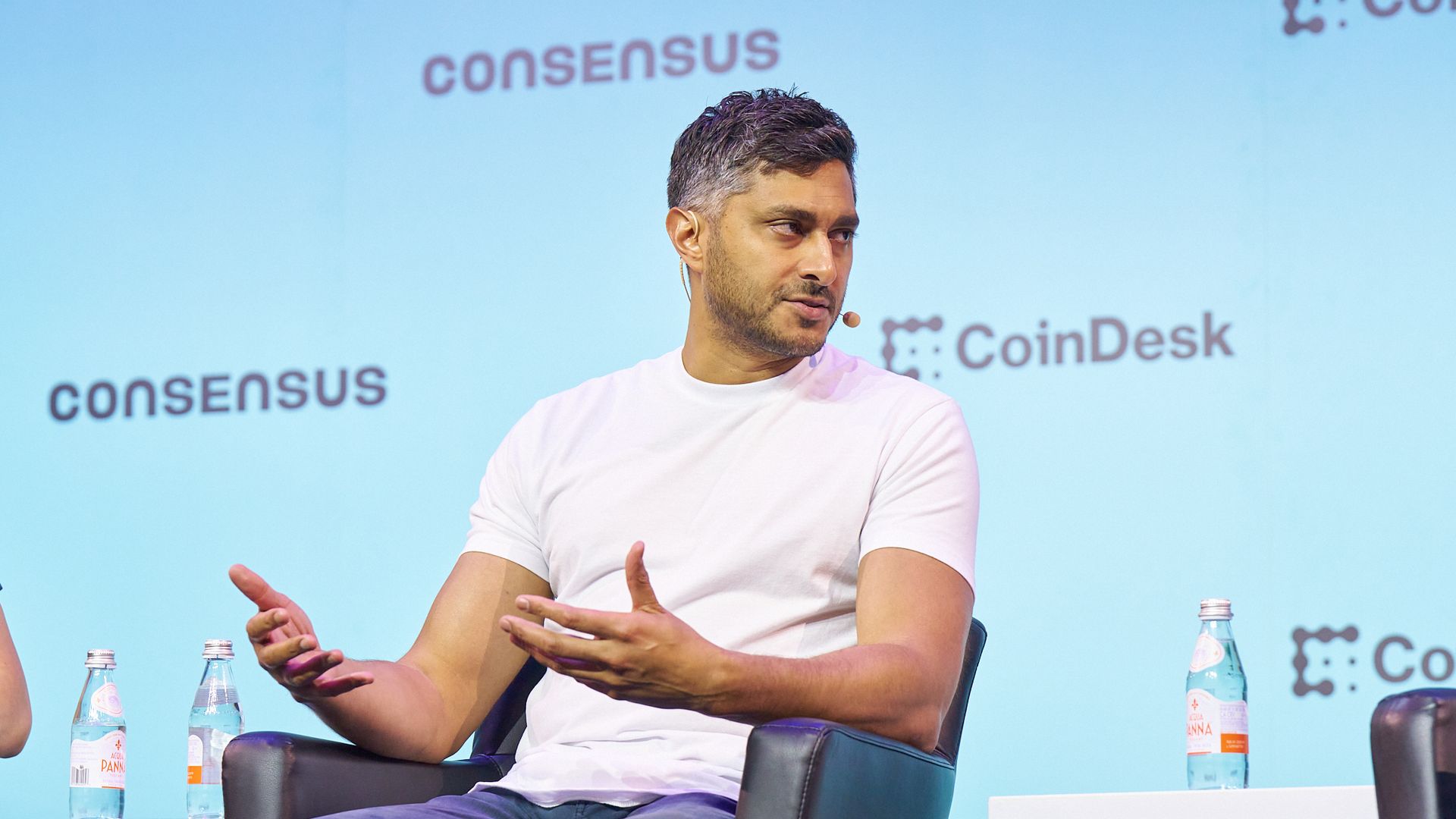
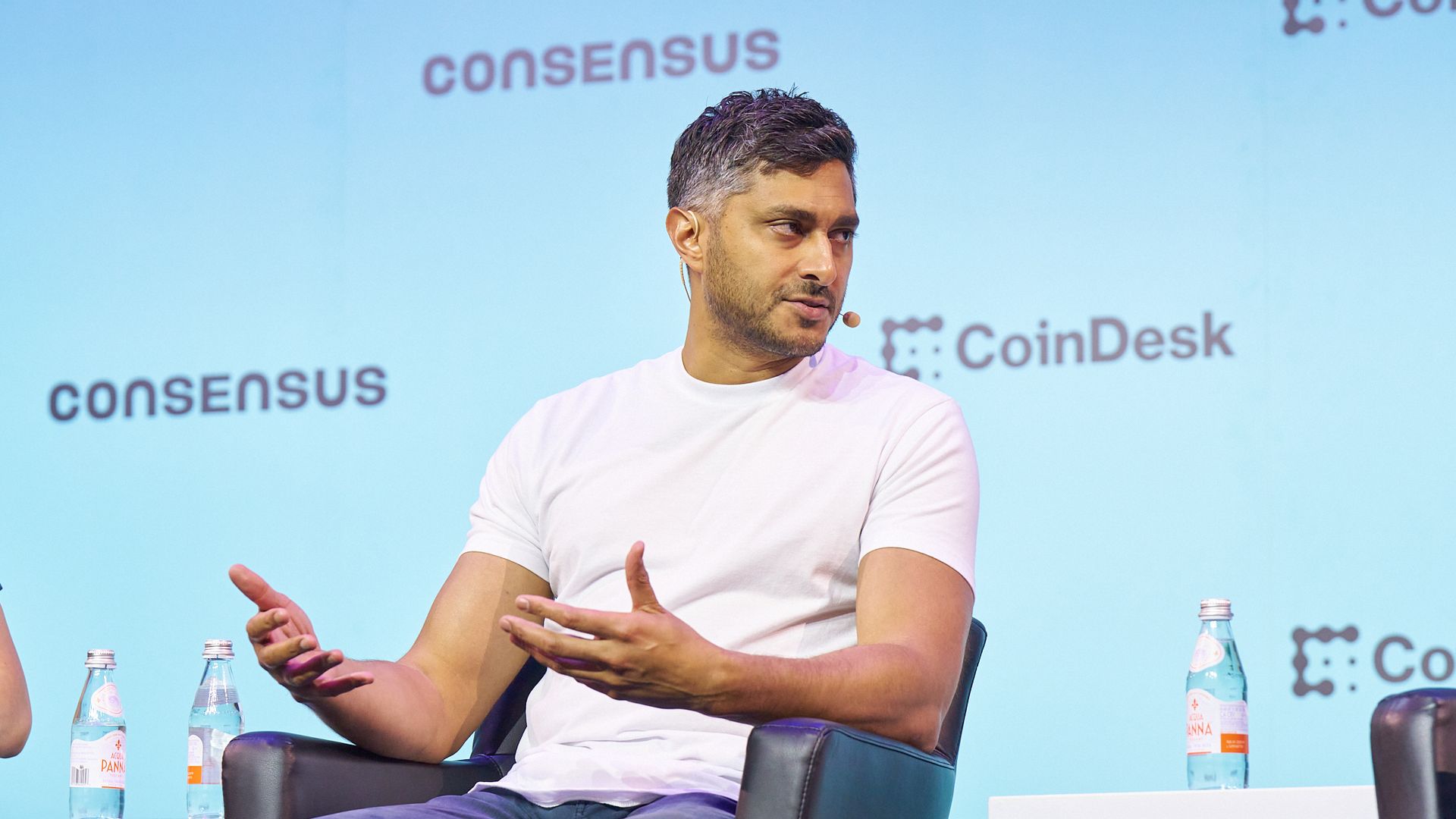
Kraken parent company Payward agreed to acquire stablecoin-focused payments firm Reap Technologies in a $600 million cash-and-stock deal, Bloomberg reported Thursday, citing Payward and Kraken co-CEO Arjunt Sethi.
The acquisition values Payward stock at $20 billion and marks Kraken’s first infrastructure acquisition in Asia, according to the report. Sethin told Bloomberg the deal is also the company’s third-largest to date.
Reap, based in Hong Kong, provides cross-border and business payments infrastructure that connects traditional financial systems with digital assets. The company focuses heavily on stablecoin-powered settlement and business-to-business payment flows.
“If you take Europe out, the fastest growing market is Asia, not just revenue but also asset-on-platform,” Sethi told Bloomberg. “They have already done it in Asia. They can expand into the US overnight with us.”
On Tuesday at Consensus Miami 2026, Sethi announced Kraken is “about 80% ready” to go public, highlighting the company’s initial public offering (IPO) plans as it rolls out a new partnership with MoneyGram aimed at solving crypto’s “last mile” problem.
The Reap deal announcement also follows Payward’s April 17 deal to acquire digital asset derivatives platform Bitnomial for up to $550 million, in a cash-and-stock transaction that values the firm at $20 billion. Bitnomial, founded over a decade ago, is the first crypto-native platform to secure all three licenses required to operate a full-stack derivatives business in the U.S. It has approvals to operate a designated contract market, a derivatives clearing organization and a futures commission merchant. The acquisition effectively shortcuts years of regulatory buildout for Payward as it expands its U.S. footprint.
The acquisition announced Thursday expands Kraken’s footprint in Asia, which has emerged as one of the fastest-growing regions for crypto adoption and stablecoin activity.
Reap was founded by Daren Guo, who previously launched Stripe’s Asia-Pacific business, and Kevin Kang, a former investment banker, according to the company’s website.


TLDR
- Coinbase reported a net loss of $394.1 million in the first quarter of 2026.
- The company recorded a $482 million loss on crypto assets held for investment.
- Total revenue fell 31% year over year to $1.41 billion.
- Transaction revenue declined 40% to $756 million during the quarter.
- Subscription and services revenue dropped 14% to $584 million.
Coinbase reported a $394.1 million net loss in the first quarter of 2026 as crypto prices fell sharply. The exchange also posted lower revenue and weaker transaction income during the period. However, Chief Executive Brian Armstrong outlined plans to reduce reliance on spot crypto trading.
Coinbase Reports Q1 Loss as Crypto Holdings Weigh on Earnings
Coinbase recorded a net loss of $394.1 million for the first quarter of 2026. The company attributed the result to falling cryptocurrency prices during the period. It also reported a $482 million loss on digital assets held for investment.
Total revenue reached $1.41 billion, which marked a 31% decline year over year. Transaction revenue dropped 40% to $756 million as trading activity slowed. Subscription and services revenue fell 14% to $584 million.
In the first quarter of 2025, Coinbase earned $66 million in net income. The latest result marked its second consecutive quarterly loss. In the previous quarter, the company posted a net loss of $667 million.
Bitcoin prices fell from above $97,000 in January to near $63,000 in early February. By the end of the quarter, Bitcoin traded below $70,000. The broader crypto market moved lower during the same period.
CEO Outlines Strategy to Expand Beyond Spot Trading
Armstrong said the company will diversify its revenue sources beyond spot crypto trading. He stated that Coinbase aims to support trading in derivatives, commodities, and futures. He also said the platform will expand into prediction market event contracts.
“Despite the crypto market being down, the fundamental growth of the onchain economy is strong,” Armstrong said in a video on X. He added that eventually “all of finance” will move onchain. He said Coinbase built its business to capture that shift.
The company reported an 8.6% share of global crypto trading during the quarter. It also posted adjusted EBITDA of $303 million, down from $930 million a year earlier. Stablecoin revenue rose 11% to $305 million.
Armstrong also highlighted efforts to support regulated stablecoins and AI-driven payment options. He said Coinbase aims to become a destination for compliant digital dollar products.



Executives at federally regulated banks told a Consensus Miami 2026 panel that crypto companies are increasingly seeking bank licenses as the industry moves toward regulated financial infrastructure.
Summary
- Panelists at the Consensus Miami 2026 Policy Summit said the push for bank licenses is accelerating among crypto firms under the current regulatory environment.
- A bank charter gives crypto companies direct access to client deposits, reduces borrowing costs, and pulls operations out of regulatory grey zones.
- The session follows a broader Trump-era deregulatory shift that has encouraged firms to pursue national and state bank charters.
Executives at federally regulated banks told the Consensus Miami 2026 Policy Summit on Thursday that the number of crypto companies seeking bank charters is rising sharply, as the industry pursues regulated status to gain credibility and reduce costs.
The session formed part of the Day 3 policy agenda, which also featured discussions on PAC spending, midterm strategy, and crypto legislation.
A bank charter gives a company direct access to customer deposits, federal oversight, and the legal authority to offer banking services.
For crypto firms, the appeal is structural: chartered status reduces borrowing costs, moves operations out of regulatory grey areas, and signals legitimacy to institutional clients who remain cautious about unregulated counterparties.
As crypto.news reported, at least half a dozen crypto industry executives confirmed in early 2025 that their firms saw an opportunity under the Trump administration to apply for banking licenses.
What is driving the charter push
The Office of the Comptroller of the Currency reversed its anti-crypto stance and permitted banks to engage in cryptocurrency-related activity including stablecoins operations and custody. Law firm Troutman Pepper Locke said it was “working on several applications now,” according to filings.
World Liberty Financial applied for a national trust bank charter through its WLTC Holdings entity in January, making it one of the most high-profile applications to date, even as Senator Elizabeth Warren called for the OCC to pause the review.
As crypto.news documented, chartered crypto firms can offer services like loans and deposits that previously required costly third-party arrangements, with SoFi’s relaunch as a nationally chartered bank offering crypto trading the most prominent recent example.
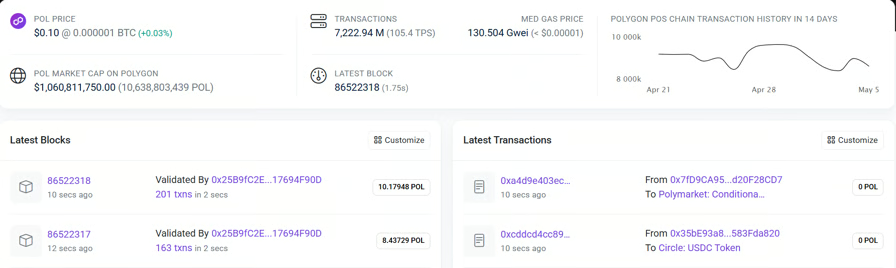
Blockchain layer-2 (L2) network Polygon reduced its average block time by 250 milliseconds to 1.75 seconds, marking its first block-time reduction since genesis as the network pushes deeper into stablecoin payments and settlement infrastructure.
Polygonscan shows that the latest blocks on the network were created in 1.75 seconds. The upgrade means that Polygon can process around 14% more payments per second, reaching a maximum theoretical throughput of about 3,260 transactions per second (TPS), according to Polygon software engineer Lucca Martins.
Shorter block times can help transaction backlogs clear faster, reducing the duration of network congestion and subsequent transaction fee spikes, which is particularly important for high-frequency use cases such as payments, stablecoins or decentralized finance (DeFi) trading.
The upgrade comes as Polygon makes efforts to position itself for use cases targeting more institutional adoption, such as private stablecoin payments. On Tuesday, Polygon introduced a new wallet feature that enables users to privately route stablecoin transactions through a shielded pool verified by zero-knowledge proofs.
The upgrade is part of the Polygon Improvement Proposal PIP-86, a two-step motion that seeks to further reduce block time to 1.5 seconds and scale down checkpoint rewards to maintain the Polygon (POL) token emissions at the target 1% after the block time reduction.
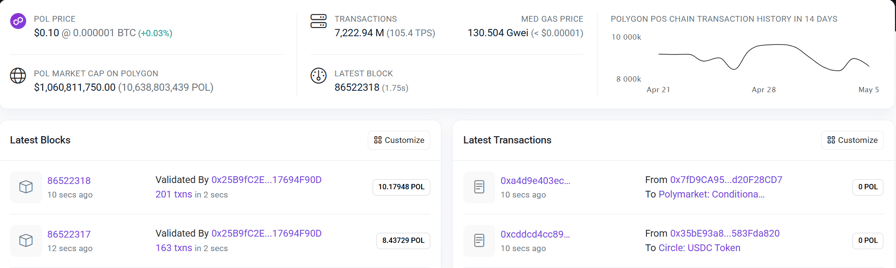
Polygon blockchain explore, latest blocks, production time. Source: Polygonscan
Cointelegraph reached out to Polygon for comment on its block time reduction plans, but had not received a response by publication.
Related: Morgan Stanley takes on crypto trading rivals with E*Trade pilot
Polygon targets private stablecoin payments to onboard institutions
Polygon’s new wallet feature is part of an aim to onboard more institutional users as it hides senders, receivers and amounts onchain while maintaining compliance through Know Your Transaction (KYT) screening and auditable files.
The feature introduces more privacy for businesses transacting with stablecoins, according to Polygon community lead Smokey.
Despite the upgrade, Polygon’s (POL) token remained stagnant over the past 24 hours and traded at $0.09 at the time of writing. The token is down 54% over the past year, CoinMarketCap data shows.
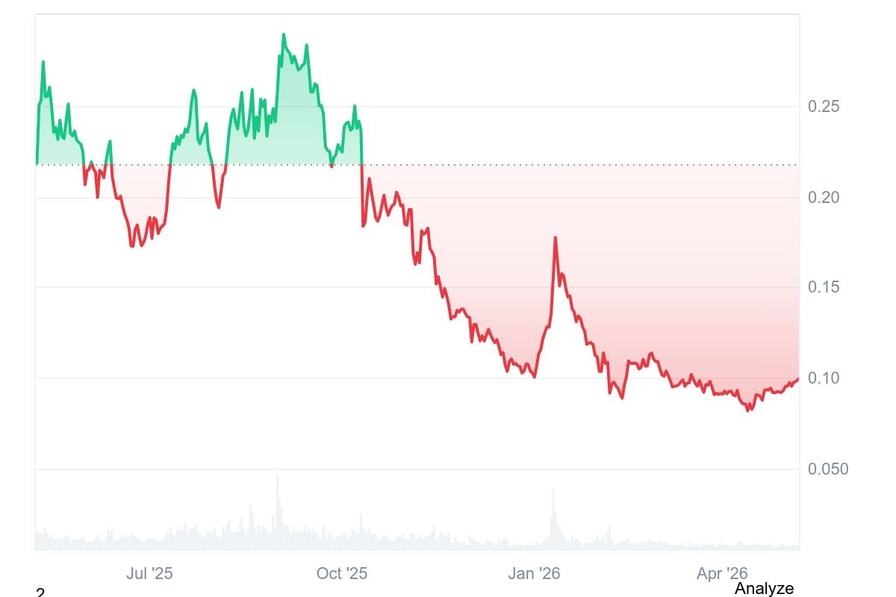
POL/USD, one-year chart. Source: CoinMarketCap
Polygon has also integrated with large credit card providers. On April 29, global payments giant Visa expanded its stablecoin pilot to include support for Polygon Base, the Canton Network, Arc and Tempo.
Launched by Visa in 2023, the pilot allows partners to settle transactions through stablecoins rather than traditional banking rails, to evaluate whether stablecoins can offer faster settlement.
TLDR
- Amazon Web Services launched Bedrock AgentCore Payments to support automated USDC transactions for AI agents.
- The company partnered with Coinbase and Stripe to provide wallet infrastructure and blockchain payment rails.
- Developers can choose between Coinbase and Stripe wallets and fund them with stablecoins or fiat.
- Coinbase enabled agentic micropayments through the open x402 protocol governed by the x402 Foundation.
- The system allows AI agents to pay for APIs, web content, and digital services in real time.
Amazon Web Services has launched a payment feature that lets AI agents transact using USDC stablecoins. The company partnered with Coinbase and Stripe to provide wallet infrastructure and blockchain payment rails. The rollout introduces Amazon Bedrock AgentCore Payments for automated micropayments across digital services.
Amazon Web Services Rolls Out AgentCore Payments with Coinbase and Stripe
Amazon Web Services introduced Amazon Bedrock AgentCore Payments to support agent-driven transactions. The company said the system allows agents to access and pay for web content and APIs. It also enables payments for MCP servers and other agents through integrated wallets.
AWS built the feature with Coinbase and Stripe, which supply wallet infrastructure and payment rails. AWS said, “We’ve built these capabilities in partnership with Coinbase and Stripe.” The company added that the tools let agents instantly access and pay for resources they use.
Developers can choose either a Coinbase wallet or a Stripe wallet within AgentCore. They can fund wallets with stablecoins such as USDC or with fiat currency. The system processes micropayments that can measure fractions of a cent.
USDC and x402 Protocol Enable Agentic Payment Infrastructure
Coinbase confirmed that developers can create agentic payment solutions using the x402 protocol. The protocol allows AI agents to send micropayments through USDC stablecoins. USDC is issued by Circle and serves as Coinbase’s preferred stablecoin.
Coinbase said, “x402 itself is an open, neutral protocol governed by the x402 Foundation.” The company stated that both AWS and Coinbase hold membership in the foundation. This governance model aims to support open standards for agent transactions.
Stripe also supports blockchain-based agent payments through Tempo’s Machine Payments Protocol. Tempo describes its system as an HTTP-native standard for machine transactions. The protocol operates in a manner similar to Coinbase’s x402 framework.
AWS said the new feature marks the first managed payment capability built for autonomous agents. The company stated that agents can use wallets to execute direct payments for services. This setup removes manual steps in digital transactions.
Developers building on Amazon Bedrock AgentCore can integrate real-time micropayments. The system lets agents pay for APIs and other digital tools automatically. Coinbase and Stripe manage wallet operations and transaction routing.
Recent projects have also given bots access to virtual Mastercard and Visa cards. These tools expand payment options for automated systems. However, AWS focused its rollout on stablecoin and wallet-based infrastructure.
The launch follows similar moves in cloud and blockchain services. The Solana Foundation recently released a solution for agent access to Google Cloud services. AWS now provides its own infrastructure through Bedrock AgentCore Payments.
AWS said the platform supports funding wallets with stablecoins or fiat. The company designed the feature to operate within its managed Bedrock environment. Coinbase reiterated its support for the x402 protocol in its Thursday statement.


Meta wiped millions of fake followers from the accounts of celebrities like Cristiano Ronaldo, BLACKPINK, and Taylor Swift this week as its AI moderation systems scaled up across Facebook and Instagram.
The cleanup is part of a wider Meta push that introduced AI tools aimed at impersonation, scam ads, and coordinated inauthentic behavior on its apps.
The Great Purge of 2026 Hits Celebrities on Instagram
Celebrities, including Kylie Jenner, Ariana Grande, Justin Bieber, Selena Gomez, Virat Kohli, and Priyanka Chopra, all saw their numbers drop, with some losing millions overnight.
The wave followed Instagram’s May 5 policy update and a new moderation system trained to spot fake engagement patterns and predict user age.
K-pop and football accounts have long been favored grounds for bot farms inflating reach for crypto promotions, fake giveaways, and sneaker scams. A sweep of this size shows how deep automated activity had spread inside the platform’s biggest profiles.
Meta’s broader cleanup removed 10.9 million accounts tied to scam centers in 2025 and 159 million scam ads, according to its update. The company says 92% of those ads were taken down before any user reported them.
Crypto Promo Bots Sit at the Center of the Meta Sweep
Crypto scam farms have been heavy users of Meta surfaces. Fake influencer profiles push token presales and airdrop hoaxes, impersonating figures like Elon Musk and Vitalik Buterin. They have saturated comments under celebrity posts for years.
The new detection model targets that pattern, scanning bios, behavior signals, and image context. It flags impersonators of brands and public figures.
The move arrives at a sensitive moment for Meta’s wider crypto plans. The company recently rolled out stablecoin payouts in USDC for creators in Colombia and the Philippines. A cleaner ad and creator surface helps Meta court-regulated payment partners as it scales its blockchain push.
The post Here’s Why Cristiano Ronaldo and Taylor Swift Lost Millions of Followers on Instagram appeared first on BeInCrypto.
21Shares debuted the first US ETF tracking the Canton Network on Thursday. The launch lands as retail interest in the institutional chain catches up to its on-chain dominance.
The 21Shares Canton Network ETF trades on Nasdaq under the ticker TCAN with a 0.50% expense ratio. The fund holds at least 80% of its assets in Canton Coin (CC), the network’s native token.
Canton Network’s Hidden Scale Outpaces Its Profile
ETF Analyst Eric Balchunas confirmed the listing soon after the open on May 7, 2026. Early trading placed TCAN near $24.76 with NAV close to $25.
The fund packages exposure to a chain that now settles more than $350 billion in daily repo volume. Broadridge’s distributed ledger platform alone runs more than $6 trillion in monthly repo flow on Canton. Backers and active institutions include DTCC, Goldman Sachs, JPMorgan, Microsoft, Nasdaq, Visa, and Broadridge.
“Wall Street is already on-chain. $350B settles daily on Canton, with over $6T in tokenized real-world assets and institutions like JPMorgan and DTCC building in production,” Canton Network stated recently.
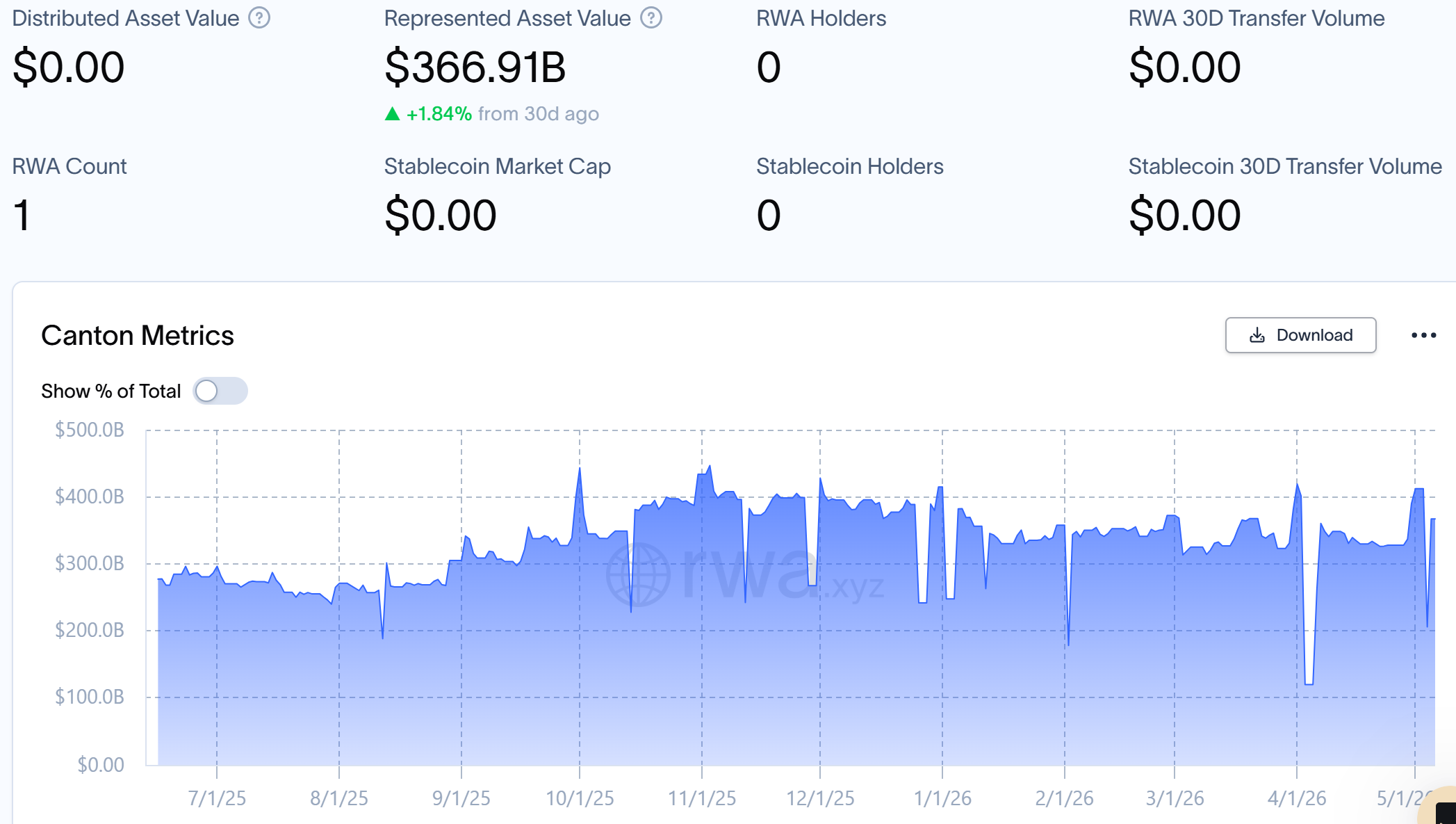
Real-world asset value on the network sits at $366.9 billion as of this writing, putting the Canton ahead of every other chain in tokenized RWA value.

Those figures sit on top of throughput most public blockchains would call inadequate. Canton processes only five to seven transactions per second in live use.
A Kaiko report called Broadridge’s repo platform on Canton the clearest case of distributed ledgers improving TradFi.
Matt Mena, a 21Shares research strategist, argued in late 2025 that Canton may rank among crypto’s most undervalued assets.
TCAN is 21Shares’ first US fund tied to a permissioned institutional chain. The firm has run a Canton Network ETP on Amsterdam under the ticker CANTN since November 2025. Earlier US altcoin filings from 21Shares include Dogecoin and HYPE.
Retail Signals Start Catching the Story
The institutional dominance has been hidden in plain sight. Investor Quinten Francois described Canton as the “silent giant” of institutional blockchain in late 2025. He framed the network as one beginning to wake up.
Several retail-side indicators have moved in the same direction since late 2025. Google trends data shows search volume for Canton has climbed steadily into 2026.
The token’s burn/mint ratio has stayed elevated, with more CC burned than minted across recent periods.

The 2026 real-world asset thesis has positioned Canton as a candidate beneficiary. Some commentary cites the absence of major exchange listings as a reason the token still has room to run.
An ETF Without a Coinbase or Binance Listing Behind It
Canton Network’s CC altcoin remains absent from Binance and Coinbase. The listing gap has constrained retail price discovery despite the network’s institutional volume.
TCAN gives US investors a regulated wrapper without requiring direct token custody, an unusual sequence in altcoin ETF history.
However, not all market participants buy the institutional billing, with some contending that Canton functions more like a directed acyclic graph than a true blockchain.
“Canton is retardio, total solutionism every step of the way, masked by specious “compliance” arguments that wither under the slightest scrutiny. It is not even a blockchain but actually a DAG,” one user stated.
The next test is whether TCAN demand converts the late-2025 rally and rising search interest into sustained inflows.
DTCC’s tokenized US Treasury go-live on Canton is targeted for Q2 2026, a near-term catalyst with deeper institutional implications.
CC is still pre-listing on the largest centralized venues. The 21Shares fund stands as the most accessible regulated path into the asset for now.
The post 21Shares Lists Canton Network ETF as Retail Signals Catch Up to Institutions appeared first on BeInCrypto.


Nationally chartered U.S. bank SoFi’s relaunched crypto business generated $121.6 million in crypto transaction revenue in the first quarter, its first granular disclosure of the unit’s economics since the bank returned to the cryptocurrency space late last year.
That revenue was almost entirely offset by $120.7 million in related transaction costs, leaving just $852,000 in net crypto transaction revenue, according to the company’s latest quarterly filing.
The company reported earnings of $0.12 per share on a GAAP basis, or about $0.13 on an adjusted basis, up from $0.06 a year earlier.
SoFi said it records crypto transactions on a gross basis because it acts as principal, buying crypto from or selling it to third-party liquidity providers before transferring it to or from customer accounts. The structure appears similar to a brokerage model, where the platform intermediates trades rather than taking directional risk.
The company reported “239,509 crypto accounts” as of March 31, a metric that captures the total number of accounts opened through its platform, rather than active traders.
The figures give the first public read on SoFi’s crypto business since its in-app trading launch in November.
SoFi had outlined its return to crypto in June, with plans for crypto investing and blockchain-based remittances..
SoFi said that the GENIUS Act would require it to migrate SoFiUSD to a “separately licensed or regulated entity.” SoFi launched SoFiUSD in December as a stablecoin for enterprise payments.
The company said in the filing that it began minting SoFiUSD in the first quarter and entered a partnership with Mastercard to support future settlement capabilities across the card network.
SoFi said its own crypto holdings remain immaterial and are held as incidental inventory for operations, not as long-term investments.

The U.S. Treasury reportedly pressed Binance to align with an independent monitoring program linked to a 2023 settlement, as reports emerged that the exchange facilitated about $1 billion in transfers to Iran-linked entities. The Information reported on Thursday that the Treasury privately demanded Binance comply with the three-year oversight regime established after the settlement with U.S. authorities, a development that underscores ongoing regulatory pressure on the world’s largest crypto exchange as authorities scrutinize sanctions evasion and anti-money‑laundering controls.
The 2023 settlement between Binance, the Treasury, and the U.S. Department of Justice required the exchange to operate under a government‑supervised monitoring program for three years. The Information’s account ties the Treasury’s current push to those terms, signaling that the oversight is far from complete and that regulators remain vigilant about potential sanctions risks associated with the platform.
The reporting also cited internal disclosures that Binance had “fired individuals responsible for telling executives that $1 billion flowed through the platform to Iran‑linked entities.” The development prompted a follow‑up from a group of senators urging Treasury Secretary John Bessent to report on Binance’s compliance with the 2023 settlement, signaling that congressional scrutiny is intensifying alongside regulatory enforcement actions across the crypto sector.
“Binance is committed to cooperating with the independent monitor and our ongoing collaboration with relevant agencies,” a Binance spokesperson told Cointelegraph in response to the report. “We welcome constructive feedback from the Treasury and view this oversight as an important part of continuously strengthening our compliance and anti-money laundering controls. We are providing the monitor with full cooperation and transparency.”
The unfolding narrative sits within a broader regulatory backdrop that has seen U.S. officials increasingly tie sanctions enforcement to digital asset platforms. The Information’s reporting aligns with a pattern of heightened scrutiny that regulators have pursued since the 2023 settlement, which was accompanied by a multi‑billion‑dollar financial penalty and an obligation to implement robust AML systems and monitoring arrangements.
Zhao at Consensus: leadership plans and regulatory coming‑led scrutiny
The Information’s article coincided with Changpeng Zhao’s appearance at the Consensus conference in Miami. Zhao, the former Binance CEO who stepped down in November 2023, used the venue to frame his current stance in the wake of ongoing investigations and regulatory pressure. He signaled that he has no appetite for leading another crypto company and downplayed the prospect of returning to a top executive role, saying he is “a one‑trick pony” and that he’s done with running a startup.
Earlier in the day, Zhao touched on the possibility of reviving Binance.US to improve access to global liquidity, but he emphasized that his focus is not on reclaiming leadership at a crypto company. The remarks arrived as Binance has navigated a complex web of U.S. and international regulatory inquiries that extend beyond sanctions enforcement to questions about compliance infrastructure and governance. Zhao’s public comments come as Binance and its executives remain under intense regulatory scrutiny in multiple jurisdictions.
The thread of regulatory tension has, at times, blurred the boundary between enforcement actions and broader market implications. Zhao’s stance at Consensus underscores a sectorwide pivot from rapid growth to governance, risk controls, and transparent oversight. While the former executive has signaled detachment from future leadership duties in the industry, the regulatory spotlight on Binance and similar exchanges remains bright as policymakers pursue stricter AML standards and clearer accountability for platform operators.
Amid the coverage, a note of caution hangs over the broader market: statements about sanctions compliance, internal controls, and monitoring programs carry real consequences for users, traders, and liquidity providers who rely on timely, predictable enforcement and governance clarity. The Binance narrative reflects a broader shift in which regulators are increasingly demanding demonstrable, verifiable compliance benchmarks from large crypto players, not merely settlement settlements and generic commitments.
Additionally, the article notes a controversial thread about ties to political events and figures, including references to a UAE‑based investor and to past political actions concerning Binance leadership. While these details are part of the public discourse surrounding Binance’s regulatory journey, readers should treat such links as part of a broader storytelling arc rather than definitive conclusions about platform operations or future outcomes.
What this means for investors and users
For traders and investors, the key takeaway is that regulatory oversight is moving from broad investigations toward enforceable, codified compliance regimes embedded in settlement terms and independent monitoring. The ongoing exposure of Binance to an independent monitor—if maintained—could influence how banks, payment rails, and regional regulators interact with the exchange, potentially affecting on‑ramps, withdrawal flows, and the pace of new product launches that depend on regulatory clarity.
From a risk management perspective, the situation highlights the importance of clear AML controls, provenance tracking for flows, and transparent reporting to oversight bodies. Firms in the space are watching closely how governments interpret and enforce the combination of penalties, monitoring commitments, and ongoing cooperation obligations, given that the balance of deterrence and operational practicality shapes the broader adoption trajectory for compliant crypto services.
Looking ahead, market participants should monitor updates on the monitoring program’s status, any new findings from the independent monitor, and congressional or regulatory responses to the latest disclosures. While the Treasury’s private communications suggest continued emphasis on compliance, the exact contours of future enforcement actions, potential penalties, or remedial requirements remain uncertain, and could influence regulatory expectations for other major exchanges as well.
In the meantime, Zhao’s public remarks at Consensus reiterate a cautious posture: leadership ambitions may take a back seat to a wider industry push toward governance and compliance. For users who rely on cross‑border liquidity and access to global markets, the episode reinforces the importance of choosing platforms with transparent oversight and proven AML capabilities—criteria that could shape platform selection in the months ahead.
Readers should stay tuned for official updates from the independent monitor and from U.S. regulators, as well as any new statements from Binance regarding progress on the monitoring program and the handling of past internal reports. The regulatory narrative around Binance is continuing to evolve, with consequences that extend beyond a single settlement to the way the industry defines legitimacy and operational discipline in the digital asset era.
A joint proposal to release the roughly $71 million in Ether frozen after the Kelp DAO exploit is set to pass later on Thursday, moving a cross-protocol recovery effort closer to restoring part of rsETH’s backing.
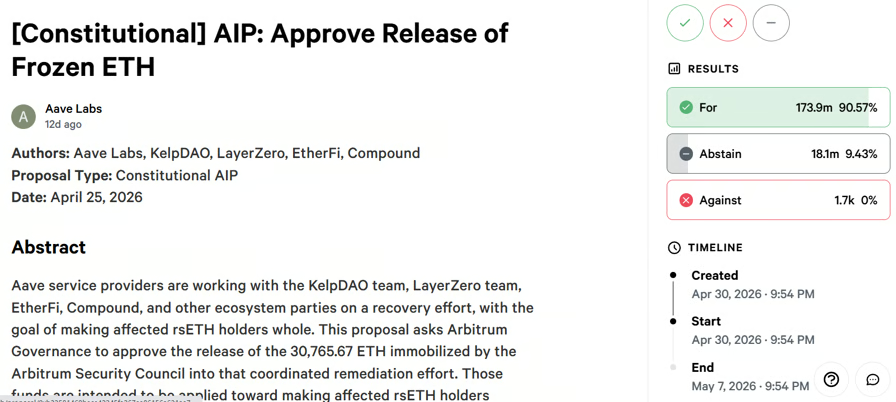
Over 90.5% of the tokens were cast in favor of the motion, representing 173.9 million Arbitrum (ARB) tokens, while 9.4%, or 18.1 million tokens, abstained. Less than 1%, or 1,700 tokens, voted against the proposal before the voting period’s scheduled end at 6:54 pm UTC, according to a Snapshot at the time of writing.
Co-authored by Aave Labs, Kelp DAO, LayerZero, EtherFi and Compound, the proposal seeks to unfreeze the 30,765 Ether (ETH) that was frozen by Arbitrum’s Security Council on April 21, days after an attacker drained about 116,500 restaked Ether (rsETH) from Kelp Dao, worth between $290 million and $293 million at the time.
The proposal marks the end of the first round of voting, bringing the “DeFi United” recovery effort closer to restoring part of rsETH’s backing and moving the motion to a definitive onchain governance proposal. It comes shortly after Aave Labs liquidated the Kelp DAO hacker’s remaining rsETH positions on Ethereum and Arbitrum, moving one step closer to resolution.
“DeFi United” is a recovery effort initiated by DeFi protocols, including Mantle, EtherFi Foundation, Golem Foundation, Lido DAO, Ethena, LayerZero, Ink Foundation and Tydro, who have pledged a cumulative 43,000 Ether (worth about $101 million) to reduce the contagion effect of the Kelp DAO exploit.
As the next step, the protocols will conduct a snapshot “temperature check” to gauge delegate sentiment before the proposal is finally submitted onchain via Tally as a Constitutional Arbitrum Improvement Proposal (AIP).
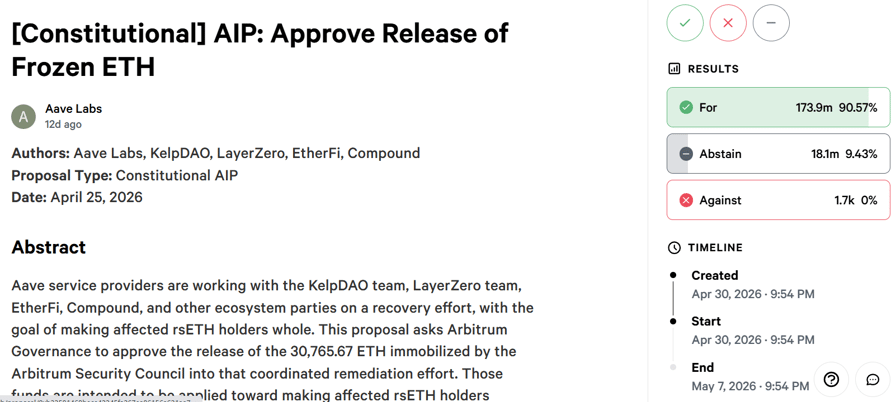
Joint proposal to release funds frozen by Arbitrum’s security council. Source: Snapshot.org
Subject to a binding onchain governance vote, the funds would be released in a designated recovery address ‘0xf22’ in a 3-of-4 Gnosis Safe (SAFE) with signers from Aave Labs, Kelp DAO, Certora and EtherFi.
However, even if the final governance proposal passes, rsETH’s backing is still facing a shortfall of about 76,127 rsETH, currently worth about $174.5 million. The proposal argued that even partially restoring rsETH’s backing will help stabilize market conditions in the broader DeFi ecosystem.
Cointelegraph reached out to Arbitrum and Aave for comment on the next steps in the governance process and the proposed timeline for restoring rsETH’s backing.
Related: Aave deposits fall by $15B as Kelp exploit sparks flight from DeFi lender
Arbitrum to pass proposal to deploy 6,000 ETH for yield
The Arbitrum DAO is also poised to approve a separate proposal to move 6,000 ETH, currently worth about $14 million, from the DAO treasury into its Treasury Management Portfolio.
The proposal increases the planned ETH allocation from 5,000 ETH to 6,000 ETH after forum feedback, according to the Arbitrum governance forum. It also seeks to transfer about $150,000 worth of idle USDC into the portfolio to generate additional yield
More than 99.9% of voting power was in favor of the proposal, representing 185.7 million ARB tokens, while 0.1%, or 266,930 ARB, abstained. The voting window is scheduled to close Friday at 2:22 pm UTC, according to Tally.
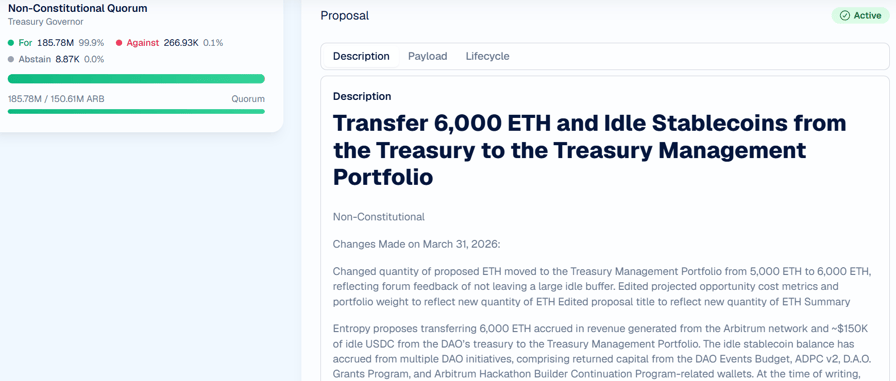
Proposal to transfer 6,000 ETH to Arbitrum DAO’s portfolio. Source: alt.gov.arbitrum.foundation.
The 6,000 ETH allocated to yield strategies is projected to generate an additional 288 ETH worth about $625,000 in the next year, assuming an ETH price of $2,200, based on the current 30-day-average annualized rate.
Magazine: 53 DeFi projects infiltrated, 50M NEO tokens could be ‘given back’: Asia Express
Circle Internet Group’s stock jumped nearly 20% on Monday after two US senators announced a bipartisan compromise on one of the most contentious issues holding up federal crypto legislation.
The deal, months in the making, drew loud opposition from the banking industry within hours of its release.
Lawmakers Push Stablecoin Compromise Despite Bank Resistance
In posts published on X on May 5, Senator Thom Tillis said he and Senator Angela Alsobrooks had reached a “consensus-based product” after working with industry stakeholders for months. According to Tillis, the agreement directly addresses one of the banking sector’s biggest concerns: deposit flight.
“Our compromise prohibits stablecoin rewards from resembling interest on bank deposits,” Tillis wrote, adding that banks had been “at the table” throughout negotiations.
At the same time, the proposal still allows crypto companies to offer alternative customer rewards, a concession that keeps parts of the existing business model intact.
The banking industry disagreed. A joint statement from the American Bankers Association, the Bank Policy Institute, the Consumer Bankers Association, the Financial Services Forum, and the Independent Community Bankers of America said the senators were “seeking to achieve the correct policy goal” but that the proposed language “falls short.”
The group cited research suggesting yield-bearing stablecoins could reduce consumer, small-business, and farm loans by one-fifth or more and pledged to send detailed suggestions to lawmakers in the coming days.
Tillis and Alsobrooks did not back down, with the pair saying the deal was locked and pointedly telling the banks that they “respectfully agree to disagree.”
Coinbase Chief Legal Officer Paul Grewal, who attended earlier White House meetings on this exact dispute back in February, was characteristically dry on X:
“I must say I feel obligated to offer my congratulations to the banking trades,” he wrote. “They’ve managed to do the impossible in our country these days: bring sensible Rs and Ds together.”
Circle Stock Rebounds
Markets responded almost immediately to the news, with Circle shares closing May 4 at around $120, up from roughly $100 the previous session. They then climbed further in after-hours trading to about $126.
That marks a sharp reversal from late March, when the stock dropped about 20% in a single day after earlier drafts of the legislation raised concerns about a blanket ban on stablecoin yield.
This time, the reaction has been different. The latest compromise still restricts interest-like payments but leaves room for other forms of rewards, which analysts have previously said match Circle’s existing model. The company already keeps the yield generated from reserves backing its USDC stablecoin rather than passing it on to users.
The post Circle Shares Jump 20% as Lawmakers Reach Stablecoin Deal appeared first on CryptoPotato.
Coinbase Reports $394M Loss as Revenue Drops 31%

Rory McIlroy makes single birdie on return to action after retaining Masters

Opinion: The AI capex conundrum

Manchester United reach agreement with Casemiro over contract clause amid transfer speculation

US brings back mandatory military draft registration

Steven Gerrard disagrees with Gary Neville over ‘shock’ Chelsea and Arsenal claim | Football


-

 NewsBeat4 days ago
Channel 5 – All Creatures Great and Small series 7 new post
-

 Crypto World19 hours ago
Upbit adds B3 Korean won pair as Base token gains Korea access
-
 Tech6 days ago
Trump’s 25% EU auto tariff breaches Turnberry Agreement that also covers semiconductors and digital trade
-
 NewsBeat20 hours ago
NCP car park operator enters administration putting 340 UK sites at risk of closure
-
 Sports6 days ago
Paul Scholes issues Marcus Rashford reality check as agreement emerges over Man United star
-

 Entertainment6 days ago
Met Gala 2026 Rumored Guest List Is Turning Heads
-

 Business7 days ago
Strait of Hormuz Blockade Persists Amid US-Iran Standoff, Sending Oil Prices Soaring
-
Entertainment6 days ago
New on Prime Video in May 2026 — Full List of Movies and Shows
-

 Entertainment6 days ago
Kylie Jenner Hit With Second Lawsuit From Ex-Housekeeper
-

 Sports6 days ago
Cavaliers vs. Raptors Game 6 live score, updates, highlights from 2026 NBA playoffs first-round series
-
 Sports6 days ago
David Benavidez responds to team Canelo saying the fight will never happen
-

 Tech7 days ago
Meta ends Sama contract after Kenyan workers report seeing intimate footage from Ray-Ban smart glasses users
-
Entertainment5 days ago
New Netflix Movies in May 2026 — My Top 3 Picks to Stream
-
 Sports6 days ago
IPL 2026: ‘Love you darling’- Hardik Pandya’s reaction to MS Dhoni steals the show |Watch | Cricket News
-

 Entertainment6 days ago
Young and the Restless Next Week: Cane Arrested & Matt’s Deadly New Scheme!
-

 Entertainment5 days ago
Melissa Joan Hart and More Stars Attend 2026 Kentucky Derby
-

 Business5 days ago
Luka Doncic Injury Update: Doncic’s Hamstring Recovery Slows Lakers’ Hopes Against Thunder: Can He Run Yet?
-
Crypto World5 days ago
Pi Network Mandates Protocol 23 Upgrade for All Mainnet Nodes Before May 15 Deadline
-

 Sports7 days ago
Bayern won’t hand bottom side Heidenheim ‘gifts’ despite PSG game
-

 Sports7 days ago
What Preity Zinta Said After Punjab Kings’ First Defeat Of IPL 2026
You must be logged in to post a comment Login